Single Dad Broke Into the CEO’s Office to Save Her—She Screamed, “Arrest Him!” (Part 3)

Single Dad Broke Into the CEO’s Office to Save Her—She Screamed, “Arrest Him!” (Part 3)
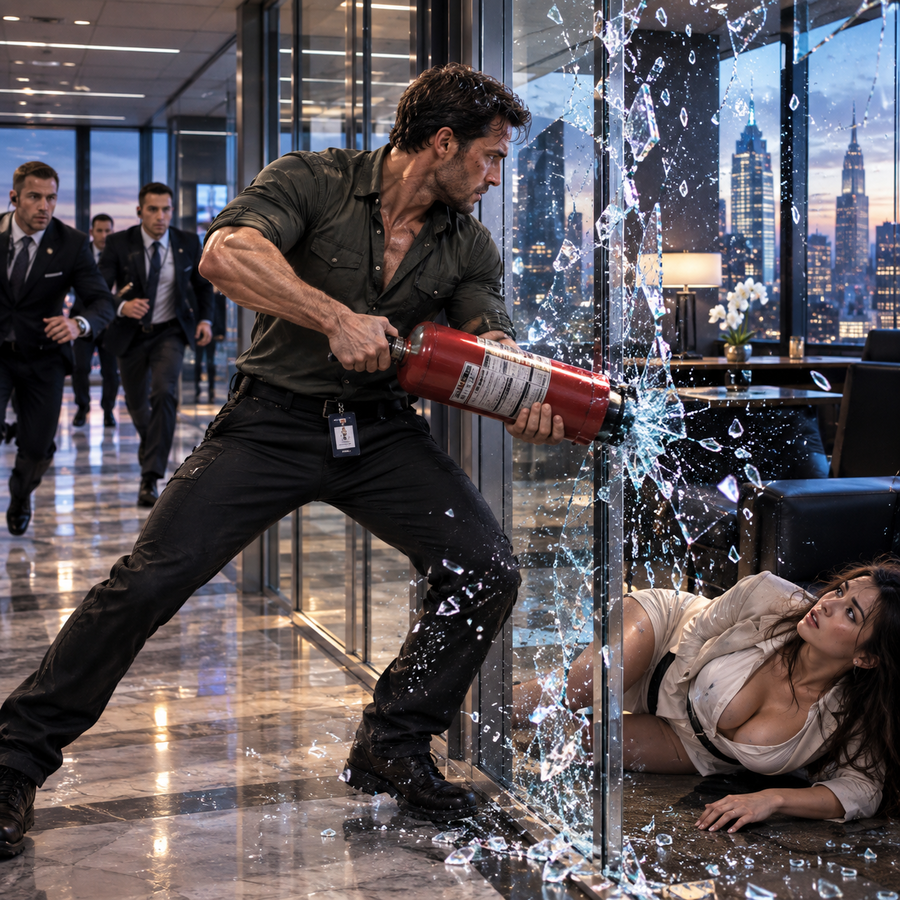
PART 3
He arrived at the Astron Tower at 1:48 p.m. He had not been inside it since the security officer walked him out just before midnight on Friday. Standing on the sidewalk outside the glass entrance, looking up at thirty-eight floors of it, he felt something that wasn’t quite intimidation and wasn’t quite anger. Something more precise than either. The feeling of a man returning to the site of something that had tried to define him in a way he refused to accept.
He went in. A visitor badge was waiting for him at the security desk, which told him the meeting was real and that Holt had arranged access. The security officer who processed it—not Marsh, someone older—did it without making it awkward, which Nathan appreciated.
He rode the elevator to the nineteenth floor, which housed the compliance and HR departments, and sat in a conference room for six minutes before Patricia Holt came in carrying a leather portfolio and a cup of coffee. She sat on the other side of the table without offering him one.
Then she looked at him and said, without any preliminary softening, “Your suspension has been lifted as of this morning. You’re reinstated with full pay for the period of suspension. Your badge access is being restored today.” She paused. “The company is also prepared to offer a formal written apology for the manner in which you were detained on Friday night.”
Nathan looked at her. “That’s the employment part. What’s the rest?” Holt smiled. Just at the edges. “Miss Whitmore would like to speak with you this afternoon, if you’re available.”
“Where?” “She came back to the building this morning.” Holt’s voice carried something careful in it. “Against medical advice. Apparently, she said she had work to finish.”
Nathan thought about Audrey Whitmore sitting in her hospital chair in her own clothes. Recovered enough to be impatient. Too disciplined to let a near-death experience slow her schedule by more than seventy-two hours. He thought, “She’s exactly what I thought she was.” Which was both her strength and the thing that had almost gotten her killed.
“I’m available,” he said.
Holt walked him to the thirty-eighth floor herself. The executive level was quieter than it had been on Friday. Several offices were dark. Rebecca’s office, he noticed—door closed, no light under it.
The acquisition documents that had been scattered across Audrey’s floor had been collected and presumably secured. The broken glass beside her door had been temporarily boarded with a sheet of plywood while the replacement panel was on order. Nathan stood in front of that plywood for exactly one second before Holt opened the office door and stepped aside.
Audrey Whitmore was at her desk. She looked better than she had at the hospital. More centered. More herself. Though still carrying the visible residue of what her body had been through. She was reading something when Nathan came in, and she finished the sentence before she looked up, which told him she was back to operating on her own terms and not anyone else’s.
“Close the door,” she said. He did. She gestured to the chair across from her desk. He sat.
For a moment, neither of them spoke. Then Audrey said, “The board has been fully briefed. The acquisition has been suspended pending a forensic review of the agreement amendments.” Rebecca’s access to all company systems was terminated at 11:30 last night. She paused. “The state securities division opened a formal inquiry this morning. I was informed an hour ago.”
“I know,” Nathan said. “My attorney told me.” “Of course he did.” She looked at him steadily. “The internal investigation has been formally redirected. The preliminary finding—the one pointing at you—has been retracted from the official record and replaced with a corrected account based on the door controller log, your photographs, and your statement to Foresight.”
She paused. “There will be no record in your file of the suspension or the preliminary finding.” “I appreciate that.” “That’s not a favor,” she said. “That’s a correction. There’s a difference.”
He almost smiled. “I know.” Audrey looked at the plywood where her window panel used to be. Then she looked back at him. “I’ve been thinking about what I’d say to you since yesterday morning. I’ve been trying to figure out whether an apology is adequate.”
“It’s a reasonable starting point,” Nathan said. She looked at him sharply. Then something in her expression shifted. Not humor, exactly. But the recognition of someone who had just confirmed something they suspected. “You’re not going to make this easier for me.”
“No,” he said. “I’m not.” She was quiet for a moment.
“I heard you through the intercom on Friday afternoon. In the hallway. When you stopped me after the investor meeting. I heard what you said afterward, when you thought I’d walked away.” She paused. “You said she almost listened.”
Nathan went still. The building’s intercom system. He’d forgotten. Executive corridors ran on a live audio feed to the security desk and the executive PA station. Anything said within range was captured.
“I didn’t know that was recorded,” he said. “It wasn’t recorded. My assistant heard it through her station and mentioned it to me Saturday.” Audrey kept her eyes on him. “She almost listened. That’s what you said.”
“Yes.” “That’s what I’ve been sitting with.” Audrey said. “Almost.” She let the words sit between them for a moment. “I want you to know that I understand the full meaning of that word in this context. Almost means you spent an hour after that trying to reach me through every other channel available to you. Almost means you called security and dispatch and reception and my direct line. Almost means you stood in front of a locked door watching me fall and broke through it with a wall-mounted key box.”
She paused. “Almost means I was wrong.” Nathan said nothing.
“I’m not going to defend it,” she said. “I told you yesterday I wasn’t. What I want to tell you today is that my being wrong wasn’t random. It wasn’t just a bad moment. It was a pattern.”
She looked at him with the particular directness of someone who has spent two days in a hospital bed arriving at conclusions they would have preferred not to reach. “I dismissed you. Wearing what you were wearing. From what floor you were on. Not because of anything you said or any evidence you presented. I made a determination about the value of your judgment based on your uniform before you opened your mouth. And then I was consistent about that determination all day long, even when the evidence was telling me to revise it.”
“Yes,” Nathan said. “That’s what happened.” “I’d like to tell you it was exceptional behavior for me. I’d like to tell you I don’t do that.” She paused. “But I think I’d be wrong about that, too.”
Nathan looked at her for a long moment. Then he said, “You didn’t need to know I used to be an engineer. You didn’t need my résumé. You only needed to believe that the person responsible for your building safety might know something you didn’t.”
Audrey absorbed that. “What did you used to be?” she asked. “Before this?” “Industrial automation engineer. Control systems design. Mainly manufacturing and pharmaceutical facilities.” “Why did you leave?”
“My wife died,” Nathan said. Simply. Directly. Without the softening people usually expected around that sentence. “My daughter was thirteen. She needed a father who came home at the same time every night more than I needed to keep climbing.”
Audrey held his gaze. “You walked away from a career at that level voluntarily.” “I walked toward my daughter,” Nathan said. “That’s a different framing.”
She was quiet. “The people who maintain your building,” Nathan said. “Your electrical systems, your fire suppression, your ventilation—they’re not interchangeable. That’s not unskilled. Some of them have more technical knowledge than the executives three floors above them. When your organization treats the floor someone works on as a measure of how seriously to take their words, you create exactly the condition that almost killed you on Friday. Someone who knows something critical can’t get anyone to listen because the people who need to listen have already decided the speaker isn’t important enough.”
Audrey was very still. “That’s not an accusation,” Nathan said. “That’s the lesson. And it cost both of us.”
A long silence held the room. Then Audrey said, “I want to offer you a position.” Nathan had expected this. He waited.
“Director of Building Safety and Technical Operations,” she said. “All Astron facilities nationwide. Comprehensive authority over life safety systems, inspection protocols, and emergency procedures.” She named a salary. It was close to four times what he made. “The role reports directly to me.”
Nathan looked at her for a moment. Then he said, “I have a condition.” She didn’t flinch. “Tell me.”
“Every qualified technician in every Astron facility,” Nathan said, “receives written authority to initiate an emergency shutdown, evacuation, or inspection when documented life safety thresholds are exceeded. No executive overrides that action based on meeting schedules, investor visits, or financial deadlines. The authority is in writing, in the technician’s employment agreement, with specific reference to immunity from retaliation for good-faith safety actions.”
Audrey was quiet. “You told me Friday afternoon that you hired me to maintain the building, not manage your schedule,” Nathan said. “I’m asking you to make that true for every technician in every building this company operates. Because what happened to me on Friday happens every day in organizations that don’t have the documentation to prove it. Someone knows something. Someone important dismisses them. And sometimes the outcome isn’t a near miss. Sometimes it’s a catastrophe. If every technician has that authority—”
“Audrey said carefully, ‘We’ll have false alarms. Disrupted meetings. Financial exposure from unnecessary shutdowns.'” Nathan held her gaze. “So can ignoring the right person.”
The silence stretched. Audrey looked at the plywood over her window panel. Then she looked back at Nathan. “Draft the policy language,” she said. “Bring it to me by end of week. I’ll review it with legal, and we’ll implement it companywide within sixty days.”
Nathan nodded. “And Mr. Cole—” Her voice stopped him as he started to rise. “The condition you set? That was the right condition.” She paused. “I just want you to know I recognize that.”
He stood up. He looked at her across the desk. “Thank you,” he said, “for looking at the evidence.” “Thank you,” she said, “for getting me to the hallway.”
He walked out. In the elevator on the way down, he called Marcus. “She offered the position,” he said. “I took it.” “The condition?” “She agreed. Full written authority for technicians. Companywide. Sixty days.”
Marcus was quiet for a moment. Then, “Nathan, that’s—that’s not a small thing.” “I know.” “That policy is going to cover what? Hundreds of technicians?” “Closer to four hundred across all facilities.”
“Four hundred people who will now have documented authority to do exactly what you did on Friday without losing their jobs for it.” “Yes,” Nathan said.
Marcus exhaled slowly. “How do you feel?” Nathan thought about it. He thought about the handcuffs on the thirty-eighth floor. He thought about sitting in the security office watching camera feeds and thinking about Lily. He thought about four hours of sleep and cold coffee and a kitchen table covered in printed documents and the particular loneliness of knowing something true that nobody in authority was willing to hear.
“Tired,” he said. Honestly. “Just tired.” “Go home,” Marcus said. “Take the rest of the day.”
He did. He picked Lily up from school at 3:30 because he could. Because his badge was being restored and his truck was in the parking garage and he was reinstated and he had nothing on his schedule until end of week except drafting a policy that would change the working conditions of four hundred people. And picking up his daughter from school on a Wednesday afternoon was the kind of thing he had built his entire adult life to be able to do.
She came out through the school’s main entrance and saw his truck and stopped on the sidewalk for one second with an expression she controlled quickly. But not quite quickly enough. Relief. Pure and unguarded. The look of someone who had spent three days pretending not to be afraid and had just been given permission to stop.
She got in the truck. “Hey,” he said. “Hey,” she said. He pulled out of the school parking lot.
“Did it work out?” she asked. “Yes,” he said. She nodded. Looked out the window.
“I knew it would.” “You said that last night.” “I meant it last night, too.”
They drove in silence for a minute. The good kind. Then Lily said, “What’s the new job?”
“Director of Building Safety. All facilities nationwide.” She was quiet for a moment, processing the scale of that. “Are you going to be home every night?”
“Yes,” he said without hesitation. She nodded again. “Good,” she said.
He drove. At 6:00 that evening, his phone rang with a number he didn’t recognize. He almost let it go to voicemail. Then something made him answer.
A man’s voice. Measured and professional. “My name is Gerald Park. I’m a federal investigator with the Securities and Exchange Commission. I’ve been briefed on the Astron matter, and I’d like to speak with you at your earliest convenience.”
Nathan pulled his truck to the side of the road. “Mr. Park,” he said. “I can talk right now.” “That’s excellent. I’ll be brief for tonight. We’ll schedule a formal interview for later this week. But I need to ask you directly—the corporate structure diagram you brought to Miss Whitmore yesterday. How did you identify the family connection?”
“Public filings,” Nathan said. “Corporate registration records and registered agent documentation. It took about three hours and the assistance of my attorney, who has a financial background. All public sources. Everything I found is in a public record somewhere. I just followed the chain.”
“And you have documentation of your methodology.” “I have every search and every source,” Nathan said. “I’ll send it all to you.” “That’s very helpful.”
Park paused. “Mr. Cole, I want to ask you something off the record.” “Go ahead.” “When you first noticed the abnormal fan reading on Friday morning—when you looked at that number and understood something was wrong—how long did it take you to decide to pursue it?”
Nathan thought back to that moment in the basement mechanical room. The number on the screen. The particular quality of stillness that came before he understood what he was looking at.
“About thirty seconds,” he said. “And you knew at that point that pursuing it was going to create friction.”
“I knew it was going to create friction the moment I saw who had the authority to dismiss my concern,” Nathan said. “That didn’t change what the reading said.”
Park was quiet for a moment. “In your experience, Mr. Cole—in your professional experience—how common is it for someone to notice something like that and decide not to pursue it?”
Nathan thought about all the buildings he’d worked in. All the pressure complaints that turned out to be nothing and the ones that turned out to be something. All the technicians he’d known who’d filed concerns that disappeared into work order queues and were never reviewed. All the times he’d heard a version of the same thing. It’s probably nothing. It’s a glitch. Handle it Monday.
“Very common,” he said. “It’s much easier not to pursue it. Especially when the people who can dismiss you are several floors above you in a building where floor level correlates with authority.”
Park said, “What made you different?” Nathan thought about Karen. About Lily at the kitchen table. Amber eyes. Cereal bowl. Earbuds in. The easy silence of two people who knew each other. About the choice he’d made two months after the funeral. About all the definitions of success that had been offered to him over the years, and the one he’d finally arrived at on his own.
“I wasn’t different,” he said. “I just wasn’t willing to be wrong about this one and live with it.”
Park thanked him and ended the call. Nathan sat parked on the side of a Denver street in the early evening light and thought about Rebecca Sloan somewhere in this city with her attorney and her negotiation strategy and the precise, careful intelligence she’d spent nine years building and one morning dismantling.
He thought about how close it had come. He thought about what the outcome would have been if he’d been the kind of man who went home at his regular time and filed the work order for Monday. He thought about Audrey’s office. The frosted glass. Her hand on the desk. The way she went down.
And he thought, “No.” That was the whole thought. No. Some things you see, and you cannot look away from. Not because you’re exceptional or heroic or built differently from other people. But because you’ve decided somewhere along the line—probably in a hospital waiting room or a kitchen at four in the morning or a parking lot outside a school—that there are things worth the cost of pursuing and things that aren’t.
And once you’ve made that decision clearly enough, the friction becomes just friction. Just noise. Not a reason to stop.
He pulled back onto the road. He drove home. He made dinner. And the next morning, he sat at his kitchen table and opened his laptop and began drafting a policy that would ensure—in precise and legally binding language—that the next person who saw something real in a building full of people who weren’t listening would have the written authority to act on it without losing everything they’d worked for.
He wrote carefully. He was always careful. That was still the job. Just a different version of it now.
The policy took Nathan four days to draft. Not because he was slow, because he was thorough. And because thorough mattered here, more than it had ever mattered in any work order or equipment log he’d filed in two years of maintaining the Astron Tower.
This document was going to govern how four hundred people in thirty-one facilities across nine states understood their own authority. Every sentence had weight. Every word had a job to do.
He worked at his kitchen table in the mornings before Lily woke up, the way he’d always worked best—in the quiet before the day had opinions about itself. He ran each draft past Marcus, who reviewed the legal language with the particular attention of someone who understood that a policy say with a loophole was worse than no policy at all, because it created the illusion of protection without providing it.
On the third day, Marcus called him at 7:00 a.m. “The SEC filed formal charges this morning,” Marcus said. “Rebecca Sloan, her brother-in-law Gerald Ferris, and two associates at the Phoenix Investment Firm. Securities fraud, wire fraud, and conspiracy to commit both.”
“The criminal referral from the Colorado AG’s office on the life safety manipulation is expected by end of week.” Nathan absorbed that. “How did she respond?”
“Her attorney issued a statement saying she intends to cooperate fully and that the financial provision was a legitimate consulting arrangement.” “She’s still trying to reframe it.”
“She’ll be trying to reframe it until a jury tells her to stop,” Marcus said flatly. “But Nathan, the door controller log, your photographs, and the corporate structure documentation you put together are cited explicitly in the SEC filing. You’re referenced as the individual who identified the connection.”
Nathan was quiet for a moment. “You want to know something strange?” he said. “Tell me.” “I don’t feel anything about her right now. Not anger, not satisfaction. Just nothing. She made a choice that almost killed someone and nearly destroyed my life. And I feel about as much as I feel when I finish a repair and close out a work order.”
Marcus was quiet for a moment. “That might be the healthiest response possible.” “Or I’m just tired.” “Also possible,” Marcus said. “Finish the policy. Bring it in. Take the job. Go home every night.”
“That’s the plan,” Nathan said.
He submitted the final policy draft to Audrey’s office on Thursday morning at 8:52 a.m. He noted the time because he noted everything. And because 8:52 had a particular resonance now—that was the minute Rebecca Sloan’s credential had opened the mechanical room door on a Friday morning, nine days ago, and set everything in motion.
He thought it was appropriate to file something constructive at the same minute something destructive had begun. Audrey’s response came at 10:15 a.m. Three words in the subject line: “Reviewing with legal.” And then below: “It’s good work.” That was all she wrote. Nathan read it twice and decided it was enough.
His first day back in the building was the following Monday. He parked his truck in the same spot he’d used for two years, took the same service entrance, and rode the same elevator. His new badge—reflecting his new title and his new access level—worked on every floor.
He stood in the elevator, watching the numbers climb, and thought about the last time he’d been in this building. Driving away at midnight in a car he’d called from the sidewalk. His hands empty and his phone in an evidence bag and his daughter awake at the kitchen table with a cup of tea.
The elevator stopped at the second floor and Thomas Reed got on. Reed looked at him. Nathan looked at Reed. “Director Cole,” Reed said. “Thomas,” Nathan said.
Reed shook his hand. Firmly. The kind of handshake that contains a full sentence of acknowledgement that neither man was going to say out loud. Then the elevator door opened on nineteen and Reed got off without looking back, which was exactly right.
Nathan rode to the thirty-eighth floor. The executive level was different in the daylight of a Monday morning. Populated. Purposeful. Carrying the low-grade intensity of people who were paid to operate near the top of a large organization and had internalized that proximity as a definition of importance.
Nathan walked through it in his new badge and his same work boots and felt none of the ambient difference that typically moved through a corridor when someone with a senior title appeared. He felt something better than deference. He felt like he belonged there.
Not because the title said so. Because he’d always belonged there. He’d just had to break a door to prove it.
He spent the morning in meetings he’d never been invited to before. Facilities operations leadership. Life safety compliance. The technical directors from three regional facilities who’d dialed in remotely. He listened more than he spoke. He asked questions that were precise enough that twice the regional director from Chicago went quiet for a moment before answering. The way that people go quiet when a question has located a problem they’d been hoping nobody would locate.
Nathan noted both moments and moved on. At 11:30 a.m., he walked through the executive corridor on his way back to the elevator. He slowed when he passed the spot where the glass had been. The replacement panel was in. Clean. Clear. No trace of the breach except a slightly brighter sheen on the new frame compared to the ones beside it.
He stood in front of it for a moment. Not dramatically. Just the way you stop in front of something that means something and let it mean it for a second. Then he kept walking.
That afternoon, he got a call from a woman named Sandra Chu. She was a facilities technician at Astron’s Chicago facility—one of the voices on the morning call—and she had something specific she’d been reluctant to raise in the group.
“I don’t know if this is the right channel,” she said, with the careful hesitation of someone who had been dismissed enough times to preface every concern with an apology for having it. “But I’ve been flagging an issue with the electrical room on our fourteenth floor for six weeks, and the work order keeps getting deprioritized.”
“What kind of issue?” Nathan asked. “Thermal readings. The room runs about twelve degrees hotter than the spec baseline, and the trend is climbing. Nothing alarming yet, but—” “Six weeks,” Nathan said. “Yes. You’ve been flagging it for six weeks and it’s been deprioritized.”
“The operations director said it was within acceptable variance.” Nathan reached for a pen. “Tell me the equipment room designation and give me the last three thermal readings you logged.”
She told him. He wrote them down. He looked at the trend she was describing. Twelve degrees above baseline and climbing. Six-week duration. And felt something click into place in his mind the way a problem does when you’ve spent enough time with similar problems to recognize its shape.
“Sandra, is there any recent battery or UPS system work in that room or adjacent to it?” A silence. “There was a UPS replacement three months ago,” she said quietly.
Nathan closed his eyes for one second. “I’m going to send an inspection team to your facility this week. Physical inspection. Not system review. Local hard reading of the central BMS.”
“Okay,” she said. And then, very quietly, “I didn’t think anyone was going to actually respond.” “I know,” Nathan said. “I’m responding.”
He hung up and sat for a moment with the weight of that sentence. Six weeks. She’d been saying it for six weeks, and the work order kept getting deprioritized because the operations director had decided the variance was acceptable. Which was exactly the same species of dismissal that had let contaminated air build for hours in a CEO’s office on a Friday afternoon.
He drafted the inspection order and sent it before the end of the day. He sent it with a note to the regional facilities director that was professional and direct and made perfectly clear that any delay in scheduling the physical inspection would be escalated immediately to his office.
He did not say please. He did not need to anymore.
The policy was formally adopted three weeks into November. Signed by Audrey Whitmore and countersigned by the board’s independent directors. Diane Foresight’s signature at the top, which Nathan read as intentional. And distributed to every Astron facility in the country with a cover letter from the CEO that was two paragraphs long and said, among other things:
“Every qualified technician at Astron has the documented authority to initiate an emergency inspection, shutdown, or evacuation when life safety thresholds are exceeded. This authority supersedes scheduling considerations, financial deadlines, and executive preferences. It is not discretionary. It is not subject to override. And it cannot be the basis for any adverse employment action.”
Nathan read that cover letter four times. Not because he doubted it. Because he wanted to know it completely.
Three days after the policy distribution, Frank Dinger called him. Frank, who had told him to handle it Monday. Frank, who had eight open tickets that morning and a chiller throwing codes on twenty and not enough hours in the shift to do everything that needed doing.
“I saw the policy,” Frank said. “Good,” Nathan said. “I should have—” Frank stopped. Started again. “When you called me that morning about the fan reading. I should have—”
“Frank,” Nathan said. Not unkindly. “You were doing your job the way the organization had trained you to do it. That’s what this policy changes. You’re not the problem I was trying to solve.”
Frank was quiet. “Still,” he said. “Still,” Nathan agreed. “But we’re moving forward. Not backward.” “You okay?” “Yeah,” Frank said. “Yeah, I’m okay.”
A pause. “You’re really the director now.” “I really am.” “Huh,” Frank said. And the huh contained a universe of recalibration. “Well. You always knew more than they gave you credit for.”
“So do most of your people,” Nathan said. “Pay attention to that going forward.” “I will,” Frank said. And Nathan believed him.
The twist came in December. Six weeks after Nathan started the job. And it came from a direction he hadn’t anticipated.
Gerald Park from the SEC called him on a Tuesday afternoon with the particular quality of controlled urgency that federal investigators carry when something significant has moved.
“Mr. Cole, the forensic review of the acquisition agreement has produced a finding I need to walk you through.” “Go ahead.” “The amendment that contained the consulting provision—the one that created the financial benefit for the Sloan family—was not the version that was in Astron’s document management system before the Friday of the incident.”
Nathan went very still. “What do you mean?” “I mean that the version currently in Astron’s document management system was uploaded to replace an earlier version. The earlier version did not contain the consulting provision.”
Park paused. “The replacement occurred at 7:43 a.m. on the Friday of the incident.” Nathan did the math instantly. Two hours before she accessed the mechanical room. “Correct. She uploaded the altered agreement at 7:43. She accessed the mechanical room at 8:51. She put the sensors in bypass at 9:04.”
Park’s voice was steady. “This was not opportunistic, Mr. Cole. This was a sequenced operation that began before 7:00 a.m. on Friday morning. She came to work that day with the full plan already running.”
Nathan sat at his desk in the Astron tower and understood—for the first time—the complete shape of what Friday had actually been. Not a plan that developed over weeks, though the preparation had taken months. Not a moment of moral compromise that escalated. A morning. A sequence.
A woman who woke up on a Friday, drove to work, sat at her desk, uploaded a fraudulent document, walked to a mechanical room, bypassed three safety systems, and then went to an investor meeting and smiled at everyone in the room for six hours while the contaminated air built toward a threshold that would send the one person standing between her and tens of millions to a hospital bed.
“She timed all of it,” Nathan said. “Yes.” “She planned for the investigators to find the central system logs and nothing else. She planned for the altered logs to point in the wrong direction. She planned for exactly the confusion that happened on Friday night.”
“Yes.” “What she didn’t plan for,” Nathan said, “was a door controller with an independent log. And a technician who photographs everything.”
“That is accurate,” Park said. Nathan thought about all the moments that could have gone differently. If he hadn’t noticed the fan reading at 11:43. If he’d accepted Frank’s explanation about the automation update. If Thomas Reed hadn’t been willing to pull the local hardware log instead of just the central system. If the door controller on the thirty-eighth floor had been networked through the building management system instead of running its own enclosed log.
“Any one of those things, Mr. Park,” Nathan said. “What’s the expected outcome?” “Miss Sloan has been offered a plea arrangement by the US Attorney’s Office in exchange for full cooperation and testimony. Her attorney indicated this morning that she’s prepared to accept.”
Park paused. “The arrangement involves significant restitution, federal oversight of her financial activities for a period of years, and a sentence recommendation that will be at the court’s discretion. The criminal charges related to the life safety manipulation are not part of the plea arrangement. Those will be prosecuted separately by the Colorado AG.”
“Separately,” Nathan said. “The federal financial charges and the state safety charges are independent prosecutions,” Park confirmed. “She does not get to trade one for the other.”
Nathan said nothing for a moment. “Good,” he said finally.
After the call, he sat at his desk for a while without working. Not processing. Settling. The way a structure settles after a load has been removed. Not collapsing. Not celebrating. Just finding its new equilibrium.
He thought about Rebecca Sloan in a courtroom. He thought about the Phoenix investment office and the family name buried four layers deep. He thought about Sandra Chu in Chicago, who had been flagging a thermal reading for six weeks and didn’t think anyone was going to respond.
He thought about every version of that story playing out in every building in every city. Someone who knew something. Someone above them who didn’t want to hear it. And the particular institutional silence that covered the gap between those two people.
He picked up his phone and called Audrey. She answered on the second ring, which still surprised him slightly. He was still recalibrating to the reality of having direct access to the CEO.
“Park called me,” she said before he could speak. “The document upload timestamp. 7:43 a.m.” “She was in the building before 7:30 that morning,” Audrey said. “I verified it with the parking garage records. She badged in at 6:58.”
A pause. “She came in before 7:00 a.m. on a Friday. Nobody comes in before 7:00 a.m. on a Friday unless they have something to do that they don’t want witnessed.”
“She was careful,” Nathan said. “She was almost right,” Audrey said. And her voice on those three words carried something Nathan recognized as the particular weight of a person who has looked squarely at how close catastrophe came and refused to look away from it.
“Nathan, I need to ask you something.” “Ask.” “The morning you first noticed the fan reading. When you looked at that number on your screen at 11:43 and understood something was wrong—” She paused. “What would you have done if every attempt to escalate had failed? If Reed had refused to pull the door controller log? If the investigation had stayed pointed at you? If I hadn’t agreed to meet with you at the hospital?”
Nathan considered the question seriously. The way it deserved. “I would have gone to the board directly,” he said. “I would have walked into Foresight’s office or found her email address or stood in the lobby until someone took a message to her. And if that failed, I would have taken everything I had to a journalist.”
“That would have ended your career in this industry.” “My daughter’s alive,” Nathan said. “She’s got two more years of high school and then college. I’ve got the skills to work anywhere. My career ending wouldn’t have been the worst outcome I’ve lived through.”
Audrey was quiet. “You asked what I would have done,” Nathan said. “That’s the answer. The only leverage I ever really had wasn’t the photographs or the timeline or the door controller log. It was that I had nothing to protect that mattered more than telling the truth about what I saw.”
A long silence. Then Audrey said, “I’m going to tell you something I don’t say often enough.” Nathan waited. “I was wrong,” she said. “Not just on Friday. The organizational culture that made Friday possible—I built that. I rewarded the behavior that created conditions someone like Rebecca could operate in and someone like you could be ignored. That’s not Rebecca’s failure. That’s mine.”
The silence after that statement was different from all the previous silences. It was the silence of something being said that didn’t have a comfortable response and wasn’t asking for one.
“I know,” Nathan said. “I also know you’re fixing it.” “I’m trying to.” “That’s enough to work with,” he said. “That’s all any of this is.”
The Chicago inspection came back the following week. The lead technician Nathan had dispatched called him directly. “Director Cole, the UPS unit in that equipment room has a faulty thermal management system. The insulation around the charging assembly is showing early-stage thermal degradation.” A pause. “If this had been left for another six to eight weeks, we’d be looking at the same class of contamination event you had in Denver.”
Nathan closed his eyes for one second. “How’s Sandra?” he asked. “She’s good. She wants to know how you knew.” “I didn’t know,” Nathan said. “I listened.”
He ordered the repair, documented the find, and added a mandatory UPS inspection protocol to the new policy’s appendix. That afternoon, he sent Sandra Chu a direct email telling her she’d done the right thing by flagging it, that her instincts were correct, and that the repair was being expedited.
She wrote back in four words. “Thank you for responding.” He pinned it to the corkboard above his desk. Not for sentiment. As a reminder of the actual job.
In the months that followed, Nathan found his rhythm in the new role. The way he always found his rhythm in any room he inhabited. Methodically. Without performance. Paying attention to the things that mattered.
He hired two additional regional safety coordinators and spent the first month of their employment teaching them the same discipline he’d spent his career developing. Document everything. Trust the readings over the explanations. And never accept that the absence of an alarm means the absence of a problem.
He told them the story of the thirty-eighth floor exactly once. Not as biography. As instruction. “The system reported the fan was running correctly,” he told them. “The fan was running backward. The system was not lying. The system believed what the controller told it. What the controller told it was wrong.” He paused. “That gap—between what the system reports and what is actually happening—is where people die. Your job is to close that gap before it closes itself.”
They wrote it down. He didn’t tell them it felt good to say it. But it did.
Lily turned seventeen in February. Nathan took her to dinner at a restaurant she’d been wanting to try for months. Not expensive. Just specific. The kind of place she’d seen recommended somewhere and quietly noted with the particular patience of someone who understood that wanting things was okay and that most good things required waiting.
They sat in a corner booth and ordered and talked about her history class and the college campus visit she had coming up in spring and whether she wanted to do the summer chemistry program at CU Boulder that her teacher had recommended. She was reaching for everything her mother would have wanted her to reach for. And doing it in her own way.
And Nathan watched her across the table and felt the particular kind of gratitude that doesn’t have a comfortable name. Not pride, exactly. Not relief. But something that encompassed both and went deeper than either.
“Can I ask you something?” Lily said sometime around the middle of the meal. “Always,” Nathan said. “That woman. The CEO. Do you like her now?”
Nathan thought about it. “I respect her,” he said. “She was wrong about me, and she admitted it without making me comfort her about it. That’s harder than most people manage.”
“Do you think she would have listened to you before? If you’d met some other way?” Nathan considered this seriously. “I think she would have heard me,” he said. “Eventually. Given enough evidence. She’s honest enough for that.”
“But not right away.” “No. Not right away.” He paused. “The uniform mattered to her in a way it shouldn’t have. And she knows that now. Whether that knowledge survives long enough to change the pattern—that’s the question every person in her position has to answer for themselves.”
Lily was quiet for a moment. “Is that why you made the policy?” “The policy is there for the people who don’t have photographs,” Nathan said. “Or who aren’t willing to stay for an hour after being told to go away. Or who have families they can’t afford to risk their job for.” He paused. “The policy makes the floor you work on irrelevant. That’s the point.”
Lily nodded slowly. The way she nodded when she was absorbing something she intended to keep. “Mom would have liked that,” she said.
Nathan looked at his daughter. “Yeah,” he said. “She would have.”
On a Thursday morning in March, Nathan rode the elevator to the thirty-eighth floor to review the new emergency technical override panel that had been installed beside Audrey’s office door. It was clean and clearly labeled. A physical key switch and a digital display that showed real-time air quality and equipment status for the executive suite. Visible to any technician walking the corridor. No executive credential required to read it.
Below the display, engraved on a small metal plate in plain sans-serif type, were the words: LIFE SAFETY OVERRIDE — AUTHORIZED TECHNICAL PERSONNEL.
He ran his finger across the plate once. Just to confirm it was real. Then he turned around. A young executive he didn’t recognize—late twenties, sharp suit, the particular energy of someone who was several years into believing that confidence and competence were the same thing—was walking down the corridor with a phone pressed to his ear, talking fast.
He stopped when he saw Nathan. Looked at his badge. Looked at the override panel. Looked at Nathan again with the expression of someone who had not been expecting to encounter a senior director in work boots on the executive floor at 9:00 in the morning.
“Can I help you?” the young man said, in the tone that really means can I redirect you. “No,” Nathan said pleasantly. “I’m good.” He walked past him toward the elevator.
Behind him, he heard the click of Audrey’s office door. “Marcus.” Audrey’s voice. Clear and direct. Aimed at the young executive. “That panel is part of the life safety infrastructure. The director is doing his job. You do yours.”
Nathan didn’t stop walking. He didn’t need to. He heard it. He pressed the elevator button. The doors opened. He stepped in and let them close.
In the lobby on the way out, he passed two building technicians coming in for the morning shift. A man he recognized from the mechanical floors and a woman he’d met once during an equipment walkthrough. They were talking about a pressure reading on seventeen that one of them wanted to flag before the supervisor meeting.
Nathan slowed. “Flag it today,” he said. “Don’t wait for the meeting.” They looked at him. Looked at his badge. Looked back at him.
“You sure?” the man said. “Positive,” Nathan said. “And if anyone tells you it can wait until Monday, send them to me.”
He left the building. He drove across Denver in the morning light with his coffee in the cup holder and the city moving around him the way it always had. Indifferent. Enormous. Grinding forward on its own momentum.
And he thought about the particular arithmetic of the last six months. What had been taken. What had been restored. What had been built from the rubble of the thing that had tried to erase him.
He thought about a locked office and a steel bar and a CEO’s voice saying “Arrest him.” And he thought about all the ways that story could have ended differently. And he thought, “I had eleven photographs.” He thought, “I documented everything.” He thought, “That’s why I’m still here.”
He stopped at the light at 16th and Curtis and watched a city bus pull away from the curb. On the side of the bus was an advertisement for a medical technology company. Not Astron. Just a competitor. A coincidence. And the tagline said something about innovation and the future.
And Nathan looked at it for exactly as long as the light took to change. Then he drove. He had a 9:00 inspection call with the Houston facility. He had a noon meeting with Foresight’s office about extending the policy framework to Astron’s international locations. He had to pick up Lily at 3:30 because she had a volleyball tournament the following morning and needed to leave by 6:00 a.m.
And there were things to organize. Equipment to load. The ordinary logistics of a life that was intact and moving forward and full of the small necessities that only matter when everything is working the way it’s supposed to work.
At the end of the day, he had a daughter. He had a job that was the same job it had always been—keeping the spaces where people lived and worked and made their decisions from becoming without their knowledge—just from a floor they used to tell him he didn’t belong on.
And the man who had been handcuffed on that floor seven months ago, kneeling beside a woman who had just ordered his arrest, dragging her away from the air that was trying to kill her because it was the right thing to do—that man didn’t let someone else’s definition of his importance determine whether he did the right thing.
That man drove through Denver in the morning light and went to work. The same as always. Except that now, in thirty-one facilities across nine states, four hundred people went to work knowing that if they saw something real, they had the authority to act on it.
Not because they were trusted blindly. Not because the system was perfect. But because one man had documented everything. And a woman smart enough to read evidence had been honest enough to change what she could change.
And between the two of them, they had built something that would outlast both of them and the incident that made it necessary.

