Single Dad Fought 6 Men to Save a CEO—Their Leader Saw His Scar and Froze in Shock (Part 2)
Single Dad Fought 6 Men to Save a CEO—Their Leader Saw His Scar and Froze in Shock (Part 2)
PART 2
The federal detention center was 40 minutes south of the city. A flat gray building set back from the road with the particular architecture of a place designed to be neither welcoming nor deliberately hostile. Functional. Permanent. Indifferent to the lives that moved through it. Cross drove. Daniel sat in the passenger seat. Victoria had insisted on coming and was in the back seat, which neither Cross nor Daniel had argued against, for different reasons.
“You don’t have to talk to him,” Cross said as they pulled into the facility’s lot. “Whatever he has to say can be conveyed through—” “I know,” Daniel said. “I want to.” “Can I ask why?” Daniel thought about it. Genuinely thought, in the way he did when he wanted to give an honest answer rather than a convenient one. “Because I spent 15 years with no explanation,” he said. “And now there’s a man in that building who might have one. And I’d rather hear it from his face than from a page in a portfolio.” Cross nodded. Said nothing further.
The room they put him in was a standard interview space. Table, four chairs, a mirror on one wall that everyone understood the purpose of. Daniel sat on one side. Cross sat beside him. Victoria had been placed in an observation room at her own request, which Daniel had agreed to after a moment’s consideration.
Marcus Vale came in. Daniel’s first thought was that time had done to Vale what it did to everyone. Added weight in some places, subtracted it in others, deepened certain lines and created new ones. He was 51, which meant he’d been 35 the last time Daniel had seen him in the context of the organization. A brief overlap at a facility briefing. He hadn’t known Vale well. That was part of what made the afternoon before so disorienting. The recognition on Vale’s face had been immediate and total. While Daniel had needed the scar comment to fully place him.
Vale sat down across from Daniel and looked at him for a long moment without speaking. Then he said, “You look different.” “It’s been a long time,” Daniel said. “You look—I don’t know. Less like what I expected.” “What did you expect?” Vale’s jaw worked. “I spent 15 years expecting to feel something different when I saw you. Anger, maybe. Satisfaction.” He shook his head. “Yesterday, when I saw you step between her and my men, before I saw the scar, I thought you were just some idiot who didn’t understand what he was walking into.” A pause. “And then you weren’t.” “No,” Daniel agreed.
Vale looked at the table. “The review said you had advanced warning that the operation was compromised. That you had time to get the team out and chose not to. That Reyes died because you made a decision to prioritize—” “It was a lie,” Daniel said. Not angrily. Flatly. “I know that now.” “When did you know it?” Veil was quiet for a long time. “I started to have doubts about 4 years ago. When some of the people who’d been involved in the review started ending up in very specific kinds of trouble. Legal trouble. The kind of trouble that only comes from having done things that eventually need to be covered up.” He looked up. “I started pulling threads. Carefully. The kind of carefully that takes years.” “And what did you find?” “That the operation failed because of an intercept that was possible because of a leak inside the organization. Not from your team. From a layer above it. And that the internal review was structured to create a culpable party that wasn’t the actual source of the failure.”
Vale’s voice was steady, but something underneath it was not. “You were the culpable party. You were the one who got blamed.” “Yes,” Daniel said. “And you never— You just left. Yes. You didn’t fight it. You didn’t try to—” “No,” Daniel said. “I didn’t.” Vale leaned forward. “Why not? If I’d known the truth, if I’d known what they were saying about me was a lie, I would have—” “What?” Daniel said. Not harshly. Genuinely. “What would you have done?”
The question stopped Vale. “I had a wife,” Daniel said. “She was pregnant with our daughter. The organization was going to do what it was going to do regardless of how hard I pushed back. Because the people above me had made a decision and I didn’t have leverage to reverse it. So I made my own decision.” He paused. “I decided that the thing that was being taken from me—the recognition, the record, the reputation inside an organization that most people didn’t know existed—was less important than the life I was going to build outside of it.”
Vale was staring at him. “That’s it?” Vale said. “That’s it,” Daniel said. “You weren’t angry?” “I was very angry,” Daniel said. “I’m a human being. But anger is information. It tells you something is wrong. It doesn’t tell you what to do about it. I decided what to do about it was to go home.”
Vale sat back. He looked like a man who had been carrying something very heavy for a very long time and had just been told, without ceremony, that he could put it down. “I went the other direction,” Vale said. “I know. I let it—” He stopped. “I built a story in my head where you were the reason for everything. Where if you’d made a different choice, Reyes would have lived. Where the whole failure of that operation was one man’s decision.” His voice had dropped. “It’s easier when something goes wrong to have a face to put on it.” “Yes,” Daniel said. “It is.” “I spent 15 years in that story.” “I know.” “And you spent 15 years—” Vale gestured vaguely, encompassing the maintenance uniform. The whole quiet, ordinary shape of Daniel’s life. “Making pasta. Taking buses. Fixing things in a building.” “Raising my daughter,” Daniel said. “That’s mostly what I’ve been doing.”
Vale looked at him for a long, long moment. Then, in a voice that was barely audible, he said, “I’m sorry.” The words sat in the room. Daniel let them sit. He didn’t rush past them. He didn’t immediately absolve or deflect. He just let the apology exist in the space between them, which was the most honest thing he knew how to do with it.
“Tell them what you know,” Daniel said. Finally. “About the group. About who they’re working for. About what they wanted from Miss Hayes’s company.” He paused. “That’s what matters now.” “You’re not going to—” “I’m not angry at you, Marcus,” Daniel said. “I don’t have the energy for it, and it wouldn’t change anything.” He stood. “You believed what you were told by people who had a reason to lie to you. You made decisions based on that. Some of those decisions were very bad.” He straightened his jacket. “But I watched you yesterday. When you saw me. When you understood what you’d been wrong about. You didn’t run. You didn’t make it worse. You sat down and you let yourself know what you knew.” Vale was very still. “That’s not nothing,” Daniel said. “Talk to them.”
He turned toward the door. “Guardian 7,” Vale said. Daniel stopped. “Just Carter,” he said without turning around. “It’s just Carter.” He walked out.
Cross was waiting in the corridor. He fell into step beside Daniel without asking how it went. Which was the correct choice. “He’ll talk,” Daniel said. “You’re confident?” “Yes.” They walked toward the exit. Cross matched his pace. “There’s something else,” Cross said. “The original review. The one that misattributed the Krevsky failure. We’ve been working for two years to correct the official record. To ensure that the people who were blamed—” He stopped walking. Daniel stopped too. “Your file specifically. The commendation that was rescinded. The internal disciplinary notation. We want to correct it.”
Daniel looked at him. “What does that mean, practically?” Daniel said. “It means your record reflects what actually happened. Which was that you completed the mission under compromised conditions, extracted a wounded team member under fire, and resigned under circumstances that were not, as previously noted, your fault.” Daniel was quiet. “It also means,” Cross said, “that if you ever wanted to return to that field—” “I don’t,” Daniel said immediately, without any deliberation. Cross nodded once. “Then it means your record is clean. For whatever that’s worth.”
“It’s worth something,” Daniel said. He thought about it for a moment. Then he said, “Actually, it’s worth quite a bit. Not for me. But there’s a file with my name on it. And someday my daughter might have reason to look for it. I’d like her to find the right one.” Cross looked at him for a long moment. “I understand,” he said. “It’ll be done.”
Victoria was quiet on the drive back. She sat in the back seat and looked out the window and said nothing for the first 20 minutes, which Daniel noticed and respected. She was processing. He understood processing. He was doing it himself. At some point, somewhere on the expressway, the city coming back into view against the afternoon sky, she said, “Can I ask you something personal?” “You can ask.” Daniel said. “Do you miss it?” He knew what she meant. She didn’t have to specify. He thought about it honestly. “Sometimes,” he said. “Not the danger. Not the specifics of it. But the clarity. When everything’s real and immediate and the choice is right in front of you.” He paused. “There’s something almost peaceful about that, which sounds strange.” “It doesn’t sound strange,” Victoria said. “In ordinary life, the choices are murkier.” He said, “You never really know if you made the right call. You just do what seems right and hope.” “And is that worse?” He thought about Emma’s face that morning. The note he’d left beside her lunch. The pasta that had been slightly overcooked because his daughter was a teenager who cared deeply about things and forgot about timers. “No,” he said. “It’s better. It’s just harder in a different way.” Victoria nodded. The city came closer.
She said, “I want to offer you something. And I want you to hear the whole thing before you say no.” “Okay.” He said, “I have a department that handles corporate safety, emergency planning, security, infrastructure, protocols, training. The man who ran it retired in March. I’ve been using an interim for 6 months.” She paused. “It’s a real position with real responsibility and compensation to match. Not charity. Not a thank-you gift.” She held his gaze in the mirror. “I watched you yesterday. I watched you in that room an hour ago. You have something that I’ve never been able to hire, and I’ve been looking for it since March.”
Daniel looked out the windshield. “I’d need to think about it,” he said. “I know.” “I’d need to— There are logistics. Emma’s school year. My crew. I’d need to transition properly.” “Not just— Of course,” Victoria said. “And I’d need to earn it,” he said. “Whatever the position is, I’d need to come in the same way anyone else would. No special—” “I would expect nothing less,” Victoria said. And he could hear in her voice that she had anticipated this. Had planned for it. Had structured the offer precisely because she’d understood this about him from the moment he’d picked up his backpack from beside the newspaper box and said, “I fix things,” like it was the most natural summary of a human life imaginable.
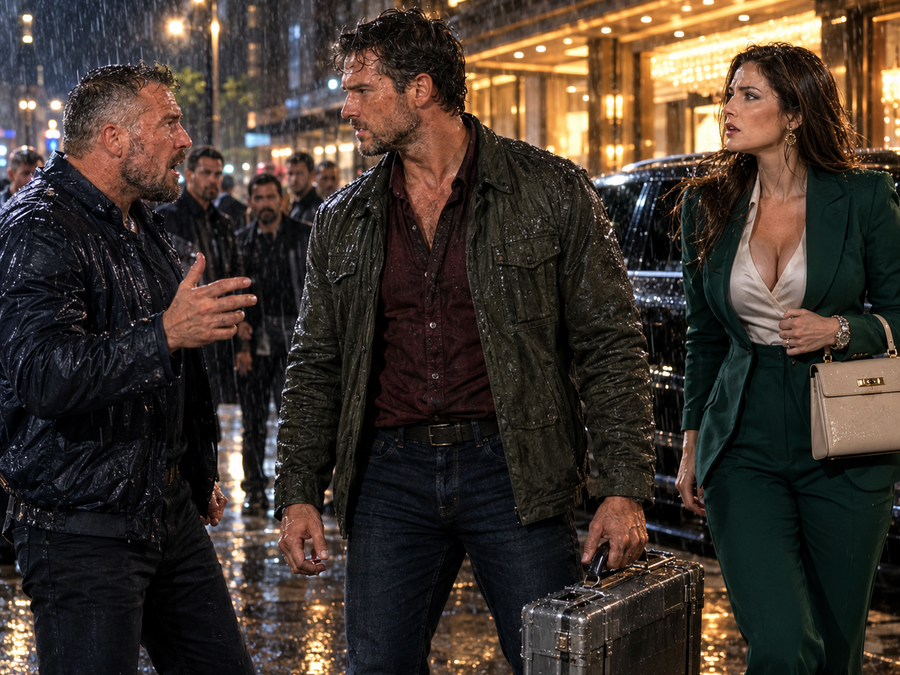
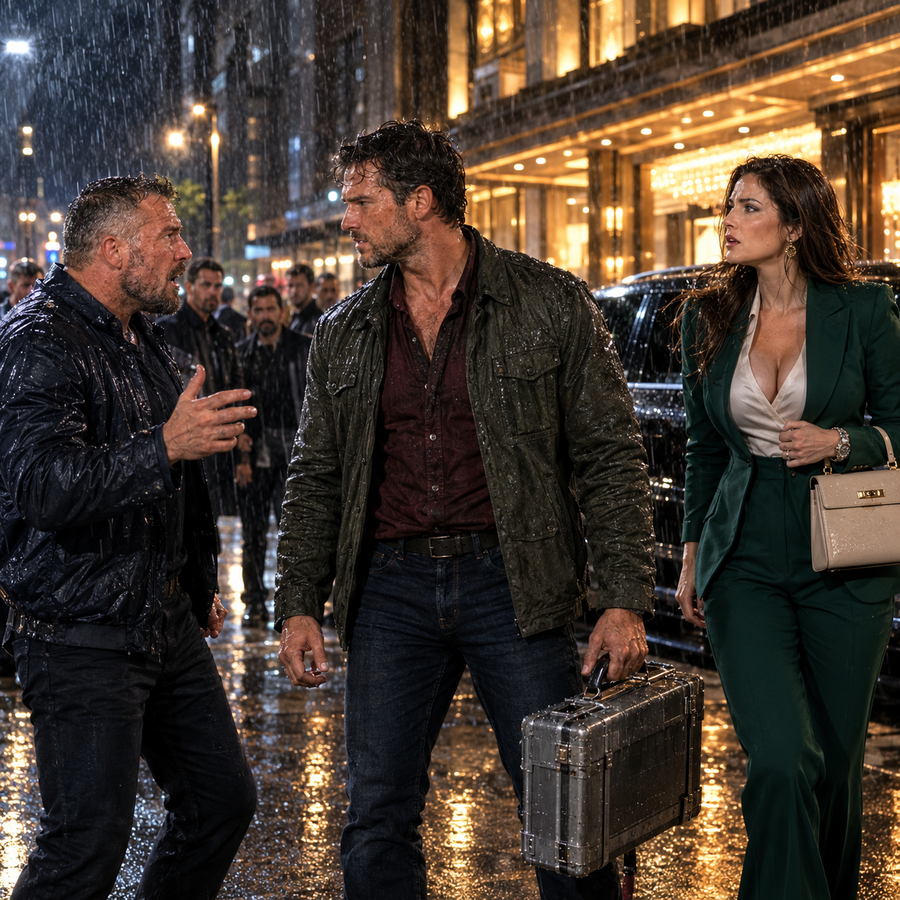
“I’ll think about it,” Daniel said again. Cross pulled the car to a stop at the Harrove building’s side entrance. The same spot where, 26 hours ago, a luxury car had been surrounded by six men, and a single father had set down his bag and made a decision. Daniel got out. He stood on the sidewalk for a moment. He looked at the place on the curb where his backpack had been. Then he went inside.
He had 3 hours of work left in his shift. A pressure issue on 23 that needed a follow-up. A lighting report to file. Ordinary things. Necessary things. The quiet business of keeping a large and complicated structure functioning for the 1,200 people who depended on it. He did them all. And at 6:00, he got on the bus, sat in the second-to-last row on the left side, and took out his phone. He typed a message to Emma. “On my way. How was the test?” Her reply came back in 40 seconds. “Crushed it. Also, I made soup. It’s better than pasta.” He smiled. It was a real smile. The kind that reached all the way. “Be home at 6:45,” he typed. “I’ll keep it warm,” she wrote back.
The bus moved south through the early evening. And Daniel Carter sat in his regular seat and thought about clean records and offered positions. And a man named Marcus Vale who had spent 15 years carrying the wrong story and had finally, today, been willing to put it down. He thought about Reyes. He thought about Sandra. He thought about Emma’s soup. He looked out the window at the city going past. Ordinary and continuous and full of people doing the difficult, invisible work of their own lives. And he thought that this—the bus, the text message, the soup waiting at home—was the thing he’d chosen. He had never once regretted it. He wasn’t going to start now.
But he was beginning to understand, for the first time in a long time, that choosing peace and accepting change were not the same thing. And that sometimes the life you’ve built doesn’t need to be abandoned in order to grow.
Emma found out on a Friday. Not from Daniel. Not because he told her, sat her down, explained it the way a responsible parent explains things to a 17-year-old who is old enough to handle complexity and young enough to still be shaped by it. She found out the way teenagers find out about everything in the modern world. Through a phone screen. At 7:14 in the morning, while she was eating cereal at the kitchen table and her father was in the shower.
The local news had picked up the story 2 days after it happened. It had been a short item. Initially, six men arrested outside a financial building. One bystander intervened. Police investigating possible connection to organized criminal activity. No names. The kind of story that gets 12 seconds on the evening broadcast and disappears by morning. But someone had a phone camera.
Emma stared at the screen. The video was 43 seconds long. It was shaky, shot from across the street, zoomed in too far, so the resolution blurred into something impressionistic rather than clear. But there was no mistaking the figure at the center of it. The broad shoulders. The old backpack set down with deliberate calm on the sidewalk. The work shirt. The way he moved. That specific, quiet, unhurried way that she had grown up thinking was just how her father walked through the world.
She watched it three times. Then she put the phone down, picked up her spoon, and finished her cereal. When Daniel came out of the bathroom, she was rinsing her bowl at the sink. “You’re up early,” he said. “Couldn’t sleep.” She turned around, looked at him, did the thing she’d been doing her whole life. That careful, patient reading of his face that she’d developed in lieu of the direct information he’d never been particularly forthcoming with. “Dad. That was you on the news.”
He was quiet for exactly 2 seconds. “Yes.” “Six men.” “Yes.” “You fought six men.” “I did.” She put the bowl in the drying rack very carefully, the way she handled things when she was managing strong feelings and didn’t want to drop them. Then she turned back around and looked at him with 17 years of accumulated love and exasperation and something new. Something that had been put there by 43 seconds of shaky cell phone video. “Okay,” she said.
He blinked. “Okay?” “I have approximately 40 questions,” Emma said. “And I’m going to ask them all. But first I need you to answer one.” “All right.” “Are you hurt?” He looked at her. Something in his chest moved in a way he couldn’t have named precisely but recognized immediately. “No,” he said. “I’m not hurt.” She nodded once, decisively, like she was crossing something off a list. “Good. Sit down. I’m making eggs and you’re going to tell me things.”
He told her things. Not everything. Not the classified parts. Not the operational details. Not the specifics of 15-year-old missions in countries she’d never heard him mention. But the shape of it. The shape of who he had been before she existed. Before her mother existed. Before the life they’d built together in this apartment with the slightly-too-hard mattress in his room and the collection of books she’d accumulated on the windowsill shelf. He gave her that.
She listened the way she listened to everything important. With her full attention and without interrupting. Asking questions only in the spaces where they were clearly invited. Her eggs going cold on the plate in front of her because she’d forgotten about them. When he finished, she was quiet for a long moment. “So the scar,” she said. “Yes. From the mission.” “Yes.” She reached across the table and touched the shoulder of his shirt. Just briefly. The way you touch something to confirm it’s real. Then she pulled her hand back. “I always wondered about that,” she said. “I know you said it was a work injury.” “It was, technically.” He paused. “The work was different than what I do now.”
Emma picked up her fork, looked at her eggs. Put the fork down again. “Mom knew.” “Your mother knew everything,” Daniel said. “She’s the one who agreed it was time to stop. Mutually agreed. She said she wanted you to grow up knowing where your father was every night.” Emma’s jaw worked for a moment. “She was right,” she said. Her voice was steady, but only just. “She usually was,” Daniel said.
They sat with that for a moment. The way they sat with most things related to Sandra. With the particular grief of people who have had enough time to learn how to carry it, but not enough time to stop noticing its weight. Then Emma picked up her fork again and said, in a completely different voice—the practical, forward-rowing voice that was Sandra’s voice exactly—”Tell me about the job offer.”
He hadn’t mentioned the job offer. “Torres told you,” Daniel said. “Torres tells me everything. He thinks I’m charming.” Emma pointed the fork at him. “Is it a good offer?” “It’s a serious offer.” “That’s not what I asked.” “It’s—” he considered it— “it’s more than I make now. Significantly. And it’s work I’m— it aligns with what I know. More than maintenance does.” “So why haven’t you said yes?” “Because I wanted to think about it.” “You’ve been thinking about it for 2 days.” “I think slowly, Dad.” She gave him the look. The one that was pure Sandra. The one that said she could see straight through whatever careful, reasonable thing he was doing to the actual reason underneath it. “Is it that you’re afraid to go back to something that looks like what you used to do? Or is it that you’re afraid to stop being what you’ve been for the last 10 years?”
He stared at her. “You’re 17,” he said. “I’m almost 18. And I’m very perceptive.” She finally ate a bite of eggs. “Also, Mom told me once that you had a tendency to choose smallness when you were scared.” She said it with love. “She said—” He said, “She said a lot of things. I wrote them down.” Emma met his eyes. “You’re not small, Dad. You should stop acting like it.”
He called Victoria’s office at 9:15 that morning. The assistant put him through in under 30 seconds, which told him that Victoria had left instructions. “Daniel,” Victoria said. “I’ve been thinking about the position,” he said. “I assumed.” “I have conditions.” “I expected you would.” “I come in at the same level as any other candidate. I go through whatever evaluation process your HR requires. No special treatment. No accelerated timeline because of what happened Wednesday.” “Agreed.” “I’ll need two weeks to transition my maintenance crew properly. They deserve—” “Take three,” Victoria said. “We’ll use the time to structure the department correctly.” “And I want—” he stopped. “The position. What does it actually involve?” “Safety systems. Emergency planning and protocols. Oversight of physical security infrastructure across all company properties. Staff training.” She paused. “And whatever else you identify as a gap. You’d have latitude to build the department the way you think it should be built.”
He was quiet for a moment. “There’s one more thing,” he said. “Yes?” “My daughter is applying to colleges in the spring. I will be at every campus visit. I will not miss a single one for work obligations, regardless of what’s happening.” The silence on the other end of the line lasted about 3 seconds. Then Victoria said, “Understood completely.” “Okay,” Daniel said. “Then I’ll come talk to your HR team next week.” He hung up. He sat at the kitchen table for a moment, in the quiet of the apartment after Emma had gone to school. And he thought about what it felt like to make a decision that moved toward something instead of away from it. It felt, he decided, like exactly what it was. A door opening.
What he didn’t expect—what he had not calculated for, in all the careful, practical thinking he’d done over the previous 48 hours—was Marcus Vale. Specifically, what Marcus Vale was saying to the federal investigators. Cross called him at 11:43 that Friday morning. “I need you to come in,” Cross said. “Not the detention center. Our field office. This afternoon, if possible.” “What happened?” “Vale talked.” A pause. “He talked more than we expected. And some of what he said involves information that we need your help to evaluate.” “What kind of information?” “The kind,” Cross said carefully, “that concerns the original Krevsky operation. Specifically, what Vale learned when he started pulling threads four years ago.”
Daniel was already standing. He didn’t remember deciding to stand. “Found something.” “He found several things,” Cross said. “Including one thing that I think you need to hear before we go any further with this investigation.” “Tell me now.” “Not on an unsecured line, Daniel.” He grabbed his jacket. “Give me 40 minutes.”
The Federal Field Office was the kind of place that had no identifying signage, occupied the third and fourth floors of a building that was otherwise a perfectly ordinary commercial structure, and was accessed through a side entrance with a keypad that Cross met him at personally. They went to a conference room on the fourth floor. Smaller than Victoria’s. No good coffee. A laptop open on the table, and a woman Daniel hadn’t met before, introduced as Agent Whitfield, who had the focused quiet of someone who was very good at her job and had learned to take up as little space as possible in order to be underestimated.
“Sit down,” Cross said. Daniel sat. “Vale’s information has three components,” Cross began. “The first involves the criminal organization currently targeting Hayes Dynamics, which we won’t go into now because it’s an active investigation and you’ll be briefed separately on the parts relevant to Ms. Hayes’s security.” He turned the laptop so Daniel could see the screen. “The second involves the internal review of the Krevsky operation. Specifically, the two individuals who structured the false narrative about your conduct.”
Daniel looked at the screen. Two names. Two faces. He knew one of them. Not well, not personally, but he’d seen the face in briefings, in corridors, in the background of institutional photographs. “He’s still active,” Daniel said. It wasn’t a question. “He retired 3 years ago,” Cross said. “But his successor—his actual successor, the person he handpicked—is currently in a position of significant oversight.” Cross met his eyes. “Which is relevant to the third component.” “What’s the third component?” Daniel said.
Cross and Whitfield exchanged a look. Whitfield opened a folder and slid a single sheet of paper across the table to Daniel. He looked at it. His face did not change. But his hands, resting flat on the table, pressed down with slightly more force than necessary. “When did this happen?” he said. “The arrangement was apparently established approximately eight years ago,” Whitfield said. “Vale found evidence of it when he was tracing the financial connections between the current criminal organization and their original funding sources.” She paused. “The funding sources trace back to the same network that originally compromised the Krevsky operation. They’re connected.”
“What happened 15 years ago and what’s happening to Hayes Dynamics right now,” Daniel said. “They’re part of the same network,” Cross confirmed. “The same overarching financial and intelligence network. Different people in some places. Same architecture.” Daniel looked at the paper again. A name he recognized. A financial arrangement he couldn’t have imagined. A line drawn between two things he had mentally kept in separate boxes for 2 days. “Victoria Hayes,” he said slowly. “She’s not a random target.” “No,” Cross said. “The data her company holds contains proprietary algorithmic analysis tools that, in the wrong hands, would allow for extremely sophisticated financial manipulation. The specific kind of manipulation that this network has been building toward for—” Cross paused for a long time. “And when they approached her 3 weeks ago, when she refused, she became a problem that needed to be solved.”
Whitfield said. Daniel sat back. He thought about a woman standing at the curb with her back against a car door, saying no. Three times. In a voice that was steady because she had decided it was going to be steady. And meaning it each time. He thought about what it cost to mean something like that. “She needs to know,” Daniel said. “We’re briefing her this afternoon,” Cross said. “We wanted you here first. Because—” he stopped, chose his words. “Because the position she’s offered you is now not just a professional arrangement. If you accept it, you would be the primary person responsible for her security in a situation that is significantly more complex than either of you understood 2 days ago.”
Daniel looked at him. “You’re asking if I still want it,” Daniel said. “I’m making sure you have complete information before you decide,” Cross said. Daniel thought about it for exactly as long as that took him to understand that there was, in fact, nothing to think about. “I still want it,” he said.
Victoria’s reaction to the briefing was something Daniel would think about for a long time afterward. He was there when Cross and Whitfield told her. They’d brought her in an hour after Daniel, to the same conference room, and sat across the table with her hands folded in front of her and listened to the whole thing. The network. The connection to Krevsky. The full scope of what her company’s data represented to people who were willing to send six men to a public sidewalk in broad daylight.
She didn’t flinch. She didn’t lose the composure. She asked three precise questions about the nature of the data vulnerability, about the timeline of the investigation, and about what the recommended security changes were. And Cross answered them. And she wrote things in a small notebook she’d brought. And then she closed the notebook. Then she looked at Daniel. “You knew some of this,” she said. “Before they told me.” “An hour more than you,” he said. “Not much.” “But you still—” she stopped herself. “The position. You still said yes.” “Yes.” “Knowing—knowing exactly what I know now.” “Yes.” He met her eyes. “The situation is more complicated than I thought. That’s not a reason to step away from it. It’s a reason to step toward it correctly.”
Victoria held his gaze for a long moment. Then she said, quietly, “I have something to tell you. Something I didn’t include in the formal offer.” “All right.” “When Reeves, my regular security director, when he retired in March, he left a note. For me personally. Not for HR.” She opened her notebook, found a page. “He said, ‘The next person in this role needs to understand that protecting a person is not the same as controlling them. Find someone who knows the difference.'” She looked up. “I’ve interviewed 11 people since March. Not one of them understood that distinction without being told.”
Daniel said nothing. “You didn’t need to be told,” she said. “No,” he said. “I didn’t.” “Reeves would have liked you,” she said. It was simple. It was genuine. It landed exactly the way she meant it to. Cross cleared his throat quietly. “There’s a practical matter we need to address. The investigation is active. The network is aware that their approach to Ms. Hayes failed, which means there’s likely to be a second approach. More sophisticated. Less direct.” “When?” Daniel said. “We don’t know. Could be weeks. Could be sooner.” Cross looked between them. “We’d like to formalize the arrangement—Mr. Carter’s position with Hayes Dynamics—quickly. And we’d like him up to speed on the full security infrastructure within the week.”
“3 weeks?” Daniel said. “We may not have 3 weeks.” “I made a commitment to my crew.” His voice was patient and absolute. “I’m not leaving them without one week.” Victoria said, “I’ll hire two of them directly. Your new department. If they’re willing.” “You don’t leave them behind. You bring them forward.” He looked at her. She was watching him with the expression he was beginning to recognize. The one that said she’d been thinking faster than the conversation and had already solved three problems ahead of where they currently were. “Which two?” he said. “Your choice,” she said.
He thought about his crew. He thought about Martinez, who had been in maintenance for eight years and had an instinct for structural problems that no amount of training could explain. He thought about Young, who was 26 and had a quiet, fierce attention to detail that Daniel had spent 2 years pointing in useful directions. “All right,” he said.
He called Martinez at 4 that afternoon. “I need to talk to you about something,” Daniel said. “Are you still at the building?” “Just leaving,” Martinez said. “Everything okay? Torres said you were in some meeting upstairs all day.” “I’ll explain in person. Can you meet me at the coffee place on Clement? 20 minutes.” A pause. “You’re scaring me a little.” “Don’t be scared. Bring your curiosity.”
Martinez was there in 18 minutes. He was 53, compact, with the perennially skeptical expression of a man who had fixed enough things to know that most problems were worse than they first appeared. He sat down across from Daniel, looked at him, and said, “You’re leaving, aren’t you?” “In a week,” Daniel said. “And I want to bring you with me.” Martinez was very still. “Where?” Daniel told him all of it. Or as much as was relevant. The position, the department, the scope of what needed to be built.
Martinez listened without interrupting. When Daniel finished, Martinez picked up his coffee, drank, and put it down. “And Young,” he said. “I’m calling her next. She’ll say yes immediately and then pretend she thought about it.” “I know.” Martinez looked out the window, did some internal calculation that Daniel let run without rushing. “Then the maintenance job. My guys need a supervisor.” “I already talked to building management. They’re promoting Diaz. He’s ready. I’ve been training him for 2 years without telling him that’s what I was doing.”
Martinez stared at him. “You planned this.” “I didn’t plan any of this,” Daniel said. “But I prepared for the possibility that things change. There’s a difference.” Martinez shook his head slowly, in the way that was not disagreement but the specific admiration of someone who has just understood something they’ve been watching without fully comprehending. “Okay,” he said. “Okay. Yes.” “You haven’t asked about the money.” “Is it more than what I make now?” “Considerably.” “Then it’s yes,” Martinez said.
Young said yes in 40 seconds. Martinez had been exactly right. Daniel filed the formal paperwork with Victoria’s HR department on Monday. He briefed his crew—all nine remaining members—on Tuesday morning in the maintenance bay. Standing in front of them the way he always stood. Without a prepared speech, without notes. Saying what was true in the most direct way he knew.
“Diaz is your supervisor starting next week,” he said. “He knows everything I know about this building. Possibly more. He’s been ready for 2 years. Martinez and Young are coming with me to a new department. The rest of y’all—every one of you does essential work that this building cannot function without. That hasn’t changed.”
Nobody spoke for a moment. Then Reyes, one of his younger crew members—no relation to the man from 15 years ago, a 23-year-old from Queens who had been on the team for 8 months—raised his hand. “Are you coming back to visit?” he said. Something in Daniel’s chest shifted. “I’ll be in the building every day,” Daniel said. “Same building, different floor.” “Good,” Young Reyes said. “Because nobody else knows how to fix the pressure gauge on 23 the right way.” “Diaz does,” Daniel said. “I showed him in January.” Young Reyes accepted this with a nod. The crew dispersed back to their work.
Diaz stayed back. He was 38, quiet, had come from a construction background and brought the careful, methodical quality of that work into everything he did. He looked at Daniel with an expression that was very controlled. “You’ve been prepping me for 2 years,” Diaz said. “Yes.” “Without telling me.” “I didn’t know if you’d want it,” Daniel said. “Some people don’t want the chair. I wasn’t going to push it on you.” Diaz was quiet. “What if I’d said no just now?” “Then I’d have spent the next week finding you a way to say yes comfortably,” Daniel said. “Because you’re the right person. The crew trusts you. They trust you more than they know they trust you. Which is the best kind of trust to have.”
Diaz looked at the floor. Then back up. “My father was a maintenance supervisor,” he said. “22 years.” “I know.” “He always said it was the most important job in any building. Because nobody thinks about you until something breaks. And then you’re all that matters.” “He was right,” Daniel said. Diaz extended his hand. Daniel shook it.
Wednesday morning, 6 days after the fight on Meridian Avenue, Daniel Carter walked off the elevator on the 41st floor and did not go back down to the maintenance bay. He had a desk now. Temporary, in a shared space outside the executive conference rooms while the safety department’s office suite was being reconfigured. He had a laptop he was still learning to navigate, different software than he was used to, and a schedule full of meetings with people who were cautiously trying to figure out what he was.
Cross called at 10. “Vale’s cooperation has opened significant parts of the investigation,” Cross said. “We’re going to need your input on the security assessment for Hayes Dynamics. Specifically, the physical infrastructure vulnerabilities.” “I’ve already started,” Daniel said. A pause. “You’ve been in the position for 4 hours.” “I walked the building last night. Off hours. I’ve been walking it for 10 years. But I walked it differently last night.” He had a yellow legal pad in front of him, covered in notes. “There are six access points that need immediate upgrading. I have a priority list.”
Another pause. This one longer. “Daniel,” Cross said. “Yes.” “Are you all right with all of this? Not the work. I mean the rest of it. Vale. The network. What it means about what happened 15 years ago.” It was the most human question Cross had asked him since they’d met. It surprised him enough that he took a real moment before answering. “I spent 15 years living with a version of events that wasn’t accurate,” Daniel said. “Learning that the version was wrong doesn’t undo 15 years. But it changes the weight of it. The story I’ve been carrying—” he paused. “It’s lighter now. Even though the events are the same.” “That makes sense,” Cross said.
“Emma asked me last night,” Daniel said, “if I was angry at the people who lied. At the system that let it happen. What did you tell her?” “I told her that anger requires a belief that things should have been different. And that I’d spent 15 years building something—her life, everything we have—out of the exact circumstances that came from what happened. So if things had been different, she might be different. And I—” He stopped. “I can’t regret the version of my life that has Emma in it. Even if I arrived at it through a door that someone else forced me through.”
Cross was quiet for a moment. “That’s—” he said, and stopped. “Yeah,” Daniel said. “Your daughter is very lucky,” Cross said. “The math goes the other way,” Daniel said. “I’m the lucky one.” He hung up. He looked at the yellow legal pad. Six access points. A security infrastructure that had been built for a company of 200 and had not been fundamentally updated since the company became 400. Training protocols that were 12 years old. Communication systems between departments that had three separate failure points under stress conditions. There was a lot of work to do. He picked up his pen. He started at the top of the list. Because this was what he knew how to do. Not the fighting, not the history, not the classified missions in countries nobody talked about. This. The patient, precise, necessary work of looking at a complicated system and making it safer for the people inside it. He had been doing that for 10 years in a building’s pipes and circuits. He was going to do it now in something larger. The difference, he decided, was smaller than it sounded.
At 12:15, Victoria appeared at his temporary desk. She looked at the legal pad, at the laptop, at the coffee going cold beside it. A pattern, apparently, in his relationship with coffee. “How are you settling in?” she said. “Ask me in a week,” he said. “I’m still figuring out the calendar system.” “Martinez called me this morning,” she said. “Before he officially starts. He already found a problem with the secondary entrance security relay on the third floor.” “I know,” Daniel said. “Sick. It’s number four on my list.” She looked at the list. Looked at him. “You wrote this last night.” “I couldn’t sleep.” “That’s either very reassuring or very concerning,” she said. “It’s just how I work,” he said. “When something matters, I want to understand all of it. All the way through.”
Victoria was quiet for a moment. She had the expression she sometimes got. The one where something was being processed behind the composure. Where she was deciding how much of her thinking to make visible. “The board is going to have questions,” she said, “about you. About how you came to be in this position. Some of them are going to do exactly the kind of research that leads to very incomplete records. I know Cross’s team is working on the record correction, but that takes time.” “I know that, too.” “Are you prepared for people to look at you and see someone who doesn’t make sense on paper?”
He picked up the legal pad, held it out to her. “I make sense in work,” he said. “Let them look at that.” She took the legal pad, looked at it. The six access points. The priority rankings. The specific and detailed reasoning beside each one. She looked up at him. “Yeah,” she said quietly. “Okay.” She handed the pad back and went back to her office.
Daniel turned back to the laptop. Outside, the city went about its business. The 1,200 people in the building doing what they did. The street below carrying its ordinary traffic. The world operating in its large and indifferent way. Inside, a man who had spent 15 years making himself small was sitting at a desk he had earned, making careful notes about how to protect people who needed protecting. He was not the same man who had set down an old backpack on a sidewalk 6 days ago. Or maybe he was exactly that man. Finally in the right room. He wasn’t sure the distinction mattered. The work was the same. Either way, he kept going.
The call came at 6:47 on a Tuesday morning. 11 days after Daniel had started on the 41st floor. He was in the kitchen making coffee when his phone buzzed. Not his personal cell, but the secondary device Cross had given him at the end of their last meeting. A simple black phone with four programmed numbers and the instruction to answer it regardless of the hour. He answered before the second buzz finished.
“We have a problem,” Cross said. No greeting, no preamble. That alone told Daniel everything about the severity level before the next sentence arrived. “There was a breach attempt at Hayes Dynamics last night. Not physical. Digital. Someone tried to access the proprietary algorithm files through a back door in the building’s legacy network infrastructure.”
Daniel put down the coffee cup. “Did they get in?” “No. The attempt was blocked by a firewall update that your team implemented 4 days ago.” He was already moving toward the bedroom to get dressed. “Martinez’s relay fix on three. The same upgrade. When he corrected the physical security relay, the IT team ran a parallel audit on the network infrastructure feeding that section. They found the back door and closed it.” A pause. “Daniel, they would have gotten everything if that relay had stayed broken for another week.”
He buttoned his shirt with the phone between his ear and shoulder. “What did they target specifically?” “The algorithmic core. The proprietary modeling system. The thing that makes Hayes Dynamics what it is.” Cross’s voice had the careful flatness of someone delivering information they find genuinely alarming while trying not to transfer the alarm. “If they’d extracted it, the company would have been—not finished, but fundamentally compromised. Years of work. Gone.” “Who ran the attempt?” “We’re tracing it. The signature is consistent with the network Vale described, but the technical sophistication is higher than what we saw last week. They escalated.”
Daniel pulled on his jacket. “They know the physical approach failed. They’re coming at it differently.” “Yes.” And Daniel—Cross stopped. A brief pause that had weight in it. “The breach attempt originated from inside the building.” The words landed in the quiet apartment like something dropped on a hard floor. “Inside,” Daniel said. “An access point on the 37th floor. Someone with legitimate building credentials used a hardwired terminal at 11:42 at night to initiate the attempt.” “The 37th floor,” Daniel said. “That’s internal finance. Access is restricted to senior staff. 17 people have card access to that floor after hours.” Cross said, “We need you here now.”
He was at the federal field office by 7:30. Whitfield was already at the conference table with three laptops open and a printed list of 17 names. Cross was on the phone in the corner. A man Daniel hadn’t met before, introduced quickly as Callahan, Cyber Division, was drawing a network diagram on the whiteboard with the focused intensity of someone who had been awake since before the breach attempt had been discovered.
Daniel picked up the list of 17 names. He read through it once. He stopped at name 11. “Philip Ardan,” he said. Whitfield looked up. “You know him?” “I know who he is. He’s Hayes Dynamics’ chief financial officer. Been with the company 6 years.” Daniel set the list down. “I met him last Thursday. Victoria introduced him during a department head walkthrough. He was—he was asking very specific questions about the new security protocols.” “What kind of questions?” Callahan asked without looking up from the whiteboard. “The kind that seemed like normal CFO due diligence at the time,” Daniel said. “Questions about timeline. About which systems had been updated and which hadn’t. About the schedule for the remaining infrastructure work.” He paused. “I answered them because they seemed legitimate.”
The room was quiet for a beat. “How much did you tell him?” Cross said. He’d come off his call. “Nothing operationally specific. General progress. General timeline.” Daniel’s voice was measured, but something underneath it was not. The specific, self-directed anger of a man who prides himself on reading situations correctly and has just discovered he missed something. “But enough that someone who was looking for a remaining window would know approximately how much time they had.” “The attempt was made 4 days after your walkthrough,” Whitfield said. “Yes,” Daniel said. “I know.”
Cross sat down. “We need to move carefully. Ardan has been with the company 6 years. He has relationships, institutional knowledge, access to financial structures we may not fully understand yet.” “If we move on him too quickly, he’ll know we’re on to him,” Callahan said. “And whoever he’s working with goes dark.” “And if we wait,” Daniel said, “they try again with a method we haven’t anticipated yet.”
Nobody disagreed with either statement. The room held the specific tension of a problem with no clean solution. Only a set of imperfect options that needed to be ranked. “What does Vale say?” Daniel asked. “About internal assets. Did the network typically embed people inside target organizations?” Cross and Whitfield exchanged a look. “Vale didn’t mention Ardan specifically,” Cross said. “But he described a standard operational pattern. Placing a financial insider at the CFO level or below. Someone who could monitor vulnerability windows and report back on timing.” “So Ardan fits the pattern perfectly.”
Daniel thought for a moment. He was running through the building in his head. Not the physical structure this time, but the human one. The relationships, the dynamics, the specific way Philip Ardan had stood during the walkthrough, asking his careful questions with an expression of polite professional interest. “Victoria doesn’t know yet,” Daniel said. “We wanted your assessment first,” Cross said. “She needs to know today. Agreed. But how we tell her matters.” “If her reaction—” “Her reaction will be correct,” Daniel said, with a certainty that surprised even Cross. “She’s been running a 400-person company for 8 years. She knows how to receive information that changes the picture without letting the change show on her face.” He stood. “Let me tell her. Before the workday starts. Before she has to sit across from him at any meeting.”
Cross looked at him. “You’re sure?” “I’m sure,” Daniel said. “I’ve been watching her for 11 days. I know how she handles things.”
He was at the Harrove building by 8:15. Victoria was in her office already. She was always in before 9:00. A habit she’d mentioned came from her first year running the company, when being the first one in and the last one out was the only way she could stay ahead of everything demanding her attention. The habit had outlasted the necessity. Her assistant, a young woman named Clare, looked up when Daniel came off the elevator. “She’s in,” Clare said. “She said if it was you to send you straight through.” He knocked anyway. “Come in.”
Victoria was at her desk with her reading glasses on and a contract open in front of her. She looked up, read his face in the way she’d gotten quicker at over the past 11 days. That rapid, accurate assessment that told her whether what he was bringing was procedural or significant. She took off her glasses. “Close the door,” she said. He did. He sat down across from her and told her everything. The breach attempt. The 37th floor terminal. The 17 names. Philip Ardan. The walkthrough. The questions. The timeline. He told it the way he told things. In order, without editorializing, with complete information, and without softening what didn’t deserve to be softened.
She listened without interrupting once. When he finished, the office was very quiet. Victoria looked at her desk. At the contract that was no longer the most pressing thing in front of her. At her hands folded on the surface with the deliberate composure of someone who has decided that composure is necessary and has generated it through will rather than circumstance. “6 years,” she said. “Yes.” “Philip has been here for 6 years.” “Yes.” She was quiet for another moment. Then, “He was in my home 3 months ago. A dinner for the department heads. He sat at my table and talked about his kids’ soccer league.” Her voice was even. “He has two daughters.” Daniel said nothing. There was nothing useful to say to that.
“How certain are you?” she asked. “The breach attempt originated from that floor, from that terminal. At a time when Ardan is one of a small number of people with access. The timing aligns with information he obtained during our walkthrough. The pattern matches what we know about how this network operates.” He paused. “I’m not certain. Nobody is certain yet. But the indicators are serious enough that you needed to know today.”
Victoria nodded once. Processing. “What do you need from me?” “Your normal schedule. Everything as usual. If Ardan is watching for a reaction—and he is—we need him to see nothing for the next 48 hours while Cross’s team builds the evidentiary picture.” “So I sit across from him in meetings.” “Yes.” “And I act as though I don’t know.” “Yes.”
She looked at him. “Can I ask you something?” “Of course.” “Is this the part where you tell me it’s going to be fine? That everything is under control?” “No,” he said. Something shifted in her expression. Something that looked almost like relief. “Good,” she said. “I’ve had too many people tell me things are under control when they aren’t. I prefer the truth.” “The truth is that we have a serious problem, a reasonable plan, and a 48-hour window that needs to hold,” Daniel said. “Whether it does depends on a lot of things neither of us fully controls. But the people working on it are good. And you’re better at this than most people would be.” She looked at him for a long moment. “How do you know that?” she said. “You’ve known me for 11 days.” “I’ve watched you for 11 days,” he said. “There’s a difference.”

