Single Dad Helped a Wheelchair Woman on the Road—Never Knowing She’d Change His Fate (Part 3)
Single Dad Helped a Wheelchair Woman on the Road—Never Knowing She’d Change His Fate (Part 3)
PART 3
Daniel knew the parcel. Old field. Had a rusted water tank on it from the original farm. Hadn’t been touched in years. “What about it?” Daniel said. “I don’t need the corridor property if I have access rights through the creek parcel,” Caldwell said. “Right of way. I can redirect the utility run. It’s not ideal, but it works.” He paused. “You give me a right-of-way easement on the creek parcel, and I withdraw the zoning complaint. The variance stands. Your operation continues.”
Daniel was very still. “You’d go to all this trouble over a right of way,” he said. “Time is money,” Caldwell said. “And the complaint costs me, too. Lawyers aren’t cheap, even when they’re mine.” A pause. “This is a clean resolution, Mr. Carter. You keep everything that matters. I get what I need to make the rest of the corridor work. Nobody loses.”
Daniel thought about it. He called Victoria. “He wants a right-of-way easement on the creek parcel behind the property,” he said. A pause. “The field with the old tank.” “Yes.” A longer pause. “That parcel isn’t in the foundation lease. It’s yours outright.” “I know,” he said. “Is there any reason I shouldn’t?” He heard her clicking through something. Documents, files, the sound of someone who kept everything organized and accessible.
“The creek parcel has no strategic value to the operation,” she said slowly. “It’s not buildable. It’s not part of the modification bay. It’s not in any future expansion plan we discussed.” Another pause. “If you grant the easement, the zoning complaint disappears. The variance stands. We continue operations without interruption.” “That’s what he said,” Daniel confirmed. “And you trust him to follow through.” Daniel thought about it. “I think he’d rather have a clean deal than a dirty fight,” he said. “He’s a developer. Dirty fights slow everything down on his end, too.” “He’s also someone who has been trying to pressure you for six months,” she said. “He’s someone who wants something specific. And finally told me what it actually is,” Daniel said. “That’s different from somebody who just wants to cause problems.”
Victoria was quiet for a long moment. “Have Foss review the easement language before you sign anything,” she said. “If the terms are clean, I don’t see a reason to refuse it.” “Okay.” “Daniel.” “Yeah.” “That was very well-handled,” she said. He didn’t answer immediately. He was looking at the bay, at the half-finished Caravan, at Luis running his hand along a bracket seam with the focused attention of a man who cared about the millimeter. “I just asked him what he actually wanted,” Daniel said. “That’s it. Most people don’t do that,” she said. “I know,” he said. “I don’t understand why.”
She was quiet again. And in the quality of that quiet, he started to recognize the moments when Victoria Whitmore, who was precise and controlled and very good at running a billion-dollar company, ran into something she hadn’t accounted for and had to stop and recalibrate. He found those moments privately to be some of the most interesting things about her.
“I’ll have Foss call Caldwell’s office by noon,” she said.
The easement agreement was signed by Thursday. The zoning complaint was withdrawn Friday morning. Daniel found out from Foss at 8:15 and walked straight into the bay and told Luis, who looked at the ceiling again, but this time Daniel was pretty sure it was a different kind of looking at the ceiling. “Carla’s still on for the 22nd,” Luis said. “She’s still on for the 22nd,” Daniel confirmed. Luis picked up his tool. “Good,” he said, and went back to work.
It was that simple and that not simple, both at once. That was the nature of most things that mattered.
The day Carla came in for her final fitting and drove her van out of the bay under her own control was a Tuesday in late November. Daniel watched from the shop door. Luis walked alongside the van for the first 20 feet, then stopped because she didn’t need him anymore and he knew it before she did. Carla pulled out onto County Road 12 and drove south about 200 yards and came back. She pulled into the lot and sat in the van for a moment before she opened the door.
When she got out, she didn’t say anything right away. She walked back to where Daniel was standing. Walked with her prosthetic the way she’d walked in three weeks ago, with the careful attention of someone who wasn’t yet sure what her own body would do. And she put her hand out. He shook it. “The job interview is next Tuesday,” she said. “I know,” he said. “I’m going to get the job,” she said. Not wishful. Decided. “I believe you,” he said. She nodded once. Got back in the van and drove away.
He watched until she was gone. He went back inside and sat in his office for a few minutes. He didn’t do anything. He just sat. “Rachel,” he thought. “You would have liked this.” He didn’t hear an answer. He never heard an answer, but the silence felt inhabited, which was the closest it ever got.
His phone buzzed. Victoria. “How’d it go?” He typed. “She drove away.” A pause. Then: “That’s everything.” He looked at those two words for a long moment. Then he put the phone down and got back to work.
Three weeks after Carla, Ted came in for his final certification. Ted was quieter than any of the other clients. Not unfriendly, just contained. He had the economy of speech that Daniel had noticed in a few veterans he’d met over the years. The quality of someone who’d learned to use words the way you used ammunition. Not more than necessary, and aimed.
Luis had worked with Ted on the van for six weeks. The hand controls, the secondary braking assist, the mirror repositioning. Luis had learned early not to talk more than the job required around Ted, which Daniel respected. Reading the person in front of you was a skill. Luis had it.
The certification day, Ted came alone. No family. He drove the van through the test sequence. All the right responses, all the right measurements, everything that needed to be documented, documented. When it was done, Luis handed him the certification folder. Ted held it, looked at it, looked at Luis, then looked at Daniel, who was standing by the office door.
“How much do I actually owe you?” Ted said. “The real number.” “The copay you already made,” Daniel said. Ted looked at him steadily. “That’s not the real number.” “The foundation covered the rest,” Daniel said. “Who funded the foundation?” Ted said. Daniel paused. “A private donor.” “The woman on the highway,” Ted said. “Raymond told me.” Daniel didn’t answer.
Ted looked at the certification folder again. Looked at the van. Then he said quietly, “I did two tours. I came back and the hardest thing I’ve dealt with since isn’t the stuff you’d expect. It’s just not being able to go where I need to go when I need to go there. Feeling like I’m asking permission to exist.” He stopped. He held up the folder. “This gives me back something I didn’t know how to ask for.”
The shop was very quiet. “You didn’t have to ask,” Daniel said. “That’s the point.” Ted looked at him for a moment. Then he extended his hand and Daniel shook it. And Ted walked out to the van and drove away, and Daniel and Luis both watched, and neither of them said anything for a little while.
It was Luis who finally spoke. “I’ve been doing this work for 9 years,” he said. “I’ve never worked somewhere that felt like this.” “Like what?” Daniel said. “Like it matters more than the paycheck,” Luis said. “That sounds like a cliché, but I mean it mechanically. Like the work itself is the point.” Daniel nodded. “It is.” “You think Whitmore knows that?” Luis said. Not challenging. Genuinely asking. “I think that’s why she built it this way,” Daniel said. “I think she knows exactly what she’s doing.”
Luis considered this. “You like her,” he said. Daniel looked at him. “I’m not talking about that,” Luis said quickly. “I mean, you respect her. The way you talk about her decisions.” Daniel said, “She thinks like a mechanic. She looks at how the parts fit. She doesn’t waste motion.” He paused. “I understand people like that.” Luis almost smiled. “You’re the same way,” he said. “Which is probably why it works.”
Daniel thought about that on the drive home. The way it works. Six weeks ago, the partnership had been a set of signed papers and a hope. Now it was Carla’s van, Ted’s folder, Doris, who was coming in next week. Marcus, who had started learning adaptive certification on his own time because, as he’d told Daniel with the complete lack of guile that was his most endearing quality, he wanted to be useful for this specifically. Luis, who’d told a client that morning in Daniel’s hearing that this was the best shop he’d ever worked in, without any apparent awareness that Daniel could hear him.
The thing was building. The momentum Caldwell had tried to break was intact. The waiting list was now 57 names, and Raymond kept calling with more.
He picked up Sophie, who was aggressively pleased about a grade she’d received on the volcano project, which had apparently been described by her teacher as the most thorough presentation of its kind she had seen in 11 years of teaching fourth grade. “Did you tell her it was named Stromboli?” Daniel said. “Of course,” Sophie said. “She thought that was very sophisticated.” “It is sophisticated,” he said. “I know.” She paused. “Dad.” “Yeah.” “When do I get to meet her?”
He kept his eyes on the road. “Meet who?” Sophie gave him the look she’d inherited directly from Rachel. The one that communicated without a single word that she found the evasion both transparent and unnecessary. “Victoria,” Sophie said.
He was quiet for a moment. “Where did you—” “You say her name differently than you say other people’s names,” Sophie said, with the casual devastation of a 9-year-old who had been paying attention to her father for 9 years. “You say it like you’re being careful with it.” He didn’t answer immediately. “Maybe,” he said finally. “When the time is right.” “Okay,” Sophie said, accepting this with the equanimity of someone who had filed the information away for future reference. “But don’t wait too long. People wait too long about things.”
He looked at her. “You’re nine,” he said. “10 in March,” she said.
He drove. He thought about what she’d said. He thought about the way Victoria’s voice changed at the end of phone calls. Not warmer, exactly, but less guarded. The way a door goes from 90% closed to 80% closed, and the gap is small, but the air moves through it. He thought about the night in the kitchen. The laugh that surprised her.
He thought about Rachel. He thought about that for a long time. In the careful way he always did. Rachel had been gone three years, and he had loved her completely, and those two things were both permanent, and he wasn’t interested in pretending either one wasn’t true. But he had also lately been thinking about something she’d said once, in one of the long hospital conversations when they’d gotten brave enough to say the things neither of them wanted to say.
She’d said, “Danny, I need you to promise me you’ll stay open. Not to anyone specific. Just to the possibility of things.” He’d made the promise. He’d broken it for three years without meaning to. And somewhere around the 40th yard on Highway 183, something had cracked the seal on it. He wasn’t sure what that meant. He wasn’t in a hurry to define it. But he’d stopped pretending he didn’t know what Sophie had noticed.
On a Friday evening in mid-December, Victoria came to the shop for the first time since they’d signed the papers at his kitchen table. Foss had mentioned she wanted to see the operation in person. The standard board reporting visit. Routine. Daniel had said fine. He’d told Luis and Marcus to work as usual, which they would have anyway.
She arrived at 4:30. Patrick drove her. The same efficient young man who had collected her from Daniel’s house in the dark hours of that first night. She wheeled herself in through the side door Daniel had widened six weeks ago because it was the right thing to do and he’d just done it without announcing it. She stopped just inside the bay.
She looked at the Doris vehicle on the lift. Looked at Luis, explaining something to Marcus at the workbench, their heads together, Luis’s hands moving in the demonstration pattern Daniel had come to recognize. Looked at the wall where the certifications were mounted. Looked at the ribbon. She wheeled over to the ribbon. She looked at it for a moment. “Rachel,” she said. “Opening day,” he said. She nodded. Didn’t say anything else about it. Which was right. Some things don’t need commentary.
She spent an hour in the shop. She asked Luis questions about the certification process and listened to the answers with the full-weight attention Daniel recognized as the quality they shared, the thing that made both of them, in different ways, good at what they did. She talked to Marcus for 10 minutes, and Marcus, to his credit, did not knock anything over. She looked at every vehicle in process and asked about each client by name, because she had read every intake file, which Daniel had suspected but hadn’t known for certain until now.
When she was done, she and Daniel stood outside by his truck in the late afternoon. December in Texas was cool, but not cold, and the light was going gold and low. “59 clients in 9 weeks,” she said. “59 completed intakes,” he said. “31 completions, the rest in process.” “The board wanted 12 completions in the first quarter,” she said. “I know you’re going to hit 40.” He shrugged. “Luis is fast and he’s precise. That’s a good combination.” “It’s not just Luis,” she said. He didn’t argue.
She looked at the shop. At the sign. Carter Automotive. Same as it had always been. No foundation branding. Just the name he’d put up in 2015 with his own hands. “Caldwell called my board chair,” she said. He looked at her. “What did he want?” “To register his concern,” she said, with a tone that made her opinion of that phrase clear. “He told the chair the pilot was scaling faster than projected and that he was worried about the zoning implications.” She paused. “What he actually meant was that the momentum is real and it’s too late to break it and he’s looking for a different angle.” “What did the board chair say?” “That the numbers speak for themselves,” Victoria said. “Which they do.” She paused. “Caldwell is going to pivot. He’ll find something else to push on. I don’t know what yet. I’m watching.” “I know,” Daniel said. “So am I.”
She looked at him sideways in the late light. Something in her expression was different from the professional precision he usually saw. More like the kitchen at midnight. The woman who had accepted a blanket and drunk his coffee and laughed without meaning to. “How are you?” she said. It was exactly what he’d asked her weeks ago. He recognized the echo of it.
“Better than I’ve been in a while,” he said. “Honestly. The shop.” “The shop,” she agreed. “And other things.” She was quiet for a moment. “Sophie asked about you,” he said. She turned her head. “She wanted to know if you were my friend,” he said. “What did you tell her?” “I told her I was still figuring that out,” he said.
Victoria looked at him steadily. “And have you figured it out?” He thought about being careful with words. He thought about the door that was 90% closed going to 80. He thought about a promise he’d made in a hospital room that he’d finally, maybe, started keeping. “Yes,” he said. She held his eyes for a moment. “Good,” she said. Quiet. Not the board meeting voice. The other one.
She turned back toward the shop. “I want to bring two board members here next month,” she said. The professional voice seamlessly back. “Let them see it for themselves. Numbers on a page are one thing.” “Whenever,” Daniel said. “Doors open.”
She started toward Patrick in the SUV. Halfway there, she paused. “Daniel,” she said. “Yeah.” “The ribbon,” she said. “Leave it where it is.” He looked at it through the bay window. Rachel’s ribbon. Kitchen scissors. Opening day. “Wasn’t planning to move it,” he said. She nodded once and continued to the car.
He watched the SUV pull out of the lot. And then he stood in the late afternoon light and breathed and thought about all the things that had broken in the last three years and all the things that had held, and understood that sometimes you cannot tell the difference between those two categories until enough time has passed to see what the breaking made room for.
The shop was lit up warm behind him. Luis and Marcus were still inside. The certifications were on the wall. The ribbon was where it had always been. He went back in. He had work to do.
January came in cold and fast. The kind of cold that makes Texas remember it’s still the South and not immune to winter. And Daniel Carter was at the shop by 6 every morning because there was always more to do than there were hours. And he had stopped minding that the way he’d stopped minding a lot of things that used to feel like weight and now felt like purpose.
The waiting list was at 71 names. Raymond called every Tuesday with updates, which had become a ritual. Neither of them acknowledged as a ritual, but both of them relied on. Raymond would call. Daniel would answer. Raymond would say something like, “Well, I’ve got three more for you.” And Daniel would write down the names, and neither of them would comment on the fact that a man who’d been sitting in a church hall with a hand-built control rig and $1,100 saved had become, without anyone formally appointing him, the community coordinator for the entire East Side intake operation.
Daniel had mentioned this to Victoria. Victoria had said, “I know. I’ve been watching him. I want to talk to you about Raymond.” But that conversation was still pending because the week she’d planned to have it, something happened that moved everything else to the side.
It started with a phone call at 6:40 on a Wednesday morning, before Daniel had gotten to the shop, while he was still in the truck listening to Sophie argue from the back seat that the school science fair judging criteria were fundamentally flawed because they prioritized presentation over methodology, which was an epistemological problem.
His phone rang. Unknown number. He answered the way he always did. “Mr. Carter.” The voice was female, professional. The clipped efficiency of someone who made a lot of calls. “My name is Sandra Oric. I’m a producer at KAN News in Austin. We’ve been covering community impact stories this month, and your name came up in connection with the Whitmore Foundation Mobility Initiative. I’d love to talk to you about what you’re building out there.”
Daniel looked at Sophie in the rearview mirror. Sophie was looking back at him with the alert expression of a child who understood that something was happening. “I’m going to have to call you back,” he said.
He dropped Sophie at school. Sat in the parking lot for three minutes and called Victoria. “Sandra Oric called me,” he said. “She called Foss yesterday. I was going to tell you today.” “Were you going to tell me before or after she called me directly?” A pause. The honest kind. “I didn’t think she’d move that fast,” Victoria said. “I’m sorry. I should have called you last night.” He let that sit for exactly one second. Then moved past it. “What do you want to do?” “That’s why I’m glad you called me first,” she said. “It has to be your decision. The story is about your shop. You’re the face of it, not me. And I want to be very deliberate about that, Daniel. I mean it. This initiative works because it lives at Carter Automotive. Because it’s yours. The moment it becomes a Whitmore Foundation PR story, it becomes something different. Something people are appropriately skeptical of.” A pause. “You talking to a reporter is different from me talking to a reporter. You’re the mechanic on County Road 12 who built a ramp for his neighbor. That’s the story. That’s the one that moves people.”
He was quiet for a moment. “You’ve thought about this a lot,” he said. “I think about all of it a lot,” she said. “You know that.” He did know that. He’d come to understand over three months that Victoria’s mind ran on multiple tracks simultaneously and never fully stopped. She’d call him at 9 at night with a thought about intake scheduling and he’d tell her to sleep and she’d say she was sleeping and he was fairly certain she was lying.
“I’ll call Oric back,” he said. “But I want you there.” A pause. “Daniel—” “Not as the foundation,” he said. “As the person who helped build it. There’s a difference between hiding you and keeping you in the right frame.” He paused. “You belong in this story, Victoria. Just not at the front of it.” She was quiet. “Okay,” she said quietly. “Okay.”
The interview was set for the following Tuesday. Sandra Oric arrived with a camera operator and the particular energy of someone who was good at her job and knew it. Not arrogant, just efficient. The same quality Daniel respected in Luis. She walked the shop. She watched Luis work. She talked to Marcus for 10 minutes, and Marcus, who had a gift Daniel had not fully appreciated until recently for saying exactly the right thing without ornamentation, told her about the day Patricia drove out of the bay laughing and described it so well that Oric stopped writing mid-note.
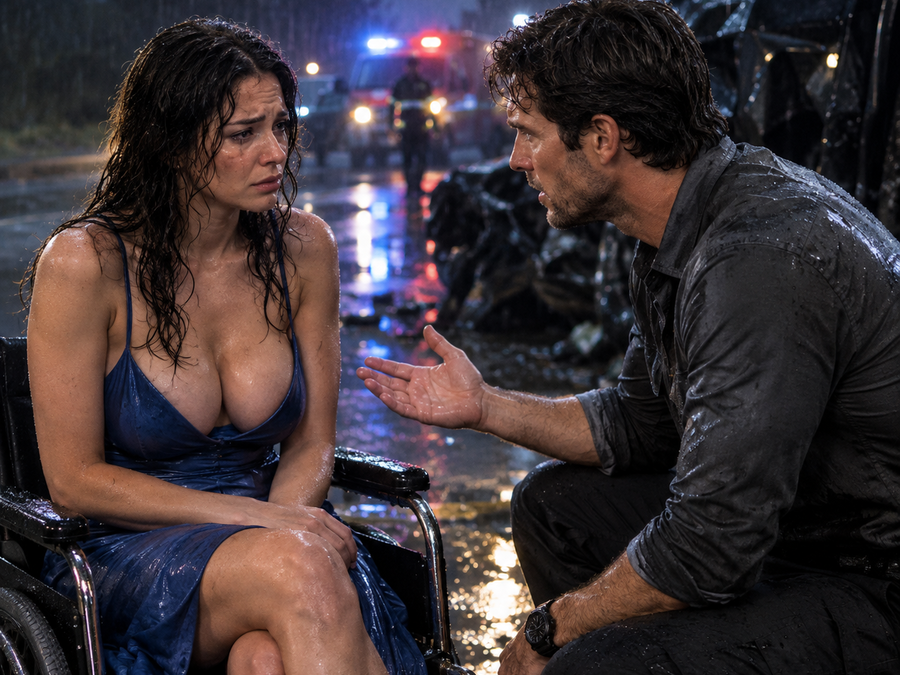
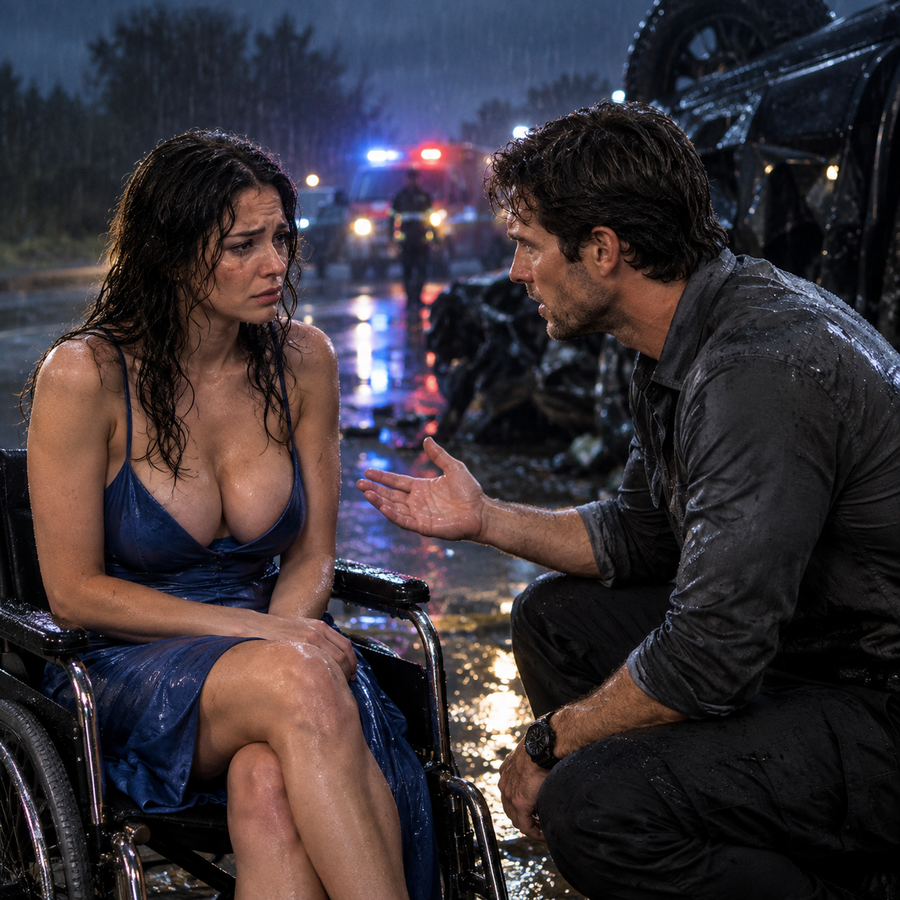
Then she sat across from Daniel in the office. “Tell me about the night you stopped,” she said. He told her the whole thing. The rain, the 40 yards, the mud. The woman who looked at passing cars without anger, just quiet acceptance. He told it the way it happened. Not shaped, not managed, just reported. He told her about Rachel’s rule. Let people see your hands. He told her about Henry the elephant, who was currently in his accustomed position between the cup holder and the dash.
Oric was a good interviewer. She let him talk. She asked follow-up questions that were specific and real, not the kind designed to get a quote for a headline. When he was done with the highway part, she leaned forward. “What happened to your shop before the foundation partnership?” she said. He looked at her. He knew what she was asking. “57 days,” he said. “That’s what I had.” She wrote it down. “And now?” He looked through the office window at the bay, at the Doris vehicle, which they’d completed last week, at the new intake, a man named Franklin, 67, Parkinson’s tremor in both hands, who’d been told by his family he probably shouldn’t drive anymore and who’d come to Daniel with the specific and dignified determination of a man who was not ready to be told what he couldn’t do.
“Now we’ve got a waiting list of 71,” Daniel said. Oric looked up from her notes. “71 and counting,” he said. She was quiet for a moment. “What do you want people to understand about this?” she said. He thought about it. Not the polished answer, the real one. “That the people on that list are not asking for charity,” he said. “They’re asking for their cars to work right so they can go to work and take their kids to school and get to their own doctor appointments without having to ask permission from someone who loves them but is scared.” He paused. “They’re asking to keep being themselves. And the gap between that and not being able to do it is sometimes about $4,000 and the right shop.” He looked at her. “We’re trying to be the right shop.”
Oric set her pen down. “Mr. Carter,” she said. “I’ve been doing this for 14 years, and I have never had someone answer that question that clearly.” He shrugged. “I’ve had good teachers,” he said.
The story ran on a Thursday evening. Daniel watched it on his phone in the shop after closing because the television at his house had a broken HDMI port he hadn’t fixed yet. Cobbler’s children. Sophie watched beside him, very serious, occasionally narrating her own observations about the filming choices, which were detailed and specific and made him wonder, not for the first time, what exactly was happening in his daughter’s head at any given moment.
The segment was four minutes and 20 seconds. They’d used the line about the 40 yards. They’d used the Carla van footage. Carla had given permission and then called Daniel afterward to say she’d shown it to everyone she knew. They’d used one shot of the ribbon on the office wall, which Daniel hadn’t expected, and which made something catch in his throat when he saw it on the screen.
His phone started ringing at 7:15. It did not stop. By 8:00, he had 23 new voicemails. A text from Raymond saying, “Brother, you just changed everything.” A text from Luis that said simply, “Well.” And a call from Deb, his accountant, who said in 12 years of practice, she had never seen a client’s situation reverse so completely and so fast. And she meant it as a compliment.
At 8:45, Victoria called. “Are you watching your phone?” she said. “It’s hard not to,” he said. “Channel 12 in Dallas picked up the segment,” she said. “They want to run a version tomorrow. I’ve also had two calls from other city foundations asking about the pilot model.” A pause. “Daniel, this is it. This is what I said I needed. The proof.” “I know.” “The board meets in three weeks. I’m going to walk in there with tonight’s coverage and the completion numbers and the waiting list and I’m going to ask them to fund five more locations.”
He was quiet. “Five,” he said. “To start,” she said. “If the board meeting goes the way I think it’s going to go.”
He sat down on the tailgate of his truck, which was where he went when he needed to think. Sophie had gone inside. She’d kissed his cheek and said, “Dad, you were really good on TV,” which was the highest praise she gave anything. “Raymond,” he said. “Yes,” she said. And the single word told him she’d already been thinking it. “He should run the East Austin location,” Daniel said. “If you’re expanding, he knows the community. He knows the clients. He’s been doing the intake coordination for three months without a title or a paycheck.” “I know,” she said. “I want to offer him a director position. Intake and community outreach. East corridor. Real salary, benefits.” Daniel exhaled. “He’s going to say he’s not qualified.” “What would you tell him?” she said. “That he’s been doing the job for three months,” Daniel said. “That qualified is what you do. Not what it says on a piece of paper.” “Good,” she said. “Because that’s what I was going to tell him and I wanted to make sure we were aligned.”
He looked at the shop, at the sign, at the lights he’d left on in the bay, which he always did because a lit shop looked like it was working and he decided years ago he wanted people driving past to see that. “Victoria,” he said. “Yes.” “I need to tell you something,” he said. “And I want to say it right. So give me a second.” A pause. He could hear her not moving on the other end of the line. “Okay,” she said carefully.
“Three months ago, I had 57 days and a shop I’d built from nothing that I was about to lose,” he said. “And now I’ve got 71 people on a waiting list and a certified adaptive mechanic and a kid named Marcus who stays late on his own time to learn the certification standards and Raymond calling me every Tuesday and Carla, who got the job—by the way, she texted me yesterday, she got it—and you calling me at 8:40 on a Thursday night about board meetings and expansion plans.” He paused. “I’m not saying any of this to credit myself. I’m saying it because I want you to know I understand what you did. And I want you to know I don’t take it lightly.”
The line was very quiet. “I didn’t do it for you,” she said. Her voice was careful. Not cold. Precise. “I did it because it was the right thing to do and because I believed the model would work.” “I know that,” he said. “That’s why it meant something.” A longer silence. “Carla got the job,” Victoria said. “Yeah. Which one?” “Office manager at a physical therapy clinic in Pflugerville,” he said. She said it feels right, working somewhere that helps people get back what they lost.” He heard Victoria breathe once. “That’s good,” she said quietly. The real voice. “Yeah,” he said. “It is.”
They stayed on the phone for another few minutes, talking about the board meeting prep and the expansion timeline and the Raymond conversation. And when they hung up, Daniel sat on the tailgate for a while longer in the January cold and looked at the lit shop and thought about Rachel’s voice. “You don’t have to just survive, Danny.” And thought it was possible that the surviving had finally actually started becoming something else.
The board meeting was on a Thursday in late January. Daniel was not invited, which he understood—it was a foundation board. His presence was not the point. But Foss called him at 9:15 that morning and said, “Ms. Whitmore wanted you to know she’s walking in with the deck.” And she said, and I’m quoting here, she said, “Tell him the geometry is right.”
Daniel smiled at that. He was under a truck when the call came in, and he smiled at his own boots. The geometry is right. He’d said that to Raymond about his hand-built control rig weeks ago in a church hall. Victoria had apparently held on to it. He found that privately to be the kind of thing you couldn’t plan for and couldn’t adequately explain to anyone else.
He worked through the morning. At 11:40, his phone buzzed. Victoria. He crawled out from under the truck and answered. “Six locations,” she said. He stood up straight. “They approved six,” she said. “Austin stays yours. East Austin goes to Raymond. Four more in a corridor from San Antonio to Dallas. Foundation funding secured. We’re hiring site directors for the four new locations starting next month.” A pause. And her voice had something in it he had not heard before. Not the smile shape. Not the controlled warmth. But something fully open. “Daniel, it’s real. The whole thing is real.”
He looked at Luis, who had looked up from the workbench at whatever had changed in Daniel’s posture. At Marcus, who was watching from across the bay. He looked at the certifications on the wall, at the ribbon, at the 71 names on the list taped to the office door. “Tell me something,” he said. “What?” “That night on 183,” he said. “You said you were used to people not stopping. You said you’d learned not to take it personally.” A pause. “Yes,” she said. “Had you really?” he said. “Learned not to take it personally.” The longest pause yet. “No,” she said. “I hadn’t.” Another pause. “I just learned to look like I had.”
He nodded to himself. “I’m glad I turned the truck around,” he said. Her voice, when she answered, was not the CEO voice or the controlled voice or the board meeting voice. It was the voice he’d first heard at a kitchen table at midnight, drinking coffee out of a #1 Dad mug. “So am I,” she said. “More than you know.”
He told Sophie that night. Not the board meeting details, not the six locations, not the expansion plans. He told her in the way he told her most important things—sideways, at the kitchen table, while she was doing something else. Because Sophie processed big information better when she didn’t have to look directly at it.
“Remember the shop?” he said. She looked up. “You said it was going to be okay.” “It’s better than okay,” he said. She looked at him the way she did when she was running calculations. “How much better?” she said. “Six locations better,” he said. Sophie put her pencil down. That was significant. Sophie rarely put her pencil down. “Six shops like yours,” she said. “Six shops like ours,” he said. She sat with that. “Is that because of what you built?” she said. “Or because of her?”
He looked at his daughter. She was 9 years old. She was, in the estimation of her fourth-grade teacher and her father and apparently her volcano, the most thorough thinker in the room at any given time. “Both,” he said. “That’s the honest answer. It took both.” Sophie picked up her pencil. “Okay,” she said. “Can I meet her now?” He opened his mouth. “Don’t say when the time is right,” Sophie said. He closed his mouth. “Sophie, she helped you keep the shop,” Sophie said. “You helped her when nobody else stopped. That means you’re both the same kind of person and same kind of people should know each other.” She looked at him with Rachel’s eyes and Rachel’s patience and something entirely her own. “That’s just logic, Dad.”
He looked at his daughter for a long moment. He thought about Rachel saying, “Stay open to the possibility of things.” He thought about 40 yards. He thought about the door at 80% closed and the air that moved through the gap. “I’ll call her,” he said. Sophie nodded, satisfied, and went back to her work.
He called Victoria the next morning. She answered on the third ring. The way she always did. “Sophie wants to meet you,” he said. No preamble. He’d learned she didn’t need it. A pause. “Does she?” Victoria said. The careful voice. The one that preceded something real. “She says same kind of people should know each other,” he said. “And I didn’t have a good argument against it.” Another pause, shorter. “She sounds like someone worth knowing,” Victoria said. “She’s the most worth-knowing person I’ve ever met,” he said. “After her mother.”
A silence. Not uncomfortable. The inhabited kind. “Saturday,” Victoria said. “Saturday,” he agreed.
She came on a Saturday in February. She came without Patrick, without Foss, without the SUV. She drove herself. Her own vehicle, adapted, because of course it was. She would have taken care of that years ago. And she pulled into his gravel drive and sat for a moment before she got out.
Daniel watched from the porch. He’d told Sophie she was coming. And Sophie had received this information with a composure that was slightly alarming and then immediately gone to make sure Henry the elephant was presentable, which apparently involved straightening his ears.
Victoria came up the ramp—the ramp Daniel had built for Jim, the ramp that had been there for years before any of this happened—and he held the door. She came in. Sophie was at the kitchen table. She looked at Victoria with the full-weight attention she gave to things she considered important. Victoria looked back with the same quality, which Daniel recognized, and which he suspected Sophie recognized, too.
“You’re Sophie,” Victoria said. “You’re Victoria,” Sophie said. “I am.” Sophie looked at her for a moment. “My dad says you’re the same kind of person as him,” Sophie said. Victoria glanced at Daniel. He kept his face neutral. “He said that,” Victoria said. “I said that,” Sophie said. “He didn’t disagree.” Victoria almost smiled. The real one. The room-lighting one. “That might be the nicest thing anyone has said to me this year.” Sophie considered this seriously. “It’s February,” she said. “The year just started.” “True,” Victoria said. “But I have high confidence it’s going to hold.”
Sophie looked at her for one more moment. Then she stood up and said, with the gravity of a formal introduction, “This is Henry.” She held up the elephant. Victoria looked at Henry, then at Sophie. “Henry the elephant,” she said. “Who has been with your dad for 8 months?” Sophie looked at Daniel. “You told her about Henry.” “We talked a lot,” Daniel said. Sophie looked back at Victoria with renewed interest. The kind of interest that meant Victoria had just passed a test she hadn’t known she was taking. “He’s been with Dad since before any of this started,” Sophie said. “So he knows everything.” “Then he’s the most important person in the room,” Victoria said. Sophie smiled. A full, genuine 9-year-old smile, the kind that required your whole face and meant you weren’t performing anything. “I like her,” she said to Daniel directly. While Victoria was right there. “I know,” Daniel said. “Good,” Sophie said, and sat back down to her work.
He made coffee. Victoria sat at the table. The same table. The same two chairs. The #1 Dad mug still in the drying rack. And they talked. And Sophie occasionally offered observations from across the table. And outside it was February in Texas and cold and gray. And inside the kitchen was warm.
At one point, Victoria picked up the mug. She looked at it. She looked at Daniel. “She gave you this,” Victoria said. “Father’s Day,” he said. “She was seven.” Victoria set it down. She looked at it for another moment. Then she looked at Sophie, who was pretending to do homework but was absolutely listening. “Sophie,” Victoria said. Sophie looked up. “Your dad stopped his truck on the side of a highway in the rain,” Victoria said, “when everyone else drove past. And because of that, because he turned around, 71 people are going to be able to drive themselves to work and to their doctor and to whatever they need to get to. Six shops are going to open across Texas. People who gave up are going to stop giving up.” She paused. “I want you to know that because he’ll never tell you the size of it himself.”
Sophie looked at her father. Daniel said nothing. Sophie looked back at Victoria. “I know,” Sophie said quietly. “He stops for people. He always has.” The kitchen was very still. “Yes,” Victoria said. “He does.”
Six months after the board meeting, on a warm Tuesday morning in July, Daniel Carter stood outside a building on East Riverside in Austin that used to be a tire shop and was now the second Carter Automotive adaptive location. And Raymond Briggs stood beside him and they watched the sign go up.
Raymond didn’t say anything for a while. He was doing the thing Daniel had come to recognize. The counting. The disbelief. The reckoning with something that is real and that you’re still slightly convinced isn’t real. “I’ve got 11 people booked for next week,” Raymond said finally. “I know,” Daniel said. “I’ve never—” Raymond stopped. Started again. “I’ve never run anything,” he said. “Except my own situation,” Daniel said. “That qualifies.” “That’s the main qualification,” Raymond looked at him. “You really believe that?” “I really believe that,” Daniel said.
Raymond looked at the sign. Looked at the shop behind it. Looked at the intake list in his hand. 11 names. All of them from the community he’d lived in for 40 years. All of them people he knew or people connected to someone he knew. “Raymond,” Daniel said. “Yeah.” “You’re the right person for this,” Daniel said. “I’m not saying it to be nice. I’m saying it because Luis said it and Marcus said it and Victoria said it before I did and we’re all looking at the same evidence.”
Raymond was quiet for a moment. “Ted came back,” he said. “After his certification. Twice,” Daniel said. “Once to have us check the calibration. Once just to—I think he just wanted somewhere to be for a while. He sat in the bay and watched Luis work.” Raymond nodded. “That’s what a place is,” he said. “For some of these folks, it’s not just the car.” “I know,” Daniel said. “It’s the being seen.” “Raymond said, ‘Walking in somewhere and the person looks at your face before they look at your chair or your arm or your limp.'” He paused. “You do that. You did that to me in that church hall. You looked at my control rig and said the geometry is right. You didn’t look at my hand.”
Daniel didn’t answer. “I’m going to do that,” Raymond said. “For everybody who comes in here, that’s what I’m going to do.” “I know you are,” Daniel said. “That’s why I told her your name.” Raymond looked at him. “Thank you,” he said. Not effusive. Direct. The way Raymond said important things. “Thank you,” Daniel said back.
They stood for another minute watching the sign. Then Raymond’s phone rang and he answered it and was immediately in coordinator mode. Efficient and focused. The natural leader that Daniel had recognized in the first 10 minutes of knowing him and that Raymond had apparently not recognized in himself until recently. Daniel listened to him handle it. Watching. Thinking, “Yes, like that. Keep going.”
He drove back to County Road 12. He pulled into his lot. Carter Automotive. Same sign, same gravel, same lift through the bay window. Luis was already on something. He was always already on something. Marcus’s truck was in the lot, which meant Marcus was early, which meant Marcus had a job he was impatient to get to. And Daniel recognized that quality and liked it very much.
He sat in the truck for a moment before he got out. He thought about a rainy highway and 40 yards. He thought about 57 days and a drawer with takeout menus and birthday candles. He thought about a ribbon cut with kitchen scissors. He thought about an elephant who’d been in his truck for 8 months and had seen a lot of blown transmissions and apparently understood something about turning points before Daniel did. He thought about a woman who sat in the mud in the dark and didn’t flag down the cars that passed because she’d learned to look like it didn’t hurt. He thought about what Raymond had said. “It wasn’t anything, but it was everything, depending on where you’re standing.”
He knew now where he was standing. He got out of the truck. Victoria’s car was in the lot. Her own car. The adapted one she drove herself. He hadn’t known she was coming today. She hadn’t said she was coming today. But there it was.
He walked into the bay. She was at the workbench talking to Luis, looking at a bracket design Luis had modified for the Franklin vehicle. She had her glasses on, the ones she wore when she was reading something technical, and she was asking a question about load tolerance that was specific and right. And Luis was answering it with the respect he gave to people who actually knew what they were asking.
She heard Daniel come in. She looked up. She took her glasses off for a moment. Neither of them said anything. Just two people in a shop on County Road 12. Eight months from a rainy highway. Six shops across Texas. 71 names and counting. A daughter who had already decided. And an elephant who had known before anyone.
“You didn’t say you were coming,” he said. “I know,” she said. “I was in the area.” “You’re never just in the area,” he said. She looked at him. The real look, the one with nothing managed about it. “I wanted to see the shop,” she said. “The real one. On a regular day. Not a board visit, not a milestone, not a media day.” She paused. “Just the shop working.”
He looked at Luis, who had gone back to the bracket with the focused grace of a man who understood when to be invisible. “Well,” Daniel said. “This is what it looks like.” She looked around at the lift, at the certifications, at the ribbon. “I know,” she said. And smiled. The room-lighting one. The one she’d had in the kitchen at midnight when he’d said Henry the elephant needed to see the world.
He thought, “Rachel, you were right. You were right about staying open. You were right about all of it.” He didn’t hear an answer. He didn’t need to. Some things you know without needing confirmation. The way you know a bolt is seated right. You feel it through your hands and you trust what you feel and you move forward.
“Copy,” he said. “God.” “Yes,” she said. He almost laughed. He went to make the coffee, and the shop was lit, and the work was real. And outside on County Road 12, a truck was pulling into the gravel lot. And Daniel Carter, who had almost not stopped, who had driven 40 yards past a woman in the rain and then turned around, who had signed his name on a Thursday morning at a table where the only witness he cared about was a stuffed elephant with a loose button eye—Daniel Carter was exactly where he was supposed to be, doing exactly what he was supposed to do, and he knew it down to the bone.
Some men spend their whole lives looking for that feeling. He’d found it 40 yards from where he almost gave up.

