Single Dad Pulled the CEO From a Cliffside Wreck—Then She Saw His Name and Froze (Part 3)

Single Dad Pulled the CEO From a Cliffside Wreck—Then She Saw His Name and Froze (Part 3)
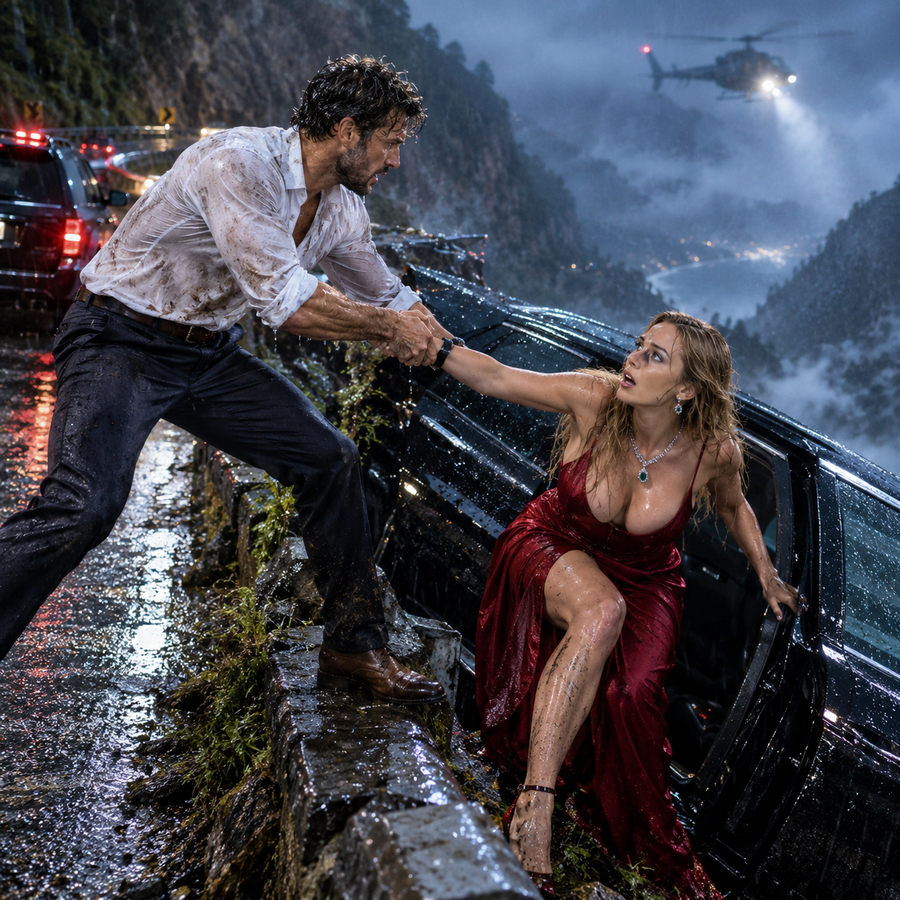
PART 3
When Marcus finished, Clare spoke. She was precise and unhurried and gave nothing to the emotional framing Marcus had constructed. No defense of her judgment. No response to the concussion implication. Nothing that would let the argument stay on the terrain Marcus had chosen. She moved directly to data. Okafor’s findings. The state weight restriction. The ODOT assessment team currently on site. The access log showing the Saturday night deletion attempt on the Meridian files. The document Walter Hayes had provided. And when she set the copies of the original Pacific West analysis on the table—12 copies, the same number as Tuesday, because she had anticipated this room requiring them—Eleanor Tran picked hers up and read it in the specific way of someone who understood exactly what they were reading.
Victor Olsen looked at his copy, then at Richard Davenport, then back at his copy. Gerald Cross said, “These are preliminary findings from an outside firm hired without—” “The findings are corroborated by ODOT,” Clare said, without looking up from her own materials. “The state of Oregon is currently assessing the bridge based on the same data. That’s not a preliminary outside finding anymore. That’s a state investigation.” Gerald stopped talking.
Marcus stepped back in. “The question before this board is not the bridge assessment. The question is whether the CEO followed proper governance procedures in—” “The question before this board,” Eleanor Tran said, and she said it quietly, without raising her voice, but the room stopped the way rooms stop when someone who has been silent suddenly speaks with complete authority, “is whether the CEO acted in a manner consistent with her fiduciary responsibilities to the company and to the public. Which includes,” Eleanor continued, still quiet, “whether the alternative—following internal procedures and allowing the company to manage a structural safety disclosure through its normal legal and communications apparatus—would have met that same standard.” The room was completely still. “I’d like to hear from Mr. Cole,” Eleanor said.
Mason had not expected to be invited to speak. He had prepared for it anyway, because the alternative—being caught unprepared in a moment that required precision—was not something he was willing to risk. He spoke for 18 minutes. He did not speak about himself. He did not speak about what had been done to him 15 years ago, except as technical context for why he had identified the specific failure mode and why his identification of it was credible.
He spoke about the bridge. He spoke about the anchor steel. He spoke about hydrogen embrittlement and freeze cycles and the specific progression of cracking and compromised high-strength bolt assemblies under repeated seasonal stress. He spoke about Okafor’s findings in the specific language of structural engineering. Not simplified. Not performed for a lay audience. And then he translated each point into plain terms with the unhurried clarity of someone who had been explaining technical things to non-technical people for 30 years.
He spoke about the original analysis. What it said. What it recommended. What had happened to it. He did not editorialize. He did not perform emotion. He presented the sequence of events the way you’d present a failure analysis. Cause, mechanism, progression, current state, projected outcome under different intervention scenarios. When he finished, the room was quiet for a long moment.
Then Gerald Cross said, “You have an obvious personal interest in the outcome of this investigation. How can this board rely on your—” “Mr. Cross,” Eleanor Tran said. And her voice had the same quiet authority as before, except this time there was something additional in it. The specific patience of someone making a point they expect to make only once. “Do you have a question about the engineering analysis? Or are you questioning Mr. Cole’s credibility on the basis of his personal history with this company?”
Gerald blinked. “I’m pointing out that—” “Because if you’re questioning his credibility,” Eleanor said, “I’d like to note that his personal history with this company includes being terminated following submission of a structural concern report that a 15-year-old document now indicates was accurate. Questioning his credibility on that basis would require this board to argue that being correct is a disqualifying characteristic.” She looked at him steadily. “I don’t recommend that argument.”
Gerald Cross did not finish his sentence. Victor Olsen looked at Richard Davenport. Richard Davenport was looking at Eleanor Tran with the expression of a man who has just realized that the room he thought he had arranged is not arranged the way he thought. Then Marcus Hale made a decision that Mason read immediately as a mistake, but which Marcus had apparently calculated differently. He said, “Mr. Davenport would like to address the board directly.” Eleanor said, “Of course.”
Richard stood. He spoke for nine minutes. Mason listened to every word with the specific attention he brought to things that mattered. Not passively, but actively tracking, looking for the load-bearing elements. Richard was good. He acknowledged the seriousness of the bridge assessment. He acknowledged the original analysis and described his decision-making process in 2009 with careful, measured language that positioned the substitute steel decision as a reasonable executive judgment made under genuine time and resource pressure, based on competing professional opinions.
He acknowledged that in retrospect he wished the decision had been different. He used the phrase “with the benefit of hindsight” twice. He did not acknowledge that he had known the original analysis was legitimate and had proceeded anyway. He did not acknowledge that a document had been made to disappear. He did not acknowledge that Mason Cole had told the truth and been destroyed for it. But he said all the right things around those omissions, in the right order, in the right tone. And Mason watched three of the board members—Olsen, Lee Morris, and Cross—visibly settle slightly as Richard spoke. Their postures easing by a degree. The specific physical relief of people who wanted a version of events that let them be comfortable and were being given one.
And then Mason did something he had not planned. He said, “Mr. Davenport.” Richard stopped. Everyone looked at Mason. “On Tuesday,” Mason said, “in the meeting with the state investigator, you said—and I want to be precise about the wording—you said the original analysis was legitimate, and you knew it was legitimate. Is that still your position?”
The room went absolutely still. Richard looked at him. The silence lasted four seconds, which is a very long time in a boardroom. “I acknowledged awareness of the preliminary analysis,” Richard said carefully. “You said it was legitimate,” Mason said. “Those were your words. Kevin Marsh was present. There is a recording.” Another silence. Shorter. “There’s a recording of that meeting?” Marcus Hale said. And his voice had changed in the specific way of someone recalculating.
“State Investigator Marsh conducts all formal interviews under standard ODOT recording protocol,” Clare said. She said it simply, without drama. The way you state something that was always true and that you knew would matter. “I assumed everyone’s legal teams were aware of that.” Marcus looked at his associates. Gerald Cross leaned toward Victor Olsen and said something very quietly. Richard Davenport sat back down. He did not speak again.
And in that silence, something shifted in the room. Mason felt it. The way you feel a structural change. Not always visible, not always audible, but present in the way the weight distributes differently, the way the load paths adjust. The three board members who had been settling into Richard’s narrative were no longer settling. Patricia Lee Morris looked at the table. Victor Olsen looked at the window. Gerald Cross looked at his hands. Eleanor Tran looked at Richard Davenport for a long moment. Then she looked at Clare.
“Miss Davenport,” she said. “The independent engineering assessment, the ODOT notification, the decision to bring Mr. Cole into the investigative process. Did you make those decisions because you believe they were in the best interest of the company and the public?” “Yes,” Clare said. “And did you make them knowing they would create significant personal and institutional difficulty?” “Yes.” Eleanor nodded once. Then she looked at the board. “I’d like to move to a closed session,” she said. “Principals only. Thirty minutes.”
Mason and Walter, who had sat quietly through the entire proceeding, gathered their materials and moved to the hallway. Marcus Hale and his associates followed. Okafor, who had come prepared to present technical detail and had ultimately not been needed, gave Mason a brief look that communicated several things efficiently and then went to find coffee. In the hallway, Walter stood beside Mason and said nothing for almost five minutes. Then he said, “The recording?” “Yes,” Mason said. “Did you know about it?” “Clare mentioned the ODOT recording protocol on Monday night,” Mason said. “I didn’t say anything in the room because I wasn’t sure whether she’d decided to use it. I didn’t want to step on whatever she had planned.” “She didn’t plan it,” Walter said. “You could see it on her face. She said it because it was true and it needed to be said.”
Mason thought about that. “Sometimes those are the same thing,” he said. Walter looked at him with the expression of someone who has lived long enough to know that wasn’t always true, but understood this was not the moment to say so.
The closed session lasted 41 minutes. When the boardroom door opened, Eleanor Tran came out first. She found Mason in the hallway and stood in front of him with the direct, unperformed attention of someone who had decided to be precise. “I want you to know,” she said, “that the vote was 4 to 3 to retain the current CEO and endorse the independent investigation.” Mason nodded. “I want you to also know,” she said, “that it was not my vote that made the difference.” He looked at her. “Victor Olsen,” she said. “He changed his vote during closed session.” She paused. “He said he’d driven across Redwood Pass last Thanksgiving with his grandchildren in the car.”
Mason was quiet for a moment. “Turns out 9,000 vehicles a day isn’t an abstraction,” he said. “No,” Eleanor said. “It isn’t.” She looked at him steadily. “Your disciplinary record is going to be formally reviewed as part of the investigation. I want you to know that I intend to ensure that review is genuinely independent.” “Thank you,” he said. “Don’t thank me,” she said. “You told the truth 15 years ago. The least the institution can do is be honest about that.” She paused. “The least.” Then she went back into the boardroom, and Mason stood in the hallway and Walter put a hand briefly on his shoulder without saying anything, which was the right thing to do.
Clare came out 12 minutes later. She found Mason by the elevator. She looked, for the first time since he’d met her, like someone who had put down something heavy and was still processing the feeling of not carrying it. “Four to three,” he said. “Four to three,” she said. “Olsen.” “Olsen.” She shook her head slightly. “I spent 48 hours modeling every possible argument for every possible board member, and I never once thought about Victor Olsen’s grandchildren.” “The data is more persuasive when it’s personal,” Mason said.
She looked at him. “You could have brought up the recording yourself. At any point in that meeting.” “It was your meeting,” he said. “You knew about it.” “I knew it existed,” he said. “I didn’t know whether you’d decided to use it, and it wasn’t mine to decide.” She held his gaze. “Why?” Just that. Just the one word, carrying everything underneath it. Why help? Why trust? Why continue to give the benefit of the doubt to a family that had taken 15 years from him?
He thought about the honest answer. “Because the bridge needed to be fixed,” he said. “And because you were the person who could fix it. And because I’ve spent enough time being the man who told the truth and then stood outside the room. I didn’t want to be the reason you didn’t have what you needed inside it.”
She looked at him for a long moment. Then she said, “My father is going to be suspended pending investigation. Marcus told me in the session. He accepted it.” She paused. “I think he’s tired.” “Fifteen years is a long time to hold something,” Mason said. “He didn’t carry it the way you carried it,” she said quietly. “No,” Mason said. “He carried it differently. But it was still weight.” He paused. “That’s not forgiveness. I’m not there yet. Maybe I won’t be. But it’s something.”
She nodded slowly. The elevator came. Neither of them moved toward it immediately. “My communications team is going to need to release a statement by end of day,” she said. “About the investigation, the bridge, my father’s suspension.” She looked at him. “Your name is going to be in it. The public version of what happened. Is that all right?” He thought about Emma. About the school bus. About the specific thing a 12-year-old girl inherits from a story about her father. “Yes,” he said. “That’s all right.”
The elevator closed without them. “What do you want?” she said. “After this. After the investigation closes and the record is corrected and the bridge is fixed. What do you actually want?” It was the most direct question she had asked him, and she had asked him several direct questions. He understood that she was not asking about money or position or the formal remedies that corporate investigations produce. She was asking something more specific than that.
He thought about what he’d told Walter on the drive down. He thought about Emma asking him if he was angry. He thought about 15 years of generators and wiring harnesses and mountain resorts and a daughter who had grown up watching him be exactly what he was instead of what he might have been, and how those two things were not, in the end, as separable as he’d once believed. “I want the next engineer who finds something wrong to have somewhere to go with it,” he said. “A structure that protects them instead of protecting the project. Something built into the institution, not dependent on whether the right person is CEO or whether the board happens to have someone like Eleanor Tran.” He paused. “I want the thing that happened to me to be the last time it happens that way in this company. At least.”
She looked at him for a long moment. “That’s a bigger ask than a job offer,” she said. “I know,” he said. “I’m going to need you to help me design it,” she said. “The structure. Whatever it looks like. I don’t know enough about where the failure points are, not from the inside. I need someone who found them from the outside.” “I know where the failure points are,” he said. “I know you do.” She paused. “Will you?”
He thought about it. He genuinely thought about it, the way he thought about things that mattered. Not performatively, not with a planned answer waiting behind the consideration, but actually sitting with the question and letting it find the right place. “Yes,” he said. “But not as an employee. I’ll consult. I’ll help design the framework. But I go home to Pine Hollow at the end of the day. I keep my business. I keep my truck.”
“You keep your truck,” she said. “The truck works,” he said. She almost smiled. This time she let it reach her eyes. “Okay,” she said. “The truck stays.” The elevator came again. This time they got in. They rode down together in silence through 14 floors, and in the lobby they parted. She went toward the executive entrance, where Daniel was already waiting with a tablet and the beginning of what would clearly be a very long afternoon. And he went toward the parking structure, and the city moved around both of them with its ordinary indifference.
His phone buzzed before he reached the truck. A text from Emma. “How’d it go?” He smiled. She had known, without being told, that today was the day something would conclude or fail to conclude. The way she knew things—quietly, without announcement, with the specific receptive attention of a kid who had grown up watching her father navigate the world with care. He typed back. “It went.” Her reply came fast. “Did the truth win?” He thought about Eleanor Tran. About Victor Olsen and his grandchildren. About Walter Hayes and a manila envelope in the center of a kitchen table. About a 4-to-3 vote in a room he hadn’t been allowed to stay in. He typed, “It’s getting there.” Her reply: “Good enough for today.”
He looked at the message. He thought about the bridge, where ODOT engineers were currently measuring the extent of something that had been developing in the dark for 15 years and was now finally in the light, where it could be addressed. He typed, “Good enough for today.” He got in the truck. He sat for a moment. The parking structure was quiet. The city sounds muffled. The late morning light coming in at an angle through the concrete levels. He started the engine. He drove toward Route 26, toward Pine Hollow, toward the mountain roads he’d been driving for 15 years.
Past the exit for Lake Oswego, past the Tualatin Valley junction, up into the foothills where the trees got thick and the road got narrower and the city fell behind and the mountains opened ahead of him. He drove past the new guardrail on the cliffside bend. He didn’t slow down. He didn’t look at it. He kept going, because that was always what you did. You kept going.
And somewhere behind him, in the basement records of the Davenport building, a 15-year-old personnel file was being flagged for formal review by an independent investigator who had been selected by Eleanor Tran and who answered to nobody with a financial interest in the outcome. And somewhere south of Portland, Walter Hayes was driving home to Milwaukie with the manila envelope empty on the passenger seat, and whatever he was feeling as he drove, Mason suspected it was lighter than anything he’d felt in a very long time.
And in a corner office on the 14th floor, Clare Davenport was sitting across from her communications director with a draft statement on the table between them, and she was crossing out the careful language and the managed phrasing and the institutional hedging, word by word, replacing each one with something simpler and truer. Because she had decided, somewhere between the boardroom and the elevator, that the era of careful management of inconvenient truths was over, and the era of just saying what was true was going to have to start today. Right now. In this draft. Because it had to start somewhere.
And the bridge stood over its gorge, carrying its weight, cracking in the dark in the specific places where a 28-year-old engineer had pointed 15 years ago and said, “Here. This is where it will fail.” But now there were people on the bridge with instruments. Now there were people who knew where to look.
The statement went out at 4:17 in the afternoon. Clare had rewritten it three times. The first version her communications director had prepared read like every corporate statement reads. Measured, hedged, architecturally designed to convey accountability while actually conveying as little specific information as possible. The second version she wrote herself in 40 minutes was too personal, too raw, the kind of statement that a lawyer reads and immediately circles 17 phrases with a red pen. The third version was what actually went out. And it said, in plain language, three things that corporate statements almost never say plainly. What had happened. Who was responsible. And what was going to be done about it.
It named Mason Cole. It described what he had found in 2009, what had been done to his report, and what the current Meridian assessment had confirmed. It used the word “suppressed” in reference to the original Pacific West Laboratory analysis. It announced Richard Davenport’s suspension pending independent investigation. It announced the emergency reinforcement program for Redwood Pass and a comprehensive safety review of the company’s historical materials documentation processes. And it contained one sentence that her communications director had argued against three times and that Clare had kept all three times.
“The engineer who identified this structural risk 15 years ago told the truth, and this company failed to hear it. That failure had a cost, and acknowledging it honestly is the beginning of addressing it.”
By six in the evening, the statement had been picked up by every major Pacific Northwest outlet and was spreading nationally. By eight, cable news had the story. By 10, the Davenport Infrastructure Group stock dropped 11% in after-hours trading, which was the specific number that told Clare the market had processed the disclosure as serious rather than manageable. She was still at her desk at 10:30 when her phone rang. It was a number she didn’t recognize. She answered it.
“Miss Davenport,” a man’s voice said. Older. Careful. “My name is Arthur Reyes. I was a project foreman on the Redwood Pass job in 2009. I saw your statement tonight.” She sat forward. “Mr. Reyes.” “I need to tell you something,” he said. “Something I’ve needed to tell someone for a long time.” He paused. “I was there the day they told Mason Cole to clean out his office. I was on the site. I knew what he’d found. I knew it was real.” Another pause. “I said nothing. I had three kids and a mortgage, and I said nothing.”
Clare was very still. “I’m not asking for anything,” Arthur Reyes said quickly. “I’m not. I just—I saw that statement. I saw his name in it, and I needed somebody to know that there were other people who knew and stayed quiet. And I’m one of them. And I’m sorry.” His voice broke slightly on the last word. Not dramatically. Just the small, honest fracture of someone delivering something they’ve been carrying for a long time. “I just needed to say it to someone at your company. That’s all.”
She sat with the phone for a moment. “Thank you for calling, Mr. Reyes,” she said. Genuinely. After she hung up, she sat in the quiet office for several minutes. Arthur Reyes was not going to change the legal outcome. He was not a key witness. His call would not alter the investigation’s trajectory. But he had called at 10:30 at night because a statement had told the truth plainly, and the truth had found the people it belonged to.
She texted Mason. “A project foreman from 2009 just called. He said he knew you were right and stayed quiet. He apologized.” The reply came back in four minutes. “How many more are out there who knew?” She looked at the message. She didn’t have an answer for it. She typed, “I don’t know. But they’re hearing it now.” His reply: “That’s something.”
She set the phone down. Then she picked it up again and typed one more line. “Your name is cleared in the public record. How does that feel?” She waited. Almost eight minutes passed. Then: “Ask me when Emma reads the statement.” She set the phone down and didn’t write back, because there was nothing to add to that.
Three weeks passed. The ODOT assessment concluded that the eastern anchor clusters at Redwood Pass required immediate structural intervention. The bridge was closed to through traffic while emergency shoring was installed and the replacement anchor assembly procurement process began. Local media covered the closure extensively. The state transportation director gave a press conference in which he described the disclosure process as an example of the kind of institutional transparency that public safety infrastructure required. Which was the kind of sentence that sounds like a compliment and also functions as a pointed observation about how rarely it happens.
The independent investigation into Davenport Infrastructure’s 2009 decision-making was formally opened by a three-person panel appointed by Eleanor Tran. The panel had subpoena power. The panel had no Davenport affiliates. The panel’s findings would be made public. Richard Davenport retained his own legal counsel, separate from the company’s.
Mason’s disciplinary record was formally reopened on a Thursday morning. The investigator assigned to the review was a retired Oregon engineering board member named Catherine Woo, who had the reputation of being thorough in a way that occasionally annoyed everyone involved. She called Mason on a Wednesday and told him she’d need his original documentation from 2009. Whatever he still had. He had all of it. He’d kept every email, every memo, every dated note from site meetings, every version of the structural concern report he’d submitted. He’d kept them in a filing box in his garage for 15 years. Not because he thought they’d ever matter. But because throwing them away had felt like agreeing with the story the company had written about him, and he’d never been willing to agree with that story.
He drove a copy of the complete file to Catherine Woo’s office in Salem on a Friday morning. She met him at the door and shook his hand and said, “I should tell you upfront, this kind of review typically takes 60 to 90 days.” “I’ve waited 15 years,” he said. “Sixty days is fine.” She looked at him over her reading glasses. “Forty-five,” she said, “if your documentation is as complete as you’re suggesting.” “It’s complete,” he said.
It took her 38 days. The formal finding arrived on a Tuesday, by certified mail, which Emma happened to be home for because it was a teacher in-service day, and she’d been watching television in the living room when the mail carrier knocked. She brought the envelope to Mason in the garage, where he was in the middle of rewiring a circuit board for one of the resort’s older lift systems. “It’s from the Oregon State Engineering Board,” she said.
He set down the circuit board. He looked at the envelope. He’d been waiting for this specific piece of mail for 38 days and, in a different way, for 15 years. He understood, rationally, what it was going to say, because Catherine Woo had called him the Friday before to tell him the finding was being finalized and he should expect the official notification early the following week. He knew what it contained. He still sat with it in his hands for almost a full minute before opening it.
Emma sat down on an overturned milk crate in the corner of the garage and waited. She did not tell him to hurry. She did not ask what it said. She just sat with him in the specific way she’d learned to sit with him over 12 years. Present. Quiet. Giving him the space to be exactly what he was in whatever moment he was in. He opened it. He read it.
The language was formal and careful and institutional, the way official findings always are. But the substance of it was simple and plain. The 2009 disciplinary action against Mason R. Cole had been based on documentation that was incomplete. The finding of conduct violation was unsupported by the available evidence. The disciplinary notation was formally expunged from his professional record. His engineering license was eligible for reinstatement upon completion of a standard continuing education update. Given the 15-year gap, his professional record was clean. He read it twice. Then he set it on the workbench and looked at it.
Emma said, “Dad.” “Yeah,” he said. “What does it say?” He looked at her. His 12-year-old daughter, sitting on a milk crate in his garage, with his eyes and her mother’s patience and 15 years of watching him be exactly who he was. “It says I was right,” he said. She looked at him for a moment. Then she said, “I knew that.” He almost laughed. He didn’t quite. But it was close. “I know you did,” he said.
“Does it feel better? Having it official?” He thought about it honestly, the way he thought about things that Emma asked, because she had a way of asking that made evasion feel disrespectful. “Yes,” he said. “It’s better.” “Good,” she said, with the flat certainty of someone who had made a decision about something and was satisfied to have it confirmed. Then she got up from the milk crate. “I’m going to make sandwiches. Do you want a sandwich?”
He looked at his daughter. “Yeah,” he said. “I want a sandwich.” She went inside, and he sat in the garage with the letter on the workbench and the circuit board to his left and the truck out front and the mountain air coming through the open bay door. And he felt something settle in him that had been unsettled for a very long time. Not dramatically, not with ceremony. Just settling, the way a structure settles when the right load paths are finally carrying the right weight.
He picked up his phone and called Clare. She answered on the second ring. “The letter came,” he said. A brief silence. “And?” “Expunged,” he said. “Clean record. License eligible for reinstatement.” He heard her exhale. It was a longer breath than she’d intended to let out. He could tell. The specific sound of someone who has been holding tension without quite admitting it. “Mason,” she said. “I know,” he said. “I’m glad,” she said. And then, after a pause, “I’m sorry it took 15 years for the right people to read the right documents.” “The documents were always right,” he said. “The people took some time.” She made a sound that was almost a laugh. Almost.
“I need to ask you something,” she said. “And I need you to take it seriously.” “Okay.” “The Independent Safety Division,” she said. “We’ve been working on the framework for six weeks. Eleanor Tran is chairing the oversight committee. We have the board authorization. We have the budget structure. We have the reporting chain.” She paused. “I need someone to design the actual technical protocols. The inspection standards, the escalation procedures, the documentation requirements that make it impossible to make a report disappear the way yours was made to disappear.” Another pause. “I need someone who knows exactly where the system fails because they were the failure point.”
Mason was quiet for a moment. He thought about what he’d told her in the parking structure. About going home at the end of the day. About keeping the truck. “Still on those terms,” he said. “Still on those terms,” she said. “You design it. You consult on implementation. You go home to Pine Hollow. No title, no office on the 14th floor. Consulting contract renewable annually, with a clause that says you can walk away if you ever think the division is being compromised.” “Who reviews the division?” he said. “Eleanor Tran’s committee. Independent of executive leadership.” “Who appoints the division’s lead engineer?” “The committee. Not the CEO. Not even you.” “Not even me,” she said. “That was your requirement. I’m honoring it.”
He sat with that. “You understand why that requirement matters?” he said. “Because the problem 15 years ago wasn’t just that my father made a bad decision,” she said. “It was that he was in a position to make that decision unilaterally and then manage the consequences of it internally. The safety division has to exist outside of that possibility. It has to be structurally impossible for a CEO or a board or an executive with a merger deadline to quietly redirect it.” She paused. “I understand. I designed the governance structure around that understanding.”
“Okay,” he said. “Okay, you’ll do it.” “Okay,” he said. “I’ll do it.” She exhaled again. This time she didn’t try to contain it. “Thank you,” she said. “Don’t thank me,” he said. “I’m doing it for the next engineer. Not for you.” “I know,” she said. And the way she said it told him she had understood that from the beginning, and that it was, in some specific way he couldn’t quite name, the reason she trusted him.
He hung up. He looked at the letter on the workbench. He looked at the circuit board. He picked up the circuit board and went back to work.
The winter came early to the Cascades that year. The first significant snowfall hit Pine Hollow in late October, which was early even by mountain standards. And by November, the ski resort was operating ahead of schedule, and Mason was the busiest he’d been in years. The lift systems needed attention. The generator units needed calibration for the cold-weather load cycles. The mountain lodges were booking ahead. He worked. He drove Route 26. He made Emma’s lunches and attended her school events and helped her finish a science fair project. Not the water filtration model, which had been completed two months earlier, but a new one about structural load distribution in bridge design, which she had chosen independently, and which she presented with the specific confidence of a kid who has had access to a primary source.
Her teacher gave her the highest grade in the class and asked where she’d gotten her research materials. Emma had said, “My dad.” Mason found out about this secondhand, from the teacher, who had emailed to say she’d been impressed by the technical depth of Emma’s project and wondered if Mason might be willing to talk to the class about structural engineering. He said yes. He drove to the school on a Thursday in November and spent 45 minutes talking to 22 seventh graders about how bridges work, what makes them fail, and why the people who find problems are just as important as the people who build the solutions.
The kids asked better questions than most adults he’d briefed. One boy in the back asked what you do when you find a problem and nobody wants to listen. Mason thought about it. “You document everything,” he said. “You keep every note, every email, every date, every conversation. You find the people who can verify what you found. And then you keep going.” He paused. “The truth doesn’t expire. It’s still true in 15 years. It’s still true when the right person finally reads the right document.”
The boy in the back wrote something in his notebook. Mason drove home and thought about the fact that this was possibly the most useful thing he’d done all week, which was not a small thing, given the week.
In December, Redwood Pass reopened. The replacement anchor assembly installation had taken six weeks. The new steel was the correct specification, properly certified, independently tested, with a chain of custody documentation trail that would survive any future audit. The eastern span had been completely re-anchored. The load distribution had been recalibrated. The safety margin was restored to the original design specification and then exceeded.
The reopening was covered by every major Oregon news outlet and several national ones. Given the story that had preceded it, ODOT organized a brief ceremony. The transportation director, two state senators, the lead Meridian engineer. Clare Davenport was there. Eleanor Tran was there. The independent investigation was still ongoing, but its preliminary findings had already been released, and those findings were not gentle.
Mason almost didn’t go. He’d been planning to watch the reopening on the news. It was a Tuesday. He had a generator job at the resort. Emma had school. He had approximately 47 reasons to simply let the moment be what it was without needing to stand in it personally. Clare called him the night before. “You need to be there,” she said. “The bridge doesn’t need me there to reopen,” he said. “No,” she said. “But I think you need to be there.” And she paused. And for once, she didn’t manage the pause. She just let it sit. “I think you’ve earned the right to stand on a bridge you told the truth about.”
He didn’t answer immediately. “Emma has school,” he said. “It’s at nine in the morning,” she said. “You can drop her off and still make it.” Another pause. “The truck will make it,” he said finally. “I know the truck will make it,” she said. “Will you?” “Yeah,” he said. “I’ll be there.”
He was there. He stood at the edge of the group during the ceremony, slightly apart from the official cluster, in his work jacket with his hands in his pockets, watching the transportation director say the right things in the right order about safety and transparency and institutional accountability. The words were good words. He didn’t doubt the speaker meant some of them more than others. But that was true of everyone. After the ceremony, after the cameras, after the handshakes and the ribbon and the first convoy of vehicles cleared to cross, Clare found him.
They stood together at the railing. The new railing, properly installed, properly bolted, and looked at the gorge below. The Deschutes River, 400 feet down, running fast and cold in December. Neither of them spoke for a moment. “The plaque is inside the project office,” she said. “Do you want to see it?” “What does it say?” “The new inspection protocols. The documentation standards. The escalation requirements.” She paused. “Your name isn’t on it.” “Good,” he said. “The framework is named the Cole-Hayes Safety Standard,” she said quietly. He looked at her. “Walter’s name, too,” she said. “Eleanor insisted. A man who spent 15 years carrying the truth deserved to have his name on the system built to make sure the next person doesn’t have to carry it that long.”
He looked back at the gorge. Walter Hayes had died six weeks earlier. Peacefully. His daughter had told Mason by phone, which was the word people used, and which Mason chose to believe, because Walter had made his peace with something real before he went. He had not died carrying the weight he’d arrived with. He had died having set it down in a room where it mattered. That was not nothing. That was, in fact, considerably more than nothing.
“He would have said it was too much,” Mason said. “He would have said it with that specific dry tone,” Clare said, “and then been privately glad.” Mason nodded. They were quiet for another moment. Then Clare said, “I need to tell you something. And I want to say it here. Not in an office, not over the phone. Here.” He waited. “When you climbed down after me,” she said, “I thought you were reckless. I thought you were—I didn’t know what you were. Someone trying to be a hero. Someone who didn’t fully understand the risk.” She paused. “And then you got me up the slope, and you looked at me the way you look at a problem you’ve solved. And I realized you had understood the risk completely and gone anyway. And that was different.”
She looked at the gorge. “I’ve been thinking about that for three months. What it means to see the risk clearly and go anyway. Not because you don’t feel it. Because the alternative is worse.” He listened. “I spent years learning to manage risk,” she said. “Quantify it, mitigate it, distribute it across enough variables that it became someone else’s problem. That’s what my father taught me. That’s what I thought leadership was.” She paused. “You didn’t manage the risk. You held it and went toward it anyway. And I’ve been trying to figure out how to do that. How to be the kind of person who does that.”
“You filed with ODOT on Monday,” he said. “You knew what it would cost you, and you filed anyway.” “That was easier,” she said. “That was a document. That was a process.” “It was your career and your family,” he said. “Yes,” she said, “but it wasn’t a cliffside in a rainstorm.” “No,” he agreed. “It was harder. The cliffside was 60 seconds. The other thing took three months.”
She looked at him. “Don’t do that,” she said. “What?” “Make it sound like what I did was comparable to what you did 15 years ago.” And then he looked at her steadily. “Fifteen years ago, I didn’t have a choice that felt like a choice. The truth was just true, and it needed to be said. I wasn’t brave. I was just the person who happened to be standing there when the analysis came back.” He paused. “Three months ago, you had every option available to you to manage this quietly and preserve everything you’d built. You had lawyers and a communications team and board members who were ready to help you frame it as someone else’s problem.” He held her gaze. “That was a choice.”
She was quiet for a moment. “We’re not very good at accepting from each other,” she said. “No,” he said. “Maybe we should work on that.” “Maybe,” he said. The river moved below them. The convoy of reopened traffic moved across the span above their heads. Each vehicle a small, ordinary weight on the new steel, on the properly anchored structure, on the bridge that had finally been fixed.
Clare said, “What happens now? For you?” “I go back to Pine Hollow,” he said. “I finished the generator job at the resort. I help Emma with whatever project she has due next. Knowing her, it’s already been started, which is new. So apparently the science fair situation was a learning experience.” He paused. “I start working on the safety standard protocols. Catherine Woo’s office has a meeting in January about potential license reinstatement. And the resort manager asked me last week if I’d consider taking on some structural consultation for their expansion project.” “Are you going to?” “Probably,” he said. “It’s honest work. And it needs doing.”
She smiled. Not the careful professional version. The real one, which he’d seen exactly three times and which was, he’d noted, considerably warmer than its managed counterpart. “You’re a frustrating person to offer things to,” she said. “I know,” he said. “But I think you’ve figured out that that’s part of why you can trust me.” She looked at him. The smile stayed. “Yes,” she said. “I have.”
They stood at the railing a while longer. The morning was cold and clear, and the mountains were visible in every direction the way they get in December, when the air has been washed completely clean. Below them, the river kept moving. Indifferent and constant, doing what rivers do, regardless of what happens on the structures above them.
Eventually, Clare said, “I should get back to Portland. The investigation team has a briefing at two.” “I’ve got a generator that’s been waiting since yesterday,” he said. “The truck will make it back,” she said. “The truck always makes it back,” he said. She laughed. Actually laughed. Briefly. The way people laugh at things that aren’t quite jokes but land like them. Because the moment is right.
She turned and walked back toward the cluster of vehicles on the road shoulder. Mason stayed at the railing a moment longer. He looked at the bridge. The new steel. The load was distributed correctly. The anchors were doing what anchors were designed to do, because this time the right materials had been installed in the right locations by people who had checked their work against specifications that existed. Because someone, 15 years ago, had understood what the wrong materials would do.
He thought about Walter Hayes. He thought about Arthur Reyes, calling a CEO at 10:30 at night to say he’d stayed quiet when he shouldn’t have. He thought about Victor Olsen’s grandchildren. He thought about Emma, at school right now, in a seventh-grade classroom somewhere in Pine Hollow, probably working on whatever came after the bridge project. Building things. Thinking things through. Carrying the specific inheritance of a kid who grew up watching her father tell the truth even when the truth was inconvenient, and the people who needed to hear it weren’t ready to listen.
He thought about the boy in the back of that classroom who’d asked what you do when you find a problem and nobody wants to hear it. You document everything. You find the people who can verify what you’ve found. And you keep going. He pushed off the railing. He walked back to the truck. He drove north on Route 26, into the mountains, toward Pine Hollow and the generator job and the wiring harness that needed replacing, and the daughter who would be home at 3:15, and the ordinary, particular work of a life that had been undeniably, indelibly, permanently his.
The bridge stood behind him, carrying its load. The truth, long buried in a box in a garage in Milwaukie, long suppressed in a document that should have been read and wasn’t, long carried by a man who had refused to set it down even when setting it down would have been so much easier—that truth had finally found the place it belonged. Not in a headline. Not in a legal finding. Not in a plaque on a wall with his name on it. In 9,000 vehicles crossing safely every day. In a 12-year-old girl who knew her father had told the truth. In a system built to make sure the next engineer who found something wrong had somewhere to go with it. In the specific, unshakable fact that the crack in the steel had been found, and the steel had been replaced, and the bridge was holding.
