Single Dad Sat Alone at a Wedding — Until a Billionaire Woman Walked Toward Him (Part 1)
Single Dad Sat Alone at a Wedding — Until a Billionaire Woman Walked Toward Him (Part 1)
PART 1
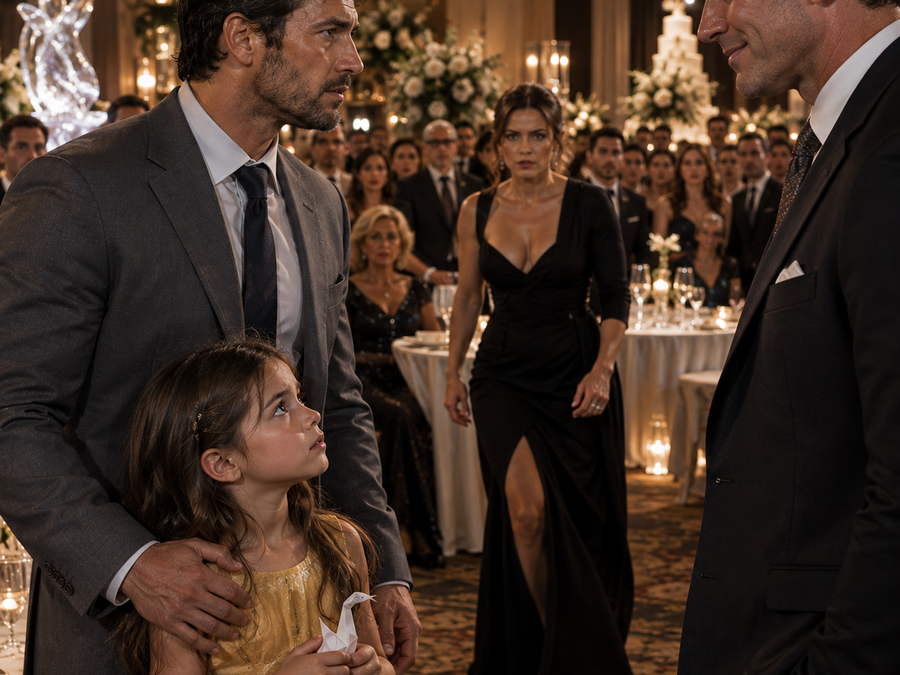
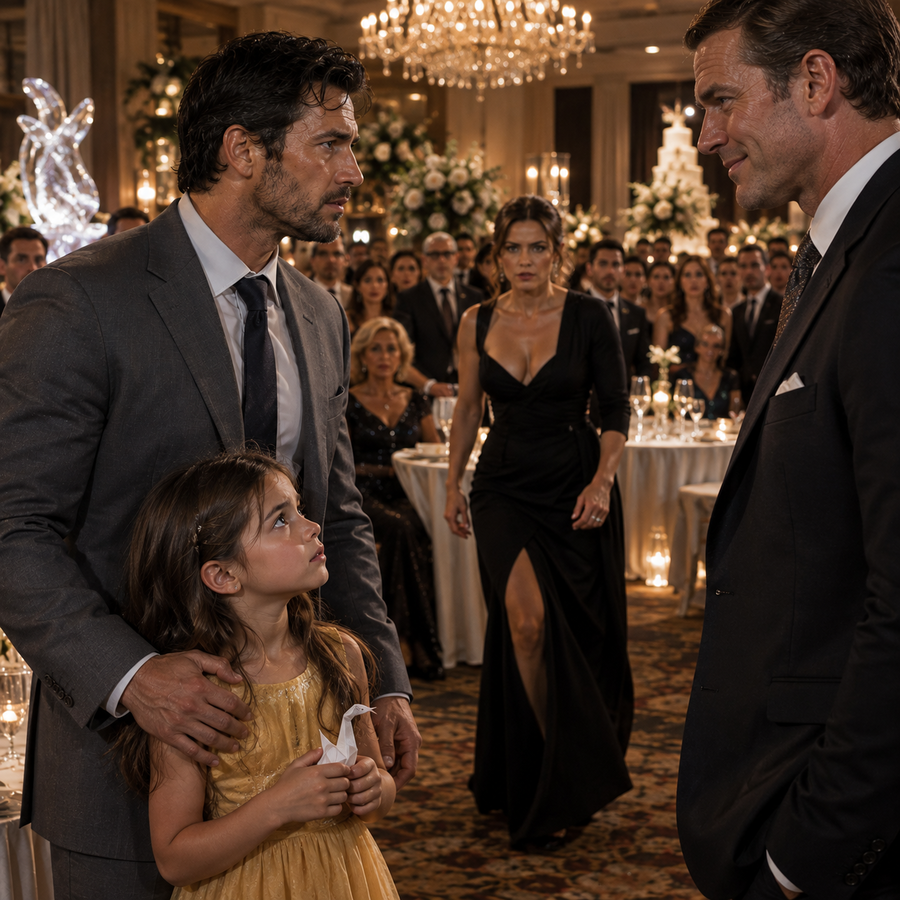
Daniel Hayes ripped the wine glass out of the rich man’s hand and slammed it down so hard the whole table jumped because that man had just called his six-year-old daughter a charity case loud enough for 200 guests to hear. The room went dead silent. Every millionaire in that hall turned to stare at the single father in the borrowed gray suit. And that’s the exact moment a billionaire named Victoria Sterling, a woman who never spoke to anyone beneath her, pushed back her chair and started walking straight toward him. But here’s what nobody in that room knew before the night ended. One of these two strangers would hand the other something worth more than every dollar under that roof.
Daniel Hayes had not raised his voice in three years. Not once. Not when the bank called about the second mortgage. Not when his boss took credit for a design that had kept him up for six straight nights. Not even when he stood at the edge of a grave that swallowed the only woman he had ever loved. He had learned to fold his anger into a small, hard square and tuck it somewhere behind his ribs where nobody could see it. So when the glass hit the table and the sound cracked across the reception hall like a rifle shot, even Daniel was surprised at his own hand.
“Say it again,” Daniel said. His voice was quiet. That was the frightening part. It wasn’t loud. It was steady and it was cold. “You said, ‘What about my daughter?'”
The man across from him was tall, tan, and dressed in a suit that cost more than Daniel’s car. His name was Preston Vain, and he was the kind of man who had never in his life been told to sit down. He looked at Daniel’s hand, still pinning the glass to the linen, and he smiled the way a man smiles when he has never once been hit in the mouth.
“Relax, friend,” Preston said. “I said she’s adorable. A little charity case in a party dress. It’s sweet. Really. Somebody at this wedding actually needs the free food.”
There were maybe 15 people close enough to hear it clearly. Daniel heard every syllable land. And behind Preston, half a step back, holding a napkin she had folded into a tiny paper swan, stood Lily. Six years old. Wearing the yellow dress Daniel had ironed himself at midnight because he didn’t own an iron and had to borrow one from the neighbor.
She had heard the words. Daniel could see it in her face. The way her little smile had frozen. The way her eyes had gone to the floor. The way she was already trying to make herself smaller because she thought she had done something wrong. That was what broke him. Not the insult to himself. He had absorbed a thousand of those. It was watching his daughter learn in real time that some people would look at her and see less.
“Lily,” Daniel said, not taking his eyes off Preston. “Come here, sweetheart.”
She came around the table quickly and pressed herself against his leg. Daniel let go of the glass. He crouched down to her level, right there in front of everyone, and he put both hands on her shoulders.
“You did nothing wrong,” he told her. “You hear me? Nothing. That man is confused about something and it isn’t you.”
“Daddy, is he mad at us?” she whispered.
“No, baby. He’s just not very happy inside. And people who aren’t happy inside sometimes say ugly things so other people feel as bad as they do.” He tucked a strand of hair behind her ear. “But we don’t do that, do we?”
“No.”
“That’s my girl.”
He stood back up. And now the whole room was watching, because word of a scene travels faster than any music. And the band had trailed off, and even the bartender had stopped pouring. Daniel felt 200 faces turn toward him, waiting to see what the man in the cheap suit would do.
“You know what, Preston?” Daniel said. “I’m going to thank you.” Preston blinked. “Thank you for showing my daughter exactly what she should never grow up to be.”
Daniel picked up his own untouched glass of champagne, the one he had been holding all night like a prop, and he set it gently in Preston’s hand. “You look thirsty. Here. On the house.” And he took Lily’s hand and turned to walk away.
Which is when the second thing happened. The thing that changed the entire trajectory of Daniel Hayes’s life. A voice cut across the hall. Clear, precise, used to being obeyed.
“Preston.”
Every head turned, because everyone in that room knew that voice. And everyone in that room knew what it meant when Victoria Sterling used your name like a blade.
She was already on her feet. Forty-one years old. Black dress. No jewelry except a single band she never explained to anyone. She ran a holding company that touched three industries and 11,000 employees. And she had a reputation, carefully earned, of being impossible to move. People had described her in the business press as glacial. One columnist had famously written that Victoria Sterling had the warmth of a bank vault and the patience of a tax audit.
Right now, she was walking straight down the center of the reception hall. Past the ice sculpture. Past the cake. Past a hundred people who had spent years trying to get five minutes of her attention and never once succeeded. She wasn’t walking toward Preston. She was walking toward Daniel.
“Miss Sterling.” Preston started straightening his jacket, arranging his face into the smile he used on people who could help him. “I didn’t realize you were—”
“You’re going to leave,” Victoria said. She didn’t even look at him. She was looking at Lily now. “And you’re going to do it quietly, because the only thing worse than being cruel to a child at a wedding is being remembered for it. And I have an excellent memory, Preston. Ask anyone whose contract I’ve reviewed.”
The color went out of Preston’s face. He opened his mouth, closed it, and then—because a man like that always finds a way to protect himself—he laughed, set the champagne glass down, and walked off toward the exit, muttering something nobody could hear.
Then Victoria Sterling, the woman who did not talk to people who left charity galas early, who had once made a senator wait 90 minutes and then rescheduled, crouched down in front of a six-year-old girl in a borrowed yellow dress.
“That,” she said to Lily, “is the most beautiful paper swan I have ever seen. Did you make that yourself?”
Lily nodded, wide-eyed, still half hidden behind her father’s leg.
“Would you teach me? I run a very large company and I cannot fold a napkin to save my life. It’s embarrassing, honestly.”
And Lily, who a moment ago had been shrinking into the floor, giggled.
Daniel didn’t know what to say. For three years, his whole existence had been about protecting this little girl from a world that kept taking things away from her. And he had spent that entire time believing he had to do it alone. Because that’s what happens when the person who was supposed to help you carry the weight is gone. And now a stranger—a stranger worth more money than he could imagine—was on her knees on the ballroom floor making his daughter laugh.
“Thank you,” Daniel managed. “You didn’t have to do that.”
Victoria stood back up, and for a moment they simply looked at each other, and something passed between them that neither of them could have named yet. Recognition, maybe. Two people who had learned to survive by making themselves invisible, standing in the middle of a crowded room, suddenly seen.
“No,” Victoria said. “I didn’t have to. But I’ve spent a very long time in rooms full of people like Preston Vain, and I’ve noticed something.” She glanced back toward the exit where he had gone. “The ones who need the most to feel big are usually the ones who feel smallest inside. You said it better than I could have, actually. To your daughter.” She paused. “I’ve never heard anyone explain cruelty to a child so kindly.”
“She’s six,” Daniel said. “She’s going to run into a lot worse than that man. I’d rather she learns now that it says more about them than her.”
Victoria studied him for a long moment, and then she said something that Daniel would remember for the rest of his life, though he didn’t know it yet. “Where did you learn to be so calm?”
He almost laughed. “I’m not calm, ma’am. I’m just tired.”
Rewind six hours, and Daniel Hayes had not wanted to come at all. The invitation had sat on his kitchen counter for two weeks, propped against the salt shaker, and every time he walked past it, he thought about the same thing. Weddings. His brother Michael was getting married on a lakeside estate that Daniel could never afford to rent for a single hour, to a woman whose family owned half the marinas in the state. It was going to be beautiful, and that was exactly the problem.
“You’re not going,” Michael had said on the phone three weeks earlier. It wasn’t a question. Michael knew his brother.
“I didn’t say that.”
“You didn’t have to. I can hear you not saying it.” A pause. “Danny, it’s my wedding.”
“I know it’s your wedding.”
“I want my brother there.”
Daniel had closed his eyes. “Weddings are hard for me, Mikey. You know that.”
There was a long silence on the line. Michael was four years younger, and for most of their lives, Daniel had been the one taking care of him after their father left, after their mother worked herself into an early grave. Daniel had been the one who stayed home from his own senior prom to make sure Michael got to his baseball games. Michael knew all of this. He knew that his big brother had spent his whole life showing up for other people and almost never for himself.
“It’s been three years, Danny,” Michael said finally, gently. “Sarah wouldn’t want you sitting in that house forever.”
“Don’t,” Daniel said. “Don’t tell me what Sarah would want.”
“I’m sorry.”
“I know. I’m sorry, too.”
Daniel had rubbed his eyes. “I’ll think about it.” And he would have thought about it right up until the day of the wedding and then found a reason not to go. A headache. A work deadline. Lily coming down with something. Except that Lily herself settled it.
She had found the invitation. She couldn’t read all the words, but she recognized the picture of the two swans on the front, and she’d carried it to him while he was washing dishes and held it up. “Daddy, is this the party for Uncle Mikey?”
“It is, sweetheart.”
“Are we going?”
“I don’t think so, baby.”
“Why not?”
And Daniel had stood there, hands in the dishwater, trying to find a way to explain to a six-year-old that weddings made him feel like his chest was caving in. That the last wedding he’d been to had been his own. That he could still remember exactly how Sarah looked walking toward him and how he’d thought, with total certainty, that they had a whole lifetime ahead of them.
“It’s grown-up stuff,” he’d said instead.
Lily had considered this. Then she’d said the thing that Daniel would think about for years afterward. “Dad,” she said, “maybe happy things can happen at weddings, too. Not just sad things.”
He’d turned off the water, looked at his daughter—six years old, and already trying to take care of him the way children of grieving parents so often do—and that broke his heart more than anything else, because it was supposed to be the other way around.
“Yeah,” he’d said, his voice rough. “Maybe they can.”
So he dug his one good suit out of the closet. A gray one. Three years old. A little tight in the shoulders now, because grief had made him thin, and then work had made him solid again. He’d ironed Lily’s yellow dress at midnight, and he’d driven the 40 minutes out to the estate, telling himself the whole way that he would put in an hour, be seen, be a good brother, and then leave before the dancing started. Before the toasts. Before all the parts that hurt.
He had not planned to speak to a single soul. He had certainly not planned to speak to Victoria Sterling.
What Daniel didn’t know—what nobody in that hall knew—was that Victoria almost hadn’t come either. She was there because the groom’s new father-in-law was a man she had done business with for 15 years. And there were relationships you honored, even when you would rather be anywhere else. She had planned to arrive late, stay exactly 90 minutes, congratulate the couple, and leave. She had a car waiting. She had told her assistant she’d be home by 10:00.
Because Victoria Sterling did not do well at weddings either. Four years earlier, she had been engaged. His name was James, and he had been the one person alive who saw past the company and the money and the reputation. The one person who used to leave her voicemails just to sing badly into the phone to make her laugh in the middle of board meetings. They had been 11 days from their own wedding when a truck ran a red light on Fremont Avenue, and Victoria had gone from being a bride to being a woman who buried the only man who had ever known her real laugh.
She had responded to it the only way she knew how. She had gone back to work. She had acquired two companies that quarter. She had built the walls higher and thicker and told everyone she was fine. Told the board she was fine. Told the press she was fine. Until she almost believed it herself. But there were nights—always at exactly the wrong moment. A certain song. A certain slant of evening light. When the wall came down all at once, and she had to sit very still in the back of a car and wait for it to pass.
She had built an empire because it was easier than being alone in a quiet house. She understood that about herself. She was not stupid about her own grief. She just didn’t know what to do with it. So when she had walked into that reception hall and scanned the room the way she scanned every room—cataloging threats, allies, exits—she had noticed almost immediately the man standing alone by the far wall. She had noticed him because he was doing the exact thing she did. Present, but not present. Holding a drink he wasn’t drinking. Watching everyone celebrate from behind an invisible pane of glass.
She had recognized it instantly. The way you recognize your own reflection in a dark window. And then Preston Vain had opened his mouth, and Victoria had watched the whole thing unfold. And she had watched this stranger crouch down in front of his daughter and choose kindness over rage in front of the entire room. And something in her chest that had been frozen for four years had shifted. Just slightly. Just enough. She had not planned to walk over. But some part of her—the part James used to talk to—had stood up before the rest of her had decided anything.
“You’re hiding from the wedding, too,” Victoria said. “Aren’t you?”
They had drifted, without quite deciding to, toward the tall windows at the edge of the hall, away from the noise. Lily had been claimed by a cluster of other children near the dessert table, and Daniel had one eye on her at all times, the way he always did.
He looked at Victoria, surprised. “Is it that obvious?”
“Only to another person doing the same thing.” She tilted her head toward the crowd. “You’ve been standing in this corner for an hour. You haven’t touched your drink. You keep looking at the exit. And every time the band plays something slow, you flinch.”
Daniel let out a breath that was almost a laugh. “You’ve been watching me.”
“I watch everyone. It’s a professional habit. Most people are easy to read. You weren’t.” She looked at him directly. “You looked like a man who’d learned how to disappear in plain sight. I know that look. I wear it myself.”
For a moment, Daniel didn’t answer. He was used to small talk at things like this. What do you do? Where are you from? How do you know the couple? The polite little exchanges that never went anywhere. He was not used to a stranger saying something true to him inside the first minute.
“My wife used to say the same thing,” he said finally. “That I could vanish while standing right in front of her. It drove her crazy.”
“Used to?”
“She passed away. Three years ago.” He said it plainly, the way you learn to say it after enough repetitions, because if you let your voice break every time, you’d never get through a conversation. “Car accident. It was fast. That’s what everyone tells me, anyway. Like it’s supposed to help.”
Victoria was quiet. And then, instead of the thing that everyone always said—”I’m so sorry. That’s so terrible. I can’t imagine”—she said something else.
“People tell you it was fast because they need it to be true,” she said. “It makes them less afraid. It has nothing to do with you.”
Daniel turned and really looked at her for the first time. “Yeah,” he said slowly. “That’s exactly it. That’s exactly what it feels like.” He shook his head. “Nobody’s ever put it that way.”
“I’ve had some practice,” Victoria said, “on the receiving end. You lost someone. My fiancé. Four years ago. Eleven days before the wedding.” She said it the same way he had. Flatly. Precisely. The words worn smooth from handling. “So I understand the flinch when the band plays something slow.”
They stood there together in the noise, two strangers who had just told each other the one true thing at the center of their lives. And for a long moment, neither of them felt the need to say anything at all.
“Can I ask you something?” Daniel said eventually.
“You can ask.”
“You’re—I know who you are. Everybody in this room knows who you are. There are people here who’d trade a kidney for the conversation you’re having with me right now.” He gestured slightly at the room. “So why are you over here in the corner talking to a guy who designs starter homes for a living?”
Victoria considered him, and what she said surprised them both. “Because you’re the only person in this room who wanted absolutely nothing from me.” She said, “Do you know how rare that is? Everyone in here has an angle. A pitch. An ask. A favor they’ve been saving up. I could see them circling all night. And then there was you. In your corner. Wanting nothing from anyone. Just trying to get through the evening so you could take your daughter home.” She paused. “It was the most restful thing I’d seen in years.”
“I do want something,” Daniel said.
Victoria’s expression cooled by half a degree. An old reflex. “And there it is.”
“I want to make it to my car without crying in front of 200 rich strangers,” Daniel said. “That’s the whole list.”
And Victoria Sterling—glacial, impossible to impress, warmth of a bank vault—Victoria Sterling laughed. A real laugh. Surprised out of her. The kind she hadn’t laughed in longer than she could remember.
“That,” she said, “is an achievable goal. I can help you with that.”
They talked longer than either of them intended. Daniel found out that she had grown up poor. Actually poor. Food-stamps poor. A fact she had buried so deeply that the business press invented a whole fictional pedigree for her, and she never bothered to correct it. He found out that she worked 70 hours a week—not because she loved it, but because the alternative was going home. He found out that she remembered the names of the security guards in her building. All nine of them. And their kids’ names, too. And that she quietly paid the college tuition of three of those kids, and had made them all sign agreements never to tell anyone, including her own board.
“Why the secret?” Daniel asked.
“Because if people find out you’re kind, they line up,” she said. “And then you can never tell who’s real. It’s easier to let them all think I’m cold. Cold people get left alone.”
“That sounds lonely.”
“It is,” she said simply. “But loneliness is quiet, and I can work in the quiet.”
She found out in return that Daniel had once dreamed of designing real buildings. Museums. Libraries. The kind of structures that outlive their architects. And that he’d given it up when Sarah got pregnant because starter homes paid steadier, and he needed steady. She found out that after Sarah died, he had turned down a promotion that would have doubled his salary because it required travel, and there was no one else to pick Lily up from kindergarten.
“You turned down double your salary,” Victoria repeated. “I turned down double my salary. Do you know how many people I’ve met who would sell their own mother for double their salary?”
“Do you have kids?” Daniel asked.
“No.”
“Then you don’t know yet,” he said, without judgment. “When you’ve got someone that small depending on you, it changes the math. There’s no amount of money that’s worth her thinking her dad chose a job over her. She already lost one parent. I’m not going to make her feel like she’s losing pieces of the other one, too.”
Victoria was quiet for a long moment. And then she said, almost to herself, “James would have liked you.”
“Your fiancé?”
“He used to tell me I measured everything in the wrong units. Dollars. Deadlines. Market share.” She looked out at the crowd, and her voice went somewhere far away. “He said I’d built the most successful life he’d ever seen, and I still hadn’t figured out what it was for.” She turned back to Daniel. “You seem to have figured out what yours is for.”
“I didn’t figure it out,” Daniel said. “It was decided for me in a hospital hallway three years ago.” He watched Lily across the room, spinning in her yellow dress, showing another little girl how to fold a paper swan. “Everything I’ve got left, I already know what it’s for. Her. That’s the whole answer. It’s not complicated when you’ve got nothing else.”
“You don’t have nothing else,” Victoria said, and she didn’t fully understand why she said it.
Daniel looked at her.
“I mean,” she said, recovering the professional distance she wore like armor, “you have a career. Skills. You’re clearly very good at what you do, whether or not you get to build museums.” She stopped. That wasn’t what she had meant, and they both knew it. And the small, honest thing hung in the air between them.
It was Lily who broke it. She came running across the hall, weaving between the tables, and she skidded to a stop in front of them and tugged on Daniel’s sleeve. “Daddy. Daddy. I made a swan for the nice lady.”
She held it up. It was lopsided, and one wing was bigger than the other, and it was without question the finest thing in that entire $800,000 wedding. “Is she still here? I want to give it to her.”
“She’s right here, baby,” Daniel said.
Lily turned, looked up, and her whole face lit up when she realized the nice lady from before was still there. “This is for you,” Lily said solemnly, presenting the swan with both hands. “So you can practice. So you’re not embarrassed anymore at your big company.”
And Victoria Sterling, who negotiated nine-figure deals without blinking, who had once stared down a hostile takeover with her heart rate never breaking 60, knelt down on the floor of a wedding hall and took a lopsided paper swan from a six-year-old girl and had to look away for a moment because her eyes had gone hot and she absolutely was not going to cry in front of 200 people.
“Thank you,” she said, and her voice wasn’t quite steady, and she didn’t try to hide it. “I’m going to keep this on my desk, right next to the phone, so every time somebody important calls, I’ll see it first.”
“Promise?” Lily said.
“I promise.”
“Pinky promise.”
Victoria held out her little finger. “Pinky promise.”
Daniel watched the two of them—his daughter and this stranger—hook their fingers together over a paper swan. And something happened inside his chest that he hadn’t felt in three years. It wasn’t hope, exactly. He wasn’t ready for anything as big as hope. It was smaller and quieter than that. It was the sensation of a door he’d nailed shut a long time ago, moving just slightly on its hinges. The feeling of a wall that had been solid for three years developing, for the first time, the smallest hairline crack. He didn’t trust it. He’d learned not to trust good feelings, because in his experience, they were usually the setup for something worse. But he felt it anyway.
“Lily,” he said gently, “why don’t you go say goodbye to your cousins? We’re going to head home soon.”
“Okay. Okay, Daddy.” And she was gone again, off across the room the way children move—all forward motion, no looking back.
Daniel turned to Victoria, who was still holding the swan carefully in both hands like it was made of glass. “She likes you,” he said. “That doesn’t happen. Not since—she doesn’t warm up to people. Not anymore. She used to, before.” He didn’t finish the sentence. He didn’t have to.
“She’s remarkable,” Victoria said. “You did that. However you got here, whatever it cost you, you raised a child who folds swans for strangers because she wants them to feel less embarrassed. Do you understand how rare that is? I’ve been in rooms with the most powerful people on earth, and I have never once seen a single one of them do something that pure.”
“She got the good parts from her mother,” Daniel said quietly.
“No,” Victoria said. “She got them from the parent who stayed.”
The band started up again. Something slow. And Daniel felt the old flinch coming—the reflex, the memory. But this time, standing next to this woman who understood exactly why he flinched, it didn’t cut as deep as it usually did.
“I should go,” he said, though part of him didn’t want to, and that surprised him, too. “It’s past her bedtime, and I promised myself an hour, and I’ve done—” He checked his watch and blinked. “Three hours.”
“Three hours,” Victoria said, “in a corner hiding. Turns out the corner had company.” She almost smiled. Then she reached into a small clutch that probably cost more than his monthly mortgage and pulled out a plain white card, and she wrote something on the back of it. Not her office number. He’d realize later. But a different one. A private one that maybe six people on Earth possessed.
“I run a company,” she said, holding out the card. “And I have a project. A real one. Not a starter home.” She watched his face carefully. “There’s an old building downtown. Historic. Beautiful. Or it was. Everyone I’ve hired wants to tear it down and put up something that prints money. And every time I look at their drawings, I feel like I’m signing a death certificate for something that shouldn’t die.” She paused. “I don’t know why I’m telling you this at a wedding, except that you’re the only architect I’ve met all year who talked about buildings like they were worth saving. So. That’s my card. If you ever want to talk about a building that deserves to keep standing, call the number on the back.”
Daniel took the card. Looked at it. Looked at her. “I design starter homes, Miss Sterling.”
“You design homes,” Victoria said. “The word ‘starter’ is something other people put in front of it. I stopped letting other people put words in front of mine a long time ago.” She nodded toward Lily, who was hugging her cousins goodbye across the room. “You should, too. For her sake, if not yours.”
And Daniel Hayes—who had come to this wedding to be invisible, who had planned to slip out before the toasts, who had spent three years believing that the best part of his life was already behind him and the only thing left to do was hold the line for his daughter—stood in that hall with a billionaire’s private phone number in one hand and a lopsided reflection of his own kindness playing out across the room, and felt, for the first time in a very long time, like the story of his life might not be finished after all.
He didn’t call the number that night. Or the next day. But he didn’t throw the card away either. He put it in the inside pocket of his one good suit, right over his chest. And he drove his daughter home under a sky full of stars. And when Lily fell asleep in the back seat, still clutching a leftover paper swan, Daniel looked at her in the rearview mirror and said, very quietly, to no one and to everyone, “Maybe you were right, baby. Maybe happy things can happen at weddings, too.”
And 40 minutes away, in a house far too large for one person, Victoria Sterling set a lopsided paper swan on the desk where she made every important decision of her life. And she looked at it for a long time. And for the first time in four years, she did not go straight to her laptop. She just sat there and she let herself remember what it felt like to laugh.
The card stayed in Daniel’s suit pocket for 11 days. He knew, because he counted. Every morning he’d hang the gray jacket back on the hook by the door, and every morning he’d feel the small, stiff rectangle in the inside pocket, right over his heart. And every morning he’d tell himself the same thing.
“She was being polite,” he said to the coffee maker one Tuesday, out loud, which was a habit he’d picked up living alone with a six-year-old. “Rich people say things at weddings. It doesn’t mean anything.” But he didn’t throw the card away.
On the 12th day, Lily brought it up over breakfast, because children remember everything and forget nothing that matters to them. “Daddy, did you call the swan lady?”
Daniel nearly dropped the milk. “The what?”
“The nice lady from Uncle Mikey’s wedding. The one I gave the swan to. Did you call her?”
Lily was working through a bowl of cereal with the focus of a surgeon. “You said you might.”
“I don’t think I said that, sweetheart.”
“You said ‘we’ll see.'” Lily pointed her spoon at him. “That means yes, but slow.”
Daniel stared at his daughter. Six years old, and she’d already cracked the entire adult language. “It’s complicated, baby.”
“Why?”
“Because she’s a very important, very busy person. And I’m—” He stopped.
“You’re what?”
“I’m just Dad.”
Lily set down her spoon and looked at him with an expression that was so much like her mother’s that it physically hurt him. That flat, disappointed, patient look Sarah used to level at him whenever he sold himself short.
“You’re not just anything,” Lily said. “You’re the best dad.” She said. “So—” she said, “—you’re the parent who stayed. I heard her. She picked her spoon back up. “So, you should call her. She promised to keep my swan on her desk, and I want to know if she really did.”
And that was how Daniel Hayes ended up standing in his kitchen at 7:40 in the morning, phone in his hand, staring at 10 digits on the back of a white card, feeling his heart hammer like he was 17 years old. He almost hung up twice before it connected.
“This is Victoria.” Not “Sterling residence.” Not an assistant. Just her voice. The same clear, precise voice that had cut Preston Vain in half across a wedding hall.
“Miss Sterling. Hi. It’s—you probably don’t remember. We met at—”
“Daniel,” Victoria said. And he could hear something in her voice that hadn’t been there a second before. Warmth, maybe. Surprise. “The architect who designs homes. How’s Lily?”
He blinked. “You remember her name?”
“I remember everything. It’s a professional habit and a personal curse. How is she?”
“She’s—she’s the reason I’m calling, actually.” Daniel rubbed the back of his neck. “She wanted me to ask you something, and she won’t let it go.”
“So ask me.”
“Is the swan still on your desk?”
There was a pause on the other end of the line. When Victoria spoke again, her voice had changed. It had gone quieter. “Hold on,” she said. He heard movement. A door. And then her voice came back, and there was something almost shy in it, which was an impossible word to attach to a woman like that. “I’m looking at it right now,” she said. “It’s leaning against my monitor. One wing’s bigger than the other. Tell her it survived a very important video conference on Thursday with a room full of men in Zurich who have no idea they were being watched by a paper swan the entire time.”
Daniel laughed. He couldn’t help it. “She’s going to lose her mind.”
“Good. Tell her I keep my promises.” A beat. “And Daniel—”
“Yeah?”
“The other thing I said at the wedding. The building. That offer wasn’t polite conversation. I don’t do polite conversation. I don’t have the time or the patience for it. Ask anyone.” He heard her take a breath. “I meant it. Come look at the building. That’s all I’m asking. Come look at it and tell me what you see. If you tell me it should come down, I’ll believe you. But I need someone to tell me the truth. And everyone I pay to tell me the truth is lying to me, because there’s more money in the lie.”
Daniel gripped the edge of the counter. “Miss Sterling, I have to be honest with you. I’ve never worked on anything like that. I do—I do subdivisions. Three-bedroom houses. I’m not—I’m not the guy who saves historic buildings. You’ve got the wrong—”
“Do you know why every architect I’ve hired wants to tear it down?” Victoria interrupted. “Because it’s cheaper to build new. Because they can’t see it,” she said. “They walk in and they see a liability. A code problem. A demolition cost. They don’t see the building. You told me at that wedding that places carry memories. You said it like it was obvious. Nobody I pay half a million dollars a year says things like that.” She paused. “I don’t need the best architect in the city, Daniel. I’ve hired four of them. I need one who can see. Come look at the building. One hour. I’ll pay you for your time either way. Bring Lily if you have to. I’ll find her something better to do than watch two adults argue about load-bearing walls.”
Daniel closed his eyes. He thought about the second mortgage. He thought about Lily’s school shoes already too small. He thought about the promotion he’d turned down and the museums he’d never build and the way he’d folded up his own dreams and put them in a drawer three years ago and told himself he’d stopped needing them.
“One hour,” he said.
“One hour,” Victoria agreed. “I’ll text you the address.”
The building was on the corner of Ninth and Marlow, and Daniel knew it the second he saw it, because he’d walked past it a hundred times as a kid.
“The Ardmore,” he said, standing on the sidewalk, looking up. “This is the Ardmore.”
“You know it.” Victoria was beside him in a coat that probably cost more than his car, looking entirely out of place on the cracked downtown sidewalk and entirely unbothered by it.
“Everybody who grew up around here knows it. My grandmother used to take me to the tea room on the third floor when I was little. It closed when I was, I don’t know, nine? Ten?” He walked toward the entrance, and his whole posture had changed. Victoria noticed it immediately. He wasn’t standing back anymore. He was leaning in.
“They had these tiles in the lobby. Green and gold. My grandmother used to let me count them while she talked to her friends. There were 482.”
“You counted the tiles?”
“I was nine and bored.” He reached the door and put his hand flat against the old brass. “Are they still in there? The tiles?”
“I don’t know,” Victoria said. “I’ve been in this building exactly twice, and both times I had a lawyer on one side and an engineer on the other, telling me what it would cost to knock it down.”
Daniel turned to look at her. “You own it, and you’ve never actually looked at it.”
“I own 41 buildings, Daniel. I don’t have a personal relationship with all of them.” But even as she said it, something flickered across her face, like she’d heard how it sounded. “I bought it as part of a portfolio. The plan was always to redevelop the corner. It’s prime real estate. The building is just in the way.”
“In the way,” Daniel repeated.
“That’s what my board calls it.”
He pushed open the door and walked inside. And Victoria followed him, and she watched a transformation happen that she would think about for a long time afterward. Because the man who’d been “just Dad” in the doorway of his own kitchen, the man who’d shrunk into the corner of a wedding hall, straightened up the moment he crossed the threshold of that ruined old building.
He walked into the dim lobby, and he didn’t see the water stains or the boarded windows or the half-century of dust. He crouched down and brushed his hand across the filthy floor. And when he pulled his hand back, there it was, under the grime. Green and gold.
“They’re still here,” he said, and his voice caught. “The tiles are still here, Victoria. 482 of them.”
He looked up at her from the floor, and there was something in his face she hadn’t seen before. Something young and open and completely without armor.
“Miss Sterling, do you have any idea what you’re sitting on? Do you know how much hand-work went into these? Nobody makes floors like this anymore. Nobody can. The craftsmen who did this are all dead.” He stood up. “If you tear this down, this doesn’t come back. Not for any amount of money. This is the only one there is.”
Victoria stood very still. “Show me the rest,” she said quietly.
So he showed her. He walked her through that building for two hours, and it was nothing like the tours the engineers had given her. The engineers had shown her problems. Daniel showed her a building.
He showed her the ceiling in the old tea room, 30 feet up, where someone a century ago had hand-painted a border of leaves and forgotten flowers, faded now but still there. He showed her the staircase. “Look at the way it curves. They call that a geometric stair. They figured out how to build this without a single central support, and we’ve mostly forgotten how.”
And the tall windows on the south face, and the way the light came through them even now, through a hundred years of dirt. “You feel that?” he said, standing in the middle of the empty second floor, arms out, the light. “This whole building was designed around the sun. They oriented it so the reading room would catch the morning and the tea room would catch the afternoon. Somebody thought about that. Somebody stood right here, a hundred years ago, and thought about how the light would move through this room, and then they built it. And it’s still doing exactly what they wanted it to do.”
He turned to her. “You can’t buy that. You can’t build that on a deadline with a spreadsheet. You’d have to care. And nobody’s paid to care anymore.”
“You’re not being paid to care either,” Victoria said. “I’m paying you for an hour of your time to tell me whether it should come down.”
Daniel looked at her. “It shouldn’t come down,” he said. “But you already knew that. Or you wouldn’t have hunted down a starter-home architect at a wedding and put your private number on the back of a card. You didn’t need me to tell you the truth, Miss Sterling. You needed somebody to say it out loud so you’d have permission to believe it.”
For a long moment, Victoria didn’t say anything at all. And then she did something Daniel didn’t expect. She laughed. Short and disbelieving. And shook her head.
“James used to do that,” she said. “See straight through me like that. It’s very irritating.”
“Your fiancé?”
“He’d have loved this building. He’d have loved you standing in the middle of it with your arms out, telling a billionaire she already knew the answer.” She walked to one of the tall windows and looked out through the grime at the street below. “I have a board meeting in nine days. On the agenda is a vote to approve the demolition and break ground on a 40-story mixed-use tower. The projections on that tower are extraordinary. It would be financially the best decision I’ve made in three years.” She paused. “And I don’t want to sign it.”
She said it like a confession. Like it cost her something. “I’ve been sitting on this vote for four months. My CFO thinks I’m losing my edge. Maybe I am.” She turned back to face him. “So here’s what I’m going to do. And I need you to listen carefully, because I only make offers like this once. I want you to design the alternative.”
Daniel went very still.
“I want you to take this building and show me what it could be,” Victoria went on. “Not a tower. Not a tear-down. A restoration. Something that saves the tiles and the staircase and the light and turns it into something that actually works. That people can use. That makes enough money to justify itself so my board doesn’t have me committed. I want a full concept. Drawings. A model. Numbers. And I want it in nine days so I can put it in front of that board and give them a choice.”
“Nine days,” Daniel said faintly.
“I’ll pay you properly. Whatever your firm charges times 10. And you’ll bill me directly, not through them, because I want you, not your firm.” She named a number then, casually, the way she might mention the weather. And Daniel had to put his hand on the windowsill, because it was more money than he’d made in the last two years combined.
“Miss Sterling—”
“Victoria.”
“Victoria. I can’t. I have a job. I have a boss. I can’t just take a leave or quit or do it nights and weekends—”
“I don’t care how you get it done. I care that it gets done.” She crossed the room and stood in front of him. “You told me at the wedding that you gave up designing real buildings when Lily came along. Museums. Libraries. The things that outlive you.” Her voice softened. “This building has stood for a hundred years, Daniel. If you save it, it’ll stand for a hundred more. Your name will be on it. Lily will be able to bring her kids here someday and say, ‘My father did this.’ You want to talk about what things are for? That’s what this is for. That’s what I’m offering you.”
And Daniel Hayes, standing in a ruined tea room where his grandmother had once let him count tiles, felt the drawer he’d shut three years ago slide all the way open.
“Why me?” he said. It came out rougher than he meant it. “Really. Why me? You could have anyone. Why the guy in the borrowed suit?”
Victoria looked at him for a long moment, and when she answered, she told him the truth, which was not something she did often. “Because for four years, I’ve been surrounded by people who see exactly what things cost and nothing about what they’re worth,” she said. “And then a man knelt down at a wedding and told his little girl that a cruel man was just unhappy inside. And I thought: there’s someone who still knows the difference. There’s someone who could look at a broken thing and see what it used to be, instead of just what it would cost to haul away.” Her voice dropped. “I need to be around that. I’ve forgotten how to see it myself. I need someone to remind me.”
Daniel didn’t have an answer for that. It landed somewhere too deep for words.
“I’ll do it,” he said. “But I have conditions.”
Victoria’s eyebrow went up. “You have conditions.”
“Two.” He held up his fingers. “One: Lily comes first. If she’s sick, if there’s a school thing, if she needs me, I’m gone. No matter what’s on the schedule, no matter whose board meeting it is. That’s non-negotiable. If that’s a problem, we shake hands right now and I go home.”
“Done,” Victoria said instantly. “That’s not a condition. That’s the only sane thing anyone’s said to me in months. What’s two?”
Daniel looked at her steadily. “You don’t get to disappear on me. If I’m going to bet everything on nine days and one board meeting, I need to know you’re actually in it. Not hiding in your corner. I saw you at that wedding, Victoria. You were doing the same thing. Standing in a room full of people and being somewhere else entirely. If we’re doing this, I need you here. Present. For real.”
It was, Victoria realized, the exact thing she’d said to him. “You looked like a man who’d learned to disappear in plain sight.” He’d turned it around and handed it back.
“That’s a harder condition than the first one,” she said quietly.
“I know.”
“Nobody’s asked me to be present in four years. Do you understand? People ask me for money. Access. Decisions. Favors. My signature. Nobody asks me to actually be there.”
“I’m asking.”
She held out her hand. “Deal,” she said.
And when Daniel shook it, something passed between them again. The same current that had run through them both across a crowded wedding hall. And neither of them let go quite as fast as a business handshake required. And both of them noticed. And neither of them said a word about it.
The next nine days rearranged Daniel’s entire life. He quit his job. He did it on the second day, after lying awake the whole first night doing math and coming to the terrifying conclusion that Victoria’s offer, if it went through, meant he’d never have to lie awake doing math again.
His boss—the one who’d taken credit for his designs for six years—was so stunned he actually stood up from his desk. “You’re making a mistake, Hayes,” he said. “You’ve got a good, steady thing here. You’ve got a kid to feed. You’re going to walk away from a guaranteed paycheck to gamble on some rich woman’s pet project? What happens when it falls through?”
“Then it falls through,” Daniel said. “And I’ll have designed something real for nine days, which is more than I’ve done here in six years.” He picked up the box of his things off the desk. “You know what, Rick? Keep the coffee mug. Consider it a going-away gift.”
He set up a workspace in his dining room. He covered the table in tracing paper and the walls in printouts and photographs of the Ardmore, and he worked after Lily went to bed until two, three, four in the morning, and then got up at 6:30 to make her breakfast and take her to school, running on coffee and something he hadn’t felt in years, which was the electric current of doing work that mattered.
And Victoria, to his genuine surprise, kept her end of the deal. She showed up. Not through an assistant. Not by phone. She showed up. She came to the dining room on the third night, still in her work clothes, and she looked at the drawings spread across his table, and she asked real questions.
And when Lily padded out in her pajamas because she’d heard voices, Victoria didn’t wave her away. “Is that my swan?” Lily said, pointing at the drawings. Because there, in the corner of the main concept sketch, tiny, tucked into a rendering of the restored lobby, Daniel had drawn a small paper swan on a reception desk.
“That’s your swan,” Daniel confirmed. “I put it in the drawing.”
“Why?”
“Because,” Daniel said, “the whole idea of this building is that we keep the things that matter instead of throwing them away. And your swan matters. So it’s in the plan.”
Lily beamed like she had been knighted. And Victoria, standing over the drawings, had to press her lips together and look at the ceiling for a second.
“You put a paper swan in a $100 million architectural concept,” she said.
“I did.”
“My board is going to have questions.”
“Then I’ll answer them,” Daniel said. “The swan stays.”
Victoria came back the fourth night. And the fifth. On the sixth night, she brought dinner. Actual dinner, from a place with cloth napkins, because she’d noticed there was almost nothing in his refrigerator, and she’d figured out, correctly, that he’d been feeding Lily first and himself with whatever was left, which lately was not much.
“You don’t have to do that,” Daniel said when she set the bags on the counter.
“I know I don’t have to. I own a company, Daniel. I’m aware of the concept of things I don’t have to do.” She started unpacking cartons. “You’re working 18 hours a day on my building and living on coffee and toast. I need you functional. This is a business expense.”
“Uh-huh. It’s a business expense. Whatever helps you sleep, Victoria.”
She stopped and looked at him across the counter. And for a second, neither of them was talking about dinner at all.
“Very little helps me sleep,” she said, and it came out more honest than she’d intended. “It’s been that way for four years.”
Daniel set down his pencil. “Me too,” he said. “Three.”
They stood there in the small kitchen, the smell of good food between them. Two people who hadn’t slept properly in years. And it would have been the easiest thing in the world to close the distance. He saw her think about it. He thought about it himself. And then Lily’s voice came from the other room. “Is that food? I smell food.”
And the moment folded itself back up and got put away gently by both of them. For later.
“Later,” Victoria said, reading his face, and it wasn’t clear even to her what she meant by it.
“Later,” Daniel agreed.
On the seventh day, the trouble started. Daniel found out about it because Victoria went quiet in a way he was learning to read. She’d come by to look at the model he’d built—an actual physical model of the restored Ardmore, three feet long, that he’d stayed up until five to finish—and she should have been happy, because it was beautiful. And instead she stood looking at it with her jaw set and her eyes somewhere else.
“What’s wrong?” Daniel said. Not a question. He’d gotten good at reading her.
“Nothing. It’s beautiful. Better than I hoped.”
“Victoria. What’s wrong?”
She sat down heavily in one of his dining chairs, which he’d never once seen her do. She was a woman who occupied space like she was ready to leave it at any second. And she rubbed her forehead.
“There’s a man on my board,” she said. “Gerald Ashford. He’s been on the board longer than I’ve owned the company. He came with the last acquisition, and I couldn’t get rid of him. He controls a voting block. Enough shares that if he swings the room, he swings the vote.” She looked up. “He wants the tower badly. There’s money in it for people he knows. And he found out I’ve been working with an outside architect on an alternative, and he’s been asking questions.”
“What kind of questions?”

