Single Dad Saved His Boss and Rushed Her to the ER — Then She Wrote His Name on the Form (Part 1)
Single Dad Saved His Boss and Rushed Her to the ER — Then She Wrote His Name on the Form (Part 1)
PART 1
He carried her. No hesitation, no calculation, no thought about what it might cost him. Daniel Mercer, a widowed single father who hadn’t missed a single school pickup in 4 years, a man with $43 in his checking account and a cracked dashboard on his 10-year-old SUV, bent down, slid his arms under the most powerful woman in North Carolina, and lifted her off the floor. She told him to put her down. He didn’t.
She told him she could fire him for this. He said, “Fire me from the hospital.” And then he walked through an empty executive hallway, down a service elevator, across a dark parking lot in the middle of a Charlotte rainstorm, and put his billionaire boss in the backseat of a car that still had his daughter’s spelling homework on the floor.
He drove 8 minutes to Mercy Regional. He carried her inside. He stayed until the surgeon came out at 4:00 a.m. and told him she was going to live. And when they handed her the emergency contact form with every Astron attorney and board member sitting 30 ft away in that waiting room, Clare Whitmore picked up the pen and wrote his name. Not her chairman, not her lawyer, the man in the dirty work uniform.
The storm came in fast that Tuesday night. By 11:15 p.m., the Charlotte streets were slick and black, rain hammering the pavement in sheets. Traffic signals swung on their cables above empty intersections. Most of the city had already gone home, pulled off their shoes, and forgotten about the world outside their front doors.
Daniel Mercer hadn’t gone home yet. He was still inside Astron Medical Systems’ 8-story headquarters on the south side of Charlotte, kneeling on a concrete floor in the basement mechanical room. His hands were inside an environmental control panel that had decided at the absolute worst possible time to stop cooperating.
He wiped sweat from his forehead with the back of his wrist, leaving a dark smear of grease across his skin, and checked his watch for the third time in 10 minutes. 11:19 p.m. He had promised Sophie he’d be home by 9. Sophie was 9 years old. She was already asleep. He knew that.
Mrs. Garland from next door was sitting on their couch watching television and charging him $20 an hour, which was more than fair, but still the numbers were adding up the way numbers always added up at the end of the month—quietly and ruthlessly, like water filling a room. Daniel took a slow breath and turned back to the panel.
The system had to be reset before morning. Astron had an FDA inspection scheduled at 8:00 a.m., a critical one tied to a product certification that the company had been building toward for 2 years. If the laboratory environmental controls failed during that inspection, the consequences would cascade through every department in the building, and Daniel, as senior facilities coordinator, would be the man standing in the middle of it.
He wasn’t the most important person at Astron Medical Systems. He wasn’t even close. His name didn’t appear in any press releases. He didn’t attend the executive meetings on the seventh floor. He ate lunch in the breakroom on the second floor, not the private dining room reserved for senior leadership.
When Clare Whitmore walked through the lobby each morning—and she always arrived by 6:45, never later, always in a dark blazer, always moving like someone who had already made four decisions before most people had finished their coffee—she walked right past Daniel without ever once slowing down. He didn’t take it personally. That was simply how the world worked. He kept the building running. She ran the company. They operated in completely different atmospheres, separated by seven floors and approximately $60 million in annual compensation.
Daniel finally found the fault: a relay switch that had corroded from a slow water leak no one had reported. He replaced it with a backup unit from the supply closet. The system hummed back to life. The pressure gauges steadied. He watched the readings stabilize, waited two full minutes to be certain, then closed the panel and gathered his tools.
He should have gone straight to the parking garage. He almost did. But part of his job, the part that had kept him employed for 6 years without a single serious complaint, was thoroughness. He had reset the basement system, but the executive floor on 7 had a separate environmental branch that shared the same circuit pathway.
A reset at the basement level sometimes created a feedback delay in the upper nodes. It would take him 3 minutes to check. He took the service elevator to the seventh floor. The executive level was quiet in a different way than the rest of the building. Downstairs, emptiness felt ordinary. Up here, it felt like something held its breath. The carpet was thicker, the lighting warmer. The whole floor smelled faintly of fresh flowers, which was apparently part of some interior design philosophy Daniel had never been asked about.
He checked the environmental panel in the utility closet near the stairwell. Readings were fine. He updated the log on his tablet, initialed the entry, and turned to go. That’s when he heard the sound. It was sharp, clean—glass hitting a hard floor. Daniel stopped walking. He stood completely still in the hallway for a moment, listening. The building should have been empty up here. Security had done their 10 p.m. sweep. He had passed the guard desk downstairs, Marcus reading a paperback thriller, who’d waved him through without looking up.
Another sound, softer—something shifting against furniture. Daniel moved toward it. The private conference room at the far end of the hall. Clare Whitmore’s personal conference room, the one nobody was ever invited into unless she wanted them. The door wasn’t fully closed. A narrow band of light fell across the hallway carpet. Daniel knocked twice. No answer. He pushed the door open.
He saw the broken water glass first. It had fallen from the small credenza along the sidewall and shattered across the hardwood floor near the windows, water still spreading in a thin sheet across the dark wood. Then he saw her. Clare Whitmore was on the floor beside the conference table, one hand braced against the leg of a chair, the other arm limp at her side. Her blazer was pushed up on one shoulder. A cut on her forearm from the broken glass had stained part of her sleeve a dark, wet red.
But Daniel’s eyes didn’t stay on the cut. He had seen enough medical emergencies—years of them sitting beside a hospital bed, learning what a body looks like when it is trying to signal that something is very wrong—to know that the cut wasn’t the problem. The problem was her face. One side of it wasn’t moving right. Her left eye was slightly different from the right. Her speech, when she tried to speak, came out slow and clumsy, like words being pulled through resistance.
“I’m fine.” Her voice was flat, controlled. Even now. “I don’t need—” “Don’t move,” Daniel said. He was already across the room, crouching beside her, his hand on her shoulder. “Look at me. Can you look at me?” She did. Her eyes focused on him. Dark brown, sharp, and for the first time in the six years he had worked in this building, uncertain.
“What’s your name?” he asked. She gave him a look that would have withered a less steady man. “I know my own name.” “Tell me anyway.” A short pause. “Clare Whitmore.” The second word came a half second slower than it should have. Daniel’s jaw tightened. He reached for his phone. “No.” Her good hand caught his wrist. Her grip was surprisingly strong.
“Don’t call the company line. Don’t call corporate security.” “I’m calling 911.” “Not on the company phone. Don’t tell them where you’re calling from.” He looked at her. “Clare, listen to me.” Her voice was low and focused, pulling itself together by force of will. “There is a board vote tomorrow morning, 7:00 a.m. If the wrong people find out I’m incapacitated tonight, they can invoke section 14 C of our governance structure. I lose the CEO seat before I can defend it.”
“I don’t care about the board vote.” “I do.” “You might be having a stroke.” She said nothing for a moment, then, “I know.” The word landed like a stone dropped into still water. Daniel dialed 911 on his personal cell phone. The dispatcher was calm, professional, and delivered the worst possible news in the most efficient way.
A multi-vehicle accident 2 mi away and a water main break had stretched emergency resources across the south side of Charlotte. Available ambulances were tied up. Estimated response time: 22 to 30 minutes, possibly longer with the storm. “If you’re able to safely transport the patient,” the dispatcher said, “Mercy Regional emergency is 8 minutes away. That would be the faster option.”
Daniel looked at Clare Whitmore—brilliant, feared, impossibly private, barely conscious on the floor of her own conference room—and made the kind of decision that happens in seconds but changes everything that follows. “Stay with me,” he said. “I’m going to get you up.” “I can walk.” “You have one working arm and your balance is off. You’re not walking anywhere by yourself.” She started to argue. He didn’t let her finish.
He got one arm under her shoulders and the other beneath her knees and lifted her. She was lighter than he expected, which told him she hadn’t been eating enough, which was the kind of observation he immediately told himself was irrelevant. “This is completely unnecessary,” she said. “Uh-huh.” “I could have you fired for this.” “You can fire me from the hospital.”
He carried her through the conference room door, down the hallway to the service elevator, because the service elevator was faster and closer and Daniel Mercer always knew the fastest route through any building he maintained. He kept his footsteps steady. She said nothing for a moment, which concerned him more than her arguing had. “Talk to me,” he said. “About what?” “Anything. What were you working on tonight?” “Board preparation.” “Tell me about it.” “You wouldn’t understand it.” “Try me.”
A pause. “We’re preparing a response to a proposed acquisition of our diagnostic division by a company called Helixor Global. I’ve been opposed to it. Some board members disagree.” “Why are you opposed?” “Because the valuation is wrong. The numbers were manipulated to make the division look worth less than it is. Someone inside this company has been feeding false data to the acquisition committee, and I’ve been trying to prove it for 4 months.”
The elevator doors opened. Daniel walked out into the lobby. “Have you proved it?” Something shifted in her expression. “Tonight I finally had what I needed.” He pushed through the lobby’s side door into the rain. His SUV was parked 30 ft away in the employee lot—a 2015 Ford Explorer with a cracked dashboard mount, a back seat permanently scattered with Sophie’s school things, and 147,000 mi on the odometer.
He got Clare into the passenger seat, buckled her in, and was behind the wheel and moving in under 90 seconds. “You’re a facilities coordinator,” she said. Her speech was still slow, but present. “How do you know what a neurological emergency looks like?” Daniel pulled out of the lot and turned toward Mercy Regional. The rain was heavy now, the windshield wipers working hard. “My wife,” he said. “She was sick for a long time before she died. I learned to read the signs.”
Clare was quiet for a moment. “I didn’t know you had a wife.” “She passed four years ago. I’m sorry.” He glanced at her. “Keep talking. Don’t close your eyes.” “I’m not closing my eyes.” “Good. What’s your daughter’s name?” He looked at her again. She’d remembered from the elevator, from his brief mention upstairs. “Sophie,” he said. “She’s nine.” “What’s she like?”
Daniel almost smiled despite everything. “She’s the kind of kid who asks questions I don’t have answers to. Last week, she asked me why clouds don’t fall down. I looked it up for 20 minutes.” “Do you know the answer?” “Something about air pressure and water density. She said my explanation was kind of boring and looked it up herself.” A sound came out of Clare that might, in a different context, have been a laugh.
“Stay with me,” Daniel said. His voice was quiet but firm. “Sophie wants to meet you someday. Don’t make me tell her it didn’t happen.” Clare turned her head slowly toward him. “You’re a strange man, Daniel Mercer.” “I’ve been told.”
Mercy Regional’s emergency bay was lit hard against the storm. Daniel pulled in fast, got out of the SUV, and had Clare’s door open before the orderly on the curb had finished reaching for his radio. He said the words, “Possible TIA or cerebral aneurysm. Left side weakness, speech irregularity, onset approximately 40 minutes ago,” clearly and quickly, because six years of coordinating medical building systems had required him to learn the language, and he had learned it completely.
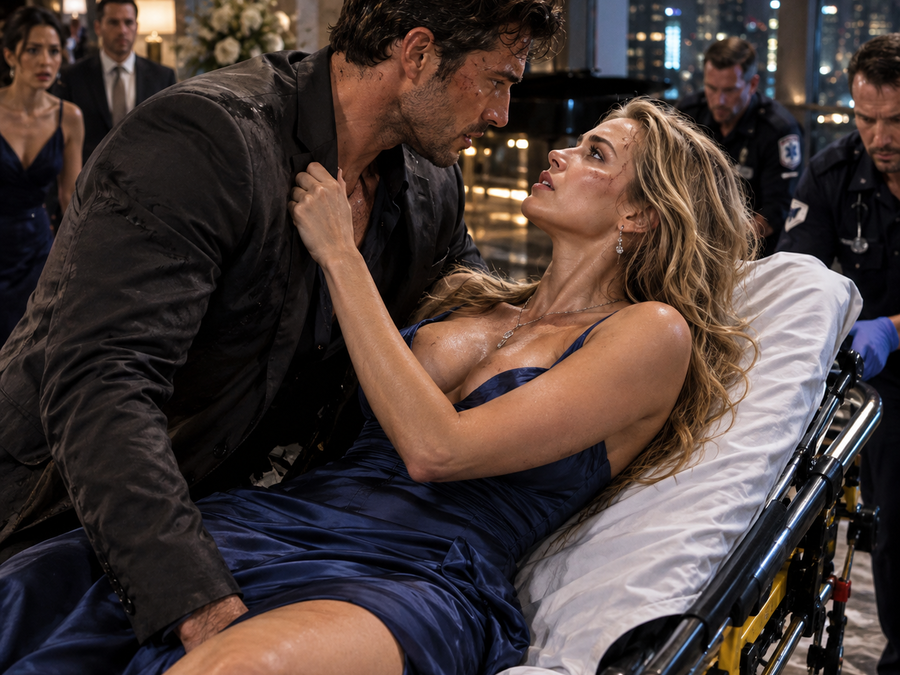
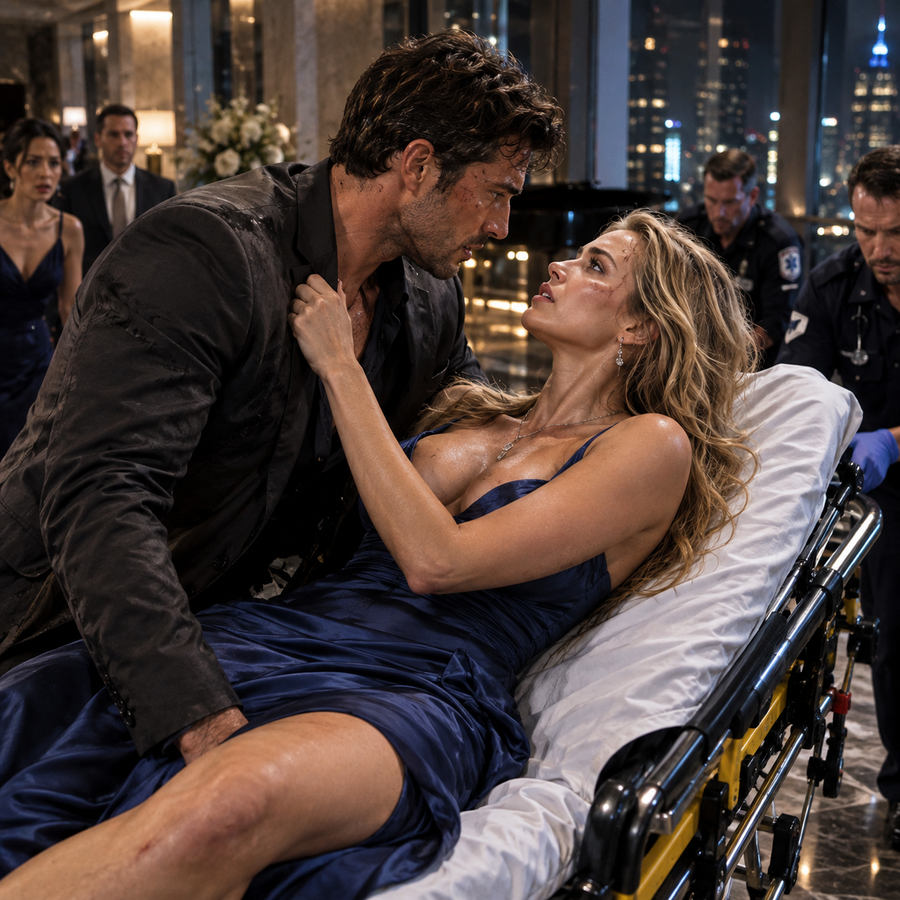
They moved Clare onto a gurney with practiced speed. She didn’t let go of Daniel’s hand until they made her. He stood in the waiting area, still in his grimy work uniform, rain-soaked, with grease on his wrist and someone else’s blood on his sleeve, and he did not entirely know what to do with himself.
A nurse approached him 20 minutes later. “Sir, are you with Miss Whitmore?” “I’m the one who brought her in.” “She’s asking for you. She’s conscious, but we need to move quickly. The neurology team has identified a cerebral aneurysm. It’s been leaking. She needs surgery within the hour.”
Daniel followed the nurse through swinging doors. The trauma bay was bright and busy and organized in the way that emergency rooms are organized—controlled emergency, voices measured, movement deliberate. They had Clare on a bed with monitors attached and an IV already running. She looked smaller here than she did in the building. He had never thought of Clare Whitmore as small. In the seven years she had led Astron from a $2 million startup to a $600 million medical technology company, she had never looked small. She had looked like someone who made rooms rearrange themselves around her presence.
Here, under fluorescent lights, in a hospital gown, with her hair loose and her face without any of the armor she wore so precisely, she looked like what she was: a person. A frightened one. “They told me,” she said when he came to stand beside the bed. “I figured. Brain surgery.” She said it the same way someone might say “unexpected thunderstorm,” acknowledging a reality they hadn’t planned for.
“You’re going to be fine.” “You don’t know that.” “No,” he agreed. “But I think you’re too stubborn to let a blood vessel in your head win.” A ghost of something crossed her face. “You’re still talking to me the same way.” “What way?” “Like I’m a person.” Daniel looked at her. “You are a person.”
She didn’t answer that directly. Instead, the nurse approached with the surgical authorization paperwork—a clipboard thick with forms, with flags on the sections that needed signatures. Clare signed methodically, her good hand moving steadily through each page. She had clearly dealt with paperwork in high-pressure situations before; it showed.
She reached the last page. Near the bottom, inside a bordered box with bold type above it, was the line: EMERGENCY CONTACT. Authorized representative. Print name and sign below. Daniel watched her pause. He watched her look at the line for several seconds. He thought she was searching her memory for an attorney’s name. He knew Astron had a full legal team. He knew there were people whose entire job was to handle exactly this kind of situation on Clare Whitmore’s behalf.
Then she picked up the pen and she wrote two words. Daniel Mercer. He stared at the form. “Clare.” He didn’t know what else to say at first. “You barely know me.” She set the pen down and looked up at him. Her eyes were clear and steady. Whatever confusion had blurred her speech earlier was now burned away by focus and exhaustion and something he couldn’t quite name.
“I know what you did tonight when nobody was watching,” she said. “I did what anyone would have done.” “No,” she said it simply, without drama. “You didn’t do what anyone would have done. I have security cameras in that building, Daniel. I know exactly what is visible from every angle. I know every camera position on the executive floor.”
Her good hand rested flat on the bed beside her. “I know what you could have done when you found me. You could have called the company line. You could have photographed me and sold it to a media contact. You could have used what I told you in the elevator as leverage.” She paused. “You did none of those things.” “Of course, I didn’t.” “That’s exactly my point.”
She held his eyes. “Most people, given that situation, given power over someone like me, would have used it. Consciously or not. A word here, an implication there, some quiet leverage for a future moment.” Her voice was steady. “You chose my life before you knew whether helping me would benefit you at all.” Daniel didn’t have an answer for that. She tapped the form with one finger. “That name stays on there.”
Then the surgical team came in and the room became controlled, organized motion, and they wheeled her toward the OR doors. Daniel stood in the trauma bay holding a clipboard that gave an ordinary facilities employee unexpected legal authority over one of the most powerful executives in the state of North Carolina. He stood there for a long moment. Then he sat down in the chair beside the empty bed, and he waited.
He had been waiting for less than an hour when the suits started arriving. The first one came in at 1:30 a.m. A man in his mid-50s, silver-haired, with the kind of natural authority that didn’t need to announce itself, wearing a cashmere coat over his dress shirt like he’d gotten dressed in 90 seconds and still managed to look better than most men did on their best day. Graham Voss.
Daniel didn’t know his face, but he’d heard the name. Everyone at Astron had. Executive chairman. One of the original investors. The man who, depending on who you asked, was either Clare’s most important ally or her most complicated problem. Graham walked into the ER waiting area with two other men, younger, carrying leather portfolios, and immediately began speaking to the charge nurse in the kind of voice that assumed it would be listened to.
Daniel watched from his chair across the room. Within 3 minutes, Graham had been told that Clare was in surgery, that no information could be released, and that he would need to speak to the attending physician in the morning. He didn’t like those answers. He turned from the nurse’s desk and swept the waiting room with his eyes. They landed on Daniel—on the dirty work uniform, the rain-soaked jacket, the grease and the dried blood on his sleeve.
Graham walked toward him. “You were with her.” Daniel stood, not because he was intimidated, but because his father had taught him to stand when someone approached you. “I brought her in.” Graham studied him the way certain men study things they’re deciding whether to pick up or leave on the floor. “Your facilities staff. Senior facilities coordinator.” “Yes.” “You transported the CEO of this company in a—” He paused. “What vehicle?” “My SUV.”
Graham absorbed that. “Then who knows she’s here?” “I called 911 on my personal phone. I don’t know who else might know.” “The board vote is in 6 hours.” Daniel said nothing. “I need to know her condition,” Graham said. “I need to speak with her doctors. I need to understand what we’re dealing with from a governance perspective. Who has her authorization paperwork?”
Daniel kept his voice even. “She’s in surgery.” “I understand that. But I need access to her information as a matter of corporate necessity. She would want the executive team informed. I’m the executive chairman. I need to know what decisions have been made here. Consent, authorization, representation.”
Daniel looked at him for a moment. “Her authorization is handled,” Daniel said. Graham paused. “By whom?” Daniel held the man’s gaze. “By the person she put on the form.” The silence that followed lasted approximately 4 seconds. Graham Voss looked at Daniel Mercer—the work uniform, the grease, the blood, the quiet steadiness in his eyes—and something shifted in the room. Not dramatically, not with visible anger, just a recalibration, a recognition.
“And who,” Graham said carefully, “are you?” “Daniel Mercer.” “Astron Medical Systems, senior facilities coordinator, six years with the company.” Graham was quiet for a moment, then he smiled. It was the kind of smile that had nothing warm in it. “Well, Daniel.” Graham’s voice dropped to something almost conversational. “It sounds like you’ve had quite a night.” “Yes, sir,” Daniel said. “I have.”
Graham held his eyes a moment longer. Then he turned, walked back to the two men with the leather portfolios, and began speaking to them in a low voice. Daniel sat back down. He looked at his hands. He thought about Sophie asleep at home in her bed. He thought about Clare Whitmore somewhere in this building right now with a neurosurgical team working on the inside of her skull.
He thought about what she had said. You chose my life before you knew whether helping me would benefit you. He picked up his phone and typed a message to Mrs. Garland next door. Running late. Emergency at work. Please stay tonight. I’ll cover extra. Sophie shouldn’t worry. Then he set the phone down and he stayed. That was the whole of it. He stayed because it was the only thing that made any sense to do.
The surgeon came out at 4:17 a.m. She was a compact woman with short gray hair and the kind of unhurried manner that Daniel had learned to associate with people who had seen everything and decided that rushing solved nothing. She crossed the waiting room toward Daniel—not toward Graham Voss, who had positioned himself deliberately near the doors, not toward the three additional Astron attorneys who had appeared around 3:00 a.m., not toward the two board members who had shown up at 3:45 and were now drinking coffee and speaking in low voices near the window.
She came to Daniel because his name was on the form. “The aneurysm was a grade two rupture,” the surgeon said. She spoke clearly and without decoration, and Daniel appreciated that. “We’ve clipped it successfully. The surgery went well. She’ll be in recovery for several hours. The next 48 hours will be important in terms of monitoring for vasospasm and assessing any lasting neurological effects, but the immediate danger is past.”
Daniel let out a long breath. “Can I see her?” “Not yet. Tomorrow morning, most likely.” “Okay.” He nodded slowly. “Thank you.” The surgeon glanced once at the cluster of suits across the waiting room, then back at Daniel. “You did the right thing getting her here when you did,” she said quietly. “Another 30 minutes and we’d be having a very different conversation.”
She walked away. Daniel sat alone for a long moment. Then Graham Voss was beside him. Not aggressive, not loud—quiet and precise, the way real danger usually is. “I think,” Graham said, sitting down one chair away, “that you and I should have a conversation.” Daniel looked at him. “She’s going to be fine,” Daniel said. “That’s the good news.” “Yes.” Graham’s voice was pleasant. “And the board vote is in 2 and 1/2 hours.”
Outside the hospital windows, Daniel could see the first gray edge of dawn beginning to separate the sky from the horizon. The storm had passed. Charlotte was waking up, and Daniel Mercer—who had gone to work last night to fix a broken relay switch so his daughter could afford braces—was sitting in a hospital waiting room with a billionaire’s signature in his name and powerful men closing in from every direction.
He was still in his dirty work uniform. He had $43 in his checking account. He had made no calculations about what any of this might mean for his future. He had simply stayed. And somehow, that was exactly the thing that made everything that was coming next inevitable.
Graham Voss sat down one chair away from Daniel, and the distance between them felt like the distance between two completely different worlds. He didn’t look at Daniel right away. He crossed one leg over the other, adjusted the cuff of his coat, and looked out the window at the gray dawn breaking over Charlotte. He had the particular patience of a man who had learned long ago that silence was a more effective weapon than volume.
“6 years,” Graham said finally. Daniel looked at him. “Sir?” “You’ve been with Astron 6 years.” He said it the way someone reads a file. Flat, informational. “Senior facilities coordinator. Before that, 3 years at Meridian Property Group. Before that, two years at a smaller outfit in Concord.” He paused. “You know your building systems. Everyone says so. Marcus at the security desk said you could find a faulty relay in a 300,000 ft building in the dark.”
“Marcus is generous.” “It’s not generosity. It’s a fact.” Graham finally turned and looked at him. His eyes were a pale, steady gray. The kind that didn’t show what was behind them. “You’re a capable man, Daniel. That’s obvious. Which is exactly why I think you understand the position you’re in right now.”
Daniel waited. “Clare is going to survive,” Graham continued. “That’s good. I mean that sincerely. She’s a remarkable woman and nobody in that boardroom wanted anything to happen to her.” He paused just long enough to let that land. “But survival and capacity are two different things. She just had emergency brain surgery. The next 48 hours are uncertain. And in 2 hours and 17 minutes, the Astron board is scheduled to vote on the most significant corporate transaction in this company’s history. The Helixor acquisition.”
Graham tilted his head slightly. “She told you about that in the car. On the way here.” Something moved behind Graham’s pale eyes. “What exactly did she tell you?” Daniel held his gaze. “She told me the valuation was wrong. That someone inside the company manipulated the numbers.”
The silence that followed was exactly 1 second longer than comfortable. Then Graham smiled. Not the warm kind. The kind that people like Graham Voss use as a tool, the way a carpenter uses a level. “Clare has been under enormous stress for months. The kind of stress that can distort a person’s perspective. Make them see patterns that aren’t necessarily there.”
He tilted his head slightly. “I want you to understand something, Daniel. Whatever Clare said in that car, she was in the early stages of a medical emergency. Her judgment was compromised. Whatever she told you, whatever she believes she found, it should be treated with compassion, not as reliable intelligence.”
“She seemed pretty clear to me.” “She had a brain aneurysm.” “Not when she was talking. The symptoms came later.” Another pause. Longer this time. Graham unfolded his leg, leaned forward slightly, and rested his elbows on his knees. His voice dropped to something almost intimate, almost kind.
“I’m going to be honest with you because I think you’re the kind of man who respects honesty. What happens in the next few hours matters enormously. Not just for this company, but for 4,000 employees who depend on Astron stability—for their families, their mortgages, their kids’ futures.” He let that settle.
“The board needs to be able to proceed today. The governance structure allows for a temporary leadership provision if the CEO is medically incapacitated. All that requires is documentation from someone with medical authorization. Someone like the name on that form.”
Daniel was quiet. “I am not asking you to harm Clare,” Graham said. “I’m asking you to acknowledge a medical reality that a neurosurgeon could confirm in 30 seconds. She just had brain surgery. She cannot participate in a corporate vote today. That’s simply true.”
“And if I sign something to that effect,” Daniel said slowly, “what happens to the vote?” “It proceeds under emergency provisions. The board makes the decision on the Helixor acquisition. Business continues, and Clare recovers, returns, everything continues normally.”
Daniel looked at him for a long moment. Then he said, “Except the vote she was trying to stop goes through without her.” The temperature in the conversation dropped several degrees. Graham straightened. “The vote was going to happen with or without her. The board has the right.”
“She told me the numbers were manipulated.” Daniel kept his voice even. “She told me someone inside the company fed false data to the acquisition committee to make the diagnostic division look worth less than it is. She said she had proof.” He paused. “You want me to sign a document that lets a vote go through that she believes is built on fraud tonight? Before anyone looks at what she found?”
Graham studied him. Then something shifted in his expression. The warmth, already thin, drained away completely. What was left underneath was not angry. It was simply cold and precise and entirely without sympathy. “Let me be very clear,” Graham said quietly. “I have been running companies since you were in high school. I have navigated situations that would end careers, destroy reputations, and leave competent men with nothing. I am this not because I am cruel, but because business operates by rules that don’t care about intentions.”
He paused. “You are a facilities coordinator. You are a single father with a daughter in elementary school. You have a mortgage on a house in East Charlotte, a vehicle that probably shouldn’t pass its next inspection, and a bank balance that I suspect would not survive one missed paycheck.”
Daniel’s jaw tightened. “I am not threatening you,” Graham said. “I am describing reality. The reality is that what you do in the next 2 hours will determine the shape of your next 10 years. I can make sure that your loyalty tonight is rewarded in ways that would genuinely change your daughter’s life.” He stopped. Let the silence do the work.
“Or,” he continued, “I can make sure that your interference in a legitimate corporate governance process cost you everything you’ve spent 6 years building.” Daniel sat with that for a moment. Then he said, “You mentioned Sophie.” “I mentioned your daughter. Yes.” “You mentioned her school.” “I have a thorough staff.” “Yeah.” Daniel nodded slowly. “I noticed.”
He looked down at his hands. “Can I ask you something?” “Of course.” “When you walked into this hospital tonight, first thing you did before you even asked the nurse how Clare was, you asked about the vote. I was watching from across the room.” Daniel looked up. “Is that true or am I wrong?” Graham said nothing.
“You asked about the vote before you asked if she was alive,” Daniel said. “I was 30 ft away and I watched it happen.” He paused. “I just wanted to make sure I was reading that right before I decided anything.” Something flickered in Graham’s eyes.
“I’m going to go get some coffee,” Daniel said, and stood up. He walked to the vending machine at the end of the hall, put in a $1.50, and stood there while the machine ground through its cycle. And he thought about Sophie. He thought about the braces appointment next month. He thought about the inspection sticker on the SUV that was already three months overdue. He thought about Mrs. Garland on his couch and the $20 an hour he owed her, and the fact that he still hadn’t eaten anything since the granola bar he’d had at 7:00 the previous evening.
He thought about half a million dollars, because that was the number Graham named 40 minutes later when he found Daniel in the family waiting room just off the main corridor, away from the board members and attorneys clustered near the entrance. $500,000. He didn’t announce it. He placed a folded piece of paper on the chair next to Daniel, sat down across from him, and said it the same way a man might quote a contractor price. Matter of fact, reasonable, like it was just a number being offered for services rendered.
“Sophie’s education,” Graham said, “fully covered. A trust account established today. College, graduate school, wherever she wants to go. Plus a personal payment of $500,000 transferred to an account of your choosing within 72 hours of today’s vote.” He clasped his hands loosely in his lap. “And a promotion. Director level. Real salary, real benefits. The kind of position you’ve earned but probably stopped believing you’d ever see.”
Daniel stared at the folded paper. He did not pick it up. “All I need,” Graham said, “is your signature on a document that states Clare Whitmore is currently medically unable to participate in corporate decisions. Which she is. The surgeon already said the next 48 hours are uncertain. You’re not lying. You’re stating a documented medical fact.”
The family waiting room was small and quiet. There was a box of tissues on a side table, a framed landscape print on the wall, the kind of room designed to absorb grief without comment. Daniel thought about what Clare had said in the elevator on the way down. Not the corporate information, not the acquisition. The other thing. The quiet, exhausted way she had said, “Tonight I finally had what I needed.” The way she’d said it, like someone who had been carrying a weight for a very long time and had finally, just barely, reached the place they’d been trying to reach.
And then someone had entered her office while he was driving her here. I didn’t know that part yet. That would come later. But he was already thinking about it in the way that experienced facilities coordinators think. Who went where, when, and why, and whether the record of it matched what he knew should be true.
“You need an answer now?” Daniel asked. “The vote is in 90 minutes.” Daniel looked at the folded paper. He thought about Sophie’s face when she was excited, the way she talked with her whole body, hands moving, sentences running into each other. He thought about her asking him last week why he looked tired, and him telling her he was fine, and her saying, “Dad, I know what fine looks like. And that’s not it.” 9 years old. She already knew.
Daniel picked up the folded paper. Graham watched him. Daniel unfolded it, read it carefully—all of it, every line, the way his father had taught him to read anything before he touched a pen—and then refolded it along its original crease and set it back on the chair beside him. “No,” he said.
Graham was very still. “I’m not signing that, Daniel. She told me the numbers were manipulated. She told me she had proof. Someone went into her office while she was unconscious in my car.” He looked directly at Graham. “I don’t know yet who it was, but I know it happened. And I know that what you’re asking me to do right now clears the way for a vote that she was about to stop.”
His voice was steady. Not raised, not emotional, just steady. “I’m not signing it.” The quiet in the room changed texture. When Graham spoke again, the pleasant reasonableness was entirely gone. “You need to think about what you’re doing very carefully.” “I have.” “You are a facilities coordinator. You have no standing in this process. You have no understanding of the legal exposure you’re creating for yourself by interfering with—”
“I’m not interfering with anything. I’m just not signing something.” Daniel stood up. “And I’m going to stay here until Clare can speak for herself. That’s all I’m doing.” Graham stood too, and for a moment they were just two men standing in a small waiting room, and the distance between them was about 3 ft of carpet, and it should not have felt like the kind of standoff it felt like.
“You have a daughter,” Graham said. His voice was quiet and flat and precise. “I want you to think about her future. Not just college, not just now. I want you to think about what it looks like for a 9-year-old girl when her father makes an enemy of the wrong people. When his career evaporates. When every reference call goes cold. When every door in a 30-mile radius closes because the people who close doors decided to.”
He held Daniel’s eyes. “I am not threatening Sophie. I want to be absolutely clear about that. I am simply describing what the world looks like for a man who makes powerful enemies for no reason.” Daniel looked at him for a long moment. Then he said something that Graham Voss, in 40 years of corporate life, had probably never heard from a man in a dirty work uniform in a hospital waiting room.
“My daughter is 9 years old,” Daniel said quietly. “And every day I try to teach her one thing. That character is what you do when doing the right thing costs you something.” He paused. “She’s watching me. Even when I’m not home, even when she’s asleep, she’s watching me. And I can’t sign that document and then go home and look at her.”
He took a breath. “So, whatever it costs me, you do what you’re going to do. But I’m not signing it.” He walked out of the room. Graham Voss stood alone in the small, quiet space and did not move for a very long time.
It was 6:03 in the morning. Natalie Brooks arrived at the hospital at 6:20. Daniel knew her by sight. Astron’s general counsel, a tall woman with a precise, measured way of moving through a room that suggested she was always calculating three variables simultaneously. She had sharp eyes and the particular composure of someone who had spent 20 years in rooms where the wrong sentence cost millions.
She found Daniel in the corridor outside the recovery wing, standing with a cup of bad vending machine coffee going cold in his hand. She looked at him the way people look at something they’re trying to categorize. “Mr. Mercer.” “Ms. Brooks.” “I heard about last night. What you did.” She stopped in front of him. “How is she?” “Surgery went well. They’re monitoring her.”
Natalie nodded. She looked down at her own hands for a moment, then back up. “Graham spoke to me 20 minutes ago.” Her voice was neutral. Careful. “He told me you declined to sign.” “That’s right.” She was quiet for a moment. “Can I ask you something?” “Go ahead.” “Why? Honestly. Setting aside everything else—the money, the principle, all of it. Why? You could walk away from this right now. Nobody would think less of you. You saved her life. That’s real. That’s enough. Nobody expects anything more from a facilities coordinator.”
Daniel looked at her. “Do you believe the acquisition numbers are accurate?” Natalie’s expression didn’t change, but something behind her eyes did. A small, careful shift, like a door opening an inch. “That’s a complicated question,” she said. “Is it?” She looked down the corridor. The board members and attorneys were visible at the far end near the elevator bank, their voices low, their body language tense. Graham was among them. He had not looked in Daniel’s direction since leaving the waiting room.
“Clare told you she had found something,” Natalie said. It was not a question. “She did.” “Did she tell you where it was?” “No.” Daniel studied her face. “Why?” Natalie was quiet for another moment. Then, very carefully, she said, “Her office was accessed at approximately 12:40 a.m. Executive override. The credential log would show a name.” She paused. “But credential logs can be adjusted by someone who knows the right system. I’ve been trying to pull the original record for the past hour, and I’m getting access errors I’ve never seen before.”
Daniel’s mind went very still. He thought about the environmental control system in the basement. The one he’d reset the night before. The one that shared a circuit pathway with the executive floor. He thought about the mechanical control server—an independent unit, older than the main digital system, installed during the original building construction and largely ignored during the last two network upgrades because nobody thought it mattered. It logged everything independently. Not the credential system, not the security cameras. The mechanical relay system. Every electronic door trigger in the building recorded against the HVAC sequencing log because the original contractor had wired them onto the same timing circuit.
It wasn’t supposed to be a security record, but it was. And Daniel was possibly the only person in the building who knew it existed. He looked at Natalie Brooks. “Are you on Clare’s side?” he asked directly. She met his eyes. “I have been Clare’s counsel for 9 years.” “That’s not an answer.” A pause. “Yes,” she said. “I’m on her side.” “Then I need to get into the building.”
Natalie stared at him. “The vote is in 50 minutes.” “I know.” He set the cold coffee down on the windowsill beside him. “But if what I think is in that mechanical server is actually there, the vote doesn’t matter. The whole thing unravels.” He looked at her steadily. “Can you get me building access without going through the executive credential system?”
“I have a general counsel override. It’s physical key-based. It doesn’t log digitally.” “Then let’s go.” She looked at him for a long moment. This man in a dirty work uniform who had carried her CEO through a lobby at midnight and sat in a hospital waiting room until 4 in the morning and turned down half a million dollars because of something he was trying to teach his 9-year-old daughter.
“You know what you’re doing?” she asked. “I know that building,” Daniel said. “Better than anyone.” He paused. “I don’t know everything else, but I know that part.” Natalie reached into her bag. She pulled out a slim, old-fashioned physical key card, the kind from the building’s original access system, before the digital overlay went in, before the network upgrades, before everything got faster and smarter and easier to manipulate. She held it out. Daniel took it.
Outside the hospital windows, Charlotte’s morning was fully bright. The storm was entirely gone, the streets washed clean and glittering in the early light. In 47 minutes, the Astron board would sit down to vote. And Daniel Mercer, who had come to work the night before to fix a corroded relay switch, walked back through the hospital’s automatic doors, got into his battered SUV with the cracked dashboard and the spelling homework still on the back seat floor, and drove toward the building he had maintained for 6 years.
Toward a mechanical server that no one thought mattered. Toward a truth that someone had tried very hard to bury. He drove without rushing, because the thing about buildings, the thing Daniel had learned in 20 years of keeping them running, was that they remembered everything. Every door that opened, every system that triggered, every moment someone thought they were alone. Buildings remembered. And Daniel knew exactly where to look.
Daniel pulled into the Astron parking garage at 6:41 in the morning. The building looked exactly the same as it always did. Same concrete, same glass, same security camera above the employee entrance blinking its slow red pulse. But something felt different about it now. The way a familiar street feels different after something terrible has happened on it. Like the building itself knew what had occurred inside it the night before and was holding its breath.
Marcus was not at the security desk. The overnight shift had ended. A younger guard Daniel barely recognized looked up from behind the console, saw the Astron badge on his jacket, and buzzed him through without a word. Daniel kept walking. He kept his pace normal, unhurried. He had learned a long time ago that the fastest way to draw attention in a building was to look like you were trying not to draw attention.
He took the service elevator to the basement. The mechanical room was exactly as he had left it the night before. Panel closed, tools back in the supply closet. The replaced relay sitting in the discard bin where he’d tossed it at 11:30 p.m., which now felt like it had happened in a different lifetime. The environmental system was running clean. He checked the gauges out of habit, the way he always did, because 6 years of maintaining a building teaches your hands to verify things before your brain finishes asking the question.
Then he crossed the mechanical room to the far wall. Behind the main HVAC control rack, behind a steel utility shelf holding spare filter housings and a box of cable ties that had been sitting there since the previous facility’s manager retired, was a panel that most people who worked in this building did not know existed. It was labeled INTEGRATED RELAY CONTROL — BUILDING ORIGINAL, and it had a small digital display about the size of a paperback novel, and it had not been meaningfully checked by anyone in at least 4 years.
Daniel pulled the shelf aside, punched in the six-digit maintenance code that he had memorized during his first month on the job and never forgotten, and the display lit up. The unit was fully operational. He had explained to Natalie in the car, talking fast while she drove her own vehicle back toward the building 3 minutes behind him, that the original construction contractor had wired the building’s electronic door triggers onto the same timing circuit as the HVAC sequencing system. It was a cost-saving measure from 2009 that nobody had bothered to correct during two subsequent network upgrades, because the system was invisible, independent, and, as far as the executive team was concerned, entirely irrelevant.
It logged relay triggers. Not credentials, not camera footage. Just door events. Open, closed, locked, unlocked, matched against the building’s mechanical timing sequence down to the second. It could not be accessed remotely. It could not be edited through the main network. It had no connection to the digital credential system that Graham’s people had apparently managed to manipulate. It was just a dumb, old, standalone relay log that nobody thought was worth manipulating because nobody knew it existed.
Daniel pulled up the event log for the previous night. He set the filter to executive floor door events and ran it back to 10:00 p.m. The display populated line by line. 10:47 p.m. Executive floor, main corridor door. Trigger event: open. That was Daniel himself, going up to check the environmental node.
11:03 p.m. Executive floor, main corridor door. Trigger event: open. This was him leaving. Then nothing until 12:38 a.m. 12:38 a.m. Executive floor, main corridor door. Trigger event: open. 12:39 a.m. Private conference room, east wing. Trigger event: open. 12:41 a.m. Private conference room, east wing. Trigger event: closed, locked. 12:44 a.m. Executive floor, main corridor door. Trigger event: open, exit sequence.
Daniel stared at the display. Someone had entered the executive floor at 12:38 a.m., 51 minutes after Daniel had carried Clare out of the building. Someone had gone directly to her private conference room, spent 2 minutes inside it, and left. In and out in 6 minutes total. Professional, purposeful. Exactly the kind of access pattern that someone makes when they know exactly what they’re looking for and exactly where it is.
Daniel pulled out his phone and photographed every line on the display. Then he photographed the unit itself, its serial number, its installation plate, its independent power source. He photographed the maintenance code panel. He photographed the relay circuit diagram mounted on the inside of the access door. Then he pulled up the digital credential log on his tablet—the same one Natalie had told him was showing access errors she’d never seen before—and compared the timestamps.
The digital log showed no executive floor activity between 10:00 p.m. and 6:00 a.m. Nothing. As if no one had been there at all. Someone had deleted it. Someone had gone into Clare’s conference room at 12:38 in the morning, taken whatever she had gathered—the evidence she had described in the elevator as she was losing consciousness, the thing she’d said she’d finally obtained that night—and then wiped the digital record of ever being there.
But they hadn’t known about the relay log. Because nobody knew about the relay log. Daniel saved every photograph to his personal cloud backup, then texted the full series to Natalie Brooks with three words. Found it. Come now. He looked at his watch. 6:53 a.m. The board vote was in 7 minutes.
He took the service elevator back up. Natalie was already in the lobby when the elevator doors opened, her phone in her hand, reading his photographs with an expression that moved through several stages quickly. Focus. Recognition. And then something that looked a great deal like controlled fury.
“The digital log was wiped,” Daniel said. “I know.” She didn’t look up from her phone. “I’ve been staring at access errors for the past hour that I now understand weren’t errors. Someone ran a selective purge on the credential timestamps for the executive floor.” She looked up. “But this—” she held up her phone, his photographs on the screen. “This doesn’t go through the credential system at all. Independent relay circuit. Completely isolated.”
“Can it be challenged? Can someone argue it’s unreliable?” “It’s the original building system. It’s been logging continuously since 2009. Every maintenance inspection for 14 years. It’s never been altered because nobody ever thought to alter it.” Daniel held her eyes. “It’s cleaner than the digital system because it’s too boring for anyone to bother with.”
Natalie was quiet for exactly 3 seconds. Then she said, “We need to get upstairs.”
The seventh floor boardroom was the kind of room that announced its own importance without trying. Long table, high-backed chairs, a wall of windows. Seven board members were already seated when Daniel and Natalie came through the door, and the particular silence that fell when they entered was the kind of silence that meant their arrival had been the last thing anyone expected.
Graham Voss was at the head of the table. He looked at Daniel with an expression that lasted less than a second before it was replaced by something smooth and controlled. But Daniel had spent six years reading building systems, which meant he had spent six years reading subtle signals, and that 1 second was enough. Graham had not expected this.
“Natalie,” he said, his voice perfectly even. “The meeting is in session. This is a closed board—” “I’m general counsel,” Natalie said, and she pulled out the chair to the left of the head position and sat down as if she had been planning to sit there all morning. “I have standing in every board session. You know that. And Mr. Mercer is here at my request.” She set her phone on the table face down and folded her hands. “I need 5 minutes before the vote opens. There is a procedural matter.”
A board member to Graham’s right, a woman in her 60s named Harriet Caldwell, who Daniel had seen maybe twice in the halls of Astron and who had a reputation for being the sharpest person in any room she entered, said, “What procedural matter?” “The integrity of the acquisition timeline,” Natalie said. “Specifically, whether the data underlying the valuation of the diagnostic division was accurately represented to this board.”
The air in the room changed. Graham set both hands flat on the table. It was a controlled gesture, deliberate, the gesture of a man who was running calculations behind very still eyes. “The valuation has been independently verified by three separate financial advisory firms. Natalie, you reviewed those reports yourself.”
“I reviewed the reports I was given,” she said. “The question is whether those reports accurately reflected the internal data they were supposed to be based on.” “This is a delay tactic.” Graham looked around the table. “Clare’s illness has understandably affected the judgment of some of her associates.”
“Clare found something.” Daniel said it from where he was standing near the door. He hadn’t planned to speak yet, but Graham’s voice when he said the word “illness,” the particular way he wrapped it around Clare’s name, like a constraint, like a diminishment, made the words come out of Daniel before he’d finished deciding to say them.
Every head in the room turned toward him. He was still in his work uniform. He was aware of how he looked in this room. He was aware of the difference between his worn jacket and the suits around that table. He let himself be aware of it and then set it aside, the same way he set aside irrelevant variables when he was diagnosing a building problem.
He said, “Clare Whitmore spent approximately 30 minutes before her medical emergency going through documents in her private conference room. She told me in the car on the way to Mercy Regional that she had finally obtained evidence of data manipulation in the acquisition timeline. She described it as the thing she’d been building toward for 4 months.” He paused.
“At 12:38 this morning, while she was in surgery, someone entered her conference room. They were inside for 2 minutes. They left. The entire digital credential record of that entry was subsequently deleted.” Graham’s voice was perfectly controlled. “That’s a remarkable claim for a facilities coordinator to be making in a board meeting.”
“I have the relay log,” Daniel said. Silence. He held up his phone. The photographs were already open. “The building’s original mechanical relay system logs every door event on an independent circuit. It has no connection to the digital credential network. It cannot be accessed remotely and has never been included in any network update. It logged an executive floor entry at 12:38 a.m., access to Clare’s conference room at 12:39, and an exit at 12:44.”
He looked at Graham directly. “The digital credential log for that same window shows nothing, because someone deleted it. But they didn’t know about the relay log, because nobody knows about the relay log except the people who maintain this building.”
Harriet Caldwell leaned forward. “Let me see that.” Daniel walked around the table and handed her his phone. She looked at the photographs carefully. Not quickly. She scrolled through each one, zooming in on the timestamps, the serial numbers, the installation date on the unit’s identification plate. She was thorough in the way that people who have spent long careers in boardrooms are thorough, because they have learned that the details other people overlook are almost always the ones that matter.
“2009 installation,” she said, half to herself. “Original building system.” “Yes, ma’am.” “And this has been logging continuously?” “The power source is independent. The log buffer holds 18 months of data. I’ve checked it twice a year during building maintenance inspections. It’s never failed.”
Harriet looked up at Graham, and the look she gave him was the kind of look that does not require a single word to convey its meaning. Graham’s jaw was tight. “One relay log from an obsolete mechanical system is not evidence of anything. Door triggers malfunction. Timestamps drift. What this man is presenting is completely unverifiable without an independent—”
“I’ll verify it,” Harriet said quietly. Graham stopped talking. “I’ll request an independent facilities audit before this vote proceeds,” she continued. “I have the authority to do that under section 9 of our governance structure. The vote will be postponed pending review.” She looked around the table. “Does anyone object?”
The room was very still. Two board members looked at Graham. Neither spoke. A third looked down at the table. A fourth, a man in his 70s at the far end, whom Daniel didn’t recognize, folded his hands and said, “I’ll second the motion for postponement.”
Graham’s voice, when it came, was quiet and very flat. “This is a mistake.” Harriet looked at him with remarkable calm. “Maybe.” She set Daniel’s phone down on the table in front of her. “But it’s my mistake to make.” Graham stood up. He straightened his coat. He looked at Daniel once more, a long, measured look that Daniel held without flinching. And then he walked toward the door.
He paused in the doorway. “You have no idea what you’ve stepped into,” he said, not loudly, almost conversationally, like someone pointing out a hazard in the road. “Probably not,” Daniel said. “But I know what I stepped into last night, and I know I’d do it again.”
Graham left. The door closed. The room exhaled. Natalie looked across the table at Daniel, and for a moment, her composed, calculated expression dropped just enough to show something underneath it. Something that might have been relief. “Well,” Harriet Caldwell said, picking up Daniel’s phone and beginning to go through the photographs again. “I suppose we have some work to do.”
Daniel’s phone buzzed in his hand. He had given Harriet his photos from cloud backup on her own tablet by then, so he had his phone again. The buzzing was a text from Mrs. Garland. Sophie’s awake, making her breakfast. She wants to know if you’re okay. She said she had a dream you were in an adventure.
Daniel stood at the back of the boardroom while Harriet and two other board members began the process of formalizing the postponement motion. And he read that text three times. He typed back, Tell her I’m okay. Tell her I’ll be home soon. Tell her the adventure is almost over.
He looked up at the room, at the people around that table, at the morning light coming through the windows, at the city below, going about its ordinary business, entirely unaware of what had just happened on the seventh floor of this building. He thought about Clare. He thought about her in a recovery room somewhere in Mercy Regional, unconscious, monitored, surrounded by machines and medical professionals and the sterile efficiency of a hospital morning, with no idea what was happening in her company in the hours since she’d gone under. With no idea that the man she had put on the form had driven back to her building in his battered SUV and found the thing that changed everything.
He thought about what she had said. You chose my life before you knew whether helping me would benefit you. The postponement motion passed at 7:14 a.m. The Helixor acquisition vote did not happen, and the investigation that would eventually unravel everything started 2 hours later, when Harriet Caldwell called a forensic audit firm she had worked with for 20 years and told them she needed them in Charlotte by noon.

