“Take That Off!” Judge Shouted at Single Dad—Until a SEAL Admiral Heard His Callsign (Part 2)
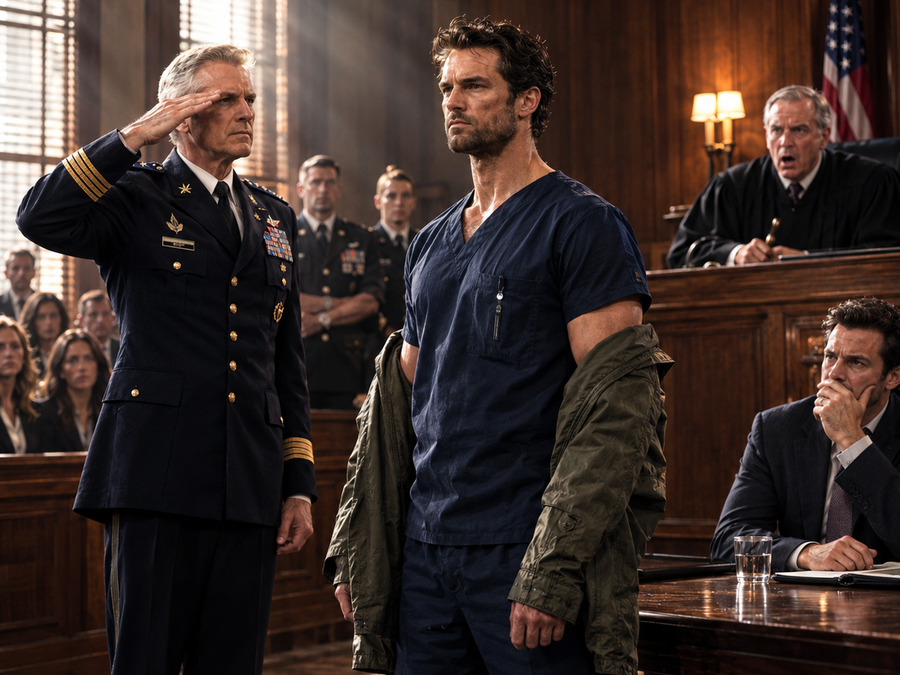
“Take That Off!” Judge Shouted at Single Dad—Until a SEAL Admiral Heard His Callsign (Part 2)
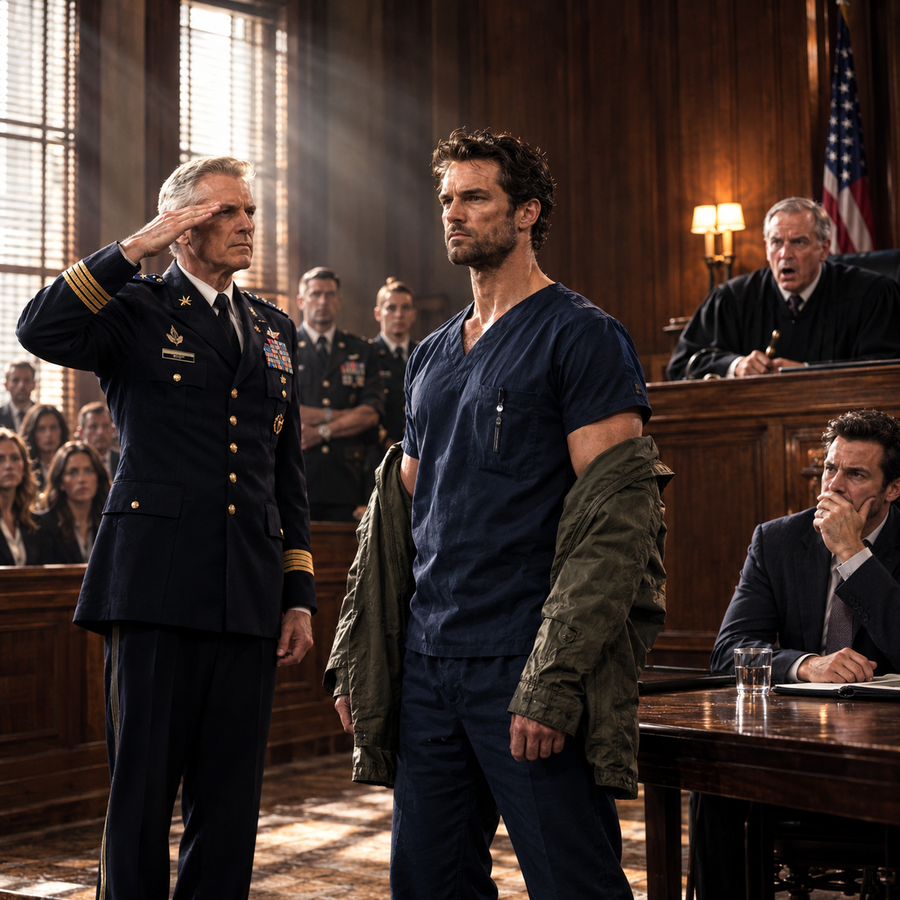
PART 2
Ethan, in the gallery now beside the admiral, with Lily on his knee, had gone very still. “And then,” Holloway prompted. “And then they got between the cars and I couldn’t see so good, but I heard her say ‘no’ loud. Like, really loud. And then I heard her say ‘stop.’ And I started to come out from behind the stand because—because I knew, you know? You just know. And then—” Danny’s voice caught. “And then this other guy came out of the restaurant. Fast. And he went right at them. And I froze. I just—I stopped. Because I was scared, and I didn’t know what was happening. And I’m ashamed of that. I’m so ashamed of that. Because he didn’t freeze.” He pointed at Ethan. “He didn’t freeze for one second.”
The courtroom was silent. “What did you see him do?” Holloway asked quietly. “He grabbed Logan’s arm. The one that was—the one that was on the woman. And he pulled him off her, and put him down on the ground. And it was—it wasn’t even violent, exactly. It was fast, but it was like—controlled. Like he knew exactly how much to do and not one bit more. Logan was on the ground, and the guy had his knee on him, holding him, but he wasn’t hitting him. He wasn’t hurting him. He was just holding him there so he couldn’t get up. And he yelled at the woman to run. He said, ‘Go. Get out of here. You’re safe. Go.’ And she ran.”
“And what did Logan Pierce do?” Danny’s jaw tightened. “He screamed. Not because he was hurt. Because he was mad. He was screaming, ‘Do you know who I am? Do you know who my father is? You’re finished. You’re done. I’ll bury you.’ Over and over. That’s what he was saying. While he was on the ground. He kept saying his father’s name.” Every eye in the courtroom went, as one, to Gerald Pierce, who was no longer looking smug. Who was, in fact, looking like a man watching the walls of a very expensive fortress come down around his ears.
“Go on, Danny,” Holloway said. “The cops came, and by then the woman was gone, and Logan’s on the ground, and this guy—” he nodded at Ethan “—is standing there with his hands up, saying he’ll cooperate, telling them exactly what happened. And Logan’s telling them he got jumped, attacked out of nowhere. And there’s these two other guys. They come out of the restaurant. I’d never seen them before. They weren’t even eating there. I don’t think—I think they came with Logan. And they start saying they saw the whole thing, and it was all this guy. Unprovoked. He just went crazy and attacked poor Logan.”
Danny’s voice was rising now, shaking with the outrage he’d been swallowing for six weeks. “And it was a lie. It was all a lie. And I stood there, and a cop looked right at me—right at me—and said, ‘You see anything?’ And I—” He stopped. “And you what?” Holloway asked, and his voice was very gentle now. “I said no.” Danny’s eyes filled. “I said I didn’t see anything. I said I was in the back. God forgive me.” He looked at Ethan. The valet’s voice broke completely. “I looked at the only person in that whole parking lot who did the right thing, and I let them arrest him. And I said I didn’t see anything.”
The courtroom was so quiet you could hear the boy trying not to cry. “Why?” Holloway asked. “Why did you lie, Danny?” And Danny Alvarez looked up, and he looked straight at Gerald Pierce, and he answered the question. “Because two nights later, a man came to my house.”
10:58 in the morning, and you could have heard a pin drop on the carpet of courtroom 4. “What man?” Holloway said. “I don’t know his name. He never said. He knocked on our door at like eleven at night. My mom answered. He was real polite. Real calm. He said he was a friend of the Pierce family, and he wanted to talk to me about the misunderstanding at the restaurant.” Danny’s hands were clenched into fists in his lap. “And he sat down in our living room, in my mom’s chair, and he told me a story. He told me a story about a young man who worked hard. Who had a little sister in high school. Who had a mother who cleaned houses and a father who wasn’t around. A family that was just barely making it. He knew all of it. Everything about us. Where my sister went to school. Where my mom worked. What time she got off.”
Danny’s voice was shaking with fury and old fear. “And then he said it would be a real shame if a hard-working young man got confused about what he saw one night, and it cost his whole family everything. He said memory is a funny thing. He said sometimes people think they saw something, and they’re wrong. And he told me—he told me I’d remember, if I was smart, that I was in the back that night, and I didn’t see anything at all.” Danny looked at his own hands. “And then he left. And I was so scared. I’ve got a little sister. I’ve got my mom. What was I going to do?”
His voice cracked into something raw and pleading. “So when the cops came around again, I said I didn’t see anything. And I’ve hated myself every single day since.” He looked at the man Reynolds had sent, standing at the back. “When this man showed up at the restaurant an hour ago and said an admiral wanted to know the truth, and said there were people who’d protect my family if I told it—I thought, ‘This is it. This is my one chance to stop being a coward.’ So here I am.” He wiped his face with the back of his hand, angry at his own tears. “Here I am, and I’m telling the truth, and I don’t care what happens to me anymore. That man in the coat saved a woman’s life. And I helped these people try to bury him for it. And I’m so sorry. I’m so sorry, sir. I’m so sorry.”
He was looking at Ethan now. And Ethan Walker, who had sat through being called filthy, being threatened with a cage, being called a criminal—all of it—without breaking, Ethan Walker put his hand over his mouth and closed his eyes. And in that gallery, a nineteen-year-old kid and a thirty-six-year-old veteran wept forty feet apart over the same six weeks of pain.
“Your honor.” Whitfield was on his feet, and his voice had the desperate pitch of a man scrambling on a collapsing deck. “This is—there’s no corroboration. This is one young man’s word, uncorroborated, six weeks after the fact, produced under highly irregular circumstances by an admiral with no standing in this—” “Sit down.” It wasn’t Holloway who said it. It was Diane Foley.
The CPS caseworker had risen from the chair she’d exiled herself to at the far end of the room, and she was holding her binder against her chest, and her face was pale and set. “Your honor,” she said, “I’d like to say something for the record. And then I’d like to formally withdraw my department’s recommendation.” The whole room turned to her. “When I walked in here this morning,” Diane said, “I had a recommendation already written. Temporary removal of the minor child. Because the file said felony assault, and the file said this man was a danger, and I believed the file.” She looked at Ethan. “I’ve been doing this work for eleven years. And the thing that keeps me up at night—the thing every single person in my department is terrified of—is the day we get it wrong. The day we take a child from a home where she was safe and loved because we trusted a piece of paper over our own eyes.”
Her voice was steady, but there was a tremor of feeling underneath it. “I’ve been watching that man all morning. I watched a judge threaten to jail him, and he didn’t raise his voice. I watched his daughter run across this courtroom and cling to him like he’s the safest place in the world. And children don’t lie about that, your honor. Not with their bodies. Not the way that little girl grabbed onto him. And then, twenty minutes ago, I sat three feet from Mr. Pierce, and I heard him tell his lawyer to find the admiral’s pressure point. Those were his words. ‘Find his pressure point.'” Gerald Pierce’s face had gone from white to gray.
“So,” Diane said, and she set her binder down on the table, and she folded her hands. “For the record: I no longer believe this child is in any danger from her father. I believe the danger in this room is coming from an entirely different direction. And I am withdrawing my department’s recommendation for removal, effective immediately. And I will be documenting everything I have witnessed here today in a report that I will be very, very careful about who I hand it to.” She looked directly at Gerald Pierce when she said the last part. And Gerald Pierce understood the threat perfectly.
“Thank you, Ms. Foley,” Holloway said quietly. “Your candor is noted and appreciated.” 11:04 in the morning. And Judge Richard Holloway leaned back in his chair, and he looked out over a courtroom that had, in the space of two hours, been turned completely inside out. He looked at the janitor who was a war hero. He looked at the valet who’d found his courage. He looked at the caseworker who’d changed her mind. He looked at the admiral standing guard over a little girl. And he looked, last of all and longest, at Gerald Pierce.
“Mr. Pierce,” Holloway said. “Your honor—” “I’m going to speak, and you’re going to listen.” The judge’s voice was quiet and terrible and absolutely without mercy. “I have been a judge in this county for thirty years. And in those thirty years, I have seen a great many powerful men come through my courtroom, convinced that the law was a thing that happened to other people. Convinced that money was a kind of gravity that everything else had to bend around. And do you know what I learned, Mr. Pierce?” He leaned forward. “I learned that they were usually right. That is the shameful truth of it. They were usually right. The system bent. I watched it bend more times than I’ll ever be able to make peace with. And this morning, I nearly bent it myself, for you, without even knowing I was doing it. Because a man walked into my courtroom in an old coat, and I decided he was nobody. And I very nearly handed you his daughter.” The judge’s jaw worked. “But not today. Not in this one. Today, an admiral walked through that door. And a scared kid found his spine. And a caseworker trusted her own eyes over your paperwork. And I got old enough, apparently, to admit when I’m wrong. And so today, Mr. Pierce, for once, the gravity is going to run the other way.”
“You have no proof of anything,” Pierce said. But his voice had lost all its iron. “A boy’s story. Feelings. There’s nothing—” “There will be,” Reynolds said. It was the first thing the admiral had said in twenty minutes, and it dropped into the room with the weight of an anchor. He walked forward, slowly, until he stood at the rail, looking down at Gerald Pierce. “You sent a man to that boy’s house,” Reynolds said. “To threaten a nineteen-year-old and his mother and his little sister. You think that’s the kind of thing that stays buried?” The admiral’s smile was the coldest thing in the room. “Mr. Pierce. I have spent my entire career finding people who did not want to be found and evidence that other men were very sure they’d destroyed. That is quite literally what I did for a living for thirty-eight years. And I promise you—I promise you—that man you sent left a trail. There’s a car. There’s a phone. There’s a payment, somewhere, to somebody. Because men like you never do the dirty work yourselves. And starting this afternoon, there are going to be people I trust pulling on every one of those threads.”
He leaned down, close. “The valet. The two witnesses who came out of that restaurant. The woman in the parking lot, who I intend to find. Because a scared woman who ran from an assault is a scared woman who’s been waiting six weeks for someone to tell her it’s safe to come back.” He straightened. “You didn’t just railroad an innocent man. You threatened a child’s family. You corrupted a police report. You suborned perjury. And you did all of it against the one man in the state of Virginia whose friends include people who do this for the United States government. You picked the wrong janitor, Mr. Pierce.”
Gerald Pierce opened his mouth. Nothing came out. And then, into that silence, a small voice spoke. “Excuse me.” Every head turned. It was Lily. She had climbed down off the bench, and she was standing in the middle of the courtroom in her pink sweatshirt, looking up at the judge in the tall chair. The same man who’d terrified her an hour ago. Who’d yelled at her daddy. And she was doing the bravest thing an eight-year-old could possibly do, which was to speak to him anyway. “Lily,” Ethan said, half rising. “Baby, come here—” “It’s all right,” Holloway said. And he did something no one had seen him do all morning. He smiled. It was rusty, and it didn’t fit his face quite right, like a muscle he hadn’t used in years. “It’s all right, Mr. Walker. Let her speak.” He leaned forward and he softened his voice as much as a voice like his could soften. “What is it, young lady?”
Lily looked up at him with enormous, serious eyes. “You said my daddy’s jacket was filthy,” she said. The courtroom held its breath. “I did say that,” Holloway admitted. “I was wrong, too. I’m sorry I said it.” “It’s not filthy,” Lily said. “It’s got a name inside it. He showed me once. There’s a name sewed inside the sleeve. Right here.” She touched her own forearm. “And he said it was the name of his friend. And he said when he wears the jacket, it’s like his friend gets to come with him everywhere. Even to work. Even to walk me to school.” Her chin trembled. “So it’s not filthy. It’s the opposite of filthy. It’s the most special thing he has. Except me. He says I’m the most special thing he has, and the jacket is second.”
Nobody in that courtroom said a word. Nobody could. Ethan Walker had his hand over his mouth again, and his shoulders were shaking. And the admiral had put a hand on the man’s back, steadying him the way you steady a brother. And Judge Richard Holloway—thirty years on the bench, a face like a closed fist, a man who had built his entire life on the belief that he could read a soul off a surface—Judge Richard Holloway looked at that little girl, and then he looked at the coffee-stained coat that he had called filthy, twice, on the record. And something in his old face simply came apart.
“Thank you, Lily,” he said, and his voice was not steady at all anymore. “Thank you for telling me that. I think—I think that might be the most important testimony I’ve heard all morning.” He took off his glasses. He pressed his fingers to his eyes. And when he put the glasses back on, the fist of his face had been replaced by something else. Something that looked, for the first time in a very long time, like a man. “Mr. Walker,” he said, “would you come back up here, please? And bring your jacket? I’m not going to ask you to take it off. I want to make that clear, on the record, for everyone in this room and everyone who ever reads this transcript. I am not asking you to take it off. I’m asking you to come up here and, if you’re willing—only if you’re willing—to tell me the name that’s stitched inside it. Because I called it filthy without knowing what it was, and I would like to be corrected. I would like, if you’ll allow it, to know.”
Ethan Walker stood. He picked up Lily, settled her on his hip, and he walked to the front of that courtroom with his daughter in his arms and a name on his sleeve that three men had died saying. And he rolled back the frayed cuff of the jacket that a judge had called filthy. And he showed them all what was written underneath.
The cuff rolled back, and there it was. Stitched into the inside of the sleeve, in small, careful letters that had been sewn by hand and had faded with four years of wear, was a name. Just one name. Daniel Ruiz. And under it, smaller: Ghost 9. For a long moment, nobody said anything. And then Admiral Thomas Reynolds made a sound. A low, broken sound. The kind a strong man makes when something he’d sealed away for years cracks open without warning. And he stepped closer, and he stared at that name, and his eyes filled.
“Danny Ruiz,” Reynolds whispered. “Yes, sir,” Ethan said. “You carried him.” The admiral’s voice was barely holding together. “That last day. When we couldn’t—when the reports came back and there was so much we couldn’t confirm. They told me Ghost 9 went down covering the withdrawal. And that nobody got to him. That’s what the after-action said. Nobody got to him.” “The after-action was wrong, sir.” Ethan’s jaw was tight. He held his daughter a little closer, and he spoke like every word cost him. “I got to him. I got to him. He was already gone by the time I did. But I wasn’t going to leave him out there. I carried him back two miles. I don’t remember most of it. My body just did it. And when they put me on the last bird, they wanted to take him off. Said there wasn’t room. Said the living came first. Said I had to let go of him.” Ethan’s voice dropped to almost nothing. “I wouldn’t let go. I held on to him the whole way home. And the last thing he ever said to me, before it all went wrong—before any of it—he grabbed my arm, and he said, ‘Ghost 7, don’t let them forget my name.'”
The courtroom was utterly silent. “So I sewed it into my sleeve,” Ethan said. “The day I got out. Danny Ruiz. Ghost 9. Because I made him a promise. And I keep my promises.” He looked up, and he looked directly at Judge Holloway, and there was no anger in it now. Only a terrible, weary honesty. “That’s what you were trying to make me take off this morning, your honor. That’s the filthy jacket. It’s the only place in the world his name still lives. Except in me. And I wasn’t going to fold it up and set it on a table so a room full of strangers would think better of me. I’d rather have gone to your cell.”
11:11 in the morning. And Judge Richard Holloway put his face in his hands. Not for show. Not for the record. The old man sat behind his high bench, in front of a room full of people, and he covered his face with both hands, and his shoulders moved once. Twice. A man reckoning, in real time, with the size of what he had almost done and the smallness of the reason he had almost done it. When he lowered his hands, his eyes were red.
“Mr. Walker,” he said, and his voice was ruined. “I have sat on this bench for thirty years, and I have prided myself—God help me, I have actually prided myself—on being a man who could look at a person and know them. It was my gift. I told myself. My instinct. Thirty years of a gift that was nothing but arrogance wearing a robe.” He shook his head slowly. “You walked into my courtroom this morning carrying a dead man’s name against your heart. And I looked at the coat it was sewn into, and I called it filthy. Twice. In front of your child.” His voice cracked. “There is no apology large enough for that. I’m not going to insult you by pretending there is. But I am going to say the words anyway, because you’re owed them, and because I need to hear myself say them out loud. I am sorry. I was wrong. I judged a hero as garbage because of a coffee stain. And I will carry that for whatever years I have left.”
Ethan Walker was quiet for a moment. And then he did something that made half the courtroom lose its composure entirely. “Your honor,” he said gently. “You’re forgiven.” “You don’t have to—” “I know I don’t have to.” Ethan shifted Lily on his hip. “But I’ve spent four years being angry at a world that looked at me and saw nothing. And I’m tired, your honor. I’m so tired of carrying it. You made a mistake. You owned it. That’s more than most men ever do. So you’re forgiven. For her sake. And for mine. Because I don’t want to teach my daughter to hold on to things that’ll poison her.” He almost smiled. “Danny would have forgiven you, too. He forgave everybody. Drove me crazy.”
And Admiral Reynolds, standing there, laughed. A wet, broken laugh. And he wiped his eyes with the heel of his hand and said, “Yeah. Yeah, he did. He really did.” 11:14. And for one moment in a Norfolk courtroom, three men who had never met before that morning stood together, grieving the same ghost. And it was the truest thing that had happened all day. But it did not last. Because there was still a rich man in the gallery. And rich men who are cornered do not grieve. They calculate.
“This is very moving,” Gerald Pierce said. His voice cut through the moment like a blade, and every head turned. He had risen to his feet again, and he had gathered himself, and the smooth mask was back on. But it was cracked now, and everyone could see the cracks. “It is truly—a war hero, a fallen comrade, a name in a sleeve. I’m sure it’ll make a wonderful story. But I want to be very clear about something, for the record, because everyone in this room seems to have lost sight of it.” He straightened his cuffs. “My son is in the hospital. My son sustained real injuries at the hands of that man. And no amount of sentiment—no dead soldier, no crying child, no medals—changes the fact that a trained killer put my son on the ground. You want to talk about a promise sewn in a sleeve? I’ll talk about the promise I made when I held my son as a baby. That I would protect him. And I intend to keep that promise. In this courtroom. And every other one. No matter how many admirals you parade through that door.”
It was, in its way, a masterful move. It reframed everything. It made the villain a father. And for a half second, you could feel the room tilt, just slightly, back toward doubt. And then Danny Alvarez, still in the witness box, said quietly: “Your son told the woman he’d been watching her for three weeks.” The room went cold.
Gerald Pierce turned. “What did you say?” “In the parking lot,” Danny’s voice was steady now. Steadier than it had been all morning. The steadiness of a young man who has stopped being afraid and started being angry. “Before the other guy came out. Before any of it. Logan had her against the SUV, and he was talking to her low, but I was close enough by then—I’d started coming over. And he said—he said, ‘I’ve been watching you for three weeks. You think I don’t get what I want?’ That’s what he said to her. Three weeks. He’d been watching her for three weeks.” Danny looked at Gerald Pierce, and there was something almost like pity in it, mixed with the contempt. “That’s not a man who got jumped, sir. That’s a predator who got interrupted.”
Gerald Pierce’s mouth opened. And then closed. Because there was, quite simply, nothing to say to that. “Your honor,” Whitfield said. Everyone turned. The lead gray suit was on his feet, and his face was the color of ash, and his voice had a strange, flat quality to it. The quality of a man who has just made a decision that will end one part of his life to save another. “Your honor, I need to place something on the record.” “Mr. Whitfield—” Gerald Pierce said, in a low, warning growl. “Sit down.” “I represent the interests of the state and the child services petition,” Whitfield continued, ignoring his client, speaking directly to the judge, fast, like a man who knows that if he stops, he’ll lose his nerve. “I was retained through—through an arrangement. Mr. Pierce’s associates connected me to the caseworker’s office. I was told this was a straightforward matter. A dangerous man, a police report, a child at risk. I was told the facts were clean.” He swallowed hard. “The facts are not clean, your honor. I know that now. I’ve known it for the last twenty minutes, and I’ve been sitting here trying to figure out how to keep my law license and my soul at the same time. And I’ve decided I care more about the second one. I don’t know everything Mr. Pierce did. But I know I was used to launder it through this court. And I am withdrawing from this matter, effective immediately. And I will be reporting what I know to the State Bar and to the Commonwealth’s attorney.”
“You’re finished,” Gerald Pierce said. His voice had dropped to something dangerous. “You understand that? In this county, you are finished.” “I’ll—” “You’ll what?” Reynolds said. He said it almost pleasantly, and he turned to face Gerald Pierce fully for the first time, and there was nothing pleasant in his eyes at all. “Go on,” the admiral said. “Finish the threat. In open court. On the record. In front of a judge who’s already caught you once today. Tell the man who just found his conscience exactly what you’re going to do to him. I’d very much like to hear it.” He waited. Nothing. “No? That’s the trouble with men like you, Mr. Pierce. Your whole power is in the dark. In the phone call nobody hears. In the man who comes to the door at eleven at night. And you’ve made the one mistake your kind can’t survive. You’ve been dragged into the light. And you’re finding out, right now, in real time, that you don’t work so well in it.”
11:19 in the morning. Judge Holloway brought his gavel down once. Sharp. “That’s enough,” he said. “Everyone. That’s enough.” He drew a breath, and when he spoke again, it was in the voice of a man reasserting control of his own courtroom. But a different control than before. Control aimed at justice instead of away from it.
“Here is where we stand. Mr. Whitfield, your withdrawal is noted, and I’ll expect your report to the bar to be thorough. Ms. Foley, your department’s recommendation is withdrawn, and this court accepts that withdrawal. As of this moment, there is no petition before me seeking to remove Lily Walker from her father’s custody. None. It is dismissed.” Ethan closed his eyes. And Lily, who did not understand all the words but understood the feeling, whispered, “Is it good, Daddy? Is it good?” “It’s good, baby,” Ethan managed. “It’s real good.”
“But,” Holloway continued, and the room stilled again, “I am not done. Because this court has heard sworn testimony this morning from Mr. Alvarez alleging witness tampering, intimidation of a minor’s family, and the suborning of perjury in a criminal matter. I have also heard a licensed attorney state on the record that he believes this proceeding was used to launder a corrupt case through my court. These are not small things. These are among the most serious things I have ever heard in this room.” His eyes went to Gerald Pierce, and they were flint. “So I am referring this entire matter—the assault charge against Mr. Walker, and everything I’ve heard about how that charge was constructed—to the Commonwealth’s attorney for immediate investigation. And I am ordering that the criminal charges against Ethan Walker be stayed pending that investigation. Effective now.”
“You can’t—” Pierce started. “I can. And I have. And if you interrupt me one more time, I will hold you in contempt. And I’ll enjoy it a great deal more than I would have enjoyed holding Mr. Walker.” Holloway didn’t even raise his voice. “You came into my courtroom, Mr. Pierce, and you counted on me being exactly the man I’ve been for thirty years. Vain enough to judge a poor man as guilty and a rich man as wronged. And you almost got what you paid for. You very nearly did.” The judge leaned forward. “But you made one mistake I don’t think you could have planned for. You picked a defendant that an admiral would walk through fire for. And in doing that, you’ve shown a very bright light on exactly the kind of thing you’ve spent your whole life doing in the dark. I don’t think this is the first time, Mr. Pierce. I don’t think it’s the tenth. And I think, before this investigation is finished, a great many people are going to come out of the shadows you put them in.”
11:23. And Gerald Pierce, for the first time in his adult life, understood that he was not going to be able to buy, threaten, or lawyer his way out of a room. He sat down slowly, and he did not say another word. But the admiral wasn’t finished with him. Because there was one more thread. And Reynolds, a man who had spent thirty-eight years pulling threads, was not going to leave it hanging.
“Your honor,” Reynolds said. “There’s one more person we need to talk about. And she isn’t here. And she should be.” “The woman,” Holloway said. “The woman in the parking lot.” “The one Mr. Walker protected. The one who ran.” The admiral’s voice was grim. “She’s the real victim in all of this. And she’s been out there for six weeks. Alone. Terrified. Probably telling herself it was her fault. Probably too scared to come forward against a man like Pierce. And I wanted on the record that finding her safely, and offering her whatever protection she needs, is the first priority. Because everything that happened in this room today started with her. And she deserves to know that the man who saved her didn’t get destroyed for it.” “So noted and so ordered,” Holloway said. “The Commonwealth’s attorney will make locating and protecting that woman a priority. Admiral, I understand you have resources of your own, if you’re willing to lend them.” “They’re already moving, your honor,” Reynolds said. “Have been since the recess.”
And that was when the courtroom door opened for the fourth time that morning. Everyone turned. And the man Reynolds had sent for Danny—the quiet man who did this kind of work—stepped inside. But he wasn’t alone this time. There was a woman with him. She was maybe thirty, with dark hair pulled back and the hollow, watchful eyes of someone who had spent six weeks flinching at every knock on the door. She stood in the doorway, and she looked into that courtroom full of powerful men, and she was clearly on the edge of turning and running. And then she saw Ethan. And Ethan saw her.
“It’s you,” she said. Her voice was barely audible. “You’re—you’re okay. They told me—I heard you got arrested. I heard they said you attacked him. I’ve been—oh, God. I’ve been so—” Her voice broke. “I ran. I’m so sorry. I ran, and I left you there, and they arrested you for saving me, and I was too scared to come back. For six weeks, I’ve been too scared. I kept telling myself somebody else would fix it. I’m so sorry. I’m so, so sorry.”
“Hey,” Ethan said gently. He set Lily down and took a step toward the woman, slow, the way you’d approach someone standing on a ledge. “Hey. It’s all right. You don’t have anything to be sorry for. You hear me? Not one thing. You were scared. Anybody would have been scared, what that man did to you.” His voice hardened, then softened again. “None of it was your fault. And I’d do it again. Ten times out of ten. I don’t regret one second of it. So don’t you dare apologize to me. Not to me.”
The woman’s face crumpled, and she pressed her hand to her mouth. “Ma’am,” Judge Holloway said, as gently as his gravel voice could manage. “You’re safe here. I want you to understand that. There are people in this room who will make sure of it. Would you be willing—only if you’re able—to tell this court your name?” The woman looked around the room. At the judge. At the caseworker. At the admiral. At the man in the coffee-stained coat who’d saved her life and nearly lost everything for it. And she seemed to gather something inside herself. Some last reserve she didn’t know she had. “My name is Sarah Chen,” she said. “And I’ll tell you everything that man did. Everything. I’m done running.”
And in the gallery, Gerald Pierce closed his eyes. Because he knew, in that moment, that it was truly over. That the fortress had fallen. That the light had gotten in. And that there was not enough money in the world to put the dark back the way it had been. 11:31 in the morning. But the story wasn’t finished. Because even now, even with everything crumbling around him, Gerald Pierce had one card left. And a cornered man will always, always play his last card.
“My son,” Pierce said. He stood slowly, and his voice had changed. The smooth confidence was gone, and what was left underneath was something rawer. Uglier. And for the first time, almost human. “You’re all so sure. So sure you know what he is. A predator. A monster. You’ve got your valet and your woman and your admiral, and you’ve decided.” His hands were shaking. “He’s my son. Do you understand that? Whatever he is, whatever he did, he’s my son. And I have spent my whole life cleaning up after him because his mother left when he was six. And I raised him alone. And I did everything wrong. I know I did everything wrong. I gave him money instead of a father. And I gave him lawyers instead of consequences. And I made him exactly what he is.”
His voice cracked completely. “And I don’t know how to stop. I don’t know how to watch my own son go to prison. I don’t know how to be the man who lets that happen. So yes. I threatened a kid. I buried a report. I’d do worse. Because he’s mine. And I broke him. And cleaning up his messes is the only way I know how to love him.” The courtroom was silent. It was not a defense. It was a confession. And it was, somehow, the most honest thing Gerald Pierce had said in twenty years.
And Ethan Walker, who had every reason on earth to hate this man who had nearly lost him his daughter because of him, looked at Gerald Pierce with something that was not hatred at all. “I know what it is to love a kid so much you’d burn the world down for them,” Ethan said quietly. “I said those exact words to my daughter in the hallway this morning. I said I’d burn the whole world down before I let anybody take her.” He shook his head slowly. “But that’s the difference between us, Mr. Pierce. I’d burn the world down to protect my kid from becoming something terrible. You’ve been burning it down to let your son stay terrible. And that’s not love. I know it feels like love. I know it’s the only way you know how. But it’s the thing that broke him. You didn’t protect your son by cleaning up his messes. You taught him there’s no such thing as a mess he has to face. And a boy who never faces anything—” Ethan’s voice was gentle and devastating “—grows into a man who thinks he can watch a woman for three weeks and take whatever he wants.”
Gerald Pierce stared at him. “The kindest thing you could do for your son now,” Ethan said, “the only thing left that’s actually love, is to stop. Let him face it. Let it cost him something for the first time in his life. Because maybe, on the other side of that, there’s a man worth saving. But there’s definitely not one on this side. Not the way you’ve been doing it.” For a long, long moment, Gerald Pierce didn’t move. And then something in the rich man’s face collapsed. Not into anger. Not into calculation. But into the exhausted grief of a father who has just been told, by the one person with standing to say it, the thing he has been refusing to know for thirty years. He sat down. And he put his face in his hands. And Gerald Pierce, who had walked into that courtroom to destroy an innocent man, wept for the son he’d already destroyed.
11:38 in the morning. Judge Holloway let the silence hold for a moment. Then quietly he lifted his gavel. “This court will recess pending referral to the Commonwealth’s attorney,” he said. “The custody petition is dismissed. The criminal charges against Mr. Walker are stayed. Ms. Chen, Mr. Alvarez, you’ll both be given protection and a point of contact before you leave this building. Mr. Pierce—” He paused. “You should call yourself a lawyer. A real one. And a different kind than the ones you’re used to.” He looked one last time at Ethan Walker, standing there with his daughter’s hand back in his, the name of a dead friend on his sleeve, the whole long nightmare finally breaking apart around him like ice going out on a river in spring. “Mr. Walker,” the judge said, “take your daughter home.”
And Ethan Walker picked up Lily, and he held her tight. And he walked toward the doors of courtroom 4, a free man. And the admiral fell into step beside him, one hand on his shoulder. The way you walk out beside a brother you thought you’d buried and found, somehow, impossibly, still alive. They walked out of that courthouse into the ordinary daylight of a Tuesday. And for a moment, Ethan Walker just stood on the top step, holding his daughter, breathing air that tasted different than it had two hours ago. Free air.
The admiral stood beside him. And neither man said anything, because some moments are too big for words, and they both knew it. Then Lily broke the silence the way children do, cutting straight through everything to the thing that mattered. “Daddy, can we get ice cream now? You said if the tall chairman was nice, we could get ice cream.” Ethan laughed. It came out of him ragged and wet and startled. The laugh of a man who hadn’t laughed in six weeks and had forgotten how much he needed to. “I did say that. I did. Yeah, baby. We can get ice cream.” “Can the tall chairman come? He got nice at the end.”
“He’s busy, sweetheart, but that’s kind of you to ask—” “Can he come?” Lily pointed at the admiral with the total lack of self-consciousness that only an eight-year-old possesses. “The tall man who saluted you. You never let anybody salute you. I never even saw anybody salute you before.” And Admiral Thomas Reynolds—four stars, thirty-eight years, a man who had commanded thousands and buried too many—crouched down to Lily’s level, right there on the courthouse steps, in his good suit. And he said, with complete seriousness, “Young lady, it would be the honor of my entire week.”
So that was how it happened. That was how a decorated Navy admiral ended up in a plastic booth at a strip-mall ice cream parlor, eating a scoop of mint chocolate chip across from a maintenance worker and an eight-year-old, on the afternoon the whole world quietly turned right side up again. But there was a conversation the two men needed to have. And Reynolds waited until Lily was fully occupied with a spoon and a mountain of sprinkles before he leaned in and lowered his voice. “You disappeared on us,” he said.
Ethan didn’t look up from his coffee. “I know.” “Four years, Ethan. We thought you were dead. There’s a stone with your name on it. I grieved you.” The admiral’s voice was low and rough. “And you were here, fixing pipes, forty minutes from my office.” “I know, sir.” “So talk to me. Because I’ve been sitting with it all morning, and I can’t make the pieces fit. The Ethan Walker I knew ran toward things. That’s who Ghost 7 was. And this man—” He gestured gently. “This man spent four years running away. And I need to understand the difference. Because I don’t think I do.”
Ethan was quiet for a long time. He watched his daughter chase a sprinkle around the rim of her bowl. “You want to know why I ran?” he said finally. “I want to know why you ran.” “Because when I got home, they wanted to make me a hero.” Ethan’s voice was flat. Careful. A man walking across ice he wasn’t sure would hold. “The medals. The ceremony. There was going to be a whole thing. The president, even, maybe. And everybody kept telling me what an honor it was. What I’d earned. How the country wanted to thank me.” He finally looked up, and his eyes were haunted. “And all I could think about was Danny Ruiz. All I could think about was, ‘They want to pin a medal on me for the same day my best friend died screaming. They want to throw me a parade for the worst day of my life. They want me to stand on a stage and smile while they call me a hero. And Danny’s in the ground and his mama got a folded flag.'” His jaw worked. “I couldn’t do it, sir. I couldn’t stand on that stage. Because standing on that stage meant it was worth it. And it wasn’t worth it. Nothing was worth Danny. And if I let them call me a hero, I was letting them close the book on him. I was letting them turn the worst thing that ever happened into a nice, clean story with a medal at the end.”
Reynolds didn’t say anything. He just listened. The way you listen when you finally understand. “So I left,” Ethan said. “I let them think what they wanted to think, and I came here, and I got the quietest job I could find, and I disappeared. And I sewed his name into my sleeve so that at least somebody was still carrying it. Not a medal in a drawer. Not a name on a wall. People walk past somebody every day fixing pipes with his name against my arm.” He shook his head. “And then Emily got sick.”
“Your wife.” “My wife.” Ethan’s voice cracked, just slightly. “We had two good years. Two. Lily was four when Emily passed. And after that, it was just—it was just the two of us. And I stopped thinking about Danny. About the medals. About any of it. Because I had a little girl who needed her lunch packed and her hair braided and somebody to walk her to school. And that became the whole mission. That became everything.” He looked at his daughter. “And I was okay, sir. For the first time in a long time, I was actually okay. I wasn’t running anymore. I was just living. Small and quiet and okay. And then I heard a woman scream in a parking lot, and I couldn’t not go. Because that’s—that’s the one part of Ghost 7 I could never leave behind. And I don’t want to. And it nearly cost me everything.”
Reynolds nodded slowly. He turned his coffee cup in a slow circle on the table. “Can I tell you what I think?” “You’re going to anyway, sir.” That earned a small laugh. “I think you had it backwards,” Reynolds said. He leaned in. “You told me you couldn’t stand on that stage because it would mean Danny’s death was worth it. But son, you’ve had it upside down for four years. Standing on that stage was never going to make Danny’s death worth it. Nothing makes a death like that worth it. That’s not what the medal was for.” His voice dropped, and it carried the weight of a man who had handed a lot of folded flags to a lot of grieving mothers. “The medal wasn’t about whether it was worth it. The medal was for the eight men you carried out of that place. It was for the wives who still have husbands and the kids who still have fathers. That’s real, Ethan. That’s not a story somebody made up to close a book. That’s eight families, right now, tonight, sitting down to dinner because of what you did. And you ran away from letting the world know that because you couldn’t separate the eight you saved from the one you lost.”
He reached across the table and put his hand on Ethan’s arm. On the sleeve. On the name. “But Danny would want them separated. Danny told you, ‘Don’t let them forget my name.’ He didn’t tell you, ‘Don’t let them thank you.’ You’ve spent four years honoring half his last wish and running from the other half.” Ethan stared at him. And something in his face, some knot that had been tied tight for four years, loosened just a little. “I never thought about it like that,” he said quietly. “That’s because you’ve been carrying it alone,” Reynolds said. “And a man carrying something that heavy alone, in the dark, for four years—he stops being able to see the whole shape of it. That’s not weakness, son. That’s just physics. That’s what happens to any of us when we won’t let anybody help carry the load.” He squeezed Ethan’s arm and let go. “You don’t have to carry it alone anymore. That’s the thing I came here to tell you. Whether you know it yet or not.”
He sat back. “Those eight men—they’d stand in front of a train for you. And they’ve spent four years not knowing you were alive. What do you think that’s going to be like when they find out? When Marcus Delgado finds out the man he thinks is dead is packing his little girl’s lunch forty minutes from Norfolk?” Ethan’s throat worked. “Delgado made it?” “Delgado made it. Delgado’s got three kids and a bad knee and a landscaping business. And he names his lawnmowers after you. All of them. He’s got a whole fleet of lawnmowers named Ghost 7.” Reynolds smiled. “They all made it, Ethan. The eight you carried out. Every one of them is alive today. And every one of them has spent four years thinking they never got to say thank you.”
And Ethan Walker put down his coffee, and he pressed the heel of his hand against his eyes. And for the second time that day, but the first time out of something other than pain, a few tears got past him. “Okay,” he whispered. “Okay. Okay.” “What?” “Okay. I’ll—I’ll meet them. I’ll let them find me. I’ll stop running.” He lowered his hand and looked at the admiral. “But I’m not moving. I’m not taking some job on a base and uprooting Lily. Her whole life is here. Her mama’s buried here. Her school, her friends. I’m not doing that to her.” “I wouldn’t dream of asking you to,” Reynolds said.
Two weeks later, the ground kept moving. The Commonwealth’s attorney did not let it go. And the admiral, true to his word, did not let it go either. And the two of them together made a kind of gravity that even Gerald Pierce’s money couldn’t bend. Sarah Chen told her story. All of it. And it turned out she wasn’t the first. There were others. Three others that they found in the first month. Three other women who’d learned the hard way what Logan Pierce thought he was entitled to. Three other women who’d been made to disappear by a quiet man with a checkbook and a threat. And each one of them, when they learned they weren’t alone, found the courage to come forward. Until the thing Gerald Pierce had spent a fortune keeping in the dark was standing in the full light of a grand jury.
Danny Alvarez testified. So did the man Pierce had sent to his house, because it turned out the quiet man with the checkbook wasn’t willing to go to prison to protect an employer. And he cut a deal, and he named names, and the names went all the way up. The two witnesses from the restaurant recanted. The falsified police report unraveled thread by thread, and it took a detective down with it—a man who’d taken an envelope to write a lie, and who now understood that the envelope had been the most expensive money he’d ever accepted.
Logan Pierce was charged, not just with what he’d done to Sarah Chen, but with what he’d done to three other women. And the charges were the kind that don’t come with a good lawyer’s escape hatch. And Gerald Pierce, who had wept in a courtroom over a son he’d broken, did, in the end, the one thing Ethan had told him was the only love left available to him. He stopped. He didn’t hire the army of lawyers. He didn’t make the phone calls. He let his son face it. And whether that was grace or just exhaustion, whether it was too little, too late, or the first true thing he’d done in thirty years, was a question that would follow Gerald Pierce for the rest of his life. But he did it. He let go of the wheel.
Judge Richard Holloway did something, too. He didn’t retire. Not right away. But he did stand up in front of a room full of his colleagues at a judicial conference three months later. And he told them a story about a man in a coffee-stained coat, and about a name sewn in a sleeve, and about the day he learned that thirty years of instinct had been thirty years of a comfortable lie. It was not a comfortable speech to give. Several people in that room did not thank him for it. But a few of them, the honest few, went home and thought about the men in old coats they’d sent to prison and wondered.
And the charges against Ethan Walker were dismissed. Fully. With an apology from the Commonwealth’s attorney that was entered into the record and meant something, because it was true. But none of that—none of it—was the thing that mattered most to Ethan Walker. The thing that mattered most happened on a Saturday, about a month after the courtroom. Ethan was in the driveway of his small house, changing the oil in his truck, when the cars started arriving.
Not one car. Eight of them. They came up the quiet street one after another, and men climbed out. Big men, most of them, who moved with a certain economy even in middle age. Men with the particular bearing of people who had once done a particular kind of work. And they stood in the street, all eight of them, and they looked at the house, and they looked at the man in the driveway with a wrench in his hand and grease on his forearms. And one of them—Marcus Delgado, with a bad knee and three kids and a fleet of lawnmowers—took one step forward, and his voice came out broken all to pieces. “You son of a bitch,” Delgado said. “You’re alive.”
Ethan Walker set down the wrench. And eight men who thought they’d buried their brother crossed a suburban front lawn and grabbed hold of him. All of them. All at once. A great tangle of arms and grief and disbelief and joy. And they held on to him the way he’d once held on to them. And not one of them was ashamed of the tears. Because there is no shame in that kind of tears. There never was.
Lily watched from the front window, her hand pressed to the glass, and she didn’t understand all of it, but she understood the most important part. She understood that these men loved her father. That her quiet, ordinary father—the one who braided her hair and packed her lunch and fixed the neighbors’ fences for free—was loved like that. By grown men who cried in the front yard. And later that day, when the grilling was done and the stories had been told and the eight men had met Lily one by one, and each of them had knelt down to her level and told her, with total seriousness, that her daddy was the bravest man they’d ever known.
Later that day, Delgado found Ethan alone by the truck, and he said the thing he’d driven four hours to say. “My oldest is named Ethan,” Delgado said. “Did you know that?” Ethan shook his head slowly. “My Emily—not yours, my Emily—she was pregnant when I deployed. And I made you a promise out there, in the worst of it, when I didn’t think either of us was walking out. I said, ‘If you got me home—if I got to meet my kid—I’d name him after you.'” Delgado’s voice cracked. “And you got me home. And I named him Ethan. And for four years, I thought I was naming my son after a dead man. And now—” He had to stop and gather himself. “And now I get to tell him. I get to tell my boy that the man he’s named after is alive, and he’s the best father I ever met. And someday, when he’s old enough, they’re going to meet.”
Ethan couldn’t speak. He just pulled Delgado into another embrace. And the two of them stood there in the driveway as the sun went down. Two fathers. Both of them alive. Both of them home.
The admiral came around eventually, too. Not to offer him a job. Reynolds had heard him loud and clear on that count. But to make a different kind of offer. “There’s a program,” Reynolds said, sitting on Ethan’s back porch with a beer he wasn’t really drinking, watching Lily draw with chalk on the patio. “For the guys coming back. The rescue specialists. The ones who do what you did.” He turned the bottle in his hands. “And the thing we can’t teach them—the thing there’s no manual for—is how to carry it after. How to come home and be a person again. How to hold what they saw and what they did and still braid a kid’s hair in the morning.” He looked at Ethan. “You figured that out, son. The hard way. Alone. In the dark. But you figured it out. And I’d like you to teach it. Not on a base. Not full-time. Just a few days here and there. Talk to them. Tell them what you told me. That it’s possible to come home. That the mission after the mission is the hardest one, and it can be done. And here’s a man who did it.”
He paused. “You’d be saving lives, Ethan. Different lives than the ones you carried out of that place. But lives. The ones we lose after they come home—we lose too many of those. And you might be exactly the man who knows how to reach them.” Ethan watched his daughter drawing a lopsided sun on the concrete. “A few days here and there,” he said. “A few days here and there. Home every night. Lily first. Always.” “That’s the only version I’m offering,” Reynolds said. “Because it’s the only version you’d say yes to. And it’s the only version that’s actually true to who you are. Ghost 7 was never the guy who left people behind. He was the guy who went and got them. This is just a different kind of going and getting them.”
And Ethan Walker, after a long moment, nodded. “Yeah,” he said. “Okay. Yeah. I can do that.”
The years went by the way years do. Logan Pierce went to prison and stayed there. And the four women who’d been made to feel alone found, in each other and in a jury’s verdict, something that looked a little like being made whole. Danny Alvarez got a scholarship—nobody ever said from where, but the admiral had a way of making things happen—and he became a paramedic, because he’d learned something in that parking lot about the difference between the people who freeze and the people who don’t. And he decided which one he wanted to be for the rest of his life.
Judge Holloway did finally retire. And he spent his last years reviewing old cases for an innocence project, looking for the men in old coats he’d sent away. And he found two of them. And he got them out. And it did not undo what he’d done. But it was not nothing. And he died at peace, which is more than he’d expected to.
And Ethan Walker kept fixing pipes. He kept the job at the naval training facility, because he liked the quiet and he liked the work and he liked being home by four. But a few days a month, he’d drive out to talk to the men and women coming back from the dark places. And he’d tell them the truth. That coming home was harder than going out. And that it could be done. And that carrying your ghosts didn’t mean you couldn’t also carry your kids. He’d roll back his sleeve and show them the name. Danny Ruiz. Ghost 9. And he’d tell them what Reynolds had told him. That honoring the ones you lost and letting yourself be thanked for the ones you saved were not the same thing. And you were allowed to do both. And you had to. Or the weight would crush you.
He never became famous. He never wanted to be. There was no book, no movie, no medal ceremony he could be talked into attending. He stayed exactly what he’d always been. A quiet man in an old coat, doing ordinary work, asking for nothing. But Lily grew up knowing. She grew up knowing that the quiet man who walked her to school had once been a name that soldiers whispered like a prayer. She grew up knowing that eight men were alive because of him. And that eight families set eight tables every night in a world where her father had decided their lives were worth more than his own. She grew up knowing that heroism doesn’t wear a cape or stand on a stage. That sometimes it wears a coffee-stained jacket and gets up at four in the morning to braid a little girl’s hair.
And on the day Lily graduated from high school, years and years after a judge shouted, “Take that off,” in a Norfolk courtroom, she stood up to give a speech, because she’d been chosen to. And she looked out at the crowd, and she found her father in the third row. He was wearing the jacket. He’d worn it to every important day of her life, because it was the only thing he owned that carried everyone he loved at once. A dead friend on the sleeve. A lost wife in the memory of it. And the daughter who’d grown up under it.
“I want to tell you about my dad,” Lily said into the microphone, and her voice only shook a little. “Most of you know him as the guy who fixes things. The quiet man who’s always early. The one who fixed the gym floor for free and never mentioned it.” She smiled through the tears already coming. “What most of you don’t know is that a long time ago, a judge in a courtroom looked at my father in his old work jacket and told him to take it off. He said it was filthy. He said it meant my dad didn’t respect anybody.” Her voice grew stronger. “And my father, who could have folded that jacket up and made his whole life easier, looked that judge in the eye and said no. He said the jacket was a promise. Because there’s a name sewn inside the sleeve. The name of a man who died so that eight other men could come home. A man my father carried two miles on the worst day of his life and never let go of. And never forgot.”
The gymnasium had gone completely silent. “My dad taught me the most important thing I know,” Lily said. “He taught me that you can’t tell what a person is worth by looking at them. That the quietest man in the room might be the one who’s given the most. That the world is full of heroes who never get a stage and never want one. And they’re walking past you every single day, in old coats, carrying names and losses and love you’ll never know about. Asking for nothing.”
She looked directly at her father now, and she stopped fighting the tears. “The world looked at my dad and saw a janitor in a filthy jacket. I looked at my dad and saw the bravest, kindest, most honorable man who ever lived. And I was the one who was right.”
Ethan Walker sat in the third row, in a coffee-stained jacket, with a dead friend’s name against his heart. And he wept openly in front of everyone. And he did not care who saw. Because the world had spent years telling him he was nobody. A judge had shouted at him to take off the one thing that told the truth about who he was. And in the end, none of it had mattered. Not the judge. Not the rich man. Not the years of being looked through like glass. Because the only verdict that ever counted had just been delivered from a high school stage by the one person in the world who’d always known. He had never needed the world to call him a hero. He’d only ever needed to be her dad. And he was. He always had been. He always would be. That was the promise.

