“Teach Him a Lesson!” Billionaire’s Fiancée Sent 5 Men — They Didn’t Know He Was an MMA Champ (Part 1)
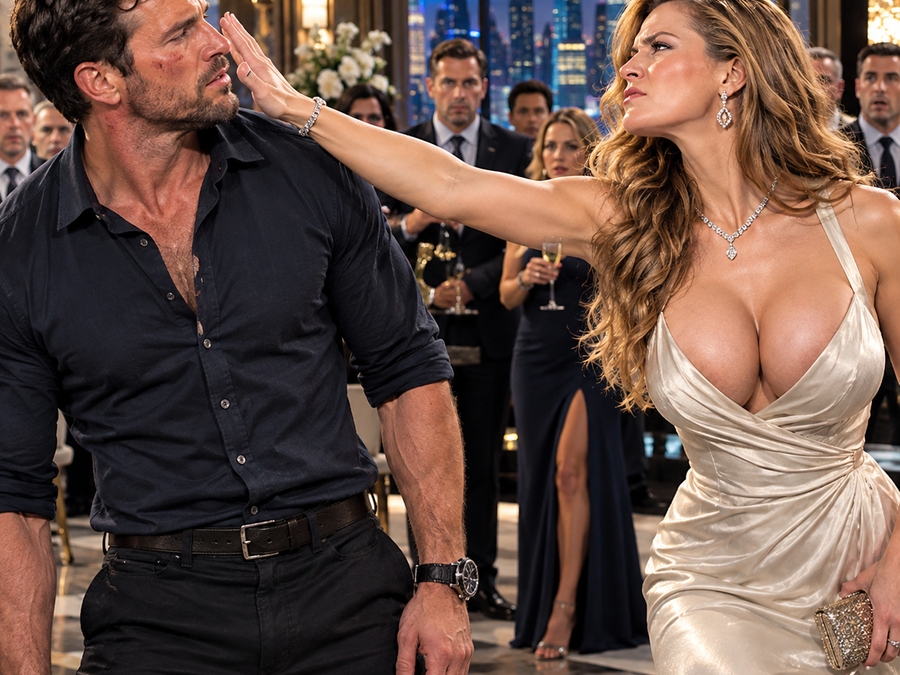
“Teach Him a Lesson!” Billionaire’s Fiancée Sent 5 Men — They Didn’t Know He Was an MMA Champ (Part 1)
PART 1
Sophia Bennett pointed one manicured finger at her head of security and said four words that would change everything.
“Teach him a lesson.”
She didn’t raise her voice.
She didn’t look back at the parking lot.
She just snapped her clutch shut, turned on her heel, and walked back into the candlelight and crystal of her private dining room like she’d ordered another bottle of wine.
Derek nodded once and picked up his phone. Five minutes later, five men stepped out of the shadows of that rain-soaked Austin parking lot, moving fast, moving certain, moving toward a beat-up Ford F-150 and the man leaning against it.
They had no idea they were walking toward one of the most dangerous men in the country. They thought they were about to rough up a mechanic. They had never been more wrong in their lives.
Michael Hayes had driven forty minutes across Austin in rush hour traffic to get that specific cake from that specific bakery on Sixth Street because his daughter Emma had circled it in the little paper catalog they kept on the fridge.
The one with her drawings on the cover—purple stars, a yellow dog that looked more like a potato, and the words “Daddy’s Favorites” written in red crayon across the top.
She was turning seven tomorrow. And Michael Hayes had never missed a birthday.
Not once.
He sat in the front seat of his ’09 Ford F-150—212,000 miles, a crack in the passenger mirror he kept meaning to fix, and a pine air freshener that had stopped smelling like pine about three years ago—with the white cake box balanced on the center console and both hands on the wheel, watching the rain come down soft and steady over the parking lot behind Luminara, one of those Austin restaurants where the entrées cost more than his electric bill.
He hadn’t planned to be here this long.
The plan had been simple.
He’d been called to do a minor brake job on a catering van parked in the service lot, a favor for an old buddy named Terrence who ran a small catering operation and didn’t trust anyone else with his vehicles.
Quick job, cash in hand, enough to cover Emma’s birthday weekend without dipping into the rainy day fund he kept in an envelope taped behind the kitchen cabinet.
In and out, home by seven. Except it was now almost nine. The rain had picked up, and Michael was still sitting in his truck.
Not because of the brake job—that had taken forty-five minutes, done clean, no problems. He was still here because of a bag. It had been sitting between two parked cars, a cream-colored leather tote, the kind that cost more than Michael made in a week, left on its side like someone had set it down and simply walked away.
He’d spotted it when he was loading his tools back into the truck bed.
Most people would have walked past it.
Told themselves, “Not my business.”
Maybe kicked it a little further under the car so no one tripped over it. Michael picked it up.
He wasn’t thinking about being a good person in that moment.
He wasn’t performing some virtue.
He was a man with calloused hands and grease under his fingernails who had raised a daughter by himself for five years. And somewhere along the way, Emma had started picking up stray cats and returning dropped wallets at the grocery store and apologizing to furniture she bumped into.
And Michael had realized, with a kind of slow, warm certainty, that she’d gotten that from him.
He unzipped the bag just enough to find an ID. Sophia Callahan Bennett.
Below the name, an address in Westlake Hills, the kind of neighborhood where the houses don’t have numbers on the mailbox because everyone who belongs there already knows where they live.
There was also a phone, locked, a passport, and a thick envelope that Michael didn’t open but that he could feel was full of something flat and rectangular and almost certainly expensive.
He zipped the bag back up, looked toward the back entrance of Luminara, sighed once—the long, quiet kind that means I know exactly what I’m walking into—and got out of the truck.
Luminara’s back entrance opened into a narrow hallway that smelled like rosemary and expensive wine, which is a combination that sounds pleasant in theory and in practice makes you feel like you’ve walked into a museum where everything is delicate and you’re not sure what you’re allowed to touch.
A young server with a carefully neutral expression stopped him almost immediately.
“Sir—” The kid’s eyes did the quick scan—work boots, Carhartt jacket, hands that told a story no résumé could—and the professional warmth in his voice dropped about fifteen degrees.
“The service entrance is back through the—” “I know,” Michael said.
“I’m not here for service.
I found a bag in the parking lot that belongs to a guest. Sophia Bennett.
Sophia Callahan Bennett.”
The server blinked, recalibrated.
“I’ll need to check with—” “I’ll wait right here.”
He said it easy. No edge to it.
He’d learned a long time ago that the fastest way to make someone uncomfortable was to be completely comfortable yourself.
The server disappeared. Michael waited, hands in his jacket pockets, the cream bag hanging from one shoulder.
A busboy passed with a tray and glanced at him. Michael nodded. The busboy nodded back.
Three minutes later, the server returned with a woman in a black manager’s blazer who introduced herself as Renata and explained that Ms.
Bennett was currently dining with a private party and perhaps Michael could leave the bag with the coat check and she would personally ensure— “I’d rather just hand it to her,” Michael said.
“There’s a passport in there.
I’d feel better knowing she got it directly.”
Renata studied him for a moment with the particular expression of someone running a silent calculation—threat level, nuisance potential, likelihood of a scene—and then made a decision.
“Follow me.”
The private dining room at Luminara was the kind of space that didn’t announce itself.
No sign on the door, just a single hostess standing outside who stepped aside when Renata approached. And then Michael was inside a room that held twelve people arranged around a table that probably cost more than his truck.
Crystal, fresh flowers, soft light from somewhere above that managed to make everyone in the room look slightly more attractive and slightly less human at the same time. Michael had been in rooms like this before.
A different life, a different version of himself who wore tailored clothes and shook hands with promoters and knew how to read a contract. That version of himself felt very far away right now.
Every face at the table turned. And at the far end, already rising from her chair with a frown carved between her brows, was Sophia Bennett.
She was beautiful in the way that certain expensive things are beautiful—precisely engineered to give that impression, leaving no detail unconsidered. Late thirties, maybe forty.
Dark hair pulled back. A dress that was simple enough to look effortless and cost enough to be anything but.
“What is this?”
she said, not alarmed.
“Ma’am, I found your bag in the parking lot.”
Michael stepped forward and held it out.
“Thought you’d want it back.”
Sophia’s eyes moved from his face to the bag to his face again.
She didn’t take it.
“How did you find it?”
“It was between two cars in the service lot.
I was finishing up a job out there.”
“A job.”
The word landed in a particular way. Flat.
Deliberate. A small test wrapped in a simple syllable.
“Brake job on one of the catering vans.”
“I see.”
She finally reached out and took the bag, held it with one hand, and didn’t break eye contact.
“And you went through it.”
It wasn’t a question.
Michael felt the shift in the room. Eleven people who had been pretending to look elsewhere were no longer pretending.
“I opened it far enough to find your ID,” he said, “so I’d know who it belonged to.
And everything else is accounted for.”
There it was. He recognized it immediately.
Not because he’d heard it often, but because there is a particular tone that some people use when they want to accuse someone without technically saying the word.
A kind of plausible deniability dressed up as a question.
“I’m just checking.
Can’t blame me for checking.
You understand?”
Michael was quiet for exactly two seconds. Long enough for everyone in the room to notice.
Short enough that it could still read as patience.
“I didn’t count your money, if that’s what you’re asking,” he said.
“I don’t know what’s in that envelope.
I didn’t open it.
You can check right now if you want.”
Someone at the table shifted. A fork clinked against a plate.
Sophia’s chin lifted a fraction of an inch.
“I’m simply being thorough.”
“Of course.”
Michael took a breath.
“I just wanted to make sure it got back to you safe.
Have a good evening.”
He turned to go.
“Wait.”
He stopped, turned back slowly. Sophia was holding the bag open, looking inside.
The envelope, the passport. The phone.
“There should be a card,” she said.
“A business card.
It was in the side pocket.”
Michael thought back.
He’d checked the main compartment for ID.
Hadn’t gone any further.
“I don’t know anything about a card.”
“He said it was there this morning.”
“Then it may have fallen out before I found the bag.”
“I don’t have it.”
“Or you took it.”
The room went very still. Michael looked at her for a long moment.
He wasn’t angry.
That was the thing that might have surprised everyone watching, if they’d been paying close enough attention.
There was no heat in his eyes, no wounded pride, no flash of the kind of reactive outrage that tends to escalate situations like this. There was just a man who was tired and had a cake in his truck and a little girl who was going to wake up tomorrow expecting her father.
“I didn’t take your card,” he said.
“I don’t know what it was for and I didn’t take it.”
Sophia opened her mouth, and Michael did something that, judging by the look on her face, no one in that room had done to her in a very long time. He kept talking—quietly, without raising his voice or asking her permission.
“You don’t know me,” he said.
“I understand that you don’t know where I came from or what kind of man I am.
And in your position, I imagine you’ve had good reasons to be careful.
But I came in here tonight because it was the right thing to do. Not because I expected a thank you.
Not because I wanted anything from you.”
He paused.
“The value of a person isn’t in what they own.
It’s in what they do when no one’s watching.”
He let that sit for exactly one breath.
Then: “Your bag is in your hands.
I hope the rest of your evening is good.”
And he walked out. The back hallway felt longer on the way out.
Renata caught up with him near the service entrance and pressed something into his hand. Michael caught a glimpse of the number before she let go and he shook his head and handed it back.
“That’s not necessary.”
“Miss Bennett would like—” “I’m sure she would.”
He held the door open, more out of habit than anything else.
“Have a good night, Renata.”
He stepped out into the rain. The service lot was quiet.
Just the hiss of tires on the street beyond the fence and the low hum of the kitchen exhaust fan and the thin, cool smell of Texas rain on hot pavement. Michael walked to his truck, opened the door, looked at the birthday cake on the passenger seat, and let out a long, slow breath.
“That’s done,” he told himself.
“Go home.”
He sat down, closed the door, started the engine—and then he turned it off again. Because something was wrong.
He didn’t know what it was yet.
Just that familiar pull at the base of his neck.
The thing that had kept him safe in a lot of places where safety wasn’t guaranteed.
The old instinct that his trainer, a bald man from Baltimore named Roy Gibbs, had called “the signal.”
Not fear, exactly.
More like the body’s knowledge arriving slightly ahead of the mind’s.
“Pay attention,” Roy used to say.
“Your body knows things your brain hasn’t figured out yet.”
Michael sat in the dark truck and paid attention. Through the windshield, he could see the service lot stretching out in front of him.
The vans, the dumpsters, the chain-link fence, the single yellow security light that buzzed and flickered and threw long shadows everywhere. Nothing.
Just rain. Just the hum.
He almost started the truck again. Almost.
👉👈
Part 2
Inside Luminara, Sophia Bennett was not having a good evening. She had come here tonight specifically to feel like herself again.
To sit at a table where people treated her like the woman she’d spent twenty years becoming, to eat food that required a reservation six weeks in advance.
To exist in a space where her name carried the weight she’d worked so hard to give it.
Instead, she was standing in the private bathroom off the main corridor, staring at her own reflection and feeling something she hadn’t felt in a very long time.
Small. Not because of anything Michael Hayes had done to her.
Not physically, not with any force or aggression or threat. Because of seven words.
What they do when no one’s watching.
She pressed her fingers against the cool tile of the sink counter and tried to identify the exact shape of what she was feeling.
It wasn’t guilt, exactly.
Sophia had long since made her peace with the fact that people in her position had to be careful, had to protect themselves, had to make calculations that other people didn’t understand.
It was something closer to recognition. The uncomfortable kind. The kind that arrives when something true has been said directly to you by someone who had nothing to gain from saying it.
She looked at herself in the mirror for another ten seconds. Then she picked up her phone and called Derek.
Derek was the head of her private security detail, a former law enforcement officer with a jaw like a concrete block and the professional disposition of someone who had decided at some point in his forties that thinking was overrated.
“The mechanic in the parking lot,” Sophia said when he picked up.
“The one who just came in to return my bag.”
“I saw him on the cameras.”
“You want me to run him?”
“I want you to make sure he understands,” she said, “that the Bennett family doesn’t appreciate being spoken to like that.”
There was a pause.
“How much of a lesson are we talking?”
Sophia looked at her reflection one more time.
“Enough that he remembers it,” she said.
She hung up. And for just a moment—a fraction of a second she would spend a long time trying not to think about—she felt something twist in her chest.
She ignored it. Derek made two calls. The men he called were not criminals in any useful legal sense.
They were contractors.
The kind that existed in the gray space between personal security and don’t-ask-questions.
Big men. Capable men.
Men who understood the difference between leaving a mark and leaving evidence. There were five of them total.
Derek briefed them in the alley behind Luminara with the efficiency of someone who has done something enough times that it stops feeling like anything at all.
“Guy in the Ford F-150 in the service lot.
Work jacket.
He’s alone.
We want him shaken, not hospitalized.
Make sure he knows who sent the message.”
The largest of the five, a man with a red beard and the build of someone who had once played college football and never quite let go of who that made him, cracked his knuckles.
“Easy night,” he said.
Derek didn’t respond.
Somewhere in the back of his head, something small and professional was registering discomfort with this particular job.
He’d pulled Sophia’s search on the man’s plate before making the calls.
The truck was registered to a Michael D. Hayes, Austin address.
No record. Clean. Too clean, something said.
But Sophia had given him a direction, and Derek was a man who moved in directions he was given. He walked back inside. Michael was still sitting in the truck when the first figure appeared at the edge of the security light.
Then another.
Then three more, spreading out from the shadows on both sides like they’d rehearsed it.
Which, he realized, they had. Five men. Dark clothes.
The deliberate, unhurried movement of people who weren’t worried about what happened next.
Michael watched them come. His hands stayed loose on his thighs. His heart rate went up four beats per minute.
He knew because he could feel it. That familiar calibration. The body preparing without being asked.
The red-bearded one stopped about eight feet from the driver’s side door.
The others fanned out in a rough semicircle.
They’d put one man near the truck bed to cut off a retreat that Michael hadn’t been planning to take.
Redbeard tilted his head toward the restaurant.
“You made a mistake in there, brother.”
Michael opened the truck door and stepped out slowly. Stood up.
He was six-one, 185, not the biggest man in this parking lot by a meaningful margin, and he was dressed like someone whose biggest physical concern that week had been a stubborn lug nut. He looked at Redbeard. Then, calmly, he looked at each of the other four in turn.
Not sizing them up, exactly. More like acknowledging.
The way you might acknowledge a set of problems you’ve already solved before and are simply being asked to solve again.
“I didn’t make a mistake,” he said.
Redbeard’s smile arrived easy and wide.
“That right?”
“I returned a bag.
I spoke honestly to someone who wasn’t used to it.”
Michael glanced toward the restaurant.
“If that’s a mistake in her book, that’s a problem with the book.
Not with me.”
“See, that’s the attitude right there.”
Redbeard took a step forward.
“That’s exactly what we’re here to correct.”
Michael didn’t step back.
He didn’t step forward either.
He just stood there, very still, with the rain coming down quiet around him and the yellow security light throwing shadows across his face, and he said something that probably sounded to every man in that parking lot like the words of someone who hadn’t yet understood the situation he was in.
“I have a birthday cake in my truck,” he said.
“My daughter turns seven tomorrow.
I would really, genuinely like to get home to her tonight.”
He looked at Redbeard.
“I’m asking you, man to man, to let me go.”
Redbeard stared at him. Then laughed.
Short. Sharp.
The kind of laugh that’s mostly air and dismissal.
“Walk away,” he said to his men.
“Wait—” One of them started.
“No, I mean tell him to walk away after.”
Redbeard reached out and grabbed Michael’s jacket at the shoulder.
A grip designed to establish something. To make a point before any point had been physically made.
He looked Michael in the eye from roughly eighteen inches away.
“Sophia Bennett says you owe her an apology, and we’re going to stay here until you understand that.”
Michael looked down at the hand on his shoulder. Looked back up. And something very small and very old moved behind his eyes.
Not anger. Not fear.
Not pride. Just a door opening.
“Take your hand off my jacket,” Michael said.
“Or what, brother?”
“Or what?”
Michael Hayes had not competed professionally in four years. He had not thrown a punch in anger in longer than that.
He had not had a reason to access any of what Roy Gibbs had put into him over eight years of training—the footwork, the economy of motion, the absolute ruthless understanding of how a human body moves and where it is vulnerable—in so long that he’d started to think of it the way you think of a language you learned as a child and haven’t spoken since.
You don’t forget it.
You just stop needing it. Until you do.
Redbeard’s grip tightened.
And Michael Hayes remembered every single word. It happened fast.
That was always the thing people didn’t understand until they saw it.
Not the violence of it, but the speed. Redbeard had a full grip on his jacket and was beginning to lean his weight into it. The natural first move in this kind of confrontation.
The physical grammar of I’m in control here.
Michael moved inside the grip. Not away from it. Inside it.
His left hand came up and redirected Redbeard’s wrist.
Not a block. More like a redirect. Like adjusting the angle of a door that was swinging the wrong direction.
And in the same motion, his hip turned, and his right arm went across Redbeard’s chest and then down.
And Redbeard was on the ground before his brain had finished processing that something had changed. One second.
Maybe less. Redbeard hit the wet pavement face-first and had just enough awareness left to realize that his right arm was held at an angle it was not designed to achieve, controlled by a hand that was applying exactly and precisely enough pressure to hold him there without doing permanent damage. And that the man holding it was not even slightly out of breath.
“Stay still,” Michael said quietly.
“I’m not trying to hurt you.”
For a half second, no one moved. Then the second man came in from the right, fast, with a straight-arm shove that would have caught most people in the ear.
Michael released Redbeard, ducked under the shove, and came up with his forearm across the man’s collarbone.
Not a strike. A check.
And used the man’s own momentum to walk him two steps sideways into the side of a parked van, where he ended up with his cheek against the metal and Michael’s hand flat against his shoulder blade.
“I don’t want to do this,” Michael said.
To this man. To all of them. To the rain and the yellow light and whoever was watching from inside.
The third man hesitated.
He’d seen two things in about four seconds that his nervous system had not been prepared for.
And his nervous system was, to its credit, updating its threat assessment.
“He’s trained,” the third man said.
Not to anyone in particular. Just out loud.
A fact that needed to be in the air. The fourth and fifth men exchanged a look. Redbeard was getting up slowly.
Holding his wrist.
His earlier confidence replaced with something he probably wasn’t used to feeling and definitely wasn’t ready to name.
Michael stepped back to the center of the semicircle. His hands were at his sides. He was wet from the rain.
His jacket had a smear of pavement grit on one shoulder.
He looked, in every external sense, exactly like what he’d been forty-five minutes ago: a mechanic who’d had a long day and wanted to go home.
Except now every man in that parking lot understood something they hadn’t understood sixty seconds ago.
“Whoever sent you,” Michael said, “made a mistake.
I’m not saying that to be threatening.
I’m saying it because it’s true and because you’re the one standing in the rain over it.
Not her.”
He looked at Redbeard.
“I came in tonight and did an honest thing.
That’s all.
She didn’t like the way I spoke to her.
That’s her right.
But this—” he gestured at the space between them— “this isn’t something I deserve, and it’s not something you want to be part of.”
Redbeard was very still.
“What are you?”
he asked.
It came out quieter than he’d intended.
Michael picked up the birthday cake box from where it had fallen. Lemon. Still in one piece.
Barely. And set it gently on the hood of his truck.
“Right now,” he said, “I’m someone’s dad.”
He looked at all five of them one more time.
“Go home,” he said.
And one by one, with varying degrees of grace, they did. Michael sat on the tailgate for a while after they were gone.
The rain had slowed to something barely above a mist. The parking lot was quiet again.
His heart rate had come back down to something normal. He looked at his hands. They were steady.
They’d always been steady.
Roy had called it the strangest thing about him. Most fighters either got too hot or too cold under pressure.
And Michael had always been exactly the right temperature.
“It’s not a gift,” Roy had told him once, after a particularly ugly sparring session that Michael had ended calmly by putting three men on the mat in succession without a visible change in expression.
“It’s a choice.
Every second.
It’s the hardest choice there is.”
Michael thought about that now. About how easy it would have been tonight to do more. To break something.
To make a point that would have been impossible to argue with. To remind five men and one woman and every camera in that parking lot exactly who Michael D.
Hayes used to be. Used to be. Before Emma.
Before the choice.
Before he decided that what he wanted to leave his daughter wasn’t a legacy of force, but a model of what it looked like to be a man who could and consistently chose not to.
He could have. He genuinely, absolutely could have.
He didn’t.
He picked up the cake box, got back in the truck, and drove home. The apartment was quiet when he got in.
Emma asleep with her bedroom door cracked. The small nightlight casting a half-moon on the hallway floor. Michael set the cake in the refrigerator, cleaned up at the kitchen sink, leaned against the counter in the dark kitchen, and listened to the sound of his daughter breathing through the baby monitor.
He still kept it—even though she’d long since passed the age for it—because he liked knowing.
Because some nights, when everything else in the world felt unsteady, the sound of her breathing was the most real thing he had. He looked at the refrigerator. Behind the door, the lemon cake waited.
Tomorrow.
He pushed off the counter and walked to Emma’s door and looked in at her, curled on her side.
One hand open on the pillow.
Hair spread out around her like she’d been poured gently into sleep.
Seven tomorrow. Michael smiled.
He turned off the hallway light. He went to bed.
He didn’t think about Sophia Bennett or the five men or the parking lot.
He thought about whether they had enough candles. He was asleep in four minutes.
What Michael Hayes didn’t know—what he wouldn’t know for several days—was that the parking lot behind Luminara had four external security cameras.
And that every second of what had happened under that yellow light had been recorded. And that one of those cameras, it turned out, was monitored by a security service that flagged unusual incidents automatically.
And that the notification had gone to the one person who hadn’t sent those five men.
The one person, in fact, who was going to have a very significant number of questions for his fiancée in the morning. Alexander Bennett had not become one of the most successful real estate developers in Texas by being slow to understand what he was looking at.
And what he was looking at—alone in his home office at 11:47 p. m.
, watching the footage on his laptop with a glass of scotch untouched beside him—was something he hadn’t seen in years.
He leaned forward. Paused the video.
Looked at the frame. Five men in the rain.
One mechanic standing perfectly still at the center of them. Patient as a stone.
Alexander Bennett was fifty-three years old. He had shaken hands with senators and survived three economic downturns and built a company from a single property in East Austin into a portfolio that stretched across four states. He was not easily surprised.
He was surprised now. Because he recognized something in the footage that had nothing to do with business. He recognized the way the mechanic moved.
He recognized the economy of it. The total, devastating absence of wasted motion.
The impossible stillness before and the controlled precision during. The immediate stand-down the moment the threat was resolved.
He’d seen it before.
On a screen, yes. But a much larger screen.
In a much larger room. With 40,000 people around him who had all gone completely silent at exactly the same moment. He sat back slowly.
“Michael Hayes,” he said quietly.
He looked at the screen for another long moment. Then he picked up his phone and called Sophia. She answered on the second ring.
Voice bright with the false alertness of someone who hadn’t actually been asleep.
“Alex?”
“Did you send security to confront someone in the parking lot tonight?”
Silence.
“Sophia—” “He was disrespectful.”
“Did you send five men after a mechanic in the back lot?”
Another silence. Longer.
“Derek handled it.
It was a simple—” “The mechanic’s name is Michael Hayes.”
Alexander paused.
“Does that name mean anything to you?”
“Should it?”
Alexander looked at the paused frame on his laptop. The still image of a man standing alone in the rain.
Five other men scattered around him like cards dropped from a hand.
“In 2019,” he said slowly, “I paid $1,200 for two tickets to watch that man fight at Madison Square Garden.
He won in the second round.”
He turned the laptop slightly, as if she could see it through the phone.
“And tonight you sent five people after him in a parking lot because he said something you didn’t like.”
The silence this time was different.
“I didn’t know that he could defend himself.”
Sophia’s voice was very quiet now, which anyone who knew her understood was considerably more serious than loud.
“That’s not actually the point.”
Alexander closed the laptop.
“We need to talk,” he said.
“Tonight.”
He hung up. He sat in the dark office for a long time after that.
Thinking about a mechanic with grease on his hands who had walked into an expensive restaurant to return a bag that wasn’t his.
Who had been accused of stealing. Who had said something that, when Alexander replayed it in his mind, landed with the weight of something true and permanent.
What they do when no one’s watching.
Alexander looked at his untouched glass of scotch. He thought about who he used to be before the portfolio, before the reputation, before the name on the buildings.
He thought about what his father had told him a long time ago in a language that money didn’t speak.
He thought about five men in the rain. And he thought about one man standing perfectly still among them who had chosen. He finally picked up his drink.
Took one slow sip.
“Hm,” he said to the empty room.
And somewhere across the city, Michael Hayes was asleep. And Emma was breathing in that quiet, steady way.
And a lemon birthday cake was waiting in the dark refrigerator. And tomorrow was going to come the way tomorrow always comes, regardless of what anyone deserved.
👉👈
Part 3
Derek was already back inside when the five men moved. Redbeard—whose actual name was Curtis, though nobody in that parking lot knew it and nobody particularly cared—was walking point, the way he always did on these jobs.
Eleven years of this kind of work had given Curtis a very specific relationship with his own confidence. He trusted it the way other men trust their reflexes or their bank accounts. It had never failed him.
Not once. He could read a situation in about four seconds flat.
That was the skill. That was what Derek paid for. You look at a man, you see how he stands, how his hands sit, whether his eyes go to the exits, whether his jaw is tight or loose.
And in four seconds, you know everything you need to know about what the next five minutes are going to look like. Curtis looked at Michael Hayes and saw a mechanic. Fifties truck.
Old jacket. Hands shoved in pockets. Shoulders down.
No tension in the body.
The posture of a man who had already decided this wasn’t going to be a fight.
Which, in Curtis’s experience, meant it wasn’t going to be much of anything at all.
Four seconds. Read complete.
Easy night. He put on the smile that he used for these situations.
The one that said, without saying it, that the outcome of the next few minutes had already been decided and the only variable was how much discomfort the other man wanted to experience before he came around to that understanding.
“Hey, brother,” Curtis said.
“Rough night.”
Michael looked at him with a kind of patience that Curtis registered as stupidity.
“Going home,” Michael said.
“Or I was.”
“Yeah, that’s going to be a few minutes yet.”
Curtis stopped about six feet out, which was close enough to make a point and far enough to give the other men room to set their positions.
He didn’t look at them.
Didn’t need to.
Fourteen jobs together. They knew the geometry.
“You had yourself a little moment in there.
Said some things.”
“I said true things.”
Curtis tilted his head.
“See, that’s the part where we disagree.”
“We can disagree and I can still go home.”
After Curtis said that, Michael’s eyes moved.
Not nervously. Just deliberately.
The way you check a room when you want to understand what’s in it.
He looked at the man on his left. The man on his right.
The one near the truck bed.
The one hanging back at Curtis’s shoulder.
Five. He looked back at Curtis.
And here was the thing that Curtis noticed but didn’t yet understand—the thing that would come back to him later, in the quiet of his own car, driving home with his wrist wrapped and his ego substantially restructured.
The man’s eyes weren’t afraid.
They weren’t angry either.
They were just calculating. Like someone sitting down at a chessboard who has seen this particular opening before and already knows the response.
“I have my daughter’s birthday cake in my truck,” Michael said.
“I want to go home.”
Curtis laughed.
He couldn’t help it.
The birthday cake. The way he said it, as if that was a relevant piece of information. As if any of that mattered right now.
“That’s sweet, brother.
Real sweet.”
He took one step forward.
“Sophia Bennett says you owe her an apology, and we’re going to stand here in this rain until you figure out how to say it.”
“I don’t owe her an apology.”
“Yeah, you do.”
“No,” Michael said.
And his voice was the same temperature it had been since the moment Curtis first heard it. Completely unreadable. Even.
“What I did tonight was walk into a restaurant and return something that didn’t belong to me.
What she did was accuse me of stealing it in front of twelve people.
If anyone owes anyone an apology, we both know which direction that goes.”
Curtis felt the first real flicker of something that wasn’t quite annoyance and wasn’t quite respect.
The man wasn’t backing down.
That happens sometimes. Usually with younger guys. Twenties.
A little drunk on their own youth. You leaned in, they leaned back.
This man was different.
He wasn’t leaning anywhere.
“Last chance to do this the easy way,” Curtis said.
He grabbed Michael’s jacket at the shoulder.
Not a strike. A grip.
The kind that said, I am in control of this situation, and I am demonstrating it physically so there is no ambiguity.
“Apologize.
We go home.
Simple.”
Michael looked down at the hand. The parking lot was absolutely quiet.
Then Michael said, very softly, “Don’t.”
And Curtis—who had eleven years of reading situations in four seconds—had exactly one second to understand that he had misread this one completely before the world tilted.
He didn’t process it as a sequence of events because it happened too fast for sequence.
What he experienced was: his own grip on the jacket.
Then the jacket moving in a direction he hadn’t initiated.
Then his arm being somewhere it shouldn’t be.
Then the pavement against his face. Then a hand on his wrist at an angle that communicated, with total clarity and zero aggression, that the person holding it could end the conversation right here and had decided, for reasons of their own, not to.
He was on the ground in under two seconds. The rain came down on the back of his neck.
He heard someone say, “What the—” and then the sound of someone else moving fast from his right.
He didn’t see what happened next.
His cheek was against the asphalt. But he heard it.
The short, sharp sound of momentum redirected. A body contacting a van. And then silence.
And then Michael’s voice again.
The exact same temperature as before.
Saying, “I don’t want to do this.”
Curtis breathed. He was not a man who frightened easily.
He’d been in bad situations.
Real ones.
Situations with stakes that this parking lot outside a steakhouse didn’t come close to.
But something was moving up the back of his spine right now that he recognized from those situations. Something animal and very old. The thing the body generates when it has correctly identified that it is in the presence of something significantly more dangerous than it had prepared for.
He stayed very still. The hand on his wrist stayed very still, too.
“Curtis.”
That was Marco’s voice.
The third man.
“Curtis, he’s trained.”
Curtis said nothing.
“He took down both of them in about four seconds.
Man, he didn’t even—” “He’s just standing there.”
“I know,” Curtis said.
Into the pavement.
“What do you want us to—” “Nothing,” Curtis said.
“Do nothing.”
Michael’s hand released his wrist.
Curtis got up slowly.
He didn’t rush it.
He took his time. Got his knees under him. Got to his feet.
And turned to look at the man who had put him there.
Michael Hayes was standing exactly where he’d been standing when Curtis walked up.
Same posture. Hands at his sides. Now, the birthday cake box had fallen off the hood of the truck at some point and was sitting slightly crumpled on the wet asphalt, and Michael reached down and picked it up, turned it over once to assess the damage, and set it back on the hood.
He looked at Curtis.
“We’re done,” he said.
Curtis looked at his wrist. Looked at Marco, who was standing with one shoulder against the van and an expression on his face that Curtis had never seen on him before.
Looked at the two men who hadn’t moved and were now very quietly wishing they were somewhere else.
“Who are you?”
Curtis said.
It came out quieter than he’d meant it to.
Less like a challenge.
More like a genuine question from someone who understood they’d been missing a critical piece of information.
Michael didn’t answer right away.
He looked at the restaurant. Then back at Curtis.
“Someone who wanted to do the right thing tonight,” he said, “and got this for it.”
He picked up the cake box from the hood and opened the truck door.
“Go back inside and tell whoever sent you that the lesson didn’t take the way she expected.”
He got in the truck. Curtis stood in the rain and watched the brake lights of the F-150 come on, then go off as Michael put it in drive, then watched the truck pull slowly out of the service lot and onto the street beyond. He stood there for a long time after the taillights were gone.
“What just happened?”
Marco said.
Curtis didn’t answer him.
He was already pulling out his phone. Because something was telling him—the same instinct that had served him for eleven years, now recalibrating itself in real time—that he needed to know exactly who that man was before Derek did. He pulled the plate number from his memory and typed it into the search he used for these situations.
It came back in under a minute. Michael D.
Hayes, 35, Austin, Texas. Registered owner of the F-150. One address.
No record. Curtis stared at the name.
Something about it.
He opened a different app, typed the name into a broader search, added the word “fighter.”
The results came back and Curtis went very still in the rain, reading the screen.
“Marco,” he said quietly.
“Yeah.”
“You remember that fight at Madison Square Garden, 2019?
The one where the guy finished the main event in the second round and the whole arena went quiet for about ten seconds before anyone even started cheering?”
Marco looked at him.
“What about it?”
Curtis held up his phone. Marco squinted at the screen.
“Read it.”
“Read it again.”
“That’s him.”
“Marco said that’s him.”
Marco looked at the empty space where the F-150 had been.
“And Sophia Bennett sent us after him.”
Marco said it not really as a question. More as someone testing whether the sentence made sense when spoken out loud.
It didn’t.
Particularly.
“Because he said something she didn’t like.”
“Because he said something she didn’t like,” Curtis confirmed.
Marco was quiet for a moment.
“You need to call Derek,” he said.
“I know.”
“Like right now.”
“I know, Marco.”
Curtis looked at his wrist again. Rolled it once.
Nothing broken.
He’d been handled with more care than he’d had any right to expect.
And he understood that. And the understanding sat in his chest in a way that was going to take a while to move through.
He called Derek. Derek picked up on the first ring.
“Tell me it’s handled,” Derek said.
Curtis took a breath.
“Derek,” he said, “I need you to run a name for me.”
Three floors up, behind the amber windows of the private dining room, a woman who had ordered this night like a meal from a menu was sitting with her back very straight and her wine glass untouched, listening to her phone ring. It was Alexander.
She knew because of the ringtone—a specific one she’d assigned to his number six months ago when she thought it was romantic and hadn’t yet started finding the sound of it complicated.
She looked at the screen. Let it ring twice. Picked up.
“Alex,” she said, bright and even.
“I thought you were in Dallas.”
“I came back early.”
His voice was quiet.
Alexander’s voice was always quiet.
Which was one of the things that had attracted her to him initially and had since become one of the things she found most difficult to read.
“The security system flagged an incident in the Luminara lot.
I’ve been watching the footage.”
Sophia’s hand tightened on the phone.
She kept her face completely still, because there were still eleven people within eyeshot and she had not survived the last twenty years by letting a room see her recalibrate.
“There was a man,” she said carefully.
“He was disrespectful.”
“He returned your bag.
After going through it.”
“The footage shows him opening it to check the ID.”
Alexander paused.
“That’s it.
That’s what he did.”
Sophia said nothing.
“And then you told Derek to send five men after him.”
“I asked Derek to make sure he understood—” “Sophia.”
The quiet voice got quieter.
It was a specific kind of quiet that Alexander used when he was about to say something he’d thought through completely and was not going to revisit.
“Do you know who that man is?”
“A mechanic.”
“His name is Michael Hayes.”
Silence.
“Does that mean something to you?”
Sophia said nothing.
“It should,” Alexander said.
“I watched that man fight at the Garden in 2019.
I paid $1,200 for those tickets.
He was one of the best fighters in the country.”
Another pause.
“And tonight you sent five people to rough him up in a parking lot because he told you that a person’s value isn’t measured by their bank account.”
The room around Sophia was the same room it had been all evening. The crystal, the flowers, the soft, flattering light.
Nothing about it had changed.
And yet— “He made me look—” “He made you look like someone who needed to hear what he said,” Alexander said.
“And so did this.”
She opened her mouth. Closed it.
“Come home,” Alexander said.
“We need to talk about this.”
He hung up. Sophia sat with the phone in her hand for a moment. Then she set it face down on the table with the measured care of someone who is being watched and very much does not want to appear to be anything other than composed.
Excused herself from the table with a smile that had been professionally maintained through worse moments than this. Walked to the private bathroom.
Locked the door. Stood at the sink. Looked at herself.
She was forty-one years old. She had a name that opened rooms.
She had a ring on her finger that represented a future that she had chosen, deliberately, intelligently, from a position of total self-determination. And somewhere in the parking lot, two floors down, five men were standing in the rain because she had told them to be there.
Because a mechanic had looked her in the eye and hadn’t looked away.
Because he’d said something that had gotten underneath her composure in a way that she was now recognizing, with the particular discomfort of honest self-examination, had nothing to do with him and everything to do with her.
She turned the cold water on and held her wrists under it. The face in the mirror looked back at her with the expression of someone who had built a very tall, very polished thing and was only now beginning to notice the hairline cracks at the base. She turned the water off.
Dried her hands. Walked back out.
Collected her coat, her bag, and her composure—in that order—and left.
Derek was waiting near the valet stand, his face arranged into the professional neutrality that Sophia had always appreciated and was currently finding somewhat irritating, because she was very aware that he had additional information that she didn’t yet have and she was very aware that she was going to have to ask for it.
“The situation in the lot,” she said.
“Resolved,” Derek said.
“Sort of.”
She looked at him.
“The man wasn’t—the situation didn’t go the way we anticipated.”
“Meaning?”
Derek looked at her steadily.
“Meaning Curtis is going to need ice on his wrists tonight, and the man in the F-150 left under his own power after about ninety seconds.”
Sophia was very quiet for a moment.
“He took down five men.”
“He took down two.
And the other three made what I’d call an informed decision to stand down.”
“He’s a mechanic.”
“He was,” Derek said.
“His name is Michael Hayes.
Before he was a mechanic, he was a professional MMA fighter. One of the top-ranked fighters in the country. 2015 to 2020.
He retired.”
He paused.
“Miss Bennett, he went easy on them.
From what Curtis described, he could have put all five of them in the hospital.”
Sophia stared at him. She had the sudden, disorienting sensation of a narrative she had written in her head being shown to her from a different angle.
The same events, the same people, but the light coming from somewhere else entirely.
Illuminating everything she’d arranged in the dark.
“Why didn’t he?”
she asked. Derek looked at her with an expression that she would think about for a long time afterward.
“I think,” he said carefully, “because he didn’t want to.”
The valet brought her car. She got in. The drive back to Westlake Hills was twenty-two minutes.
And she spent all of it in a particular kind of silence. Not the comfortable kind.
Not the tired kind. But the kind that comes when the version of yourself you thought you were has started to feel like a stranger.
Alexander was in the study when she got home. He was sitting behind his desk with the lamp on and his laptop open. And when she walked in, he looked up from the screen with an expression that she had only seen on his face a handful of times.
Not anger. Not disappointment. But something more specific and more difficult.
Clarity.
“Sit down,” he said.
She sat.
“I want to show you something.”
He turned the laptop toward her. The footage from the parking lot cameras.
Already queued up. Timestamp 9:14 p.
m. She watched it.
She’d known what she was going to see—Derek had described it in broad strokes—but watching it was different.
The camera angle made the parking lot look exactly as small and unglamorous as it was. And the five men moved into frame with a confidence that looked, she now realized, almost comically misplaced.
She watched Michael Hayes step out of the truck. She watched him look at each man in turn. She watched Curtis grab his jacket.
And she watched what happened next. And it was nothing like what she had pictured when she made the phone call. She had pictured something that would reassert a certain order of things.
A reminder.
A demonstration that the world ran the way she’d understood it to run, which was that people like her made decisions and people like him absorbed their consequences.
What she watched instead was something that had nothing to do with any of that.
Because after the two men were down and the others had gone still, Michael Hayes stood in the center of that parking lot and put his hand on his daughter’s birthday cake and he looked at five men who had been sent to hurt him and he said something.
“I can read lips a little,” Alexander said quietly.
“I watched that section about eight times.”
“What did he say?”
Alexander looked at her.
“He said, ‘Go home.’
” Sophia looked at the frozen frame on the screen.
Michael Hayes mid-sentence. Rain on his jacket. Birthday cake in his hand.
Five men standing around him and none of them—none of them—moving.
“He could have destroyed them,” Alexander said.
“Anyone who knows anything about that man’s record understands what kind of damage he is capable of.
He could have put all five of them in the emergency room and called the police from the hospital parking lot and been completely within his legal rights.”
He closed the laptop slowly.
“And instead he picked up a birthday cake and told five men to go home.”
Sophia said nothing.
“I’ve done a lot of things in my career that I’m proud of,” Alexander said.
“I’ve also done things I’m not.
And I’ve learned—it took a while, but I learned—that the measure of a person isn’t what they do when they’re in a position of weakness.
It’s what they do when they’re in a position of strength.”
He looked at her.
“That man was in a position of total strength tonight.
And what he did with it was show restraint.”
“Alex—” “You accused him of stealing in front of a room full of people because he made you feel something you didn’t like.”
He wasn’t raising his voice.
He never raised his voice.
“And then you sent men to make sure he knew his place.”
The word landed between them.
“That’s not who I am,” Sophia said.
“I know that,” Alexander said immediately, and without hesitation.
“I know exactly who you are.
That’s why I’m still sitting here talking to you instead of—” He stopped himself.
Took a breath.
“But tonight, that’s what you did.”
She looked at the closed laptop.
“I thought he—” She stopped.
“I thought he was trying to embarrass me.”
“He was trying to return your bag.”
“He looked at me like—” “Like you were.”
Alexander waited.
Sophia’s jaw tightened.
“Like I was someone who needed to be corrected,” she said.
Alexander studied her for a long moment.
“Maybe,” he said gently.
“He wasn’t wrong.”
The room was very quiet.
Sophia felt something in her chest that she hadn’t felt in a long time.
Something she’d spent considerable energy keeping at a safe distance, because in her experience it tended to arrive at inconvenient moments and suggest things that were difficult to act on.
It felt like accountability. It felt like the weight of a very simple thing clearly seen.
“I need to apologize to him,” she said.
It came out before she’d decided to say it, which meant she understood that she’d already decided.
Alexander looked at her with an expression that she recognized from early on. From before the ring, before the public life, from a smaller version of what they were now, when things were simpler and she was still learning who he was. He looked proud.
Not of a business deal or a social victory or any of the things that she’d watched him be proud of in the years since.
Proud of her.
“Yeah,” he said quietly.
“You do.”
She sat with that for a moment.
“He’s not going to want to see me,” she said.
“Probably not.”
“He’s not going to accept—” “Maybe not,” Alexander said.
“But that’s not the point.
The point is that you do it.”
He leaned forward slightly.
“Not for him.
Not for what comes after.
Just because it’s what’s right.”
Sophia looked at her hands. At the ring.
At the hands of a person who had built something out of sharpness and precision and the constant management of perception, and who was now, in a study in Westlake Hills at 11 p. m. on a Tuesday, being asked to walk back out into the world and be something softer.
“Okay,” she said.
Alexander nodded once.
He didn’t say anything else.
He didn’t need to.
And in the east part of the city, in a quiet apartment with the lights off and a lemon birthday cake in the refrigerator, Michael Hayes slept without knowing that anything in the world was about to change. His daughter breathed in the next room.
The night moved on the way nights do. And in the morning, everything would be exactly what it was.
Until it wasn’t.
👉👈
Part 4
Emma Hayes woke up at 6:47 in the morning, the way she always did on her birthday. Not gradually, not reluctantly, but all at once, like a light switching on.
Sitting straight up in bed with both eyes open and the immediate, absolute certainty that today was different from every other day. She was seven.
She ran down the hallway in her socks and slid the last four feet into the kitchen doorway, where her father was standing at the stove in yesterday’s t-shirt with a spatula in one hand and the particular expression of a man who had been awake for exactly long enough to make pancakes and not one minute longer.
“There she is,” Michael said.
Emma launched herself at him from three feet away with the full commitment of a child who has never once considered the possibility that the person she’s jumping at won’t catch her.
Michael dropped the spatula, caught her with both arms, and spun her once before setting her on the counter.
“Seven,” he said, looking at her like it was a thing that needed to be confirmed.
“Seven,” she said back, very seriously.
“That’s a big number.”
“It’s the biggest number I’ve ever been.”
He laughed. The real kind. The kind that came from somewhere below the chest.
And kissed the top of her head.
And she smelled like sleep and the strawberry-shaped shampoo he bought in bulk because it was the only kind she’d accept.
And for exactly that moment, everything else in the world was very far away. They ate pancakes at the kitchen table.
Emma talked without stopping for approximately twenty-two minutes about a dream she’d had involving a horse that could do math, a detail she found deeply significant and wanted to explore at length.
Michael listened and asked questions and drank his coffee and did not think about parking lots or five men or a woman named Sophia Bennett. He had decided, sometime between falling asleep and waking up, that last night was last night, and today was today.
That was a discipline he’d developed over years.
The ability to put a thing in its box and close the lid and be present for whatever was in front of him. Roy had called it compartmentalization.
Michael just called it being a dad.
“Can I have cake for breakfast?”
Emma asked.
“No.”
“Can I have cake right after breakfast?”
“No.”
“Is there a time between breakfast and lunch that doesn’t count as either one?”
Michael looked at her over his coffee cup.
“No.”
She considered this with the focused expression of someone looking for a legal loophole.
“What about second breakfast?”
“You’ve been watching that movie again.”
“The Hobbit ones are very educational, Emma.”
“Fine.”
She stabbed a pancake.
“Tonight though.”
“Tonight,” he confirmed.
“We invite Mrs.Reyes from next door.
We put candles on the lemon cake and you get two slices.”
She looked up.
“Two?”
“It’s a big number.”
She smiled so wide it took up most of her face. And Michael Hayes, who had stood in a rain-soaked parking lot the night before and faced down five men without blinking, felt something crack open in his chest in the very best way. The way that only a seven-year-old with strawberry shampoo and a Hobbit argument could manage.
He was still smiling when his phone buzzed on the table. Unknown number. He let it ring.
It rang again forty minutes later, while Emma was in the shower singing something that was either a pop song or a very enthusiastic personal composition. Hard to tell. Michael was washing the dishes, and he looked at the screen and set the phone back down.
The third time, just before noon, he picked up.
“Mr.Hayes.”
The voice was professional, measured, female. Not Sophia. Someone who worked for Sophia.
“My name is Clare.
I’m calling on behalf of Ms.
Bennett.
She’d like to speak with you at your convenience.”
Michael dried his hands on a dish towel.
“About what?”
he said. A very brief pause.
“She’d like to apologize.
In person, if you’re willing.”
Michael looked at the dish towel in his hands.
He thought about the room in Luminara, the twelve faces, the word “theft” implied without ever being spoken.
The particular calibration of Sophia Bennett’s voice when she’d asked whether everything was accounted for.
Not curious, not relieved, but testing. Probing.
Looking for the version of him she’d already decided was true.
“Tell her I appreciate that,” he said.
“But it’s not necessary.”
“She was quite insistent—” “I’m sure she was,” Michael said.
“Tell her I said thank you, and I don’t hold any hard feelings.
And tell her I hope the rest of the bag was in order.”
He hung up. Emma came out of the bathroom wrapped in a towel and wearing the expression of someone who had just had a very important idea.
“Can we go to the park?”
she said.
“Yeah,” Michael said.
“We can go to the park.”
They went to the park. Zilker Park on a Wednesday morning in October belonged mostly to dog walkers and joggers and one very committed man who was doing Tai Chi near the pavilion with the focused serenity of someone who had given up caring what anyone thought of him.
Michael sat on a bench and watched Emma tear across the grass after a soap bubble she’d made with the little kit she kept in the pocket of her jacket.
And he thought about nothing at all. That was the thing people never understood about him. The thing that had made him difficult to interview, difficult to profile, difficult to edit into the kind of story that sports media liked to tell.
He wasn’t deep and brooding.
He wasn’t haunted by his past.
He wasn’t carrying some enormous invisible weight that made every quiet moment dramatic.
He just liked being outside with his kid. He just liked the way soap bubbles caught light before they disappeared.
His phone buzzed again. Different number this time. Austin area code.
He almost didn’t answer, but something—that old instinct, the one Roy had named—made him pick up.
“Michael Hayes.”
The voice was male. Quiet. Accustomed to being listened to without having to raise its volume.
“Yeah,” Michael said.
“My name is Alexander Bennett.”
Michael was quiet for exactly two seconds.
“Mr.Bennett,” he said.
“I’d like to apologize for what happened last night,” Alexander said.
“Not on Sophia’s behalf.
For myself.
Those men were operating under instructions that shouldn’t have been given, and they were given because of a situation that I should have been present for and wasn’t.”
A pause.
“That’s not sufficient as an explanation.
I just want to be clear that I’m not calling to manage a problem.
I’m calling because what happened to you was wrong.”
Michael watched Emma chase another bubble across the grass.
“Your fiancée thought I’d stolen something from her,” Michael said.
“I hadn’t.
Five men came to make a point in a parking lot.
I went home.”
He paused.
“No one got hurt.
I don’t think there’s anything that requires a phone call.”
“I’ve seen the footage,” Alexander said.
Michael said nothing.
“You had every right—legally and otherwise—to do considerably more damage than you did.”
“Yeah,” Michael said.
“I did.”
“Why didn’t you?”
It was a genuine question. No agenda underneath it.
Just a man who had watched something he didn’t fully understand and wanted to.
Michael thought about how to answer it honestly. He looked at Emma, who had given up on the bubble kit and was now attempting to do a cartwheel with the technique and enthusiasm of someone who had never seen a cartwheel but had been given a very enthusiastic description of one.
“Because the goal wasn’t to win,” Michael said.
“The goal was to go home.”
Alexander was quiet for a moment.
“Can I ask you something?”
Michael said.
“Of course.”
“The footage.
The security cameras in that lot.
Who monitors those?”
“Third-party security service.
They flag incidents automatically.”
“So you found out because of a flag.”
“Yes.”
Michael nodded slowly, though Alexander couldn’t see it.
“Does your fiancée know you called me?”
A brief pause.
“No.”
“Okay,” Michael said.
“I appreciate the call, Mr.Bennett. I genuinely do.
But I think the only conversation I need to have is with her, if she wants to have it.
And I already told your assistant it wasn’t necessary.”
“She’s going to disagree with that.”
“She can,” Michael said.
“Have a good afternoon.”
He hung up. Emma landed her cartwheel.
Mostly.
She came up with grass on her knees and both fists raised like she’d just won something, turned to find her father, and yelled, “Did you see that?”
“I saw it,” he called back.
“I’m basically a gymnast.”
“Basically,” he agreed.
She ran back toward him, still flushed and grinning, and threw herself onto the bench beside him with the full physical commitment that she brought to everything, including sitting down.
“Dad,” she said.
“Yeah.”
“Is today going to be a good day?”
Michael looked at her. Seven years old. Grass on her knees.
Hair still damp from the shower and frizzing in the October air. Looking at him with the specific trust of a child who has learned, from consistent evidence, that her father tells the truth.
“Yeah,” he said.
“It’s going to be a great day.”
He meant it.
What he didn’t know was that approximately four miles away, in the lobby of a hotel that Sophia Bennett was using to collect herself between the previous night and whatever came next, a conversation was happening that was going to make the afternoon considerably more complicated than he’d planned.
Curtis sat across from Sophia in the hotel lobby with his wrist wrapped and a cup of coffee he wasn’t drinking and the specific expression of a man who has decided to be completely honest in a situation where honesty is not going to be comfortable for anyone.
Sophia had called him herself. Not through Derek. That alone had told Curtis something.
“Tell me exactly what happened,” she said.
So he did. He told it straight. Without softening it or shaping it or leaving out the parts that reflected badly on him, which was most of them.
He told her about the first four seconds when he’d read Michael Hayes as no threat.
He told her about the grab. He told her about the ground. He told her about the moment afterward when Michael had picked up the birthday cake.
Sophia listened without moving.
“He asked us to go home,” Curtis said.
“That was it.
He didn’t threaten us.
He didn’t call the police.
He didn’t—” He stopped.
“Miss Bennett, I’ve been doing this work for eleven years.
And I have never been handled like that.
And I have definitely never been handled like that and then just let go.”
He looked down at his wrapped wrist.
“He could have broken this.
He had the angle. He had the leverage.
He chose not to.”
Sophia looked at the untouched coffee in front of her.
“Why are you telling me this?”
she said. Curtis looked up at her.
“Because I think you need to know the kind of man you sent us after.”
The lobby moved around them. People checking in, rolling luggage, a child crying somewhere near the elevator bank.
The world proceeding at its normal pace.
“He’s not angry,” Sophia said.
“He seemed like a man who was mostly thinking about a birthday cake,” Curtis said.
She almost smiled. It happened involuntarily, a reflex, and she controlled it before it fully formed.
But Curtis saw it.
“His daughter turns seven today,” Sophia said, very quietly, more to herself than to Curtis.
“Yes, ma’am.”
She sat with that.
Then she looked at Curtis directly and said, “I need his address.”
Curtis looked at her steadily.
“Ms.
Bennett, I’m not going to send anyone.
I’m going to go myself.”
“That’s not—” “He may not want—” “I know,” she said.
“That’s not the point.”
Curtis recognized that sentence.
He’d heard it last night, in different words, from a different person.
He thought about Alexander Bennett sitting in his office watching parking lot footage at midnight. He thought about what kind of people surrounded themselves with what kind of people, and what that said.
He thought about Michael Hayes in the rain telling five men to go home.
“I’ll need to verify with Mr.Bennett,” Curtis said.
“Alexander doesn’t know I’m doing this.”
“All the more reason.”
Sophia held his gaze for a moment. Then she nodded once.
“Make the call.”
He did. Alexander answered on the second ring and listened to Curtis explain the situation without interrupting.
When Curtis finished, Alexander was quiet for a moment, and then he said, “Let her go.
But you go with her.
And Curtis—don’t tell her I already called him.”
Curtis looked at Sophia across the lobby.
“Understood,” he said.
He hung up.
“Well,” Sophia said.
“I’ll drive you,” Curtis said.
She looked at him with an expression he couldn’t quite read.
Something between gratitude and the specific discomfort of someone who is not accustomed to needing things from other people and is currently in the position of needing several.
“Thank you,” she said.
It was the quietest he’d ever heard her.
They drove across Austin in a black SUV with the radio off. And Sophia sat in the passenger seat with her hands in her lap and her eyes on the road.
And Curtis drove and said nothing, because there was nothing useful to say, and he’d learned a long time ago that silence was sometimes the most professional thing you could offer.
They pulled up outside a two-story apartment building on the east side. Not run down.
Not neglected. Just the kind of building that houses people who are focused on other things than impressing whoever drives past.
Sophia looked at the building for a moment.
“What if he closes the door?”
she said.
“Then you’ll have done what you came to do,” Curtis said.
“And you walk back to the car.”
She opened the door.
She was wearing the same clothes as last night, which was something she was aware of and couldn’t fix, and she was very conscious of how she looked.
The expensive coat, the heels.
All of it landing differently in this context than it had in Luminara’s private dining room.
Landing as what it was, maybe, rather than what she usually managed to make it represent. She found the apartment number from the building directory and climbed one flight of stairs and stood in front of the door and did something she very rarely did. She hesitated.
Not out of fear. Out of something closer to respect. The understanding that she was about to knock on a door that she had no particular right to knock on.
And that the man behind it had every reason to not answer it. And that none of the things she usually relied on—her name, her money, her ability to control the narrative of a room—were going to be useful here.
She knocked. She heard movement inside. A voice.
Small. Seven years old.
Said something she couldn’t make out.
Then footsteps. The door opened. Michael Hayes looked at her from the doorway.
He was in jeans and a clean flannel shirt, which was different enough from last night’s work jacket that it took her brain a half second to confirm it was him.
He looked at her without surprise, which meant she understood immediately that he had already been called. By Alexander, or by Clare, or by someone. And he had known this was coming.
He hadn’t left.
He hadn’t locked the door.
He just waited to see if she’d actually show up.
“Miss Bennett,” he said.
“Mr.Hayes,” she said.
“I’m sorry to come to your home.”
“I know I should have.”
“How did you get the address?”
“Your security ran your plates last night.
Derek had it on file.”
A pause.
“I know.
I understand how that sounds.”
“Yeah,” Michael said.
He didn’t move from the doorway.
“What do you want?”
“To apologize.”
“She said, ‘In person.
Not through an assistant.’
” From somewhere behind him came a small voice.
“Dad, who is it?”
Michael turned his head slightly.
“Nobody you know, baby.
Give me a minute.”
He looked back at Sophia. She took a breath.
“Last night,” she said, “I accused you of stealing from me in front of people I have known for years.
You hadn’t stolen anything.
You’d done something that most people don’t do, which is go out of your way to return something that would have been easy to keep or ignore.”
She stopped.
“And I made you feel like a suspect instead of a person.
And then I sent five men to make sure you understood your place.”
She said the last two words with a specific, deliberate steadiness, as though she needed to hear herself say them out loud.
“That was wrong.
All of it.
And I’m sorry.”
Michael looked at her. The hallway was quiet.
From inside the apartment, faintly, something that was either a cartoon or Emma’s personal soundtrack of sound effects.
“Is your daughter okay?”
Sophia said.
It came out before she’d planned it.
“I know last night the cake was—” “She’s fine,” Michael said.
“Cake survived.”
“Good.”
A beat.
“That’s good.”
He studied her for a moment with that expression she’d seen in Luminara.
Not suspicious, not warm, just present. The expression of someone who is actually looking at you, rather than at what they expected to find.
“I accept your apology,” he said.
She blinked.
“Just like that?”
“Were you hoping I’d make it harder?”
“I—” She stopped.
Almost smiled.
“I didn’t know what to expect.”
“You came all the way across the city,” he said.
“You knocked on a door you didn’t have to knock on.
You said something real.”
He shrugged slightly.
“That’s enough.”
She looked at him for a moment.
“You’re not what I expected,” she said.
“I know,” Michael said.
“You thought I was a mechanic.”
“I thought you were a mechanic,” she agreed.
“And I thought that meant something.”
“It means I fix cars,” he said.
“That’s all it means.”
She nodded slowly. There was a pause. Not uncomfortable, but real.
The kind of pause that exists in a conversation when the prepared words have been used and what’s left is just two people standing in an honest moment without the script.
“Can I ask you something?”
Sophia said.
“Sure.”
“Last night, when you walked into the restaurant—” She met his eyes.
“You knew what it would look like.
A man dressed the way you were dressed, walking into a room like that.
You knew how people would read it.”
“Yeah,” Michael said.
“I knew.”
“And you came in anyway.”
“It was your bag.
That’s it.”
She said, “That was the whole calculation?”
Michael looked at her for a long moment.
“Miss Bennett,” he said, “the calculation was about the bag.
The rest of it—how the room read it, how you read it—that wasn’t my calculation to make.
I can only control what I do.
Not what people decide it means.”
She absorbed that.
“My fiancé watched the parking lot footage,” she said.
“He said—” “He said you could have.”
“I know what I could have done,” Michael said.
And there was a quietness in his voice that wasn’t unkind but was very final.
Not a door closing. More like a door that had never been open in the first place.
“I’m not interested in what I could have done.
I’m interested in what I did.”
She stood with that. Then something behind his eyes shifted. Something warming, just slightly.
“Your bag is fine,” he said.
“Everything in it is fine, including whatever was in that envelope.”
She nodded.
“I know.
I checked.”
“Good.”
Another pause.
“There wasn’t a business card,” she said.
“No, I know that now, too.”
She looked down briefly.
“It fell out in the car.
I found it this morning.”
Michael looked at her.

