“What Rank Are You, Asshole?” a SEAL Mocked Single Dad—Then 4 Generals Saluted Him (Part 1)
“What Rank Are You, Asshole?” a SEAL Mocked Single Dad—Then 4 Generals Saluted Him (Part 1)
PART 1
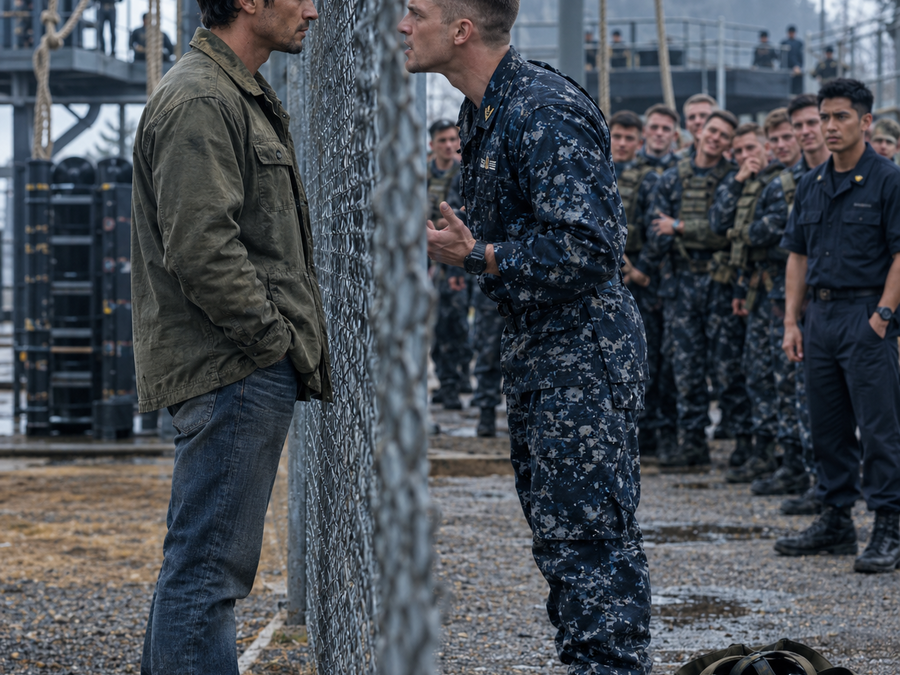
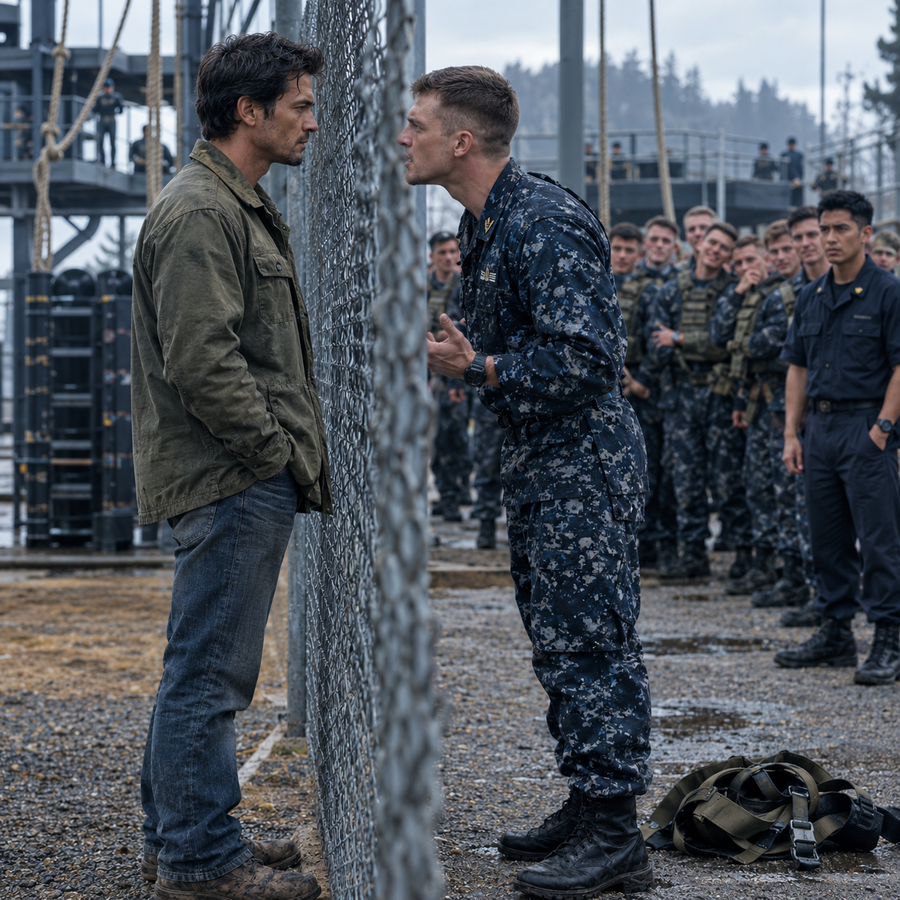
Lieutenant Blake Ror got two inches from the man’s face. Jaw tight. Voice loud enough for every SEAL in that training yard to hear. And asked the question like it was a weapon. “What rank are you?” The man in the faded jeans didn’t flinch. Didn’t step back. Didn’t raise his voice. He just looked Ror dead in the eyes and said, “No rank you need to worry about.”
The whole yard laughed. Ror laughed loudest. Nobody knew. Not Ror. Not the SEALs. Not the captain standing two hundred yards away, polishing his reputation. That those words had just started a clock. And when that clock ran out, four United States generals would walk past every uniformed man in that hangar and salute the guy in the old pickup truck.
The engine of Daniel Cross’s 2003 Ford F-150 knocked once, then settled as he pulled into the visitor lot of Joint Maritime Warfare Center just after 7:40 on a cold Monday morning in November. The truck had 214,000 miles on it. The passenger seat had a juice box in the cup holder, a purple hair tie looped around the gear shift, and a worksheet on the floorboard that read in a child’s careful handwriting, “My Hero.” A presentation by Mia Cross, age 10.
Daniel didn’t notice any of that right now. He was watching the base. He sat behind the wheel for ninety seconds before he got out. Not because he was nervous. The men who knew Daniel Cross understood that when he went still like that, he wasn’t resting. He was reading. Taking in the layout, the movement of personnel, the timing of gate rotations, the way junior sailors walked versus the way officers walked, whether the body language between them matched or contradicted what the official reports had said. The official reports said everything was fine. The body language said something different.
He climbed out, clipped his visitor credential to the chest of his weathered jacket, and walked toward the main entrance with both hands loose at his sides. His phone buzzed before he reached the gate. He already knew who it was. “Hey, sweetheart.” “Dad.” Mia’s voice came through the speaker with the particular urgency of a ten-year-old who has decided that what she needs to say cannot wait. “You remembered, right? My presentation is tonight, not tomorrow. Tonight. Mrs. Frell moved it back an hour, which actually makes it better for you, I think, because now it’s at seven instead of six. So, Mia, you have more time to get back, but I just wanted to make sure because last time you forgot, and I know you didn’t really forget, but—” “Mia.” “What?”
“I’ll be there.” A pause. Then softer. “Promise.” Daniel stopped walking. Let the cold morning air sit around him for one second. Thought about how small her voice sounded when she asked that. Thought about how she always asked that. How she always would. “Promise,” he said. “Seven o’clock. Front row if I can get it.” She laughed, and it cut right through him the way it always did. “You can’t sit in the front row, Dad. That’s for the kids.” “Maybe I’ll stand in the front row.” “That’s so embarrassing.” “That’s my job.”
She laughed again, said goodbye, told him not to eat vending machine food for lunch, and hung up. Daniel put his phone in his jacket pocket and walked through the gate.
The credentialing desk was staffed by a young petty officer who was maybe twenty-two, twenty-three. The kid looked at Daniel’s visitor badge, typed something into his computer, frowned slightly at whatever came back, typed something else, and then looked up with a carefully neutral expression. “Purpose of visit, sir?” “Readiness review consultation,” Daniel said. The kid typed that, frowned again. “I don’t see you on today’s—can I get a secondary contact name?” “Captain Vance’s office handled the access.”
More typing. Then a long pause. Then the kid picked up the phone, spoke quietly into it, listened, and set it down. His expression had shifted, though he was clearly working to keep it professional. “You’re cleared, Mr. Cross. Have a good morning, sir.” Daniel thanked him and walked through.
He already knew what had happened on the other end of that phone call. He’d been doing this long enough to recognize the particular pause that happened when someone pulled a record and found it wasn’t what they expected. Too many restricted fields. Too many blank pages where a normal consultant’s background would show contract history, clearance tiers, company affiliations. When a record had that many empty spaces, it meant one of two things. Either nothing was there, or something was there that most people were not cleared to see.
Daniel had stopped caring which conclusion people reached. Both of them kept people from asking follow-up questions. And right now, the less attention he drew, the more clearly he could see what this place actually was versus what it was pretending to be.
He spent the first hour and fifteen minutes walking. Not touring. Not being escorted. Just walking. He had the kind of easy, purposeful stride that didn’t invite questions. Not fast enough to look rushed. Not slow enough to look lost. He held a plain manila folder under his arm and occasionally consulted it the way any consultant might. What he was actually doing was cataloging.
The first thing he noticed was the paperwork. Specifically, the way certain personnel reacted to paperwork. A chief petty officer near the maintenance bay spent eight minutes reviewing a single form, then set it down without signing it, then picked it up again and looked around before putting it in a different folder. Daniel wrote nothing down. He simply remembered.
The second thing he noticed was the conversations that stopped when he walked past. Not the normal pauses of privacy or security consciousness. These were different. The kind of stops that involved eye contact between two people who were mid-sentence, then silence, then overly casual resumption of something else entirely once the stranger had passed. The conversations of people who knew they were doing something that couldn’t survive scrutiny.
The third thing he noticed was Noah Bennett. He hadn’t been briefed on Bennett specifically, but he recognized the type immediately. Twenty-four, maybe twenty-five. Good posture. Trained posture, not natural. Quick eyes that moved to exits and faces the way observant people’s eyes did. And something else. A particular quality of suppressed alertness, like a man who had information he didn’t know what to do with. Daniel filed that away and kept walking.
He heard the training yard before he reached it. Ror’s voice carried. That was the first thing to understand about Lieutenant Blake Ror. His voice was a tool he had spent years sharpening. It projected authority without effort. It filled spaces. It made younger men want to be looking at him when they heard it, because the instinct said that someone speaking like that had something worth seeing.
Daniel reached the chain-link boundary of the outdoor tactical training area and stopped. Twelve operators were mid-exercise, working a rope system drill over a simulated ship deck. The equipment was the right equipment. The execution was technically competent. And Ror was moving through them like a current. Sharp corrections. Immediate demands. A word here. A command there. Keeping the pace just past comfortable. Daniel watched.
Then one of the operators, young, probably three or four months into his current assignment, mistimed a transition. Nothing catastrophic. A half-second hesitation that broke the team’s rhythm on a handoff sequence. Ror was on him before the echo died. “Bennett.” The name came out like a door slamming. “That’s the third time. The third time. What are we doing? What is this drill? Walk me through it. Right now. Out loud.”
Bennett straightened. “Sir, the—” “From the beginning, Bennett. The whole sequence. Because apparently we need to go back to basics.” “Sir, the primary transition requires—” “Louder.” “The primary transition requires the secondary operator to confirm load—” “Louder, Bennett. You think everyone on your team can hear you? You think in a real environment, with wind and rotors and active fire, that voice is going to save anybody? Do it again. All of it. Louder.”
Bennett did it again. Louder. His face was controlled, but his hands were tight. Daniel watched. When the sequence ended, Ror turned away without acknowledgement, which was itself a statement as calculated as anything else he did, and called the next phase of the drill. That’s when Daniel saw the harness. It took him four seconds. One glance at the primary rope system, one at the load-bearing attachment point on the outer frame, and he knew. The carabiner coupling on the secondary safety line was showing stress fracturing at the gate hinge. Not catastrophic. Not yet. But under dynamic load—a man’s full weight plus the acceleration of a fast-rope descent—it was a question of when, not if.
He stepped forward to the boundary fence. “That harness needs to be replaced.” Twelve operators stopped. Ror turned slowly. He took in Daniel Cross. The way a man takes stock of something he has already decided doesn’t require serious consideration. Civilian clothes. Visitor badge. No insignia. The kind of jacket that came from a sporting goods store, not a military surplus shop. The faded jeans. The worn work boots. The old truck still visible in the parking lot.
Ror’s assessment took about three seconds, and by the end of it, his posture had shifted into something that the young operators around him would recognize as a social performance. Controlled. Theatrical. The kind of authority that needed an audience. “Who the hell asked you?” he said. His tone was almost pleasant. That was the worst part of it. Not the aggression, but the lightness. The certainty that this would cost him nothing.
Daniel looked at the harness. Then back at Ror. “The coupling on the secondary safety line has stress fracturing at the gate. Under full dynamic load, that fails. I’d estimate within thirty to forty cycles at current use rate.” Silence. Ror let the silence breathe for a moment, the way men with an audience do when they want the audience to feel the size of what they’re about to say. Then he walked toward the fence. Slowly. Each step deliberate. He stopped four feet from Daniel, with the chain-link between them, and then he came right up to the fence until the metal touched his chest and he looked at Daniel the way you look at something small that has made the mistake of speaking.
“You want to tell me,” Ror said quietly, loud enough that every man in the yard could hear him, “who you are and what gives you the idea that you get to walk up to my training area and start telling me how to run my drills?” “I’m not telling you how to run your drills,” Daniel said. “I’m telling you that harness is going to fail.” “That harness was inspected.” Ror’s jaw moved. “Last week. Who signed off on it?” “That’s not your concern.” “It’ll be someone’s concern when Bennett goes down three stories on a fractured carabiner.”
At the sound of his name, Bennett’s eyes moved from Ror to the visitor at the fence. He said nothing. Ror took two more steps until he was as close as the fence allowed. And then he looked at Daniel with the specific expression of a man who has spent years being told he was the most dangerous person in any room and had grown to believe it. “What rank are you, asshole?” The yard was completely silent.
Daniel looked at him. Not up at him. They were roughly the same height. Not flinching back. Not forward. Just steady. The kind of steady that doesn’t need to announce itself because it has never had a reason to doubt itself. “No rank you need to worry about,” Daniel said.
The laughter started at the back of the group and moved forward. It was the laughter of men who’d read the situation and understood the politics of it, who had learned in the particular social ecosystem of a SEAL team that laughing at what their lieutenant found amusing was a form of alignment. Not all of them found it funny. But all of them laughed.
Ror let the laughter run its course. Then he turned back to his operators. “New safety equipment gets logged by end of week,” he said, which was not an immediate stand-down, which was not an inspection, which was not what Daniel had said was necessary. And Ror said it loud enough to the yard to make it sound like a response to a concern rather than a decision to continue with the current equipment. “Mr. Cross—” one of the junior operators started. “We’re done here,” Ror said. “Phase two. Let’s go.”
The operators moved. Bennett looked at the visitor one more time before he turned back to the formation. Daniel stood at the fence. He didn’t argue. He didn’t raise his voice. He reached into his jacket pocket, took out a small worn notebook with a black cover, clicked a pen, and wrote down the time. 8:43 a.m. Then he put the notebook away and walked back toward the main buildings.
Petty Officer Noah Bennett found him an hour later. Not on purpose. Not in any conspiratorial way. Bennett simply walked around the corner of the maintenance bay, heading toward the equipment storage room, and nearly collided with Daniel, who was standing at a wall-mounted inspection log with his hands clasped behind his back, reading it. Bennett started to apologize and step around. “When was the last full safety audit on the rope systems in training area four?” Daniel asked without looking up from the log.
Bennett stopped. “Sir, the harness—” “The whole rope system. When was the last complete audit?” Bennett looked at the door behind him, then at the log, then at Daniel. “I’m—I’m not sure I should be—” “You don’t have to answer,” Daniel said, still reading the log. His voice was even, patient, like a man who had time and knew it. “I’m going to find out anyway. It’ll be in the records. But it’s faster if someone who’s been here tells me.” A long pause. “Six months,” Bennett said. “Maybe seven.”
Daniel looked up from the log. “And the equipment issue today. That specific harness. Has it been flagged before?” Bennett looked at the door again. This time he didn’t look back right away. Daniel waited. “Yeah,” Bennett said finally. “Twice. Both times it was written up. Both times it came back from Captain Vance’s office with a note that the equipment met minimum operational standard.” “Who wrote it up?” “Chief Eve Hartman wrote the first one. Senior Chief Murdoch wrote the second.” “What happened to their reports?”
The pause was longer this time. “They came back with the note. Both of them were told that if they had concerns about readiness statistics, there was a process for that, and the process didn’t involve holding up training exercises.” Daniel nodded once. He wrote something in his notebook. Not fast, not performatively. Just a steady hand putting words on paper the way a man does when he’s building something.
“You should know,” Daniel said, still writing, “that anything you tell me isn’t going to come back on you. I’m not compiling a list of names for Lieutenant Ror.” “I don’t know who you are,” Bennett said. “No,” Daniel agreed. “So how do I know you’re telling the truth?”
Daniel closed the notebook, put it in his jacket. He looked at Bennett directly. “You don’t. You have to decide whether what’s been happening here is worth the risk of trusting someone you just met. Or whether it’s safer to walk away and let it keep happening.” He didn’t push. He didn’t lean in. He didn’t make it a recruitment speech. He simply said it and then waited.
Bennett looked at the floor, then at the log on the wall, then at something past both of them that only he could see. “The helicopter crash,” he said. “Three months ago.” Daniel said nothing. “The official report said mechanical failure. Unexpected component fatigue.” Bennett’s voice was careful. Quiet. “But I was in the maintenance bay six days before that exercise. I heard Chief Hartman talking to one of his guys. He said they’d flagged an issue with the tail rotor assembly and been told to log it as within tolerance and clear the aircraft.”
The hallway was very quiet. “Did you talk to anyone about that?” Daniel asked. “I tried.” Bennett’s jaw moved once. “Junior guy doesn’t exactly have a direct line to anyone who cares. The word that came back was that I was—that junior personnel questioning senior maintenance decisions was a morale issue. And if I wanted to pursue it formally, I could, but I should understand that readiness assessments factored into assignment reviews.”
Daniel let that sit in the air for a moment. Then he said, “Thank you, Petty Officer.” Bennett blinked. “For what? I didn’t tell you anything official.” “No,” Daniel said. “But you told me the truth. That’s harder than people think.” He started to walk away, then stopped. “One more thing,” he said without turning around. “Start keeping copies. Emails. Maintenance logs. Anything that crosses your desk that relates to equipment clearances. Don’t share them with anyone yet. Don’t do anything with them. Just keep them somewhere that isn’t here.”
Bennett stared at his back. “Why?” Daniel turned his head just slightly. “Because when this is over, the only thing that’s going to matter is what the paper says. And right now, someone is working very hard to make sure the paper says something different than what happened.” Then he walked away down the hall.
Ror started digging that afternoon. He didn’t go to Vance. That would have required explaining why some civilian visitor had gotten under his skin, and Ror was not in the habit of offering that kind of ammunition. He went to a friend in the administrative shop, a lieutenant JG who owed him a favor, and asked for a background pull on Daniel Cross, listed as a defense consultation contractor, visitor access authorized through Captain Vance’s office. Twenty minutes later, the lieutenant JG called back.
“You want the short version?” he asked. “Sure.” “There isn’t one. The background is weird.” “Weird how?” “Like—there’s a Navy service record there. The dates track. He was definitely in. But the unit designations are all classified. The deployments, the locations—redacted. The commendations are there, but the citations are sealed. And then there’s this section in the middle where his service dates just—there. There. But there’s no assignment. Just a code I don’t recognize.”
Ror frowned. “What code?” “I don’t know. It’s not any standard classification I’ve seen. I called a buddy in records, and he got quiet and said he’d call me back, and then he texted me and said he couldn’t help with this one and I should probably drop it.” A pause. “Ror, you there?” “Yeah,” Ror said. “Forward me what you have.”
He read through it twice that evening. Then he called an older Master Chief named Holloway, who had been in long enough to have seen almost everything and was trusted precisely because he volunteered opinions only when he thought they mattered. “What does it mean,” Ror asked, “when someone’s service record has this many restricted fields?” Holloway was quiet for a moment. “Where’d you get this?” “Background pull on a visitor today. Civilian. No uniform. Showed up in a beat-up truck watching training.” “Uh-huh.” “He had a visitor credential. Said he was a consultant.” “Uh-huh.” “I’m trying to figure out who he actually is.”
Holloway made a sound that wasn’t quite a laugh. “Son,” he said, “when a record has that many blank pages, there are two things you don’t do. You don’t assume it means nothing, and you don’t assume you have the clearance to find out what it means.” “So what do I do?” “You ask yourself whether you treated that man well today.”
A silence. “I asked him what rank he was,” Ror said. Holloway made the sound again. This time it had something more in it. Something that might have been pity. “How’d that go?” he asked. Ror didn’t answer. “Listen to me,” Holloway said. “I’ve been in twenty-six years. I’ve seen men with records like this once. Maybe twice. The kind where the blank pages aren’t absence. They’re presence. The kind where what’s not written is more significant than what is.” He paused. “When someone’s record looks like this, you don’t laugh at them. You ask why they’re blank. And if you already laughed, I’d be doing some serious thinking about who was in that yard today.”
Ror stared at the redacted pages on his screen. “He had a purple hair tie on his gear shift,” he said. Holloway was quiet. “And a juice box. I saw it when I walked past his truck in the lot.” “He’s got a kid,” Holloway said. “Apparently.” Another silence. “What did he want?” Holloway asked. “He was looking at a harness on our rope system. Said it needed to be replaced.”
A very long pause. “Did he write anything down?” Holloway asked. Ror thought about the notebook. The careful, unhurried way the man had taken it out. The steady hand. The time he’d written. 8:43 a.m. “Yeah,” Ror said. Holloway exhaled slowly. “Then I’d be thinking very carefully about what happened in your yard this morning,” he said. “And I wouldn’t be making any more phone calls about this man’s record.”
Captain Richard Vance heard about the visitor incident secondhand. From his XO, who had heard it from the training coordinator, who had heard it from two different operators who’d been in the yard that morning. The retelling was mostly amused. Some civilian consultant tried to interrupt Ror’s drill. Ror handled it. There were a few variations on the punchline. The version that reached Vance still had Ror’s question in it. “What rank are you?” And still had the laughter.
Vance didn’t laugh. He sat behind his desk after the XO left and thought about three things in sequence. The first was Daniel Cross’s visitor authorization, which he had approved eleven days ago based on a phone call from a Pentagon liaison whose exact office he hadn’t fully parsed and hadn’t asked about. The second was the helicopter crash from three months ago. The investigation. The report that had gone out with his signature on the summary findings. The third was the maintenance logs he’d been briefed on six weeks before the crash, which had contained a flagged item on the tail rotor assembly, which he had directed the maintenance chief to log as within operational tolerance so that the exercise schedule could proceed without impacting the quarterly readiness report.
He sat with those three things for a while. Then he called his administrative officer and told her to have the training records for the past eight months reviewed for anything that might present documentation inconsistencies before Friday’s joint readiness review. He used those exact words. Documentation inconsistencies. She said, “Yes, sir.” He sat back in his chair and he told himself that the man in the faded jeans was a contractor who had stepped out of line and been put back in line, and that was the end of it. He almost believed it.
Daniel ate lunch alone at a small table in the back of the base cafeteria. He had a cup of black coffee and a plate of food he’d taken from the hot line. Nothing remarkable. Nothing chosen with any particular care. And he sat with his back to the wall, facing the room, and he watched. He watched rank interact with rank. He watched who sat with whom. He watched who performed deference while harboring something else. Who was genuinely afraid.
He watched a junior technician choose a seat three tables away from a senior chief rather than the closer available seat. He watched two pilots laugh loudly at something said by a commander who was less than two years their senior. He watched three enlisted personnel have what appeared to be a genuinely comfortable, low-stakes conversation. The only group in the entire cafeteria that looked like they were actually just eating lunch.
His phone buzzed. He looked at it. Not Mia this time. A message from a number he recognized but didn’t have saved in his contacts. From a man who worked in an office on the fourth floor of a building in Washington whose name he wasn’t going to think in a room with this many people. The message read: “Assessment timeline moved. Review convenes Friday, not Monday. Vance’s team will know by tomorrow.”
Daniel set his phone face down on the table. So Vance had less time than he thought. Which meant the records would be moved faster than anticipated. Which meant any documentation that was going to disappear would disappear in the next forty-eight hours. He looked at his coffee. He thought about Mia’s presentation. He thought about the juice box in the passenger seat of his truck. He thought about the harness at 8:43 in the morning. And Bennett’s careful voice saying “twice, both times.” And the weight of everything that had been filed and ignored and filed again and ignored again. All the small, refused warnings that had accumulated the way small debts do. Invisibly. Until the moment they weren’t invisible anymore.
He thought about the helicopter. Two men who had been injured. Two families who had received explanations that were technically consistent with the investigation’s findings and were not, in any meaningful sense, true. He picked up his coffee. He took out his notebook. He wrote: “Documentation review initiated. 48-hr window. Bennett secondary source. Physical evidence location TBD. Harness secure before Friday.” He put the notebook away. He finished his coffee. He threw away his tray, nodded to the cashier on his way out, and walked back out into the cold November afternoon. He had work to do. And he had promised Mia he’d be home by seven. He would keep that promise. He always kept that promise. But first, he was going to find out exactly how deep the damage went. And whether anyone on this base still had the courage to tell the truth before someone else got hurt.
The base settled into its afternoon rhythm, the way military installations always do. Not quietly, but with a particular kind of organized noise that had its own cadence, its own predictable patterns. Vehicles moved on schedule. Personnel rotated on schedule. Even the wind coming off the coast seemed to understand that Joint Maritime Warfare Center ran on a timetable. Daniel Cross did not run on their timetable.
He was back in the maintenance bay at 1:15 p.m., and he was reading a wall. Not metaphorically. There was a physical inspection board mounted near the secondary equipment storage. A large corkboard system with color-coded tags representing the status of training gear across all active exercise areas. Green meant cleared. Yellow meant flagged for review. Red meant stand-down. The board was almost entirely green.
Daniel stood in front of it with his coffee cup and his plain face and his visitor badge, and he counted forty-seven items. Forty-three green. Three yellow, all logged within the past four days. One red—a navigation system from an aviation trainer that had been pulled two weeks ago. He took out his notebook and wrote down the numbers. Then he wrote something else. “Previous audit. What did this board look like before the helicopter crash?”
He already knew the answer wasn’t going to be forty-three green tags. He already knew that, because Noah Bennett had told him about the flagged tail rotor assembly. He already knew that, because Chief Hartman had written up the rope harness twice and been turned back twice. He already knew that, because men who were afraid to speak in a hallway did not become afraid overnight. They became afraid over time. Gradually. The way water wears stone. Not dramatically. Not all at once. But persistently. Until one day, the stone is just gone, and you’re standing in a hole you don’t remember digging.
He turned away from the board. Senior Chief Marcus Murdoch was standing six feet behind him. Daniel hadn’t heard him come in. That was notable, because Daniel Cross had spent enough years in enough places where not hearing someone approach had consequences, and his instincts on that particular point did not go quiet just because he was wearing civilian clothes and carrying a coffee cup in a maintenance bay in North Carolina.
Murdoch was in his mid-forties, thick through the shoulders, with the particular stillness of a man who had long since stopped needing to prove anything to anyone. He looked at Daniel with an expression that was not hostile and not welcoming. It was measuring. The careful look of a man deciding whether something was worth his time. “You’re the consultant,” Murdoch said. Not a question. “Daniel Cross,” Daniel said.
Murdoch looked at the board, then at the notebook, then back at Daniel. “You wrote up the harness this morning.” “I noted it,” Daniel said. “Lieutenant Ror noted that it would be addressed by end of week.” Something moved across Murdoch’s face. Not quite a smile. Closer to the expression you make when someone confirms a thing you already knew but were hoping not to. “I wrote that harness up six weeks ago,” Murdoch said. “I know,” Daniel said.
Murdoch was quiet for a moment. “How do you know that?” “Because it wasn’t the first time. And it wasn’t the only thing.” Daniel looked at the board again. “How many of those green tags should be yellow right now?” A very long pause. Murdoch looked at the door, then at the board. He was doing the calculation that men in his position always had to do. The one where you weighed what you knew against what it cost to say it, and tried to decide if the scale had finally tipped far enough.
“I’m not here to get anyone in trouble,” Daniel said quietly. “I’m here because two men went down in a helicopter three months ago, and their families were told it was component fatigue. I want to know if that’s true.” Murdoch said nothing. “You know whether it’s true,” Daniel said. Still nothing. “Senior Chief.” Daniel’s voice didn’t harden. It stayed exactly the same. Level. Patient. With no performance in it at all. “I’m going to find out. The only question is whether I find out from the documents or from the people who are actually here. The documents are already being altered. I watched them start this morning.”
Murdoch’s jaw tightened. “How do you know they’re being altered?” “Because someone told Captain Vance that the review timeline moved up. And by now, Vance has told someone to clean the records. And that someone is in an office right now deciding which files need to look different by Friday.” Daniel paused. “I’ve seen it before. The pattern is always the same. The only thing that ever changes it is someone with firsthand knowledge deciding the truth matters more than the consequences.”
Murdoch stared at the green board for a long moment. “The tail rotor assembly,” he said finally. “It wasn’t component fatigue. We had a documented wear indicator that was outside spec. Not catastrophically outside. But outside. I brought it to Chief Hartman. Hartman brought it to the training officer. The training officer went to Vance’s XO.” He stopped. “The exercise was on the quarterly readiness calendar. Moving it would have dropped us below the 95% threshold for the report cycle.”
Daniel wrote nothing. He just listened. “The XO came back and said the wear reading was within acceptable operational tolerance, given the flight hours and mission profile. I asked him who made that determination. He said it had been reviewed.” Murdoch’s voice had gone very flat. “I asked reviewed by whom. He said that was above my level.” “Did you sign off on the aircraft?” Daniel asked. “No.” The word came out hard and clean. “I logged my objection. I wrote it in the maintenance record with my name and the date and exactly what I’d found. Three days later, when I went back to pull that record for my files, the page had been replaced. The new entry showed the assembly cleared to standard. My name wasn’t on it.”
The maintenance bay was completely quiet. “That entry,” Daniel said. “The replacement. Do you know who wrote it?” Murdoch looked at him directly. “I know who had the access and the authority to write it. I can’t prove it with what I have in my hands right now.” “But you kept records,” Daniel said. It wasn’t a question.
Murdoch held his gaze for three full seconds. “I’ve been in this Navy for twenty-two years,” he said. “I’ve seen what happens when you don’t.” He reached into the breast pocket of his uniform and produced a folded piece of paper. He held it without extending it, like a man deciding at the last possible moment whether he was actually going to do this. “This is a personal log,” he said. “Dates, times, entries. Exactly what I observed and what was said to me. I wrote it the day after the crash.” He paused. “I’ve been carrying it around for three months, not knowing what to do with it.”
Daniel took it carefully. He unfolded it, read through it once, folded it back. “I’ll need your formal statement,” he said. Murdoch nodded. Once. The nod of a man who had made a decision and was done second-guessing it. “There’s one more thing,” Murdoch said. “The boy. Bennett. He came to me about two months ago. He’d seen something in the maintenance logs that concerned him. Discrepancies between the raw equipment data and the summarized reports going up the chain. I told him to be careful.” He paused, and something moved across his face that was close to regret. “I should have told him more than that.”
“He’s all right,” Daniel said. Murdoch looked at him. “How do you know?” “Because I talked to him this morning. And he’s still asking questions.” Daniel put the folded paper in his notebook. “That’s how you know someone is all right.” He thanked Murdoch and he walked back out into the afternoon. It was 2:07 p.m. He had less than forty-eight hours. And somewhere in this base, someone was shredding paper.
The thought moved through him without panic. That was one of the things that years of operating in high-stakes environments gave you. Not the absence of urgency, but the ability to carry urgency without letting it rewrite your judgment. He knew what the pressure to move fast could cost. He’d seen careful men make destructive mistakes because they’d let the clock turn into fear and fear into shortcuts and shortcuts into the kind of error that couldn’t be walked back. So he did not run. He walked to his truck, got in, drove to a gas station three miles outside the base gate, and called a number he hadn’t called in six weeks.
The woman who answered was named Margaret Chen, and her official title was Senior Staff Analyst, Joint Oversight Review. But Daniel had known her for eleven years, and she was one of the four people on the planet he trusted without qualification. “Tell me you have something,” she said before he finished saying hello. “Three sources. One written log, firsthand. One verbal account, firsthand. No documentation yet. One secondary witness who has been copying records.” He heard her exhale. “Enough for the review. Enough to open it. Not enough to close it.” He looked at the rearview mirror out of habit. Empty parking lot. “Vance started cleaning the records this morning. We have maybe thirty-six hours before the documentation trail goes cold. Can you secure the originals?”
“Working on it. What do you need from this end?” “I need the review board assembled and ready to convene on Friday, not Monday. I need a records hold placed on Vance’s command files, official, with authorization from the commission, so it can’t be overridden locally. And I need someone to reach out to the families.” A pause. “The crash families. They deserve to know the investigation is being reopened before they read about it somewhere else.”
Chen was quiet for a moment. “You know this is going to blow back hard on some senior people.” “Yeah.” “Vance has connections on the Hill.” “I know. The commission’s authority covers this. But if Vance pushes back through his contacts—” “Margaret.” His voice was calm, almost gentle. “Two men are permanently injured. Their families were told a lie. How many connections does that cancel out?” Silence. “I’ll have the hold in place by 0600 tomorrow,” she said. “Thank you.” He hung up, sat in the truck for a moment, then he drove back to the base. It was 2:41 p.m. He had five hours and nineteen minutes before Mia’s presentation. He was going to make it. But first, Blake Ror was waiting for him in the corridor outside the training analysis office.
And the expression on Ror’s face had changed significantly since that morning in the yard. The theatrical confidence was still there. You couldn’t strip that from Ror without surgery. But underneath it, something else had moved in. A kind of watchfulness that hadn’t been visible at 8:43 a.m. Ror had made some phone calls. He’d gotten some answers he hadn’t expected. And now he was standing in the corridor with his arms crossed and his jaw set, and he was waiting for the man he had laughed at four hours ago.
“Mr. Cross,” he said. Daniel stopped. “Lieutenant.” “You want to tell me what you’re actually doing here?” “I thought I explained this morning. Readiness review consultation.” “I made some calls about you.” “I know,” Daniel said. That stopped Ror. “You know?” “When someone runs a background check on a visitor and comes back confused, the person who ran it usually tells someone. Word moves.” Daniel’s voice had nothing combative in it. He spoke the way you speak to someone you are not afraid of and do not particularly enjoy making uncomfortable. “What did you find out?”
Ror’s jaw worked. “Not much. That’s the point. Your record is like reading a book where someone cut out every other page.” “Yes.” “Why?” “Because some of what’s in those pages required a clearance level you don’t have. And the people who set up those access controls made a determination about what was appropriate to share with whom.” Daniel paused. “It’s not personal, Lieutenant.” Ror looked at him for a long moment. “Who are you?” “I told you this morning. I’m no rank you need to worry about.” “You’re worrying me,” Ror said. And the way he said it—without the performance, without the audience—was the most honest thing Daniel had heard from him all day.
Daniel looked at him steadily. “That harness you kept in service this morning. If Bennett had gone down on it, what would have happened to his family?” The question landed differently than Ror expected. Daniel could see it at the slight change in posture. The thing that moved behind the eyes. “Equipment met operational standard,” Ror said. “Did it?” The review cycle. I talked to Senior Chief Murdoch this afternoon.” Daniel said. Silence. Ror’s arms, which had been crossed, came down. It was a small movement, but it was telling. “Murdoch doesn’t—” “He wrote that harness up six weeks ago. And another piece of equipment two months before that. And a concern about the helicopter before the crash.” Daniel said all of it quietly. No accusation in his voice. Just facts delivered at a pace that allowed each one to land. “Both reports came back cleared. His maintenance log entry was replaced.”
Ror was very still. “I know you didn’t do that,” Daniel said. “I know you’re not the one who changed the records. I know you benefited from a culture that you didn’t create.” He paused. “But you kept a damaged harness in service this morning because you wanted the drill to continue. And you mocked a safety concern in front of your team. And now every young operator in that yard has learned something from watching you do it.” He let that sit. “That part is on you.”
Ror said nothing for a long moment. When he finally spoke, his voice was different. Not broken. Not apologetic. But different in the way that something is different when a crack appears in it. “What happens on Friday?” “The review board convenes. I present my findings. The commission makes determinations based on what the evidence shows.” “And if the evidence has been cleaned?” “It hasn’t all been cleaned,” Daniel said. “That’s the thing about trying to erase a truth that more than one person knows. You can pull the paper. You can’t pull the memory.”
Ror looked at him. The watchfulness in his face had become something else. Something more complicated. Harder to name. He looked like a man beginning to understand that the room he’d been standing in was larger than he’d thought. “What do you want from me?” Ror said. “Nothing right now,” Daniel said. “You have until Friday to think about what kind of officer you want to be in that room.” He moved to step past him, then stopped. “For what it’s worth, Lieutenant, you’re a good operator. I’ve been watching your team work all day. You’re skilled, and you’re disciplined, and your people execute under pressure. None of that goes away.” He met Ror’s eyes. “The question is whether those qualities belong to the institution or to you. Whether you’re good because you’ve been shaped to project competence for the metrics, or whether you actually believe the mission matters—which means the people doing it have to come home.”
He walked away. Behind him, he heard Ror not move for a long moment. Then footsteps. Not following. But walking in the opposite direction. Which was its own kind of answer.
It was 3:18 p.m. Daniel went back to work. He spent the next ninety minutes in quiet, methodical motion through the base. Not drawing attention. Not rushing. Not doing anything that looked different from a consultant reviewing documentation. He photographed three physical inspection logs with his phone—not covertly, but openly, the way a man with authorization photographs things as part of a legitimate review. He spoke to two more maintenance personnel. Brief conversations. Neutral in framing. Designed not to lead, but to listen. Both of them separately corroborated pieces of what Murdoch had told him. Both of them separately mentioned the phrase “readiness statistics” the way people mention a weather system. As something that had arrived without their consent and now governed everything around them.
At 4:50 p.m., Noah Bennett found him. He was in the secondary documentation room reviewing a binder of training cycle reports when the door opened and Bennett slipped in with the particular energy of a young man who has been working up to something for hours and has finally arrived at the moment where he either does it or he doesn’t. He was carrying a flash drive. He set it on the table in front of Daniel without a word.
Daniel looked at it. Looked at Bennett. “How much?” he asked. Bennett’s voice was steady, though it cost him something to make it that way. “Seven months of maintenance logs. Copies I made from the system before they started restricting my access three weeks ago. Emails. Mostly internal. Some with attachments. And a folder of training incident reports that I found in the old archive system that don’t match the official summary documents that went up the chain.”
Daniel picked up the drive. “When did you start copying?” “Four months ago,” Bennett said. “Right after the crash. I didn’t know what I was going to do with any of it. I just—I knew something wasn’t right. I knew what I’d heard before the crash. And after the crash, when the report came out and it said mechanical failure and component fatigue, I kept thinking—I kept thinking that’s not what Chief Hartman said in that maintenance bay.” His jaw was tight. “These guys got hurt. Two of them. And they were told something that wasn’t true about why it happened. And their families were told something that wasn’t true.” He paused. “I couldn’t unknow that.”
Daniel turned the drive in his hand. He thought about what it had cost this kid. Twenty-four years old. Junior rank. No protection. No certainty that anyone on the other side of whatever he was walking toward was actually going to catch him. To walk into this room and put this on the table. “You understand,” Daniel said carefully, “that this constitutes a formal disclosure. That it goes into the record. That I can’t promise you it doesn’t have professional consequences.” “I know,” Bennett said. “And you’re sure?” “I’ve been sure for four months,” Bennett said. “I’ve just been scared for four months. Those are different things.”
Daniel looked at him for a long moment. “Yes,” he said quietly. “They are.” He put the drive in his jacket pocket. “What happens now?” Bennett asked. “Now you go about your evening normally. Don’t alter anything. Don’t access anything. Don’t discuss this with anyone. Not Murdoch. Not anyone you trust. Not anyone at all until after Friday.” Daniel closed the binder in front of him. “You’ve been brave enough for today. Let me carry it from here.”
Bennett nodded. He started for the door, then stopped. “Mr. Cross,” he said. “Yeah.” “Who are you?” The question was simpler than Ror’s version. There was no challenge in it. Just need. The need of a young man who has risked something significant and wants to know if it was in the hands of someone real.
Daniel considered the question. “I’m someone who was sent here because people in Washington got an anonymous report saying that what happened to those two servicemen wasn’t an accident. And they needed to know if that was true.” He paused. “I’m someone whose daughter has a presentation tonight at seven o’clock that I am not going to miss.” He met Bennett’s eyes. “And I’m someone who has been in situations before where junior personnel were the only ones with the courage to say what was actually happening. And I’ve never forgotten that.”
Bennett absorbed that. Then he nodded. A different nod than the professional one. Something more personal. He left. Daniel sat with the flash drive in his pocket and the binder in front of him and the quiet of the documentation room around him. It was 5:07 p.m. He had until Friday. He had three firsthand sources, a physical log, seven months of copied documents, and the beginning of a records hold that would go into effect at 0600 the next morning.
He also had fifty-three minutes to get off this base, drive to Wilmington, change his shirt, find parking, and walk into a school gymnasium in time to watch his daughter stand in front of a room of people and present a project she had been working on for two weeks. He packed up the binder, returned it to its shelf—not hidden, not removed, simply returned, because he didn’t need to take it when he had what it contained. He straightened the chair. He checked the table to make sure he’d left nothing. Then he walked out of the documentation room, down the corridor, through the main building, and out into the cold November late afternoon.
His truck was where he’d left it. The juice box was still in the cup holder. The purple hair tie was still looped around the gear shift. Mia’s worksheet was still on the floorboard. He started the engine, and the knock came and settled, and he pulled out of the visitor lot and headed for the gate. The guard at the gate was the same young petty officer from the morning. He looked at Daniel’s badge as he processed the exit, and then looked up with something in his expression that was very slightly different from the professional neutrality of 7:40 a.m.
Daniel didn’t know what had circulated through the base about the morning’s incident in the yard. He imagined something had. Things like that always did. “Have a good evening, Mr. Cross,” the kid said. “You too, Petty Officer,” Daniel said. He drove through the gate and onto the highway.
And for a few miles, he didn’t think about the flash drive in his pocket or the records hold going into effect at 0600 or what Captain Vance was doing right now in his office or what Blake Ror was doing wherever Ror had gone after their corridor conversation. He thought about purple construction paper and a ten-year-old’s careful handwriting. He thought about a little girl who had told him the front row was for kids. He pressed the accelerator and drove. He was going to be there. He always was.
But back at the base, in an office on the second floor of the administrative building, Captain Richard Vance was staring at a memo that had just come through on a channel he hadn’t expected, from an authorization level he couldn’t override. Informing him that effective 0600 the following morning, all training records, maintenance logs, and administrative documentation from the past twelve months at Joint Maritime Warfare Center would be subject to a federal records hold pending a classified Joint Commission review. He read it three times.
Then he picked up his phone and tried to call his contact on the Hill. It went to voicemail. He tried again. Voicemail. He set the phone down on his desk and stared at the wall. And somewhere in the paperwork on his desk, under the memo he’d just read, was a requisition form from the maintenance shop requesting replacement of a secondary safety harness in training area four. It had been sitting there for six weeks. It still had his signature pending. He hadn’t signed it tonight. Staring at that wall, he finally understood that the quiet man in the faded jeans who had driven an old pickup truck through his gate that morning had not come to his base as a visitor. He had come as a reckoning. And the clock that had started ticking at 8:43 a.m. was still running.
Mia’s presentation was on a Tuesday night, which meant the gymnasium smelled like industrial cleaner and old sneakers, which meant the folding chairs had been set up in crooked rows by fourth graders who had wildly different opinions about what constituted a straight line, which meant Daniel Cross arrived at 6:52 p.m. with eight minutes to spare, still wearing his dark jacket from the base, and found a seat three rows back on the left side because the front row was, in fact, occupied by children, and his daughter had been entirely correct about that.
He’d changed his shirt in the truck at a red light. He was not going to think about that. The gymnasium filled up the way school gymnasiums always do. Parents with phones out before anything had actually started. Younger siblings running between the chairs until a teacher used the specific voice that stopped them. A few grandparents in the very back who had arrived early and claimed the seats with the best view and the most back support. Daniel said hello to the couple next to him, a pair of parents whose daughter was apparently doing a project on Harriet Tubman, and they talked for four minutes about nothing in particular. And the whole time, Daniel felt the flash drive in his jacket pocket like a stone, and he did not think about it, and he watched the door through which the students would enter.
Mia came through at third. She was carrying a poster board against her chest, facing in, hiding it, and she was walking with the particular kind of careful dignity that ten-year-olds deploy when they are terrified and determined not to show it. She scanned the audience immediately—the way Daniel had taught her without realizing he was teaching her. Quick. Systematic. Left to right. And when she found him, she broke into a smile that she immediately tried to suppress because she was being professional. And then the smile won, and she gave a tiny wave with the hand that wasn’t holding the poster board. Daniel raised his hand back.
She found her seat with the other students. He let out a breath he hadn’t entirely known he was holding. For the next forty minutes, he did not think about Blake Ror. He did not think about the records hold going into effect at 0600. He did not think about what Vance was doing in his office or what Margaret Chen was navigating in Washington or what the flash drive contained or what Friday would look like. He watched eight children present projects about their heroes. He watched a boy nearly drop his poster board and catch it at the last second. He watched a girl forget her opening line and then remember it and deliver the rest flawlessly. He watched all of it with the particular quality of attention he gave Mia’s life. Total. Patient. Genuinely interested. Because this was the work that mattered, and he had understood that clearly for five years. Ever since the morning he had stood in a hospital corridor and been told that his wife was gone. And had driven home to tell a five-year-old girl that her mother wasn’t coming back. And had understood in that moment what the rest of his life was actually for.
Then Mia stood up. She walked to the front with her poster board still facing in. And she set it on the easel the teacher had prepared. And she turned to face the audience, and she took one breath, and she began. “My hero,” she said, in a clear, steady voice that made something tighten in Daniel’s chest, “is someone who has never been on television. He doesn’t have a trophy. He doesn’t have a cape.” She paused. “He has a 2003 Ford F-150 with 200,000 miles on it, and he makes really bad pancakes, and he comes to every single one of my games, even when it’s raining.”
A soft wave of laughter from the parents. Mia turned the poster board around. It had a photograph of Daniel in the center. Not in uniform. Not at any ceremony or formal occasion. It was a picture taken at the kitchen table on an ordinary Sunday morning, where he was helping her with a math worksheet, leaning over her shoulder with a pencil, and they were both laughing at something, and Daniel had had absolutely no idea anyone had taken it. He stared at it.
“My dad fixes my bike when it breaks,” Mia said. “He makes my lunch every day, even though he’s not a very good cook. He knows every rule of baseball because he coaches my team, but he never gets mad when we lose.” She looked at the poster, then at the audience. “He comes to parent meetings even when he’s tired. He sits with me when I have nightmares. He always—always—always says good night.” She paused. “I don’t know everything my dad did before. He doesn’t talk about it very much. But I know that whatever it was, he decided I was more important. And I think that’s what a hero does. They decide what matters most. And then they show up for it. Every single day.”
The gymnasium was very quiet. Then the parents started clapping, and Daniel was clapping with them, and he was looking at that photograph on the poster board. The Sunday morning kitchen. The math worksheet. The two of them laughing. And he was thinking about rank. About what it meant. About what it measured and what it could not. He’d held ranks that most people in that gymnasium would not have been cleared to know about. He had operated in places and circumstances that would never appear on any record available to any of them. He had been addressed by his position in rooms where the address itself was classified. He had been saluted by men of extraordinary distinction. And sitting in a crooked folding chair in a school gymnasium that smelled like industrial cleaner, watching his ten-year-old daughter tell a room full of strangers that he made bad pancakes and always said good night, Daniel Cross understood with the kind of clarity that doesn’t argue with itself that she had just described the highest rank he had ever held.
He got to her as she came off the small stage, and she looked up at him with the expression of someone waiting for a verdict. “The pancakes are not that bad,” he said. She grinned. “They kind of are.” “Your mother would have agreed with you.” Her grin softened into something quieter. “I know,” she said. Then: “Was it okay?” He crouched down to her level, which he still did, even though she was getting old enough that she didn’t require it, because he wanted to be at her eye level when it mattered. “It was perfect,” he said. “Every word.”
She leaned into him briefly, the way she did when she was tired of performing composure, and he put his arm around her, and they stood like that in the gymnasium for a moment before she straightened back up because her friend Kayla was waving from across the room. He drove her home. She talked the whole way about Kayla’s project and whether the judges would pick a winner and what she wanted for dinner. He listened to all of it and answered all of it and pulled into the driveway at 8:23 p.m. feeling more grounded than he had in three days.
He put her to bed at 9:30. She asked him to tell her one thing about his day. He thought for a moment. “I met a young man today who was afraid to do the right thing and then did it anyway,” he said. “That was the best part.” She considered this. “That’s good,” she decided, with the authority of someone for whom moral clarity was still uncomplicated, and fell asleep inside of seven minutes. Daniel sat at the kitchen table until midnight.
He had his notebook open, a cup of coffee going cold beside it, and the flash drive on the table next to both of them. He wasn’t reviewing the drive. He wouldn’t put it in his own computer. He was working through his handwritten notes, building the shape of the narrative. The chain of decisions and their consequences. The names and dates and connections that he would present to the commission on Friday. The pattern was clear now. Not messy. Not ambiguous. Not the product of individual bad actors operating in isolation. It was systemic. It was the shape that institutions take when the metrics they use to measure success stop corresponding to the things that actually matter.
98% operational readiness sounds like excellence. And it was excellence—on paper, in the report cycles, in the briefings that went up the chain to people who needed the numbers to be good. But the number had become the thing itself instead of representing the thing. And everything that threatened the number had been pushed down, filed away, reclassified, ignored. Until the number stayed clean while the reality it was supposed to reflect deteriorated underneath it. The helicopter was not an accident. It was the predictable outcome of a machine that had been optimized to report well rather than function well.
He wrote for two more hours. Then he closed the notebook, washed his coffee cup, and went to sleep. He was back at the base by 7:15 a.m.
By 7:15 a.m., the atmosphere had changed overnight. He felt it at the gate. The young petty officer who processed his entry was professionally composed, but there was something careful in his manner. Something that said he had been briefed that morning on things that made this particular visitor’s arrival significant in ways he was not authorized to fully understand. The gate log process took four minutes instead of two. That wasn’t carelessness. That was documentation. Someone had told him to document everything. Vance had told someone to document everything. Daniel walked through the gate and thought, Good. A man who starts documenting the arrival of his reviewer has already made his first confession.
He was in the corridor outside the operations wing at 7:31 a.m. when he heard the raised voices from inside. Not a briefing. Not a training exercise. Two voices. Private and pressured. Coming through the door of an office that had been someone’s idea of a meeting room. Cramped. Fluorescent-lit. The kind of space where difficult conversations happened because it was the closest available room with a door that closed. He didn’t stop at the door. He kept walking. But he heard enough.
Vance’s voice, low and controlled and hard: “I need you to understand the position this puts the command in.” And another voice. Older. Rougher. The voice of a man who had stopped being careful. “Sir, with respect, I’ve been understanding the position for eight months. I’ve been understanding it every time someone brought me a safety report and I was told to make it go away.” Daniel stopped twelve feet past the door. The second voice was Chief Petty Officer Dale Hartman.
He stood and listened for four more seconds. He heard Vance say something sharp and clipped that he couldn’t make out. He heard Hartman say, clearly: “Then I’ll put it in writing, sir. I’ll put all of it in writing.” Daniel kept walking. At 7:44 a.m., Hartman came out of the corridor door behind him, and Daniel turned and looked at him, and Hartman looked back, and something passed between them that required no words. The recognition between two men who understood exactly what was happening and had each made their choice about which side of it to stand on.
“Senior Chief mentioned your name,” Hartman said. “He spoke highly of you,” Daniel said. Hartman laughed once. A short, humorless sound. “I’ve been getting everyone else hurt trying to protect myself,” he said. “I’m done with that.” “There will be a formal interview,” Daniel said. “Today, if you’re available. Everything on the record.” “I’m available,” Hartman said. They walked to a room at the far end of the building, and Daniel recorded everything Hartman said, and Hartman said a great deal, and none of it was comfortable, and all of it was true.
It was 9:20 a.m. when they finished, which was seven minutes before Blake Ror walked into the exercise planning bay and found Daniel at the main briefing table reviewing a stack of training cycle documents with two junior analysts who had been seconded to the review, and did something that nobody in the bay expected. He sat down. Not confrontationally. Not with the theatrical weight he’d carried into the training yard two days ago. He pulled out a chair across the table from Daniel and sat down. The way a man sits when he’s done performing and has arrived at something real. The two analysts looked at each other. “Give us a few minutes,” Daniel said without looking up from the documents. They left.
Ror put both hands flat on the table. He looked at them for a moment. Then he looked at Daniel. “I talked to Master Chief Holloway last night,” he said. “I know who he is,” Daniel said. “He told me some things. About the kind of record you have. Not specifics. He doesn’t know the specifics either. Just the shape of it.” He paused. “He told me that the last time he saw a record with that structure, it belonged to someone who had been in places and done things that most of the people at this installation would not have survived.” Daniel said nothing.
“I’ve been thinking,” Ror said, “about what it means that I talked to you the way I talked to you yesterday morning. And the day before.” “What did you land on?” Ror was quiet for a moment. “That it would have been wrong even if you were exactly who you looked like. A consultant. A contractor. Whoever.” He looked at his hands. “I asked junior sailors what rank they are when I want to establish that they don’t have the standing to challenge me. That’s—I’ve been doing that a long time. I didn’t think of it as a problem. I thought of it as authority.” He paused. “It isn’t authority. It’s a way of deciding in advance who deserves to be heard.”
The planning bay was very quiet. “Why are you telling me this?” Daniel asked. “Because I think I’m going to be in a room on Friday with a lot of people trying to explain themselves,” Ror said. “And I want to be able to say something true in that room. Something that isn’t about protecting myself.” His jaw was tight. “And I can’t do that if I haven’t said it to you first.”
Daniel looked at him directly for the first time since Monday morning in the yard. He looked at Blake Ror without any professional filter on the look. No assessment. No distance. No calculation. Just one man looking at another. “The harness,” Daniel said. “Right now. This morning. Pull it from service.” Ror looked at him. “Don’t wait for Friday. Don’t wait for the review. Don’t wait for authorization. You don’t need it. That harness does not go back on a training system today.” Daniel’s voice was not hard. It was simply final. “You have the authority to make that call as a training officer. Use it.”
A pause. Then Ror nodded. He stood, and for a moment he just stood there, and then he said something that Daniel hadn’t expected. “My team respects you. The operators who were in the yard Monday. They’ve been talking about it.” He met Daniel’s eyes. “They don’t know who you are either. But they know what happened. And they respect it.” Then he left.
Daniel sat alone in the planning bay for ninety seconds. He thought about what Ror had just said. He thought about a young lieutenant who had been shaped by years of an institution rewarding aggression, and who was now sitting in the difficult space between what he’d been taught to be and what he was beginning to understand he could choose to be. That wasn’t nothing. It was, in fact, exactly the kind of thing that mattered more in the long run than any single investigation. He went back to work.

