‘Who Would Ever Want an Aging Mafia Boss ‘ She Taunted—Then He Made Her Regret It (Part 1)
‘Who Would Ever Want an Aging Mafia Boss ‘ She Taunted—Then He Made Her Regret It (Part 1)
PART 1
No, I can’t. I can’t get out. I only made one stupid comment. I saw that powerful man crossing the ballroom. Everyone parting to make way as if they were afraid to breathe near him, and I let the wrong sentence slip at the worst possible moment. Who would want a mobster who’s already passed his prime?
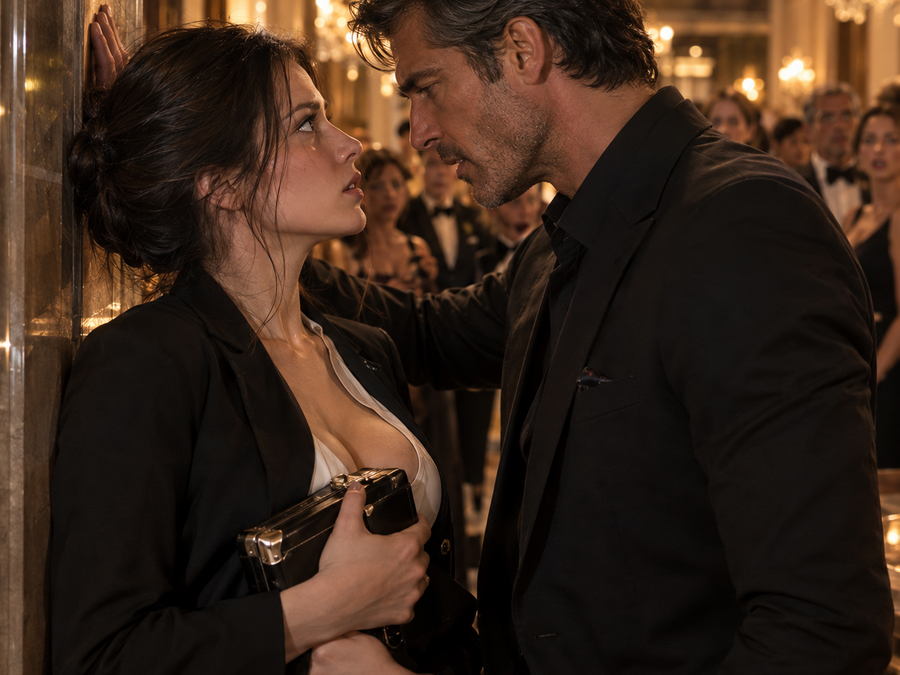
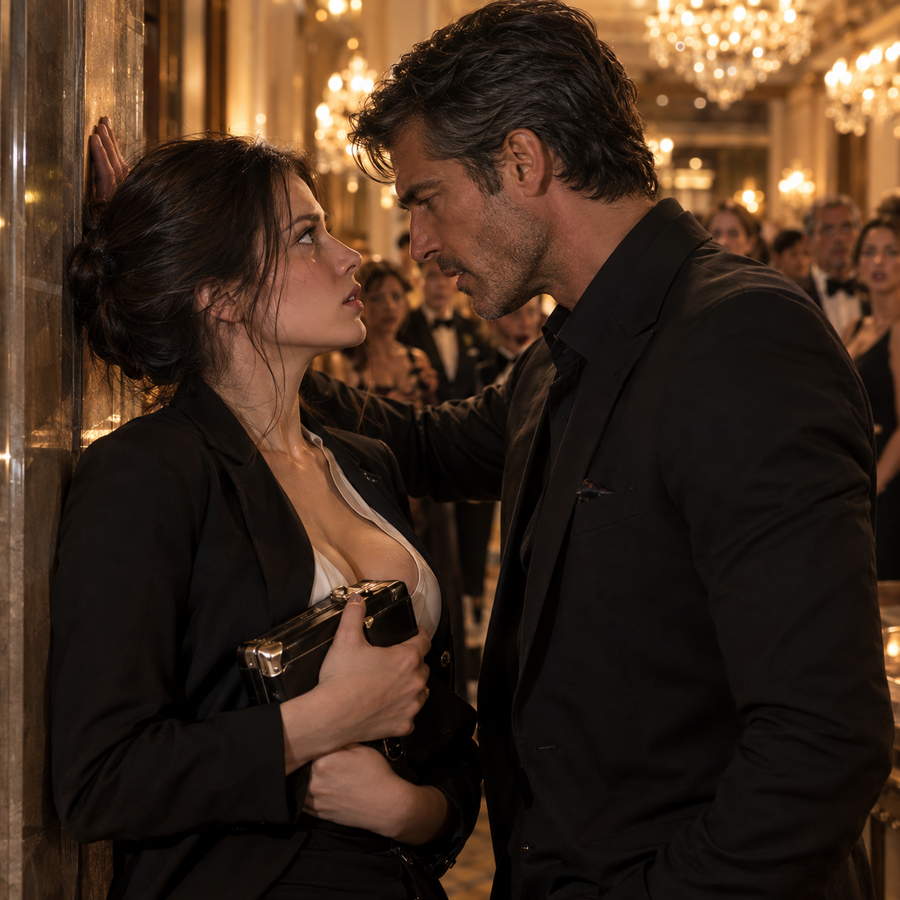
The problem is that he heard. When I tried to run, he cut off my path, put his hand on the wall beside my face, and looked at me as if I had just challenged the most dangerous man in Chicago. I turned red, speechless, no way out. And then I discovered that provoking Orsino Valkcanti could be the most dangerous mistake or the beginning of everything.
My aunt’s cough started before the sun. I recognized the sound through the bedroom wall. That dry wheeze that came with the first hours of mourning and never asked permission. I got up quickly, fixed my hair with my fingers, and crossed the short hallway of the small house I’d been supporting on my own since Nona got sick.
The door to Nonna Natalia’s bedroom was cracked open, and the gray Saturday light seeped through the frayed curtain of the window, casting a long shadow over the worn wooden floor. “Nona, did you take your medicine last night?” I asked, sitting on the edge of the bed. She opened just one eye, the other still buried in the pillow. She drew in air like someone rationing every ounce of breath.
“I took it, my love. Took it and still dreamed about your father. Imagine that. God spare me from two punishments in one night.” I laughed softly despite the hour, despite the exhaustion, despite the tightness in my chest that the mention of my father always brought without asking permission.
I kissed her forehead, felt the warm, dry skin against my lips, the chamomile scent of the soap she insisted on using, even when I bought another, more expensive one, which sat wrapped in the bathroom unopened. “I’m going to work. Fancy wedding at the Bell. That bride I told you about. The spoiled one.” “The spoiled one.”
Nonna Natalia stretched out her thin hand and squeezed mine with a strength that didn’t match the body she’d become over the last two years. As if the illness had shrunk everything except her stubbornness. “Charge a lot and don’t let anyone talk down to you. You hear? If they do, you talk back. Your mouth was always your best inheritance.”
I tucked the words away with the rest of what I carried inside before leaving. I grabbed the makeup case from the living room, checked the zipper twice, counted the brushes a third time. I always counted three times when I was nervous, and that morning I was, because the fee from that one wedding covered Nona Celia’s medicine for two whole months.
I couldn’t mess up, couldn’t be late, couldn’t drop a palette in the marble bathroom of a bride who treated staff like scenery. The rental car waited out front. I set the case on the passenger seat with the care of someone carrying a sleeping child, backed out, and prayed the Saturday traffic would cooperate. It didn’t. It never cooperated, and I knew that. And even so, I always left with the time margin a perfect day would require.
I arrived at the Bell Hotel eleven minutes late. Enough for the bride’s mother to look at me the way you look at a roach in the kitchen of an expensive restaurant. “You’re late.” “I apologize. The traffic in the area—” “The traffic in the area isn’t my problem. It’s yours.”
I swallowed the reply Nonelia would have approved and smiled my best service provider smile, the one I’d practiced in front of the mirror until it became unrecognizable as effort. The bride’s mother spun on her heels and vanished toward the bar without waiting for an answer, and I followed one of the coordinators to the elevator.
The bride’s suite was on the eighth floor, and the elevator rose packed with expensive perfume and shrill voices, bridesmaids arguing about shoes, a florist fighting with her phone. Someone crying for a reason no one would tell me. Adalgisa Vernon was sitting in a white robe in front of the lit mirror, her hair still wet, her face turned toward her own image like someone searching for a flaw where none exists.
She raised her eyes to me in the reflection. She didn’t smile. “Are you the makeup artist?” “I am. Mia Bellafonte.” “I didn’t ask your name.” I pulled up the stool, set up the case on the glass sideboard, breathed deeply through my nose. An hour and a half of work, the fee in my pocket, the exit door in the same place it had always been. That was all that mattered.
I worked in silence. Adalgisa complained about the foundation, too light. We changed it. Complained about the eyeliner, too thick. I redid it. Complained about the lipstick, not red enough. We applied the darkest one in the palette and she told me to take it off, making a grimace that cost more than I’d earned that morning. In the end, we were left with the lipstick I’d suggested at the start, and she looked at her own reflection as if she’d invented the color herself. “It’ll do.”
I packed up slowly, arranging each brush back in place with more attention than necessary, just to have something to focus my eyes on. The bridesmaids circled around. No one offered water. No one asked if I wanted to sit. One of them, in particular, blonde hair pulled into a low bun, champagne-colored silk dress that must have cost more than my rent, wouldn’t stop circling the bride’s neck with outstretched fingers. “Adalgisa. Oh, let me see that necklace up close. My god.” “Later.” “Otilia. Later.”
I registered the name without meaning to. Otilia. There are people you memorize without understanding why, and only later do you understand that your brain was paying more attention than you were. The coordinator pushed us into the main ballroom before two in the afternoon. The rule was that the bride would stay in a private anteroom until the time of her entrance, and I’d stay nearby for any last-minute touch-ups.
I took the case with me, settled into a burgundy velvet armchair in the corner of the ballroom, accepted the glass of water someone finally remembered to offer. The ballroom was a theater of gold, columns tall as sentinels, a heavy chandelier scattering light and fragments across the ceiling, arrangements of white flowers so dense the sweet scent settled in the air like something solid. Guests arrived in waves of perfume and jewels, and I became part of the furniture. The girl in the black blazer sitting in the corner, eyes down, phone in hand, faking existence.
It was in that waiting silence that I heard it. Three women passed near my armchair, glasses of champagne balanced on their fingers with that lightness that only comes from lots of practice. Heads tilted toward each other like conspirators in a soap opera. “Mr. Valkcanti, imagine, still thinks all he has to do is walk into a room to become the talk of it.” “That charm is long gone, sweetheart. A man that age should stop looking at the young girls.” “He should stop looking at himself in the mirror. That’s what—”
Restrained laughter, the kind that only exists between women who know they’re being cruel and enjoy it. I didn’t look at who they were. I didn’t look around. My brain, tired, offended by the whole morning, squeezed by the pharmacy bill waiting on top of the fridge at home, let the sentence slip before I authorized it. “Who would want a mobster who’s already passed his prime?”
I said it quietly. Quietly to myself, quietly into the glass of water I was raising to drink. Quiet, but not quite quiet enough. An older woman passing by with her husband turned her face in my direction with a speed that startled me. The three conspirators froze and one of them gripped her glass hard enough to make a sound against the rim. A waitress stopped serving a meter away from me, the tray suspended in the air. The pianist at the back of the ballroom ended a musical phrase early and the next one took half a second longer to begin. That half second that filled the silence with something very much like fear.
An entire ballroom doesn’t fall silent by accident. I raised my eyes slowly like someone trying not to be seen by their own movement. On the other side, leaning against one of the golden columns with the calm of someone who’d rented the place by his own right, stood a man in a black suit and shirt of the same color. Tall, broad shoulders the cut of his jacket didn’t try to hide. On the contrary, it seemed made to celebrate them. Dark hair with gray strands at the temples, arranged with a precision only money and time can buy. A glass of whiskey in his hand, still full, as if he’d forgotten he was holding anything.
He was looking at me, not with surprise, not with obvious anger. With the kind of quiet, absolute attention a hunter gives to an animal that made the wrong sound at the wrong time, in a place where it shouldn’t be. My chest sank a couple of centimeters inside my rib cage. The woman, two steps from him, an older woman with a pearl necklace and hair pinned in a severe chignon, leaned toward his ear and whispered something short, two, three words at most. I didn’t need to hear it to understand. She was confirming for him that I was the author of the sentence. She was handing me over with the same calm as someone fulfilling a social obligation.
He didn’t move his face. He just blinked once slowly and returned the glass to a passing waiter’s tray without the waiter needing to stop, as if the waiter knew he should be nearby at that exact instant. When his arm came down, he began to cross the ballroom in my direction. He didn’t walk fast. He walked like someone who knows the distance will close one way or another. That time works in his favor and always has. Each step was measured, deliberate, and each step pushed a guest slightly out of the way without his needing to ask. People moved aside before they realized they were moving aside. As if the space around him were an unwritten rule everyone knew except me.
I stood up from the armchair. The case slipped from my lap and I caught it in the air by a hair. A ridiculous shadow amid the scene forming around me. I felt my cheeks burn, felt my throat go dry in a way the glass of water in my hand wasn’t going to fix. Felt the icy certainty that Noncelia had been wrong that morning. My mouth wasn’t my best inheritance. It was my greatest enemy.
He stopped three meters from me, then two, then one. His eyes were dark, not black. Dark like aged whiskey with a light inside them that didn’t belong to that ballroom’s lighting. Deep lines at the corners, the mark of a face that had spent years deciding things I didn’t even want to imagine. “Excuse me, miss,” he said in a low voice that cut through the background noise effortlessly without volume, as if the silence opened for it. “Could you repeat what you just said?”
I didn’t quite hear it. He heard. He heard every syllable, every accent, every idiotic inflection of the sentence. The courtesy was the blade. The politeness was the warning. I opened my mouth, closed it, opened it again. The word sorry reached the tip of my tongue and came back whole, ashamed of itself. “I—I—” I began, and my voice came out half an octave above normal, as if it had escaped through a crack. “I wasn’t—I was talking to myself.” “To yourself?” “To myself.” “Out loud?” “Apparently.”
He tilted his head one degree to the side like someone examining a piece he hadn’t yet decided whether to buy or break, but who already had an opinion about both possibilities. At that instant, a door slammed at the back of the ballroom, and a shrill voice cut through the scene like glass. “It’s gone. It’s gone. My necklace is gone.” Adalgisa came running in, her veil still undone, falling to one side, her neck bare where the necklace should have gleamed, her finger pointing in my direction before she’d even seen me properly. “The makeup artist. It was the makeup artist. No one else went into my room.”
The ballroom that was already silent fell into another kind of silence. The kind that carries judgment and curiosity in equal parts. The kind that makes the room’s temperature rise a degree without anyone moving. And the man in the black suit, who still hadn’t told me his name, slowly turned his face toward the bride and then back to me. In his eyes, there was now a new question. And I understood too late that he had heard every word of the sentence I never should have said, and that he still hadn’t decided what he was going to do with it.
I ran. It’s not pretty to admit, but it’s the right word. Adalgisa screamed. The entire ballroom turned to me. The security guards began walking from the side, and my legs decided on their own before my head caught up to the decision. I grabbed the case by the handle, muttered an absurd apology to no one in particular, and went out the side door of the ballroom, the one the waiters used to reach the kitchen.
The service corridor had hospital white light and a smell of industrial detergent that made my eyes sting within three seconds. I walked fast, almost ran, the case banging against my thigh with every step, my breathing already faltering before the effort justified it. I turned at one bend, then another tighter one. Pushed a door that opened onto a smaller, darker corridor. No sign, no exit indication, with a lower ceiling and stale air as if no one had opened that door in weeks.
That’s where I heard it. Footsteps behind me. Not hurried, calm, measured, the kind that knows it doesn’t need to run because the corridor ends at a wall. I didn’t look back. I quickened my pace. The door at the end of the corridor had a large metal key in the lock on the wrong side. Locked from the outside, obviously, because life at that hour wasn’t going to offer me any courtesy.
I put my hand on the knob anyway, rattled it, felt the cold metal refuse with a firmness that felt personal. I rested my forehead against the wood for a second. The varnish was worn away at the level of my eyes. Someone before me had also reached this point without being able to get through. The footsteps stopped about three meters behind my back. “If you’d run a little more, you’d have hit the wall,” his low voice said, unhurried. “I thought it best to let you choose whether to turn around and face me or keep your back to me.”
I turned slowly. He was two meters away, his jacket still impeccable, his left hand in his trouser pocket like someone waiting for an elevator. He raised his right slowly and rested it on the wall beside my face without touching me, without pinning me, just closing off the exit path with a gesture that required no effort at all, only presence. “I’m not going to hurt you,” he said. And the way he said it, direct and without ornament, made me believe him. “I just want to talk.”
“Talk about what?” “About an interesting sentence I heard. A comment about mobsters past their prime.” The wall at my back seemed colder than any wall had a right to be. I held the case in front of my body as if it could serve as a shield, which was ridiculous. And my mouth decided that this was the perfect time to malfunction. “Look, I—I said that just, you know, without thinking, like it wasn’t about you specifically. It was more of a general observation.” “A general observation.” “Yeah. About mobsters.” “In theory.” “In theory.”
He slightly arched an eyebrow. He didn’t smile, but something at the corner of his mouth made a tiny movement that wasn’t hatred and that I couldn’t name in that cold hotel corridor. “Do you usually insult dangerous men in theory?” he asked. “Or do I have the special honor?” “I didn’t—I didn’t know you were you. If I’d known—” “If you’d known, you’d have done what?”
I opened my mouth, closed it. The honest answer was, I’d have done exactly the same thing because I was distracted and in a bad mood. And that’s how I operate when I’m distracted and in a bad mood. And that answer clearly wasn’t going to get me out of the corridor alive. I searched for another. None came out in any decent form.
The case chose the worst moment to give way. The zipper I’d checked three times before leaving home gave out along the side seam. And one brush fell, then another, then the eyeshadow palette. Everything scattered across the cold corridor floor between my feet and his Italian shoes. I closed my eyes for half a second, breathed through my nose. When I opened them, he was crouched down in a thousand-dollar suit, elbow resting on his knee, gathering my things with both hands with a deliberate patience that left me speechless.
He stood up with the brushes held between his fingers like playing cards and held them out to me. “You’ll drop them again if you take them all at once,” he said. “Hold out the case.” I held it out. He arranged each piece in the right order, each brush in the right compartment. The palette fitted into the bottom with just enough pressure not to bend. He knew where each thing went because he looked once and memorized it, or because he had an organizing habit that didn’t belong to my case, or to any mobster I’d ever imagined.
He closed the zipper carefully, tested it, handed it back. “There.” “Thank you,” I whispered, and hated how small my voice came out. He rested his hand on the wall beside my face again without touching. We were back to the opening scene, but the corridor seemed smaller than before. Warmer despite the stale air. His scent reached me now. Cedar, amber, something expensive and discreet that didn’t need to announce itself because it had already arrived.
“The bride accused you over a necklace,” he said. “Yes.” “Did you take the necklace?” “No.” “Do you know who did?” I hesitated. Not because I didn’t know. I hesitated because accusing Otilia with no proof, with no one on my side, with a makeup artist’s word against a bridesmaid’s word, was the kind of thing Nona Natalia would have called opening your mouth in the wrong place. And all morning I’d been opening my mouth in the wrong place.
He waited. He didn’t pressure me. He gave no sign of impatience. No movement suggesting his time was more valuable than my silence. He just waited, his dark eyes fixed like someone certain the answer would come. I took a deep breath. “Adalgisa called me for a touch-up in the ballroom without bringing any bag. If she’d had the necklace, she’d have the necklace. And one bridesmaid, Otilia, left the room right when it disappeared. She came back later with a handbag closed too tightly to be empty.”
He listened to it all without moving a muscle in his face. When I finished, he blinked once, turned his head toward the corridor he’d come from, and spoke without raising his voice. “Dante.” A man appeared at the corner of the corridor as if he’d been there for minutes. Maybe he had. Silent, tall, in a dark gray suit, the closed expression of someone who never had to ask for the same thing twice. He bowed his head one degree. Just one degree.
“Boss. Have the ballroom exits locked. No one leaves. Review the cameras in the corridor by the bride’s suite, the elevator, and the main ballroom. Focus on the time of the touch-up.” “Yes, boss.” Dante disappeared in the direction opposite my escape without making a sound, and I realized I had his boss—Orsino—the man whose name I still hadn’t heard out loud, practically brushing my shoulder without touching me. The space between his arm and my coat had the thickness of a decision.
“What’s your name?” he asked. “Mira Bellafonte.” “Orsino Valkcanti.” We both knew he wasn’t introducing himself. He was making me hear out loud the name my idiotic sentence had offended half an hour before. It was a calm and absolutely clear reminder. “Come,” he said, and finally moved his hand away from the wall. “Let’s watch together.”
The hotel’s camera room was two corridors ahead, behind a door with no sign that Orsino opened with a nod to the security guard sitting inside. The guard stood up so fast that the chair hit the console with a metallic sound that echoed off the small walls. Orsino didn’t look at him. He pulled a chair from the corner over for me with the tip of his shoe, without bending his knee, without ceremony. “Sit.” I sat, the case in my lap, my hands trembling so much that I had to interlace my fingers so my knees wouldn’t feel it.
The videos played in silence. Adalgisa entering the suite bedroom in the morning, fixing the necklace on her neck, looking at her own reflection with that face of someone who hates their own reflection but can’t stop looking. Adalgisa leaving for the touch-up. Her neck already without the necklace. Adalgisa returning to the room. And five minutes before she came back, a silhouette in a champagne-colored dress entering the room without a veil, without guests, and leaving with a handbag closed too tightly.
Otilia. Orsino said nothing. He pointed at the screen with two fingers. The guard paused it. He froze Otilia’s face on the monitor. The image grainy but sufficient. Orsino looked for three seconds with that attention of someone cataloging, not just seeing. Then he turned to me. “You were right.” “I know,” I whispered without meaning to.
The corner of his mouth made that minimal movement again that wasn’t a smile, but wanted to be. Or maybe it was just my mind searching for things that didn’t exist in the face of a man who probably never needed to smile to get what he wanted. We went out to the lobby. Dante already had Adalgisa and Otilia leaned against the marble wall of the entrance, the hotel security on one side, two men in black suits who clearly didn’t belong to the hotel on the other.
Adalgisa was screaming. Otilia was crying with her mascara sliding down slowly. That kind of crying that seems calculated even when it’s real. The necklace appeared at the bottom of her handbag as if it had crawled in there on its own. Orsino didn’t approach them. He stood three meters away beside me, his hand now in the inner pocket of his jacket, his face with no expression at all. There was no pleasure in it. There was only conclusion. And a huge difference between the two things.
“Do you want to file a complaint?” he asked. Low, just to me. “Against the bride for false accusation. Against the bridesmaid for the setup. I’ll handle it today.” I looked at Adalgisa. I looked at Otilia. I thought about Nona Natalia waiting at home with the heater that failed on the coldest afternoons. I thought about the fee I still needed to collect. I thought about what kind of woman I wanted to be when I walked out of that lobby.
“I want to collect my fee,” I said. “And leave. No scandal, no lawsuit. Just leave.” He looked at me for a second longer than the others, as if reviewing some conclusion he’d drawn earlier. Then he nodded. “Dante.” “Boss.” “Miss Bellafonte will receive double the agreed amount in cash now. And walk her to the car.” “Yes, boss.” “Not double,” I began. “Double,” Orsino cut in without looking at me. “For the scare.” I stayed quiet. I learned early from Nona Natalia when staying quiet was smarter than arguing.
And in that lobby, with the white marble gleaming and Adalgisa sobbing against the wall, double the fee was two things at once. Two extra months of medicine for my aunt and a debt I still didn’t know how to calculate. Dante handed the envelope into my hand and pointed to the revolving door. I began to walk. The marble under my shoes was cold even through the sole. And the lobby seemed bigger than when I’d entered that morning. Before the bride, before the necklace, before the dead-end corridor.
Before crossing through the door, I looked back one last time. Orsino was still standing in the same place, and Dante, who had returned to his side with his usual silence, tilted his head one degree toward the boss’s ear. I was too far away to hear. But the service corridor at the moment of being cornered had taught me something new. Sometimes you understand without hearing.
Dante said something short. Orsino answered even shorter. The two of them looked at me at the same time, and I quickened my pace to the rental car like someone fleeing a fate they already know will arrive one way or another. I only realized when I closed the door and put the key in the ignition that my heart was still beating to the rhythm of the corridor and that I had no idea what kind of man I had just met.
Monday started with reheated coffee and a long cough coming from Nona Natalia’s bedroom. I got up before the sun, opened the kitchen window, and looked at the still empty street, trying to convince my own body that Saturday at the Bell Hotel had been a bad dream that had already passed. It hadn’t passed. The envelope with the doubled fee sat on top of the table. And every time I looked at it, I remembered the way that man in the black suit had looked at me in the lobby.
The way Dante had whispered something near his ear. The way the two of them had watched me leave the hotel as if they were deciding something about me without consulting me. I pushed the envelope under a dish towel and poured coffee for my aunt. “You look like someone who slept with their eyes open,” Nona Natalia said, sitting in the chair with the old blanket around her shoulders. “Did something happen at that party?”
“Nothing major,” I lied, stirring the sugar slower than I needed to. “Difficult client, missing necklace, headache. The usual.” She looked at me for a second longer than I wanted, and wise as always, decided not to pull the thread. “Drink your coffee, girl, and take a coat. The sky looks ugly.” I grabbed the case and headed out to the Trevy Salon. The sky really did look ugly, but I preferred the rain to any other conversation in that kitchen.
The salon opened at nine. Ria Cavalo, my best friend since my first months at Trevy and the hair stylist at the chair next to mine, was already inside smoking on the sly at the back door when I arrived. Twenty-eight years old, sharp mouth, and an impressive ability to curse in Italian when the day started off wrong. “Madonna Santa,” she said when she saw me. “You look like someone who needs whiskey, not coffee.” “Good morning to you, too.” “Tell me later.” “Ah, so there is something to tell.”
I passed by her without answering and started setting up my space. Brushes lined up, sponges by size, foundation separated by shade. I’d learned early that my work began with the order of the counter because the rest of the day rarely respected any order at all. The first client came in at 9:20. A bride’s mother who wanted to test a look for her daughter’s wedding. She sat down, ordered coffee, and talked for forty minutes about a second cousin who refused to come to the ceremony because of an old fight about orange cake. I listened, smiled in the right places, and worked. It was exactly the kind of morning I wanted. Ordinary, repetitive, no men in black suits.
At 10:30, the door chime rang. I didn’t need to turn to know. The air of the salon changed. Ria, who was washing another client’s hair, raised her eyes and her hand stopped mid-motion for a second before returning to normal. I finished spreading concealer on the bride’s mother’s skin before lifting my face. Orsino Valkcanti was standing three steps from the door in a gunmetal gray suit this time, hands at his sides, looking directly at me. Serious, elegant, the kind of man who doesn’t need to say anything to occupy an entire salon.
“Good morning,” he said, low. “Good morning,” I answered and hated how thin my voice sounded. “Any openings for a beard trim?” Ria dropped the spray hose and looked at me as if I’d just announced I was leaving for Nepal. “This is a women’s salon,” I said, brush frozen in the air. “We don’t do beards.” “What a shame.” He didn’t even smile. He just kept standing there. “Then I’ll wait.” “Wait for what?” “For you to finish. I need to talk to you.”
The bride’s mother, in the mirror in front of me, widened her eyes and pretended to be very interested in her own phone. She pretended so poorly you could almost hear her ears growing. “I’m working,” I answered. “I noticed. That’s why I’m going to wait.” He sat in the waiting chair against the opposite wall, crossed one leg over the other, took his phone from the inner pocket of his jacket, and began looking at the screen as if this were any old waiting room, and he were any old client. He wasn’t.
I spent the next forty minutes trying to pretend my hand wasn’t shaking. I applied eyeshadow, applied mascara, drew a thin line of eyeliner that came out reasonably well. Despite everything, the bride’s mother paid, thanked me, and before leaving looked from me to him and back to me with a raised eyebrow. I wanted to wipe off her face. When the door slammed shut behind her, the salon became dangerously similar to the silence of the Bell Hotel at the moment of my insult.
Ria, who was now wrapping the client’s head in a towel, cleared her throat too loudly. “I’m going to get more towels from the back,” she announced to no one in particular and vanished. I cleaned the counter just to have something to do with my hands. “What did you come here for?” I asked without turning. “To find out if you got home safely on Saturday.” “I did.” “Was your aunt awake?”
That’s when I turned. He had put the phone away. He was looking at me as if he’d been waiting for exactly that movement from me. “How do you know about my aunt?” “You mentioned a sick aunt in the corridor before you dropped the case.” I didn’t remember mentioning it. He remembered. That was what scared me most about that man. More than the black suit and the power he radiated effortlessly. He kept things.
“She was sleeping,” I answered. “I got home fine.” “Yes.” “Good. That’s it.” “No.” He stood up and the salon seemed to shrink around him. He took three steps and stopped on the other side of my counter with the glass between us. “Do I still look past my prime, Miss Bellafonte?” Blood rushed to my face so fast that I felt my ears burn. “I already apologized.” “You didn’t.” “Then I’m apologizing now.” “I’m not asking for one. I’m just asking.”
He rested one hand on the edge of the counter. He didn’t touch me. He didn’t need to. My breathing had already fallen out of rhythm on its own. “You don’t look past anything,” I said so low it barely came out. “Satisfied?” He tilted his head slightly. He didn’t smile, but something in his eyes moved. “For today.” The door chime rang again. An eleven o’clock client coming in with a rush and a wet umbrella. He moved away from the counter, greeted the woman with an almost imperceptible nod of his head, and left without saying anything more.
Ria reappeared the exact second the door closed. “Mira Bellafonte,” she said in the tone of someone starting an official interrogation. “You owe me a long conversation and an espresso.” “Later.” “Mava Alferno later. That man came here to trim a beard that was already perfect. He didn’t trim any beard.” “Exactly.” I had no answer for that. I went back to arranging the brushes for the third time that morning.
On Tuesday, he showed up again. This time, he stayed ten minutes at the door, said he’d only stopped by to return a credit card I’d forgotten in the case at the Bell. I hadn’t forgotten any card. The card was clearly an excuse, and he handed me the plastic, resting it in the palm of my hand. His fingers touched mine. They stayed there a second longer than they needed to. A second too small to accuse him of anything and too big to pretend it hadn’t happened. I didn’t pull my hand away. Neither did he. Ria, in the mirror next to us, left the hair dryer running without drying anything.
On Wednesday, he showed up at lunchtime with two coffees from the cafe across the street. He put one on my counter, the other on the one beside it, and said quietly, “One for your friend so she’ll stop pretending she isn’t listening.” Ria choked on her own air and had to go to the back again. On Thursday, it rained the entire afternoon. The salon emptied early. I grabbed the case, put away the brushes, and said goodbye to Ria, who stayed to close the register.
When I opened the door to my house, I took off my soaked coat on the doormat, tried to shake the rain from my hair, and heard Nona Natalia’s voice from the kitchen. “Girl, there’s a gentleman here in the living room.” I stopped. “A what?” “A gentleman. He brought bread, a package of good coffee, and a blanket he said was for me. I told him to come in because it was raining daggers.”
I passed through the hallway without moving the hair from my face and saw him on my living room sofa with my aunt’s coffee cup in his hands, serious as always, dark suit damp at the shoulders despite the coat hanging on the coat rack at the entrance. On the low table, a package of fresh bread, a bag of whole bean coffee of a brand I could never afford, and a plaid blanket still with the tag on. Nona Natalia was sitting in the armchair beside him, smiling like I hadn’t seen her smile in months.
“She’s home,” my aunt announced, satisfied as if introducing the main attraction of the theater. “I’m home,” I repeated dry. “Good evening, Mr. Valkcanti.” “Not Mr. Valkcanti,” he stood up and rested the cup on the table with an almost absurd care for the size of his hands. “Orsino.” “You’re getting my rug wet.” “I apologize.” “You’ll forgive me, Mira,” my aunt interjected in the tone she’d used since I was ten and she thought I was being rude. “I was the one who insisted he come in. The young man came to drop off a package. It was raining. I wasn’t going to send him away.”
“He’s not a young man, auntie.” “Better. Young men are unpredictable.” Orsino, to my dismay, almost smiled. It didn’t quite become a smile, but the corner of his mouth moved in a way I’d never forget. And Nona Natalia noticed, because Nona Natalia noticed everything. “He’s staying for coffee,” my aunt decided, as if it were a decision of the state. “Auntie, he brought the coffee. He leaves with the coffee.” “And what are we going to do? Drink water?”
I closed my eyes for a second. When I opened them, he had already sat back down, and my aunt was already asking whether he preferred sugar or sweetener. I sat in the chair farthest from the room and forced myself to breathe. Over the next twenty minutes, Nona adopted Orsino Valkcanti as if he were a nephew lost in a distant war. She asked where his family came from, where his accent came from, whether he ate well, slept well, took care of his liver. He answered everything in a low voice with a patience I never would have imagined in him after what I’d seen at the Bella Verde. He didn’t answer what he did for a living. She didn’t ask. I got the impression she knew and pretended she didn’t know because she decided right there that it didn’t matter.
