“Army? Really? You couldn’t get into a real college, so you’re going to go play soldier?
“The phone rang at 2:47 in the morning. I knew before I answered. Nobody calls at that hour with good news.”
Everyone thought Eli was just a quiet veteran who’d wasted his life playing soldier — until the money his stepfather gambled away turned up in a casino safe, and the man who took it learned exactly what a Ranger does when someone steals from his family.
I knew before I answered. Nobody calls at that hour with good news. I’d spent twelve years in the Army, most of it in places where a 3 a.m. phone call meant somebody wasn’t coming home. My body had learned to read those rings a long time ago.
I reached for the phone on the nightstand. My wife Sarah stirred beside me but didn’t wake.
“Mercer,” I said.
“It’s your mother.” Her voice was thin. Worn out. Like she’d been crying for hours. “Eli, I need you to come home.”
I sat up. The clock on the nightstand glowed red. 2:47. The house was quiet except for the hum of the refrigerator downstairs.
“What happened?”
“It’s your stepfather. He—” She stopped. I heard her breathe. “He did something. Something bad.”
I waited. In the Army, I learned to let silence do the work. People fill silence. They tell you things they wouldn’t say if you pushed.
“He took the money,” she said finally. “Your college fund. All of it.”
I didn’t say anything.
“The one your father set up before he died. The one I was supposed to protect for you.” Her voice cracked. “He took it, Eli. He bet it. On some—some sure thing. And now it’s gone.”
I looked at the wall. At the framed photograph of my father in his dress uniform. He’d been a chief warrant officer in the Navy. Twenty-six years. He died when I was eleven. The college fund was the last thing he’d left me. Not the money itself—that came from his life insurance—but the idea of it. The plan. The belief that I’d go to school, make something of myself, carry his name somewhere good.
My stepfather had been in my life for eighteen years. I’d never liked him. But I’d never thought he’d do this.
“How much?” I asked.
“Eighty-seven thousand dollars.”
I closed my eyes.
“What’s his name?” I said.
“What?”
“The bookie. The person he placed the bet with. What’s his name?”
She was quiet for a long moment.
“Eli, I don’t think—”
“Mom. What’s his name?”
She told me. A name I’d never heard before. A name that would mean nothing to most people. But I’d spent years learning to remember names. To file them away. To find them later when I needed to.
I wrote it down on the notepad beside my bed.
“I’ll be there tomorrow,” I said.
“Eli—”
“I’ll be there tomorrow.”
I hung up.
Sarah was awake now. She’d heard enough. She sat up and turned on the lamp, and I saw her face in the yellow light. Worried. She’d been worried about my family for years. She never said it out loud, but I knew.
“How bad?” she asked.
“Bad enough.”
“The money?”
“Gone.”
She was quiet. Then: “What are you going to do?”
I looked at the notepad. At the name written in my blocky handwriting.
“I’m going to find out where it went,” I said. “And I’m going to get it back.”
She didn’t ask how. She’d learned not to ask that question a long time ago. She just nodded and turned off the lamp, and we lay there in the dark, and I listened to the sound of her breathing until it slowed into sleep.
I didn’t sleep. I lay there and thought about my father. About the way he used to sit on the porch and clean his service pistol, his hands steady and sure. About the way he’d look at me and say, “You’re going to do something important, Eli. I can feel it.”
I thought about my stepfather. About the way he’d looked at me when I told him I was enlisting. The way he’d laughed. The way he’d said, “Army? Really? You couldn’t get into a real college, so you’re going to go play soldier?”
I thought about the way I’d walked out of that house and never looked back.
And I thought about the money. Eighty-seven thousand dollars. My father’s last gift to me. Bet on a sure thing by a man who’d never been sure of anything in his life.
I got up at 5 a.m. I put on my boots. I went for a run.
The road outside my house was dark and quiet. I ran five miles at a steady pace, the way I’d learned to run in the Army. Ranger pace. Nothing too fast. Nothing too slow. Just steady. Just relentless.
By the time I got back, Sarah was making coffee. She handed me a cup without a word.
“Thank you,” I said.
“What are you going to do?”
“I told you. I’m going to find out where it went.”
“And then?”
I took a sip of coffee. It was hot and bitter.
“And then I’m going to get it back.”
She looked at me for a long moment. Then she nodded.
“Be careful,” she said.
“Always am.”
She smiled. It was a small smile. A worried smile. But it was there.
“You’re a terrible liar, Eli Mercer,” she said.
I kissed her forehead and went to pack my bag.
The drive to my mother’s house took six hours.
I could have flown. I had the money. The Army had taught me a lot of things, and one of them was how to save. I’d put away a little every month for twelve years. Never touched it. Never needed to.
But I wanted to drive. I wanted the time to think.
I passed through towns I’d never heard of. Farms. Fields. The kind of America that doesn’t make the news. I stopped once for gas and once for coffee. I didn’t turn on the radio. I didn’t need the noise.
I thought about my father. About the day he died. About the way my mother had cried at the funeral, and the way I hadn’t. I’d been eleven years old, and I’d stood there in my little suit and watched them lower him into the ground, and I hadn’t cried. I’d just stood there. I’d thought that if I cried, it would mean he was really gone.
I thought about my stepfather. About the first time I met him. I was twelve. He’d shown up at the house with flowers for my mother and a baseball glove for me. He’d tried to play catch. I’d thrown the ball too hard. He’d dropped it and laughed. I hadn’t laughed.
I thought about the college fund. About the way my mother had explained it to me. “Your father wanted you to go to school,” she’d said. “He wanted you to have choices.” And I’d believed her. I’d believed that the money was there, waiting for me. Even when I’d chosen the Army instead. Even when I’d told myself I didn’t need it.
I thought about the name on the notepad. The bookie. The man who’d taken my father’s money.
I was going to find him.
I was going to find out everything.
My mother’s house was a small ranch-style place on the edge of a town called Millbrook. It had a porch and a yard and a big oak tree that my father had planted the year I was born.
I pulled into the driveway at 2 p.m. The lawn was mowed. The porch was swept. Someone had been taking care of the place. Probably my mother. She’d always been the one who kept things together.
She was standing on the porch when I got out of the truck. She looked older than I remembered. Thinner. Her hair was gray now, and her face had lines that hadn’t been there the last time I’d seen her.
“Eli,” she said.
“Mom.”
She came down the steps and hugged me. She was shaking. I held her for a long moment, and she cried into my shoulder, and I let her.
“I’m sorry,” she kept saying. “I’m so sorry.”
“It’s not your fault.”
“I should have watched him. I should have—”
“It’s not your fault.”
She pulled back and looked at me. Her eyes were red.
“You’ve grown,” she said.
“It’s been a while.”
“Too long.”
“I know.”
She led me inside. The house was the same as I remembered. The same furniture. The same pictures on the walls. There was a new television in the living room, big and expensive-looking. I noticed it. I didn’t say anything.
“Sit down,” she said. “I’ll make you some coffee.”
“I don’t need coffee. I need to know what happened.”
She hesitated. Then she sat down across from me, and she told me.
My stepfather’s name was Richard.
He’d been a car salesman when he met my mother. Then he’d been a real estate agent. Then he’d been a financial advisor. Then he’d been a lot of things. None of them had worked out.
What had worked out was his ability to make my mother believe he was on the verge of something big. A deal. An investment. A sure thing.
He’d borrowed money from her. From friends. From a man named Vincent Corrado.
Vincent Corrado ran a betting operation out of a bar called The Anchor. He’d been doing it for years. He was careful. He was quiet. He was the kind of man who didn’t advertise.
Richard had gone to him six months ago. He’d bet on a basketball game. He’d lost. He’d bet again. He’d lost again. He’d kept betting, trying to win it back, and he’d kept losing, and now he owed Vincent Corrado fifty thousand dollars.
The money was gone. All of it. My father’s money. My college fund. Bet on games Richard had no business betting on.
“He said it was a sure thing,” my mother said. “He said he had a system. He said—”
“Where is he now?”
She looked away.
“He left. Three days ago. He said he was going to fix it. He said he had a plan.”
“A plan.”
“He hasn’t come back.”
I sat there for a long moment. I thought about all the things I could say. All the things I wanted to say. But I didn’t say any of them.
“Mom,” I said. “I need you to tell me everything you know about Vincent Corrado.”
She looked at me. Her eyes were wide.
“Eli, you can’t—”
“I’m not going to do anything stupid.”
“Promise me.”
“I promise.”
She didn’t look convinced. But she told me anyway.
The Anchor was a bar on the south side of town. It was the kind of place that didn’t advertise. The kind of place where you had to know someone to get in.
I parked across the street and sat in my truck for an hour. Watching. Waiting.
The bar opened at 4 p.m. A few cars drifted into the lot. Men in work clothes. Men in suits. A woman with a briefcase. None of them looked like they belonged together.
At 6 p.m., a black SUV pulled up. Two men got out. Both of them were big. Both of them had the kind of posture that said they’d been in fights before. They went inside.
At 7 p.m., a man came out. He was older. Gray hair. A gray suit. He looked like a banker. He got into a Cadillac and drove away.
I didn’t move.
At 9 p.m., the bar closed. The men in the SUV came out. They stood by the door for a while, talking. Then they got in the SUV and drove away.
I waited another hour. Then I went home.
My mother had made up my old room.
The bed was the same. The desk was the same. The posters on the wall were the same. It was like stepping into a time capsule. I stood there for a long moment, looking at the sixteen-year-old version of myself. The kid who’d joined the Army because he didn’t know what else to do. The kid who’d wanted to prove something to a man who wasn’t his father.
I sat down on the bed. I pulled out my phone. I called Sarah.
“Hey,” she said.
“Hey.”
“How’s your mom?”
“Not good.”
“What did you find out?”
I told her. About Richard. About Vincent Corrado. About the bar.
“You’re not going to do anything stupid, are you?”
“Why does everyone keep asking me that?”
“Because we know you.”
I laughed. It was a small laugh. But it was real.
“I’m not going to do anything stupid,” I said. “I’m going to do something smart.”
“What’s the difference?”
“You’ll see.”
The next morning, I went to see an old friend.
His name was Danny Okafor. We’d served together in the 75th Ranger Regiment. He’d gotten out a year before me and started a private security company in the city. We’d kept in touch. Not often. But enough.
He met me at a diner on the edge of town. He was bigger than I remembered. Grayer, too. But his eyes were the same. Sharp. Alert. The eyes of a man who’d spent years looking for threats.
“Eli Mercer,” he said. “As I live and breathe.”
“Danny.”
We shook hands. He sat down across from me.
“You look good,” he said. “Better than the last time I saw you.”
“The last time you saw me, I was in a hospital bed.”
“Exactly.”
The waitress came. We ordered coffee. We waited until she was gone.
“What’s going on?” Danny said.
I told him. About Richard. About the money. About Vincent Corrado.
He listened without interrupting. When I was done, he leaned back in his chair.
“Vincent Corrado,” he said. “I’ve heard of him.”
“You have?”
“He’s connected. Not to the big guys. Not to the families. But he’s connected. He’s got people. He’s got money. He’s got a reputation.”
“What kind of reputation?”
“The kind that says you don’t want to owe him money.”
I nodded.
“I need to find out where the money went,” I said. “And I need to find out if there’s any of it left.”
Danny looked at me for a long moment.
“You know I’ll help you,” he said. “But I need to ask you something.”
“Ask.”
“Is this about the money? Or is this about the man?”
I thought about it. I thought about my father. About the look on his face when he’d told me he loved me for the last time. About the way Richard had laughed when I’d told him I was enlisting.
“Both,” I said.
Danny nodded.
“Then let’s get to work.”
PART 2 — THE ANCHOR
Danny and I spent the next three days building a picture.
He had contacts I didn’t. Local cops. A guy at the DMV. A woman who worked at the county clerk’s office and owed him a favor from a divorce case he’d handled. I had contacts he didn’t. A buddy from the Ranger Regiment who’d gone into federal law enforcement. A guy I’d served with who now worked for a private intelligence firm in D.C. Between us, we had enough reach to find almost anyone.
Vincent Corrado was a ghost on paper.
No criminal record. No outstanding warrants. He paid his taxes. He owned The Anchor through a shell company that owned three other shell companies. He lived in a house in the wealthy part of town, the kind of house with a gate and a security system and a lawn service.
But he had a habit.
Every Tuesday and Friday, he went to a diner on the north side of town. He sat in the same booth. He ordered the same thing. Coffee. Eggs. Rye toast. He met with people. Different people. He talked for an hour. Then he left.
Danny found the pattern. I found the diner.
The waitress was a woman in her sixties named Patty. She’d worked there for twenty years. She knew everyone. She remembered everything.
I went in on a Tuesday morning and sat at the counter. I ordered coffee and a bagel. I watched the door.
At 9:15, Vincent Corrado walked in.
He was shorter than I’d expected. Gray hair. Gray suit. The kind of man who looked like he sold insurance or managed a bank. He nodded at Patty. He sat in his booth. He opened a newspaper.
I drank my coffee. I waited.
At 9:30, a man joined him. Forties. Expensive watch. Nervous eyes. They talked for twenty minutes. The man left. Corrado stayed.
At 10:00, another man joined him. Younger. Tattoos on his neck. They talked for fifteen minutes. The younger man left. Corrado stayed.
At 10:30, Corrado paid his bill. He left a tip on the table. He walked out. He got into a black Cadillac and drove away.
I finished my coffee. I paid. I left a tip.
Patty smiled at me.
“See you again?” she said.
“Maybe.”
Danny called me that night.
“I found something,” he said.
“What?”
“Richard. He’s not in Millbrook. He’s not in the state. He’s in Reno.”
“Reno.”
“At a motel. He’s been there for two days. He’s using a credit card in his own name. He’s not even trying to hide.”
I sat there for a moment. Thinking.
“Why would he go to Reno?”
“Because Reno has casinos. And because Reno is far enough away that he probably thought nobody would follow him.”
“Or because he’s trying to win the money back.”
“Either way, he’s there.”
I looked out the window. The street was dark. Quiet. The kind of quiet that made you think about all the things you’d rather not think about.
“Can you send me the address?” I said.
“You’re not going to do anything stupid, are you?”
“Why does everyone keep asking me that?”
“Because we know you.”
I laughed. It was the same laugh I’d given Sarah.
“I’m not going to do anything stupid,” I said. “I’m going to do something smart.”
I flew to Reno the next morning.
I didn’t tell my mother. I didn’t tell Sarah. I just got on a plane and went. The flight was three hours. I spent most of it looking out the window at the clouds. Thinking.
My father had taught me how to fish. He’d take me to a lake up in the mountains, and we’d sit there for hours, not talking, just waiting. He’d say, “Patience, Eli. Fish don’t come to you. You go to them.”
I’d never been patient as a kid. The Army had taught me. The Army had taught me a lot of things.
I landed in Reno at 11 a.m. I rented a car. I drove to the motel.
It was the kind of place that charged by the hour. Two stories. A parking lot. A neon sign that said VACANCY. Richard’s car was in the lot. A beat-up sedan with a dent in the passenger door.
I parked across the street. I waited.
At 12:30, Richard came out of his room. He looked terrible. His clothes were wrinkled. His hair was a mess. He got in his car and drove away. I followed him.
He went to a casino. He parked. He went inside. I followed.
The casino was loud. Bright. Full of people who were losing money and people who were making it. I stood by the entrance and watched.
Richard found a blackjack table. He sat down. He bought chips. He started playing.
I watched him for an hour. He won a little. He lost a lot. He kept playing.
At 3 p.m., he got up. He walked to the cashier. He cashed out. He had about two hundred dollars in chips. He walked out.
I followed him back to the motel. He went into his room. I knocked on the door.
He opened it. He saw me. His face went white.
“Eli,” he said.
“Richard.”
“What are you—how did you—”
“Can I come in?”
He hesitated. Then he stepped aside.
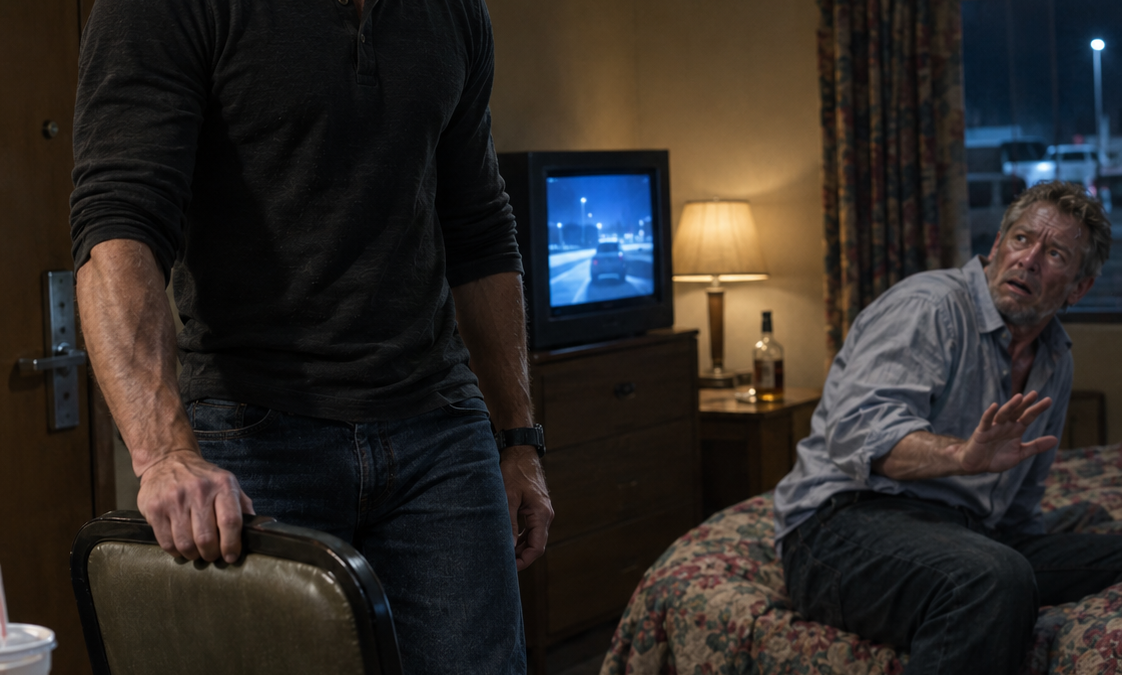
The room was a mess. Clothes on the floor. Fast food wrappers on the table. An empty bottle of whiskey on the nightstand. The TV was on, playing some kind of game show.
“Nice place,” I said.
He closed the door. He stood there, looking at me. He was scared. I could see it in his eyes. The kind of scared you get when you realize you’ve been running and the person who’s been chasing you has finally caught up.
“Your mother sent you,” he said.
“No. I came on my own.”
“She’s worried about me.”
“She’s worried about the money.”
He flinched. He sat down on the edge of the bed. He put his head in his hands.
“I’m sorry,” he said. “I’m so sorry.”
“I don’t care if you’re sorry. I care about the money.”
“It’s gone.”
“All of it?”
“Most of it. I lost. I kept trying to win it back. I kept losing. I—”
“Where’s the rest?”
He looked up at me. His eyes were red.
“What?”
“You said most of it. Where’s the rest?”
He hesitated.
“There’s a safety deposit box,” he said. “At a bank in Millbrook. I put some money in there. Before I lost the rest.”
“How much?”
“Twelve thousand. Maybe thirteen.”
I stared at him.
“Thirteen thousand dollars,” I said. “Out of eighty-seven.”
“I know. I know. I’m sorry.”
“You’re sorry.”
“I was going to win it back. I had a system.”
“A system.”
“I was sure.”
I walked over to the window. I looked out at the parking lot. At the neon sign. At the cars.
“I need the key,” I said.
“The key?”
“To the safety deposit box.”
He hesitated.
“Why?”
“Because I’m going to get what’s left. And then I’m going to find Vincent Corrado. And I’m going to figure out where the rest of it went.”
His face went white again.
“You can’t go to Vincent Corrado,” he said. “He’ll kill you.”
“He can try.”
“Eli, you don’t understand. He’s—”
“I understand perfectly.”
I turned back to him. I held out my hand.
“The key,” I said.
He looked at me for a long moment. Then he reached into his pocket. He pulled out a small brass key. He handed it to me.
I put it in my pocket.
“Go home,” I said. “Tell my mother the truth. All of it.”
“And then what?”
“And then you wait.”
I walked out. I didn’t look back.
I flew home the next morning.
I drove straight to the bank. I went in. I showed them the key and my ID. They led me to a small room. They brought the box.
I opened it.
Thirteen thousand dollars. In hundreds. Banded.
I took it. I put it in my bag. I walked out.
It was a start. But it wasn’t enough. Not even close.
I needed the rest. And I needed to know where it had gone.
Danny came over that night.
We sat at the kitchen table. Sarah was upstairs, reading. She knew enough to know that she didn’t want to know more.
“Richard’s back,” Danny said.
“I know.”
“He told your mother everything?”
“He told her most of it. He told her about the safety deposit box. He told her about losing the rest.”
“Did he tell her about Vincent Corrado?”
“He told her he owed him money. He didn’t tell her how much.”
Danny leaned back in his chair.
“So what’s the plan?”
I looked at the money on the table. Thirteen thousand dollars. My father’s money.
“Vincent Corrado has a gambling operation,” I said. “He’s been running it for years. He’s careful. He’s quiet.”
“Right.”
“But careful people make mistakes. Quiet people have patterns.”
Danny nodded.
“What kind of patterns?”
“He goes to the diner every Tuesday and Friday. He meets with people. Different people. But he always sits in the same booth. He always orders the same thing.”
“So?”
“So the diner’s been in business for twenty years. The waitress has worked there the whole time. She knows him. She knows what he does.”
“You want to talk to the waitress.”
“I want to talk to the waitress.”
Danny thought about it.
“You think she’ll talk?”
“She’ll talk. If I ask the right way.”
“How are you going to do that?”
I smiled. It was the kind of smile that made people nervous.
“I’m going to be patient,” I said.
 [Tap here for the Next Part ]

