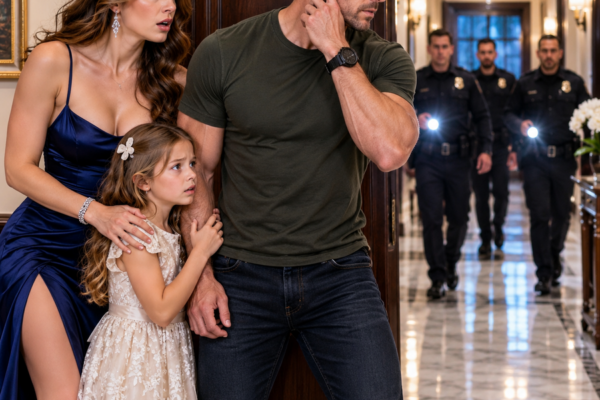
“Captain. I don’t understand what’s happening.” / “You will.”
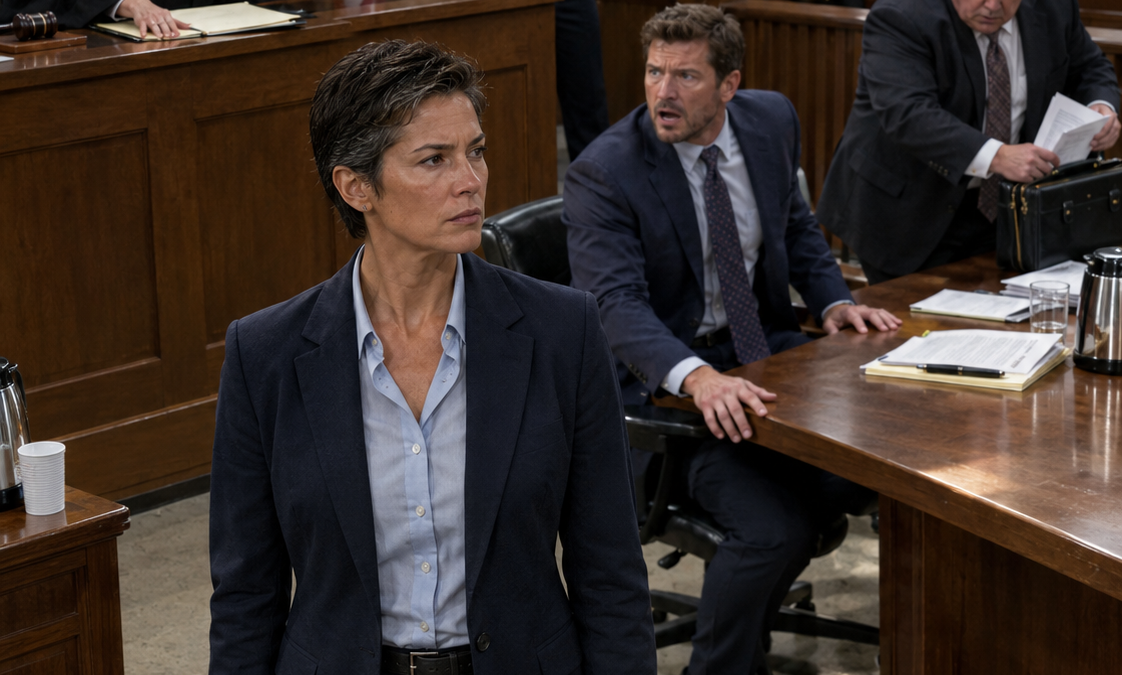
“Grant chose the police station for the exchange. He said it was for Ruby’s safety. It wasn’t.”
They thought dragging her into a police station would make her look dangerous → the captain behind the counter knew exactly who she was, and the judge knew exactly who filed the reports.
He said it was for Ruby’s safety.
It wasn’t.
It was for the cameras. For the record. For the story he was building, one careful brick at a time.
What Grant didn’t know was that the man running the night shift at the Port Alma Police Department had once called me by a different name — and that he still owed me a debt he’d been carrying for eleven years.
My name is Dana Reyes. I’m forty-one years old. For twelve years I was a Force Recon Marine, and then a MARSOC Raider. Four deployments. A knee that clicks in cold weather. A Bronze Star with a Combat V that lives in a shoebox on the top shelf of my closet, behind the Christmas decorations.
Grant has never seen it. He’s never asked.
He’s asked plenty of other things.
I pulled into the lot at 6:52. Seven minutes early. I’m always early. It’s a habit I picked up in a place where being late meant someone else’s problem.
The Port Alma police station sat on a corner lot off Delaney Street. Two stories of beige brick. A flagpole. A row of blue-and-white cruisers parked nose-out. Fluorescent light spilled out of the front windows and pooled on the wet sidewalk. It had rained an hour earlier. The air smelled like asphalt and diesel.
I parked the truck. I sat for a second. I reached into my jacket pocket and closed my hand around a coin. A challenge coin. Worn smooth on the edges from years of thumbing it.
I put it back.
Then I got out and walked inside.
The lobby was small. Gray tile. Plastic chairs bolted to the floor. A counter with a plexiglass window and a young officer behind it. A bulletin board with a “Most Wanted” flyer and a water-damage notice. White light. Buzzing ballast.
Grant was already there.
He stood near the counter in a navy blazer and an open-collar shirt. He looked like he was running for something. Cecily stood beside him in a cream-colored coat, phone in hand, angled just right. She was recording. She always recorded.
Ruby sat on the bench behind them. Nine years old. Legs swinging. She was counting something on her fingers. She does that when she’s nervous.
I stopped inside the door.
Grant saw me. He smiled. That smile he uses when he wants people to think he’s the reasonable one.
“Dana,” he said. “Right on time.”
I said nothing. I walked to the bench and knelt in front of Ruby.
“Hey, baby.”
“Hi, Mom.”
“You good?”
She nodded. Her eyes went past me to Grant. Then back.
“Did you eat?”
“Dad got me a burger.”
“Okay.”
I stood up. I looked at Grant.
“Where’s her bag?”
“In the car,” he said. “We’ll get it in a second. First, I want to talk about something.”
There it is.
I should explain something about Grant.
We were married for six years. He sells commercial real estate now — mostly strip malls and self-storage. He does well. He married Cecily two years after we divorced, and Cecily’s father owns three car dealerships on the peninsula. Grant has been climbing toward that money ever since.
When we were married, he used to tell people I was “in the military.” Just that. As if I’d been a clerk somewhere. When people asked what I did, he’d change the subject.
Once, at a dinner party in Bellevue, a man asked me directly. “What branch?”
“Marine Corps,” I said.
“Oh yeah? What’d you do?”
Grant cut in before I could answer. “She was in logistics.”
I wasn’t in logistics.
I let it go. I let a lot of things go back then.
He filed for divorce eleven months after Ruby was born. He said I was “emotionally unavailable.” He said I was “always somewhere else.” He said he couldn’t live with someone who “flinch-checked every doorway.”
That last part was true. I do check doorways. It’s not a flaw. It’s a survival instinct that’s saved my life more than once.
He used it against me.
He’s been using it against me ever since.
“Talk about what?” I said.
Grant glanced at the young officer behind the counter. Then back at me. He lowered his voice, but not much. Just enough to make it look like he was being careful.
“Ruby told me something last week that concerned me.”
“Okay.”
“She said you grabbed her arm.”
I didn’t move.
“I didn’t grab her arm.”
“She said you did.”
“She’s nine, Grant.”
“She’s old enough to know what happened.”
Cecily spoke up. Soft. Reasonable. “Dana, we’re not accusing you of anything. We just want to make sure everyone’s safe. That’s why we’re here. That’s why we chose this location.”
She said it like she was reading from a script.
I looked at Ruby. She was counting again. Faster now.
“Ruby,” I said. “Did I grab your arm?”
She looked at Grant. Then at me. Then at the floor.
“I don’t know,” she said.
That’s the thing about nine-year-olds. They know when the room is dangerous. They just don’t know who to protect.
Grant opened a folder.
Manila. A label on the front in his handwriting. I could read it upside down.
Incident Documentation — D.R.
He’s been keeping a file on me.
“I’ve been documenting things for a while,” he said. “For my own protection. And Ruby’s. I’ve got dates. I’ve got texts. I’ve got a report from her teacher about Ruby showing up with a bruise on her arm last month.”
I remembered that bruise. She got it at soccer practice. I took a picture of it. I texted it to Grant the same day.
“You got that text,” I said.
“I got a text. It didn’t explain anything.”
“I sent you a picture of the field. She fell on the field.”
“I didn’t see a picture.”
“You replied to it.”
He shrugged. “I don’t remember that.”
The young officer behind the counter was watching all of this. His name tag said OFFICER PENA. He looked about twenty-four. He looked like he wanted to be somewhere else.
Grant turned to him.
“Officer, I’d like to file a report.”
Pena blinked. “A report about what, sir?”
“About a pattern of behavior. I have documentation.”
“Sir, if you want to file a report, you’ll need to—”
“I want it on the record that I’m concerned for my daughter’s safety. That’s all. I want it documented.”
Pena looked at me. Then back at Grant. Then at the folder.
“I can take a statement,” he said. “But I’ll need to talk to my supervisor.”
“Please do.”
I stood there and said nothing.
That’s the part that confuses people about me. They think because I can fight, I want to fight. They think because I trained to kill that I’m always looking for a reason.
The truth is the opposite.
I spent twelve years learning when not to act. When to hold. When to wait. The hardest thing I ever learned was how to stand still while someone else made a mistake in front of me.
Grant was making a mistake.
He just didn’t know it yet.
Pena picked up the desk phone and spoke into it. Quiet. I caught one word.
Captain.
I looked at the bulletin board. I looked at the water-damage notice. I looked at Ruby.
She’d stopped counting.
“Mom,” she said. Quiet.
“Yeah?”
“Can we go?”
“Soon.”
Grant heard her. He turned around. “Ruby, we’ll go in a minute. I just need to finish something.”
“Okay.”
She didn’t look at him.
The elevator at the back of the lobby dinged.
I heard the doors slide open. I heard boots on tile. Not cop boots. Not the hard clack of dress shoes.
The kind of boots that come with a certain kind of training.
I didn’t turn around yet. I kept my eyes on Grant. He was still talking to Pena. Still performing. Still building his little wall.
Then the footsteps stopped.
And a voice behind me said one word.
“Reyes.”
I turned.
He was older. Gray at the temples. A captain’s uniform. Broad shoulders that had gone a little soft but not much. A face I hadn’t seen in eleven years.
Captain Ray Delgado.
He was staring at me like he’d seen a ghost.
And then he looked past me. At the folder on the counter. At Grant. At the young officer.
His jaw tightened.
“Officer Pena,” he said. Slow. Controlled. “What’s this?”
“Sir, this gentleman wants to file a—”
“I know what he wants.”
Delgado looked at Grant.
Then he looked at me.
And then he said something that changed the entire room.
“Gunnery Sergeant Reyes.”
Grant’s head snapped around.
“What?”
Delgado didn’t look at him. He kept looking at me.
“I didn’t know you were back in Port Alma.”
“I’ve been here three years, Captain.”
“You should’ve called.”
“I didn’t know you were here.”
“I’ve been here six.”
We stood there for a second. Two Marines in a police lobby, eleven years of silence between us, and a manila folder sitting on the counter like a lit fuse.
Grant’s voice went up half an octave.
“Wait. What did you call her?”
Delgado finally turned. He looked at Grant the way you’d look at a guy who just walked into a minefield holding a match.
“I called her by her rank,” he said. “Gunnery Sergeant. United States Marine Corps.”
“I know she was in the Marines,” Grant said. “She was in logistics.”
Delgado stared at him.
Then he laughed. One short, flat sound. No humor in it at all.
“Logistics,” he said.
He looked at me.
“You hear that, Gunny?”
“I heard it.”
Delgado reached over and picked up the manila folder. He opened it. He flipped through two pages. His face didn’t change.
Then he closed it. He handed it to Pena.
“Bag it,” he said. “And pull the file on Reyes, D. Whatever we’ve got.”
“Sir?”
“Now.”
Pena took the folder and walked fast toward the back.
Grant was still standing there with his mouth half open.
“Captain, I don’t understand what’s happening.”
“You will.”
Delgado looked at Ruby.
“Ma’am,” he said. Gentle now. “Are you okay?”
She nodded.
“Good. Your mom’s going to be right here.”
He looked at me.
“Gunny. My office. Now.”
I looked at Ruby.
“Two minutes,” I said.
“Okay.”
I looked at Grant. He was pale. Cecily had stopped recording. Her phone was down at her side.
I followed Delgado to the elevator.
The doors closed.
We stood there in the hum.
“You didn’t tell him,” he said.
“No.”
“Why not?”
“Because he never asked.”
Delgado nodded. Slow.
Then the elevator opened on the second floor.
And I saw what was waiting on his desk.
PART 2 — THE SECOND FLOOR
The desk was standard issue. Gray metal. A computer monitor. A phone. A coffee mug that said WORLD’S OKAYEST CAPTAIN.
And a single sheet of paper, face-up, with three names on it.
I only needed one.
REYES, D. — GSGT — USMC — 2005–2017
Below it, in smaller type:
BRONZE STAR W/ COMBAT V — 2012 — OPERATION REDLINE
I stood in the doorway and looked at it for a long time.
Delgado walked past me and sat down. He didn’t invite me to sit. He knew I wouldn’t.
“Close the door,” he said.
I closed it.
He leaned back in his chair. He looked at me the way he used to look at me across a briefing table.
“You want to tell me what’s going on downstairs?”
“No.”
“Didn’t think so.”
He picked up the paper. He read it like he was seeing it for the first time. He wasn’t. He’d already read it. He’d read it before I walked in.
“This is your file,” he said.
“I figured.”
“You know how many times I’ve pulled it since I took this post?”
“No.”
“Four.”
He set the paper down.
“First time was three years ago, when I saw your name on a traffic citation. I thought it was a coincidence. Second time was two years ago, when a domestic call came in with your address on it. It wasn’t you. Neighbor dispute. Third time was last month, when a report came across my desk from a man named Grant Hollis. Fourth time was tonight, when Officer Pena called me.”
I said nothing.
“The report last month,” he said. “You want to know what it said?”
“I already know what it said.”
“You know what he wrote. You don’t know what I did with it.”
I waited.
He opened a drawer. Pulled out a folder. Set it on the desk.
“This is everything Hollis has filed against you in the last fourteen months. Six incident reports. Two formal complaints. One request for a protective order that was denied. One complaint to Child Protective Services that was screened out. And one letter to the county prosecutor’s office that got forwarded to me for review.”
He tapped the folder.
“I’ve been watching this guy for a year, Gunny. I just didn’t know he was yours.”
I sat down. Finally.
The chair was hard. The kind that’s designed to keep you from getting comfortable. I didn’t care.
“Tell me what you know,” I said.
Delgado opened the folder. He read from it the way a man reads a grocery list.
“Fourteen months ago. Hollis calls the non-emergency line. Says his ex-wife is unstable and he’s worried about his daughter. No specifics. No evidence. Officer responds, talks to him, files a report, closes it.”
“Nine months ago. Hollis calls again. Says you showed up at his house unannounced and ‘confronted’ him in the driveway. Officer responds. You weren’t there. He told the officer you’d left. No witnesses.”
“Six months ago. Hollis files a formal complaint. Says you threatened him at a school event. There were forty people at that event. Not one of them saw you speak to him.”
“Three months ago. Hollis calls CPS. Says Ruby has unexplained bruises. CPS visits your home. Finds nothing. Screens it out.”
“Last month. Hollis sends a letter to the prosecutor. Says you’re a danger to the community. Says you have ‘military training’ and ‘access to weapons.’ Says he fears for his life.”
He closed the folder.
“The prosecutor forwarded it to me because it mentioned Port Alma jurisdiction. I read it. I flagged it. I was going to call you.”
“You didn’t.”
“I was going to call you this week.”
I looked at the folder. Then at him.
“Why didn’t you call me three years ago?”
Delgado didn’t answer right away.
He turned his chair toward the window. The blinds were half open. The parking lot lights threw orange across the glass.
“You remember Fallujah,” he said.
“I remember.”
“You remember what happened at the second checkpoint.”
“I remember.”
“You pulled me out of that truck.”
“I did.”
“You shouldn’t have. You had a hole in your side. You had a tourniquet on your own leg. You still came back for me.”
“I remember.”
“You were a staff sergeant then. I was a first lieutenant. I was supposed to be in charge. And you still came back for me.”
He turned back around.
“I owe you my life, Gunny. I’ve known it for eleven years. I just never had a chance to pay it back.”
“You don’t owe me anything.”
“I do.”
“Delgado—”
“I do.”
He said it hard. The way you say something you’ve been rehearsing.
“So here’s what I’m going to do,” he said. “I’m going to do my job. And then I’m going to do you a favor.”
He picked up the phone on his desk.
“Pena,” he said. “Bring me Hollis’s file. All of it.”
He hung up.
He looked at me.
“You’ve got a lawyer?”
“Yes.”
“Good. Call them.”
“Why?”
He didn’t answer. He just waited.
Pena knocked. He came in with a thin folder. He set it on the desk. He looked at me for a second too long — the way young officers look at people they’ve been told about but never met.
“Sir,” he said. “There’s something else.”
“What?”
“Hollis is asking to leave. He says he has somewhere to be.”
“He can wait.”
“He’s got the girl with him.”
Delgado stood up.
“Where are they?”
“Lobby. He’s by the door.”
Delgado looked at me.
I was already standing.
We went down together. The elevator was slow. Delgado didn’t say anything. Neither did I.
The doors opened.
Grant was at the front door. He had Ruby’s hand. Cecily was behind him. He was pulling the door open.
Ruby saw me.
“Mom.”
Grant turned. His face was red. His voice was high.
“I’m leaving. You can’t stop me. This is harassment.”
Delgado stepped off the elevator. He didn’t raise his voice. He didn’t walk fast.
“Mr. Hollis,” he said. “You filed a report tonight. We’re processing it. You can’t leave until we’re done.”
“I didn’t file a report. I asked for documentation.”
“You asked for a report to be filed. Officer Pena wrote it down. That means it’s in the system. That means you’re in the system.”
Grant’s mouth opened. Closed. Opened.
“That’s not—”
“It is.”
Cecily stepped forward. “This is ridiculous. We’re not being detained.”
“You’re not being detained. You’re being asked to wait. There’s a difference.”
“We’re leaving.”
Delgado looked at her. Then at Grant.
“Mr. Hollis. If you leave now, before we finish processing your own complaint, I will note in the file that you refused to cooperate with an active review. That note will go to the prosecutor’s office. It will also go to your attorney. If you have one.”
Grant’s hand tightened on Ruby’s.
“Let go of her hand,” I said.
He looked at me.
“What?”
“Let go of her hand. You’re squeezing it.”
He looked down. He was.
He let go.
Ruby ran to me. I caught her. She buried her face in my jacket.
“Mom.”
“I’m here.”
“I don’t want to go with him.”
Grant’s voice cracked. “Ruby—”
“I don’t want to go.”
Delgado stepped between us. He didn’t touch anyone. He didn’t have to.
“Mr. Hollis. Ms. Alcott. Please have a seat.”
Cecily started to say something.
“Now,” Delgado said.
They sat.
Ruby stayed with me. I put my hand on the back of her head. She was shaking.
Pena came down with the folder. He handed it to Delgado.
Delgado opened it. He flipped through it. Then he looked at Grant.
“Mr. Hollis. You told Officer Pena tonight that you were concerned about your daughter’s safety due to a pattern of behavior by Ms. Reyes.”
“That’s correct.”
“You said you had documentation.”
“I do.”
“You said you had a report from her teacher about a bruise on Ruby’s arm.”
“I have a note.”
“From the teacher?”
“From Ruby’s folder. The teacher writes notes home.”
“Did the teacher say the bruise was from abuse?”
Grant hesitated.
“She said Ruby had a bruise. She didn’t say how.”
“So the teacher didn’t say it was abuse.”
“She implied it.”
“She didn’t imply anything. You’re adding that.”
Cecily cut in. “This is semantics.”
Delgado looked at her. “It’s the difference between a report and a fabrication, ma’am. That’s not semantics. That’s the whole thing.”
Grant looked at the folder in Delgado’s hands.
“What’s that?”
“This is your file.”
“My file?”
“Everything you’ve filed against Ms. Reyes in the last fourteen months.”
Grant’s face changed. Just a little. Just enough.
“So you’ve been keeping tabs on me?”
“I’ve been doing my job. When someone files six reports against the same person with no corroborating evidence, that person ends up in a file. Your file is the one with your name on it.”
“That’s not—”
“That’s exactly what it is.”
Delgado set the folder on the counter.
“I’m going to read you something, Mr. Hollis. This is from your own complaint, filed three months ago.”
He opened it. He read.
“Ms. Reyes has a history of violence. She was in the military. I believe she received some kind of discharge. I don’t know the details but I believe she is dangerous. I fear for my daughter’s life.”
Grant looked at the floor.
Delgado closed the folder.
“I know her discharge details, Mr. Hollis. I know them very well. Do you want me to read them to you?”
Grant didn’t answer.
“I’ll read them anyway.”
He picked up the other folder. The one with my name on it.
“Gunnery Sergeant Dana Reyes. United States Marine Corps. Twelve years of service. Four combat deployments. Two Purple Hearts. A Bronze Star with a Combat V. A Navy and Marine Corps Achievement Medal. An honorable discharge in 2017. And a letter of commendation from a three-star general that I have read three times and still can’t get through without my voice doing something I don’t like.”
He looked at Grant.
“That’s the discharge you were worried about.”
Grant’s face was white.
Cecily had stopped talking.
Ruby was still holding onto my jacket.
“Mr. Hollis,” Delgado said. “You’ve been filing reports against a decorated combat veteran with no evidence and no corroboration. You’ve been trying to build a record that doesn’t exist. And tonight, you brought your own daughter into a police station and tried to use her to hurt her mother in front of my officers.”
“That’s not what I—”
“That’s exactly what you did.”
Delgado took a step closer.
“I’ve been a cop for six years. Before that I was a Marine for twenty-two. I know what a false report looks like. I know what a custody play looks like. And I know what a man looks like when he’s trying to make a good woman look crazy so he can take her kid.”
Grant opened his mouth.
“I’ve got your file,” Delgado said. “And I’ve got hers. Which one do you think the family court is going to read first?”
The lobby went quiet.
Ruby looked up at me.
“Mom?”
“Yeah, baby.”
“Are we going home?”
“Soon.”
“Is Dad in trouble?”
I looked at Grant. He wouldn’t look at me.
“I don’t know,” I said. “That’s not up to me.”
Delgado looked at his watch. Then at Pena.
“Officer Pena. Take Mr. Hollis and Ms. Alcott into the conference room. Get their statements. Full statements. On the record. Tonight.”
“Yes, sir.”
“And call Judge Morrow.”
Pena blinked. “Sir?”
“Call her. Tell her I’m requesting an emergency review of the custody order. Tonight.”
“Sir, it’s almost eight—”
“Call her.”
Pena went.
Grant stood up. “You can’t—”
“I can. Sit down.”
Grant sat down.
Cecily was already crying. Quiet. Real.
Ruby watched her.
“Mom,” she said. “Why is she crying?”
“I don’t know, baby.”
“She didn’t do anything.”
“I know.”
Delgado walked me to the door.
“Call your lawyer,” he said. “Tonight. Not tomorrow. Tonight.”
“I will.”
“And Reyes.”
“Yeah?”
He looked at me. Old eyes. Tired eyes.
“You should’ve told me you were here.”
“I know.”
“You should’ve told somebody.”
“I know.”
He nodded. Slow.
“Go home. I’ll call you in the morning.”
I looked back at the lobby. At Grant. At Cecily. At Ruby, sitting on the bench again, counting on her fingers.
“Can I take her?”
“Take her. I’ve got everything I need.”
I walked over. I knelt down.
“Ruby.”
She looked at me.
“Come on. We’re going home.”
She stood up. She took my hand.
We walked out.
The rain had started again.
I didn’t look back.
At the truck, Ruby stopped.
“Mom.”
“Yeah?”
“Is Dad going to jail?”
“No, baby. Not from this.”
“But he did something bad.”
“He did something wrong. That’s not the same as something illegal.”
She thought about that.
“Did you do something wrong?”
“No.”
“Then why does he say you did?”
I looked at her. Nine years old. Counting on her fingers. Trying to make the world make sense.
“Some people need to believe something bad about someone else,” I said. “So they don’t have to look at themselves.”
She nodded. Like she understood.
Then she said the thing that broke me.
“I counted the bad things he said about you. Forty-one. I counted them all.”
I didn’t say anything. I just opened the truck door and helped her in.
Then I got in myself and sat in the driver’s seat and looked at the rain on the windshield.
I reached into my pocket. Closed my hand around the challenge coin.
I put it back.
Then I started the truck.
PART 3 — THE LAWYER’S OFFICE
I called Marisol Vega at 9:14 that night.
She picked up on the second ring.
“Dana. It’s late.”
“I know.”
“Are you okay?”
“No.”
A pause. Marisol and I met four years ago at a veterans’ legal clinic. She was volunteering. I was there for a landlord issue. She took my case for free, then told me never to pay her for anything again. She’s been my lawyer ever since — unofficially. Mostly she’s been my friend.
“Where are you?”
“Driving home.”
“Is Ruby with you?”
“Yeah.”
“Where’s Grant?”
“Police station. Port Alma.”
Another pause. Longer this time.
“Port Alma,” she said. “The one on Delaney.”
“Yeah.”
“Who’s the shift captain there?”
“Delgado.”
“Ray Delgado?”
“You know him?”
“I know of him. He testified in a case two years ago. He’s solid. He doesn’t play.”
“He played tonight.”
“For who?”
“For me.”
Silence.
“Dana. What happened?”
I told her. It took six minutes. She didn’t interrupt once.
When I finished, she said one word.
“Good.”
“Good?”
“Good that it happened there. Good that it happened in front of a captain who knows who you are. That’s the best thing that could have happened.”
“It doesn’t feel good.”
“It won’t for a while. Where’s Ruby now?”
“Backseat. She’s asleep.”
“Take her home. Put her to bed. Don’t talk to Grant. Don’t text him. Don’t answer if he calls. Don’t post anything. Don’t tell anyone.”
“I wasn’t going to.”
“I know. I’m saying it anyway.”
“Marisol.”
“Yeah?”
“He’s been building this for fourteen months.”
“I know.”
“He’s not going to stop.”
“No. He’s not. But now he’s on the record. That changes things.”
“How?”
“Because now he has to explain himself. And men like Grant don’t like explaining themselves.”
I got home at 9:40. The house is a two-bedroom bungalow on Fourth Street. I bought it four years ago with a VA loan. Gray siding. A maple tree in the front that drops leaves all over the walk. A porch light that flickers if you don’t jiggle the switch.
I carried Ruby in. She weighs sixty-two pounds and she didn’t wake up. That’s a skill you don’t lose.
I put her in bed. I pulled off her shoes. I pulled the blanket up to her chin.
She stirred.
“Mom.”
“Yeah, baby.”
“Are we going to be okay?”
“Yeah.”
“Promise?”
“Promise.”
She went back to sleep.
I stood in the doorway for a long time.
I didn’t sleep that night.
I sat at the kitchen table with a cup of coffee and a notebook and I wrote down everything I could remember.
Every incident Grant had ever mentioned. Every time he’d texted me something strange. Every time he’d shown up somewhere he wasn’t supposed to be. Every time Ruby had come home from his house and said something that didn’t fit.
It was a lot.
The school event, six months ago — he’d told the officer I threatened him. I hadn’t spoken to him that night. But I remembered something else. Cecily had been standing near the door with her phone. Recording.
The driveway incident, nine months ago — he told the officer I showed up unannounced. I hadn’t been there. But I’d gotten a text from him that night at 7:14. It said: “You shouldn’t have come here.” I hadn’t responded. I’d assumed he was confused.
He wasn’t confused.
He was building a paper trail.
I thought about calling my old team.
I thought about it for a long time.
There are four of us still in touch. Me, and three others. We text on birthdays. We send each other memes. We don’t talk about the deployments. That’s not what the group chat is for.
But there’s one name I thought about more than the others.
Marcus Yee.
Marcus was my team lead on the second deployment. He got out two years before I did. He runs a private security firm now — mostly corporate stuff, some consulting, a little work for the VA. He lives in Oregon. He’s married. Two kids. He’s the most connected person I know.
I didn’t call him.
Not that night.
I wanted to. But I didn’t want to be that person — the one who calls an old teammate because she’s in trouble. I’ve always been the one who handles things.
I went to bed at 3:00 a.m.
I woke up at 6:15.
The phone rang at 7:30.
It was Delgado.
“Reyes.”
“Captain.”
“I called Judge Morrow last night.”
“And?”
“And she’s going to review the custody order. Emergency hearing. Thursday.”
“Thursday’s two days away.”
“I know. That’s the fastest she could do.”
“That’s fine.”
“There’s something else.”
“Okay.”
“Grant called his lawyer last night. At 9:50. From our parking lot.”
“How do you know?”
“Because his lawyer called the station at 10:15. Asked to speak to me. Asked why we were ‘harassing’ his client.”
“What did you say?”
“I told him we were processing a report his client filed voluntarily. And then I told him about the file.”
“What did he say?”
“He said he’d ‘look into it.’ Then he hung up.”
“Okay.”
“Reyes. There’s something else.”
“Okay.”
“His lawyer is Douglas Pratt.”
I knew the name. Everyone in the county knew the name. Douglas Pratt was a family law attorney in Bell Harbor. He was expensive. He was aggressive. He was known for one thing — winning custody cases for fathers with money.
“He’s the best Grant could buy,” I said.
“He’s the best anyone could buy. That’s the problem.”
“Okay.”
“You’re going to need someone better.”
“I have Marisol.”
“Marisol Vega is a good lawyer. She’s not Douglas Pratt.”
“She’s better than Douglas Pratt.”
“She’s better than Douglas Pratt at being a human being. She’s not better than him at fighting.”
I stood in my kitchen and looked out at the maple tree.
“Then I’ll find someone who is.”
I called Marisol at 7:50.
“Pratt,” I said.
She was quiet for a second.
“Okay.”
“You know him?”
“Everyone knows him.”
“Delgado says I need someone better.”
“He’s right.”
“So what do I do?”
Marisol was quiet for a long time. Then she said a name I didn’t recognize.
“Everett Shaw.”
“Who’s that?”
“Old guy. Retired now. Used to be the best family law attorney in the state. He’s eighty-two. Lives on Whidbey Island. Doesn’t take cases anymore.”
“Then why are you telling me his name?”
“Because he’ll take yours.”
“Why?”
“Because I called him at 5:30 this morning and told him about you.”
“Marisol—”
“He’s expecting your call. He doesn’t do email. Call him. Today.”
“What do I say?”
“Tell him your name. Tell him your rank. Tell him what happened last night. Then don’t say anything else.”
“Why not?”
“Because he’ll know the rest. He’s been doing this for fifty years.”
I called Everett Shaw at 8:15.
A woman answered. His wife, I assumed. She didn’t ask who I was. She just said, “Hold on,” and put the phone down.
A minute later, a man picked up.
“Ms. Reyes.”
“Mr. Shaw.”
“Marisol told me about you.”
“Yes, sir.”
“She told me you were a Marine.”
“Yes, sir.”
“What unit?”
“Force Recon. Then MARSOC.”
“Which team?”
“Second Raider Battalion. Then I was attached to a joint task force for two deployments.”
Silence.
“You were at Redline.”
“Yes, sir.”
“You were the one who went back for the lieutenant.”
“Yes, sir.”
“You shouldn’t have survived that.”
“No, sir.”
“You shouldn’t have. But you did. And now you’ve got a problem.”
“Yes, sir.”
He cleared his throat. It sounded like gravel being poured.
“Tell me what happened last night.”
I told him. It took four minutes. He didn’t interrupt once.
When I finished, he said:
“Good.”
“That’s what Marisol said.”
“She’s smart. Here’s what we’re going to do.”
“I’m listening.”
“First. You’re not going to speak to Grant. Not one word. Not one text. Not one email. Nothing.”
“Okay.”
“Second. You’re going to send me every text, every email, every voicemail he’s ever sent you. Every photo. Every receipt. Every school note. Everything. Today.”
“Okay.”
“Third. You’re going to tell me about Redline. Not the whole thing. Just enough.”
“Why?”
“Because Douglas Pratt is going to bring up your service. He’s going to call you unstable. He’s going to call you dangerous. He’s going to tell the judge you have PTSD and you shouldn’t be around a child. And when he does, I need to know what to say.”
“He can’t just say that.”
“He can say anything. It’s a courtroom. The question is what lands.”
I stood in my kitchen and looked at the coffee cup going cold in my hand.
“Redline was a mission in 2012,” I said. “Helmand Province. Four-man team. We were doing reconnaissance on a weapons cache. We got compromised. We lost two men. The other two of us made it out.”
“Which two?”
“Me and a lieutenant.”
“Delgado.”
“Yes, sir.”
“Was he hurt?”
“Yes, sir.”
“Did you carry him?”
“Yes, sir.”
“How far?”
“Two miles.”
Silence.
“Anything else?”
“That’s it.”
“No, it’s not. What else?”
I closed my eyes.
“I was injured too. I didn’t know it at the time.”
“What was the injury?”
“A collapsed lung. And a fracture in my left leg.”
“You walked two miles with a collapsed lung and a broken leg.”
“I didn’t know it was broken.”
“You still walked.”
“Yes, sir.”
Another silence.
“All right,” he said. “Send me the files. All of them. Today. And Ms. Reyes—”
“Yes, sir?”
“Stop saying ‘sir.'”
“Okay.”
“Call me Everett.”
I spent the rest of the day gathering everything.
It took six hours.
Texts. Emails. Voicemails. Photos. A video Ruby had taken at a soccer game two years ago where Grant could be heard yelling at a referee. A screenshot of a message he’d sent at 2 a.m. three months ago that said: “You’ll never take her from me.” A copy of the protective order request that had been denied. The CPS screening letter. The note from Ruby’s teacher — the real one, which said Ruby had a bruise from soccer practice and asked if she was okay.
And the texts I’d sent Grant. All of them. Every one. Because I don’t delete things. I learned that a long time ago.
I put everything in a folder. I scanned it. I uploaded it. I sent it to Everett Shaw by 4:00 p.m.
At 5:30, he called back.
“Ms. Reyes.”
“Yes, sir. Sorry. Everett.”
“You didn’t tell me about the school.”
“What school?”
“Ruby’s school. The incident four months ago.”
I went cold.
“What incident?”
“There’s a note from the principal. Grant was called in. He was angry. He told the principal that Ruby’s mother was ‘unfit’ and that he was ‘documenting everything.'”
“I didn’t know about that.”
“I know. The principal sent a copy to you by certified mail. Do you have it?”
I thought about the stack of unopened mail on my kitchen counter. I never open certified letters. I’m not sure why. I think some part of me always expected bad news.
“I don’t know.”
“Find it. Read it. Send it.”
“Okay.”
“And Ms. Reyes—”
“Yeah?”
“Your daughter told you something last night. At the truck. What did she say?”
I thought about it. Ruby counting on her fingers. Ruby saying the number.
“She said she counted the bad things Grant said about me. Forty-one.”
Silence.
“Put that in writing,” he said. “Sign it. Date it. Send it.”
“Why?”
“Because that’s the number the judge is going to hear.”
I found the letter.
It was in the stack. Unopened. Postmarked four months ago.
I opened it.
The principal’s note was short. Professional. It said that on February 12th, Mr. Hollis had been asked to come to the office regarding a conversation he had with Ruby during pickup. Ruby had told her teacher that her dad said “bad things about Mom.” The principal said she was “documenting the situation” and “encouraging both parents to seek mediation.”
It was signed by Dr. Andrea Novak.
I read it three times.
Then I sat down at my kitchen table and wrote my statement.
It took me an hour.
I signed it. I dated it. I sent it.
Then I made dinner for Ruby.
She came to the table and looked at me.
“Mom.”
“Yeah?”
“Are you okay?”
“Yeah.”
“You look tired.”
“I am.”
“Did you do something bad?”
“No.”
“Then why do you look like that?”
I sat down across from her.
“Because sometimes doing the right thing is tiring. That’s all.”
She thought about it.
“Okay,” she said.
Then she ate her spaghetti.
That night, my phone rang at 10:15.
It was a number I didn’t recognize.
I answered.
“Ms. Reyes.”
It was a man’s voice. Not Everett. Not Delgado. Someone younger.
“Who is this?”
“My name is Douglas Pratt. I represent Grant Hollis.”
I said nothing.
“I’m calling as a courtesy. To let you know that my client is requesting a hearing on Thursday to modify the custody agreement. He’s also requesting that all visitation be suspended pending review.”
I said nothing.
“Ms. Reyes?”
“I heard you.”
“Do you have counsel?”
“Yes.”
“Who?”
I thought about it. I thought about Everett. About Marisol. About Delgado. About the coin in my pocket.
“You’ll find out,” I said.
Then I hung up.
 [Tap here for the Next Part ]