“Congratulations, man. Seriously. Still playing soldier at your age? That’s dedication.”
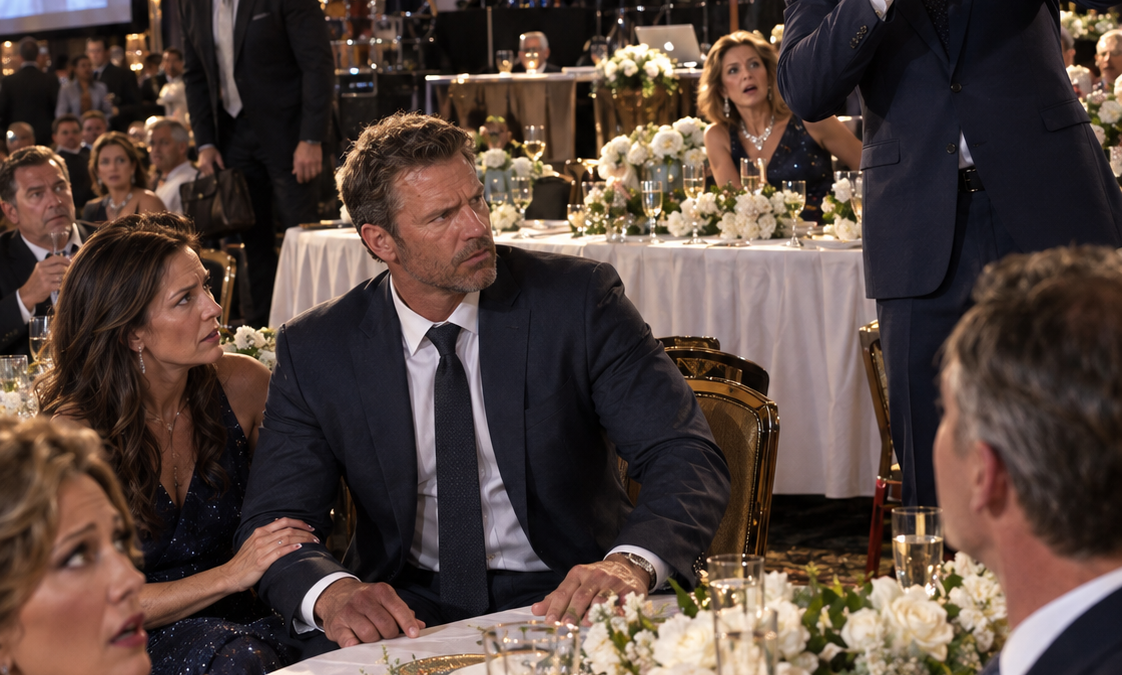
“The microphone screeched. That high-pitched feedback whine that makes everyone wince and reach for their drinks. Derek held it like he’d been handed a trophy.”
They thought Daniel Kessler was a washed-up weekend warrior with nothing to show for his life → Now his name is spoken with honor in the halls of Congress, and the three men he lost in the Korengal Valley finally have justice.
Derek held it like he’d been handed a trophy.
“I want to propose a toast,” he said, already laughing at his own setup. “To my new cousin-in-law over there. Staff Sergeant… what was it? Something military. Anyway.”
He turned toward my table. Four hundred guests turned with him.
“Congratulations, man. Seriously. Still playing soldier at your age? That’s dedication.”
A few people laughed. The kind of laugh that’s more about the person laughing than the joke. Derek’s finance buddies, mostly. Their wives in designer dresses who’d spent the cocktail hour asking what branch of the military I was in like it was a trivia question.
I set my fork down.
My wife’s hand found my knee under the table. She knew. She always knew.
What Derek didn’t know was that the man he’d hired to MC his wedding—the professional announcer with the baritone voice and the laminated schedule—had spent four years under my command in the 75th Ranger Regiment. What Derek didn’t know was that Marcus Webb had already recognized me from across the reception hall. What Derek didn’t know was that Marcus had a folder in his bag with my name on it, and he was waiting for the right moment to use it.
But that came later.
Right now, Derek was still talking.
“I mean, no offense,” he continued, doing that thing where someone says “no offense” to give themselves permission to offend. “But my eight-year-old nephew has a higher rank than you. He’s a colonel in Call of Duty.”
More laughter. Louder this time.
I took a breath. Counted to four. Let it out slow.
Twenty-three years in uniform teaches you things. How to stay calm when everything around you is chaos. How to read a room in three seconds. How to wait.
I was forty-nine years old. Former Staff Sergeant, U.S. Army Ranger, 3rd Battalion. Four combat deployments. A Bronze Star with Valor. A Silver Star I didn’t talk about. Two Purple Hearts I definitely didn’t talk about.
None of that was on my face. It never was.
I was just the guy in the corner in a navy suit, nursing a club soda, watching my wife’s cousin marry the kind of man who thought wealth was the same thing as worth.
My name is Daniel Kessler. I was forty-seven years old when I officially retired from the Army. Two years later, my wife Rachel and I were sitting at a table at the Fairmont in downtown Seattle, watching her cousin’s new husband make me a punchline.
The wedding had been planned for eighteen months.
Rachel’s cousin Vanessa was the kind of person who’d been planning her wedding since she was old enough to hold a magazine. Her mother—Rachel’s aunt Patricia—had made sure of that. Patricia was the family’s self-appointed matriarch, the one who kept score at every gathering, the one who’d spent thirty years reminding everyone that she’d married into old money while the rest of the family was still “getting there.”
Patricia’s husband had died eight years ago. Since then, she’d poured everything into Vanessa. The perfect daughter. The perfect wedding. The perfect son-in-law.
Derek Holt was thirty-four years old and already a senior vice president at a wealth management firm that managed—according to the toast he’d given at the rehearsal dinner—”north of four billion in assets.”
He drove a Porsche. He wore a watch that cost more than my first car. He had the kind of smile that didn’t quite reach his eyes.
And he’d been needling me since the moment we met.
It started small. The engagement party six months ago. Derek had asked what I did for a living, and when I said I’d recently retired from the Army, he’d nodded slowly like he was processing a math problem.
“Army,” he’d repeated. “So, like… logistics? Supply chain?”
“Infantry,” I said.
“Right, right.” He’d already been looking past me, scanning the room for someone more useful to talk to. “That’s cool. Must be nice to have a government pension.”
Rachel had squeezed my arm. I’d let it go.
Then came the bachelor party. I wasn’t invited, obviously—I was forty-nine and married to the bride’s cousin—but Derek had made sure to describe it to me at the next family dinner. The private jet to Vegas. The bottle service. The “entertainment.”
“Nothing against you military guys,” he’d said, “but you probably haven’t seen that kind of lifestyle up close. It’s a different world.”
I’d spent three weeks in Afghanistan living in a cave complex, eating cold MREs, watching my best friend die from a wound I couldn’t stop. I’d been to worlds Derek couldn’t imagine.
I said nothing.
The pattern continued through every family gathering. Derek would find a way to bring up my service, always with that same tone. Not hostile—that would’ve been easier to call out. Just dismissive. Like my entire career was a quirky hobby I’d eventually grow out of.
At Easter, he’d asked if I’d “ever thought about getting into something more… you know… lucrative.”
At the Fourth of July barbecue, he’d introduced me to his golf buddy as “Rachel’s husband, the veteran guy.”
Not by name. By my former occupation. Like that was all I was.
Vanessa had laughed at every one of his jokes. Patricia had smiled her tight, superior smile. And Rachel—my Rachel—had sat beside me each time, her hand on my knee, her eyes asking the question she never had to voice out loud: Do you want to leave?
I never did. That would’ve been the easy thing. And Rangers don’t do easy.
The wedding ceremony was beautiful.
I’ll give them that. Vanessa looked radiant. Derek looked like a man who’d won something. The flowers alone probably cost more than my first year of college.
But the whole time, I couldn’t shake the feeling that something was building. Derek kept glancing my way during the vows, during the kiss, during the walk back down the aisle. Not with malice, exactly. More like anticipation.
He was waiting for his moment.
The reception was in the Fairmont’s grand ballroom. Chandeliers the size of compact cars. White tablecloths with gold-rimmed plates. A live band, a ten-piece orchestra, large screens on either side of the stage showing a slideshow of Vanessa and Derek’s greatest hits: Cabo, Aspen, the Hamptons, Paris.
Rachel and I were seated at table twelve. Not the head table, not the family table, but close enough to feel included. Patricia had arranged the seating herself. I’d learned later that she’d originally put us in the back, but Rachel had called her, and there’d been a “discussion,” and somehow we’d ended up at table twelve.
Progress.
The dinner was fine. The speeches were fine. Vanessa’s maid of honor cried. Derek’s best man told an inside joke that no one outside the finance world understood. Patricia gave a toast that was less about the couple and more about her own parenting.
And then Derek took the microphone.
He’d been drinking. Not drunk, but loose. The kind of loose that makes people think they’re funnier than they are.
“I’ve got one more toast,” he said, grinning out at the crowd. “To my new family. The Kesslers. The Garzas. All of you.”
He paused. Took a sip of champagne.
“And especially to Rachel’s husband. What’s your name again? Dan?”
I didn’t answer. Rachel’s hand tightened on my knee.
“Dan,” Derek repeated, like he was trying the name on for size. “Dan the Army man. Let me tell you something about Dan.”
The room was quiet now. Four hundred people waiting for the punchline.
“This guy—and I mean this with love—this guy spent his whole life playing soldier. And now he’s what? Forty-five? Fifty? Still in the Reserves or whatever. Still doing his weekend warrior thing.”
He laughed. A few people joined him.
“I asked him at Easter if he’d ever thought about making real money. You know what he said? Nothing. Just looked at me. Like he was too good to answer.”
More laughter. My jaw tightened.
“But hey,” Derek continued, “I respect it. I really do. Someone’s gotta do the jobs the rest of us don’t want. Am I right?”
He raised his glass.
“So here’s to Dan. The guy who chose honor over money. The guy who’s still playing soldier while the rest of us built actual lives. Congratulations, buddy. You’re a real American hero.”
The sarcasm was thick enough to choke on.
I sat there. Calm. Still. The way I’d been trained.
But inside, something was shifting. Not anger. I’d learned to control anger a long time ago. Something colder. More patient.
I looked across the room and found Marcus Webb watching me.
He was standing near the sound booth, still holding his own microphone, his expression unreadable. Forty-two years old. Bald now, with a neatly trimmed beard and the kind of posture that never quite left you, no matter how many years passed. He was wearing a black suit and a silver tie, professional and unobtrusive, the perfect wedding MC.
Our eyes met.
He nodded once. Barely perceptible.
I nodded back.
Rachel leaned close. “We can leave,” she whispered. “Right now. I’ll grab our coats.”
“No,” I said.
“Daniel—”
“It’s fine.”
It wasn’t fine. But it would be.
Derek was still talking, wrapping up his toast with some comment about how he and Vanessa would “show us all how it’s done.” I wasn’t listening anymore. I was thinking about Marcus Webb. About the folder he’d mentioned in his email three weeks ago. About what he’d said when I’d called to confirm the wedding details.
“I’ll be there, Sergeant,” he’d said. “Wouldn’t miss it.”
I hadn’t thought much of it at the time. Marcus and I had served together in the Regiment. He’d been a young sergeant back then, eager and sharp, and I’d been his team leader. We’d lost touch after I rotated out, but he’d reached out a few years ago, and we’d stayed in loose contact. When he’d told me he was doing professional MC work for weddings and corporate events, I’d been surprised but happy for him.
Now I was starting to understand why he’d insisted on taking this particular job.
The toast ended. Applause. Derek handed the microphone back to Marcus, who accepted it with a professional smile.
“Thank you, Derek,” Marcus said. His voice was smooth, practiced. The voice of a man who’d learned to command a room without raising his volume. “That was… something.”
A few chuckles.
“Now, before we move on to the first dance, I have a special request from the family. They’ve asked me to introduce a few of the guests properly. Give everyone the full picture, so to speak.”
My heart rate ticked up. Just slightly. Just enough for me to notice.
“First,” Marcus continued, “let me introduce the bride’s family. Patricia Garza, mother of the bride. Vanessa’s aunt Rachel and her husband Daniel Kessler.”
We stood. Or rather, Rachel stood, and I stood with her. Polite applause.
“Daniel Kessler,” Marcus repeated, and something in his tone shifted. Subtle. Almost imperceptible. But I heard it. “Staff Sergeant, U.S. Army Rangers, 3rd Battalion. Retired.”
The room went quiet.
Not the whole room. Just the tables nearby. The people who’d heard. The people who were now turning to look at me with new eyes.
Marcus continued.
“Two Silver Stars. Three Bronze Stars with Valor. Two Purple Hearts. Four combat deployments. Operation Iraqi Freedom. Operation Enduring Freedom.”
He paused.
“And, as of last month, the recipient of the Distinguished Service Cross for actions in the Korengal Valley.”
I felt Rachel’s hand find mine. Squeeze.
The room was fully silent now. Four hundred people. You could’ve heard a pin drop.
Derek’s face had gone pale. His champagne glass was frozen halfway to his lips.
“Congratulations, Sergeant Kessler,” Marcus said. “It’s an honor to be in the same room as you.”
He lowered the microphone.
For a long moment, nobody moved.
Then someone started clapping. An older man near the back. A veteran, I’d learn later. Others joined in. The applause spread through the ballroom like a wave.
I stood there. Calm. Still. The way I’d been trained.
But inside, I was thinking about Derek’s toast. About the word “playing.” About the four hundred people who’d just learned what he actually meant.
He’d wanted a moment. He’d gotten one.
Just not the one he’d planned.
PART 2 — THE FOLDER
The applause lasted ninety seconds. I counted.
When it stopped, the room was different. Not transformed—that would be too much to claim. But different. The way a room gets different when people realize they’ve been looking at a painting upside down.
Derek’s face had three distinct phases.
First, confusion. The way his eyes narrowed, the way his mouth opened slightly, like he was waiting for the punchline. Like this had to be part of the joke.
Second, disbelief. When Marcus didn’t laugh, when nobody laughed, when the silence stretched past the point of comedy.
Third, something I hadn’t seen on him before. Something small and ugly and afraid.
He found me in the crowd. Our eyes met.
I didn’t smile. I didn’t gloat. I just held his gaze the way I’d held positions in places he couldn’t imagine, waiting for him to break first.
He did. He looked away.
Patricia was the next to react. She rose from her seat at the head table, her face a mask of forced composure, and made her way toward Marcus. I watched her lean in, whisper something I couldn’t hear. Marcus’s expression didn’t change. He handed her the microphone, calm as a man who’d been through actual firefights and wasn’t about to be rattled by a society matron in a mother-of-the-bride dress.
“I think,” Patricia said into the microphone, her voice slightly too high, “that’s enough speeches for tonight. Let’s get the dancing started, shall we?”
The band took the cue. Music filled the ballroom. Conversations resumed, louder than before, the kind of loud that covers awkwardness.
Rachel turned to me. Her eyes were wet.
“You knew,” she said. Not a question.
“I knew Marcus was coming.”
“You didn’t tell me.”
“I didn’t know what he was going to say.”
She stared at me for a long moment. Then she laughed. A real laugh, the kind I hadn’t heard from her in months.
“Daniel Kessler,” she said. “You’ve been holding out on me.”
I took her hand. “I don’t like talking about it.”
“I know. But you should have told me about the Distinguished Service Cross.”
I looked down at our joined hands. Mine were scarred. Old calluses, old burns, the kind of hands that had done things.
“It didn’t feel real,” I said. “Until tonight.”
The next hour was a blur of handshakes and introductions.
People I’d never met came up to our table, wanting to shake my hand, wanting to thank me. An older man named Harold, a retired Marine, told me he’d served in Vietnam and hadn’t heard a room go that quiet since his own homecoming.
“Those finance types,” he said, nodding toward Derek’s table. “They don’t know. They can’t know. You can’t explain it to someone who’s never been there.”
I nodded. He understood.
A woman in her fifties, one of Patricia’s friends, asked if I’d ever met any celebrities. I said no. She looked disappointed, then asked if I’d killed anyone. Rachel stepped in before I had to answer.
The reception continued around us, but the mood had shifted. Derek and Vanessa were doing their first dance, but Derek’s smile was mechanical now, his eyes darting toward our table every few seconds. Vanessa looked confused. She kept glancing at her mother, who kept shaking her head in tiny, disapproving movements.
Patricia found me near the bar.
“Daniel,” she said, her voice clipped. “I need to speak with you.”
Rachel was across the room, talking to a cousin. I was alone. I set down my club soda.
“I’m listening.”
“That little performance. That was you, wasn’t it? You arranged that.”
“I didn’t arrange anything.”
“Don’t lie to me. That MC—Marcus, whatever his name is—he works for us. We hired him. And suddenly he’s giving a military citation at my daughter’s wedding?”
I looked at her. Fifty-nine years old, perfectly preserved, dressed in a gown that probably cost more than my first house. She’d spent thirty years looking down on people. It was all she knew.
“Marcus Webb served under my command,” I said. “I didn’t know he was working this wedding until last week. I didn’t know he was going to say what he said.”
“Then why did he say it?”
“You’d have to ask him.”
Her eyes narrowed. “You think you’re clever.”
“I think I’m a man who spent twenty-three years doing a job most people can’t do. I don’t need to be clever. I just need to wait.”
She stared at me. The words landed the way I meant them to. Patricia had spent decades controlling her family, shaping narratives, being the one who decided who mattered and who didn’t. Tonight, for the first time, she’d lost that control. And she knew it.
“Stay away from my family,” she said.
I didn’t respond. She turned and walked away, her heels clicking against the marble floor like a countdown.
The wedding ended at eleven. Rachel and I walked out together, past the marble fountain, past the valet stand, past the photographers who were packing up their equipment.
The rain had stopped. Seattle in June, cool and damp, the kind of night that smells like wet pavement and possibility.
“You want to tell me the rest?” Rachel asked.
I unlocked the car. Opened her door. Waited until we were both inside before I answered.
“There’s a folder,” I said. “Marcus brought it. He wants me to take it.”
“A folder.”
“Letters. Citations. Some photos. Things I don’t have copies of.”
“Why does he have them?”
I started the engine. The dashboard lights came on, green and soft.
“Because I saved his life,” I said. “Korengal. 2007. He was a private, first deployment. We got ambushed. He was hit. I carried him four miles to the extraction point. He lost a lot of blood. They didn’t think he’d make it.”
Rachel was quiet.
“He did make it,” I continued. “And he spent the next fifteen years trying to thank me. I never let him. I didn’t want to be the guy who needed thanking.”
“But he kept the folder.”
“He kept the folder.”
She reached over. Took my hand.
“What’s in it?”
I looked at the road ahead. The windshield wipers swept back and forth, clearing away the mist.
“Orders,” I said. “From 2006. Classified at the time. Orders that sent my team into the Korengal Valley on a mission that officially didn’t happen. Twelve men went in. Nine came out. I was one of the nine.”
“What does that have to do with Derek?”
Another long pause.
“Derek’s father was a contractor,” I said. “Halberd Group. They were supposed to extract us. They didn’t. They said the weather was too bad. The intel was bad. Whatever excuse they needed.”
Rachel’s hand tightened on mine.
“Three of my men died waiting for that extraction. Men I’d trained. Men who trusted me.”
“You think Derek knows?”
“I don’t know what Derek knows. But I know his father was on the board of Halberd Group. I know the company paid a settlement to the families. I know it was sealed.”
I turned onto the freeway. The city lights blurred past, streaks of gold and white.
“And I know that Marcus thinks Derek knows more than he’s saying.”
We drove in silence for ten minutes.
Rachel was processing. I could see it in the way she stared out the window, the way her jaw worked back and forth. She was a lawyer. Had been for twenty years. She understood consequences, connections, the way small threads could weave into something larger.
“You’re going to open that folder,” she said finally.
“When we get home.”
“And then?”
I didn’t answer. I didn’t need to. She knew me well enough to understand that patience wasn’t the same thing as inaction. It was just the space between decision and execution.
We pulled into our driveway. The house was dark. Rachel’s car was in the garage, where we’d left it this morning, before the wedding, before everything.
I sat in the driver’s seat for a moment. Let the engine idle.
“There’s something else,” I said.
“What?”
“Derek’s firm. Halberd Financial. The one he brags about managing four billion in assets.”
Rachel turned to look at me.
“The name isn’t a coincidence. It was spun off from Halberd Group. Same family, different holding company. Derek’s father started it in 2009, right after the settlement was sealed.”
Her eyes widened. “You’re saying—”
“I’m saying Derek didn’t just dismiss my service because he thought it was beneath him. He dismissed it because he knew. Maybe not the details. But enough. Enough to know that my world and his world had crossed before. Enough to be uncomfortable.”
I turned off the engine.
“Tonight wasn’t about money or status. Tonight was about a man who was afraid of what I might know.”
The house was quiet. Rachel went upstairs to change. I went to the study, closed the door, and opened my laptop.
Marcus had emailed me the folder two days ago. Encrypted. I hadn’t opened it. I’d been waiting.
I opened it now.
The first file was a scan of my service record. DD-214, citations, medical evaluations. Everything I’d tried to leave behind.
The second file was a photo. Korengal Valley, April 2007. Twelve men in a line, grinning at the camera, weapons slung, the mountains rising behind us like the walls of a green cathedral.
I knew every face. I’d memorized them.
Three of them were dead.
The third file was a document. A contract. Halberd Group, extraction services, April 2007. Signed by a man named Charles Holt.
Derek’s father.
I read it twice. Then a third time.
The contract specified extraction within four hours of a confirmed distress call. The distress call had gone out at 0600. The extraction hadn’t come until 1400. Eight hours. Eight hours that cost me three men.
The fourth file was a witness statement. An unsigned declaration from a former Halberd employee, swearing that the extraction delay had been deliberate. That Charles Holt had ordered the delay because the mission was politically inconvenient. Because someone in Washington didn’t want to admit that twelve Rangers had been sent into hostile territory without proper support.
I closed the laptop.
My hands were steady. They always were.
But inside, something was burning. Something old and cold that I’d kept buried for fifteen years.
I walked to the window. Looked out at the dark street, the trees, the neighbor’s porch light.
Rachel appeared in the doorway. She’d changed into sweats, her hair down. The wedding was gone. The performance was over.
“You found something,” she said.
I nodded.
“Is it bad?”
I turned to face her.
“It’s worse than bad,” I said. “It’s proof that Derek’s family paid to keep my men dead.”
She crossed the room. Put her arms around me. I held her, the way I’d held her for twenty-two years, through deployments, through injuries, through everything.
“What are you going to do?” she whispered.
I looked over her shoulder at the laptop. At the folder. At fifteen years of questions that finally had answers.
“I’m going to wait,” I said. “And when the time is right, I’m going to let the truth do what it does.”
She pulled back. Looked at me. Her eyes were searching, the way they’d been when we first met, when I was a young sergeant and she was a law student and neither of us knew what we were getting into.
“You’ve been waiting a long time,” she said.
“I can wait a little longer.”
The next morning, my phone rang at 7:15.
Unknown number. I answered anyway.
“Daniel Kessler?” A man’s voice. Official. Clipped.
“Speaking.”
“This is Major General Richard Cole, U.S. Army, ret. I’m calling on behalf of a former colleague of yours. Marcus Webb.”
I sat up. Rachel was still asleep beside me.
“Is Marcus okay?”
“Marcus is fine. He asked me to reach out. He said you might need some support.”
“What kind of support?”
“Legal. Professional. The kind that comes with a three-star endorsement and a team of people who know how to handle sensitive information.”
I swung my legs out of bed. Walked to the window. The morning light was gray and soft, the way Seattle mornings always were.
“General, with respect—what’s this about?”
“It’s about Halberd Group. It’s about a sealed settlement. And it’s about a wedding that made national news last night.”
I closed my eyes.
“National news?”
“You didn’t check your phone this morning, did you?”
I pulled it away from my ear. Opened the browser.
The first headline: “Veteran Humiliated at Seattle Wedding Receives Distinguished Service Cross in Front of 400 Guests.”
The second: “Halberd Financial Faces Scrutiny After Viral Wedding Video Shows Exec Mocking Decorated Army Ranger.”
I scrolled. There were videos. Clips of Derek’s toast. Clips of Marcus’s introduction. Clips of the applause, the silence, the look on Derek’s face.
Four hundred thousand views. And climbing.
“Mr. Kessler?” The general’s voice brought me back.
“I’m here.”
“The Army is prepared to release a statement. The Distinguished Service Cross citation is already public record, but the circumstances surrounding the Korengal Valley mission are classified. We can declassify portions. We can make some things very clear.”
“Why would you do that?”
A pause.
“Because men like Charles Holt don’t get to bury the truth forever. And men like you deserve to have their service acknowledged. The country owes you that. We owe you that.”
I looked at the phone. At the unknown number. At the general who’d called me before 7:30 on a Sunday morning.
“Marcus put you up to this.”
“Marcus Webb called me at 4 a.m. He said you’d earned the right to choose how this story gets told. But he also said you’re the kind of man who never chooses. So I’m choosing for you.”
I almost smiled.
“What happens now?”
“Now, you open the door. There’s someone waiting for you.”
I turned. Looked toward the front of the house.
“I don’t—”
“Just open the door, Sergeant.”
The line went dead.
I walked downstairs. Rachel was still asleep. The house was quiet. I put my hand on the front door, hesitated, then opened it.
A woman stood on my porch. Mid-fifties. Salt-and-pepper hair cut short. Dark pantsuit. She looked like she could’ve been a lawyer, a diplomat, or a spy. Turned out she was all three.
“Mr. Kessler,” she said. “My name is Elizabeth Harrow. I work with the Army’s Office of Special Investigations. I believe you have something that belongs to us.”
I looked past her. A black SUV was parked at the curb. Two more people sat inside.
“I don’t have anything.”
“You have a folder. Marcus Webb sent it. It contains documents that were supposed to have been destroyed in 2009.”
I didn’t respond.
“Mr. Kessler, I’m not here to take it from you. I’m here to help you use it. But we need to do this carefully. There are people in Washington who’d rather this stayed buried. There are people at Halberd who will do anything to keep it quiet.”
“Charles Holt.”
“Holt is the least of your problems. He died three years ago. But his partners are still alive. And they’re very, very nervous.”
She handed me a card. Plain white, no logo. Just a phone number.
“Call this when you’re ready. We have a team. We have resources. And we have a plan.”
“What kind of plan?”
She smiled. It wasn’t a warm smile. It was the smile of someone who’d spent decades in rooms where power was measured in secrets.
“The kind that ends with the right people in prison and the right people honored. But only if you’re willing to trust us.”
I looked at the card. Then at her. Then at the SUV.
“I trusted Halberd once,” I said. “It cost me three men.”
“I know. That’s why we’re here. Not to ask for your trust. To earn it.”
She walked back to the SUV. Got in. The engine started. The car pulled away.
I stood on the porch for a long time. The sun was rising over the Cascades. The air smelled like rain and cut grass.
When I went back inside, Rachel was standing in the kitchen, holding my phone.
“It’s blown up,” she said. “Everyone’s calling. Your old commander. A reporter from the Times. Patricia.”
“What does Patricia want?”
“She wants you to issue a statement saying Derek didn’t know. She wants you to protect him.”
I took the phone. Scrolled through the notifications. Forty-seven missed calls. Two hundred and six text messages.
“What are you going to do?” Rachel asked.
I set the phone on the counter. Walked to the coffee maker. Started a pot.
“I’m going to have breakfast,” I said. “And then I’m going to make a call.”
“To who?”
I thought about Elizabeth Harrow. About the folder. About three men who’d never come home.
“To the people who helped me once before,” I said. “And who owe me a favor.”
PART 3 — THE CALL
The coffee was still brewing when I made the call.
I sat at the kitchen table. Rachel sat across from me, her hands wrapped around a mug she hadn’t touched. The phone rang twice before a familiar voice answered.
“Kessler. I was wondering when you’d call.”
Tommy Varela. Master Sergeant, retired. My old team sergeant from 2nd Platoon. The man who’d taught me everything I knew about staying alive when the world wanted you dead.
“You heard,” I said.
“I saw. Whole internet saw. Marcus did good.”
“He did.”
“You okay?”
I looked at Rachel. She was watching me the way she always did when I was about to step into something. Not afraid. Just present.
“I’m okay. But I need the old crew.”
Silence on the line. The kind of silence that meant Tommy was thinking, calculating, running through a mental roster of who was still alive, still able, still willing.
“How many?”
“Everyone who’ll come.”
“That’s a big ask, Danny. Some of the guys have moved on. Families. Jobs. One of them’s a pastor now.”
“I know.”
“Then you know what you’re asking.”
“I do.”
Another pause. I heard Tommy exhale. The sound of a man who’d spent thirty years carrying other people’s weight and wasn’t about to stop now.
“Give me twenty-four hours. I’ll make some calls.”
“Thank you.”
“Don’t thank me yet. Just tell me one thing.”
“What?”
“Is this about the Valley?”
I closed my eyes. Fifteen years. Fifteen years of not talking about it. Of pretending it was just another mission, another memory, another thing I’d survived.
“Yeah,” I said. “It’s about the Valley.”
“Then I’m in. And so is everyone else. You know why?”
“Why?”
“Because we’ve been waiting for this. All of us. We just didn’t know it until now.”
He hung up.
Rachel waited until I set the phone down.
“Tommy?”
“Yeah.”
“The one from El Paso?”
“The one from El Paso.”
She nodded slowly. She’d met Tommy once, years ago, at a barbecue on base. He’d told her a joke that made her laugh so hard she cried. Then he’d pulled me aside and told me she was the one, and if I didn’t marry her, he’d do it himself.
“He’s coming?” she asked.
“He’s bringing everyone.”
“How many is everyone?”
I did the math in my head. Twelve men had gone into the valley. Nine had come out. Of those nine, seven were still alive. One was in a wheelchair in New Mexico. One was a pastor in Ohio. One had disappeared into the mountains of Montana and hadn’t spoken to anyone in five years.
“Seven,” I said. “Maybe eight if we can find McCallister.”
“McCallister?”
“The one in Montana.”
She reached across the table. Took my hand.
“What happens when they get here?”
I looked at the window. The morning light was stronger now. The neighborhood was waking up. Lawn mowers. Dogs barking. The ordinary sounds of ordinary lives.
“We do what we should’ve done fifteen years ago,” I said. “We tell the truth.”
The rest of the morning was chaos.
My phone wouldn’t stop ringing. I let it go to voicemail. Rachel handled the calls she could, turning away reporters, politely declining interview requests, telling Patricia that no, I wasn’t going to issue a statement, and no, I wasn’t going to protect Derek, and no, I didn’t care what it did to the family’s reputation.
“She called me a disgrace,” Rachel said, setting down her phone. “She said I married beneath myself.”
“She’s said that before.”
“Doesn’t make it less true to her.”
I was at the kitchen counter, going through the folder again. The contract. The witness statement. The photo of twelve men who’d trusted me to bring them home.
“She’s scared,” I said. “Patricia’s spent her whole life building a certain image. This threatens it.”
“Good.”
I looked up. Rachel’s jaw was set. Her eyes were hard.
“Good?” I repeated.
“She’s spent thirty years treating you like a prop. Like you were something she had to tolerate because her niece married my cousin. She never once asked what you did. Never once said thank you. Now she’s scared. That’s not just good. That’s overdue.”
I set down the folder. Walked to her. Put my hands on her shoulders.
“You’ve been holding that in a while.”
“Twenty-two years.”
“Why didn’t you say something?”
“Because you didn’t want me to. You never wanted to make a scene. You never wanted to be the guy who needed recognition.”
I looked at her. My wife. My partner. The person who’d stood beside me through deployments I couldn’t talk about, injuries I couldn’t explain, silences I couldn’t fill.
“I’m sorry,” I said.
“For what?”
“For making you carry it alone.”
She reached up. Touched my face. Her hand was warm.
“I didn’t carry it alone,” she said. “I carried it with you. That’s what marriage is.”
The doorbell rang at noon.
I opened it to find Marcus Webb standing on my porch, a leather satchel in his hand, a tired smile on his face.
“Sergeant.”
“Marcus.”
He looked older than he had last night. The suit was gone, replaced by jeans and a faded Rangers hoodie. His bald head gleamed in the pale Seattle sun.
“I figured I’d get this to you in person,” he said, holding up the satchel. “Before anyone else tries to take it.”
I stepped aside. He walked in.
Rachel met us in the living room. She’d made tea. She always made tea when things got serious.
“Mrs. Kessler,” Marcus said, nodding.
“Rachel.”
“Rachel.”
He sat on the couch. Set the satchel on the coffee table. Opened it.
Inside were more folders. More documents. More evidence.
“I’ve been collecting this for fifteen years,” Marcus said. “Ever since I got out. I started with the contract. Then I found the witness. Then I found the other witness. Then I found the guy who signed the extraction order and traced him to a cabin in Idaho.”
“Where did you get all this?” I asked.
“I was a Ranger. We’re good at finding things.”
Rachel handed him a cup of tea. He took it with both hands, the way men who’d spent years in the cold always did.
“Why didn’t you tell me?” I asked.
Marcus set down the tea. Looked at me.
“Because you didn’t want to know. You wanted to move on. You wanted to be Daniel Kessler, retired staff sergeant, civilian, husband. You didn’t want to be the guy who couldn’t save three men.”
I didn’t respond. He was right.
“But I couldn’t let it go,” he continued. “I couldn’t let Charles Holt die without anyone knowing what he did. So I kept collecting. Kept waiting. And then Derek hired me for his wedding, and I saw your name on the guest list, and I knew.”
“Knew what?”
“Knew it was time.”
He pulled out a single sheet of paper. A photocopy of an email.
“This is from Charles Holt to the Halberd operations director. Dated April 14, 2007. Three days before the Korengal mission.”
I took the paper. Read it.
Delay extraction until further notice. Political sensitivity. Await my authorization.
I read it again. Then a third time.
“Political sensitivity,” I said.
“He didn’t want the mission on the books. He’d been told by someone in the Pentagon that sending twelve Rangers into the valley would embarrass the administration. So he delayed the extraction. He figured you’d find your own way out.”
“Three men died.”
“Three men died.”
Marcus’s voice was flat. Not emotionless. Just controlled. The way we’d all learned to be.
“And Derek?” I asked.
“Derek knew his father was a contractor. He knew about the settlement. But I don’t think he knew about the email. I don’t think he knew his father deliberately left you to die.”
I set the paper down.
“Then why did he treat me the way he did?”
Marcus shrugged. “Maybe he suspected. Maybe he felt guilty. Maybe he’s just an asshole who didn’t like being reminded that some people chose service over money.”
Rachel spoke up. “What do we do with this?”
Marcus looked at me. “That’s up to Sergeant Kessler. I just brought the ammunition.”
I stood. Walked to the window. Looked out at the street.
“What did General Cole tell you?” I asked.
“That the Army is ready to move. They’ve been waiting for someone to come forward with the evidence. The email is enough to reopen the case. The witness statements are enough to prove conspiracy. The contract is enough to prove negligence.”
“And Halberd?”
“Halberd Financial is already under investigation for unrelated fraud. This just gives the FBI another reason to dig deeper. Derek’s name is on the door. He’s going to be answering questions whether he likes it or not.”
I turned. Looked at Marcus. At Rachel. At the folder on the table.
“So what happens now?”
Marcus stood. Picked up his tea.
“Now you call Elizabeth Harrow. You tell her you’re ready. And then we wait.”
“Wait for what?”
“For the news to do what it does. For the family to turn on each other. For Derek to realize that his father didn’t just pay off some families. He killed three Rangers.”
He finished his tea. Set the cup down.
“And then we watch it burn.”
Marcus left an hour later.
I called Elizabeth Harrow. She answered on the first ring.
“Mr. Kessler. I was hoping you’d call.”
“I’m ready.”
“Good. I’ll have a team at your house tomorrow morning. We’ll need the original documents. We’ll need your statement. And we’ll need to coordinate with the Army’s public affairs office.”
“Public affairs?”
“You’re going to be asked a lot of questions. The story’s already out there. The wedding video. The citation. People want to know who you are.”
“I don’t want to be a story.”
“I understand. But the more you hide, the more they’ll dig. Better to control the narrative than let someone else do it.”
I thought about that. About what it would mean to sit in front of a camera. To say the names of the men I’d lost. To finally tell the truth.
“What about Derek?” I asked.
“Derek Holt is a person of interest in a federal investigation. He’s not going anywhere. His assets are frozen. His partners are already cooperating with prosecutors to save themselves.”
“He’s not the target.”
“No. He’s collateral. The target is the people who ran Halberd Group. The people who used his father as a front. The people who’ve been laundering money through defense contracts for twenty years.”
I processed that. The scale was bigger than I’d imagined.
“Why didn’t anyone stop them before?”
“Because nobody had the evidence. Until now.”
That night, Rachel and I sat on the porch.
The rain had come back. Soft, steady, the kind of rain that made everything feel clean. I’d opened the folder again, but not to read. Just to look at the photo.
Twelve men. Young. Stupid. Invincible.
“Do you have a favorite memory of them?” Rachel asked.
I thought about it. The question deserved a real answer.
“Peterson,” I said. “He could recite every line from every John Wayne movie ever made. Used to do it on patrol when things got quiet. Drove everyone crazy.”
Rachel smiled. “What else?”
“Cruz. He was from Brownsville. Every time we got back to base, he’d call his grandmother before he did anything else. Before he ate. Before he showered. Before he slept. Always called his grandmother.”
“And the third?”
I was quiet for a long time.
“Reyes,” I said. “He had a kid. Two years old. He’d never met her. Was supposed to meet her on his mid-tour leave. The ambush happened two weeks before.”
Rachel reached over. Took my hand.
“I’m sorry.”
“I’ve been sorry for fifteen years.”
“Then maybe it’s time to stop being sorry. And start being angry.”
I looked at her.
“I’m not sure I know how.”
She squeezed my hand.
“Then let me teach you.”
The next morning, Elizabeth Harrow arrived at 8 a.m.
She brought two people with her. A lawyer named Davis and a public affairs officer named Tran. They sat in my living room for three hours, going through every document, asking every question, building a case.
When they left, I had a plan.
The plan was simple: we would release the evidence. Not all at once. In pieces. First the contract. Then the email. Then the witness statements. The Army would issue a statement confirming the mission had been compromised by a defense contractor. The FBI would announce an expanded investigation. The media would do what media does.
And somewhere in the middle of it, Derek Holt would have to answer for his father’s choices.
“You understand,” Davis said before they left, “that this will destroy his career.”
I looked at him. Thirty-two years old. Ivy League. Never spent a day in uniform.
“I understand,” I said.
“And you’re okay with that?”
I thought about Peterson. About Cruz. About Reyes. About the letters I’d written to their families. About the funerals I’d attended. About the years I’d spent wondering if I could’ve done something different.
“No,” I said. “I’m not okay with it. But I’m not doing this to destroy Derek Holt. I’m doing this to clear the names of three men who died because someone else decided they didn’t matter.”
Davis nodded. “Understood.”
They left. Rachel came into the room.
“You okay?” she asked.
“I will be.”
That afternoon, the first story hit.
A reporter from the Seattle Times named Aisha Patel had been working the wedding angle for twenty-four hours. She’d found the Halberd contract on a public filing from 2009. She’d connected the settlement to the three families. She’d called the Army for comment.
Now she published.
“Decorated Veteran’s Wedding Humiliation Reveals Defense Contractor’s Dark Legacy.”
The story was fair. Cautious. It didn’t accuse Derek directly of anything. But it laid out the facts. The contract. The delay. The settlement. The sealed documents.
By evening, it was national.
By midnight, Patricia had called Rachel fourteen times.
Rachel didn’t answer. Neither did I.
PART 4 — THE RANKS
The story went everywhere.
By Tuesday morning, it was on the morning shows. By Tuesday afternoon, it was on the evening news. By Tuesday night, it was the top trending topic on every social media platform I’d never used and never wanted to use.
I stopped checking my phone.
Rachel took the calls she had to take. Her law firm was understanding—they’d known about my background, vaguely, and her managing partner called to offer “any support you need.” She told him she’d let him know.
Patricia showed up at our house on Wednesday.
I was in the garage, working on the boat. A nineteen-foot Boston Whaler I’d bought at a government auction three years ago. It needed new wiring. I needed something to do with my hands.
I heard the car pull up. Heard the door slam. Heard the heels on the driveway.
“Daniel.”
I set down the wire strippers. Wiped my hands on a rag. Turned around.
Patricia stood in the garage doorway, dressed in a navy blue suit that probably cost more than my truck. Her face was pale. Her hands were shaking.
“We need to talk.”
“I’m listening.”
She stepped into the garage. Looked around at the tools, the boat, the half-finished projects. Like she was seeing it for the first time.
“You’ve been avoiding my calls.”
“I’ve been busy.”
“Busy destroying my family.”
I set the rag down. Crossed my arms.
“Your family destroyed itself. I just stopped protecting it.”
She flinched. The words landed the way I meant them to.
“Derek didn’t know,” she said. “He didn’t know what his father did.”
“Maybe not. But he knew something. He treated me like a joke for two years. Like my service was something to be embarrassed about. Why?”
She didn’t answer.
“I’ll tell you why,” I continued. “Because deep down, he knew. Maybe not the details. But he knew his father had been involved in something. Something he couldn’t talk about. And when he looked at me, he saw someone who might know. Someone who might ask questions.”
“That’s not—”
“So he tried to make me small. To make my service seem worthless. So that if I ever did say anything, no one would believe me.”
Patricia’s jaw tightened. “You don’t know that.”
“I know men. I know how they act when they’re hiding something. Derek’s been hiding something his whole life. He just didn’t know I’d be the one to find it.”
She stepped closer. Her eyes were hard now. The fear was still there, but the anger was winning.
“What do you want?” she asked. “Money? An apology? You want us to grovel?”
“I don’t want anything from you.”
“Then why are you doing this?”
I looked at her. Fifty-nine years old. Spent her whole life climbing. Spent her whole life making sure everyone knew she’d made it. Spent her whole life looking down on people like me.
“Because three men died,” I said. “And for fifteen years, no one said their names. No one told their families what really happened. No one held anyone accountable.”
“That’s not Derek’s fault.”
“No. It’s his father’s fault. But Derek benefited from it. He built his career on it. He used the money from that settlement to start his firm. He used the connections from Halberd Group to get his clients. He’s been living off blood money his whole life.”
Patricia’s face went white.
“You can’t prove that.”
“The FBI can. And they will.”
She stared at me. For a long moment, neither of us spoke.
Then she turned and walked away. Her heels clicked on the driveway. The car door slammed. The engine started.
I watched her drive off.
Rachel appeared in the doorway. She’d been listening from the kitchen.
“That went well,” she said.
I picked up the wire strippers. Went back to work.
“It went the way it needed to.”
The family split.
That was the thing about the Garzas. They’d spent thirty years pretending to be a united front. Patricia at the center, Vanessa as the golden child, everyone else orbiting like planets around a sun.
But when the sun started to dim, the planets scattered.
Rachel’s mother called. She was in Florida, retired, had been out of the family drama for years. She’d seen the news. She wanted to know if Rachel was okay.
“Your husband,” she said, “is the most interesting person in this family. And I’ve been saying that for twenty years.”
Rachel laughed. Cried a little. Told her mother she loved her.
Then there was Rachel’s brother, Michael. He lived in Portland. Had never had much use for Patricia’s side of the family. Called to say he’d always known Derek was a jerk.
“You could’ve said something,” Rachel told him.
“Would it have mattered?”
Probably not. But it was nice to hear.
Vanessa called on Thursday.
Not Patricia. Vanessa herself. The bride.
Rachel took it in the kitchen. I stood in the doorway, listening.
“Vanessa. Are you okay?”
“I don’t know.” Her voice was small. The voice of someone whose whole world had just tilted on its axis. “I don’t know what’s happening. Derek won’t talk to me. He’s been locked in his office for three days. His lawyers are here. He’s… he’s not the person I thought he was.”
“Vanessa, I’m sorry.”
“Did you know? Did Daniel know?”
“Daniel knew about the mission. He didn’t know about Derek’s connection until the wedding.”
A long pause.
“Mom says Daniel is trying to destroy us. She says he’s been planning this for years.”
“That’s not true.”
“I know. I know it’s not. But I don’t know what to do.”
Rachel’s voice softened. “You don’t have to do anything right now. Just take care of yourself.”
“He was so cruel to Daniel. At the wedding. He made everyone laugh at him.”
“Yes.”
“Why would he do that?”
Rachel sighed. “I think because he was afraid. And people do terrible things when they’re afraid.”
Another pause.
“I didn’t know,” Vanessa said. “I swear I didn’t know. About any of it.”
“I believe you.”
“Do you think Daniel believes me?”
Rachel looked at me. I nodded.
“Yes,” Rachel said. “He believes you.”
Vanessa started crying. Rachel stayed on the phone with her for an hour.
The team started arriving on Friday.
Tommy Varela was first. He flew in from El Paso, a duffel bag over his shoulder and a grin on his face.
“You look old,” he said.
“You look older.”
He laughed. Pulled me into a hug.
“Twelve years,” he said. “Too long.”
“Too long.”
He stepped back. Looked at the house. Whistled.
“Nice place. Rachel picked it out?”
“She picked everything. I just signed the papers.”
“That’s how it works.”
Tommy was sixty-two now. Retired after thirty-five years in uniform. He’d spent the last decade running a ranch, raising horses, staying out of trouble. He was the kind of man who’d never quite left the Army, even after he took off the uniform.
“The others?” I asked.
“Reyes’s brother is coming. The one from San Antonio. He wants to meet you.”
Reyes. One of the three. I hadn’t known he had a brother.
“Cruz’s widow is flying in from Phoenix. She wants to be here when it happens.”
Cruz. Two of three.
“And Peterson’s son,” Tommy continued. “He’s twenty-eight now. Never met his father. Wants to know what kind of man he was.”
Three of three.
I didn’t say anything for a moment. Tommy put a hand on my shoulder.
“You didn’t know?”
“No.”
“We’ve been keeping in touch. All of us. The families. Every year, on the anniversary. We get together. Talk about the guys. Remember them.”
I’d never known. I’d spent fifteen years avoiding the other survivors, thinking they blamed me the way I blamed myself. Thinking they didn’t want to see me. Thinking I was the reminder of the worst day of their lives.
“I didn’t know,” I said again.
“Because you never asked.”
He walked past me into the house.
“Come on. Let’s get a drink. You’ve got a lot to catch up on.”
By Saturday, six of the eight surviving Rangers were in Seattle.
We met at a bar in Ballard, a place Tommy found that had a private room and a bartender who didn’t ask questions. There were eight of us total: me, Tommy, Marcus, three other men from the old platoon, Cruz’s widow Rosa, and Reyes’s brother Miguel.
The eighth was McCallister.
He walked in last. Gray-haired now, weathered, the kind of face that had seen too much sun and not enough sleep. He looked at me across the room.
“Kessler.”
“McCallister.”
“I heard you finally decided to stop hiding.”
“I heard you moved to Montana and stopped talking to anyone.”
He nodded. “Fair.”
He walked to the bar. Ordered a whiskey. Drank it in one swallow.
“I’ve got a wife,” he said. “Three kids. A ranch. I don’t talk about the Valley. Not to anyone. But I heard what you’re doing, and I figured it was time.”
“Time for what?”
“Time to say his name.”
He looked at me. His eyes were wet.
“Reyes was my best friend. Did you know that?”
“I knew you were close.”
“I was supposed to be on that patrol. I got sick. Food poisoning. Doc pulled me off at the last minute. So he went instead.”
I didn’t respond. There was nothing to say.
“I’ve been carrying that for fifteen years,” McCallister continued. “Survivor’s guilt. You know how it is.”
“I know.”
“So I’m here. Not to forgive you. Because there’s nothing to forgive. But to say his name. Out loud. In front of someone who matters.”
He held out his hand. I took it.
“Welcome back,” I said.
“Good to be back.”
We spent that night talking.
Really talking. The way we hadn’t in fifteen years. We talked about the Valley. About the ambush. About the hours we spent waiting for extraction that never came. About the men we lost. About the men who came home different.
Tommy told the story of Peterson doing his John Wayne impressions while under fire. Everyone laughed. The kind of laugh that hurts.
Rosa told us about Cruz’s daughter, who was seventeen now, and wanted to join the Army. Rosa had tried to talk her out of it. She’d told her about the Valley. About the waiting. About the fear.
“She still wants to go,” Rosa said. “Says it’s because of her father. Says she wants to serve the way he did.”
“Good for her,” Tommy said.
“I don’t know if it’s good. But it’s what she wants.”
McCallister told the story of Reyes’s last letter. He’d written it the night before the patrol. Gave it to McCallister to mail if anything happened.
“I still have it,” he said. “Never sent it. Didn’t think I had the right.”
“You should give it to his daughter,” Rachel said. She’d come with me. She’d been quiet most of the night, listening.
McCallister looked at her. “I don’t know if I can.”
“You can. When you’re ready.”
He nodded slowly. Order a second whiskey. Didn’t drink it. Just held it.
By Sunday, the story had evolved.
The wedding video was everywhere. But now it wasn’t just about Derek’s toast. Now it was about the whole picture. The decorated veteran. The hidden records. The defense contractor. The three men who died.
Aisha Patel published a follow-up. She’d found one of the three families. Peterson’s widow. Living in a small town in Kansas. Never spoke to the press. Never talked about her husband.
She talked now.
“My husband wrote me letters every week,” she told the reporter. “He said he was proud of what he was doing. Proud of the men he was serving with. He said they were the best soldiers he’d ever known.”
The story went viral again.
By Sunday evening, the Army had issued a formal statement. They confirmed the mission. They confirmed the delay. They confirmed that an investigation had been opened into Halberd Group’s actions.
They didn’t mention Derek’s name. But they didn’t have to. Everyone knew.
Rachel found me in the garage that night.
I was sitting on the boat. Not working on it. Just sitting.
“You okay?” she asked.
“I think so.”
She climbed in. Sat next to me.
“Talk to me.”
I looked at her. My wife. My partner. The person who’d seen me at my worst and stayed anyway.
“Reyes’s daughter,” I said. “She wants to meet me.”
Rosa had told me. Over drinks. Said her daughter had questions. About her father. About the mission. About what happened.
“When?”
“Next week. She’s flying in.”
“How do you feel about that?”
I looked at the ceiling. The garage was dark. The only light came from the window, the streetlamp outside casting a soft orange glow.
“I don’t know. I’ve never… I’ve never talked to the families. Not really. I wrote letters. I went to funerals. But I never sat down with anyone. Never answered questions.”
“Why not?”
“Because I didn’t think I had the right. I was the one who brought them in. I was the one who was supposed to bring them home. I failed.”
Rachel took my hand.
“You didn’t fail.”
“Three men died.”
“Because a contractor delayed extraction. Because a system failed. Not because of you.”
I didn’t respond.
“Daniel, listen to me. You carried Marcus four miles on your back. You held off enemy fire while your team escaped. You did everything you were trained to do. Everything you could do.”
“Not everything.”
“You can’t save everyone. No one can.”
I knew she was right. I’d known it for fifteen years. But knowing something and believing it were different things.
“I’ll meet her,” I said. “I’ll answer her questions.”
“Good.”
“And then?”
She leaned against me. Her head on my shoulder.
“Then we finish what we started.”
 [Tap here for the Next Part ]


