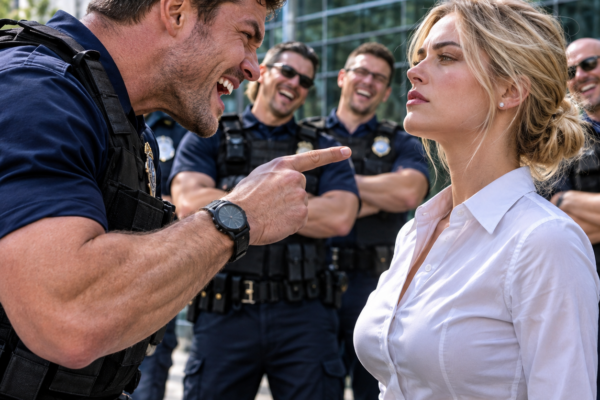
Cop Puts A Gun To The New Girl’s Head To Intimidate Her — Unaware She Was A Navy SEAL For 15 Years

Cop Puts A Gun To The New Girl’s Head To Intimidate Her — Unaware She Was A Navy SEAL For 15 Years
Maybe you and I need to have a real conversation about knowing your place. Cold steel pressed against her temple.
11 witnesses frozen mid-refast. Forks halfway to their mouths.
Nobody daring to move. Officer Grant Dolan waited for the begging, the crying, the apology he believed the whole town owed him.
It never came. The waitress didnt blink, didnt flinch.
two breakfast plates still balanced in her hands, and those hands did not shake.
Not once. Youve got a decision to make, officer, she said, quiet as a held breath.
Put that weapon away.
Or keep it pointed at an unarmed woman in front of 11 witnesses and see how that follows you for the rest of your life.
What Grant Dolan didnt know, the woman he just threatened had spent 11 years doing things this town could never imagine, and she remembered every face in that room.
The barrel of a police revolver pressed against her temple.
Cold steel, warm skin. 11 people watched from their booths, and not one of them moved.
Not one of them breathed. Officer Grant Dolan waited for the begging, the crying, the apology he believed the world owed him from anyone who ever crossed him.
It never came.
The woman did not blink, did not flinch.
Her hands, still holding two breakfast plates, stayed perfectly, impossibly still. You have a decision to make, officer, she said quiet as a held breath.
Put that weapon away and we both go back to our day or keep it pointed at an unarmed woman in front of 11 witnesses and see how that follows you for the rest of your life. What Grant Dolan did not know was that the waitress he had just threatened had spent 11 years doing things this town could never imagine.
Things that leave a person able to count every exit in a room without meaning to.
She remembered every face in that diner, every hand near a phone, every angle of the door.
There is a moment right before a gun changes your life. You do not hear it coming.
You just feel the air go thin.
That is what happened to Ren Callaway on a Tuesday afternoon in Mil Haven, Ohio. To understand why she did not flinch, you have to go back one week back to the morning she walked into town with one duffel bag in a strangers face.
Mil Haven sits where the cornfields end and the old state highway begins.
The kind of town most drivers pass through without noticing.
A grain silo, a water tower painted with a school mascot nobody could name anymore.
One stoplight that blinks yellow after 9 at night. You could miss it in a sneeze.
But the people who live there do not want you to miss it. They want you to slow down.
Roll your window down. Say good morning to a stranger and mean it.
That is the town Ren Callaway walked into on a Sunday morning in late September. Off the bus with one duffel bag over her shoulder, no suitcase, no phone pressed to her ear.
A woman in her late 20s, dressed plain, walking with a posture that made people glance twice without knowing why. Her back was straight.
Her steps were even.
She did not look lost, even though nobody in Mil Haven had ever laid eyes on her before. She walked past the hardware store, past the barber shop, its striped pole frozen midspin for years.
She stopped in front of a diner with a faded sign that read the anchor. Inside, an old bell rang over the door.
A woman behind the counter looked up.
Late 50s, apron dusted with flower.
Reading glasses pushed into gray hair.
This was Peggy Sullivan.
She had run that diner alone for 22 years, ever since her husband passed.
Morning, Peggy said. Sit anywhere you like.
Ren did not sit. I saw the sign in your window.
Her voice was even unhurried.
youre hiring. Peggy looked her over.
Not unkindly. The way a person checks a used car before handing over money for it.
You ever waited tables before?
No, maam. You ever worked a job where people yell at you for things that arent your fault?
Ren almost smiled. Almost.
Something like that.
A pause.
A long one. Peggy had learned over 22 years to trust her gut about people.
and her gut told her something about this young woman did not add up, not in a bad way.
In a way that made her curious instead of careful. Rents due Friday for most folks in this town, Peggy said.
You got somewhere to stay?
Not yet. Theres a room above the hardware store.
Old man Whitaker rents it cheap if you dont mind creaky floors.
I dont mind much of anything. Creaky floors included.
Peggy wiped her hands on her apron and stuck one out.
Start tomorrow 6:00 a.m.Dont be late. And dont ask me twice about the coffee machine.
Its older than my daughter would have been. Ren shook her hand.
Firm, controlled, the handshake of someone trained somewhere sometime to hold steady under pressure. Peggy could not have said how she knew that.
She just knew it. She did not yet know what it meant.
By 6:15 the next morning, Ren was already refilling ketchup bottles before her shift officially began.
Peggy watched from the kitchen window and said nothing. She liked people who showed up early.
It usually told you something about how they were raised or what they had learned the hard way.
The regulars started rolling in around 7.
Harold and Dot Peton married 51 years, splitting one plate of eggs every morning because Dot said portions had gotten too big for two people who used to farm 60 acres by hand. Ruth Alvarez, who ran the flower shop two doors down and drank her coffee black, no cream, because cream made her slow, and slow was a luxury she could not afford before 8:00 a.m.And there was Earl Matson.
Earl came in every single day at 7:15 and sat in the same booth by the window, the one with a slight wobble nobody had ever fixed because Earl said he liked knowing which chair was his.
78 years old, a widowerower, 30 years driving grain trucks across three counties before his knees gave out. He always ordered the same thing.
Two eggs over easy, wheat toast, black coffee, no sugar. Ren brought his plate over that first morning and set it down gently.
Two eggs, wheat toast. Coffees fresh, I promise.
Made it myself 20 minutes ago. Earl looked up at her over his glasses.
New girl?
Not a question, Ren?
Earl?
He nodded once like that settled something important. You from around here?
No.
Didnt think so.
You walk like someone whos been somewhere.
Ren paused.
just long enough for Peggy watching from the counter to notice. Everyones been somewhere, Earl.
She moved on to the next table.
Earl watched her go. Something crossing his weathered face that Peggy recognized.
A man doing quiet arithmetic.
Old math from a long way back.
He said nothing else that morning, but he kept watching. The diner had a rhythm, the way small town diners do if you pay attention.
Breakfast rush from 6:00 to 9:00, a lull until lunch.
Ren picked it up fast.
She learned which regulars wanted their coffee topped off without asking and which ones wanted to be left alone with their newspaper.
She learned that Peggy hummed old country songs under her breath when things were good and went quiet when something was bothering her. 3 days after Ren arrived on a slow Wednesday just before noon, Peggy went quiet the moment the bell over the door rang.
Ren looked up from the table she was wiping.
A man walked in wearing a Mill Haven police uniform.
Mid30s, built like someone who spent more time at the gym than on patrol.
Sunglasses pushed up on his head despite the overcast sky outside.
Officer Grant Dolan did not sit at a table.
He walked straight to the counter and leaned on it like he owned the place. Peg, coffee, bag me a couple donuts.
Peggy did not look at him. Thats 1250, Grant.
Come on, Peg. You know how this works.
I know how its worked for 3 years. Her voice was tight.
Doesnt mean I like it. Dolan smirked and turned, scanning the room like he was hunting for an audience.
His eyes landed on Ren.
Whos this? Started Monday, Peggy said too quickly.
Dolan walked over, raged still in Rens hand. You got a name, new girl.
Ren.
Ren, he said so slow, tasting the word, deciding he did not care for the flavor. Where you from, Ren?
Around.
Arounds not a place. Its the only one Ive got right now.
A few of the regulars had gone quiet. Harold and Dot traded a glance.
Ruths hand tightened around her coffee cup. Earl in his booth set down his fork.
Dolan leaned in. We dont usually get strangers wandering into town and picking up work.
Not without somebody vouching for them. Im not a stranger to myself.
Thats usually enough to get through the day. Harold let out a short laugh, quickly swallowed once Dolan shot him a look.
Dolans jaw tightened.
Cute. Well see how cute you are once I run your plates.
I dont have a car, then Ill run you. He said it like a threat because it was one in Mil Haven.
Everyone understood exactly what it meant when Grant Dolan decided to run your name. It meant digging through databases.
He had no legal reason to search. It meant using the badge like a crowbar instead of a shield.
Ren did not flinch.
You do what you need to do, officer.
Ive got tables to clear.
She turned and walked off.
Dolan watched her go, somewhere between annoyed and intrigued.
Most people who got pushed like that either apologized or shrank down small. She had done neither.
He grabbed his coffee and donuts and left without paying the 1250.
Peggy exhaled once the door swung shut.
You didnt have to do that. Do what?
Push back.
Grant doesnt forget things like that.
Ren kept wiping the counter slow and even.
Neither do I.
Here is something worth understanding about small towns like Mil Haven.
Power does not always wear a badge or hold a title or carry a gun.
Sometimes it wears silence instead.
An entire community agreeing without ever saying it out loud not to make waves. Grant Dolan had learned that trick early from a master.
His father, Walter Dolan, had spent 16 years on the town council before stepping down two years back.
People still called him councilman out of habit and maybe out of something closer to fear.
Together, father and son had built something rotten underneath the towns friendly surface. Nobody spoke of it directly, but everybody knew the rules.
You did not question a traffic stop. You did not report a missed inspection.
And if a Dolan asked you to send something, you signed it, smiled, and thanked them for stopping by.
Earl Matson had lived under those rules for 2 years, ever since his wife passed, and the medical bills started climbing faster than his pension could keep up with. 3 days after Ren started at the diner on a bright Thursday morning, Grant Dolan walked into the anchor again.
This time, he was not after free coffee.
He walked straight to Earls booth and sat down uninvited. Earl, we need to talk about the property.
Earls shoulders went stiff.
I told you already. Im not signing.
Its a good offer. Fair market value, plus a little extra for the trouble.
Its my land.
My wife and I built that porch with our own two hands. Dolan leaned forward, dropping his voice, though not far enough.
Ren stood three tables away and heard every word.
Heres the thing, Earl.
That barn of yours failed inspection last spring.
I could reopen that file anytime I like. Citations pile up fast for a man on a fixed income.
That inspection was fine.
You know that.
I know what the paperwork says I wanted to say.
Earls hands resting on the table had begun to shake. Not from fear exactly, from the particular exhaustion of a man worn down slowly over two long years.
Youve got until the council vote next week, Dolan said standing.
Sign by then or things get complicated. He turned to leave and nearly walked into Ren closer than he expected.
Coffee pot in hand.
Refill officer.
Something in her tone made him pause.
Calm. Too calm.
Like she had heard something and was choosing to hold on to it for later.
Im good. He left.
Ren set the pot down and slid into the booth across from Earl.
You all right?
Earls eyes were wet, though he would never admit it out loud.
Ive been better.
40 years I drove that grain route.
30 of them with my wife waiting up every night. Kitchen light on.
That land is the only piece of her Ive got left.
Nobody should lose the last piece of someone they loved, Ren said.
Because a man with a badge decided he wanted it more. Earl studied her face.
You say that like youve lost something, too. Ren did not answer right away.
Everybodys lost something, Earl. The question is what you do with whats left.
She stood and went back to work.
Earl kept watching her the way he had that first morning, doing that old math again. The days that followed carried a strange weight, the kind of tension that settles in before a storm nobody has named yet.
Ren kept her head down and worked.
She learned every regulars name, learned how they liked their eggs, never once complained about a double shift.
But something had shifted in the diner since that Thursday morning. People noticed how Ren had listened while Dolan leaned on Earl.
They noticed she had not looked away. In a town that had spent years practicing the art of looking away, that mattered more than anyone said aloud.
Dolan noticed, too. It bothered him more than he expected.
He came in almost every day that week, always with some small test built into an ordinary sentence.
Hed knock over a napkin dispenser and watch to see if she flinched picking it up. Hed fire off sudden questions, hoping to catch her in a lie.
You said youre from around where exactly. Thats not an answer.
Its the only one Im giving. He tried a different angle one afternoon, leaning against the counter while she restocked the pie case.
Most people who move to a town like this are running from something. Bad marriage, debt, maybe worse.
Ren did not stop stacking the boxes and some people move to a town like this because theyre running towards something.
Ever consider that? Like what?
Peace.
Quiet mornings. A place where the only real worry is whether the coffee is fresh.
Dolan laughed short and humorless. Theres no peace in this town.
Not really. Thats an odd thing for a police officer to admit.
His jaw tightened.
That made twice she had made him feel small in front of witnesses.
He did not care for the feeling.
Men like Grant Dolan rarely do.
He left without another word. That night, alone in the small rented room above the hardware store, Ren sat on the edge of a narrow bed and took something out of her duffel bag.
An old watch, military style.
The metal band worn smooth from years of use. The face cracked in one corner, a thin scar running clean through the number nine.
She held it in both hands for a long time.
If you had been in that room, you might have noticed how her breathing changed while she held it. Slower measured.
A person managing something heavy without letting the weight show on the outside. She did not put it on.
She never wore it in public.
She simply held it, turned it once in her palm, and set it back on the small table by the bed.
Then she switched off the light. Tuesday arrived again.
Eight days after Rens first shift, the morning began ordinary enough. Harold and Dot split their eggs.
Ruth ordered her black coffee. Earl sat in his booth, though he looked more tired than usual, in a way that worried Peggy.
Around 11:00, the bell over the door rang and Grant Dolan walked in.
Something was different this time.
He was not smiling.
His jaw sat tight and his hand rested on his belt in a way that hushed the whole diner before he even opened his mouth. He had spent the morning at the station reading something that made him furious.
A complaint.
Not against him directly, but close. Someone had called the county sheriffs office asking questions about a land transfer near Matsons property.
Questions Grant Dolan did not want anyone asking.
He did not know who made that call, but he had a guess.
He walked past the counter, past Earls booth, and stopped in front of Ren, clearing a table near the window. You call the sheriffs office.
Ren set down the plates she was holding slow and careful.
I dont even know the sheriffs number.
Dont lie to me. Im not.
Somebody in this diner made a call this morning about things that are none of their business. The room had gone dead still.
Peggy stood frozen behind the counter, dish towel in hand.
Harold reached across and took Dots hand. Earl gripped the edge of his booth.
Ive been serving tables since 6:00 a.m.Ren said, her voice even. Youre welcome to check the schedule.
Dolans hand shifted to his hip.
I dont need to check anything.
I know how this works. New face shows up in town and suddenly people start asking questions they never used to ask.
Thats not how cause and effect works, officer. It was either the wrong thing to say or exactly the right thing, depending on what happens next in a story like this one.
Dolans face flushed red. In one motion, faster than anyone in that diner expected from a man his size, he drew his service weapon.
Someone gasped.
Dot let out a small cry. Peggys hand flew to her mouth.
He raised the gun and pressed the barrel against Rens temple.
The diner went utterly still.
Even the refrigerator hum in the kitchen seemed to fade to nothing. Maybe you and I need to have a real conversation, Dolan said, his voice shaking with something between rage and adrenaline.
About respect, about knowing your place in a town that doesnt know you.
Ren did not move.
Her eyes stayed forward, steady, looking past him rather than at him the way you look at weather, instead of a person standing in front of you. Her hands, still holding the empty plates, did not shake, not even slightly.
That was the detail Peggy would remember most, telling this story to anyone who asked. Not the gun, not the silence.
The fact that this young womans hands had been perfectly impossibly still.
Youve got a decision to make, officer, Ren said, her voice barely above a whisper, though clear enough to reach the whole room.
You can put that weapon away right now and we both go back to our day or you can keep it pointed at an unarmed woman in front of 11 witnesses and see how that decision follows you for the rest of your life.
For three long seconds, nobody breathed. Then slowly Dolan lowered the gun.
He did not apologize.
He did not explain himself. He holstered the weapon, straightened his jacket, and looked around the room like he was daring someone to speak.
Nobody did.
Watch yourself, he said to Ren, though his voice had lost some of its earlier certainty. He walked out, the bell over the door ringing behind him like nothing unusual had happened at all.
For a long moment after the door closed, nobody in the diner moved.
Then, Doc Peton began to cry quietly into Harolds shoulder.
Ruth sat down her coffee cup with a hand that would not stop trembling.
Peggy came around the counter and put both hands on Rens shoulders. Are you all right, honey?
Are you hurt? Im fine, Peggy.
You could have died right here in front of everybody. Ren finally set the plates down and took a slow breath.
Ive had worse mornings.
It was such an unusual thing to say that Peggy nearly laughed out of sheer disbelief, though laughing felt wrong in a room still ringing with fear.
Earl Matson had not moved from his booth.
He sat there staring at the spot where Ren had stood, his weathered face giving nothing away. He had just seen something he had not expected to see again.
Not in Mil Haven, not in a diner that smelled like coffee and bacon grease. He had watched a person hold perfectly still under the barrel of a gun.
Not frozen from fear, but steady from training.
He knew the difference.
He had spent enough years around men who came home changed from things they never spoke about. He said nothing that afternoon.
He paid his bill, left his usual tip, and walked home slower than usual, leaning a little harder on his cane.
But that night, in his small house at the edge of town, he sat by the window a long while, thinking about a young woman with steady hands and eyes that did not blink. Word travels fast in a town of,00 people.
By the next morning, everyone in Mil Haven had heard some version of what happened at the anchor. Some versions were accurate.
Some grew the way stories always do, gathering extra danger and extra drama with every retelling, but the core of it stayed the same. A cop had pulled his gun on the new waitress, and she had not backed down.
At the diner that Wednesday, the regulars came in quieter than usual.
Harold and Dot held hands across their table instead of splitting their usual plate. Ruth brought Ren a small bouquet wrapped in brown paper and did not say much beyond.
You didnt deserve that.
Peggy tried twice to ask if Ren wanted to talk about it.
Both times, Ren gently steered the conversation back to work.
But some things are easier carried than explained.
And Peggy did not push.
She simply started watching Ren more closely after that. Not with suspicion, with something closer to respect, mixed with worry, mixed with a curiosity she could not quite name.
Earl came in at his usual time and settled into his usual booth.
When Ren brought his eggs, he looked up at her a long moment.
You didnt sleep much last night, did you? Does it show?
Only to somebody who knows what not sleeping looks like. Ren allowed herself a small, tired smile.
Ive had a lot of practice not sleeping, Earl. He nodded slowly, as though he had already suspected as much.
Can I ask you something? You dont have to answer if youd rather not.
Go ahead.
That thing you did yesterday, standing still like that.
Thats not something you learn from a rough childhood or a bad marriage.
Thats something you learn from training. Real training.
Ren was quiet a moment. Earl, I came to Mil Haven to leave certain things behind, not to erase them, just to set them down for a while.
Fair enough.
A mans allowed to set things down. He did not ask again, but something had shifted between them, an understanding that did not need words to hold its shape.
That Thursday, 2 days after the incident, Ren finished her shift a little early. Peggy insisted, Go get some fresh air, honey.
Ren did not go home right away.
She walked instead, unhurried, down Main Street, past the barberh shop until she reached the small park at the center of town, a gazebo with peeling white paint, a war memorial listing names from three different generations, a few benches facing a fountain that had not run in years.
An old woman sat on one of the benches, wrestling with a grocery bag that had torn at the bottom. Cans of soup rolled across the pavement faster than she could catch them.
Ren crossed the park without thinking twice and knelt down, gathering the cans before they scattered further.
Thank you, the woman said breathless. They dont make these bags like they used to.
Nothing does. Ren held the cans in the crook of one arm.
Where are you headed?
I can carry these the rest of the way.
The woman studied her. Youre the new girl from the diner.
The one who stood up to Grant Dolan.
I just poured coffee.
Thats not all, and you know it.
My name is Loretta. I live two streets over.
My husband passed last spring, and my knees arent what they used to be.
Im Ren. Lets get you home, Loretta.
They walked together, slow enough to match Lorettas pace, past small houses with sagging porches and neatly trimmed lawns.
Loretta talked the whole way, the way people do when loneliness has been sitting on them a while and someone finally shows up to listen about her husband, a mechanic who had fixed half the cars in Mil Haven over four decades. About her son who lived two states away and called on Sundays sometimes about Grant Dolan, though she lowered her voice when she did.
That boys been trouble since he was young.
His father was worse.
Walter Dolan ran this town like it belonged to him for 16 years on that council.
People were afraid to cross him.
Still are most days.
What changed that?
Loretta shrugged, a small, tired gesture. Nothing changed it.
Thats the trouble. Nobody ever stood up long enough for anything to shift.
We just got used to letting it slide.
They reached a small house with blue shutters and a windchime on the porch.
This is me, Loretta said.
Thank you for the company, dear. And thank you for standing up for Earl, for Ruth, for the rest of us who forgot how.
I didnt do much. You did something.
Thats more than most people manage. Ren walked home slower than usual that evening, turning over how a whole town could learn over years to accept things that never should have been accepted in the first place.
How silence repeated long enough starts to feel like peace even when it is really just exhaustion wearing a familiar coat.
The days after the gun incident settled into something close to normal, though normal now carried a different texture. Grant Dolan did not come into the diner for four straight days, the longest gap anyone could remember since he started demanding free coffee 3 years earlier.
When he finally returned on Saturday afternoon, he did not lean on the counter or make demands.
He sat quietly at a table near the door, ordered properly, and paid for it before leaving. He did not look at Ren once.
But everyone in the diner sensed the story was not finished. Grant Dolan was not a man who let embarrassment go unanswered.
He was simply waiting for the right moment. That moment came the following Tuesday, exactly one week after the first incident.
On a slow afternoon, once the lunch rush had thinned, Ruth Alvarez sat near the counter, sipping tea and reading the local paper. A slight tremor lived in her hands, a small sign of age most people in town had learned to work around without comment.
Ren was carrying a tray of hot water and tea supplies across the diner, headed for Ruths table.
Grant Dolan walked in at that exact moment.
He saw Ren carrying the tray.
He saw an opening. Nobody in that diner, not even Peggy, could say for certain afterward whether what happened next was truly an accident or something Dolan decided to make happen in the half second he had to choose.
He stepped sideways fast directly into Rens path. The tray tipped.
Scalding water meant for a pot of tea arched through the air toward Ruth Alvarezs exposed hands and face.
For most people, this would have ended in a scream in burned skin in an ambulance ride in a lawsuit dragging on for months.
But Rens body moved before her mind had finished forming a decision. Her left hand shot out and caught the falling tray by its edge, redirecting the water in a controlled arc away from Ruth entirely, splashing it harmlessly onto the tile floor instead.
Her right hand in the same motion guided Ruths shoulder backward out of range. The whole sequence took less than one second.
When it was over, Ruth sat stunned but completely unharmed, her tea and newspaper scattered on the table in front of her.
The hot water steamed on the floor several feet from where anyone had been standing.
Ren stood perfectly still, Trey now empty in her hand, breathing normally as though nothing unusual had happened at all. The diner fell silent for the second time in 2 weeks.
Grant Dolan stood frozen near the doorway. Oh, his expression caught somewhere between shock and something close to fear.
That was clumsy of me, he muttered, though nobody in that room quite believed the word clumsy described what they had just watched. He left quickly without ordering anything.
Ruth sat shaking slightly, more from adrenaline than injury.
How did you? she started, then stopped, unable to finish the sentence.
How did you do that so fast?
Ren knelt and began mopping up the spilled water, her hands steady again.
Instinct?
Thats all. Thats not instinct, Earl said from his booth.
He had watched the whole thing without moving his coffee, cooling untouched in front of him. Thats training.
Ive seen that kind of reflex exactly once before in my life. Where was that?
Peggy asked, coming around the counter, her voice careful. Earl was quiet a long moment, staring at the wet spot on the floor, as though the memory itself needed time to surface.
A long time ago, I had a nephew who came home from overseas, different than hed left.
Quiet like our Ren here. Steady hands even when everything around him was falling apart.
He used to say, The training never really leaves you.
It just waits. Dinar sat with that for a moment, absorbing what Earl had said and what he had not.
Ren finished cleaning the floor and stood, setting the empty tray on the counter. Your nephew sounds like he understood something.
Most people never have to learn.
He did. Cost him plenty to learn it, though.
Something passed between Ren and Earl in that moment.
Not a confession, exactly.
Not a confirmation either.
Just two people recognizing the shape of a similar weight, even without naming it out loud. Ruth reached out and took Rens hand.
Thank you.
Whatever that was, whatever you did, you saved me from a very bad afternoon.
You dont have to thank me. I just did what needed doing.
Thats usually when thanks matter most, Ruth said. When someone does the right thing without waiting to be asked, Harold cleared his throat.
Ive lived in this town 63 years.
Ive watched a lot happen at that counter.
Never once seen anything like what you just did. It was 1 second, Harold.
Barely worth mentioning. 1 seconds usually all it takes, he said.
Good or bad. Nobody tells you that when youre young.
Life doesnt ask permission before it changes.
It just happens fast and you either meet it or you dont.
Dot squeezed her husbands hand.
He gets philosophical after lunch, but hes not wrong this time.
Peggy came around with a fresh towel and finished wiping down the last of the water, though the floor was already mostly clean.
I think we could all use a slow afternoon after that. Coffees on the house, every table.
A few tired laughs moved through the diner, the kind that come after fear has passed, and people need somewhere to put the leftover adrenaline.
Ren carried the empty tray back to the kitchen, and for a moment, alone behind the swinging door, she let herself close her eyes and breathe. Nobody saw that moment except the old refrigerator humming in the corner and the afternoon light slanting through the small window above the sink.
It was enough for now, that nobody had gotten hurt.
She had learned a long time ago not to ask for more than that. That night, after the diner closed, Ren walked the two blocks back to her small rented room.
The town had gone still in the particular way small towns settle after dark.
Porch lights glowing here and there, the distant hum of a television through an open window. She climbed the narrow staircase, unlocked her door, and set her bag down by the bed.
She sat on the edge of the mattress a long while before reaching for the small table beside it.
The watch waited exactly where she had left it. Cracked face, worn band, a thin scar running through the number nine.
She picked it up, turned it once in her palm, and held it against her chest for a moment, eyes closed. If you had asked her in that small room what she was thinking about, she might not have had an easy answer.
Some memories refuse to arrange themselves into simple sentences.
They just sit in your chest, heavy and familiar, like an old friend who visits without calling first.
She thought about a person she used to know, someone who had given her this watch once a long time ago in a place far from Mil Haven under circumstances she rarely let herself remember in detail. She thought about promises made in difficult moments, about the particular hush that follows a person home after certain experiences, one that never fully leaves, no matter how many small towns you move to or how many diner shifts you work.
She thought about Earl and the way his eyes had understood something about her without needing an explanation. She thought about a gun pressed against her temple and the strange small mercy of having learned long ago how to hold still when everything in you wanted to move.
Ren opened her eyes, set the watch gently back on the table, and did not put it on.
Not yet. She was not ready for Mil Haven to know the whole story.
But something had already begun shifting in this small town, whether she wanted it to or not.
A cop with too much power had drawn his weapon in front of 11 witnesses, and an entire town had watched a stranger refuse to be afraid.
That kind of moment does not simply disappear. It sits in a towns memory, waiting for the next thing to happen.
And in Mil Haven, the next thing was already on its way. Small towns rarely announce their turning points in advance.
They arrive quietly, disguised as ordinary Tuesdays, ordinary diners, ordinary strangers stepping off an ordinary bus with nothing but a duffel bag and a face nobody recognized.
Mil Haven would not recognize, not yet, that its turning point had already walked through the door of the anchor a week earlier, asking about a help wanted sign. It would take a few more weeks before the town understood what it had actually been given.
A chance to remember something about itself that two years of quiet fear had nearly worn away entirely.
The simple, stubborn belief that neighbors look out for neighbors, no matter who wears the badge, and no matter how long the silence has lasted, Earl Matson would carry that thought with him into the days ahead. Through paperwork, he still had not signed.
through a council vote still looming on the calendar, through a friendship with a quiet young woman that would ask more of him than he expected and give him back more than he ever thought he had left to give.
And somewhere above a hardware store in a small rented room with creaky floors, a woman with 11 years of service folded quietly into her past would sleep a little easier that night.
Not because the danger had passed, but because for the first time in longer than she could remember, she was not the only one standing guard.
Some men learned from being embarrassed. Grant Dolan was not one of them.
 [Tap here for the Next Part ]