“I can try. But I don’t know if I can just… let go.”
“I can try. But I don’t know if I can just… let go.”
She married him to save her father from debt. She stayed to save them both from the past.
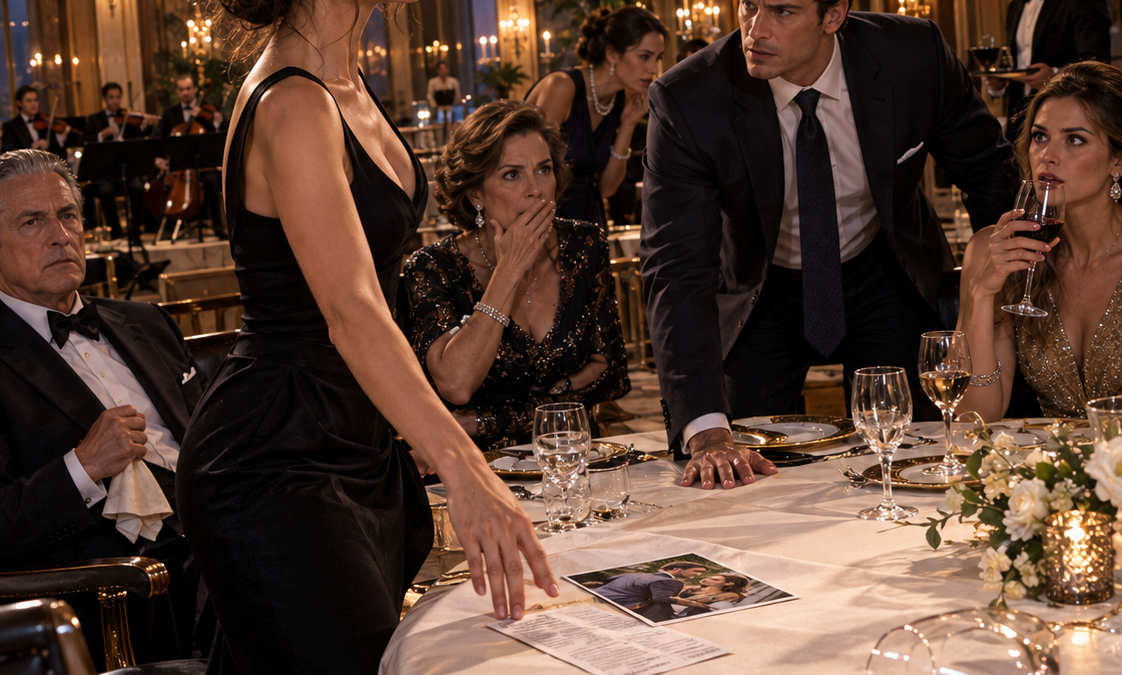
The envelope landed face-down on the white linen tablecloth, slid there by a waiter’s gloved hand, and Elena Volkov watched her husband’s mother reach for it before anyone else could.
“Mother Volkov, please—” Elena started.
But Irina Volkov had already turned it over. The old woman’s rings caught the chandelier light as she examined the seal—unbroken, unmarked, nothing but a thin strip of packing tape holding it shut. No return address. No stamps.
“It was under the bread plate,” Irina said, her voice carrying that particular tone she used when she wanted the whole table to lean in. “How curious.”
Forty people filled the private dining room of the Volkov family’s flagship hotel—the Imperial on Fifth Avenue, twenty floors of old-money limestone that had been in the family since Elena’s grandfather-in-law had bought it from a dying railroad baron in 1952. Crystal chandeliers. Hand-painted ceiling frescoes that had been imported from a demolished Venetian palazzo. A string quartet playing something delicate enough to be background noise.
Elena’s fingers tightened around her wine glass. She’d been married to Viktor Volkov for three years, and she still hadn’t figured out how to breathe in this room.
“Give it here, Mama,” Viktor said from the head of the table. His voice was quiet—it was always quiet—but the string quartet faltered for half a beat, then recovered. That was the thing about Viktor. He didn’t need to raise his voice. The room adjusted itself around him.
Irina held the envelope just out of reach. “It’s addressed to Elena.”
The table went still.
Elena felt every eye swing toward her—Viktor’s sister Natalia, who had never once looked at her without calculating something. His uncle Dmitri, who ran the family’s shipping interests and smelled perpetually of cigars and cold water. The board members and their wives, the cousins and their plus-ones, the family lawyer with his nervous blink. Thirty-eight people who had spent three years treating Elena like a temporary condition, something Viktor would eventually get over.
“What is it?” Elena asked, and her voice came out steady, which surprised her.
Irina slid the envelope across the table. It stopped just short of Elena’s plate.
“I’m sure I don’t know,” Irina said. “But I’m equally sure you’ll want to open it privately. Perhaps after dinner.”
That was the trap. Elena saw it clearly. Open it now and she was dramatic, attention-seeking, making a scene at the family’s quarterly dinner. Open it later and Irina would have already sent someone to intercept it, or would have already opened it herself, or would have already spun whatever was inside into something ugly.
Elena picked up the envelope.
“Elena,” Viktor said. Not a question. A warning.
She looked at him—really looked, the way she’d trained herself to do in the early days of their marriage, when she’d still believed she could learn to read him. Dark hair, dark eyes, the kind of face that magazines called “striking” and that Elena had learned to call “closed.” He was forty-one years old, the youngest CEO in the history of Volkov Industries, and he had never once told her he loved her.
Not once. Not in three years.
“I’ll open it,” Elena said.
“Don’t.” Viktor’s hand flattened on the table. A small gesture. A contained one. But she saw the tension in his knuckles.
“Are you afraid of what’s inside?” she asked.
The silence that followed was the loudest thing Elena had ever heard.
She opened it.
The envelope contained three items: a photograph, a receipt, and a single sheet of paper covered in handwriting she didn’t recognize.
The photograph showed Viktor. Viktor and a woman. Viktor and a woman in a hotel room—not this hotel, but a hotel, the generic kind with beige walls and generic art and a bed that was clearly visible behind them. Viktor’s tie was loosened. The woman’s dress was unzipped. They were laughing at something the camera couldn’t see.
The receipt was from a jewelry store on Madison Avenue. A bracelet. Twenty-two thousand dollars. Purchased three weeks ago. The name on the receipt was not Elena’s.
The handwritten note said: Ask him about the apartment on 72nd Street. Ask him about the baby.
Elena read it twice. Three times. The words didn’t change.
She set the items down on the table, face-up, where everyone could see them.
“Elena—” Viktor started.
“Ask him about the apartment on 72nd Street,” Elena said, and her voice carried—carried the way Irina’s never did, the way Viktor’s never needed to. “Ask him about the baby.”
The string quartet stopped playing.
Later, Elena would remember the next thirty seconds in fragments. The way Natalia’s wine glass froze halfway to her lips. The way Dmitri’s face went carefully, deliberately blank—the expression of a man who had known something and was now calculating how to pretend he hadn’t. The way Irina’s eyes flickered, just once, toward the door, as if checking whether it was still possible to escape.
Most of all, she would remember Viktor’s face.
It didn’t change. That was the thing. His expression didn’t shift, didn’t crack, didn’t show anything at all. He looked at the photograph, then at Elena, then at the forty people watching them, and he said, in that quiet voice that made the whole room lean in:
“Who gave you that envelope?”
“Does it matter?”
“Yes.”
“It was under my bread plate, Viktor. Someone wanted me to see it.”
“Someone wanted to humiliate you,” Irina said, finding her voice. “In public. At a family dinner. Whoever sent this is trying to destroy your marriage, Elena. Surely you can see that.”
Elena turned to her mother-in-law. Three years of small cruelties. Three years of being corrected, dismissed, treated like a mistake Viktor had made and would eventually unmake. Three years of Irina’s voice saying the Volkov name this and the Volkov reputation that, as if Elena were a stain on the family ledger.
“I can see a photograph,” Elena said. “I can see a receipt. I can see handwriting that says ask him about the baby. Which part of that is a lie, Irina? Tell me which part is a lie and I’ll apologize to the whole table.”
Irina’s mouth opened. Closed. She looked at Viktor.
Viktor stood up.
He was tall—six-foot-two, the kind of tall that made rooms feel smaller—and when he stood, everyone else at the table instinctively shifted in their seats, half-rising, as if he were a judge entering a courtroom.
“Elena and I will discuss this privately,” he said. “The rest of you, finish your dinner. Natalia, see that the staff brings out the dessert.”
“Viktor—” Natalia started.
“Dessert,” Viktor repeated, and Natalia shut her mouth.
He held out his hand to Elena.
She looked at it—that hand. She’d held it at their wedding, in front of six hundred guests, none of whom had known that the marriage was a contract, a merger, a deal brokered by lawyers and sealed with a kiss that had felt like signing on a dotted line. She’d held it in hospital rooms when his father was dying, in cars on the way to charity galas, in bed on the nights when he reached for her in the dark and she let him because she didn’t know how to say no.
She didn’t take it.
“I’ll meet you in the car,” she said, and walked out of the dining room with her chin up and her hands shaking and the photograph still lying on the table behind her, face-up, for everyone to see.
The hallway outside the private dining room was cold—the hotel’s ancient HVAC system doing its best to keep the old limestone from sweating—and Elena made it exactly twelve steps before her legs gave out.
She sat down on a velvet settee that had probably been worth more than her first car, and she pressed her hands against her knees, and she breathed.
Ask him about the baby.
Three years of marriage. Three years of trying—of doctors and charts and temperature tracking and the careful, clinical way Viktor would ask are you sure this is the right time before he touched her. Three years of Irina’s pointed comments about heirs and legacies and the Volkov name dying out. Three years of Elena swallowing it all, telling herself that this was what she’d signed up for, that the contract was clear, that she’d known what she was getting into when she’d agreed to marry the most powerful man in her family’s world.
She hadn’t known. That was the truth of it. She’d been twenty-six years old, drowning in her father’s debts, and Viktor Volkov had appeared like a lifeline—a cold, beautiful, terrifying lifeline—and she’d grabbed on because the alternative was watching her mother lose the house.
And now there was a baby.
Not her baby. A baby. Some other woman’s baby, growing inside some other woman’s body, while Elena sat in a hotel hallway and tried to remember how to breathe.
The door behind her opened.
She didn’t turn around. She knew the sound of his footsteps—measured, deliberate, the gait of a man who had never once in his life been in a hurry.
“Elena.”
“Don’t.”
“Elena, look at me.”
She turned.
Viktor stood in the doorway, silhouetted against the warm light of the dining room. His tie was still perfect. His hair was still perfect. He looked like a painting of himself, like something designed to be admired from a distance.
“Who is she?” Elena asked.
“Does it matter?”
“It matters.”
“She’s no one.”
“She’s having your baby, Viktor. She’s not no one.”
His jaw tightened. Just slightly. Just enough for her to see.
“Who told you that?” he asked.
“The note.”
“The note could be lying.”
“The photograph isn’t lying. The receipt isn’t lying. Unless you want to tell me you bought a twenty-two-thousand-dollar bracelet for your mother?”
Silence.
“I didn’t think so,” Elena said.
Viktor stepped into the hallway. The door swung shut behind him, and they were alone—really alone, for the first time in months, maybe years. No family. No board members. No staff. Just the two of them and the cold air and the truth sitting between them like a third person.
“The apartment on 72nd Street,” Viktor said slowly, “is a business asset.”
“Is that what you call her?”
“It’s where I keep—” He stopped. Started again. “It’s where I conduct certain meetings that can’t happen at the office.”
“Meetings.”
“Yes.”
“With a woman who isn’t your wife.”
“With a woman who works for me.”
“That’s worse.”
“Is it?”
Elena stood up. Her legs were steadier now. The shock was wearing off, and in its place was something colder, something sharper—something that felt almost like relief.
“I want a divorce,” she said.
Viktor didn’t move. Didn’t blink. Didn’t react at all, except for the faintest tightening around his eyes.
“No,” he said.
“No?”
“No divorce.”
“You don’t get to decide that.”
“I do, actually.” He reached into his jacket and pulled out a folded document—how long had he been carrying it? How long had he known this moment was coming?—and held it up. “The prenuptial agreement. Page fourteen, section three. In the event of a divorce initiated by either party, the marital assets are frozen for a period of five years, during which time neither party may access—”
“Stop.”
“—any funds, properties, or holdings acquired during the marriage, including—”
“Stop.” Elena’s voice cracked. “Stop it.”
Viktor lowered the document. His face was still closed, still unreadable, but his voice—his voice had something in it she’d never heard before. Something almost like pleading.
“I’m not going to let you leave,” he said. “Not like this. Not because of a photograph and an anonymous note.”
“You’re not going to let me?”
“I’m going to find out who sent that envelope. I’m going to find out why. And then—”
“And then what? You’ll explain? You’ll tell me the baby isn’t yours? You’ll tell me the apartment is just a business asset and the bracelet was a business expense?”
“The bracelet was a gift for you.”
Elena laughed. It came out broken, ugly, nothing like the elegant laugh she’d trained herself to use at parties.
“It was in a box with another woman’s name on it, Viktor. I saw the receipt.”
“The receipt was—” He stopped. Closed his eyes. When he opened them again, something had shifted. “The receipt was a mistake. The woman—her name is Anya. She’s my—”
“Your what?”
“She’s my sister.”
The hallway went very quiet.
“I don’t have a sister,” Viktor said. “Officially. But my father—” He stopped again. Swallowed. “My father had a relationship, before he married my mother. Anya is the result. She’s been living in Europe for most of her life. She came back six months ago because she needed help.”
Elena stared at him.
“That’s the story you’re going with?”
“It’s not a story. It’s the truth.”
“Then why the hotel room? Why the photograph? Why does she look at you like—”
“Like what?”
“Like you’re hers.”
Viktor’s face did something then. It cracked—just for a second, just enough for her to see the exhaustion underneath. The weight. The years of holding everything together, of being the oldest son, the heir, the one who had to be perfect.
“She’s not mine,” he said. “But she’s carrying my father’s child. My father, who died two years ago. Who left her pregnant and alone and no way to prove the child is his. She came to me because she had nowhere else to go.”
Elena’s hands were shaking again.
“You should have told me.”
“Yes.”
“You should have trusted me.”
“Yes.”
“Instead you hid her. You kept her secret. You let me think—” Her voice broke. “You let me think you were having an affair. You let your mother look at me like I was nothing. You let everyone at that table watch me open that envelope and see that photograph and—”
“I didn’t know about the envelope.”
“Someone did. Someone in your family knew about Anya. Someone wanted me to see that photograph. Someone wanted to destroy—”
“Me,” Viktor said. “They wanted to destroy me. You were just the weapon.”
Elena looked at him—really looked, the way she hadn’t let herself look in years. His hands were at his sides, clenched. His breathing was too controlled, too deliberate. He was holding himself together by sheer force of will, and she could see it, and she hated that she could see it, hated that after three years of his silence she could still read him when it mattered.
“I want to meet her,” Elena said.
Viktor’s head came up. “What?”
“Anya. I want to meet her.”
“That’s not—”
“I don’t care what it is or isn’t. I want to meet the woman in the photograph. I want to hear her story. I want to look her in the eye and decide for myself whether you’re lying to me.”
“She won’t—”
“She will if you tell her to.” Elena stepped closer, close enough to smell his cologne, the same scent she’d smelled on their wedding day. “Unless you have something else to hide.”
Viktor was silent for a long moment.
Then he reached into his pocket and pulled out his phone.
“Tomorrow,” he said. “Ten a.m. The apartment on 72nd Street.”
“Fine.”
“And Elena—”
She was already walking away, toward the elevator, toward the cold night air, toward the first breath of freedom she’d had in three years.
She didn’t look back.
She should have looked back. She would think that, later, when everything fell apart.
But in that moment, all she could think about was the photograph—the way the woman had looked at Viktor. Not like a sister. Not like someone who needed help.
Like someone who was winning.
Chapter 2: The Woman Who Wasn’t a Mistress
The apartment on 72nd Street was nothing like Elena had expected.
She’d imagined something sleek and modern—chrome and glass and the kind of cold luxury that Viktor favored in his office. Instead, the building was old, pre-war, the kind with a doorman who actually stood up when you walked in and an elevator that required a key. The hallway smelled like lemon polish and old books.
Viktor walked ahead of her, his shoulders rigid. He hadn’t spoken since they’d gotten into the car. Hadn’t looked at her. Hadn’t done anything except drive with both hands on the wheel, like a man steeling himself for something.
“The baby—” Elena started.
“Is not mine.”
“You said that already.”
“It’s still true.”
The door opened before Viktor could knock.
Anya was smaller than Elena had expected—fine-boned, with the kind of delicate features that made her look younger than she probably was. She was maybe thirty, with Viktor’s same dark hair and Viktor’s same dark eyes, but where his were closed and cold, hers were wide, watchful, afraid.
“You brought her,” Anya said. Not a question.
“I told you I would.” Viktor stepped inside, and Elena followed, and the door closed behind them with a soft click.
The apartment was small—smaller than any of the Volkov properties, smaller than Elena’s own apartment before she’d married. Two bedrooms, maybe. A kitchen that was really just a corner of the living room. Books stacked on every surface, in Russian and French and English. A bassinet in the corner, empty.
“You’re pregnant,” Elena said.
Anya’s hand went to her stomach. She was barely showing—five months, maybe, the kind of weight that was easy to hide under a loose sweater.
“Twenty-two weeks,” Anya said.
“Viktor said—” Elena stopped. Swallowed. “He said the baby is your father’s.”
“Yes.”
“Your father, who died two years ago.”
“Yes.”
“And you came to Viktor because—”
“Because I had nowhere else to go.” Anya’s voice was quiet, accented, careful. “My mother died when I was sixteen. I grew up in Switzerland, in a boarding school, paid for by the Volkov family. I never knew my father—not really. He visited twice a year. He never told my mother he was married. He never told his wife about me.”
“Your mother was—”
“His mistress. Yes.” The word hung in the air. “She knew what she was. She never expected anything from him. But when she died, he sent me money. Every month, until he died. And then it stopped.”
Elena looked at Viktor. He was standing by the window, his back to them, his reflection a ghost in the glass.
“You stopped the payments?”
“I didn’t know about them.” Viktor’s voice was flat. “I didn’t know about Anya. My father never told me. My mother—” He stopped. “My mother knew. She’s known all along. She’s been paying Anya out of a private account for years. When she found out about the pregnancy—”
“She cut me off,” Anya said. “She told me I was a disgrace. She told me my child was a disgrace. She told me—” Anya’s voice cracked. “She told me to disappear.”
Elena felt something shift in her chest—something that felt dangerously close to sympathy.
“And Viktor found you.”
“Viktor found me through a private investigator.” Anya’s eyes flickered to her half-brother. “He was trying to find out who was stealing from the family accounts. He found me instead.”
“I was investigating my mother,” Viktor said quietly. “She’s been moving money for years. I didn’t know why. Now I do.”
“She’s been hiding you.”
“Protecting the family name. That’s what she calls it.” Viktor turned from the window. His face was still closed, but his voice had an edge to it—something sharp and dangerous. “If anyone knew my father had an illegitimate daughter, there would be questions. About the will. About the inheritance. About the shares.”
“About everything,” Anya said.
Elena’s head was spinning. She’d walked into this apartment expecting to confront a mistress. Instead, she was standing in the middle of a family secret—one that went back decades, one that involved money and power and a dead patriarch and a child who had never asked to be born.
“Why did you keep it from me?” she asked Viktor.
“Because it wasn’t mine to tell.”
“You’re my husband.”
“And Anya is my sister. She didn’t want anyone to know. Not until—” He stopped.
“Not until what?”
“Not until the baby was born,” Anya said. “I wanted time. Time to decide what to do. Whether to keep it. Whether to—”
“You were going to give it up,” Elena said.
“I don’t know what I was going to do.” Anya’s voice was barely a whisper. “I still don’t. But Viktor said he’d help me. He said he’d find a way. And then—”
“The envelope.”
“The envelope,” Viktor agreed. “Someone found out. Someone decided to use Anya against me. Against us.”
Elena sat down on the edge of the sofa—an old velvet thing, worn at the arms, clearly secondhand. She thought about the dinner. The photograph. The way the whole table had watched her open that envelope, waiting for her to break.
“Who?” she asked. “Who would do that?”
Viktor was silent.
“Viktor?”
“I don’t know yet.” He looked at her—really looked, his eyes meeting hers for the first time since the dinner. “But I’m going to find out. And when I do—”
He didn’t finish the sentence. He didn’t need to. Elena had heard him finish that sentence a hundred times in board rooms, in negotiations, in the quiet moments after a deal had gone wrong. And when I do. Everyone in the Volkov orbit knew what that meant.
“You’re going to destroy them,” Elena said.
“Yes.”
“The way you destroy everyone who crosses you.”
Viktor’s jaw tightened. “The way I protect what’s mine.”
“I’m not yours.”
“You’re my wife.”
“That’s not the same thing.”
The silence that followed was heavy—thick with all the things they’d never said to each other. The things Elena had swallowed for three years. The things Viktor had locked away behind his closed face.
Anya looked between them, her hand still resting on her stomach.
“You should go,” she said softly. “Both of you. This isn’t—I didn’t mean for anyone to get hurt.”
“Too late,” Elena said.
She stood up. Looked at Anya—really looked, the way she’d promised herself she would. The woman was scared. Exhausted. Alone. She was carrying a child she hadn’t planned for, a child whose father was dead, a child who was already a scandal waiting to happen.
Elena knew what it was like to be alone. She’d been alone for three years.
“Will you let me help?” Elena asked.
Anya blinked. “What?”
“The baby. Whatever you decide—whether you keep it or not—will you let me help?”
“I don’t—”
“I’m not asking as Viktor’s wife. I’m asking as—” Elena stopped. What was she? She wasn’t Anya’s sister. Wasn’t her friend. Wasn’t anything except a stranger who had walked into this apartment expecting to hate her.
“An ally,” Elena said. “I’m asking as an ally.”
Anya looked at Viktor. Viktor looked at Elena. And something passed between all three of them—something complicated, something that felt almost like the beginning of something.
“I’ll think about it,” Anya said.
“That’s all I ask.”
In the car, on the way home, Viktor said nothing.
The city slid past the windows—lights and people and the endless gray ribbon of the West Side Highway. Elena watched the river, dark and choppy in the November wind, and she thought about the bassinet in Anya’s apartment. The empty bassinet, waiting.
“You weren’t supposed to know,” Viktor said finally.
“I know.”
“About Anya. About any of it. I was trying to protect you.”
“You were trying to control me.”
He didn’t argue.
“Three years,” Elena said. “Three years of you not telling me anything. Three years of me wondering what you were thinking, where you were going, who you were with. Three years of your mother looking at me like I was a bug she was waiting to squash. And you never once—” She stopped. Breathed. “You never once told me the truth about anything.”
“The prenuptial agreement—”
“Is not the truth. It’s a contract.”
“Aren’t they the same thing?”
“No.” Elena turned to look at him. His profile was sharp against the window, his hands steady on the wheel, and she hated him—hated how composed he was, how controlled, how he could sit there like this was just another negotiation and not the unraveling of everything they’d supposedly built. “A contract tells you what to do. The truth tells you who you are.”
Viktor was silent for a long moment.
“I don’t know how,” he said finally.
“Don’t know how to what?”
“Tell the truth. I’ve never—” He stopped. Swallowed. “I’ve spent my whole life being what the family needed. What the business needed. I don’t know how to be anything else.”
“That’s not an excuse.”
“No. It’s not.”
He pulled the car into the underground garage of their building—the penthouse, the one with the view, the one that had never felt like home. The engine cut off, and they sat there in the dark, both of them silent.
“I don’t want a divorce,” Viktor said.
“I know. The prenup—”
“Not because of the prenup.” He turned to look at her. In the dim light of the garage, his face was almost soft. Almost open. “Because you’re the only person who’s ever asked me for something real. Everyone else just wants what I can give them. You wanted something I couldn’t give.”
“What’s that?”
“The truth.” He held her gaze. “You wanted to know me. And I didn’t know how to let you.”
Elena’s throat tightened.
“I still want that,” she said. “Even now. Even after everything.”
“I know.”
“Can you give it to me?”
Viktor reached out—slowly, carefully, the way he did everything—and took her hand. His fingers were warm against hers. Rough, callused—the hands of a man who still worked with his hands, who hadn’t fully given himself over to the softness of money.
“I can try,” he said.
It wasn’t a promise. It wasn’t a grand gesture. But it was something—something real, something true.
And Elena, sitting in the dark of a garage with her husband’s hand in hers, decided to stay.
For now.
Chapter 3: The Collector
The first threat came three days later.
Elena was in the kitchen—the penthouse kitchen, all marble and stainless steel, the kind of kitchen designed by someone who had never actually cooked—when the doorbell rang.
She checked the security feed. A man in a dark coat, dark gloves, a dark hat pulled low over his face. He was holding something in his right hand. An envelope.
Again.
Elena didn’t open the door. She called Viktor, who was at the office, who answered on the first ring.
“There’s a man at the door.”
“Don’t open it.”
“I wasn’t planning to.”
“Did you get a look at him?”
“Dark coat. Dark gloves. Dark hat. Very original.”
“Don’t be flippant.”
“Don’t tell me how to feel.”
A pause. Then: “I’ll be there in twenty minutes. Don’t open the door. Don’t answer the intercom. Don’t do anything.”
“I’m not an idiot, Viktor.”
“You married me. That’s not a point in your favor.”
He hung up before she could respond.
Elena stood in the kitchen, staring at the security feed, and she thought about the envelope at the dinner. The photograph. The receipt. Someone wanted to hurt Viktor—had wanted to hurt him badly enough to weaponize Elena, to humiliate her in front of his entire family.
And now they were at her door.
The man rang the bell again. Then a third time. Then he set the envelope on the ground and walked away.
Elena watched him go. Watched the elevator doors close behind him. Watched the empty hallway, the envelope sitting there like a bomb.
She didn’t open it.
But she didn’t stop thinking about it, either.
Viktor arrived in eighteen minutes. He took the envelope, opened it with a letter knife he kept in his study, and read the contents in silence.
“What does it say?” Elena asked.
He didn’t answer. He just handed her the paper.
It was a single sheet, printed in a font that looked like it had come from an old typewriter. It said:
Ask your husband about Alexei Morozov. Ask him what happened to the Morozov family. Ask him who killed them.
Elena read it twice.
“Who are the Morozovs?” she asked.
Viktor’s face was pale. Paler than she’d ever seen it.
“Alexei Morozov was my father’s business partner,” he said. “In 1999, he and his family were killed in a car bombing. The case was never solved.”
“And?”
“And nothing. It was a tragedy. A terrible tragedy.”
“Viktor.”
“I don’t know who sent this.” His voice was tight. Controlled. “I don’t know what they want. But I’m going to find out.”
“Who would want to hurt you like this?”
He looked at her—really looked, his eyes meeting hers with something she’d never seen before. Something that looked almost like fear.
“Someone who knows my family’s secrets,” he said. “Someone who’s been waiting a very long time.”
The next morning, Elena hired a private investigator.
She didn’t tell Viktor. She didn’t tell anyone. She just found a name in an old magazine article—a woman who specialized in financial crimes, who had a reputation for discretion—and she called the number.
The woman’s name was Marisol Vega. She had a voice like gravel and cigarettes and she agreed to meet Elena at a coffee shop in Brooklyn, far from the Volkov orbit.
“You’re married to Viktor Volkov,” Marisol said, when Elena sat down across from her.
“Yes.”
“And you want to know about the Morozovs.”
“Yes.”
Marisol stirred her coffee. She was in her fifties, with gray-streaked hair and the kind of eyes that had seen everything and been impressed by none of it.
“The Morozovs were a rival family,” Marisol said. “Old money. Like the Volkovs, but older. They controlled most of the shipping in the Black Sea, back in the nineties. When the Soviet Union fell, they were positioned to take over everything.”
“What happened?”
“Alexei Morozov was accused of embezzling from the family business. He denied it. But the evidence was—convenient. A paper trail, a witness, a bank account in his name. He was arrested, released on bail, and then—” Marisol made a gesture with her hand. “Boom.”
“Who accused him?”
“Who do you think?” Marisol’s eyes met Elena’s. “Viktor’s father. Sergei Volkov.”
Elena felt something cold settle in her stomach.
“You’re saying the Volkovs framed him.”
“I’m saying the evidence against him was never verified. I’m saying the witness recanted, six months after the bombing. I’m saying the bank account was opened by someone who died ten years before Alexei was born.” Marisol took a sip of her coffee. “I’m saying the Volkovs got the shipping routes. The Morozovs got a grave.”
“And Viktor?”
“Viktor was twenty-three years old when the bombing happened. He was in New York, at business school, waiting for his father to retire. He had nothing to do with it.”
“Then why send me a note about it?”
Marisol set down her cup.
“Because someone wants you to ask him,” she said. “And I don’t think they care whether the answer is the truth.”
Elena walked home. She didn’t take a car—didn’t want to be in a Volkov vehicle, didn’t want to be tracked, didn’t want to be anywhere near the family’s machinery. She just walked, through Brooklyn, over the bridge, up through the city, the cold air stinging her face.
She thought about Viktor. About his father. About the Morozovs and the shipping routes and the car bomb that had killed a family and never been solved.
She thought about the woman at the door, the envelope, the note.
She thought about the photograph of Anya, and the way someone had known to put it under her bread plate at the family dinner.
Someone wanted to hurt Viktor. Someone wanted to hurt him badly. And they were using Elena to do it.
But why? What did they want? What was the endgame?
She was almost home when her phone buzzed. A text from Viktor.
Where are you?
She typed back: Walking.
Where?
Almost home.
I’m coming to get you.
Don’t. I’m fine.
A pause. Then: You’re not fine. I can tell.
She stopped walking. Stared at the phone.
How can you tell?
Because you’re walking. You never walk. You hate the cold.
Elena stood on the sidewalk, in the shadow of a building, the wind cutting through her coat, and she thought about all the things Viktor knew about her—the small things, the details, the habits she’d never told him about. He noticed. He’d always noticed. He just never let on.
I’m at the corner of 72nd and Central Park West.
I’ll be there in five minutes.
She waited. He came.
In the car, neither of them spoke.
Viktor drove. Elena stared out the window. The city slid past—familiar and strange, the same streets she’d walked for three years, the same buildings she’d passed a thousand times. But everything felt different now. Everything felt like it was about to change.
“The Morozovs,” Elena said finally.
Viktor’s hands tightened on the wheel.
“You looked into them,” he said.
“I hired someone.”
“Who?”
“Does it matter?”
“Everything matters.”
Elena turned to look at him. His profile was sharp, his jaw set, his eyes fixed on the road ahead. He looked like a man driving toward a cliff and refusing to slow down.
“Someone is trying to use me against you,” she said. “Someone is sending me notes about your family’s secrets, trying to turn me into a weapon. I’m not going to sit in your penthouse and wait for the next envelope. I’m going to figure out what’s happening. With or without your help.”
Viktor was silent for a long moment.
“The Morozovs,” he said finally, “were murdered by my father. Or at least—by men my father hired. I’ve known for years. I’ve known and I’ve done nothing.”
“Why?”
“Because I was twenty-three. Because I was in business school. Because I didn’t want to believe my father was capable of—” He stopped. Breathed. “Because I was a coward.”
“And now?”
“Now someone is trying to make me pay for it. They’re trying to use you—and Anya—and God knows who else to tear my family apart.” His voice was low, dangerous. “And I’m not going to let them.”
“What are you going to do?”
“I’m going to find out who’s behind this. And I’m going to stop them.”
“And then?”
He looked at her—really looked, his eyes meeting hers for a long moment before he turned back to the road.
“And then I’m going to tell you the truth,” he said. “All of it. The way I should have told you three years ago.”
Elena leaned back in her seat. The city slid past. The river glittered in the distance.
She didn’t know if she believed him. She didn’t know if she could trust him. But for the first time in three years, she felt like she was finally seeing him—the real him, the one behind the closed face and the perfect suit and the quiet, controlled voice.
And she thought: Maybe that’s enough. Maybe that’s a start.
 [Tap here for the Next Part ]

