“I don’t want to manage you anymore. I want to be the person you choose. Not the person you’re stuck with.”
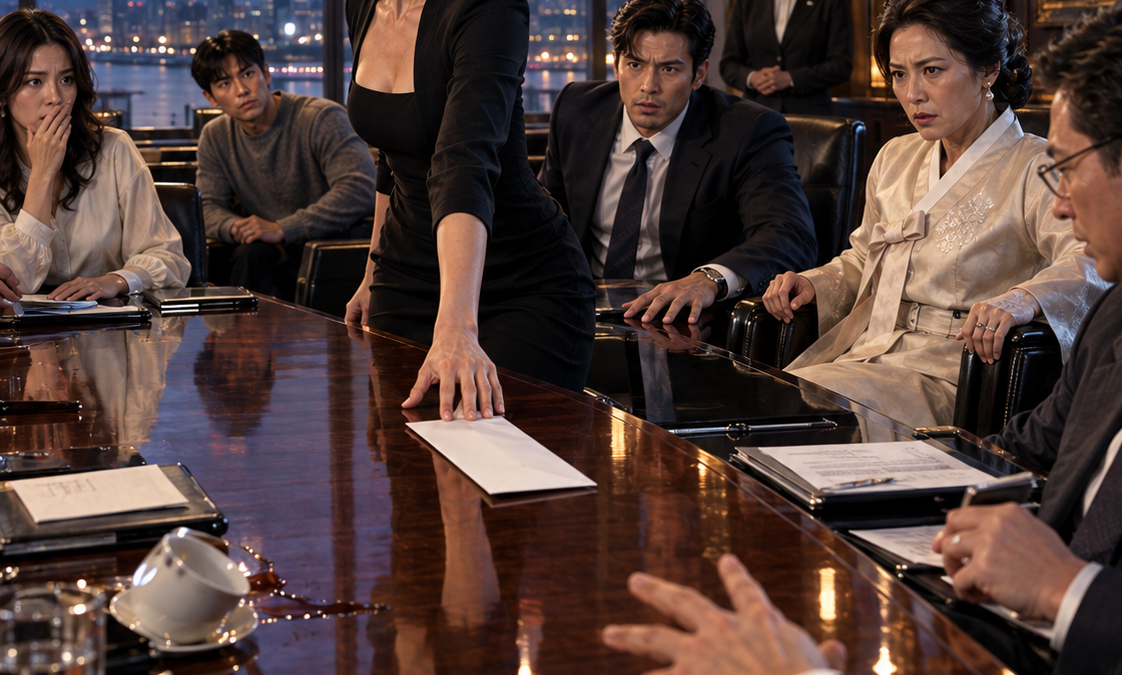
“I don’t want to manage you anymore. I want to be the person you choose. Not the person you’re stuck with.”
She married him to pay off a debt she never owed. She stayed to claim a power she never knew she had.
The envelope was already in her coat pocket when she walked into the Hyeon family’s seventieth-anniversary dinner, and it stayed there through the champagne toast and the polite applause, pressing against Yun-ji’s ribs like a second heartbeat.
She didn’t open it. She’d already read it three times.
“Yun-ji.” Her mother-in-law’s voice cut across the table like a letter opener. “You’re not eating.”
Yun-ji looked up. The private dining room of the Hyeon Foundation’s flagship hotel held thirty guests—board members, old family friends, two congressmen, and every Hyeon cousin who could afford the flight. White orchids climbed the centerpieces. Crystal caught the chandelier light and scattered it across the linen.
“I’m pacing myself,” Yun-ji said. “The galbi is rich.”
Madame Hyeon—Park Soo-jin, who had never once called Yun-ji by her first name without a pause before it—set down her wine glass with the precision of a woman who had spent forty years perfecting disapproval. “You’ve been married to my son for two years. You should know by now that appearances matter more than appetite.”
Across the table, Kang Min-ho didn’t look up from his phone. His thumb moved. His face was the same mask he wore in boardrooms—half bored, half dangerous—but Yun-ji had learned to read the small tells: the tendon in his jaw, the way his shoulders went still when he was actually paying attention.
He was paying attention now.
“Mother,” he said, still not looking up. “Let her eat what she wants.”
Soo-jin’s smile didn’t waver. “I’m only saying—”
“You’re saying she should perform hunger for the guests.” Min-ho set his phone down. When he finally looked at his mother, the room’s ambient chatter seemed to drop a register. “She’s not a centerpiece.”
The silence stretched. Two tables over, Min-ho’s aunt leaned toward her husband and whispered something behind her napkin. The congressman’s wife pretended to admire the orchids. Yun-ji felt the familiar heat crawl up her neck—the same heat she’d felt at her wedding, when Soo-jin had corrected her bow, and at every family dinner since, when her clothes were too modern or her Korean too informal or her family name simply not enough.
But tonight was different.
Tonight she had the envelope.
The dinner ended with the usual choreography: the men retreated to the smoking lounge, the women gathered in the drawing room for tea and subtle warfare, and Yun-ji excused herself to the terrace with a headache that wasn’t entirely fake.
The November air bit through her silk dress. City lights smeared across the river far below—the Hyeon Foundation’s hotel sat on the bluff like a crown on a hill, visible from half the skyline. Yun-ji had grown up on the other side of that river. Her father had been a respected art dealer until the day he wasn’t—until the forged Rothko, the creditors, the quiet death three years ago that had left her with a name she couldn’t use and a debt she couldn’t pay.
The debt was how she’d ended up here. The debt was why Min-ho’s lawyers had approached her with a contract six weeks after her father’s funeral. The debt was the leash around her throat that Madame Hyeon pulled whenever she wanted to remind Yun-ji exactly how replaceable she was.
The debt was also why the envelope in her pocket mattered so much.
She pulled it out now, the paper soft from handling. The return address was a law firm in Seoul she’d never heard of. Inside was a single page: a notarized acknowledgment, dated eight years ago, signed by Kang Dae-hyun—Min-ho’s father, the patriarch who had died of a stroke last spring—and a woman whose name Yun-ji had never seen before.
Kim Eun-sun.
The acknowledgment stated that Kang Dae-hyun recognized Kim Eun-sun’s son, born 1994, as his legal heir, entitled to a full share of his estate under Korean civil law. It was stamped, sealed, and witnessed by a secretary whose signature Yun-ji couldn’t quite read.
She’d found it three days ago, in a box of her father-in-law’s old papers that Madame Hyeon had asked her to organize for the family archive. The box had been mislabeled—misfiled among decades of tax returns and property deeds. Yun-ji had almost missed it. And then she’d opened the envelope, and the floor had dropped out from under her.
A second family. A hidden son. A legal claim that, if enforced, would fracture the estate into pieces—and with it, the pending merger that was supposed to save Hyeon Industries from the hostile takeover bid by the Baek Group.
She’d spent three days deciding what to do with it.
“You’ve been out here for twenty minutes.”
Min-ho’s voice came from behind her, low and even. Yun-ji didn’t turn around. She folded the page along its creases and slid it back into the envelope.
“I needed air.”
“You needed to escape my mother.” He stepped up beside her, close enough that she caught the faint scent of his cologne—cedar and something sharper underneath. “I don’t blame you.”
Below, the river moved like poured ink. Min-ho’s reflection floated in the glass of the terrace door: tall, broad-shouldered, hands in his pockets, eyes on her rather than the view. Two years of marriage, and she still didn’t know what he saw when he looked at her. A contract. A tool. A stranger who shared his house and his name and nothing else.
“I heard what she said,” he continued. “About appearances.”
“You heard. You didn’t disagree.”
“I told her to let you eat.”
“That’s not the same thing.” Yun-ji finally turned. The cold had numbed her fingers; she flexed them inside her sleeves. “You never disagree with her, Min-ho. You just redirect. It’s a very elegant form of surrender.”
Something flickered across his face—there and gone. “You think I surrender to my mother.”
“I think you’ve spent your whole life managing her, and you’ve gotten so good at it that you’ve forgotten there’s a difference between managing and winning.”
The terrace was empty except for them. The music from inside drifted through the glass, muffled and distant. Min-ho studied her for a long moment, and Yun-ji felt the weight of his attention like a hand on her spine.
“You’re different tonight,” he said.
“I’m the same.”
“No.” He took a step closer. “You’re not. You’ve been sitting on something since the appetizers. You keep touching your pocket.”
Yun-ji’s hand stilled. She hadn’t realized she’d been doing it.
“What is it?” His voice dropped. Not threatening—curious. Almost gentle, if Min-ho’s voice could ever be called that. “Whatever it is, I’d rather hear it from you than find out later.”
Later. Because he always found out. Because that was the thing about being married to a man who ran a conglomerate: he had eyes everywhere, and ears in every wall, and a memory that never let anything go.
Yun-ji thought about the envelope. About Kim Eun-sun and her hidden son. About the merger that would collapse if the secret got out, and the inheritance clause that would cut the second family off if it didn’t. About her own debt, still unpaid, still hanging over her head like a blade.
She could give him the envelope now. She could watch his face change as he read it. She could let him decide what to do—because that was what he expected, wasn’t it? That she would always be the one waiting for his decision.
But Yun-ji had spent two years waiting.
“It’s my father’s debt,” she said. Not the truth, but not exactly a lie. “The creditors called again.”
Min-ho’s expression didn’t change, but his posture shifted—just slightly, just enough. “I told you I’d handle it.”
“I don’t want you to handle it.”
“It’s a quarter of a billion won, Yun-ji. You can’t—”
“I know exactly how much it is.” Her voice came out sharper than she’d intended. “I’ve known every won since the day my father died. I don’t need you to remind me.”
He went quiet. The music inside shifted to something older—a ballad Yun-ji’s mother used to hum while she cooked. Min-ho’s jaw worked once, twice.
“Fine,” he said. “What do you want?”
The question landed harder than it should have. What did she want? She wanted to stop being a debt. She wanted her name back. She wanted to walk into a room without calculating which version of herself would cause the least friction.
She wanted, against every rational instinct, for Min-ho to look at her the way he looked at the deals he actually cared about—not as an obligation, but as something worth fighting for.
“I want to be useful,” she said. “Not managed.”
It was the closest she’d ever come to honesty with him. Min-ho’s eyes narrowed—calculating, assessing, reading her like a contract he was deciding whether to sign.
“You want to be useful,” he repeated slowly. “Then tell me what’s in your pocket.”
The terrace door slid open behind them. Both of them turned.
Madame Hyeon stood in the doorway, her silk hanbok immaculate, her smile thin as paper.
“Min-ho,” she said. “The Baek Group’s representative is here. He wants to discuss the merger timeline. Privately.”
Min-ho didn’t move. His eyes stayed on Yun-ji.
“Tell him I’ll be there in ten minutes.”
Soo-jin’s gaze flicked to Yun-ji—cold, assessing, the way she’d looked at her on the wedding day. “It’s a private discussion, dear. Family matters.”
Family matters. Meaning: not you. Meaning: you are family in name only, and you know it.
Yun-ji knew it. She’d known it from the first dinner, when Soo-jin had asked about her father’s business and then changed the subject the moment the answer became uncomfortable. She’d known it from the prenuptial agreement, which stripped her of any claim to the Hyeon fortune and made her continued presence in the family conditional on the merger’s success. She’d known it from every whispered conversation that stopped when she walked into the room.
But tonight, for the first time, she had something better than being included.
She had leverage.
“Go,” Yun-ji said to Min-ho. “I’ll be fine.”
He hesitated. It was a small thing—just half a second—but she saw it. And Soo-jin saw it too, if the tightening at the corners of her eyes was any indication.
“Ten minutes,” Min-ho repeated, and this time he was saying it to Yun-ji, not his mother. A promise. A question.
Yun-ji nodded.
He walked inside. The door slid shut behind him. Soo-jin stayed in the doorway, watching her daughter-in-law with an expression that was almost—almost—curious.
“You’ve changed your hair,” Soo-jin said.
“No.”
“Hm.” She tilted her head. “Then something else has changed.”
She didn’t wait for a response. The door closed, and Yun-ji was alone on the terrace with the envelope in her pocket and the cold seeping into her bones.
Something has changed, she thought. Something is about to.
She pulled out her phone and typed a message to the one person in the world who might understand what she was holding.
I need to see you. Tomorrow. It’s about the will.
Chapter 2: The Secretary Who Never Forgot
The office was small for a woman who had spent forty years at the center of Hyeon Industries.
A single desk, a filing cabinet that creaked when it opened, a window that looked out onto the parking garage rather than the river. But the view didn’t matter—Han Ji-yeon had never been the kind of secretary who needed a window. She’d been the kind who remembered everything: every contract, every deal, every late-night phone call that was never supposed to be documented.
She’d been Kang Dae-hyun’s secretary since she was twenty-three. She’d been the one who scheduled his affairs, covered his absences, and—eight years ago—stood beside him in a Seoul notary’s office while he signed a piece of paper that acknowledged a son he’d never publicly claimed.
Now she was retired, technically. But she still came into the office twice a week to handle “legacy matters,” which was the family’s polite term for keeping the old man’s secrets buried.
Yun-ji found her on the fourth floor, sorting through a box of documents with the steady patience of someone who had done this for decades.
“Mrs. Han.”
“Yun-ji.” Ji-yeon didn’t look up. “Close the door.”
Yun-ji did, and the small room felt even smaller. The older woman’s glasses hung from a chain around her neck; her gray hair was pulled back in a neat bun; her hands, spotted with age, moved through the papers with surgical precision.
“You found the acknowledgment,” Ji-yeon said. It wasn’t a question.
“You knew about it.”
“I wrote it.” She finally looked up, and her eyes were sharp behind her glasses—sharp and tired, the way people looked when they’d carried something heavy for too long. “I sat in the notary’s office when he signed it. I watched him do it. And then I filed it away and never spoke of it again.”
“Why?” Yun-ji sat down in the chair opposite the desk. Her legs felt unsteady. “Why would you keep this secret for eight years? If the family found out—”
“The family didn’t find out.” Ji-yeon’s voice was calm, almost gentle. “That was the point. Mr. Kang—the senior Mr. Kang—he was a complicated man. He loved his wife, in his way. He loved his public family, his reputation, the empire he’d built. But he also loved Kim Eun-sun. And he loved the son she gave him.”
“He had an affair.”
“He had a life.” Ji-yeon set down the paper she’d been holding. “Two lives, running in parallel. He told me once that he felt like a man split in half—one half belonged to the Hyeons, to the company, to the image he’d built. The other half belonged to a woman in Seoul who asked nothing of him except his presence, once a month, for twenty years.”
Yun-ji thought of her own marriage—the quiet dinners, the separate bedrooms, the way Min-ho looked at her sometimes as if she were a problem he hadn’t yet solved. She thought of the debt that had made her a wife of convenience rather than choice.
She thought of the envelope in her pocket, and the fact that she was about to use it as a weapon.
“Why did he sign the acknowledgment?” she asked. “If he wanted to keep them secret, why leave a paper trail?”
Ji-yeon was quiet for a long moment. Outside, a car engine revved in the parking garage. The fluorescent light hummed overhead.
“Because he got sick,” she said finally. “Eight years ago, he had a cancer scare. They told him he might not survive the surgery. He panicked—not for himself, but for the boy. He wanted to make sure that if he died, Kim Eun-sun’s son would be provided for. So he signed the acknowledgment, and he gave me instructions to file it with the family’s legal counsel if anything ever happened to him.”
“But you didn’t file it.”
“I filed it with myself.” Ji-yeon’s mouth curved into something that wasn’t quite a smile. “I’ve been holding onto it for eight years. Waiting to see if it would ever be needed.”
Yun-ji’s heart was beating too fast. “Why show it to me? Why put it in the box I was asked to organize?”
“Because I’m seventy-one years old,” Ji-yeon said. “And I won’t live forever. Someone needs to know the truth. Someone needs to decide what to do with it.”
“You could have given it to Min-ho.”
“I could have.” Ji-yeon’s eyes met hers, steady and unblinking. “But Min-ho is his father’s son. He would have done what his father always did: protected the company, protected the image, and buried the truth so deep that no one would ever find it again.”
“And I’m different?”
“You’re an outsider.” The word landed like a slap, but Ji-yeon’s tone was matter-of-fact. “You have no loyalty to the Hyeon name. You’ve spent two years being treated like a piece of furniture—useful when needed, invisible when not. You have every reason to burn it all down.”
Yun-ji’s throat tightened. “And if I do?”
“Then you’d better be prepared for what comes next.” Ji-yeon leaned forward, her voice dropping. “The merger with Baek Group depends on the appearance of a stable, unified family. If the existence of Kim Eun-sun’s son becomes public, the merger collapses. Hyeon Industries loses the deal, the stock tanks, and the Baek Group walks away with the leverage they need for a hostile takeover.”
“And if I keep it secret?”
“Then the second family gets nothing. The acknowledgment stays buried, the estate stays intact, and you can go back to being Madame Hyeon’s favorite punching bag.” Ji-yeon’s expression didn’t change. “Or you can find a third option.”
Yun-ji stared at her. “What third option?”
The older woman reached into the filing cabinet and pulled out a second envelope—thicker, heavier, stamped with the seal of a Seoul law firm.
“There’s a clause in the family trust,” she said. “A provision that Kang Dae-hyun added fifteen years ago, after the first merger discussions. It states that any legal heir acknowledged by the patriarch—whether public or private—is entitled to a seat on the board of Hyeon Industries, and a percentage of voting shares equal to the eldest son’s.”
Yun-ji’s breath caught. “That would—”
“Give Kim Eun-sun’s son as much voting power as Min-ho.” Ji-yeon slid the envelope across the desk. “If the board knew about this clause, they’d have to honor it. And if they honored it, the Baek Group would see the family as fractured—which means they’d walk away from the merger, and Hyeon Industries would be left without a lifeline.”
“Unless the shares were already distributed,” Yun-ji said slowly. “Unless the acknowledgment was enforced before the merger vote, and the second son was brought into the fold.”
Ji-yeon nodded. “Then the family would appear unified—expanded, but unified. The Baek Group would have no leverage. And you would have something you’ve never had before.”
“What’s that?”
“Leverage of your own.” Ji-yeon sat back. “Madame Hyeon controls the family through secrets. She always has. But if you know the secrets, and you’re the one who decides when to reveal them, then you’re not a victim anymore. You’re a player.”
The word hung in the air between them. Yun-ji thought of the prenuptial agreement, the debt, the way Min-ho’s family had treated her like a problem to be managed rather than a person to be respected. She thought of her father, who had spent his last years drowning in shame and debt, and the way she’d sworn she would never be powerless again.
She thought of the third option.
“Where is Kim Eun-sun now?” she asked.
“Busan.” Ji-yeon’s voice was quiet. “She runs a small art gallery. Her son is a photographer—talented, by all accounts. They’ve never asked for anything from the Hyeon family. They’ve never even used the Kang name.”
“Does Min-ho know about them?”
“I don’t know.” Ji-yeon’s eyes were ancient, unreadable. “But if he does, he’s never said a word to me.”
Yun-ji stood up. The envelope felt heavy in her hand—the acknowledgment, the clause, the weight of two decades of secrets.
“Thank you,” she said.
“Don’t thank me yet.” Ji-yeon’s voice followed her to the door. “Once you start this, you can’t stop it. The Hyeon family will fight you. Min-ho will fight you. And the merger will either save you or destroy you.”
Yun-ji paused at the door. “Which do you think it’ll be?”
“I think,” Ji-yeon said slowly, “that you’re going to find out.”
The door closed behind her. Yun-ji walked down the corridor with the envelope pressed against her ribs, and for the first time in two years, she felt the shape of something other than fear.
She felt the shape of a plan.
Chapter 3: The Man Who Never Asked
Min-ho found her in the library at midnight.
The house was quiet—a sprawling stone mansion on the ridge above the city, all high ceilings and cold floors and rooms that no one ever used. Yun-ji had learned to navigate it by sound: the creak of the east stairs, the whistle of the draft under the study door, the way the chandelier in the foyer sang in the wind like a tuning fork.
Tonight, the library fire was lit. She’d done it herself—a small rebellion, since Madame Hyeon considered it “wasteful” to burn wood when the central heating was more efficient.
Min-ho stood in the doorway, his tie loosened, his shirt sleeves rolled to the elbow. He looked tired in a way that had nothing to do with the late hour.
“You didn’t come to bed,” he said.
“I wasn’t tired.”
“You’ve never been a good liar.”
Yun-ji looked up from the book she wasn’t reading. “Neither have you.”
He walked into the room—slow, deliberate, the way he did everything. The firelight caught the sharp planes of his face, the hint of gray at his temples that made him look older than thirty-six. He’d been CEO for five years, since his father’s stroke had forced the handoff, and the job had carved lines into his face that the public never saw.
“There’s a board meeting on Friday,” he said. “The Baek Group wants to accelerate the merger timeline. My mother wants you to attend.”
“Why?”
“Because the merger agreement requires the appearance of family unity. That includes you.”
Yun-ji closed the book. “I’m not family. I’m a contract.”
Min-ho’s jaw tightened. “You’re my wife.”
“On paper.”
The fire cracked. A log shifted, sending sparks up the chimney. Min-ho didn’t move, but something in his expression changed—a fracture, just barely visible, in the mask he’d worn since the day she met him.
“What do you want from me, Yun-ji?”
The question was the same one he’d asked on the terrace, but it landed differently here—in the dark, in the quiet, with the fire between them and no audience to perform for.
“I want to know why you married me,” she said.
“You know why. The contract—”
“The contract was business. My father’s debt was business. But you didn’t have to choose me.” She stood up, and the blanket fell from her lap. “You could have paid off the debt and walked away. You could have found someone with a better family name, a better reputation, a better ability to smile at your mother’s dinner parties. Instead you chose the daughter of a disgraced art dealer with a quarter-billion won debt and no connections.”
Min-ho’s eyes didn’t leave hers. “My mother chose you.”
“Your mother presented the contract. You signed it.”
“I signed it because you were the only person I’d met in years who looked at me like I wasn’t a Hyeon.” His voice was low, almost rough. “You looked at me like I was a problem you hadn’t decided how to solve yet. And I wanted to see what you’d do when you figured it out.”
Yun-ji’s pulse stuttered. “That’s not an answer.”
“It’s the only one I have.” He stepped closer—close enough that she could see the firelight reflected in his eyes. “You want me to be honest with you? Fine. I don’t know why I married you. I don’t know what I expected. But I know that every day for two years, I’ve watched you navigate my family’s cruelty without breaking, and I’ve never once regretted it.”
She wanted to believe him. She wanted to believe there was something real underneath the contract, the prenuptial agreement, the separate bedrooms and the careful distance. But she’d spent two years learning that the Hyeon family’s truth was always conditional.
“There’s something I need to tell you,” she said.
Min-ho’s expression shifted—alert, calculating. “Tell me.”
The words sat on her tongue: Your father had a second family. Your father signed an acknowledgment. Your father gave a stranger’s son the right to your inheritance, your board seat, your company.
She could tell him now. She could watch the ground shift under his feet the way it had shifted under hers.
But if she told him, she would lose the only advantage she had. He would take the envelope, bury the secret, protect the company—and she would be right back where she started, a debt wrapped in a wedding ring.
She couldn’t afford that. Not yet.
“I want a divorce,” she said.
The lie tasted like copper. But it was the only lie that would buy her time.
Min-ho went very still. The firelight flickered across his face, and for a moment—just a moment—something cracked open behind his eyes. Something raw. Something she hadn’t seen before.
Then it was gone.
“Is that what you want?” His voice was flat. Controlled. “A divorce.”
“What I want doesn’t matter.” Yun-ji lifted her chin. “The merger does. The family does. The debt does. The only thing I’ve ever been allowed to want is to survive until the next demand.”
“So you’d rather leave than stay.”
“I’d rather stop being a contract.” She met his eyes. “I’d rather be a person.”
Min-ho was silent for a long moment. The fire popped. Outside, the wind shifted, and the chandelier in the foyer sang its low, mournful note.
“Friday,” he said finally. “The board meeting. If you attend, and you still want a divorce after, I’ll sign the papers myself.”
Yun-ji’s breath caught. “Why Friday?”
“Because Friday is when the Baek Group votes on the merger.” He held her gaze. “And because you’re right. You’ve been a contract. But contracts can be renegotiated.”
He turned and walked out of the library. The door closed behind him. The fire burned on, and Yun-ji stood alone in the warm light, wondering if she’d just made the first move of a game she didn’t know how to play.
Or the first mistake of a war she couldn’t win.
Chapter 4: The Rules of Engagement
Friday came faster than it should have.
Yun-ji spent the days between the library and the board meeting doing what she did best: watching, listening, and cataloging everything she learned.
She learned that Madame Hyeon had scheduled a private dinner with the Baek Group’s chairman the night before the vote—an intimacy offensive designed to seal the merger before any dissenting voice could be heard. She learned that Min-ho’s younger sister, Kang Se-ra, had been quietly negotiating her own exit from the family business, and that her loyalty to her brother was genuine but thin. She learned that the family’s legal counsel was an old friend of Ji-yeon’s, which meant there was at least one person in the building who wouldn’t immediately report back to Soo-jin.
And she learned that the Baek Group’s chairman, Baek Seung-ho, had a reputation for collecting secrets the way other men collected art. He was a man who understood leverage, and he would have no hesitation in using the Hyeon family’s fractures against them.
On Thursday night, Yun-ji called Ji-yeon.
“I need to know more about Kim Eun-sun’s son,” she said. “His name, his age, what he does. Everything you can tell me.”
Ji-yeon’s voice was quiet on the other end of the line. “His name is Kim Jae-won. He’s twenty-nine. He studied photography in Seoul and Paris, and he’s been living in Busan for the past five years. His work has been shown in three galleries. He’s never made any claim on the Hyeon family.”
“Why not?”
“Because his mother asked him not to.” A pause. “Kim Eun-sun spent twenty years loving a man who could never fully belong to her. When he died, she made a choice: she would protect her son from the family that had already taken so much. She told him the truth about his father, and then she told him to live his life as if the Hyeon name didn’t exist.”
Yun-ji’s throat tightened. “And the acknowledgment?”
“She kept it. She didn’t file it, she didn’t enforce it. She just kept it—as proof that her son was wanted, even if only for a moment.”
The words hit harder than Yun-ji expected. She thought of her own father, who had died with a debt he could never repay and a daughter he could never protect. She thought of the way she’d spent three years after his death feeling like a ghost in her own life—present but invisible, alive but not quite real.
Kim Eun-sun had made a choice. Yun-ji had made a choice too. But the difference was that Yun-ji was still choosing—still fighting, still looking for the leverage that would let her stand on her own feet.
“The board meeting tomorrow,” she said. “Will you be there?”
“I’ll be there.” Ji-yeon’s voice was steady. “I’ve been waiting eight years for someone to do something with that envelope. I’m not going to miss the moment it happens.”
Yun-ji hung up. The house was quiet. Min-ho was still at the office—he’d been working late all week, running numbers with the Baek Group’s analysts, trying to close the merger before the clock ran out.
She walked to the window and looked out at the city. The lights were scattered like spilled diamonds, and somewhere out there, a photographer in Busan was living his life without knowing that a stranger in Seoul was about to change it.
I’m not doing this for him, Yun-ji thought. I’m doing this for me.
But even as she thought it, she knew it wasn’t entirely true. She was doing it for the version of herself who had walked into the Hyeon family with nothing but a debt and a contract, and who deserved more than a lifetime of being managed.
She was doing it for the girl who had believed, once, that she could be more than her father’s mistake.
Tomorrow, she would find out if she was right.
 [Tap here for the Next Part ]