“I know she was an operative. I know she was embedded. I know you were her handler.”
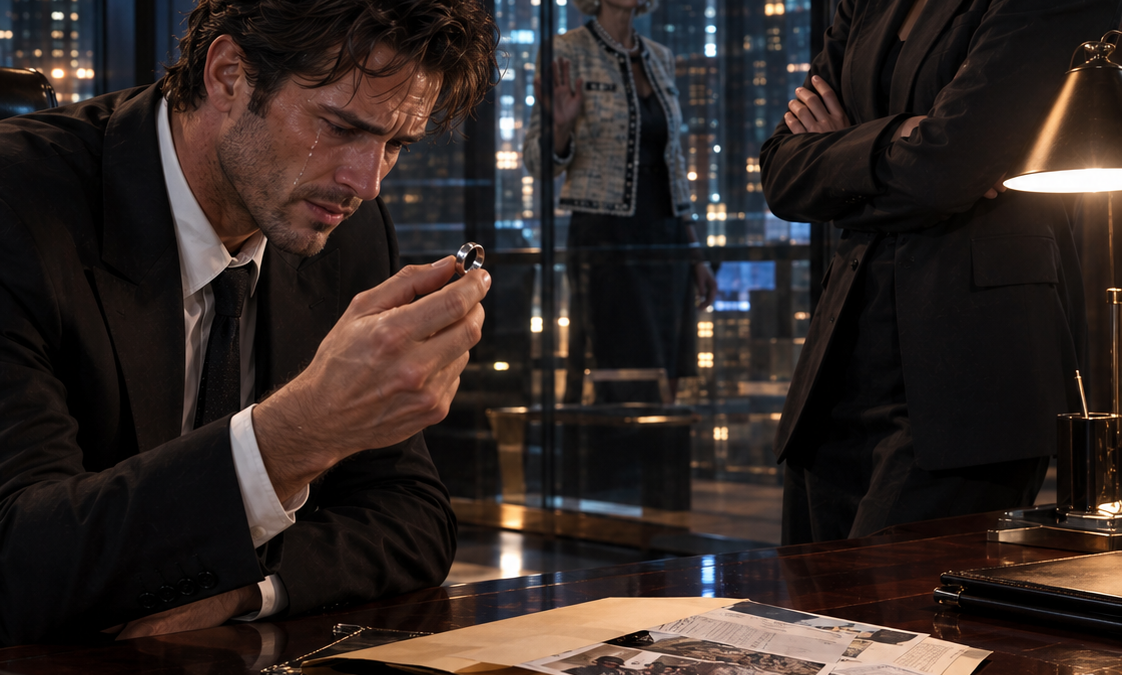
“I know she was an operative. I know she was embedded. I know you were her handler.”
He thought his wife died in a tragic accident. He never knew she was an undercover operative who died protecting him—and the woman who bought her ring holds the key to everything.
The words hit Ronan Harrington like a bullet he didn’t see coming.
He was standing in the marble foyer of his parents’ estate—the same foyer where he’d married Elena eight years ago, where she’d laughed and called the chandelier “obscene” and he’d agreed and loved her more for saying it. His mother stood across from him now, adjusting the sleeve of her Chanel jacket, her expression the kind of serene that came from a lifetime of never being questioned.
“What did you say?” His voice came out quiet. Too quiet. The kind of quiet that made men on his security team reach for their radios.
His mother, Margaret Harrington, tilted her head. “The ring, darling. The one from the safe. I had it appraised and sold it. We needed the liquidity for the east wing renovation, and frankly, it was just sitting there collecting dust.”
Three people witnessed it. His father, Charles, stood by the fireplace with a glass of scotch, not meeting his son’s eyes. His sister, Vivian, had gone still on the staircase, one hand gripping the railing. And Elena’s old friend—the only one who still visited, who still called on the anniversary—stood frozen in the doorway to the study.
Ronan felt something crack inside his chest. Not break. Crack. A fissure that ran from his sternum to his spine.
“You sold Elena’s wedding ring.”
“I sold a ring that was doing nothing but gathering cobwebs in a safe, Ronan. You never wear it. You never look at it. It’s been three years. It’s time to move—”
“Where is it?”
The question cut through the air like a blade. His mother’s composure flickered—just for a second, just enough for him to see the calculation behind her eyes.
“I don’t remember the buyer’s name. Some woman. The appraiser handled it. Really, darling, you’re being melodramatic—”
“Who. Was. The. Buyer.”
His father finally spoke. “Ronan, your mother is right. It’s just a ring. You’ve been holding onto—”
“It wasn’t just a ring.” Ronan’s voice didn’t rise. That was the terrifying thing. It dropped, low and cold, the way it did before he dismantled a rival company in a boardroom. “It was her grandmother’s. It was the only thing she had from her family. And I put it on her finger in this house, in front of everyone, and I promised her I would never let it leave this family.”
Margaret waved a hand. “Sentimental nonsense. Elena is gone, Ronan. The dead don’t care about jewelry.”
Vivian made a small sound on the staircase—a sharp intake of breath.
Ronan turned to her. “Do you know who bought it?”
“I—” Vivian glanced at their mother, then back at him. “Mom said it went to an estate dealer. I didn’t ask questions.”
Of course she didn’t. Vivian was twenty-six and still living on their parents’ dime, still terrified of being cut off. He couldn’t blame her. He’d been that person once, before Elena.
Before Elena taught him how to stand on his own.
He pulled out his phone. “Get me the name of the appraiser. Now.”
“Ronan—” His mother stepped forward.
He looked at her. Really looked. The woman who had made his wife’s life a quiet hell for eight years. Who had criticized Elena’s background—Navy, not blue blood—her clothes, her manners, her inability to produce an heir fast enough. Who had smiled for the cameras and sharpened her knives in private.
“You had no right,” he said. “You had no right to touch anything of hers.”
“I am your mother. This is my house. Everything in it—”
“This is not your house.” He said it quietly. “It’s mine. I bought it back from the bank when Father nearly bankrupted us six years ago. You live here because I allow it. And you went into my safe—the safe in my study—and you took my wife’s ring.”
Margaret’s face went white. Charles set down his glass with a sharp click.
“I’ll have the name by morning,” Ronan continued, sliding his phone back into his pocket. “And when I find the buyer, I will buy it back. And then, Mother, you and I are going to have a conversation about boundaries.”
He turned and walked out. Behind him, he heard his mother’s voice, shrill now: “Charles, say something to him!”
He didn’t hear his father’s response. He was already in his car, already dialing his head of security.
“Find out who appraised a ring from my personal safe in the last thirty days. I want a name in one hour.”
Chapter 2: “The Woman Who Bought It”
The name came in forty-two minutes.
Sloane Mercer. Former Lieutenant, US Navy. Currently runs a maritime security consulting firm. Purchased one antique diamond ring, platinum band, inscription inside: “Semper Fidelis — E.”
Ronan read the report three times. Then he read it a fourth.
Semper Fidelis. Always faithful.
He’d had the ring made for Elena after they eloped—before the big ceremony his parents had demanded, before the circus. She’d laughed when she saw the inscription. “You put a Marine Corps motto in my wedding ring?”
“You were a SEAL. It’s close enough.”
“Close enough for a jarhead, maybe.” But she’d kissed him, hard, and worn it every day until the day she died.
The ring had been in his safe for three years. He’d taken it off her finger in the hospital, after the accident, and he hadn’t been able to look at it since. But he’d known it was there. That was the point. It was there, waiting, a piece of her preserved in platinum and diamond.
And now it was with a woman named Sloane Mercer.
He pulled up her file. Forty-one. Left the Navy six years ago after a medical discharge—knee injury, the kind that ended careers. Started her own firm in San Diego, then expanded to New York. No criminal record. No debts. No obvious connection to the Harringtons or to Elena.
Except.
He frowned at the screen. There was something. A footnote in her service record—a joint task force, some operation in the Gulf. He scanned the details. SEAL Team 3. Supporting element. And there—a name he knew.
Lt. Elena Vasquez.
His wife.
Ronan sat back in his chair. The office was dark around him—he hadn’t turned on the lights when he came in, just sat down at his desk and pulled up the file. Now he stared at the screen, at the proof that the woman who bought Elena’s ring had served with her.
That couldn’t be a coincidence.
He picked up his phone and called the number in the file. It rang four times.
” Mercer.”
The voice was low, clipped, no-nonsense. The voice of someone who’d spent years giving orders and expecting them to be followed.
“This is Ronan Harrington.”
A pause. Then: “I know who you are.”
“You bought a ring from my mother. A platinum band with an inscription.”
Another pause. Longer this time. “I did.”
“I want it back.”
“I’m sure you do.”
He waited. She didn’t elaborate.
“I’ll pay you double what you paid. Triple. Name your price.”
“That’s not how this works, Mr. Harrington.”
“Then tell me how it works.”
Silence. He could hear her breathing, slow and steady. The kind of breathing that came from years of sniper training—the ability to stay perfectly still, perfectly calm, while everything around you burned.
“I knew your wife,” she said finally. “I served with her. Did you know that?”
“I know now.”
“Then you know why I’m not selling you this ring.”
“I don’t know anything. That’s the problem.”
She laughed—a short, humorless sound. “You didn’t know your mother was going to sell it. You didn’t know I existed. You didn’t know your wife had a whole life before you, a whole family in the teams. You don’t know a lot of things, Mr. Harrington.”
“Then educate me.”
“No.”
The line went dead.
Ronan stared at his phone. In eight years of marriage, Elena had never mentioned a Sloane Mercer. She’d talked about her team, sure—the men she’d served with, the ones who’d died, the ones who’d survived. But the names had blurred together, lost in the grief of her final years, when the PTSD had gotten bad and the drinking had gotten worse and he’d been too busy running his father’s failing company to notice his wife was drowning.
He’d failed her. That was the truth he lived with every day. He’d been so focused on saving the family business, on proving to his parents that he could clean up the mess they’d made, that he hadn’t seen Elena slipping away.
The accident had been a single-car crash on a rain-slicked road. No other vehicle. No witnesses. Just his wife, alone, at two in the morning, driving too fast on a road she knew too well.
The coroner had ruled it accidental. Ronan had never been sure.
He pulled up Sloane Mercer’s address. New York. A brownstone in the West Village—modest by Harrington standards, but probably worth a small fortune in today’s market.
He’d go there tomorrow. He’d make her understand.
One way or another, he was getting that ring back.
Chapter 3: “Not for Sale”
The brownstone was unassuming from the outside—dark brick, black door, a single potted plant that looked like it was barely surviving. Ronan knocked at 8:00 AM sharp, because waiting was a luxury he didn’t have.
The door opened. Sloane Mercer stood in the threshold, coffee mug in hand, dressed in jeans and a faded Navy sweatshirt. She was taller than he’d expected, with dark hair pulled back in a messy knot and a scar that ran from her temple to her jaw—a scar she hadn’t bothered to hide.
“You’re early,” she said.
“You said no. I don’t accept no.”
“I figured you’d show up.” She stepped back, letting him in. “Might as well get it over with.”
The inside of the brownstone was sparse but deliberate—a couch, a bookshelf, a desk covered in papers. On the wall hung a framed flag, the American one, folded into a triangle. Next to it, a photograph: a group of soldiers in desert fatigues, squinting into the sun. Elena was in the center, grinning, her arm slung around Sloane’s shoulders.
Ronan stopped in front of it.
“That’s her,” he said.
“That’s her.” Sloane stood beside him, not looking at the photo but at him. “That was Fallujah. 2004. We were both twenty-five and thought we were invincible.”
“I didn’t know her then.”
“I know.”
He turned to face her. “Why won’t you sell me the ring?”
She took a sip of her coffee. “Because it’s not mine to sell.”
“You bought it.”
“I bought it to keep it safe.” She set the mug down on the desk. “When I heard through the VA grapevine that Margaret Harrington was liquidating her daughter-in-law’s assets, I moved fast. I knew what that ring was. I knew what it meant.”
“And what does it mean?”
Sloane looked at him for a long moment. “You really don’t know.”
“I know I put it on her finger. I know I promised her forever. And I know my mother had no right to sell it.”
“That’s not what it means.”
“Then tell me.”
She shook her head. “No. That’s not my story to tell.”
“Elena’s dead. There’s no one else to tell it.”
“There’s you.” She met his eyes, and for a second, he saw something flicker there—not anger, not pity. Something sharper. Disappointment. “You were married to her for eight years. If you don’t know what that ring meant, that’s on you.”
The words landed like a punch.
“I want to buy it back,” he said, keeping his voice steady. “Name a price.”
“There’s no price.”
“Everyone has a price.”
“Not me.” She picked up her coffee again. “I’ve got a successful business, no debts, and a pension from the Navy. I don’t need your money.”
“Then what do you need?”
“I need you to leave.”
He didn’t move. “I’m not leaving without the ring.”
“Then you’re going to be here a long time.” She walked past him, toward the door, and pulled it open. “Goodbye, Mr. Harrington.”
He stood his ground. “I’ll come back.”
“I’m sure you will.”
“I’ll keep coming back until you give me what I want.”
She smiled then—a thin, sharp smile that didn’t reach her eyes. “That’s the thing about SEALs, Mr. Harrington. We don’t break under pressure. We just get more creative.”
He walked out. The door closed behind him with a soft click.
Chapter 4: “The Debt She Carries”
Three days passed. Ronan didn’t sleep. He called in favors, pulled strings, dug into Sloane Mercer’s life with the same ferocity he’d used to save Harrington Industries from his father’s mismanagement.
What he found didn’t add up.
Sloane’s business was successful, but not that successful. She had no debt, sure—but she also had no savings. Every dollar she made went somewhere. Charities. Veterans’ organizations. A scholarship fund in Elena’s name.
That last one stopped him cold.
The Elena Vasquez Memorial Scholarship. Established 2019. Annual award of $50,000 to a female veteran pursuing a degree in engineering.
He stared at the screen. Elena had been an engineer—a combat engineer, trained to build bridges and blow them up. She’d left the Navy after eight years and never talked about it. Never talked about any of it.
He’d assumed she wanted to forget. He’d assumed wrong.
On the fourth day, he went back to the brownstone. This time, he brought flowers—not roses, which felt wrong, but sunflowers, because Elena had once told him they were the only flowers that made her feel like the sun wasn’t going anywhere.
Sloane opened the door and looked at the flowers.
“What are those for?”
“They’re for you.”
“Why?”
“Because I’ve been an asshole.”
She raised an eyebrow. “That’s a start.”
“Can I come in?”
She stepped back. He followed her into the living room. This time, he noticed more—the books on the shelf (military history, engineering manuals, a battered copy of The Art of War), the blanket on the couch (navy blue, frayed at the edges), the small wooden box on the mantle.
“What’s in the box?” he asked.
Sloane glanced at it. “Letters.”
“From who?”
“Elena.”
He felt the floor shift under his feet. “She wrote to you?”
“For six years. Every month.” Sloane sat down on the couch, not offering him a seat. “She wrote about you. About your marriage. About the company. About her mother-in-law.”
“She never told me.”
“She didn’t tell you a lot of things.”
He sat down across from her, the flowers still in his hands. “Tell me.”
“Why should I?”
“Because I loved her. Because I failed her. Because I need to know what I missed.”
Sloane was quiet for a long time. Then she leaned forward, elbows on her knees, and looked at him with an expression he couldn’t read.
“Elena had PTSD,” she said. “You knew that.”
“I knew.”
“What you didn’t know was that she was in treatment. She’d been seeing a therapist for two years before she died. She was getting better.”
Ronan’s throat tightened. “She never told me.”
“She was afraid you’d see her as broken.”
“I would never—”
“She was afraid of a lot of things.” Sloane’s voice was gentle now, not sharp. “She was afraid of your mother. She was afraid of losing you. She was afraid that if she told you the truth—all of it—you’d walk away.”
“What truth?”
Sloane stood up. Walked to the mantle. Picked up the wooden box.
“The truth about the ring,” she said. “The truth about why she married you. The truth about what happened in Fallujah.”
Ronan’s heart was pounding. “Tell me.”
She turned to face him. “Not yet.”
“Why not?”
“Because you’re not ready.” She set the box back down. “You want the ring because it’s yours. You want it because your mother took it. But you don’t want it because of what it meant to Elena. And until you do, you don’t deserve to have it back.”
He stood up. “That’s not your call.”
“It’s exactly my call.” She met his eyes. “Elena gave me that ring for safekeeping. Not the physical one—she gave that to you. But the meaning of it. The promise. She gave me the job of making sure it didn’t end up in the wrong hands.”
“What promise?”
Sloane shook her head. “Come back when you’ve figured it out.”
Chapter 5: “The House Always Wins”
Ronan didn’t go home. He drove to his office, sat down at his desk, and pulled up everything he had on Fallujah.
It took him three hours to find the report. It was buried in a declassified file, the kind of document that took a security clearance and a lot of patience to access. He had both.
The operation had been a disaster. An ambush. A unit pinned down, outnumbered, outgunned. The report listed casualties—three dead, five wounded. It listed the survivors—four SEALs, three Marines, one interpreter.
It listed the names.
Lt. Elena Vasquez. Lt. Sloane Mercer. Petty Officer Marcus Webb. Petty Officer David Chen.
The names blurred. He read the next part twice.
Lt. Vasquez sustained multiple injuries. Recommended for medical discharge. Request denied per Lt. Vasquez’s own request. Lt. Mercer sustained injuries including facial laceration and knee damage. Recommended for medical discharge. Request granted.
He sat back. Elena had been recommended for discharge. She’d refused. She’d stayed in for two more years, fighting a war she could have walked away from.
Why?
The answer came to him slowly, like a door opening in a dark room.
Because of Sloane.
Because Sloane had taken the discharge—had been forced to take it—and Elena had blamed herself. He didn’t know why, but he could feel it, the shape of it, the weight. She’d stayed because she owed her friend something. She’d stayed because leaving would have meant admitting that what happened in Fallujah had broken something between them.
And then she’d come home, and she’d met him, and she’d married into a family that treated her like a piece of furniture—useful until it wasn’t, decorative until it was time to replace it.
His mother had sold her ring. His mother had sold the only thing Elena had left of her grandmother, of her family, of the girl she’d been before the war.
And Sloane Mercer, the woman who’d carried that burden with her for years, had bought it back.
He picked up his phone and called his sister.
“Vivian.”
“Ronan.” Her voice was cautious. “Are you okay?”
“No. I need you to do something for me.”
“What?”
“Go to Mother’s study. There’s a ledger in the bottom drawer of her desk—the one with the lock. She keeps a record of every transaction she makes without telling anyone. I need you to find the entry for the ring.”
“Why can’t you—”
“Because she’ll know it was me. She won’t suspect you.”
Vivian was silent for a moment. “What are you going to do?”
“I’m going to find out who my wife really was. And then I’m going to make sure my mother never touches anything of hers again.”
Chapter 6: “The Ledger Doesn’t Lie”
Vivian called back at midnight.
“I found it. The entry’s there—sold to a private buyer, Sloane Mercer, for $47,000. But that’s not the part you need to see.”
“What’s the part I need to see?”
“The date, Ronan. The date.”
He closed his eyes. “Tell me.”
“She sold it three days after the anniversary. Three days after you visited Elena’s grave. And there’s a note in the margin—in Mom’s handwriting. It says, ‘Finally. Now maybe he’ll move on.'”
Ronan didn’t speak. He couldn’t.
“She waited until you were at your weakest,” Vivian continued, her voice shaking. “She waited until you were grieving, and then she went into your safe and took the one thing you had left, and she sold it. And she thought she was helping.”
“I know.”
“Ronan—”
“I know, Viv. I know what she is.”
He hung up. Sat in the dark of his office. Stared at the wall, at the framed photograph of Elena on their wedding day—the one his mother had always hated, because Elena was laughing, and Margaret had said she looked “unrefined.”
Semper Fidelis.
Always faithful.
He’d promised Elena forever. And then he’d let his mother sell the symbol of that promise for $47,000 and a renovation.
He stood up. Grabbed his keys. Drove to the brownstone.
Sloane opened the door at 1:00 AM. She didn’t look surprised.
“I know,” he said. “About Fallujah. About the discharge. About why she stayed.”
“Then you know part of it.”
“Tell me the rest.”
She looked at him for a long moment. Then she stepped back.
“Come in.”
Chapter 7: “What Elena Knew”
They sat in the kitchen this time. Sloane made tea—chamomile, because it was late, because caffeine would keep them both up. Ronan wrapped his hands around the mug and waited.
“Elena and I were in the same unit for four years,” Sloane began. “We went through BUD/S together—the only two women in our class. We were rivals at first. Then we were friends. Then we were sisters.”
She paused.
“In Fallujah, we were ambushed. Elena took a hit—shrapnel to the leg. I dragged her out. I took a hit too—the scar on my face, the knee that ended my career. We both nearly died.”
“I read the report.”
“The report doesn’t tell you what happened after.” Sloane took a sip of tea. “Elena blamed herself. She thought if she’d been faster, smarter, better, I wouldn’t have gotten hurt. She carried that guilt for years.”
“That’s why she stayed in.”
“That’s part of it. But the other part…” Sloane set down her mug. “The other part is that Elena was pregnant when we deployed.”
Ronan went very still.
“She didn’t know. Not until after. The medics told her when they were treating her for the shrapnel wounds. She’d been pregnant—maybe six weeks. And she lost it.”
The room was silent except for the hum of the refrigerator.
“She never told me,” Ronan said.
“She never told anyone. She was ashamed. She thought it was her fault—that if she’d known, she would have been more careful, would have pulled back, would have protected the baby.”
“That’s not—”
“I know it’s not rational. Trauma isn’t rational.” Sloane leaned back. “She carried that loss with her when she came home. She married you, and she loved you, but she never told you because she was afraid.”
“Afraid of what?”
“Afraid that you’d blame her. Afraid that you’d see her as damaged. Afraid that you’d leave.”
“I would never have left her.”
“She didn’t know that.” Sloane’s voice was soft. “You have to understand—Elena grew up in foster care. She never had a family until the Navy. And then she met you, and you gave her a home, and she was terrified of losing it. So she kept the hard parts to herself.”
Ronan closed his eyes. The guilt was a physical thing, pressing down on his chest.
“The ring,” he said. “The inscription. Semper Fidelis.”
“Always faithful.” Sloane nodded. “It wasn’t just about you. It was about her. About the promise she made to herself—to always be faithful to the person she wanted to be. The person she was before the war. The person she was still trying to become.”
“And my mother sold it.”
“Your mother sold a symbol of something she never understood.”
Ronan opened his eyes. “Why didn’t you tell me this before?”
“Because you weren’t ready to hear it.” Sloane met his gaze. “You were angry. You wanted the ring because it was yours, because your mother took it. You didn’t want it because of what it meant.”
“And now?”
“Now you know. What you do with that is up to you.”
He stood up. Walked to the window. Looked out at the dark street.
“I want to make this right,” he said. “Not just the ring. All of it. The way my family treated her. The way I treated her.”
“You can’t fix the past.”
“I know. But I can honor her memory.” He turned back to face Sloane. “You said Elena gave you the job of making sure the ring didn’t end up in the wrong hands. What if I proved to you I’m not the wrong hands?”
“How?”
“By doing what she would have wanted. By fighting for the things she cared about.” He paused. “You run a scholarship in her name. You support veterans. You’ve been carrying her legacy for years while I’ve been drowning in my family’s mess. Let me help.”
Sloane studied him. “You’re serious.”
“I’m serious.”
“Then there’s something you need to know.” She stood up, walked to the mantle, and picked up the wooden box. “Elena left you a letter. She gave it to me before she died. She said if anything ever happened to her, I should give it to you—but only if you were ready to hear the truth.”
She handed him the box.
Ronan opened it. Inside, a single envelope, his name written in Elena’s handwriting.
He looked up at Sloane. “Why now?”
“Because you finally asked the right question.” She walked to the door. “I’ll give you some privacy.”
She left the room.
Ronan sat down. Opened the envelope. And began to read.
Chapter 8: “The Letter”
Ronan,
If you’re reading this, I’m gone. I’m sorry I didn’t tell you in person. I’m sorry I wasn’t brave enough.
There’s so much you don’t know about me. About the war. About the things I did and the things that were done to me. About Fallujah.
I was pregnant when I deployed. I didn’t know until after. I lost the baby, and I lost a part of myself with it.
I never told you because I was afraid. I was afraid you’d look at me differently. I was afraid you’d see the broken parts and decide I wasn’t worth the trouble.
But that’s not the only thing I kept from you.
Sloane knows the rest. She’s carried it for me because I couldn’t. She’s the bravest person I’ve ever known, and I don’t deserve her friendship.
I’m telling you this because I need you to understand something. The ring—my grandmother’s ring—it wasn’t just a piece of jewelry. It was a promise. My grandmother gave it to me when I left for boot camp. She said, “This ring has been in our family for four generations. It’s survived wars and famines and everything else this world could throw at it. Wear it, and remember that you come from survivors.”
I wore it every day. Even in the desert. Even when we weren’t supposed to wear jewelry. It made me feel like I belonged to something bigger than myself.
When I met you, I thought I’d found that same thing. A family. A home. A place to belong.
But your family never accepted me. Your mother made that clear from the beginning. And I tried—God, I tried—to be what they wanted. To be what you needed.
In the end, I couldn’t. I wasn’t enough.
But the ring—the ring is still mine. It’s still my grandmother’s. It’s still a promise. And I need you to promise me something.
Don’t let them erase me.
Don’t let your mother turn me into a footnote in your life. Don’t let her sell my things and give away my clothes and pretend I never existed.
I existed. I mattered. I loved you more than I ever knew how to say.
And if you ever loved me, you’ll fight for that.
Semper Fidelis.
Always faithful.
Elena
Ronan read the letter three times. Then he folded it carefully, put it back in the envelope, and sat in the dark for a long time.
When Sloane came back, he was still sitting there.
“Are you okay?” she asked.
“No.” He looked up at her. “But I’m going to be.”
Chapter 9: “The Harrington Way”
He went to his parents’ house the next morning.
Margaret was in the morning room, sipping coffee and reading the Times. Charles was in his study. Vivian was nowhere to be found.
“Ronan.” His mother looked up, smiling. “I didn’t expect you so early. Have you come to apologize for your outburst?”
“No.” He sat down across from her. “I’ve come to tell you something.”
She set down her cup. “What is it?”
“You sold Elena’s ring. You went into my safe, took her property, and sold it without asking me. That was a violation of my trust, my privacy, and my wife’s memory.”
“Ronan—”
“I’m not finished.” He leaned forward. “I know about the ledger. I know about the note you wrote in the margin. I know you waited until the anniversary of her death to do it.”
Margaret’s face went pale. “Vivian told you.”
“Vivian did what was right. Something you’ve never done a day in your life.”
“How dare you—”
“I’m not finished.” His voice was ice. “Here’s what’s going to happen. You’re going to pack your things. You’re going to leave this house. And you’re going to move to the estate in Vermont.”
Margaret stood up. “You can’t do this.”
“I can, and I am. The house is mine. The company is mine. I’ve spent ten years cleaning up the mess you and Father made, and I’m done being grateful for scraps you threw at me.”
“Your father—”
“Father will go with you. I’ve already spoken to his doctor. The stress of the city isn’t good for his heart.”
Margaret’s hands were shaking. “You’re throwing us out? After everything we’ve done for you?”
“What exactly have you done for me, Mother? You criticized my wife. You undermined my marriage. You sold her ring. What part of that was for me?”
“We were trying to help—”
“You were trying to control. But that ends now.” He stood up. “You have until the end of the week.”
He walked out. Behind him, his mother was screaming.
He didn’t look back.
Chapter 10: “The Terms”
He went back to Sloane’s brownstone that evening.
“I did it,” he said. “I told my mother she’s moving out.”
Sloane raised an eyebrow. “How did she take it?”
“About as well as you’d expect.”
“Good.” She stepped back to let him in. “Does this mean you want the ring back?”
“It means I want to earn it back.” He sat down on the couch. “You said Elena gave you the job of making sure the ring didn’t end up in the wrong hands. I want to prove I’m not the wrong hands.”
“How?”
“By doing what she would have wanted. By supporting the scholarship. By helping veterans. By living up to the promise she made me give her.”
Sloane studied him for a long moment. Then she nodded.
“Okay. Here are my terms.”
“Terms?”
“You heard me.” She sat down across from him. “You want the ring. I’m not giving it to you yet. You want to prove you’ve changed. So here’s what you’re going to do.”
She held up one finger.
“First, you’re going to spend time with the people Elena actually cared about. Not your family. Not your business partners. The veterans she served with. The friends she made in the teams. You’re going to listen to their stories. You’re going to learn who she was when she wasn’t your wife.”
She held up a second finger.
“Second, you’re going to keep running the scholarship. Not just funding it—running it. You’re going to read the applications. You’re going to meet the recipients. You’re going to see what Elena saw in them.”
She held up a third finger.
“Third, you’re going to tell the truth. To your family. To your board. To the world. About what your mother did. About what Elena meant to you. About the kind of man you want to be.”
She lowered her hand.
“Do those three things, and I’ll give you back the ring.”
Ronan looked at her. “That’s it?”
“That’s it.”
“And if I fail?”
“Then you’ll have failed a dead woman’s memory. And I’ll keep the ring for someone who deserves it.”
He nodded slowly. “Okay.”
“Okay?”
“Okay. I’ll do it.”
Sloane smiled then—a real smile, not the sharp one from before. “Then you’d better get to work, Mr. Harrington.”
“Ronan.”
“Ronan.” She stood up. “I’ll see you tomorrow.”
Chapter 11: “The First Veteran”
The first veteran was a man named Marcus Webb.
Sloane gave Ronan his address—a small house in Queens, not far from the hospital where he worked as an orderly. He’d lost an arm in Fallujah, the same ambush that had nearly killed Elena and Sloane. Now he spent his days helping other veterans navigate the VA system.
Ronan knocked on the door at 10:00 AM on a Saturday. A man in his forties opened it, his left sleeve empty and pinned at the shoulder.
“You must be Harrington,” Marcus said. “Sloane told me you’d come.”
“I’m sorry to bother you.”
“You’re not bothering me.” Marcus stepped back. “Come in. I made coffee.”
They sat at a small kitchen table. Marcus poured two cups, then sat down across from Ronan.
“Elena talked about you,” he said.
“She did?”
“She said you were the best thing that ever happened to her. And the worst.”
Ronan flinched.
“Don’t take it personally. She meant it as a compliment.” Marcus took a sip of coffee. “She loved you. But she didn’t know how to be loved. The Navy taught us how to fight. It didn’t teach us how to come home.”
“She never talked about the war.”
“No. She wouldn’t.” Marcus set down his cup. “What do you want to know?”
“Everything.”
Marcus nodded. “Then I’ll tell you. But you have to understand something first. Elena wasn’t the person you think she was. She was better. And she was worse. And she deserved more than she got.”
For three hours, Marcus told Ronan about the woman he’d married.
The woman who’d carried him out of a burning building. The woman who’d held his hand while he bled out. The woman who’d visited him every day in the hospital, even after she’d been discharged, even after she’d married into a family that didn’t want her.
The woman who’d written him a check for $10,000 when his wife left him, because she said he deserved a fresh start.
The woman who’d been broken and brave and human.
By the end, Ronan was crying.
He didn’t try to hide it.
Chapter 12: “The Truth About the Ring”
Ronan sat on Sloane’s couch, his eyes red, his hands wrapped around a mug of tea that he hadn’t touched.
“I didn’t know,” he said.
“I know.”
“I didn’t know any of it.”
“That’s why I didn’t give you the ring.” Sloane sat across from him, her expression gentle. “You needed to know.”
“Did she really pay for Marcus’s divorce?”
“She did. She never told him it was her. He only found out after she died, when he got a letter from her lawyer.”
“Why didn’t she tell him?”
“Because she didn’t want credit. She just wanted to help.” Sloane paused. “That was Elena. She gave everything to everyone and never asked for anything in return. Except one thing.”
“What?”
“She asked you to see her. The real her. The one who wasn’t broken or lost or struggling. The one who could have been whole if she’d had more time.”
“I failed her.”
“Maybe. But you’re here now. You’re trying. That counts for something.”
Ronan set down his mug. “I want to do more.”
“Then do more. The scholarship needs a fundraiser. The veterans need a voice. And your mother needs to face consequences for what she did.”
“What do you mean?”
Sloane leaned forward. “You told me you’d tell the truth. To your board. To the world. About what your mother did. About what Elena meant to you. Are you still willing to do that?”
“Yes.”
“Then here’s what I want you to do.”
Chapter 13: “The Announcement”
The board meeting was scheduled for Thursday.
Ronan walked into the conference room with his jaw set and his hands steady. Eleven board members looked up, expecting the usual—quarterly numbers, strategic initiatives, the kind of dry business updates that made everyone reach for their phones.
Instead, he stood at the head of the table and said, “Before we begin, I need to address something personal.”
The room went quiet.
“Three years ago, my wife died. Many of you knew her. Some of you didn’t. What you probably don’t know is that she was a veteran—a combat engineer who served two tours in Iraq. She was also the most honest person I ever met.”
He paused.
“Earlier this month, my mother sold her wedding ring. A ring that had been in Elena’s family for four generations. She sold it without asking. Without telling me. Because she believed it was just a piece of jewelry collecting dust in a safe.”
The board members exchanged glances.
“It wasn’t just a piece of jewelry. It was a symbol. A promise. And my mother’s decision to sell it was a violation of my trust and my wife’s memory. I’m telling you this because I believe in transparency. And because I want you to know that from now on, Harrington Industries will be different.”
He took a breath.
“We’re going to support veterans. We’re going to fund scholarships. We’re going to honor the people who served this country. And we’re going to do it in Elena’s name.”
He looked around the table.
“Any questions?”
Chapter 14: “The Comeback”
The press release went out the next morning.
HARRINGTON INDUSTRIES ANNOUNCES NEW VETERANS INITIATIVE
Company pledges $10 million to scholarships, job training, and mental health services for veterans and their families.
The story was picked up by three major news outlets within an hour. By the end of the day, Ronan was being called a “changed man” and a “leader for a new generation.”
He didn’t care about the praise. He cared about the fact that Elena’s name was in the headlines. That she was being remembered. That she mattered.
Sloane called him that evening.
“I saw the news,” she said.
“Did I do okay?”
“You did better than okay.” She paused. “I have something for you.”
“What?”
“Come over.”
Chapter 15: “The Ring”
She was waiting for him on the porch.
In her hand, a small velvet box.
“Elena told me something else,” she said. “Something I didn’t tell you before.”
“What?”
“She said if you ever proved you were worthy of the ring—if you ever honored her the way she deserved—I should give it to you. Not to keep. To carry.”
She handed him the box.
Ronan opened it. The ring was there—platinum band, diamond center, inscription inside.
Semper Fidelis — E.
He looked up at Sloane.
“Thank you.”
“Don’t thank me yet.” She smiled. “You still have work to do.”
“I know.”
“But you’re on the right path.”
He slid the ring onto his pinky finger. It didn’t fit—Elena’s hands had been smaller than his—but he didn’t care. He’d wear it until he figured out where it belonged.
“Come inside,” Sloane said. “I’ll make dinner.”
He followed her in.
Chapter 16: “Dinner and Unfinished Business”
Sloane’s kitchen was small and warm—the kind of kitchen that had seen a thousand meals, none of them fancy. She moved around it like she was still on a mission, efficient and precise, pulling ingredients from the fridge without looking.
“You don’t have to cook,” Ronan said from the table.
“I know.” She set a cutting board on the counter. “But I’m hungry, and you look like you haven’t eaten a real meal in weeks.”
He didn’t argue. She was right.
She made pasta—simple, garlic and olive oil and tomatoes—and set a plate in front of him. He ate like a man who’d forgotten food could taste like something other than obligation.
“Marcus told me you paid for his divorce,” Ronan said between bites.
Sloane didn’t look up from her plate. “He told you that?”
“He said Elena did it. Through a lawyer. Never told him it was her.”
“That sounds like her.”
“Why didn’t you tell me?”
“Because it wasn’t my story to tell.” She finally met his eyes. “You’re learning that about me. I don’t give away other people’s secrets.”
Ronan set down his fork. “You’ve been carrying her secrets for years. Doesn’t that get heavy?”
“Every day.” She pushed her plate aside. “But it’s the last thing I can do for her. So I do it.”
He looked at the ring on his pinky finger—Elena’s ring, still too small, still sitting there like a promise he wasn’t sure he could keep.
“I want to know more,” he said. “Not just about Elena. About you.”
Sloane raised an eyebrow. “Why?”
“Because you’re the only person who ever really knew her. And because—” He stopped.
“Because what?”
“Because you look at me like you’re waiting for me to fail. And I want to know why.”
She was quiet for a moment. Then she leaned back in her chair.
“I met Elena when we were twenty-three. She was the toughest person I’d ever met—and I’d met a lot of tough people. She didn’t talk much. She didn’t need to. She just did the work.” Sloane paused. “When she met you, she changed. She started talking about the future. About kids. About a house with a garden. Things she’d never let herself want before.”
“She never told me that.”
“She wouldn’t. She was afraid of wanting things. Afraid they’d be taken away.” Sloane’s jaw tightened. “And then they were.”
Ronan felt the guilt rise like bile. “I didn’t take them away.”
“No. Your mother did.” She met his eyes. “But you didn’t stop her.”
The words landed hard. He didn’t flinch.
“You’re right,” he said. “I didn’t stop her. I was too busy trying to save a company that my father had already run into the ground. I told myself I was protecting Elena—that if I kept the family business alive, I was keeping her safe. But I wasn’t. I was protecting my own ego.”
Sloane studied him. “That’s the first honest thing you’ve said since you walked through my door.”
“I’m trying.”
“I know.” She stood up, cleared the plates. “You want to know why I look at you like I’m waiting for you to fail?”
“Yes.”
“Because everyone fails eventually. The question is whether you get back up.”
She turned to the sink, her back to him. He watched her shoulders—the tension in them, the weight she carried.
“I’m not going to fail her again,” he said.
“Good.” She didn’t turn around. “Because she’s not the only one you need to worry about.”
“What do you mean?”
She finally looked at him over her shoulder. “Your mother is still in that house. Still has access to your accounts. Still has allies on your board. You think she’s going to go quietly?”
Ronan hadn’t thought about that. He’d been so focused on Elena, on the ring, on proving himself—he’d forgotten that Margaret Harrington didn’t lose gracefully.
“She’ll fight,” Sloane said. “And she’ll use whatever she can find.”
“Let her try.”
“Don’t be arrogant.” She turned fully, drying her hands on a towel. “She knows things about your family that you don’t. And she’s been playing this game a lot longer than you have.”
Ronan stood up. “Then I’ll learn the game.”
Sloane smiled—not the sharp smile, but something smaller, almost sad. “You’d better. Because if she comes after you, she’ll come after me too.”
“Why you?”
“Because I have the one thing she wanted.” Sloane nodded at the ring on his finger. “And because I know the one thing she’s spent thirty years trying to bury.”
Chapter 17: “The Enemy of My Mother”
The call came at 6:00 AM.
Ronan was already awake—he hadn’t slept much since Elena’s letter—when his phone buzzed with a number he didn’t recognize.
“Harrington.”
“Mr. Harrington, this is Diane Chen. I represent the Chen Group.”
He sat up straighter. The Chen Group was the Harringtons’ oldest rival—a family conglomerate that had been circling Harrington Industries for decades, waiting for a weak moment.
“What can I do for you, Ms. Chen?”
“Your mother reached out to us yesterday. She made an offer—a rather interesting one—about the shares she still controls in your company.”
Ronan’s blood went cold. “My mother doesn’t control any shares.”
“According to our records, she controls 12% of Harrington Industries. Inherited from her father, held in trust. She’s offering to sell them to us at a significant discount.”
“She can’t do that without board approval.”
“She can if the board is fractured. And from what I hear, your board is very fractured right now.” A pause. “Your announcement about the veterans initiative spooked some of your older investors. They’re wondering if you’ve lost focus on the bottom line.”
Ronan gripped the phone. “What do you want, Ms. Chen?”
“I want to make you an offer. Step aside as CEO. Let the Chen Group acquire a controlling interest. We’ll keep the Harrington name on the building and give you a generous exit package. Everyone walks away happy.”
“And if I refuse?”
“Then your mother sells us her shares, we make a play for the board, and we take the company the hard way. Either way, we win.”
Ronan was silent.
“You have until Friday to decide,” Diane Chen said. “Have a pleasant day.”
She hung up.
Ronan sat in the dark of his bedroom, phone in hand, mind racing.
His mother was selling them out. His own mother.
He called Vivian.
“Did you know?” he asked when she picked up.
“Know what? Ronan, it’s six in the morning—”
“Did you know Mother was selling her shares to the Chens?”
Silence. Then: “She’s what?”
“Answer the question.”
“No. God, no. I didn’t know.” Vivian’s voice was shaking. “I knew she was angry—she’s been talking about how you humiliated her, how she was going to make you pay—but I didn’t think she’d go this far.”
“She’s trying to take the company.”
“She can’t. She doesn’t have enough shares.”
“She has 12%. And she’s offering them to the Chens. If they get a foothold, they’ll pick off the rest of the board.”
“What are you going to do?”
Ronan’s mind was already working. “I need to call a board meeting. Emergency session. Tonight.”
“Will they come?”
“They’ll come. Because if they don’t, the Chens will own this company by next quarter.”
He hung up and called Sloane.
“Ronan?” Her voice was groggy but alert. “What happened?”
“My mother is trying to sell her shares to the Chens. They’re making a play for the company.”
A pause. “Shit.”
“I need your help.”
“What kind of help?”
“Security consulting. I need to know who on my board is loyal and who’s been talking to the Chens. I need to know what my mother has on them. I need to know everything.”
Sloane was quiet for a moment. “This is going to get ugly.”
“I know.”
“And it’s going to pull me into your world. Into your family’s mess. You understand that?”
“I understand.”
She sighed. “Okay. I’ll come to your office this afternoon. But I’m not doing this for you.”
“Then who are you doing it for?”
“Elena. She hated your mother. And she would have hated the Chens more.”
Chapter 18: “The Consultant”
Sloane walked into Harrington Industries like she owned the place.
She was dressed in a black suit, her hair pulled back tight, the scar on her face catching the light. She looked like someone who’d been in a war and hadn’t lost.
Ronan met her in the lobby. “You clean up well.”
“I clean up because I have to. Don’t get used to it.” She glanced around the marble atrium. “This place is obscene.”
“I know.”
“You could feed a small country for what you spend on flowers.”
“I know.”
She looked at him. “You don’t like it either.”
“I never did. Elena hated it. She said it felt like a mausoleum.”
“She wasn’t wrong.” Sloane pulled out a tablet. “I’ve been doing some digging since we talked. You’ve got three board members who are vulnerable to pressure—Klein, Morrison, and Yates. Klein has gambling debts. Morrison’s son is in legal trouble. Yates is having an affair with his assistant, and his wife is the one with the money.”
“How do you know all this?”
“I’m good at my job.” She handed him the tablet. “I’ve also got a source inside the Chen Group. Diane Chen is the one running this play, but she’s doing it without her father’s full knowledge. If we can expose that, it might fracture their coalition.”
“You have a source inside the Chen Group?”
“I have sources everywhere.” She smiled—the sharp smile. “That’s what happens when you spend twenty years in the intelligence community.”
Ronan looked at the tablet, at the names and the debts and the secrets. “This is a lot.”
“This is just the beginning. If your mother is willing to sell you out, she’s willing to do worse. I need to know what she has. And I need to know who she’s been talking to.”
“I’ll get you access to everything.”
“Good.” She turned and started walking toward the elevators. “Let’s get to work.”
They spent the afternoon in Ronan’s office, going through records. Sloane was methodical, quiet, asking questions that cut to the bone.
“Who does your mother hate more—you or your father?”
“Me. I’m the one who took away her power.”
“Then she’ll come after you personally. Not just the company.”
“She already has.”
“No. She’s just getting started.” Sloane looked up from the laptop. “You need to prepare for the possibility that she’ll go after the thing you care about most.”
“Which is?”
She held his gaze. “I don’t know yet. But she does.”
The door opened. Vivian walked in, looking pale.
“Ronan. I found something.”
“What?”
She handed him a folder. “Mother’s been keeping records. Not just of the company—of the family. Everything. Every mistake, every secret. She’s been collecting it for years.”
Ronan opened the folder. Inside were photographs, documents, letters. His father’s affairs. His own teenage arrests—sealed, but somehow she had them. Medical records. Financial records. Anything that could be used as leverage.
“She’s been building a dossier on all of us,” Vivian said. “In case she ever needed it.”
“She always knew she’d need it.” Ronan closed the folder. “She just never expected to use it against me.”
Sloane stood up. “We need to secure your personal records. Change your passwords, your locks. If she has access to anything, we need to cut it off.”
“I’ll do it.”
“And you need to talk to your father.”
Ronan looked at her. “Why?”
“Because he’s been married to her for forty years. He knows where the bodies are buried. And if she’s going after you, he might be the only person who can stop her.”
“He won’t help me.”
“Then make him.” Sloane’s voice was hard. “You’re not a victim here, Ronan. You’re a target. And targets fight back.”
 [Tap here for the Next Part ]

