“I understand that you’ve been lying to me. For how long, Daniel? How long have you had someone else?”
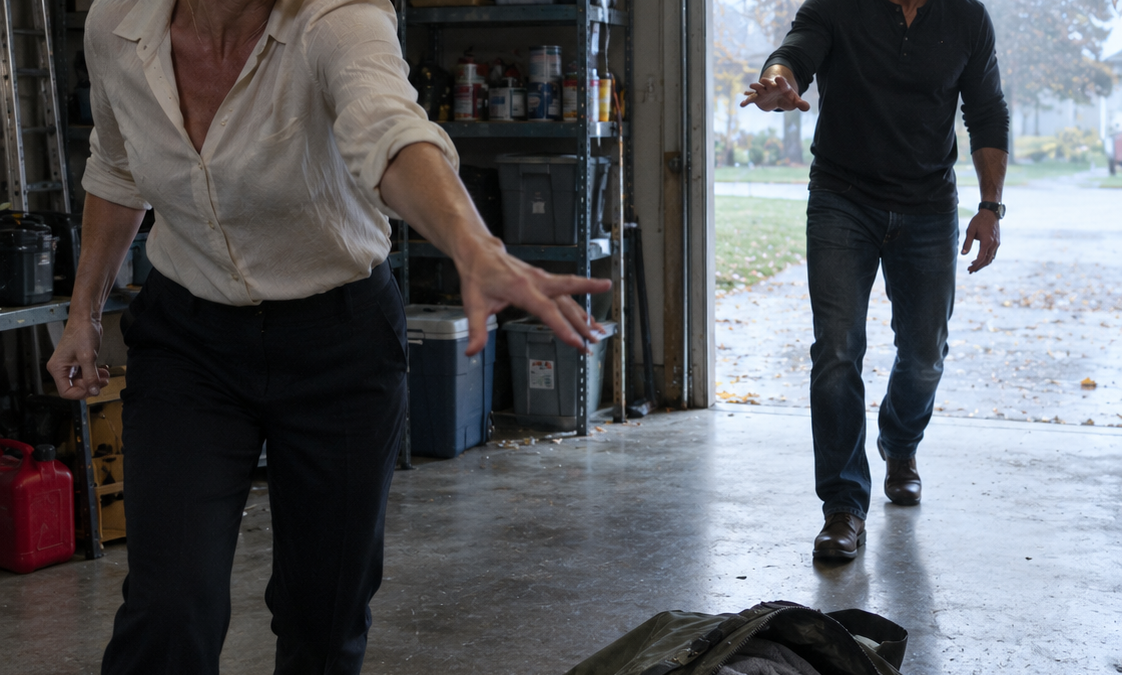
“My wife threw my duffel bag onto the concrete floor of our garage. ‘Get out,’ she said. I stood there in the open doorway. The bag had split at the zipper.”
Before: My wife thought I was a quiet, boring veteran having an affair → After: She watched a three-star general honor me in front of 200 people and finally learned who she’d been married to for twenty-three years.
“Get out,” she said.
I stood there in the open doorway. The bag had split at the zipper. My old fleece, the gray one with the frayed cuffs, spilled halfway out like a gutted animal.
“Karen.”
“Don’t.” She held up one hand. Her nails were fresh. Pale pink. She’d gotten them done that morning. “I heard you. On the phone. Crying like a child, telling some woman you’d always be there for her. That you’d promised.”
My name is Daniel Mercer. I was fifty-four years old when my wife of twenty-three years told me to leave our home. I am a former Air Force Pararescueman. PJ. I spent eighteen years jumping out of helicopters into places most people spend their lives trying not to think about.
I have been shot at. I have pulled men out of burning aircraft. I have held a dying teammate’s hand in the mud of a country I will not name and told him lies about how he was going to be fine.
I have never been as afraid as I was standing in that garage.
“You don’t understand what you heard,” I said.
“I understand enough.” Her voice cracked. She was trying not to cry. Karen hated crying. She thought it made her look weak. She’d told me that once, years ago. “I understand that you’ve been lying to me. For how long, Daniel? How long have you had someone else?”
“There’s no one else.”
“Then who is she?”
I opened my mouth. Closed it.
The thing was—I couldn’t tell her. Not then. Not like this. The promise I’d made wasn’t mine to break.
“See?” Karen said. Her face went hard. “You can’t even answer.”
“Karen, please. Just let me—”
“Get your bag. Get in your truck. And don’t come back tonight.”
She turned and walked into the house. The door to the garage clicked shut. I heard the deadbolt slide home.
I stood in the garage for a long time. Long enough for the automatic light to click off. Long enough for my eyes to adjust to the dark. Long enough to hear the muffled sound of Karen crying on the other side of the door.
I could have told her.
That’s the thing that kept me up for weeks afterward. I could have told her everything, right there, and maybe none of what came next would have happened.
But I’d made a promise. And promises were the only thing I had left that still meant anything.
I slept in my truck that first night.
Not because I had nowhere else to go. I had a dozen buddies within an hour’s drive who would have taken me in without a question. I had a VA card and a credit card and enough cash in my wallet to get a hotel room.
I slept in my truck because I didn’t want to explain.
The truck was a 2015 F-150. Dark blue. One hundred and forty thousand miles. I’d bought it used when I got out, back when Karen still thought my military pension was “cute” and my stories were “interesting.” Before she started flinching every time someone mentioned deployment. Before she started changing the subject at dinner parties when someone asked what I used to do.
I lay in the driver’s seat with my jacket bunched under my head and stared at the ceiling of the cab.
What they didn’t know.
That thought kept circling. What none of them knew. Not Karen. Not her mother, Patricia, who had never once looked at me without a flicker of disappointment. Not her brother Michael, who made vice president at his software company at thirty-two and never let anyone forget it.
None of them knew who I really was.
Not the version of me that existed before. The one that still existed underneath, if you knew where to look.
I closed my eyes.
I was twenty-six years old the first time I jumped into a war zone. We were over the Hindu Kush, somewhere north of Kandahar, and the helicopter was taking fire. The crew chief was screaming something I couldn’t hear over the rotors. I remember looking at the guy next to me—fellow PJ, name of Marcus Webb—and seeing him grin.
“Just another Tuesday,” he said.
Marcus Webb died four years later in a canyon in the Alborz Mountains. He died because I couldn’t get to him in time. He died with my hand on his chest and his blood soaking through my gloves and his last words being—
I opened my eyes.
The truck cab was cold. My breath fogged the windows.
I had promised Marcus something. Something I’d kept for seventeen years. Something Karen had just heard a piece of, through a door, without context, without knowing anything about the man I’d been talking to or the woman on the other end of the line.
Rose Webb.
Marcus’s widow.
I reached for my phone. 4:47 a.m.
I typed a message to Rose: Something came up. Can we talk tomorrow?
Her reply came three minutes later: Of course. You okay?
I stared at those two words for a long time.
You okay?
No. I was not okay. My wife had thrown me out of my house. My marriage was dangling by a thread. And the only person I could talk to about any of it was the one person who couldn’t know—because telling Rose would mean breaking the other promise. The one I’d made to Marcus.
I typed back: Yeah. Just tired.
Then I put the phone down and watched the sun come up over a parking lot outside a 24-hour diner, and I tried to figure out how to explain something to my wife that I’d spent seventeen years keeping secret.
Karen and I met at a barbecue in Virginia Beach.
I was forty-one. Three years out of the Air Force. Working as a contractor for a private security firm, doing risk assessment for oil companies overseas. The work was boring and paid well and didn’t involve anyone dying, which was the point.
She was a real estate agent. Pretty. Funny. She laughed at my jokes, which not many people did. She asked about my time in the service and actually listened to the answers.
“You saved people,” she said.
“Sometimes.”
“That’s amazing.”
“It’s a job.”
She tilted her head. “You don’t like talking about it.”
“Not really.”
“Why?”
I thought about it. “Because the people I saved aren’t the ones I remember. I remember the ones I didn’t.”
She was quiet for a moment. Then she took my hand.
“That’s the saddest thing I’ve ever heard,” she said.
I married her eleven months later.
For a while, it worked. She liked the idea of me—the quiet veteran with the mysterious past. I liked the idea of her—the warm, pretty woman who made me feel normal. We bought a house in Chesapeake. We had two kids. I took a job teaching tactical medicine at a training center, and I coached Little League on weekends, and I went to church on Christmas and Easter, and I was, by every measure that mattered, a civilian.
A normal guy.
A nobody.
That’s what her family saw. That’s what they still see, when they bother to look at all. Karen’s mother, Patricia, took one look at my faded jeans and my old boots the first time we met and decided I was “underdressed for the occasion.” Her brother Michael asked me at Thanksgiving if I “missed the violence” and laughed like it was a joke. They never asked about the details. They never wanted to know.
I was fine with that. I’d spent my whole adult life being told to keep my mouth shut. Operational security. Compartmentalization. The less people knew, the safer everyone was.
So I kept my mouth shut. For twenty-three years.
I kept my mouth shut about the deployments. About the missions. About the men I’d carried out of fire and the men I hadn’t. About the medals in a shoebox in the attic that I’d never bothered to display because what was the point.
And I kept my mouth shut about Marcus Webb.
Until the phone call Karen heard.
I went to the training center the next morning.
It was a converted warehouse on the edge of Norfolk, all corrugated steel and fluorescent lights. The kind of place that smelled like sweat and gun oil and old coffee. I’d been teaching there for eleven years. Basic tactical casualty care. Advanced field medicine. The stuff that saves lives when the ambulance is forty-five minutes away.
My boss, a former Army Ranger named Cole Hendricks, took one look at me and knew something was wrong.
“You look like shit,” he said.
“Didn’t sleep.”
“Karen kick you out?”
I looked at him.
“Shit,” he said. “Karen kicked you out.”
“It’s complicated.”
“Everything’s complicated.” He poured me a cup of coffee. “You want to talk about it?”
No. I did not want to talk about it. What I wanted was to teach my class, go home, and figure out how to explain seventeen years of silence to a woman who was already convinced I’d been cheating on her.
But Cole was a friend. Had been for over a decade. He knew about Marcus. He was one of maybe four people alive who knew the whole story.
“It’s about the anniversary,” I said.
Cole went still.
“The ceremony,” he said.
“Yeah.”
“She heard you on the phone.”
“She heard part of it.”
Cole set down his coffee. “You need to tell her.”
“I can’t.”
“Why not?”
“Because it’s not my story to tell.” I wrapped my hands around the mug, letting the heat seep into my fingers. “Marcus made me promise.”
“Marcus is dead, Danny.”
“I know.”
“Dead men don’t hold you to promises.”
I didn’t answer. Because that was the thing Cole didn’t understand—the thing nobody understood, not really. Marcus had died in my arms. He’d looked at me with eyes that were already going, and he’d made me promise.
Take care of Rose. Take care of her. Don’t let her be alone.
And I’d said yes.
I’d said yes because what else was I supposed to say? I’d said yes because it was the last thing he ever asked me. I’d said yes because I was twenty-nine years old and covered in his blood and I would have promised him anything.
But what I hadn’t known, what I hadn’t understood, was that “take care of Rose” meant something more than I’d bargained for.
Rose Webb lived in a small house in Suffolk, about forty minutes from my place.
I drove there after work. The drive was familiar—I’d made it dozens of times over the years, always on the same route, always at the same time of day. Past the naval base. Past the farms. Past the billboard with the faded advertisement for a barbecue restaurant that had closed back in 2012.
Rose was in the garden when I pulled up. She was kneeling in the dirt, pulling weeds, wearing a faded blue sweatshirt that I recognized.
It had been Marcus’s.
She looked up when she heard the truck. Her face was weathered, lined with years of grief and sun. She was sixty-one now. She’d been forty-four when Marcus died. She’d never remarried.
“Danny,” she said.
“Rose.”
I got out of the truck. She stood up slowly, brushing the dirt from her knees. There was something careful about the way she moved now. Something deliberate.
“You look tired,” she said.
“I’ve been better.”
She studied my face. She’d always been good at that—reading people. Marcus used to say she had radar.
“Karen called me,” Rose said.
My stomach dropped. “What?”
“This morning. She called me.” Rose’s voice was calm, but I could hear the tremor underneath. “She said she heard you on the phone with me. She said she wanted to know who I was and why you were crying.”
“Rose—”
“She called me the other woman.” Rose smiled. It was a sad smile. “I’ve been called a lot of things in my life, Danny. But never that.”
“I’m sorry.”
“Don’t be sorry. Tell her.”
“I can’t.”
“Why not?”
I didn’t answer. I couldn’t. Because the answer was the same reason I’d never told Karen anything—the same reason I’d spent seventeen years pretending to be someone I wasn’t. Because the truth wasn’t mine to tell. Because the promise I’d made to Marcus was bigger than any promise I’d made to Karen.
Because I was afraid.
Afraid that if Karen knew the whole story—knew what I’d done and what I’d failed to do—she would see me the way I saw myself.
As a man who let his teammate die.
Rose invited me inside.
Her house was small and clean and full of photographs. Marcus in uniform. Marcus at a barbecue. Marcus holding a fish he’d caught on a trip to the Outer Banks. Marcus, always Marcus, frozen in time at thirty-three years old.
I sat at the kitchen table while Rose made tea. The same table where I’d sat hundreds of times before. The same chair. The same view of the same garden through the same window.
“The ceremony’s in three weeks,” Rose said.
“I know.”
“You’re still coming.”
“I’ll be there.”
She set a mug in front of me. Chamomile. Marcus had hated chamomile. He used to call it “hot grass water.” Rose had drunk it every night for as long as I’d known her.
“Karen asked me if I was your girlfriend,” Rose said.
I choked on my tea.
“I told her I was your best friend’s widow.” Rose sat down across from me. “I told her we’d known each other for seventeen years. I told her you were the one who held my hand at the funeral and helped me sell Marcus’s truck and sat with me on every anniversary for as long as I can remember.”
“What did she say?”
“She hung up.”
I closed my eyes.
“She thinks I’m lying,” Rose said. “She thinks you put me up to it.”
“She doesn’t know you.”
“No. She doesn’t.” Rose wrapped her hands around her mug. “And she doesn’t know you, either. Not really.”
“That’s not her fault.”
“It’s not yours, either.”
We sat in silence for a while. The tea cooled. The light through the window shifted.
“I’ve been thinking,” Rose said finally. “About the ceremony.”
“What about it?”
“The general’s going to be there this year. General Harmon. He’s the one who recommended Marcus for the Air Force Cross.”
I nodded. I knew about Harmon. He’d been Marcus’s squadron commander back in the day. He’d been at the funeral. He’d shaken my hand and told me I’d done everything I could.
“I’m going to ask him to say something,” Rose said. “About you.”
I looked up. “What?”
“About what you did. About what you tried to do.”
“Rose—”
“I’m going to ask him to talk about Marcus, and about you, and about what happened on that mountain.” Her voice was steady. “And I’m going to invite Karen.”
“You can’t.”
“I already did.”
I stared at her.
“She needs to know, Danny. She needs to know who you are.” Rose’s eyes were wet. “And you’re never going to tell her. So I will.”
I opened my mouth to argue. To explain why this was a bad idea. To list all the reasons why Karen couldn’t know the truth.
But nothing came out.
Because part of me—a small, buried part that I’d been ignoring for years—wanted her to know.
Wanted someone to know.
Wanted to stop being invisible.
PART 2 — THE SHOEBOX
Karen didn’t come home for three days.
I didn’t, either. I stayed at Cole’s place, sleeping on his pull-out couch, eating his leftovers, staring at the ceiling and trying to figure out how my life had fallen apart so fast.
On the fourth day, I went back to the house.
Karen was in the kitchen. She’d been crying—I could tell from the puffiness around her eyes. But her face was hard when she saw me. The same hard face she’d worn in the garage.
“I need to get some things,” I said.
“Fine.”
I went upstairs. Our bedroom looked the same. The same floral bedspread. The same wedding photo on the dresser. The same two pillows on each side of the bed.
I stood there for a minute, looking at it.
Then I went to the attic.
It took me a while to find what I was looking for. The attic was full of junk—old furniture, holiday decorations, boxes of things we’d never unpacked when we moved in twenty years ago. But eventually I found it.
The shoebox.
It was in the corner, under a stack of old blankets. A plain brown shoebox, held shut with a rubber band. I pulled off the rubber band and opened the lid.
The medals were on top. Air Force Cross. Purple Heart. Two Bronze Stars. A handful of others that I’d never bothered to learn the names of. I’d never worn them. I’d never displayed them. They were just there, in the box, gathering dust.
Under the medals were the photographs.
I pulled them out one by one.
A group shot of my old team. Seven guys, squinting into the sun, young and stupid and alive. Marcus was in the middle, grinning like always. I was on the left, looking like I’d rather be anywhere else.
A shot of Marcus and me, arms around each other’s shoulders, standing in front of a helicopter. We were maybe twenty-five in that one. So young. So sure we were invincible.
A shot of Rose at the funeral. Black dress. Blank face. Behind her, a flag folded in a triangle.
I sat there in the attic for a long time, holding those photographs.
What had I been thinking? What had I been doing for twenty-three years? I’d married Karen and built a life with her and never once—not once—let her see the person underneath. I’d told myself I was protecting her. Protecting us. But that was a lie. The truth was simpler and uglier.
I was protecting myself.
I was afraid that if Karen saw the real me—the man who’d held his friend as he died, the man who’d carried that guilt for seventeen years—she’d look at me the way I looked at myself in the mirror.
Like a failure.
Like someone who should have done more.
I heard footsteps on the stairs. Karen appeared at the top of the attic ladder.
“What are you doing?” she asked.
“Looking for something.”
She climbed up. Her eyes landed on the shoebox in my hands.
“What’s that?”
I didn’t answer. I just opened it and held it out.
She looked inside. Her face changed. It went from hard to confused to something else—something I couldn’t read.
“Daniel,” she said. “What is this?”
“Medals.”
“I can see that.” She reached out and touched the Air Force Cross. “What are they for?”
“Saving people.”
She looked at me. “You never told me.”
“No.”
“Why not?”
I thought about it. “Because it never felt like anything to be proud of.”
Karen sat down next to me on the attic floor.
We’d been married twenty-three years. We’d had two kids. We’d built a life together. And I realized, sitting there, that this was the first honest conversation we’d ever had about who I really was.
“Tell me,” she said.
“Tell you what?”
“Everything.”
I looked at the photographs in my hands. Marcus’s grin. Rose’s blank face. The folded flag.
“His name was Marcus Webb,” I said. “He was my best friend.”
Karen was quiet.
“We were PJs together. Pararescuemen. He was the best man I ever knew. Funny. Brave. Stupid brave, actually—he once jumped into a river in Kosovo to save a dog, and the river was full of sewage, and he didn’t even care.”
“What happened to him?”
“He died.” I set the photographs down. “In Iran. 2007. A mission to extract a downed pilot. The chopper went down. We were in a canyon, taking fire from three sides. Marcus got hit. I tried to get to him. I tried—”
My voice broke.
Karen took my hand.
“I tried,” I said. “I couldn’t reach him. The fire was too heavy. And by the time I got there, he was—” I stopped. Breathed. “He was dying. And I couldn’t do anything. I couldn’t save him.”
“What did you do?”
“I held him. Until he died. And I promised him I’d take care of his wife.”
“Rose.”
“Yeah.”
Karen was quiet for a long moment.
“That’s who you were on the phone with,” she said. “Rose.”
“Yeah.”
“The other woman.”
“She’s not—”
“I know.” Karen’s voice was small. “I know, Daniel. I’m sorry. I just—I didn’t know. You never told me. You never told me anything.”
“I know.”
“Why?”
I looked at her. “Because I was ashamed.”
“Of what?”
“Of everything.” I gestured at the shoebox. “Of these. Of what I did. Of what I didn’t do. Of the fact that I came home and he didn’t.”
Karen’s eyes were wet.
“You think I would have judged you?” she asked. “For that?”
“I didn’t know. I never knew how you’d react. And I was scared.”
“Scared of what?”
“Scared you’d see me the way I see myself.”
She was quiet for a moment. Then she leaned over and kissed my cheek.
“I see you just fine,” she said.
I wanted to believe her. I really did. But a part of me—the part that had been hiding for twenty-three years—knew that the real test was still coming.
The next morning, there was a card on the kitchen table.
It was from Rose. A simple card, white with blue flowers. Inside, in Rose’s careful handwriting:
Dear Karen,
I understand you’ve been going through a hard time. I want you to know that I don’t blame you for what you said to me on the phone. If I were in your position, I would have thought the same thing.
But I want to explain something. Your husband is the reason I’m still alive. Not because he saved me—he didn’t—but because he kept his promise. After Marcus died, I wanted to die too. I spent six months planning it. And the only reason I didn’t go through with it was because Daniel showed up at my door every single week. He made me eat. He made me sleep. He sat with me in the dark and told me stories about Marcus that I’d never heard. He told me it was okay to be angry and sad and lost, and he told me it would get better, and he was the only person in the world who made me believe it.
He never asked for anything in return. He never expected anything. He just showed up.
That’s who your husband is.
The ceremony is in two weeks. I hope you’ll come.
—Rose
Karen read the card twice. Then she set it down.
“I’ll come,” she said.
PART 3 — THE REUNION
The weeks before the ceremony were strange.
Karen and I were still married. We were still living in the same house. But there was a distance between us now—not the icy silence of the garage, but something more careful. Something cautious. Like two people learning to dance together again after years apart.
She asked me questions.
Not the easy ones. The hard ones.
“What was it like over there?”
“Hot. Loud. Terrifying.”
“Did you ever kill anyone?”
“That’s not a question I can answer.”
“Did you ever want to?”
“Everyone wants to, sometimes. The trick is not doing it.”
She asked about Marcus. She asked about Rose. She asked about the missions and the deployments and the men I’d served with.
I answered as best I could. There were things I couldn’t tell her—things that were still classified, things that weren’t mine to share. But I told her what I could.
It was more than I’d ever told her before.
More than I’d ever told anyone.
And gradually—slowly—the distance began to close.
But there was something else going on. Something I couldn’t quite put my finger on.
Karen kept looking at me differently. Not with distrust—with something else. Something that looked almost like… calculation.
“What?” I asked one night, catching her staring.
“Nothing.”
“You’re looking at me weird.”
She smiled. “I’m just trying to figure you out.”
“Good luck.”
“I don’t need luck.” She kissed my forehead. “I just need time.”
Ten days before the ceremony, I got a call from Rose.
“Have you talked to General Harmon?” I asked.
“I have.”
“What did he say?”
“He said yes.” Rose’s voice was warm. “He said he’d be honored. And he said—” She paused. “He said he’s been thinking about you for seventeen years.”
“What does that mean?”
“He said he wants to talk to you. Before the ceremony.”
“Why?”
“I don’t know. He wouldn’t tell me.”
I hung up feeling uneasy. General Harmon was a legend—a three-star who’d overseen some of the most important rescue operations of the past two decades. He’d been there when I got my Air Force Cross. He’d shaken my hand and called me a hero.
I’d spent seventeen years trying to forget that.
The ceremony was held at a small airfield outside of Norfolk.
It was a tradition that had started eleven years ago—a gathering of PJs, active and retired, to remember the men they’d lost. Rose had organized the first one. I’d helped. We’d been doing it every year since.
Usually, it was just a few dozen people. Old teammates, old friends, old widows. A simple ceremony. A moment of silence. A wreath laid on a memorial.
But this year was different.
This year, there were brass.
I could see them as I pulled into the parking lot: a row of official vehicles, black SUVs with government plates. A cluster of men in dress blues. A podium set up near the memorial, with a row of chairs behind it.
“What’s going on?” Karen asked.
“I don’t know.”
We got out of the truck. The air was cool, the sky gray. A fall day, the kind that made you want to stay inside with a cup of coffee.
Rose was waiting for us near the entrance.
“Danny,” she said. “Karen. Thank you for coming.”
“What’s all this?” I asked.
“I told you. General Harmon wanted to say something.”
“About Marcus?”
Rose hesitated. “About both of you.”
Before I could ask what she meant, a tall man in a blue uniform stepped forward. Silver hair. A face that looked like it had been carved out of granite.
“Daniel Mercer,” he said.
“General.”
He extended his hand. I shook it.
“I’ve been wanting to meet you for a long time,” he said.
“We’ve met.”
“I know. I mean I’ve been wanting to talk to you.” He glanced at Karen. “Is this your wife?”
“Yes. Karen, this is General James Harmon.”
Karen shook his hand. Her eyes were wide.
“I’ve heard a lot about you,” she said.
“Not as much as I’ve heard about him, I imagine.” Harmon smiled. “But that’s about to change.”
“What do you mean?”
Harmon looked at me. “You didn’t tell her?”
“Tell her what?”
He shook his head. “You really are something else, Mercer.”
The ceremony started at noon.
There were maybe two hundred people gathered around the memorial—a granite wall etched with the names of fallen PJs. I recognized some of the faces. Old teammates. Old friends. Some I hadn’t seen in years.
The ceremony began with a prayer. Then a moment of silence. Then a flag folding, done by an honor guard in perfect synchronicity.
And then General Harmon stepped up to the podium.
“Seventeen years ago,” he said, “I had the privilege of commanding a team of men whose courage I will never be able to adequately describe. They were Pararescuemen. The best of the best. The men who go into the fire to pull others out.
“One of those men was Master Sergeant Marcus Webb. Marcus gave his life on a mountainside in Iran, trying to rescue a downed pilot. He died a hero. And every year, we gather here to remember him.”
He paused. Looked out at the crowd.
“But today, I want to talk about someone else. Someone who is still with us. Someone who, I believe, has been carrying a burden that he never should have had to carry alone.”
I felt the blood drain from my face.
“His name is Daniel Mercer.”
The crowd turned to look at me. Karen took my hand.
“Daniel was on that mountainside with Marcus. He was the one who tried to reach him. He was the one who held him as he died.” Harmon’s voice was steady. “And for seventeen years, he has never spoken about it. Not to me. Not to anyone. He has never told his wife, or his children, or his friends what he did that day.”
I wanted to disappear. I wanted to sink into the ground.
“Daniel Mercer is a hero,” Harmon said. “He was awarded the Air Force Cross for his actions that day—the second-highest honor a PJ can receive. He pulled three men out of that canyon under heavy fire. He saved their lives. And then he came home, and he put his medals in a box, and he went back to being a regular person, because that’s what he thought he was supposed to do.”
The crowd was silent.
“But that’s not why I’m telling you this.” Harmon leaned on the podium. “I’m telling you this because I’ve been watching Daniel for seventeen years. I’ve seen him show up for every ceremony. I’ve seen him sit with widows and hold their hands. I’ve seen him pay for funerals out of his own pocket. I’ve seen him visit wounded warriors in hospitals and stay with them for hours. I’ve seen him do all of this quietly, without ever asking for credit, without ever expecting anything in return.”
He looked directly at me.
“And I’ve seen him carry guilt that was never his to carry. I’ve seen him blame himself for something that was never his fault. I’ve seen him—”
His voice cracked.
“I’ve seen him become a better man than any of us deserve.”
PART 4 — THE MEDALS
I don’t remember much of what happened after that.
I remember Karen’s hand tightening around mine. I remember the silence that followed Harmon’s speech—the kind of silence that felt heavier than any noise. I remember Rose stepping forward and hugging me, her shoulders shaking.
I remember people coming up to me afterward. Old teammates I hadn’t seen in years. Men whose lives I’d saved. Men whose lives I’d failed to save. They shook my hand and hugged me and told me stories I’d never heard—stories about what I’d done, what I’d meant to them, what I’d given them.
I remember Karen standing beside me the whole time, holding onto my arm, watching everything with wide eyes.
And I remember her asking, later, in the truck on the way home: “Why didn’t you tell me any of this?”
I couldn’t answer.
Not because I didn’t want to. Because I didn’t know how to explain the thing that had kept me silent for so long. The shame. The guilt. The feeling that I didn’t deserve any of it—the medals, the praise, the gratitude.
Because I’d let Marcus die.
Karen and I didn’t talk much over the next few days.
Not because we were angry. Not because we were avoiding each other. Just because there was too much to process. Too many things had changed. Too many truths had come out.
I went back to work. I taught my classes. I came home. I ate dinner. I slept.
But something was different.
Karen looked at me differently now. Not with suspicion—with wonder. Like she was seeing me for the first time. And I realized, slowly, that she was. She’d spent twenty-three years married to a version of me that I’d invented. A quiet, boring, middle-aged veteran who taught tactical medicine and coached Little League and never talked about his past.
Now she was seeing the real me.
And I wasn’t sure I liked it.
A week after the ceremony, Karen found the shoebox.
I’d left it on my workbench in the garage. I’d meant to put it back in the attic, but I’d never gotten around to it. So it was just sitting there, open, the medals and photographs on display.
Karen stood in the doorway of the garage, looking at it.
“You kept these,” she said.
“Yeah.”
“Why?”
“I don’t know.”
She walked over. Picked up the Air Force Cross. Held it in her palm.
“This is the second-highest award a PJ can get,” she said.
“That’s what they tell me.”
“They tell you?”
“I never really looked it up.”
She looked at me. “You never looked up your own medal?”
“I know what it’s for.”
“What’s it for?”
I took a breath. “For saving three men who would have died otherwise.”
“How?”
“The chopper went down in a canyon. We were under fire. I pulled three men out of the wreckage and got them to cover. One of them was bleeding out. I kept him alive until evac could reach us.”
“And Marcus?”
“I couldn’t get to him.” My voice was flat. “He was on the other side of the wreckage. There was too much fire. By the time I got there, he was—”
I stopped.
Karen set the medal down.
“You saved three people,” she said.
“It wasn’t enough.”
“It was three more than anyone else could have saved.”
I shook my head. “You don’t understand.”
“Then explain it to me.”
I looked at her. Really looked at her. For the first time in twenty-three years, I looked at my wife and saw someone who might actually want to know.
“The thing about being a PJ,” I said, “is that you’re trained to save everyone. That’s the job. You go into the fire, and you bring people out. You don’t leave anyone behind. You don’t give up. You find a way, or you die trying.”
“And?”
“And sometimes you can’t.” I sat down on the workbench. “Sometimes the fire is too hot. Sometimes the cliff is too steep. Sometimes the bullet finds its mark before you can get there. And when that happens, you have to live with it.”
“That doesn’t mean it’s your fault.”
“Doesn’t it?”
“No.” Karen sat down next to me. “Daniel, listen to me. You did everything you could. You tried. You tried so hard. And you saved three lives. That’s not nothing. That’s everything.”
I wanted to believe her.
I wanted to.
But seventeen years of guilt doesn’t go away in a single conversation.
The kids came home the following weekend.
Alex was twenty-four, living in Richmond, working as a software developer. Emma was twenty-one, a senior at James Madison, studying psychology. They’d heard about the ceremony from Karen—she’d called them after we got home.
They wanted to hear the story.
So I told them.
Not everything. Not the classified details. But enough. The shape of it. The canyon, the chopper, the fire. Marcus. The promise I’d made. The years I’d spent keeping it.
They listened without interrupting.
When I finished, Alex said: “Dad, why didn’t you ever tell us?”
“I don’t know.”
“Were you ashamed?”
“Maybe.”
“Of what?”
“Of being different.” I looked at my son—tall, confident, comfortable in a way I’d never been at his age. “You grew up in a nice house. You went to good schools. You never had to worry about anything. I didn’t want you to know about the other stuff. The war stuff. The death stuff. I wanted you to have a normal life.”
Alex was quiet for a moment.
“That’s kind of insulting,” he said.
“What?”
“You think I can’t handle knowing who my dad is?” He shook his head. “Dad, I’ve known you my whole life. I’ve seen you stay calm when everything’s falling apart. I’ve seen you help people without being asked. I’ve seen you show up for everyone, all the time, no matter what. I always knew there was something underneath. I just didn’t know what it was.”
Emma nodded. “Same. You always seemed… I don’t know. Like you were carrying something. I used to think it was just being old, but now I get it.”
“You get what?”
“You were carrying this.” She gestured at the shoebox. “All of this. And you never let us help you carry it.”
I looked at my children.
I didn’t know what to say.
That night, Karen and I sat on the back porch.
The sky was clear. The stars were out. We’d been silent for a while, just sitting there, listening to the crickets.
“I’m sorry,” Karen said.
“For what?”
“For the garage. For what I said. For accusing you of—”
“You didn’t know.”
“That’s not an excuse.” She looked at me. “I should have trusted you. I should have asked. I should have—”
“Karen.”
She stopped.
“I kept secrets from you for twenty-three years,” I said. “You had every reason to be suspicious. You had every reason to think the worst. The fact that you were wrong doesn’t mean you were wrong to wonder.”
She was quiet for a moment.
“Why did you keep the secrets?” she asked.
I thought about it.
“Because I was afraid,” I said. “Afraid that if you knew who I really was, you’d leave.”
“Leave?”
“Everyone leaves, eventually. Marcus left. My teammates left. The men I saved went home to their families and forgot about me. I was afraid that if I let you see the real me—the broken parts, the dark parts—you’d realize you’d made a mistake.”
“Daniel.”
“I know it doesn’t make sense.”
“It makes perfect sense.” She took my hand. “But you were wrong. I’m not going anywhere.”
“How do you know?”
“Because I’ve spent twenty-three years with you, and I’m still here.” She squeezed my hand. “And because I’ve finally met the real you. And I like him.”
I looked at her.
“You do?”
“I do.” She leaned against me. “I just wish I’d met him sooner.”
We sat there for a long time, looking at the stars.
And for the first time in seventeen years, I felt something I’d almost forgotten.
Peace.
PART 5 — THE LETTER
The peace lasted three weeks.
Then the letter came.
It was addressed to me, care of the training center. Plain white envelope. No return address. The handwriting was unfamiliar—sharp, angular, the kind of handwriting that looked like it had been drilled into someone by force.
I opened it in my office.
Dear Mr. Mercer,
My name is Thomas Webb. I am Marcus Webb’s older brother.
I understand you’ve been taking care of my sister-in-law, Rose, for the past seventeen years. I understand you’ve been attending memorial ceremonies in my brother’s name. I understand you’ve been playing the role of the grieving friend, the loyal comrade, the hero who couldn’t save him.
I know what really happened in that canyon.
I know you left my brother to die.
I know you could have saved him, and you chose not to.
I’ve been waiting seventeen years to say this to your face. And I’m going to say it at the next ceremony. I’m going to tell everyone the truth about what you did.
Unless you do the right thing and step aside.
You have until the end of the month.
—Thomas Webb
I read the letter three times.
Then I put it in my desk drawer and sat there, staring at the wall.
Thomas Webb.
I’d met him once. At the funeral. A tall, angry man with a face like a clenched fist. He’d shaken my hand and said nothing. Just looked at me with eyes that said everything.
I’d known, even then, that he blamed me.
I’d known, even then, that he was right to.
I didn’t tell Karen about the letter.
I didn’t tell anyone. Not Cole. Not Rose. Not General Harmon. I just carried it around with me, a weight in my chest, a knot in my stomach.
I thought about what Thomas had said. You could have saved him, and you chose not to.
Was that true?
I’d spent seventeen years telling myself I’d done everything I could. That the fire was too heavy. That the distance was too far. That there was no way to reach Marcus without getting myself killed.
But was that really true?
Or had I just been too scared?
I replayed the moment in my head a thousand times. The canyon. The chopper. The fire. Marcus, thirty yards away, bleeding out, calling my name.
I’d tried to reach him. I know I’d tried. I’d crawled through the dirt and the smoke and the blood, and I’d gotten maybe halfway before the fire drove me back.
But maybe I could have tried harder.
Maybe I could have found another way.
Maybe I could have saved him.
A week after the letter arrived, I drove to Rose’s house.
She was in the garden again. Same spot. Same sweatshirt. She looked up when she heard the truck.
“Danny,” she said. “What’s wrong?”
I got out. Stood there for a moment, not sure how to say it.
“I got a letter,” I said.
“From who?”
“Thomas.”
Rose’s face went pale.
“He’s coming to the ceremony,” I said. “He’s going to tell everyone that I let Marcus die.”
Rose stood up slowly. “That’s not true.”
“I know.”
“Then why are you worried?”
“Because I don’t know if it’s not true.” I looked at her. “Rose, I’ve spent seventeen years telling myself I did everything I could. But what if I didn’t? What if I could have saved him, and I just—”
“Stop.” Rose’s voice was sharp. “Stop it right now.”
“I’m just—”
“No.” She walked over to me. Took my face in her hands. “Listen to me, Daniel Mercer. You did everything. Everything. I know because Marcus told me.”
I stared at her. “What?”
“Before he deployed. The last time he was home. He told me that if anything ever happened to him, I should find you. He told me that you were the best man he’d ever known. He told me that you would take care of me, no matter what.”
“He said that?”
“He said that.” Rose’s eyes were wet. “And you did. You took care of me. You kept your promise. You’ve been keeping it for seventeen years.”
“But I couldn’t save him.”
“No.” Rose’s voice was gentle now. “You couldn’t. Because sometimes people die, Danny. Sometimes the fire is too hot, and the cliff is too steep, and the bullet finds its mark. And there’s nothing anyone can do about it. Not even you.”
I closed my eyes.
“Marcus knew that,” Rose said. “He knew the risks. He knew what he was signing up for. And he knew that if he died, it wouldn’t be your fault.”
“How do you know?”
“Because he told me.” She smiled. “He told me that if he died, I should tell you it wasn’t your fault. He said you’d blame yourself. He said you’d carry it forever. And he wanted me to tell you—”
She paused.
“Tell me what?”
“That he forgave you. For whatever you think you did wrong. He forgave you.”
I broke down.
Right there, in Rose’s garden, in the middle of the afternoon, I fell to my knees and cried like I hadn’t cried since I was a child.
Rose knelt beside me. Held me. Let me sob into her shoulder.
“I’m sorry,” I said. “I’m sorry. I’m sorry.”
“You don’t have to be sorry.”
“I should have saved him.”
“You couldn’t.”
“I should have tried harder.”
“You tried as hard as anyone could.”
“I should have—”
“Daniel.” Rose pulled back. Looked me in the eyes. “Stop. Just stop.”
I stopped.
“Marcus loved you,” she said. “You were his brother. His best friend. His hero. And he would hate to see you like this—beating yourself up over something that was never your fault.”
I wiped my eyes.
“What do I do about Thomas?” I asked.
Rose was quiet for a moment.
“You let him come,” she said. “You let him say whatever he wants to say. And then you let the truth come out.”
“What truth?”
“The truth that you’re a hero. The truth that you saved three lives. The truth that you’ve spent seventeen years taking care of the people Marcus loved.” She stood up. “The truth that you’re a better man than Thomas Webb will ever be.”
 [Tap here for the Next Part ]


