“I’m going to burn his world down. And I’m going to do it with a smile.”
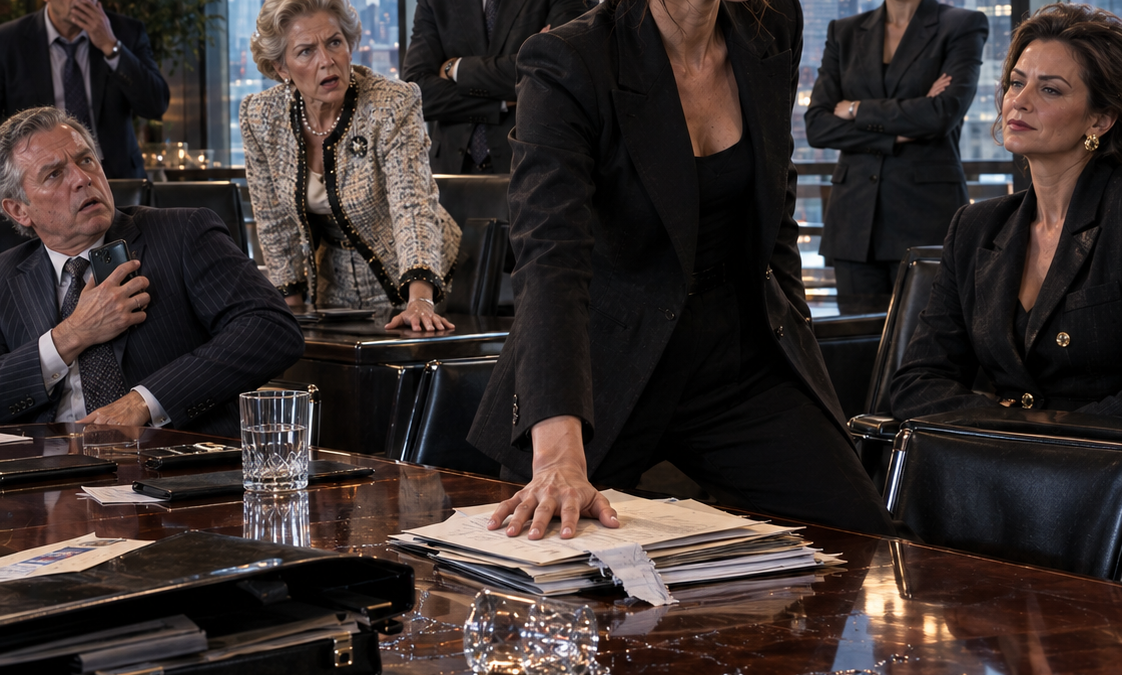
“I’m going to burn his world down. And I’m going to do it with a smile.”
She walked out of his party with nothing but her rage. She walked back in with the power to destroy him.
The text message arrived at 7:47 PM, three minutes before the black-tie dinner celebrating the Whitmore Group’s centennial anniversary was scheduled to begin.
“I know you’re already there. Don’t make a scene. We’ll talk at home.”
Elena Whitmore stared at the screen of her phone, her thumb hovering over the message from her husband of eleven years. Around her, the grand ballroom of the Whitmore Estate hummed with the particular frequency of Chicago’s oldest money—crystal glasses clinking, silk gowns rustling, the low murmur of conversations that had been inherited along with the trusts that funded them.
“Mrs. Whitmore?” A server appeared at her elbow, balancing a silver tray of champagne flutes. “Would you like—”
“No.” She heard her own voice come out too sharp, too thin. “No, thank you.”
The server retreated. Elena slipped her phone into her clutch and forced herself to breathe. In through the nose, out through the mouth. The way her therapist had taught her three years ago, when the panic attacks started and Damian had responded by scheduling her a standing weekly appointment and then never once asking how they were going.
We’ll talk at home.
She hadn’t been home—truly home, in the sense of belonging somewhere—since the morning she’d found the earring on the passenger seat of Damian’s Range Rover. A single diamond stud, clearly expensive, clearly not hers. She’d held it between her thumb and forefinger for a full minute, watching the light catch in the facets, before placing it carefully in the center console. She hadn’t mentioned it. Neither had he.
That was eight months ago.
Since then, she’d become an expert in the archaeology of infidelity. The unexplained late meetings. The subtle shift in his cologne—something warmer, more expensive than what she’d bought him for Christmas. The way he’d stopped touching her entirely, not even the absent-minded hand on her lower back that had once been as automatic as breathing. The second phone, the one he thought she didn’t know about, charging in his home office behind a row of leather-bound first editions he’d never actually read.
She’d catalogued it all with the precision of a woman who had once, before she became Mrs. Damian Whitmore, been the top of her class at Northwestern’s Kellogg School of Management. Before she’d given up her career to become the perfect corporate wife. Before she’d traded her own ambitions for the privilege of standing silently at Damian’s side while he built the empire his father had handed him on a silver platter.
“Elena.”
She turned. Margaret Whitmore, her mother-in-law, approached with the practiced grace of a woman who had spent six decades perfecting the art of looking down her nose at people without ever actually tilting her chin. Margaret’s silver hair was swept into an elegant chignon, her emerald earrings—family heirlooms, Elena knew, worth more than most people’s mortgages—catching the chandelier light.
“You’re standing alone in the corner. People are noticing.” Margaret’s smile didn’t reach her eyes. It never did. “Where’s Damian?”
“Running late. Apparently.” Elena kept her voice neutral. Margaret had never liked her—had made that clear from the first dinner, when Elena had used the wrong fork and Margaret had corrected her with a laugh that was supposed to be kind but landed like a slap.
“I see.” Margaret’s gaze swept over Elena’s navy gown—Valentino, from three seasons ago, because Damian had stopped approving her clothing budget in the spring. “Well. Try to look less like you’re attending a funeral. The Whitmore Group doesn’t celebrate a hundred years of success with long faces.”
She glided away before Elena could respond. Not that Elena would have. Eleven years of marriage had taught her which battles were worth fighting, and Margaret Whitmore was a war that could never be won—only survived.
Elena checked her phone again. No new messages.
The ballroom was filling now, Chicago’s elite filtering in through the grand double doors. She recognized faces from a decade of corporate events—the Hendersons from Henderson Capital, the young tech billionaire who’d been on the cover of Forbes last month, three of the city’s most powerful judges, the mayor himself. All of them here to celebrate the dynasty that Damian’s great-grandfather had founded with a single textile mill and that Damian had grown into a forty-billion-dollar conglomerate spanning real estate, shipping, and private equity.
She should have been at his side, playing the role she’d been trained to play. Instead, she was standing alone, holding a glass of champagne she had no intention of drinking, and wondering if tonight would be the night she finally said out loud what she’d known for months.
“There you are.”
Damian’s voice behind her, low and controlled. She turned.
He was impeccable, as always—Armani tuxedo, silver cufflinks, the sharp jaw and dark eyes that had made her fall in love with him when she was twenty-three and stupid enough to believe that intensity meant devotion. He was forty-seven now, and the years had only sharpened him, added gravity to his presence. When Damian Whitmore walked into a room, people noticed. When he spoke, they listened. He had the kind of power that didn’t need to announce itself.
“You’re late,” Elena said.
“Traffic.” He didn’t look at her when he said it. His gaze was already moving past her, scanning the room, cataloguing who was here, who mattered, who needed to be seen. “Margaret’s been asking about you.”
“Margaret’s always asking about me. Usually in the form of criticism.”
Damian’s jaw tightened—that familiar flash of irritation he always showed when she refused to play the role of the contented wife. “Not tonight, Elena. This is important.”
“Every night is important, Damian. That’s the point.”
He finally looked at her then, really looked, and she saw something flicker in his eyes—not guilt, exactly. More like inconvenience. The expression of a man who had been caught in a minor accounting error and was calculating the cost of fixing it.
“We’ll talk at home,” he said again, the same words from his text, and she realized with a cold clarity that he wasn’t going to acknowledge anything here. Not tonight. Maybe not ever, if he could avoid it.
“When?” she asked. “After you’ve fucked your mistress and washed the evidence off your hands?”
His face went very still. Around them, the party continued—laughter, music, the clink of glasses—but in the small space between them, the air had turned to glass.
“I don’t know what you’re talking about.”
“You never do.”
She watched him calculate. She could see it happening behind his eyes—the rapid assessment of risk, of optics, of what happened if she made a scene here, in front of four hundred of the most important people in Chicago. His father’s legacy. His mother’s expectations. The hundred-year anniversary of the company he’d devoted his life to.
“Elena.” His voice was soft now, the voice he used when he was closing a deal. “Whatever you think you know—”
“I know her name.” Elena hadn’t planned to say it. The words came out before she could stop them, and once they were out, there was no taking them back. “Olivia Chen. Your new VP of acquisitions. Thirty-two. Stanford MBA. You hired her eight months ago, right around the time you stopped coming home for dinner.”
Damian’s expression didn’t change, but something behind it did—a shift, a recalculation. He hadn’t expected her to know. That was the thing about Damian Whitmore. He was so used to being the most powerful person in any room that he’d forgotten how to account for the possibility that someone might have been paying attention.
“You’ve been having me followed,” he said.
“I’ve been paying attention. There’s a difference.” She set her champagne glass down on the tray of a passing server, her hand steady despite the earthquake happening in her chest. “You really thought I wouldn’t notice? Eleven years, Damian. I know you better than you know yourself.”
“Then you know this isn’t the time or place—”
“There’s never going to be a time or place that works for you. That’s the point.” She took a step closer to him, close enough that she could smell his cologne—the expensive one, the one she hadn’t bought him. “You’ve been managing me for years. Treating me like a problem to be solved, a box to be checked. The perfect wife, standing silently in the background while you build your empire and fuck your way through your staff.”
“I’m not—”
“She’s here tonight.” Elena’s voice was barely above a whisper now. “Olivia. She’s here, at your family’s anniversary party. That’s how little you think of me. That’s how little you think of anyone.”
Damian’s hand closed around her wrist—not hard enough to hurt, but hard enough to remind her that he could. “You need to stop. Right now. Whatever you’re planning—”
“I’m not planning anything.” She pulled her arm free. “I’m done, Damian. That’s all. I’m just done.”
She turned and walked away from him, through the crowd of Chicago’s elite, past Margaret’s sharp, questioning gaze, past the mayor’s wife who tried to catch her eye, past the young billionaire who was looking at her with something that might have been recognition. She walked with her head up and her spine straight, the way she’d learned to walk in the years since she’d become a Whitmore, and she didn’t stop until she reached the terrace doors.
The night air hit her like a wall—cold, sharp, real. She stepped outside, the sound of the party muffled by the heavy glass doors closing behind her, and she stood at the railing looking out over the grounds of the estate, the manicured lawns and the reflecting pool and the tennis courts where she’d once played with Damian on lazy Sunday mornings that felt like they belonged to a different life.
Her phone buzzed in her clutch. She pulled it out.
“You think you can just walk away? We have a prenup. You have nothing. No money. No career. No name that means anything without me. Come back inside and smile, and I’ll forget this ever happened.”
Elena read the message twice. Then she laughed—a short, bitter sound that surprised even her.
Eleven years. Two children she’d raised almost entirely alone while Damian built his empire. A career she’d abandoned, a life she’d sacrificed, a self she’d buried so deep she’d almost forgotten who she used to be. And he thought—he actually thought—that she had nothing.
She typed back with steady fingers: “I have the one thing you can’t afford to lose. The truth. And I’m not afraid to use it.”
She hit send before she could second-guess herself.
Behind her, the party continued—the celebration of a hundred years of Whitmore success, a dynasty built on the backs of people who had been told they should be grateful for the crumbs. Elena looked at the glow of the chandeliers through the glass, at the silhouettes of people who had spent their entire lives pretending to be something they weren’t, and she felt something shift inside her. Something that had been dormant for so long she’d forgotten it existed.
Rage.
Not the hot, explosive rage of the moment, but something deeper. Colder. The kind of rage that didn’t burn out but instead settled in your bones and became the fuel for something else entirely.
She was still standing there when the terrace door opened behind her. She didn’t turn around.
“I thought I might find you here.”
The voice was male, low, and familiar in a way that made her pause. She turned.
The man standing in the doorway was tall, dark-haired, with the kind of face that looked like it had been carved from stone—sharp cheekbones, a jaw that could cut glass, eyes the color of whiskey held up to light. He was wearing a perfectly tailored black suit, no tie, and he looked at her with an expression she couldn’t quite read.
“You don’t remember me,” he said.
“No,” she admitted. “Should I?”
“I was at your wedding.” He stepped out onto the terrace, letting the door close behind him. “You threw the bouquet. I caught it.”
Elena frowned, digging through memories she’d tried hard to bury. Her wedding—eleven years ago, a massive production at the Drake Hotel, Margaret’s hand in every detail. She remembered flowers and music and the weight of the Whitmore name settling onto her shoulders like a yoke.
“You’re thinking too hard,” the man said. “It’s been a long time. I was just a kid.”
“A kid who caught the bouquet at my wedding.”
“A kid who was here because my father worked for the Whitmore Group.” He held out his hand. “Marcus Chen. Olivia’s brother.”
The name hit her like a physical blow. She stared at him—at the resemblance she should have caught immediately, the same sharp cheekbones, the same way of holding himself that suggested he was always aware of where the exits were.
“You’re—”
“Her brother. Yes.” Marcus’s expression didn’t change. “And before you ask—no, I’m not here for the party. I’m here for you.”
Elena’s heart hammered against her ribs. “Excuse me?”
“Your husband destroyed my sister.” Marcus’s voice was calm, almost conversational, but there was something underneath it—something cold and patient and utterly unbending. “He promised her things he had no intention of delivering. He used her to close a deal and then tried to discard her when she became inconvenient. She’s not the first woman he’s done this to, but she’s the first one with a brother who pays attention.”
“I don’t—” Elena stopped, her mind racing. “Why are you telling me this?”
“Because I’ve been watching you, Mrs. Whitmore. For eight months. I’ve been watching what he does to you, how he treats you, how he systematically dismantles everything you are to keep you dependent on him.” Marcus took a step closer, and she caught the faint scent of cedar and something sharper underneath. “And I’ve been waiting for the night you finally decided to fight back.”
“You’ve been waiting.”
“I have a proposition for you.” He reached into his jacket and pulled out a business card, holding it out to her. She took it automatically—the paper was heavy, expensive, embossed with a single name and a phone number.
Marcus Chen. Chen Capital Partners.
“I’m not interested in revenge,” Elena said, though the word tasted like a lie even to her. “I’m not interested in using my marriage as a weapon. I just want to be free of it.”
“Free.” Marcus smiled, and it wasn’t a warm expression—it was sharp, knowing, the smile of a man who had learned long ago that the world didn’t offer freedom to people like them. “You think walking away will give you freedom? You think the prenup he made you sign, the one his lawyers are already preparing to enforce, will leave you with anything? You have two children, Mrs. Whitmore. He’ll use them. He’ll use everything you’ve ever loved to keep you in line, and when he’s done, you’ll have nothing—no money, no career, no name, no self.”
“I know what he’ll do.” Her voice cracked on the last word, and she hated herself for it.
“Then you know you can’t fight him alone.” Marcus’s eyes held hers. “But you don’t have to.”
The terrace door opened again behind them, and Elena heard Damian’s voice—sharp, controlled, the voice of a man who was used to getting what he wanted.
“Elena. We’re leaving. Now.”
She turned to look at her husband. He was standing in the doorway, his expression thunderous, his gaze flickering between her and Marcus with barely concealed fury.
“I’m not ready to leave,” Elena said.
“I don’t care what you’re ready for. We’re going home.”
“Am I your wife or your prisoner, Damian?”
The question hung in the air between them. Marcus stood silent at Elena’s side, a quiet presence that somehow made her feel less alone. Behind Damian, through the glass doors, Elena could see the party continuing—people dancing, laughing, celebrating a hundred years of a family that had built its legacy on the backs of people like her.
“Don’t do this,” Damian said, and for a moment—just a moment—she thought she saw something that might have been desperation in his eyes. “Don’t make a scene. Not here. Not tonight.”
“I’m not making a scene.” Elena walked toward him, her heels clicking on the marble. “I’m making a choice.”
She walked past him, through the doors, back into the warmth of the ballroom. She felt the weight of a hundred eyes turning toward her, whispers starting to spread like ripples in a pond. Margaret appeared from somewhere to her left, her face twisted with something that was almost fear.
“Elena, what’s going on? Why is Damian—”
“Ask your son, Margaret.” Elena’s voice carried farther than she intended. “Ask him about Olivia Chen. Ask him why he thinks a prenup gives him the right to treat his wife like a piece of furniture.”
The ballroom went very quiet. Elena could feel the shift—the way every person in the room had suddenly become a witness, the way the air had changed from celebration to something closer to a courtroom. She saw faces she knew turning toward her, expressions shifting from confusion to shock to something that looked like anticipation.
“Elena.” Damian’s hand closed around her arm, his grip tight enough to leave marks. “You need to stop talking. Right now.”
“Or what?” She turned to face him, and this time she didn’t lower her voice. “You’ll hit me? You’ll have your lawyers destroy me? You’ll take my children and leave me with nothing?” She laughed, and it was a wild sound, a broken sound, a sound that came from somewhere deep inside her that had been waiting years to be heard. “Go ahead. Try it. I’ve been married to you for eleven years. I’ve seen you do worse to better people.”
The room was dead silent now. Somewhere in the crowd, someone had stopped the music. Elena could see her children’s nanny, Marta, hovering near the far door with a look of pure panic on her face.
“You want to talk about the prenup?” Elena pulled her arm free from Damian’s grip. “Fine. Let’s talk about it. Let’s talk about the clause that says I forfeit everything if I speak to the press about our marriage. Let’s talk about the clause that says I can’t work, can’t earn my own money, can’t have a life that doesn’t revolve around you and your family’s reputation. Let’s talk about the clause that gives you full custody if I ever do anything that embarrasses the Whitmore name.”
She turned to face the room—the family friends, the business partners, the judges and politicians and society matrons who had spent years watching her play the role of the perfect wife.
“So here’s what I’m going to do,” Elena said, and her voice didn’t shake at all. “I’m going to walk out of this party. I’m going to take my children. And I’m going to tell the world exactly what kind of man Damian Whitmore is.”
“You can’t—” Damian started.
“Watch me.”
She turned and walked toward the doors. Behind her, she heard Margaret’s voice rise in a shriek—something about embarrassment, about family, about the Whitmore name. She heard Damian calling after her, his footsteps heavy on the marble floor.
And she heard, somewhere in the chaos, the quiet sound of someone clapping.
Marcus Chen. Standing by the terrace doors. Watching her.
Elena didn’t stop. She walked out of the ballroom, past the shocked guests, past the security guards who didn’t quite know whether to stop her, and she walked out into the night, where a car was already waiting—Marta and the children, who she’d arranged to have brought here an hour ago, just in case.
Just in case she finally found the courage.
CHAPTER 2: “The Prenup Has a Clause for This”
The car was already moving before Elena’s hands stopped shaking.
She sat in the back seat, her children on either side of her—Isabella, nine, her dark hair falling in tangles over her party dress, and Thomas, seven, asleep against Elena’s shoulder with his fist curled into the fabric of her gown. Marta sat in the front passenger seat, sending frantic texts to someone Elena couldn’t identify.
“Mrs. Whitmore,” Marta said, twisting around to look at her. “Is everything—I mean, should I—”
“You should call your family,” Elena said. “Tell them you’re coming home. I’ll send you your severance tomorrow.”
“My—” Marta’s face crumpled. “Mrs. Whitmore, I don’t understand.”
“I know.” Elena’s voice was gentle. “But it’s not safe for you to stay with us. Not after tonight. Damian will—” She stopped, looked down at Thomas’s sleeping face. “He’ll be looking for someone to blame.”
The car turned onto Lake Shore Drive, the city lights blurring past the windows. Elena’s phone was buzzing—Damian, Margaret, probably half the guests from the party. She turned it off and slipped it into her clutch.
“Where are we going?” Isabella asked, her voice small. She had her father’s eyes—dark, watchful—but her mother’s mouth, the one that always looked like it was on the verge of a smile.
“Somewhere safe,” Elena said.
“What about Papa?”
Elena closed her eyes. “Papa and I need to be apart for a while.”
“Are you getting divorced?”
The question hung in the air. Elena opened her eyes, looked at her daughter—nine years old, already so perceptive, already learning to read the spaces between words.
“I don’t know,” Elena admitted. “Maybe. But whatever happens, it’s not your fault. It’s not about you or Thomas. Do you understand?”
Isabella nodded, though her eyes were wet.
The car pulled into the underground garage of the Peninsula Hotel. Elena had booked the suite three weeks ago, using a credit card Damian didn’t know about—one she’d opened in her maiden name, the one she’d kept hidden like a survivalist hiding canned goods.
“Marta, can you stay tonight? Just until I figure out—”
“Of course.” Marta’s voice was thick. “Mrs. Whitmore, I’m so sorry.”
“Don’t be. You didn’t do anything wrong.” Elena reached over and squeezed her hand. “You’ve been the only kind person in that house for years. I won’t forget that.”
They took the elevator up to the suite—two bedrooms, a kitchenette, a living room with floor-to-ceiling windows overlooking the lake. Elena got the children settled into bed, answering their questions as honestly as she could without frightening them, and then she stood in the living room, looking out at the city.
Chicago at midnight. The lights reflecting off Lake Michigan like scattered diamonds.
She reached into her clutch and pulled out Marcus Chen’s business card. She turned it over in her fingers, feeling the weight of it, the texture of the paper.
I have a proposition for you.
She didn’t know what he wanted. She didn’t know if she could trust him. But she knew one thing: she couldn’t fight Damian Whitmore alone.
She picked up the hotel phone and dialed the number.
Marcus arrived at the Peninsula two hours later. Elena had changed out of her gown into jeans and a soft sweater, her hair pulled back in a ponytail. She looked, she realized, like the person she’d been before she became a Whitmore—the girl who’d graduated with honors, who’d been offered a job at McKinsey, who’d had a future that belonged to her.
“Nice place,” Marcus said, stepping into the suite. He’d changed too—out of the suit, into a black turtleneck and dark jeans. He looked younger this way, more approachable, though the wariness in his eyes hadn’t softened.
“It’s temporary.” Elena gestured to the sofa. “Coffee?”
“I’m good.” He sat, his posture careful, his gaze scanning the room with the same alertness she’d noticed on the terrace. “How are the kids?”
“Asleep. Confused. Scared.” She sat across from him, her hands wrapped around a mug of tea she hadn’t touched. “You said you had a proposition.”
“I did.” Marcus leaned back, crossing one ankle over his knee. “How much do you know about your husband’s business?”
“Enough. I worked in finance before we got married. I kept up—at least until he made it clear he didn’t want me involved.”
“Made it clear how?”
Elena paused. The memory was sharp, even now—Damian telling her that his wife didn’t need to worry about the details, that her job was to look pretty and host dinner parties and leave the business to the men. She’d been too young to realize what he was really saying. Too in love to push back.
“He cut me off,” she said simply. “Access to accounts, access to information. He made me dependent on him for everything.”
“And now?”
“Now I’m finding out just how dependent.” She took a breath. “There’s a clause in our prenup that gives him full custody if I embarrass the family. I didn’t know about it until last year, when I finally read the document he made me sign. I was twenty-three. I trusted him.”
“You were a mark.” Marcus’s voice wasn’t cruel, but it wasn’t gentle either. “Damian Whitmore has been training himself to find and exploit vulnerable people since he was in his twenties. You weren’t the first. Olivia wasn’t the second. There’s a pattern.”
“What pattern?”
Marcus reached into his pocket and pulled out a folder, placing it on the coffee table between them. Elena recognized the logo on the front—a private investigations firm she’d heard of, one that specialized in corporate due diligence.
“Damian has a history of using relationships to close deals,” Marcus said. “In 2015, he got engaged to the daughter of a real estate developer in Chicago. The engagement ended when the developer signed the deal giving Damian control of the company. Two years later, he married you.”
Elena’s stomach turned over. “And Olivia?”
“Olivia was a target from the beginning. Damian hired her because she had access to a distribution network he wanted. He promised her a future, told her he loved her, and when she gave him what he wanted, he started looking for a way to cut her loose.” Marcus’s jaw tightened. “She’s not innocent—she knew he was married. But she didn’t deserve what he’s doing to her now. He’s threatening to destroy her career, to make sure she never works in finance again unless she gives him back the shares he signed over to her as part of their arrangement.”
“Shares?”
“He gave her stock in the Whitmore Group as a sign of good faith. His good faith.” Marcus’s voice was bitter. “Now he’s trying to claw them back. But those shares are the leverage we need.”
“To do what?”
Marcus looked at her for a long moment. Then he leaned forward, and Elena saw something in his eyes—determination, maybe. Or anger. Or both.
“To take control of the Whitmore Group,” he said. “Before Damian destroys anyone else.”
The words hung in the air between them. Elena thought about the party, about the hundred years of Whitmore history, about the empire Damian’s father and grandfather had built. She thought about everything she’d sacrificed to become part of that world—her career, her identity, her sense of self.
“You want me to help you destroy my husband’s company.”
“I want you to help me save it.” Marcus’s expression didn’t change. “The Whitmore Group is a good company. It employs thousands of people. It just has a bad leader. And bad leaders can be replaced.”
Elena sat back, her mind racing. She thought about the prenup clause, the threats, the years of being treated like an accessory. She thought about her children—what they’d grow up thinking if their father was never held accountable.
“Why me?” she asked. “Why not just take him down yourself?”
“Because I need access.” Marcus’s voice was blunt. “I need someone who knows the company from the inside, someone who can get me information about the deals Damian’s done, the illegal ones. I need someone he trusts—or thought he trusted. I need you.”
“You’re asking me to spy on my husband.”
“I’m asking you to fight.” Marcus leaned forward, his eyes intense. “I’m asking you to use everything you know, everything he’s taught you by trying to break you, to tear down the thing he cares about more than anything. I’m asking you to make him feel what it’s like to lose control.”
Elena looked out the window at the city. Somewhere out there, Damian was probably making calls, marshaling his lawyers, preparing to destroy her. Somewhere out there, Olivia Chen was probably scared, wondering if her life was over. Somewhere out there, Margaret Whitmore was probably planning her next attack.
She thought about the rage she’d felt on the terrace. The cold, patient rage that had settled in her bones.
“One condition,” she said.
“Name it.”
“When we win—when Damian is out—I want something in writing. I want my children. I want my freedom. And I want enough money to build a life that’s actually mine. I’m done being dependent on anyone.”
Marcus’s smile widened, and for the first time, it looked almost warm.
“Deal,” he said. “But before we do anything else, you need to know something about me.”
“What?”
“I’m not just Olivia’s brother.” He reached into the folder and pulled out a photograph—an old one, yellowed with age, showing two men standing in front of a building. One was Marcus’s father, she assumed—the same sharp features, the same dark eyes. The other was a man she recognized immediately.
“Your grandfather,” Marcus said. “James Whitmore. He and my father started a business together in 1972. Your grandfather stole it from him. Took everything—the patents, the clients, the capital—and left my father with nothing but a lawsuit he couldn’t afford. My father died a broken man when I was eight years old. My mother raised me and Olivia on welfare.”
Elena stared at the photograph. The man she’d married—the man whose name she’d taken, whose family she’d devoted her life to—was part of a history of theft that went back fifty years.
“I didn’t know,” she said.
“Of course you didn’t. The Whitmores don’t advertise the people they’ve stepped on.” Marcus’s voice was hard. “But you do now. So the question is: what are you going to do about it?”
Elena set the photograph down. She thought about her grandfather-in-law, who she’d met only a handful of times before he died—a stern, silent man who’d always looked at her like she was an object that needed to be dusted. She thought about Damian, who’d built on his family’s legacy of exploitation, who’d treated her like a tool to be used and discarded.
She thought about her children, who deserved a father who could teach them something worth learning.
“Tell me what you need me to do,” she said.
Marcus nodded, and for the first time since she’d met him, he looked at her not as a means to an end, but as a partner.
“We need to talk about the will,” he said. “Your grandfather’s will. And what happens when it comes to light that he wasn’t the man everyone thought he was.”
CHAPTER 3: “The Overnight Bag Was Never Really for a Business Trip”
The next morning, Elena was still in the suite when the front desk called up. She answered, her voice careful, her heart already racing.
“Mrs. Whitmore? There’s a Mr. Whitmore here to see you. He says he’s your husband.”
Elena closed her eyes. She’d known he would find her—of course he would. Damian Whitmore didn’t let anything go, and he certainly didn’t let his wife walk out of a party and disappear without a fight.
“Send him up,” she said.
She called Marta, who took the children down to the hotel restaurant for breakfast, and then she stood in the living room, waiting, her hands clasped in front of her. She was wearing jeans and a plain white shirt, no makeup, her hair still damp from the shower. She wanted him to see her like this—not as the polished corporate wife, but as the person underneath.
When Damian walked through the door, he looked like he hadn’t slept. His tie was missing, his shirt slightly rumpled, and there were circles under his eyes that spoke of a night spent making phone calls and doing damage control. In any other context, she might have felt a flicker of sympathy.
He closed the door behind him and stood there, staring at her.
“Really?” he said. “The Peninsula?”
“I needed somewhere safe.” She didn’t move, didn’t offer him a seat. “You’ve made it clear that my safety isn’t a priority in our house.”
“Your safety—” He stopped, took a breath. “Elena, do you have any idea what you did last night? The scene you caused? The things people are saying this morning?”
“Tell me.”
He stared at her. “There are already stories online. The Star is running a piece about ‘trouble in the Whitmore marriage.’ The board is calling an emergency meeting. My mother—”
“Is probably thrilled she has something new to criticize me for.” Elena crossed her arms. “Is that why you’re here, Damian? To tell me I embarrassed you?”
“I’m here to bring you home.” He took a step toward her. “I’m here to fix this.”
“Fix what? The marriage you’ve been destroying for years? Or the public relations crisis I created in thirty seconds?”
“Both.” Another step. “Elena, I know you’re upset—”
“Upset.” She laughed. “I’m not upset, Damian. I’m done. There’s a difference.”
“Don’t be dramatic—”
“Do you remember what you said to me when you proposed?” Elena’s voice was quiet, controlled. “You said I was the most important person in your life. You said you’d do anything for me. You said you’d never hurt me.”
Damian’s jaw tightened. “That was eleven years ago.”
“Exactly. Eleven years. And in those eleven years, I’ve watched you turn into someone I don’t recognize. Someone I don’t respect. Someone who treats people like—” She stopped, shook her head. “It doesn’t matter. What matters is what happens next.”
“What happens next is you come home.” His voice was harder now, the negotiating voice. “We go to therapy, we make a statement to the press, and we move on. It’s a rough patch. It happens.”
“Move on.” Elena looked at him and felt something inside her go very still. “You think this is a rough patch? You think I’m going to come home and pretend nothing happened?”
“You have a prenup, Elena. You know what that means.”
“I know exactly what it means.” She walked to the table where Marcus had left the folder, and she picked it up, holding it so Damian could see it. “Do you know what this is?”
He frowned. “What?”
“It’s a dossier. Everything about your business dealings—the ones you thought I didn’t know about. The insider trading in 2018. The shell companies in the Caymans. The deal you made with the Chinese shipping conglomerate that violated at least three federal laws.” She watched his face go pale. “I’ve been paying attention, Damian. For years. I just never had a reason to use it.”
“Where did you get that?”
“Does it matter?” She set the folder down. “What matters is that I have it. And I’m not going to come home and pretend nothing happened. I’m going to fight.”
Damian was silent for a long moment. When he spoke again, his voice was quiet—almost gentle.
“You’ll lose.”
“Maybe.” Elena met his eyes. “But I’ll lose on my own terms. I’ll lose knowing I tried. I’ll lose with my children knowing I did everything I could to protect them.”
“They’re my children too.”
“Yes. And they’ll learn what kind of man their father is.” She paused. “Or they’ll learn what kind of man he chose to become.”
Damian took a step toward her, and for a moment she thought he might actually try to reason with her. But then his expression shifted—hardened—and she saw the man she’d been married to for eleven years.
“You’ll be hearing from my lawyers,” he said. “And Elena—whatever you think you have, whatever you think you know—it’s not enough. I’ve been playing this game a lot longer than you.”
He turned and walked out the door.
Elena stood still for a long moment after he left. Then she walked to the window and looked out at the city, at the lake sparkling in the morning sun, at the world that was still turning despite everything.
Her phone buzzed. A text from Marcus: “How did it go?”
She typed back: “He’s scared. He’s hiding it, but he’s scared.”
“Good. Let’s make him more scared. We need to talk about the will.”
Elena looked at the message, then out the window again. Somewhere out there, Damian was already planning his next move. Somewhere out there, Margaret Whitmore was probably sharpening her claws. Somewhere out there, Olivia Chen was waiting to see if her life was going to be destroyed.
But somewhere, too, was the woman Elena had been before she became a Whitmore—the woman with a future that belonged to her, the woman who had once believed she could change the world.
She was still there. Buried, maybe, but not gone.
Elena turned away from the window, and she started planning.
CHAPTER 4: “The Will Has a Name Nobody Expected”
Marcus arrived at the Peninsula at noon with two cups of coffee and a folder thick enough to stop a bullet.
“You look like hell,” he said, setting the coffee on the table.
“Thanks. You look like a man who slept in his car.”
“I did.” He sat down, unbothered. “Worth it. I spent the morning with a contact at the Cook County clerk’s office. We need to talk about your grandfather-in-law.”
Elena wrapped her hands around the coffee cup—black, no sugar, exactly how she liked it. She hadn’t told him that. She filed the observation away.
“James Whitmore died six years ago,” she said. “I was at the funeral. Damian gave a speech about legacy and family. Margaret cried.”
“Margaret cried because she knew what was in the will.” Marcus flipped open the folder. “James didn’t leave everything to Damian. He left a controlling interest in the Whitmore Group—thirty-eight percent—to a trust. A trust that was supposed to be managed by his business partner.”
“His business partner died in the eighties.”
“His business partner’s heir.” Marcus tapped a page. “The will specifies that if the partner or his descendants could be located, they would inherit the trust and its voting rights. But James’s lawyers—who were paid by the Whitmore family, by the way—declared the partner’s line extinct. Closed the file. Transferred the trust to Damian’s control.”
Elena set her coffee down. “You’re saying Damian stole your family’s shares.”
“I’m saying your husband’s family has been stealing from mine for fifty years. The business partnership. The patents. And now the shares that should have gone to my father—and after him, to me and Olivia.”
“Does Damian know?”
Marcus’s mouth twisted. “He knows something. He’s been careful—no direct evidence tying him to the original theft. But he’s been paranoid about the trust for years. That’s why he’s been so aggressive about consolidating control. He knows there’s a hole in the story, and he’s been trying to patch it before anyone looks too closely.”
“And Olivia?”
“Olivia doesn’t know anything about this. She was just a tool to him. A way to get access to a distribution network. She’s not part of the bigger picture.” Marcus’s voice hardened. “Which makes what he did to her worse, not better.”
Elena looked at the documents spread across the table. Corporate filings. Probate records. A copy of James Whitmore’s will, with certain clauses highlighted in yellow. She thought about the years she’d spent in that family, the dinners and holidays and charity galas, never knowing that the foundation of everything she’d married into was built on theft.
“What do you need from me?” she asked.
“Access.” Marcus leaned forward. “The original will is sealed in a safety deposit box at Whitmore Group headquarters. I need someone who can get into the executive floor without setting off alarms. Someone with a key card and a plausible reason to be there.”
“Damian changed the locks on my access after I left last night. I checked this morning—my credentials are dead.”
“Then we need another way in.” Marcus was quiet for a moment. “The board meeting. Damian called an emergency session for tomorrow afternoon. If you show up—”
“I’m not on the board.”
“No. But you’re the wife of the CEO. You have the right to attend as an observer. It’s in the company bylaws. And if you’re there, you can create a distraction while I get into the records room.”
Elena stared at him. “You want me to walk into a board meeting and cause a scene.”
“I want you to walk into a board meeting and ask questions.” His eyes met hers. “Questions about the trust. About the shares. Questions that will make Damian nervous enough to make a mistake.”
“You’re using me as bait.”
“I’m using you as a weapon.” He didn’t flinch. “There’s a difference. You’re not a victim in this, Elena. You’re the most dangerous thing Damian’s ever encountered—someone who knows him. Someone he underestimated. Someone who’s finally stopped being afraid.”
The words settled over her like a weight. She thought about the party, about the look on Damian’s face when she’d walked out. She thought about the prenup clause, the threats, the years of being treated like an accessory.
“Fine,” she said. “But I need something from you first.”
“Name it.”
“Your sister. I want to meet her.”
Marcus’s expression flickered—surprise, then wariness. “Why?”
“Because she’s part of this. Because Damian hurt her too. And because I need to know if she’s going to be a liability or an asset when this goes public.”
“She’s scared. She’s not thinking clearly.”
“Then I’ll help her think clearly.” Elena stood up. “Set it up. Today.”
CHAPTER 5: “Your Husband Is a Thief, and So Was His Grandfather”
Olivia Chen was not what Elena expected.
She’d imagined someone harder, someone colder—a woman who had knowingly entered into an affair with a married man and was now paying the price. But the person who opened the door to the small apartment in Lincoln Park was thin and pale, with dark circles under her eyes and hands that shook when she reached for the coffee cup Elena offered her.
“You’re his wife,” Olivia said. It wasn’t a question.
“I was. I’m not sure what I am now.” Elena sat across from her in the cramped living room. Marcus had stayed outside, at Elena’s request. “I’m not here to attack you.”
“Why not? I’d attack me.”
“Because you’re not the enemy.” Elena took a breath. “Damian is. And I think you know that.”
Olivia looked at her for a long moment, then looked away. “He told me he was going to leave you. He said the marriage was over, that you were just waiting for the right time to make it official. I believed him.”
“How long?”
“A year. Maybe longer.” Olivia’s voice cracked. “I knew it was wrong. I knew I was being stupid. But he was—” She stopped, shook her head. “He was charming. He made me feel like I was the most important person in the world. And then when he got what he wanted, he just… stopped.”
“The distribution network.”
Olivia’s head snapped up. “How do you know about that?”
“Marcus told me.” Elena watched Olivia’s face. “He also told me that Damian gave you shares in the Whitmore Group as part of your arrangement. Do you still have them?”
“I—yes. He’s been trying to get them back. He’s been threatening to destroy my career if I don’t sign them over.”
“Don’t sign anything.” Elena leaned forward. “Those shares are leverage. Not just for you—for all of us.”
Olivia’s eyes narrowed. “What are you planning?”
“To take control of the company. To expose what Damian’s done—the insider trading, the shell companies, the illegal deals. To make sure he never hurts anyone else the way he’s hurt you and me.”
“You want revenge.”
“I want justice.” Elena paused. “And I want you to help.”
Olivia stared at her. “You want me—the woman who slept with your husband—to help you take down your husband.”
“I want the woman who was used and discarded by Damian Whitmore to help me take down the man who did it.” Elena’s voice was steady. “You’re not the enemy, Olivia. You’re a witness. And witnesses can change everything.”
Olivia was silent for a long time. Then she reached for her coffee and took a sip, her hands steadier than they’d been when Elena arrived.
“What do you need me to do?”
 [Tap here for the Next Part ]

