“I’m not going to kill you. And in this city, that’s a declaration of love.”
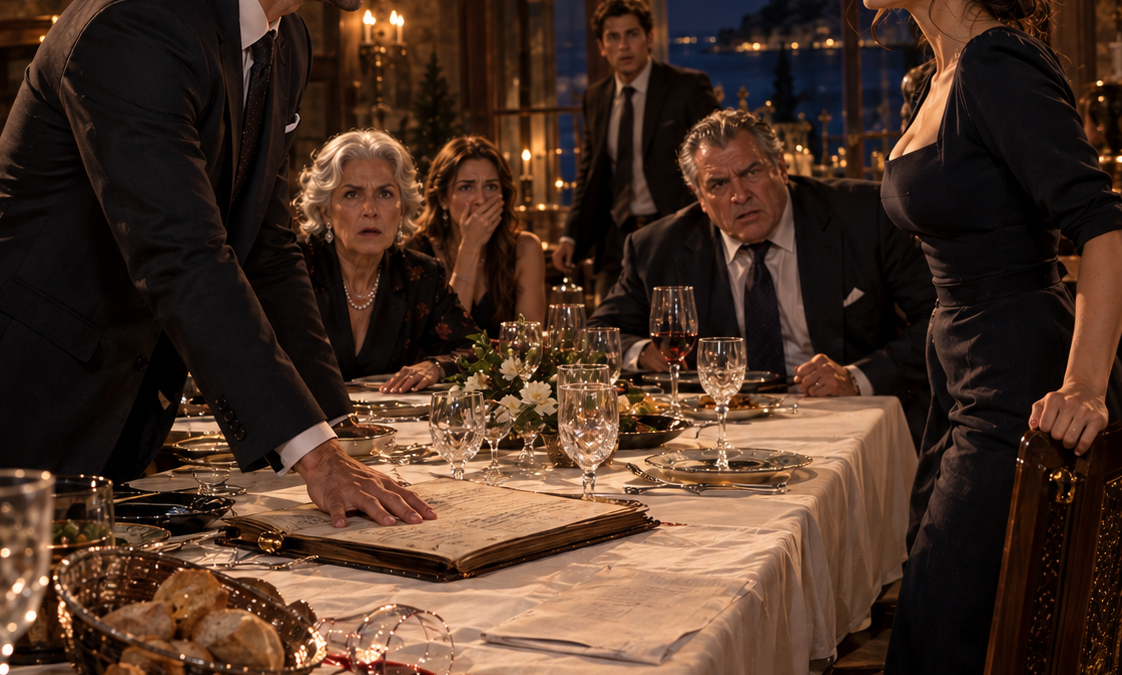
“I’m not going to kill you. And in this city, that’s a declaration of love.”
She was sent to expose his family’s crimes. She never expected to fall for the man who was already burning it all down.
The manifest was wrong. Elena Vitale knew it before she’d finished reading the third line.
She sat in the fluorescent glare of the customs office at the Port of Genoa, a Styrofoam cup of espresso cooling at her elbow, and traced the batch number with her pen. *AR-2749-03.* The coded prefixes were standard — region of origin, production year, lot number. But the suffix didn’t match the harvest records she’d pulled from the consortium’s database at six that morning. AR-2749-03 was supposed to be a 2022 batch. According to the certification papers, it was 2023.
Two-year-old oil sold as new. A minor fraud, on its face. The kind of thing that happened when a producer was trying to dump old stock before it went rancid.
Except this was the fourth time in six weeks that the Arcuri family’s export arm had shipped a batch with mismatched dates, and Elena had stopped believing in coincidences somewhere around the second one.
She reached for her phone, scrolled to the anonymous text she’d received forty minutes ago — the one that had sent her digging through the port’s digital manifest system in the first place.
Check AR-2749-03 before it clears. Don’t trust the paperwork.
No sender ID. The number was a burner, she’d already confirmed that much. Just like the previous three messages, each one arriving in the dead hours before dawn, each one precise enough to make her skin prickle.
She should have forwarded it to her supervisor immediately. That was protocol. Instead, she’d spent the past forty minutes doing exactly what the anonymous texter had wanted her to do — digging.
“Vitale.”
She looked up. Marco Ferraro, her supervisor, stood in the doorway of her cubicle, arms crossed over his paunch. Fifty-three years old, twenty of them spent in customs enforcement, and in the three months since Elena had transferred to his unit, she’d learned that he had two modes: bored and territorial.
“You’re still here,” he said. “It’s almost nine.”
“I found something.” She held up the manifest. “Arcuri shipment. The batch dates don’t match the harvest records. Fourth time this quarter.”
Ferraro’s expression didn’t change. “And?”
“And that’s a pattern. Someone at Arcuri Export is falsifying certification papers, and either they’re doing it badly or—”
“Or they’re doing it deliberately, and you’re looking at a clerical error.” He stepped into the cubicle, plucked the manifest from her hand, and scanned it with the air of a man who’d already decided what he was going to say. “The Arcuris have been exporting from this port for forty years. Their paperwork is handled by three different administrative offices. You think a mismatched date is worth flagging?”
“I think four mismatched dates in six weeks is worth a conversation.”
Ferraro set the manifest down. “You know who Matteo Arcuri is?”
“Of course I do.”
“Then you know that if you file an inquiry into his family’s export arm, you’re not just flagging a clerical error. You’re starting a war with a man who owns half the shipping infrastructure in this city. The last analyst who tried to audit an Arcuri shipment spent eight months fighting a defamation suit before she resigned.”
Elena kept her voice level. “I’m not trying to audit anyone. I’m trying to do my job.”
“Your job is to clear legitimate shipments and flag obvious violations. Not chase conspiracy theories based on anonymous tips.”
The room went very still. Elena felt the blood drain from her face — just slightly, just enough that Ferraro noticed. His eyes narrowed.
“How did you know about the tips?”
Elena didn’t answer.
“Vitale.” Ferraro’s voice dropped. “How long have you been receiving them?”
“Three weeks,” she said, because lying would only make it worse. “Maybe four. They come in at odd hours. No sender ID. Always about Arcuri shipments.”
“And you didn’t report them.”
“I was verifying them first.”
“You were verifying them,” Ferraro repeated, and there was something in his tone — not anger, exactly. Something closer to resignation. “You think this is a whistleblower.”
“I think someone is trying to warn us about counterfeit goods before they cross the border. That’s not a crime.”
“No. It’s a rival family trying to sabotage a competitor.” He said it flatly, like he’d already decided. “You’ve been here three months. You don’t know how this city works yet. The Arcuris and the Battaglias have been at each other’s throats for two decades. Every few years, one side tries to get the other’s shipments seized on technicalities. It’s a game. You’re being played.”
“I’m not being played.”
“You’re being used.” Ferraro picked up the manifest again, folded it in half, and slid it into his jacket pocket. “I’m pulling you off Arcuri accounts. Effective immediately. You’ll focus on the northern shipping lanes until further notice.”
“You can’t—”
“I can, and I am.” He turned toward the door. “Go home, Vitale. You look like you haven’t slept in a week.”
She hadn’t. But that wasn’t the point.
“One more thing,” Ferraro said, pausing in the doorway. “If you receive another one of those texts, you forward it to me immediately. No investigating. No verifying. You forward it. Understood?”
Elena said nothing.
“I said, understood?”
“Understood.”
He left. She sat alone in the fluorescent hum of the cubicle, staring at the empty space where the manifest had been, and tried to decide what to do next.
The obvious answer was to comply. Ferraro was right about one thing — she’d been at this posting for three months, and she didn’t fully understand the politics. The Arcuris were powerful. The Battaglias were ruthless. And somewhere in the middle of their feud, someone was sending her batch numbers with surgical precision, and she had no idea why.
But the batch number was wrong. That part wasn’t political. That part was fact.
She opened her laptop, pulled up the port’s departure schedule for the next forty-eight hours, and found the Arcuri shipment logged for 06:00 tomorrow morning. AR-2749-03. Destination: Marseille.
She stared at the screen for a long moment. Then she closed it, grabbed her coat, and walked out into the cold Genoa night.
She didn’t notice the man in the gray coat watching her from the far end of the parking lot. He’d been there for two hours. He had a burner phone in his pocket with her number saved under a false name, and he’d been the one sending the texts.
He watched her drive away, then pulled out his phone and typed a single message to an unlisted number.
She’s digging. Might need to intervene.
The reply came four minutes later.
No. Let her dig. She’s the first honest one we’ve had.
Matteo Arcuri slid the phone back into his pocket and stood in the shadows a moment longer, watching the taillights disappear into the city. Then he turned and walked toward his car — a nondescript sedan, nothing like the armored SUVs his security team preferred — and drove home to the villa on the hill, where his mother was waiting with dinner and questions he didn’t want to answer.
CHAPTER 2: The Man in the Gray Coat
The notification arrived on Elena’s phone at 3:47 a.m.
Don’t let them ship AR-2749-03. It’s cut with industrial oil. Not just mislabeled — dangerous.
She sat up in bed, heart pounding, and read it three times. Then she was out of bed, pulling on clothes, grabbing her laptop and her credentials. The drive to the port took twenty minutes at that hour, the streets empty and slick with recent rain.
The Arcuri shipment was scheduled for loading at 06:00. If she wanted to stop it, she had less than three hours.
She told herself she was doing the right thing. She told herself the text was credible — the sender had been right three times before, even if the batches had cleared without incident. She told herself that industrial oil cut into olive oil wasn’t just fraud, it was a public health hazard. It could sicken people. Kill them, if the contamination was severe enough.
She told herself all of this as she pulled into the port’s administrative parking lot and badged through security.
But the truth was simpler and harder to admit: she was angry. Ferraro had pulled her off the account, confiscated her manifest, and treated her like a naive outsider. And she was tired of being treated like she didn’t know what she was doing.
She’d spent eight years in customs enforcement. She’d worked fraud cases in three countries. She knew a false manifest when she saw one.
She just didn’t know who was on the other end of those texts.
The loading dock was already active when she arrived — lights blazing, forklifts moving pallets of shrink-wrapped containers toward the waiting cargo ship. She scanned the area for the Arcuri shipment, found it near Bay 4, and walked toward it with the deliberate calm of someone who had every right to be there.
A man stepped into her path.
He was tall, dark-haired, wearing a gray coat that looked expensive in a way that didn’t advertise itself. Late thirties, maybe early forties. Sharp cheekbones, a jaw that looked like it had been set in concrete, and eyes the color of winter sea.
“You’re not authorized to be here,” he said.
Elena held up her credentials. “Customs enforcement. I need to inspect that shipment.”
“No, you don’t.”
“I have reason to believe the contents don’t match the manifest.”
“I know what you have.” His voice was low, controlled, with a Sicilian accent he’d mostly smoothed away. “You have an anonymous tip from someone you can’t identify, and a supervisor who already told you to drop it. Go home, Ms. Vitale.”
She went cold. “How do you know my name?”
He didn’t answer. Just stood there, blocking her path, his expression unreadable.
“You’re Arcuri,” she said slowly. “Aren’t you.”
“Matteo Arcuri.” He said it like it meant nothing, like it was just a name and not the weight of an empire behind it. “And you’re about to make a very serious mistake.”
“Am I? Because from where I’m standing, a shipment of counterfeit oil is about to leave this port, and you’re standing in the way of me inspecting it.”
“You don’t want to inspect that shipment.”
“I don’t care what I want. I care about what’s legal.”
Something flickered in his eyes — not anger, exactly. Something closer to amusement. Or maybe respect.
“That’s the first honest thing anyone’s said to me in a month,” he said. “Fine. Inspect it.”
He stepped aside.
Elena blinked. She hadn’t expected that. She’d expected resistance, obstruction, a call to his lawyers. Instead, he was letting her through.
“I want to see the certification papers,” she said.
“They’re in the container. Sealed.”
“Open it.”
He looked at her for a long moment. Then he pulled a set of keys from his pocket and walked toward Bay 4. Elena followed, her pulse loud in her ears.
The container was one of a dozen, all bearing the Arcuri logo — a stylized olive branch wrapped around the letter A. Matteo unlocked the first one, pulled the door open, and gestured inside.
“After you.”
She stepped in. The container was packed floor to ceiling with shrink-wrapped cases of olive oil, each one labeled with the Arcuri name and the batch number AR-2749-03. She pulled a box free, slit the plastic with her pocketknife, and opened the carton inside.
The bottles were dark green glass, sealed with gold foil. She pulled one out, held it up to the light.
The oil inside was a deep, cloudy amber — the color of a batch that had gone off.
“Smell it,” Matteo said from the doorway.
She uncapped the bottle and inhaled. The scent hit her like a wall — not the grassy, peppery aroma of good olive oil, but something acrid and chemical. Like motor grease.
“It’s not cut with industrial oil,” she said slowly. “It is industrial oil.”
Matteo didn’t respond.
“You’re shipping industrial oil labeled as olive oil. That’s not fraud, that’s—” She stopped. “That’s poison. If someone cooks with this—”
“They’d get sick. Yes.” His voice was flat. “That’s the point.”
Elena stared at him. “You’re admitting it?”
“I’m not admitting anything. I’m telling you what’s in the bottle. What you do with that information is up to you.”
“Up to me?” She laughed, short and sharp. “You just showed me a container full of contaminated oil and told me to do what I want? That’s not how this works. I’m seizing this shipment. I’m filing a report. I’m—”
“You’re going to file a report on Matteo Arcuri,” he said, “and by the time it crosses your supervisor’s desk, the container will be gone, the certification papers will be clean, and you’ll be the analyst who filed a false complaint against the most powerful family in Sicily. You’ll be transferred. Maybe fired. And the oil will still ship — just from a different port, on a different manifest, with a different batch number.”
The words landed like stones in her chest.
“You can’t—”
“I can. I have. Three times before.” He stepped closer, and she caught the scent of him — clean, sharp, something like cedar. “The only reason you’re standing here is because I let you. The only reason you know what’s in that bottle is because I showed you. So ask yourself, Ms. Vitale: why would I do that?”
She didn’t have an answer.
“I’m not the villain here,” he said quietly. “But you already decided I was before you ever met me. That’s the problem with tips from anonymous sources. They never tell you the whole story.”
He turned and walked out of the container, leaving her standing in the dim light with a bottle of poison in her hand and the cold certainty that she had just walked into something far bigger than a customs violation.
CHAPTER 3: The Audit
The call came at seven that morning. Elena was still in her car in the port parking lot, staring at the container that had been sealed, loaded, and shipped while she watched.
“Vitale,” Ferraro said. “My office. Now.”
She’d expected that. What she hadn’t expected was the man sitting in the chair across from Ferraro’s desk when she arrived — Matteo Arcuri, in a different gray coat, looking like he owned the building.
Which, she was starting to understand, he probably did.
“Ms. Vitale,” Ferraro said. “Mr. Arcuri has requested a third-party audit of his family’s export operations. In light of your recent… concerns, I’ve agreed to assign you as the lead analyst.”
Elena’s mouth opened. Closed.
“I’m sorry?”
“You heard me. You’ll have full access to Arcuri Export’s records — manifests, certifications, production logs. You’ll work out of their head office in Palermo for the next three months. You’ll report directly to me.”
“That’s—” She looked at Matteo, who was watching her with an expression that gave nothing away. “That’s not how audits work. The analyst is supposed to be independent. I can’t report to you and work inside his company.”
“You can and you will,” Ferraro said. “Consider it a compromise. Mr. Arcuri has graciously agreed to cooperate with our investigation. In return, we’re not going to embarrass his family with a public inquiry.”
“An investigation into what, exactly? You said there was no case.”
“I said you had no case. Mr. Arcuri has a different concern. It seems someone inside his own operation may be tampering with shipments. He wants it found.”
Elena turned to Matteo. “You want me to find the person who’s been sending me those texts.”
“I want you to find out who’s been sabotaging my family’s business,” he said. “The texts are part of that.”
“The texts are from someone inside your operation. Someone who knows exactly which batches are compromised.”
“Or someone who’s creating the compromises and then pointing you at them.” He leaned forward, elbows on his knees, and his voice dropped. “I didn’t ask for this audit, Ms. Vitale. Your supervisor did. He thinks I’m hiding something. Maybe I am. But if you want to find out what’s really happening in my company, you’ll need to come inside it.”
The room was very quiet.
“And if I refuse?”
“Then you’ll be reassigned to the northern lanes, like Ferraro wanted. And you’ll spend the rest of your career wondering what you missed.”
Elena looked at Ferraro, who was studying the ceiling. Then at Matteo, who was studying her.
She’d spent eight years fighting for a seat at tables like this. She’d clawed her way through a male-dominated field, endured the condescension, the harassment, the endless small humiliations. And here was a man offering her exactly what she’d been fighting for — access, authority, a chance to prove herself.
But it was on his terms. In his territory. Under his roof.
It was a trap. She knew it was a trap.
“Three months,” she said.
“Three months,” Matteo agreed.
“I want unrestricted access to your servers. I want to interview your staff without your supervision. I want the right to pull any file, any manifest, any production log without asking permission.”
“Granted.”
“And I want it in writing. A contract, signed and notarized, specifying the terms of my employment and my independence. If I find something, I report it to Ferraro — not to you.”
Matteo smiled. It was the first time she’d seen him do it, and it was not a warm expression. It was the smile of a man who’d just been handed the exact thing he wanted.
“Ms. Vitale,” he said, “I think this is the beginning of a beautiful adversarial relationship.”
CHAPTER 4: The House on the Hill
The Arcuri estate sat on a hill above Palermo, a sprawling compound of stone and glass that had been in the family for six generations. Elena’s driver — a silent man named Luca who addressed her only as signorina — pulled through the iron gates at dusk on her first evening, and she watched the city lights spread out below like a sea of stars.
She was given a suite in the east wing. It was larger than her entire apartment in Genoa. She stood at the window for a long moment, looking out at the valley, and tried to remember why she’d agreed to this.
Because you want to know, she told herself. Because someone is sending you tips and you need to find out who.
The first dinner was an ordeal.
She’d expected Matteo, and maybe a few of his executives. Instead, she found herself seated at a table of twelve — his mother, his sister, his uncle, a cousin she couldn’t place, and several people who might have been business associates or might have been family. The distinction seemed blurred here.
His mother, Caterina, sat at the head of the table. She was a small woman in her seventies, dressed in black, with sharp eyes that tracked Elena’s every move.
“So,” Caterina said as the soup was served, “you’re the auditor.”
“Yes, signora.”
“And you think my son is a criminal.”
“I think there are irregularities in your family’s export operations that need to be investigated.”
“Irregularities.” Caterina repeated the word like it tasted bad. “My husband built this business from nothing. He was a farmer, you know. He planted the first trees with his own hands. And now a girl from Genoa comes to tell us we have irregularities.”
“Mother,” Matteo said quietly.
“No, let her answer.” Caterina’s gaze didn’t waver. “Tell me, signorina. When you walk through my house, do you see a criminal empire? Or do you see a family?”
Elena set down her spoon. “I see a family,” she said. “And I see a business. And sometimes the two are hard to tell apart.”
A silence fell.
Then Matteo’s sister, Lucia, laughed — a bright, sudden sound that cut through the tension. “I like her,” she said. “She doesn’t flinch.”
“She’s a fool,” Caterina said. “But a brave fool. That’s something.”
The dinner continued. Elena answered questions about her background, her education, her family. She told them her father had been a prosecutor, that he’d died when she was nineteen, that she’d joined customs enforcement because she wanted to do something that mattered.
“You could have been a prosecutor,” Lucia said. “Like your father.”
“I didn’t want to be like my father.”
“Why not?”
Elena hesitated. “Because he spent his whole life chasing people he could never catch. And in the end, they were the ones who destroyed him.”
She didn’t elaborate. She didn’t have to. The table understood.
After dinner, she found Matteo on the terrace, smoking a cigarette and looking out at the valley. She hadn’t known he smoked.
“You handled my mother well,” he said without turning around.
“I handled her honestly.”
“That’s what I said.” He took a long drag, exhaled into the night air. “She’s testing you. She tests everyone. Don’t take it personally.”
“I don’t.”
“You will.”
Elena leaned against the railing, a careful distance away. “Why did you agree to this audit? You could have blocked it. You have enough power.”
“Yes.”
“So why didn’t you?”
He was quiet for a long moment. Then he stubbed out the cigarette and turned to face her.
“Because someone in my company is trying to destroy my family,” he said. “And I don’t know who. The tips you’ve been receiving — I’ve been receiving similar warnings. Anonymous. Precise. Accurate. Someone is trying to expose the counterfeits, but not to the authorities. To someone who can stop them.”
“You.”
“I don’t know.” He looked at her, and for a moment, the mask slipped — just a fraction, just enough that she saw something underneath. Exhaustion. Fear. Something like loneliness. “That’s why I need you.”
“You need an auditor.”
“I need someone I can trust.”
“You don’t even know me.”
“No,” he said. “But you’re the only person in this whole godforsaken city who hasn’t asked me for anything. You didn’t want my money. You didn’t want my favor. You just wanted to do your job.”
He stepped closer. Elena’s breath caught.
“I’m offering you the truth, Ms. Vitale,” he said. “If you can handle it.”
The terrace was very quiet. Somewhere below, a night bird sang.
“Why should I trust you?” she asked.
“Because I’m not going to kill you,” he said. “And in this city, that’s a declaration of love.”
He walked inside, leaving her alone on the terrace with the cold wind and the feeling that something had just shifted under her feet.
Shall I continue with Act 2?
CHAPTER 5: The Ledger Room
The audit began at eight the next morning in a room on the third floor of the Arcuri Export building — a long, narrow space lined with filing cabinets and a single oak table that had clearly been chosen because it looked imposing.
Elena didn’t care about the table. She cared about the records.
“These are the production logs for the past five years,” said the man who’d escorted her in — a nervous, thin-shouldered accountant named Paolo who kept adjusting his glasses. “Mr. Arcuri said you’re to have full access. But if you need anything translated—”
“I read Italian.”
“Of course. Of course.” He hovered near the door. “The, uh, the computer system is password-protected. I can give you the guest credentials—”
“I want the master credentials.”
Paolo’s face went pale. “I don’t have those.”
“Then find someone who does.”
He fled. Elena sat down, opened the first ledger, and began to read.
The Arcuri family had been exporting olive oil for forty-three years. The records were meticulous — every harvest logged, every batch numbered, every shipment documented with the precision of people who understood that paperwork was the difference between a thriving business and a criminal investigation.
She worked through the morning without looking up. By noon, she’d mapped the basic structure of the operation: three production facilities, two bottling plants, a distribution network that stretched across Europe and into North America. The batch numbers followed a clear pattern — AR for the Arcuri name, followed by a four-digit production code, then a two-digit year identifier, then a lot number.
AR-2749-03. 2022 harvest. Lot three.
Except the certification papers claimed 2023. And the oil inside was industrial-grade poison.
Someone had swapped the contents of the container after it was sealed. That was the only explanation. The batch number was legitimate — the oil was not.
Which meant someone inside the operation had access to the sealed containers. Someone with authority. Someone who knew exactly which batches to compromise and when.
She was still working when the door opened at two in the afternoon and Matteo walked in.
He was wearing the same gray coat, but he’d loosened his tie, and there was a smudge of something dark on his collar — engine grease, maybe. He looked like a man who’d been doing something physical, not sitting in an office.
“You missed lunch,” he said.
“I’m not hungry.”
“You’ve been in here for six hours.”
“Seven.” She didn’t look up from the ledger. “Your records are thorough. Almost too thorough.”
“What does that mean?”
“It means that for a company with something to hide, you keep very good books.” She finally looked at him. “Which suggests either you’re innocent, or you’re very good at hiding things.”
“Or both.”
“There’s no both. You’re either hiding something or you’re not.”
He walked to the table, pulled out the chair across from her, and sat down. Close enough that she could smell the cedar again, and something underneath it — smoke, sweat, the faint metallic tang of machinery.
“What did you find?” he asked.
“Nothing yet. But I’ve only gotten through the first two years.” She closed the ledger. “Tell me about your father.”
Matteo’s expression didn’t change, but something in his posture shifted — a slight tightening, like a man bracing for impact.
“Why?”
“Because he built this company. Because the batch coding system is his design, and it’s unusual. Most exporters use standard international codes. Your father created his own system, with its own logic. I want to understand it.”
“He was a farmer,” Matteo said. “He didn’t trust institutions. He didn’t trust governments. He wanted a system that only he could read.”
“Only him?”
“Only him and whoever he chose to teach.” He paused. “Me.”
“So you’re the only one who understands the full code?”
“Now, yes. He died four years ago.”
Elena filed that away. “And the batch numbers — the ones that have been compromised. Did you flag them yourself?”
“I flagged the first one. The second and third, I didn’t know about until your supervisor called me.”
“Someone sent you the numbers too.”
“Yes.”
“Do you still have those messages?”
He pulled out his phone, scrolled through it, and slid it across the table. Elena picked it up and read.
The messages were identical in tone to the ones she’d received — terse, precise, anonymous. But there was one difference: the sender had used a different number each time. Three different burners.
“Whoever this is,” she said, “they’re being careful. They know you’re tracking communications.”
“They know everything,” Matteo said. “That’s what worries me.”
He reached for the phone, and his fingers brushed hers. The contact was brief — barely a second — but Elena felt it like a current. She pulled her hand back and busied herself with the ledger.
“I need to interview your staff,” she said. “Starting tomorrow.”
“Anyone in particular?”
“Everyone who has access to sealed containers. Everyone who handles certification papers. And your family.”
Matteo’s mouth curved. “My family won’t like that.”
“Your family doesn’t have to like it. They just have to answer questions.”
He studied her for a moment. Then he stood, buttoned his coat, and walked to the door.
“Ms. Vitale.”
She looked up.
“You’re the first person who’s ever come into this building and asked about my father,” he said. “Most people pretend he never existed. They think it’s easier that way.”
“Easier for whom?”
He didn’t answer. He walked out, and the door closed behind him with a soft click.
CHAPTER 6: The Mother’s Table
The interviews began the next morning, and by the end of the first day, Elena had spoken to fourteen employees. By the end of the second day, twenty-three. By the end of the week, she’d interviewed everyone who had access to the sealed containers, and she was no closer to an answer than she’d been on day one.
They were all loyal. That was the problem. Every single one of them — from the forklift operators to the certification clerks — spoke about the Arcuri family with a kind of fierce, protective devotion that made Elena’s skin prickle. They weren’t just employees. They were retainers, in the old sense of the word. People whose families had worked for the Arcuris for generations. People who would rather go to prison than betray the family name.
She was sitting in the ledger room at nine on a Friday night, staring at a spreadsheet that refused to make sense, when Caterina Arcuri walked in.
The old woman moved slowly, leaning on a cane, but her eyes were as sharp as they’d been at dinner. She walked to the table, sat down across from Elena, and set a covered dish between them.
“You haven’t eaten,” she said.
“I ate.”
“You ate a biscuit at your desk. I saw you.” She lifted the cover, revealing a small bowl of pasta with sardines. “Eat.”
Elena opened her mouth to refuse, then closed it. The smell was overwhelming — rich, salty, deeply Sicilian. Her stomach growled.
She ate.
Caterina watched her in silence for a long moment. Then she said, “You’re wasting your time.”
“Am I?”
“Looking for a traitor. There isn’t one.”
“Someone is sending anonymous tips about compromised shipments. Someone has access to your containers. That’s not nothing, signora.”
“It’s someone from the outside. Someone who wants to destroy us.”
“Your son thinks it’s someone from the inside.”
“My son thinks too much.” Caterina leaned back in her chair. “You know what this family has survived? Wars. Famine. The fascists. The Americans. The Battaglias.” She said the rival name with particular venom. “We’ve been in this business for six generations. Do you think we’d be brought down by a few bad bottles?”
“Signora, this isn’t about a few bad bottles. This is about industrial oil being shipped as food. People could die.”
Caterina’s expression didn’t change. “People die every day. In this city, they die from poverty, from violence, from the government’s neglect. A few bottles of bad oil is not the tragedy you think it is.”
“It’s a crime.”
“It’s business.”
Elena set down her fork. “Is that what your husband would have said?”
The air in the room went cold.
Caterina’s eyes narrowed. “You didn’t know my husband.”
“No. But I know he built this company with his own hands. I know he designed a coding system so complex that only he and his son could read it. I know he spent forty years building a reputation for quality. And I know that someone is using his system to destroy that reputation.” She met the old woman’s gaze. “I don’t think that’s business. I think that’s personal.”
Caterina was silent for a long moment. Then she stood, slowly, leaning heavily on her cane.
“You’re clever,” she said. “My son thinks he can control you. He can’t. That’s why he likes you.”
“He doesn’t—”
“He does. I know my son.” She walked to the door, then paused. “Be careful, signorina. In this family, cleverness is a weapon. And weapons have a way of turning in the hand.”
She left.
Elena sat alone with the empty bowl and the feeling that she’d just been warned about something she didn’t fully understand.
 [Tap here for the Next Part ]

