“I’ve been watching you for months, Ms. Petrova. Your work, your reputation, your record. You’re exactly what I needed.”
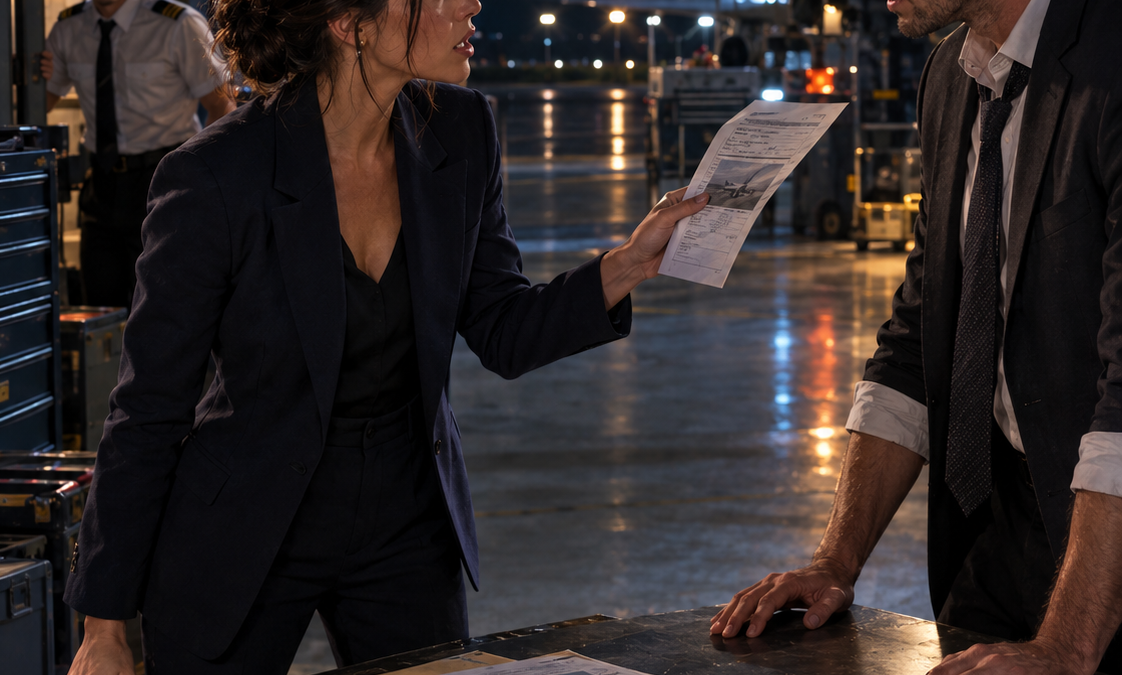
“I’ve been watching you for months, Ms. Petrova. Your work, your reputation, your record. You’re exactly what I needed.”
She thought she was investigating a criminal. She never expected to fall in love with the man trying to stop one.
Chapter 1: The Weight of Evidence
The folder hit the polished oak of Dmitri Volkov’s desk with a sound like a gunshot.
“You want to explain why three crew members on last Tuesday’s Berlin run have manifest weights that don’t match their physical profiles?”
Natalia Petrova stood on the other side of the desk, her back straight, her hands steady at her sides. She’d spent six years as an aviation safety inspector for the Federal Air Transport Agency, and in those six years, she’d learned that the only way to survive an encounter with a man like Dmitri Volkov was to never let him see you sweat.
The office was a monument to controlled power — floor-to-ceiling windows overlooking the private hangars of Volkov Air Cargo, a desk carved from a single slab of Siberian oak, and behind it, a man who’d built an empire on the bones of his enemies. The Bratva connections were an open secret in certain circles. The legitimate aviation business was the public face. The rest was rumor and blood.
Dmitri didn’t look at the folder. He looked at her.
“You’re new,” he said. His voice was low, unhurried, the voice of a man who’d never needed to raise it to be heard. “The previous inspector — Mikhailov — he understood how things worked.”
“Mikhailov retired.” Natalia kept her voice level. “I don’t.”
She was thirty-two years old, with dark hair pulled back in a practical twist and eyes the color of winter slate. She wore a plain navy blazer, no jewelry, nothing that could be used to categorize her as anything other than what she was: a government auditor with a clipboard and a mandate. But she was aware, acutely, of the way Dmitri’s gaze moved over her — not with desire, but with the cold assessment of a man cataloging a potential threat.
“Three crew members,” Dmitri repeated slowly. He leaned back in his chair, and for the first time, he glanced at the folder. “You flagged this yourself?”
“The anomaly was flagged by the automated system. I’m the one who decided it warranted an in-person audit.” She paused. “Your airline has had six manifest discrepancies in the past four months. That’s a pattern, Mr. Volkov. And patterns get investigations.”
Something shifted in his expression. It was subtle — a micro-tension in his jaw, a flicker in those pale gray eyes — but Natalia caught it. She’d been trained to catch it. The question was what it meant.
“An investigation,” he said. Not a question.
“A formal review of your crew manifests, cargo logs, and flight records. If I find evidence of systematic fraud or trafficking-related activity, I’m obligated to escalate to federal authorities.” She let that land. “You have forty-eight hours to provide documentation or I file my preliminary report.”
Dmitri stood.
He was taller than she’d expected — she’d seen him in photographs, of course, the CEO of Volkov Air Cargo at various industry events, always in a tailored suit with a beautiful woman on his arm. But photographs flattened him. In person, he was a presence, a wall of controlled violence wrapped in charcoal wool and a silver watch that probably cost more than her annual salary.
“You’re thorough,” he said. “I appreciate that in an employee.”
“I’m not your employee.”
“No.” He walked around the desk, and Natalia had to fight the urge to step back. “You’re my auditor. Which means, for the next forty-eight hours, you’re going to be spending a great deal of time here. In my building. Under my roof.”
“I’ll be conducting interviews and reviewing records, yes.”
“Then let me make something clear.” He stopped a foot away from her. Close enough that she could smell his cologne — cedar and something darker, like smoke. “Whatever you think you’ve found, whatever pattern you think you see — you’re wrong. Volkov Air Cargo moves freight. Medical supplies, machine parts, agricultural equipment. Nothing more.”
“Then you won’t mind proving it.”
His mouth curved. It wasn’t a smile. It was the expression of a predator deciding whether the thing in front of him was prey or something more interesting.
“Forty-eight hours,” he said. “I’ll have my legal team prepare the documentation.”
“Documentation isn’t enough. I need access to your flight crew. All of them. And I need to inspect the aircraft assigned to next week’s Munich run.”
“The Munich run is scheduled for Thursday. Six days from now.”
“Then you’d better hope I finish my audit before then.” Natalia picked up her folder. “Because if I don’t, that flight doesn’t leave the ground.”
She turned and walked out of his office, her heels clicking against the marble floor in a rhythm that she willed to stay steady. She didn’t look back. She never looked back.
But she felt his gaze on her the entire way out, and she knew, with the certainty of someone who’d spent her career navigating the egos of powerful men, that Dmitri Volkov was not a man who let things go.
The Volkov Air Cargo terminal was a sprawling complex on the eastern edge of the city, a labyrinth of hangars, warehouses, and administrative buildings that had been in the Volkov family for three generations. The original business had been a single cargo plane and a handful of routes. Now it was a fleet of forty-seven aircraft, routes spanning three continents, and a reputation that was, depending on who you asked, either impeccable or terrifying.
Natalia had done her homework. She knew that Dmitri’s father, Viktor Volkov, had built the business from nothing — or rather, from the kind of “nothing” that involved smuggling Soviet-era weapons across borders in the chaos following the fall of the USSR. Viktor had died eight years ago, a heart attack that some whispered was a poisoning, and Dmitri had taken over at twenty-nine. Under his leadership, the company had gone legitimate. Mostly.
The Bratva connections remained. They always did.
But Natalia wasn’t here to investigate organized crime. She was here because of the manifests. Because three crew members on a Berlin run had listed weights that were, according to the physical profiles in their employment files, off by a combined total of nearly two hundred kilograms. Because the same pattern had appeared on five other flights, always on routes that passed through countries with weak border controls, always with crew members who’d been hired in the past eighteen months.
It could be fraud. It could be trafficking. It could be something else entirely, something she hadn’t yet imagined.
What it couldn’t be was nothing.
She set up her workspace in a small conference room adjacent to the crew scheduling office and began pulling records. The documentation was meticulous — suspiciously so. Every manifest accounted for, every crew member’s weight logged, every cargo container sealed and certified. If someone was running something illegal through this airline, they were doing it with the precision of a Swiss watchmaker.
At 9:47 PM, the door opened.
Natalia looked up from her laptop to find a woman standing in the doorway — early fifties, sharp-featured, with the kind of expensive blond bob that screamed “trophy wife” until you noticed the intelligence in her eyes. She wore a cream-colored suit and carried a leather briefcase that matched her shoes.
“You’re the auditor,” the woman said.
“I’m an auditor. And you are?”
“Katya Volkov.” She extended a hand. “Dmitri’s mother.”
Natalia shook it. Katya’s grip was firm, brief, and assessing.
“I heard you’re threatening to ground the Munich flight,” Katya said, settling into the chair across from Natalia without waiting for an invitation. “That would be… inconvenient.”
“Inconvenient for whom?”
“For everyone.” Katya’s smile was thin. “The Munich run carries medical equipment for a children’s hospital. If it’s delayed, people suffer. I’m sure you understand.”
“I understand that my job is to ensure the safety and legality of every flight under this company’s banner. If the documentation clears, the flight leaves on time.”
“And if it doesn’t?”
Natalia met her gaze. “Then it doesn’t.”
Katya studied her for a long moment. Then she laughed — a sound that was surprisingly warm, given the ice in her eyes.
“You’re not going to be easy, are you?”
“I’m not here to be easy, Mrs. Volkov. I’m here to do my job.”
“I see.” Katya stood, smoothing her skirt. “Well, Ms. Petrova, I wish you luck. My son is… complicated. But he’s not stupid. Whatever you think you’ve found, he’ll have an explanation.”
“Then I look forward to hearing it.”
Katya paused at the door. “One more thing. You’re staying in the guest quarters on the fourth floor, correct?”
“Yes.”
“The fourth floor is Dmitri’s private wing. He keeps a suite there for… guests.” The pause was deliberate. “You’ll be very close to him. I hope that won’t be a problem.”
Natalia’s stomach tightened, but her expression didn’t change. “I’m a professional, Mrs. Volkov. I don’t have problems with proximity.”
“Good.” Katya smiled again. “Because my son has a way of making people forget they’re professionals. It’s one of his talents.”
She left, and Natalia sat in the silence, listening to the hum of the building’s climate control and the distant rumble of a plane taking off from the runway beyond the windows.
She’d been set up. The “guest quarters” on the fourth floor weren’t a courtesy. They were a message: We know where you are. We’re watching you. And we’re not afraid.
She pulled up the manifest data again and stared at the numbers. Two hundred kilograms of unaccounted weight. Three crew members whose physical profiles didn’t match their logged weights. Six flights with the same pattern.
What was Dmitri Volkov moving through his airline?
And why did she get the sense that he’d been expecting her?
Chapter 2: The Wolf’s Den
The fourth floor of the Volkov Air Cargo administrative building was not what Natalia had expected.
She’d anticipated something austere — the kind of cold, minimalist luxury that rich men used to intimidate. Instead, the hallway outside her assigned suite was warm, lined with photographs of aircraft through the decades, and smelled faintly of coffee. The suite itself was larger than her apartment: a bedroom with a king-sized bed, a sitting area with a leather sofa and a bookshelf stuffed with aviation manuals and Russian novels, and a bathroom with heated floors.
It was, she realized with irritation, designed to make her comfortable.
She didn’t want to be comfortable. She wanted to find the truth, file her report, and get out of this building before Dmitri Volkov’s world swallowed her whole.
But at 11:23 PM, when she was still awake, staring at her laptop screen and trying to make sense of a set of cargo logs that seemed deliberately opaque, she heard a sound from the hallway.
Footsteps. Slow, deliberate. Then a knock at her door.
She opened it to find Dmitri, still in his suit but with his tie loosened and his sleeves rolled up, looking less like a CEO and more like a man who’d been working late. He held two cups of coffee.
“You’re still awake,” he said.
“I’m working.”
“I noticed.” He held out one of the cups. “Black, no sugar. That’s how you take it, right?”
Natalia didn’t take the cup. “How do you know that?”
“I asked the crew scheduler. He’d seen you in the break room this afternoon.” Dmitri’s expression was unreadable. “I like to know the habits of people in my building.”
“I’m not in your building. I’m conducting an audit in your building. There’s a difference.”
“There is.” He took a sip of his own coffee, watching her over the rim. “But you’re still here. Still working. Which means you haven’t found what you’re looking for.”
“I’ve been here for six hours. I’ve barely scratched the surface.”
“Then let me save you some time.” He leaned against the doorframe, casual, as if he had all the time in the world. “The anomalies in the manifests are real. The weights don’t match the crew profiles. I know.”
Natalia’s pulse quickened, but she kept her voice steady. “You’re admitting that?”
“I’m admitting that there’s an explanation. One that has nothing to do with trafficking or fraud.” He paused. “The crew members in question are… contractors. They’re not regular employees. Their files in our system are placeholders, which is why the weights don’t match.”
“Contractors for what?”
“That’s the part I’m not going to tell you.” He straightened. “Not yet.”
“Then we’re at an impasse.”
“No. We’re at the beginning of a negotiation.” He set the coffee cup on the small table by her door. “You have forty-eight hours. I have something to protect. Let’s see who blinks first.”
He turned and walked away, his footsteps fading down the hallway.
Natalia stood in the doorway, staring at the coffee he’d left behind. Black, no sugar. The exact way she took it.
She closed the door and locked it, then leaned against the wood, her heart pounding.
He’d been watching her. He’d been gathering information about her. And he’d just told her, with a smile that didn’t reach his eyes, that he knew exactly what she was looking for and that she wouldn’t find it.
But here was the thing: he’d told her too much. If the anomalies were innocent, he wouldn’t have needed to approach her privately. He wouldn’t have needed to explain anything. A man with nothing to hide would have simply handed her the documentation and let her audit proceed.
Dmitri Volkov was hiding something. And he wanted her to know he was hiding something.
Which meant either he was playing a game she didn’t understand, or he was trying to distract her from something even bigger.
She sat back down at her laptop and opened a new file. Instead of focusing on the manifests, she pulled up the flight logs for the past six months — every route, every crew assignment, every cargo manifest. If there was a pattern, she’d find it.
At 2:17 AM, she found it.
Six flights. Six anomalies. But there was a seventh pattern, one she hadn’t noticed before: the flights with manifest discrepancies were always followed, within seventy-two hours, by a flight on a different route — always to a different country, always with a different crew. And those follow-up flights had their own anomalies, subtler but present. Crew members whose names appeared nowhere in the company’s official employment records. Cargo containers that were logged as “empty” but whose weights suggested otherwise.
Someone was moving people through this airline. Not as passengers. As crew.
And they were doing it right under Dmitri Volkov’s nose.
Or, she thought, with a cold knot forming in her stomach, with his full knowledge and cooperation.
She saved her findings and closed her laptop. Tomorrow, she would confront him. Tomorrow, she would demand answers.
But as she lay in the unfamiliar bed, staring at the ceiling, she couldn’t shake the memory of his voice: “That’s the part I’m not going to tell you. Not yet.”
Not yet.
As if there was a version of this story in which he would tell her. As if there was a version in which they weren’t enemies.
She closed her eyes and willed herself to sleep. But her last conscious thought was of the coffee he’d left on the table — still warm, still waiting, a small kindness from a man who’d just warned her not to cross him.
Chapter 3: The Sister
Morning came too fast.
Natalia woke at six, showered, dressed, and was in the conference room by seven. She’d requested interviews with the six crew members whose manifests had raised flags, and by eight, she had her first subject: a young woman named Anya Morozova, twenty-four, listed as a “cargo handler” on three of the suspicious flights.
Anya was small — barely five feet tall, with dark circles under her eyes and hands that trembled as she sat across from Natalia. She wore the standard Volkov Air Cargo uniform, but it hung on her like a borrowed skin.
“Thank you for coming in,” Natalia said. “I just have a few questions about your work history.”
Anya nodded, not meeting her eyes.
“How long have you been with the company?”
“Six months.”
“And before that?”
“I… worked in a factory. In Novosibirsk.”
“Novosibirsk.” Natalia made a note. “That’s a long way from here. What brought you to the city?”
Anya’s hands twisted in her lap. “A… job opportunity. A friend told me about it.”
“What friend?”
“I don’t remember his name. He was just… someone who helped me.”
Natalia set down her pen. “Anya, I’m not here to get you in trouble. I’m here because there are discrepancies in the crew manifests, and I need to understand why. If you’re being coerced into something, if someone is forcing you to—”
“I’m not being forced.” The words came out too fast, too loud. Anya’s eyes finally met hers, and Natalia saw something there — fear, yes, but also a desperate, pleading hope. “I’m not. I’m here by choice. I’m… I’m getting out.”
“Getting out of what?”
Anya’s mouth opened. Closed. She shook her head. “I can’t. I’m sorry. I can’t.”
“Anya—”
“I have to go. My shift starts in ten minutes.” She stood, her chair scraping against the floor. “Please. Don’t ask me any more questions.”
She was at the door before Natalia could stop her. But she paused, one hand on the frame, and spoke without turning around.
“Talk to the pilot. The one who flies the Berlin route. He knows more than I do.”
Then she was gone.
Natalia sat in the silence, her mind racing. Talk to the pilot. The Berlin route pilot was listed in the company records as Sergei Volkov — Dmitri’s younger brother.
She pulled up his file. Thirty years old, five years with the company, licensed for long-haul cargo flights. No red flags in his personnel record. No disciplinary actions. No complaints.
But he was family. Which meant he was either part of whatever Dmitri was hiding, or he was as in the dark as everyone else.
She needed to find out which.
The hangar was cold, the kind of cold that seeped through her blazer and settled in her bones. Natalia stood at the edge of the maintenance bay, watching as a crew of mechanics swarmed over a massive cargo plane — a Volkov Air Cargo 747, its fuselage gleaming under the industrial lights.
“You’re the auditor.”
She turned. The man approaching her was younger than Dmitri, with the same gray eyes but a softer jaw, a less controlled posture. He wore a pilot’s uniform, the wings on his chest polished to a shine.
“Sergei Volkov?”
“That’s me.” He stopped a few feet away, hands in his pockets. “My brother told me you’d be poking around. He said to cooperate.”
“Your brother is unusually accommodating.”
“He’s unusually smart.” Sergei’s mouth curved — not quite a smile, but close. “What do you want to know?”
“Your crew on the Berlin run. The manifest discrepancies. What do you know about them?”
Sergei’s expression didn’t change, but something flickered in his eyes. “I know that the manifests are accurate. Whatever discrepancies you’re seeing are… administrative errors.”
“Three crew members with weights that don’t match their profiles. That’s not an administrative error. That’s a pattern.”
“A pattern of what?”
“That’s what I’m trying to determine.”
Sergei was quiet for a moment. Then he said, “You’re not going to find what you’re looking for.”
“Because there’s nothing to find?”
“Because what you’re looking for isn’t in the manifests.” He met her gaze, and for a moment, Natalia saw something there — not guilt, not defensiveness, but something more complicated. Worry, maybe. Or warning. “My brother is a lot of things, Ms. Petrova. Some of them are not good. But he’s not a monster.”
“I never said he was.”
“You didn’t have to. I’ve seen the way people look at him. The way they look at this family.” Sergei shook his head. “There’s more going on here than you understand. And if you push too hard, you’re going to get hurt.”
“Is that a threat?”
“It’s advice.” He turned to walk away, then paused. “The Munich flight. The one you’re threatening to ground. Don’t.”
“Why not?”
“Because there are people on that flight who need it to leave the ground. People who’ve been waiting a long time for a way out.” He looked at her over his shoulder. “You want to help people, Ms. Petrova? Then let the flight go.”
He walked away, leaving Natalia standing in the cold, her mind spinning.
People who’ve been waiting a long time for a way out.
What did that mean? Who were these people? And why did Sergei’s warning feel less like a threat and more like a confession?
She pulled out her phone and typed a message to her contact at the Federal Air Transport Agency: I need background checks on six crew members. Priority. Names attached.
Then she went back to the conference room and started digging.
Chapter 4: The Fourth Floor
By the end of the second day, Natalia had interviewed four of the six crew members. Each one had been polite, cooperative, and utterly opaque. They answered her questions with the careful precision of people who’d been coached. They didn’t volunteer information. They didn’t make eye contact. And they all, without exception, found a reason to leave the room as quickly as possible.
But there was one thing they had in common: they were all afraid. Not of her — of something else. Something they wouldn’t name.
At 8 PM, she returned to her suite, exhausted and frustrated. She’d been in the building for two days, and she had nothing concrete. The documentation Dmitri had promised her was immaculate — every manifest, every cargo log, every crew file in perfect order. If there was fraud here, it was hidden behind a wall of paperwork so thick she couldn’t see the other side.
She was about to start reviewing the cargo logs again when her phone buzzed. A text from an unknown number:
The Munich flight can’t be delayed. People will die if it is.
She stared at the screen. Then she typed back: Who is this?
No response.
She tried to trace the number, but it was a burner — untraceable. Whoever had sent the message had gone to great lengths to remain anonymous.
People will die.
Was that a threat? A warning? Or something else entirely?
She thought of Sergei’s words in the hangar: People who’ve been waiting a long time for a way out.
She thought of Anya Morozova, her trembling hands and desperate eyes: I’m getting out.
And she thought of Dmitri, standing in her doorway, his voice low and steady: That’s the part I’m not going to tell you. Not yet.
What if she’d been wrong about him? What if the anomalies in the manifests weren’t evidence of a crime, but evidence of something else — something he was trying to hide from his own family, his own organization?
What if Dmitri Volkov was not the villain of this story?
She was still sitting there, phone in hand, when the door to her suite opened.
Dmitri stood in the doorway, his expression unreadable. He was still in his suit, but his hair was disheveled, as if he’d been running his hands through it.
“We need to talk,” he said.
“About what?”
“About the message you just received.” He stepped into the room, closing the door behind him. “I know who sent it. And I know what they’re trying to do.”
Natalia’s heart hammered, but she kept her voice steady. “Who sent it?”
“My mother.”
The words landed like a blow. “Katya? Why would she—”
“Because she knows what I’m doing. And she wants to stop me.” Dmitri’s jaw tightened. “My mother has been running the… less legitimate side of this business for years. I’ve been trying to shut it down. But she has other plans.”
“Plans that involve the Munich flight?”
“Plans that involve a shipment of… cargo. Not the kind that’s listed on the manifest.” He paused. “I’ve been working with the authorities. Quietly. To move victims out of a trafficking network that my family has been involved with for decades. The manifests you flagged — the weight anomalies — those aren’t errors. They’re deliberate. I’ve been moving people, not cargo. Women and children who were being trafficked through our routes. I’ve been smuggling them out.”
Natalia stared at him. “You’re… you’re the one who made the anomalies obvious.”
“I knew that if I flagged them subtly enough, an experienced auditor would catch them. And I knew that if the flight was grounded — for safety reasons, for administrative reasons, for any reason — it would delay the shipment my mother is planning. It would give me time to get the victims out through a different route.”
“You used me.”
“I used the system. The same system that should have been protecting these people all along.” He met her eyes. “I’m not asking for your forgiveness, Ms. Petrova. I’m asking for your help. The Munich flight leaves in four days. If it takes off with the cargo my mother has arranged, twelve people will be sold into slavery. If it’s delayed, I can get them out. But I need your report to be… convincing. I need you to ground that flight.”
Natalia’s mind raced. Everything she’d assumed, everything she’d built her investigation around, was wrong. Dmitri wasn’t the criminal. He was trying to stop one.
But he was still a Volkov. Still a man who’d grown up in a world of violence and power. And she had no proof that anything he’d just told her was true.
“Why should I believe you?”
Dmitri reached into his pocket and pulled out a small photograph. He handed it to her.
It was a picture of a young woman — dark-haired, gaunt, with the hollowed eyes of someone who’d seen too much. She was holding a child, maybe four years old, and behind them was a chain-link fence and a building that looked like a barracks.
“That was taken six months ago,” Dmitri said. “At a facility in Kazakhstan. The woman’s name is Irina. The child is her daughter. They were part of a group of twenty-three that my mother’s associates were moving through a network spanning six countries. I’ve gotten nineteen of them out. Irina and her daughter are supposed to be on the Munich flight.”
“Supposed to be?”
“She’s one of the crew members on the manifest. The weight discrepancy — it’s because she was listed as a cargo handler, but she’s actually a passenger. I’ve been forging crew records to get them out.”
Natalia looked at the photograph again. The woman’s eyes seemed to stare through her, pleading and hopeless and fierce all at once.
“If this is true,” she said slowly, “then why not just go to the authorities? Why the elaborate scheme?”
“Because my mother has people everywhere. In the police, in the government, in the agency you work for.” Dmitri’s voice was hard. “If I’d gone to the authorities, she would have found out. She would have shut me down. And the people I’m trying to save would have disappeared. This was the only way.”
“The only way was to trick a federal auditor into filing a false report?”
“The only way was to make the anomalies obvious enough that someone would investigate, but not so obvious that my mother would notice. I needed someone from outside the family, someone with authority, someone who couldn’t be bought. The moment I saw your file — your record, your reputation — I knew you were the one.”
“You’ve been planning this for months.”
“Years.” He paused. “I’ve been planning this since the day I found out what my family was doing. Since I found out that my mother had turned our father’s business into a pipeline for human misery.”
Natalia set the photograph on the table. Her hands were shaking, but her voice was steady.
“I need proof. Real proof. Not a photograph and a story.”
Dmitri nodded. “I’ll give you access to everything. The real manifests. The routes. The names of the people I’m trying to save. If you still want to file a report that grounds that flight, I won’t stop you. But if you want to help me — if you want to help them — then I need you to trust me.”
“Trust is earned, Mr. Volkov.”
“I know.” He met her eyes, and for the first time, she saw something beneath the control — something raw and tired and almost desperate. “I’m asking you to give me the chance to earn it.”
Natalia looked at the photograph. At the woman, at the child, at the hope and fear frozen in their faces.
She thought of the message on her phone: People will die.
She thought of Sergei’s warning: There are people on that flight who need it to leave the ground.
She thought of Anya Morozova: I’m getting out.
And she made a decision.
“All right,” she said. “Show me.”
Chapter 5: The Truth in the Dark
Dmitri led her through the building’s lower levels, past the hangars and the maintenance bays, to a small, unmarked door at the end of a service corridor. He unlocked it with a key card and a code, then gestured for her to enter.
The room beyond was nothing like the polished offices above. It was a war room — maps on the walls, photographs of faces pinned to corkboards, stacks of files on a metal table. In the corner, a bank of monitors displayed live feeds from security cameras around the complex.
“This is where I’ve been working,” Dmitri said. “The only people who know about this room are me, my brother, and two people I trust with my life. My mother doesn’t know it exists.”
Natalia walked to the corkboard, studying the photographs. Faces — dozens of them. Women, mostly, but some men. Children. All of them with the hollowed, haunted look she’d seen in Irina’s photograph.
“These are the victims?”
“These are the ones we know about. The ones we’ve been able to identify. There are more — hundreds more — that we haven’t been able to trace.” Dmitri’s voice was tight. “My family’s network spans Eastern Europe, Central Asia, the Middle East. They’ve been doing this for thirty years. My father started it. My mother… expanded it.”
“And you?”
“I found out when I was twenty-five. I’d just taken over the company, and I started noticing things. Anomalies in the cargo logs. Crew members who didn’t exist. Flights that didn’t make sense.” He paused. “I confronted my mother. She told me I could either be part of the business or I could be removed from it. Permanently.”
“But you stayed.”
“I stayed because leaving would have meant abandoning them.” He gestured at the photographs. “I couldn’t do that. So I started working from the inside. I built this room, this network, this plan. And I’ve been waiting for the right moment to strike.”
“The right moment being… me.”
“The right moment being someone from outside who could help me bring it down without tipping off my mother. Someone with the authority to ground flights, to demand investigations, to create chaos that I could exploit.” He met her eyes. “I’ve been watching you for months, Ms. Petrova. Your work, your reputation, your record. You’re exactly what I needed.”
“You manipulated me.”
“I used the system to get your attention. I made the anomalies obvious because I knew you’d catch them. And I knew you’d investigate.” He paused. “But I didn’t expect… this.”
“Expect what?”
“I didn’t expect to respect you.” The words came out rough, almost reluctant. “I’ve been dealing with people who look the other way, who take bribes, who pretend not to see. You didn’t. You came in here ready to tear apart my family’s business because you thought it was the right thing to do. That’s… rare.”
Natalia didn’t respond. She was still looking at the photographs, at the faces of people who’d been sold and used and discarded by the Volkov family’s empire.
“My mother is planning to move a shipment on the Munich flight,” Dmitri said. “Twelve people. Women and children. They’re being held in a warehouse near the airport. If that flight takes off, they’ll be gone. I won’t be able to save them.”
“So you need me to ground the flight.”
“I need you to file a report that raises enough red flags to delay it. A safety violation, a documentation error, anything that gives me forty-eight hours to move them through a different route.”
“And after that?”
“After that, I’ll have enough evidence to bring my mother down. I’ve been gathering it for years — financial records, witness statements, photographs. I just need time.”
Natalia turned to face him. “And what about me? What happens when your mother finds out I helped you?”
“She won’t find out. As far as she knows, you’re just an auditor doing your job.”
“And if she does?”
Dmitri was quiet for a moment. Then he said, “I’ll protect you. Whatever happens, whatever it costs, I’ll protect you.”
The words hung in the air between them, heavy with implications neither of them was ready to name.
Natalia looked at the photographs one more time. At Irina and her daughter. At all the others.
“All right,” she said. “I’ll help you. But I have conditions.”
“Name them.”
“First, I want full access. Everything — the records, the witnesses, the evidence. I’m not going to file a report based on your word alone.”
“Done.”
“Second, when this is over, you turn everything over to the authorities. Your mother, her network, the whole operation. You don’t protect anyone. Not even family.”
Dmitri’s jaw tightened, but he nodded. “Done.”
“Third.” She met his eyes. “You stop lying to me. About anything. I don’t care if it’s about the business or the weather. I want the truth.”
Something flickered in his expression — surprise, maybe, or something softer. “Done.”
“Then we have a deal.”
She held out her hand. He took it, his grip firm and warm.
“Thank you,” he said.
“Don’t thank me yet. We haven’t won anything.”
“No.” He released her hand, but his eyes stayed on hers. “But we’ve started.”
Chapter 6: The Weight of Secrets
The next three days were a blur of documents, interviews, and sleepless nights.
Natalia moved through the Volkov Air Cargo complex like a ghost, conducting her “official” audit while secretly building a file that could destroy the family that owned it. Dmitri gave her access to everything — the real manifests, the routes that didn’t exist on paper, the names of the people who’d been moved through the network over the years.
It was worse than she’d imagined.
The Volkov family had been trafficking human beings for three decades. Women from impoverished villages in Central Asia, lured with promises of work and then sold into brothels and factories. Children, some as young as five, taken from orphanages and shipped across borders like cargo. The network was vast, spanning six countries, and it was controlled by Katya Volkov with the precision of a general directing an army.
But Dmitri had been working against her for years. Slowly, carefully, he’d been dismantling the network from the inside — rerouting shipments, falsifying records, creating escape routes for victims who would otherwise have disappeared forever. He’d saved hundreds of people. He’d lost count of the ones he couldn’t save.
“They haunt me,” he said one night, sitting across from her in the war room. It was past midnight, and they were both exhausted, surrounded by empty coffee cups and stacks of paper. “The ones I couldn’t get to. The ones who were already gone by the time I found out.”
“You can’t save everyone.”
“I know. But I can try.” He looked at her, his eyes red-rimmed and tired. “That’s all I’ve been doing for seven years. Trying. Failing, mostly. But trying.”
Natalia set down her pen. “Why didn’t you go to the authorities? Years ago, when you first found out?”
“Because the authorities are compromised. My mother has people in every level of government. Police, prosecutors, even the agency you work for.” He paused. “That’s why I needed you. You’re not part of the system yet. You’re new enough that they haven’t gotten to you.”
“They’ll try.”
“I know. That’s why we need to move fast.”
She studied him across the table. In the dim light of the war room, with his tie discarded and his sleeves rolled up, he looked less like the ruthless CEO and more like what he was: a man carrying an impossible burden.
“Can I ask you something?”
“You can ask me anything.”
“Why did you stay? Why not just… walk away? Leave the family, leave the business, start over somewhere else?”
Dmitri was quiet for a long moment. Then he said, “Because if I left, no one would be left to stop her. And because…” He hesitated. “Because I loved my father. Even after I found out what he was. Even after I learned what he’d done. I loved him. And I couldn’t let his legacy be this.”
“His legacy is this.”
“I know.” He met her eyes. “That’s why I’m trying to change it.”
Natalia didn’t know what to say to that. So she said nothing, and after a while, they went back to work.
Chapter 7: The Proof
On the third day, Natalia found the evidence she needed.
It was buried in a set of financial records — accounts in the Cayman Islands, wire transfers to shell companies in Cyprus and Dubai, payments to individuals whose names matched the faces on Dmitri’s corkboard. The money trail was clear: Katya Volkov had been funding the trafficking network through a series of legitimate business transactions, using the airline as a front.
“This is it,” Natalia said, spreading the documents across the table. “This is what we need to bring her down.”
Dmitri leaned over her shoulder, studying the records. “How did you find this?”
“Your mother isn’t as careful as she thinks she is. She’s been using the same accounting firm for years — a firm in Zurich that’s known for… discretion. But they made a mistake.” She pointed to a highlighted line. “This transfer here — it’s flagged as a ‘consulting fee’ paid to a company that doesn’t exist. But the routing number matches an account I found in your father’s old records. An account that was supposed to have been closed when he died.”
“She kept it open.”
“She kept everything open. She’s been running the network on her own for eight years, using the infrastructure your father built.” Natalia looked up at him. “This is enough to bring her down. All we need now is a witness who’ll testify.”
Dmitri’s expression was grim. “I know someone. One of the women I helped escape. She’s been living in hiding for two years, but she’s agreed to testify if we can guarantee her safety.”
“Can we?”
“I’ll make sure of it.” He straightened. “We need to move fast. If we’re going to ground the Munich flight and get those twelve people out, we need to act in the next twenty-four hours.”
“Then let’s do it.”
 [Tap here for the Next Part ]