Part 2: “He’s my father. Not yours.” / “He’s the only father who ever treated me like a son.”
PART 4 — THE RESTRAINING ORDER
The hearing was set for Thursday at 9:00 A.M.
I spent Monday and Tuesday preparing. Patricia sent me a list of documents she needed. Staff statements. Medical records. The emails from Roy’s account. Everything I’d gathered and everything I was still gathering.
Delia came through. She got me six statements from staff members who’d witnessed Edward’s decline. A nurse named Carla who’d documented the medication gaps. An aide named Marcus who’d found Edward on the floor the night of the fall. A physical therapist named Jenna who’d noted that Edward’s mobility had decreased significantly over the past six months — a decrease that couldn’t be explained by Alzheimer’s alone.
“They’re scared,” Delia told me. “They don’t want to lose their jobs. But they also don’t want to watch another resident die because of neglect.”
“Another resident?”
She was quiet for a moment. “We’ve lost three people in the past year. All of them were on the reduced supervision schedule. All of them were Evergreen patients.”
I felt something cold settle in my stomach.
“Were any of those deaths investigated?”
“No. They were all attributed to natural causes. But the staff knows. We talk. We see the pattern.”
“Will anyone testify to that?”
“Not publicly. They’re too afraid. But the statements I got you — those will help.”
I nodded. “Thank you, Delia. For all of this.”
“I’m not doing it for you,” she said. “I’m doing it for him. And for the ones we couldn’t save.”
Tuesday afternoon, Mike called.
“I found something,” he said. “About Veronica Cross.”
“What?”
“She’s not just on the board of Evergreen Holdings. She’s the primary shareholder. She owns forty percent of the company through a series of shell corporations.”
“That’s a conflict of interest.”
“That’s not all. She’s also been billing Willow Creek for consulting services. Fifty thousand dollars over the past year.”
“For what?”
“For ‘care management.’ Which is interesting, because she’s never met any of the residents she’s supposedly managing.”
I closed my eyes. Took a breath.
“So she’s been taking money from the facility while making decisions that cut costs and reduce care.”
“That’s the short version.”
“And Roy knows?”
“Roy’s been signing off on the invoices. He’s listed as the authorized family contact for billing purposes.”
I thought about Edward. About the two hours he spent on the floor. About the medication gaps and the unexplained falls. About the three residents who’d died.
“Mike,” I said. “I need you to do something for me.”
“What?”
“I need you to find out if any of those deaths were reported to the state. And if they weren’t — I need you to find out why.”
“You’re talking about a cover-up.”
“I’m talking about a pattern. And I’m going to prove it.”
Wednesday morning, two things happened.
The first was good news. Patricia called to confirm that the emergency guardianship petition had been accepted by the court. The hearing was on for Thursday morning.
“The judge is a woman named Helen Park,” she said. “She’s known for being tough on elder abuse cases. If we present our evidence well, she’ll listen.”
“What do we need to prove?”
“That Roy is unfit to serve as guardian. That he’s acted against Edward’s best interests. That there’s an alternative guardian who can provide better care.”
“That alternative being me.”
“Yes. But we need to be careful. The court will want to know why a son-in-law should be appointed over a blood relative. We need to make it clear that you’ve been the primary caregiver. That you’re the one who’s been showing up.”
“I have the visitation log,” I said. “Two years of Saturdays. My name is on every page.”
“That’s good. That’s very good.”
“What about the deaths?”
“We can mention them. But we need to be careful. We don’t have proof that Roy was directly responsible. We have proof that he was complicit. That he authorized the changes that led to the neglect.”
“Complicit is enough.”
“Complicit is enough,” she agreed.
I hung up and felt something like hope. It was a small thing, fragile, but it was there.
Then the second thing happened.
I was in my truck, driving to Willow Creek for my Wednesday visit, when my phone buzzed. A text from Delia.
Don’t come. Roy is here. He has a restraining order.
I pulled over to the side of the road.
What?
He filed for an emergency protective order. Against you. He says you’ve been harassing him and threatening him. The facility has to enforce it. You can’t come within 500 feet of the property.
I stared at the screen. My hands were shaking.
Can he do that?
He already did. I’m sorry.
I sat in my truck for a long time. The sun was setting behind me. The road was empty. Everything was quiet.
I’d been in dangerous situations before. I’d been shot at. I’d been in crashes. I’d been in places where the wrong move meant death. But I’d never felt this kind of helplessness. This kind of anger.
Roy was using the system to keep me away from Edward. He was using the law to isolate him. And there was nothing I could do about it.
Except fight back.
I called Patricia.
“He filed a protective order,” I said. “Against me. To keep me away from the facility.”
She was quiet for a moment. “That’s a problem.”
“I know.”
“How did he justify it?”
“He says I’ve been harassing him. Threatening him. The confrontation at the facility. The phone call. He’s painting me as the aggressor.”
“Did you threaten him?”
“I told him I’d go to the state if he kept me from seeing Edward. I told him I’d go to the media. I told him the truth.”
“That’s not a threat. That’s a warning.”
“The court might not see it that way.”
Patricia paused. “We need to respond. We need to file a counter-motion. Show the court that the protective order is retaliatory. That he’s using it to keep you from testifying.”
“Can we do that in time for tomorrow’s hearing?”
“We can try. But it’s risky. If the judge sides with Roy on the protective order, it could prejudice her against us in the guardianship hearing.”
“So what do we do?”
“We fight. We present our evidence. We show the court what Roy’s been doing. And we hope the judge sees through his lies.”
I closed my eyes. Took a breath. Let it out slow.
“Okay,” I said. “What do you need from me?”
“Everything. The emails. The visitation log. The staff statements. Your service record.”
“My service record?”
“Your military background. It shows you’re reliable. Disciplined. Someone who can be trusted with responsibility.”
“I don’t usually talk about that.”
“I know. But this is different. This is a courtroom. You need to show them who you are.”
I thought about the shadow box in my garage. The medals I never talked about. The missions I couldn’t discuss.
“Okay,” I said. “I’ll bring it.”
That night, I sat in my garage and opened the shadow box for the first time in years.
The medals were there. The Air Force Cross. The Purple Heart. The Airman’s Medal. The commendations I’d never framed, never displayed, never mentioned.
Underneath the medals was a photograph. My old team. Twelve men, standing in front of a helicopter. We were young. We were cocky. We were invincible.
Six of them were dead now. Three in combat. Two in training accidents. One by his own hand, years after he’d come home.
I looked at their faces. Remembered their names. Remembered the things we’d done together. The lives we’d saved. The people we’d lost.
That Others May Live.
That was the motto. That was the promise. We went in when everyone else ran out. We risked our lives so others could keep theirs.
I’d kept that promise for twenty-two years. And now I was going to keep it for Edward.
I closed the box and went inside.
Sarah was at the kitchen table, waiting for me.
“How bad is it?” she asked.
“Roy filed a protective order. I can’t go to the facility.”
Her face fell. “He can’t do that.”
“He did. But we’re going to fight it. The hearing is tomorrow. Patricia thinks we have a chance.”
“And if we lose?”
I sat down across from her. Took her hand.
“Then we find another way. We always find another way.”
She looked at me — that look again, the one that said she was seeing something she’d forgotten.
“You’re not worried,” she said.
“I’m always worried. But I’ve been through worse. And I’ve learned that worrying doesn’t help. Preparation helps. Action helps. So that’s what we’re going to do.”
She nodded. “Okay.”
“Get some sleep. Tomorrow’s going to be a long day.”
She went upstairs. I stayed in the kitchen for a while, thinking about the hearing. About Roy. About the judge who would decide Edward’s fate.
I’d been in situations where the odds were against me. Where the enemy had more men, more firepower, more advantages. I’d learned that the only way to win was to be smarter, faster, more determined.
Roy had money. He had lawyers. He had the weight of the system behind him.
But I had the truth. And the truth, if presented correctly, was the most powerful weapon of all.
Thursday morning, I put on my best suit.
It was a dark blue suit I’d bought for Sarah’s cousin’s wedding three years ago. It didn’t fit as well as it used to — I’d lost weight since then, from stress and from the hours I’d spent in the garage, working on this case. But it would do.
I looked at myself in the mirror. The gray in my hair. The lines around my eyes. The scar on my jaw from a training accident in my twenties.
I didn’t look like a hero. I didn’t look like someone who’d saved lives. I looked like a middle-aged man in a suit that didn’t quite fit.
But I knew who I was. I knew what I’d done. And I knew what I was going to do.
Sarah was waiting in the car. She was dressed in a gray blazer and a white blouse. Her face was calm, but her hands were shaking.
“Ready?” she asked.
“Ready.”
We drove to the courthouse in silence. The sky was gray. The streets were wet from rain the night before.
Patricia was waiting for us outside the courtroom. She was a tall woman with short gray hair and a no-nonsense expression.
“The judge is in a good mood,” she said. “That’s rare. Let’s not waste it.”
“What’s the plan?”
“We present our evidence. We call our witnesses. We make it clear that Roy has been neglecting his duties and that you are the only viable alternative.”
“And the protective order?”
“We’ll address it. But first, we focus on the guardianship. That’s the main event.”
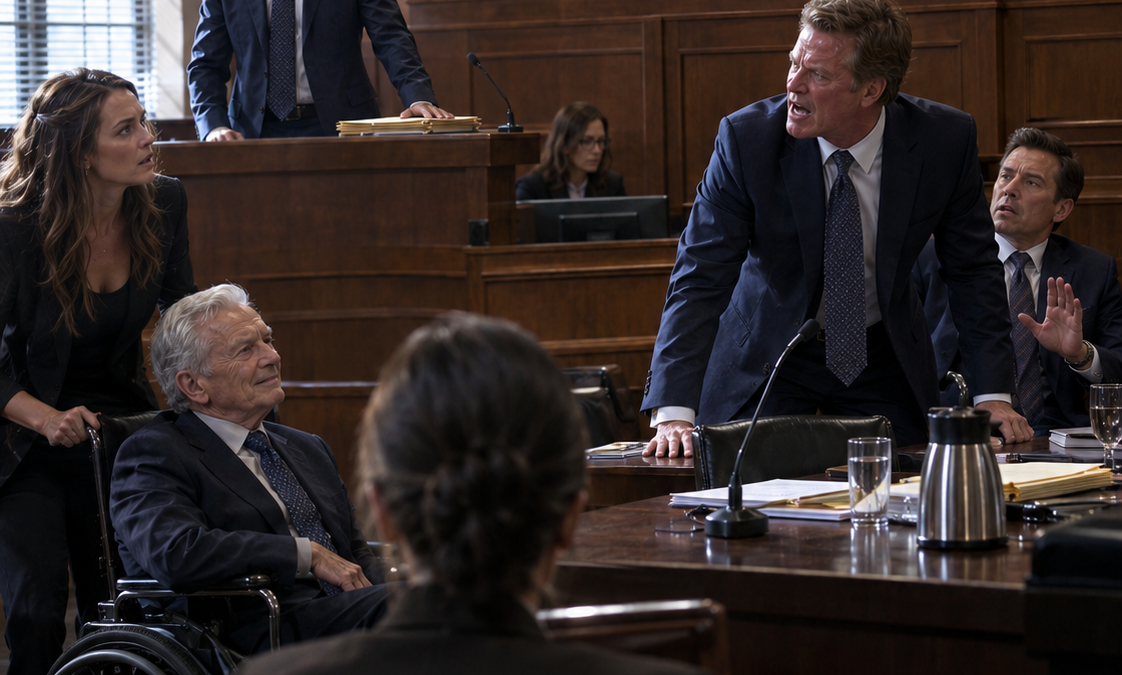
We walked into the courtroom. Roy was already there, sitting at a table with his lawyer — a slick man in an expensive suit. Veronica was beside him, dressed in a dark dress and pearls. She looked like she was going to a funeral.
Roy’s eyes met mine. He didn’t look away. Neither did I.
The bailiff called the court to order. Judge Park entered. She was a small woman in her sixties with sharp eyes and a no-nonsense expression.
“Be seated,” she said.
We sat.
The hearing began.
PART 5 — THE HEARING
Judge Park looked at the papers in front of her. Then she looked at Roy. Then she looked at me.
“Mr. Ashford,” she said to Roy. “You’ve petitioned for a protective order against Mr. Vance. Is that correct?”
Roy stood. His suit was navy, his tie was silk, his shoes were polished to a mirror shine. He looked like a man who’d spent his life in courtrooms and boardrooms, and expected them to go his way.
“Yes, Your Honor. Mr. Vance has been harassing me. He’s made threats. He’s shown up at my father’s facility unannounced and confronted me in front of staff.”
Judge Park made a note. “What kind of threats?”
“He said he would go to the state. He said he would go to the media. He accused me of things that aren’t true.”
“What things?”
Roy hesitated. “He accused me of neglecting my father. He accused my girlfriend of making decisions about my father’s care without proper authorization.”
“Were those accusations false?”
Roy’s lawyer stood. “Objection, Your Honor. The witness is being asked to characterize statements that are the subject of the guardianship petition.”
“Sit down, Mr. Hartley. I’ll allow it.” Judge Park turned back to Roy. “Answer the question.”
Roy’s jaw tightened. “Some of them were false. Some of them were… exaggerated.”
“Which ones were exaggerated?”
“I never neglected my father. I was busy. I have a business to run. But I made sure he was taken care of.”
“By whom?”
“By the staff at Willow Creek. And by my girlfriend, Veronica Cross, who has experience in healthcare management.”
I saw Patricia make a note. She was sitting beside me, calm and focused.
“Your Honor,” Patricia said. “May I respond?”
“Go ahead.”
Patricia stood. “The protective order Mr. Ashford has filed is retaliatory. It’s an attempt to keep Mr. Vance from testifying at today’s hearing. Mr. Vance is the primary caregiver for Edward Ashford. He has been visiting every week for two years. He has been the one taking Mr. Ashford to appointments, monitoring his care, and advocating for his needs.”
“Objection,” Roy’s lawyer said. “Counsel is testifying.”
“Sustained. Ms. Okonkwo, please present your evidence through witnesses.”
“Of course, Your Honor.”
Patricia called Delia first.
Delia walked to the witness stand. She looked nervous — her hands were clasped tightly in front of her, and her voice was soft when she swore the oath. But when she started talking, her voice got stronger.
“I’ve worked at Willow Creek for eleven years,” she said. “I’ve seen a lot of residents come and go. But I’ve never seen a family situation like this.”
“Can you describe what you observed regarding Edward Ashford’s care?” Patricia asked.
“His son rarely visited. Maybe four times in two years. But Mr. Vance came every week. Every Saturday, without fail. He knew Edward’s routine. He knew his medications. He knew what he liked to eat and what he didn’t. He was the one who noticed when things were wrong.”
“What kind of things?”
“When Edward started declining. When he stopped eating. When he had falls.” Delia paused. “And when his chart started showing medications being signed out but not administered.”
Roy’s lawyer stood. “Objection. Hearsay.”
“Overruled. The witness is describing what she personally observed.”
Delia continued. “I filed a complaint about the medication gaps. Nothing happened. I filed another complaint about the supervision levels being reduced. Nothing happened either. It wasn’t until Mr. Vance started asking questions that anything changed.”
“What changed?”
“The supervision level was restored. Edward is being checked on every two hours again. He’s eating better. He’s more alert.”
“And who authorized the original reduction in supervision?”
“According to the chart, it was authorized by Veronica Cross. She’s listed as a care consultant. But no one at the facility has ever met her.”
Patricia paused. “Thank you, Delia. No further questions.”
Roy’s lawyer stood for cross-examination.
“Ms. Delia, you said Mr. Vance visited every Saturday. Is that correct?”
“Yes.”
“And you said he was the one who noticed when things were wrong. Is that also correct?”
“Yes.”
“So would it be fair to say that Mr. Vance was acting as Edward’s primary caregiver?”
“I would say so, yes.”
“And yet Mr. Vance is not related to Edward by blood. He’s married to Edward’s daughter. Is that correct?”
“Yes.”
“So his authority to make decisions about Edward’s care is… limited. Wouldn’t you agree?”
Delia looked at him steadily. “I’m not a lawyer. I don’t know about authority. I just know who showed up.”
“No further questions.”
Judge Park made another note.
Patricia called Carla next. The nurse who’d documented the medication gaps.
Carla was younger than Delia, maybe thirty, with dark hair pulled back in a ponytail. She spoke quietly but clearly.
“I noticed the gaps about six months ago,” she said. “Medications were being signed out but there was no record of them being administered. I brought it to my supervisor. She said it was probably a documentation error.”
“How many times did this happen?”
“Dozens. I documented forty-seven separate instances.”
“And did you ever see anyone actually administer those medications?”
“No. They were signed out by someone else. Someone who wasn’t on shift.”
“Who was signing them out?”
“A name I didn’t recognize. Veronica Cross.”
Roy’s lawyer objected again. Overruled again.
Patricia called Marcus next. The aide who’d found Edward on the floor.
Marcus was a big man, maybe forty, with a kind face and tired eyes. He spoke slowly, like he was choosing every word.
“I was doing my rounds,” he said. “It was about one in the morning. I found Mr. Ashford on the floor of his room. He’d been there for a while. He was cold. He was confused. He couldn’t tell me how long he’d been there.”
“What did you do?”
“I got him back in bed. I checked him for injuries. He had a bruise on his hip. I reported it to my supervisor.”
“And what happened?”
“Nothing. The incident report just said ‘no injuries.’ But he had a bruise. I saw it.”
“Did you tell anyone about the discrepancy?”
“I told my supervisor. She said it wasn’t my job to question the report.”
Patricia paused. “Thank you, Marcus. No further questions.”
Roy’s lawyer cross-examined Marcus, trying to poke holes in his story. But Marcus was steady. He’d seen what he’d seen. He wasn’t going to change his story.
Then Patricia called me.
I walked to the witness stand. My heart was beating faster than I wanted it to, but my face was calm. I’d learned how to control my face a long time ago.
“Mr. Vance,” Patricia said. “Can you tell the court about your relationship with Edward Ashford?”
“He’s my father-in-law,” I said. “But he’s more than that. He’s the only father who ever treated me like a son.”
“How did you meet him?”
“I met him when I started dating his daughter Sarah. That was thirteen years ago. He was welcoming from the start. He never made me feel like I wasn’t good enough.”
“And your relationship with the rest of the family?”
I glanced at Roy. He was staring at me with cold eyes.
“Some of them felt differently. But Edward never did.”
“What did you do before you retired?”
“I served in the United States Air Force for twenty-two years.”
“What was your role?”
“I was a Pararescueman. A PJ. We were trained to go into hostile or dangerous environments to rescue people. Downed pilots, injured soldiers, civilians in disaster zones. We were the ones who went in when everyone else was running out.”
Patricia let that sit for a moment. Then she asked, “What did you do after you retired?”
“I moved back here with my wife. Her father was getting older. Someone needed to be around.”
“And that someone was you?”
“Yes.”
“Not his son?”
“No.”
“Why not?”
I looked at Roy again. “You’d have to ask him.”
“What did you notice about Edward’s care when you started visiting regularly?”
“I noticed that he wasn’t getting the attention he needed. His room was messy. His clothes weren’t being changed as often as they should be. He was losing weight. He was confused more often.”
“What did you do about it?”
“I started coming more often. Every Saturday, without fail. I talked to the staff. I learned his routine. I made sure he was eating. I made sure he was clean. I made sure someone was checking on him.”
“And did that help?”
“For a while. But then things started getting worse. His supervision level was reduced. His medications were being mismanaged. He had falls that weren’t properly documented.”
“How did you find out about the supervision level?”
“Delia showed me the chart. She’d filed a complaint, but nothing had happened.”
“What did you do?”
“I started documenting everything. I took photos of his chart. I collected statements from staff. I gathered emails from Roy’s account that showed he and his girlfriend were planning to move Edward to a facility six hours away.”
“Six hours away?”
“Yes.”
“Why would they do that?”
“According to the emails, they wanted to make decisions without family interference.”
Roy’s lawyer stood. “Objection. Hearsay. The emails haven’t been authenticated.”
“Your Honor,” Patricia said. “We have the emails. We have the account information. We can authenticate them.”
“Then do it,” Judge Park said.
Patricia submitted the emails into evidence. Roy’s lawyer tried to argue they’d been obtained illegally, but Patricia was ready. Sarah had access to the account as a family member. She’d discovered the emails while looking for something else. It was a gray area, but it was enough for the judge to allow them.
Judge Park read the emails. Her face didn’t change, but something in her eyes hardened.
“Mr. Vance,” she said. “You said you were a Pararescueman. What does that mean, exactly?”
“It means I was trained to save lives. In combat. In disasters. In situations where most people would give up.”
“How many lives did you save?”
“I don’t know the exact number.”
“Can you give me an estimate?”
I paused. “I was involved in over a hundred rescue missions. Some of them saved multiple people. Some of them… didn’t.”
“What was the hardest one?”
I thought about the mountain. The climber. The whiteout. The two days I’d spent carrying him down on my back.
“Denali,” I said. “A climber had fallen into a crevasse. He’d been there for two days. No one could get to him. The weather was too bad. But we went in anyway. We got him out.”
“How did you do that?”
“We didn’t give up. That’s all. We didn’t give up.”
Judge Park looked at me for a long moment. Then she looked at Roy.
“Mr. Ashford,” she said. “You filed a protective order against this man. You said he was harassing you. But from what I’ve heard today, he was the one visiting your father every week. He was the one making sure your father was safe. He was the one who noticed when things went wrong. What were you doing?”
Roy stood. His face was pale. “I was managing my father’s affairs. I was ensuring his financial security. I was—”
“You were ensuring your own financial security,” Judge Park interrupted. “You were putting your girlfriend on your father’s chart so she could make decisions that cut costs. You were planning to move him to a facility where no one could check on him. You were collecting money from a company that has a history of neglecting its residents.”
“Your Honor, I object—”
“Overruled. I’ve read the emails. I’ve seen the chart. I’ve heard the witnesses.” Judge Park leaned forward. “Mr. Ashford, this court takes elder abuse very seriously. And what I’m seeing here looks like a pattern of neglect that goes beyond simple carelessness.”
Roy’s lawyer stood. “Your Honor, my client has done nothing illegal. He has power of attorney. He has the right to make decisions about his father’s care.”
“He has the right,” Judge Park said. “But he also has the responsibility. And from what I’ve seen today, he’s failed in that responsibility.”
She looked at me.
“Mr. Vance, you’ve been the one showing up. You’ve been the one fighting for Edward’s care. You’ve been the one documenting what’s gone wrong. That matters to this court.”
“Thank you, Your Honor.”
“Don’t thank me yet.” She turned to the bailiff. “We’ll take a recess. I need to review the evidence. I’ll make my ruling in thirty minutes.”
The gallery cleared out. I stayed in the courtroom with Patricia. Sarah was outside, talking to Delia. Roy was in the hallway with his lawyer, his face red, his hands gesturing wildly.
“You did well,” Patricia said.
“I just told the truth.”
“That’s all it takes sometimes.” She paused. “The judge is going to rule in our favor. I can feel it.”
“You can’t know that.”
“I’ve been doing this for twenty years. I know.”
I wanted to believe her. But I’d learned a long time ago not to count on outcomes. You did the work. You prepared. You executed. But you didn’t assume the result.
You waited. You watched. You stayed ready.
The thirty minutes felt like hours. I sat in the hallway and stared at the wall. Sarah sat beside me and held my hand.
“What if we lose?” she asked.
“Then we appeal. Then we keep fighting.”
“And if we win?”
“Then we take your father home.”
She squeezed my hand. “I love you.”
“I love you too.”
The bailiff called us back in. Judge Park was already at the bench. Her face was unreadable.
“I’ve reviewed the evidence,” she said. “And I’ve made my decision.”
I held my breath.
“The protective order against Mr. Vance is denied. There is no evidence that he poses a threat to Mr. Ashford or his family. The evidence suggests the opposite — that he is a dedicated and consistent caregiver.”
Roy’s face went white.
“The petition for emergency guardianship is granted. Roy Ashford is removed as guardian of Edward Ashford. Effective immediately, Daniel Vance is appointed as emergency guardian of Edward Ashford, with all rights and responsibilities thereof.”
I closed my eyes. Let out the breath I’d been holding.
“This is an emergency appointment,” Judge Park continued. “A permanent guardianship hearing will be scheduled within sixty days. At that time, the court will review Mr. Ashford’s care and make a final determination. But for now, Mr. Vance has the authority to make decisions about Edward Ashford’s health and welfare.”
She looked at Roy.
“Mr. Ashford, you are ordered to turn over all documents related to your father’s care, including his medical records, his financial records, and any other relevant materials. You are also ordered to cease any actions that could interfere with Mr. Vance’s ability to care for your father.”
Roy stood. His voice was shaking. “This is ridiculous. He’s not even family.”
“He’s more family than you’ve been,” Judge Park said. “This court is adjourned.”
We walked out of the courtroom into the gray morning light.
Sarah was crying. Delia was hugging Patricia. Marcus and Carla were standing off to the side, looking relieved.
I just stood there. I’d been in a lot of situations. A lot of moments where the outcome was uncertain until the very end. But this was different. This wasn’t a mission. This was someone’s life. Someone I loved.
Roy walked past me without a word. His lawyer followed. Veronica was gone — she’d left during the recess, probably to make phone calls.
“Daniel,” Sarah said. “We did it.”
“We did it,” I said.
“Let’s go get him.”
I nodded. “Let’s go.”
We drove to Willow Creek together. The sun was coming out from behind the clouds. The streets were drying. The world looked different than it had that morning.
We walked into the facility. Delia was already there — she’d left the courthouse ahead of us, her face bright with a smile I’d never seen on her before.
“He’s in his room,” she said. “He’s been asking for you.”
I walked down the hallway. The same hallway I’d walked down every Saturday for two years. The same fluorescent lights. The same antiseptic smell.
Edward was sitting in his chair by the window. He looked up when I walked in.
“Daniel,” he said. “You came.”
“Always do.”
“I heard you were in court. Delia told me.”
“I was. We won.”
He smiled. A small smile, but a real one.
“What does that mean?”
“It means you’re coming home. With me and Sarah. We’re going to take care of you.”
He looked at me for a long moment. Then he reached out and took my hand.
“I knew you would,” he said. “I knew you wouldn’t give up.”
I squeezed his hand. “Never.”
We sat there for a while, watching the sun move across the floor. The same sun I’d watched with him every Saturday. The same light. The same room.
But everything was different now.
PART 6 — THE MOVE
We brought Edward home on a Friday.
I’d spent the week getting the house ready. The guest room on the first floor — the one that had been a storage space for years — was converted into a bedroom. Sarah picked out the curtains and the bedding. I installed grab bars in the bathroom and a ramp over the front steps.
Delia came by to help. She’d taken a leave of absence from Willow Creek — she said she couldn’t work there anymore, not after everything that had happened. She spent three days with us, setting up Edward’s room, organizing his medications, teaching Sarah and me how to handle the daily routines.
“You’ll need to check his blood pressure every morning,” she said. “And his oxygen levels. The pulse oximeter is on the nightstand. If the numbers drop below ninety, call the doctor.”
“What about his medications?”
“I’ve organized them by day and time. The pill organizer is on the kitchen counter. He needs to take them with food, or he’ll get nauseous.”
“Got it.”
“And Mr. Vance?”
“Yeah?”
“Talk to him. Not just about his care. About things he enjoys. His memories. His stories. The Alzheimer’s is going to get worse. But the more you engage with him, the longer he’ll stay present.”
I nodded. “I’ll do that.”
She looked at me for a moment. “You’re good at this. Taking care of people.”
“I’ve had practice.”
“I know. I looked you up.”
I paused. “You looked me up?”
“After the hearing. I wanted to know who I was working with.” She smiled. “You saved a lot of people, Mr. Vance. A lot of lives.”
“I was just doing my job.”
“That’s what heroes always say.”
I didn’t know what to say to that. So I just nodded and went back to installing the grab bars.
Edward arrived at noon.
I’d borrowed a van from Mike — something big enough to fit Edward’s wheelchair and his few belongings. Sarah rode in the back with him. I drove.
Edward looked out the window the whole way. He didn’t say much. He just watched the world go by, like he was seeing it for the first time.
When we pulled into the driveway, he turned to Sarah. “Is this your house?”
“It’s our house, Dad. Yours too, now.”
He looked at the house. A small ranch-style home with a big front porch and a garden that Sarah had been tending for years.
“It’s nice,” he said. “It’s… nice.”
We got him inside. He walked slowly, with a cane, but he walked. Sarah showed him his room. He looked at the bed, the window, the photograph of Margaret on the nightstand.
“Margaret,” he said. “She would have liked this room.”
“I think so too,” Sarah said.
He sat down on the bed. Looked around. Then he looked at me.
“Daniel,” he said. “Thank you.”
“You don’t have to thank me.”
“I do. I do have to thank you.” He paused. “I know what you did. I know you fought for me. I know you went to court. I know you didn’t give up.”
“Edward—”
“You’re a good man,” he said. “The best man I know. And I’m proud to call you my son.”
I felt something catch in my throat. I’d been called a lot of things in my life. Hero. Soldier. Pararescueman. But no one had ever called me son. Not my own father — he’d left when I was twelve and never looked back.
“Thank you,” I said. “That means more than you know.”
He nodded. Then he lay back on the bed and closed his eyes.
“I’m tired,” he said. “I think I’ll rest for a while.”
“Take your time,” I said. “You’re home now.”
The first week was hard.
Edward had good days and bad days. On the good days, he remembered who we were. He told stories about his childhood, about Margaret, about the insurance company he’d built from nothing. He asked about Sarah’s garden and my military service. He laughed at jokes and ate full meals.
On the bad days, he didn’t know where he was. He asked for Margaret, who’d been dead for three years. He tried to leave the house, saying he needed to get to work. He got angry when we tried to help him, accusing us of keeping him prisoner.
I’d learned patience in the Air Force. I’d learned how to stay calm when everything around me was chaos. But this was different. This was personal.
“There’s no manual for this,” Sarah said one night, after a particularly difficult day. “No training. No preparation.”
“No,” I agreed. “But we’re figuring it out.”
“We?”
“You and me. Together.”
She leaned into me. “I don’t know what I’d do without you.”
“You’d do fine. You’re stronger than you think.”
“I’m not. I’m not strong at all.”
I held her. “You are. You just don’t see it because you’re in the middle of it.”
We sat there for a while, listening to the quiet of the house. Edward was asleep. The night was still.
“I’m sorry,” Sarah said.
“For what?”
“For not seeing it sooner. For not standing up to Roy. For letting you fight alone.”
“You didn’t know.”
“I should have. I should have known what kind of man he was.”
“We all should have. But we know now.”
She was quiet for a moment. “What happens next? With Roy?”
“I don’t know. The permanent hearing is in sixty days. He could contest the guardianship. He could try to regain control.”
“Will he?”
I thought about Roy. About his face in the courtroom. About the way he’d looked at me.
“He might. But he’s in a difficult position. The judge saw through him. The evidence is against him. If he tries again, he’ll have to explain why he neglected his father for two years.”
“So we’re safe?”
“For now. We’ll deal with whatever comes.”
Mike called the next week.
“I’ve got more on Veronica,” he said. “The financial records. The consulting fees. It’s all documented.”
“How bad is it?”
“She billed Willow Creek for fifty thousand dollars in consulting services. She never provided any services. It was pure fraud.”
“Can we prove it?”
“We can prove it. The invoices are signed by Roy. The payments went to a shell company she controls. It’s a clear paper trail.”
“What about the deaths? The three residents?”
“I found something. The state did investigate one of them. A woman named Eleanor Reeves. She died six months ago. The cause of death was listed as a fall.”
“But?”
“She was on the reduced supervision schedule. Same as Edward. The investigation was closed after two weeks. No charges filed.”
“Who closed it?”
“A state inspector named Harold Grayson. He’s been working with Evergreen Holdings for years. He’s signed off on every inspection at their facilities.”
I closed my eyes. “He’s dirty.”
“He’s complicit. Maybe worse.”
“Can we use this?”
“We can try. But it’s risky. If we go after Grayson, we’re going after the state. That’s a bigger fight.”
“Edward almost died because of these people. Eleanor Reeves did die. Someone has to answer for that.”
“I know. But you need to be careful. You’ve already won the guardianship. Don’t jeopardize that.”
“I’m not jeopardizing anything. I’m just… gathering information.”
“Daniel—”
“I know. I’ll be careful.”
I hung up and sat in the garage. The challenge coins caught the afternoon light. That Others May Live.
I thought about Eleanor Reeves. A woman I’d never met. A woman who’d died alone because someone had decided she wasn’t worth the cost of proper care.
I thought about the other residents still at Willow Creek. Still on the reduced supervision schedule. Still waiting for someone to notice.
I couldn’t save all of them. I knew that. But I could make sure the people who’d hurt them faced consequences.
I picked up my phone and called Patricia.
“I have something,” I said.
“What?”
“A state inspector named Harold Grayson. He’s been covering up deaths at Evergreen facilities. Including one that was directly caused by the reduced supervision schedule.”
“Daniel, this is serious. If we go after a state official—”
“I know. But we have evidence. Financial records. Invoices. The paper trail is clear.”
Patricia was quiet for a moment. “Send me what you have. I’ll look it over. But I’m warning you — this could take months. Years. And it could put you and your family at risk.”
“I’ve been at risk before. It’s never stopped me.”
“Okay. Send it over. And Daniel?”
“Yeah?”
“You’re a good man. But you don’t have to do everything alone. Let me help.”
“You are helping.”
“I mean it. Don’t try to be a hero. Not this time.”
I thought about the mountain. The climber. The two days I’d spent carrying him down on my back.
“I’m not trying to be a hero,” I said. “I’m just trying to do what’s right.”
That night, Edward had a bad night.
He woke up at three in the morning, confused and scared. He didn’t know where he was. He didn’t know who I was. He tried to leave the house, saying he needed to find Margaret.
I sat with him for two hours. Talked to him in a calm voice. Told him stories about my missions. The time I’d rescued a pilot from a crashed helicopter. The time I’d jumped into a frozen lake to pull out a drowning child. The time I’d spent three days in the mountains with a broken leg, waiting for rescue.
“You were a soldier?” he asked.
“I was a rescuer,” I said. “I went in when everyone else ran out.”
“That’s what you do now,” he said. “You rescue people.”
“I try.”
“You rescued me.”
“I did.”
He looked at me for a long moment. His eyes were clear again. The confusion had passed.
“I remember,” he said. “I remember you coming to visit. Every Saturday. You always brought me books. I couldn’t read them anymore, but I liked looking at the pictures.”
“I know.”
“You never gave up on me.”
“Never.”
He reached out and took my hand. His grip was weak, but it was there.
“Thank you,” he said. “For not giving up.”
I squeezed his hand. “Get some rest, Edward. I’ll be here in the morning.”
He closed his eyes. Within minutes, he was asleep.
I sat there for a while, watching him breathe. The night was quiet. The house was still.
I thought about all the people I’d saved. All the lives I’d touched. All the missions I’d completed.
This was different. This wasn’t a mission. This was family.
But maybe that was the point. Maybe the real mission was always about the people you loved. The people you chose to protect. The people who needed you most.
I stood up. Walked to the door. Looked back at Edward one more time.
“I’ll be here,” I said. “Always.”
Then I went to bed.
 [Tap here for the Next Part ]


