Part 2: “He’s not strong, Mom. He’s broken. That’s the whole problem.”
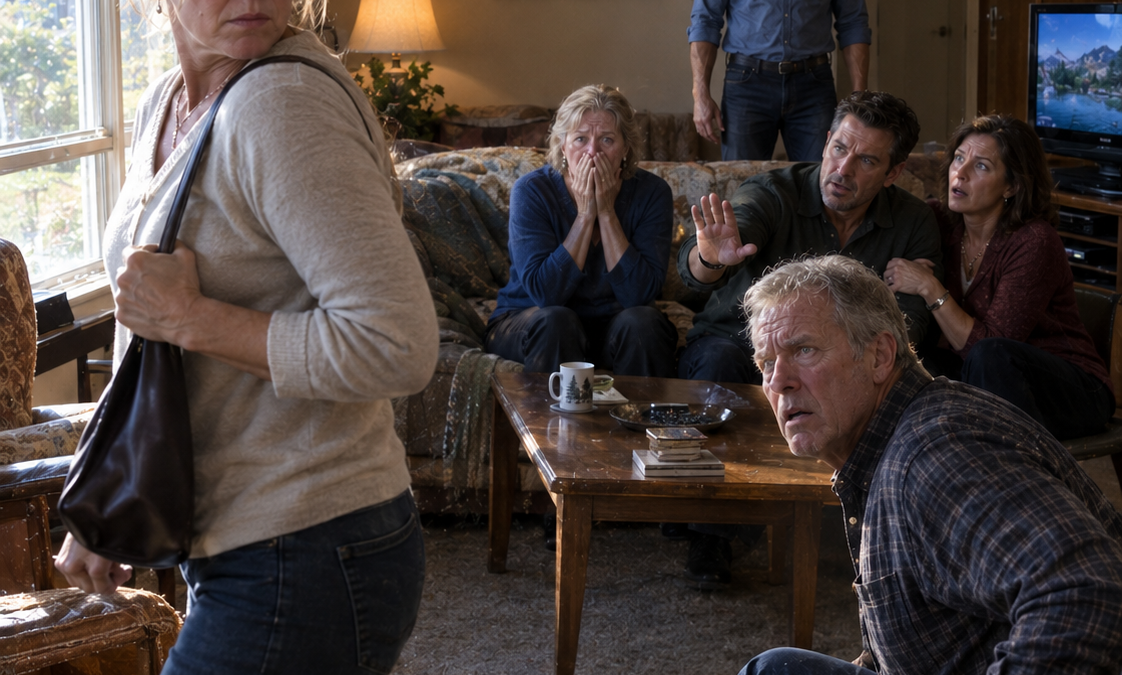
PART 5 — THE SIT-DOWN
The room was quiet for a long moment.
My father sat down in his recliner. He moved slowly now. Everything took longer than it used to. But his voice was steady when he spoke.
“I asked you all here because we need to talk about something. Something that’s been going on in this family for a long time.”
Karen shifted in her chair. She still hadn’t looked at me.
“I’m not going to make a speech,” my father said. “I’m going to say what I know and then we’re going to hear from Jack. That’s the plan.”
He looked at my mother. She nodded.
“Two years ago, after Christmas, Karen removed Jack from the family group chat. She told us she was doing it because Jack asked her to. She told us he wanted space. She told us he’d said things that night that made it clear he didn’t want to be part of this family anymore.”
Karen’s jaw tightened.
“We believed her,” my father said. “Because it was easier to believe her than to admit we’d done something wrong. We didn’t call Jack. We didn’t check. We just… let it happen.”
Uncle Jim leaned forward. “So what actually happened?”
My father looked at me. “Jack?”
I stood up. I didn’t need to. I just didn’t want to be sitting.
“What happened is that Karen lied,” I said. “She told you I said things I never said. She told you I’d blocked your numbers. She told you I’d stopped caring. None of that was true.”
Karen finally looked at me. Her eyes were hard.
“You can’t prove that.”
“I can.”
I took out my phone and pulled up the files. I didn’t read them aloud. I just held the phone up so everyone could see the screen.
“Phone records,” I said. “Two years of messages from the family chat. Messages from Karen’s phone to my parents’ phones. All of it. Sent to me by someone who knows how to find things.”
Karen’s face went white.
“You hacked my phone.”
“No. I hired someone to pull records that your phone carrier had. Same thing any lawyer could do in a lawsuit.”
“That’s illegal.”
“It’s not. And even if it were, it doesn’t change what’s in the messages.”
I looked at my parents.
“Some of you have already seen this. I sent it to everyone on that chat. I think it’s time we all looked at it together.”
I didn’t read everything. That would have taken hours. I read the worst parts.
The message where Karen told my mother I’d said I was glad my father was sick. The message where she told my father I’d called them a burden. The message where she called me a leech and said I’d try to take the house.
My mother cried. She didn’t try to hide it. She just sat there with tears running down her face and her hands in her lap.
My father didn’t cry. He listened with his jaw set and his eyes fixed on Karen.
Uncle Jim was the first to speak when I finished.
“Karen. Is this true?”
She didn’t answer.
“Karen.”
“It’s out of context.”
“Then give me the context.”
She looked around the room. At my parents. At Uncle Jim. At Aunt Paula, who was sitting with her hand over her mouth. At me.
“He made me do it,” she said.
“How?” I asked. Calm. Even.
“You know how. You came to that dinner and you dumped all your baggage on everyone. You made Mom cry. You made Dad uncomfortable. You sat there and told us about all the terrible things you’d seen and done and expected us to just… absorb it. Like we were your therapists.”
“I told you the truth.”
“You told us things we didn’t need to know.”
“Because you asked.”
“I asked what you were doing with yourself. Not for a trauma dump.”
I looked at her for a long moment.
“So you cut me out.”
“Yes.”
“And you lied about it.”
“I protected my parents.”
“From what?”
“From you.” She stood up. “From your problems. From your anger. From all of it. You think you’re the only one who’s suffered? You think you’re the only one who’s had a hard life? Mom and Dad don’t need to carry your issues. They have enough of their own.”
“Karen,” my mother said. Quietly.
“What?”
“Sit down.”
She didn’t sit down. But she stopped talking.
My father spoke. His voice was quiet but it carried.
“You lied to us for two years. You told us things about your brother that weren’t true. You made us believe he’d abandoned us. You made us believe he didn’t care.”
“I was trying to protect you.”
“That’s not protection. That’s control.”
Karen’s face twisted. “You don’t know what it’s been like. You don’t know what it’s like to be the one who has to hold everything together while he’s off in his cabin doing nothing.”
“Doing nothing,” I said.
“That’s right.”
“You don’t know what I’ve been doing.”
“I know you sit in the woods and feel sorry for yourself.”
I looked at her. I didn’t raise my voice. I didn’t step forward. I just stood there, the way I’d learned to stand when people said things meant to hurt.
“You’re right that I live in the woods. You’re right that I keep to myself. But you don’t know why.”
“Because you’re broken.”
“Because I spent twenty-two years in the Army. Because I deployed five times. Because I lost men I loved. Because I watched things happen that I will never be able to unsee. And because the one time I tried to tell my family the truth about it, they looked at me like I was speaking a foreign language.”
Karen opened her mouth, but I didn’t stop.
“You want to know what I was doing while you were holding everything together? I was in Iraq. I was in Afghanistan. I was leading men into places where people were trying to kill us. I was carrying wounded soldiers on my back. I was watching my friends die.”
“I didn’t ask you to do that.”
“No. But I did it. And when I came home, I didn’t ask for a parade. I didn’t ask for medals. I asked for one thing. I asked for someone to listen. And you couldn’t even give me that.”
The room was silent.
“Jack,” my mother said. Her voice was small.
“Let him finish,” my father said.
I looked at Karen.
“I’m not broken,” I said. “I’m different. There’s a difference. And the fact that you can’t see it says more about you than it does about me.”
Karen left.
She didn’t storm out. She just stood up, picked up her purse, and walked to the door. She stopped with her hand on the knob.
“You’ll regret this,” she said. To me.
“I don’t think I will.”
She looked at my parents.
“Are you going to let him talk to me like that?”
My father looked at her for a long moment.
“I think you should go home,” he said. “And I think you should think about what you’ve done.”
She stared at him. Then she opened the door and walked out.
The door closed behind her.
The room was quiet for a long time after that.
My mother was still crying. Uncle Jim was looking at the floor. Aunt Paula had her hand on my mother’s arm.
My father looked at me.
“Sit down, Jack.”
I sat.
“I should have done this two years ago,” he said. “I should have called you. I should have asked you what was wrong. I should have listened.”
“It’s okay.”
“It’s not okay.”
“I know.”
He nodded slowly.
“I want to know,” he said. “All of it. The things you tried to tell us. I want to hear them.”
“Dad—”
“I’m not asking as your father. I’m asking as a man who spent two years believing a lie. I want to know who my son really is.”
I looked at him. At my mother. At Uncle Jim.
“Okay,” I said. “But it’s not a short story.”
“We have time.”
So I told them.
I told them about basic training. About the first time I’d fired a weapon at another human being. About the first time I’d watched someone die.
I told them about Ramadi. About the night I’d carried a wounded team leader two miles through hostile streets with a broken collarbone. About the Silver Star I’d never mentioned because I didn’t think it mattered.
I told them about the men I’d lost. Gonzalez. Miller. Stevens. I said their names out loud for the first time in years.
I told them about coming home. About the nightmares. About the way crowds made me nervous and loud noises made me flinch. About the way I’d learned to live with it, to manage it, to keep going.
I didn’t tell them everything. Some things don’t need to be said. But I told them enough.
When I finished, my mother was crying again. My father was looking at me like he’d never seen me before.
“I didn’t know,” he said.
“I know.”
“I should have known.”
“You couldn’t have. I didn’t tell you.”
“You tried. That Christmas. You tried to tell us and we didn’t listen.”
I nodded.
“Jack,” my mother said. “The Silver Star. What does that mean?”
“It means I did something they thought was worth recognizing.”
“What did you do?”
I looked at her. “I carried a man out of a firefight. He lived. That’s all.”
“That’s all,” she repeated.
“It’s not nothing,” my father said.
“No,” I said. “It’s not.”
Uncle Jim and Aunt Paula left around nine. Uncle Jim shook my hand at the door. He held it for a long time.
“I’m proud of you,” he said. “I don’t know if anyone’s told you that. But I am.”
“Thank you.”
“You ever need anything, you call me. I mean it.”
“I will.”
They left. My mother went to bed. My father and I sat in the living room.
“You should stay the night,” he said.
“I should get home.”
“Stay. There’s a guest room. It’s made up.”
I looked at him. He was tired. He was old. But there was something in his face I hadn’t seen in years.
“Okay,” I said. “I’ll stay.”
I didn’t sleep well. I never do in strange beds. But I slept.
In the morning, I made coffee and sat in the kitchen with my father. The sun was coming up. The house was quiet.
“What happens now?” I asked.
“I don’t know.” He sipped his coffee. “Karen will come around. Or she won’t. That’s up to her.”
“And you?”
“I’m going to call you. Every week. And you’re going to answer.”
“Okay.”
“And I want to know about your life. The cabin. Your daughter. All of it.”
“Okay.”
He nodded. We sat in silence for a while.
Then he said, “I’m proud of you too.”
I didn’t say anything. I just nodded.
I drove home that afternoon. The road was clear. The sky was blue. I called Maya from the truck.
“How did it go?”
“It was hard.”
“Are you okay?”
“I think so.”
“What happened?”
I told her. Not everything. But enough.
When I finished, she was quiet for a moment.
“Are you going to be okay with Aunt Karen?”
“I don’t know. That’s up to her.”
“Are you going to forgive her?”
I thought about it.
“I don’t know if forgiveness is the right word. But I’m not going to carry this. I’ve carried enough.”
“That’s good, Dad.”
“Yeah.”
“I love you.”
“I love you too, kiddo.”
PART 6 — THE POST GOES WIDE
The veterans’ blog ran the story three days after the family dinner.
Not the whole story. Just a short piece titled “Family Rift Turns Public: Oregon Veteran Accused of Hacking Sister’s Phone.” The reporter had done what reporters do — she’d reached out to both of us and gotten a response from Karen. She printed it.
Karen’s statement: “My brother has been struggling with mental health issues for years. He’s refused treatment. My family and I are doing everything we can to protect our elderly parents. I just want him to get help.”
My statement: “No comment.”
I didn’t read the comments. That’s a rule I learned a long time ago. The comments are where the worst parts of the internet live, and I didn’t need to see them. But Terry called me the next day and read me a few.
“You want to hear this?”
“Not really.”
“You’re going to want to hear this.”
So he read them.
Most were supportive of Karen. Praying for this family. Sounds like he needs help. Why is he harassing his sister?
But there were a few that surprised me.
One from a user named GhostStalker75: This guy’s sister is full of it. I know Jack Calloway. He was a Ranger. 2nd Batt. Deployed to Ramadi in 2005. I served with him. Whatever his sister is saying about him, it’s garbage.
Another from SOTCPete: Jack Calloway was in the same AO as my unit in 2006. Ran a mission with him once. He’s the real deal. If his family doesn’t know that, that’s on them.
I sat in my kitchen and looked at the screen.
I hadn’t given the reporter my full name. She’d used it anyway — Karen had mentioned it in her statement. And now men I hadn’t talked to in fifteen years were popping up in the comments to defend me.
I hadn’t asked them to. I hadn’t even known they’d seen it.
I closed the laptop and sat there for a minute.
Then I picked up my phone and called Terry.
“Did you do that?”
“Do what?”
“Get guys to post in that comment section.”
He laughed. “Jack. I didn’t do anything. I shared the article on the team forum. That’s all. The rest was organic.”
“Team forum?”
“Ranger forum. The one we all use. Somebody saw the article and cross-posted it. Next thing I know, guys are coming out of the woodwork.”
I was quiet for a second.
“Who else is on that forum?”
“Everybody. Active. Retired. Guys you served with. Guys who heard about you. Guys who want to know why some woman in Oregon is calling a Silver Star recipient mentally unstable.”
“She doesn’t know about the Silver Star.”
“She does now.”
I closed my eyes.
“You didn’t tell them.”
“No. The citation is public. It’s been public for twenty years. She could have looked it up any time. She just never bothered.”
The blog piece got picked up by a bigger site two days later. Then another. Then a veterans’ news outlet called for an interview.
I turned them all down. That wasn’t the point. I hadn’t sent those files to the family to make Karen look bad in public. I’d sent them so my parents would know the truth.
But the internet doesn’t work that way. The story had a life of its own now.
By the end of the week, the article had been shared more than four thousand times. The comments had doubled. And they were no longer mostly supportive of Karen.
They were mostly about me.
This guy carried a wounded Ranger two miles under fire with a broken collarbone. His sister thinks he’s “broken.” Imagine.
Family members who don’t understand veterans are the worst thing in the world. This story proves it.
I don’t know Jack Calloway. But I know men like him. And I know what it costs to come home from that. His sister owes him an apology she’ll never be able to give.
I read those comments. I told myself I wouldn’t. I read them anyway.
It didn’t feel good. That’s the strange thing. It didn’t feel like vindication. It felt like being seen by strangers in a way I’d never been seen by my own family. That’s a different thing than being honored. Closer to being exposed.
Karen called me that Friday.
I was on the porch, watching the sun go down. The phone buzzed and her name came up. I looked at it for a second.
Then I answered.
“Jack.”
“Yeah.”
A long pause. I could hear her breathing.
“You did this on purpose,” she said.
“Did what?”
“You know what. You sent those files to the whole family and then you let the whole internet eat me alive.”
“I didn’t send anything to the internet.”
“Somebody did.”
“Somebody I don’t know. I only sent the files to the family. Whatever happened after that, I didn’t do it.”
“You could have stopped it.”
“How?”
“I don’t know. You could have said something. You could have told the reporter not to run it. You could have—”
“I could have what, Karen? I could have kept my mouth shut? I could have kept letting you lie about me? I could have sat in my cabin for another two years while you told Mom and Dad I was glad Dad was sick?”
Silence.
“Did you say that?” she asked, quieter.
“No. I never said that. That was you.”
“I didn’t mean it that way.”
“Then how did you mean it?”
“I was trying to make a point. I was trying to make them understand why you shouldn’t be involved.”
“Because I’m broken.”
“Because you’re not well.”
“Because I’m not the version of me you wanted.”
She didn’t answer that.
“You know what the worst part is?” I said. “It’s not that you did it. It’s that you never once asked me. In two years, you never called me. You never asked how I was doing. You never gave me a chance to explain. You just decided who I was and then told everyone else.”
“You wouldn’t have explained.”
“I would have. I tried. That Christmas. I tried.”
“You told us things we didn’t want to hear.”
“You asked.”
“You’re not listening.”
“No,” I said. “You’re not.”
I hung up.
That night, I sat on the porch and thought about my father.
He’d been home from the hospital for two weeks. He called me every other day. We talked about his rehab, about the garden he wanted to put in this spring, about the weather. Normal things. Small things. The kind of things we’d never talked about before because we’d always been too busy not talking about everything else.
He’d asked me once — about a week after the dinner — whether I’d ever considered getting help for the things I carried.
“I did,” I said. “I’ve been seeing someone. A therapist. For five years.”
He’d been quiet. Then he’d said, “I didn’t know.”
“I didn’t tell you.”
“Why not?”
“Because you never asked. And because I didn’t think you’d want to know.”
That had hurt him. I could hear it in the pause. But it was the truth, and he’d asked for the truth.
“Tell me now,” he’d said. “Tell me what it’s been like.”
So I had. Not all of it. But enough. And he’d listened. He’d listened better in that one phone call than he had in twenty years.
That was the thing about my father. He was slow. He was stubborn. He was set in his ways. But when he decided to change, he changed. He just had to decide first.
My mother was different. She was still struggling. She called me, she checked in, but she was careful with me in a way that felt foreign. She asked about my health and my job and my daughter and then said goodbye. She was trying to be better, but she didn’t know how. She’d spent so long believing a lie that she didn’t know how to trust her own judgment anymore.
I understood that. I didn’t like it. But I understood it.
The bigger story broke a week later.
A reporter from the Oregonian got in touch with Terry. He’d seen the Ranger forum posts. He wanted to know more about the men who’d served with Jack Calloway.
Terry called me. “You want me to talk to him?”
“What would you say?”
“The truth. That you’re one of the best men I ever served with. That you saved my life twice. That whatever your sister thinks she knows about you, she’s wrong.”
“You don’t have to do that.”
“I know I don’t. But I want to.”
I thought about it.
“Say whatever you want. Just don’t make it about me being a hero. Make it about what it was actually like.”
“Deal.”
The Oregonian piece ran on a Sunday.
It was longer than the others. It wasn’t just about the family story. It was about what veterans carry, about what happens when families don’t understand, about the quiet lives that some men and women live after they come home.
The reporter had talked to Terry. He’d talked to two other guys from my old unit. He’d talked to a psychologist who specialized in combat trauma. He’d talked to me for an hour.
The piece didn’t call Karen a liar. It didn’t need to. It just laid out the facts — the deployments, the Silver Star, the two years of silence — and let them speak for themselves.
The headline was “A Family’s Silence: What One Oregon Veteran Lost When He Came Home.”
I read it twice. Then I put it down.
My mother called that afternoon.
“Jack.”
“Hi, Mom.”
“I read the article.”
“Okay.”
“It was… I don’t know how to describe it.”
“You don’t have to.”
“It made me realize something.” She paused. “It made me realize that I’ve spent my whole life being afraid of things I don’t understand. And that when I don’t understand something, I push it away. I did that to you.”
“You did.”
“I know. And I’m sorry.”
I didn’t say anything.
“Jack, I want to come see your cabin. I want to see where you live. I want to see the life you’ve built.”
“Okay.”
“Can I? Soon?”
“Yeah. Come up next weekend.”
“Thank you.”
“It’s not a big deal.”
“It is to me.”
I hung up and sat there for a while.
The sun was setting. The sky was orange and pink and purple. The trees were dark against it. The air smelled like pine and cold and the first hint of spring.
I’d spent two years in that cabin alone. Two years wondering what I’d done wrong. Two years telling myself that my family had moved on and I should too.
It hadn’t been my fault.
That’s the thing I kept coming back to. It hadn’t been my fault.
I wasn’t broken. I was different. And the people who’d decided I was broken had never bothered to find out what I actually was.
Now they knew.
Now they’d have to live with it.
I went inside and made dinner. Simple food. Rice and chicken. I ate at the table with the radio on low. Then I called Maya and told her about my day.
She listened. She laughed. She told me she loved me.
“Love you too, kiddo,” I said.
I hung up and looked around the cabin. The walls I’d built. The shelves I’d put up. The photograph on the mantel — the one of my team from 2006, taken two days before the mission that had earned me the Silver Star.
I looked at the men in that photo. Gonzalez. Miller. Stevens. Terry. Me.
Four of us in that picture were dead now. Two were still alive. I was one of them.
I was still here.
PART 7 — THE CABIN
My mother came up the following Saturday.
She called first, of course. She’d never been one to just show up. She asked for directions, even though she had a GPS in her car and had lived in the Rogue Valley for forty years. She asked what she should bring. I told her nothing. She brought a pie anyway.
I heard her car on the gravel around ten in the morning. I was on the porch with a cup of coffee. The sun was out. The last of the snow had melted off the roof. The creek at the bottom of the property was running high.
She parked and got out. She looked around at the trees, the cabin, the woodpile. She didn’t say anything at first.
Then she walked up the steps and stood in front of me.
“It’s beautiful.”
“It’s small.”
“It’s yours.”
I nodded. “Come inside.”
She followed me through the door. She looked at the kitchen. The table. The wood stove. The bookshelf along the far wall. The photograph on the mantel.
She walked over to the photograph. She picked it up.
“Who are these men?”
“My team. Two thousand six.”
She looked at it for a long time. Seven men in desert uniforms, squinting into the sun, arms around each other’s shoulders. Young. Tired. Alive.
“Which one is you?”
I pointed.
She looked at the photo, then at me.
“You look different.”
“I was thirty-six.”
“You look older than thirty-six.”
“I was in Iraq for eight months by then.”
She set the photo down carefully. Then she turned and looked at the cabin again. The fireplace. The window over the sink. The chair by the stove where I sat and read.
“You built this yourself?”
“Most of it. I had help with the roof.”
“Why here?”
I thought about it.
“Because it’s quiet. Because I can see the ridge. Because nobody knows me and nobody asks me questions.”
She nodded slowly.
“That sounds lonely.”
“Sometimes.”
“Do you ever think about moving back to town?”
“No.”
“Why not?”
“Because I don’t want to.”
She looked at me. There was something in her face I couldn’t read.
“I don’t know you,” she said. “I realized that on the way up here. I don’t know my own son.”
“You knew me when I was a kid.”
“That’s not the same.”
“No,” I said. “It isn’t.”
She sat down at the kitchen table. I poured her a cup of coffee. She wrapped her hands around it and looked out the window.
“I want to know you now,” she said. “If that’s okay.”
“Okay.”
We sat there for a while. Then she asked about the photo. About the men in it. I told her about Terry, who owned a consulting company in Arizona. About Gonzalez, who’d lost his leg and run a marathon. About Miller, who’d died in a place I couldn’t point to on a map. About Stevens, who’d been the youngest and the first to go.
She listened. She didn’t flinch. She didn’t look away.
When I finished, she was quiet for a moment.
“I’m sorry,” she said. “For all of it.”
“You said that already.”
“I know. I’ll probably say it again.”
“That’s okay.”
“I don’t know how to make it right.”
“You don’t have to make it right. You just have to be here.”
She nodded. She wiped her eyes with the back of her hand.
“I can do that,” she said.
We walked the property after lunch. I showed her the creek, the old apple tree, the spot on the ridge where I liked to sit in the evenings. She asked questions. I answered them. It was easy in a way I hadn’t expected. The silences weren’t heavy. They were just silences.
When she left, she hugged me at the door. She hadn’t hugged me in years. She held on for a long time.
“I’ll call you next week,” she said.
“Okay.”
“Jack?”
“Yeah?”
“I love you.”
I looked at her.
“I love you too, Mom.”
She got in her car and drove away. I stood on the porch and watched the taillights disappear down the driveway. Then I went inside and sat by the fire.
The cabin felt different somehow. Not bigger. Just less empty.
The weeks passed.
My father called every Sunday. He talked about the garden he was planning. Tomatoes. Peppers. A new rosebush for my mother. He asked about my week. I told him about the fence I was building, the truck repairs, the book I was reading.
It wasn’t deep. It wasn’t the kind of relationship I’d always wanted. But it was real. And it was ours.
My mother called every Wednesday. She was more careful than my father. She asked more questions. She was trying, in her own way, to make up for lost time. I didn’t rush her. I just let her find her footing.
Karen didn’t call.
I didn’t expect her to. Some things don’t get fixed. Some things just get carried differently.
I heard about her through the family. She’d stopped going to the Sunday dinners. She’d told Uncle Jim she was “taking a break.” She’d told her kids that I was the problem. Emily called me once to ask what had happened. I told her the truth. She said she understood.
Sarah came up to visit me in April. She drove five hours from Ashland, showed up at my door unannounced, and stood there with a duffel bag and tears in her eyes.
“Can I stay for a few days?”
“Of course.”
She stayed for a week. She helped me split firewood. She asked questions about my deployments. She told me about her mother — the things she’d seen, the things she’d always suspected.
“I’m sorry,” she said one night, sitting by the fire. “I’m sorry I believed her.”
“You didn’t know.”
“I should have known.”
“You were a kid. You’re not a kid anymore. That’s what matters.”
She nodded. She wiped her eyes. We sat there in silence for a while.
“You’re not broken, Uncle Jack.”
“I know.”
“You’re just different.”
“Yeah,” I said. “I’m different.”
She smiled. It was the first time I’d seen her smile in years.
The letter came in May.
It was from the Department of the Army. Official. Stamped. I opened it at the kitchen table and read it twice.
It was an invitation. Not to a ceremony. To a reunion.
The 75th Ranger Regiment was holding a regimental gathering at Fort Benning in September. The letter said that certain veterans were being invited to attend, and that my name had come up. There was no explanation beyond that. Just an address, a date, and a number to call.
I sat there with the letter in my hand for a long time.
I hadn’t been back to Benning since I’d retired. I hadn’t wanted to. Too many memories. Too many ghosts. But the letter had a different feel to it. It wasn’t an obligation. It was an invitation.
I called Terry.
“You get the letter?”
“Yeah. I got it.”
“You going?”
“I don’t know.”
“Jack. Come on.”
“I haven’t been back.”
“I know. That’s why you should go.”
I thought about it.
“You’ll be there?”
“I’ll be there. So will a bunch of other guys. Guys you haven’t seen in years. Guys who’ve been asking about you.”
“Who?”
“Everyone. After that article ran, everybody wanted to know how you were doing. You’d be surprised how many people remember you.”
I was quiet for a minute.
“Okay,” I said. “I’ll go.”
“Good. Book your flight. I’ll pick you up at the airport.”
My father called me that night. I told him about the letter.
“You should go,” he said.
“I am.”
“Good.”
“I want you to come.”
Silence on the line.
“Jack—”
“I know it’s a lot. I know it’s far. But I want you there. Both of you. I want you to see it.”
Another pause.
“Okay,” he said. “We’ll be there.”
The reunion was in September.
Terry picked me up at the airport in Atlanta. He looked older than the last time I’d seen him — grayer, softer around the middle — but his handshake was the same. Firm. Steady.
“You look good, Jack.”
“So do you.”
“You’re a terrible liar.”
We drove to Columbus and checked into a hotel. My parents were arriving the next day. I didn’t sleep much that night.
The reunion was held at the regimental headquarters. There was a ceremony in the morning. Awards. Speeches. A moment of silence for the fallen. I stood in the back with Terry and a few other men. We didn’t talk. We didn’t need to.
In the afternoon, there was a reception. Tables set up under a tent. Photos on display. Men in civilian clothes and men in uniform. The smell of barbecue and coffee.
I stood with a cup of coffee in my hand and looked around at the faces. So many of them were familiar. So many of them were gone.
“Jack Calloway.”
I turned.
The man standing in front of me was tall and lean, with gray hair and a face that had seen things. I recognized him immediately.
“Colonel Barrett.”
He smiled. “Not a colonel anymore. Just Barrett.”
I shook his hand. He held on longer than expected.
“I heard about the article,” he said. “The one your sister’s nonsense spawned.”
“Yes.”
“I want you to know something.” He looked at me steadily. “You were one of the best men I ever commanded. I don’t say that often. I say it now because I want you to hear it.”
“Thank you, sir.”
“Don’t thank me. Just know it’s true.”
He nodded at me once and walked away. I stood there with my coffee and watched him go.
My parents arrived at noon.
I saw them before they saw me. My father walked slowly, leaning on his cane. My mother held his arm. They looked around at the tent, the tables, the men in uniform.
Then my father spotted me.
“Jack.”
I walked over. He shook my hand. Then he pulled me into a hug. It was awkward — he was shorter than me now, and his cane got in the way — but he held on.
“Thank you for coming,” I said.
“I wouldn’t miss it.”
My mother hugged me too. She didn’t say anything. She didn’t have to.
I showed them around. I introduced them to Terry. I introduced them to Barrett. I showed them the photos on display — the ones from my deployments, the ones from the regiment’s history.
My father stopped in front of one photo. It was from 2006. My team. The same photo I had on my mantel.
“That’s you,” he said.
“Yeah.”
“You look like you.”
I didn’t know what that meant. But I nodded.
The ceremony in the evening was the part I’d been dreading.
They called the names of the fallen. One by one. Men I’d served with. Men I’d loved. Men I’d carried. Men I’d buried.
When they called Gonzalez, I stood. When they called Miller, I stood. When they called Stevens, I stood.
My father stood with me.
He didn’t say anything. He just stood there, leaning on his cane, with his hand on my shoulder. My mother stood on my other side.
When it was over, we sat down.
My father looked at me.
“I didn’t know,” he said.
“I know.”
“I didn’t know any of it.”
“Now you do.”
He nodded. He wiped his eyes. He didn’t try to hide it.
The reunion ended late. The tent emptied out. The cars drove away. My parents went back to their hotel. Terry went back to Arizona.
I sat on a bench outside the regimental headquarters and looked at the sky. The stars were out. The air was warm. It was September in Georgia.
I thought about my sister. About the two years of silence. About the lies and the anger and the way it had all come apart.
I didn’t hate her. That was the strange thing. I’d spent two years being erased and I didn’t hate the person who’d done it. I pitied her. She’d spent so much energy trying to control something she couldn’t control that she’d lost the thing she was trying to protect.
The family was still hers. But it was mine too now. Mine and my parents’. Mine and Maya’s. Mine and Sarah’s.
She’d tried to cut me out. Instead, she’d cut herself off.
I stood up. I walked to my rental car. I drove back to the hotel.
Tomorrow I’d fly home. Tomorrow I’d go back to the cabin. Tomorrow I’d live my quiet life in the woods, and nobody would know what I’d done or who I was.
And that would be fine.
Because I knew.
And now they did too.

