Part 2: “I think it’s time for the Ashford family to have a new matriarch.”
Chapter 6: The Fire This Time
The next morning, Diana met Gabriel in his office at nine o’clock. He had coffee waiting—her order, from the café near the foundation. He had remembered. It was a small thing. But for six years, she had thought he remembered nothing about her.
They spent the morning reviewing his evidence: emails between Vanessa and Renner executives, financial records showing the diverted foundation funds, phone logs, a timeline of Charles’s movements and decisions. Diana read everything, asked questions, took notes. By noon, she understood the full scope of what had happened.
“So what do we do?” she said. “We have the evidence. We can go to the board, the police, the Attorney General. Why haven’t you already?”
“Because Charles has evidence, too. About my father. About Sarah Chen. If I expose him, he exposes us. The scandal doesn’t just destroy Charles—it destroys the entire family. The company. The foundation. Everything.”
“So we’re stuck. We can’t expose him without destroying ourselves.”
“I’ve been trying to find a third option. For weeks.” Gabriel’s voice was tired. “I’ve been trying to find Sarah Chen—the woman my father attacked. If I can find her, if I can get her to cooperate, maybe there’s a way to neutralize Charles’s leverage. But she disappeared sixteen years ago. I haven’t been able to trace her.”
Diana was quiet for a moment. Then: “I have an idea.”
The Ashford Foundation’s annual holiday gala was scheduled for the second Saturday in December—two weeks away. It was the biggest event in the foundation’s calendar, drawing donors and board members and important figures from across the city. Eleanor chaired the event. Vanessa Cole was on the guest list. So was Charles.
“Charles will be there,” Gabriel said, when Diana outlined her idea. “He always is. He uses the gala as an opportunity to network with potential partners—and to undermine me with the board.”
“Good. Then we let him come. But we change the script.” Diana pulled out a folder. “I’ve been tracking down old records from the foundation—grant applications, donor lists, correspondence from sixteen years ago. I found something interesting.”
She spread the papers across the desk. “Sarah Chen wasn’t just any young woman. She was a foundation employee. She worked in the grant department for two years before she accused your father. She was a graduate of Bryn Mawr, she had a clean record, she was well-liked. And then she disappeared.”
“I know all this.”
“But what you don’t know is that Sarah had a roommate in college—a woman named Elizabeth Reyes. They stayed in touch for years after graduation. And Elizabeth Reyes happens to be on the foundation’s donor list. She’s been giving money to the foundation for the past decade. And she’s RSVP’d for the gala.”
Gabriel’s eyes sharpened. “You think Sarah might come with her.”
“I think if Sarah is still in contact with Elizabeth—if they’ve maintained a friendship for all these years—there’s a chance she might attend. And if she does, if we can get her to tell her story, publicly, in a controlled setting—we can take away Charles’s leverage before he knows what’s happening.”
“The gala is two weeks away.”
“Then we have two weeks to plan.” Diana met his gaze. “I’m not saying it’s a good plan. I’m saying it’s a plan. And it’s better than sitting around waiting for Charles to make his next move.”
Gabriel was quiet for a long moment. Then he nodded slowly. “What do you need from me?”
“Access. Information. And for once in our marriage—” she held his gaze, “—trust. I need you to trust me.”
He looked at her for a long moment. Then he reached across the desk and took her hand—a gesture so unexpected, so unlike the man she had known for six years, that she almost pulled away.
“I trust you,” he said. “I should have said that a long time ago. I should have shown you that a long time ago. But I’m saying it now.”
Diana looked down at their joined hands. His grip was warm, steady. She thought about all the years she had spent feeling invisible—the wife who ran the galas, the woman who was tolerated but never wanted. She thought about Eleanor’s casual cruelty, Charles’s thin contempt, the way the entire family had treated her like a temporary arrangement that would eventually expire.
She thought about the woman she had been when she married Gabriel: eager, hopeful, willing to endure anything for the chance to be loved. And she thought about the woman she had become: harder, more guarded, more dangerous.
She didn’t know yet if she could forgive him. She didn’t know if their marriage could be salvaged. But she knew that she was done being a passive participant in her own life.
“I need something else,” she said.
“Name it.”
“When this is over—when Charles is dealt with and the foundation is secure—I want a real partnership. Not just in name. I want a seat on the board. I want authority over the foundation’s finances. I want to be involved in every decision that affects this family’s business. No more protecting me. No more keeping me out. Either we’re equals, or we’re nothing.”
Gabriel didn’t hesitate. “Done.”
She pulled her hand away. “Don’t say that unless you mean it.”
“I mean it.” His voice was steady. “I should have offered it years ago. I should have seen you—really seen you—instead of treating you like something fragile that needed to be sheltered. I was wrong. I’m going to spend the rest of my life making it right, if you’ll let me.”
Diana stood up. “We’ll see.”
She walked to the door. Then she paused.
“One more thing.”
“Anything.”
“Your mother. Eleanor. She knew about the blackmail. She knew about Charles. She’s been complicit in this from the beginning.”
Gabriel’s expression didn’t change. “I know.”
“What are you going to do about it?”
He was quiet for a long moment. Then: “What do you think I should do?”
Diana considered the question. She thought about Eleanor’s cold smile, her casual dismissals, her certainty that Diana was nothing—a temporary inconvenience, a wife who would eventually be discarded like all the other things the Ashfords found unworthy.
“I think,” Diana said slowly, “that it’s time for the Ashford family to have a new matriarch.”
She left before he could respond.
Chapter 7: The Gala
The Ashford Foundation holiday gala was held in the ballroom of the Bellevue Hotel, a historic landmark that the family had been patronizing for generations. Crystal chandeliers hung from the ceiling, casting warm light over tables draped in white linen and gold-rimmed china. A string quartet played in the corner. Champagne flowed freely.
Diana arrived alone, deliberately. She wore a deep green gown—a color she had chosen because it was the opposite of the champagne-colored dresses Eleanor favored, the ones she always suggested Diana wear. Her hair was pinned up, her makeup understated. She looked, she knew, like a woman who had made a decision about who she was going to be.
Gabriel was already there, working the room with practiced ease. He caught her eye across the crowd and nodded—a small gesture, almost imperceptible. She nodded back.
Eleanor was holding court near the bar, surrounded by donors and board members. Charles stood beside her, charming and relaxed, his smile never faltering. Vanessa Cole was at a table near the front, deep in conversation with a man Diana recognized as the CEO of Renner Capital.
The plan was in motion.
Diana made her way through the crowd, accepting greetings and compliments, scanning faces for the one she was looking for. Elizabeth Reyes was supposed to be seated at table twelve—near the back, away from the main action.
And there, sitting beside Elizabeth, was a woman Diana had never seen before. She was in her early fifties, with graying hair and a quiet, watchful expression. She wore a simple black dress, no jewelry, no attempt to blend into the glittering crowd around her. She looked like a woman who had spent a long time trying not to be seen.
Diana’s heart began to pound.
She approached the table slowly, deliberately. Elizabeth Reyes looked up and smiled.
“Diana! It’s so good to see you. This is my friend, Sarah. Sarah, this is Diana Ashford—she runs the foundation.”
Sarah Chen looked up. Her eyes were dark, steady. She didn’t smile.
“Mrs. Ashford,” she said. “I’ve heard a lot about you.”
Chapter 8: The Truth in the Room
Diana sat down across from Sarah Chen. Her hands were steady. Her voice was calm.
“I’m glad you came,” she said. “I was hoping we could talk.”
“I wasn’t sure I should.” Sarah’s voice was soft, but there was steel underneath it. “I’ve spent sixteen years trying to forget this city. This family. Everything that happened.”
“I know. And I’m not going to pretend that I understand what you went through, or that I have the right to ask anything of you.” Diana leaned forward. “But I need you to know that I’m not here to protect the Ashford family. I’m here to expose the truth. Whatever that truth is.”
Sarah studied her for a long moment. “You’re not what I expected.”
“What did you expect?”
“I expected a rich wife playing at charity. Someone who would smile and nod and try to make me feel better about what happened.” Sarah’s expression didn’t change. “You’re not doing that.”
“No. I’m not.” Diana glanced across the room. Charles was still talking to a group of board members, laughing at something. He had no idea what was about to happen. “I’ve spent six years being underestimated by this family. I’m done with that. And I’m done with watching them cover up crimes and call it protecting the family name. Your story deserves to be heard. And the people who silenced you deserve to be held accountable.”
Sarah was quiet for a long moment. Then, slowly, she nodded.
“What do you want me to do?”
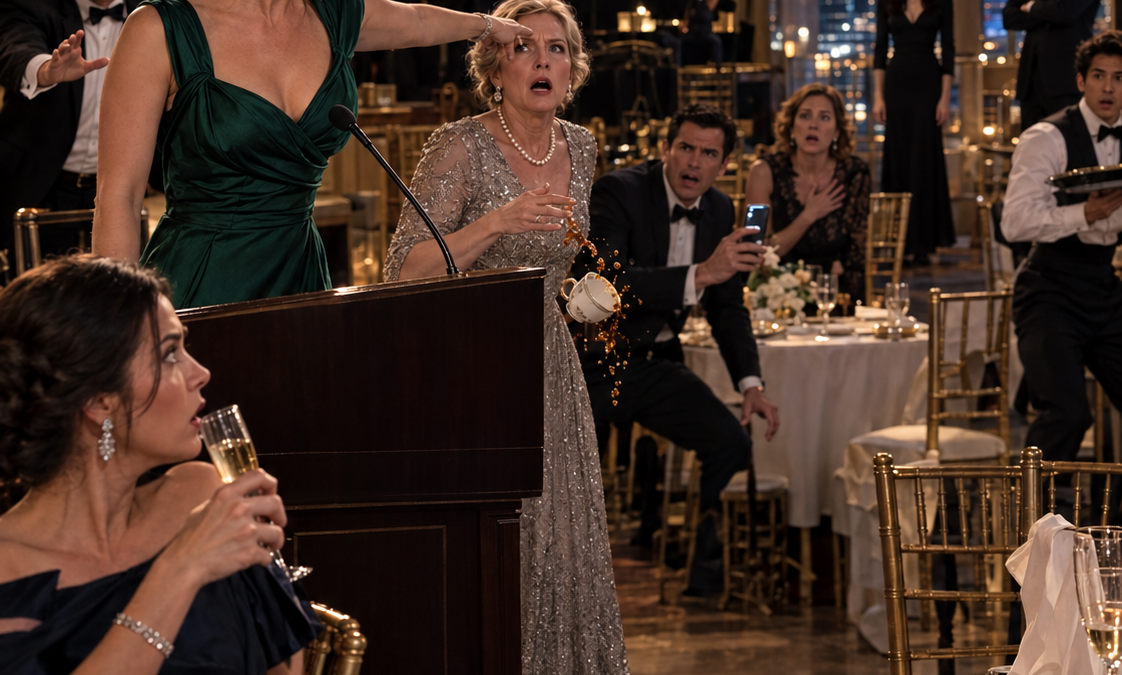
The moment came during Eleanor’s welcome speech.
She stood at the podium, resplendent in a silver gown, her voice warm and gracious as she thanked the donors and board members for their support. She talked about the foundation’s achievements, the grants it had awarded, the lives it had changed. She talked about the Ashford family’s commitment to philanthropy, their dedication to making the world a better place.
And then Diana stood up.
“Eleanor,” she said, her voice carrying across the ballroom. “I’d like to say a few words.”
Eleanor’s expression flickered—surprise, then irritation, then a careful mask of graciousness. “Of course, Diana. But perhaps after—”
“Now.” Diana walked toward the podium. “I think now is the right time.”
The room had gone quiet. Three hundred people turned to watch. Diana could feel their eyes on her—curious, expectant, uncomfortable. She could see Gabriel at the back of the room, his expression unreadable. She could see Charles, frozen mid-conversation, his smile slipping. She could see Vanessa Cole, suddenly alert.
She reached the podium. Eleanor stepped aside, her expression murderous.
“Thank you,” Diana said. “I won’t take long. I just want to introduce someone.”
She gestured toward the back of the room. Sarah Chen stood up.
“This is Sarah Chen. Sixteen years ago, she was an employee of the Ashford Foundation. She was also a victim of assault by a member of the Ashford family. When she came forward, she was paid off, threatened, and driven out of the country to keep her silent. The settlement was arranged by Eleanor Ashford, who is standing right here.”
The room erupted.
Eleanor’s face went white. “This is absurd. This is a lie. Diana, you have no idea what you’re—”
“I have the settlement documents. I have the threats made against Sarah’s family. I have the records showing that the foundation paid her off using charitable funds—the same funds that have been systematically looted for the past eighteen months by Charles Ashford and Vanessa Cole, working in coordination with Renner Capital to destroy this family’s company.”
Charles was on his feet. “That’s a lie. That’s—”
“I have the emails, Charles.” Diana’s voice was ice. “I have the financial records. I have the phone logs. I have everything.”
The room was chaos. Board members were shouting. Donors were pulling out their phones. Eleanor was trying to regain control, her voice rising above the din, but no one was listening.
And in the middle of it all, Sarah Chen walked to the front of the room. She stood beside Diana, her head high, her voice steady.
“My name is Sarah Chen,” she said. “And I’m not afraid anymore.”
Chapter 9: The Fallout
The next morning, the Philadelphia Inquirer ran the story on its front page. By noon, it had been picked up by every major news outlet in the country. By evening, the Attorney General’s office had opened a formal investigation into the Ashford Foundation’s finances, and the board had voted to suspend Charles Ashford and Eleanor Ashford pending the outcome.
Gabriel held a press conference that afternoon. He stood at a podium in the Ashford Holdings lobby, his face composed, his voice steady.
“I want to apologize to Sarah Chen, to the foundation’s donors, and to the public. What happened sixteen years ago was a crime, and the subsequent cover-up was a betrayal of everything this foundation is supposed to stand for. I am cooperating fully with the investigation. I am committed to making this right.”
He didn’t mention Diana. He didn’t need to. Everyone in the room knew who had exposed the truth.
That evening, Diana sat in her office at the foundation, staring at the pile of paperwork on her desk. The foundation was in crisis. The board was in chaos. The future was uncertain.
But for the first time in six years, she felt like she was exactly where she was supposed to be.
Gabriel appeared in her doorway. He looked exhausted—the kind of exhaustion that came from days of crisis management and sleepless nights. But he also looked lighter, somehow. Like a man who had been carrying a weight for years and had finally set it down.
“Can I come in?”
She nodded.
He sat across from her, in the same chair Marcus had occupied weeks ago. For a long moment, neither of them spoke.
“I should have done this years ago,” he said finally. “I should have stood up to my mother. I should have told the truth. I should have—” He stopped. “I should have been the man you deserved.”
Diana looked at him. She thought about all the years of silence, all the nights she had lain awake wondering if her marriage was a mistake, all the times she had told herself that she just needed to try harder, adjust more, be better.
She thought about the woman she had been when she married him. And the woman she had become.
“I’m not the same person I was,” she said.
“I know.”
“I’m not going to be the wife who stands behind her husband and smiles while he makes all the decisions. I’m not going to be the woman who swallows her opinions and her ambitions to make everyone else comfortable. I’m not going to be the Ashford wife who exists to run galas and look pretty at dinner parties.”
“I know.”
“I want a real partnership. I want a seat at the table. I want to be involved in everything—the company, the foundation, the family. And I want your mother out. Eleanor has no place in this family anymore. Not after what she did.”
Gabriel didn’t hesitate. “Agreed.”
“And Charles. He should be prosecuted. He should go to prison for what he did.”
“Agreed.”
“And Vanessa Cole. She should be exposed. Not just for the affair she pretended to have with you, but for the fraud, the theft, the corporate espionage. She should never work in this city again.”
“Agreed.” Gabriel leaned forward. “Diana, I know I’ve lost the right to ask anything of you. But I’m asking anyway. Give me a chance. Give us a chance. I know I’ve been a terrible husband. I know I’ve been distant and controlling and incapable of letting you in. But I want to change. I want to be better. And I want to do it with you.”
Diana was quiet for a long moment. Then she stood up and walked to the window. Outside, the city lights were coming on, one by one, a constellation of small brightnesses in the dark.
“I don’t know if I can forgive you,” she said. “Not yet. Maybe not ever.”
“I understand.”
“But I do know that I want to try.” She turned to face him. “Not because I need you, or because I’m afraid of being alone, or because I think marriage is something I have to endure. I want to try because I see something in you that I didn’t see before. Something worth fighting for.”
Gabriel stood up. He didn’t approach her—he stayed where he was, giving her space.
“What do you see?”
“I see a man who was raised to be cold and distant and controlling, who learned those lessons so well that he couldn’t find his way out. I see a man who tried to protect me by pushing me away, because that’s the only kind of love he ever knew. I see a man who is capable of change, if he wants it badly enough.” She met his eyes. “Do you want it badly enough?”
“Yes.” His voice was raw. “More than anything.”
Diana nodded slowly. “Then we start over. Not as husband and wife, but as partners. Equals. We rebuild this foundation, this company, this family—together. And we see where we end up.”
Gabriel held her gaze. Then, slowly, he extended his hand.
“Partners,” he said.
She took it. “Partners.”
Chapter 10: The New Matriarch
Six months later, the Ashford Foundation held its annual spring gala. It was a smaller event than the holiday gala—more intimate, more focused. The guest list had been carefully curated by Diana, who had taken over as executive director in the wake of the scandal.
Eleanor was not invited. She had retreated to her house on Grayling Lane, where she was reportedly “in seclusion,” though Diana suspected she was simply regrouping, planning her next move. Charles was awaiting trial on charges of fraud, embezzlement, and conspiracy. Vanessa Cole had fled to the Cayman Islands, where she was fighting extradition.
The foundation had survived. More than survived—it had thrived. Under Diana’s leadership, it had implemented new financial controls, new transparency measures, new accountability standards. Donations were up. Public trust was slowly being rebuilt.
And Diana was no longer just the wife who ran galas. She was the executive director. She was on the board of Ashford Holdings. She had authority over the foundation’s finances and a voice in every major decision.
She had become, in every way that mattered, an equal partner.
The night of the gala, Diana stood at the podium, looking out over the crowd. Sarah Chen was there, sitting at a table near the front, smiling. She had decided to stay in Philadelphia, to rebuild her life, to finally stop running. Marcus was beside her, his face lighter than Diana had ever seen it. He had forgiven Gabriel for keeping the secret about his sister—slowly, painfully, but genuinely.
And Gabriel was standing at the back of the room, watching Diana with an expression she had never seen on his face before. It looked like pride. It looked like awe. It looked, she thought, like love.
“Thank you all for being here,” Diana said. “Six months ago, this foundation was in crisis. We had been betrayed by the people we trusted most. We had lost sight of our mission. We had forgotten why we existed.”
She paused, letting the words settle.
“But we have not just survived. We have grown. We have learned. We have recommitted ourselves to the work that matters—the work of serving others, of making the world a little better, a little fairer, a little kinder.”
She looked out at the crowd—at the donors, the board members, the staff. At Sarah, at Marcus, at the people who had believed her when she said she would find the truth and expose it.
“This foundation belongs to all of us now,” she said. “Not to a family. Not to a name. To all of us. And I promise you—I promise—that I will spend every day making sure it lives up to that promise.”
She stepped back from the podium. The room erupted in applause.
And Gabriel, at the back of the room, raised his glass.
Chapter 11: The Quiet After
Later that night, after the last guests had gone and the ballroom had been cleared, Diana found Gabriel on the terrace, looking out at the city.
She stood beside him in silence for a long moment. The night was cool, the stars faint behind the city lights.
“You were good tonight,” he said.
“Thank you.”
“I mean it. You were—” He shook his head. “You were extraordinary. You’ve always been extraordinary. I just didn’t see it.”
Diana looked at him. In the dim light, his face was softer than she remembered—less guarded, less controlled. He looked like a man who had learned, finally, how to be human.
“I’ve been thinking,” she said.
“About?”
“About what comes next.” She turned to face him. “The foundation is stable. The company is recovering. Charles is awaiting trial. Eleanor is in seclusion. The scandal is—not forgotten, but managed.”
“And?”
“And I think it’s time for me to decide what I want. Not what’s expected of me, not what the family needs, not what you need. What I want.”
Gabriel was quiet for a moment. “What do you want?”
Diana looked out at the city. She thought about the past six months—the investigation, the confrontation, the slow rebuilding of everything that had been broken. She thought about the woman she had been before all of this: guarded, reactive, trying desperately to fit into a world that didn’t want her. And she thought about the woman she had become: someone who had claimed her own power, who had held her boundaries even when it was hard, who had fought for the truth and won.
“I want to stay,” she said.
Gabriel’s breath caught. “Diana—”
“I want to stay married. I want to rebuild this life with you. But not because I need you, or because I’m afraid to leave, or because I think it’s the right thing to do.” She turned to face him. “Because I choose you. Because after everything—after all the silence and the distance and the lies—I still see something in you worth loving. And I want to see what happens if we both try.”
Gabriel’s eyes were bright. He reached for her hand, and this time, she didn’t pull away.
“I don’t deserve you,” he said.
“No,” she agreed. “You don’t. But you’re learning. And I’m willing to keep teaching.”
He laughed—a real laugh, the kind she had never heard from him before. It transformed his face, made him look younger, lighter, more human.
“I love you,” he said. “I should have said it years ago. I should have said it every day. I should have—”
“Stop.” She put a finger to his lips. “Stop apologizing. Stop looking backward. We have a lot of time to make up for, and we can’t do it if we’re always dwelling on the past.”
He kissed her finger. Then her hand. Then, slowly, he pulled her toward him.
“Diana Ashford,” he said. “Will you stay married to me? For real this time. Not as a contract, not as an arrangement, but as a partnership. As equals. As two people who chose each other and keep choosing each other, every day, for the rest of their lives.”
She looked at him—this man who had been a stranger to her for six years, who had hidden his heart behind walls of control and silence, who had finally, painfully, learned how to let her in.
“Yes,” she said. “I will.”
He kissed her then, on the terrace, under the city lights. And for the first time in six years, Diana felt like she was exactly where she belonged.
Chapter 12: The Inheritance
Six months later, Diana stood in the conservatory of Grayling Lane, the same room where Eleanor had once told her she would never belong. The house had been sold—Eleanor had moved to a smaller apartment in the city, where she lived in quiet exile, her social invitations having mysteriously dried up.
Diana was there to collect the last of the family papers—documents and photographs that had been stored in the house for generations. She had volunteered for the task, wanting to see the place one last time.
She walked through the rooms slowly, remembering. The dining room where she had endured so many tense family dinners. The living room where Eleanor had held court. The conservatory where she had finally stopped being afraid.
And in the study, tucked away in a drawer, she found something she hadn’t expected: a letter. It was addressed to her, in Eleanor’s handwriting.
Diana opened it slowly.
Diana,
If you’re reading this, it means you’ve won. I always knew you would, in the end. You have a strength I never had—the strength to fight for what you believe in, to refuse to be diminished, to claim your own power.
I spent my entire life being what this family needed. I married a man I didn’t love. I raised children I didn’t understand. I sacrificed everything—my ambitions, my identity, my soul—to protect a legacy that was never mine.
I told myself it was worth it. I told myself that power was the only thing that mattered. I told myself that you—with your idealism, your stubbornness, your refusal to play by the rules—were everything I had been taught to despise.
But I was wrong. You were everything I was afraid to be.
I don’t expect your forgiveness. I don’t deserve it. But I want you to know that I see you now. I see what you’ve done, what you’ve built, what you’ve become. And I want you to know that you’ve earned the place you’ve claimed. Not through inheritance, not through marriage, but through your own strength.
The Ashford family has a new matriarch now. And I think—for the first time in a very long time—the family might actually be better for it.
Eleanor
Diana read the letter twice. Then she folded it carefully and tucked it into her bag.
She walked out of the conservatory, out of the house, out of the life that had once been hers. And she didn’t look back.
Epilogue: The Garden
Two years later, Diana and Gabriel sat in the garden of their home—a smaller house than the Ashford estate, but warmer, more personal, filled with the things they had chosen together. The foundation was thriving. The company had recovered. Charles had been convicted and sentenced to seven years in prison. Eleanor had passed away quietly in her sleep, leaving behind a small fortune to the foundation that Diana now ran.
They had rebuilt their marriage slowly, carefully, with the patience of two people who had learned, finally, how to be honest with each other. It hadn’t been easy. There had been arguments, setbacks, moments when Diana wondered if she had made the right choice. But they had kept choosing each other, every day, and slowly, the trust had grown.
Gabriel reached over and took her hand. “What are you thinking about?”
“The past,” she said. “The future. Everything in between.”
“Regrets?”
She considered the question. “I regret the years we lost. The silence, the distance, the misunderstandings. I regret that it took a crisis to force us to see each other clearly.”
“But?”
“But I don’t regret where we ended up.” She looked at him—this man who had been her adversary, her partner, her unexpected ally. “I don’t regret fighting for the truth. I don’t regret claiming my own power. And I don’t regret choosing you, in the end.”
Gabriel lifted her hand to his lips and kissed it. “I don’t deserve you.”
“You keep saying that.”
“Because it’s true.”
She smiled. “Maybe. But you’re learning. And that’s what matters.”
They sat in silence for a while, watching the sun set over the garden. And Diana thought about the journey that had brought her here—from the wife who ran galas to the woman who ran the foundation, from the victim of a family’s cruelty to the one holding the power.
She had fought. She had won. And she had found, in the end, something she had never expected: a partnership built on truth, on respect, on the kind of love that could only exist between two people who had seen each other at their worst and chosen each other anyway.
It wasn’t the fairy tale she had imagined when she was young. It was better. It was real.

