Part 2: “I’d suggest you remember that the next time you decide to judge a man by his truck.”
PART 5 — THE LETTER ARRIVES
Three days before the wedding, Elena called me.
She wasn’t crying this time. She was angry.
“Patricia got a letter,” she said. “From a Marine Corps sergeant major. Camp Lejeune.”
“Okay.”
“Dad, it says — I don’t understand what it says. It says your citation is real. It says your record is real. It says anyone who questions it is questioning the Marine Corps.”
“That sounds about right.”
“She read it out loud at breakfast. To everyone. She was — Dad, she was shaking.”
“From anger?”
“I don’t know. Maybe. She told David to call his lawyer.”
“His lawyer?”
“She wants to sue. She thinks you arranged the letter. She thinks it’s a fake.”
“It’s not a fake.”
“I know. But she doesn’t believe that. She said no sergeant major would write a letter like that for someone they didn’t know.”
“He doesn’t know me. Not personally.”
“Then why—”
“Because he knows the record. And the record is enough.”
Elena was quiet.
“Dad, what did you do?”
“Elena—”
“I’m not asking as your daughter. I’m asking as someone who’s about to marry into a family that thinks you’re a fraud. I need to know.”
I was quiet for a moment.
“I can’t tell you everything,” I said. “But I can tell you this. In 2004, I was in Fallujah. There was an operation that wasn’t supposed to happen. A lot of men died. Some of them were under my command. I did what I was trained to do. That’s all.”
“What operation?”
“It doesn’t have a name. Not officially.”
“That doesn’t make sense.”
“I know. But that’s the truth.”
She was quiet for a long time.
“Okay,” she said. “I believe you.”
“Thank you.”
“But I need you to do something for me.”
“What’s that?”
“Come to the rehearsal dinner tomorrow. Please. I need you there.”
“Patricia invited me?”
“She didn’t. But I’m inviting you. It’s my wedding. I get to say who comes.”
I almost smiled.
“Okay,” I said. “I’ll be there.”
The rehearsal dinner was at a restaurant downtown. Upscale. Patio seating. White lights strung between olive trees.
I parked the truck two blocks away. I didn’t want to make a scene.
I walked in. Elena met me at the door. She was wearing a yellow dress. Her hair was different. She looked older than she had a week ago.
“Dad.”
“Hey, kiddo.”
She hugged me. Tight. Longer than usual.
“Patricia’s inside,” she said. “She knows you’re coming. She’s not happy.”
“I didn’t expect her to be.”
“Just — be careful. She’s been drinking.”
“I’ll be careful.”
I walked in.
The patio was full. Twenty people. David’s family and friends. A few of Elena’s friends. Charles at the head of the table. Patricia beside him.
And Delano. The consultant. Sitting two seats down from Patricia.
He saw me. His face didn’t change.
Patricia saw me. Her face did.
“Michael,” she said. Loud enough for the table to hear. “I didn’t realize you were joining us.”
“Elena invited me.”
“Did she.”
“Yes.”
She looked at Elena. Elena didn’t look away.
“Of course,” Patricia said. “Sit. Anywhere.”
I sat at the end of the table. Opposite Charles. Beside one of Elena’s friends. A young woman named Priya who’d known Elena since college.
She leaned over. “Mr. Torres. I’ve heard a lot about you.”
“Good things, I hope.”
“Elena says you’re the calmest person she knows.”
“I try.”
“Patricia says you’re a liar.”
I looked at her.
“She does?”
“She said it to David last night. I was in the kitchen. She didn’t know I could hear.”
“What did David say?”
“He didn’t say anything.”
I nodded.
“That sounds like David.”
Dinner was long. Four courses. Wine. Toasts.
David’s best friend gave a speech. Charles gave a speech. Elena’s maid of honor gave a speech.
No one asked me to speak.
Patricia kept looking at me. Across the table. Over her glass. Not hostile exactly. Calculating.
Delano did the same. But quieter.
Halfway through the main course, Patricia set down her fork.
“Michael,” she said. “I want to ask you something.”
The table went quiet.
“Go ahead.”
“You’ve been very quiet about your service. I understand that. Some men don’t like to talk about it. But I have to ask — if you’re as decorated as this letter claims, why is there no record?”
“There’s a record. It’s just not public.”
“That’s convenient.”
“It’s not convenient. It’s classified.”
Delano spoke. “Mr. Torres, I’ve worked with classified records for decades. There’s always something. A file. A name. A reference number. Something.”
“Not always.”
“Then how do we know the letter isn’t a forgery?”
“You don’t.”
“That’s not good enough.”
“It’s all you’re getting.”
Patricia leaned forward. “Michael, I’m going to be honest with you. I’ve reached out to some people. People who know about these things. And they’ve told me that what you’re describing isn’t possible.”
“What am I describing?”
“A classified operation with no record. A citation with no mission. A medal you never collected. It doesn’t happen.”
“It happened.”
“Then prove it.”
“I don’t have to prove anything to you.”
“You do if you want to be part of this family.”
“I’m not part of your family. I’m Elena’s father. That’s all.”
“Then maybe you shouldn’t be here.”
The table went silent.
Elena stood up.
“Patricia,” she said. “Stop.”
Patricia looked at her. “Elena—”
“No. You stop.” Her voice was shaking. “This is my rehearsal dinner. My wedding is tomorrow. And you’ve spent the entire week trying to prove my father is a liar. I’m done.”
“Elena, I’m trying to protect you.”
“From what? From my dad? The man who raised me alone after my mom died? The man who worked two jobs to put me through school? The man who paid for this entire wedding with his own money?”
Patricia’s face went pale.
“He paid for the wedding. Not you. Not Charles. Him. And you’ve treated him like a criminal.”
“We were concerned—”
“You were insulting. That’s different.”
David spoke for the first time that night.
“Elena, maybe we should talk about this at home.”
“No.” She looked at him. “I’m talking now.”
David didn’t say anything else.
Elena looked around the table. At David’s family. At Charles. At Patricia. At Delano.
“My father is not a liar,” she said. “And if you can’t accept that, then I don’t know what we’re doing here.”
She sat down. Her hands were shaking.
I reached over and put my hand on hers.
“It’s okay,” I said.
“No, it’s not. But it will be.”
The dinner broke up early. People left in twos and threes. Patricia didn’t say goodbye to me. Charles didn’t either.
David walked Elena to her car. I waited by the truck.
Priya came up to me.
“Mr. Torres.”
“Yes.”
“I just wanted to say — I believe you.”
I looked at her.
“Why?”
“Because I know what a liar looks like. My uncle was one. He lied about everything. He lied when the truth would have been easier. You don’t do that.”
“Thank you.”
“I don’t know what you did. But I know it was something.”
“It was a long time ago.”
“It doesn’t seem like a long time ago to them.”
“No. It doesn’t.”
She smiled. Small. Real.
“Goodnight, Mr. Torres.”
“Goodnight.”
She walked away.
Elena came over a few minutes later. Her eyes were red.
“Dad.”
“Hey.”
“I’m sorry about tonight. I should have said something sooner.”
“You said it when it mattered.”
“I don’t know if it helped.”
“It helped me.”
She hugged me.
“Are you still coming tomorrow?”
“I’ll be there.”
“Promise?”
“I promise.”
She got in her car and drove away.
I sat in the truck for a long time.
The wedding was tomorrow.
And I had a feeling something was going to happen.
Something nobody was expecting.
I got home at midnight.
The folder was still on the kitchen table. The citation. The letter from Elias.
I picked up the letter and read it again.
You did what the rest of us couldn’t.
I thought about that. About Fallujah. About the men I carried. About the ones I didn’t.
I thought about Reyes. About his voice on the radio. About the last thing he said to me.
Get them out. I’ll hold the line.
He’d held the line. For twelve minutes. Long enough for me to get four men out. Long enough for the fifth to die in my arms.
He’d never talked about it. Neither had I.
The record was empty because we’d both decided it should be. Too many people involved. Too many things that couldn’t be explained. The mission had never happened.
But it had happened. And Reyes had died for it.
And now his letter was sitting on my kitchen table.
I folded it and put it in my jacket pocket. I’d carry it tomorrow.
I didn’t know why. I just knew I should.
The wedding was at four.
I arrived at three-thirty. The Whitmore Estate. Forty acres of manicured lawn. The carriage house converted into a reception hall. White tablecloths. Military flags. Large screens.
I parked the truck in the back. Away from the other cars.
I walked in. Elena was in the bridal suite. She saw me through the window. She waved.
I waved back.
Patricia was in the main hall. Directing staff. She saw me. Her face didn’t change.
Delano was there too. Standing near the entrance. Watching.
I found my seat. Front row. Left side. The father’s seat.
I sat down.
And I waited.
The ceremony was at four.
The music started. The doors opened. Elena walked down the aisle.
She was beautiful. Her mother’s dress. Her mother’s necklace. Her mother’s eyes.
I stood up when she passed.
She looked at me. Smiled.
I sat down.
The ceremony was short. Twenty minutes. Vows. Rings. A kiss.
Then the recessional. The photographs. The cocktail hour.
I stayed in my seat for a while. Watching.
Then I got up and walked outside.
The lawn was full of people. Laughter. Champagne. Music.
I stood near the edge of the patio. Looking out at the desert.
The sun was going down. Orange and gold.
I thought about Rosa. About our wedding. Twenty-eight years ago. A small church in El Paso. Her mother crying. My mother beaming.
Elena had been born two years later.
Rosa had died twelve years after that.
And now Elena was married.
I took the letter out of my pocket.
You did what the rest of us couldn’t.
I read it one more time.
Then I folded it and put it back.
And I heard a voice behind me.
“Mr. Torres.”
I turned.
Delano was standing there. Alone. No drink in his hand.
“Colonel.”
“I want to talk to you.”
“Go ahead.”
He stepped closer. Looked at me.
“I’ve been doing this for thirty years,” he said. “And I’ve never seen anything like this.”
“Like what?”
“Like you.”
I didn’t say anything.
“I called the sergeant major,” he said. “The one who sent the letter. I asked him why he’d stick his neck out for a man he’d never met.”
“What did he say?”
“He said, ‘Because I know what he did. And I know why no one else does.'”
I looked at him.
“Did he tell you what I did?”
“No. He said it was above my clearance.”
I almost smiled.
“Colonel, why are you here?”
“Because I need to know if I’ve been wrong.”
“About what?”
“About you.”
I looked at him for a long moment.
“You’re not wrong,” I said. “You just don’t know everything.”
“Then tell me.”
“I can’t.”
“Can’t or won’t?”
“Both.”
He stared at me.
“Mr. Torres, I’ve spent the last two weeks telling the Whitmores that you’re a fraud. I’ve written a report that says your citation is unverifiable. I’ve told them you’re either lying or hiding something.”
“Then why are you here now?”
“Because I don’t believe it anymore.”
I looked at him.
“The sergeant major,” he said. “He doesn’t write letters for liars. He doesn’t stick his neck out for frauds. So I know there’s something. I just don’t know what.”
“Then you’ll have to live with not knowing.”
He was quiet.
“I suppose I will,” he said.
He turned and walked away.
I stood on the patio and watched the sun set.
The reception started at six.
And I had a feeling something was about to happen.
PART 6 — THE RECEPTION
The reception started at six.
The carriage house was transformed. Round tables with white linen. Centerpieces of desert flowers. A band on a small stage. Screens on either side of the room showing photos of Elena and David.
I found my seat. Table one. Front and center. The father’s table.
Patricia was at the table next to mine. She didn’t look at me.
Charles was at the bar.
Delano was gone. I didn’t see him anywhere.
The band started playing. People danced. Elena and David had their first dance. Then Charles and Patricia. Then Elena and me.
She came to my table. Held out her hand.
“Dad.”
I stood up.
“I’m not much of a dancer.”
“I know. Neither am I.”
I took her hand. We walked to the floor.
The band played something slow. Old. I didn’t recognize it.
We danced. Badly. She laughed.
“You’re stepping on my feet.”
“You’re leading.”
“I’m not supposed to lead.”
“I know.”
She put her head on my shoulder.
“Thank you,” she said.
“For what?”
“For coming. For staying. For everything.”
“You don’t have to thank me.”
“I know. But I wanted to.”
We danced for the rest of the song.
Then she went back to David. And I went back to my table.
The reception went on.
Toasts. Speeches. More toasts. The best man told a story about David getting lost in Madrid. The maid of honor told a story about Elena’s first apartment. Everyone laughed.
No one asked me to speak.
I didn’t mind.
I sat at my table and watched. The lights. The laughter. The way Elena’s eyes crinkled when she smiled. The way David looked at her when he thought no one was watching.
He was a good man. I’d known that for a while. Not a strong man. Not a brave man. But a good one.
He’d marry well. Elena would keep him honest.
I was proud of her. Of both of them.
And I was content.
At nine o’clock, the band took a break.
The screens switched from photos to a video montage. Elena’s childhood. David’s childhood. Their first date. Their engagement.
The room went quiet.
I watched the screen. Elena at five. Elena at twelve. Elena at eighteen. Graduation. College. First job.
Then the photos shifted. Rosa. Our wedding. Elena as a baby.
I hadn’t known they were going to show those.
I looked at the screen. At Rosa’s face. Young. Happy.
My chest tightened.
Then the montage ended. The screen went dark.
And then something else appeared.
Not a photo. A document.
White paper. Blue ink. Official letterhead.
I knew what it was before I could read it.
My citation.
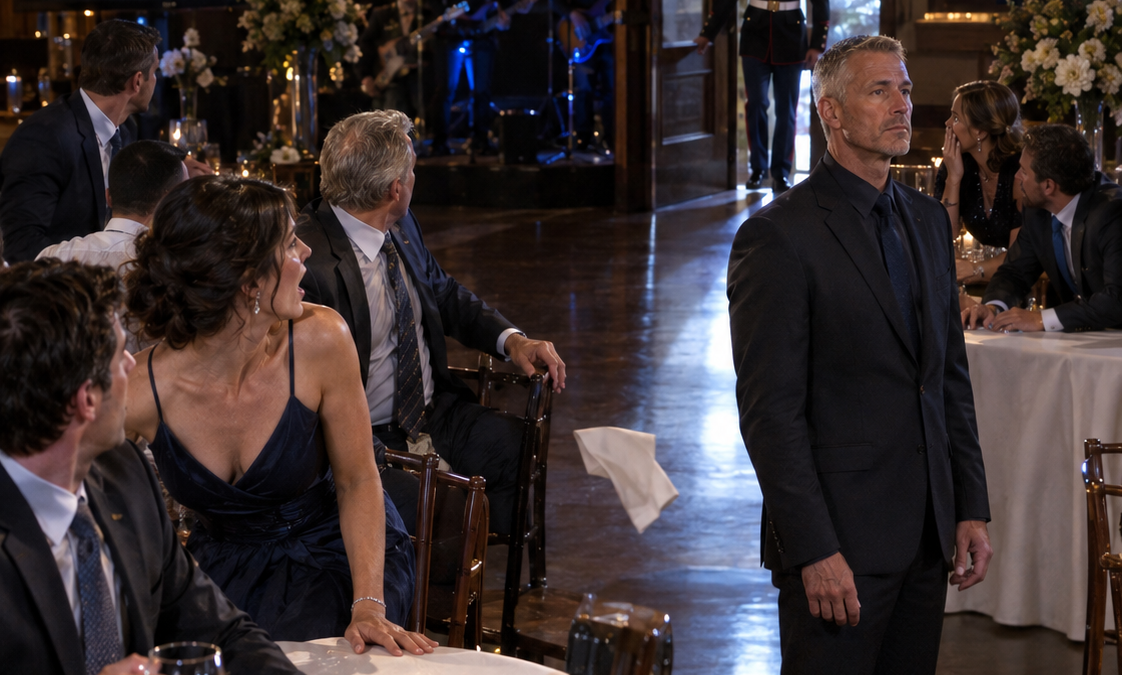
The room went silent.
Everyone looked at the screen.
The citation filled the frame. Large enough to read from the back of the room.
For extraordinary heroism in action against an armed enemy…
While serving as Team Leader, Second Reconnaissance Battalion…
On 12 November 2004, then-Staff Sergeant Michael A. Torres led a four-man reconnaissance element…
…voluntarily exposed himself to heavy enemy fire to recover two wounded Marines…
…personally carried one wounded Marine over 300 meters through hostile territory…
…his actions saved the lives of two Marines and directly contributed to the successful extraction of all remaining personnel…
…his extraordinary heroism and unwavering dedication to duty reflected great credit upon himself and were in keeping with the highest traditions of the United States Marine Corps.
Silver Star.
The screen stayed there.
I didn’t move.
I didn’t breathe.
Patricia stood up from her table. Her face was white.
“What is this?” she said. “Who put this on the screen?”
No one answered.
The band was silent. The room was silent.
Then a voice from the back.
“I did.”
Everyone turned.
A man was standing in the doorway of the carriage house. Tall. Gray hair. Dress blues.
Sergeant Major Raymond Cole.
He walked into the room.
The room parted for him.
He walked to the center of the floor. Stopped. Looked around.
“My name is Sergeant Major Raymond Cole. I’m with MARSOC headquarters at Camp Lejeune.”
No one spoke.
“I’m here because I received a request from this family to verify a citation that had been flagged in our system. I’m here to tell you that the citation is authentic.”
Patricia stepped forward. “You can’t just — you can’t just show up at my son’s wedding—”
“Ma’am, with all due respect, this is not about your son.”
He looked at the screen. At the citation.
“This citation is for Staff Sergeant Michael Torres. In 2004, he was part of a unit that doesn’t officially exist. He was part of a mission that doesn’t officially exist. And he did something that the Marine Corps has never publicly acknowledged.”
He looked at me.
“But we know.”
I didn’t move.
“The mission was in Fallujah. The unit was a MARSOC element attached to a larger operation. The details are still classified. I can’t tell you what happened. But I can tell you what happened after.”
He looked back at the crowd.
“Staff Sergeant Torres led a team into an ambush. He lost his commanding officer. He lost two men. But he didn’t lose the others. He carried one man out. Then went back for another. Then went back for a third. On his last trip, he was shot twice.”
The room was silent.
“He got them all out. Every man who was still alive when the ambush started. He got them all out.”
He looked at me.
“And then he never talked about it. Not to the media. Not to the historians. Not to anyone. He took the citation and he put it in a drawer. And he went home and raised his daughter.”
He paused.
“That’s the man you’ve been calling a liar.”
Patricia’s face was gray.
Charles was staring at the screen. At the citation. At me.
David was holding Elena’s hand. Elena was crying.
Sergeant Major Cole walked over to me.
“Mr. Torres.”
“Sergeant Major.”
He held out his hand.
I shook it.
“On behalf of the Marine Corps,” he said. “Thank you.”
I nodded.
He turned to the room.
“I’m not going to stay. I just wanted to make sure everyone here knew the truth. This man served his country in ways most of you will never understand. And he did it without asking for anything in return. Not recognition. Not thanks. Not even a medal.”
He looked at Patricia.
“I’d suggest you remember that the next time you decide to judge a man by his truck.”
He walked out.
The room was silent for a long time.
Elena was the first to move.
She ran across the floor. Threw her arms around me.
“Dad.”
“It’s okay.”
“I didn’t know. I didn’t—”
“You weren’t supposed to know.”
“You should have told me.”
“No.”
“Why not?”
“Because some things you carry alone. It’s not a burden. It’s just — mine.”
She held me tighter.
“I’m sorry,” she said. “I’m sorry for everything they said.”
“You didn’t say it.”
“I didn’t stop it.”
“You tried.”
“I should have tried harder.”
I pulled back. Looked at her.
“Elena. Listen to me. You’re the best thing I ever did. Not the Marine Corps. Not the medals. You.”
She cried harder.
I held her.
Patricia approached me ten minutes later.
I was standing by the door. Getting some air. The reception had resumed, but quieter. The band was playing again. People were dancing again. But the energy was different.
“Michael.”
I turned.
She was standing there. Her hands were clasped. Her face was pale.
“I owe you an apology.”
“You don’t owe me anything.”
“I do. I said terrible things. I made terrible assumptions. I hired a man to investigate you. I accused you of lying. I—”
“You treated me like a poor man with something to hide.”
She flinched.
“Yes.”
“Why?”
She didn’t answer.
“Why did you assume the worst about me?”
She was quiet for a long moment.
“Because you weren’t like us,” she said. “And I didn’t understand why.”
“That’s not a reason.”
“I know.”
She looked at the ground.
“I’ve spent my whole life being the richest person in the room. And when I met you, I couldn’t figure out why you didn’t care. You didn’t try to impress me. You didn’t try to keep up. You just — didn’t.”
“Because I didn’t need to.”
“I know that now.”
She looked up at me.
“I’m sorry.”
I looked at her for a long moment.
“I forgive you,” I said.
She blinked.
“You do?”
“I do.”
“Why?”
“Because you’re Elena’s mother-in-law. And because holding a grudge isn’t worth it. And because I’ve been through worse.”
She stared at me.
“Thank you.”
“Don’t thank me. Just do better.”
She nodded.
“I will.”
She walked away.
Charles came up next. He was drunk. Not sloppy. Just enough.
“Michael.”
“Charles.”
“I want to say something.”
“Go ahead.”
“I misjudged you.”
“You did.”
“I apologize.”
“Okay.”
“You’re not going to make this easy, are you?”
“No.”
He laughed. Short. Not unkind.
“I deserve that.”
“You do.”
He looked at me.
“Four point seven million dollars.”
“Yeah.”
“I still can’t get over that.”
“You don’t have to.”
“But—”
“It’s just money, Charles. It doesn’t matter.”
“Then what matters?”
I looked at the dance floor. At Elena. At David.
“She matters. That’s all.”
He nodded.
“You’re a strange man, Michael.”
“I know.”
He walked away.
Delano found me at the bar.
I was drinking water. He ordered a whiskey.
“I was wrong,” he said.
“You were.”
“I’m going to resign from the board.”
“You don’t have to.”
“I do. I judged a man based on the absence of a record. That’s not what I was trained to do.”
“You were trained to verify facts. You did that. The facts just weren’t there.”
“That’s not an excuse.”
“No. It’s not.”
He drank his whiskey.
“I read the citation,” he said. “On the screen.”
“Everyone did.”
“I’ve seen a lot of citations. That one — it’s real. I don’t know how I missed it.”
“You didn’t miss it. You couldn’t verify it.”
“I should have tried harder.”
I looked at him.
“Colonel, the men who wrote that citation are dead. The men who could verify it are dead. The only reason Sergeant Major Cole came here tonight is because he knows the story through channels you don’t have access to.”
“And you do.”
“I do.”
He nodded.
“Then I guess I was right about one thing. You’re not just a retired Marine.”
“I’m exactly what I appear to be. A man who did his job and came home.”
“That’s not what you appear to be.”
“It’s what I am.”
He finished his whiskey.
“Goodnight, Mr. Torres.”
“Goodnight, Colonel.”
He left.
The reception ended at midnight.
Elena and David left in a limousine. The guests drifted out in twos and threes. The staff began cleaning up.
I was the last one there. Standing on the patio. Looking at the desert sky.
The stars were out. Bright. The way they only are far from the city.
I thought about Rosa. About the night we met. About the way she’d looked at me when I told her I was going back to the Marines.
You always come back, she’d said.
I always come back.
I’d kept that promise. For twenty-two years. And then I’d come home for good.
She’d been dead for twelve years. And I still thought about her every day.
I took the letter out of my pocket.
Elias’s handwriting. Blue ink. Yellowed paper.
You did what the rest of us couldn’t.
I folded it and put it back.
Then I walked to the truck.
The drive home was quiet.
The road was empty. The desert was dark. The radio was off.
I got home at one in the morning.
I parked in the driveway. Sat in the truck for a while.
Then I went inside.
The house was the same as I’d left it. The folder was on the table. The citation was in the folder.
But the citation didn’t matter anymore. Everyone had seen it. Everyone knew.
What mattered was what came next.
I didn’t know what that was.
But I was ready for it.
PART 7 — THE QUIET AFTER
The phone rang at eight the next morning.
I was in the kitchen. Coffee. Eggs. The same routine I’d had for twenty years.
It was Elena.
“Dad.”
“Morning.”
“Did you sleep?”
“Some.”
“Me neither.”
I waited.
“David and I talked last night,” she said. “After the reception. For like three hours.”
“Okay.”
“He didn’t know. Any of it. His mother never told him she hired the investigator. She never told him about the letter from the sergeant major. She never told him about the meeting with Delano.”
“She kept him out of it.”
“She kept everyone out of it. She was trying to — I don’t know — handle it. Like it was a problem to manage.”
“That’s what she does.”
“I know.” She paused. “He’s furious. David. He’s actually furious. I’ve never seen him like that.”
“Good.”
“Dad.”
“I mean it. He should be. She went behind his back. She treated his wife’s father like a suspect. He should be angry.”
“He is. He told her he needs space. We’re not going to the family dinner next week.”
“Okay.”
“He also said he wants to apologize to you. In person. He said he should have said something a long time ago.”
“He doesn’t have to.”
“I know. But he wants to.”
I poured coffee into a mug. The black one. The one Rosa had given me.
“Okay,” I said. “Tell him to come by. Whenever.”
“Today?”
“Sure.”
“Dad—”
“Yeah.”
“I’m proud of you. I don’t think I said that last night.”
“You didn’t have to.”
“I wanted to.”
“Thank you.”
She hung up.
David came by at eleven.
He parked the Mercedes in the driveway. Got out. Looked at the truck. Then at the house.
I was in the garage. Working on the Tacoma. Not because it needed work. Just because I wanted to.
“Mr. Torres.”
“Michael.”
“Michael.” He put his hands in his pockets. “Can we talk?”
“Sure.”
He walked into the garage. Looked at the tools. At the truck. At me.
“I don’t know how to say this,” he said.
“Just say it.”
“I’m sorry.”
“Okay.”
“That’s it? Okay?”
“What else am I supposed to say?”
He looked at me.
“You should be angry.”
“I’m not.”
“Why not?”
“Because anger doesn’t fix anything. And because you’re not the one who did it.”
“I didn’t stop it.”
“No. You didn’t.”
He looked at the ground.
“I should have. I should have said something when my mother started making assumptions. I should have said something when she hired the investigator. I should have said something when she called your daughter a liar.”
“She didn’t call me a liar. She called me a fraud.”
“Same thing.”
“Not to her.”
He looked at me.
“My mother has spent her whole life believing that money is the only measure of a person. She can’t help it. It’s how she was raised.”
“That’s not an excuse.”
“I know. But it’s an explanation.”
I wiped my hands on a rag.
“David. Why are you here?”
“Because I want you to know something.”
“What’s that?”
“I’m going to be a better man than my mother. I don’t know how yet. But I’m going to try.”
I looked at him for a long moment.
“That’s all I ask.”
He nodded.
“Okay.”
“Okay.”
He turned to leave.
“David.”
He stopped.
“Yeah.”
“Take care of her.”
“I will.”
“I mean it. She’s the best thing in my life. If you hurt her—”
“I won’t.”
“You won’t. But if you do—”
He almost smiled.
“I understand.”
He got in the Mercedes and drove away.
The days after the wedding were quiet.
Elena called every day. David called twice. Patricia didn’t call at all.
I didn’t expect her to.
I went back to my routine. Coffee. Work. The truck. The house. The desert.
The folder stayed on the kitchen table for a while. Then I put it back in the safe.
The citation. The letter. Both of them.
I didn’t need them anymore.
A week after the wedding, I got a letter.
Handwritten. No return address. Postmarked Scottsdale.
I opened it at the kitchen table.
Michael,
I don’t know how to write this. I’ve started it six times. Each time I’ve thrown it away.
I was wrong about you. I was wrong in a way that I can’t undo. I treated you like a problem to be managed. I treated your service like a credential to be verified. I treated your daughter like a piece of a transaction.
I know I can’t take any of it back. I know an apology doesn’t fix anything. But I want you to know that I’ve been thinking about what you said. About how I assumed the worst about you because you weren’t like us.
You were right. I did. And I’m ashamed of it.
I’ve spent my whole life trying to be the most important person in every room. And you spent yours doing things that made you less important. On purpose.
I don’t understand it. But I respect it.
I’m not asking for forgiveness. I just wanted you to know.
Patricia
I read it twice.
Then I folded it and put it in the drawer.
I didn’t write back.
I didn’t need to.
A month passed.
Elena and David moved into their condo. They invited me for dinner. I went.
The condo was nice. Clean. Modern. David cooked. He wasn’t very good at it. Elena laughed at him.
It was the first time I’d seen her laugh like that since the wedding.
We ate on the balcony. The desert was pink and orange. The city lights were coming on.
“Dad,” Elena said. “I have something to ask you.”
“Okay.”
“David and I have been talking. About the future.”
“Okay.”
“We want you to be part of it. More than you have been.”
“I’ve been around.”
“I know. But — I mean, actually part of it. Family dinners. Holidays. Things like that.”
“I already do that.”
“Not with them.”
I set down my fork.
“With the Whitmores?”
“With Patricia. And Charles. They’re my family now too. Whether I like it or not.”
“You don’t have to like it.”
“I know. But I have to live with it.”
I looked at her.
“And you want me to live with it too.”
“I want you to try.”
I was quiet for a moment.
“Elena—”
“I know what she did. I know what she said. I’m not asking you to forgive her. I’m asking you to be in the same room as her. For me.”
I looked at David. He was watching me. Quiet. Nervous.
“You knew about this?” I asked.
“She asked me to bring it up,” he said. “I told her it was a bad idea.”
“It’s not a bad idea.”
He blinked.
“It’s not?”
“No. It’s what family does. They sit in the same room even when it’s hard.”
Elena looked at me.
“So you’ll come?”
“I’ll come.”
She smiled. Wide. The way she had when she was a kid.
“Thank you.”
“Don’t thank me yet.”
The first dinner was three weeks later.
At the Whitmore house. The same house. The same fountain. The same two cars in the driveway.
I parked the truck in the same spot.
Patricia answered the door. She didn’t smile. She didn’t frown. She just looked at me.
“Michael.”
“Patricia.”
“Thank you for coming.”
“I was invited.”
“By Elena. I know. But you didn’t have to accept.”
“I know.”
She stepped aside.
I walked in.
The living room was the same. The photographs were the same. David at prep school. David at Yale. David on a sailboat.
But there was a new photograph now. On the mantel. Next to the others.
Elena and David. At the wedding. Smiling.
And beside it, another one. Smaller. In a plain frame.
A photograph of me. In uniform. From 2004.
I hadn’t seen that photo in twenty years.
Patricia saw me looking.
“Elena gave it to me,” she said. “She found it in a box in your house.”
“I didn’t know she had it.”
“She said she wanted it displayed. So everyone could see.”
I looked at the photo. Young. Serious. The desert behind me. The men beside me.
Most of them dead now.
“Thank you,” I said.
Patricia nodded.
“Come in,” she said. “Dinner’s almost ready.”
The dinner was different.
Not warm exactly. But not cold either. Patricia asked me questions. Not about my service. Not about the money. Just about my life. My work. My hobbies.
I told her about the truck. About the land in Montana. About the way I liked to watch the sunset from the back porch.
She listened. She didn’t interrupt. She didn’t assume.
Charles talked about the stock market. David talked about work. Elena talked about the new project she was leading at her firm.
It was normal. Ordinary.
And for the first time in eighteen months, I felt like I was in the room.
After dinner, Patricia walked me to the door.
“Michael.”
“Yeah.”
“I know I can’t undo what I did.”
“You can’t.”
“But I want you to know — I’m trying.”
“I know.”
“I read the citation. Every word. I looked up the mission. There’s nothing there. But I read it anyway.”
“There’s nothing to find.”
“I know. That’s what makes it — I don’t know. Impressive.”
I looked at her.
“It’s not impressive. It’s just what I did.”
“That’s what makes it impressive.”
I didn’t argue.
“Goodnight, Patricia.”
“Goodnight, Michael.”
I walked to the truck.
The desert sky was clear. The stars were out. Bright.
I thought about Rosa. About Elena. About Elias.
About the men who never came home.
I got in the truck.
And I drove home.
The next morning, I went for a walk.
Not a long one. Just around the neighborhood. The way I did most mornings.
The sun was coming up over the Catalinas. Orange and gold.
I thought about the wedding. About the letter. About the way Elena had looked when she saw the citation on the screen.
She’d never asked me what happened in Fallujah.
She’d never asked me to explain.
She’d just hugged me. And told me she was proud.
That was enough.
I walked back to the house. Made coffee. Sat on the back porch.
The desert was quiet. The birds were singing. The world was waking up.
I thought about the folder in the safe. The citation. The letter.
Maybe I’d take them out again someday. Maybe I’d show them to Elena. Maybe I’d tell her the whole story.
Or maybe I wouldn’t.
Some things were mine. Some things were hers. Some things were ours.
But the important thing was that I was still here. Still standing. Still watching the sun come up over the desert.
That was the thing about surviving. You kept going. You kept living. You kept showing up.
And eventually, people saw you.
Not the truck. Not the quiet. Not the assumptions.
Just you.

