Part 2: “If you sign this deal, you’re mine to protect—and mine to destroy, if you give me a reason.”
Chapter 7: The Woman in the Photograph
Three days later, Charlotte found the photograph.
She was in the distillery’s archive room, looking for old labels for a heritage release, when she opened a box marked “Codicils and Trust Documents.” Inside, beneath layers of legal papers, was a photograph—old, black and white, dated 1995.
Her father, young and smiling, standing with a woman Charlotte didn’t recognize. She was beautiful, with dark hair and a shy smile, her hand resting on Thomas Hartwell’s arm in a way that suggested intimacy.
On the back, in her father’s handwriting: Margaret, 1995. I’m sorry.
Charlotte stared at the photograph for a long time.
Margaret. Aunt Margaret—her father’s sister, who’d lived in Louisville her whole life, who’d never married, who’d always been a little distant, a little sad.
But the woman in the photograph wasn’t Aunt Margaret.
She looked like her, though. The same eyes, the same smile. A younger version—maybe a daughter.
Charlotte’s hands were shaking.
She put the photograph in her pocket and went to find Julian.
He was in his temporary office at the distillery, on a call when she walked in. He took one look at her face and ended the call.
“What’s wrong?”
She handed him the photograph. He looked at it, then at her, his expression carefully blank.
“I found this in the archive,” Charlotte said. “That’s my father. And a woman named Margaret. But it’s not my Aunt Margaret.”
Julian set the photograph on the desk. “Where did you find this?”
“In a box of trust documents. Right next to the codicil that voided my brother’s vote.” Charlotte’s voice was steady, but her hands were still shaking. “Who is she?”
Julian was quiet for a long moment.
“Her name is Margaret Ashford,” he said finally. “Gerald Ashford’s daughter. She died in 1998.”
Charlotte felt the floor tilt beneath her. “Ashford. As in—”
“As in Celeste Ashford’s sister. As in the woman your father had an affair with for seven years. As in the mother of the child he never acknowledged.”
Charlotte sank into a chair.
“Celeste is my father’s daughter.”
“Yes.”
“And she works for you.”
“Yes.”
“And she knows.”
“Yes.”
Charlotte looked at the photograph—her father’s smile, the woman’s hand on his arm, the whole secret life she’d never known existed.
“Why didn’t she tell me?”
“Because she doesn’t want anything from you.” Julian’s voice was careful. “She came to me three years ago, after her sister died. She had evidence of the affair—letters, photographs, financial records. She wanted to understand who her father was. And when she found out about your family, about the distillery, she made a choice.”
“What choice?”
“She chose to protect you. Not expose you. Not hurt you. Protect you.” Julian leaned against his desk. “She’s been working with me to monitor your brother’s activities. She’s the one who discovered the embezzlement. She’s the one who found the loan documents from Kreel. Without her, you’d have lost everything.”
Charlotte stared at him. “She’s my sister.”
“Half-sister.”
“She’s my sister, and she’s been protecting me from the shadows, and I didn’t even know she existed.” Charlotte stood, the photograph clutched in her hand. “I need to see her.”
“Charlotte—”
“I need to see her, Julian. Right now.”
He looked at her for a long moment. Then he picked up his phone.
“Celeste,” he said. “She knows. Come to the distillery.”
He hung up and looked at Charlotte.
“She’ll be here in an hour.”
Charlotte nodded. Then she walked out of the office, out of the building, and stood in the gray afternoon light, looking at the rickhouses that held her family’s history—and now, apparently, its secrets.
Her father had a daughter. A daughter he’d never acknowledged. A daughter who’d spent years protecting the family that didn’t know she existed.
And Charlotte had spent her whole life believing she was alone.
She wasn’t.
She had a sister.
The thought was terrifying and wonderful and impossible all at once.
She went back inside to wait.
Chapter 8: Two Sisters
Celeste arrived at the distillery looking nothing like the polished corporate associate who’d shaken Charlotte’s hand at the press conference. She wore jeans and a simple sweater, her hair loose around her shoulders, her face bare of makeup. She looked younger. She looked vulnerable.
She looked like the woman in the photograph.
“You found it,” she said quietly.
Charlotte held up the photograph. “I found it.”
They were in the rickhouse—the only place Charlotte could think of where they could talk without being interrupted, without being overheard. The barrels surrounded them like silent witnesses, the air thick with the smell of aging whiskey.
“I was going to tell you,” Celeste said. “I wanted to. But there was never a good time, and then everything with your brother—”
“How long have you known?”
“Since I was sixteen. My mother told me on her deathbed. She’d kept it a secret my whole life—she didn’t want to hurt my father, didn’t want to cause a scandal. But when she was dying, she wanted me to know the truth.” Celeste’s voice was steady, but her eyes were bright. “She gave me letters. Photographs. Proof.”
“And you came to find us.”
“I came to find you.” Celeste looked at the photograph in Charlotte’s hand. “I’d known about the distillery my whole life—my mother talked about it like it was a fairy tale, this magical place where my father made something beautiful. But I never wanted to interfere. I just wanted to know who he was.”
“And what did you find?”
Celeste was quiet for a moment.
“I found out he was a good man who made a mistake. I found out he loved my mother, but he loved his family more. I found out he sent money every month, that he paid for my education, that he never forgot about me—even if he never acknowledged me publicly.” She paused. “And I found out that you existed. That you were his pride and joy. That he talked about you all the time, to my mother, in his letters. ‘Charlie did this today. Charlie learned that. Charlie’s going to be the best master distiller this family has ever seen.'”
Charlotte felt tears on her cheeks.
“He never told me about you.”
“Because he was afraid. Afraid of what it would do to your family, to his marriage, to you. He made a choice—a terrible choice—and he spent the rest of his life trying to make up for it.” Celeste stepped closer. “I don’t blame you for not knowing. I don’t blame you for anything. I just… I wanted you to know the truth.”
Charlotte looked at the woman in front of her—this stranger who was also her sister, this woman who’d spent years protecting her from the shadows.
“Why did you help me?” she asked. “Why did you protect me from Everett?”
“Because you’re my sister.” Celeste’s voice cracked slightly. “Because even though we never met, even though you didn’t know I existed, you were still family. And I don’t turn my back on family.”
Charlotte reached out and took her hand.
“I’m sorry,” she said. “For everything you lost. For everything you never had.”
“I didn’t lose anything. I gained a sister.” Celeste smiled, and it was the same smile from the photograph—shy, warm, full of hope. “If you’ll have me.”
Charlotte pulled her into a hug.
They stood in the rickhouse, surrounded by barrels that had aged for decades, and held each other like they’d been waiting their whole lives.
Maybe they had.
Chapter 9: The Dinner
Two weeks later, Julian hosted a dinner at his home—a sprawling estate outside Louisville, the kind of place that made the Hartwell homestead look like a cottage. Charlotte arrived with Celeste, and the three of them sat at a table that could have seated twenty.
“You’re nervous,” Julian said, watching Charlotte push her food around her plate.
“I’m not nervous.”
“You’ve rearranged your peas three times. That’s nervous.”
Charlotte set her fork down. “I’m not used to this.”
“To what?”
“To being taken care of.” She looked at him across the table. “My whole life, I’ve been the one doing the work. The one solving problems. The one holding things together. And now—”
“And now you have help.”
“And now I have help.” She looked at Celeste, who was smiling at both of them. “I have a sister. I have a partner. I have people who actually want me to succeed.”
“Is that so hard to believe?”
“Yes.” Charlotte’s voice was quiet. “It’s very hard to believe.”
Julian reached across the table and took her hand.
“Believe it,” he said.
They sat like that for a long moment, the candlelight flickering between them, the night quiet outside the windows.
Then Celeste cleared her throat.
“I should go,” she said, standing. “I have an early flight tomorrow.”
Charlotte looked at her. “You don’t have to—”
“I do.” Celeste smiled. “You two need to talk. Without me.”
She kissed Charlotte’s cheek, nodded at Julian, and walked out of the room.
The silence that followed was charged with something Charlotte couldn’t name.
“Walk with me,” Julian said.
They walked through the gardens, past the roses that were just beginning to bloom, past the fountain that hadn’t been turned on yet, past the hedges that bordered the property. Julian’s hand found hers again, and this time, she didn’t pull away.
“I need to tell you something,” he said.
“I’m listening.”
“When I agreed to your father’s request—when I promised to protect you—I didn’t do it because I owed him. I did it because I’d been watching you for years.”
Charlotte stopped walking. “What?”
“Your father wasn’t the only one who knew about the affair. My father knew too. He and Thomas were close—closer than anyone knew. And when Thomas asked him to look after you, he passed that responsibility to me.” Julian turned to face her. “But he didn’t have to. I would have watched you anyway.”
“Why?”
“Because the first time I saw you—at a whiskey conference in Chicago, three years ago—I couldn’t look away.” Julian’s voice was low, intimate. “You were on a panel about barrel aging. You argued with a man twice your age about the proper char level for a high-rye mash bill, and you won. You didn’t back down, you didn’t apologize, you just… stood your ground. And I thought—”
He stopped.
“You thought what?”
“I thought, ‘There she is.'” Julian’s hand tightened around hers. “The one person in this world who isn’t afraid of anything. The one person who wouldn’t be impressed by my money or intimidated by my reputation. The one person who could stand beside me without flinching.”
Charlotte’s heart was pounding. “You don’t know me.”
“I know you better than you think.” Julian stepped closer. “I know you’re stubborn. I know you’re brilliant. I know you work too hard and sleep too little and care too much about things that don’t matter to anyone else. I know you’re loyal to a fault. I know you’re scared of being alone, but you’d rather be alone than be with someone who doesn’t see you.”
Charlotte’s breath caught.
“And I know,” Julian continued, “that I’ve been waiting for you my whole life without knowing it.”
He kissed her.
It was soft at first—tentative, questioning—and then it wasn’t. His hands found her waist, pulling her closer, and she melted into him, her fingers tangling in his hair, her whole body alive in a way it hadn’t been in years.
When they finally broke apart, Charlotte was trembling.
“I don’t know how to do this,” she whispered.
“Neither do I.” Julian pressed his forehead to hers. “But I want to try. With you.”
Charlotte looked up at him—this man who was power and danger and everything she’d been taught to avoid—and saw something she hadn’t expected.
She saw hope.
“Okay,” she said. “Let’s try.”
Chapter 10: The Storm
The peace lasted three weeks.
Then Victor Kreel came to Kentucky.
Charlotte was in the rickhouse when she heard the cars—three black SUVs, pulling up to the main gate like an invasion. She walked outside and found Julian already there, standing between the vehicles and the distillery, his posture relaxed but his eyes cold.
“Mr. Kreel,” he said. “I’ve been expecting you.”
The man who emerged from the middle SUV was smaller than Charlotte had expected—average height, average build, wearing an expensive suit that couldn’t hide the violence in his eyes. He smiled, and it was the smile of a predator.
“Mr. Sinclair. I’ve heard a lot about you.”
“All of it true, I’m sure.” Julian didn’t move. “You’re on private property. State your business.”
“My business is simple.” Kreel walked toward him, flanked by two men who looked like they’d been hired for their fists rather than their brains. “Your new associate—Miss Hartwell’s brother—owes me fourteen million dollars. I have a signed agreement that says if he doesn’t pay, I get the distillery. And since I’m a reasonable man, I’m here to offer a compromise.”
“What kind of compromise?”
Kreel’s smile widened. “I’ll take the aging reserve. All of it. Every barrel over ten years. That covers the debt, plus interest. Your new company keeps the distillery, the brand, the buildings. Everybody wins.”
Charlotte stepped forward. “That’s not a compromise. That’s extortion.”
Kreel’s eyes flicked to her. “You must be the sister. I’ve heard you’re the one who actually knows how to make whiskey.” He looked back at Julian. “She’s feisty. I like that.”
“You’ll like a courtroom even more.” Julian’s voice was flat. “The agreement you have with Everett Hartwell is fraudulent. He didn’t own the assets he pledged as collateral—they belong to the family trust, which requires unanimous consent for any sale or transfer. Your lawyers know this. That’s why you’re here, trying to intimidate us into a settlement instead of filing suit.”
Kreel’s smile didn’t waver, but something in his eyes shifted.
“You’re well-informed.”
“I’m well-prepared.” Julian stepped closer. “Here’s my offer: You leave Kentucky. You forget about the distillery. You write off the debt as a bad investment. And in exchange, I don’t hand over the evidence I have of your other business dealings—the ones that would put you in federal prison for the next twenty years.”
Kreel’s face went pale.
“You’re bluffing.”
“I don’t bluff.” Julian reached into his pocket and withdrew a folded document, handing it to Kreel. “That’s a summary of wire transfers, shell companies, and offshore accounts. All of it traceable. All of it yours. My team has been building this file for two years. I was waiting for the right moment to use it.”
Kreel stared at the document. His hands were shaking.
“This isn’t over.”
“Yes, it is.” Julian’s voice was quiet, but it carried. “You have twenty-four hours to leave Kentucky. After that, I make a phone call. And you spend the rest of your life looking over your shoulder.”
Kreel looked at him—really looked—and saw something that made him take a step back.
He got in his car and drove away.
Charlotte stood in the gravel, her heart pounding, watching the SUVs disappear down the long driveway.
“You had that file the whole time,” she said.
“I had it the whole time.”
“Why didn’t you use it earlier?”
Julian turned to her. “Because I wanted you to see what kind of man your brother was dealing with. I wanted you to understand what you were up against. And I wanted you to know that I would do whatever it took to protect you—not because I had to, but because I chose to.”
Charlotte looked at him—this man who was power and danger and everything she’d been taught to fear—and felt something shift inside her.
“Thank you,” she said.
Julian smiled. “Don’t thank me yet. We still have to deal with your brother.”
Chapter 11: The Confrontation
Everett Hartwell was waiting in the distillery’s boardroom when they arrived—the same room where he’d tried to sell his family’s legacy, the same table where Charlotte had watched her birthright almost disappear.
He looked terrible. His suit was rumpled, his eyes bloodshot, his hands shaking slightly as he clutched a glass of whiskey.
“You sold me out,” he said.
“You sold yourself out.” Charlotte sat across from him. “Eight years of embezzlement. Fourteen million dollars in debt. A deal with a man who would have destroyed everything our family built. You did this, Everett. Not me.”
“I did it to save us.”
“From what?”
“From you.” Everett’s voice cracked. “Dad always favored you. You were the golden child, the one who could do no wrong. And I was just… the son who didn’t measure up. The one who couldn’t taste the difference between a 10-year and a 12-year. The one who wasn’t good enough.”
Charlotte felt a pang of something she didn’t want to name.
“I never knew you felt that way.”
“Of course you didn’t. You were too busy being perfect.” Everett took a drink. “I just wanted to prove I could do something. That I could be as good as you. And I made mistakes. Bad ones.”
“Everett—”
“Just tell me what happens now.” He set the glass down. “Do I go to prison?”
Charlotte looked at Julian, who was standing by the door, his expression unreadable.
“That depends,” Julian said. “On whether you’re willing to cooperate.”
“Cooperate with what?”
“Victor Kreel. The man you borrowed money from. He’s involved in activities that go beyond loansharking. My team has evidence that could put him away for decades, but we need testimony. Someone who knows how he operates, who’s done business with him, who can tell a jury what kind of man he is.”
Everett’s face went white. “You want me to testify.”
“I want you to do the right thing.” Julian walked toward the table. “If you do, I’ll recommend leniency. You’ll serve time, but it’ll be measured in months, not years. And when you get out, you’ll have a second chance. A real one.”
“And if I don’t?”
“Then you’ll spend the rest of your life in a federal prison. And I’ll make sure everyone knows what you did—how you stole from your father’s legacy, how you betrayed your family, how you tried to destroy everything your sister worked for.”
Everett looked at Charlotte. “You’d let him do this to me?”
“I’m not letting him do anything.” Charlotte’s voice was steady. “I’m giving you a choice. The same choice you never gave me when you tried to sell our family’s future. You can take responsibility for what you’ve done, or you can run. But if you run, you’re on your own.”
Everett was silent for a long moment.
Then he nodded.
“Fine. I’ll testify.”
Charlotte stood.
“For what it’s worth,” she said, “I’m sorry. For whatever I did to make you feel like you weren’t enough. I never meant to.”
Everett looked at her, and for a moment, she saw her brother—the boy who’d taught her to ride a bike, who’d stayed up late helping her study for exams, who’d stood beside her at their father’s funeral.
“I know,” he said. “I know.”
He walked out of the room.
Charlotte sat down, her legs weak, and let the tears fall.
Chapter 12: The Fallout
The next month was a blur of lawyers and depositions and meetings with federal prosecutors. Everett cooperated fully, providing testimony that led to Victor Kreel’s arrest and eventual conviction on racketeering charges. The story made national news—the gambling debts, the embezzlement, the attempted sale of a family legacy—and Charlotte watched her brother’s reputation crumble with a mixture of sorrow and relief.
Through it all, Julian was there.
He was there when she testified before the grand jury, sitting in the back of the courtroom, his presence a steady anchor. He was there when the prosecution played recordings of Kreel threatening her, his face expressionless but his hand finding hers under the table. He was there when the verdict came down, when her brother was sentenced to eight months in a minimum-security facility, when she walked out of the courthouse and felt the weight of the past two years finally lift.
“Come home,” he said.
She went.
His home was a penthouse overlooking the Ohio River—all glass and light and clean lines, the kind of place that felt like a hotel rather than a life. But when she walked in, she saw the small things: a row of books on the shelf, a half-finished puzzle on the coffee table, a photograph of his father on the mantel.
“You live here,” she said.
“I live here.”
“It doesn’t feel like you.”
Julian walked to the window, looking out at the river. “I’ve never felt at home anywhere. This place is just… convenient.”
“Then let’s make it home.” Charlotte walked to him, wrapping her arms around his waist. “Fill it with things that matter. Make it yours.”
He turned, pulling her close. “You make it mine.”
They stood like that, the city lights flickering below, and Charlotte felt something she hadn’t felt in years.
She felt safe.
Chapter 13: The Secret
But there were still secrets between them.
Charlotte discovered it three months later—a locked drawer in Julian’s desk, a folder she wasn’t supposed to see, a truth he’d been hiding from the beginning.
She found it while looking for a pen. The drawer wasn’t locked, just stuck, and when she pulled it open, the folder was there—thick with documents, photographs, and a single sheet of paper in her father’s handwriting.
A letter she’d never seen.
Dear Julian—
If you’re reading this, I’m dead. And if you’re reading this, Charlotte has found her way to you, which means she’s in trouble. I’m sorry for that. I’m sorry for a lot of things.
The truth is that I’ve known about your father’s business for years—the deals he made, the people he hurt, the lives he destroyed. I’ve known, and I’ve kept quiet, because he was my friend and because I was afraid. Afraid of what he’d do to my family if I spoke up. Afraid of what he’d do to Charlie.
But I’m not afraid anymore. Because I’m dying, and dying makes you brave.
Julian—I’m asking you to do what I couldn’t. I’m asking you to protect my daughter. Not just from Everett, not just from Kreel, but from everyone who would use her to get to me. From your father’s enemies. From yours.
I know what you are. I know what you’ve done. And I know that beneath all of it, you’re a better man than your father ever was. Prove it. Prove it by protecting Charlie. Prove it by being the man she deserves.
I’m trusting you with the most precious thing I have. Don’t let me down.
Thomas Hartwell
Charlotte read the letter twice. Three times.
Then she went to find Julian.
He was in his office, on a call, and she walked in without knocking. He took one look at her face—at the letter in her hand—and ended the call.
“You found it.”
“I found it.” Charlotte set the letter on his desk. “You knew my father was afraid of yours. You knew about the business—the deals, the people he hurt. And you never told me.”
“I was trying to protect you.”
“From what?”
“From the truth.” Julian stood, walking toward her. “My father was not a good man. He built his empire on the backs of people who couldn’t fight back—small businesses, competitors, anyone who got in his way. He destroyed lives. He ruined families. And I’ve spent my whole life trying to be nothing like him.”
“But you are like him.” Charlotte’s voice was shaking. “You use people. You manipulate situations. You control everything and everyone around you. You told me you were protecting me, but you were protecting yourself—from me finding out the truth.”
Julian’s face went pale.
“That’s not—”
“It is.” Charlotte stepped back. “I trusted you. I let you in. I believed you when you said you’d changed, that you were different. But you’re not different. You’re just better at hiding it.”
“Charlotte—”
“No.” She held up her hand. “I need time. I need to think. I need to figure out if I can be with someone who’s been lying to me from the beginning.”
She walked out of the office, out of the penthouse, out into the city that had never quite felt like home.
And she didn’t look back.
Chapter 14: The Reckoning
Charlotte went back to the distillery.
She walked the rickhouses, touched the barrels, breathed in the smell of aging whiskey that had been her family’s legacy for six generations. She thought about her father—the secrets he’d kept, the mistakes he’d made, the love he’d tried to express in the only way he knew how.
She thought about Julian—the lies he’d told, the truths he’d hidden, the man he’d been trying to be.
And she thought about herself—the woman she’d become, the power she’d claimed, the future she wanted to build.
She called Celeste.
“I need you to tell me the truth,” she said. “About Julian. About my father. About everything.”
Celeste was quiet for a moment. Then: “Are you sure?”
“I’m sure.”
They met at a coffee shop in downtown Louisville—neutral ground, neutral territory. Celeste looked tired, like she hadn’t been sleeping.
“I’ve been waiting for this conversation,” she said. “For months. Years, maybe.”
“Then tell me.”
Celeste took a breath.
“Julian’s father was a monster. Everyone knew it—the business community, the government, the families he destroyed. But no one could prove it, because he was careful. He kept his hands clean, used intermediaries, made sure nothing could ever be traced back to him.”
“And Julian?”
“Julian spent his whole life trying to be different. But he learned how to be a monster from the best. He knows how to manipulate, how to control, how to make people do what he wants without them even realizing it.” Celeste paused. “But he’s not his father. He’s made mistakes—he’s made choices that hurt people—but he’s tried. He’s tried to be better.”
“He lied to me.”
“He didn’t tell you the whole truth. There’s a difference.” Celeste leaned forward. “Julian was afraid. Afraid that if you knew the whole story—about his father, about the business, about the things he’s done—you’d leave. And he couldn’t bear that. Because he loves you, Charlotte. He loves you more than he’s ever loved anyone.”
Charlotte’s eyes were burning. “How do you know?”
“Because I’ve seen him change. Because I’ve watched him try to be the man you deserve. Because he chose you—over his reputation, over his father’s legacy, over everything.” Celeste reached across the table. “He’s not perfect. But he’s trying. And that’s more than most people ever do.”
Charlotte sat in silence for a long moment.
Then she picked up her phone and called Julian.
“Where are you?” she asked.
“At the distillery. Waiting.”
“For what?”
“For you.” His voice was raw. “For however long it takes. For whatever you need.”
Charlotte closed her eyes.
“Don’t move,” she said. “I’m coming.”
She found him in the rickhouse—the same place where they’d first talked about her father, where they’d first held hands, where something had begun that she was only now beginning to understand.
He was sitting on a barrel, his suit jacket discarded, his shirt sleeves rolled up, looking like a man who’d been waiting for a verdict.
“I’m sorry,” he said.
“I know.”
“I should have told you. About my father. About the things he did. About the things I’ve done.”
“You should have.” Charlotte sat down beside him. “But I understand why you didn’t. I understand what it’s like to be afraid of losing something—someone—you can’t bear to lose.”
Julian looked at her. “Can you forgive me?”
Charlotte was quiet for a long moment.
“I don’t know,” she said honestly. “But I want to try.”
Julian’s hand found hers.
“That’s enough,” he said. “For now, that’s enough.”
They sat together in the dark, surrounded by barrels that held decades of history, and Charlotte felt something shift inside her.
She wasn’t a victim anymore.
She wasn’t a woman being pushed out of her own life.
She was a master blender who’d fought for her family’s legacy and won. She was a woman who’d claimed her power and her future. She was a sister, a daughter, a partner—a person who’d learned that trust wasn’t given, it was earned.
And Julian Sinclair was earning it.
One day at a time.
Chapter 15: The Reserve
Six months later, Hartwell Distillery released a new bourbon.
It was Charlotte’s creation—a 15-year barrel proof, aged in charred oak, finished in cognac casks, bottled at 128.4 proof. She called it “The Reserve”—a tribute to the aging stock her brother had tried to sell, the legacy she’d fought to protect, the future she’d built.
The release party was held in the distillery’s visitor center—the same barn where she’d stood beside Julian at the press conference, where she’d first met Celeste, where her life had changed forever. Journalists from across the country attended, along with industry insiders, loyal customers, and friends.
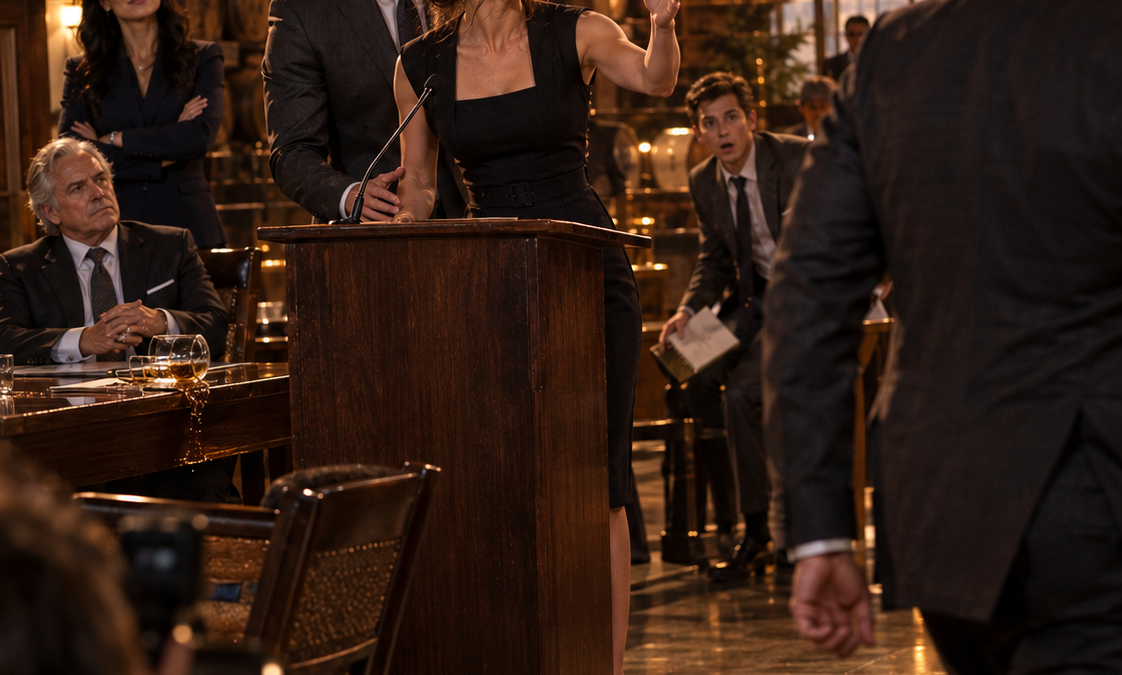
Charlotte stood at the podium, looking out at the crowd.
“Two years ago,” she said, “I stood in this room and watched my brother try to sell my family’s future. I was told that I was powerless, that my name meant nothing, that the distillery would be better off without me.”
She paused.
“Two years later, I’m standing here as CEO and master blender of Hartwell Distillery. I’m releasing a bourbon that I made with my own hands, from barrels I selected, in a rickhouse my father taught me to love. And I’m telling everyone here: you can’t sell what doesn’t belong to you. You can’t destroy what’s built to last.”
The crowd applauded.
Charlotte looked at the front row—at Celeste, who was smiling through tears; at Gerald Ashford, who nodded slowly; at the empty chair where her brother would have sat, if he’d been there.
And she looked at Julian, standing at the back of the room, his eyes on her.
“I want to thank the people who believed in me,” she said. “My father, who taught me everything I know. My sister, who protected me from the shadows. And Julian Sinclair, who gave me the chance to fight.”
She raised her glass.
“To The Reserve. To family. To the future.”
The crowd echoed her toast.
And Charlotte Hartwell, master blender, CEO, and heir to a legacy that would never be sold, drank to her own victory.
After the party, Charlotte and Julian walked through the rickhouse—their rickhouse now, their future.
“I’m proud of you,” Julian said.
“I’m proud of me too.” Charlotte stopped at a barrel marked with a white chalk circle—the 15-year her father had laid down after her mother died, the one he’d said was for her wedding. “I want to open this.”
Julian looked at the barrel. “That’s the one your father made.”
“For my wedding. Yes.”
“You’re not married.”
“Not yet.” Charlotte turned to face him. “But I’m thinking about it.”
Julian’s eyes widened.
“Are you—”
“I’m not proposing. I’m just… saying.” Charlotte smiled. “I’m saying that I’m not afraid anymore. I’m saying that I trust you—not completely, not yet, but more than I’ve trusted anyone in a long time. I’m saying that I want to build something with you. Something real.”
Julian stepped closer, his hands finding her waist.
“Then let’s build it,” he said. “Together.”
They kissed—slow, deep, a promise and a beginning.
And Charlotte felt, for the first time in years, that she was exactly where she was supposed to be.
Chapter 16: The Future
The wedding was small—just family and close friends, held in the distillery’s rickhouse, surrounded by barrels that had aged for decades. Celeste stood beside Charlotte as maid of honor. Gerald Ashford, frail but smiling, walked her down the aisle. And Julian Sinclair, the man who’d been her adversary and her ally, her partner and her love, waited at the altar.
They said their vows beneath the same oak tree where Charlotte’s parents had married forty years earlier.
And when the ceremony was over, they opened the 15-year barrel—the one her father had made for this moment—and poured glasses for everyone who’d come to witness.
Charlotte raised her glass.
“To my father,” she said. “Who knew, even when I didn’t, that I was strong enough to fight.”
The crowd echoed her words.
And Thomas Hartwell’s spirit, if it lingered in the rickhouse at all, must have been smiling.
His daughter had won.
His legacy had survived.
And the whiskey—the whiskey was perfect.
Charlotte and Julian settled into a life that was equal parts chaos and calm—board meetings and quiet dinners, business trips and long weekends at the distillery. They argued about everything and agreed about nothing, and somehow, that worked.
Celeste became a permanent part of the family, moving to Louisville to head up Sinclair Global’s Kentucky operations. She and Charlotte spent weekends experimenting with new blends, arguing about char levels, and laughing at jokes only they understood.
Everett served his sentence and was released after eight months. He didn’t come back to the distillery—that part of his life was over—but he sent Charlotte a letter, and she wrote back, and slowly, carefully, they began to rebuild what had been broken.
Not everything could be fixed.
But some things could.
One year after the wedding, Charlotte stood in the rickhouse, holding a newborn baby in her arms.
“She has your eyes,” Julian said, standing beside her.
“She has your stubbornness.” Charlotte smiled down at her daughter—their daughter—who had been born three weeks early and had already proven herself to be a force of nature. “I think she’s going to be a master blender.”
“She’s going to be whatever she wants to be.” Julian kissed Charlotte’s forehead. “That’s the whole point.”
They stood together, surrounded by barrels and history and the future, and Charlotte felt something she hadn’t felt in years.
She felt complete.
Epilogue: The Angel’s Share
Years later, Charlotte Hartwell-Sinclair stood at the edge of the rickhouse, watching her daughter—now twelve years old, with her grandmother’s smile and her grandfather’s stubborn streak—run through the rows of barrels, touching each one like she’d done a thousand times before.
“Mom,” the girl called. “Which one is Grandpa’s?”
Charlotte walked to her, stopping at a barrel marked with a white chalk circle. “This one. He laid it down the year your grandmother died. Said it was for me, for my wedding.”
“But you didn’t open it.”
“I did open it. At my wedding. We poured it for everyone who came.”
The girl looked at the barrel. “Is there any left?”
“A little.” Charlotte smiled. “Enough for your wedding, if you want it.”
The girl’s eyes lit up. “Really?”
“Really. It’s yours. That’s what family does—we save things for the people we love.”
They stood together in the dark, surrounded by history, and Charlotte felt her father’s presence—not as a ghost, but as a memory, a lesson, a love that had never really left.
“The angel’s share,” she said.
“What?”
“That’s what they call the whiskey that evaporates while it ages. The part that’s lost to time. My dad used to say it was the angels’ tax—the price of perfection.”
The girl frowned. “That’s sad.”
“No. It’s not. Because what’s left is better. The years take what they need, and what remains is… enough. It’s always enough.”
She took her daughter’s hand.
“Come on. Let’s go home.”
They walked out of the rickhouse together, leaving the barrels behind—holding the past, promising the future, aging slowly toward perfection.
And in the silence, the angel’s share rose like a prayer.
