Part 2: She Fired the Ex-SEAL Janitor for Shining a Light at Her Blind Daughter—Then Everything Changed!
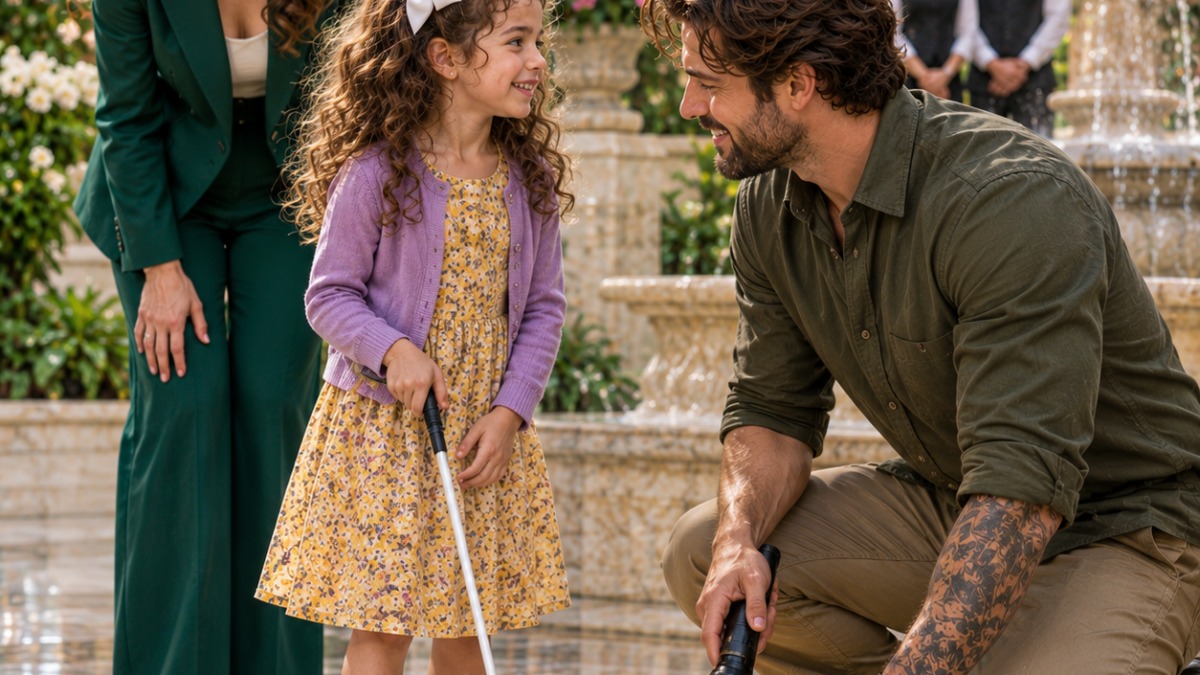
In the kitchen, Mia announced that the table was set and asked if there was going to be garlic bread because she wanted there to be garlic bread.
Theres going to be regular bread.
Ethan said. Thats not the same.
I know. Im sorry.
Victoria stood.
She straightened her coat. She picked up her bag from the floor beside the couch where shed set it when she came in.
I want to bring Lily back to her specialist. she said.
With specific observations and a specific request for targeted testing.
I need to be able to tell them exactly what to look for and why.
She looked at him.
I want you to write it down.
Everything you observed the corridor, the timing, the light source, the angle, the response in in both eyes in the music room.
All of it with as much precision as you can. Ethan looked at her steadily.
And youll take it to the specialist.
Yes.
What if they dont listen?
Then Ill find one who will. He was quiet for a moment.
Okay.
he said.
She moved toward the door. He stood and followed, not to hurry her out but because it was the natural movement of the space.
At the door, she stopped and turned back. Im going to ask the academy to reconsider your termination.
she said. I dont know what Dr.Marsh will decide.
Thats her prerogative and Ill respect it whatever she chooses.
But Ill ask. Ethan looked at her.
He didnt say thank you, which she found she preferred. The document.
he said. Ill have it to you by tomorrow evening.
She gave him her direct email address.
He didnt write it down.
He just looked at her for a moment the way someone does when theyre filing something away with precision, then nodded.
She opened the door. The evening outside was cool and still.
The street damp from last nights rain but clear now. Her driver was parked at the end of the block discreetly, the way shed asked.
Ms.Ashford. She turned.
He was standing in the doorway, one hand on the frame. Mia had appeared behind him, leaning around his arm with the look of a child who has registered that the adult conversation is ending and normal life is resuming.
For whatever its worth, he said, What you did yesterday coming in there, the way you did, that was the right instinct. You just didnt have enough information.
He paused.
Neither did I. Victoria looked at him for a moment.
Well see if the information helps. she said.
She walked down the front step and along the street toward the car. Behind her, she heard Mias voice.
Dad, who is that? An Ethans, someone who needed some answers.
Did she get them? A pause.
Some of them.
he said. The rest were still working on.
The document arrived the next evening at 6:43.
Victoria was at her desk in the home office, working through contracts when the email appeared. She opened it immediately.
There was no introduction, no pleasantries, just the document attached.
She opened that, too. It was four pages, single-spaced, written in a style that was neither clinical nor casual, precise and observational.
The kind of writing that came from someone who had spent years filing field reports. Every detail had a timestamp.
Every light source was described with reference to its angle, distance, and approximate intensity.
Lilys responses were recorded with the specific, careful language of someone who understood the difference between what they had seen and what they were interpreting.
He had noted twice, in different sections, that he was not a clinician and his observations should be reviewed by s- s- someone with appropriate expertise.
Victoria read it twice. Then she forwarded it to the email address of Dr.Cara Whitfield, a specialist in pediatric retinal disorders, who worked at a research hospital two cities over, and who had a 3-month waiting list and a reputation for taking on cases that other specialists had given up on.
Victoria had tried to get an appointment with Whitfield twice before and been told there was no availability.
She tried again now, but this time she didnt call the appointments line.
She called the department directly and asked to speak with Dr.Whitfields research coordinator. She explained that she had a detailed behavioral of observation document, authored by an individual with advanced surveillance and perceptual training describing a possible residual light response in a child with a documented LCA diagnosis.
The research coordinator asked her to hold. She held for 11 minutes.
When the coordinator came back on the line, she said, Doctor Whitfield can see you in 3 weeks.
Victoria said, Id like to discuss the possibility of 2 weeks. A pause.
Ill ask. The coordinator said it was 2 weeks.
Victoria set the phone down and looked at the window for a moment. Then she picked up her pen and went back to the contracts.
She still had 6 hours of work to do and Lily needed to be up for school by 7:00.
She did what she had always done. She kept moving.
But something had shifted somewhere in the quiet of the evening in the space between one thing and the next.
She hadnt been able to name it yet.
She thought she would eventually.
3 weeks was a long time to sit with something and not know what to do with it.
Victoria had spent those weeks working the way she always worked with concentration and discipline and the kind of forward momentum that left very little room for the other thing.
The appointment with Dr.Whitfield was on the calendar.
Ethans document had been sent. There was nothing to do now but wait and continue.
And continuing was something Victoria knew how to do better than almost anything else.
She didnt contact Ethan during those weeks. She wasnt sure what she would have said.
The situation between them existed in a category she didnt have a clean name for.
He wasnt an employee anymore.
Dr.Marsh had been genuinely apologetic but firm explaining that the circumstances of the dismissal, regardless of their resolution, had created a situation that made reinstatement complicated.
She had offered a reference letter and 3 weeks additional pay. Victoria had accepted the decision without argument because she had promised to respect whatever Marsh decided and she kept her promises, even the inconvenient ones.
She had told Ethan by email.
He had replied with two sentences, I understand. Thank you for asking.
That had been 12 days ago. She had thought about calling him.
She had thought about it in the particular way you think about things youve decided not to do with an awareness of the decision sitting there, present and slightly uncomfortable. What stopped her wasnt propriety.
It wasnt professional caution or the advice of her legal team or any of the practical considerations that govern most of her decisions. What stopped her was simpler and harder to justify.
She didnt know what they were to each other now and she didnt have a category for it and Victoria did not move comfortably in the absence of categories.
So she worked. She took Lily to her regular appointments.
She sat through two more board meetings, one supplier negotiation, and a Friday afternoon call with a lawyer that lasted an hour longer than it should have. She made garlic bread for Lily on Saturday evening because Lily had asked and she watched Lily eat it at the kitchen table with the careful focused pleasure of a child who takes food seriously.
She didnt sleep particularly well, but she hadnt slept particularly well in 8 years, so that wasnt new.
The appointment with Dr.Whitfield was on a Tuesday. Dr.Kara Whitfield was not what Victoria had expected, which was itself unexpected.
Victoria was usually good at knowing what to expect. She had imagined someone formal, institutional, the kind of specialist who delivered assessments with a remove that was probably protective but always felt cold.
What she found instead was a small woman in her early 50s with reading glasses pushed up into her hair and a habit of asking questions in rapid succession and then going very quiet while she listened to the answers. Her office was cluttered in the way of someone who was always working, journals stacked on the chair that wasnt being sat in, a whiteboard with diagrams and measurements that had been partially erased and rewritten.
There was a coffee mug on the desk that had a cartoon on it that Victoria couldnt quite read from her angle.
Sit.
Dr.Whitfield said, already reading something in the folder shed received.
Ive read the document twice.
I want you to walk me through it verbally while I ask questions. Victoria had prepared for this.
She had not brought Lily to this initial meeting, which Whitfield had specified in her pre-appointment instructions. The first meeting would be a records review and consultation.
No patient present.
She walked Whitfield through Ethans observations.
The corridor, the truck, the tracking movement, the flashlight test, the specific detail about the response being more pronounced in the left eye. Whitfield asked questions throughout, and they were precise questions, angles, and distances, and durations, the kind that cut straight to what mattered.
At one point she looked up from the folder.
The person who wrote this, she said, Whats their background? Former Navy SEAL, 14 years.
Specialized training in surveillance and field observation. Whitfield looked at the folder again.
Not medical. No, Doesnt matter.
Whitfield said, which surprised Victoria.
This isnt a clinical document.
Its an observation document.
It doesnt tell me whats happening.
It tells me that something is happening.
Very different thing.
She set the folder down and picked up a different sheet, Lilys existing medical records, which Victoria had sent ahead. Ive read her file.
Shes been assessed six times in six years.
Seven.
Victoria said.
Seven.
The most recent was 14 months ago? Yes.
Whitfield looked at the records for a moment.
She had a pen in her hand, but she wasnt writing anything, just tapping it lightly against the desk. The protocol thats been used consistently across these assessments, she said, is the standard ERG battery, electroretinogram.
You measure electrical response in the retina when light is introduced. In LCA the response is characteristically flat or near flat.
Her results have been consistent across seven assessments.
Thats what Ive been told.
Victoria said.
Heres the thing.
Whitfield said. ERG tells you about photoreceptor function at the retinal level.
It doesnt tell you about every downstream pathway. There are cases, uncommon but documented, where the retinal response is severely compromised, but theres preserved function in the residual pathways.
The signal chain from eye to brain is longer than a lot of people realize, and there are cases where parts of that chain maintain some function even when the ERG is flat. Victoria was very still.
Is that what you think is happening with Lily?
I dont think anything yet, Whitfield said flatly. I look at data.
I dont theorize ahead of data. She closed the folder.
But the behavioral observations in this document are consistent with a profile Ive seen before.
Twice.
In my career. Both times the initial specialist assessments had concluded minimal remaining function.
Both times targeted testing found something. She paused.
The field has moved.
There are tests now that werent standard practice even 4 years ago.
I want to run a specific battery.
Itll take a full day, possibly two.
Its intensive and it requires Lily to cooperate, which means she needs to understand enough of whats happening to participate without being frightened. How do I prepare her?
Whitfield looked at her directly.
Tell her the truth.
Tell her that someone noticed something that nobody else had noticed and that we want to look more carefully. Tell her it might not find anything.
But tell her were going to look.
Victoria absorbed this.
Shes eight, she said. Shes been told variations of were going to look her whole life.
I know, Whitfield said.
Thats why the framing matters. Dont promise her anything.
Just tell her theres a person who looked more carefully than usual and we want to see if he was right. The coffee mug caught Victorias eye again.
She could read it now from this angle.
Id rather be doing research. She almost smiled.
When can we schedule it?
Victoria asked. End of next week, Whitfield said.
I want to review the full protocol before then. Ill have my coordinator send you the pre-assessment instructions by tomorrow.
She picked up the folder again, already moving to the next thing.
One more question. Victoria waited.
The man who wrote this, Whitfield said, is he still involved?
Victoria paused. He was dismissed from the school.
Hes not formally involved with Lilys care.
Whitfield gave her a look over the top of the folder.
It was a brief look, but it was the kind that communicated a complete thought without needing words. Im asking, she said, because if the testing finds anything, I may want to speak with him directly.
The observations he made about the directional response the left eye versus right, that kind of specific detail could be useful when were interpreting results.
Ill make sure hes reachable, Victoria said. Whitfield nodded.
She was already reading again. Victoria gathered her things and stood.
Dr.Whitfield, she said, honestly, what are the odds? Whitfield didnt look up immediately.
She finished reading whatever she was reading, and then she looked up. I dont do odds, she said.
I do tests. Well know more afterward.
It wasnt comforting in the conventional sense, but it was honest, and in Victorias experience, honest was usually better.
She sat in the car outside the hospital for a few minutes before telling the driver to go. She was trying to organize her thoughts, which was difficult because they were not organizing themselves cooperatively.
Everything Whitfield had said was careful and measured and had contained no promises, but it had also contained something.
Victoria hadnt heard from a specialist in years. It had contained the word possible.
Not certain.
Not likely. Not even probable, but possible, which was different from what she had been carrying for 6 years, which was a carefully managed form of not quite hopeless.
She pressed her fingers to her closed eyes for a moment.
Then she picked up her phone.
She had Ethans number because shed called him once 2 weeks ago to let him know the appointment had been confirmed.
The call had lasted 4 minutes and had been almost entirely factual.
She had thanked him for the document.
He had asked if she had any questions about anything in it. She had said no.
There had been a brief, not entirely comfortable pause, and then they had said goodbye. She looked at the number now.
She thought about the things Whitfield had said, about the possibility of needing him for the interpretation of results, about the word possible and what it had done to the air in that cluttered coffee mug office.
She thought about 3 weeks of not calling, and the decision sitting there, slightly uncomfortable. She called.
He picked up on the third ring.
There was background noise, something mechanical, distant. Ms.Ashford.
I just came from Dr.Whitfield, she said.
She reviewed everything. She wants to run a full targeted assessment next week.
A pause.
Okay. His voice was careful, like he was working out what to do with the information.
She said the observations in your document were consistent with a profile shes seen before.
She didnt promise anything. But she wants to look.
Another pause, longer this time. Thats good.
He said.
His voice had shifted very slightly.
Something loosened in it. Something that had been held.
She said she might want to speak with you directly, Victoria said. About the directional observations specifically.
If thats something youre willing to do.
Yes, he said, no hesitation. All right.
Victoria looked out the car window at the gray exterior of the hospital building. Where are you?
At work, he said. New job.
Loading dock supervisor at a freight company. A brief pause.
Its fine. She noted the way he said its fine, not complainingly, not with self-pity, but with the flatness of someone describing a factual condition they decided not to spend energy on.
The kind of statement that closes a door before anyone can try to open it.
Im sorry the school didnt take you back, she said.
Im not, he said, which surprised her enough that she didnt respond immediately.
I mean, its okay.
It was never going to be the right thing long-term.
The job was fine, but it was fine, he said again, differently this time.
Victoria understood what he wasnt saying. 14 years in special operations and then a loading dock with a music room hallway in between.
It was fine.
But it was not what he was. Ill have Dr.Whitfields coordinator contact you with details, she said.
Ill make myself available, he said.
She almost said goodbye. And then she didnt.
Ethan.
It was the first time she had used his first name, and she registered it as it happened. Dr.Whitfield told me to tell Lily that someone noticed something nobody else had noticed.
That we want to see if he was right.
I I you should know, thats how she framed it.
There was quiet on the line for a moment.
Distant mechanical sounds. How did Lily take it?
he asked. I havent told her yet.
The appointments next week.
A pause. But I think shell be glad to know someone was paying attention.
Yeah.
he said quietly.
Goodbye, Ethan.
Goodbye, Ms.Ashford. She put the phone down.
The driver pulled away from the hospital. She watched the building disappear in the side mirror, and then she thought about Lily, and then she thought about Lily tell her the truth without making it a promise, and she thought about what it would feel like if next week answered nothing, and she thought about the look on Ethans face when she told him he was fired, and the sound of his voice just now.
Something loosened in it. She thought about a lot of things on that drive home.
She sorted most of them into categories that could be acted on, but some of them resisted sorting, and she let them be.
She told Lily that evening, after dinner, during the part of the day that belonged to the two of them, the quiet hour before Lilys bedtime, when they sometimes read together, sometimes talked, sometimes just existed in the same room without needing to account for it.
Lily was sitting on the living room floor with her legs crossed and her back against the couch, her fingers moving over the pages of a braille book.
Victoria sat on the couch above her, close enough that their usual proximity was intact.
She said, I want to tell you something about the appointment next week.
Lilys fingers paused on the page. The new doctor?
Yes, Dr.Whitfield. Shes different from the others.
Victoria stopped, organizing her words.
She had spent part of the drive home deciding how to do this. Theres a man, you remember the man from the music room from school?
Lilys head came up slightly.
The one you fired?
Victoria absorbed the directness of this, as she absorbed most of Lilys directness, which was considerable. Yes, she said.
Him. His name is Ethan.
He wrote down everything he noticed about the way you moved when the light was in the hallway during the drill, and the way your eyes moved in the music room.
He wrote it all down very carefully, and I gave it to Dr.Whitfield.
Lily was quiet.
He noticed something, she said.
Her voice was neutral in the way she made it neutral when she was working something out.
You think so?
Dr.Whitfield thinks its worth looking at properly.
Lily turned this over. What did he notice?
He thought your eyes might be responding to light in a way that wasnt showing up in the regular tests, Victoria said.
She had decided to be plain.
Lily had been talked around things her whole life by well-meaning people who softened everything into shapes that were easier to hold. Victoria had promised herself years ago that she would always tell Lily the truth.
Hes not a doctor, he could be wrong. Next weeks tests will tell us more, but he might be right.
He might be right.
Lily was quiet for a long moment.
Her fingers werent moving on the book.
She was sitting very still and Victoria couldnt always read what that stillness meant, whether it was working through something or protecting something or just thinking. He was nice, Lily said.
When he was in the music room before you came in.
A pause. I knew you were going to be upset.
I could tell from the way he got quiet when he heard you coming. You heard me coming?
You walk loud when youre worried, Lily said, not unkindly, just as a fact. Victoria had not known this about herself.
She sat with it.
He said, dont stop looking, Lily said, after before he left.
I know.
I heard him. Lily stopped.
She picked up the braille book and held it in her lap without reading it.
I didnt know if he meant it or if it was just a thing people say.
I think he meant it, Victoria said. Lily considered this.
Okay, she said, Ill do the tests.
Youre sure?
Lily tilted her face upward slightly in the way she did when she was making a decision. If he noticed something, I want to know what it is.
A pause. Even if it turns out to be nothing.
Victoria put her hand on Lilys shoulder. Lily leaned into it briefly, the way shed been doing since she was small, quick and warm and then pulling back to her own uprightness, her own independence, which was considerable for eight.
Can I keep reading?
Lily said.
Yes, Victoria said.
She sat on the couch above her daughter who was reading in the quiet room and she didnt say anything else for a while. She just sat there, which was sometimes the only honest thing.
She called Ethan 3 days before the assessment. This time she called from the kitchen while Lily was at school sitting at the table with a cup of coffee shed forgotten to drink.
Outside the kitchen window it was a pale March day, the kind of cold that looked warmer than it was.
He answered after two rings. The assessments Tuesday, she said.
Whitfields coordinator should have already contacted you about speaking with her directly. Have you heard from them?
Yesterday, he said. Im going in Monday afternoon.
She wants to go through the observation document before she runs the tests. Good.
Victoria turned the coffee cup on the table once and then stopped. How did the loading dock job go this week?
There was a pause, brief but there.
Fine, he said.
Long days, its fine. You keep saying that.
Another pause, longer. Its honest, he said.
Its not what Id choose if I was choosing, but its work and it pays and Mias got a good school and Im He stopped. Im okay.
The two of you get along well, Victoria said. You and Mia.
Most of the time.
Shes eight.
He said it with the specific dry flatness of a parent who loves their child absolutely and is also well acquainted with the less charming dimensions of them.
Shes been pushing her bedtime by 10 minutes every night for the past 2 weeks and she thinks I havent noticed.
Have you told her youve noticed? No.
Im curious how far shes going to take it. Victoria found herself smiling at the kitchen table.
She pressed her lips together.
That sounds like surveillance, she said.
Old habits, he said. And then he laughed a short surprised sound like he hadnt quite expected to.
It changed the quality of the call in a way that was hard to describe.
She said, I told Lily about you.
About the document and what you noticed. The laughter was gone replaced by that careful attention again.
What did she say?
She said shed do the tests, Victoria said.
She said that if you notice something she wanted to know what it was even if it turned out to be nothing.
He was quiet for a moment. She sounds like a tough kid, he said.
She is, Victoria said. There was something in her voice when she said it, not pride exactly, or not only pride, something older and more complicated than pride.
Shes been a tough kid since she was 2 years old.
I dont know if I made her that way or if she came that way and I just didnt get in her path.
Probably both, he said. Probably, she said.
They were quiet for a moment, which felt different from previous silences between them.
Those had been the silences of two people figuring out what they were to each other and why they were talking. This one was less effortful.
She wasnt sure when that had shifted. She said, I walk loud when Im worried.
Victoria said.
What? Lilly.
She said she heard me coming down the corridor before I came into the music room.
She said I walk loud when Im worried. Victoria looked at the kitchen window.
Ive been thinking about that for days.
Do you? he said.
Walk loud when youre worried? Apparently.
I had no idea.
Your daughter notices things, he said. Yes, Victoria said.
She does.
Another pause. Youve been carrying this along for a long time, he said.
It wasnt a question and it wasnt soft.
He said it the way he said most things, with the kind of directness that was almost blunt but stopped just short of it because there was care behind it.
Victoria looked at the untouched coffee. Thats generally how I function, she said.
I know, I can tell. He paused.
Its not a criticism. I know its not, she said.
And she did know it. Its just the way the equation works.
The more variables you control, the more predictable the outcome.
The more people you bring in, the more variables you introduce. Yes.
That works until it doesnt, he said. Im aware, she said.
Thats why I went to your house.
He was quiet for a moment and she could tell he was thinking, not the performed pause of someone constructing a polite response, but actual thought.
Tuesday, he said finally. Ill be thinking about how it goes.
Ill let you know, she said. You dont have to.
I know, she said. I will anyway.
She hung up and looked at the coffee and finally drank some of it, which was cold by then and entirely her own fault. The assessment took 11 hours.
It was not supposed to take 11 hours.
Whitfield had scheduled eight with a lunch break and two rest periods because the testing required Lilys sustained engagement and a tired child was not a cooperative child.
But Lily was cooperative in a way that surprised everyone except Victoria, who was not surprised at all.
She sat in the examination room with the patience of someone who had been in examination rooms many times and had developed her own relationship with the process, a quiet, internal kind of participation, focused and still. She answered questions when she was asked questions.
She responded to instructions when they were given. When Dr.Whitfield explained what each test was measuring in plain language, the way she had said she would, Lily listened with her head at that characteristic slight tilt and said, Okay.
And then did the thing. The extra 3 hours came from something Whitfield hadnt anticipated.
Halfway through the battery, one of the results triggered a follow-up sequence that wasnt in the original protocol. Whitfield ran it twice and then a third time with different parameters.
Victoria sat in the observation room through all of it. She had a laptop and she worked or she opened the laptop and looked at it and occasionally typed something and then stopped.
She was aware of how little she was actually doing and she was aware that this was one of those situations where there was genuinely nothing to do but wait and that she was bad at waiting and that being bad at it was not going to change the results. At 4:00 in the afternoon, with Lily resting in a side room with a blanket and her audio player, Dr.Whitfield came out and sat in the observation room and put her reading glasses on and spread four printed readouts on the small table between them.
She pointed to a specific section of the first readout. There, she said.
Victoria looked.
She was not qualified to read the readout.
She knew she wasnt.
She said, Tell me.
Whitfield told her. It took a long time and it was careful and technical and Victoria understood perhaps 60% of it.
What she understood was this, there was a response, not in the retinal layer where the primary damage was severe and unchanged, but further up the chain.
A preserved pathway, partially functional, that the standard testing battery had not been designed to detect. Lillys brain was receiving something.
Not enough to see in any complete sense, but enough to register light movement, strong contrast.
Enough that it could be worked with, potentially. How far can this go?
Victoria said. Her voice was steady.
She had decided she would be steady. Whitfield looked at the readouts.
Im going to be honest with you, she said. Whats preserved is real, but its limited.
Were not talking about a restoration of vision.
Thats not what this is. She paused.
But but with the right therapeutic program specifically designed to work with the pathway thats active, there are real possibilities for functional improvement.
The ability to perceive light sources, movement, contrast, shapes, possibly faces over time, under the right conditions. She set down the paper she was holding.
It wont be what youve hoped for.
Itll be something different.
Different is Victoria stopped. Whitfield waited.
Different is more than we had this morning, Victoria said.
Yes, Whitfield said, it is.
Victoria looked at the readouts on the table.
All those lines and measurements.
Eight years of looking and relooking and finding the same flat answer.
And one man with a flashlight who had looked differently. She felt something move in her chest, not a dramatic thing.
Not a wave or a flood.
Just a slow shift, like something that had been braced for a long time, finally giving just slightly. And the release of that tension was so quiet, it was almost nothing, and also almost everything.
Shes going to want to know, Victoria said. How much do you want to tell her?
Victoria thought about Lilly on the living room floor with her braille book.
Even if it turns out to be nothing.
The toughness that was entirely her own, and that Victoria had never quite known how to account for. Everything, Victoria said.
Shes earned everything. Whitfield nodded.
She gathered the readouts and stood.
Ill have the full written report to you by Thursday, she said.
And Ill want to schedule a follow-up to discuss the therapy options in detail.
My team can design a program, but its a long process.
Months of work, possibly more. She looked at Victoria.
It requires patience. I have patience, Victoria said.
Whitfield gave her a look that was not unkind, but was also not credulous.
You have a drive, she said. Thats different.
But for this, she gestured at the readouts, drive will get you started. Patience is what finishes it.
Victoria looked at her.
Ill learn, she said. And she meant it in the particular way she meant things when she said them, not as aspiration, but as decision.
As something already in motion. As the first step of a plan she had just made.
Whitfield almost smiled. Go tell your daughter, she said.
Victoria went. She walked through the corridor to the side room where Lily was resting, and she opened the door, and she sat on the edge of the small cot, and she put her hand over her daughters.
Lily pulled out one earbud.
What did they find? She said.
No preamble, no preparation needed.
Victoria took a breath.
He was right, she said.
Lily was very still.
Ethan?
Yes. A long quiet.
Then Lily said, I knew it.
She said it so simply, with such complete and private certainty that Victoria had to look away for a moment at the plain wall of the hospital side room. You knew, she said.
I felt it, Lily said, in the music room. When the light was moving.
A pause.
It was fast. But it was real.
I knew it was real.
She paused again.
I just didnt know if I was allowed to think it was real. Victoria looked back at her daughter.
Youre allowed, she said.
Youre absolutely allowed. Lilys hand turned under hers and held it properly.
Palm to palm. The way shed held her hand since she was small.
Her thumb moved across Victorias knuckles once.
A small and deliberate thing.
Okay, Lily said.
Just that. Outside the window of the small hospital room, the afternoon light was flat and winter pale and entirely ordinary.
And it lay across the floor of the room in thin bar, and Lily couldnt see it, not yet, not really.
But something in her knew it was there.
And that was where it began. The written report arrived Thursday morning, as Whitfield had promised.
Victoria read it at her desk before anyone else arrived at the office, before Dana, before the junior associates who kept early hours to demonstrate their commitment, before the buildings cleaning crew finished their rounds. She had been there since 6:15, which was not unusual for her.
But on this particular morning, she had arrived with the specific purpose of reading the report alone, without the ambient noise of other peoples days beginning around her.
It was 22 pages, dense, technical, written in the language of clinical research that she was not fluent in, but had spent 8 years developing a working vocabulary around. She read it the way she read legal documents, slowly, with attention to the language that qualified things, the hedges and conditionals and careful delimitations of what was known versus what was possible.
What was known? Lily had preserved function in the visual cortex pathway that standard testing had not been designed to detect.
The function was limited. The retinal damage was real and permanent.
Nothing in the report changed that. What was possible with targeted therapeutic intervention?
The preserved pathway could be worked, stimulated, trained in a sense to make better use of what it had.
The science on this was newer than most people realized. Developments in the last 4 years changed the landscape of what rehabilitation could accomplish in cases where some pathway function remained.
Whitfield cited four studies. Victoria looked up all four before 8:00.
What the report could not tell her, how far it would go, how much functional improvement was realistic, whether Lily would reach the higher end of the projected range or the lower end or somewhere in between. There were too many variables, too many individual factors that could only be assessed as the therapy progressed.
The word patience appeared in the final paragraph.
Victoria read it twice.
Then she closed the report, opened her calendar, and began rearranging the next 3 months.
She called Dr.Whitfields coordinator at 8:30 and scheduled the follow-up consultation. She called her personal lawyer at 9:00 and asked him to research the legal requirements for establishing a medical research foundation, not because she had decided to do that yet, but because she liked to know the landscape before she needed to move through it.
She spent 40 minutes on the phone with the director of the specialized therapy unit Whitfield had recommended.
A woman named Dr.Pria Nair, who ran a program 40 minutes outside the city and who had a wait list, and who after Victoria explained the specifics of Lilys case and mentioned that Dr.Whitfield had referred them, said she could fit Lily in within the month.
By noon, Victoria had accomplished what would have taken most people a week.
 [Tap here for the Next Part ]