Part 2: “You should have thought about that before you embarrassed this family.”
PART 3 — THE CEREMONY
The event that changed everything was a gala.
My parents had been nominated for a humanitarian award. Some local charity. The Nevada Business Council, or something like that. They had donated money to a hospital wing. They had sponsored a scholarship fund. They had done the things that people do when they want to be seen as generous without actually being generous.
The award ceremony was in Las Vegas. Black tie. Five hundred guests. Press coverage.
My mother called me two weeks before the event.
“Elena. I need to talk to you.”
“About what?”
“The gala. Your father and I are receiving an award.”
“I heard.”
“We want you to come. We want the family to be there.”
I almost laughed.
“You want me to come to the ceremony where you’re being honored for your humanitarian work? After you left me and my son on the side of a highway?”
“Elena—”
“Why would I do that?”
“Because you’re family. Because we need to show a united front.”
“United front.”
“The press will be there. People will be watching. We need to look like we’re okay.”
“We’re not okay.”
“I know. But we can pretend.”
“Mom, I’ve been pretending for forty years. I’m done.”
“Elena, please. I’m asking you. For your father. He’s not well. He needs this.”
I thought about my father. The hospital. The way he had looked at me and said he was sorry.
I thought about the things I had been collecting. The statements. The documents. The evidence.
I thought about the network I had built.
I thought about what it would mean to show up at that gala.
“I’ll think about it,” I said.
“Thank you. That’s all I ask.”
I hung up.
Then I called Jim.
“I need to go to Las Vegas,” I said.
“You’re going to the gala?”
“I’m going to the gala.”
“What’s your plan?”
“I don’t have one yet. But I’m going to have one.”
“Elena.”
“Jim, I have three weeks. I have everything I need. I just need to figure out how to use it.”
He was quiet for a moment.
“I know some people in Vegas,” he said. “Let me make a call.”
The next day, I got a call from a man named Thomas Reyes.
Thomas was a retired FBI agent who had worked organized crime in Las Vegas for twenty years. He was also Jim’s former brother-in-law, which was how they knew each other.
“Jim tells me you’re trying to take down a couple of local philanthropists.”
“They’re not philanthropists. They’re frauds.”
“That’s usually the case. What do you have?”
I told him.
He listened without interrupting.
“That’s a lot,” he said when I was done. “The financial stuff is interesting. The abandonment is interesting. But you’re going to need something more if you want to make a real impact.”
“Like what?”
“Like a witness who can’t be dismissed. Someone with credibility. Someone who can tie everything together.”
“Who?”
“I’ve been looking into your parents for a few weeks now. Ever since Jim called me. And I found something you might want to know about.”
“What?”
“There was a business partner. A man named Frank Delgado. You mentioned him.”
“I did.”
“Frank was pushed out of the dealership in 2008. He got a settlement. He signed an NDA. He went quiet.”
“I know.”
“He didn’t go quiet. He went careful. He’s been collecting evidence of his own for fifteen years. He has emails. Financial records. Proof that your father committed fraud to push him out.”
I felt something shift in my chest.
“Why didn’t he say anything?”
“Because he was scared. Your father has connections. Some of them are not nice people. Frank didn’t want to put his family at risk.”
“But he has the evidence?”
“He has everything. He’s been waiting for someone to reach out. Someone who could protect him.”
“Can you protect him?”
“I can try. But it’s going to take all of us.”
“All of us?”
“Your network. Jim’s network. My network. There are a lot of people who owe you, Elena. A lot of people who have been waiting for a chance to pay you back.”
I didn’t know what to say.
“I didn’t know,” I said finally. “I didn’t know anyone was keeping track.”
“That’s not why you helped them.”
“No.”
“That’s why they remember.”
I spent the next two weeks building my case.
Frank Delgado and I talked on the phone for hours. He had been collecting evidence for years. He had everything: emails, memos, wire transfers, recorded conversations. He had been meticulous. He had known that one day, he would need it.
“Why didn’t you use it?” I asked.
“I tried. Once. I hired a lawyer. He told me I was crazy. He told me your father had too many connections. He told me I would lose everything if I kept pushing.”
“So you stopped.”
“I stopped. But I didn’t forget.”
“Frank, I’m not going to let them do this to anyone else.”
“I know. That’s why I’m talking to you.”
The gala was on a Saturday night.
I spent the afternoon getting ready. I had bought a dress. Simple. Black. Not flashy. I didn’t want to be the center of attention. Not yet.
Mateo was with Jim. They were going to spend the weekend at the ranch. I had told him I had a work thing. I didn’t want him to know what I was doing. Not yet. Not until it was over.
I drove to the venue alone.
The hotel was beautiful. Marble floors. Crystal chandeliers. People in tuxedos and evening gowns.
I walked in like I belonged there. I had learned how to do that in the military. It was a skill you needed, sometimes. The ability to walk into a room and act like you owned it, even when you felt like you were falling apart.
My parents saw me from across the room.
My mother’s face lit up. She actually smiled. She looked relieved.
My father looked at me and nodded. There was something in his eyes. Something I couldn’t read.
They walked over.
“You came,” my mother said.
“I said I would think about it.”
“I’m so glad you’re here.”
She reached out to hug me. I didn’t move. She hesitated, then let her arms fall.
“Well,” she said. “You look nice.”
“Thank you.”
“We have a table near the front. Come sit with us.”
I followed them to the table. I sat down. I smiled. I made small talk with the other guests.
I was calm. I was precise. I was polite.
I was waiting.
The ceremony started at eight.
There were speeches. There were videos. There were awards. My parents were given a plaque and a standing ovation.
My mother wiped her eyes. My father looked proud.
I clapped.
Then the host said something that changed everything.
“And now,” he said, “we have a special presentation. A tribute to the Montoya family.”
I froze.
Montoya was my mother’s maiden name. She had always been proud of it. She had always said it was a name that meant something in this community.
“We have a video message from someone who couldn’t be here tonight,” the host said. “Someone who wanted to share what the Montoya family means to them.”
The screen behind the stage flickered.
And then I saw him.
Frank Delgado.
He was sitting in a chair. He looked older than I remembered. His hair was white. His face was lined. But his eyes were clear. His voice was steady.
“My name is Frank Delgado,” he said. “I was a business partner of Richard and Maria Montoya for twelve years. I want to tell you a story about what that partnership cost me.”
The room went silent.
“Richard and Maria built their dealership with my help. I gave them money when no bank would. I gave them my time. I gave them my reputation. And when the business started to succeed, they pushed me out.”
My mother was frozen. My father’s face was white.
“They forged my signature on a buyout agreement. They stole my share. They told me that if I ever said anything, they would destroy me. And they had connections. I believed them.”
The audience was staring. Some of them were leaning forward. Some of them were glancing at my parents.
“For fifteen years, I kept quiet. I kept the evidence. I waited. And then, a few weeks ago, I got a call from someone who told me I didn’t have to be afraid anymore.”
He looked directly into the camera.
“Elena, this is for you. You showed me that courage doesn’t die. It just waits for someone to remind it that it’s still there.”
The video ended.
The room was silent.
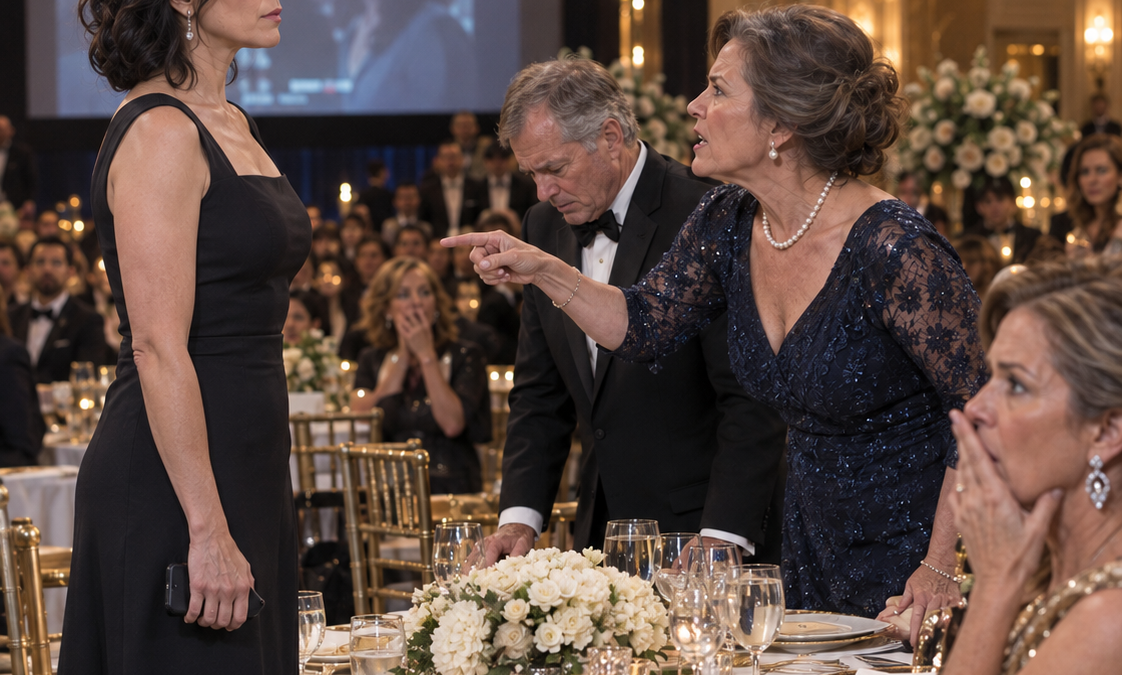
Then my mother stood up.
She stood up and looked at me. Her face was twisted with rage.
“You did this,” she said.
I stood up too.
“I didn’t do anything,” I said. “Frank did. He waited fifteen years for a chance to tell the truth. You should have been kinder to him.”
“You’ve humiliated us.”
“You humiliated yourselves. I just made sure people could see it.”
“You’ll pay for this.”
“No. I won’t.”
I looked at the audience. Five hundred people. All of them staring. All of them waiting.
“I’m going to tell you a story,” I said. “About a couple who left their daughter and grandson on the side of a highway at two in the morning because they were embarrassed. I’m going to tell you what they’ve done to people. I’m going to tell you what they’ve stolen. And then I’m going to walk out of here, and I’m going to go home to my son, and I’m going to sleep like a baby.”
My father stood up.
“Elena, please. Not here.”
“Where else, Dad? You’ve spent thirty years pretending to be something you’re not. This is the only place that matters.”
I pulled out my phone.
“I have a video,” I said. “Actually, I have about twenty. From people you’ve hurt. People who were too scared to speak until now.”
I looked at my mother.
“Do you want me to play them?”
She didn’t say anything. She couldn’t.
“Or do you want to sit down and let me finish?”
She sat down.
I played the videos.
I played Patricia O’Brien, telling the story of how my mother had cut her off when she needed help the most. I played Harold Chen, telling the story of the fifty thousand dollars he had never been repaid. I played a woman named Maria Rodriguez, whose mother had worked as a maid for my parents for ten years and had been fired when she asked for a raise.
I played them all.
The audience watched in silence. Some of them looked uncomfortable. Some of them looked angry. Some of them looked like they were realizing, for the first time, that the people they had just applauded were not who they claimed to be.
When I was done, I put my phone away.
“I’m not going to tell you what to think,” I said. “I’m just going to give you the facts. What you do with them is up to you.”
I looked at my parents one more time.
“Goodnight,” I said.
And I walked out.
The aftermath was swift.
The award was rescinded the next day. The hospital announced that it would be renaming the wing that had been dedicated to my parents. The scholarship fund was dissolved.
There were articles. There were interviews. There were investigations.
The business collapsed within a year. The debts were too big. The reputation was too damaged. No one wanted to buy a car from a man who had been exposed as a liar and a thief.
My parents moved out of the hills. They moved into a small apartment in a town they had never heard of. They stopped going to events. They stopped talking to most of their friends.
They didn’t call me. Not for a long time.
When they finally did, it was my father. He was tired. He was sick. He had been sick for a while.
“I don’t have much time,” he said.
“I know.”
“I wanted to say… I wanted to say I’m sorry. For everything. For the highway. For the years of pretending. For not being the father you deserved.”
I didn’t know what to say.
“I know it’s not enough,” he said. “I know it doesn’t fix anything. I just needed you to hear it.”
“I hear it.”
“Can you forgive me?”
I thought about it.
“I don’t know,” I said. “But I can try.”
“That’s all I ask.”
He died three weeks later.
I went to the funeral. It was small. Just a few people. My mother was there. She looked old. She looked tired.
She didn’t talk to me.
I didn’t talk to her.
I just stood there, in the back, and watched them bury my father.
Then I went home.
PART 4 — THE MORNING AFTER
The months after the gala were strange.
I had expected to feel triumphant. I had expected to feel vindicated. I had expected the scales to fall from the world’s eyes and for everything to be different.
Some things were different.
My parents were gone from public life. The award was rescinded. The hospital wing had a new name. The story had been told.
But I still had to get up every morning. I still had to make breakfast for Mateo. I still had to go to work. I still had to figure out what came next.
The world didn’t stop turning just because I had won.
I went back to Reno.
I had left my job when I went to the ranch. I had told them it was a family emergency. They had been understanding. But now I needed to figure out what I was going to do.
I didn’t want to go back to the same job. Not because I didn’t like it. I did. It was a good job, working with veterans at a nonprofit that helped them transition to civilian life. It was meaningful work.
But I had changed. The woman who had left Reno three months ago was not the same woman who was coming back.
I talked to Jim about it.
“You should start something,” he said.
“Start what?”
“Your own thing. A consulting business. You’re good at connecting people. You’re good at solving problems. You’re good at seeing what other people miss.”
“I don’t know the first thing about starting a business.”
“You know more than you think. And you have a network. That’s the most important thing.”
I thought about it.
“What would I even do?”
“You could help veterans. Connect them with resources. Help them navigate the bureaucracy. You’ve done it for yourself. You could do it for others.”
I thought about the people who had helped me over the years. Marcus. Sarah. David. Jim. All of them had given me something. Not just money or time. They had given me belief. They had told me, in a thousand small ways, that I was worth helping.
Maybe I could do the same for someone else.
I started small.
I talked to a few veterans I knew. I asked them what they needed. What they struggled with. What they wished someone had helped them with.
The answers were consistent.
They needed help navigating the VA. They needed help finding jobs. They needed help connecting with other veterans. They needed someone who understood what they had been through.
I started a small consulting business. I called it Vasquez Veterans Services. It was just me and a laptop and a phone.
The first client was a woman named Angela, who had served in Afghanistan and was struggling to find work after she got out. She had a degree in engineering, but no one would hire her because of the gap in her resume.
I helped her rewrite her resume. I connected her with a friend who worked at an engineering firm. I coached her through the interview process.
She got the job.
She called me a month later, crying.
“I don’t know how to thank you,” she said.
“You don’t have to thank me. Just pay it forward.”
“I will. I promise.”
The second client was a man named Rob, who had been homeless for two years. He had PTSD. He had been in and out of treatment. He had given up.
I connected him with a therapist who specialized in trauma. I helped him find transitional housing. I sat with him while he filled out paperwork that he didn’t understand.
He called me six months later.
“I have an apartment,” he said. “I have a job. I have a life.”
“That’s all you.”
“No. It’s you. You didn’t give up on me.”
I didn’t know what to say.
The business grew.
Word spread. Veterans talked to other veterans. People started calling me. People started referring their friends.
I hired a few people. Other veterans who understood what I was trying to do. We expanded our services. We started offering job training, mental health support, financial counseling.
I wasn’t making a lot of money. But I was making a difference.
Jim called me every few weeks.
“How’s the business?”
“Good. Busy.”
“Are you taking care of yourself?”
“I’m trying.”
“Good. You need to take care of yourself. You’re no good to anyone if you burn out.”
“I know.”
“You say that, but you don’t do it.”
“I’m doing better than I was.”
“That’s all I ask.”
Mateo adjusted better than I expected.
He made friends at his new school. He joined a soccer team. He started taking guitar lessons.
He didn’t talk about his grandparents much. When he did, he was matter-of-fact.
“They were mean to us,” he said one night at dinner.
“Yes, they were.”
“Are they still mean?”
“I don’t know. I don’t talk to them much.”
“Why not?”
“Because sometimes, when people hurt you, you need to take a break from them. You need to protect yourself.”
“Like a timeout?”
“Kind of. A very long timeout.”
He thought about it.
“Are you sad?”
“Sometimes. But I’m also happy. Because I have you. And I have people who love us.”
“Like Jim?”
“Like Jim.”
“Jim is nice. He let me feed the horses.”
“Jim is very nice.”
I smiled at him. He smiled back.
That was enough.
My mother called me a year after the gala.
I almost didn’t answer. I had gone back and forth on whether to block her number a dozen times. I had decided, finally, to leave it unblocked. I didn’t want to be the kind of person who cut people off without giving them a chance.
But I also didn’t want to be the kind of person who got hurt again.
“Elena.”
“Mom.”
“I need to talk to you.”
“About what?”
“About everything. About the gala. About your father. About… us.”
I was quiet.
“I know you’re angry,” she said. “You have every right to be. I’ve been… I’ve been thinking about things. About the way I treated you. About the way I treated Mateo.”
“And?”
“And I want to say I’m sorry.”
I closed my eyes.
“Why now?”
“Because I don’t have anyone else. Your father is gone. My friends are gone. The life I built… it’s gone. And I’m alone.”
“So you’re calling me because you’re lonely.”
“I’m calling you because I’m finally starting to understand what I did. Not just because I’m lonely. Because I’ve had time to think. And I realize that I spent thirty years trying to be someone I wasn’t, and in the process, I hurt the people who actually mattered.”
I didn’t say anything.
“Can I see Mateo?”
“No.”
“Elena—”
“No. You can see me. Maybe. If you can prove you’re actually sorry. But you can’t see Mateo. Not until I know you’re not going to hurt him again.”
She was quiet.
“That’s fair,” she said finally. “That’s fair.”
“I’m not doing this for you,” I said. “I’m doing it for myself. Because I need to know that I’m not the kind of person who holds onto anger forever.”
“I understand.”
“Do you?”
“I’m trying to.”
I hung up.
I drove to see her a month later.
She was living in a small apartment in a town called Fernley. It was a long drive from Reno. The apartment was clean but sparse. A couch. A table. A TV.
She looked older than I remembered. Her hair was gray. Her face was lined. She had lost weight.
“Thank you for coming,” she said.
I nodded.
We sat in her small living room. She made tea. We drank it in silence.
“I’ve been going to a therapist,” she said.
“Good.”
“She’s helped me see things. About myself. About the way I treated you. About the way I treated everyone.”
“Okay.”
“I know it doesn’t undo anything. I know it doesn’t make up for the things I said. The things I did. But I wanted you to know that I’m trying. I’m trying to be better.”
I looked at her. The woman who had pushed me out of a car at two in the morning. The woman who had spent my entire childhood making me feel like I wasn’t enough. The woman who had stood by while my father ignored me.
She looked small.
“I don’t know if I can forgive you,” I said. “Not yet. Maybe not ever.”
“I understand.”
“But I can acknowledge that you’re trying. That’s something.”
She nodded. Her eyes were wet.
“Thank you,” she said.
“Don’t thank me. Just… keep trying.”
I finished my tea. I stood up.
“I should go.”
“Elena.”
I stopped at the door.
“I love you,” she said. “I know I never said it. I know I never showed it. But I love you.”
I didn’t say anything.
I walked out.
PART 5 — THE NETWORK RETURNS
The next few years were good.
The business grew. We opened a second office. We hired more people. We started getting grants. We started getting recognition.
I was asked to speak at conferences. I was asked to join boards. I was asked to advise other organizations.
I said yes to some of it. I said no to most of it. I had learned, over the years, that the most important thing was to stay focused on the work.
The work was helping people.
Jim came to visit every few months.
He was getting older. His knees bothered him. His back bothered him. He had started talking about selling the ranch and moving into town.
“You’re not selling the ranch,” I said.
“I’m getting old, Elena.”
“So am I. But you don’t see me giving up.”
“You’re not the one with two replaced knees.”
“Yet.”
He laughed.
We sat on the porch and watched the sun go down. Duke was asleep at our feet. He was even older than Jim. He slept all the time now.
“You know,” Jim said, “I never expected to be here.”
“Where?”
“Sitting on a porch with you. Watching the sunset. Being… happy.”
“You deserve to be happy.”
“So do you.”
I thought about it.
“I am happy,” I said. “Most of the time.”
“What about the other times?”
“I think about my parents. About my father. About the way things ended.”
“Do you regret what you did?”
“No. But I regret that it was necessary.”
He nodded.
“That’s the thing about doing the right thing,” he said. “It’s often necessary. But it’s rarely easy.”
The call came on a Tuesday.
It was Marcus.
“Elena. I have news.”
“What kind of news?”
“Your mother is sick.”
I felt my stomach drop.
“What kind of sick?”
“Cancer. Ovarian. They caught it late.”
I sat down.
“How late?”
“Six months. Maybe a year. She’s been in and out of the hospital for weeks.”
I didn’t know what to say.
“Elena?”
“I’m here.”
“Are you okay?”
“I don’t know.”
I drove to Fernley the next day.
My mother was in the hospital. She looked terrible. Her skin was gray. Her eyes were sunken. She had lost even more weight.
“Elena.”
“Mom.”
She reached out her hand. I took it.
“I’m sorry,” she said. “I didn’t want you to see me like this.”
“Don’t apologize.”
“I’ve been trying to call you. I didn’t want to bother you. You’re so busy.”
“I’m never too busy for this.”
She closed her eyes.
“I’m scared,” she said.
“I know.”
“I don’t want to die alone.”
I squeezed her hand.
“You’re not alone,” I said. “I’m here.”
I stayed with her for three weeks.
I took time off work. I arranged for other people to cover my responsibilities. I slept in a chair by her bed. I held her hand. I read to her. I told her stories.
I told her about Mateo. About his soccer team. About his guitar lessons. About the way he laughed at everything.
I told her about the business. About the people we helped. About the difference we were making.
I told her about Jim. About the ranch. About the way he had saved me when I needed saving.
She listened. She asked questions. She cried sometimes. She laughed sometimes.
One night, she told me something I had never heard before.
“I was jealous of you,” she said.
“Jealous?”
“Yes. When you joined the military. When you came back. When you had Mateo. You were so… you. You didn’t care what anyone thought. You did what you wanted. You were free.”
“I wasn’t free. I was just pretending.”
“Maybe. But you were better at it than me. I spent my whole life pretending to be someone I wasn’t. I spent my whole life trying to be respected. And in the end, I lost everything. You kept everything that mattered.”
I didn’t know what to say.
“I’m proud of you,” she said. “I know I never said it. But I’m proud of you.”
I held her hand.
“I know,” I said. “I know.”
She died two days later.
The funeral was small.
Just a few people. A cousin. A neighbor. A woman from the church who had been visiting her.
I gave the eulogy. I talked about her life. I talked about her flaws. I talked about her attempts to change. I talked about the fact that she had died trying to be better.
I didn’t lie. I didn’t pretend she was a saint. But I acknowledged that she had tried.
After the funeral, I sat in my car in the parking lot and cried.
Not for the mother I had lost. For the mother I had never had.
I went back to Reno.
Mateo was waiting for me. He hugged me when I walked in the door.
“Are you okay, Mom?”
“I’m okay.”
“Is Grandma in heaven?”
“I don’t know. I hope so.”
“Are you sad?”
“Yes.”
“That’s okay. You can be sad. I’ll take care of you.”
I laughed through my tears.
“You’re a good boy,” I said.
“I know.”
Life went on.
Mateo grew up. He went to high school. He went to college. He became a software engineer. He got married. He had children.
I stayed close. I was at every graduation. Every birthday. Every important moment.
The business grew. We helped thousands of veterans. We won awards. We made a difference.
I never stopped thinking about my parents. But the anger faded. Not because I forgave them. Because I realized that holding onto anger was like drinking poison and expecting the other person to die.
I let it go.
PART 6 — THE REUNION
Twenty years after the gala, I received a letter.
It was from a woman named Patricia Montoya. She was my mother’s cousin, a woman I had met once or twice at family gatherings when I was a child.
She had been going through old family papers. She had found something she thought I should have.
It was a photo album.
The album was full of pictures from my childhood. There were pictures of me as a baby. Pictures of me on my first day of school. Pictures of me at Christmas. Pictures of me with my parents.
But there was something strange about the album.
Almost all the pictures were of me with other people. My grandmother. My uncle. Neighbors. Friends.
My parents were barely in any of them.
I looked through the album several times. I counted the pictures. Of the two hundred or so photos in the album, my mother appeared in maybe twenty. My father appeared in maybe fifteen.
Most of the pictures were of me with other people. People who had actually raised me. People who had actually been there.
I sat on the couch and cried.
Not because I was sad. Because I was grateful.
I had been loved. Not by my parents. But by a whole village of people who had stepped in when my parents wouldn’t.
My grandmother, who had taught me how to cook. My uncle, who had taught me how to drive. The neighbor who had watched me after school. The teachers who had encouraged me. The friends who had stood by me.
I had never been alone. I had just never noticed.
I called Jim.
“Elena. What’s wrong?”
“Nothing. I just… I wanted to say thank you.”
“For what?”
“For everything. For being there. For saving me. For believing in me.”
He was quiet.
“You don’t have to thank me.”
“I know. But I want to.”
He paused.
“Are you okay?”
“I’m more than okay. I’m grateful.”
“That’s good. Gratitude is important.”
“I know. I learned it from you.”
I thought about my life.
I had been abandoned by my parents. I had been left on the side of a highway in the middle of the night. I had been dismissed and disrespected and treated like nothing.
But I had also been saved. By Jim. By Marcus. By Sarah. By David. By a network of people who had seen something in me that my parents couldn’t see.
I had built a life. I had raised a son. I had helped thousands of people.
I had done it all with the help of people who loved me.
That was the real story. Not the story of how my parents hurt me. The story of how everyone else caught me when I fell.
I went to visit Jim one last time.
He was ninety-two years old. He was living in a small house in town. The ranch had been sold years ago. Duke had been gone for a decade.
He was sitting on his porch when I arrived. He was reading a book. He looked up when he saw me.
“Elena.”
“Hi, Jim.”
I sat down next to him.
“How are you?”
“Old,” he said. “But happy.”
“That’s the best you can hope for.”
“I know.”
We sat in silence for a while. The sun was setting. The sky was orange and pink.
“I’ve been thinking about the highway,” I said.
“What about it?”
“That night. When you came to get us.”
“What about it?”
“I never asked you why. Why you came. Why you didn’t hesitate.”
He looked at me.
“Because you called,” he said. “That’s all.”
“That’s not all.”
“That’s all that matters.”
I took his hand.
“Thank you,” I said.
“You don’t have to thank me.”
“I know. But I want to.”
He smiled.
“You’re a good person, Elena. You always have been. Your parents just couldn’t see it.”
“I know.”
“That’s their loss.”
“I know.”
We sat on the porch and watched the sun go down.
The next morning, Jim didn’t wake up.
He died in his sleep. Peacefully. At home.
I was the one who found him.
I sat with him for a long time. I held his hand. I told him I loved him. I told him he had saved my life.
Then I called the authorities.
The funeral was small. A few veterans. A few neighbors. A few friends.
I gave the eulogy.
I talked about his service. I talked about his kindness. I talked about the way he had been there for me when no one else was.
I talked about the ranch. About the horses. About Duke.
I talked about the fact that he had been the father I never had.
After the funeral, I went back to his house. I sat on his porch. I watched the sun go down.
I felt alone. But I also felt held.
Jim was gone. But he would never really be gone. He would always be with me. In my memories. In my heart. In the way I tried to live my life.
I went home.

