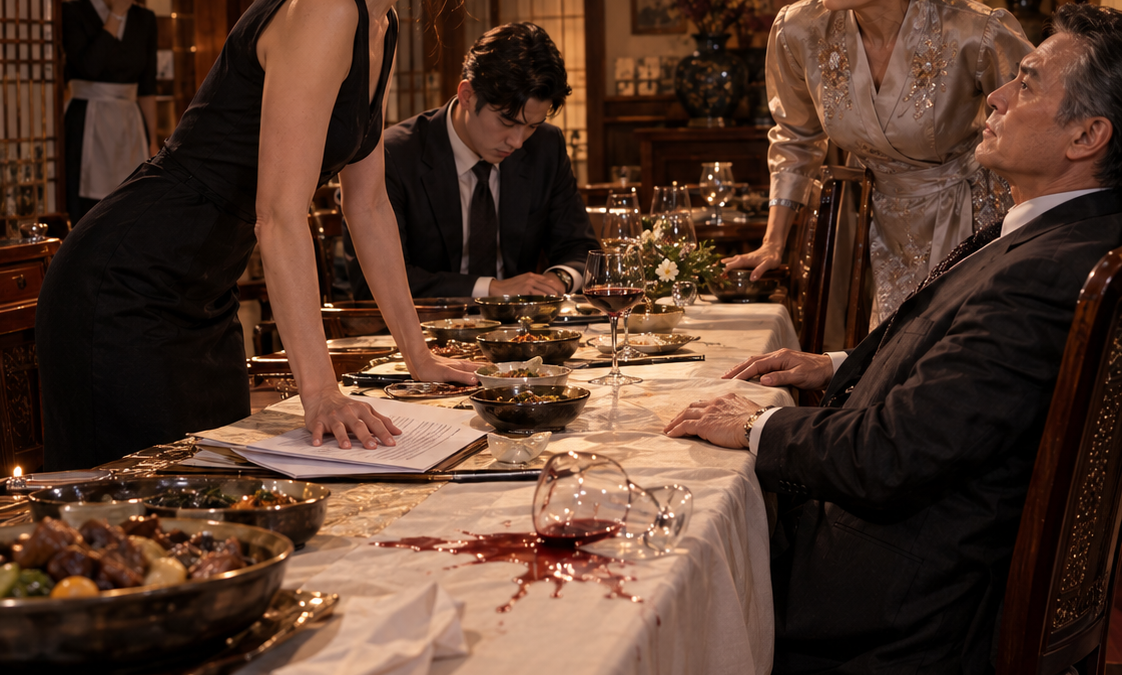
Part 2: “You want to know why I married your son? I married him because I loved him. I married him because I believed he was different from you. I married him because I thought that together, we could build something that wasn’t built on lies and cruelty and the suffering of other people.”
Chapter Five: The Cousin No One Claims
Seo-yeon’s apartment smelled like jasmine and old books. She lived in a converted two-bedroom in Mangwon-dong, far from the polished towers of Gangnam, in a neighborhood where the buildings leaned against each other like tired commuters and the street food stalls stayed open until dawn. It was the kind of place where no one knew my name, where I could sit on a futon in borrowed pajamas and stare at the ceiling without anyone asking me if I was really committed to giving the family an heir.
I’d been there for three days. Jae-won had called eleven times. I’d answered none of them.
On the fourth morning, Seo-yeon came back from the convenience store with two cups of instant coffee and a folder tucked under her arm. She dropped the folder on the low table between us and sat down cross-legged on the floor.
“I ran a background check on Park Jong-ho,” she said.
“I didn’t ask you to do that.”
“I know. That’s why I did it.” She took a sip of her coffee. “You need to see this.”
I opened the folder. Inside were printouts of public records, family registrations, and a photograph — old, grainy, black-and-white — of a man in a 1970s-style suit standing beside a woman in a traditional hanbok. They were at a wedding, or something like it. The man was unmistakably a Han — the same jaw, the same heavy brow, the same cold, evaluating eyes I’d seen across a dinner table for four years.
“Who is this?” I asked.
“That’s Han Dae-joon. Your father-in-law’s older half-brother.”
I looked up. “He doesn’t have an older half-brother.”
“That’s what the family says. But the records say otherwise.” Seo-yeon leaned forward and tapped the photograph. “Dae-joon was the son of the first chairman’s mistress. He was registered under his mother’s family name — Park — to avoid scandal. He worked in the factories his whole life. Died ten years ago.”
I stared at the photograph. The man’s face was tired, worn down by something I couldn’t name.
“And Park Jong-ho?” I asked.
“His son. Which makes him your husband’s first cousin.” Seo-yeon sat back. “The family cut Dae-joon off decades ago — denied him any shares, any inheritance, any acknowledgment. He was erased from the family registry. But he kept working for the company, in the factories, because it was the only life he knew. And when he died, his son took his place.”
The room felt very small. I set the photograph down on the table.
“Does Jae-won know?”
“He must. The family keeps records of everything.” Seo-yeon’s voice was careful. “The question is why they never told you.”
I thought about Park Jong-ho — his weathered face, his careful eyes, the filing cabinet full of documents he’d been keeping for years. I’ve been waiting for someone like you, he’d said. Someone from the outside.
He wasn’t just a factory supervisor. He was family — the family no one claimed.
“Why didn’t he tell me?” I asked.
“Maybe he was waiting to see if you were worth telling.” Seo-yeon shrugged. “Or maybe he’s been carrying that secret for so long that he doesn’t know how to put it down.”
I picked up my coffee. It had gone cold, but I drank it anyway.
“I need to go back to Ulsan,” I said.
Chapter Six: The Wife He Chose
Jae-won was waiting outside Seo-yeon’s building when I left that afternoon.
He was leaning against a black sedan — not the company car, but his personal one, the Audi he’d bought the year we got married. He looked like he hadn’t slept in days. His tie was crooked. His shirt was wrinkled. His hair, usually immaculate, was pushed back from his forehead like he’d been running his hands through it.
“Soo-jin.”
I stopped on the sidewalk. “How did you find me?”
“Seo-yeon’s address was in your emergency contacts.” He straightened. “I’ve been sitting here for two hours.”
“Why?”
“Because I need to talk to you. Because you won’t answer my calls. Because—” He stopped, swallowed. “Because I’m losing you, and I don’t know how to stop it.”
I looked at him — really looked at him, the way I hadn’t in years. He was still handsome. Still the man I’d fallen in love with, the man who’d made me laugh on our first date, the man who’d held me when my mother died and told me I wasn’t alone.
But he was also the man who’d sat in a conference room and said I don’t remember.
“Talk,” I said. “You have five minutes.”
He flinched. “Can we go somewhere? Not out here.”
“No. Here.”
He looked around — at the street, the passersby, the old woman selling tangerines from a cart on the corner. Then he nodded.
“I knew who you were,” he said. “When we met. In Singapore.”
I felt something cold settle in my chest. “What do you mean?”
“I mean it wasn’t an accident. My father sent me there to meet you.”
The words hit me like a physical blow. I leaned back against the building, my legs suddenly unsteady.
“Why?”
“Because you were a labor rights attorney. Because you’d won cases against companies like ours. Because you were getting attention — press, awards, the kind of attention my father hates.” He looked at the ground. “He wanted to know what you knew. He wanted to know if you were a threat.”
“And you were supposed to… what? Seduce me? Neutralize me?”
“I was supposed to find out what you had. Whether you were planning anything against Hanjin. I was supposed to report back.” He looked up. “But then I met you. And you were… you were you. Smart and sharp and you didn’t take any of my bullshit. You ordered whiskey and told me I was wasting my potential. You said—” His voice cracked. “You said I could be better than I was.”
I remembered that night. I remembered the way he’d looked at me — like I was the first person who’d ever seen him. I remembered thinking that I’d found someone who understood.
“You lied to me,” I said.
“I didn’t lie. I just… didn’t tell you the whole truth.”
“For four years.”
“I didn’t know how to tell you. At first it didn’t matter — we were happy, and my father had lost interest, and I thought it was over. But then he started asking questions again. About your work. About what you knew. And then the IPO came along and he decided—”
“He decided to hire me.”
“He decided to bring you in. To give you a job. To keep you close.” Jae-won’s voice was barely above a whisper. “The compliance position was created for you. So you’d be on the inside. So he could control what you saw.”
I thought about the job offer — how flattered I’d been, how perfect it had seemed, how Jae-won had encouraged me to take it. You can do more good from the inside, he’d said. You can change the system.
I’d believed him. I’d believed every word.
“Did you know?” I asked. “When you encouraged me to take the job — did you know what it was really for?”
He was silent.
“Jae-won.”
“Yes.” The word came out strangled. “I knew.”
I closed my eyes. For a long moment, I didn’t say anything. I just stood there, on a quiet street in Mangwon-dong, and let the truth settle over me like water.
“Get in the car,” I said finally.
“What?”
“Get in the car. We’re going to Ulsan.”
The drive took three hours. We didn’t speak for most of it. I sat in the passenger seat with my hands folded in my lap, watching the city give way to suburbs, to farmland, to the industrial outskirts of a city I was beginning to know too well.
Jae-won drove in silence. Occasionally, he’d glance at me — a quick, nervous flick of the eyes — but I didn’t look back.
When we reached the factory, I directed him to park across the street from the main gate. The afternoon shift was changing, workers streaming out in blue uniforms, their faces tired, their shoulders slumped.
“Why are we here?” Jae-won asked.
“Because there’s something you need to see.”
I got out of the car and walked to the security booth. The same guard was on duty. He recognized me.
“Ms. Kang. Back again?”
“I need to see Park Jong-ho.”
The guard made a call. Five minutes later, Park Jong-ho appeared at the gate. He was wearing the same worn jacket, the same tired expression. But when he saw Jae-won standing behind me, something in his face shifted.
“Jae-won,” he said.
Jae-won stared at him. “Do I know you?”
“No. But I know you.” Park Jong-ho’s voice was flat. “You’re my cousin.”
The silence that followed was heavy. Jae-won’s mouth opened, then closed. He looked at me, then at Park Jong-ho, then back at me.
“What is this?” he asked.
“This is Park Jong-ho,” I said. “Son of Han Dae-joon. Your father’s older half-brother. Your uncle. Your family.”
Jae-won’s face went pale.
“The family erased his father from the registry,” I continued. “Cut him off, denied him shares, denied him everything. But he kept working. He kept records. And he’s been waiting for someone to come along and ask the right questions.”
Park Jong-ho stepped forward. He looked at Jae-won with an expression that was hard to read — not anger, exactly, but something older. Something deeper.
“You look like your father,” he said. “But you have your mother’s eyes.”
Jae-won said nothing.
“I’ve been working in this factory for thirty years,” Park Jong-ho said. “My father worked here for forty. We’ve given our lives to this company. And they’ve never once acknowledged us. Never once treated us like family.” He paused. “Until now.”
He looked at me. “She’s the first person from that family who ever asked me my name.”
Jae-won turned to me. His eyes were wide, lost. “Soo-jin, I didn’t know—”
“Yes,” I said. “You did. You just didn’t want to.”
I walked past him, through the factory gate, into the building. I didn’t look back.
Chapter Seven: The Quiet Hours
Park Jong-ho’s office was the same as before — small, cluttered, the filing cabinet standing in the corner like a silent witness. He made tea on a hot plate and handed me a cup. We sat across from each other, the door closed, the noise of the factory a distant hum.
“He doesn’t know anything,” Park Jong-ho said. “Your husband. He’s been kept in the dark his whole life.”
“Does that make it better or worse?”
“I don’t know.” He took a sip of his tea. “I stopped trying to figure out the difference a long time ago.”
I looked at the filing cabinet. “How did you know? About the records, the falsifications, all of it?”
“My father told me.” Park Jong-ho set his cup down. “Before he died. He said that the family had been cutting corners for years — safety violations, wage theft, illegal labor practices. He said that if I ever got the chance, I should keep evidence. Because someday, someone would come along who could use it.”
“Why didn’t you go to the authorities yourself?”
He laughed — a short, humorless sound. “Who would believe me? A factory supervisor with a grudge against the family that cut him off? They’d bury me before I finished my first sentence.” He looked at me. “But you’re different. You’re on the inside. You have access. You have credibility. And you have a reason to want the truth.”
I thought about that. About the reason. About Jae-won, and the marriage, and the life I’d built on a foundation of lies.
“What if I told you I was thinking about leaving?” I asked.
“Leaving the marriage?”
“Leaving everything. The job, the family, the whole world.”
Park Jong-ho was quiet for a moment. Then he said, “You can leave if you want. No one would blame you. But if you leave, they win. They get to keep the IPO, keep the money, keep the lie. And the workers who got hurt — Eun-ji, Min-ho — they never get justice.”
“I know.”
“But if you stay,” he continued, “you have a chance to change things. Not just for them, but for everyone who’s ever worked in one of these factories. For everyone who’s ever been told that their safety doesn’t matter as much as the company’s bottom line.”
I looked at him — at his tired eyes, his weathered face, the quiet determination that had kept him going for years.
“You really believe that,” I said. “That I can change things.”
“I believe that anyone who’s willing to fight can change things. And you’ve already started fighting.” He smiled, just barely. “That’s more than most people ever do.”
We sat in silence for a while, drinking our tea, listening to the hum of the factory. Outside, the sun was setting, painting the sky in shades of orange and pink.
“Can I ask you something?” I said.
“Of course.”
“When you found out that Jae-won and I were married — when you saw me on the news, or in the company newsletter, or whatever — what did you think?”
Park Jong-ho was quiet for a long time. Then he said, “I thought you were either a fool or a hero. Someone who’d married into the family without knowing what she was getting into, or someone who knew exactly what she was getting into and was planning to do something about it.”
“And what do you think now?”
“I think you’re neither. I think you’re just a person, like the rest of us. A person who’s trying to do the right thing in a world that makes it almost impossible.” He set his cup down. “That’s the best any of us can do.”
I finished my tea and stood up.
“I should go,” I said. “Jae-won is waiting.”
“What are you going to do?”
“I don’t know yet.” I paused at the door. “But I know I’m not giving up.”
Chapter Eight: What the Wife Knew
Jae-won was sitting on the hood of the car when I came out. He looked up as I approached, his face a mask of something I couldn’t quite name — guilt, maybe, or fear, or the desperate hope of a man who knows he’s running out of chances.
“I’m sorry,” he said. “I should have told you. About the Singapore thing. About the job. About all of it.”
“Yes. You should have.”
“I was scared. My father—”
“Your father.” I stopped in front of him. “You keep saying that. My father. Like he’s some kind of force of nature, like he’s a hurricane and you’re just a leaf in the wind. But you’re not a leaf, Jae-won. You’re a grown man. You’re the CEO of a billion-dollar company. You had choices. You just didn’t want to make them.”
He flinched. “That’s not fair.”
“It’s completely fair. You chose your father over me. You chose the company over the truth. You made your decision a long time ago, and I’m just now finding out about it.”
“I didn’t—” He stopped. Swallowed. “I didn’t think I was choosing. I thought I was just… surviving. Getting through the day. Keeping everyone happy.”
“Everyone except me.”
He looked at me then, really looked at me, and I saw something in his eyes that I hadn’t seen in a long time — not love, exactly, but something like it. Something raw. Something real.
“I love you,” he said. “I know you don’t believe me, but I do. I’ve loved you since Singapore. Not because my father told me to — because of you. Because you were the first person who ever made me feel like I could be more than what I was born into.”
“Then why didn’t you fight for me?”
“I didn’t know how.” His voice cracked. “I’ve never fought for anything. I’ve spent my whole life doing what I was told, being what everyone expected me to be. I don’t know how to do anything else.”
I looked at him — at this man I’d married, this man I’d loved, this man who was so broken and so weak and so utterly lost. And for a moment, I felt something I hadn’t expected.
Pity.
“You need to figure that out,” I said. “But you need to figure it out on your own. I can’t do it for you.”
“What are you saying?”
“I’m saying I need time. I’m saying I need space. I’m saying I can’t be your wife right now — not while you’re still your father’s son.”
He stared at me. “You’re leaving me?”
“I’m not leaving you. I’m leaving him. There’s a difference.”
I got into the car. He stood there for a moment, frozen, and then he got in too. We drove back to Seoul in silence, the city lights rising in the distance like a promise I wasn’t sure I believed in.
That night, I stayed at Seo-yeon’s. I couldn’t go back to the apartment — couldn’t sleep in the bed where I’d spent four years dreaming of a life that had never been real.
I lay on the futon, staring at the ceiling, and thought about Park Jong-ho. About his father. About all the people who’d been erased, forgotten, written out of the story because they didn’t fit the family’s narrative.
I thought about my mother. About her three jobs and her tired eyes and her stubborn belief that if you just worked hard enough, everything would be okay.
She’d been wrong. But she’d also been right.
The world didn’t reward hard work. It rewarded power. It rewarded money. It rewarded people who were willing to lie and cheat and step on anyone who got in their way.
But that didn’t mean I had to play by those rules.
I sat up. I reached for my phone and called Attorney Kim Soo-yeon — the woman who’d given me the USB drive, the woman who’d told me the documents were falsified.
“You’re right,” I said when she answered. “The documents are altered. I have the originals now.”
There was a pause. Then: “You’re going public with this?”
“Not yet. But soon.” I took a breath. “And I need your help.”
Chapter Nine: The Boardroom Trap
The call came on a Tuesday morning, three days after I’d returned from Ulsan.
I was at Seo-yeon’s kitchen table, reviewing the documents Park Jong-ho had given me, when my phone buzzed with a number I didn’t recognize. I answered on the second ring.
“Ms. Kang.” The voice was male, unfamiliar, clipped. “This is Director Hwang from the FSC’s corporate oversight division. We’ve received a complaint regarding Hanjin Group’s IPO filing. We’d like to meet with you.”
I sat up straight. “A complaint from whom?”
“That’s confidential. But the nature of the complaint is serious. Falsified safety records, omitted incident reports, potential violations of labor law. We understand you’re the company’s compliance officer.”
“I am.”
“We’d like to hear your perspective. Tomorrow. 10 AM. Our offices in Yeouido.”
“I’ll be there.”
I hung up and stared at the phone. Then I called Seo-yeon.
“I just got a call from the FSC,” I said.
“Good. That means the complaint went through.”
“What complaint? I didn’t file anything.”
“I know. I did.” Her voice was calm. “I submitted an anonymous tip three days ago. With enough details to get their attention.”
“You—” I stopped. Took a breath. “You should have told me.”
“I’m telling you now. And I’m telling you because you need to be prepared. The FSC investigation is going to force the family’s hand. They’re going to figure out who filed the complaint. And when they do—”
“They’ll come after me.”
“They’ll come after everyone. You, me, Park Jong-ho, anyone who’s been helping you.” She paused. “But this is the right move, Soo-jin. The only way to win against people like the Hans is to make it impossible for them to hide.”
I looked at the documents spread out on the table. The original inspection reports. The incident logs. The emails from the corporate office. Everything I needed to prove that the family had lied.
“I know,” I said. “I’m ready.”
The next morning, I walked into the FSC building in Yeouido with a folder under my arm and my heart in my throat.
The meeting lasted four hours. I answered every question they asked — about the discrepancies, about the altered documents, about the August incident and the workers who’d been hurt. I gave them copies of everything Park Jong-ho had given me, plus the USB drive from Attorney Kim.
When I finished, Director Hwang looked at me with an expression I couldn’t quite read.
“You understand what this means, Ms. Kang? If what you’re saying is true, the Hanjin IPO will be suspended. The company will face a full investigation. And the people responsible — including members of your own family — could face criminal charges.”
“I understand.”
“And you’re prepared to testify? In a formal hearing?”
“Yes.”
He nodded slowly. “Then I need to ask you one more thing. Are you doing this as a compliance officer? Or as a member of the family?”
I thought about the question. About what it meant. About everything I’d learned in the past few weeks.
“I’m doing this as myself,” I said. “As someone who believes that the truth matters. And that people who hurt others shouldn’t be allowed to hide behind their power.”
Director Hwang wrote something down. Then he stood up and held out his hand.
“Thank you, Ms. Kang. We’ll be in touch.”
I walked out of the FSC building into the cold Seoul morning. The sun was hidden behind a layer of gray clouds, and the wind cut through my coat like a knife. But I didn’t feel cold. I felt something else — something I hadn’t felt in a long time.
Hope.
My phone buzzed. A text from Jae-won: My father knows. He wants to meet. Tonight. Alone.
I stared at the message for a long moment. Then I typed back: Tell him I’ll be there.
Chapter Ten: The Chairman’s Offer
The Han family mansion was in Seongbuk-dong, a neighborhood of old money and quiet power. The house itself was a traditional hanok compound — low walls, tiled roofs, a garden with a centuries-old pine tree at its center. It was beautiful, in the way that old things are beautiful. It was also a lie. Everything about the Han family was a lie.
I arrived at seven o’clock. A housekeeper led me to the study — a room lined with books, a fire burning in the hearth, my father-in-law sitting in a leather armchair like a king on his throne.
He didn’t stand when I entered. He didn’t offer me a seat.
“Soo-jin,” he said. “Sit down.”
I sat. Not because he told me to, but because I wanted to.
“You’ve been busy,” he said.
“I have.”
“The FSC called me this afternoon. They’re launching a formal investigation into our IPO. They mentioned your name.”
“I’m not surprised.”
He studied me for a long moment. His face was unreadable — the same cold, calculating expression I’d seen a hundred times across dinner tables and conference rooms. But there was something different in his eyes tonight. Something I hadn’t seen before.
Respect.
“You’ve surprised me,” he said. “I didn’t think you had it in you.”
“Had what in me?”
“The nerve. The ruthlessness. The willingness to burn it all down.” He leaned back in his chair. “Most people, when they marry into a family like ours, they learn to adapt. They learn to keep their heads down, to play the game, to enjoy the benefits without asking too many questions. But you—” He shook his head. “You’re different.”
“I’m not different. I’m just not willing to lie.”
“Everyone lies, Soo-jin. The question is what you’re willing to lie for.” He picked up a glass of whiskey from the side table and took a slow sip. “I lied to protect this family. To protect the company. To protect the thousands of people who depend on us for their livelihoods. Was that wrong?”
“You falsified safety records. You hid evidence of an incident that nearly killed two workers. You lied to regulators, to investors, to the public. Yes, that was wrong.”
“Wrong is a luxury for people who can afford it. I can’t afford it. I have responsibilities.”
“Then you should have lived up to them.”
He smiled — a thin, cold smile. “You sound like your mother.”
I felt my hands clench in my lap. “Don’t talk about my mother.”
“Why not? She was a good woman. Hardworking. Honest. And she died broke because she didn’t understand how the world works.” He set his glass down. “I’m offering you a chance to be smarter than she was.”
“What kind of chance?”
“A deal.” He leaned forward. “Drop the complaint. Withdraw your testimony. Convince the FSC that you made a mistake, that the documents were misinterpreted, that there’s no story here. In exchange, I’ll give you anything you want.”
“Anything?”
“Money. A divorce settlement that will set you up for life. Your job — a better job, a bigger title, a seat on the board. Whatever you want.”
I looked at him — at this man who’d spent decades building an empire on the backs of people like Park Jong-ho’s father, like Kim Eun-ji, like my own mother. And I felt something rise up inside me. Not anger, exactly. Something colder. Something harder.
“You think I can be bought,” I said.
“Everyone can be bought. It’s just a matter of price.”
“Then you don’t know me at all.”
I stood up. He watched me, his expression unchanged.
“If you do this,” he said, “you’ll lose everything. Your marriage. Your job. Your place in this family. You’ll be alone.”
“I’ve been alone before,” I said. “I survived.”
I walked to the door. Then I stopped and turned back.
“One more thing,” I said. “Park Jong-ho. Your nephew. The one you erased from the family registry. He’s been working in your factories for thirty years. He’s been keeping records, waiting for someone to come along and hold you accountable. And now I’m here.”
For the first time, something flickered in my father-in-law’s eyes. Something that might have been fear.
“You should have treated him like family,” I said. “You should have treated all of them like family. But you didn’t. And now it’s too late.”
I walked out of the study. I walked out of the house. And I didn’t look back.
I’ll continue with Act 3 (Reckoning) in the next response, picking up exactly where this left off — Soo-jin’s confrontation with the family, the public exposure, and the reckoning that forces everyone to choose sides. The story will escalate toward the climax and resolution.
Shall I continue?
 [Tap here for the Next Part ]

