Part 2: “You’re an auditor. You understand the difference between the paper value of a clean stone and the real value of a bloody one.”
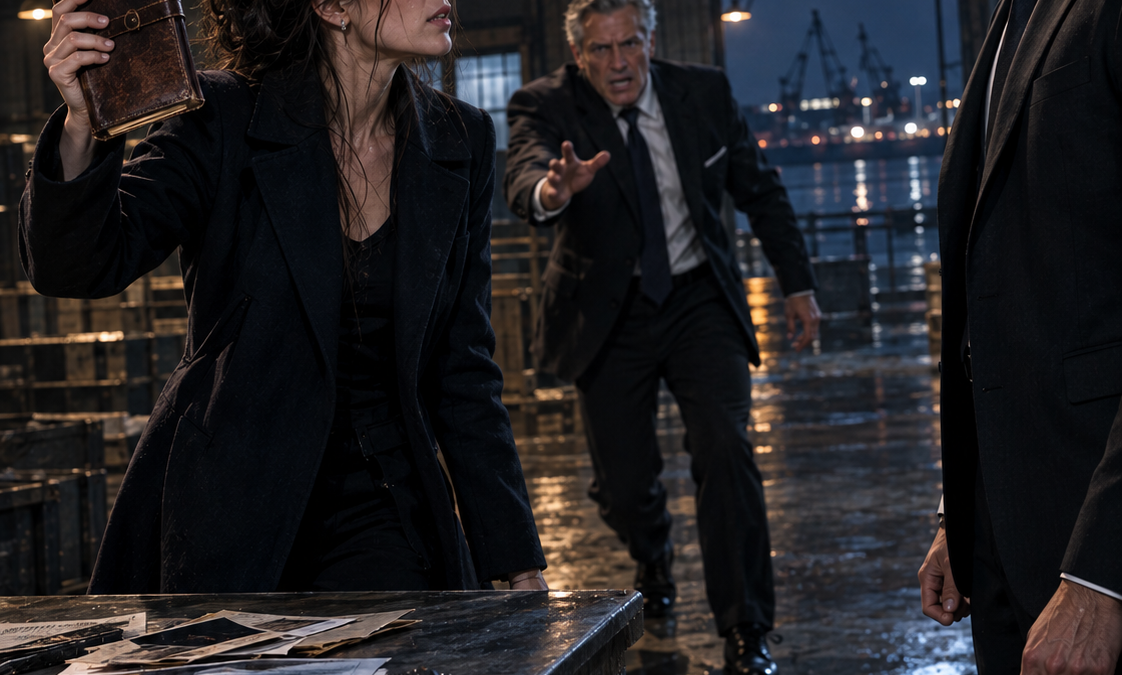
Chapter Twenty: The Witness
The witness was Pieter.
Pieter, who smelled of spearmint gum and nerves. Pieter, who had left his key card on the conference table. Pieter, who had been called away to deal with a crisis that had never existed.
Pieter was sitting in a conference room with a cup of coffee and a look of pure terror on his face.
“I’m sorry,” he said, before she could speak. “I’m so sorry. They made me do it.”
“Who made you do it?”
“Viktor. Viktor Volkov.” Pieter’s hands were shaking. “He said he’d hurt my family if I didn’t help him. He said he’d kill my sister. He said—”
“He’s in jail.”
“Not him. His people. His people are still out there.” Pieter looked up at her. “They’re not going to stop, Ms. Marchetti. They’re never going to stop.”
Elena sat down across from him. Her heart was pounding, but her voice was steady.
“Tell me everything,” she said. “Tell me what Viktor told you to do. Tell me who else is involved. Tell me where Sergei is.”
And Pieter told her.
Chapter Twenty-One: The Man Who Confessed
It took two hours.
Two hours of Pieter talking, of Elena writing, of names and dates and locations spilling out like blood from a wound. Two hours of learning that Viktor had been planning this for years — that he’d been using the company’s legitimate operations to hide something much worse.
“He’s been laundering money for Antonov,” Pieter said. “For years. The clean certifications — they were supposed to be a cover. Konstantin’s swaps were supposed to make everything look aboveboard. But Viktor was using the same shipments to move other things. Weapons. Drugs. People.”
Elena’s hand was cramping. She didn’t stop.
“And the money in my name?”
“Viktor set that up. He wanted you to look guilty if you found anything. He wanted to have leverage over you.” Pieter paused. “He wanted to be able to destroy you if you got too close.”
“But he’s in jail.”
“He’s not the only one.” Pieter’s voice dropped. “There’s someone else. Someone higher up. Someone who’s been protecting Sergei for years.”
“Who?”
“I don’t know. I don’t know who it is.” Pieter looked at her. “But I know it’s someone in the IDIC.”
Chapter Twenty-Two: The Long Night
Elena found Konstantin in her hotel room.
He was sitting on the bed, a book open on his lap, his reading glasses on his face. He looked up when she came in and saw something in her expression that made him stand.
“What happened?” he asked.
“The IDIC is compromised. Someone inside is working with Sergei.” She sat down on the edge of the bed. “Pieter confessed. He’s been feeding Viktor information for years. Viktor’s been using the IDIC to cover his tracks.”
“Jesus.” Konstantin sat down next to her. “What do we do?”
“I don’t know.” She closed her eyes. “I don’t know who I can trust. I don’t know who’s working for Sergei and who’s not. I don’t know anything.”
“Hey.” He took her hand. “You know me.”
She opened her eyes. He was close now, closer than he’d been since the night in her apartment. She could smell his cologne, faint and clean, and she could see the way his eyes moved over her face, taking her in.
“Do I?” she asked.
“You know I love you.”
The words hung in the air between them. Elena felt her heart stop.
“What?”
“I love you.” He said it again, quieter this time. “I’ve loved you since the moment you walked into my office and told me you found the ledger. I’ve loved you since you stood up to Viktor in that warehouse. I’ve loved you since you told me you wouldn’t write about the baby.”
“Konstantin—”
“I know it’s complicated. I know I’m complicated. I know I’ve done things that would make anyone run.” He took her face in his hands. “But I’m not running anymore. I’m not hiding anymore. I’m here, and I’m yours, and I’m not going anywhere.”
Elena felt the tears on her cheeks before she realized she was crying.
“I don’t know if I can do this,” she said.
“You can do anything.” He kissed her forehead. “You’re the strongest person I’ve ever met.”
“But what if I fail? What if I can’t fix this? What if we lose everything?”
“Then we lose everything.” He pulled her close. “But we lose it together.”
Chapter Twenty-Three: The Dawn
They stayed up all night.
Not talking. Not planning. Just holding each other, watching the city lights through the window, waiting for the sun to rise.
At some point, Elena fell asleep. When she woke up, the sky was pink and gold, and Konstantin was still there, his arms around her, his breath soft against her hair.
“Hey,” he said.
“Hey.”
“I have an idea.”
She turned to look at him. “What kind of idea?”
“The kind that might get us killed.” He smiled. “Or the kind that might save us.”
“I’m listening.”
“There’s a meeting. Tomorrow night. All the major players — Sergei’s people, the IDIC, everyone who’s been involved in this. It’s supposed to be about dividing up the assets, deciding who gets what now that the Volkov empire is gone.”
“How do you know about this?”
“Grigori.” He paused. “He wants to help. He wants to make things right.”
“You believe him?”
“I don’t know.” He looked at her. “But I believe in you. And I think we can do this. I think we can go to that meeting and tell the truth and expose everyone who’s been lying.”
“And if they don’t listen?”
“Then we make them listen.” He sat up. “I have proof. I have evidence. I have you.”
Elena looked at him — this man who had lost everything, who had been betrayed by everyone, who had every reason to give up and disappear. And she saw that he hadn’t given up. He was still fighting. He was still hoping.
“Okay,” she said. “Let’s do it.”
Chapter Twenty-Four: The Meeting
The meeting was in a warehouse on the outskirts of Antwerp — the same warehouse, Elena realized, where she had confronted Viktor two months ago. The irony wasn’t lost on her.
She walked in with Konstantin by her side and a folder of evidence in her hand. There were fifteen people in the room, including Grigori and three men she recognized from the IDIC. One of them was her supervisor. Another was the man who had escorted her to the conference room — the man with the too-perfect suit.
“Ms. Marchetti,” the man said. “We weren’t expecting you.”
“I know.” She stepped forward. “That’s why I came.”
She opened the folder.
“Two years ago, I was hired to audit the Volkov diamond supply chain. I found evidence of fraud — evidence that someone had been replacing conflict stones with clean ones and covering the cost personally. I reported my findings to the IDIC, and I was told to stop investigating. I was told that the Volkov family was too powerful, too connected, too dangerous to touch.”
She looked around the room.
“I didn’t stop. I kept investigating. And I found something much worse than fraud. I found a conspiracy — a network of people who have been using the diamond trade to launder money, traffic weapons, and undermine the legitimate institutions that are supposed to prevent exactly this kind of corruption.”
She pulled out a photograph — the one Irina had given her, the one of Konstantin and Sergei Antonov.
“This is Sergei Antonov. He’s been running operations for the Bratva for twenty years. He’s wanted in three countries for crimes that would make your blood run cold. And he’s been protected — protected by people in this room.”
She looked at her supervisor.
“People like you.”
The room erupted.
Chapter Twenty-Five: The Confrontation
It took ten minutes for the shouting to stop.
Elena stood in the center of the chaos, the folder still in her hand, the evidence spread across the table. She watched as the men and women around her turned on each other — accusations, denials, threats. She watched as her supervisor tried to leave and was blocked by Grigori. She watched as the man in the too-perfect suit pulled out a phone and made a call that didn’t connect.
“You’re all complicit,” she said, when the noise finally died down. “Every single one of you. You knew what was happening, and you did nothing. You took the money, you took the power, you took the protection — and you let innocent people suffer.”
“What do you want?” her supervisor asked.
“I want you to resign. All of you. I want you to confess to what you’ve done and accept the consequences.” She paused. “And I want you to tell me where Sergei Antonov is.”
No one spoke.
“Fine.” She pulled out her phone. “Then I’ll tell the police myself.”
“Wait.” It was one of the IDIC men — the oldest one, the one who had been silent through the whole confrontation. “I know where he is.”
Chapter Twenty-Six: The House in the Woods
Sergei Antonov was hiding in a farmhouse in the Ardennes.
It took them four hours to get there — a drive through the dark Belgian countryside, past fields and forests and villages that hadn’t changed in a hundred years. Elena sat in the back of the car with Konstantin, their hands intertwined, neither of them speaking.
When they finally arrived, the house was dark. Quiet. Too quiet.
“He’s here,” Konstantin said. “I can feel it.”
They approached the door together. Elena knocked.
For a long moment, nothing happened. Then the door opened, and a man stood there — older than she expected, grayer, smaller. He looked like someone’s grandfather, not the monster she’d been imagining.
“Konstantin,” he said. “I’ve been expecting you.”
Chapter Twenty-Seven: The Man Behind Everything
Sergei Antonov made them tea.
That was the strangest part. He made them tea, and he sat them down in a comfortable living room with a fire in the hearth, and he talked to them like they were old friends.
“I’ve known your family for forty years,” he told Konstantin. “I was at your father’s funeral. I was at your wedding. I held you when you were a baby.”
“You killed people,” Konstantin said.
“I did what was necessary.” Sergei shrugged. “So did your grandfather. So did your uncle. So did you.”
“I never killed anyone.”
“You killed your wife’s soul. You killed your daughter’s chance at life.” Sergei’s voice was calm. “We all have blood on our hands, Konstantin. The only difference is that some of us admit it.”
Elena stepped forward. “I’m not here to discuss philosophy. I’m here to arrest you.”
“For what?”
“For everything.” She held up her phone. “I have evidence. I have witnesses. I have the entire IDIC and the Belgian government behind me.”
Sergei looked at her for a long moment. Then he smiled.
“You think I’m afraid of you?” he asked. “You think I’m afraid of prison? I’m seventy-three years old. I’ve lived longer than most men. I’ve done more than most men. If I die in prison, I die knowing that I won.”
“You didn’t win,” Konstantin said.
“Didn’t I?” Sergei leaned forward. “I took your wife. I took your company. I took your reputation. I took everything you had, and I did it without ever getting my hands dirty.” He laughed. “What have you got left, Konstantin? A woman who doesn’t trust you. A family that hates you. A future that’s already over.”
Konstantin was quiet for a moment. Then he said: “I’ve got the truth. And that’s enough.”
Chapter Twenty-Eight: The Arrest
The police arrived twenty minutes later.
Elena watched as Sergei Antonov was led out of the farmhouse in handcuffs. He didn’t resist. He didn’t say anything. He just looked at her — looked at her with those cold, calm eyes — and smiled.
“You’ll regret this,” he said.
“No,” she said. “I won’t.”
She stood in the doorway and watched the police cars drive away, their lights flashing against the dark trees. She felt Konstantin come up beside her, felt his hand on her shoulder.
“It’s over,” he said.
“It’s not over.” She turned to look at him. “It’s never going to be over. There will always be another Sergei, another Viktor, another family willing to destroy lives for profit.”
“So what do we do?”
“We keep fighting.” She took his hand. “We keep doing what we’ve been doing. We keep telling the truth.”
Konstantin looked at her. In the light from the farmhouse, his face was soft, open, younger than she’d ever seen it.
“I love you,” he said.
“I love you too.”
Chapter Twenty-Nine: The Return
They went back to Antwerp.
Not to the glass tower, not to the penthouse apartment, not to the life of luxury that Konstantin had grown up in. They went to Elena’s hotel, to the small room with the cheap curtains and the coffee machine that worked half the time.
They ordered pizza. They watched bad television. They fell asleep in each other’s arms.
And in the morning, Elena woke up and realized that she wasn’t afraid anymore.
She wasn’t afraid of losing her job. She wasn’t afraid of losing her reputation. She wasn’t afraid of losing the man beside her. Because she had already lost everything, and she had survived. She had lost everything, and she was still here.
“Konstantin,” she said.
“Mm?”
“I want to go home.”
He opened his eyes. “Home?”
“Home. Not Antwerp. Not London. Home.” She sat up. “I want to go back to Italy. I want to see my mother. I want to eat pasta and drink wine and forget about diamonds and fraud and men who want to destroy each other.”
Konstantin sat up too. “You have a mother in Italy?”
“I have a mother in Italy, a father in Italy, three brothers in Italy, and a grandmother who will probably try to feed you until you explode.” She smiled. “They’re going to love you.”
“Are they?”
“Maybe.” She leaned over and kissed him. “If you behave.”
Chapter Thirty: The Rebuilding
They spent three months in Italy.
Three months of sunshine and pasta and family. Three months of Konstantin learning how to make bread and Elena learning how to relax. Three months of watching her mother try to set him up with her cousin, of watching her brothers threaten to break his legs if he hurt her, of watching her grandmother pinch his cheeks and tell him he was too thin.
It was the happiest Elena had ever been.
But she knew it couldn’t last. She knew that the real world was still out there, waiting for them. She knew that the IDIC was still in chaos, that the diamond trade was still corrupt, that there were still people who wanted to hurt them.
So when the phone call came — an offer from the United Nations to consult on a new international diamond monitoring program — she said yes.
“You don’t have to do this,” Konstantin said, when she told him.
“I know.”
“We could stay here. We could open that bookshop you talked about. We could forget about all of it.”
“I can’t forget.” She looked at him. “I can’t forget because I’ve seen what happens when people forget. I’ve seen what happens when people look the other way.”
Konstantin was quiet for a moment. Then he nodded.
“Okay,” he said. “Then I’ll come with you.”
“You don’t have to.”
“I know.” He smiled. “But I want to.”
Chapter Thirty-One: The New Beginning
They moved to Geneva.
It was a compromise — neutral territory, a city of diplomats and bankers and people who didn’t ask too many questions. They found an apartment near the lake, small but bright, with a balcony that looked out at the mountains.
Elena started her work with the UN. Konstantin started consulting for NGOs that were trying to reform the diamond trade. They were both busy, both tired, both happier than they’d ever been.
At night, they sat on the balcony and watched the sun set over the water. They talked about their days. They talked about their dreams. They talked about the future.
“Do you ever think about what would have happened if you hadn’t found that ledger?” Konstantin asked one evening.
“Sometimes.”
“Would you have arrested me?”
“I would have tried.” She smiled. “But you would have charmed your way out of it.”
“I don’t know about that.” He took her hand. “I think you would have seen through me from the beginning.”
“I did see through you.” She looked at him. “That’s why I fell in love with you.”
PART FOUR: RESOLUTION
Chapter Thirty-Two: The Wedding
They got married in Italy.
It was a small ceremony — just family and close friends, a handful of people who had stood by them through everything. Elena wore her grandmother’s dress, the same dress her mother had worn, the same dress that had been worn by four generations of women in her family. Konstantin wore a suit that his father had left him, the only thing he had kept from his old life.
Grigori came. He had been released from prison after testifying against Viktor and Sergei, and he had spent the last year trying to make amends. He played piano at the reception — jazz, the kind he’d always wanted to play.
Irina didn’t come. She was still in prison, still serving her sentence, still refusing to admit that she had done anything wrong. Elena had visited her once, before the wedding, and had told her that she was sorry for what had happened. Irina had laughed.
“You’re not sorry,” she said. “You’re just guilty.”
“Maybe,” Elena said. “But I’m still sorry.”
Chapter Thirty-Three: The Child
The baby was born in the spring.
A girl — small and perfect, with dark hair and her father’s eyes. They named her Sofia, after the daughter Konstantin had lost, after the daughter he had never stopped grieving.
“She would have liked this,” Konstantin said, holding the baby in his arms. “She would have liked being a big sister.”
Elena watched him with the child, watched the way he held her like she was made of glass, watched the way he looked at her like she was the most precious thing in the world.
“You’re going to be a good father,” she said.
“I’m going to try.” He looked up at her. “I’m going to try every day.”
Chapter Thirty-Four: The Return
Five years later, Elena went back to Antwerp.
She went alone. Konstantin stayed in Geneva with Sofia and their son, Marco, who was three years old and had his mother’s stubbornness and his father’s charm. She went alone because she needed to see it — the building, the district, the place where everything had started.
The glass tower was still there. But it was different now. The Volkov Diamonds logo was gone, replaced by the name of a new company — a fair-trade consortium that had bought the building and the business and was trying to do things differently.
Elena stood outside and looked up at the windows.
She thought about the woman she had been when she first walked into this building — young, naive, determined to prove herself. She thought about the ledger she had found. The photographs. The secrets.
She thought about Konstantin.
He had changed since then. They both had. The man who had tried to save his family’s company by swapping stones had become a man who had lost everything and rebuilt himself from the ground up. The woman who had tried to expose the fraud had become someone who understood that the truth was never simple.
She took out her phone and called him.
“Hey,” she said.
“Hey. How’s Antwerp?”
“The same.” She paused. “But different.”
“Are you okay?”
“I’m okay.” She smiled. “I’m more than okay.”
Chapter Thirty-Five: The Truth
She found the ledger in a box of old files.
She had been cleaning out the apartment — the one she kept in Antwerp for when she needed to be close to her work — and she had found the box in the back of a closet. The green leather was cracked, the pages yellowed, but the handwriting was still there.
Shipment 4471-K. Origin: Marange. Replaced with Botswana stones at personal cost: €847,000. Difference absorbed by K.V. — personal account.
Elena sat down on the floor and read through the pages.
She read about the shipments. The swaps. The personal cost. She read about the risk Konstantin had taken, the things he had done, the person he had been trying to become.
And she understood, for the first time, how much he had sacrificed.
She called him.
“I found the ledger,” she said.
A pause. “The original?”
“Yes.”
“I thought it was lost.”
“It was in a box. I forgot I had it.” She paused. “Do you want it?”
“No.” His voice was quiet. “I don’t need it anymore.”
“You don’t?”
“I’ve got you. I’ve got Sofia. I’ve got Marco.” He paused. “That’s all I need.”
Chapter Thirty-Six: The Clean Stone
They went back to Antwerp together, a year later.
The city had changed. The diamond district was quieter now, more regulated. The IDIC had been reformed, new leadership, new procedures. There were still problems — there were always problems — but there was also hope.
Elena took Sofia to the diamond museum. Sofia was six years old, curious about everything, full of questions that Elena couldn’t always answer.
“Where do diamonds come from?” Sofia asked.
“They come from the earth,” Elena said. “From deep underground.”
“But where do they come from?”
“They come from places like Africa. South America. Canada.” She paused. “Some of them come from places where people were hurt. Where people died.”
Sofia was quiet for a moment. Then she said: “That’s sad.”
“Yes,” Elena said. “It is.”
“But you and Daddy are trying to make it better?”
“We’re trying.”
“Does it work?”
Elena looked at her daughter — at the dark eyes and the serious face and the hope that was still unbroken. She thought about everything she had seen, everything she had done, everything she had learned.
“Sometimes,” she said. “Sometimes it works.”
Chapter Thirty-Seven: The Stone
That night, Elena sat on the balcony of their hotel room, looking out at the city.
Konstantin came up behind her and put his arms around her.
“What are you thinking about?” he asked.
“Everything,” she said. “Nothing.”
“That’s vague.”
“I know.” She turned to look at him. “I found something today. In the museum.”
“What?”
She reached into her pocket and pulled out a small stone. It was unpolished, uncut, no more than a pebble — but there was something about it, something in the way the light caught it, something in the way it glittered.
“It’s a diamond,” she said. “The real thing. The museum had a display about conflict stones and they had this one — this one that someone had found in a river and brought to them. It’s worth almost nothing. It’s too small to cut, too flawed to sell.”
“So why did you take it?”
“Because it’s clean.” She held it up. “No one died for this. No one was hurt. It’s just a stone that came from the earth, and it’s beautiful, and it’s free.”
Konstantin looked at the stone. Then he looked at her.
“You’re beautiful,” he said. “And you’re free.”
Elena laughed. “That’s the cheesiest thing you’ve ever said.”
“I know.” He kissed her. “But I meant it.”
Chapter Thirty-Eight: The Truth About the Stones
They stayed in Antwerp for a week.
They visited the old warehouse. They walked along the river. They ate dinner at the café where Elena had opened the envelope and seen her name on a bank statement.
“Do you ever regret it?” Konstantin asked.
“Regret what?”
“Finding the ledger. Investigating the company. Going to the warehouse.” He paused. “Falling in love with me.”
Elena thought about it. She thought about the woman she had been, the life she had planned, the future she had imagined. She thought about the man beside her, the children at home, the life they had built together.
“No,” she said. “I don’t regret any of it.”
“Even the hard parts?”
“Especially the hard parts.” She took his hand. “The hard parts made me who I am.”
Chapter Thirty-Nine: The Return
They went back to Geneva.
They went back to Sofia and Marco and the small apartment near the lake. They went back to work — Elena to the UN, Konstantin to his NGOs. They went back to the life they had built together, the life that was messy and complicated and full of joy.
But something had changed.
Elena had seen something in Antwerp — something she hadn’t seen before. She had seen the way the city had moved on, the way the industry was changing, the way the people who had been hurt were starting to heal.
She had seen hope.
And she had decided to bring that hope home.
Chapter Forty: The Clean Stone
Ten years later, Elena stood on a stage in Geneva and accepted an award for her work in diamond reform.
The award was called the Clean Stone Prize, and it was given to people who had made a difference in the fight against conflict diamonds. Elena was the first auditor to receive it.
She stood at the podium and looked out at the crowd. She saw her mother and her brothers. She saw Grigori, who had become a composer and was living in Vienna. She saw the children — Sofia and Marco — sitting in the front row, their faces bright with pride.
And she saw Konstantin.
He was standing at the back of the room, leaning against the wall, watching her with a smile that was just for her. He was older now, grayer, softer. He had stopped trying to save the world and had started trying to live in it.
She smiled back.
“Thank you,” she said, into the microphone. “Thank you to the committee, to my colleagues, to my family.” She paused. “And thank you to the man who showed me that even the most broken things can be made clean.”
She lifted the award — a small, unpolished stone, no more than a pebble — and held it up to the light.
“Some things are worth fighting for,” she said. “And some things are worth saving.”
Chapter Forty-One: The End
They went home that night and put the children to bed.
They sat on the balcony and watched the sun set over the mountains. They talked about nothing and everything — the way they always did, the way they had been doing for twenty years.
“Do you remember the first time we met?” Konstantin asked.
“You were sitting in your office. You didn’t stand up.”
“I was trying to intimidate you.”
“I know.” She smiled. “It didn’t work.”
“It never does.” He took her hand. “Not with you.”
They sat in silence for a while, watching the sky change colors. Elena thought about everything they had been through — the ledger, the warehouse, the farmhouse. The betrayals and the confessions. The long nights and the longer days.
She thought about the woman she had been and the woman she had become.
“I love you,” she said.
“I love you too.” Konstantin turned to look at her. “More than anything.”
“More than the diamonds?”
“More than everything.”
Elena leaned her head on his shoulder. The sun dipped below the mountains, and the sky turned dark, and the stars came out one by one.
It was a good life. A hard life, sometimes. But a good one.
And it was theirs.
Chapter Forty-Two: The Final Truth
The ledger sat on the shelf in their Geneva apartment, next to a photograph of Sofia and Marco and a stone that had come from a river in Antwerp.
Elena looked at it sometimes, when she was alone. She looked at the handwriting, the dates, the numbers. She thought about the man who had written them — the man who had been so lost, so broken, so determined to do the right thing that he had been willing to destroy himself to do it.
She thought about the woman who had found the ledger — the woman who had been so naive, so determined, so sure that she could fix the world if she just tried hard enough.
They had both changed. They had both grown. They had both learned that the truth was never simple, and that love was never easy, and that the only way to move forward was to keep moving.
She closed the ledger and put it back on the shelf.
Then she went to find her husband.

