Part 3: “I’m going to let you face the consequences of your own actions.
PART 8 — THE DEPOSITION
The deposition was scheduled for a Thursday afternoon in a conference room on the fourth floor of the county courthouse.
I wasn’t required to be there. Miriam told me I didn’t have to go. Detective Reyes told me I didn’t have to go. Even Andrea Kowalski, the prosecutor, told me I didn’t have to go.
But I went.
I sat in the back of the room with Miriam on one side and a cup of coffee on the other. Charles sat at the head of the table with his attorney, Philip Grant, on one side and a court reporter on the other. Detective Reyes sat near the door. Andrea Kowalski sat across from Charles.
Charles looked worse than he had the last time I saw him. His suit was too big. His hands were shaking. He had a bruise on his left cheek that I hadn’t noticed before.
“Mr. Marsh,” Andrea Kowalski said. “Do you understand why you’re here today?”
“Yes.”
“You’re here to provide a full and truthful account of your involvement with Victor Krol and Crossroads Holdings. Do you understand that anything you say can and will be used against you in a court of law?”
“Yes.”
“Do you understand that if you lie, your plea agreement will be revoked and you will face the full extent of the charges against you?”
“Yes.”
“Then let’s begin.”
She opened a folder and set it on the table.
“Tell me about Victor Krol. When did you first meet him?”
Charles took a breath. He looked at his attorney. His attorney nodded.
“Three years ago,” Charles said. “In 2023. I was at a bar in Cleveland. I was — I was having a bad night. I had just lost a big client. I was drinking. He sat down next to me and started talking.”
“What did he say?”
“He said he knew who I was. He said he knew about Marsh & Company. He said he could help me.”
“Help you how?”
“He said he could help me grow the business. He said he had connections. He said he could bring in new clients.”
“Did you believe him?”
“I wanted to believe him.”
“What happened next?”
“He bought me a drink. Then another. Then he told me he had a proposition.”
“What was the proposition?”
Charles looked down at the table.
“He said he could make my problems go away. He said he had ways of dealing with people who owed me money. He said he had ways of making clients pay.”
“Did you ask what those ways were?”
“No.”
“Why not?”
Charles was quiet for a moment.
“Because I didn’t want to know.”
Andrea Kowalski wrote something down.
“Did you agree to his proposition?”
“Yes.”
“What did you agree to?”
“I agreed to pay him fifty thousand dollars a month for ‘consulting services.'”
“Did he provide any consulting services?”
“No.”
“What did he provide?”
Charles looked up. His eyes were red.
“He provided protection.”
“Protection from what?”
“From him.”
The room was quiet. The court reporter’s fingers clicked on the keyboard.
“Explain that,” Andrea Kowalski said.
“He said if I paid him, he would protect me. He said if I didn’t pay him, he would hurt me. He said he had people. He said he could make my life very difficult.”
“Did you believe him?”
“Yes.”
“Why?”
“Because I saw what happened to other people who didn’t pay him.”
“What did you see?”
Charles was quiet for a long time. Then he said, “There was a man. A restaurant owner. He owed Krol money. He didn’t pay. One night, his restaurant burned down. The fire department said it was an accident. But I knew.”
“You knew what?”
“I knew it wasn’t an accident.”
Andrea Kowalski wrote something else down.
“Did you ever go to the police?”
“No.”
“Why not?”
“Because I was scared.”
“Were you scared of Krol?”
“Yes.”
“Were you scared of what would happen if you stopped paying him?”
“Yes.”
“Were you scared of what would happen if your wife found out?”
Charles looked at me. It was the first time he had looked at me since the deposition started. His eyes were wet.
“Yes,” he said.
Andrea Kowalski paused. She looked at her notes. Then she said, “Tell me about the money. Where did it come from?”
“From the company.”
“Which company?”
“Marsh & Company.”
“Did you have authority to use company funds for personal payments?”
“No.”
“Did you have authority to sign contracts on behalf of the company?”
“No.”
“Did you tell Victor Krol that you owned the company?”
Charles was quiet.
“Mr. Marsh. Did you tell Victor Krol that you owned the company?”
“Yes.”
“Why?”
“Because I wanted him to think I was important. I wanted him to think I had money. I wanted him to think I was worth protecting.”
“But you didn’t own the company.”
“No.”
“Who owned the company?”
“My wife.”
“Did you tell Victor Krol that?”
“No.”
“What did you tell him?”
“I told him I was the owner. I told him my wife was just a bookkeeper. I told him she didn’t know anything about the business.”
Andrea Kowalski looked at me. I looked back at her. I didn’t say anything.
“Mr. Marsh,” she said. “Did you tell Victor Krol that your wife was a bookkeeper?”
“Yes.”
“And that she didn’t know anything about the business?”
“Yes.”
“But that wasn’t true, was it?”
Charles was quiet.
“Was it true, Mr. Marsh?”
“No.”
“What was the truth?”
“The truth was that she built the company. She owned sixty-two percent. She made all the decisions. I was just —”
He stopped.
“You were just what?”
“I was just the face.”
The court reporter kept typing. The room was very quiet.
“Let’s talk about the shell company,” Andrea Kowalski said. “Crossroads Holdings. What was it for?”
“It was for the money.”
“What money?”
“The money I was paying Krol. I couldn’t pay him directly from the company accounts. It would have shown up on the books. So I set up Crossroads Holdings. I made payments to Crossroads. Then Crossroads made payments to Krol.”
“Who owned Crossroads Holdings?”
“Krol.”
“Did you know that?”
“Yes.”
“So you were paying Krol through a company that Krol owned?”
“Yes.”
“Why?”
“Because it was cleaner. It made the payments look legitimate. If anyone asked, I could say I was paying a vendor.”
“Did anyone ask?”
“My wife.”
“When?”
“Six months ago. She noticed the payments. She asked me about them.”
“What did you tell her?”
“I told her it was a software subscription.”
“Did she believe you?”
Charles was quiet.
“No,” he said. “She didn’t.”
“How do you know?”
“Because she started asking more questions. She started looking at the books. She started —”
He stopped again.
“She started what?”
“She started figuring things out. She’s always been good at that. She’s always been good at reading the fine print.”
Andrea Kowalski leaned forward.
“Is that why you filed for divorce at the gala?”
Charles looked at me again. His face was pale.
“Yes,” he said.
“Explain.”
“I knew she was getting close. I knew she would find out about Krol. I knew she would find out about the money. I thought if I could humiliate her — if I could make her look like the bad guy — then no one would believe her when she told the truth.”
“So the gala wasn’t about Danielle?”
“It was about Danielle. But it was also about —”
He stopped.
“About what?”
“About control. I wanted to control the narrative. I wanted to make her look crazy. I wanted to make her look like the jealous wife who couldn’t accept that her husband had moved on.”
“Did you think that would work?”
“I thought it would work. I thought she would cry. I thought she would beg. I thought she would do anything to make it stop.”
“But she didn’t.”
“No.”
“What did she do?”
“She said ‘okay.'”
The room was silent.
“She said ‘okay,'” Charles repeated. “And then she walked out. And then she came back. And then she told four hundred people that she owned the company.”
He looked at me.
“I didn’t know she had it in her,” he said. “I didn’t know she was that strong.”
Andrea Kowalski closed her folder.
“Mr. Marsh,” she said. “I’m going to recommend that the court accept your plea agreement. You’ve been cooperative. You’ve provided valuable information. But I want to be clear about something.”
She leaned forward.
“You’re still going to prison. You’re still going to lose everything. And you’re still going to have to live with what you did.”
Charles nodded. He didn’t say anything.
Andrea Kowalski stood up and walked out of the room. Detective Reyes followed her. Philip Grant started packing up his papers.
I stayed in my seat.
Miriam leaned over.
“Do you want to talk to him?” she said.
I thought about it.
“Yes,” I said.
She nodded and stepped out of the room. Charles looked up. He seemed surprised.
“Vivian,” he said.
“Charles.”
He was quiet for a moment. Then he said, “I’m sorry.”
“I know.”
“I mean it. I’m sorry for everything. For the gala. For the lies. For the money. For —”
He stopped.
“For what?”
“For not seeing you.”
I looked at him. I looked at the man I had married. I looked at the man who had spent thirty-one years taking credit for my work. I looked at the man who had tried to destroy me.
“What do you mean?” I said.
“I mean — I never saw you. I never saw what you were. I saw what I wanted you to be. I saw a bookkeeper. A wife. A background character. I never saw that you were —”
He stopped again.
“That I was what?”
“That you were the whole thing.”
I was quiet for a moment.
“Why didn’t you?” I said. “Why didn’t you see me?”
He looked down at his hands.
“Because if I had seen you,” he said, “I would have had to admit that I was nothing without you. And I couldn’t do that.”
I looked at him. I didn’t feel angry. I didn’t feel sad. I felt something else. Something that was almost like pity.
“You were never nothing,” I said. “You were just never enough.”
He looked up. His eyes were wet.
“What does that mean?”
“It means you had potential. You had charm. You had intelligence. You could have built something with me. You could have been a real partner. But you chose to be a fraud instead.”
He stared at me.
“You chose to take credit for my work. You chose to steal from me. You chose to humiliate me. You chose to lie to me. You chose all of it.”
I stood up.
“I didn’t choose any of this,” I said. “You did. And now you’re going to pay for it.”
I walked out of the room.
Miriam was waiting in the hallway.
“How did it go?” she said.
“It went,” I said.
We walked to the elevator and rode down to the lobby. The sun was setting outside. The courthouse was emptying.
“What happens now?” I said.
“The plea agreement has to be approved by the judge. That’ll happen next week. Then Charles will be sentenced. Then Krol will go to trial.”
“How long will Charles get?”
“Probably five to seven years. With good behavior, maybe less.”
“And Krol?”
“Twenty. Maybe more.”
I nodded. We walked out of the courthouse and stood on the steps. The air was cool. The sky was orange.
“Are you okay?” Miriam said.
I thought about that. I thought about Charles sitting in that conference room. I thought about the way he had looked at me. I thought about the way he had said he was sorry.
I thought about the first time I met him. I thought about the way he smiled. I thought about the way he made me feel.
“I’m okay,” I said. “I’m actually okay.”
We walked to the car. I got in the passenger seat. Miriam started the engine.
“I need to tell you something,” she said.
“What?”
“When I first took your case, I thought you were going to fold.”
I looked at her.
“You thought I was going to fold?”
“Most people do. Most people in your position — they get scared. They settle. They give up. But you didn’t.”
She pulled out of the parking lot.
“You didn’t just fight back,” she said. “You won. You actually won.”
I looked out the window. The courthouse was disappearing behind us. The city was spread out in front of us. The sky was full of stars.
“I didn’t win,” I said. “I just didn’t lose.”
Miriam laughed.
“That’s the same thing,” she said.
I smiled.
“Maybe,” I said. “Maybe it is.”
We drove home. I walked into the house on Elm Street and set my keys on the table. I poured a glass of wine. I sat down at the kitchen table.
I thought about Charles. I thought about the way he had looked at me. I thought about the way he had said he was sorry.
I thought about the way I had walked out.
I took a sip of wine.
For the first time in thirty-one years, I was alone.
But I wasn’t lonely.
I was free.
PART 9 — THE SENTENCING
The sentencing hearing was on a Tuesday morning in November.
I wore a navy dress and low heels. I sat in the second row of the courtroom with Miriam on one side and Patricia on the other. The gallery was about half full. There were a few reporters in the back. There was a woman from the prosecutor’s office. There was a man I didn’t recognize who turned out to be a reporter from the Cleveland Plain Dealer.
Charles sat at the defense table with Philip Grant. He was wearing a gray suit that didn’t fit him. He had lost weight since the arrest. His wrists were thin. His collar was loose.
Victor Krol sat at a separate table with his own attorney. He was wearing an orange jumpsuit. He didn’t look at anyone. He stared straight ahead with the flat expression of a man who had been through this before.
The judge was a woman named Eleanor Hartley. She was sixty-three years old, with silver hair and reading glasses and a reputation for being tough but fair. She had been on the bench for twenty-two years. She had sentenced people to life in prison. She had also sentenced people to probation.
I didn’t know which way she would go.
The bailiff called the court to order. Judge Hartley sat down and adjusted her glasses.
“Before I impose sentence,” she said, “I want to hear from the defendant. Mr. Marsh, do you have anything to say?”
Charles stood up. He looked at the judge. Then he looked at me. His eyes were red. His hands were shaking.
“Yes, Your Honor,” he said.
“Go ahead.”
He took a breath.
“I want to apologize to my wife,” he said. “I want to apologize to my employees. I want to apologize to my clients. I want to apologize to everyone I hurt.”
He paused.
“I spent thirty-one years taking credit for work I didn’t do. I spent thirty-one years lying to the person who loved me most. I spent thirty-one years pretending to be someone I wasn’t.”
He looked down at the table.
“I don’t have any excuses. I don’t have any justifications. I did what I did because I was weak. I did what I did because I was afraid. I did what I did because I couldn’t stand the thought of being ordinary.”
He looked up at the judge.
“I know I’m going to prison. I know I deserve it. I just want to say that I’m sorry. And I want to say that Vivian was the best thing that ever happened to me. And I threw her away.”
He sat down.
The courtroom was quiet. Judge Hartley looked at him for a long moment. Then she looked at her notes.
“Mr. Marsh,” she said. “You have been charged with twelve counts of embezzlement, fraud, and money laundering. You have pleaded guilty to all counts. You have cooperated with the prosecution. You have provided testimony that has led to the indictment of Victor Krol and three other individuals.”
She paused.
“These are serious crimes. You stole from your wife. You stole from your company. You stole from your clients. You used the money to pay a criminal. You lied to everyone around you. You tried to humiliate your wife in public.”
She looked at him.
“But you also cooperated. You also told the truth. You also accepted responsibility.”
She looked at her notes again.
“I am sentencing you to seven years in federal prison. I am ordering you to pay restitution in the amount of two point four million dollars. I am ordering you to forfeit any claim to the house on Elm Street, Marsh & Company, and any other assets acquired during your marriage.”
She paused.
“I am also ordering you to have no contact with Vivian Marsh for the duration of your sentence. No letters. No phone calls. No visits.”
Charles nodded. He didn’t say anything.
“Mr. Krol,” Judge Hartley said.
Victor Krol stood up. He didn’t look at anyone.
“You have been charged with twenty counts of extortion, racketeering, and criminal conspiracy. You have pleaded not guilty. You have been convicted by a jury of your peers.”
She looked at him.
“You have terrorized this community for more than a decade. You have extorted money from small business owners. You have threatened people with violence. You have used shell companies to hide your crimes. You have shown no remorse.”
She paused.
“I am sentencing you to twenty-five years in federal prison. I am ordering you to pay restitution in the amount of three point one million dollars. I am ordering you to forfeit all assets related to your criminal enterprise.”
Victor Krol didn’t react. He just stood there with the same flat expression he had worn all morning.
Judge Hartley banged her gavel.
“This court is adjourned.”
The bailiffs led Charles and Victor Krol out of the courtroom. Charles looked at me as he walked past. I looked back at him. I didn’t smile. I didn’t nod. I just looked.
Then he was gone.
Miriam leaned over.
“How do you feel?” she said.
I thought about that. I thought about the gala. I thought about the divorce papers on the white tablecloth. I thought about the four hundred people who had watched.
“I feel like I can breathe,” I said.
We walked out of the courthouse together. The reporters were waiting on the steps. They shouted questions at me. I didn’t answer any of them. I just kept walking.
Patricia was waiting at the bottom of the steps. She was holding two cups of coffee.
“Thought you might need this,” she said.
I took the coffee.
“Thank you.”
We walked to Miriam’s car and drove to the office. The building was quiet. It was Saturday. No one was there except the security guard.
I walked into my office and sat down at my desk. I looked at the photograph of my parents. I looked at the contract on the corner of my desk. I looked at the window.
I thought about my father. He had died at his desk when I was twenty-two. He had worked for a company for thirty-five years. He had kept their books. He had kept their secrets.
I had never asked questions. I had been too young, too grieving, too lost.
But now I wondered if he had been like me. If he had been underestimated. If he had been taken advantage of. If he had spent his whole life being the foundation while someone else was the face.
I would never know. But I could honor him.
I picked up the phone and called Miriam.
“I want to change the company name,” I said.
“You said you weren’t going to.”
“I changed my mind.”
“What do you want to call it?”
I looked at the photograph of my parents.
“Marsh & Daughter,” I said.
Miriam was quiet for a moment. Then she said, “I like it.”
I hung up and sat back in my chair. The sun was shining through the window. The office was quiet. The building was still.
For the first time in thirty-one years, I was exactly where I was supposed to be.
Six months later, the company was thriving.
We had gained twelve new clients since the story broke. Some of them had come because they had seen the video. Some of them had come because they had read the news. Some of them had come because they wanted to work with a woman who had stood up to her husband and won.
We had also lost a few clients. That was expected. Some people didn’t want to be associated with scandal. Some people didn’t want to be associated with me.
I didn’t care. I had enough clients. I had enough revenue. I had enough of everything.
Patricia was promoted to chief operating officer. David Chen was promoted to senior accountant. We hired three new employees. We moved into a bigger office. We changed the sign on the door.
Marsh & Daughter.
Danielle testified against Krol. Her testimony helped convict him. She also testified against Charles. She didn’t have to — he had already pleaded guilty — but she wanted to. She wanted to tell her side of the story.
After the trial, she moved back to Michigan. She told me she was going to try to save her marriage. She told me she was going to try to be a better person. I told her I hoped she succeeded.
I didn’t forgive her. I didn’t have to. But I understood her. She had been lost. She had been looking for someone to tell her who she was. She had found Charles. He had told her she was special. He had told her she was loved. He had lied.
I knew what that felt like.
Charles’s mother died in January. She never knew what happened to her son. She had dementia. She had been living in a world of her own for years. Charles wasn’t allowed to attend the funeral. He was in prison.
I went to the funeral. I sat in the back. I didn’t speak. I just watched.
I thought about the way she had looked at me the first time we met. I thought about the way she had said, “You’re not what I expected.” I thought about the way she had never really accepted me.
I didn’t feel sad. I didn’t feel angry. I just felt like I was closing a door.
I went home and poured a glass of wine. I sat at the kitchen table and looked at the photographs on the wall. My parents. My wedding. A picture of me at the office in 2003.
I had built something. I had built it from nothing. And I had done it while a man who was supposed to love me was stealing from me and lying to me and planning to destroy me.
But I had won. I had survived. I had thrived.
And I had done it all on my own.
That was the thing no one understood. They thought I was lucky. They thought I had been saved by the recording. They thought I had been saved by Miriam. They thought I had been saved by Detective Reyes.
But I hadn’t been saved. I had saved myself. I had spent thirty-one years being underestimated. I had spent thirty-one years being the foundation. And when the time came, I had stood up and I had said “okay” and I had walked out of that ballroom with my head up.
I had saved myself.
And that was the best feeling in the world.
PART 10 — THE FINE PRINT
One year after the gala, I got a letter.
It came to the office, addressed to me in careful handwriting. There was no return address. The postmark was from a federal correctional facility in West Virginia.
I opened it at my desk on a Tuesday morning. Patricia had already brought me coffee. David Chen was on the phone with a client. The office was busy and loud and alive.
The letter was two pages long. It was written in blue ink on lined paper.
“Dear Vivian,
I know I’m not supposed to write to you. The judge said no contact. But I’m not writing to ask for anything. I’m writing to tell you something I should have told you thirty-one years ago.
I was jealous of you.
From the very beginning. From the first time I saw you doing payroll at that construction company. You were so good at what you did. You were so sure of yourself. You didn’t need anyone. And I needed everyone.
I know that doesn’t excuse what I did. Nothing excuses what I did. But I want you to know that I knew. I always knew. I knew you were the one who built the company. I knew you were the one who made it work. I knew I was just the face.
I told myself it didn’t matter. I told myself that being the face was just as important as being the foundation. I told myself that we were partners.
But we weren’t partners. I was a parasite. I was living off your work and taking credit for it and telling myself I deserved it.
I’m not asking for forgiveness. I’m not asking for anything. I just want you to know that I knew. And I’m sorry.
I hope you’re happy. I hope the company is doing well. I hope you found someone who sees you.
You deserve to be seen.
Charles”
I read the letter twice. Then I folded it and put it in my desk drawer.
I didn’t cry. I didn’t feel angry. I didn’t feel sad. I just felt like something had finally come to an end.
I picked up my coffee and took a sip.
At noon, Patricia came into my office.
“There’s a woman in the lobby,” she said. “She wants to see you.”
“Who?”
“She says her name is Ruth Pinsky.”
I set down my coffee.
Ruth Pinsky was the wife of Harold Pinsky, the man who had owned the construction firm where I worked in the 1990s. Harold had gone bankrupt after being defrauded by a business partner. He had come into my office one Friday afternoon and cried. I had sat with him for an hour.
I hadn’t seen Ruth in almost thirty years.
“Send her in,” I said.
Ruth Pinsky walked into my office. She was eighty-one years old, with white hair and glasses and a walker. She moved slowly. She sat down in the chair across from my desk.
“Mrs. Pinsky,” I said. “It’s been a long time.”
“It has,” she said.
“How did you find me?”
“I saw you on the news. The video. The trial. I recognized your name.”
She looked around my office.
“You built all this,” she said.
“I did.”
“Harold always said you would.”
I felt something catch in my throat.
“He did?”
“He said you were the smartest person he ever hired. He said you could read a contract better than any lawyer. He said if he had listened to you, he wouldn’t have lost the company.”
I was quiet for a moment.
“What happened to Harold?” I said.
“He died in 2011. Heart attack.”
“I’m sorry.”
“He was sorry too. He was sorry about a lot of things.”
She reached into her purse and pulled out a small envelope. She set it on my desk.
“What’s this?”
“Harold left it for you. In his will. He said if you ever came back to Ridgemont, I should give it to you.”
I opened the envelope. Inside was a single piece of paper. It was a handwritten note from Harold.
“Vivian,
If you’re reading this, I’m gone. I want you to know that you were the best employee I ever had. You were also the best person. You stayed with me when I lost everything. You sat with me when I cried. You never once made me feel like a failure.
I should have told you this when I was alive. I should have told you that you were going to be okay. I should have told you that you were going to build something amazing.
But I’m telling you now. I’m telling you that you were always enough. You were always more than enough.
Thank you for being kind to me.
Harold”
I set the note down on my desk. I looked at Ruth. She was watching me with a small smile.
“He talked about you all the time,” she said. “He said you were the only one who ever treated him like a human being after he lost everything.”
I didn’t know what to say. So I said, “Thank you.”
“You’re welcome.”
She stood up. She picked up her walker.
“I should go,” she said. “I just wanted to give you that.”
“Mrs. Pinsky.”
She stopped.
“Yes?”
“Thank you for coming. This means more than you know.”
She smiled. Then she walked out of my office.
I sat at my desk and looked at the note. I looked at the letter from Charles. I looked at the photograph of my parents.
I thought about Harold Pinsky. I thought about the way he had cried in my office. I thought about the way I had sat with him. I thought about the way he had believed in me when no one else did.
I thought about my father. I thought about the way he had died at his desk. I thought about the way he had worked for thirty-five years for a company that had probably never appreciated him.
I thought about Charles. I thought about the way he had taken credit for my work. I thought about the way he had tried to destroy me.
I thought about all the people who had underestimated me. All the people who had dismissed me. All the people who had thought I was just a bookkeeper.
I picked up my phone and called Miriam.
“I’m changing the name again,” I said.
“You just changed it.”
“I know. I want to change it again.”
“What do you want to call it?”
I looked at the note from Harold. I looked at the photograph of my parents.
“Marsh & Pinsky,” I said.
Miriam was quiet for a moment. Then she said, “Why?”
“Because Harold Pinsky believed in me before I believed in myself. Because he gave me my first real job. Because he treated me like a person when I was nothing and no one.”
“You don’t have to do that.”
“I know. I want to.”
Miriam was quiet again.
“Okay,” she said. “I’ll have the paperwork drawn up.”
I hung up and sat back in my chair.
At three o’clock, Patricia came into my office.
“Did you have a good meeting?” she said.
“I did.”
“What did she want?”
“She wanted to give me a letter. From her husband. He died in 2011.”
“I’m sorry.”
“It’s okay. It was a good letter.”
Patricia nodded. She started to leave. Then she stopped.
“Vivian,” she said.
“Yes?”
“You know you’re not just the foundation anymore, right?”
I looked at her.
“What do you mean?”
“I mean everyone knows who you are now. Everyone knows what you built. You’re not in the background anymore. You’re the face.”
I thought about that. I thought about the video. I thought about the trial. I thought about the news coverage.
“I know,” I said.
“Is that okay?”
I looked at my office. I looked at the photograph of my parents. I looked at the letter from Harold Pinsky.
“Yes,” I said. “It’s okay.”
She smiled. Then she left.
I sat at my desk and looked out the window. The sun was setting. The parking lot was full. The building was alive.
I had spent thirty-one years being underestimated. I had spent thirty-one years being the foundation. I had spent thirty-one years letting someone else be the face.
But that was over now.
I was the face. I was the foundation. I was everything.
And I was exactly where I was supposed to be.
Two years after the gala, I was invited to speak at the Ridgemont Chamber of Commerce annual dinner.
I had never spoken at the Chamber dinner. Charles had spoken at the Chamber dinner. He had spoken three times. He had stood at the podium and told jokes and shaken hands and taken credit for everything I had built.
Now it was my turn.
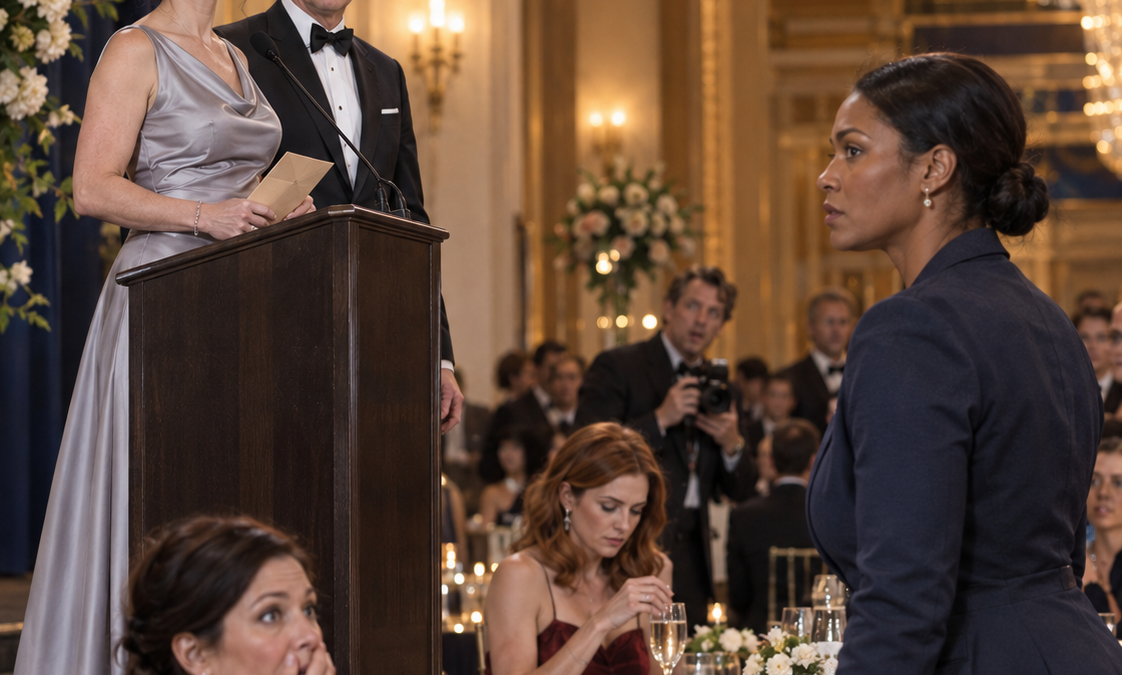
I wore a dove-gray gown. The same one I had worn to the gala. Patricia had tried to talk me out of it. She said it would bring back bad memories. She said I should wear something new.
But I wanted to wear the gray gown. I wanted to stand on that stage in the same dress I had worn when Charles tried to destroy me. I wanted to look out at the same crowd — or at least some of the same faces — and tell them who I really was.
The dinner was at the Ashford Hotel. The same ballroom. The same chandeliers. The same marble floor.
I walked in the front door and looked around. It was strange to be back. The last time I was here, I was Charles’s wife. I was the quiet woman in the corner. I was the background character.
Now I was the keynote speaker.
I walked to the head table and sat down. The mayor was there. The president of the Chamber was there. A few other local business owners were there. They all shook my hand and told me they were glad I was speaking.
I smiled and said thank you.
When it was time for my speech, I walked to the podium. I looked out at the crowd. Four hundred people. The same number as the gala.
“Good evening,” I said.
The room was quiet.
“My name is Vivian Marsh. I own Marsh & Pinsky. I built it from nothing. I built it while a man who was supposed to love me was stealing from me and lying to me and taking credit for my work.”
I paused.
“Two years ago, I stood in this room and watched that man try to humiliate me. He served me with divorce papers at our anniversary party. He told four hundred people that I had never been enough. He thought I would cry. He thought I would beg. He thought I would fold.”
I looked out at the crowd.
“He was wrong.”
The room was still quiet.
“I want to tell you something about being underestimated. It’s not a weakness. It’s a gift. When people underestimate you, they don’t see you coming. They don’t prepare. They don’t protect themselves. They think you’re harmless.”
I paused.
“I spent thirty-one years being underestimated. I spent thirty-one years being the foundation. And when the time came, I didn’t just survive. I won.”
I looked out at the crowd. I saw Patricia in the back. I saw Miriam at a table near the front. I saw David Chen and the rest of my employees.
“I want to thank you all for being here. I want to thank you for supporting me. I want to thank you for believing in me.”
I paused.
“But most of all, I want to thank the people who underestimated me. Because without them, I never would have known how strong I was.”
The room erupted in applause.
I stood at the podium and looked out at four hundred people. I thought about the gala. I thought about the divorce papers. I thought about the way I had said “okay” and walked out.
I thought about the way I had come back.
I smiled.
“Thank you,” I said. “And good night.”
I walked off the stage. Miriam met me at the bottom of the steps.
“That was good,” she said.
“Thank you.”
“You’re not going to cry?”
“No.”
“Why not?”
I looked at her.
“Because I’m done crying,” I said. “I’m done being the victim. I’m done being the quiet woman in the corner.”
I looked around the ballroom. The chandeliers. The marble floor. The four hundred people.
“I’m the face now,” I said. “And I’m not going anywhere.”
Miriam smiled. Patricia walked over and hugged me. David Chen shook my hand. The mayor told me it was the best speech he had ever heard.
I stood in the middle of the ballroom and let it all wash over me.
I thought about my father. I thought about Harold Pinsky. I thought about all the people who had believed in me when I didn’t believe in myself.
I thought about Charles. I thought about the way he had looked at me when he said he was sorry. I thought about the way he had looked at me when he said I deserved to be seen.
I had been seen. I had been seen by four hundred people. I had been seen by my employees. I had been seen by my friends.
But most importantly, I had been seen by myself.
And that was the thing that mattered most.
I walked out of the ballroom and into the lobby. The same lobby I had walked through two years ago. The same marble floor. The same glass doors.
I pushed open the doors and stepped outside. The night air was cool and clear. The stars were out. The parking lot was full.
I got into my car and drove home.
The house on Elm Street was quiet. I walked in the front door and set my keys on the table. I poured a glass of wine. I sat down at the kitchen table.
I looked at the photographs on the wall. My parents. My wedding. A picture of me at the office in 2003.
I looked at the note from Harold Pinsky. I looked at the letter from Charles. I looked at the contract that had started it all.
I took a sip of wine.
I was fifty-nine years old. I owned a company. I had friends. I had respect. I had everything I had ever wanted.
And I had done it all on my own.
I picked up the phone and called Miriam.
“Hey,” I said.
“Hey. You okay?”
“I’m great. I just wanted to say thank you.”
“For what?”
“For everything. For believing in me. For fighting for me. For being there.”
Miriam was quiet for a moment. Then she said, “You don’t have to thank me. You did the hard part.”
“I know. But I couldn’t have done it without you.”
“You could have. You just didn’t have to.”
I laughed.
“Good night, Miriam.”
“Good night, Vivian.”
I hung up and sat at the kitchen table. I looked out the window. The moon was bright. The street was quiet.
I thought about the gala. I thought about the divorce papers. I thought about the way I had said “okay” and walked out.
I thought about the way I had come back.
I finished my wine. I set the glass in the sink. I walked upstairs and got into bed.
I closed my eyes.
For the first time in thirty-one years, I slept through the night.

