Part 3: “I’m not between careers. I’m between deployments. That’s different.”
PART 8 — THE AFTERMATH
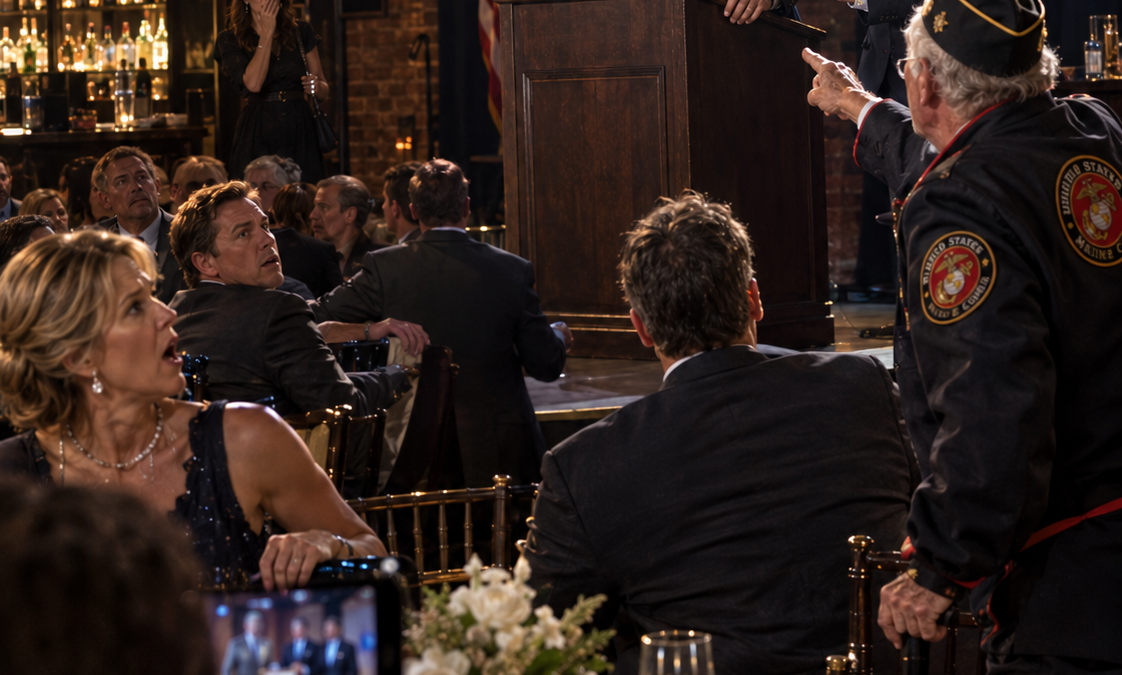
Mark stood on the stage for a full thirty seconds.
His face was doing something I’d never seen before. Cracking. The practiced smile was gone. The calm confidence was gone. What was left was a man who’d been caught. A man who’d been exposed. A man who was watching his carefully constructed image crumble in real time.
The clapping died down. The room waited.
“I—” Mark started again. Then stopped.
He looked at the crowd. At the phones still recording. At Patricia’s face, which was twisted with something like disgust. At Gerald’s, which was blank but watchful.
Then he looked at me.
“I apologize,” he said. The words came out flat. Forced. Like he was reading them off a card. “I was wrong. I shouldn’t have questioned your service.”
I didn’t say anything.
“I was misinformed. I made assumptions. I apologize.”
The room was quiet.
“You don’t mean it,” I said.
Mark blinked. “Excuse me?”
“You don’t mean it. You’re not sorry you did it. You’re sorry you got caught.”
His face flushed. “That’s not—”
“Let me finish.” I stepped closer to the microphone. My voice was steady. It was the voice I used in the field. The voice I used when I was talking men through the worst moments of their lives.
“You invited me here tonight to humiliate me. You set a trap. You thought I was a fraud. You thought I was a liar. You thought you could put me on stage and make me look small.”
I paused.
“But here’s what you didn’t understand. I’ve been questioned before. I’ve been doubted before. I’ve been in rooms where people didn’t believe me. I’ve been in countries where people wanted to kill me. I’ve been in situations that would make this party look like a Sunday picnic.”
I looked at the crowd. At the two hundred faces watching.
“Your opinion of me doesn’t matter. It never did. What matters is that I know who I am. And I don’t need your validation. I don’t need your apology. I don’t need anything from you.”
Mark’s face was white now. His hands were clenched at his sides.
“Then why did you come?” he asked. “If you don’t need anything from me, why did you come?”
I looked at him. Really looked at him. At the fear behind his eyes. At the smallness of him.
“I came because you’re not the only one who’s been lying,” I said. “I’ve been lying too. To myself. For five years, I let other people define who I was. I let them hide me. I let them be ashamed of me. I let them tell their friends I was between careers.”
I looked at Karen, who was standing near the back of the room. She’d come after all. I hadn’t seen her walk in.
“I’m done with that,” I said. “I’m not between careers. I’m not in transition. I’m not a former Marine who needs to be introduced carefully at dinner parties. I’m a Marine. Always have been. Always will be. And if that makes some people uncomfortable, that’s their problem. Not mine.”
I stepped back from the microphone.
The room was silent.
Then Frank said, “Semper Fi, Gunny.”
And the room exploded.
The applause lasted two minutes.
Mark tried to walk off the stage. But people were standing. People were blocking his path. Not aggressively—just by being there. By being present. By being witnesses.
Gerald Connelly was the first to reach me. He shook my hand. His grip was firm.
“I knew Mark was trouble,” he said. “I should have warned Karen. I should have said something. I’m sorry.”
“It’s not your fault.”
“It is my fault. I’m on the board of his nonprofit. I saw the signs. I ignored them.” He shook his head. “That changes tonight.”
Patricia was behind him. She looked at me differently now. Not with pity. With something else.
“David,” she said. “I’m sorry. At book club—I didn’t know. Karen never told us—”
“She didn’t tell you because she was ashamed. That’s not your fault. That’s hers.”
She nodded. Didn’t argue.
Helen and Richard came over. They said similar things. They were sorry. They didn’t know. They’d been wrong.
I accepted their apologies. I didn’t need them. But I accepted them.
Mark disappeared out a side door. I watched him go.
Frank came up beside me. “He’ll be back.”
“I know.”
“Men like that don’t take losses well. He’s going to come at you again. Different way. Different angle.”
“I know.”
“What are you going to do?”
I looked at the room. At the people who’d witnessed the truth. At Karen, who was standing alone near the back.
“I’m going to live my life,” I said. “He can do whatever he wants. I’m done hiding.”
Frank nodded. “Good answer.”
He walked away.
I walked toward Karen.
She was standing by the door. Her arms crossed. Her face unreadable.
“You came,” I said.
“I wasn’t going to. But I couldn’t stay home. I had to see.”
“See what?”
“See if it was true. See if you were who I thought you were. See if I’d been wrong.”
“And?”
She looked at me. Her eyes were wet.
“I was wrong,” she said. “About everything. About you. About what you did. About who I thought you were.”
“You didn’t think I was a liar.”
“Didn’t I?”
I looked at her.
“At the dinner,” I said. “When Mark questioned me. When he said my record was empty. You didn’t defend me. You didn’t say anything.”
“I was scared.”
“Scared of what?”
“Scared of the truth.” She wiped her eyes. “Scared that if I defended you, I’d have to admit that I’d been lying to myself. That I’d been hiding you. That I’d been treating you like—”
“Like a secret.”
She nodded.
“Why did you do it?” I asked. “Not the lies. Not the book club. Not the dinner party. Why did you start hiding me in the first place?”
She was quiet for a long time. Then she said, “Because I was afraid.”
“Afraid of what?”
“Afraid that if people knew who you were—what you’d done—they’d see me differently. They’d see me as someone who couldn’t understand. Someone who didn’t belong. I grew up in a world where people like you were—” She stopped. Started again. “My father was a lawyer. My mother was a socialite. They never served. They never knew anyone who served. To them, the military was for other people. Poor people. Uneducated people. People who didn’t have options.”
“And you married one.”
“I married you because I loved you. But I didn’t know how to explain you. I didn’t know how to fit you into that world. So I—I didn’t. I kept you separate. I kept us separate. And I told myself it was fine. I told myself you didn’t mind.”
“I minded.”
“I know. I know now.” She reached out and touched my arm. “I’m sorry, David. I’m sorry for everything. For the way I treated you. For the way I treated your service. For the way I let Mark humiliate you. I should have stood up for you. I should have defended you. I should have been proud of you.”
I looked at her hand on my arm. Then at her face.
“You can still be proud of me,” I said.
She looked up. “What?”
“You can still stand up for me. You can still defend me. You can still be proud of me. It’s not too late.”
She stared at me. Then she started crying. Really crying. Not the polite tears from the kitchen. Not the angry tears from the bedroom. Just crying. Raw. Messy. Human.
I didn’t hug her. Not yet. But I didn’t pull away.
“Let’s go home,” I said.
She nodded. Wiped her face. Followed me out of the bar.
We drove home in silence.
The city lights passed by. The radio was off. The heater was on low. Karen stared out the window. I kept my eyes on the road.
When we got to the house, she went inside. I stayed in the truck for a minute.
I looked at the Silver Star pinned to my chest. The gold star on the blue ribbon. The citation I’d never read. The medal I’d never worn.
I thought about Benitez. About the house in Fallujah. About the men who’d died and the men who’d lived. About the life I’d built after the war. The life I’d let someone else define.
Then I got out of the truck and went inside.
The kitchen light was on. Karen was at the table. She’d made tea. Two cups. One for her. One for me.
I sat down.
“I called my mother today,” she said.
“And?”
“I told her about you. About everything. About the Corps. About the Silver Star. About what you did.”
“What did she say?”
“She was quiet for a long time. Then she said—she said she was proud of me. For marrying someone who served.”
“That doesn’t sound like your mother.”
“It doesn’t. But she said it. And then she said she was sorry she’d never asked. She said she was sorry she’d never tried to understand.”
I drank my tea. It was hot. Strong. The way I liked it.
“I don’t know if we’re going to make it,” I said. “I don’t know if we can fix what’s broken.”
Karen nodded. “I know.”
“But I’m willing to try. If you are.”
She looked at me. “Really?”
“I didn’t marry you because I wanted you to validate me. I married you because I loved you. And I still do. But I can’t be married to someone who’s ashamed of me. I can’t be married to someone who hides me. I can’t be married to someone who lets me be humiliated at dinner parties and says nothing.”
“I know.”
“So if we’re going to try—really try—things have to change. You have to change. I have to change. We have to be honest with each other. About who we are. About what we want. About what we’ve done.”
She reached across the table and took my hand.
“I want to try,” she said. “I want to be the kind of wife who deserves a man like you.”
“Don’t do it for me. Do it for yourself.”
She nodded. “I’ll do it for both of us.”
I squeezed her hand. Then I let go.
“I’m going to bed,” I said.
She nodded. Stayed at the table.
I walked to the bedroom. Took off the suit. Hung it in the closet. Unpinned the Silver Star. Set it on the nightstand.
Then I lay down and stared at the ceiling.
I didn’t know what was going to happen. I didn’t know if we’d make it. I didn’t know if Mark would come back. I didn’t know what the future held.
But I knew one thing.
I wasn’t hiding anymore.
The next morning, I woke up early.
The sun was coming through the blinds. The house was quiet. I could smell coffee.
I got up. Walked to the kitchen. Karen was there. Dressed. Awake. Two cups of coffee on the table.
“Morning,” she said.
“Morning.”
She handed me a cup. I took it.
“I’ve been thinking,” she said.
“About what?”
“About what you said last night. About change. About honesty. About who we are.”
“And?”
“And I want to start. Today. With something small.”
“What?”
She reached into her pocket and pulled out a piece of paper. Folded. Worn. She set it on the table.
“What’s this?”
“Open it.”
I unfolded it.
It was a printout from the internet. A screenshot. A Facebook post. From the book club. From two years ago.
The post was from Karen. A photo of the group. Six women. Wine glasses. Smiling.
And the caption: “Book club tonight! So lucky to have these amazing women in my life. #blessed”
Underneath, a comment from Patricia: “Where’s David? He’s always so helpful!”
And Karen’s reply: “He’s around. He’s between careers right now. Figuring things out.”
I looked at the post. At the words. At the date.
“That’s the first time,” Karen said. “The first time I said it. I was ashamed of myself the minute I posted it. But I didn’t take it down. And I didn’t correct it. I just let it stand.”
“Why are you showing me this?”
“Because I want you to know that I know. I know what I did. I know how long I did it. I know how much it hurt you. And I want to be accountable. Not just sorry.”
I looked at the post. At the woman who’d written it. At the husband she’d described.
Then I folded the paper and set it back on the table.
“Thank you,” I said.
“That’s it?”
“That’s it.”
“You’re not going to yell at me?”
“No.”
“Why not?”
“Because you showed me the truth. And that’s what I asked for.”
She looked at me. Her eyes were wet again. But she smiled. Just a little.
“What now?” she asked.
“Now we have breakfast. Then we figure out the rest.”
She nodded. Turned to the stove. Started cooking eggs.
I sat at the table and drank my coffee.
And for the first time in a long time, the house felt like it might be a place I could live.
The next few weeks were hard.
Karen canceled the deal with Mark. She sent a letter. She didn’t pay the “consulting fees.” She told him to sue if he wanted.
He didn’t sue. But he tried other things. He called her clients. He spread rumors. He sent emails to her investors, telling them she was unstable. He tried to get her broker’s license reviewed.
None of it worked.
Gerald Connelly stood up for her. So did Patricia. So did Helen and Richard. The people who’d been at the dinner, who’d seen Mark exposed, they closed ranks around Karen. Not because they were being kind. Because they’d seen the truth.
Mark’s nonprofit dissolved. The board resigned. Someone filed a complaint with the state attorney general’s office. I don’t know what happened after that. I didn’t follow it.
I had other things to do.
Luis Reyes called me a week after the event.
“Gunny,” he said. “I did it.”
“Did what?”
“I saw Sofia. My daughter. We went to the park. We played on the swings. She called me Daddy.”
His voice cracked on the last word.
“That’s good,” I said. “That’s really good.”
“I’m going to the meetings. The Marine Corps League. I talked to Frank. He said he’d help me find a job.”
“Good.”
“I wanted to thank you. For coming to see me. For talking to me. For—I don’t know. For not giving up on me.”
“I didn’t do anything.”
“You did. You showed up. That’s all. You showed up.”
I hung up the phone and sat in my truck for a long time.
Then I drove to The Broken Arrow. Ordered a coffee. Sat at the end of the bar.
Frank was there. At a table. With Jason. And Luis. And three other men I didn’t know.
They waved me over.
I sat down.
“Gunny,” Jason said. “We were just talking about you.”
“All good things?”
“All true things.”
I laughed. Actually laughed.
The waitress brought me a coffee. I drank it. Listened to the men talk. Told a few stories of my own.
And for the first time in years, I felt like I was home.
PART 9 — THE NEW NORMAL
A month passed.
It didn’t feel like a month. It felt like a year. Time moves differently when you’re rebuilding something. Every day is a decision. Every conversation is a chance to turn left or right. Every silence is a question.
Karen and I went to counseling. Not because we were falling apart—because we were trying to put something together. A new thing. A real thing. The counselor was a retired Navy chaplain who’d worked with special operations families. He understood the weight. He understood the silence. He understood the way war follows you home and sits in the corner of the living room like a guest who never leaves.
“You’ve been living two lives,” he told us. “Most couples live one. You’ve been living two. That’s why it feels so hard. You’re not fixing a marriage. You’re building one from scratch.”
Karen took notes. I listened. We did the homework. We talked about things we’d never talked about. Her fear of being seen as ordinary. My fear of being seen as broken. The way we’d both used each other to hide from something.
It wasn’t easy. But it was honest.
That was new.
The book club met again in January.
Karen didn’t want to go. I told her she should.
“They’re your friends,” I said.
“They weren’t your friends. They sat there while Mark humiliated you.”
“They didn’t know.”
“They should have known. I should have told them.”
“Then tell them now.”
She looked at me. “You’d be okay with that?”
“I’d be more than okay with it.”
So she went. And when Patricia asked how I was doing—really asked, not the polite version—Karen told her the truth. All of it. The Silver Star. The deployments. The men I’d lost. The years of silence. The book on her nightstand with the notes in the margins.
Patricia cried. Helen cried. Even Susan, who barely knew me, got teary. And then they asked questions. Real questions. The kind you ask when you actually want to know someone.
Karen came home that night and told me about it. She was different. Lighter. Like she’d set something down she’d been carrying for years.
“They want to meet you,” she said. “Properly. Not as the husband. As David.”
“As David who?”
“As David Cole. The Marine. The man I married.”
I thought about it. Then I said, “Tell them I’ll come. But I’m not making bruschetta.”
She laughed. A real laugh. The kind I hadn’t heard in years.
The dinner was at our house. Karen’s idea. She wanted to host. She wanted to do it right.
I stayed out of the planning. This was her thing. Her friends. Her chance to introduce me properly. I just showed up when it was time and helped set the table.
Patricia and Gerald came. Helen and Richard. Susan brought her husband, a quiet man named Paul who’d done two tours in Vietnam and never talked about it. We sat next to each other at dinner and didn’t say much. We didn’t need to.
Halfway through the meal, Patricia raised her glass.
“I want to make a toast,” she said. “To David. And to Karen. And to the truth.”
Everyone raised their glasses.
“I’ve known Karen for fifteen years,” Patricia said. “I thought I knew her. I thought I knew her life. But I didn’t. And that’s not her fault. It’s mine. I never asked the right questions. I never looked beneath the surface. I was comfortable with the version of Karen that fit my world. And that wasn’t fair. To her. Or to David. Or to the truth.”
She looked at me.
“David, I want to apologize. Not for what I did—for what I didn’t do. I should have asked. I should have been curious. I should have known that a woman like Karen wouldn’t marry a man who was ‘between careers.’ I should have trusted that there was more to the story.”
I nodded. “Thank you.”
“I’m not done.” She smiled. “I also want to thank you. For your service. For your sacrifice. For the men you lost and the men you saved. I don’t understand it. I never will. But I respect it. And I’m proud to know you.”
She sat down.
The room was quiet.
Then Richard said, “Hear, hear.”
And everyone drank.
Karen and I stayed up late that night.
The guests had gone home. The dishes were in the sink. We were on the couch, side by side. Not touching. Just close.
“That was good,” she said.
“It was.”
“Patricia meant it. About being proud to know you.”
“I know.”
“Do you? Because I wasn’t sure. I thought maybe she was just being polite.”
“She wasn’t.”
“How do you know?”
“Because she cried. People don’t cry for polite.”
Karen was quiet for a moment. Then she said, “I’m still figuring this out.”
“Figuring what out?”
“How to be married to you. The real you. Not the version I made up.”
“You don’t figure it out. You just do it. One day at a time.”
“That sounds hard.”
“It is hard.”
She leaned her head on my shoulder. I didn’t pull away.
“I love you,” she said.
“I know.”
“Do you love me?”
I looked at her. At her face. At the woman I’d married. The woman who’d hurt me. The woman who was trying.
“I’m still here,” I said.
She nodded. Closed her eyes.
We sat like that for a long time.
Mark Davidson didn’t go away.
He just changed tactics.
A week after the dinner, I got a call from a reporter. A woman named Diane. She worked for the Richmond Times-Dispatch. She wanted to talk about the veterans’ tribute. About Mark. About what happened.
“Someone sent me a video,” she said. “From the bar. It’s been circulating online.”
“What video?”
“The one where your friend exposes Mark. It’s been viewed about two hundred thousand times.”
I hadn’t known that. I hadn’t been on social media since the event.
“What do you want from me?”
“Your story. Your side. People are asking questions about Mark. His business. His nonprofit. The more I dig, the more I find.”
“You should talk to Frank Alverez. He knows more than I do.”
“I already have. He’s the one who told me to call you.”
I thought about it. About the risk. About the exposure. About the fact that once I told my story, I couldn’t take it back.
“Okay,” I said. “When do you want to meet?”
The article ran a week later.
It was on the front page of the Sunday paper. Above the fold. A photo of me in uniform. A photo of Mark from a charity gala. A headline that made my stomach turn.
“A HERO AND A FRAUD: How a Richmond Investor Targeted a Decorated Marine and His Wife”
The article was long. Thorough. It detailed Mark’s history of targeting women-owned businesses. It detailed his shell companies. His lawsuits. His settlements. It detailed the night of the veterans’ tribute—Frank standing up, the crowd applauding, Mark walking out.
And it detailed my service. The Silver Star. The deployments. The men I’d served with.
I read it three times. Then I called Frank.
“You saw it,” he said.
“I saw it.”
“You okay?”
“I don’t know.”
“That’s normal. When your life becomes a story, it feels like it belongs to someone else.”
“I didn’t ask for this.”
“No. But you earned it. And so did Mark. He’s been getting away with this for years. Now he’s not.”
I hung up. Read the article again.
Then I went to find Karen.
She was in the kitchen. The paper was open on the table. She’d already read it.
“They called you a hero,” she said.
“They called me a lot of things.”
“They called me a fool. For not seeing who you were.”
“They called you a victim. There’s a difference.”
She looked at me. “I was a fool.”
“Maybe. But you’re not anymore.”
She nodded. Closed the paper.
“What happens now?” she asked.
“I don’t know. But I’m not going anywhere.”
She reached out and took my hand.
“Neither am I.”
The article changed things.
I got calls from old friends. Men I hadn’t talked to in years. Men who’d served with me. Men who’d heard the story and wanted to say thank you. A retired colonel from Quantico. A congressman’s aide. A woman from the VA who wanted to know if I’d be willing to speak at a veterans’ event.
I said yes to some. No to others.
Jason called. “You’re famous, Gunny.”
“I’m not famous. I’m just in the paper.”
“Same thing.”
“No. Not same thing.”
He laughed. “You want to come to the next meeting? The guys have been asking about you.”
“I’ll be there.”
Luis called. “I saw the article. You’re a hero.”
“I’m not a hero. I’m just a man.”
“That’s what heroes say.”
I laughed. Actually laughed.
“Thanks, Luis. How’s Sofia?”
“She’s good. She’s great. I get to see her every weekend now. Her mom and I are talking. It’s not fixed. But it’s better.”
“Good. That’s all that matters.”
I hung up and sat in my truck.
The sun was coming through the windshield. The radio was off. The world was quiet.
I thought about the article. About Mark. About Karen. About the life I’d built and the life I’d lost and the life I was building now.
It was strange. For years, I’d felt invisible. Not just to Karen, but to everyone. I’d been a background character in my own story. Someone who served a purpose. Someone who helped. Someone who was between careers.
Now I was visible. People saw me. People knew me.
It was uncomfortable. But it was real.
And real was better than invisible.
That night, Karen asked me something I didn’t expect.
“Do you want to go back?”
“Go back where?”
“To the Marines. To that world. To the people who understand you.”
I looked at her. “What do you mean?”
“I mean—you’ve been happier since you reconnected with Frank and Jason and the others. You’ve been more yourself. I see it. I see you.”
“You’ve always seen me.”
“No. I’ve always seen the version of you I wanted to see. That’s not the same thing.”
I didn’t argue. She was right.
“The Marines are my past,” I said. “I can’t go back. But I can stay connected. I can be part of that community. It doesn’t have to be one or the other.”
“Can it be both? This life and that one?”
“I don’t know. But I’m willing to try.”
She nodded. “Then I am too.”
The next morning, I woke up before Karen.
I went to the garage. Opened the footlocker. Took out the uniform. The boots. The photographs.
I laid them on the workbench and looked at them.
The uniform was still faded. Still soft. Still carrying the smell of dust and sweat and the worst days of my life. The boots were still scuffed. The photographs were still old.
But something had changed. They didn’t feel like a secret anymore. They felt like a history. A record. A testament.
I picked up the Silver Star. Held it in my palm.
It was still heavy. Still heavier than it looked.
But it didn’t feel like a burden anymore.
It felt like a part of me.
I put it back in the box. Closed the footlocker. Went inside.
Karen was awake. Making coffee.
“Morning,” she said.
“Morning.”
She handed me a cup. I took it.
“What are you going to do today?” she asked.
“I’m going to the Marine Corps League. Then I’m going to see Luis. Then I’m going to come home.”
“That sounds like a full day.”
“It is.”
She smiled. “Good.”
I smiled back.
It wasn’t perfect. It wasn’t fixed. But it was something.
It was a start.
PART 10 — THE FLAG
Spring came early that year.
The dogwoods bloomed in April. The river ran high. The city shook off winter like a coat it was tired of wearing. I noticed these things now. I hadn’t noticed them for years. I’d been too busy being invisible.
I wasn’t invisible anymore.
The Marine Corps League asked me to speak at the Memorial Day ceremony. I said yes. Then I spent three weeks trying to figure out what to say.
Frank helped. Not by giving me words, but by sitting with me. We’d meet at The Broken Arrow and drink coffee and talk about nothing. Old missions. Old friends. Old jokes that weren’t funny to anyone else. The kind of conversation that doesn’t require you to explain yourself because the other person already knows.
“You’ll figure it out,” he said. “You always do.”
“I’m not a public speaker.”
“You don’t have to be. You just have to tell the truth.”
“That’s what I’m afraid of.”
He looked at me. “Why?”
“Because the truth is heavy. People don’t always want to hear it.”
“That’s their problem. Not yours.”
I nodded. Drank my coffee. Looked at the photographs on the wall.
“You know what I figured out?” I said.
“What?”
“All those years I was hiding—it wasn’t just Karen. It was me. I was hiding from myself. From what I’d done. From what I’d lost. I thought if I didn’t talk about it, it would go away.”
“And did it?”
“No. It just got heavier.”
Frank nodded. “That’s how it works. The more you carry alone, the heavier it gets. You have to share the load.”
“I’m learning.”
“Good. It’s about time.”
Memorial Day was hot and bright.
The ceremony was at the Virginia War Memorial. A big crowd. Veterans. Families. Politicians. News cameras. Flags everywhere—American flags, state flags, service flags. A Marine Corps color guard in dress blues, rifles polished, faces young and serious.
I stood in the back before it started. Watching. Breathing. The way I used to before a mission. Calm. Focused. Ready.
Karen was in the crowd. She’d come. Not because she had to. Because she wanted to. She was wearing a simple blue dress. No diamonds. No makeup. Just her. She caught my eye and smiled. I smiled back.
Jason was there. Luis was there. Frank was there. The men from The Broken Arrow. The men from the League. The men who’d become my brothers again.
When it was my turn, I walked to the podium.
The crowd was quiet. A thousand faces. A thousand stories. A thousand reasons to be there.
I looked at the flag. Then at the crowd. Then at the page in my hand.
I’d written a speech. Twenty minutes. Good words. Strong words. The kind of words that make people cry and clap and feel something.
I folded the paper and put it in my pocket.
“Good morning,” I said.
The crowd murmured back.
“I had a speech prepared. But I’m not going to read it. Because it wasn’t the truth. It was just words.”
I paused.
“The truth is that Memorial Day isn’t about speeches. It’s not about flags or ceremonies or politicians. It’s about men and women who aren’t here anymore. Men and women who gave everything. Men and women I served with.”
I looked at the crowd.
“I served in Force Recon. Two deployments to Iraq. Three to Afghanistan. I lost eight men in that time. Eight Marines. Eight brothers. I carry them with me every day.”
I paused.
“One of them was named Luis Benitez. Corporal. Twenty-two years old. From El Paso. He wanted to be a teacher. He had a girlfriend named Maria. He showed me her picture once. I told him she was pretty. He blushed.”
The crowd was silent.
“He died in my arms. I held him while he bled out. I told him he was going to be okay. I lied.”
I looked at the flag.
“Memorial Day isn’t for me. It’s not for the veterans who came home. It’s for the ones who didn’t. It’s for Benitez. It’s for the eight men I lost. It’s for the thousands of others who gave their lives so we could stand here today and argue about politics and watch football and drink beer and forget.”
I paused.
“So today, I’m not going to ask you to thank me. I’m not going to ask you to shake my hand. I’m not going to ask you to call me a hero. I’m going to ask you to remember. Remember the ones who didn’t come home. Remember the ones who did come home and never really left. Remember the families who lost someone and never got them back.”
I looked at Karen.
“Remember the truth. Even when it’s hard. Even when it’s inconvenient. Even when it doesn’t fit the story you want to tell.”
I stepped back from the podium.
For a moment, nothing happened.
Then Frank Alverez stood up. He was in the front row. His cane in one hand. His Marine Corps League jacket on. His face wet with tears.
He raised his hand in a salute.
Then Jason stood. Then Luis. Then the other men from The Broken Arrow. Then the veterans in the crowd. Then the families. Then the strangers.
One thousand people, standing.
Saluting.
Remembering.
After the ceremony, Karen found me.
She was crying. Not sad tears. Something else. Something I hadn’t seen from her before.
“That was beautiful,” she said.
“It was the truth.”
“I know. That’s why it was beautiful.”
She reached up and touched my face. Just lightly. The way she used to. Before everything.
“I’m proud of you,” she said. “I don’t know if I’ve ever said that. Not really. Not the way you deserve. But I’m proud of you. For who you are. For what you did. For the man you’ve become.”
I looked at her. At her wet eyes and her open face.
“Thank you,” I said.
“It’s not enough.”
“It’s a start.”
She nodded. Then she hugged me. Held on. Didn’t let go.
I hugged her back.
The sun was warm. The flags were snapping in the wind. The crowd was dispersing.
And for the first time in years, I felt like I was exactly where I was supposed to be.
Summer came.
Karen’s business survived. Not just survived—thrived. Without Mark’s deal, she’d had to find new investors. But she did. People who believed in her. People who didn’t want to control her. People who respected what she’d built and wanted to help her build more.
She opened a second office in Charlottesville. Hired three new agents. Started a mentorship program for young women in real estate. She was busy. Happy. Different.
We weren’t the same couple we’d been. We were something else. Something better. We still argued. We still had hard days. But we didn’t hide anymore. Not from each other. Not from the truth.
I went back to work. Not consulting. Something else. Jason’s nonprofit offered me a job. Veteran outreach coordinator. It didn’t pay much. But it mattered. I helped men like Luis. Men who’d come home and lost their way. Men who needed someone who understood.
I also started going to the Marine Corps League meetings every week. Not just attending. Leading. Frank stepped down as chapter president. He said he was too old. He said it was my turn.
I said I wasn’t ready.
He said no one ever is.
So I took the job.
In August, I got a letter.
It was from the Department of the Navy. Official stationery. Official language. It said that after a review of my service record, they had decided to upgrade my discharge status. Not because there was anything wrong with it—but because they wanted to recognize “sustained valor and exceptional leadership in combat operations.”
They also informed me that I would be receiving an additional award. The Navy Cross. Second only to the Medal of Honor.
I read the letter three times. Then I called Frank.
“You knew,” I said.
“I might have written a letter.”
“You wrote a letter?”
“I wrote three. To three different people. It took them two years to respond. But they responded.”
“Why didn’t you tell me?”
“Because you didn’t need to know. You needed to be you. The rest would take care of itself.”
I was quiet for a long time.
“Frank,” I said.
“Yeah?”
“Thank you.”
“You don’t have to thank me. You earned it.”
“No. I mean—thank you. For everything. For following me. For standing up for me. For being there when I didn’t know I needed someone.”
Frank was quiet. Then he said, “That’s what Marines do.”
“Yes. It is.”
The Navy Cross ceremony was in September.
It was small. I asked for it to be small. Just family. Just friends. Just the men who mattered.
It was at Quantico. The Marine Corps base in Virginia. A chapel. A flag. A general.
Karen was there. In the front row. Wearing the same blue dress she’d worn to Memorial Day. Jason was there. Luis was there. Frank was there. The men from The Broken Arrow. The men from the League.
The general gave a speech. He talked about valor and sacrifice and the Marine Corps ethos. He talked about the Silver Star I’d earned in Fallujah. He talked about the twenty-three years of service. He talked about the men I’d saved and the men I’d lost.
Then he pinned the Navy Cross to my chest.
It was heavier than the Silver Star. Heavier than anything I’d ever worn.
I looked at the crowd. At the faces of the people who’d stood by me. At Karen, who was crying. At Frank, who was smiling. At Jason and Luis, who were standing at attention.
“Thank you,” I said. “Not for the medal. For the truth. For making me remember who I am.”
The room applauded.
And for the first time in my life, I didn’t feel like a fraud.
I felt like a Marine.
Life went on.
The seasons changed. The dogwoods bloomed and faded. The river ran high and low. The city moved forward. I moved with it.
Karen and I sold the house. It was too big. Too full of old memories. We bought something smaller. Closer to the river. A place with a porch and a garden and room for the dog we adopted—a mutt named Gunny who slept at the foot of the bed and didn’t care about medals or rank.
I kept the footlocker. But I didn’t keep it in the garage. I kept it in the living room. Open. Visible. The uniform folded on top. The photographs on the wall above it. The medals in a case on the shelf.
Karen hung the photo from 2016. The one Jason had sent me. The one with the eight Marines and the dusty courtyard and the smiles that didn’t quite reach our eyes.
She hung it in the hallway. Where everyone could see it.
“Who are these men?” guests would ask.
“Those are David’s Marines,” she’d say. “He saved their lives.”
And then she’d tell the story. Our story. The real one. The one she’d hidden for years.
She told it with pride.
One evening in October, I was sitting on the porch.
The sun was going down. The river was gold. Gunny was asleep at my feet. Karen was inside, making dinner. I could hear her humming. The way she used to. Before everything.
I thought about the journey. From the book club to the Veterans’ Tribute. From “between careers” to the Navy Cross. From invisible to seen.
It had cost something. It had cost years of my life. Years of silence. Years of pretending to be someone I wasn’t.
But it had been worth it.
I reached into my pocket and pulled out the card Catherine Marsh had given me. Jason’s mother. The woman who’d walked up to me at the party and changed everything.
I’d called her. After the article. After the ceremony. I’d thanked her. She’d said, “You don’t have to thank me. Jason wanted to. I just delivered the message.”
I looked at the card. Then I put it back in my pocket.
Karen came out with two glasses of lemonade. Sat down next to me.
“What are you thinking about?” she asked.
“The past.”
“Good thoughts or bad?”
“Both.”
She nodded. Didn’t ask for more.
“I was thinking about the book club,” I said. “The first time you told them I was between careers.”
She winced. “I’m sorry.”
“I know. You’ve said that.”
“Does it still hurt?”
“Sometimes. But it’s fading. The good stuff is louder now.”
She leaned into me. I put my arm around her.
“I love you,” she said.
“I know.”
“Do you love me?”
I looked at her. At the woman who’d hurt me. The woman who’d changed. The woman who was still changing.
“Yeah,” I said. “I do.”
She smiled. Closed her eyes.
We sat on the porch and watched the sun go down.
The river was quiet. The dog was snoring. The world was still.
And for the first time in a long time, I was at peace.
That night, I had a dream.
I was back in Fallujah. 2004. The house with the blue door. The heat. The dust. The sound of gunfire.
Benitez was there. Young. Alive. Smiling.
“You did good, Gunny,” he said.
“I tried.”
“You did more than try. You saved us. You saved me.”
“I couldn’t save everyone.”
“No. But you saved who you could. That’s all anyone can do.”
He reached out and touched my shoulder. His hand was warm. Real.
“Go home, Gunny,” he said. “You’ve earned it.”
I woke up.
The room was dark. Karen was asleep beside me. Gunny was snoring at the foot of the bed. Outside, the river was running. The world was turning.
I lay there for a long time. Thinking about Benitez. About the men I’d lost. About the men I’d saved. About the life I was living and the life I’d left behind.
Then I closed my eyes and went back to sleep.
And for the first time in years, I didn’t dream of war.
I dreamed of peace.
The morning after the dream, I woke up early.
The sun was coming through the curtains. Karen was still asleep. Gunny was still snoring. I got up, walked to the living room, and stood in front of the footlocker.
The uniform was there. The boots. The photographs. The medals in their case.
I looked at them for a long time.
Then I opened the case. Took out the Silver Star. Held it in my palm.
It was still heavy. Still carried the weight of everything I’d done and everything I’d lost.
But it didn’t feel like a burden anymore.
It felt like a reminder.
A reminder of who I was. Who I’d been. Who I’d always be.
I put the medal back in the case. Closed it. Went to the kitchen. Made coffee.
Karen came out a few minutes later. Hair messy. Eyes half open. The way she looked in the morning before she put on her face.
“Morning,” she said.
“Morning.”
She took the cup I offered. Drank.
“What do you want to do today?” she asked.
“I don’t know. Something normal.”
“Normal like what?”
“Normal like—I don’t know. Go for a walk. See a movie. Have dinner.”
“That sounds nice.”
“It does.”
She smiled. Kissed me on the cheek. Sat down at the table.
I sat across from her.
The house was quiet. The river was running. The sun was rising.
And for the first time in my life, I didn’t want to be anywhere else.
I was home.

