Part 3: My nephew handed me his phone with both hands. He was eleven. His name was Caleb. He didn’t say anything. He just held it out like it was something that might bite him.”
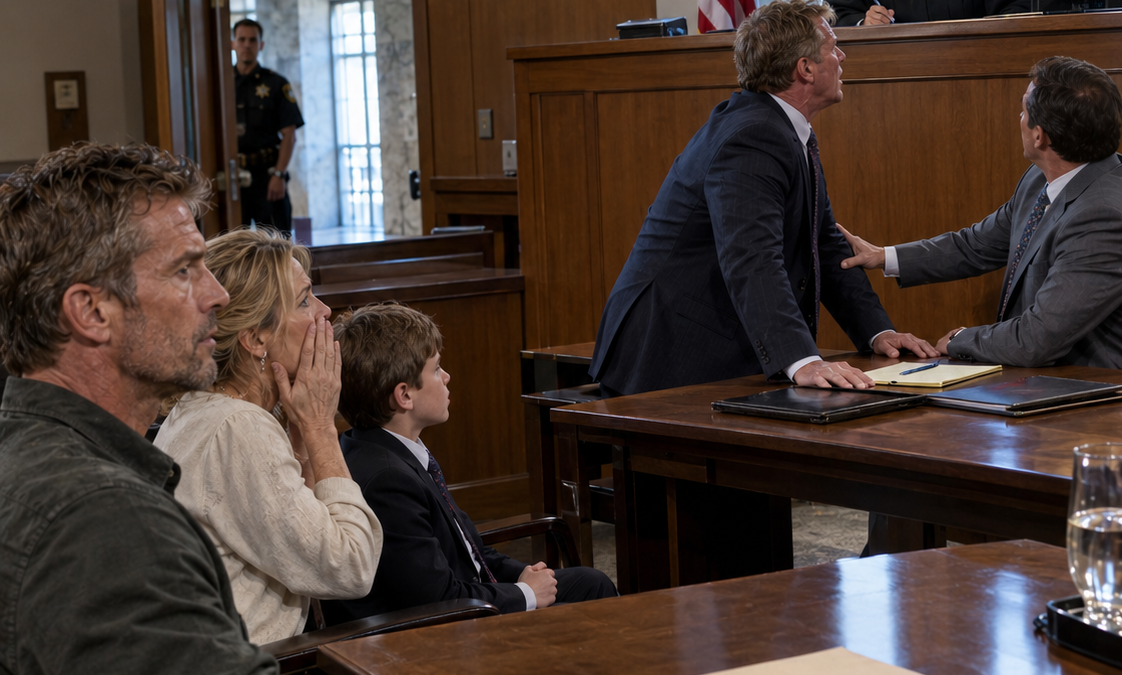
PART 6 — THE HEARING
The hearing was set for a Thursday.
Paul called me the night before. He wanted to go over everything one more time. The order of witnesses. The evidence. The questions he would ask. The questions Douglas’s lawyer would ask.
“Caleb is the key,” Paul said. “The judge needs to hear from him. Needs to see him. Needs to understand what he’s been living with.”
“He’s eleven.”
“I know. But he’s also the victim. And he’s articulate. He can do this.”
“I’ll talk to him.”
“Do that. And Jack? One more thing.”
“What?”
“Douglas is going to come after you. In the hearing. He’s going to try to make this about you. About your involvement. About why you’re really here. He’s going to try to paint you as the villain.”
“Let him try.”
“I’m serious. He’s good at this. He’s a lawyer. He knows how to manipulate a room.”
“So do I.”
Paul was quiet for a moment. Then he laughed.
“Okay,” he said. “I guess you do.”
The courthouse was a brick building in downtown Denver.
It was old. It was formal. It had flags and columns and a sign that said “Justice” in big letters.
We got there at nine o’clock. Paul met us at the entrance. He was wearing a dark suit. He looked serious.
“Karen. Caleb. Jack. Good morning.”
“Morning,” I said.
“How are you feeling, Caleb?”
Caleb shrugged. “Nervous.”
“That’s normal. Everyone gets nervous. Even me.”
“You get nervous?”
“Every time. It means you care about the outcome.”
Caleb nodded. He looked at me. I nodded.
We went inside. The hallway was quiet. The floors were marble. Our footsteps echoed.
We found the courtroom. It was small. A judge’s bench. Two tables. A few rows of seats. A flag in the corner. A clock on the wall.
Douglas was already there.
He was sitting at the table on the right. His lawyer was next to him. A man in a gray suit with slicked-back hair and a face that didn’t move.
Douglas looked at us when we walked in. His eyes were cold. He didn’t say anything. He just looked.
Karen looked away. Caleb looked at the floor.
I looked back at him. I didn’t blink. I didn’t smile. I just looked.
He looked away first.
We sat at our table. Paul sat between Karen and Caleb. I sat on the end. I could see the whole room from where I was.
The bailiff stood by the door. A sheriff’s deputy stood near Douglas. The judge’s clerk sat at a small desk near the bench.
We waited.
The judge came in at nine-thirty. She was a woman in her fifties. Gray hair. Reading glasses. A no-nonsense expression. Her name was Judge Ramirez.
She sat down. She looked at the room. She looked at the file in front of her.
“Good morning. We’re here for the hearing on the protective order filed by Karen Whitmore against Douglas Whitmore. Are both parties present?”
“Yes, Your Honor,” Paul said.
“Yes, Your Honor,” Douglas’s lawyer said.
“Good. Let’s begin. Mr. Chen, you may call your first witness.”
Paul stood up.
“Thank you, Your Honor. I’d like to call my first witness. The petitioner, Karen Whitmore.”
Karen stood up. She walked to the witness stand. She was shaking. She sat down. She looked at me. I nodded.
Paul approached her.
“Mrs. Whitmore. Can you tell the court why you’re here today?”
Karen took a breath. She looked at the judge. She looked at Douglas. She looked at me.
“I’m here because I’m scared,” she said. “I’m here because I need to protect my son.”
“Protect him from whom?”
“From my husband. Douglas Whitmore.”
“What are you afraid he’ll do?”
“I’m afraid he’ll hurt my son. I’m afraid he’ll hurt me. I’m afraid he’ll take my son away and I’ll never see him again.”
“Has he ever hurt your son?”
Karen paused. She looked at Douglas. He was staring at her. His eyes were hard.
“Yes.”
“Can you tell the court what happened?”
She told them. She told them about the watch. About the accusations. About the slaps. About the bruises. About the way Douglas talked to Caleb. About the way he talked to her.
She didn’t cry. She didn’t break down. She just told it. The way I’d taught her. Plain. Direct. No emotion. Just facts.
When she was done, Paul asked her one more question.
“Mrs. Whitmore. Why did you stay?”
She was quiet for a moment. Then she spoke.
“Because I was afraid,” she said. “Because I had nowhere to go. Because I didn’t have a job. Because I didn’t have any money. Because he told me if I left he’d destroy me. And I believed him.”
“But you left.”
“Yes.”
“What changed?”
She looked at me.
“My brother came,” she said. “He reminded me who I was. He reminded me that I wasn’t alone. He reminded me that I was stronger than I thought.”
She looked at Caleb.
“And my son,” she said. “My son was braver than I was. He’s the one who recorded everything. He’s the one who gave the recordings to my brother. He’s the one who saved us.”
Douglas’s lawyer cross-examined Karen for twenty minutes.
He asked about her mental health. About her drinking. About her past relationships. About whether she’d ever been diagnosed with depression or anxiety.
He tried to make her look unstable. He tried to make her look unreliable. He tried to make her look like a woman who was making things up.
She didn’t crack.
She answered every question. She didn’t get angry. She didn’t get defensive. She just told the truth.
When it was over, the judge called a recess.
We went out into the hallway. Caleb was pale. He was shaking.
“How did I do?” Karen asked.
“You did great,” I said.
“I felt like I was going to throw up.”
“You didn’t.”
“I know. I’m surprised.”
Paul came over. “Good job,” he said. “You held up under pressure. That’s what matters.”
“What happens next?”
“Caleb testifies. Then we play the recordings. Then Douglas’s lawyer cross-examines. Then we make our closing arguments.”
“And then?”
“And then the judge decides.”
Caleb was even better than Karen.
He walked to the witness stand like he was walking to his own execution. He was small. He was scared. He was eleven years old.
But he told the truth.
He told the judge about the first night at the cabin. About the drinking. About the yelling. About the slap.
He told her about the second night. About the accusation. About the punishment for something he didn’t do.
He told her about the third night. About the things Douglas said to Karen. About the way he made her feel small.
He told her about the fourth night. About calling the police. About hiding under his covers while Douglas stood in the doorway.
He told her everything.
When Paul asked him why he recorded the abuse, he said something that made the whole courtroom go quiet.
“Because I wanted proof,” he said. “Because I knew no one would believe me if I just said it. Because I knew I needed evidence. Because I wanted to be able to show someone. Because I wanted someone to help me.”
“Did anyone help you?”
He looked at me.
“My uncle did,” he said. “He listened. He believed me. He didn’t tell me I was lying. He didn’t tell me I was imagining it. He just said he’d help me. And he did.”
Douglas’s lawyer tried to break him.
He asked him about his grades. About his behavior at school. About whether he’d ever lied. About whether he’d ever been in trouble.
Caleb answered every question. He didn’t lie. He didn’t exaggerate. He just told the truth.
When he was done, Paul asked him one final question.
“Caleb. Do you love your stepfather?”
Caleb paused. He looked at Douglas. Douglas looked back.
“No,” he said. “I don’t.”
“Do you want to live with him again?”
“No.”
“What do you want?”
Caleb looked at the judge.
“I want to live with my mom,” he said. “I want to be safe. I want to not be scared anymore.”
The recordings took an hour to play.
Paul played them in order. One by one. The whole courtroom listened.
They heard Douglas call Karen lazy. Useless. A burden. They heard him say she married him because she couldn’t make it on her own.
They heard him call Caleb nothing. A mistake. A burden. They heard him say Caleb’s father left because of him. They heard him say Karen would never choose her son over her husband.
They heard the slaps. The threats. The silence after.
They heard everything.
Douglas sat at his table. He didn’t move. He didn’t look at anyone. His face was pale. His lawyer scribbled notes. But there was nothing to note. The recordings were clear. There was no mistaking the voice. No mistaking the words.
When the last recording ended, the courtroom was silent.
Judge Ramirez looked at Douglas.
“Mr. Whitmore. Do you have anything to say?”
Douglas stood up. He looked at the judge. He looked at Karen. He looked at Caleb. He looked at me.
“This is a setup,” he said. “This is my brother-in-law. He’s been trying to destroy my marriage for years. He’s been poisoning my wife against me. He’s been manipulating my stepson. He’s the one who’s been causing problems. Not me.”
“Mr. Whitmore. I asked if you had anything to say. Not if you had someone else to blame.”
“He’s not even their family. He’s just some guy who used to be in the military. He thinks he’s a hero. He thinks he can just come in and take over. But he’s nothing. He’s a landscaper. He lives alone. He’s a failure.”
I didn’t say anything. I just looked at him.
“Mr. Whitmore. Sit down.”
Douglas sat down.
Judge Ramirez looked at the room.
“I’ve heard enough,” she said. “I’m granting the permanent protective order. Douglas Whitmore, you are to stay five hundred feet away from Karen Whitmore and Caleb Whitmore at all times. You are not to contact them. You are not to come near their home, their workplace, or their school. If you violate this order, you will be arrested.”
She looked at the clerk.
“Additionally, I’m referring this case to the district attorney’s office for criminal charges. Assault. Child abuse. Criminal threatening. The recordings are more than enough evidence to proceed.”
Douglas’s lawyer stood up. “Your Honor—”
“Sit down, Mr. Hobbs. I’ve made my ruling.”
He sat down.
Judge Ramirez looked at Caleb.
“Young man. You showed more courage today than most adults I see in this courtroom. I want you to know that what you did was right. You protected yourself and your mother. You did the right thing.”
Caleb nodded. He didn’t say anything. He just nodded.
“Court is adjourned.”
We walked out of the courtroom together.
Karen was crying. Caleb was holding her hand. Paul was shaking my hand and telling me he’d be in touch.
Douglas was still inside. I could hear him yelling at his lawyer.
We didn’t wait to hear what he had to say.
We walked outside. The sun was shining. The sky was blue. The air was warm.
Karen looked at me. Her eyes were red. Her face was wet.
“We did it,” she said.
“We did.”
“He’s not going to hurt us anymore.”
“Not if I have anything to say about it.”
She laughed. It was a real laugh. A laugh I hadn’t heard in years.
“Jack,” she said. “Thank you.”
“Don’t thank me.”
“I’m thanking you anyway.”
She hugged me. She held on for a long time.
Caleb hugged me too. He didn’t say anything. He just held on.
When they finally let go, I looked at them. The two of them. Standing in the sunshine. Free.
“Let’s go home,” I said.
PART 7 — THE HOSPITAL
The first three weeks were quiet.
Too quiet.
We stayed at the safe house. Karen didn’t leave except to go to the grocery store. Caleb didn’t leave except to go to the park across the street with me. We kept the curtains closed. We kept the doors locked.
Paul called every few days. He gave us updates. The criminal case was moving forward. The district attorney’s office was building a file. Douglas had been formally charged with assault and child abuse. He’d been released on bond. He was living in his apartment in Denver. He was not allowed to leave the state.
“That’s good,” I said.
“It’s not enough,” Paul said. “He’s still out there. He’s still got money. He’s still got connections.”
“What are you saying?”
“I’m saying be careful. Don’t let your guard down. Men like Douglas don’t just give up. They escalate.”
I remembered that. In the PJs, we learned that a cornered animal was more dangerous than one with room to run. Douglas was cornered now. He was exposed. He was humiliated. He wasn’t going to take that lying down.
I started checking the locks twice a night. I started keeping my phone on. I started sleeping with one eye open.
Karen noticed.
“You’re doing it again,” she said.
“Doing what?”
“The thing you used to do when we were kids. The thing where you’d stay up all night listening for Dad.”
I didn’t answer. She was right.
“You don’t have to protect us anymore, Jack. We’re safe now.”
“Are we?”
She looked at me. She didn’t say anything.
We both knew the answer.
The medical emergency happened on a Tuesday.
Karen had been complaining about headaches for a few days. I told her to see a doctor. She said she didn’t have insurance. I told her I’d pay for it. She said she didn’t want to be a burden.
Then she collapsed in the kitchen.
I heard the crash from the living room. I ran in. She was on the floor. Her eyes were open but she wasn’t seeing anything. Her hands were twitching.
I called 911. I stayed with her. I checked her airway. I checked her breathing. I checked her pulse. I did everything I’d been trained to do.
The ambulance came in eight minutes. The paramedics loaded her onto a stretcher. They asked me questions I couldn’t answer. Medical history. Medications. Allergies.
I didn’t know any of it.
I followed the ambulance to the hospital. Caleb stayed with a neighbor. A woman named Mrs. Patterson. She was in her seventies. She had a kind face. She said she’d take care of him.
I sat in the emergency room for three hours.
The doctors ran tests. They did scans. They did blood work. They came out and told me she’d had a seizure. Caused by stress. Caused by months of accumulated trauma.
“She’s going to be okay,” the doctor said. “But she needs rest. She needs to reduce her stress. She needs to see a neurologist. She needs to see a therapist.”
“Can I see her?”
“She’s resting. You can see her in a few minutes.”
I sat in the waiting room. I put my head in my hands.
I’d been so focused on Douglas. On the hearing. On the legal case. I’d forgotten about Karen. I’d forgotten that she was carrying the weight of everything. I’d forgotten that she was human.
I should have seen it. I should have noticed. I was trained to notice.
But I’d been too close. Too focused on the mission. Too focused on the fight.
I’d failed her.
Karen was awake when I walked into her room.
She looked small in the hospital bed. The gown was too big. The monitors beeped. The IV dripped.
“Hey,” I said.
“Hey.”
“How are you feeling?”
“Like I got hit by a truck.”
“That’s about right.”
I sat in the chair next to her bed. I didn’t say anything for a while. Neither did she.
Then she spoke.
“I’m sorry.”
“For what?”
“For this. For making you worry. For being weak.”
“You’re not weak.”
“I collapsed in the kitchen. I couldn’t even stand up.”
“That’s not weakness. That’s your body telling you it’s been through too much.”
She looked at me. Her eyes were wet.
“I keep thinking about what he did. I keep replaying it in my head. Every word. Every look. Every time he hurt Caleb. I can’t stop.”
“You need to talk to someone.”
“I don’t want to talk to a stranger.”
“Then talk to me.”
She was quiet for a moment. Then she spoke.
“I feel like I’m drowning,” she said. “I feel like I’m in the water and I can’t get to the surface. And every time I try to swim, something pulls me back down.”
“That’s what trauma does. It makes you feel like you’re trapped even when you’re not.”
“How do I stop it?”
“You don’t. Not all at once. You take it one day at a time. One hour at a time. You let people help you. You let me help you.”
She looked at me. She took my hand.
“You’ve already done so much.”
“I haven’t done enough.”
“You’ve done everything.”
“No. I focused on Douglas. I forgot about you.”
“You didn’t forget about me. You saved me.”
“I didn’t save you. You saved yourself. You stood up in that courtroom. You told the truth. You fought for your son.”
“I fought because you were there. I fought because you believed in me.”
I didn’t say anything. I just held her hand.
We sat there for a long time. The monitors beeped. The IV dripped. The hospital hummed.
Then the door opened.
A nurse came in. She was young. She looked nervous.
“Mrs. Whitmore? There’s someone here to see you.”
Karen looked at me. I looked at her.
“Who?” I asked.
The nurse hesitated. “A man. He says he’s her husband.”
I stood up.
“Where is he?”
“In the waiting room. He’s demanding to see her.”
“Did you tell him she’s not allowed visitors?”
“He said he has a right to see his wife.”
“He doesn’t have a right. There’s a protective order.”
The nurse looked confused. “I didn’t know.”
“Now you do. Tell him to leave. If he doesn’t, call security.”
She nodded. She left.
I looked at Karen. Her face was pale.
“He found us,” she whispered.
“He found the hospital. That’s not the same thing.”
“How did he know I was here?”
“I don’t know. Maybe he’s been watching. Maybe he called around. Maybe someone told him.”
“What do we do?”
“I’m going to handle it.”
I walked out of the room. I walked down the hallway. I walked into the waiting room.
Douglas was standing at the front desk. He was arguing with a receptionist.
“I have a right to see my wife. You can’t keep me from seeing my wife.”
“Sir, if there’s a protective order—”
“There’s no protective order. That’s a lie. My brother-in-law made it up.”
I walked up to him.
“Douglas.”
He turned around. His face was red. His eyes were wild.
“Jack. Where is she? Where’s Karen?”
“She’s safe. That’s all you need to know.”
“I need to see her. I need to talk to her. She’s my wife.”
“She’s not your wife anymore. Not in any way that matters.”
“You did this. You turned her against me. You turned my son against me.”
“He’s not your son. He’s her son. And you hurt him. That’s why she left.”
“I never hurt him. I never touched him.”
“I heard the recordings, Douglas. I heard you slap him. I heard you threaten him. I heard you tell him his father left because of him.”
“That was a joke. He took it the wrong way.”
“It wasn’t a joke. It was abuse. And you’re going to pay for it.”
He stepped closer. His face was inches from mine.
“You think you’re so tough,” he said. “You think because you were in the military you’re better than me. You’re nothing. You’re a nobody. You’re a landscaper who lives alone in a house that’s falling apart. You’ve got no wife. No kids. No life. You’re just a sad, lonely man who thinks he’s a hero.”
I didn’t move. I didn’t blink. I just looked at him.
“You’re right,” I said. “I don’t have a wife. I don’t have kids. I live alone. But I have something you don’t have.”
“What’s that?”
“I have people who trust me. I have people who believe in me. I have a sister who loves me and a nephew who looks up to me. And I have a promise I made to protect them. A promise I intend to keep.”
He stared at me. His hands were clenched. His jaw was tight.
“You’re going to regret this,” he said.
“No. You are.”
Security arrived. Two big men in uniforms. They escorted Douglas out of the building.
He was yelling the whole way. Threatening. Cursing. Promising.
I watched him go. Then I went back to Karen’s room.
She was sitting up. She was holding the call button. She looked at me when I walked in.
“Is he gone?”
“He’s gone.”
“Did he hurt you?”
“No.”
“Did he say anything?”
“He said a lot of things. None of them mattered.”
She looked at me. She took a breath. Then she nodded.
“Okay,” she said. “Okay.”
The next morning, I got a call from Detective Alvarez.
“Mr. Halloran. I heard about the incident at the hospital. I’m sorry you had to deal with that.”
“It’s fine. He’s gone.”
“For now. But I wanted to let you know. We’re pursuing charges for violating the protective order. That’s a separate crime. It carries jail time.”
“Good.”
“There’s something else. We’ve been investigating Douglas Whitmore for a while now. Not just the domestic abuse. Other things.”
“What kind of things?”
“Financial fraud. Wire fraud. Money laundering. He’s been running a scheme for years. Using his law firm to funnel money through shell companies. We’ve been building a case for months.”
“Why are you telling me this?”
“Because I want you to know. He’s not just a domestic abuser. He’s a criminal. And he’s going down. One way or another.”
I didn’t say anything for a moment. I just let it sink in.
“Thank you,” I said.
“You’re welcome. And Mr. Halloran?”
“Yeah?”
“What you did for your sister and your nephew. That was good work. I’ve been doing this for twenty years. I’ve seen a lot of families destroyed by men like Douglas Whitmore. It’s nice to see one that got out.”
“We’re not out yet.”
“You’re closer than most. Keep fighting.”
“I will.”
He hung up.
I sat in the hospital cafeteria. I drank a cup of bad coffee. I thought about what he’d said.
Douglas was going down. Not just for the abuse. For everything. For all the things he’d done. For all the people he’d hurt.
The recordings were just the beginning. The recordings were the key that opened the door. But behind the door was a whole world of crime. A whole world of lies.
I thought about Caleb. Eleven years old. Holding a phone in his hands. Recording his stepfather. Recording the abuse. Recording the truth.
He didn’t know what he was doing. He just knew he needed to do something. He just knew he needed proof. He just knew he needed someone to believe him.
And because he did that. Because he was brave enough to record it. Because he was brave enough to hand me the phone. Because he was brave enough to tell the truth in court.
Because of all of that. Douglas was going to pay. Not just for the abuse. For everything.
That was the thing about courage. It didn’t always look like courage. Sometimes it looked like an eleven-year-old boy with a cracked phone and shaking hands.
But it was courage all the same.
PART 8 — THE RECORD
Douglas pled guilty six weeks later.
Not to everything. His lawyer worked out a deal. He pled guilty to one count of criminal child abuse and one count of felony wire fraud. The other charges were dropped. The DA said it was the best they could do without a long trial. Paul said it was a good outcome. I wasn’t so sure.
“Six years,” Paul told me on the phone. “Four for the abuse. Two for the fraud. He’ll serve at least four before he’s eligible for parole.”
“That’s not enough.”
“It never is.”
“What about Karen and Caleb? Do they have to testify again?”
“No. The plea means no trial. No cross-examination. No more courtrooms.”
That was the part that mattered. Caleb wouldn’t have to sit in a witness stand again. He wouldn’t have to look at Douglas. He wouldn’t have to relive it.
“Okay,” I said.
“There’s something else. The restitution order. Karen’s getting the house. The cabin. Half of the assets. The judge was not sympathetic to Douglas.”
“She’s getting the cabin?”
“She’s getting everything that wasn’t tied up in the fraud. The judge was clear. Douglas used his position to isolate and control her. She was financially abused as well as physically abused. The court is treating that seriously.”
I sat there for a moment. The cabin. The place where we’d grown up. The place where Douglas had spent a week terrorizing his family.
“She’s going to sell it,” I said.
“She can do whatever she wants with it. It’s hers.”
Karen came home from the hospital three days after the seizure.
She was on medication. She was seeing a therapist twice a week. She was sleeping more. She was eating again.
Caleb was different too. He was still quiet. He was still careful. But something had changed. He didn’t flinch when a door closed. He didn’t look at the floor when someone spoke to him. He didn’t apologize for existing.
The first night back at the apartment, he came out of his room and sat next to me on the couch.
“Uncle Jack?”
“Yeah, bud?”
“Is it over?”
“For now. Douglas is in jail. He’s going to be there for a while.”
“How long?”
“Four years. Maybe more.”
He was quiet for a moment. Then he nodded.
“That’s good,” he said.
“Yeah. It is.”
“Are we going to stay here?”
“For now. Your mom needs to figure out where she wants to live.”
“Can we go back to the cabin?”
I looked at him. “Do you want to?”
He thought about it. Then he shook his head.
“No,” he said. “I don’t want to go back there.”
“That’s okay. You don’t have to.”
“I want to go somewhere new. Somewhere he’s never been.”
“Then that’s what we’ll do.”
He leaned against me. He didn’t say anything else. He just sat there.
I put my arm around him. We watched the television. Something stupid. A cartoon. He laughed once. A real laugh. The kind of laugh I hadn’t heard from him in months.
That was enough. For now. That was enough.
The district attorney’s office called me a week later.
A woman named Sarah Okonkwo. She was the lead prosecutor on the fraud case. She wanted to meet.
We met at a coffee shop near the courthouse. She was in her forties. Tall. Direct. She had a file with her. She set it on the table.
“Mr. Halloran. Thank you for coming.”
“Call me Jack.”
“Jack. I wanted to talk to you about the fraud case. The financial scheme Douglas Whitmore was running.”
“I thought he pled guilty.”
“He did. To the wire fraud. But the scheme was bigger than he admitted to. He had partners. He had shell companies. He had money stashed in accounts that we haven’t been able to trace.”
“Okay.”
“I’m telling you this because you may have information that could help us.”
“I’m a landscaper. I don’t know anything about finance.”
“I’m not talking about finance. I’m talking about Douglas. His habits. His patterns. The people he talked about. The places he went. The things he did when he thought no one was watching.”
I thought about it. I thought about the week at the cabin. The phone calls. The trips into town. The late-night meetings.
“He had a partner,” I said. “A man named Reeves. He mentioned him a few times. Said he was his ‘guy in the city.'”
“Reeves. First name?”
“I don’t know. He never said.”
“That’s helpful. Anything else?”
“He had a second phone. A burner. He kept it in his briefcase. He never let anyone touch his briefcase.”
“How do you know?”
“I noticed.”
She looked at me. “You noticed.”
“I notice things.”
She smiled. It was a real smile. “I bet you do.”
She wrote something down. Then she looked at me again.
“One more thing. The recordings. Caleb’s recordings. They were entered as evidence in the criminal case. They’re part of the record now. They’re going to be used in the fraud case too. The things Douglas said about his business. The things he said about his partners. It’s all there.”
“I didn’t know that.”
“Caleb recorded more than abuse. He recorded a man who thought he was alone. A man who said things he would never say in public. That recording is going to put three other people in prison.”
I didn’t say anything for a moment.
“Does Caleb know?”
“He doesn’t need to know. Not yet. Not until he’s older.”
“Good.”
“But you should know. What he did. What he recorded. It didn’t just save him and his mother. It took down a criminal operation. It’s going to save a lot of other people.”
I nodded. I didn’t trust myself to speak.
“Jack. I’ve been doing this for eighteen years. I’ve seen a lot of cases. I’ve seen a lot of evidence. I’ve never seen anything like that phone. Your nephew is the reason we got them.”
“He’s eleven.”
“I know. That’s what makes it remarkable.”
She stood up. She shook my hand.
“Thank you,” she said. “For raising him right.”
“I didn’t raise him. I just listened.”
“That’s more than most people do.”
The day Douglas was sentenced, I went to the courthouse.
I didn’t tell Karen. I didn’t tell Caleb. I just went.
Douglas was in the courtroom. He was wearing an orange jumpsuit. His hands were cuffed in front of him. He looked smaller than I remembered. Older. Tired.
He didn’t look at me. He looked at the judge. The judge read the sentence. Six years. No parole before four. Restitution. A restraining order that would last ten years past his release.
Douglas didn’t say anything. He didn’t apologize. He didn’t fight. He just stood there. The deputies led him away.
I sat in the back row and I watched.
I thought about what it meant. Six years. Four before parole. That wasn’t enough for what he’d done. Not even close. But it was something. It was more than most abusers ever got.
I thought about Karen. About the look on her face when she walked out of the courtroom after the protective order was granted. About the way she’d hugged me. About the way she’d laughed.
I thought about Caleb. About the phone in his hands. About the recordings. About the courage it took to make them.
I thought about the day I got the call. The day I found out. The day I drove three hours to a cabin in the mountains.
I hadn’t known what I was walking into. I hadn’t known what I’d find. I just knew my sister needed me. My nephew needed me.
That was enough. That was always enough.
I got up and walked out of the courthouse. The sun was shining. The sky was blue. It was a good day.
PART 9 — THE LANDSCAPER
I went back to Colorado Springs in September.
I had a business to run. A house to maintain. A life to get back to. I’d been gone for almost two months. My clients had been patient, but patience doesn’t pay the bills.
The first week back, I worked every day. I mowed lawns. I trimmed hedges. I planted a new garden for a woman who lived in a big house on the north side. She said she’d waited for me because I was the only one who did it right.
That made me smile. It was a small thing. But it mattered.
I kept my phone on. I called Karen every night. I talked to Caleb every weekend. They were doing okay. Karen had found a small apartment in a suburb south of Denver. She’d started taking classes at a community college. She wanted to be a paralegal. She said she wanted to help people like her.
Caleb had started at a new school. He was making friends. He was playing soccer. He was doing better.
He still had bad days. He still woke up with nightmares. He still got quiet sometimes. But he was learning how to talk about it. He was learning how to ask for help.
Karen told me he’d started seeing a therapist. A woman named Dr. Reyes. He liked her. He said she understood.
I was glad. I was glad he was getting help. I was glad he wasn’t carrying it alone.
The military reunion was in October.
I hadn’t planned to go. I never went to those things. I didn’t like the crowds. I didn’t like the noise. I didn’t like the way people talked about the old days like they were the only days that mattered.
But Donnie called me. He said it was important. He said there was someone who wanted to see me.
“Who?”
“You’ll find out when you get here.”
“Donnie.”
“Jack. Just come. Trust me.”
So I went.
It was at a hotel in Denver. A big ballroom. White tablecloths. Military flags. Large screens showing photos from deployments. A lot of men in suits. A lot of medals. A lot of stories.
I walked in and immediately felt out of place. I was wearing a simple button-down shirt. I didn’t have any medals on display. I didn’t have any stories to tell.
Then I saw him.
He was standing near the back. He was older than I remembered. Gray hair. A cane. But his eyes were the same. Sharp. Clear. He was looking right at me.
Colonel Mark Ellison. My old commander. The man who’d trained me. The man who’d sent me on missions. The man who’d pinned my PJ badge on my chest.
He walked over. Slowly. He used the cane. He stopped in front of me.
“Halloran,” he said.
“Colonel.”
“You look old.”
“You look older.”
He laughed. It was a real laugh. Loud. Full.
“Still a smartass.”
“Yes, sir.”
He put his hand on my shoulder. He looked at me for a long moment.
“I heard what you did,” he said.
“What I did?”
“Your sister. Your nephew. The recordings. The hearing. The whole thing.”
“How did you hear about that?”
“Donnie told me. He keeps me informed. He knows I like to know what my boys are up to.”
I didn’t say anything. I didn’t know what to say.
“You saved them,” he said. “You saved your sister. You saved your nephew. You saved them from a man who would have destroyed them.”
“I did what anyone would do.”
“No. You did what most people wouldn’t. You saw a problem. You assessed it. You planned. You executed. You didn’t leave anyone behind.”
“That’s the job, sir.”
“That’s the job. And you did it.”
He reached into his jacket. He pulled out a small box. He handed it to me.
“What’s this?”
“Open it.”
I opened it. Inside was a medal. A small silver cross. A blue ribbon.
“The Airman’s Medal,” I said.
“The Airman’s Medal. For heroism. For actions above and beyond the call of duty.”
“Sir, I didn’t—”
“Don’t tell me what you didn’t do. I read the file. I read the police report. I read the transcript of the hearing. You went into a hostile environment. You protected a child. You gathered evidence. You coordinated a rescue. You did it without weapons. Without backup. Without anyone knowing what you were doing.”
“Sir—”
“You did exactly what we trained you to do. You made a difference. You saved a life. Two lives. Maybe more.”
He pinned the medal to my shirt. Then he stepped back. He looked at me.
“I’m proud of you, Halloran. I’ve been proud of you for twenty years. You’re one of the best I ever served with.”
I didn’t say anything. I couldn’t. My throat was tight.
“Now go sit down,” he said. “They’re about to serve dinner. And you’re going to eat. You look like you haven’t eaten in a week.”
The reunion was good.
I saw men I hadn’t seen in years. Men I’d served with in Afghanistan. Men I’d served with in Iraq. Men I’d pulled out of burning vehicles. Men who’d pulled me out of the same.
We talked. We laughed. We remembered. We drank. We ate.
I told them about Karen. About Caleb. About the recordings. About the hearing.
They listened. They didn’t say much. They didn’t need to. They knew.
When I got up to leave, Donnie walked me to the door.
“Jack.”
“Yeah?”
“You did good.”
“I just did what I was supposed to.”
“That’s not what I mean. I mean you did good. You’re a good man. You always were. You were one of the best of us. And you still are.”
I looked at him. He looked back.
“Thank you,” I said.
“Don’t thank me. Just keep doing it.”
“I will.”
He hugged me. He held on for a long time. Then he let go.
“Now go home,” he said. “Get some sleep. You look like hell.”
I laughed. I walked out the door. I got in my truck. I drove home.
PART 10 — THE CABIN
Karen decided to sell the cabin in November.
She asked me to come with her. She said she couldn’t do it alone. She said she needed someone who understood. Someone who remembered.
I drove up on a Friday. The drive was three hours. The road was familiar. The trees were bare now. The sky was gray.
We met at the cabin. Just the two of us. Caleb was staying with a friend. He said he didn’t want to come. He said he never wanted to see that place again. I didn’t blame him.
The cabin looked the same. The same gray wood. The same green shutters. The same porch where I’d sat with Caleb and listened to the recordings.
Karen unlocked the door. We walked in. The air was cold and still. The furniture was covered in sheets. The windows were dark.
“I haven’t been here since we left,” she said.
“I know.”
“I don’t know if I can do this.”
“Then we’ll do it together.”
We walked through the rooms. The kitchen. The living room. The bedrooms. We packed up the things that belonged to us. The photos. The books. The small things that mattered.
We found the closet where we’d hidden as kids. The closet where Karen had held the door shut while our father screamed. It was empty now. But it wasn’t. It was full of memories.
She sat down in the doorway. She looked at the floor.
“I remember,” she said. “I remember being so scared. I remember thinking he was going to break the door down. I remember holding it shut with my whole body.”
“I remember too.”
“I was ten years old.”
“You were.”
“I shouldn’t have had to do that.”
“No. You shouldn’t have.”
She looked at me. There were tears in her eyes.
“But I did. I did it. I protected you. I protected us.”
“Yes. You did.”
“And then I stopped. I stopped protecting. I stopped fighting. I married a man just like Dad. And I let him hurt my son.”
“You didn’t let him.”
“I did. I stood by. I watched. I told myself it wasn’t that bad. I told myself he didn’t mean it. I told myself it was my fault.”
“It wasn’t your fault.”
“I know that now. But it took me too long to figure it out.”
I sat down next to her. I put my arm around her.
“You figured it out,” I said. “That’s what matters. You figured it out. And you got out. And you saved your son.”
“I didn’t save him. You saved him.”
“I just listened. He’s the one who recorded it. He’s the one who gave me the phone. He’s the one who stood up in court and told the truth.”
She was quiet for a moment.
“He’s so brave,” she said.
“He is.”
“He gets it from you.”
“No. He gets it from you. He gets it from the woman who held a door shut when she was ten years old.”
She looked at me. She didn’t say anything. She just leaned her head on my shoulder.
We sat there for a long time. In the closet. In the dark. The way we used to. The way we’d always done.
When we finally got up, we walked out of the cabin. We stood on the porch. We looked at the trees. The lake. The sky.
“It’s a good place,” I said. “It’s a good place to sell.”
She nodded. “It is.”
We locked the door. We walked to our cars. We hugged.
“Thank you,” she said.
“For what?”
“For being my brother.”
“Always.”
I got in my truck. I drove away. I didn’t look back.
The cabin sold in December.
Karen got a good price. She put the money in a savings account for Caleb. She said it was for college. She said it was for whatever he wanted to do. She said he’d earned it.
She finished her first semester at the community college. She got an A in her legal writing class. She called me to tell me. She was crying. Happy tears. The kind I hadn’t heard from her in years.
Caleb made the soccer team. He scored his first goal in January. He called me from the field. He was out of breath. He was laughing. He said he wished I could have been there.
I wished I could have been there too. But I was there in spirit. I was always there in spirit.
I kept working. I kept mowing. I kept planting. I kept living.
I saw a therapist too. Not because I had to. Because I wanted to. Because I’d spent twenty years carrying things I didn’t need to carry. Because I’d spent twenty years pretending I was fine when I wasn’t.
It helped. Talking helped. It always did.
I thought about the recordings sometimes. I thought about the files on the phone. I thought about the words Douglas said. The words Caleb recorded. The words that put a man in prison.
I thought about the day Caleb handed me the phone. The way his hands shook. The way he didn’t say anything. The way he just trusted me.
I thought about the day I listened to the first file. The way my stomach tightened. The way I knew. The way I understood.
I thought about the day I confronted Douglas at the hospital. The way he called me a nobody. The way he said I had no life. The way he said I was a failure.
I wasn’t a failure.
I was a landscaper. I was a brother. I was an uncle. I was a PJ.
I was all of those things. And I was enough.
The last time I talked to Caleb was on a Tuesday.
He was thirteen now. He was taller. He was stronger. He was different.
He called me after school. He wanted to tell me about a project he was doing. Something about veterans. Something about service. Something about what it meant to help people.
“I want to be like you,” he said.
“You don’t want to be like me.”
“Yes I do.”
“Then be better than me.”
He laughed. “I’m already better than you.”
“That’s true.”
“Uncle Jack?”
“Yeah?”
“Thank you.”
“For what?”
“For believing me. For listening. For being there.”
“I’ll always be there.”
“I know.”
He hung up. I sat in my truck. I looked at the sunset. I thought about the cabin. About the recordings. About the phone.
I thought about the truth. The truth that was hidden. The truth that was recorded. The truth that was revealed.
It wasn’t a happy story. Not all of it. There was pain. There was fear. There was loss. There was a boy who had to record his own abuse because no one would believe him.
But there was also this. A family that survived. A sister who found her strength. A nephew who found his voice. A man who found his purpose.
The truth set them free. But it wasn’t the recordings that did it. It was the courage. The courage of a boy who pressed record. The courage of a mother who stood up. The courage of a man who listened.
That was the story. That was the truth.
I started my truck. I drove home. The sky was pink and orange and purple. It was beautiful. It was right.
I was forty-three years old. I was a former Air Force Pararescueman. I was a landscaper. I was an uncle.
And I was enough.

