“Real men don’t need medals to prove they’re men.”
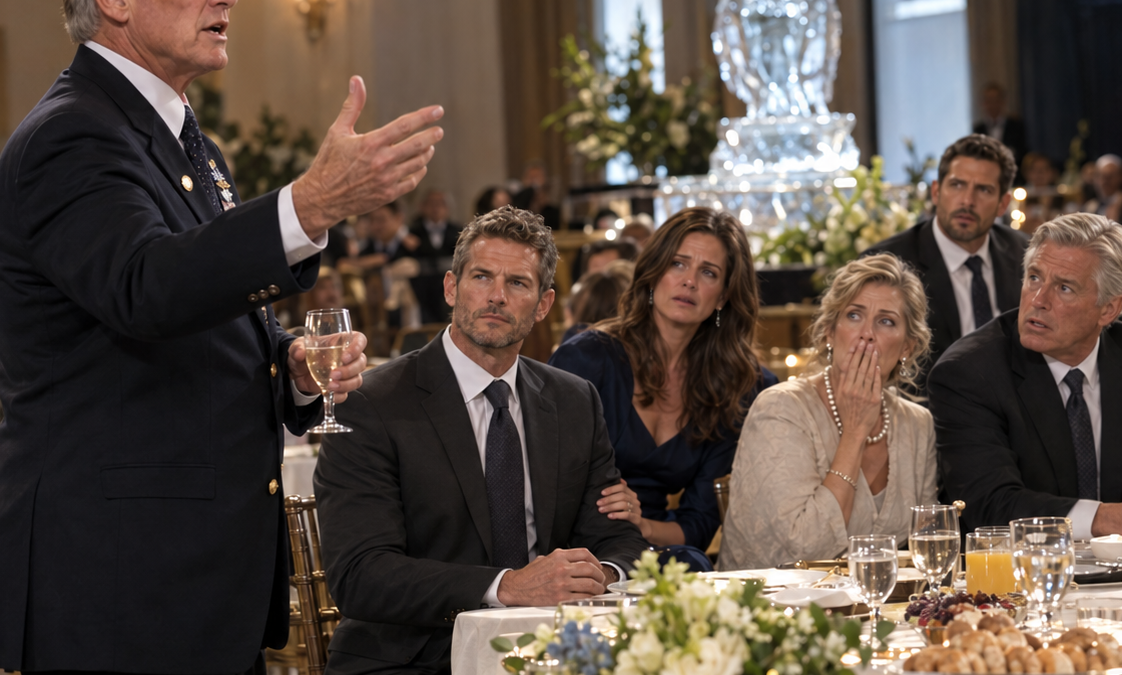
The champagne glass shattered against the marble floor.
My mother-in-law didn’t even flinch. She just smiled that thin, practiced smile of hers and said, loud enough for the whole table to hear, “Real men don’t need medals to prove they’re men.”
The room went quiet. Not the good kind of quiet. The kind where you can hear ice cubes settling in glasses and someone’s fork scraping a plate three tables over.
What she didn’t know was that the man sitting two seats to her left had signed the orders for one of those medals. Had, in fact, pinned it on my chest himself in a hangar in North Carolina fourteen years earlier.
My name is Eric Mercer. I was forty-six years old when my mother-in-law decided to make my military service the punchline of her anniversary toast.
I’m a former U.S. Army Ranger. 3rd Ranger Battalion. Two deployments to Afghanistan, one to Iraq. I retired as a Sergeant First Class after twenty years. I don’t talk about it much. I never have.
Diane Whitmore, my wife’s mother, had been building toward that moment for the better part of a decade. I just hadn’t realized how public she intended to make it.
The occasion was my in-laws’ fortieth wedding anniversary. Richard and Diane Whitmore had rented out the grand ballroom at the Ashford Country Club, a place with crystal chandeliers and waitstaff who moved like they were gliding on rails. Two hundred guests. White tablecloths. An ice sculpture of two swans. A string quartet for cocktails and a live band for dancing.
Karen and I had been married for eleven years. We had two kids — Tyler, nine, and Sophie, seven. We lived in a modest house in a suburb of Columbus, Ohio, where I worked as a logistics coordinator for a regional medical supply company. It was a good life. Quiet. The kind of life you build when you’ve had enough noise.
I’d met Karen at a hardware store, of all places. She was trying to find a specific size of wood screw, and I happened to be in the same aisle. She asked for help. I helped. We talked for forty minutes. She said later that I had this calm about me, like nothing could rattle me. I told her I’d just been through some things that put minor frustrations in perspective.
I didn’t tell her what those things were. Not then. Not for a long time.
The Whitmores were old money. Not enormous money, but the kind of comfortable, generational wealth that comes from a grandfather who owned a chain of car dealerships and a father who invested well. Diane had grown up in Columbus society, married Richard when she was twenty-three, and had spent the next four decades curating her image as a woman of taste, refinement, and quiet influence.
She had never approved of me.
Not because I was unkind to her daughter. Not because I was a bad father. Not because I drank too much or gambled or ran around. She disapproved because I was, in her words, “not our kind.”
The first time we met, she asked what I did for a living. I told her I worked in logistics. She asked where I’d gone to college. I told her I hadn’t. I’d enlisted at eighteen and gotten my degree later, on nights and weekends, while I was still active duty.
She nodded and changed the subject.
Karen later told me her mother had said, “He seems nice enough, but he’s not exactly… you know.”
I knew.
For eleven years, I’d been the son-in-law who didn’t quite fit. The one who wore the wrong shoes to the country club. The one who didn’t know which fork to use for the salad course. The one who talked too little at parties and seemed, in Diane’s words, “a bit intense.”
I heard all of it. Karen tried to shield me from the worst of it, but Diane wasn’t subtle. She’d make comments at family dinners, little jabs disguised as jokes. “Eric, you’re so quiet. What are you thinking about in there?” Or, “It must be nice to have such a simple life. No board meetings, no stockholders.”
I let it roll off. I’d been trained to let things roll off. You don’t survive twenty years in the Rangers by reacting to every provocation. You learn to pick your battles. You learn that most things aren’t worth the energy.
But this was different.
This was a room full of two hundred people. Family. Friends. Business associates. People Karen had known since childhood. And Diane had decided to use her toast to put me in my place.
Let me back up.
The evening had started well enough. Karen looked beautiful in a dark blue dress she’d bought specially for the occasion. Tyler and Sophie were staying with Karen’s sister, so we had the night to ourselves. I wore a charcoal suit that Karen had picked out, a simple white shirt, no tie. Diane had raised an eyebrow when she saw me, but said nothing.
Cocktail hour was fine. I made small talk with Richard, who was a decent man, if a bit passive. He’d long ago learned that resisting Diane was futile. He spent most of his time on the golf course or in his study, staying out of her way.
I talked to Karen’s brother, Michael, who worked in finance and had never quite forgiven me for not being impressed by his car. I talked to various cousins and family friends, most of whom asked polite questions about my work and then moved on when they realized I wasn’t going to offer anything interesting.
Dinner was uneventful. The food was good. The wine was better. I sat next to Karen and across from a couple named the Hendersons, who had known the Whitmores for thirty years and spent most of the meal talking about their recent trip to Tuscany.
Then came the toasts.
Richard’s brother went first. Then a business partner. Then Michael, who gave a speech that was mostly about himself but pretended to be about his parents. Then Diane stood up.
She had a microphone. The room fell silent.
“Thank you all for being here,” she said. “Forty years with Richard has been… an adventure. And I’m grateful for every moment.”
Polite laughter.
“I want to thank my children, Michael and Karen, for being the lights of my life. And I want to thank their spouses for joining our family and making it richer.”
She looked at me when she said that. Just for a second. But I saw it.
“And I want to say something to all the young people here tonight. Something I’ve learned over forty years of marriage.”
She paused. Took a sip of champagne.
“Real men don’t need medals to prove they’re men.”
The words hung in the air.
I felt Karen stiffen beside me. I put my hand on her knee under the table. Steady.
“Now, I know we have some veterans here tonight,” Diane continued, her voice smooth as silk. “And I respect their service. I do. But I’ve always believed that a man’s worth isn’t measured by what he did in uniform. It’s measured by what he does at home. How he provides. How he leads his family. How he shows up, day after day, in the quiet moments.”
She smiled.
“My Richard never served. He never wore a uniform. But he’s been the best husband and father I could have asked for. He’s built a business. He’s built a life. And he’s done it without needing anyone to pin a ribbon on his chest.”
More polite laughter. A few nods.
I sat there. Calm. Still.
What Diane didn’t know — what no one in that room knew except me — was that the man she was implicitly mocking had been awarded the Silver Star for actions in the Shahi Kot Valley in 2002. That he had a Bronze Star with Valor device. That he had a Purple Heart from a night in Ramadi when he’d taken shrapnel to the shoulder and kept fighting.
What she didn’t know was that I’d carried three wounded men out of a burning building while under fire. That I’d spent six hours in a firefight that killed two of my closest friends. That I’d come home with a limp I still had, a limp I’d learned to hide, a limp that flared up on cold mornings and reminded me of things I’d rather forget.
What she didn’t know was that one of the guests at her anniversary party had been my battalion commander. General Marcus Webb. Retired now, living in Virginia, but still connected to the military community. He and Richard had served on a charity board together years ago, and he’d accepted the invitation as a favor.
I’d seen him during cocktails. He’d seen me. We’d nodded at each other across the room, the way veterans do. He knew who I was. He knew what I’d done. He’d been there for some of it.
And he was sitting three tables away when Diane made her toast.
I didn’t look at him. I kept my eyes on Diane. I kept my face neutral. I kept my breathing steady.
Karen squeezed my hand under the table. She knew. Not everything, but enough. She knew I’d served. She knew I’d been awarded medals I didn’t talk about. She’d seen the shadow box in my closet, the one I kept turned to the wall because I couldn’t stand to look at it.
She knew her mother was out of line. But she also knew that making a scene would only make things worse.
So we sat there. And Diane finished her toast. And everyone applauded.
And I said nothing.
The rest of the evening passed in a blur. People came up to congratulate Diane on her speech. A few of them glanced at me, curious, maybe wondering if I’d taken offense. I smiled and shook hands and made small talk. I was good at that. I’d learned to be good at that.
Karen stayed close to me. She didn’t say anything about the toast. She didn’t need to. I could feel her anger radiating off her, directed at her mother, but she kept it contained. We both did.
At around ten o’clock, I stepped outside to get some air. The country club had a patio overlooking a golf course, and the night was cool and clear. I stood by the railing and looked up at the stars.
That’s when I heard footsteps behind me.
I turned.
General Webb was standing there, in a dark suit with a small pin on his lapel — the insignia of the 75th Ranger Regiment.
“Eric,” he said.
“General.”
He walked up and stood beside me. Neither of us said anything for a moment. We just looked out at the golf course, two old soldiers in the dark.
“That was quite a speech,” he said finally.
“Yes, sir.”
“Your mother-in-law always like that?”
I almost smiled. “More or less.”
He nodded. “I thought so. I’ve met her before. At a charity gala a few years back. She spent twenty minutes telling me about her son’s achievements in finance. Never asked what I did.”
“That sounds like her.”
He was quiet for another moment. Then he said, “I signed the orders for your Silver Star.”
I didn’t respond.
“I remember the citation. Shahi Kot. You went back into a collapsing building to pull out two of your men. You were already wounded. You didn’t stop until you’d gotten them both out.”
I looked down at my hands. “They were my responsibility.”
“They were your men,” he corrected. “And you brought them home.”
We stood there in silence.
“I’m going to say something tomorrow,” he said. “At the brunch. I don’t know what exactly, but something. I’m not going to let that woman’s ignorance stand.”
“General, you don’t have to—”
“I know I don’t have to.” He looked at me. “But I want to. And I think you deserve it. Whether you want it or not.”
I didn’t know what to say. So I said nothing.
He patted me on the shoulder and walked back inside.
I stayed out there for a long time, looking at the stars, thinking about the men I’d lost, the men I’d saved, and the strange twist of fate that had brought a general to my mother-in-law’s anniversary party.
The next morning, there was a brunch. Same ballroom. Same people. Same white tablecloths and crystal chandeliers.
I didn’t know what was coming.
PART 2 — THE BRUNCH
The brunch started at eleven.
Karen and I arrived at ten forty-five, mostly because she wanted to get there before her mother so she could control the seating arrangement. She’d been quiet on the drive over, and I could tell she was still stewing about the toast. I didn’t push. Karen processed things in her own time.
The ballroom had been transformed overnight. The dance floor was gone, replaced by long tables laden with pastries, fruit, eggs, bacon, and about six different kinds of quiche. The swan ice sculpture had melted down to a sad-looking blob. The string quartet had been replaced by a pianist playing soft jazz.
People were already mingling. I recognized most of them from the night before. Diane was holding court near the entrance, wearing a cream-colored dress and a string of pearls that probably cost more than my car.
She saw us come in and waved.
“Karen, darling! Eric! Come sit with us.”
Karen squeezed my arm. “Here we go.”
We made our way through the crowd. I nodded at a few familiar faces. The Hendersons. Michael and his wife. Richard, who was standing by the coffee station looking like he’d rather be anywhere else.
Diane gestured to two empty chairs at her table. “Sit. Sit. I saved these for you.”
We sat.
The table was round, seating about ten people. Diane and Richard. Michael and his wife, Bethany. Karen and me. And four others — a couple named the Ashfords, who I assumed were somehow related to the country club, and two older men I didn’t recognize.
Diane introduced everyone. The Ashfords were old friends. The two men were business associates of Richard’s, retired now, who had flown in from Chicago for the anniversary.
Then she introduced me.
“This is our son-in-law, Eric. He works in logistics. Very… grounded.”
The way she said it made “grounded” sound like a polite word for “small.”
I shook hands with the men. They asked the usual questions. What kind of logistics? Medical supplies. Interesting. How long have you been doing that? About twelve years. Before that? I was in the Army.
I didn’t elaborate. I never did.
The conversation moved on. Business. Real estate. Someone’s daughter was getting married in Napa next spring. Someone else’s son had just been promoted at Goldman Sachs.
I ate my eggs and listened.
Karen was engaged in a conversation with Bethany about something to do with interior decorating. Michael was talking to the Chicago men about a deal he was working on. Diane was holding forth about the anniversary party, the guest list, the flowers, the band.
I was invisible. That was fine. I’d been invisible for eleven years.
Then I noticed a new arrival.
General Webb walked into the ballroom, dressed in a navy blue blazer and gray slacks. He moved like a man who’d spent forty years in uniform — straight posture, purposeful stride, eyes scanning the room automatically. Old habits.
He saw me and nodded.
I nodded back.
Diane noticed the exchange. “Do you know him?” she asked, her tone curious.
“He’s an old friend,” I said. “From the service.”
Diane’s eyebrows rose slightly. “Oh? I didn’t realize you had… connections like that.”
I didn’t respond.
General Webb made his way to our table. He’d been seated with the Ashfords, who he apparently knew from some charity board. But he stopped by our table on his way, extending his hand to Richard.
“Richard. Good to see you again.”
“Marcus.” Richard shook his hand warmly. “Glad you could make it.”
General Webb turned to Diane. “Diane. Lovely event.”
“Thank you, Marcus. So glad you could come.”
Then he looked at me.
“Eric.”
“General.”
He shook my hand. Held it for a moment. “I’ll see you later.”
He moved on to his table.
Diane watched him go, then turned to me with a puzzled expression. “How do you know Marcus Webb?”
“We served together,” I said simply.
“You served… with a general?”
“I served under him. He was my battalion commander.”
Diane’s expression flickered. Something between surprise and irritation. “I didn’t know you were in the military long enough to know generals.”
“Twenty years,” I said. “I retired in 2015.”
She blinked. “Twenty years?”
“Yes.”
“And you never mentioned this?”
“You never asked.”
That landed. I saw it hit her. But she recovered quickly, smoothing her expression and turning back to her quiche.
“Well,” she said, “that’s… interesting.”
Interesting. That was all she could manage.
Karen squeezed my hand under the table. I squeezed back.
The brunch continued. More small talk. More conversations I wasn’t part of. I finished my coffee and considered whether I could excuse myself for a walk.
Then General Webb stood up.
He had a glass in his hand. Not champagne — orange juice. He tapped it with a fork.
The room quieted.
“I’m not much for speeches,” he said, his voice carrying easily across the ballroom. “Spent most of my career giving orders, not toasts. But I wanted to say a few words about Richard and Diane. Forty years is a long time. And I’m honored to call them friends.”
He paused. Nodded at Richard and Diane. Polite applause.
“But I also want to say something else. And I hope you’ll indulge an old soldier for a moment.”
The room was silent now. General Webb wasn’t a man you talked over.
“Last night, Diane made a lovely toast about what it means to be a real man. And I’ve been thinking about it ever since.”
Diane’s expression tightened, just slightly.
“She said that real men don’t need medals to prove they’re men. And I think I understand what she meant. She meant that a man’s worth isn’t measured by his ribbons or his rank. It’s measured by his character. His actions. His love for his family.”
He paused.
“And she’s right. About that, she’s absolutely right.”
Some people nodded. Diane relaxed a little.
“But here’s the thing. Some medals aren’t about proof. They’re about sacrifice. They’re about the moments when a man — or a woman — does something extraordinary. Something most of us couldn’t do. Something that costs them a piece of their soul.”
General Webb’s voice was steady. Calm. The voice of a man who’d given eulogies and commendations and sent young soldiers off to war.
“I’ve spent forty years in the Army. I’ve seen things I won’t talk about. I’ve lost people I loved. And I’ve given out a lot of medals. Most of them were for things nobody wants to earn. They were for moments when the world was on fire and someone ran toward the flames instead of away.”
He looked at me.
“Right now, sitting at this table, is a man who spent twenty years in the 75th Ranger Regiment. Two deployments to Afghanistan. One to Iraq. Multiple combat tours. More firefights than he’d ever tell you about.”
The room was dead silent.
“His name is Eric Mercer. And I had the privilege of pinning the Silver Star on his chest in 2002.”
I didn’t move. Didn’t react. I’d learned to sit still under observation. To let the moment wash over me without showing anything.
“In the Shahi Kot Valley,” General Webb continued, “his unit was ambushed. Two men went down. The building they were in was taking heavy fire. Eric had already been hit — shrapnel in his shoulder, if I remember correctly — but he didn’t stop. He went back into that building twice. Pulled out both men. Carried one of them on his back for half a mile.”
He paused.
“Both of those men are alive today because of him.”
I heard Karen inhale sharply beside me.
“Now, Eric has never once mentioned this to you. Not to your faces. Not because he’s ashamed. Because he’s humble. Because he doesn’t think he did anything special. Because he believes — and I’ve heard him say this — that he was just doing his job.”
General Webb looked directly at Diane.
“So when you say that real men don’t need medals, Diane, I want you to understand something. Eric doesn’t wear those medals. He doesn’t talk about them. He keeps them in a box in his closet, turned to the wall. He’s spent the last twelve years building a quiet life with your daughter, working a steady job, raising two kids, showing up every day. He doesn’t need a medal to prove he’s a man.”
He raised his glass.
“Because he proved it a long time ago. In ways that most of us will never understand.”
He took a sip.
“To Richard and Diane. Forty years. And to the real men and women who never ask for recognition.”
He sat down.
The silence lasted three full seconds.
Then someone started clapping. Then more people. Then the whole room was applauding — not the polite applause of a wedding toast, but genuine, standing applause.
I stayed seated. I didn’t know what else to do.
Karen was crying. She’d never heard the full story. She’d seen the Silver Star in the shadow box, but she’d never asked what it was for. She’d just assumed it was something from training, or a routine award. She’d never imagined anything like what General Webb had described.
Diane’s face was pale. She was staring at me like she was seeing me for the first time.
Richard was looking at me with something like awe.
Michael’s mouth was slightly open.
I sat there, calm, as the applause died down. I didn’t feel triumphant. I didn’t feel vindicated. I just felt… tired.
Tired of being invisible. Tired of being underestimated. Tired of carrying the weight of what I’d done without anyone knowing.
But also, strangely, relieved.
Someone had finally seen me.
After the brunch, people came up to me in droves. They shook my hand. They asked questions. They wanted to hear stories.
I gave them nothing. Short answers. Polite nods. I’m not a performer. I never was.
Diane approached me as we were getting ready to leave.
“Eric.”
I turned.
Her face was different. Softer. Unsure.
“I didn’t know,” she said.
“I know.”
“Why didn’t you tell me?”
“You never asked.”
She flinched. “That’s not… that’s not fair.”
“Isn’t it?”
She opened her mouth. Closed it. I watched her struggle with something. Pride, maybe. Or guilt.
“I’m sorry,” she said finally. “About last night. About… everything.”
I looked at her for a long moment.
“I appreciate that,” I said. “But I don’t need an apology. I need you to understand something.”
“What?”
“I’ve spent eleven years watching you treat me like I’m not good enough for your daughter. Like my life is somehow less because I didn’t go to the right schools or make the right money. You don’t know me, Diane. You never made the effort. And that’s fine. I don’t need your approval. I never did.”
She flinched again.
“But Karen loves you. And I love Karen. So I’ve kept my mouth shut. I’ve stayed polite. I’ve shown up to your parties and eaten your food and smiled at your friends. Because that’s what you do for family.”
I paused.
“But I won’t pretend anymore. If you want a relationship with me — real relationship — it starts now. Not with a toast. Not with a speech. With you actually seeing me as a person.”
She didn’t say anything.
I turned and walked away.
Karen was waiting for me by the door.
“What did she say?” she asked.
“She apologized.”
“What did you say?”
“I told her I didn’t need it.”
Karen looked at me. Really looked at me. “Are you okay?”
I thought about it.
“Yeah,” I said. “I think I am.”
We walked out to the car. The sun was bright. The sky was clear. And for the first time in a long time, I felt like I could breathe.
PART 3 — THE BOX
Three days later, I got a call from General Webb.
“Eric. How are you holding up?”
“Fine, sir.”
“Bullshit. You hate attention. You always did.”
I almost smiled. “Yes, sir.”
“I’m calling because I want you to do something for me.”
“What’s that?”
“Get your medals out of that box. Put them somewhere you can see them.”
I didn’t respond.
“I know you don’t want to. I know it’s easier to keep them buried. But you’ve spent twenty years carrying things nobody should have to carry. And I think it’s time you stopped hiding.”
“They’re just metal, General.”
“They’re not just metal. They’re proof. Proof that you did something that mattered. Proof that you’re not the man your mother-in-law thought you were. Proof that you survived things that would have broken most people.”
I was quiet for a long moment.
“I’ll think about it,” I said.
“That’s all I ask.”
He hung up.
I stood in the kitchen, holding my phone, staring at the wall.
Karen came in from the garage, carrying a bag of groceries. “Who was that?”
“General Webb.”
Her expression softened. “What did he want?”
“He wants me to get my medals out.”
She set the bag down on the counter. “Do you want to?”
“I don’t know.”
She walked over and put her hand on my arm. “I never knew. About the Silver Star. About any of it. You never told me.”
“I know.”
“Why?”
I thought about it. Really thought about it.
“Because talking about it makes it real,” I said. “And I spent a long time trying to make it not real.”
She was quiet.
“I saw things, Karen. I did things. And I lost people. Friends. Brothers. And I carry that with me every day. I didn’t want to put it on you.”
“You wouldn’t have been putting it on me. You would have been sharing it.”
I looked at her. “I know. I was wrong.”
She nodded slowly. “So what now?”
“I don’t know. Maybe… maybe it’s time.”
She smiled. A real smile. “Let’s get the box.”
We went upstairs. Our bedroom closet. The top shelf. The shadow box was there, wrapped in an old t-shirt, turned to the wall.
I pulled it down.
It was heavier than I remembered.
I set it on the bed and unwrapped the t-shirt.
There it was. The dark wood frame. The blue felt backing. The medals pinned in a row.
The Silver Star. The Bronze Star with Valor device. The Purple Heart. The Ranger tab. The Combat Infantryman Badge. The parachute badge with two combat jumps. Ribbons for deployments I never talked about.
Karen stood beside me. She didn’t say anything. She just looked.
“What was it like?” she asked finally.
“What was what like?”
“The Silver Star. The Shahi Kot Valley. General Webb said you carried a man on your back for half a mile.”
I closed my eyes. The memories came back like they always did. Uninvited. Unwanted.
“It was March 2002,” I said. “Operation Anaconda. We were supposed to clear a valley. Intel was bad. We walked into a hornet’s nest.”
I opened my eyes. Looked at the medals.
“I was a team leader. Second squad. We were moving through a village when the shooting started. RPGs. Machine guns. Mortars. It was chaos.”
Karen was listening. Not moving. Not interrupting.
“Two of my men went down. Private First Class Nathan Davis. Specialist Marcus Cole. They were hit by the first burst. I saw them fall.”
I paused.
“Everyone else was pinned down. The fire was too heavy. Anyone who moved got shot. But I couldn’t leave them.”
“So you went back.”
“I went back.”
I picked up the Silver Star. Held it in my hand.
“I got to Davis first. He was conscious. Bleeding bad. I dragged him behind cover. Then I went back for Cole.”
“Was he alive?”
“Barely. He’d taken a round to the chest. He was choking on blood.”
I put the medal back in the box.
“I put him on my back. Carried him out. Half a mile through open ground. Bullets everywhere. I don’t know how I didn’t get hit.”
“But you did get hit.”
“Shrapnel in my shoulder. From an RPG. Didn’t feel it at the time. Adrenaline.”
She reached out and touched my shoulder. The one with the scars.
“I got them both to the medics. Davis made it. Cole didn’t.”
I closed the box.
“He died in my arms. He was twenty-one years old. He had a wife. A baby he’d never met.”
Karen’s eyes were wet. “I’m sorry.”
“I’m sorry too.”
We stood there for a long time. The box on the bed between us. The weight of it filling the room.
Then Karen said, “What happened to Davis?”
“He got out. Went to college on the GI Bill. Became a teacher. I think he’s in Oregon somewhere. We lost touch.”
“You saved his life.”
“I did what I had to do.”
She looked at me. “That’s what makes you a real man, Eric. Not the medals. The fact that you don’t think you did anything special.”
I didn’t know what to say.
So I said nothing.
A week later, I got an email from Nathan Davis.
It came out of nowhere. A message to my old military email, which I still checked occasionally out of habit.
“Sergeant Mercer. I don’t know if you remember me. You probably do. I was the kid you dragged out of that village in Shahi Kot. I’ve thought about you every day for twenty years. I tried to find you a few times but never had any luck. Then someone told me you were at a party in Ohio and a general gave a speech about you. I figured it was time to reach out.”
I read the email three times.
“I’m married now. Two kids. I teach high school history. I coach baseball. I have a life I never thought I’d have because of you. I know you probably don’t want a fuss. But I wanted to say thank you. For what you did. For carrying me. For not leaving me behind.”
He included a photo. Him and his wife and two kids, standing in front of a house with a big oak tree in the yard. He looked happy. Healthy. Alive.
I saved the photo.
Karen found me in the kitchen that night, staring at my phone.
“What’s wrong?”
“Nothing. Something good, actually.”
I showed her the email.
She read it. Then she hugged me.
“You saved him,” she said.
“Seems like it.”
“That’s a good thing, Eric. That’s a really good thing.”
I nodded.
“I think I want to respond to him.”
“Then respond.”
I did. I wrote back that night. Told him I remembered. Told him I was proud of him. Told him I was glad he was okay.
He wrote back the next day.
“Thank you, Sergeant. That means more than you know.”
We started talking after that. Regular emails. Then phone calls. He told me about his life. I told him about mine. We weren’t the same men we’d been in Afghanistan. But there was a bond there. Something that couldn’t be broken.
He invited me to visit. I said maybe someday.
A few weeks later, Karen and I were having dinner with her parents.
Diane had invited us. “A family dinner,” she’d called it. “Nothing formal. Just us.”
I’d agreed, mostly for Karen’s sake. She wanted to give her mother a chance. I understood that.
The dinner was at Diane and Richard’s house. The big colonial with the manicured lawn and the four-car garage. We sat in the formal dining room, eating salmon and asparagus, making small talk.
Diane was different. Noticably different. She asked me questions. Real questions. About my childhood. About why I’d joined the Army. About what I’d done after I got out.
I answered them.
She listened.
It was awkward. Neither of us knew how to navigate this new dynamic. But we tried.
After dinner, Richard pulled me aside.
“Eric. I want to thank you.”
“For what?”
“For what you did. For serving. For… everything.”
He was uncomfortable. I could see it. Richard wasn’t a man who talked about feelings.
“I never served,” he said. “I was too young for Vietnam, too old for the Gulf War. I spent my whole life building businesses. Making money. And I always thought that was enough.”
He paused.
“But it’s not. Not really. When I heard what General Webb said… when I understood what you’d done… I felt small. In a way I’ve never felt before.”
I didn’t say anything.
“I don’t know how to make up for the way Diane treated you. I don’t know if there’s anything I can do. But I wanted you to know that I see it now. I see you.”
He extended his hand.
I shook it.
“Thank you, Richard.”
He nodded. “Thank you.”
We went back to the dining room. Diane was showing Karen some old photo albums. They were laughing about something.
I sat down and watched.
Things were different now. Not perfect. Not fixed. But different.
And that was enough.
For now.
 [Tap here for the Next Part ]


