She Hid Cameras to Protect Her Daughter—But the Ex-Navy SEAL Dad Did the Unexpected

She Hid Cameras to Protect Her Daughter—But the Ex-Navy SEAL Dad Did the Unexpected
She had bodyguards at every door, cameras in every hallway, and more money than she could ever spend, and still, she was losing her daughter one silent day at a time.
But the most dangerous man in her house wasnt the intruder she feared.
He was the quiet man carrying laundry baskets down the hall.
She just didnt know it yet.
The morning Camille Ashford fired her fourth housekeeper in eight months, she didnt raise her voice.
She never raised her voice anymore. She simply stood in the kitchen doorway in her silk robe, coffee going cold in her hand, and watched the woman shove cleaning supplies into a canvas bag with the efficient, wounded energy of someone who had already been crying in the car on the way here.
I understand, Camille said when the woman glanced up.
Mrs.Ashford, Im sorry. I just I cant work in in a place where I feel like Im being watched every second.
I said I understand. The woman left without finishing her sentence.
Camille stood alone in the kitchen for a long moment.
The house was quiet in the way that expensive houses get quiet, not peaceful, but pressurized, like the silence before a window cracks. She looked at the corner above the refrigerator, at the small black lens mounted there that most people took for a smoke detector, and she felt the familiar weight of a decision she had made in fear and couldnt quite bring herself to undo.
She was 30 years old.
She owned a controlling stake in a logistics technology company her father had started, and she had quietly tripled in size. She had more security consultants than friends.
She had a mansion in the Laurel Hurst neighborhood of Seattle with seven bedrooms, a professional a professional kitchen, and a backyard that a landscape architect had spent four months designing.
And in the east wing of that beautiful, suffocating house, her eight year old daughter was sitting alone behind a closed bedroom door, not speaking, not playing, not doing much of anything at all.
That was the part no amount of money had been able to fix.
Her name was Sloane.
18 months ago, Sloane Ashford had been the kind of child who made strangers smile in grocery stores, loud opinions about cereal, strong feelings about which cloud shapes looked like animals, a habit of sitting down at any piano she encountered and playing the three songs she knew with complete, unselfconscious joy.
Then the divorce happened.
Not the legal process itself that had been almost mechanical, clean in the way that surgeries are clean, lots of cutting and not much feeling until afterward. What happened was the fighting that came after, the public statements, the lawyer interviews.
The photographs taken outside the courthouse where Camille looked too controlled and her ex-husband Mark Marcus looked too wronged.
And somewhere in the coverage of two adults destroying each other politely, their daughter had simply stopped.
Stopped playing piano, stopped talking much at dinner, started spending hours at her bedroom window looking at nothing in particular.
Camille had gotten her professional support immediately. A child psychologist named Dr.Reeves highly recommended who saw Sloane twice a week and gave Camille careful, measured progress reports that all essentially said the same thing.
This takes time. This takes consistency.
This takes patience. And what Camille heard every time was you are failing your daughter and there is nothing you can do about it.
She was not a patient woman by nature. She had built her career on solving problems before they fully materialized.
She anticipated, she prepared, she controlled variables. The company had a crisis management team.
She had redundancies built into every system.
But there was no redundancy for a child who had decided the world was no longer safe enough to fully inhabit.
Messages had started six weeks ago.
Sloane had her own tablet, carefully monitored, approved apps only.
Camille checked the usage logs weekly.
She had set everything up herself, working from a security checklist her IT director had given her, and she had been confident she had been certain that the system was airtight.
She found the messages by accident. Sloane had left the tablet on the kitchen counter, unlocked, screen still on.
Camille had picked it up to move it out of the way, and the conversation was right there, open, in an app she had approved for educational games that apparently also had a social feature she had somehow missed. The other account called itself LilyGamer99.
The profile picture was a cartoon rabbit.
Hey, do you live in a big house?
Your room sounds so cool.
Does your mom work a lot?
Like, does she go out a lot during the day?
What time do you usually get home from school?
Are there people at your house at night or is it mostly just you and your mom? Camille read the messages three times.
Then she sat down on the kitchen floor because her legs had stopped working correctly. The questions individually sounded like a curious child making conversation.
Together in sequence, they were something else entirely.
They were reconnaissance.
Someone was mapping her daughters routine, her solitude, her access points. Sloane had answered some of them, not all.
Sloane didnt talk much to anyone anymore but enough, enough to tell whoever was on the other end that yes, the house was large. Yes, her mother traveled sometimes.
Yes, the afternoons were usually quiet.
Camille deleted the app that night. She reported the account.
She spent two hours on the phone with her security director, a former FBI agent named Gerald Holt, who had been with her for three years and who had in Camilles experience an unshakable belief in his own competence.
Could be a random predator, Holt told her. Could be someone specifically targeting you.
Well investigate.
In the meantime, Im recommending we increase visible security at the property perimeter and implement a new digital monitoring protocol for Sloanes devices. And if its Marcus?
A pause. Mrs.Ashford, your ex-husband has resources and motivation, but coordinating a predatory contact campaign targeting your daughter would be thats a significant legal risk for him.
He has lawyers who are better than my lawyers, Camille said. Thats why Im asking.
Holt didnt answer that directly.
That night, Camille installed the cameras, not through the security company. She did it herself, ordering six small devices online, spending an entire evening mounting them in the common areas of the house while Sloan slept, the kitchen, the living room, the main hallway, the back entrance.
She told herself it was for Sloans protection.
She told herself she was being practical.
She told herself she would remove them as soon as the situation was resolved. She was lying to herself, but she was very good at that particular lie by then.
Brennan Cross arrived on a Tuesday morning in November, carrying two duffel bags and a nine-year-old boy.
He wasnt what the placement agency had described exactly, or rather, he was all of those things, but arranged in a way that didnt quite fit the image.
37, the file had said.
Former military Navy honorable discharge, currently licensed for household management, property maintenance, cooking.
References clean, background check clean. Single father, one child, nine years old, would require live-in accommodation.
What the file hadnt prepared her for was the way he stood. Most people, when they came to interview for a household position, were performing something enthusiasm, competence, eagerness to please.
Brennan Cross stood on her front steps with his hands in his jacket pockets and looked at the house the way a contractor looks at a building hes been asked to assess, quietly, without being impressed.
Mr.Cross, Camille said. Ms.Ashford.
He shook her hand. His grip was exactly as firm as it needed to be and no more.
This is Owen.
The boy was standing slightly behind his father, not hiding, but not exactly present either.
He had his fathers dark coloring and his own very serious expression, like someone had recently explained something complicated to him, and he was still working through the implications. Hi Owen, Camille said.
Hi. He looked past her into the house.
Is that a real grand piano? Camille glanced back.
The Steinway was visible through the open living room door.
Yes. Did someone play it?
My daughter used to. Owen nodded slowly, filing this information away somewhere.
The interview was nothing like she expected.
Camille had prepared questions.
She always prepared questions, and Brennan answered them all, but he also asked his own, which most candidates didnt do. He wanted to know the property layout, the maintenance history of the house systems, whether there was a workshop space in the garage.
He asked about the camera system, and Camille said they had a professional security setup, which was true as far as it went.
He didnt ask about her daughter at all, which she noticed.
Most people asked about Sloane.
Most people who came to work in the house already knew about the divorce.
It had been public enough, and they asked about her with that particular careful softness that told Camille they were either kind or performing kindness, and she had lost the ability to tell the difference.
Brennan Cross didnt ask. He just moved through the house during the walkthrough and cataloged what he saw and asked practical questions about gutters and HVAC filters and whether the side gate had ever been repaired properly.
Why do you want this position? Camille asked at the end.
He looked at her with an expression that wasnt quite calculating but wasnt entirely comfortable either.
Owen needs stability, he said. Consistent location, consistent school.
After his mother died, we moved four times in two years.
Thats not it wasnt good for him. A live-in position somewhere safe is what makes that stop, and the work itself.
He almost smiled. It didnt quite get there.
Im good at taking care of things, he said. Houses, systems, making sure the pieces that are broken get fixed before they cause bigger problems.
A pause.
It suits me.
Camille hired him that afternoon. She told herself it was because his references were impeccable.
She did not fully examine the other reason, which was that he was the first person she had talked to in months who seemed to have absolutely no interest in impressing her.
He moved in on a Friday.
Owen started at the local school the following Monday. Brennan was in the workshop by 7:00 every morning and moved through the house on a schedule that was visible without being intrusive, replacing a cracked tile in the main bathroom, sealing a draft in the mud room, sorting the disaster of the garage storage with the calm efficiency of someone for whom disorder for was a problem to be solved rather than a state of being.
He cooked dinner for himself and Owen in the staff kitchen each evening.
Twice in the first week he made extra and left it covered on the main kitchen counter with a simple note made too much pasta, made too much soup and Camille, who usually ate alone at her desk, found herself eating in the kitchen instead of going back upstairs. Sloane didnt come down for dinner those first weeks.
She ate in her room, which Dr.Reeves said was okay for now. Part of a pattern of self-containment that would hopefully ease with time.
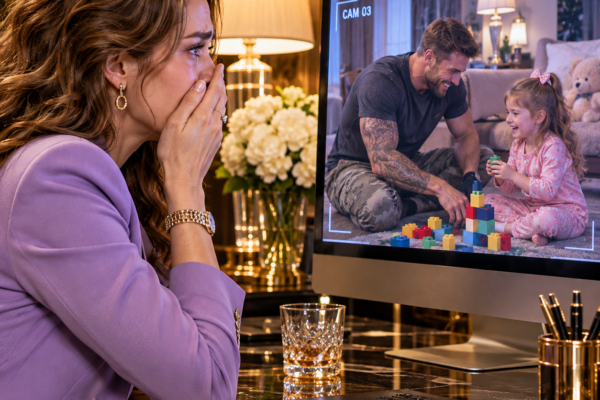
Camille watched on the cameras.
She watched Brennan move through the kitchen in the evenings, explaining things to Owen in a low, patient voice, how to properly deglaze a pan, how to check if the water was actually boiling before adding pasta. Small, practical things delivered without ceremony.
She watched Owen sit at the kitchen table doing homework while his father worked, occasionally asking questions that Brennan answered without stopping what he was doing. As though maintaining both conversations simultaneously was just the normal texture of their evenings.
She watched and felt very quietly the complicated guilt of a woman observing people who did not know they were being observed.
It was a Thursday evening, 10 days after Brennan arrived, when Camille saw something that made her put down the report she was reading. On the kitchen feed, Brennan was sitting on the floor, not at the counter, not at the table, on the floor with his back against the lower cabinets, with what appeared to be an old transistor radio disassembled in pieces around him.
Owen was beside him, also on the floor, watching. This one is the capacitor, Brennan was saying.
When it stops working, the whole thing loses its ability to tune properly.
See how its corroded here?
Owen leaned in.
Can we fix it? Thats what were going to find out.
Camille was about to look away when she saw at the edge of the kitchen camera frame the small figure she hadnt expected, Sloane, standing in the kitchen doorway in her pajamas, watching.
Brennan did not look up when Sloane appeared, did not say her name or turn toward her or adjust his tone or do any of the things that adults tended to do when they noticed Sloane these days, the careful, attentive pivot that her daughter had learned to recognize as the prelude to someone trying very hard to reach her.
He just kept talking to Owen about the capacitor. After a long moment, Sloane took three steps into the kitchen, then stopped, then sat down on the floor about 4 ft away, close enough to see what he was doing, but far enough to retain the option of not being there at all.
Brennan set a small component on the floor between them.
Thats the tuning coil, he said to no one in particular.
You have to handle it carefully. Its delicate.
Sloane looked at it. Can I touch it?
she asked.
It was the first time Camille had heard her daughter voluntarily initiate a conversation with anyone outside doctor Reeves in two months.
Sure, Brennan said, just dont squeeze it.
Upstairs, Camille sat very still in front of her laptop, watching a 3-in screen and felt something shift in her chest that she hadnt felt in so long she almost didnt recognize it. It was something adjacent to hope.
She hated herself a little for feeling it because it was coming through a camera she had installed without anyones knowledge, and hope felt like it should be cleaner than that, but it was there, and she kept watching. The weeks that followed were not a transformation.
That was the thing about real life.
It didnt move in the clean arcs that Camille had come to expect from problem solving.
There were no dramatic breakthroughs, no mornings when Sloane suddenly came downstairs bright-eyed and healed. Progress was smaller and stranger than that.
Sloane began appearing in the kitchen in the evenings, not every evening, maybe three times a week, sometimes only once.
She rarely announced herself, and she never asked for anything directly. She just appeared and found somewhere peripheral to sit, and Brennan made space for her presence without ever making it into an event.
He gave her a screwdriver when she asked to help with the radio. He let her hand him shingles when he was patching the garden shed roof, and she wandered outside to watch.
When he and Owen started building a birdhouse from a kit Owen had found in the garage, Sloane appeared on the third evening of the project and sat down at the workbench without asking, and Brennan simply moved the wood glue closer to where she was sitting. He never called these activities therapy.
He never talked about feelings. He just worked and included her when she came close enough to be included and left her alone when she stayed at the edges and did not treat her silence as a problem that needed to be fixed in this exact moment.
Camille, watching through the cameras, couldnt entirely explain what she was seeing.
She had hired specialists. She had read books.
She had done everything the framework said to do professional support, consistent routine, reduced conflict, patient presence, since Sloane had improved only in the most fragile, tentative increments. And here was a housekeeper fixing a birdhouse on the kitchen floor and somehow giving her daughter back a reason to leave her room.
One night when the house was quiet and Owen was already in bed, Camille poured herself a glass of wine and sat in the dark kitchen for a long time after Brennan had gone to the staff quarters. She sat in the exact spot where Sloane had been sitting that evening, handing him nails with the focused concentration of a surgical assistant, and Camille thought about what it meant that her daughter trusted this man she had known for three weeks, but barely spoke to the mother she had known her entire life.
She didnt let herself stay in that thought too long. She was afraid of where it ended.
The message came on a Wednesday morning in early December.
Camille was in a conference call with her legal team when her personal phone buzzed on the desk beside her.
She ignored it twice. On the third buzz, she glanced down.
It was the security feed app, motion alert, staff kitchen.
11:17 a.m.She muted herself on the call and opened the app.
Sloane was in the kitchen, which wasnt unusual.
Shed been coming down more during the day lately, small rebellions against the bedroom that Dr.Reeve said were healthy signs.
But she wasnt alone. She was sitting across the kitchen table from Brennan, and she was showing him her tablet.
Camilles blood went cold.
She watched Sloane slide the tablet across the table toward him, pointing at the screen, saying something too quiet for the cameras audio to pick up clearly.
Brennan took the tablet, read it. His face was still for a moment, and then it changed.
Not dramatically. The change was small.
But Camille had been watching this man on cameras for weeks by now, and she knew his face at rest, knew the contained, unhurried expression he carried through most situations. What she saw saw so was something different.
His eyes moved across the screen with a focused stillness that had nothing to do with the patient housekeeper who explained radio components to a nine-year-old.
The stillness was a different kind, the kind that comes from training, from years of assessing situations where the wrong read could get people killed. He looked up at Sloane.
How long have you been getting these?
he asked.
Sloanes answer was quiet. Whatever Brennan heard, he set the tablet down with the careful deliberateness of a man controlling his reaction, and for just a few seconds before he rebuilt the expression back to something manageable, Camille saw the full weight of what he actually was, not a housekeeper, not just a former Navy sailor, something considerably more.
Upstairs, still muted on her conference call, Camille sat with her hand pressed flat against the surface of her desk and understood that everything she thought she had under control was about to change. She just didnt know yet how badly.
The conference call ended without Camille contributing a single useful word in the final 20 minutes of it.
She sat at her desk after her legal team signed off, phone still in hand, the security feed app still open on the screen.
The kitchen camera showed Brennan and Sloane still at the table.
He had moved the tablet to the side and was talking to her now quietly, unhurried, and Sloane was listening in the way she almost never listened to anyone anymore, with her whole body slightly forward, like someone leaning toward a sound they couldnt quite hear but needed to.
Camille watched until Brennan gently pushed the tablet back across the table and said something that made Sloane nod.
Then he stood up, went to the refrigerator, and started making lunch like none of it had happened. Sloane stayed at the table for another few minutes.
Then she picked up the tablet, tucked it under her arm, and went back upstairs. Camille sat with the dead phone in her hand and thought about what she had just seen and thought about the messages that were apparently still coming, despite the app she had deleted, and thought about the way Brennans face had changed for those few seconds before he rebuilt it back into something ordinary.
She needed to talk to him. She did not know how to do that without revealing that she had been watching him on a camera he didnt know existed.
She decided she would figure that out later and went downstairs. Brennan was at the kitchen counter making sandwiches.
Owens school bag was by the door, which meant hed already been picked up and was somewhere in the house. The kitchen smelled like toasted bread and the specific quiet of midday, that hollow hour when the morning rush was over and the afternoon hadnt started yet.
Mr.Cross, Camille said. He glanced over his shoulder.
Miss Ashford, you want lunch?
I made extra.
No. Thank you.
She pulled out a chair at the kitchen table and sat down. I need to ask you something.
He set down the knife, turned around, leaned back against the counter with his arms crossed, not defensively, just like a man whod been on his feet all morning and was glad to not be moving for 30 seconds.
Okay. Did Sloane show you something this morning on her tablet?
Something moved across his face. Not surprise exactly, more like the adjustment a person makes when a conversation goes somewhere theyd anticipated but not quite planned for.
She did, he said. Messages?
He looked at her steadily.
Yeah.
Who knows youre monitoring her devices?
The question caught her slightly off balance.
Shed expected him to ask how she knew or to be uncomfortable or to deflect. She hadnt expected him to immediately flip the frame of the conversation.
My IT director, my security director.
Her therapist knows we have monitoring in place. She paused.
Why?
Because Sloane told me she downloaded that app 3 months ago and shes been getting messages since October.
She say you deleted the first app.
He picked up the knife again, continued cutting the sandwich, but his attention was still on her.
She found another way to access the same account.
Camille felt the floor drop slightly under her. She what?
She made a second account on a different app. Same contact on the other end.
He set both halves of the sandwich on a plate.
She didnt tell you because she wanted to see what the person was going to say.
Shes 8 years old. I know how old she is.
He said it without judgment.
Kids do things that dont make sense to adults when theyre trying to feel like they have some control over something. Camille pressed her fingers to her forehead.
The headache that lived behind her left eye these days sharpened for a moment and then settled back to its usual dull presence. What did the messages say, the new ones?
Brennan was quiet for a beat.
He carried the plate to the table and sat down across from her, which she noticed most of the household staff shed employed over the years maintained a careful physical distance, a professional architecture of space that said I work here, I dont sit here.
Brennan Cross just sat down like it was a table and tables were for sitting at. The messages got more specific, he said.
Less small talk, more direct questions. What door does she use to leave the house in the mornings?
Whether theres a code for the side gate or a key, whether her mothers security people stay inside the house at night or outside.
He looked at her. Whoever this is, theyre not a random predator fishing for any kid they can find.
Theyre building a specific picture of this specific house.
The headache behind her eye went from dull to sharp again. I need to tell Gerald, she said.
Gerald Holt, her security director. Three years.
Impeccable references of his own. Your security director already knows about the original messages, Brennan said.
It wasnt quite a question.
Yes. Hes investigating.
And in the time since you told him the contact switched platforms and started asking about entry points.
He said it flatly, without accusation, just laying the fact on the table between them like the sandwich hed made. That might be coincidence.
But you dont think it is.
He looked at her for a moment. I think you should be careful about who you tell things to right now.
Thats all Im saying.
Camille studied him across the table.
He was watching her with the same quiet assessing expression hed had during the interview, not trying to convince her of anything, not performing concern, just offering her a piece of information and leaving it entirely up to her what she did with it. You were in the Navy, she said.
Yes. What did you do specifically?
The pause was very brief.
Just a half second.
The kind of pause that most people wouldnt even catch.
Logistics and operations support, he said.
It was not a lie, she understood later.
It was also not the whole truth, and some part of her understood that too, even then, even without the information she would get later. There was a category of person who carried themselves the way Brennan Cross did with that specific lived-in containment, that ability to be fully in the room without ever seeming like they needed the room to notice them.
And that category of person did not come from pushing paperwork on a naval base. But she let it go because she had other problems.
Im going to speak to Gerald today, she said.
Brennan nodded, said nothing.
And Im going to tell my IT team to do a full audit of Sloans devices. Thats smart.
She stood up, looked at him for a moment.
Thank you for listening to her.
Something shifted in his expression, but she couldnt quite read it.
Shes a good kid, he said.
She just needed someone to not make a big deal out of it. Camille went back upstairs.
She did not call Gerald Holt. Not yet.
She sat at her desk for a long time, thinking about what Brennan had said, be careful about who you tell things to right now, and thought about how the contact had switched platforms in the window after shed reported the first messages, and thought about the small factual way hed presented that timeline without drama, without insisting on an interpretation. Just here is the sequence of events.
You decide what it means. She pulled up Gerald Holts personnel file on her computer.
She read it slowly. She did not call him that day.
Three days passed.
They were strange days, overcast and cold in the particular way of Seattle December, the kind of gray that felt less like weather and more like a mood the city had settled into for the season. The house was warm and the lights were on, and from the outside it probably looked like any other large, expensive home preparing quietly for the holidays.
Inside Camille was watching.
She had added two more cameras. She hated herself for it.
She added them anyway.
In the hallway outside Gerald Holts scheduled on-site visits, and in the corner of the mudroom where the side entrance was, the one that according to the messages Sloan had been receiving, someone was specifically interested in. She watched the feed on her laptop during conference calls, during dinner, sometimes at 2:00 in the morning when she couldnt sleep and the house was dark and quiet, and she sat in bed with the small screens cold light on her face, watching empty hallways and feeling the specific loneliness of a woman who had surrounded herself with security systems because she no longer trusted Pipple.
But she also watched other things.
She watched Brennan repair the broken latch on the mudroom door on a Wednesday afternoon, working methodically with a screwdriver and a replacement part hed ordered himself without being asked because hed noticed it was off and he fixed things that were off.
She watched Owen do his homework at the kitchen table while his father made dinner, the two of them existing in the comfortable parallel quiet of people whod been alone together long enough to not need to fill every silence. And she watched Sloan.
Sloan who came downstairs four evenings that week.
Four. The most consecutive appearances shed made anywhere outside her bedroom since the summer.
She drifted into the kitchen each time with the careful, unannouncing energy of a cat who wants to be in the room but refuses to admit it. And each time Brennan made space for her without making a moment of it, just shifted slightly, left room at the workbench, put an extra plate out at the counter without comment.
On Thursday evening, Camille watched Sloan sit at the kitchen table for 45 minutes while Brennan and Owen made pancakes, not watching from the doorway, not hovering at the edge, sitting at the table with her chin in her hand, watching Owen attempt to flip a pancake and send it partially off the pan, and then quietly, not quite smiling but close pointing at the mess on the stovetop with one finger.
You have to wait until the bubbles are all the way to the edge, Sloan said. Owen looked at her.
How do you know that?
My grandmother showed me. A pause, very small before.
Brennan didnt say anything. He just handed Owen the spatula and stepped back.
On Friday evening, Sloan made the pancakes.
Camille watched this from her office, the report she was supposed to be reviewing open on the desk in front of her, untouched.
She watched her daughter stand at the stove with the spatula, watched Brennan stand a few feet behind her, close enough to catch the pan if something went wrong, far enough to make it clear that this was Sloans operation, and watched Owen provide highly specific and largely unhelpful commentary from the table.
That ones ready, Owen said.
Its not ready yet, Sloan said.
The edges are dry.
The bubbles arent all the way across.
Youre going to burn it, Owen. Brennans voice, quiet but final.
Shes got it.
Sloan flipped the pancake.
It landed cleanly in the pan. She looked over her shoulder at Owen with an expression that was not quite triumph but in the same neighborhood.
Owen looked at the perfectly flipped pancake and then back at Sloan and said with the profound solemnity of a nine-year-old being forced to concede a point. Okay, that was good.
Upstairs, Camille put her hand over her mouth, not because she was crying.
She wasnt quite. She just needed her hand there for a moment, pressing against the complicated thing that was happening in her chest with the mixture of relief and grief and something she couldnt name that came from watching her daughter be briefly, tentatively, incompletely okay, and watching it through a camera on a 3-in screen because she was too afraid to be there in person and accidentally shatter it.
She sat like that for a long time after the kitchen camera showed the three of them eating pancakes at the kitchen table, all the dishes piled in the center, Owen talking with his mouth full about something at school, Sloane occasionally interjecting with the specific disdain of an older child who finds younger children both exhausting and secretly interesting. It was the most ordinary thing Camille had seen in her house in over a year.
She didnt go downstairs.
She was afraid that if she appeared, Sloane would remember to be closed again.
That fear that she, the mother, the person who was supposed to be the safe harbor, had become someone whose presence her own daughter found constricting was the sharpest thing Camille carried in those weeks, sharper than the fear about the messages, sharper than the suspicion about Gerald, sharper than anything.
She carried it very quietly, and she didnt tell anyone about it because she didnt know how to say it without it becoming a conversation about what she was doing wrong, and she was so tired of conversations about what she was doing wrong. On Saturday, she found the birdhouse, or rather, she found the birdhouse on the camera feed first.
Brennan and Owen had set it up on the workbench in the garage, flat-pack kit with small wooden pieces and a bag of hardware, the kind of project that advertised itself as 3 hours and took anyone with actual standard considerably longer. She watched them work on it through the garage camera for a while, Brennan explaining joints and wood glue, Owen asking why they couldnt just use more nails.
Because nails split the wood, Brennan said. You want the pieces to hold each other.
Thats what glue is for. Nails are faster.
Faster isnt always better. Owen considered this with the expression of someone who didnt entirely buy it, but was willing to table the debate.
That evening, Sloane appeared at the garage door. Camille watched the feed with the half attention of someone who expected nothing unusual to happen.
Sloane had been present for various projects before, had drifted in and out of Brennans orbit with increasing frequency, but the garage was new territory for her. It wasnt the warm kitchen, wasnt the familiar territory of the domestic space.
It was Brennans working space, and Sloane paused at the threshold the way she paused at all thresholds now, measuring the distance between where she was and where shed need to commit to being.
Brennan looked up.
Hey, what is that? Sloane asked.
Birdhouse. For what kind of birds?
Whatever birds want it.
She looked at it, looked at the pieces still laid out on the bench. How many more pieces?
Owen held up the instruction sheet.
It says 47 steps, but dad says the instructions are wrong about step 32.
They are wrong about step 32, Brennan confirmed.
Sloane took a step into the garage, then another. Can I do one?
Brennan slid the wood glue toward her without fanfare. The side panel needs to go in next.
Youll want to put a thin line along the edge there. Sloane picked up the glue.
She was in the garage for 2 hours that night.
Camille watched every minute of it, watched her daughter bent over the workbench with the focused, committed energy of a child given a real task, and taken seriously. Watched Brennan correct her grip on the clamp once and then leave her to it.
Watched Owen explain things she already knew, and Sloane correct him without cruelty. When she finally came upstairs, Sloane knocked on Camilles office door.
Camille closed the laptop. Come in.
Sloane opened the door and stood in the frame, hands slightly sticky with dried wood glue. Were building a birdhouse, she said.
I heard. That sounds fun.
It goes outside my window when it s done. She paused.
Brennan says different birds want different heights, so we have to figure out which birds are around here before we decide.
Thats smart.
Owen thinks we should paint it red, but is wrong for most birds. Another pause shorter.
I looked it up. Camille looked at her daughter, at the dried glue on her fingers and the slight flush of someone whod been in an unheated garage on a December evening and the expression that wasnt quite animated, but was closer to it than anything Camille had seen in months.
Come tell me what you found out, Camille said and moved some papers off the corner of her desk. Sloane came in.
She sat on the edge of the desk, not in a chair, on the corner of the desk, the way she used to when she was small and wanted to be close, and told Camille everything shed found about Pacific Northwest birds and nesting box specifications in the slightly breathless expert tone of a child who had spent 20 minutes on a subject and now knew more about it than anyone else in the room. Camille listened.
 [Tap here for the Next Part ]