“There are some things that are better left alone, Tom. For the good of the Corps.”
“The man who got three of my men killed walked into my squad’s reunion with a smile on his face. He was forty minutes late. That was the first thing I noticed.”
They thought one whispered threat at a reunion would keep eighteen years of buried truth in the ground → the folder they didn’t know I’d kept put a congressman in federal prison and gave a dead Marine’s mother back her son.
He was forty minutes late. That was the first thing I noticed. Colonel Marcus Webb — retired now, congressman for the Sixth District of Virginia — had always been late. In the Corps, lateness was a failure of discipline. Out of it, it was a flex. It told everyone in the room that his time was worth more than theirs.
He came through the banquet hall doors at the Hyatt in Arlington with two staffers trailing him and a hand already extended toward the first man he saw.
“Danny Reese,” he said, pumping my former point man’s hand. “Still got that football player build, I see.”
Danny didn’t smile back. He was polite the way Marines are polite to officers — by reflex, not by feeling. “Colonel,” he said.
I was standing near the back wall with a glass of iced tea, watching. That’s what I do at gatherings. I find the wall, I watch the door, I count the exits. Force Recon trained it into me, and twenty-three years out of uniform hasn’t trained it out.
My name is Thomas Cole. I was a gunnery sergeant in 2nd Force Reconnaissance Company, and later a MARSOC Raider when the Corps stood us up as a special operations command. I spent nineteen years in uniform, eleven of them in special operations. I did three combat deployments to Iraq and two to Afghanistan. I was fifty-seven years old the night my old commanding officer walked into our reunion and told us to keep our mouths shut.
What he didn’t know was that I had brought a folder with me. The original after-action report from Operation Broken Lantern, dated March 14, 2005. The one that had been altered. The one that had never been filed with the official record.
I had kept it for eighteen years.
The reunion was supposed to be simple. A bunch of old Recon Marines, most of us in our fifties and sixties now, getting together to drink bad beer and tell lies about how tough we used to be. Danny Reese had organized it. He was a contractor now, built decks and sunrooms in Northern Virginia. He had a wife, two kids, a boat he never used. He still walked with a slight limp from the shrapnel he took in Ramadi.
The Hyatt ballroom had been rented for the night. Round tables with white cloths. A projector screen showing a slideshow of old photos — most of them grainy, taken on cheap digital cameras in the dust of Al-Anbar. A color guard from the local Marine Corps League had posted the colors at the start. The flag still made my chest tight, every time.
Twenty-three of us had come. Out of the thirty-one who had deployed with 2nd Force Recon to Iraq in 2005, twenty-three were still alive and able to travel. Four had died in combat since. Two had died of cancer. One had drunk himself to death. And one — Corporal Miguel Santos — had died on March 14, 2005, on a dusty road outside Haditha, because Colonel Marcus Webb had sent us into an ambush that he had known about and had not warned us about.
That was the thing. That was the whole thing.
We had been tasked with a routine presence patrol. A show of force in a village called Albu Hyatt. Webb had told us the route was clear, the intel was good, and the village was friendly. What he hadn’t told us was that a previous patrol had taken fire from that same village two days earlier, and that the intel shop had flagged it as an ambush site. He hadn’t told us because he was up for promotion, and a failed patrol under his command would have looked bad on his fitness report.
So we drove into the kill zone. Nine Marines in three Humvees. I was the assistant team leader, riding in the second vehicle. I remember the heat. I remember the smell of diesel and dust. I remember Santos in the turret, his sunglasses reflecting the road ahead.
Then the first RPG hit the lead Humvee.
I don’t talk about that day. I’ve never talked about it. Not to my wife, not to my kids, not to the VA shrink they made me see for a year after I got out. Some things you carry, and you carry them because talking about them doesn’t make them lighter. It just spreads the weight around.
But I remember everything.
I remember pulling Santos out of the turret. I remember the blood on my hands. I remember the radio call I made to battalion, asking for immediate support, and the voice on the other end telling me that air support was twenty minutes out. I remember the sound Danny Reese made when he saw what was left of the lead vehicle.
And I remember the report Webb filed afterward. The one that said the intel had been “insufficient” and the route had been “assessed as low-risk.” The one that blamed the failure on “enemy action and inadequate reconnaissance by the patrol itself.”
I had been on that patrol. I had done the recon. I had submitted a route assessment that flagged the village as a potential ambush site. I had recommended we take a different road.
Webb had overridden it.
The report he filed didn’t mention any of that. It mentioned my name, though. It said that “the assistant team leader’s route assessment failed to identify the threat.”
I found out about it three weeks later, when a friend in the S-2 shop slipped me a copy. I was still in the hospital at Landstuhl, recovering from a fractured wrist and a perforated eardrum. I read the report three times. Then I folded it up and put it in my kit bag.
I never filed a complaint. I never wrote a letter. I was a gunnery sergeant, and Webb was a lieutenant colonel, and I knew how that math worked. I also knew that Santos was dead, and that a paper trail wouldn’t bring him back.
But I kept the report. And I kept the original route assessment I had submitted. The one with the timestamp. The one that proved Webb had lied.
I kept both of them in a manila folder in a fireproof safe in my basement.
For eighteen years.
The reunion was going well until Webb arrived.
People were laughing. Danny was telling a story about the time our team sergeant had accidentally called a general “sir” three times in a row during a briefing. Someone had brought a photo album. The beer was cold.
Then the doors opened, and Webb walked in, and the room got quiet.
He was in his late sixties now, but he still had that officer bearing — straight back, chin up, eyes that swept the room like he was counting us. He was wearing a navy blazer and khaki pants. No tie. He looked like a congressman, which he was. He had been elected six years ago, after retiring from the Corps. He sat on the House Armed Services Committee. He was a big deal.
“Gentlemen,” he said, spreading his arms. “It’s good to see you.”
No one stood up to greet him. A few men nodded. Most just watched.
He moved through the room slowly, shaking hands, clapping shoulders. He knew everyone’s name. He asked about wives, kids, jobs. He was good at this. He had always been good at this.
I stayed by the wall.
He worked his way toward me last. When he got close, he stopped and looked at me for a moment. Then he smiled.
“Gunny Cole,” he said. “Still standing guard, I see.”
“Colonel,” I said.
He reached out and shook my hand. His grip was firm, practiced. He leaned in close, close enough that I could smell his cologne and the bourbon on his breath.
“Good turnout,” he said. “Nice to see the boys.”
“Yes, sir.”
He held my hand a beat longer than necessary. Then he leaned in closer and lowered his voice.
“There are some things that are better left alone, Tom,” he said. “For the good of the Corps. For the good of everyone here.”
I didn’t say anything.
He smiled again, patted my shoulder, and moved on.
My stomach tightened. I had known he would say something. I had known it the moment I saw him walk through the door. But hearing it — hearing him say it out loud, in a banquet hall full of my brothers, with a smile on his face — was different.
He was scared. That was the thing. He was scared of me.
He had been scared of me for eighteen years, ever since I left active duty and he got promoted and the two of us stopped being in the same chain of command. He had spent those eighteen years climbing — lieutenant colonel to colonel, colonel to brigadier general, brigadier to major general, and then a seat in Congress. He had spent those eighteen years building a reputation as a warrior, a leader, a man who had led Marines in combat and had brought them home.
And he had spent those eighteen years knowing that I had the paperwork that could tear it all down.
I hadn’t done anything with it. Not for eighteen years. I had thought about it — God knows I had thought about it. Every time I saw his face on C-SPAN, every time I read an article about his “distinguished service,” every time I heard him talk about “the Marines I led” on a Sunday talk show, I thought about it.
But I had made my choice. I had chosen to keep my mouth shut. For the good of the Corps, or so I told myself. For the good of the men who had served under me, who would have been dragged into an investigation if I had blown the whistle. For the good of Santos’s family, who had been told their son died in a firefight with the enemy, not in a friendly-fire cluster because a colonel wanted a promotion.
I had kept my mouth shut.
But Webb didn’t know that. He didn’t know I had made that choice. He just knew I had the folder. And he had spent eighteen years waiting for the other shoe to drop.
Now he was here, at our reunion, whispering in my ear like a mob boss.
It made me angry. Not the whisper itself. The fact that he thought he could do it. The fact that he thought he could walk into a room full of men whose brothers he had gotten killed and tell them to be quiet. The fact that he thought we were still his to command.
I looked around the room. Danny was watching me. He had seen the whisper. He didn’t know what Webb had said, but he knew Webb. He had been there that day. He had lost friends that day.
I shook my head, just slightly. Danny nodded and looked away.
I had made my choice eighteen years ago. I had kept my mouth shut.
But I had brought the folder with me tonight. I don’t know why. Maybe because I had known Webb would be here. Maybe because I had known, somewhere in the back of my mind, that this was the night it would end.
The folder was in my truck, parked in the Hyatt garage. I hadn’t brought it into the ballroom. I hadn’t decided what I was going to do with it.
But I had brought it.
And now I had to decide.
The reunion continued. People drank. People laughed. People told stories. Webb worked the room like a politician, which is what he was. He told a story about a training exercise in the Mojave that had everyone laughing. He asked about spouses, children, grandchildren. He was charming, and people responded to charm.
But I noticed things. I noticed that Danny stayed on the far side of the room. I noticed that a few of the other men from the 2005 deployment — the ones who had been on that patrol — kept their distance from Webb. I noticed that the ones who hadn’t been there, the ones who had joined the unit later, seemed happy to see him.
I noticed that Webb noticed me noticing.
He caught my eye across the room at one point and raised his glass. I didn’t raise mine back. I just looked at him.
His smile faltered. Just for a second. Then it was back.
I finished my iced tea and walked out to the lobby. I needed air. I needed to think.
Danny followed me out.
“You okay?” he asked.
“Yeah.”
“You know why he’s here.”
“I know.”
“He’s going to try to shut us up.”
“He already tried.”
Danny was quiet for a moment. Then he said, “I still think about Santos.”
“Me too.”
“I think about his mom. The way she cried at the funeral.”
“Me too.”
“You still got the papers?”
I looked at him. “How do you know about the papers?”
“I’m not stupid, Tom. I know you. You wouldn’t have let it go without keeping something.”
I didn’t say anything.
“Use them,” Danny said. “Please. For Santos. For all of us.”
I looked out the glass doors at the parking garage. I thought about the folder in my truck. I thought about the eighteen years I had spent carrying it. I thought about the men in that ballroom, drinking and laughing and pretending that the past was past.
“I don’t know if it’ll change anything,” I said.
“It’ll change everything,” Danny said. “It’ll change what we’re allowed to remember.”
I was quiet.
“Don’t let him get away with it,” Danny said. “Don’t let him die a hero.”
I went back into the ballroom.
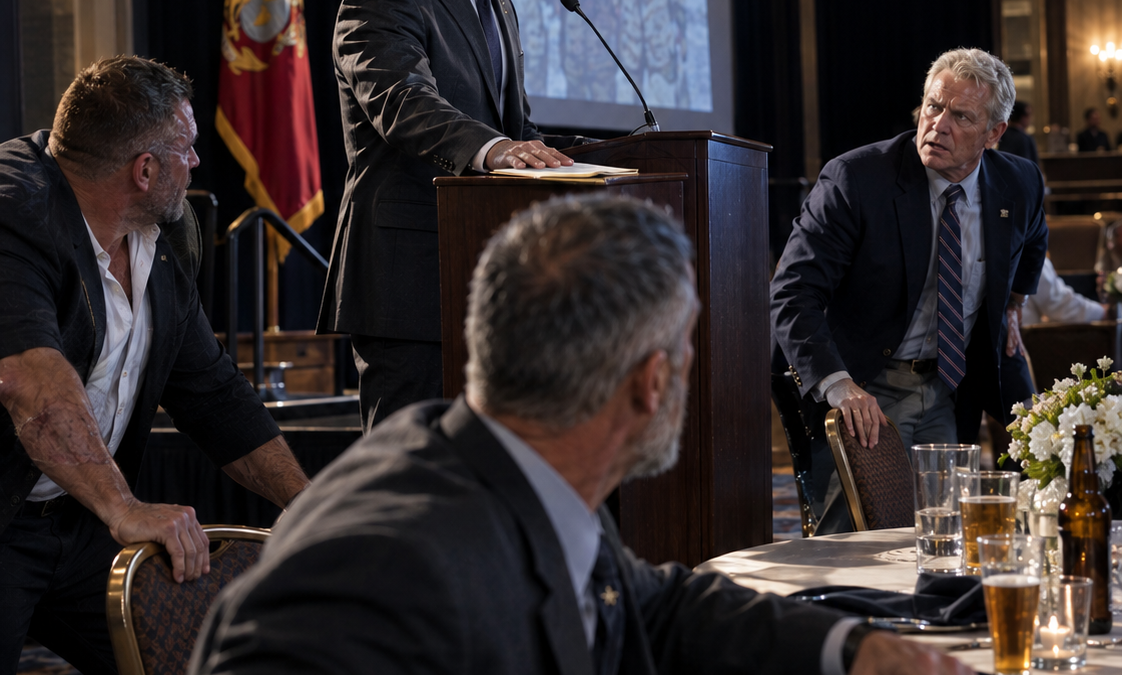
Webb was at the podium. The slideshow had ended, and someone had handed him a microphone. He was giving a speech. Of course he was giving a speech.
“Gentlemen,” he said, “I want to thank Danny for putting this together. It means a lot to me to see you all here. To see the faces of the men I led.”
He paused. He was good at pauses. He had learned them somewhere along the way, probably from a media coach.
“We went through a lot together,” he said. “The deployments. The firefights. The losses.” He paused again. “We lost good men. Santos. Kowalski. Rivera. But we brought the rest of you home. That’s what matters.”
I felt my jaw tighten.
“We did things that people back here will never understand,” Webb said. “We made choices that people back here will never understand. And some of those choices — well, they weren’t always pretty. But they were necessary. They were the choices that had to be made to accomplish the mission.”
He looked out at the crowd. He was working the room. He was making his case.
“But here’s the thing,” he said. “What happens in combat stays in combat. What happened over there — the mistakes, the errors in judgment, the fog of war — those things should stay over there. We don’t need to revisit them. We don’t need to dig them up. We need to honor the men we lost and move on.”
He looked at me. Directly at me.
“Some of us have done that,” he said. “Some of us have moved on. Built careers. Raised families. Served our country in new ways.” He paused. “Others of us have stayed stuck. Stuck in the past. Stuck in the pain. And that stuckness — that’s what does us in. That’s what keeps us from moving forward.”
I stared at him.
“So I’m asking you, as your former commander, as your friend, as a fellow Marine — let’s move forward together. Let’s honor the fallen by living well. Let’s not drag up the past.”
He smiled. “Thank you all. Semper Fi.”
The room applauded. Some men stood up. Webb handed the microphone back to Danny and stepped down from the podium, shaking hands as he went.
I didn’t move.
I was thinking.
I was thinking about the folder in my truck. I was thinking about Santos. I was thinking about the eighteen years I had spent carrying this thing.
And I was thinking about what Webb had just said. The mistakes, the errors in judgment, the fog of war. He was framing it as if he were one of us. As if what had happened on that road outside Haditha had been a shared mistake, a collective failure, a thing that we had all done together.
It hadn’t been.
It had been his mistake. His error in judgment. His refusal to pass along the intel that would have kept us off that road.
Santos was dead because of him. And he was standing in a hotel ballroom, asking us to move on.
I made a decision.
I walked out of the ballroom. I took the elevator down to the parking garage. I opened my truck. I took the manila folder out of the lockbox under the back seat.
Then I walked back up to the lobby.
Danny was there, waiting. He saw the folder in my hand. His eyes widened.
“You’re going to do it?”
“I’m going to do it.”
“Now?”
“Now.”
Danny looked at the folder. Then he looked at me. “What do you need?”
“A copy machine. And a phone.”
There was a business center off the lobby. It was closed, but Danny knew a guy at the front desk who owed him a favor. We got the key.
I made copies. Twenty-three copies. One for every Marine in that ballroom.
I made copies of the original route assessment I had submitted on March 12, 2005. The one with the timestamp. The one that flagged Albu Hyatt as a probable ambush site.
I made copies of the official after-action report filed by Webb on March 20, 2005. The one that said the route had been assessed as low-risk and that the assistant team leader’s assessment had failed to identify the threat.
I put them side by side.
The story they told was simple. Webb had overridden my assessment. Webb had sent us into an ambush. Webb had lied about it afterward, and blamed me for it.
And Webb had been promoted because of it.
I made a cover page. Just a simple line of text, centered, bold. It said:
“THE TRUTH ABOUT OPERATION BROKEN LANTERN — MARCH 14, 2005”
Then I called a number I hadn’t called in ten years.
A man answered on the second ring. “Cole?”
“Ellis,” I said. “It’s Tom.”
There was a pause. “What’s going on?”
“I’m at the Hyatt in Arlington. I’ve got something I need to do. And I need you to be here for it.”
“What kind of something?”
“The kind that ends careers.”
Another pause. “I’ll be there in twenty minutes.”
“Bring your camera.”
“Tom—”
“Please.”
He hung up.
I walked back into the ballroom.
The room was still buzzing. Webb was holding court at a table near the front, surrounded by men who hadn’t been on the patrol. The men who had been on the patrol — Danny and a few others — were clustered near the back.
I walked to the podium. Danny saw me coming. He nodded.
I didn’t say anything. I just walked up to the microphone and tapped it.
The room went quiet.
Webb looked up. He saw the folder in my hand. His face changed.
“Excuse me,” I said. “I have something to say.”
“Gunny,” Webb said. His voice was sharp. “This isn’t the time.”
“It’s the only time,” I said.
I looked out at the crowd. Twenty-three faces. Men I had served with. Men I had bled with. Men who had lost friends because of what happened on that road.
“Some of you were there,” I said. “Some of you weren’t. For those who weren’t, I’m going to tell you a story. And for those who were — I’m sorry. I’m sorry it took me eighteen years.”
I held up the folder.
“On March 14, 2005, a Force Recon patrol from 2nd Reconnaissance Company was ambushed outside the village of Albu Hyatt, Iraq. Nine Marines. Three vehicles. We took fire from three directions. Corporal Miguel Santos was killed in the opening minutes of the engagement. Four others were wounded.”
I paused.
“The official after-action report says the ambush was unavoidable. It says the route had been assessed as low-risk. It says the intelligence was insufficient to predict an attack.”
I held up the copy of the original assessment.
“This is the route assessment I submitted on March 12, 2005. Two days before the patrol. I flagged Albu Hyatt as a probable ambush site. I recommended an alternate route. I recommended increased ISR support.”
I held up the copy of the after-action report.
“This is the official report filed by Colonel Marcus Webb on March 20, 2005. It says the route was assessed as low-risk. It says the assistant team leader’s assessment failed to identify the threat.”
I put both papers down on the podium.
“Both of these things cannot be true,” I said. “Either I failed to identify the threat, or Colonel Webb overrode my assessment and sent us into an ambush.”
I looked at Webb.
“Which one is it, Colonel?”
The room was silent.
Webb stood up. His face was red. “Gunny, you’re out of line.”
“I’m asking you a question.”
“You’re embarrassing yourself. And you’re embarrassing the Corps.”
“No, sir,” I said. “I’m embarrassing you. There’s a difference.”
I turned back to the crowd.
“The intel was there,” I said. “A patrol had taken fire from that village two days earlier. The S-2 shop had flagged it. I had the report. I submitted my assessment. And Colonel Webb overrode it.”
I picked up the after-action report.
“Then he filed this,” I said. “He blamed the failure on me. He blamed the deaths on me. And then he got promoted.”
I looked at Webb again. He was standing, but he wasn’t moving. His hands were clenched at his sides.
“You knew,” I said. “You knew the village was hot. You knew because I told you. And you sent us in anyway.”
“That’s not—” he started.
“Because you were up for promotion,” I said. “Because a delayed patrol would have looked bad on your fitness report. Because you cared more about your career than you did about the men you led.”
Silence.
“Am I wrong?”
He didn’t answer.
“Am I wrong, Colonel?”
He stared at me. His mouth opened. Then closed.
Danny stood up. He was holding a copy of the paperwork. He was reading it. His hands were shaking.
“This is real,” he said. “This is all real.”
“It’s real,” I said.
One by one, the other men from the patrol stood up. They picked up the copies I had laid out on the tables. They read them. They looked at Webb. They looked at me.
I saw faces change. I saw understanding come. I saw anger — the kind of anger that had been buried for eighteen years, waiting for a reason to surface.
And I saw Webb standing alone, surrounded by men who were no longer his to command.
“You need to leave,” Danny said.
Webb looked at him. “You can’t—”
“You need to leave,” Danny repeated. “Now.”
Webb stood there for a moment. Then he turned and walked out.
He didn’t look back.
The next morning, a man named David Ellis — my old team leader, now a retired master sergeant working as a journalist for a veterans’ magazine — filed a story.
I had called him because I needed a witness. I needed someone with credibility, someone outside the unit, someone who could document what had happened. Ellis had been my team leader in 2003. He had left the Corps in 2007 and had gone to journalism school. He had been writing about veterans’ issues for a decade.
He had brought a camera and a recorder to the reunion. He had captured everything.
The story ran three days later. It was titled “The Broken Lantern: How a Colonel’s Ambition Cost Three Marines Their Lives.”
The response was immediate. The Marine Corps announced an investigation within a week. The House Armed Services Committee — Webb’s committee — announced that it would be reviewing the matter. Webb’s office issued a statement denying everything.
Then a second story broke. A reporter from the Washington Post found that Webb had been promoted three times after the incident, and that each promotion had been approved by officers who had been on his fitness reports. The paper found that the officers had not been told about the ambush.
A third story broke. The Marine Corps released the findings of its investigation. The report concluded that Webb had “failed to properly disseminate intelligence” and had “filed an inaccurate after-action report.” The report recommended that Webb be stripped of his retirement rank and benefits.
The House Ethics Committee opened an inquiry. Then the FBI opened a separate inquiry. Then a grand jury.
Webb resigned from Congress six weeks after the reunion. He was indicted on charges of obstruction of justice and making false statements. He was convicted nine months later. He was sentenced to eighteen months in federal prison.
I testified at his trial. I sat in a courtroom in Alexandria, Virginia, and told the same story I had told at the reunion. I held up the same papers. I said the same words.
“You knew,” I said. “You knew the village was hot. And you sent us in anyway.”
Webb didn’t look at me when I said it. He looked at the table in front of him.
The judge asked him if he had anything to say before sentencing. He stood up and said he was sorry. He said he had made mistakes. He said he had spent his life serving his country and that he had never meant to cause harm.
The judge didn’t say anything. He just read the sentence.
The men from my unit came to the trial. All of them. Danny Reese was there. So were the others — the ones who had been on that patrol, and the ones who hadn’t. They sat in the back of the courtroom and watched.
After the sentencing, we gathered outside the courthouse. It was a cold day in February. The sky was gray.
Danny walked up to me. He was holding a copy of the after-action report. He had been carrying it for months, like a talisman.
“You did it,” he said.
“We did it,” I said.
He nodded. He didn’t say anything else. He didn’t have to.
Miguel Santos’s mother was still alive. She was eighty-three, living in a small house in San Antonio. I flew down to see her the week after the trial.
I had never met her. I had been to her son’s funeral, but I had been in a hospital bed at Landstuhl at the time. I had sent flowers. I had written a letter. But I had never met her.
She opened the door slowly. She was small, gray-haired, with dark eyes that reminded me of her son.
“Mrs. Santos?” I said. “I’m Tom Cole. I served with Miguel.”
She looked at me for a long moment. Then she stepped back and let me in.
We sat in her living room. There were pictures of Miguel on the walls — in his dress blues, in his cammies, in his high school football uniform. There was a flag in a case on the mantel. There was a Purple Heart.
I told her everything. I told her about the ambush, about the intel that had been ignored, about the report that had been falsified. I told her about the trial. I told her about Webb’s conviction.
She listened. She didn’t interrupt.
When I finished, she was quiet for a long time. Then she said, “I knew.”
“You knew?”
“I knew something was wrong,” she said. “The men who came to tell me — they didn’t look me in the eye. They told me Miguel died a hero. They told me he died fighting for his country. But they didn’t look me in the eye.”
She looked at me.
“I didn’t know what it was,” she said. “But I knew.”
She reached out and took my hand.
“Thank you,” she said. “For telling me the truth.”
I didn’t say anything. I couldn’t.
I went back home to Virginia. I went back to my life. I had retired from the Marine Corps in 2011 and had spent the years since working as a security consultant for a defense contractor. I had a wife, Karen, who had put up with me for thirty-one years. I had two kids, both grown, both living on the West Coast. I had a house with a basement and a fireproof safe.
The folder was gone now. I had turned it over to the Marine Corps investigation. It was evidence now, not a secret.
I had spent eighteen years carrying it. Eighteen years of silence. Eighteen years of choosing the Corps over the truth.
I had been wrong.
Not about the truth. The truth had always been the truth. I had been wrong about what it meant to protect the men I had served with. I had thought that silence was protection. I had thought that moving on was strength.
It wasn’t.
The men I had served with had spent eighteen years carrying a lie. They had been told that Santos died because of a failure of reconnaissance. They had been told that the ambush was unavoidable. They had been told that their brothers died because of the fog of war.
They hadn’t been told that their commander had sent them into a trap because he wanted a promotion.
That was the thing I had stolen from them. Not the truth — they had a right to the truth. But the knowledge that their sacrifice had been betrayed. That the men they had lost had died for nothing.
I had stolen that from them, and I had called it protection.
I was wrong.
The Marine Corps reinstated Santos’s posthumous promotion to sergeant. They awarded him a Bronze Star with valor. They put his name on a memorial at Camp Lejeune.
The other men from the patrol received awards too. Danny got a Navy and Marine Corps Achievement Medal. I got a letter of commendation. It didn’t matter. The awards weren’t the point.
The point was that the truth was out. The point was that Webb was in prison. The point was that Santos’s mother knew what had really happened to her son.
The point was that we could finally remember the truth.
A year after the reunion, we held another one. This time it was at Danny’s house. He had a big backyard with a deck he had built himself. He grilled burgers and brats. His wife made potato salad. The kids ran around in the grass.
We didn’t talk about Webb. We didn’t talk about the trial. We talked about the old days. The good days. The days before the ambush, when we were young and stupid and thought we were invincible.
We talked about Santos. We told stories about him — the time he fell asleep in the back of a Humvee and woke up screaming because he dreamed he was being attacked by chickens. The time he tried to cook a Thanksgiving turkey in a microwave and set it on fire. The time he wrote a letter to his mother that was so long the mail clerk asked if he was writing a novel.
We laughed. We cried. We remembered.
That was the thing that Webb had tried to take from us. Not just the truth. The right to remember honestly. The right to mourn without being lied to. The right to honor our dead without being told that their deaths were inevitable.
We had that back now. All of us.
I sat on Danny’s deck and watched the sun go down. Karen sat next to me. She didn’t say anything. She just held my hand.
I thought about Santos. I thought about the day he died. I thought about the blood on my hands and the radio call I made and the voice on the other end telling me that air support was twenty minutes out.
I thought about the folder. I thought about the eighteen years I had carried it. I thought about the night I finally opened it.
I had spent eighteen years waiting for the right moment. I had told myself that I was waiting for justice, for accountability, for a chance to set the record straight.
But that wasn’t true. I had been waiting for permission. Permission from a system that had already failed me. Permission from a Corps that had already promoted the man who had gotten my friends killed. Permission from a world that had already decided that what happened on that road was just war.
I had been waiting for someone else to tell me it was okay to tell the truth.
No one had ever told me.
So I had told it myself.
Danny raised his glass. “To Santos,” he said.
“To Santos,” we all said.
I drank my beer and looked out at the sunset. The sky was orange and pink and gold. It was beautiful.
I thought about what Webb had said to me at the reunion. There are some things that are better left alone, Tom. For the good of the Corps. For the good of everyone here.
He had been wrong.
There were some things that had to be brought into the light. There were some things that had to be told. There were some things that had to be remembered, even if remembering them hurt.
That was what it meant to be a Marine. That was what it meant to be a brother. That was what it meant to be a man.
You didn’t bury the truth. You didn’t hide the pain. You didn’t move on from the past.
You carried it. You honored it. You told it.
That was the only way to live.
I finished my beer and set the bottle down on the deck. Karen squeezed my hand.
“You okay?” she asked.
“Yeah,” I said. “I’m okay.”
And for the first time in eighteen years, I meant it.
PART 2 — THE HOSPITAL AT LANDSTUHL
I said I was okay, and I meant it.
But getting to okay took eighteen years. Most of that time I wasn’t okay. Most of that time I was just carrying it.
I want to go back. Before the reunion. Before the trial. Before any of it. Back to the beginning, when I was lying in a hospital bed in Germany with a fractured wrist and a hole in my eardrum and a dead man’s blood still under my fingernails.
That’s where the story really starts.
I woke up in Landstuhl Regional Medical Center on March 17, 2005. Three days after the ambush.
The ceiling was white. The sheets were stiff. There was a machine beeping somewhere to my left. I remember thinking, This isn’t Iraq. Then I remembered everything.
The RPG. The smoke. Santos in the turret. The way his body had slumped when the round hit. The blood on my hands. The screaming. Danny dragging Kowalski out of the burning Humvee. The twenty minutes of waiting for air support that felt like twenty years.
I tried to sit up. My wrist screamed. I looked down and saw the cast.
“Easy, Gunny.”
A nurse. Army, by the uniform. She put a hand on my shoulder.
“You’re at Landstuhl,” she said. “You’re safe. You’re going to be fine.”
“Where’s Santos?”
She didn’t answer.
“Where’s Santos?”
She looked at me. Then she looked away.
I knew.
The next few days were a blur. Doctors. Nurses. Morphine. A chaplain who came by and sat with me for a while without saying much. I appreciated that. I didn’t want to talk. I just wanted to lie there and stare at the ceiling and try not to remember.
But I remembered. That was the thing. I couldn’t stop remembering.
I remembered Santos’s laugh. He had a big laugh, the kind that filled a room. He had been twenty-two years old. He had a girlfriend back in San Antonio named Elena. He had been planning to propose when he got home.
I remembered the way he used to talk about his mom. He called her every Sunday, no matter what. Even in Iraq. Even when the comms were bad. He would find a way.
I remembered the last thing he said to me. We were loading up for the patrol, and he looked at me and said, “Gunny, you think we’ll see anything today?”
And I said, “Probably not. Route’s clear.”
Route’s clear. I said that. I believed it. Because Webb had told us it was clear. Because Webb had told us the intel was good. Because Webb had told us the village was friendly.
I had trusted him.
That was the thing I couldn’t get past. I had trusted him. I had submitted my assessment, and he had overridden it, and I had trusted him anyway. I had believed him when he said the route was clear. I had believed him when he said the intel was good.
I had believed him, and Santos had died.
On the fifth day, a man came to see me.
He was in civilian clothes. Khaki pants, a blue button-down shirt. He had short gray hair and a face that looked like it had seen a lot of things it didn’t want to remember.
He introduced himself as a lieutenant colonel from the Inspector General’s office. His name was Patterson.
“I’m here to talk to you about the incident on March 14,” he said.
“Okay.”
He sat down in the chair next to my bed. He pulled out a notebook and a pen.
“I need to ask you some questions about the patrol,” he said. “About the intelligence you received. About the route assessment you submitted.”
I looked at him. “You have my assessment?”
“We do. It was in the file.”
“The file that Colonel Webb submitted?”
He didn’t answer that. He just looked at me.
“Gunny,” he said, “I’m going to be straight with you. There’s some confusion about what happened on that patrol. The after-action report says one thing. Some of the other documents say another thing. I’m here to try to sort it out.”
“Sort it out,” I said.
“Yes.”
“Sort out whether I failed to identify the threat or whether Colonel Webb overrode my assessment.”
He looked at me for a long moment. Then he said, “Yes.”
I was quiet. I was thinking.
I had the original assessment in my kit bag. I had brought it with me from Iraq. I had kept a copy. I had kept it because I knew, even then, that something was wrong. I had kept it because I knew that Webb was going to try to blame me.
I could have given it to Patterson. I could have told him everything. I could have ended it right there.
But I didn’t.
I don’t know why. I’ve thought about it for eighteen years. I’ve thought about it every day.
I think I was scared. Not of Webb. Of the system. Of what would happen if I accused a lieutenant colonel of lying. Of what would happen to my career. Of what would happen to the men who had served under me.
I think I was tired. I had just lost a man. I had just been blown up. I had just spent five days in a hospital bed, staring at the ceiling, trying not to remember.
I think I was ashamed. I had trusted Webb. I had believed him. And Santos had died because of it.
So I said nothing.
“The intel was insufficient,” I said. “We didn’t know the village was hot.”
Patterson looked at me. He wrote something in his notebook.
“Did you submit a route assessment?”
“Yes.”
“Did it flag any concerns about the route?”
I hesitated.
“No,” I said. “It didn’t.”
He looked at me for a long moment. Then he closed his notebook.
“Thank you, Gunny,” he said. “That’s all I need.”
He stood up and walked out.
I lay there in the bed and stared at the ceiling. I had just lied to an Inspector General. I had just covered for the man who had gotten my friend killed.
I told myself it was for the good of the Corps. I told myself it was for the good of the men. I told myself that if I told the truth, it would tear the unit apart.
I told myself a lot of things.
But I knew the truth. I knew what I had done.
I had chosen silence over justice. I had chosen the Corps over Santos.
I would spend the next eighteen years trying to live with that choice.
I went back to Camp Lejeune in April. I was on limited duty for three months while my wrist healed. I did paperwork. I did PT. I went to the range. I pretended everything was normal.
But nothing was normal.
I saw Webb every day. He was still the battalion commander. He was still my CO. He still walked around like he owned the place, like nothing had happened.
He never mentioned the ambush. He never mentioned Santos. He never mentioned the report.
But he knew. I could see it in the way he looked at me. He knew that I knew.
And he knew that I had kept my mouth shut.
The first time I saw him after I got back, he walked up to me in the hallway outside the company office.
“Gunny,” he said. “Good to have you back.”
“Thank you, sir.”
He looked at me for a moment. Then he said, “I read your statement to the IG.”
I didn’t say anything.
“I appreciate your loyalty,” he said.
He said it like it was a compliment. Like I had done something noble. Like keeping my mouth shut about the fact that he had gotten a man killed was an act of loyalty.
I wanted to hit him. I wanted to grab him by the collar and slam him against the wall and tell him that Santos was dead because of him. I wanted to tell him that I had lied to the IG because I was a coward, not because I was loyal.
But I didn’t.
“Yes, sir,” I said.
He nodded and walked away.
That was the moment. That was the moment I should have done something. That was the moment I should have gone to the IG and told the truth. That was the moment I should have stood up for Santos.
But I didn’t.
I just stood there in the hallway and watched him walk away.
The months passed. I got promoted to master sergeant. I got transferred to a new unit. I did another deployment — this time to Afghanistan, with a MARSOC team. I did my job. I did it well. I got a Bronze Star for a firefight in Helmand.
But I never forgot.
Every time I saw Webb’s name in the news, I thought about it. Every time I heard about a promotion, a new command, a new award, I thought about it. Every time I looked at the flag on my uniform, I thought about it.
I thought about Santos. I thought about his mom. I thought about the way she had cried at his funeral. I thought about the letter she had written to the unit, thanking us for our service.
I thought about the lie I had told.
And I thought about the folder.
I had kept the original assessment. I had kept the copy of the after-action report that a friend had slipped me. I had kept everything. I had put it all in a manila folder and I had put the folder in a safe.
For eighteen years.
I retired in 2011. I had done twenty-three years. I had done five deployments. I had done everything I was supposed to do.
I moved to Virginia. I got a job with a defense contractor. I bought a house. I tried to live a normal life.
But I couldn’t.
I couldn’t sleep. I couldn’t relax. I couldn’t stop thinking about it.
I went to see a VA shrink. I told her about the ambush. I told her about Santos. I told her about the guilt.
I didn’t tell her about the folder. I didn’t tell her about the lie.
She told me I had PTSD. She told me I needed to process my trauma. She told me I needed to forgive myself.
I nodded. I took the pills she gave me. I went to the sessions.
But I never forgave myself.
I couldn’t.
Karen knew something was wrong. She had known since I got back from Iraq. She had seen me wake up in the middle of the night, drenched in sweat. She had seen me stare at the wall for hours. She had seen me flinch at loud noises.
She didn’t push. She just waited.
One night, about five years after I retired, she found me in the basement. I was sitting on the floor, holding the folder.
“What’s that?” she asked.
“Nothing.”
She sat down next to me.
“Tom,” she said. “What’s in the folder?”
I looked at her. I had never told her. I had never told anyone.
“It’s about Iraq,” I said. “About the ambush.”
She waited.
“It’s about Santos.”
She put her hand on my knee. “Tell me.”
So I told her. I told her everything. I told her about the assessment. I told her about the report. I told her about the lie. I told her about the eighteen years of silence.
She listened. She didn’t interrupt. When I finished, she was quiet for a long time.
“Tom,” she said, “you need to do something with this.”
“I can’t.”
“Why not?”
“Because it’s too late. Because no one will believe me. Because I lied to the IG. Because I’m a coward.”
She looked at me. Her eyes were steady.
“You’re not a coward,” she said. “You’re a man who made a choice. A bad choice. But you can still make a different one.”
I shook my head.
“You can still tell the truth,” she said.
I looked at the folder in my hands. I thought about Santos. I thought about his mom. I thought about the way she had looked at me when I told her the truth.
“I don’t know if I can,” I said.
“You can,” she said. “When you’re ready.”
I wasn’t ready for a long time.
Years passed. I went to work. I came home. I did the things I was supposed to do. I went to barbecues. I went to kids’ birthday parties. I went to church on Christmas and Easter.
But I carried the folder with me. Everywhere. It was in the safe, but it was always in my mind.
I thought about it every day. I thought about the reunion. I thought about what I would say if I ever saw Webb again. I thought about the moment when I would finally open my mouth and tell the truth.
I rehearsed it. In the shower. In the car. In bed at night, staring at the ceiling.
I would stand up. I would hold up the folder. I would say, “This is the truth. This is what really happened.”
I would say, “Colonel Webb lied. He sent us into an ambush. He killed Santos.”
I would say, “I’m sorry it took me so long.”
But I never did it. I never said anything. I just kept carrying it.
Until the reunion.
Danny called me three months before. He told me he was organizing a reunion for the unit. He told me Webb was coming.
“I don’t know if I should,” I said.
“You should,” he said. “We all should. We need to be together.”
“I don’t know if I can face him.”
“Tom,” Danny said, “you’ve faced worse.”
He was right. I had faced worse. I had faced RPGs and IEDs and Taliban fighters. I had faced death. I had faced the loss of my brothers.
But I had never faced the truth.
I told Danny I would come. I told him I would be there.
I didn’t tell him about the folder. I didn’t tell him what I was planning to do.
I didn’t know what I was planning to do.
I just knew I couldn’t carry it anymore.
I drove up to Arlington the day of the reunion. I checked into the Hyatt. I put my bag in my room. I took the folder out of my bag and put it in the lockbox in my truck.
I told myself I wasn’t going to use it. I told myself I was just going to see my brothers. I told myself I was just going to have a beer and tell some stories and go home.
But I knew.
I knew the moment I saw Webb walk through those doors. I knew the moment he leaned in and whispered in my ear.
There are some things that are better left alone, Tom.
I knew.
I had spent eighteen years waiting for permission. I had spent eighteen years waiting for a sign. I had spent eighteen years telling myself that it wasn’t the right time, that I didn’t have enough proof, that no one would believe me.
But it wasn’t about proof. It wasn’t about timing. It wasn’t about belief.
It was about courage.
And I had finally found some.
Danny’s house was quiet now. The sun had set. The kids had gone inside. Most of the men had gone home.
I was sitting on the deck with Karen. We were watching the stars come out.
“You did the right thing,” she said.
“I know.”
“It doesn’t make it easier.”
“No.”
She took my hand.
“Tom,” she said, “Santos would be proud of you.”
I looked at her.
“You think so?”
“I know so.”
I thought about Santos. I thought about his laugh. I thought about the way he used to talk about his mom. I thought about the last thing he said to me.
“Gunny, you think we’ll see anything today?”
And I said, “Probably not. Route’s clear.”
I had lied to him. Not on purpose. But I had lied to him. I had told him the route was clear, and he had believed me, and he had died.
I had spent eighteen years carrying that lie. I had spent eighteen years telling myself that it was Webb’s fault, not mine.
And it was. It was Webb’s fault. He was the one who had overridden my assessment. He was the one who had sent us into the ambush. He was the one who had lied about it afterward.
But I had been part of it. I had been part of the lie.
I had told Santos the route was clear. I had told him we probably wouldn’t see anything. I had told him it was just a routine patrol.
He had believed me.
He had died believing me.
That was the thing I had never been able to face. That was the thing I had never been able to say out loud.
I had been part of the lie.
Not the big lie. Not Webb’s lie. But my own.
I had told Santos the route was clear, and it wasn’t. I had told him we were safe, and we weren’t. I had told him he was going home, and he wasn’t.
I had been part of it.
And I had spent eighteen years trying to pretend I wasn’t.
I went home the next morning. I went back to my life. I went back to work.
But something was different.
I had told the truth. I had opened the folder. I had said the words.
And the world hadn’t ended.
Webb was in prison. The investigation was ongoing. The stories had been written. The truth was out.
I had done what I should have done eighteen years ago.
It didn’t bring Santos back. It didn’t undo the lie. It didn’t make the guilt go away.
But it was something. It was a start.
I sat in my basement that night and looked at the empty space in the safe where the folder used to be. I thought about everything that had happened. I thought about the reunion. I thought about the trial. I thought about Santos’s mother.
I thought about the moment I had walked up to the podium and tapped the microphone.
I had been scared. My hands had been shaking. My heart had been pounding.
But I had done it anyway.
That was the thing I had learned. Courage wasn’t about not being scared. It was about being scared and doing it anyway.
I had been scared for eighteen years. I had been scared of what would happen if I told the truth. I had been scared of what people would think. I had been scared of what it would do to the Corps.
But I had done it anyway.
And it had been the right thing to do.
I called Danny a few days later. He was at work, building a deck for a client in McLean.
“Gunny,” he said. “How you holding up?”
“I’m okay,” I said. “I wanted to thank you.”
“For what?”
“For being there. For backing me up.”
“Tom,” he said, “you didn’t need me. You did it yourself.”
“I needed you,” I said. “I needed all of you.”
He was quiet for a moment. Then he said, “We needed you too. We needed you to tell the truth. We needed you to give us back Santos.”
I didn’t say anything. I couldn’t.
“He was a good man,” Danny said. “He deserved better.”
“He did.”
“We all did.”
I thought about that. We all did. We all deserved better. We deserved a commander who cared more about his men than his career. We deserved a system that held people accountable. We deserved the truth.
We hadn’t gotten it. Not for eighteen years.
But we had it now.
I went to see Santos’s mother again. I flew down to San Antonio. I sat in her living room. I told her about the trial. I told her about the conviction. I told her about the Bronze Star.
She listened. She nodded. She held my hand.
“You’re a good man,” she said.
“I’m not,” I said. “I should have done this a long time ago.”
She looked at me. Her eyes were kind.
“God forgives,” she said. “You should too.”
I didn’t know how to answer that. I didn’t know if I could forgive myself. I didn’t know if I deserved to.
But I knew I had done the right thing. I knew I had finally told the truth.
That was enough. For now.
The next reunion was at Danny’s house. It was a year later. The sun was setting. The kids were playing in the yard. The men were telling stories.
I sat on the deck with Karen. I watched the sunset. I thought about Santos.
I thought about the way he used to laugh. I thought about the way he used to talk about his mom. I thought about the way he used to dream about going home.
He never made it home. Not the way he wanted to. But he was home now. In a way. In our memories. In the truth we had told.
I raised my glass.
“To Santos,” I said.
“To Santos,” the others said.
I drank my beer. I looked at the sunset. I felt something I hadn’t felt in eighteen years.
Peace.
It wasn’t complete. It wasn’t perfect. But it was there.
And that was enough.
PART 3 — THE CROSS-EXAMINATION
I need to go back again.
Part 2 ended at Danny’s house, a year after the trial. But I skipped over the trial itself. I gave it three sentences. That wasn’t fair. To the story. To Santos. To myself.
The trial was where it all mattered. The trial was where Webb’s lawyer tried to tear me apart.
So let me go back. One more time. To the federal courthouse in Alexandria, Virginia. To the wooden bench where I sat for four days. To the moment I finally understood what it meant to tell the truth.
The trial started on a Tuesday in October, nine months after the reunion.
The courtroom was small. Federal courtrooms usually are. Wood paneling. Fluorescent lights that hummed. A flag in the corner. A seal of the Department of Justice behind the judge’s bench.
I had been to court before. Traffic court, once, for a speeding ticket when I was twenty-two. That was it. I had never testified in a federal trial. I had never been cross-examined by a defense attorney.
I was nervous. Not scared. Nervous. There’s a difference.
Karen came with me. She sat in the gallery, second row, on the aisle. She wore a navy blue dress. She held her purse in her lap and didn’t move.
Danny came too. He sat behind Karen. So did four other men from the patrol. They had all been subpoenaed as witnesses. They had all been told to be ready.
Webb sat at the defense table. He wore a gray suit and a red tie. He looked like a congressman. He looked like a man who had never done anything wrong in his life.
His attorney was a man named Gerald Fisk. He was from a big firm in D.C. He had represented senators and generals and CEOs. He was known for being ruthless.
I was about to find out how ruthless.
The prosecutor was a woman named Angela Reyes. She was from the U.S. Attorney’s office. She was in her forties, with short dark hair and a no-nonsense way of speaking. She had been on the case for six months. She knew the documents better than I did.
She called me to the stand on the second day.
I walked up. I put my hand on the Bible. I swore to tell the truth. I sat down.
“State your name for the record,” the clerk said.
“Thomas Cole.”
“Spell your last name.”
“C-O-L-E.”
“You may proceed,” the judge said.
Angela Reyes stood up. She walked to the podium.
“Gunnery Sergeant Cole,” she said. “You served in the United States Marine Corps for twenty-three years, is that correct?”
“Yes, ma’am.”
“You served in Force Reconnaissance and later in Marine Corps Forces Special Operations Command?”
“Yes, ma’am.”
“You deployed to Iraq three times and Afghanistan twice?”
“Yes, ma’am.”
“You were awarded the Bronze Star for actions in Helmand Province in 2009?”
“Yes, ma’am.”
“And you were on the patrol on March 14, 2005, that is the subject of this trial?”
“Yes, ma’am.”
She walked me through it. The patrol. The route. The ambush. Santos. The hospital. The IG interview. The eighteen years of silence.
I told it plain. No adjectives. No drama. Just the facts, in order, the way I had learned to give a report.
When I got to the part about the lie I told to the IG, I paused.
“I need to say something,” I said.
“Go ahead,” Reyes said.
“I lied to the Inspector General in 2005. I told him my assessment didn’t flag any concerns about the route. That was a lie. I lied because I was scared and because I was ashamed. I’ve regretted it every day since.”
Reyes nodded. “Thank you for that.”
She had me identify the documents. The original assessment. The after-action report. She entered them into evidence. She had me read the key sections aloud.
I read my own assessment. “Albu Hyatt is assessed as a probable ambush site. Recommend alternate route via Highway 12. Recommend increased ISR support prior to patrol.”
Then I read Webb’s report. “The route was assessed as low-risk. The assistant team leader’s route assessment failed to identify the threat.”
I put the papers down.
“Both of these documents are in my handwriting and my signature,” I said. “The first one is true. The second one is a lie.”
Reyes sat down.
The judge looked at the defense table. “Your witness, Mr. Fisk.”
Gerald Fisk stood up.
He was a tall man, in his sixties, with silver hair and a smile that didn’t reach his eyes. He walked to the podium slowly. He looked at me the way a hunter looks at a deer.
“Gunnery Sergeant Cole,” he said. “You’ve told this court that you lied to the Inspector General in 2005. Is that correct?”
“Yes, sir.”
“You lied under oath?”
“I wasn’t under oath. It was an interview.”
“But you lied.”
“Yes, sir.”
“You lied to a federal investigator.”
“Yes, sir.”
“You lied about a matter that was central to the investigation.”
“Yes, sir.”
“And you’re asking this court to believe you now?”
I looked at him. “I’m not asking you to believe me, sir. I’m asking you to believe the documents.”
“The documents you kept for eighteen years.”
“Yes, sir.”
“The documents you never filed with the official record.”
“I filed the original assessment with my chain of command in 2005. The copy I kept was for myself.”
“Why did you keep it?”
“Because I knew it was important.”
“Why didn’t you come forward in 2005?”
“I was scared.”
“You were scared.”
“Yes, sir.”
“You were a Force Recon Marine. You had a Bronze Star. You had been in combat five times. And you were scared?”
“Yes, sir.”
“Scared of what?”
“Scared of what would happen if I accused a lieutenant colonel of lying.”
“So you waited eighteen years.”
“Yes, sir.”
“Why?”
I paused. This was the question. This was the one I had been dreading.
“Because I finally decided that keeping quiet was worse than being scared,” I said.
Fisk smiled. “That’s a nice answer, Gunnery Sergeant. But it doesn’t explain why you waited eighteen years. It doesn’t explain why you came forward only after Colonel Webb had been elected to Congress. It doesn’t explain why you came forward only after he had become a public figure.”
“I came forward because I couldn’t carry it anymore.”
“You came forward because you wanted attention.”
“No, sir.”
“You came forward because you wanted to destroy a man’s career.”
“No, sir.”
“You came forward because you had a grudge.”
“No, sir.”
“You had a grudge against Colonel Webb because he didn’t promote you.”
“No, sir. I was promoted twice after the incident.”
“You had a grudge because he blamed you in the report.”
“I had a grudge because he lied. But that’s not why I came forward.”
“Then why?”
I looked at him. I looked at Webb. I looked at the gallery, at Karen, at Danny, at the other men from the patrol.
“Because Miguel Santos deserved the truth,” I said. “Because his mother deserved the truth. Because the men I served with deserved the truth. Because I was tired of carrying a lie for a man who never earned my silence.”
Fisk was quiet for a moment. Then he said, “No further questions.”
The cross-examination lasted four hours. Fisk went after everything.
He attacked the timeline. He attacked the documents. He attacked my memory. He attacked my motives. He suggested that the original assessment had been altered. He suggested that the after-action report had been written by someone else. He suggested that I was misremembering.
But he couldn’t shake the documents. They were in my handwriting. They had timestamps. They had signatures. They had been submitted through the proper channels.
He couldn’t shake Danny’s testimony either. Danny testified that he had seen me submit the assessment. He testified that Webb had called us into his office the day before the patrol and told us the route was clear. He testified that he had heard Webb say, “The intel is good. Don’t worry about it.”
He couldn’t shake the testimony of the other men. Three of them testified that they had seen the original assessment. Two of them testified that they had heard Webb override it.
By the end of the third day, the prosecution had built a case that was airtight. The documents proved the lie. The witnesses proved the cover-up. The only thing left was the question of motive.
That was where Fisk made his last stand.
On the fourth day, Fisk called Webb to the stand.
Webb walked up slowly. He put his hand on the Bible. He swore to tell the truth. He sat down.
Fisk walked him through his career. The deployments. The commands. The promotions. The election to Congress.
Then he asked the question.
“Colonel Webb,” Fisk said, “did you override the route assessment submitted by Gunnery Sergeant Cole on March 12, 2005?”
Webb paused. He looked at the jury. He looked at the judge. He looked at me.
“No,” he said. “I did not.”
“You never saw the assessment?”
“I saw an assessment. But it didn’t flag the route as a probable ambush site. It just noted some general concerns.”
“Objection,” Reyes said. “The document speaks for itself.”
“Sustained,” the judge said.
Fisk tried again. “Colonel Webb, did you tell your men that the route was clear?”
“I told them the intel was good.”
“Did you tell them the route was clear?”
“I told them the intel was good.”
“That’s not what I asked.”
“I don’t remember the exact words I used.”
“You don’t remember?”
“It was eighteen years ago.”
“But you remember the intel was good?”
“Yes.”
“You remember that?”
“Yes.”
“But you don’t remember telling your men the route was clear?”
“I don’t remember the exact words.”
Fisk nodded. “Let me ask you this, Colonel. Did you know that Albu Hyatt had been the site of an ambush two days earlier?”
Webb paused again. “I was aware of the incident.”
“You were aware of it?”
“Yes.”
“And you sent your men into that village anyway?”
“I sent them on a patrol. The intel indicated the village was secure.”
“The intel indicated the village was secure? Or you chose to ignore the intel that indicated it wasn’t?”
“Objection,” Fisk said. “Argumentative.”
“Sustained,” the judge said.
But the damage was done. The jury had heard it. The gallery had heard it. Everyone in that courtroom had heard it.
Webb had known the village was hot. He had sent us in anyway. And then he had lied about it.
I sat in the gallery for the closing arguments. Reyes stood up and walked through the evidence. She was calm. She was precise. She didn’t raise her voice.
“The documents don’t lie,” she said. “The witnesses don’t lie. The only person in this courtroom who has lied is the defendant. He lied in 2005. He lied in his after-action report. He lied to the Inspector General. He lied on the stand.”
She pointed at Webb.
“He lied to cover up the fact that he sent nine Marines into an ambush because he was afraid that a delayed patrol would hurt his chances for promotion. He lied to cover up the fact that one of those Marines — Corporal Miguel Santos — died as a result of his decision.”
She paused.
“Corporal Santos was twenty-two years old. He had a mother. He had a girlfriend. He had a future. And he died because Colonel Webb cared more about his career than he did about his men.”
She sat down.
Fisk stood up and gave his closing argument. He talked about reasonable doubt. He talked about the fog of war. He talked about the difficulty of making decisions in combat. He talked about Webb’s distinguished career, his years of service, his contributions to the country.
He didn’t talk about Santos. Not once.
The jury went out at 4:00 p.m. on a Thursday. They came back at 2:00 p.m. on a Friday.
Guilty on all counts.
Webb didn’t react when the verdict was read. He just sat there. His face didn’t change. He looked like a man who had already accepted his fate.
The judge set sentencing for three months later. Webb was allowed to remain free on bail until then. He walked out of the courtroom without looking at anyone.
I stayed in my seat. I watched him go. I thought about Santos. I thought about his mother. I thought about the eighteen years I had spent carrying the folder.
It was over.
Not completely. Not yet. But the hard part was done.
The sentencing was in January. The courthouse was cold. The sky was gray.
I sat in the same seat I had sat in during the trial. Karen was next to me. Danny was behind me. The other men from the patrol were scattered through the gallery.
Webb walked in wearing a dark suit. He looked older than he had at the trial. Tired. Beaten.
The judge asked him if he had anything to say before sentencing.
Webb stood up. He looked at the judge. He looked at the gallery. He looked at me.
“I want to say that I’m sorry,” he said. “I’m sorry to the men I served with. I’m sorry to the family of Corporal Santos. I’m sorry to this court.”
He paused.
“I made mistakes. I made decisions that I thought were right at the time. I didn’t mean to cause harm. I never meant to cause harm.”
He paused again.
“I’ve spent my life serving my country. I’ve given everything to the Marine Corps. I’ve given everything to this nation. And I’m asking the court to consider that. I’m asking for mercy.”
The judge looked at him for a long moment.
“Colonel Webb,” he said, “you are correct that you spent your life serving your country. You are correct that you gave a great deal to the Marine Corps. And that is precisely what makes your conduct so egregious.”
He leaned forward.
“You were entrusted with the lives of the men under your command. You were entrusted with their safety. You were entrusted with the truth. And you betrayed that trust. You sent nine Marines into an ambush because you were afraid of what a delayed patrol would do to your career. You let one of them die. And then you lied about it. You lied to your superiors. You lied to the Inspector General. You lied to the family of the man you killed.”
Webb didn’t say anything.
“You didn’t just fail your men,” the judge said. “You failed the Marine Corps. You failed the country you claim to have served. You failed every man and woman who has ever put on a uniform and trusted their commander to make decisions in their interest, not his own.”
He paused.
“I sentence you to eighteen months in federal prison. I fine you fifty thousand dollars. I order you to pay restitution to the family of Corporal Santos in the amount of one hundred thousand dollars. And I strip you of your retirement benefits and your rank.”
Webb closed his eyes.
“Court is adjourned,” the judge said.
We gathered outside the courthouse. The sky was still gray. It was cold. Someone had brought a flag. Someone else had brought a photo of Santos.
Danny was crying. I had never seen Danny cry. Not in Iraq. Not at the funeral. Not in eighteen years.
“He did it,” Danny said. “We did it.”
“We did it,” I said.
The other men gathered around. We stood in a circle, the way we used to stand in the field, shoulder to shoulder. Someone started singing the Marines’ Hymn. We all joined in.
From the halls of Montezuma, to the shores of Tripoli.
When we finished, we stood in silence for a moment.
Then Danny said, “Let’s go get a beer.”
We went to a bar around the corner. It was a dive, the kind of place with cheap beer and bad lighting and a jukebox that only played classic rock. We took over the back room. We ordered pitchers. We told stories.
We talked about Santos. We talked about the time he fell asleep in the Humvee and woke up screaming about chickens. We talked about the time he tried to cook a turkey in the microwave. We talked about the time he wrote a letter to his mom that was so long the mail clerk asked if he was writing a novel.
We laughed. We cried. We remembered.
That was the thing. That was what the trial had given us. Not just the verdict. Not just the conviction. The right to remember honestly. The right to mourn without being lied to. The right to honor our dead without being told that their deaths were inevitable.
We had that back now. All of us.
I went home that night. I sat in my basement. I looked at the empty space in the safe where the folder used to be.
I thought about Webb. I thought about his apology. I thought about the way he had looked at me when he said it. I thought about the way his face hadn’t changed when the verdict was read.
I didn’t feel triumphant. I didn’t feel victorious. I didn’t feel like I had won.
I just felt tired.
Tired of the eighteen years. Tired of the silence. Tired of the guilt.
But I also felt something else. Something I hadn’t felt in a long time.
I felt clean.
I had told the truth. I had done the right thing. I had honored Santos.
That was enough. For now.
The next morning, I got a phone call. It was from a reporter at the Washington Post. She wanted to know if I had a comment on the sentencing.
I told her no. I told her the story was over. I told her the truth had been told.
But it wasn’t over. Not completely.
There was still the family. Karen’s family. My family. The people who had doubted me. The people who had thought I was wasting my life. The people who had never understood what I had done in uniform.
They were about to find out.
 [Tap here for the Next Part ]