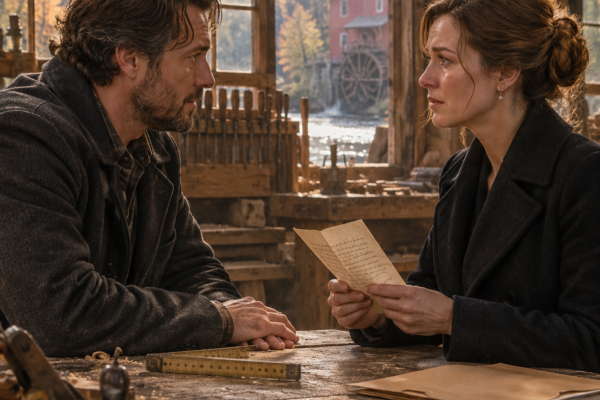
“Why don’t you ever say thank you to Daddy?”
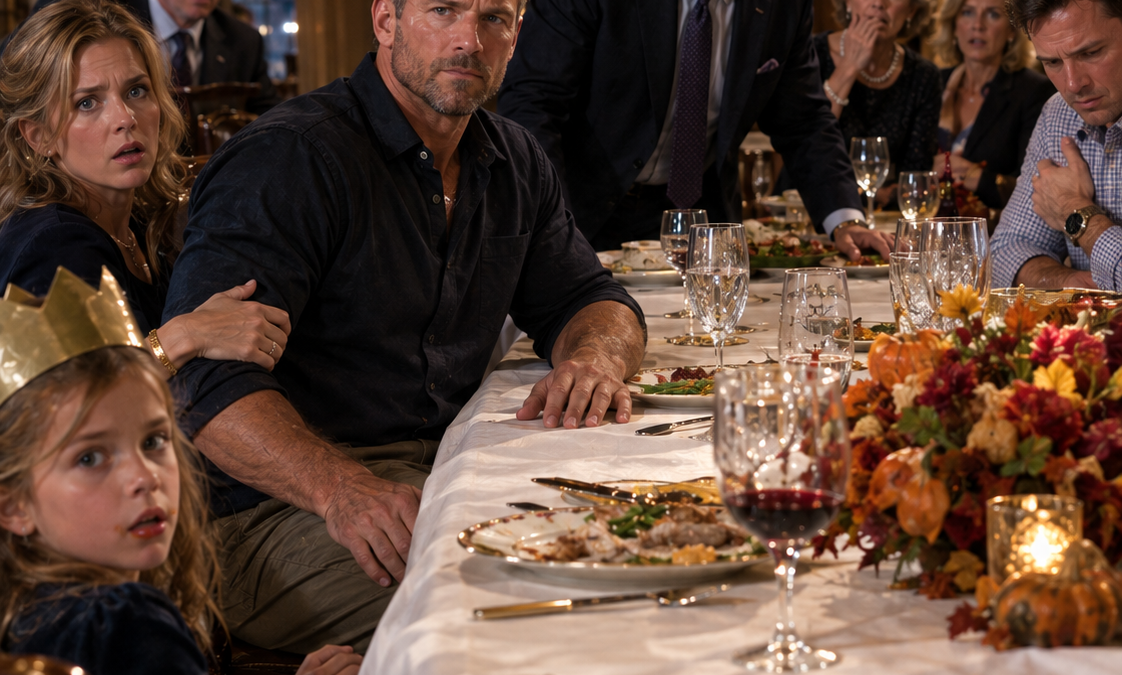
“My father-in-law raised his glass to make a toast, and my six-year-old daughter destroyed him with a single question. He was standing at the head of the table. White tablecloths. Fine china that had been in his wife’s family for three generations.”
They thought the quiet son-in-law would always stay invisible → They learned he was the reason their son was alive, and the truth cost them everything they’d built on lies.
He was standing at the head of the table. White tablecloths. Fine china that had been in his wife’s family for three generations. Twenty-two people watching him. He had that look on his face — the one he got when he was about to say something that sounded generous but wasn’t.
“To family,” he said. “To the people who built something worth building.”
What he didn’t know was that a man I’d carried out of a burning building in Fallujah was sitting in his driveway, waiting for the right moment to walk through that door.
My name is Daniel Kessler. I’m forty-three years old. I spent twelve years as a U.S. Navy SEAL, eight of them with Team Six, and I retired as a Senior Chief Petty Officer after a mission in the Hindu Kush that broke my back and killed two men I loved.
I never told my wife’s family any of that.
Not because I was hiding it. Because they never asked.
The Thanksgiving table was my father-in-law’s stage. Harold Pemberton. Sixty-eight years old. Retired investment banker. Owned a house in Greenwich that had been photographed for a magazine I’d never heard of. He collected wine and opinions, and he shared both whether you wanted them or not.
He’d been giving toasts at that table for thirty years. Every holiday. Every birthday. Every time he managed to gather enough people to listen.
The toast was still hanging in the air when Ellie spoke up.
She was sitting between me and my wife, Claire. Her feet didn’t reach the floor. She had a smear of cranberry sauce on her chin and a paper crown from the kids’ table on her head.
“Grandpa?”
Harold lowered his glass. “Yes, sweetheart?”
“Why don’t you ever say thank you to Daddy?”
The room went quiet. Not the kind of quiet where people are waiting for someone to laugh. The kind where forks stop moving and someone’s glass makes a sound when it touches the table because their hand isn’t steady anymore.
Harold blinked. “What do you mean, honey?”
“For saving Uncle Dan,” Ellie said. She said it like it was the most obvious thing in the world. “Daddy saved Uncle Dan. He pulled him out of the fire. So why don’t you say thank you?”
I felt Claire’s hand find mine under the table. Her fingers were cold.
Across the table, Dan Pemberton — Harold’s youngest son, Claire’s brother — had gone the color of the tablecloth. He was thirty-six years old. He ran a hedge fund in Manhattan. He wore a Rolex that cost more than my first car.
He also had a scar on his left arm that ran from his elbow to his wrist. A burn scar. A souvenir from a night in a Fallujah safe house that had gone wrong in every possible way.
Nobody at that table knew that story. Not even Claire. Not really.
I’d told her pieces. She knew I’d served. She knew I’d been deployed. She knew I had nightmares sometimes and that I didn’t like fireworks.
She didn’t know about Dan.
Harold set his glass down. His hand wasn’t quite steady either.
“Ellie,” he said. “That’s not— I don’t think that’s something we need to discuss at the table.”
“Why not?”
“Because it’s complicated, sweetheart.”
“It’s not complicated,” Ellie said. “Daddy told me. He said Uncle Dan was in trouble and he went and got him. That’s not complicated.”
Twenty-two people. Every single one of them looking at me now.
I kept my face still. I’d learned how to do that a long time ago. In rooms where showing anything meant giving something away. In places where the wrong expression could get you killed.
“Daniel,” Harold said. His voice had changed. It had that edge now — the one he used when he was trying to regain control of a situation. “Perhaps you’d like to explain what my granddaughter is talking about?”
I looked at him.
I thought about the fourteen years I’d known this man. The dinners where he’d asked about my “work” with a tone that made it clear he didn’t consider it real work. The Christmas when he’d introduced me to his golf buddies as “Claire’s husband, he does something with security.” The way he’d never once asked me what I did overseas. The way he’d never once wanted to know.
I thought about the fact that his son was alive because of me. And that he’d spent a decade pretending that debt didn’t exist.
“I don’t think this is the right time,” I said.
It was the calmest thing I could have said. It was the calmest thing I could have done.
Harold’s jaw tightened. He didn’t like being managed. He didn’t like being told what the right time was.
“The right time,” he repeated. “You’ve been part of this family for fourteen years, Daniel. I think if there’s something my granddaughter knows that I don’t, perhaps it’s time we all heard it.”
Claire squeezed my hand.
Ellie looked up at me with those big eyes. She didn’t understand what she’d done. She was six. She’d asked an honest question at an honest moment because that’s what six-year-olds do.
I looked at Dan.
He was staring at his plate. His scarred arm was pressed flat against the table. He hadn’t said a word.
“Dan,” I said. “You want to take this one?”
He looked up. His eyes were wet.
“I’m sorry,” he said. “I’m sorry, Danny.”
That’s when the doorbell rang.
I need to go back.
I need to explain how we got to that table. How I ended up married to Harold Pemberton’s daughter and spending every Thanksgiving in a house where I was tolerated but never welcomed.
I met Claire in 2009. I was twenty-nine years old. I’d been a SEAL for seven years. I was home on leave between deployments, and she was a third-year law student at Georgetown who’d come to a bar with friends and ended up sitting next to me because the only other open seat was next to a guy who was already too drunk to form sentences.
She asked what I did.
I said I was in the Navy.
She asked what I did in the Navy.
I said it was complicated.
She laughed. She said that was the most military answer she’d ever heard.
We talked for four hours. She told me about her father, about the pressure he put on her, about how she’d spent her whole life trying to be something he could respect. I told her about growing up in Ohio, about my mother who died when I was twelve, about my father who worked two jobs and never complained.
I didn’t tell her I was a SEAL. Not that night. Not for six months.
When I finally did, she didn’t believe me at first. Not because I didn’t look the part. Because I didn’t act the part. I wasn’t loud. I wasn’t aggressive. I didn’t talk about it. I just was what I was.
She learned. She learned about the training, about the deployments, about the men I’d lost. She learned about the way I couldn’t sleep in a room with the door locked. She learned about the way I woke up sometimes with my hands already moving, reaching for something that wasn’t there.
She loved me anyway.
Her father didn’t.
Harold Pemberton had spent his whole life building things. Money. Connections. A reputation. His daughter was supposed to marry someone who added to that. A lawyer. A banker. A politician.
Not a soldier.
The first time I met him, he shook my hand and asked what I did. I told him I was in the military. He nodded, said “interesting,” and spent the rest of the evening talking to Claire’s cousin who worked at Goldman Sachs.
That was fourteen years ago.
It never got better.
The doorbell rang again.
Harold looked toward the front of the house. Nobody moved. His wife, Margaret, started to get up, but he waved her back down.
“Who is that?” he said. “Are we expecting someone?”
Nobody answered.
The doorbell rang a third time.
“I’ll get it,” I said.
I stood up. I was calm. I was always calm. That was the thing Harold never understood. He thought calm meant weak. He thought stillness meant passivity. He’d never been in a room where the calmest man was the most dangerous.
I walked through the dining room, past the china cabinet that Margaret had inherited from her mother, past the photos on the wall — Harold and Margaret at their anniversary party, Claire at her law school graduation, Dan at his wedding to a woman nobody in the family liked.
I opened the front door.
The man on the porch was older than me by about ten years. His hair was gray now, cut short and practical. He had a face that looked like it had been through weather and war and everything in between. He was wearing a plain blue button-down and jeans that had seen better days.
He was holding a bottle of whiskey in one hand and a manila envelope in the other.
“Daniel Kessler,” he said.
“Marcus,” I said.
Marcus Webb. Master Chief Petty Officer, retired. Twenty-two years in the Teams. Eight of them with me. The man who’d taught me everything I knew about staying alive and most of what I knew about being a good man.
I hadn’t seen him in six years.
“You look good,” he said. “Civilian life agrees with you.”
“What are you doing here?”
He held up the envelope. “I need to talk to you about something. Something that couldn’t wait.”
I looked past him at the driveway. A rental car. He’d flown in. He’d come across the country on Thanksgiving to find me.
“What’s in the envelope?”
“The truth,” he said. “The version that got buried.”
I let him in.
What else was I going to do? He was my brother. Not by blood, but by something stronger. I’d carried him once. He’d carried me. We’d bled together, killed together, lost men together. There was no version of me that turned him away.
I walked him into the dining room.
Twenty-two people looked up. Harold’s face was a mask of irritation. Claire’s was a mask of confusion. Dan’s was a mask of pure terror.
“Everyone,” I said. “This is Marcus Webb. He’s an old friend.”
Marcus stood in the doorway. He didn’t smile. He didn’t offer to shake hands. He looked at the table like he was assessing a room for threats.
“Sorry to interrupt,” he said. “I wouldn’t have come if it wasn’t important.”
Harold stood up. He’d recovered some of his composure. He was in his house, at his table, surrounded by his people. He was in control.
“Mr. Webb,” he said. “I don’t believe we’ve met. I’m Harold Pemberton. This is my home. Perhaps you’d like to explain what this is about?”
Marcus looked at me.
Then he looked at Dan.
Then he looked at Harold.
“I’m here,” he said, “because your son is a liar. And I’m tired of watching him get away with it.”
The room exploded.
Not physically. But the sound of twenty-two people all trying to talk at once was close enough.
Margaret was on her feet. Dan was shaking his head. Claire was looking at me like she’d never seen me before. Ellie was crying, because she was six and the room was loud and scary and she didn’t understand what she’d done.
Harold was screaming.
“How dare you,” he said. “How dare you come into my home and—”
“Harold,” I said.
He stopped.
I don’t know why. Maybe it was something in my voice. Maybe it was the way I was standing. Maybe it was the fact that after fourteen years of being the quiet one, the one who never pushed back, the one who let everything roll off his back, I’d finally decided to stand still in a different way.
“Let him talk,” I said. “You wanted to know what Ellie was talking about. Marcus is going to tell you.”
Marcus opened the envelope.
He pulled out a piece of paper. A citation. The kind that the Navy gives out when someone does something that can’t be publicly acknowledged.
“This is a redacted copy of the after-action report for a mission that took place in Fallujah, Iraq, on March 17, 2006,” he said. “The mission is still classified. I can’t tell you the details. But I can tell you this.”
He looked at Dan.
“Your son was working for a private security contractor. He wasn’t supposed to be there. He was running supplies to a forward operating base, and he took a wrong turn, and he ended up in a part of the city that we were about to level.”
Dan was crying now. Silent tears running down his face.
“We didn’t know he was there,” Marcus said. “We didn’t know anyone was there. The building was supposed to be empty. But it wasn’t. And when the shooting started, he got hit. Not bad. But bad enough. And he couldn’t move.”
He looked at me.
“Your son-in-law went in alone. Against orders. Against protocol. Against every rule we had. He went into a building that was on fire, that was surrounded by hostiles, that we were about to call an airstrike on, and he pulled your son out.”
The room was silent.
“He carried him six hundred meters,” Marcus said. “With a bullet in his own leg. He carried him to the extraction point, and he put him on the helicopter, and then he collapsed. He spent three weeks in a hospital in Germany. He still has a piece of shrapnel in his spine that can’t be removed.”
He set the paper on the table.
“Your son is alive because of him,” he said. “And you’ve spent fourteen years treating him like he’s not good enough for your family.”
Harold was pale.
His hands were shaking. He looked at Dan, and Dan wouldn’t look back.
“Is this true?” Harold said. “Daniel. Is this true?”
I didn’t answer.
I was looking at Claire. She had her hand over her mouth. Tears were streaming down her face. She was looking at me like she was seeing me for the first time.
“Why didn’t you tell me?” she whispered.
“Because he asked me not to,” I said.
I looked at Dan.
“Tell them,” I said. “Tell them why.”
Dan was sobbing now. Full, ugly, uncontrolled sobbing. The kind of crying that comes from holding something in for too long.
“I was ashamed,” he said. “I was ashamed that I needed help. I was ashamed that I got lost. I was ashamed that I almost died because I was stupid. And I knew if I told Dad, if I told anyone, they’d look at me differently. They’d see me as weak.”
He looked at Harold.
“You always wanted me to be strong,” he said. “You always wanted me to be the one who didn’t need help. And I couldn’t be that. Not that night. Danny was the strong one. Danny was the one who saved me. And I couldn’t admit that.”
Harold sank back into his chair.
He looked old. Older than I’d ever seen him. The confidence was gone. The control was gone. He was just a man who’d spent fourteen years being wrong about something and had just found out.
“Daniel,” he said. “I—”
“Don’t,” I said.
I wasn’t angry. That was the thing. I wasn’t angry at all. I’d made peace with Harold Pemberton a long time ago. I’d accepted that he was never going to see me the way I wanted him to see me. I’d accepted that I was always going to be the son-in-law who didn’t quite fit.
But Ellie had asked a question. And the truth had come out. And now Harold had to live with it.
“I don’t need your apology,” I said. “I never did. I need you to understand something.”
I looked at him. Calm. Steady. The way I’d been trained to be.
“I’ve been in rooms where people died. I’ve been in situations where there were no good options and I had to choose the least bad one. I’ve carried men who were already gone and I’ve held men while they bled out. I’ve done things you will never know about, and I’ve seen things you will never understand.”
I paused.
“None of that makes me better than you. But it makes me different. And for fourteen years, you’ve treated different like it meant less. Like it meant I wasn’t good enough for your daughter. Like it meant I wasn’t worth knowing.”
Harold opened his mouth.
I didn’t let him speak.
“You don’t have to say thank you,” I said. “You don’t have to say anything. But you need to understand that the only reason your son is alive is because I did something you could never do. And the only reason you know that now is because your granddaughter asked an honest question at an honest moment.”
I looked at Ellie.
She was still crying. But she was looking at me with those big eyes, and she was listening.
“Daddy’s okay,” I said. “Daddy’s always okay.”
She nodded.
I looked back at Harold.
“I’m going to take my daughter upstairs,” I said. “And when I come back down, we’re going to finish this conversation. But it’s going to happen on my terms. Not yours.”
I picked up Ellie. She wrapped her arms around my neck. I carried her out of the room.
Behind me, I heard Marcus sit down at the table.
“I’ll have that whiskey now,” he said. “If you don’t mind.”
I put Ellie to bed in the guest room.
She had a million questions. I answered the ones I could. The ones I couldn’t, I told her I’d answer when she was older.
“Is Uncle Dan okay?” she asked.
“Uncle Dan is fine,” I said. “He just made a mistake a long time ago, and he was scared to admit it.”
“Did you save him?”
“Yes.”
“Were you scared?”
I thought about it. About the fire. About the bullets. About the way Dan had looked at me when I found him, like he’d already accepted he was going to die.
“Yeah,” I said. “I was scared.”
“But you did it anyway?”
“That’s what you do,” I said. “When someone needs help, you help them. Even if you’re scared. Especially if you’re scared.”
She nodded. She was six. She didn’t understand everything. But she understood that.
“I love you, Daddy,” she said.
“I love you too, baby.”
She fell asleep in about thirty seconds. Kids are like that. They can go from crying to sleeping like flipping a switch.
I sat there for a while. Watching her breathe. Thinking about what was waiting for me downstairs.
Marcus had come across the country on Thanksgiving. He’d brought a classified document into a civilian house. He’d done something that could get him in serious trouble, all because he was tired of watching me get disrespected.
I didn’t ask him to do that. I would never have asked him to do that.
But I understood why he did.
I went back downstairs.
The dining room was quiet. Marcus was sitting at the head of the table now. Harold’s seat. Harold was sitting at the other end, looking like a man who’d just been told he had six months to live.
Margaret was crying. Claire was holding her hand.
Dan was gone. I found out later he’d left through the back door. He’d gotten in his car and driven home without saying goodbye to anyone.
The rest of the family was scattered around the room. Some of them were talking in low voices. Some of them were looking at me like I was a stranger.
I sat down across from Harold.
“I’m not going to apologize,” I said. “I didn’t do anything wrong.”
“I know,” he said.
“Do you?”
He looked up. His eyes were red. He’d been crying too.
“I don’t know what to say,” he said. “I don’t know how to make this right.”
“You can’t,” I said. “Not tonight. Maybe not ever. But that’s not what I’m asking for.”
“What are you asking for?”
I leaned back in my chair.
“I’m asking you to look at me,” I said. “Right now. Look at me and tell me what you see.”
He looked at me.
He was quiet for a long time.
“I see a man who saved my son,” he said. “I see a man who’s been part of my family for fourteen years, and I never bothered to know him. I see someone I misjudged.”
“Good,” I said. “That’s a start.”
I stood up.
“I’m going to go home,” I said. “Claire and Ellie are going to come with me. We’re going to have Thanksgiving at our house next year. You’re welcome to come, but only if you’re ready to treat me like a person and not a problem.”
Harold nodded.
“I’ll be there,” he said.
“We’ll see.”
I walked out of the room.
Claire followed me.
That night, after we got home, after Ellie was asleep in her own bed, Claire sat down next to me on the couch.
“Why didn’t you tell me?” she said.
“About Dan?”
“About all of it. About what you did. About what you’ve been carrying.”
I thought about how to answer.
“Because it’s not something I talk about,” I said. “Because it’s not something I’m proud of in the way you think. Because I did what I had to do, and it doesn’t make me special, and I didn’t want you to look at me differently.”
“I wouldn’t have.”
“You would have. Maybe not in a bad way. But you would have. You would have seen me as something I’m not.”
She was quiet for a minute.
“What are you, then?” she said.
I looked at her.
“I’m a man who did his job,” I said. “I’m a man who tried to be good in situations where good didn’t always exist. I’m a man who’s carrying things that I’ll never be able to put down. And I’m a man who loves you more than anything in the world.”
She leaned into me.
“I’m sorry,” she said.
“For what?”
“For not knowing. For not asking. For letting my father treat you the way he did.”
“You didn’t let him do anything,” I said. “He did what he did. I let it happen. That was my choice.”
“Why?”
“Because I thought it was worth it. To be with you. To have Ellie. To have this life. I thought I could carry it.”
She looked up at me.
“Can you?”
I held her.
“Yeah,” I said. “I can carry it. But I shouldn’t have to.”
She nodded.
“I’m going to talk to him,” she said. “I’m going to tell him he needs to change. And if he doesn’t, we’re done.”
“Claire—”
“I mean it, Danny. I’m not going to let him treat you like that anymore. I should have said something years ago. I’m saying it now.”
I didn’t argue. She was right. And she was strong. She always had been.
“What about Dan?” I said.
“I’ll call him tomorrow. He needs to know I don’t blame him. I blame Dad.”
I nodded.
We sat there for a while. Not talking. Just breathing.
“What happens now?” she said.
“I don’t know,” I said. “I guess we wait and see.”
The next morning, my phone rang at six a.m.
Marcus.
“Hey,” I said. “You okay?”
“Your father-in-law called me,” he said. “At midnight. Woke me up.”
“What did he want?”
“He wanted to know if it was true. All of it. He wanted to know if there was more.”
“What did you tell him?”
“I told him the truth. He’s not going to like it. But he deserves to know.”
I sat up in bed. Claire was still asleep next to me.
“What did he say?”
“He said he wanted to make things right. He said he wanted to do something for you.”
“He can’t buy my forgiveness.”
“I know. I told him that. But he’s not trying to buy it. He’s trying to earn it.”
I didn’t say anything.
“There’s more,” Marcus said.
“Of course there is.”
“Dan called me too. He’s been carrying something for fourteen years. He’s been carrying the guilt. Not just of being saved. Of letting you take the blame for it.”
“What do you mean?”
“Your father-in-law didn’t know you’d saved Dan. He knew there was an incident. He knew Dan had been hurt. But Dan told him it was a training accident. He told him he got burned in a vehicle fire. He never told him the truth.”
“He lied.”
“He lied. And he let you be the one who was dismissed and disrespected, because he was too much of a coward to admit he needed help.”
I closed my eyes.
“I’m not going to tell you what to do,” Marcus said. “But I think you need to hear the whole story before you decide how this ends.”
“Okay,” I said. “I’ll listen.”
That afternoon, I went to see Dan.
He lived in a condo in the city. A nice place. The kind of place a successful hedge fund manager could afford. He was sitting on his couch when I got there, and he looked like he hadn’t slept.
“Hey,” I said.
“Hey.”
He didn’t get up. He just looked at me. His eyes were red.
“I’m sorry,” he said.
“I know.”
“I should have told them. I should have told Dad. I should have told everyone. I should have been the one who defended you, instead of letting you take all the shit.”
I sat down in the chair across from him.
“Why didn’t you?”
He looked at the floor.
“Because I was ashamed,” he said. “Because when you came back from Fallujah, you were the hero. You were the one who did something incredible. And I was the guy who got lost and needed to be rescued. I didn’t want to be that guy.”
“So you let me be the guy who was just married to his sister.”
“I didn’t plan it like that. It just happened. Every time Dad made a comment, I wanted to say something. But I never did. And then it got easier. It got easier to just let it be.”
He looked up.
“I’m not asking for your forgiveness. I don’t deserve it. I just want you to know that I know. I know what I did. And I’m sorry.”
I was quiet for a long time.
“I’m not going to forgive you tonight,” I said. “Maybe not ever. But I don’t hate you. You were scared. You made a bad choice. That doesn’t make you evil. It makes you human.”
He nodded.
“Dad is going to call you,” he said. “He wants to do something. A dinner. A ceremony. Something to make it right.”
“I know.”
“Are you going to do it?”
I stood up.
“I don’t know,” I said. “I’ll decide when he asks me.”
Harold called me that night.
He asked if I would come to dinner. Just family. No speeches. No toasts. Just a conversation.
I said yes.
I wasn’t sure why. Maybe because I was tired of being angry. Maybe because I wanted to give him a chance. Maybe because Claire asked me to.
The dinner was at their house. The same table. The same china. The same twenty-two people.
But everything was different.
Harold didn’t make a speech. He didn’t make a toast. He sat at the table and he listened. He asked me questions. About my training. About my deployments. About the men I served with.
I answered. Not all of it. Not the classified parts. But enough.
He looked at me differently. Not like a problem to be managed. Like a person to be understood.
After dinner, he pulled me aside.
“I know you don’t need an apology,” he said. “But I’m going to give you one anyway.”
I waited.
“I spent fourteen years treating you like you weren’t good enough for my family. I was wrong. You’re more than good enough. You’re the best man I know.”
I didn’t say anything.
“I’m not asking you to forgive me,” he said. “I’m asking you to give me a chance. To do better.”
I looked at him.
“You can have a chance,” I said. “But you only get one. If you go back to the way you were, I’m gone. And so is Claire. And so is Ellie.”
He nodded.
“I understand.”
“I mean it, Harold. I’m not going to let my daughter grow up watching her father be disrespected.”
“I know.”
He held out his hand.
I shook it.
It wasn’t forgiveness. It wasn’t a fresh start. It was just a chance. And for now, that was enough.
PART 2 — THE WEEK AFTER
Harold called me three times in the week after Thanksgiving.
I didn’t answer the first two. Not because I was being petty. Because I didn’t know what to say. The man had spent fourteen years treating me like a piece of furniture that happened to be married to his daughter. One dinner and a handshake wasn’t going to change that.
The third call, I answered.
“Daniel,” he said. “I’d like to have lunch. Just the two of us.”
“Why?”
“Because I don’t know you,” he said. “And I’d like to.”
I almost said no. I had a hundred reasons. Work. Ellie’s school schedule. The fact that I didn’t owe him anything.
But Claire had been looking at me differently since Thanksgiving. Not in a bad way. In a way that said she was proud of me. In a way that said she was waiting to see what I’d do next.
“Friday,” I said. “One o’clock. I’ll pick the place.”
I picked a diner in Jersey. Not because I couldn’t afford better. Because I wanted to see how Harold handled being out of his element.
He handled it about as well as I expected.
He walked in wearing a suit that cost more than the diner’s monthly rent. He looked around at the cracked vinyl booths and the faded menus and the old man behind the counter who’d been flipping eggs there since before I was born.
“This is… charming,” he said.
“It’s a diner.”
“I can see that.”
He sat down across from me. He ordered coffee. Black. He didn’t touch it.
“I don’t know how to do this,” he said.
“Do what?”
“Talk to you. Like a person. I’ve spent fourteen years talking to you like you were a problem I had to tolerate.”
“You did.”
“I know.”
He looked at his coffee. He looked at the window. He looked at everything except me.
“I want to tell you something,” he said. “Something I should have told you a long time ago.”
I waited.
“When Claire told me she was marrying you, I was angry. Not because of you. Because of what you represented.”
“What did I represent?”
“Uncertainty. Risk. A life I couldn’t control. I spent my whole career managing risk. I built my life on predictability. And then my daughter brought home a man who jumped out of airplanes for a living.”
He paused.
“I didn’t know how to handle that. So I did what I always do when I don’t know how to handle something. I dismissed it.”
I took a sip of my coffee.
“That’s a nice explanation,” I said. “It doesn’t change anything.”
“I know. I’m not trying to change anything. I’m trying to explain.”
“Okay. You’ve explained. Now what?”
He looked at me.
“Now I want to know what I missed. Fourteen years of it.”
I didn’t give him everything.
Some things are classified. Some things are mine. Some things I don’t talk about with anyone, not even Claire, not even Marcus.
But I gave him more than I’d ever given anyone who wasn’t in the Teams.
I told him about BUD/S. About the cold water and the sand and the instructors who screamed in my face for six months straight. About the day I almost quit and the man who talked me out of it.
I told him about my first deployment. About the night I lost a man I’d known since training. About the way his blood felt on my hands and the way I couldn’t wash it off for days.
I told him about Fallujah. Not everything. But enough.
He listened.
He didn’t interrupt. He didn’t try to relate. He just listened.
When I was done, he was quiet for a long time.
“I had no idea,” he said.
“That’s the point.”
“I know.”
He looked at me.
“You saved my son. And I treated you like you were nothing. For fourteen years.”
“You did.”
“I don’t know how to make that right.”
“You can’t.”
“I know.”
He was quiet again.
“What can I do?” he said. “What can I possibly do?”
I thought about it.
“Be better,” I said. “Not for me. For Ellie. She’s going to grow up watching how you treat me. She’s going to learn from it. If you keep treating me like I don’t matter, she’s going to learn that’s how people treat their family.”
He nodded.
“I will,” he said. “I promise.”
“Don’t promise me. Show me.”
The next few weeks were strange.
Harold started calling me. Not every day. But more than he ever had. He asked about my work. He asked about Ellie. He asked if there was anything he could do.
He came to Ellie’s school play. Sat in the third row. Clapped louder than anyone when she came on stage.
He invited us to dinner. Not a holiday. Just a regular Sunday dinner. He didn’t make a toast. He didn’t make a speech. He just sat and ate and asked questions and listened to the answers.
It wasn’t perfect. He still had a way of saying things that made me want to leave the room. He still had that banker’s voice, the one that sounded like he was always about to give you a performance review.
But he was trying.
And Claire noticed. She noticed the way he looked at me now. The way he said my name. The way he stopped treating me like a problem and started treating me like a person.
“It’s different,” she said one night. “He’s different.”
“He’s trying.”
“You don’t think he means it?”
I thought about it.
“I think he means it right now,” I said. “I don’t know if he’ll mean it in six months.”
“You’re such a pessimist.”
“I’m a realist. There’s a difference.”
She laughed. She was good at that. Finding the humor in things that weren’t funny.
“I’m proud of you,” she said. “For how you handled all of this.”
“I didn’t handle anything. I just stood there and let it happen.”
“That’s handling it. Most people would have blown up. Most people would have screamed. You just stood there and let the truth do the work.”
I didn’t say anything. She was right. That was the thing I’d learned in the Teams. The loudest guy in the room is usually the one who’s about to lose. The calm one is the one you have to worry about.
“Marcus is still in town,” I said. “He’s been staying at a hotel near the airport.”
“Have you seen him?”
“A few times. We had dinner last week.”
“How is he?”
“He’s Marcus. He’s fine. He’s always fine.”
She looked at me.
“You should ask him to stay with us. He came all the way across the country for you.”
“He came because he was worried about me.”
“Same thing.”
She was right. I called Marcus that night and told him to check out of the hotel. He argued for about thirty seconds. Then he said he’d be over in the morning.
Marcus moved into the guest room.
It was strange having him there. Strange in a good way. He woke up early and made coffee. He helped Ellie with her homework. He told her stories that were slightly edited versions of things we’d actually done.
“Daddy jumped out of a helicopter once,” he told her one afternoon.
“Did you?” she asked.
“Not on purpose,” I said.
“He’s being modest,” Marcus said. “He jumped out of a helicopter into the ocean in the middle of the night. In a storm. To rescue a guy who’d fallen overboard.”
“Was the guy okay?”
“Yeah,” Marcus said. “The guy was okay.”
Ellie looked at me with those big eyes.
“Did you save him?”
“Someone else saved him,” I said. “I just helped.”
Marcus snorted.
“He saved him,” he said. “Don’t let him tell you otherwise.”
Ellie hugged me. I hugged her back.
That night, after she was asleep, Marcus and I sat on the back porch. He had a beer. I had a glass of water. It was cold. Late November. The kind of cold that gets into your bones.
“How are you doing?” he asked.
“Fine.”
“Bullshit.”
“Okay,” I said. “I’m tired. I’ve been tired for fourteen years.”
He nodded.
“That’s the thing nobody tells you,” he said. “You get out, and you think the hard part’s over. But the hard part’s just starting. You spend years in a world where everything makes sense. Where there’s a mission and a team and a clear objective. And then you come home and everything’s gray.”
“I know.”
“And the people around you don’t get it. They see a guy who’s a little quiet. A little distant. They don’t see the stuff you’re carrying.”
“I know.”
He looked at me.
“Why didn’t you ever tell them? About Dan? About any of it?”
I thought about it.
“Because it didn’t matter,” I said. “Or I thought it didn’t. I thought if I just kept my head down and did my job and took care of my family, that would be enough. I didn’t need them to understand. I just needed them to leave me alone.”
“That worked out well.”
“It worked out the way it worked out.”
He took a drink of his beer.
“Your father-in-law’s trying.”
“I know.”
“You think he’s going to stick with it?”
“I don’t know. I hope so. Not for me. For Claire. For Ellie. She deserves to have a family that isn’t at war with itself.”
He nodded.
“You’re a good man, Danny.”
“I’m a man who’s trying not to make things worse.”
“That’s the same thing.”
The following week, Harold called me again.
He wanted to have a family meeting. Not a dinner. A real meeting. He said there were things he needed to say to everyone. Things he needed to set right.
“What kind of things?” I asked.
“Financial things. Family things. Things I’ve been putting off for too long.”
I didn’t like the sound of it. Harold was a man who controlled everything. If he was suddenly talking about setting things right, it meant he was planning something.
“What are you up to?” I asked.
“Nothing. I just want to make sure everyone knows where they stand.”
“Where they stand on what?”
There was a pause.
“I’m sixty-eight years old, Daniel,” he said. “I’m not going to live forever. I want to make sure my affairs are in order.”
It made sense. It also made me uneasy. But I didn’t say anything. Harold was a grown man. He could do what he wanted.
“Fine,” I said. “When?”
“Next Saturday. Two o’clock. My house.”
“I’ll be there.”
That conversation stayed with me.
I didn’t know why. It wasn’t the words. It was the way he’d said them. There was something underneath. Something he wasn’t telling me.
I mentioned it to Marcus.
“He’s up to something,” I said.
“Of course he is. He’s a banker. They’re always up to something.”
“I’m serious. He’s not just talking about his will. He’s talking about something else.”
Marcus looked at me.
“Like what?”
“I don’t know. That’s what worries me.”
He was quiet for a minute.
“You want me to look into him?”
“Look into him how?”
“I’ve got contacts. People who can pull records. Financial stuff. If he’s planning something that’s going to hurt you, I can find out before it happens.”
I thought about it.
“No,” I said. “Not yet. Let’s see what he says on Saturday first.”
“You sure?”
“Yeah. I don’t want to go down that road unless I have to.”
He nodded.
“Your call.”
Saturday came faster than I expected.
Claire and I drove over with Ellie. Marcus stayed home. He said he didn’t want to be in the room for family business. I think he just didn’t want to be in the same room as Harold longer than necessary.
The house was the same as always. White columns. Manicured lawn. The kind of place that looked like it belonged in a magazine.
Harold greeted us at the door. He looked tired. More tired than he had at Thanksgiving.
“You okay?” Claire asked.
“Fine,” he said. “Just a long week.”
We went into the living room. Margaret was there. So was Dan. So was Claire’s older brother, Richard, and his wife, Patricia. Richard was a lawyer in Boston. He’d always been the golden child. The one who did everything right.
There were others too. Harold’s brother, Charles. Margaret’s sister, Elaine. A few cousins I’d met once or twice.
It was a full house.
Harold stood at the front of the room. He had a folder in his hands. He looked at everyone.
“Thank you for coming,” he said. “I know this is short notice. But there are things I need to say. Things I should have said a long time ago.”
He opened the folder.
“First,” he said, “I want to apologize to Daniel.”
The room went quiet.
“Fourteen years ago, my daughter brought home a man I didn’t understand. A man who served his country. A man who risked his life for people he didn’t know. And instead of welcoming him, I dismissed him. I treated him like he didn’t matter.”
He looked at me.
“I was wrong. And I’m sorry.”
I nodded. I didn’t say anything.
“Second,” he said, “I want to make some changes. Changes to how this family operates.”
He pulled out a piece of paper.
“I’ve been thinking about what happened at Thanksgiving. About what I learned. And I’ve realized that I’ve been holding onto things that don’t matter. Control. Appearances. The idea that I always have to be the one in charge.”
He paused.
“I’m stepping back,” he said. “From the business. From the family trust. From all of it.”
The room erupted.
Richard was on his feet. “What do you mean, stepping back?”
“Exactly what I said. I’m retiring. Effective immediately.”
“You can’t do that.”
“I can. And I am.”
“You don’t have the authority. The trust has rules. The business has shareholders.”
Harold held up a hand.
“I’ve already talked to the lawyers. I’ve already filed the paperwork. As of Monday, control of the trust passes to a board. A board made up of family members.”
“Which family members?”
Harold looked at me.
“Daniel,” he said. “And Claire. And Dan.”
The room went silent again.
“Are you insane?” Richard said. “He’s not even family. Not by blood.”
“He’s family by marriage. And he’s family by something more important than blood. He’s family because he earned it.”
Richard looked at me. His face was red.
“This is ridiculous. He’s a soldier. He doesn’t know anything about business. He doesn’t know anything about money.”
“He knows about loyalty,” Harold said. “He knows about sacrifice. He knows about doing the right thing when it’s hard. That’s more than I can say for some people in this room.”
Richard stormed out.
Patricia followed him.
A few others left too. Charles. Elaine. They didn’t say anything. They just got up and walked out.
When the room cleared, there were only a few of us left. Me. Claire. Dan. Margaret. Harold.
“Well,” Harold said. “That went better than I expected.”
I didn’t know what to say.
I’d spent fourteen years being invisible to this family. Now Harold was handing me control of a trust worth more money than I’d ever see in my life.
“I don’t want this,” I said.
Harold looked at me.
“I know.”
“Then why are you giving it to me?”
“Because I don’t trust anyone else to do the right thing. I trust you.”
“I’m not a businessman.”
“You’re a leader. That’s more important.”
I shook my head.
“I don’t know anything about running a trust. I don’t know anything about investments. I don’t know anything about any of this.”
“You’ll learn. And you’ll have help.”
He looked at Claire.
“Claire knows more about this than she lets on. She’s been watching me for years. She knows how everything works.”
Claire looked surprised.
“Dad—”
“I know you’ve been studying the books. I know you’ve been following the market. I know you’ve been waiting for your chance.”
She didn’t say anything.
“I’m giving you that chance,” Harold said. “Both of you.”
I looked at Claire. She looked at me.
“What do you think?” I said.
“I think we should try.”
“Try what? Running a family trust? We don’t know anything about that.”
“We know how to be responsible. We know how to care about people. That’s a start.”
I thought about it.
“Okay,” I said. “We’ll try.”
Harold nodded.
“Good.”
He closed the folder.
“There’s one more thing,” he said.
“Of course there is.”
“I’ve been having some health problems.”
The room went cold.
“What kind of health problems?” Claire asked.
“Nothing to worry about. Just some tests. The doctors want to run more.”
“What kind of tests?”
“Cardiac tests. My heart’s been acting up.”
Claire went pale.
“Dad—”
“I’m fine. Really. I just wanted you to know. In case.”
“In case what?”
“In case something happens.”
He looked at me.
“That’s why I wanted to do this now. I wanted to make sure everything was in order. In case something happens.”
I didn’t say anything. I was looking at Harold, and I was seeing something I hadn’t seen before. Fear.
Harold Pemberton was afraid.
We left an hour later.
Claire was quiet on the drive home. So was I. Ellie was in the back seat, playing on her tablet, oblivious to everything.
When we got home, Marcus was waiting.
“How did it go?”
“Harold’s giving us control of the trust,” I said.
Marcus raised his eyebrows.
“That’s unexpected.”
“He’s sick.”
Marcus looked at me.
“How sick?”
“He says it’s nothing. But I saw his face. He’s scared.”
“Cardiac?”
“That’s what he said.”
Marcus was quiet for a minute.
“That changes things,” he said.
“What do you mean?”
“I mean it changes things. If he’s sick, he’s not going to be around forever. And if he’s handing you control of the trust, that means you’re going to be the one dealing with the fallout.”
“What fallout?”
“The family. Richard. Charles. Elaine. They’re not going to take this lying down. They’re going to fight.”
“I can handle them.”
“You can handle a lot of things. But this is different. This is money. Family money. People do crazy things when money is involved.”
I thought about it.
“I know.”
“Then what are you going to do?”
“I’m going to do what I always do. I’m going to stay calm. I’m going to be ready. And I’m going to protect my family.”
Marcus nodded.
“That’s what I thought.”
He looked at me.
“But you’re going to need help.”
“I know.”
“You want me to call some people?”
I thought about it. Marcus had contacts. People he’d served with. People who knew how to handle things that weren’t always legal.
“No,” I said. “Not yet. Let’s see what happens first.”
“Your call.”
That night, I couldn’t sleep.
I lay in bed and stared at the ceiling and thought about Harold. About the way he’d looked when he said he was sick. About the way he’d looked at me when he handed me control of the trust.
He was dying. He had to be. That was the only thing that made sense. He was trying to make things right before he died.
I didn’t know how to feel about that.
I didn’t love Harold. I didn’t even like him most of the time. But I didn’t want him to die. Not like this. Not with things unresolved.
I thought about my own father. He’d died five years ago. A heart attack. Sudden. No warning. I’d been in Afghanistan when it happened. I’d gotten the news over a satellite phone, standing in the middle of a dusty compound, and I hadn’t cried until three days later, when I was alone in a tent and the tears just came and wouldn’t stop.
I never got to say goodbye to my father. I never got to tell him the things I should have told him.
Maybe Harold was trying to give me that chance.
Maybe he was trying to give himself that chance.
I got up and went to the kitchen. Marcus was there. He was sitting at the table with a cup of coffee. He didn’t sleep much either.
“Can’t sleep?” he asked.
“No.”
“You thinking about Harold?”
“Yeah.”
“He’s dying.”
“I know.”
“You don’t know that for sure.”
“I know. But I feel it.”
He nodded.
“You’re probably right.”
I sat down across from him.
“What do I do?”
“About what?”
“About all of it. The trust. The family. Harold.”
He took a sip of his coffee.
“You do what you always do. You take it one step at a time. You don’t panic. You don’t get emotional. You assess the situation and you make a plan.”
“That’s easy to say.”
“It’s easy to do. You’ve done it a hundred times. In worse situations than this.”
I thought about it. He was right. I’d been in firefights. I’d been in rooms where everyone wanted to kill me. I’d been in situations where one wrong move meant death.
This wasn’t that. This was just family drama. Just money. Just people being people.
I could handle it.
“I’ll call a lawyer tomorrow,” I said. “Get the paperwork reviewed. Make sure everything’s in order.”
“That’s a good start.”
“And I’ll talk to Claire. Figure out what we actually want to do with the trust.”
“That’s a good second step.”
“And I’ll keep an eye on Richard. He’s the one who’s going to cause problems.”
Marcus nodded.
“That’s the most important step.”
I finished my water.
“I’m going to try to sleep.”
“Good luck.”
I went back to bed. Claire was awake when I got there.
“You okay?” she asked.
“Yeah. I’m okay.”
“You sure?”
I looked at her.
“No,” I said. “But I will be.”
The next morning, my phone rang at six a.m.
It was Margaret.
“Daniel,” she said. “It’s Harold. He’s in the hospital.”
PART 3 — THE HOSPITAL
Margaret was crying when we got there.
She was standing in the hallway outside the ICU. Her makeup was ruined. Her hands were shaking. She looked at Claire and then at me and then back at Claire.
“He collapsed,” she said. “In the kitchen. I found him on the floor.”
Claire hugged her. I stood there. I didn’t know what to do with my hands.
“What do the doctors say?” I asked.
“They don’t know yet. They’re running tests.”
“Which hospital?”
“Greenwich. We’re at Greenwich.”
I nodded. I knew the hospital. I’d been there once before. A few years ago. Harold had fallen off a ladder while cleaning his gutters and broken his wrist. He’d called me to drive him because Margaret was out of town. He’d spent the whole ride complaining about the traffic.
That was the most time we’d ever spent together. Two hours in a car. He’d talked about the market. I’d listened.
“What happened exactly?” I asked.
Margaret shook her head.
“I don’t know. He was fine. He was making coffee. And then he just… fell.”
“Did he hit his head?”
“I don’t think so. He was conscious when the ambulance came. He was talking. But he couldn’t move his left side.”
I felt my stomach tighten.
“Stroke?”
“I don’t know. They don’t know.”
Claire was crying now. I put my hand on her back. She leaned into me.
“Where’s Dan?” I asked.
“He’s on his way.”
“And Richard?”
Margaret’s face changed. Just a little. Just enough.
“I called him. He said he’d come when he could.”
“When he could.”
“That’s what he said.”
I didn’t say anything. I didn’t need to. Richard had walked out of the family meeting two days ago. Now his father was in the hospital and he was coming “when he could.”
We sat in the waiting room. The kind with plastic chairs and bad coffee and magazines from three years ago. Margaret kept checking her phone. Claire kept checking the door. I kept checking the clock.
Dan arrived twenty minutes later. He looked like he hadn’t slept. He was still wearing the clothes from the day before.
“What happened?” he said.
“We don’t know yet,” Claire said.
He sat down next to Margaret. She held his hand.
“He was fine yesterday,” Dan said. “He was fine.”
“He was tired,” I said. “He told us he’d had a long week.”
Dan looked at me.
“You think it’s because of the meeting? Because of what he said?”
I didn’t answer.
“He was stressed,” Dan said. “He was stressed because of us. Because of what he did.”
“It wasn’t your fault,” Claire said.
“Wasn’t it? He was trying to fix everything. He was trying to make things right. And now—”
He stopped. He couldn’t finish.
A doctor came out. A woman in her fifties. Gray hair. Kind eyes. She looked at us.
“Mrs. Pemberton?”
Margaret stood up.
“Yes.”
“Your husband is stable. He had a cardiac event. Not a heart attack. A different kind of event. It affected the rhythm of his heart.”
“What does that mean?”
“It means his heart wasn’t pumping properly for a short period of time. It’s a condition called atrial fibrillation. It can be serious if left untreated. But we’ve got him on medication now. He should recover.”
“He should recover.”
“Yes. He’s awake. He’s asking for his family.”
Margaret started crying again. This time it was relief.
“Can we see him?”
“One at a time. He needs to rest.”
Margaret went in first. Then Claire. Then Dan.
Then it was my turn.
Harold was in a private room. The kind with a window and a TV and a chair that folded into a bed. He was lying in the bed with tubes in his arms. He looked smaller than I’d ever seen him.
“Daniel,” he said.
“Harold.”
He tried to smile. It didn’t work.
“I look like hell, don’t I?”
“You look like a man who just had a heart event.”
“Fair enough.”
I sat down in the chair next to his bed.
“They told you what happened?”
“Atrial fibrillation. They said it’s treatable.”
“It is. I’ll be fine.”
He looked at me.
“That’s not why I asked for you. I asked for you because I need to tell you something.”
I waited.
“I wasn’t going to tell you this. I wasn’t going to tell anyone. But when I was on the floor, when I couldn’t move, I realized something.”
“What?”
“I realized I was going to die without saying it. And I couldn’t do that.”
He paused.
“I know I’ve been hard on you. I know I’ve treated you like you weren’t good enough. But there’s a reason.”
“What reason?”
“When Claire was born, I made a promise to myself. I promised I would protect her. No matter what. I promised I would make sure she never got hurt.”
He looked at the ceiling.
“I failed at that. Not with you. With someone else.”
“What do you mean?”
“Before you. Before she met you. She was engaged to someone. Did you know that?”
I didn’t know that. Claire had never told me.
“No.”
“His name was William. William Ashford. He was the son of a friend of mine. A good family. A good name. I thought he was perfect for her.”
“What happened?”
“He hit her.”
The words hung in the air.
“She came home one night with a bruise on her wrist. She said it was nothing. She said she fell. But I knew. I knew what he’d done. And I didn’t do anything about it.”
“Why not?”
“Because I was afraid. Afraid of the scandal. Afraid of what people would say. Afraid of losing my business connections. So I told her to be patient. I told her he would change. I told her to give him another chance.”
He looked at me.
“She didn’t. She left him. But she never forgave me for what I said. And I never forgave myself.”
I didn’t say anything.
“That’s why I treated you the way I did,” he said. “Not because you were a SEAL. Because you weren’t William. You weren’t what I’d planned. You were something I couldn’t control. And I didn’t know how to love someone I couldn’t control.”
He closed his eyes.
“I was wrong. I was wrong about you. And I was wrong about her. And I’m sorry.”
I sat there for a long time.
“I’m not Claire,” I said. “I can’t forgive you for what you did to her.”
“I know.”
“But I can tell you something. Something you should have known a long time ago.”
“What?”
“I know what it’s like to be afraid. I know what it’s like to make a choice you regret. I know what it’s like to carry something you can’t put down.”
I leaned forward.
“But that’s not an excuse. It’s an explanation. You could have chosen differently. You could have protected her. You could have done the right thing. You didn’t. That’s on you.”
He nodded.
“I know.”
“Now you have a chance to do better. Not just with me. With her. With Dan. With everyone.”
He opened his eyes.
“I will,” he said. “I will.”
“Then we’ll see.”
I walked out of the room.
Claire was waiting in the hallway.
“What did he say?” she asked.
“He told me about William.”
She went pale.
“He told you?”
“Yeah.”
She looked at the floor.
“I never told you that.”
“I know.”
“I was going to. I was going to tell you a hundred times. But I didn’t want you to see me as a victim. I didn’t want you to see me as weak.”
I took her hand.
“I don’t see you as weak,” I said. “I see you as someone who survived something. That’s not weakness. That’s strength.”
She started crying.
“I’m sorry I didn’t tell you.”
“You don’t have to be sorry. You don’t have to tell me anything you’re not ready to tell me.”
She hugged me.
“I love you,” she said.
“I love you too.”
We stayed at the hospital for a few more hours.
Richard showed up around noon. He walked into the waiting room like he owned it. He was wearing a suit. His hair was perfect. He looked like he’d just come from a meeting.
“How is he?” he asked.
“Stable,” Margaret said. “He’s going to be fine.”
“Good.”
He sat down. He didn’t ask any questions. He didn’t offer any comfort. He just sat there.
Dan looked at him.
“That’s it?” Dan said.
“What?”
“‘Good’? Dad just had a heart event and all you can say is ‘good’?”
“What do you want me to say?”
“How about ‘I’m sorry I walked out of the family meeting’? How about ‘I’m sorry I haven’t been there for him’?”
Richard’s face hardened.
“I didn’t walk out. I left. There’s a difference.”
“There’s no difference. You abandoned him.”
“I didn’t abandon him. I disagreed with him. That’s not a crime.”
“He was trying to do the right thing. He was trying to fix everything he’d done wrong.”
“By giving control of the family trust to a soldier who doesn’t know anything about business? That’s not fixing anything. That’s destroying everything.”
I was standing by the window. I hadn’t said anything. But I was listening.
Richard looked at me.
“You,” he said. “This is your fault.”
“How?”
“You got into his head. You convinced him to make these changes. You manipulated him.”
“I didn’t convince him of anything. I didn’t ask for any of it.”
“Then why is he doing it?”
“Because he’s trying to make things right.”
“He’s trying to make things right by giving everything to you? That doesn’t make any sense.”
“It makes sense to him.”
Richard stood up.
“I’m going to get the lawyers,” he said. “This isn’t over.”
He walked out.
Dan looked at me.
“He’s going to try to take the trust.”
“I know.”
“What are you going to do?”
“I’m going to be ready.”
That night, I called Marcus.
“Harold’s in the hospital,” I said.
“I heard. How is he?”
“Stable. He’s going to be fine.”
“What about the trust?”
“Richard’s going to challenge it. He’s getting lawyers.”
“Of course he is.”
“I need your help.”
“What kind of help?”
“I need to know what Richard’s been up to. I need to know if there’s anything he’s hiding.”
Marcus was quiet for a minute.
“You want me to dig up dirt on your brother-in-law?”
“I want you to find the truth. Whatever it is.”
“I can do that. But it’s going to take time.”
“How much time?”
“A few days. Maybe a week.”
“We might not have that long.”
“I’ll do what I can.”
“Thanks, Marcus.”
“Don’t thank me yet. I haven’t done anything.”
The next week was chaos.
Richard filed a motion to block Harold’s changes. He claimed Harold wasn’t mentally competent. He claimed I had manipulated him. He claimed the trust was being mishandled.
Harold, still in the hospital, hired his own lawyers. He fought back. He gave interviews to the family’s attorneys. He signed affidavits. He did everything he could to make sure his wishes were carried out.
Claire and I hired our own lawyer. A woman named Sarah Chen. She was sharp. She was fast. She didn’t take any crap from anyone.
“They’re going to try to drag this out,” she said. “They’re going to try to make it expensive. They’re going to try to make you give up.”
“I don’t give up.”
“Good. Then we fight.”
Dan joined us. He didn’t want control of the trust. He just wanted to support us. He said he owed me. He said he’d been a coward for too long.
Richard didn’t speak to any of us. He didn’t come to the hospital. He didn’t call. He just sat in his house in Boston and plotted.
Margaret was caught in the middle. She loved her son. She loved her husband. She didn’t know what to do.
I felt sorry for her. She was a good woman. She’d spent her whole life trying to keep the peace. Now she was watching her family tear itself apart.
Three days after Harold’s hospitalization, Marcus called me.
“I found something,” he said.
“What?”
“I found something about Richard. Something he doesn’t want anyone to know.”
“What is it?”
“He’s been embezzling from the family trust. For years. Since before you even met Claire.”
I felt the ground shift under me.
“How much?”
“Millions. He’s been siphoning money into shell companies. Offshore accounts. He’s been using the trust as his personal bank account.”
“Do you have proof?”
“I have documents. Bank records. Wire transfers. It’s all there.”
“How did you get this?”
“I called in a favor. A guy I served with who works in financial intelligence. He owed me.”
“Marcus—”
“Don’t thank me. Just use it.”
I sat there for a minute.
“How do I use it?”
“You give it to your lawyer. You give it to the court. You let Richard explain why he’s been stealing from his own family.”
“What happens to him?”
“Prison. Or at least a settlement that leaves him with nothing.”
I thought about it.
“He’s my wife’s brother.”
“He’s a thief. He’s been stealing from Claire too. From Ellie. From everyone.”
“I know.”
“So what are you going to do?”
I took a breath.
“I’m going to give it to Sarah. And I’m going to let the truth do what it does.”
 [Tap here for the Next Part ]