“Your Dad’s a Liar!”the Teacher Mocked — Until a Navy SEAL and His K9 Proved Her Wrong – Part 2
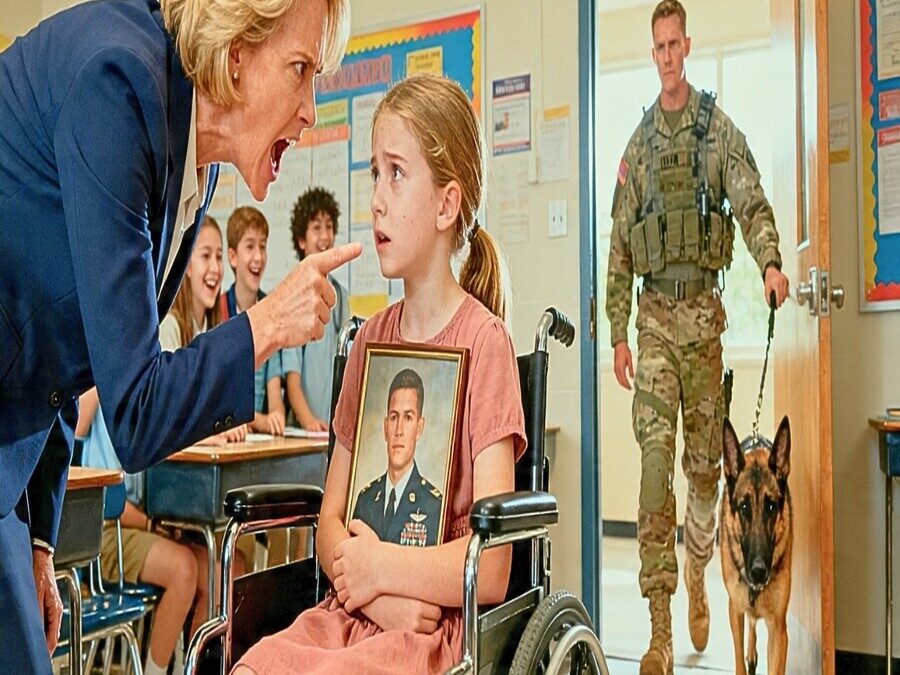
What happened happened, she said.
It’s not a different perspective.
It either happened or it didn’t.
Decker made a sound that wasn’t quite a cough.
Marsh put his pen down and picked it back up. Chloe, we absolutely want to hear your experience.
You have it. I just told you. Ethan let the silence sit for a moment.
He’d learned that rooms like this, run by people like Marsh, were designed to fill silence with process, with procedure and language and the accumulated weight of institutional habit.
The silence made them uncomfortable in a way that worked in his favor. I have documentation, he said, and opened the folder.
He didn’t present it the way a lawyer would, building to a reveal.
He put it on the table and let them read it page by page in the order it was organized. There was something in the straightforwardness of it that was, he knew, more effective than drama.
Drama gave people something to react to. Plain evidence gave them nothing to do but process. Puit read.
Marsh read. Decker had read it Tuesday, but read it again with a different quality of attention now that more people were in the room.
Garner read it last or pretended to.
Ethan watched her eyes, and they weren’t tracking the text properly, which meant she’d either seen it already.
Decker might have shared it, or she was reading for appearance rather than information.
The commenation from the federal agency was, as it had been on Tuesday, the page that changed the room’s atmosphere.
It was a specific kind of document, the kind that didn’t get generated by bureaucratic routine.
It existed because someone had done something that warranted it existing. The language was spare and official, but spare official language about a K-9 handler who had located three children in a 78-hour window meant something distinct and concrete, and everyone in the room who read it understood what it meant.
Marsh set it down. Mr. Hayes, he said, and his tone had shifted, not dramatically, but enough.
I want to be clear that the district deeply respects your service.
That’s not what this is about.
Of course.
What I mean is what this is about, Ethan said, is that my daughter told the truth and was punished for it by a person in authority who didn’t check before she acted.
That’s the issue.
My service record is only relevant because it proves my daughter wasn’t lying, but she shouldn’t have needed proof.
She’s nine.
The parent leaison, her name, he’d caught it off her badge, was Tanya Reeves, was writing something on her notepad.
Not official notes. The handwriting was too irregular for that. Processing notes, he thought.
The kind you made when something landed. Miss Garner, Puit said, turning to the teacher.
Garner looked up. Would you like to respond?
The teacher set her pen down. She had been preparing this.
He could see that the slight arrangement of posture, the breath, and what came out was the version she’d workshopped.
Not an admission, not quite a deflection, either. something engineered to occupy the space between them.
I want to say first that I have always had Khloe’s best interests at heart.
She’s a bright student and I’ve enjoyed having her in my class.
She paused. On the day of the presentations, I made a judgment call that I now understand was insufficient.
I didn’t have the context that Mr.
Hayes’s documentation provides, and I reacted in a way that in retrospect I would handle differently.
Ethan waited. That was it.
That was the whole thing.
You’d handle it differently, Khloe said.
Garner looked at her. What would you do different?
I would ask to see supporting documentation before.
I’m nine, Khloe said.
I don’t carry documentation about my dad to school because I’m nine.
She wasn’t angry.
Her voice was steady in a way that reminded Ethan painfully of himself at an age when he hadn’t yet learned to be steady.
You could have called him. You could have sent a note home.
You could have just said, “I’m not sure.
Let’s check.
You threw my drawing in the trash.”
Chloe, Decker started. The project, Garner said, was placed.
“You threw it,” Khloe said.
“That’s what you did.”
The room was quiet. Reeves had stopped writing. Puit was looking at her hands.
Marsh was doing the expression of a man who had thought he understood the dimensions of this problem and was revising upward. Miss Garner, Ethan said quietly. Do you have a child?
The shift in subject surprised her. She blinked. I Yes.
Then you understand what it costs a kid to stand up in front of their class and talk about something they’re proud of.
The rehearsing, the wanting it to go right.
He didn’t look away from her.
Khloe practiced that presentation for 4 days. She made sure she could pronounce the breed name correctly. She drew a picture of her father and his partner.
a pause and you made the people who mattered most to her laugh at her.
Garner’s face had gone through several things in the last 30 seconds that she probably hadn’t intended to show.
That wasn’t my intention.
I know, Ethan said.
That’s almost the whole problem.
Us what followed was 40 minutes of the kind of institutional process that existed primarily to give everyone in the room the sensation of moving forward while ensuring that nothing irreversible was committed to.
before it had been reviewed by people who weren’t in the room.
Puit talked about district policies on classroom management.
Marsh outlined the formal complaint procedure and what Garner’s filed concern would and wouldn’t affect.
Reeves, the parent liaison, asked Khloe three questions about her experience that were thoughtful enough that Khloe actually answered them in full. Ethan let it go where it went.
He’d said the things that needed saying.
The folder was on the table. The room knew what it knew.
What he was watching now was Garner.
She’d recomposed.
The workshopped response once delivered had given her something to stand behind. A position that was technically an acknowledgement without being an admission.
She was good at this in the way people got good at things they practiced out of necessity.
She’d been in rooms like this before, probably parents who pushed back, administrators who needed to be appeased.
She knew how to give just enough to make the room feel resolved without conceding anything she’d actually have to carry.
But she’d looked at the folder.
She’d read the commenation letter.
And now Ethan noticed this. She was no longer looking at him.
She was looking at Titan. The dog was lying flat, chin on pause, eyes half closed in the way he went when he was conserving, not sleeping.
She’d been looking at him intermittently since the meeting started.
the way people looked at things that had recalibrated their sense of a situation.
A few times her gaze lingered, and there was something in her expression that Ethan couldn’t quite name, but that he’d seen before in the field.
In the moments after a perimeter got established, and people on the wrong side of it started understanding what the parameters actually were.
She was not as certain as she’d been on Tuesday.
That was the difference. At 9:57, Puit summarized the district would conduct a formal review of the classroom incident.
Garner’s complaint about the school visit would be noted but not escalated given the confirmed documentation of Titan’s working status.
The gradebook reinstatement that Decker had agreed to Tuesday would be formalized in writing.
A meeting with Khloe’s full teaching team would be scheduled within 2 weeks to establish quote clear communication protocols for student presentations involving family members and specialized professions.
That last phrase made Ethan’s jaw tighten slightly.
He didn’t show it.
One more thing,” he said as Puit was closing her folio.
She looked at him. Khloe was given an assignment.
She completed it. She was not allowed to finish her presentation.
He let that sit for exactly 1 second.
I’d like her to have the opportunity to finish it.
Puit looked at Decker. Decker looked at Garner.
Garner’s expression was the expression of someone who had accepted an outcome and was reassessing whether acceptance had been premature.
In the classroom, Decker asked. That would be a start, Ethan said.
Sad. The drive to school was quiet.
Khloe was looking out the window with the hollowedout expression of someone who had spent the last 2 hours at a frequency they weren’t built to sustain for extended periods, which was fair, which was exactly what had happened.
Ethan drove with one hand on the wheel and didn’t push for conversation.
After about 4 minutes, she said, “She’s not sorry.”
No, he agreed.
She said the right things, but she’s not sorry.
People can do the right thing without feeling the right thing. Both can still matter. Chloe thought about that.
Does it?
If she’s not actually sorry, does the apology do anything?
It puts something on record. It changes what she can do next.
Because people are watching now. Because people are watching now.
She absorbed this. Outside the town moved past a gas station, a dry cleaner, a stretch of fast food that gave way to the residential quiet near the school. She was scared of Titan, Khloe said.
A little.
He didn’t do anything.
Doesn’t matter.
She didn’t know what he might do.
That’s enough.
Khloe was quiet for a moment, then unexpectedly. Is that why you brought him?
He glanced at her in the rear view. I brought him because he goes where I go, Ethan said.
That’s what partners do.
She held his gaze in the mirror for a second, then looked back out the window. Something in her had settled, or maybe just shifted into a different position, finding a new way to carry what the morning had put in her.
“Okay,” she said quietly.
“Okay,” he said.
He pulled into the school drop off and came around for the chair and Titan watched from his compartment with the steady banked attention he always had when Khloe was moving away from the vehicle. A behavior that had developed so gradually over 6 years that Ethan had never been able to identify the exact point at which it became a habit.
He watched his daughter wheel herself up the ramp toward the entrance and did not allow himself to feel the specific fury that had been sitting in his chest since Tuesday afternoon when she told him about the sketchbook with her voice carefully controlled in her hands in her lap. The fury was there.
He knew where it was.
He wasn’t going to use it yet.
But Friday had not resolved the way the district wanted it to resolve.
He’d watched the room and he’d watched Garner and he knew the difference between a problem that had been solved and a problem that had been postponed.
He also knew something that no one in that conference room had known coming in and that most of them still didn’t fully know going out.
The documentation they’d seen, the certifications, the commendations, the mission summary.
That was the version of the record cleared for context like this one. The version that could be handed across a conference table to a school principal and an HR manager without requiring a security briefing.
There was another version. There had always been another version.
Ethan had not brought it because he hadn’t needed it, and because he was the kind of man who did not show everything at once, but it existed.
And if Friday’s meeting turned out to be, as he was increasingly suspecting, the opening position in a longer argument rather than the resolution of a shorter one, then the question of what came next was not really a question.
He got back in the SUV. Titan shifted in his compartment, resettling, ears moving toward the school building once before going soft again. Ethan pulled out of the drop off and drove.
He had the afternoon to think.
By evening, he’d know what needed to happen.
And by Monday, one way or another, so would everyone else. The weekend passed the way weekends passed when something unfinished was sitting in the middle of the house.
Everyone moving around it, not quite naming it, but aware of its exact dimensions at all times. Saturday, Ethan ran a 12mi route before Kloe woke up, Titan ranging ahead and circling back in the way he did when they were off duty. The loose, happy trot of a working dog allowed to be something closer to just a dog for a few hours.
When Ethan got back, Kloe was in the kitchen attempting to make eggs, which she could do competently from her chair at the lowered counter section he’d had installed 2 years ago, though she always slightly underestimated how fast the pan got hot and ended up with the edges browned a little more than she intended.
She didn’t say anything about the meeting.
He didn’t either.
They watched a nature documentary in the afternoon. Something about deep ocean ecosystems that Khloe found genuinely fascinating and that Ethan found easy to sit through, which was its own kind of companionship.
Titans slept across their feet, which he technically wasn’t supposed to do on the furniture, but which was a rule that had been selectively enforced since approximately his second month in the house.
Sunday, Ethan spent 3 hours in the garage, not on gear, on paper.
He had a contact, a woman named Ror, former federal investigator now doing private consulting, who he’d worked in overlap with on a missing person’s case two years back.
She had a particular gift for institutional pressure, the kind that didn’t announce itself loudly, but was felt in the way water was felt when it found the cracks in something that thought it was sealed.
He’d sent her an email Friday evening, brief and factual, and by Sunday morning, she’d responded with three questions and a list of district level reporting requirements that were, in her words, worth knowing before Monday.
He read the list twice and filed it in the folder.
By Sunday night, he’d mapped out three contingencies depending on how Monday went, which was how he operated.
Not because he was pessimistic, but because a man who planned for one outcome was a man who got surprised by all the others. Kloe went to bed at 9:00.
She’d been quieter than usual all weekend.
Not sad exactly, more like she was processing something at a level below the one where she had words for it. He recognized the mode.
He’d raised her alone long enough to know the difference between the quiet that needed intervention and the quiet that needed space.
He left her the space.
At 9:40, he got a text from a number he’d given only to two people at that school.
Tanya Reeves, the parent liaison. Mr. Hayes thought you should know before tomorrow.
Ms. Garner has submitted a formal addendum to her complaint.
She’s claiming you used Titan to create an intimidating environment during Tuesday’s meeting and that your behavior during the Friday session constituted hostile engagement.
District HR has flagged it for review. Meeting may be affected.
I’m sorry.
Um, I shouldn’t be telling you this, but I thought it was right.
He read it twice. Then he set the phone face down on the workbench and looked at the garage ceiling for a moment.
She hadn’t been recalibrating in that conference room.
She’d been documenting every look she’d given Titan.
Every pause, every moment she could later describe as feeling unsafe or pressured.
She’d been building a secondary record in real time right across the table from him.
And he hadn’t read it correctly because he’d been watching her read the folder.
He picked the phone back up and typed, “Thank you.
I mean it.”
Then he sat for a while in the yellow garage light, very still thinking.
The thing about a certain kind of person, and he’d known enough of them in his life to have a working taxonomy, was that they were not actually motivated by being right.
Being right was useful only in so far as it protected them. What they were motivated by was not losing.
Those were different targets, and they required different responses.
He’d gone into the Friday meeting trying to establish the truth.
Garner had gone in trying to survive the room. He should have seen that coming. He had seen it actually in outline.
The recalibration he’d noticed the angles.
He just hadn’t expected the speed of the counter move.
He went inside.
He didn’t sleep immediately, but he was in bed by 11, which was close enough.
At 4:40 Monday morning, his phone rang. The number was one he knew. He was awake and sitting up before the second ring.
Hayes, it’s Carver.
The voice on the other end was the voice of a man who’d been awake for longer than Ethan had with the flat efficiency of someone moving through a task list.
Staff Sergeant David Carver, currently assigned to the same regional K9 coordination unit that Ethan worked out of, based out of the federal facility 40 minutes east. Sorry for the hour. got a notification flag on your name from the district office.
Administrative complaint, possible conduct review.
You want to tell me what’s going on or should I guess?
Ethan told him concisely in the sequence it had happened without editorializing. When he finished, Carver was quiet for a moment. The teacher filed against you and Titan.
She filed against the dog. She implied Titan was used to threaten. Her language was deliberate deployment of a trained animal to create psychological pressure.
Another silence then from Carver.
You’re kidding me.
I’m not Hayes.
That dog couldn’t intimidate a mailbox if he tried.
She doesn’t know that.
That’s the point, isn’t it?
It wasn’t a question.
She doesn’t know what he can do.
So, she filled in the gap with whatever scared her most. Yeah.
Carver exhaled. Okay.
Here’s why I’m calling.
The complaint flagged at our level because Titan is on the unit’s asset registry.
Anything that mentions him officially goes through us, which means I’ve got paperwork on this and my CO is going to have questions.
I know.
It also means Carver said that if the district tries to escalate this into something formal, they’re going to bump into the unit, which is going to be a fun conversation for them.
I’m not trying to make this into a federal situation, Carver.
I know you’re not.
But here’s the thing.
You may not get to choose. A pause.
There’s a secondary piece.
The unit CO, Major Hess. She wants a briefing.
Not punitive.
Don’t worry.
She’s seen the district complaint and she wants to understand the context before it gets to anyone above her.
Ethan looked at the window. Gray pre-dawn.
Somewhere outside, Titan was already alert.
He’d heard Ethan on the phone and had moved from his bed to the hallway outside the bedroom door.
His standard positioning when he sensed the household shifting into a different mode. When does she want it? Ethan said this morning.
She can do 8. The district meeting, if it was still happening, was scheduled for 10:00.
That was the meeting where, according to Tanya Reeves’ Sunday night text, Garner’s addendum would be formally introduced and Ethan would be given the opportunity to respond to the new complaint.
I can do eight, he said.
I’ll tell her.
And Hayes, yeah, bring the folder. Major Christine Hess had the office of someone who used their space as a working tool rather than a statement.
No motivational posters, no framed inspirational quotes, a whiteboard with active notes on one wall, a desk covered in the organized chaos of someone managing multiple concurrent priorities, and two chairs across from it that were functional rather than comfortable, which was deliberate.
She was 51 with closecropped gray hair and the posture of someone who’d spent 30 years not letting things show that didn’t need to be shown.
She’d come up through military police, transitioned to K9 coordination, and spent the last 8 years building the regional unit into something that federal agencies actually returned calls to.
Ethan had worked under her for 3 years and respected her in the specific uncomplicated way you respected someone who was competent and fair and didn’t waste your time.
She read the folder start to finish while he sat across from her and Titan lay on the floor between them. Carver sat to the side, coffee in hand, not saying anything. When she finished, she closed the folder and set it precisely in the center of her desk.
The teacher filed a complaint saying Titan was used to intimidate.
Yes, ma’am.
During a school meeting? Yes. She looked at Titan.
He looked back at her with the mild half-litted expression of a dog who was comfortable in the room and not particularly interested in performing anything for anyone. He was on a leash, she said, the whole time.
And he, she paused. Did what exactly during the meeting? Lay on the floor.
Occasionally looked at the door when someone came in. At one point, he yawned.
Carver made a sound that was technically a cough.
Hess’s expression didn’t change, but something shifted behind her eyes.
Okay. She folded her hands on the desk.
Here’s my position.
Titan is a unit asset and a registered working animal. The complaint that was filed mischaracterizes both his behavior and his deployment.
I can address that in writing to the district, which will effectively close that particular line of attack because no HR manager in a public school district wants to be on record claiming that a federal working dog was weaponized in a conference room. Ethan nodded once. What I cannot do, she continued, is manage the broader situation for you.
What happens at 10:00 is between you and the district.
The unit’s involvement is limited to the specific mischaracterization of Titan’s status and behavior.
She paused. But I can tell you that the letter from this office will land before your 10:00 meeting.
That’s within my authority and it’s the right call.
Thank you, Major.
Don’t thank me.
She filed against a federal working animal because he made her nervous. Hess picked up a pen and made a note on the pad beside her.
That’s not a complaint.
That’s a document that creates problems for her, not for you.
And she’ll figure that out when the letter arrives.
She looked up.
What’s the district actually after?
What’s Garner trying to accomplish?
Ethan thought about the right way to say it.
She made a mistake in front of witnesses and she’s trying to bury the record under a counter complaint.
If the district is spending time processing my conduct, they’re not spending time processing hers.
Classic counter referral has said it without effect. and the district is going along with it.
They’re giving it procedural weight because it’s easier than acknowledging their teacher publicly humiliated a disabled child.
She said that flatly, too. Not as an editorial, just the shape of the thing.
Your daughter is nine. Yes.
And she did a school project about your work. Yes.
Hess looked at the folder, then at him. Bring her to the 10:00. He blinked.
It was one of the rare times in recent memory that something surprised him. I was going to drop her at school before she bring her.
Hess said she’s the one this happened to.
She should be in the room when it gets resolved. A pause.
That’s not an order.
That’s an opinion.
But I’ve been in a lot of rooms where the person the problem was actually about wasn’t present.
And those rooms always resolve more slowly and more poorly than they should. Ethan was quiet for a moment.
She’ll have to miss more school, he said.
She’ll survive.
He almost smiled. Yeah.
He called Chloe from the parking lot. She picked up on the third ring already at school. Recess period from the background noise.
Change of plans, he said. I need you at a meeting at 10:00. A pause.
The district thing. Yeah.
I thought you said I didn’t have to come.
I changed my mind. Another pause.
She was thinking. He let her. Is something bad happening?
Something’s happening.
I want you there. Okay.
No argument, no pushing back, just the quick renegotiation of a kid who had learned that when her father changed course, there was usually a reason that would make sense later.
I’ll tell my teacher.
I’ll call the office.
Dad. Yeah.
Are you okay? The question caught him slightly off angle.
She asked it so directly with such unguarded intention. He was used to her being perceptive, but this was different.
She wasn’t reading the terrain.
She was just asking.
“I’m good,” he said.
“Go finish recess.”
“I’m done with recess.
I’m reading.”
“Go read, then.”
He hung up and sat in the truck for a moment, with the morning sun coming at a flat angle through the windshield and Titan breathing steadily in the back. He thought about what Hess had said.
She should be in the room when it gets resolved.
He’d been trying to manage this for Kloe.
Keep the uglier parts at a distance she couldn’t see clearly.
That was the instinct. Protect her from the mechanics of the thing. Let her experience the outcome without the process.
But Hess was right. Khloe had been in the room when it started.
She’d been there Tuesday in the first meeting.
She’d been at the conference table Friday asking Garner the question nobody else had asked.
She wasn’t a bystander to this.
She was the whole reason any of them were here. He started the engine. The district conference room looked the same.
Same institutional carpet. Same motivational phrases stencled on the wall outside. Same parking lot view from the windows.
But the composition of the room was different. Puit was there and Marsh and Decker.
Garner was there. And this time she had someone with her, a man in his 40s in a sport coat who introduced himself as Alan Frier and whose card said he was with an education advocacy firm, which was a category of professional that existed specifically to sit beside teachers in meetings like this one and make the meeting more complicated than it needed to be. Ethan
looked at the card for a moment.
Then he set it on the table.
He’d brought Khloe, who was positioned beside him, her chair pulled up to the table with the same adjustment he’d made Friday.
He’d brought Titan, leashed, who went to the floor with the same unhurrieded inevitability, and he’d brought a second folder, thinner than the first, with a tab divider, which he set in front of him without opening.
Frier looked at the dog, then at the folder, then at Ethan, with the professional assessment of a man recalibrating his morning.
Puit opened the meeting the same way she’d opened Fridays.
The same language about paths forward, about everyone’s well-being, about the district’s commitment.
Ethan let it run.
He’d learned in rooms very different from this one, but with the same underlying dynamic that the opening statement was rarely the real information.
The real information was in what happened when the opening statement was done. What happened was Marsh introduced the addendum.
Garner’s secondary complaint.
He used measured language, concerns about the meeting environment, questions about the appropriateness of certain elements, and he did not use the phrase deliberate psychological intimidation that Reeves had quoted from the document, though Ethan knew it was in there. Before we get into the substance of Ms.
Garner’s addendum, Ethan said when Marsh finished, I have something from my unit command.
He produced a single sheet from the second folder and slid it across the table to pro it. She read it. Her expression changed, not dramatically, but in the way that faces changed when they encountered something that reorganized the room they were standing in.
She passed it to Marsh. He read it. His jaw moved slightly.
She passed it to Frier. He read it faster than either of them with the focus speed of a man who knew exactly what he was looking for. Found it and understood what it meant.
The letter was on unit letterhead. It was signed by Major Christine Hess and addressed to the Milfield School District Office of Human Resources. It was three paragraphs.
The first stated Titan’s working status and certification.
The second noted that the characterization of Titan’s behavior in the filed complaint was factually inaccurate and inconsistent with all witness accounts, including those from district personnel present at both meetings.
The third paragraph, the one Frier had found fastest, noted that the filing of a formal complaint containing material misccharacterizations of a federally registered working animals behavior was a matter that the unit would be monitoring and that if escalated would require formal response at the federal coordination level. It was not a threat.
It was written in the language of administrative fact, every sentence documentable and sourced, but it had the weight of a door being closed firmly from the other side of a room. Garner had been watching Puit read it.
When Puit set it down, Garner looked at Frier. Frier was looking at the letter. He did not look at her.
I think, Puit said with the careful precision of someone choosing each word with full awareness of the words they were choosing. We should take a brief recess.
I’d rather keep going, Ethan said.
Puit looked at him.
We’ve been in process since Tuesday, he said.
My daughter has missed parts of two school days. I have documentation establishing everything she said in her presentation was accurate. I have a unit letter addressing the secondary complaint.
If there’s something else the district needs to address this morning, I’d like to do it now.
Decker, who had been very quiet in the corner of his chair, made a small movement, or not quite a nod, but close. Puit looked at Garner.
Garner was looking at the letter, or looking at the table. It was hard to tell. Her posture had gone through a shift that was almost architectural.
A thing that had been holding a certain shape had quietly stopped holding it. Patricia, Puit said, in light of this. I understand, Garner said.
Her voice was controlled flat, the voice of someone who had gotten to the end of the calculation and didn’t like the number.
I think, said slowly, we should formally withdraw the addendum. Frier put his pen down. He picked it back up.
He was doing the math on what this meant for the rest of his morning, and more specifically for any future involvement with this district.
That would be advisable, he said, which was lawyer for we’ve lost this and I would like to not be in this room anymore.
The withdrawal was documented. Marsh wrote the notation by hand, initialed it, and Puit signed it.
Garner did not sign it, which she didn’t have to, but Ethan noticed.
Frier noticed, too, and the small look he gave her said that he’d be having a different kind of conversation with her somewhere private and later.
Then Puit looked across the table and did something that Ethan hadn’t anticipated.
She looked at Chloe, not at Ethan, not at the folder, at the 9-year-old girl in the wheelchair who had been sitting beside her father for the last 40 minutes watching adults have a conversation about something that had happened to her. Chloe, she said, I want
to apologize to you directly. What happened in your classroom should not have happened.
You told the truth about your father, and you were not treated with the respect you deserved. She paused.
The district failed you.
I’m sorry for that.
The room was quiet.
Khloe looked at her steadily with that particular quality of attention she had, the one that made adults feel slightly examined when they weren’t expecting it.
“Thank you,” she said.
Then she looked at Garner. Garner looked back at her.
Her expression had settled into something that was not comfortable or satisfied or relieved, something harder and more complicated. The expression of a person sitting in a room full of consequences they generated.
Kloe didn’t say anything to her.
She just held the look for a moment and then she looked down at her hands on the armrests and then she looked at Titan. Titan was already looking at her.
He’d been watching her for the last several minutes with his calm, constant attention, the way he always watched her when the room was tense and she was the smallest person in it.
Can I ask something? Kloe said.
Of course, said the assignment was to present a hero, someone real. She paused. I never got to finish.
Can I finish it in front of everyone, the whole class? A silence.
I think that’s absolutely something we can arrange, Decker said.
And this time when he said something, it didn’t sound managed.
Garner looked at the table. Frier quietly put his pen in his jacket pocket.
Ethan didn’t say anything because there was nothing left that needed to be said.
His daughter had just walked into the center of the room and taken it quietly without raising her voice or demanding anything, just asking for what had always been hers to begin with. The morning light through the conference room windows had gone from gray to a clear flat gold.
It landed on the table between the two sides and made the documentation and the letters and the legal notepads look very small and very ordinary. Titan yawned.
It was the first sound he’d made in two hours.
Frier stood to leave first.
As he passed Titan’s position on the floor, the Malininoa lifted his head and looked at the man with the unhurried absolute directness of an animal that did not perform and did not pretend and had never needed to.
Frier moved slightly to his left. Titan put his head back down.
And in the quiet that followed, as the district administrators shuffled papers and Decker began working out the logistics of a second classroom presentation and Puit drafted language for the formal record, Ethan reached across the small distance between
himself and his daughter and put his hand briefly on her shoulder. She put her hand over his. They stayed that way for exactly as long as it needed to be, which was not very long at all.
And then Ethan straightened and Kloe let go and they both turned back to the table because there were still details to settle. And they were the kind of people who stayed until the details were settled. But the thing that had needed to happen had happened.
And everyone in the room, even the ones who hadn’t wanted to be there, even the one who still couldn’t bring herself to look up from the table, knew exactly what it was.
The logistics took another 40 minutes. Decker wanted the presentation scheduled for the following Wednesday, which gave enough time to notify parents and arrange the auditorium properly.
He’d suggested moving it out of the classroom entirely into a larger space, which Ethan read as the administrator’s instinct to convert a correction into an event, something that could be communicated upward as a positive outcome rather than a remediation.
He didn’t object.
The auditorium was fine. The auditorium was better for Khloe, actually, more space to move, better acoustics, a stage with a proper ramp. Puit stayed for the first 20 minutes of logistics, and then excused herself with the quiet efficiency of someone whose involvement had served its purpose, and who had other fires.
Marsh left with her. Frier had been gone since before the documentation was countersigned, which was fast, even by the standards of people paid to exit gracefully.
That left Decker, Tanya Reeves, and Garner. Garner had not spoken since the apology.
She sat at the end of the table with her legal pad closed in front of her and participated in the logistics discussion the way furniture participated in a room. Present, occupying space, not contributing anything that moved the conversation forward.
Reeves handled most of the coordination, pulling up the school calendar on her laptop and working through the scheduling with a brisk competence that suggested she’d been waiting for someone to let her actually do her job.
Khloe answered questions when they were directed to her. Did she want to use a microphone? Yes.
Would she want Titan on stage? A pause.
Then yes. and otherwise sat beside her father with the contained stillness of someone who had spent the last 3 hours at a level of concentration that had earned her the right to coast for 20 minutes. When it was done and they were moving toward the door, Garner stood.
Chloe. Everyone stopped. Garner was looking at the girl, not at Ethan, not at the table.
Her hands were at her sides.
She looked like a person who had rehearsed something and was now discovering that the rehearsed version wasn’t going to come out the way she’d planned.
I was wrong, she said. Not just about the facts, about how I handled it.
A pause.
The words were coming slowly like she was pulling them from somewhere they didn’t want to come from.
I embarrassed you in front of people who matter to you.
And I didn’t I didn’t ask you a single question first.
I just decided. She stopped.
That was wrong.
I’m sorry.
Chloe looked at her for a long moment. Okay, she said.
Not it’s fine or I forgive you or any of the phrases adults coach children toward in these moments.
Just okay. Acknowledgement without absolution, which was Ethan thought probably more honest than anything else she could have said. Garner nodded once.
She picked up her legal pad and her closed pen and walked out of the conference room ahead of all of them. And when the door swung shut behind her, the room felt like it had exhaled.
Reeves looked at Chloe.
“You doing all right?”
“Yeah,” Khloe said.
“I’m hungry.”
Reeves laughed, short and genuine. The laugh of someone who had been in professional mode for 3 hours and had momentarily been given permission to be a human being.
There’s a decent taco place two blocks east.
Khloe looked at her father. I know, he said.
Let’s go, Chad.
They didn’t talk about the meeting over tacos.
This was an established family protocol. Decompress first, debrief later, and only if the debrief was actually necessary.
Sometimes things that felt like they needed to be processed just needed to be slept on. And what had seemed urgent at noon looked different at 7:00 in the evening with food in you and distance between you and the room. Kloe ate with the focused efficiency of someone who had been running on adrenaline and was now discovering the bill had come due.
She finished one taco before she said anything that wasn’t a request for salsa.
And what she said was, “Titan wants one.”
Titan doesn’t eat tacos.
He thinks he does.
He’s wrong.
Titan under the table made no comment.
He’d been given a water bowl by the counter staff, a small outdoor patio, the restaurant’s concession to working animals, and was currently resting his chin on Khloe’s shoe in the way he did when he was off duty, and she was nearby, and he had decided these were optimal conditions.
“Can I ask you something?”
Khloe said.
“Yeah, why did Major Hess help?”
He looked at her.
“Because the complaint misrepresented what Titan is.”
“But she didn’t have to write the letter.
She could have just said okay and stayed out of it.
That’s not how she operates.
How does she operate? He thought about the right way to say it.
She decides what’s accurate and she says so.
That’s most of it.

