2 Hours, 4 Pilots, Zero Answers — Then She Took Control: ““Stand Back, I’ll Handle This”
2 Hours, 4 Pilots, Zero Answers — Then She Took Control: ““Stand Back, I’ll Handle This”
Get her out right now.
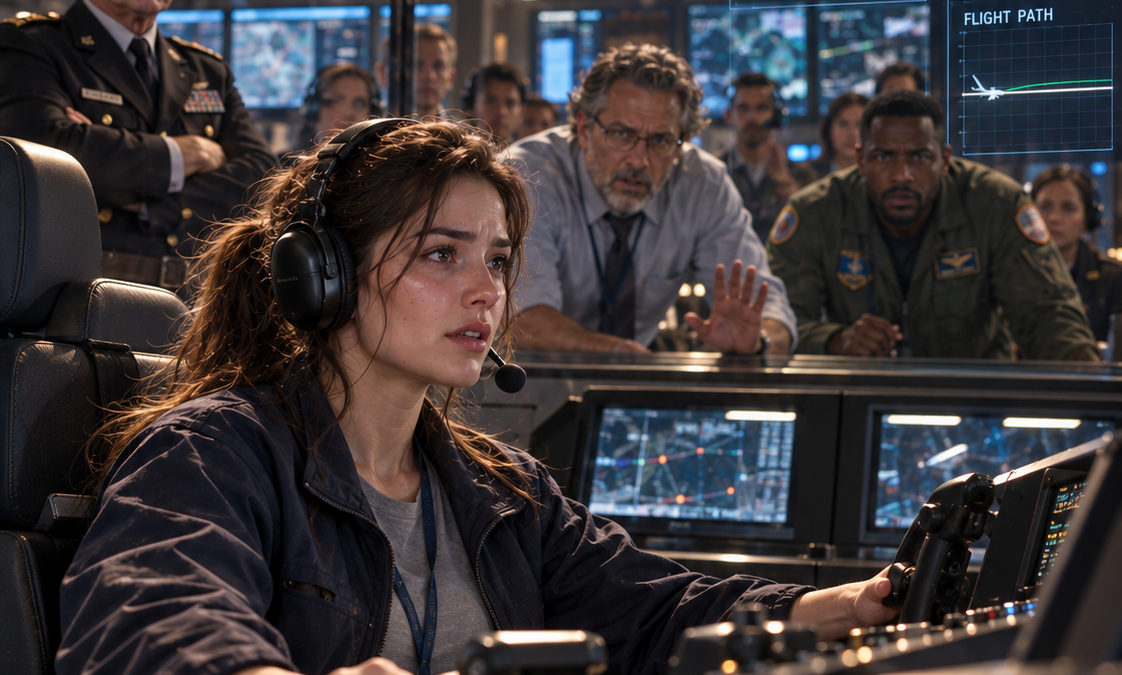
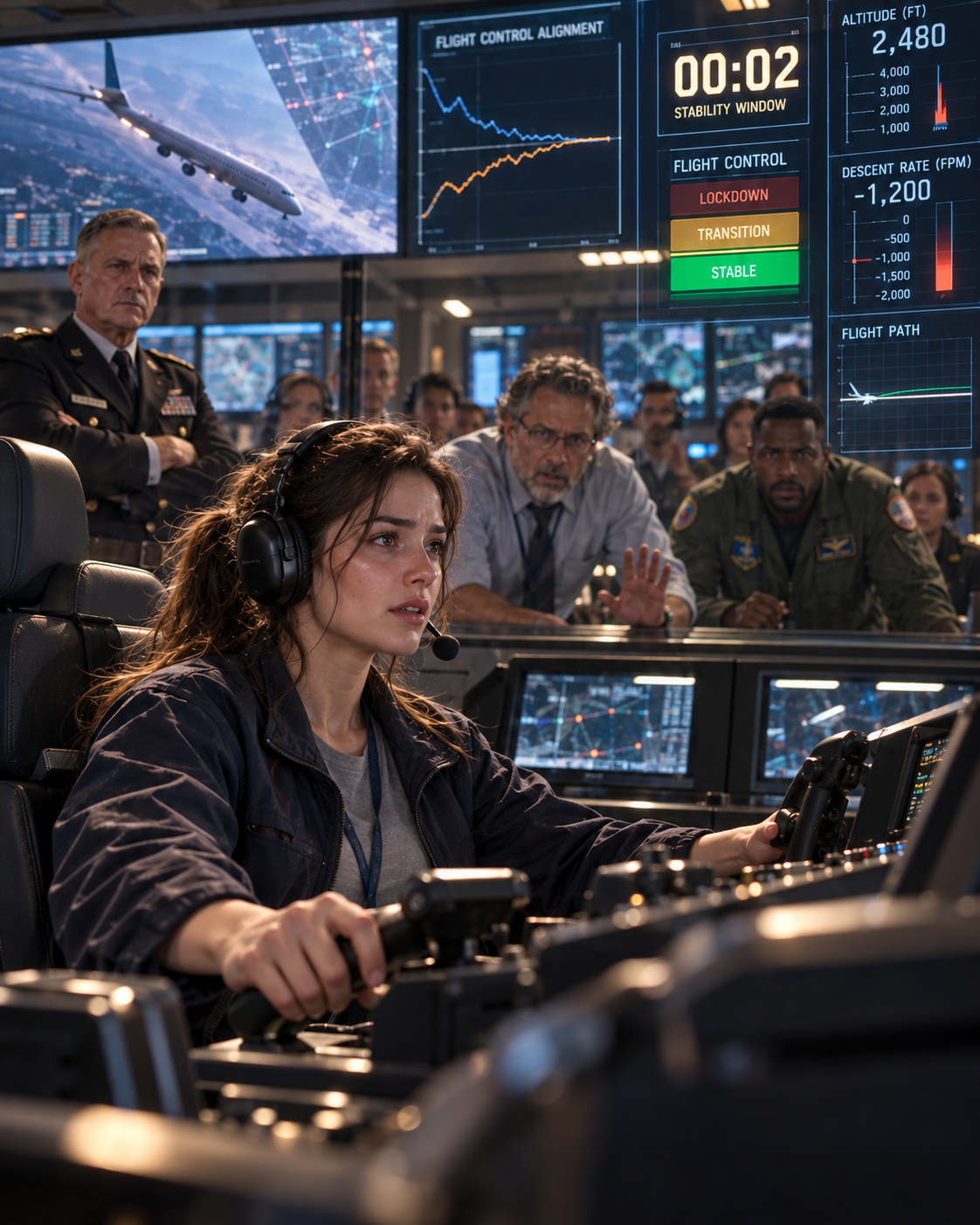
Commander Haye slammed his fist on the console and pointed directly at Emily Parker. Behind him, four decorated pilots crossed their arms, cold, certain, dismissive, and on the radio 8,000 ft above the Arizona desert.
Daniel Carter’s voice was thinning at the edges.
He was running out of time.
Four of America’s most experienced pilots had tried for 2 hours straight every procedure, every override, every trick they knew.
Nothing worked. And the one person who had the answer was being thrown out of the room.
The desert outside Hollowman Aviation Testing Facility had not changed in a thousand years. It stretched flat and pale and indifferent beneath a sky the color of bleached bone.
The kind of sky that absorbed sound, the kind of distance that made everything feel very small and very final. But inside the reinforced walls of the main command center, the air was electric in the worst possible way.
It wasn’t the kind of energy that comes before something great.
It was the kind that comes before something breaks. Every monitor in the room was alive.
Telemetry feeds cascaded across three walls of screens and real-time altitude numbers, airspeed vectors, gyroscopic readouts, system diagnostic columns scrolling faster than most people could read. The room was cold.
Facilities like this were always cold, always lit.
with that blue white fluoresence that made everyone look slightly ill, slightly haunted, slightly like they hadn’t slept in two days.
Most of the people in this room hadn’t slept in two days.
And the reason for all of it, the sleeplessness, the electric air, the cascade of data across the screens, was a single aircraft, the Aquala 9.
She was 47 feet long, a neck neck generation experimental interceptor built by a joint government and private aviation consortium that had spent 7 years and roughly $4 billion trying to make something that shouldn’t be possible.
An aircraft that could think, not just follow commands, but genuinely respond, adapt, learn, anticipate.
The flight control system inside the Aquilla 9 wasn’t just software.
It was something closer to intuition, or at least the best artificial approximation of it, that money and genius could build. And right now, that aircraft was in serious trouble. Captain Michael Reynolds had been talking to the ground for 2 hours.
2 hours. To put that in perspective, in emergency aviation, 2 minutes is a long time. 5 minutes is a crisis.
10 minutes is the kind of thing they write accident reports about. 2 hours was a different category entirely. Reynolds had 15,400 logged flight hours.
He had flown in combat zones. He had ejected from a burning aircraft over the Pacific and been rescued 3 days later.
He had done things in the sky that most pilots only read about in technical manuals.
He was the kind of man who didn’t panic, who didn’t shake, who could talk himself through the kind of situations that ended other careers or ended other lives.
But his voice coming through the radio feed in the command center had a quality that nobody in the room had heard from him before. It was thin.
It was tight around the edges, like a rubber band stretched past its comfortable limit. Still holding but threatening to snap at any moment. Control.
I’ve tried the manual override on the primary lateral again.
Same response. The computer is fighting me. Senior flight director Tom Garza pressed his headset tighter against his ear.
He was 53 years old, 28 of those years spent in aviation operations, and he had a habit of closing his eyes when he was listening to something very bad. His eyes were closed.
Copy that, Aquilla.
We’re running the diagnostic now.
Hold altitude if you can, Tom.
Reynolds’s voice dropped just slightly.
Just enough that the standing closest to the speaker caught the shift and exchanged glances.
I’ve been holding altitude for 40 minutes.
I’m telling you what I’m feeling up here.
Something is fundamentally wrong with the control response.
It isn’t just a sensor error.
Every time I apply corrective input, the aircraft interprets it as a threat and locks down harder.
I feel like I’m arm wrestling something that weighs 10 tons.
From the back of the room, barely audible, someone said, “That’s exactly what it is.”
Nobody heard her. Or more precisely, everyone heard her, and nobody turned around. Emily Parker was standing beside a secondary workstation near the rear wall where she had been standing quietly for the better part of 3 hours.
She was 26 years old. She had graduated from MIT with a dual concentration in aerospace engineering and AI systems design. She had written her thesis on adaptive failure responses in autonomous flight control architectures, a paper that had been read by exactly 11 people in the aviation world, four of whom worked in this building.
She was not a pilot. She was not a commander.
She held no rank, no title that carried weight in a room like this. Pedge said engineering consultant which in the hierarchy of an aviation emergency command center placed her somewhere between the caterers and the people who maintain the bathroom facilities. She had been watching the data for 3 hours.
She had noticed something 20 minutes ago and she had been trying to figure out how to say it to a room full of people who had already decided she wasn’t worth listening to.
The radio crackled again. Control.
I want to try the tertiary override bypass. same procedure we ran in simulation six weeks ago.
Garza opened his eyes and looked at his engineering team.
Three men in their 40s and 50s, senior Simsum engineers who had worked on the Aquilla 9’s design.
They exchanged a look. Dr.Arthur Briggs, the lead flight systems engineer, shook his head slowly.
We tried that 30 minutes ago.
It doesn’t resolve the core feedback loop issue.
Reynolds is dealing with a conflict between the primary and secondary sensor arrays. The aircraft is receiving contradictory positional data and its protective algorithm is interpreting every control input as an attempted override from a malfunctioning system.
Garza turned back to the radio. Negative on the tertiary bypass Aquilla.
We’ve already ruled that out.
A pause from the aircraft. Then Reynolds and there was something new in his voice now. Something nobody wanted to name directly.
How long has this been going on? 2 hours 14 minutes. Another pause.
Longer this time. Tom, who else do you have working on this?
Garza didn’t answer immediately because the honest answer was not a comfortable one.
The honest answer was everyone they had tried had already failed. Three other pilots had cycled through the simulator in the adjacent room, running the same failure scenario, trying to find a solution they could radio to Reynolds. Captain Donna Walsh, who had more than 10,000 hours and was widely considered the best instinctive pilot in the program.
Major James Okafor, who had spent six years as a test pilot and knew the Aquala 9 systems better than anyone who hadn’t actually designed them.
Lieutenant Commander Paul Dver, who had solved three other critical flight emergencies in the past 5 years and was considered something close to a legend among the younger pilots. All three of them had walked into that simulator. All three of them had tried everything in their collective playbook.
All three of them had failed.
We’re still working it, Garza said.
And Emily Parker, standing in the back of the room beside her secondary workstation, made a decision. She walked forward.
It wasn’t a dramatic walk.
She didn’t stride or push through anyone.
She simply moved quietly and directly toward the main console where Garza and his senior engineers were clustered around the data screens. Dr.Briggs noticed her first. He turned slightly.
Can I help you?
I think I see what’s happening, Emily said.
Her voice was steady, measured. She had thought very carefully about how to say this, not defensively, not apologetically, but clearly and specifically.
The aircraft isn’t malfunctioning.
The protection algorithm is working exactly as designed, but it’s working based on false inputs.
Briggs stared at her for a moment.
I’m aware of that, he said.
That’s what I just explained.
Right.
But the solution isn’t to override the protection layer.
That’s what every attempt so far has tried to do.
The protection layer is too robust to force down from the outside. The solution is to give the aircraft new information, accurate information, so the algorithm stopped seeing the pilot as a threat.
Briggs looked at her for another moment. Then he looked at Garza.
Garza was watching her with an expression that was not quite dismissive and not quite open. It was the expression of a man who had been in too many emergencies to waste energy on contempt, but also had too much experience to hand the wheel to a stranger without some justification.
“What’s your name?”
Garza asked. Emily Parker.
I’m an engineering consultant.
What’s your flight experience?
Simulation only. Garza nodded slowly. All right, Miss Parker.
Walk me through what you’re seeing.
And that was when Commander Robert Hayes entered the command center.
Hayes was the facility’s operational commander, 58 years old, former Marine aviator.
312 combat missions logged across two decades of service. The kind of man whose presence physically changed a room, not because he was loud or dramatic, but because he radiated a particular quality of absolute certainty that people either found deeply reassuring or deeply intimidating, depending entirely on whether they agreed with him. He walked through the door, swept the room with one long practice look, and crossed directly to Garza.
Status: Aircraft is stable, but control is compromised.
We’re 2 hours 14 minutes into the incident.
Reynolds is I know about Reynolds. Hayes glanced at the main screen. Who solved it?
We’re working on a solution.
Hayes’s gaze moved slowly, deliberately.
It landed on Emily Parker, who was standing at the main console with a data tablet in her hand, pointing at something on the secondary display screen. Who is she? Engineering consultant AI systems.
She has a theory about what are her flight hours. Garza hesitated.
Emily didn’t flinch.
Zero logged flight hours,” she said clearly without looking away from the screen.
“But I have seven years of specialized study in autonomous flight control AI architecture, and I’ve spent 3 hours analyzing this specific failure pattern.
I believe I know what’s causing it, and I believe I know how to fix it.”
Hayes looked at her for five full seconds.
“5 seconds is a long time when someone is looking at you like that.
” Emily held the look without blinking.
Four pilots with decades of combined experience couldn’t solve this, Hayes said.
Not cruy. Almost matterofactly, like he was presenting data. What makes you think you can?
Because they’re all trying to solve the wrong problem, Emily said.
The room went very quiet.
Hayes’s expression didn’t change, but something shifted behind his eyes just slightly.
The smallest recalibration. Explain that.
Emily turned to the main display and pulled up a specific data column. The number scrolled in real time sensor input values from both the primary and secondary array systems aboard the Aquala 9. Look at these two columns, she said.
Primary sensor array left, secondary sensor array right.
They’re supposed to give the aircraft a coherent picture of its own position, speed, and orientation.
When they agree, the flight control AI operates normally. When they disagree, the AI enters protective mode.
It locks down controllable systems because from the aircraft’s perspective, it doesn’t know which set of inputs to trust.
We know this, Brig said from beside her. Right.
But what nobody has pointed out yet is the pattern of the disagreement.
Emily’s finger moved across the screen.
The sensors aren’t randomly giving conflicting information.
They’re diverging in a very specific rhythm.
Every time Captain Reynolds applies a corrective control input, the vibration from that input travels through the airframe and temporarily amplifies the disagreement between the two arrays. The aircraft interprets that amplified disagreement as confirmation that something external is interfering with its systems. She paused.
In other words, every time Reynolds tries to take control, the aircraft becomes more convinced that someone or something is trying to override it, and it locks down harder. Silence.
True silence. The kind where you become aware of the fans in the computer systems and the faint hum of the fluorescent lights. Haye said very quietly.
So every rescue attempt has made it worse. Yes.
Another silence. Garza turned to Briggs.
Is that possible? Briggs was already looking at the data columns. With an expression, Emily recognized the specific look of a very smart person encountering information that reorganizes something they thought they already understood.
His eyes moved quickly back and forth across the numbers.
It’s he stopped, started again.
It’s theoretically consistent with the feedback loop architecture.
The problem is the sensor disagreement threshold was supposed to trigger a failsafe reset, not a progressive lockdown. It does trigger a failsafe reset, Emily said. after a 30- secondond window of stable, non-conlicting input.
But every attempt to override has reset that 30- secondond clock back to zero.
We’ve never given the aircraft 30 consecutive seconds of calm.
Hayes looked at her again. Something had changed in the way he was looking at her. Not fully, not completely.
But enough.
What’s the solution?
He asked, and before Emily could answer, the emergency alarm went off. Not a warning tone. the actual emergency claxon, the one that lived in a protected system that only triggered when the data crossed a hard threshold that the designers had labeled do not cross in the architecture documents.
Every screen in the room updated simultaneously. Altitude dropping, descent rate accelerating. The flight control lockdown had progressed to the final protective stage.
The aircraft was no longer just locked.
It was attempting to execute an automated emergency descent sequence, which in this context meant it was flying itself toward the ground in a controlled spiral rather than allowing a pilot it didn’t trust to do something it might perceive as dangerous.
The radio crackled.
Daniel Carter’s voice control.
I don’t know how much longer I can hold this.
The room fractured. Three people started talking at once. Garza was on his headset.
Briggs was pulling up a different data screen. Two junior engineers were cross-referencing something on a shared tablet, their voices rising with urgency, and Commander Hayes turned to Emily Parker.
“Tell me the solution right now.”
Emily was already walking toward the flight simulator.
“I need to show you,” she said.
“Not tell you.
There isn’t time to argue about whether I’m right.
I need to get in the simulator and demonstrate it while we still have an aircraft to demonstrate it with.”
Hayes looked at her for exactly 2 seconds.
Then he said, “Briggs, open the simulator.”
Briggs, Tmander, she’s not a qualified.
Briggs.
Hayes’s voice didn’t rise.
It didn’t need to open the simulator.
The room divided itself into two camps in a matter of seconds. Not loudly, not with arguments or confrontations, but you could feel it.
The way certain people some slightly away from Emily as she walked toward the simulator room. The way certain others straightened almost imperceptibly, something in them recognizing something in her.
Captain Michael Reynolds on the radio hadn’t spoken in 37 seconds.
On the main altitude display, the numbers were still falling. Emily Parker stepped into the flight simulator, sat down in the cockpit seat, and pulled the harness across her chest.
Even though she wasn’t flying anywhere, the simulator flickered to life around her.
And for the first time in 2 hours, 14 minutes, and 37 seconds, something in the command center felt different. Not resolved, not fixed, but different, like a door that had been pressed shut for a long time was for the first time beginning to open.
Emily looked at the cascading data on the simulator screen. She saw exactly what she had seen on the main display. The diverging sensor columns, the rhythmic pattern of disagreement, the 30-second reset clock that had never once been allowed to reach zero.
She placed her hands on the simulator controls, and then she did something that made every pilot in the room hold their breath. She took her hands off again. She let the controls go.
She sat perfectly still, watching, not fighting. Dr.Briggs, watching through the observation window, made a sound under his breath that might have been a short, bitter laugh or might have been something closer to reluctant amazement.
“She’s letting it fall,” someone behind him said.
“She’s not letting it fall,” Hayes said quietly.
“He was watching Emily through the window.
His arms were crossed. His expression was unreadable, but he was watching.
She’s giving it 30 seconds.”
On the main display, the simulated aircraft’s descent rate continued to increase.
5 seconds, 10 seconds. Major James Okafur, one of the three pilots who had already failed in that same simulator, was standing near the window. His hands were clasped behind his back.
His face was tight.
“This isn’t going to work,” he said.
“Not meanly.
Genuinely, he believed it.
“You can’t recover an aircraft in that profile by doing nothing.
The descent rate is past the 15 seconds,” Emily said quietly from inside the simulator.
Her voice was calm. Okapor stopped speaking because something was happening on the screens.
The sensor disagreement columns, the ones that had been diverging rhythmically for over two hours, the ones that had been resetting the 30-second clock. Every time a pilot applied corrective input, they were stabilizing slowly but measurably with no contradictory vibration input from control surface movement with no external attempt to override its protective systems.
The aircraft’s AI was reaching a state it hadn’t reached once in the entire 2-hour crisis.
It was getting 30 consecutive seconds of calm. 20 seconds, Emily said. The descent rate was still increasing.
The aircraft was still falling. Anyone looking at only the altitude display would have seen nothing but a disaster unfolding, but anyone looking at the sensor columns would have seen something else, something that looked just barely like peace.
25. Briggs was leaning forward now. His hands were on the observation window glass.
His breath was fogging it slightly. 28.
The sensor columns crossed the disagreement threshold and snapped into alignment. Both arrays simultaneously reading the same values.
For the first time in 2 hours and 16 minutes, the Aquilla 9’s AI received a coherent picture of its own situation.
And in the simulator, the flight control lockdown light the red indicator that had been solid red since the crisis began blinked. Blinked again, shifted to amber.
Emily’s hands moved back to the controls precisely, smoothly.
small deliberate inputs, not fighting the aircraft, not forcing it, but guiding it.
Gentle corrections that told the AI, “I am not a threat.
I am your pilot.
I am here to help.”
The amber lights shifted to green, and the simulated aircraft began to level.
Emily Carter’s voice came through the command center speakers with all the quiet certainty of someone reading a fact off a page.
“That’s how we bring him home.”
The command center was absolutely silent.
Then Garza’s voice broke through.
Reynolds, Reynolds, do you copy? The radio answered immediately. CC copy control.
I’m listening.
And then after a pause that told its own story.
I’ve been listening this whole time.
Garza looked at Hayes. Hayes was already looking at Emily. Tell him exactly what to do.
Hayes said to her. Emily stepped out of the simulator. She walked back to the main console.
She picked up the headset that Garza held out to her. She put it on and she spoke directly to a man she had never met 8,000 ft above the Arizona desert in an aircraft that was still falling to tell him the one thing that none of the four most experienced pilots in America had been able to figure out in 2 hours and 17 minutes.
Daniel, she said a pause. This is Emily Parker.
I’m an engineering consultant on the ground.
I need you to do something that’s going to feel wrong.
Something that every instinct you have as a pilot is going to push back against. His voice was careful.
I’m listening.
I need you to take your hands off the controls. A very long silence.
The kind of silence that has weight. Are you serious?
Yes. Another pause. For how long?
30 seconds.
That’s all.
30 seconds of complete stillness.
Don’t touch anything.
Don’t try to correct.
Don’t adjust.
Let the aircraft be. The altitude was still dropping. Everyone in the room could see it.
Emily, his voice was quiet.
If I let go right now, this aircraft is going to I know what it’s going to do.
She said, “I just watched it happen in the simulator.
I know how this looks from where you’re sitting.
I know every instinct you have is telling you that doing nothing is the worst possible choice you can make right now.”
She paused.
But the aircraft isn’t your enemy.
It’s trying to protect you.
It just doesn’t know yet, that it can trust you.
Give it 30 seconds to figure that out. The longest silence yet. The entire command center was holding its breath.
Every screen was live. Every number was in motion. The altitude was falling.
The descent rate was climbing. By every external measure, the Aqualan 9ine was still losing. And then Daniel Carter said something that Emily Parker would remember for the rest of her life.
Okay, just that word.
Simple, clean, loaded with a kind of courage that doesn’t come from medals or hours logged or anything you can point to on a resume.
The courage of choosing to trust something you can’t see yet.
I’m letting go, Daniel said.
And in the command center, the clock began. 1 second, 2, 3.
On the main altitude display, the numbers kept falling. Nobody spoke. Okapor was gripping the back of a chair.
His knuckles were pale. Briggs was staring at the sensor columns.
Garza had his headset on and both hands flat on the console in front of him like he was trying to keep something from moving. Hayes stood perfectly still.
His eyes moved between Emily and the main display back and forth. 8 seconds. 12.
15. The sensor columns were moving slowly.
The way ocean water settles after a stone is thrown in. Not all at once, but gradually the disturbance spreading outward and thinning until the surface finds its level again. 20 seconds.
Emily was watching the sensor columns.
Her face was very still, not because she wasn’t feeling anything.
Anyone who looked closely enough could see the tightness at the corners of her jaw, the almost imperceptible stillness of someone who has compressed every feeling they have into the smallest possible space so that nothing leaks out that shouldn’t.
But her voice when she spoke was completely steady. 23 25. The columns were almost a line.
Almost. One number on the secondary array still lagged by a fraction.
Briggs made a sound at 28. Emily said the number closed, aligned, both columns reading the same value. 29 30.
The red indicator light on the main Aqua 9 system display, the one that had been read for 2 hours and 17 minutes and 43 seconds turned amber. And then it turned green, Emily said calmly and quietly and with complete certainty. Daniel, now gentle input 3°.
Easy. From the radio copy, 3° left.
Gentle, hold it there.
Don’t fight it.
Let the aircraft accept the input. A pause then and the sound of it went through the command center like a current through water. The controls are responding, Emily.
The controls are responding. The altitude numbers slowed, slowed, stopped falling for three full seconds.
The Aquala 9 flew level. Then the altitude began slowly and impossibly and absolutely really to climb.
Someone in the command center started crying. Nobody looked to see who.
It wasn’t a moment for that kind of attention.
Garza pressed both hands flat against his eyes hard for exactly two seconds. Then he took them away and went back to his console.
Okafor sat down heavily in the chair he’d been gripping.
He stared at the floor for a moment. Then he looked up at the main screen where the altitude numbers was were climbing and something on his face that had been locked for 2 hours slowly let go.
Hayes didn’t move.
He was watching Emily Parker. She was still holding the headset.
Her eyes were on the main display, and very, very quietly, so quietly that Hayes might have been the only one close enough to hear, she said, “Come on, you’ve got this.”
Daniel Carter’s voice came through the radio, clearer now, stronger.
The thin rubber band quality gone. I have control.
Three words. Three words that every person in that command center had spent 2 hours and 18 minutes desperately hoping to hear. Three words that Emily Parker had believed for 27 of those minutes were possible if only someone would stop fighting long enough to let the aircraft remember what it was built to do.
The room didn’t explode.
It didn’t erupt into cheering.
It did something quieter and more profound. It exhaled.
Like something enormous that had been held tight finally let go all at once. And the relief of it was almost physical. You could feel it in the room.
the way you feel a change in air pressure, a shift in the atmosphere. Something fundamental that has been wrong now beginning slowly and irreversibly to be right. Garza was talking to Daniel, walking him through the next steps of the recovery procedure.
Briggs was already pulling up the post incident diagnostic protocols. Two junior engineers were talking rapidly to each other, pulling up data, beginning the long process of understanding exactly what had happened and exactly how.
and Commander Robert Hayes walked slowly across the command center toward Emily Parker. She was still standing at the main console, still holding the headset, watching the altitude numbers climb on the main display. She became aware of him beside her and turned slightly.
Hayes looked at her for a long moment. He was not a man who used words carelessly.
He thought about what he was going to say to and then he said it. You need to walk me through the recovery protocol in detail, every step.
Because in about 22 minutes, Daniel Carter is going to need to bring a damaged aircraft down, and I need to know that whoever is talking him through it understands every piece of what comes next. Emily nodded.
I do good. Hayes turned back toward the main display.
Then, without looking at her, he added, “Nice work.
Two words from Robert Hayes in this building, in this context.
Two words that carry the weight of something considerably larger.”
Emily turned back to the display. Above the Arizona desert, an aircraft that had been falling was climbing. And the person who had finally understood how to listen to it was already thinking about the next 22 minutes.
And the landing that had to happen and the pilot who was counting on her to get every single step exactly right.
She didn’t let herself feel anything that wasn’t useful to the task in front of her.
There would be time for the rest of it later. Right now, there was work to do. 2 hours and 19 minutes into the crisis, the Aquilla 9 was climbing.
Not fast, not confidently.
The aircraft moved the way something wounded moves carefully, tentatively like it didn’t fully trust its own legs yet, but it was climbing.
The altitude numbers on the main display were going up instead of down. And that single fact had changed the entire emotional atmosphere of the command center in the span of about 45 seconds. Emily Parker was already three steps ahead of the celebration.
She had the recovery protocol pulled up on the secondary display beside her.
And she was running through it in her head for the fourth time since Daniel Carter had said those three words, “I have control.”
Making sure she hadn’t missed anything.
Making sure every step was in the right order. Making sure that when she spoke to him next, she gave him exactly what he needed and nothing more and nothing less.
Because bringing the aircraft back under control was one thing. Landing it was something else entirely. The Aquilla 9 had been in a progressive control lockdown for more than 2 hours.
During that time, the flight control AI had been cycling through protective sub routines that were never designed to run consecutively for that long. Systems had been stressed. Components had been operating outside their intended parameters.
The fact that the aircraft was now responding to input didn’t mean it was healthy.
It meant it was responsive. There was a significant difference between those two things and Emily understood that difference better than almost anyone in the room.
She was thinking about the landing gear actuator response time, specifically whether the stress on the hydraulic system during the lockdown period would affect deployment timing when she heard Commander Hayes’s voice behind her.
He wasn’t talking to her.
He was talking to Major James Okafor and he wasn’t being quiet about it.
I want your honest assessment, Hayes said.
Before we commit to the approach sequence, Okaphor’s voice was measured.
He was a careful man who chose his words with precision. The aircraft responded to her protocol.
That’s undeniable.
A pause.
But we’re now talking about a damaged approach and landing in a compromised aircraft with a pilot who has been managing a crisis situation for over 2 hours.
The question isn’t whether her diagnosis was correct.
It’s whether she has the operational knowledge to walk Daniel through what comes next.
Emily kept her eyes on the display. She heard every word.
And your assessment? Hayes pressed. My assessment is that the landing approach for aqua 9 with unknown hydraulic and control surface integrity involves 14 distinct decision points.
Any one of which could require immediate deviation from the standard protocol based on real-time aircraft response. Okafer paused.
I’ve trained on this aircraft for 8 months.
I’ve run the emergency landing simulation 63 times.
I think it should be my voice on that radio for the approach sequence. A long silence from Hayes. Emily turned around.
With respect, she said, and her voice was steady and direct and didn’t carry a single unnecessary syllable.
Major Okafur knows the standard landing protocol better than I do.
That’s true.
Okafer looked at her surprised maybe that she was engaging this directly. But Daniel and I have been talking for the last 9 minutes. Emily continued.
He knows my voice. He knows the way I explain things.
We’ve established a communication rhythm.
Switching the voice on that radio right now at the most critical moment of this entire situation introduces a variable that we cannot afford. Hayes looked at Okafer. Okafer looked at Emily.
Something moved across his face.
It wasn’t hostility.
It was something more complex than that.
The look of a person encountering an argument they hadn’t anticipated and weren’t sure how to counter.
She’s right about the communication consistency.
Garza said quietly from his console. Hey said nothing for three full seconds. Then Parker stays on the radio.
Okafer, I want you at her shoulder for the entire approach. Every deviation from standard protocol, you flag it immediately.
Okafer nodded. Emily turned back to the display.
She heard Okaphor take a position directly behind her left shoulder.
And she felt the specific quality of attention that a person generates when they’re watching everything you do and waiting for you to make a mistake.
She had felt that quality of attention before in lecture halls, in engineering reviews, in rooms full of people who expected her to fail. She had learned a long time ago to use it as fuel. Daniel, she said into the headset.
How are you feeling? His voice came back immediately. Hands are shaking a little.
Otherwise, good. Aircraft is responding normally.
What’s our approach timeline?
We’re looking at approximately 18 minutes to final approach.
I’m going to walk you through every step before we do it.
Nothing happens until you confirm you’re ready.
Understood. Understood.
A pause, Emily. The left control surface feels slightly sluggish.
Maybe 5% reduced responsiveness compared to the right side.
Is that consistent with what you’re seeing on your end?
Emily looked at the telemetry, pulled up the control surface response data, scanned it in about 4 seconds. Behind her, she was aware of Okafor also looking at the same data on a tablet.
Yes, she said.
That’s consistent with what I’m seeing.
I want you to compensate by about 3% on left inputs during the approach. Slightly more input to get the same response.
Don’t overcorrect.
Just account for the lag. Copy.
3% compensation left side.
Okapor’s voice came quietly over her shoulder.
The compensation figure should be 4%. Maybe 4 and 1/2.
The response delta I’m reading on the telemetry is higher than three.
Emily didn’t turn around.
She looked at the data again, specifically at the trend line over the last four minutes. Not just the current value, but the direction of the change.
The lag is improving, she said equally quietly. The hydraulic system is restabilizing now that the control lock down has released.
In 10 minutes, by the time we’re on approach, the delta will be closer to 2%.
I’m calibrating for where we’ll be, not where we are.
A pause from behind her then grudgingly noted. Emily went back to the radio. 17 minutes 42 seconds.
That was the window. She had 17 minutes and 42 seconds to prepare Daniel Carter for one of the most complex emergency landings in the history of this program.
She started talking.
She walked him through the gear deployment sequence, the specific timing, the confirmation indicators to watch for what the aircraft would feel like when the gear locked versus when it didn’t.
She walked him through the approach speed management, how to account for the left surface lag, how to use the aircraft’s own stability systems now that they were back online rather than fighting them.
She walked him through the crosswind protocol because the telemetry from the runway environment was showing a 17- knot crosswind from the southwest and a crosswind that size with a compromised left surface added a complexity layer that required its own specific management approach. She talked steadily, clearly at the pace of someone who has rehearsed this a thousand times in her head and is now simply playing it back.
Daniel asked questions, good questions, specific, technical, precise questions from a man who had flown thousands of hours and knew enough to know exactly what he needed to know. Emily answered everyone behind her. Okafor was silent and then at the 11 minute mark, he spoke Parker.
His voice was quiet enough that only she could hear it. She paused between two sentences in her explanation to Daniel.
Hold that thought, Daniel. 30 seconds. She lowered the headset slightly.
The runway emergency crews are positioned for a gear up landing. Okafor said standard emergency protocol, but your approach sequence is built around a gear down landing.
If you’re wrong about the hydraulic recovery and the gear doesn’t deploy properly, he’s going to be on approach speed and angle for a landing.
That can’t happen the way you’ve set it up.
Emily felt the weight of that.
She didn’t dismiss it because Okafor was right.
That was the thing about people who were skilled and experienced and had genuinely good judgment. Even when they were opposing you, they were sometimes right. And dismissing what they said because of who they were rather than what they were saying was exactly the kind of mistake that got people killed.
She looked at the hydraulic telemetry again. Recovery trend was real.
She hadn’t invented it.
The numbers were moving in the right direction at a consistent rate.
and her projection of where they’d be in 11 minutes was based on that rate which had been stable for the last 6 minutes.
But Okafur’s point was about the consequence of being wrong, not about the probability of being wrong.
And the consequence of being wrong in this context was not a failed exam or a rejected paper or a professional embarrassment. The consequence of being wrong was Daniel Carter.
Garza, she said loud enough for the flight director to hear her. He looked up. Can we have the ground crews ready for both scenarios simultaneously?
Gear down approach primary, gear up as immediate secondary, if I call it. Garza looked at his ground operations coordinator.
A quick exchange of words she couldn’t fully hear.
It’ll require repositioning some of the phone crews.
Garza said 30 seconds, maybe 40. Do it, Haye said from across the room.
Garza gave the order. Emily put the headset back on.
Daniel, sorry for the pause.
We’re preparing the ground for two approach scenarios simultaneously.
I want to give you every option. Appreciated, Daniel said.
And then Emily, what’s your honest read on the gear?
She paused. That word honest landed with specific weight.
He wasn’t asking for the professional assessment.
He wasn’t asking for the protocol answer.
He was asking her to tell him the truth the way you ask someone you’ve started to trust.
Honest, Red, she said. I think the gear deploys fine.
I think the hydraulic system has had enough recovery time and the numbers are trending exactly where I want them, but I’m not 100% certain, and I’m not going to tell you I am.
That’s why we’re positioning for both scenarios.
A beat.
That’s the most reassuring thing anyone said to me in 2 hours, Daniel said.
Emily almost smiled. Almost 10 minutes to approach, she said. And that was when Dr.Arthur Briggs crossed the command center and said something that changed the atmosphere of the room in a completely different way.
he said to Hayes, but he didn’t bother to lower his voice.
Either he didn’t care who heard it or he wanted people to hear it.
Emily wasn’t sure which.
Commander, I want to formally register a concern before we commit to this approach. Hayes turned.
Go ahead. Briggs was holding a tablet.
His posture was that of a man delivering a technical report, not an emotional argument, precise, formal, deliberate. The recovery protocol Miss Parker used to restore aircraft responsiveness was effective.
I’ll concede that fully.
But the approach and landing protocol she is currently directing has not been simulated, tested, or verified against the specific damage profile of this aircraft. No emergency protocol has been verified against this specific damage profile, Hayes said.
By definition, the standard emergency landing protocols have been tested against a range of damage profiles that include similar scenarios. Briggs held up the tablet. Her protocol is improvised in real time by someone who has never flown this aircraft, never flown any aircraft, and whose qualification in this specific domain consists of academic study.
Silence. Hayes looked at Briggs for a long moment.
The kind of long moment that meant he was actually thinking about what had been said, not just managing it. What are you recommending?
Hayes asked.
I’m recommending we transition the approach guidance to Major Okafor, who has 63 verified simulation runs on this aircraft’s emergency procedures and the operational background to make real-time decisions under pressure.
The room waited. Emily kept her eyes forward.
She was listening to the exchange and simultaneously monitoring Daniel’s telemetry on the display and simultaneously thinking through the next three steps of the approach sequence and simultaneously somewhere underneath all of that in a
space she wasn’t entirely able to close off feeling the very specific sensation of being discussed as if she were a variable in an equation rather than a person in a room.
It was a sensation she knew well. She had felt it in engineering reviews when she was the youngest person present.
She had felt it in faculty meetings when she was the only woman in the room.
She had felt it every time she walked into a space where the people who held authority had decided before she opened her mouth what she was and wasn’t capable of.
She had learned very early that the only counter to it was performance, not argument, not indignation, not demanding to be heard. Performance. Do the thing so well that the argument dissolves on its own.
But right now, she didn’t have a thing to do yet.
She had 9 minutes before the approach and in those 9 minutes the argument that Briggs was making was sitting in the room like an object in a doorway blocking the path. Okafer spoke and what he said surprised everyone including it seemed himself. I want to say something he said.
His voice was careful for the record. Everyone looked at him. Briggs is right that I have more simulation hours on this aircraft.
That’s a fact.
He paused. But I ran those 63 simulations on the standard emergency profile. The scenario we have right now is not the standard emergency profile.
We have a post-lockdown aircraft with active hydraulic recovery, a specific left surface compensation requirement, and a pilot who has been in a high stress environment for over 2 hours and is operating on a communication rhythm he’s built with one specific person.
Another pause.
If I were in that cockpit right now, I would want the person on the radio to be the one who’s been talking to me, not the one with more flight hours.
The room was quiet. Briggs started to say something.
Hayes stopped him with a look that didn’t require words.
Parker stays on the radio, Hayes said.
He said it the same way he’d said it the first time.
Clean, final. No invitation for further argument.
He turned to Emily. 9 minutes.
Tell me where we are. Emily pulled up the full approach sequence on the main display and walked Hayes through it in 90 seconds. Gear deployment trigger point, approach speed profile, crosswind compensation angle, touchdown target zone, brake engagement sequence.
Hayes listened, nodded twice. Ask one question about the gear deployment trigger. Emily answered it.
Hayes nodded once more. Continue. 8 minutes 20 seconds.
Daniel’s voice on the radio.
Emily, I can see the runway. Good.
What’s your visual confirmation of the crosswind?
I’m seeing about 15 knots from my left, maybe 16.
Copy. Telemetry shows 17.
We’ll plan for 17.
Begin your speed reduction now. I want you at approach speed in 4 minutes.
Beginning speed reduction. The command center had reorganized itself around the approach sequence.
Garza was in constant communication with the ground crew. The ground operations coordinator was on a separate line with the runway emergency team. Briggs had, whether out of professionalism or resignation or some combination of the two, taken a position at a monitoring station and was tracking the systems data in real time.
And Okafor was still at Emily’s shoulder.
But the quality of his attention had changed.
He wasn’t waiting for her to make a mistake anymore.
He was watching the way a person watches something they want to understand. 6 minutes.
Gear deployment in 2 minutes. Daniel, I want to walk you through the confirmation sequence now. Ready?
When you activate the gear release, you’ll feel a vibration in the left rudder pedal.
Slight, maybe 2 seconds.
That’s normal for this aircraft at this speed range.
Don’t compensate for it.
After that vibration, you’ll hear the gear door locks.
Three distinct sounds, not two, not four. Three.
If you get three, you’re confirmed gear down and locked.
If you get anything other than three, tell me immediately. Three sounds. Got it.
After gear confirmation, you’ll feel the aircraft’s nose pitch up by approximately 1 and 1/2° as the drag changes.
The computer will try to correct for it. Let it correct.
Don’t override.
The computer is on your side now. Understood.
5 minutes behind her. Okafor said very quietly. The 1 and 1/2° pitch figure.
Most pilots would have said 1°ree. Standard protocol says 1°ree. Standard protocol was written for a gear deployment at 180 knots.
He’s deploying at 172.
The reduced speed increases the pitch response by about half a degree.
Emily didn’t look away from the screen.
I adjusted for it. A pause. How did you know his approach speed would be 172?
Okafor asked. Because I calculated it from his current weight, the left surface compensation, and the crosswind angle. Standard approach speed for his configuration tonight is 177, but 177 with a 17 knot crosswind and 5% left surface lag puts his correction angle in a range that creates instability in the last 800 ft.
172 gives him a better margin. Another pause longer this time.
You didn’t tell Hayes that.
Okafer said. Hayes asked if I knew the approach sequence. I do.
He didn’t ask me to justify every number.
He doesn’t have time for that and neither does Daniel.
Silence from Okafor then. The pitch figure is right.
I just checked it. 4 minutes.
Daniel gear deployment in 60 seconds.
Confirm you’re at approach speed.
Confirmed. 172. The room tightened.
Everyone who understood what was about to happen understood that this was the moment. The gear deployment on a structurally stressed aircraft with hydraulic recovery in progress was the single highest risk element of the entire approach sequence.
If the gear didn’t deploy, if it deployed partially, if it locked on one side but not the other, the options narrowed very quickly to very few.
Emily was aware of all of this. She kept her voice exactly the same as it had been for the last 18 minutes.
Steady, clear, present. 30 seconds.
When you’re ready, ready.
Gear deployment now. A sound came through the radio, not words.
Just the ambient sound of the cockpit, the specific texture of an aircraft in motion, and then Daniel’s voice activating, the telemetry screen updated.
Gear door sequence initiated. Hydraulic pressure reading Emily watched the number 94%.
92. That was the door opening normal.
Expected vibration? She asked. Yes.
Left rudder. 2 seconds, maybe three.
It’s stopping now.
Good. Count the sounds.
3 seconds of silence on the radio. In the command center, nobody breathed.
And then Daniel Carter said, “One, pause.
Two. Another pause. The longest pause.
Three.”
The exhalation in the command center was audible this time. Gear down and lock.
Daniel confirmed. Three sounds.
Gear down and locked. Perfect.
Emily said her voice didn’t change.
Now let the computer correct the nose pitch.
Don’t touch it.
Leaving it alone. Computer is correcting. I can feel it.
A beat. Emily, the correction feels smooth.
Really smooth. It should. The aircraft is healthy now.
It knows what it’s doing.
She paused. 3 minutes to runway contact.
I want you to find your visual reference point at the threshold. Tell me when you have it.
I have it. Good. Keep your eyes there.
Don’t look at the instruments.
Trust what you feel. Okapor made a sound behind her. Emily turned slightly, just enough to catch his expression.
He was looking at her with something she hadn’t seen on his face before, telling him to stop looking at the instruments.
Okafor said, “Not as criticism this time, as something closer to recognition.
That’s not in any protocol I’ve ever trained on.
No, Emily agreed.
It’s not.
But Daniel has been staring at instruments for 2 hours and 19 minutes, and he’s starting to react to the numbers instead of the aircraft.
I need him feeling the airplane right now, not reading it. A beat.
He’s been in a highly stressed cognitive state for over 2 hours, she continued.
His instrument interpretation speed is degraded. His kinesthetic sense is intact. Pilots with his hours flew by feel long before they flew by glass.
I’m giving him back his strongest tool.
Okapor looked at her for a moment. Then he turned back to the display and said nothing.
2 minutes, Daniel. Crosswind correction.
4° right. Hold it there. 4° right.
Holding.
You’re on glide path.
Speed is good.
How’s the left surface?
Feels normal. Maybe even better than before. It is better.
Hydraulics fully recovered.
You’re flying a healthy airplane.
A short laugh from the radio. Not a happy laugh, a releasing laugh.
the sound of pressure finding a small outlet. Okay, Daniel said.
Okay, that’s good to hear.
One minute. The entire command center had stopped everything that was not directly related to watching Daniel Carter bring the Aquila 9 to the runway.
Garza had nothing more to coordinate. Hayes was standing still. Briggs had moved from his monitoring station to a position where he could see the main display directly.
Even the junior engineers in the back of the room had stopped their side conversations. Everything compressed into this one runway, this one aircraft, this one voice on the radio. 40 seconds, Emily said.
You’re perfect.
You’re exactly where you need to be.
Maintain this angle.
Don’t correct unless it feels wrong.
It feels right. Good. Trust that.
30 seconds. The runway contact point was visible on the approach camera feed a narrow band of concrete at the far edge of the main display where someone had patched in the visual feed from the runway cameras.
The aircraft appeared as a shape approaching growing slowly larger. 20 seconds flare in five, Emily said. 3 2 1 begin flare.
Flaring the nose came up. 10 seconds.
Speed is good. Hold the flare.
Let it settle. 5 seconds.
The shape on the camera feed touched the runway. The telemetry registered at a half second later.
Wait on wheels. Left main gear first, then right main gear, then nose gear.
a sequence that landed in a pattern that told every engineer in the room that the gear had performed exactly as it was supposed to, that the hydraulics had held, that every number Emily Parker had calculated in real time over the last 18 minutes had been exactly right. The deceleration numbers began dropping on the main display. The aircraft was slowing still.
Still on the runway, the emergency vehicles pacing it on both sides, but slowing, controlled, deliberate, and then the speed reached zero. The Equila 9 was on the ground.
It was stopped. It was whole.
Daniel Carter’s voice came through the radio one final time in that sequence, and the quality of it, the exhaustion in it, the relief, the barely managed enormity of what he’d just been through, hit the command center like a wave.
Control, I’m down.
Aircraft is stopped.
I’m good.
Garza pressed his hand against his forehead and breathed. Hayes turned away from the display. He turned toward the room.
He looked at Emily Parker. She had taken the headset off.
She was standing very still, looking at the main display where the telemetry numbers showed a stationary aircraft on a runway in the Arizona desert.
And for the first time since she had walked to the front of the command center and pointed at a data column and said, “The aircraft isn’t broken.”
She let herself feel some fraction of what she had been holding back. for the better part of 2 and 1/2 hours. It was not a large or dramatic fraction.
It showed in a very small way a change in how she was holding her shoulders. A single slow breath, a stillness that was different from the controlled stillness of concentration. It was the stillness of something finished.
Something that had gone the way it was supposed to go. Okapor was standing beside her. He said the pitch figure was right.
She looked at him. The 1 and 1/2°.
He said, “I ran the calculation on my own while you were talking him through the flare.
” “You were right.
Standard protocol would have given him the wrong figure.”
Emily held his gaze for a moment.
“Thank you for staying at my shoulder,” she said.
“I mean that.
If I had made a mistake, I needed someone who would catch it.”
Okapor was quiet for a moment.
“Then did you know you weren’t going to make a mistake?”
Emily looked back at the main display.
“No,” she said honestly.
“I knew what the numbers said.
I knew what the analysis told me, but nobody knows for certain.
That’s why I asked Garza to position for two scenarios.
Most people in your position would have said yes, Okaphor said. Most people would have said, of course, I was sure. Emily said nothing because there was nothing to add to that.
The truth was the truth. She had been sure of her analysis.
She had not been sure of the universe, of the 10,000 things that exist between an analysis and an outcome that no analysis can fully predict. That uncertainty was not a weakness.
It was the thing that had kept her honest and kept her calibrated and kept her from making the specific mistake that experience sometimes creates the mistake of believing that because you’ve seen something work before you can be certain it will work again.
She understood at 26 something that some people didn’t learn until much later.
The best you can do is understand the problem fully. Calculate the answer carefully, communicate it clearly, and then hold your breath with everyone else.
From across the room, Commander Hayes’s voice carried over the fading noise of the winding down crisis.
Parker, she looked up.
Hayes was standing in the center of the command center and the room had that specific quality of stillness that follows something large the aftermath of an event that hasn’t been fully processed yet that exists in the space between happening and understanding.
Full debrief in 30 minutes.
Hayes said, “I want you in the room.”
It was not an invitation. It was not a compliment, but it was something that had not been 2 hours and 23 minutes ago. Emily Parker had walked into this command center as an engineering consultant who stood quietly in the corner.
She was walking into the debrief as something different.
The room hadn’t decided exactly what that was yet.
Neither had she.
But 30 minutes from now in a debrief room with Hayes and Okafor and Briggs and Garza and every person who had spent the last two plus hours watching her either rescue or endanger a man’s life 30 minutes from now.
The conversation was going to begin that would determine what this day actually meant. And somewhere on a runway in the Arizona desert, Daniel Carter was climbing out of the Aquila 9.
He had been told through his headset before the channel switched to ground operations that the voice on the radio, the voice that had walked him through through 30 seconds of terrifying stillness and a gear deployment and a 1 and 1/2 degree pitch correction and a crosswind flare belonged to a 26-year-old engineering consultant who had never flown a single flight hour in her life. Nobody in the command center knew what his reaction to that information had been.
They would find out in approximately 22 minutes when Daniel Carter walked through the door. 22 minutes.
That was how long it took for Daniel Carter to get through the post-landing medical check, hand the aircraft over to the ground crew, and walk from the runway into the main facility building. Emily knew this because she counted, not deliberately.
She wasn’t standing at a window watching for him.
She was at the secondary workstation in the corner of the command center.
her corner, the place she’d stood for three hours before any of this be going through the post incidentry data with the focused precision of someone who needed to understand exactly what had happened and why.
Not just in the broad strokes but in the specific numbers, the specific timestamps, the specific sequence of cause and effect that had turned a 2-hour crisis into a recovery. She was building something in her head, a complete picture.
The kind that would hold up under the scrutiny of a formal technical debrief. The kind that would answer not just what happened, but why it happened and how to prevent it from happening again. She was on her fourth pass through the sensor array divergence data.
When the door opened, she didn’t look up immediately.
The room did. Every head turned in the specific synchronized way that rooms turn when someone not authority to necessarily but significance.
The weight of being the person something happened to. The weight of being the reason the last 2 hours and 40 minutes had been what they were. Daniel Carter was 39 years old.
He had the kind of face that had lived in it lines around the eyes from years of squinting into cockpit glass. a jaw that had been clenched through enough difficult situations to develop a permanent quality of readiness.
He was still in his flight suit, the collar open now, the helmet gone.
He walked with the careful deliberateness of someone whose legs were working fine, but whose body hadn’t fully communicated that fact to the rest of him yet.
He stopped just inside the door. He looked at the room.
Garza was on his feet immediately. Daniel, good to see you on the ground.
Carter nodded. His eyes were moving across the room, taking inventory. The specific visual sweep of a pilot who always wanted to know where everything was before he committed to any particular direction.
His eyes found Emily. She had looked up from the workstation when the room shifted. They looked at each other across about 30 ft of command center floor.
Carter walked toward her, not toward Hayes, not toward not toward Okafor or Briggs or any of the senior personnel who constituted the visible authority structure of everything that had happened today. He walked directly toward Emily Parker.
The room watched this happen in complete silence. Emily stood up from the workstation, not because she felt she needed to perform some kind of formal acknowledgement, but because it felt wrong to be sitting down when he reached her. like something about the moment required being on her feet.
Carter stopped about 3 ft away from her. He looked at her for a long moment with an expression that was hard to read, not because it was guarded, but because it was carrying too many things at once. Exhaustion, relief.
Something that might have been gratitude, but was working its way through too many other emotions to come out cleanly.
“How old are you?”
he said.
It wasn’t the question anyone expected.
Emily blinked. Carter nodded slowly.
Like this confirmed something he’d suspected.
I’ve been flying since I was 17, he said.
22 years.
I’ve had three emergency situations that I thought were going to end my career.
One that I thought was going to end my life. He paused.
This was the first time I’ve ever had someone tell me to take my hands off the controls while the aircraft was falling.
And I actually did it. A beat.
Why did you? Emily asked.
Carter looked at her.
Because you didn’t flinch, he said.
I’ve talked to a lot of people on the radio in emergency situations, controllers, engineers, commanders, and there’s always a quality in the voice underneath whatever words they’re saying that tells you whether they believe what they’re telling you or whether they’re hoping.
I’ve learned to hear the difference.
He paused again.
You didn’t sound like you were hoping.
You sounded like you already knew. Emily held his gaze.
I didn’t know.
I was confident in the analysis, but I didn’t know.
I know, Carter said. You told me that up there when I asked your honest read on the gear.
That was the moment. He shook his head slightly.
Telling a pilot you’re not 100% certain while he’s descending in a damaged aircraft.
That should not have been reassuring. It was the most reassuring thing anyone said to me all day.
Because it was true, Emily said. Because it was true, he agreed.
Hayes spoke from across the room and his voice had a quality Emily hadn’t heard in it before.
Something slightly rougher than his usual controlled authority.
Carter, glad you’re in one piece.
Carter turned toward Hayes and they crossed the room to each other in the way that men who have known each other a long time move. Not formally, not warmly, but with a directness that contained a lot of history inside it. I heard we had a situation with protocol, Carter said.
We had a situation with protocol, Hayes confirmed. He glanced briefly at Emily, then back to Carter.
It resolved itself.
Carter said, I’d like to hear the full debrief.
everything, including what happened in this room while I was up there. 30 minutes, Hayes said. Conference room.
Everyone present. Carter nodded.
Then he turned back toward Emily one more time and he said something quietly enough that it was meant only for her. Thank you, Emily said. I just listened to what the aircraft was trying to tell us.
Carter looked at her for a moment. No, he said.
You listen to what nobody else was willing to hear. Those are different things.
He walked toward the conference room door and Emily stood in the middle of the command center and for just a moment she let herself exist in that in the specific irreducible fact of what had happened today and what it had cost her to do it and what it meant that it had worked. Then she picked up her tablet and followed the conference room held 14 people. Hayes at the head of the table, Garza on his right, Carter on his left, Briggs and Okapor ons one side, Emily and two senior engineers on the other.
Four additional program staff filling the remaining seats. Hayes did not open with pleasantries. 2 hours and 43 minutes.
He said that’s the duration of the crisis.
I want to understand in exact terms what happened. Not the narrative version, the technical version, and then the operational version and then the accountability version. In that order, he looked at Briggs.
Arthur, start with the failure origin. Briggs had been prepared for this.
He had a tablet in front of him and he spoke with the precision of someone delivering a report he’d been mentally writing for the past 40 minutes.
The Aquilla 9’s primary and secondary sensor arrays experienced a divergence event at 1417 hours.
The initial cause was a vibration resonance in the left forward mounting bracket, a frequency that fell within a specific range that the sensor calibration system wasn’t designed to filter.
Both arrays continued operating, but they were giving the flight control AI slightly different positional data. Briggs paused.
The AI’s protective response algorithm, which was designed to prevent hijacking or spoofing events, interpreted this divergence as a potential external interference scenario and began progressively restricting pilot control authority.
The more we tried to override, Okafer said, the more it locked down. Correct.
Every manual override attempt created a control surface movement that generated vibration which amplified the sensor divergence which confirmed the AI’s assessment that something hostile was happening.
Briggs set down the tap. It was a feedback loop that none of our emergency procedures accounted for because none of our simulations had ever produced the specific combination of resonance frequency divergence pattern and AI response escalation.
Hayes said,
“How long before you identified this mechanism?”
Briggs was quiet for a moment.
He said, “Parker identified it.
14 people in a room and nobody moved.”
Hayes turned to Emily, “Walk me through how.”
Emily had thought about how to present this in a way that was useful rather than self-promotional. She wanted the room to understand the method, not just the outcome. Because the method was the thing that mattered.
The method was the thing that could prevent the next crisis.
“I’d been watching the telemetry for about 3 hours.”
She said, “I wasn’t assigned to the active problem solving team.
I was there in a monitoring capacity. So, I was watching the data without the pressure of trying to solve it in real time.
That gave me a different perspective.”
“What specifically did you see?”
Hayes asked.
“I noticed that the sensor divergence values weren’t random.
They had a rhythm. Every time a control input was applied, the divergence spiked within about half a second, then partially recovered, then spiked again when the next input came.
The interval was too consistent to be random noise. She paused. Once I saw the rhythm, the mechanism became clear.
The aircraft wasn’t fighting the pilots because it was broken.
It was fighting them because every time they tried to help, they were accidentally confirming its suspicion that something was wrong. Garza said the 30-second window. The protection algorithm was designed to reset after 30 consecutive seconds of stable non-conlicting sensor input.
Emily confirmed. But in 2 hours and 17 minutes, we never gave it 30 seconds.
Every attempt to help reset the clock. The room was quiet. Then Carter said nobody saw the rhythm in 2 hours.
The people looking at the data were under significant operational pressure, Emily said carefully.
When you’re responsible for solving something, your brain naturally focuses on solutions.
You’re looking at the data through the lens of what can I do.
That makes it harder to see the data as the data.
You weren’t under the same pressure.
Hey said, “I was under a different kind of pressure,” Emily said.
And she said it quietly but directly, and the specific kind of pressure she meant was understood by everyone in the room without her needing to name it. But yes, I was watching rather than acting.
That gave me something the active problem solvers didn’t have.
Hayes nodded. Then he turned to the room.
What’s the accountability question?
The sentence landed differently than everything before it because everyone in the room understood that that this was the part of the debrief that wasn’t about what happened.
It was about what should have
happened differently and that conversation was going to require some people to be honest about things that were professionally uncomfortable. Briggs spoke first.
Emily had not expected that. I underestimated her.
Briggs said he said it without preamble and without the kind of verbal scaffolding people use when they’re trying to apologize without fully apologizing.
He said it as a flat statement of fact. I evaluated her credibility based on her flight hours and her rank in this facility zero and junior respectively.
I didn’t evaluate her based on her analysis.
He paused.
When she presented her initial assessment, I heard the conclusion the aircraft isn’t broken and I interpreted it as oversimplification.
I didn’t engage with the mechanism she was describing.
Another pause. That was a mistake.
The room absorbed this. Okafor said I argued for transferring the radio guidance to me during the approach sequence. He looked at Emily directly.
I was wrong. Not just in retrospect wrong in the logic at the time.
I was prioritizing my own simulation hours over the communication continuity she’d already built with Daniel.
That was an operational error. Carter was watching this exchange with an expression that was hard to fully read. Somewhere between respect and something more personal.
He had a specific stake in this conversation that nobody else at the table had. I want to ask Parker something, Carter said.
Hayes gestured. Carter looked at Emily. When Hayes initially refused to put you on the radio, when Briggs told you your theory was too speculative, when Okafur tried to take over at any point, did you consider backing down?
The question hung. Emily considered it honestly.
Yes, she said. Carter waited.
There’s a version of that situation where I back down, Emily said.
Where I decide the professional risk is too high or where I start to doubt my own analysis because four people with more experience and more authority are all looking at me the same way. She paused.
I’ve been in rooms like this before where the message in the air, not in the words, but in the air, is that the most helpful thing you can do is be quiet and let the people who are supposed to know what to do do it.
What kept you from backing down? Carter asked.
Emily looked at the table for a moment. Then she looked up. The data?
She said simply. I kept looking at the data and the data kept saying the same thing.
It’s in saying from the beginning.
I can doubt myself.
I can’t make the numbers say something different than what they say.
Okafor made a quiet sound, not a laugh, something more like recognition.
Hayes said that’s the lesson.
He said it with the finality of someone closing a door. Not that experience is worthless.
Not that young engineers should override operational commanders.
The lesson is that data doesn’t have a rank.
Analysis doesn’t have a rank.
If someone in this facility is looking at real information and seeing something real, the structure of authority in this room should not be capable of silencing that. He paused.
Today it nearly did. We are going to fix that a beat formally. He added in procedure.
The room understood what that meant. Hayes was not a man who said things like that casually.
If he said it was going into procedure, it was going into procedure. The debrief continued for another 35 minutes covering the technical specifics of the sensor resonance issue. The design change that would be required to prevent the same feedback loop from occurring and the simulation protocol updates that would incorporate the Parker recovery method.
The name had appeared on Hayes’s notepad about 20 minutes in, written in his spare handwriting without comment, and nobody had remarked on it because it was simply the accurate thing to call it.
When the formal debrief ended, people began filtering out in the way they do after something large slowly in pairs with the particular kind of conversation that happens when people are still processing something they haven’t fully arrived at language for yet.
Emily stayed behind, not because she was asked to, because she wanted a few minutes with the data that had been pulled up on the conference room display during the debrief, a specific section of the sensor divergence timeline that she wanted to look at again without the pressure of presenting it. She was alone in the room for about 4 minutes when the door opened again.
Hayes came back in. He crossed to the display and stood beside her looking at the sensor timeline. He studied it for a moment in silence.
the resonance frequency.
He said, “You said it was a specific range the calibration system wasn’t designed to filter.”
Do you know why? I have a hypothesis.
Emily said the calibration filter was designed around known environmental vibration sources, engine frequencies, airframe harmonics at operational flight speeds, turbulence profiles. The mounting bracket resonance that triggered this failure falls outside all of those ranges.
It’s a frequency that only occurs under a very specific combination of factors that the original design team probably never modeled as a combined scenario.
Hayes nodded. Can it be fixed? The calibration filter needs to be extended to cover the gap range.
It’s not a hardware change.
It’s a software update to the sensor management system.
Maybe 40 hours of engineering work to implement and verify. How long have you been thinking about that?
Emily looked at the display. Since about 40 minutes into the crisis. Hayes turned his head slightly to look at her.
Why didn’t you say anything?
Because at 40 minutes into the crisis, nobody in this room wanted to hear me talk about a software fix for a design gap, Emily said. They wanted to hear how to save Daniel.
So, I filed it away. Hayes was quiet.
I’m saying it now, Emily added.
Yes, Hayes said. You are.
He looked at the display for another moment.
I’m going to ask you to lead the technical remediation team.
He said the sensor management software update. I want you to own it from analysis through implementation and verification. Emily turned to look at him.
That was not a small thing. A remediation team lead on an aircraft system of this classification at her age with her formal title in this building that was several professional steps beyond where she currently existed in the organizational hierarchy.
You’re sure?
Not a question. A confirmation request?
No. Hay said.
I’m not sure about much of anything right now.
Today reminded me of the value of being honest about uncertainty.
He looked at her directly, “But I’m more sure about this than I’ve been about most decisions I’ve made in the last 3 hours.”
Emily nodded. Then something happened that nobody could have scripted and nobody who witnessed it would ever fully forget. The door opened again and Michael Reynolds walked in.
Captain Michael Reynolds, 15,000 hours. the pilot who had spent the first two hours of this crisis on the ground working the simulator trying every emergency procedure in his arsenal and failing to solve the problem. The most decorated active pilot in the program, the man whose failure along with Walshes and Okafors and Dvers had defined the shape of the crisis before Emily Parker stepped forward.
Reynolds was 61 years old. He had a face that had earned its character over six decades of a life lived at full intensity.
He had heard through the debrief notes that Garza had sent to the pilot’s briefing room the broad outline of what had happened.
He had come back to hear the rest directly. He stopped when he saw Emily. He looked at her for a long moment.
Then he looked at Hayes.
She’s the one said.
She’s the one.
Hayes confirmed. Reynolds turned back to Emily.
He studied her with the particular attention of a man who is recalibrating something fundamental.
Not defensively, but genuinely, like a navigator who has just realized the chart he’s been using has an error and is trying to understand the full implication.
Walk me through it, Reynolds said. The rhythm and the data.
What you saw that we didn’t, Emily looked at him.
She had been asked this question three times today in various forms and each time she had answered it differently based on who was asking and what they needed to understand. With Carter, it had been about trust.
With the debrief, it had been about procedure. With Hayes, it had been about remediation.
With Reynolds, she understood instinctively it needed to be something different.
Reynolds wasn’t here for the technical explanation.
He had the technical background to have read the debrief notes and understood the mechanism. He was here for something harder to name.
He was here to understand what he had missed and how he had missed it.
You weren’t looking for a rhythm, Emily said.
Nobody was because the initial assessment was that the aircraft had a malfunction. A specific identifiable malunction that produced specific identifiable symptoms.
When you’re looking for a specific thing, the data that doesn’t fit the specific thing becomes noise.
She paused.
The rhythm wasn’t noise, but it looked like noise if you already had a framework for what the problem was.
Reynolds nodded slowly and you didn’t have that framework.
I came in cold. No prior briefing on the situation, just a monitoring role in 3 hours of watching data.
She paused.
Being wrong about what the problem was wasn’t possible for me because I didn’t have a wrong framework to start from.
Reynolds looked at her for a long moment.
That’s a remarkable thing to say, he said.
And a more remarkable thing to have acted on. The data said what it said, Emily replied.
I just trusted it more than I trusted the consensus. Reynolds turned to Hayes.
She’s leading the remediation as of 10 minutes ago.
Reynolds nodded. It was a slow, considered nod, the kind that contains a complete thought that has been arrived at through a real internal process rather than through social reflex.
Good. He said one word from Michael Reynolds in this building about a 26-year-old engineering consultant.
One word that carried the weight of 15,000 flight hours and 40 years of aviation instinct finally making room for something it hadn’t expected to need to make room for.
Emily said, “I’d like your input on the simulation protocol update.
Your perspective on how pilots interpret conflicting control feedback in high stress situations would significantly improve how we design the new training scenarios.”
Reynolds looked at her. Something shifted on his face. Something that had been closed opened very slightly.
“You want my input,” he said.
“Your simulation attempts during the crisis generated some of the most valuable data in the entire incident log.”
Emily said, “Every time the feedback loop escalated in response to an override attempt.
We got a clearer picture of exactly how the protection algorithm was interpreting pilot behavior.
Your experience of the failure is something I can’t replicate in a lab.”
Reynolds was quiet for a moment. Then when do you start?
Tomorrow morning, Emily said. If that works for you.
It works, Reynolds said. He looked at her one more time. And then he did something that was small in physical terms and enormous in every other way.
He extended his hand. Emily shook it.
And in that handshake, and the specific quality of it, the firmness and the directness and the complete absence of condescension was contained the entirety of what had shifted today.
Not just in this room, not just in this crisis, but in the much larger and older and more complex structure of who gets listened to and who doesn’t, who gets trusted and who doesn’t, and what it actually takes to earn the second kind of attention from people who were born believing they deserved the first.
Hayes watched the handshake.
He didn’t say anything.
He didn’t need to.
The post crisis processing continued through the evening. Technical teams began the preliminary analysis work that would inform the sensor management software update.
Ground crews completed their assessment of the Aqualan 9’s physical condition.
Garza began drafting the incident report that would go to the program director in the morning. Emily worked until 8:47 in the evening. She knew the exact time because she had set a reminder for 9:00 the last shuttle back to the facility housing.
When the reminder went off at 8:47, she saved the data file she’d been building, closed her workstation, and began packing her bag.
The command center was largely empty by then. One overnight monitoring technician at the main console. The cleaning crew moving through the back section.
And Okafor at a workstation near the door, finishing something on his tablet. He looked up when Emily shouldered her bag.
The pitch figure, he said. She looked at him the 1 and 1/2° during the approach, he said.
I’ve been running it in the simulator for the last 2 hours.
Different speed configurations, different damage profiles, different crosswind values. Your calculation held up in every scenario. Emily looked at him.
I know, she said. And then, but thank you for checking. Okafore held her gaze for a moment.
I was trying to catch an error, he said frankly. I know that, too.
I didn’t find one.
I know he was quiet. You should have found one, he said. Not because you made one.
Because nobody should be right on every calculation in real time under that kind of pressure.
That’s not statistically.
He stopped, started again.
I’m trying to say that what you did today was not normal.
The level of it, the precision of it under those conditions. Emily picked up her bag.
People do remarkable things when the stakes are high enough.
She said, “You do too.
I watched you. I tried to take the radio from you and then you stayed at my shoulder and flagged every deviation from standard protocol and caught the moment when I was calibrating for future hydraulic recovery rather than current values and verified my pitch calculation independently.
She paused at the door.
That’s what good people do.
They push back and then they engage. Okapor looked at her for a long moment.
Tomorrow, he said the simulation protocol work.
I’d like to be part of that team if Hayes approves it.
Emily nodded.
“I was going to ask you,” she said.
She went through the door. Outside, the Arizona night was large and dark and cool, and the shuttle was waiting 40 yards across the parking area.
She walked toward it with her bag over her shoulder and her tablet under her arm, and her mind already running through the first section of the remediation plan, the specific architecture of the sensor management system, the filter parameters she would need to examine first thing in the morning. And somewhere between the door and the shuttle in the dark and the cool of the desert evening, she let herself feel the full weight of the day. Not the triumph of it, not the professional validation of it, the human weight of it, the weight of a man who had trusted her voice in the dark above the desert and taken his hands off the controls.
The weight of 30 seconds that had felt like 30 years. The weight of a gear deployment and a pitch correction and a crosswind flare that had all gone exactly right when the cost of them going wrong was a number on a display but a person.
She had been right and being right had mattered in the most direct and irreducible way that anything can matter. She got on the shuttle. She found a seat.
She set her bag on the floor and her tablet on her lap and looked out the window at the facility as the shuttle pulled away.
And she thought, “Tomorrow.
Tomorrow there is a software fix to design and a simulation protocol to rebuild and a team to lead for the first time and a pilot named Reynolds who is going to sit across a table from her and tell her everything he felt in the cockpit when the controls stopped responding and she is going to listen to every word and something useful is going to come from it.”
That
was what mattered. Not today as a story.
Today is a beginning. The shuttle moved out into the dark. And inside the facility behind her, the Aquilla 9 sat in its hanger, whole and grounded and quietly waiting the way machines wait when they have been through something and are simply resting now, indifferent to everything that happened around them, ready for whatever comes next.
The next morning came at 5:43.
That was when Emily’s phone buzzed on the nightstand in the facility housing unit.
Not an alarm she had set, but a message from an unfamiliar internal number.
She picked it up with the specific reflex of someone whose body had not fully committed to sleep anyway, had spent most of the night hovering in that shallow zone between rest and thinking where the mind keeps working on things the conscious brain hasn’t released yet.
The message was from Hayes.
It said, “Program director arriving at 0800.
Full incident review. Your presence required.
Bring everything.”
She read it twice. Then she sat up, put her feet on the floor, and started thinking.
The program director was a man named Victor Salazar. She had never met him. She knew him by reputation, 30 years in aviation systems development, a former deputy at the FAA, the kind of institutional authority that made Hayes look like middle management.
He had not been at the facility yesterday. He had been briefed by phone during the crisis and by written report overnight.
And now he was coming in person. Emily understood what that meant. When something went wrong on a program of this classification and something had gone very wrong, even if it had been resolved, the people responsible for the program came to look at it directly, to understand it, and to make decisions about what happened next.
decisions that could include, depending on what Salazar decided, a significant restructuring of the program’s emergency procedures, a review of personnel decisions, and potentially a much harder look at whether the recovery protocol
used yesterday was something to build on or something to treat as a fortunate anomaly.
She had until 8:00. She had 2 hours and 17 minutes. She was at her workstation in the command center by 6:12.
The overnight technician looked up when she walked in, mildly surprised, then went back to his console. The cleaning crew had been through.
The room had the specific quality of early morning emptiness, the console still live, the displays still running, but the human energy drained out, everything waiting for the day to start again. Emily pulled up the full incident data package she had been building the night before and went to work. She was not building a defense.
She was building a complete technically accurate structurally honest account of what had happened, what had failed, why it had failed, what the solution was and why it worked and what needed to change in the system to prevent the same failure from occurring in a different aircraft from under conditions with a different outcome. She was building it not to protect herself, but because it was the right thing to build and because nobody else was going to build it with the same level of specific technical understanding of the sensor divergence mechanism.
At 6:44, Okaphor walked in. He stopped when he saw her, then crossed directly to the workstation beside her.
He had a coffee in each hand. He set one down next to her keyboard without asking whether she wanted it. Salazar, he said.
612, she said, meaning that’s when she’d gotten in.
Okafor sat down.
I’ve met him twice.
He’s not unreasonable, but he’s thorough.
He’s going to ask questions that assume you were wrong until you prove otherwise.
Emily looked at her screen.
That’s fine.
I can prove otherwise. The data package about 60% done.
I need another hour. Okafor turned to his own console.
Tell me what you still need.
I’ll pull the secondary sensor array logs from the maintenance database.
You won’t have access to those through the standard tolet telemetry interface.
Emily looked at him. The maintenance database requires a level three clearance, she said. I have a level three clearance, Okafur said.
He said it simply, no particular emphasis. She nodded the bracket resonance frequency data from the last six test flights.
I want to show that the failure condition was building over time and was present in the pre-inccident data.
It wasn’t a sudden failure.
It was a progressive one that nobody caught because nobody knew to look for it.
Okafer said because the filter that would have flagged it didn’t exist yet.
She paused. It makes the case for the software update more urgent.
If Salazar understands that this wasn’t a random failure but a systematic one, the remediation becomes non-negotiable.
Okafor started pulling the maintenance logs. By 738, the data package was complete. It was 47 pages of technical analysis, timeline reconstruction, root solution documentation, and remediation pathway.
It was the most concentrated and precise technical work Emily had produced under time pressure in her professional life. She read it through once from beginning to end. Then she read the first five pages again.
Then she sent it to the conference room printer. At 7:52, Hayes arrived.
He walked in, saw Emily and Okafor at their workstations, and stopped.
“You’ve been here since 6:00,” he said, looking at Emily.
“612,” she said.
He nodded once. The specific nod of someone filing information without comment.
“Salazar is going to want your read on the remediation timeline.
Don’t minimize it and don’t pat it.
Give him the honest number.
40 hours of engineering work to implement,” Emily said.
Another 20 to verify 60 hours total working calendar could be done in 8 to 10 days with the right team.
That’s faster than Briggs estimated last night.
Briggs was estimating based on a standard software update workflow.
I’ve identified a more efficient implementation path that preserves the existing calibration architecture and only modifies the filter parameters.
We don’t need to rebuild the system.
We need to extend it. Hayes looked at her for a moment. Put that in the package.
He said, “It’s on page 31,” she said.
Hayes almost smiled. It was a very small almost smile, the kind his face seemed to produce only under considerable pressure from the inside.
Salazar arrives in 5 minutes. He walked toward the conference room.
Emily picked up the printed data package, straightened the pages, and followed. Victor Salazar was 62 years old and moved through a room the way certain people move through rooms, not quickly, not forcefully, but with the particular gravity of someone who has been the most important person in enough rooms that their body has simply absorbed the fact of it. He had gray hair cut close, a lean face, and eyes that did the specific thing that very experienced evaluators eyes do, which is to take in a room in a single sweep and immediately identify the most important information in it.
In this case, the most important information in the room was Emily Parker. He knew who she was before introductions were made. Emily could tell by the way his gaze moved to her first and held for a fraction of a second longer than it held on anyone else.
Someone had briefed him on the drive over or he had read the overnight incident summary carefully enough to have formed a clear picture before he walked through the door. Hayes made the introductions.
When he reached Emily, Salazar extended his hand and said, “Miss Parker, I’ve read the preliminary incident report.”
“Good morning,” Emily said.
She shook his hand. His grip was direct and brief and entirely diagnostic. The handshake of a man taking a measurement.
“I have questions,” Salazar said.
“I have answers,” Emily said.
She set the data package on the table in front of his chair and some information that wasn’t in the preliminary report.
Salazar picked up the package, looked at the page count, looked at Emily.
“You wrote this this morning,” he said.
“Started it last night, completed it this morning.
He opened to the first page.
” The meeting began.
For the first 20 minutes, Salazar read while Hayes provided context, and Garza filled in the operational timeline.
Emily sat and waited with the specific patience of someone who knows their moment is coming and doesn’t need to rush it.
Then, Salazar closed the package and looked at her.
Page seven, he said, “The sensor divergence rhythm.
You describe it as a repeating pattern with a signature interval of approximately 1. 4 seconds correlated to control input cycles.
Walk me through how you identified that in real-time telemetry data during an active crisis.”
Emily walked him through it, not quickly, carefully, with the specific kind of care that goes into explaining something technical to someone who is smart enough to understand it fully. if you give them the right sequence of information, but will form the wrong picture if you skip steps. Salazar listened without interrupting.
When she finished, he was quiet for a moment.
Then he said, “Page 22.
You propose that the recovery protocol, the 30-cond stillness window, should be incorporated into the standard emergency procedure library for the Aqua 9 and all subsequent aircraft using the same flight control AI architecture.
” Yes, Emily said, “That’s a significant recommendation.”
Telling a pilot to take their hands off a falling aircraft runs counter to every instinctbased training protocol in aviation.
I know Emily said that’s why the simulation training has to change alongside the procedure documentation.
The protocol is useless if pilots can’t override the instinct when they need to.
The simulation updates are on page 38. Salazar turned to page 38.
He read it. He turned back to Emily.
You’ve designed a training scenario.
A preliminary outline.
Emily said, “The detailed scenario design requires input from experienced pilots who’ve been through similar high stress control scenarios.
That’s why I’ve asked Major Okafur and Captain Reynolds to participate in the development team.”
Salazar looked at Okafur.
Okafor said, “I’ve agreed to participate.”
Salazar looked at Hayes. Reynolds called me this morning.
Hayes said he asked to be included before we had a chance to ask him.
Something shifted in Salazar’s expression.
It was subtle. the specific shift of someone whose internal assessment of a situation is updating in real time. He looked back at Emily, page 31, he said 60 hours, 8 to 10 working days.
That’s the remediation timeline for the sensor management software update.
Yes, Briggs estimated 96 hours minimum last night. I found a more efficient implementation path.
The existing calibration architecture doesn’t need to be rebuilt.
We’re extending the filter parameters to cover the gap frequency range.
The implementation is significantly simpler than a full system update, and you’re confident in that assessment.
Emily looked at him directly.
I’m confident in the analysis.
The implementation will require verification as we go.
If the verification reveals complications, I haven’t anticipated.
The timeline adjusts.
I’m not going to tell you 60 hours is a guarantee.
It’s the best current estimate based on the best current analysis.
Salazar looked at her for a long moment. The room was very quiet.
Then he said something nobody expected. How long have you been an engineering consultant on this program? The question landed differently than the technical questions.
It had a different texture to it. 7 months, Emily said.
Before that, graduate research at MIT, AI systems architecture. My thesis focused on adaptive failure responses in autonomous flight control systems focused specifically on what aspect of adaptive failure responses?
Emily paused.
because the honest answer to that question was going to be either very significant or very awkward and she wasn’t entirely sure which.
The specific failure mode I was studying, she said carefully, was the class of scenarios in which a flight control AI’s protective response algorithms create a feedback loop with pilot corrective inputs, resulting in progressive control restriction rather than progressive control recovery.
The silence that followed was of a different quality than the silences that had come before. Salazar set down the data package.
You wrote your thesis on exactly this failure mode. He said, not a question. A restatement.
The kind of restatement people do when they need to hear something out loud to fully believe it. Not this specific aircraft.
Emily said the theoretical framework, the general class of failure. The recovery mechanism, the 30-second window, was a concept I developed in the thesis as a theoretical solution to this class of problem.
Hayes was looking at her with an expression she hadn’t seen on his face before.
It was the expression of a man who has just realized something important was true for longer than he knew.
“You knew this before yesterday,” he said.
“I knew the theory,” Emily said.
“I recognized the real world instance when I saw it in the telemetry.”
There’s a significant distance between knowing a theory and knowing it will work when a man’s life depends on it.
But you were confident enough to step forward. I was confident in the data, she said.
for the third time in as many days that same sentence because it kept being the true answer. Salazar leaned back. He looked at the ceiling for a moment, the specific look of someone making a large decision and taking the full moment they need to make it.
Then he looked at Emily. I want to ask you a direct question, he said.
And I want a direct answer. Yes, she said. The program has seven other aircraft in the pipeline using the same flight control AI architecture.
If any one of them encounters the same failure mode before the software update is complete. If the same scenario play amp pilot and a different set of conditions is the Parker recovery protocol reliable enough to be taught to operational pilots as a crisis response.
Every person in the room understood the weight of that question. It was not asking whether the protocol had worked once. It was asking whether it was real, whether it was something that could be trusted to work again under different conditions with different people.
When everything was on the line, Emily looked at Salazar. She thought about 30 seconds above the Arizona desert. She thought about the sensor columns aligning.
She thought about a gear deployment that had produced three sounds exactly when it needed to produce three sounds. Sheath about one and a half to pitch correction that Okafur had checked independently and found out to be right.
She thought about Daniel Carter’s voice saying, “I have control.”
and she thought about what she’d said to Okaphor the night before, about nobody being 100% certain, about the universe existing between an analysis and an outcome.
Yes, she said the protocol is reliable. The 30-second window is a function of the AI architecture.
It’s in the design of the protection algorithm, and that design is consistent across all seven aircraft.
The mechanism is the same. The recovery will work the same way. She paused, but the training has to be right.
If pilots can’t override the instinct to act when everything in them is screaming to act, the protocol fails.
The protocol is only as reliable as the training that supports it.
That’s why the simulation work is as important as the software fix.
Salazar nodded. He picked up the data package again. He turned to the simulation outline on page 38.
He read it for three full minutes in silence. Then he put the package down and turned to Hayes. I want the software remediation authorized today, he said.
Parker leads the technical team. Timeline target is 10 days, he paused.
I also want the simulation protocol development authorized in parallel. I want a preliminary training module ready for pilot review in 30 days. Hayes nodded.
And I want this incident documented formally as a design learning event rather than a mission failure. Salazar continued. The aircraft was recovered.
The pilot was uninjured. The failure mode has been identified and a remediation pathway exists. We learn from this and we move forward.
He looked at Emily.
Miss Parker, you’ll have whatever resources you need.
Emily nodded. Thank you.
Don’t thank me, Salazar said.
I’m not doing you a favor.
I’m making an investment that I expect to return value.
He held her gaze for a moment.
Don’t make me wrong about that.
I won’t, she said.
The meeting ended at 9:14. People filed out with the specific purposefulness of people who have just been given real things to do within real timelines. Hayes was already on his phone before he reached the door.
Garza was talking to the ground operations coordinator about the Aquila 9’s repair schedule.
Okapor caught Emily’s eye on the way out and gave her a single nod that communicated something complete without needing words.
Emily stayed to gather the copies of the data package from around the table. Salazar stayed too. He helped her collect the pages, not performatively, just practically.
The way people sometimes do things when they want a few additional minutes in a space with someone. When the pages were stacked, he looked at her.
Your thesis, he said. The adaptive failure response work. Yes.
Who was your adviser? Aeronautical AI systems lab at MIT.
Linda’s good.
Very good. He paused.
Does she know about yesterday? Emily looked at him.
I haven’t called her yet.
Call her. Salazar said. What happened yesterday is going to be a case study.
In this program, in the broader aviation community, in AI systems design programs at universities. He looked at the data package in her hands.
the thesis work and the real world application together.
That’s a paper, maybe more than one.
Emily said nothing, not because she disagreed, because she hadn’t let herself think that far yet.
She had been focused on the immediate, the remediation, the training design, the next 10 days.
The larger implications of what yesterday meant in the wider world had been sitting in a room in her mind that she hadn’t opened yet.
“One step at a time,” she said.
“One step at a time,” Salazar agreed.
“But don’t lose track of the full picture.”
He moved toward the door, then stopped.
“One more thing,” Emily looked up.
“When you stepped forward yesterday,” he said.
“When Hayes and Briggs and the rest of them were telling you in various ways that you weren’t the right person for this, what was going through your mind?”
The question was different from the ones Carter and Okafor had asked.
“It was more personal, more interested in the interior experience than in the professional decision.
” Emily considered it honestly.
“I kept thinking about the aircraft,” she said.
not about me, not about whether I was right or whether they were wrong or what the professional consequences were going to be.
Either way, I kept thinking about the fact that that the aircraft was trying to tell us something and we weren’t listening.
And if nobody listened, the aircraft was going to demonstrate the consequence of that very concretely and very finely. She paused.
I think that’s the only thing that gets you past the moment where every reasonable self-protective instinct is telling you to be quiet and sit down.
You have to care more about the thing that’s at stake than about what happens to you personally.
Salazar looked at her for a moment.
That’s a rare thing, he said.
It shouldn’t be, Emily said.
He held her gaze. Then he nodded, not the small procedural nod of a meeting, but a real one, the kind that means something. He went through the door.
Emily stood alone in the conference room for a moment. Then she picked up the data package, tucked it under her arm, and walked out into the hallway where the day was waiting.
At 9:43, she walked back into the command center and found Briggs at one of the secondary workstations. He was alone.
He was looking at something on his screen that he turned slightly away from when she came in, then turned back to the specific body language of someone who has been waiting for a person to arrive and isn’t entirely sure how to begin.
Emily set her things down at her own workstation. Briggs, she said. He looked at I need the sensor management system architecture files, she said.
the full documentation, every version going back to the initial design. Briggs looked at her for a moment. I can have them to you by 10:00, he said.
Thank you. She turned to her screen behind her.
Briggs said, “Parker.”
She turned back. He was looking at his own screen, not at her.
His jaw was set in the way that a person’s jaw sets when they’re forcing themselves to say something they’ve decided they need to say, but aren’t comfortable saying.
The filter gap, he said, in the calibration system. I reviewed the original design documentation last night.
A pause. The frequency range that caused the failure. It was flagged as a potential concern in an early design review 3 years ago.
It was categorized as low probability and dep prioritized. Emily was very still.
The decision was documented. Briggs continued.
It’s in the design review records.
The engineering team at the time, my team, assessed the probability of the specific combination of factors as low enough to defer the filter extension to a later development phase. He stopped. The room was very quiet.
Emily said carefully, “Who made that call?”
Briggs looked at her.
“I did,” he said.
The weight of that sat in the room between them. Emily understood what it had cost him to say that.
Not just in the professional sense, though. The professional sense was real and significant. But in the personal sense, in the sense of being a person who had spent three decades being very good at their job and who was now sitting with the knowledge that a decision they made 3 years ago had contributed to a crisis yesterday that almost killed someone.
She said the probability assessment wasn’t wrong given the information available at the time.
Briggs looked at her.
I’ve looked at the pre-inccident maintenance logs.
He continued, “The resonance frequency was within normal parameters on every test flight until the last three.
The progressive development of the failure condition wasn’t visible without the pattern recognition framework I was using yesterday, which didn’t exist 3 years ago.”
She paused.
This isn’t about who made a wrong call.
It’s about a systematic gap in how we model failure conditions in AI controlled systems.
Briggs was looking at her with an expression she recognized. Now, the one that meant a recalibration was happening.
But this one was different from the one she’d seen yesterday.
This one was quieter, more interior.
“You could have let Salazar find the design review record on his own,” Briggs said.
Made sure he knew exactly where the decision came from.
“That’s not what I’m here to do,” Emily said.
“What are you here to do?”
She looked at him directly.
“Fix it,” she said.
“So it doesn’t happen again.
” Briggs looked at her for a long moment.
Then he turned to his screen.
“The architecture files will be in your shared folder by 9:55,” he said.
Emily nodded. She turned back to her own screen and the work began. The next 8 days were the most concentrated period of sustained technical work Emily Parker had ever done in her professional life.
Not the most stressful that designation belonged without contest to the afternoon of the previous day, but the most sustained, the most collaborative, and in certain ways the most revealing. The remediation team was eight people. Emily Okafor, two senior software engineers from the flight systems division.
One external AI systems consultant brought in on Salazar’s authorization and unexpectedly and with a quality of engagement that Emily had not anticipated Arthur Briggs.
Briggs worked harder than anyone on the team except Emily herself. He came in early and stayed late and asked questions that were specific and useful and demonstrated a genuine and complete engagement with the problem that went well beyond professional obligation. He had made a decision 3 years ago that had contributed to a crisis.
He was not going to make the same kind of decision again. And the way he was going to ensure that was to understand with complete precision why the first decision had been incomplete.
On the third day, he came to Emily with something he’d found in the architecture documentation.
“There’s a second gap,” he said.
Emily looked up from her screen.
“Different frequency range,” Briggs said.
He pulled up the data on her secondary display, not the one that caused the failure yesterday.
“A different one, also within the range that the current calibration filter doesn’t cover.”
He paused. If the aircraft experienced the same kind of mounting bracket resonance at this frequency, it would produce a similar but not identical failure response. The AI might not enter the same progressive lockdown.
It might do something else. Emily looked at the data. What would it do?
She said.
Briggs said, “I don’t know.
That’s the problem.
They spent the next 4 hours modeling it. The answer when they found it was worse than the original failure mode.
The second gap frequency would produce a scenario in which the AI didn’t progressively restrict pilot control, but instead began executing autonomous evasive maneuvers, fighting not just the pilot, but the environment, trying to escape a
threat it had invented from corrupted sensor data.
The Parker recovery protocol wouldn’t work, Emily said, looking at the model output.
No, Briggs said for this failure mode, the 30-second stillness window wouldn’t resolve the sensor conflict.
The AI would interpret the stillness as confirmation that the pilot had been incapacitated. Emily looked at the model for a long time.
We need a different protocol for this one, she said. Yes.
She looked at Briggs. How many of these gaps are there?
He was quiet.
I’ve been going through the full frequency spectrum documentation since last night.
He said, “I found three candidates, two of which I can model confidently, one of which I’m not sure about yet.
” Emily took a breath.
She thought about Salazar, about the 10-day timeline, about the seven aircraft in the pipeline. We expand the scope, she said.
The remediation isn’t just the filter extension for the original gap.
It’s a full frequency spectrum audit and a comprehensive filter design that closes every gap we can identify.
That changes the timeline, Brig said. How much? Double it minimum.
Emily looked at the model output on her screen. Then we brief Salazar today, she said, and we tell him the truth. Briggs nodded.
At 2:47 in the afternoon on the third day of remediation, Emily Parker sat across from Victor Salazar in his temporary office at the facility and told him that the problem was larger than they had initially understood, that the timeline was going to extend to 20 days rather than 10. And that the reason they knew this was because the remediation team had found it through exactly the kind of thorough systematic analysis that the original design process had not fully completed. Salazar listened to all of it.
He asked three clarifying questions.
Then he said, “You’re telling me we have a bigger problem than we thought.
” “Yes,” Emily said.
“And you found it because you were looking.”
“We found it because Briggs was looking,” Emily said.
He identified the second gap. Salazar looked at her.
“The weight of that attribution was not lost on him.”
“The timeline extends,” Salazar said.
“The scope expands.
You have the resources you need.”
He looked at her steadily.
“Is there anything else I should know?”
Emily thought about the third gap, the one Briggs hadn’t been able to model confidently yet.
Possibly, she said.
We’ll know more in 48 hours.
Salazar nodded.
“Come back in 48 hours,” he said.
Emily stood. She was at the door when Salazar said.
Parker, she turned.
“The fact that you’re finding more problems,” he said.
“That’s not bad news.
That’s the job working the way it should.”
Emily held his gaze.
“I know,” she said.
She went through the door down the hallway, back to the workstation, back to the data, back to the specific and necessary and deeply unglamorous work of finding the things that were wrong before the things that were wrong found someone first.
This was the part of the story that didn’t make the headlines.
Not the moment in the command center, not the voice on the radio, not the landing. This part, the 48-hour deep analysis that found the third gap, the conference room discussion where Briggs presented his uncertainty honestly, and Emily built a testing protocol around that uncertainty rather than around a false confidence. The moment on day six when the external AI consultant found something in the architecture that nobody had anticipated and the team sat together for four hours and worked through the implications without drama and without blame.
The unglamorous, steady, relentless work of people who were no longer fighting the aircraft, who were finally completely learning to listen to it. 22 days after the Aquilla 9 landed on a runway in the Arizona desert with its gear down and its pilot alive, Emily Parker stood in front of a room that 3 weeks ago would not have let her finish a sentence. The conference room held 23 people.
Hayes was there, Salazar was there, Okafor and Briggs and Garza and Carter and Reynolds, three pilots from the broader program who had flown in specifically for this briefing.
two representatives from the consortium’s oversight committee, a senior systems engineer from the manufacturer’s AI development division, who had taken a red eye from Seattle and still had the specific tarbut alert look of someone running on coffee and professional urgency.
And Dr.Linda Moss, Emily’s graduate adviser from MIT, who had flown in at Salazar’s personal invitation and was sitting in the second row with her hands folded on the table in an expression that mixed academic pride with something that looked very
much like relief.
Emily had called Linda on day two of the remediation. The conversation had been 15 minutes long.
Linda had listened to the full account without interrupting.
And when Emily finished, Linda had been quiet for a moment and then said, “The 30-second window.
That’s your thesis.
That’s chapter 4 of your thesis.
” “It worked,” Linda said.
“Yes.”
Another pause.
“How did it feel?”
Linda asked. Emily had thought about that for a moment, about the right way to answer it. Like the difference between knowing something is true and knowing it is real, she said.
Linda had said nothing for several seconds.
Then I’ll be there for the briefing.
Whatever date you set, the date was today. Emily looked at the room. She had done this many times in her mind, stood here, looked at these faces, begun this presentation.
She had rehearsed the technical content so thoroughly that it lived in her body rather than just her memory so that she could deliver it and simultaneously watch the room and read what was happening in the faces of the people she was speaking to. She had not rehearsed what she was feeling.
That was different from the technical content. The technical content was finished. The remediation was complete.
22 days of work that had started as a 10-day software fix and expanded into something significantly larger. a comprehensive frequency spectrum audit, a full recalibration filter redesign, three new emergency protocol documents and a pilot training module that had been drafted and revised and stress tested in simulation with Okafor and Reynolds until it was something they were both
willing to put their names on. All of that was done.
The briefing today was the formal presentation of it to the program stakeholders. Emily began. She started not with the technical results but with the incident itself.
Not as narrative the people in this room had read the incident report but as data. The specific sequence of cause and effect that had turned a mounting bracket resonance into a 2-hour crisis.
The mechanism, the feedback loop, the 30-second window that had never been reached because every attempt to help had reset the clock. She showed the sensor divergence data, the rhythm in the columns, the precise pattern that had been visible in the telemetry and missed for 2 hours and 17 minutes because the people looking at it were looking for something else.
She showed it clearly and without editorializing. The room was with her.
She moved to the remediation, the original filter gap, the frequency range, the calibration system hadn’t covered, and the software extension that closed it.
the implementation that Briggs had correctly identified as more efficient than a full system rebuild, the 40 hours of engineering work that had become 80 hours when the scope expanded and the reason the scope expanded. She paused here on day three of the remediation.
She said, “Doctor Briggs identified a second frequency gap in the calibration architecture, a different range from the one that caused the original failure, but present in the same sensor management system design.
She looked at the room. If the Aquilla 9 or any aircraft using this flight control AI had encountered the second gap under the right conditions, the failure mode would have been different from the one we experienced.
The AI would not have entered the same progressive lockdown.
It would have initiated autonomous evasive maneuvers based on a threat scenario that didn’t exist.
She let that sit for a moment. The man from the AI development division in Seattle had straightened in his chair. The Parker recovery protocol, Emily continued, would not have resolved that failure.
The 30-second stillness window works for the lockdown scenario because stillness removes the conflicting input that’s driving the AI’s threat response.
In the evasive maneuver scenario, stillness would be interpreted as pilot incapacitation, which would escalate the AI’s autonomous response rather than calm it.
Hayes said, “So, we would have been starting from scratch.”
Yes. Which is why the remediation expanded to include a full frequency spectrum audit and a comprehensive filter redesign that closes every gap we can identify, not just the one that caused the original incident. Emily moved to the next section of her presentation.
We found three gaps total. All three are addressed in the new filter architecture. The remediation is complete across all seven aircraft in the pipeline.
Salazar said timeline for verification completed on day 19. All seven aircraft have been updated and verified.
The verication included simulation testing at the specific resonance frequencies for each gap, confirming that the protective response algorithm no longer enters the failure mode under those conditions.
The man from Seattle said, “I want to understand the verification protocol.”
His voice had an edge to it. Not hostile, but carrying the specific quality of someone who is about to be accountable for something and wants to understand it fully before they accept that accountability.
You’re saying you induce the failure conditions deliberately in simulation to verify the fix?
Yes, Emily said in the actual aircraft or in simulation, both simulation first, then controlled ground testing in the actual aircraft for the
two most critical gap frequencies. The ground testing was conducted with the aircraft on the ground and all safety protocols in place.
She pulled up the verification data on the main display. The results are on page 44 of the technical package. The Seattle engineer turned to page 44.
He read. He looked up. The response under the gap frequencies postfix is nominal.
He said correct. No protective mode activation. Correct.
The filter extension successfully identifies the resonance frequencies as environmental noise rather than external interference. The AI receives coherent sensor data and maintains normal control response.
The Seattle engineer looked at his page for another moment. Then he looked at Emily.
I need to say something for the record. He said the gap in the calibration filter was a design phase decision by our team 3 years ago. I was part of that review.
He paused. The decision was documented. the probability assessment was conducted.
We concluded the risk was acceptable. I know, Emily said.
I’ve read the design review records.
We were wrong, he said. Not because the probability assessment was indefensible given the data available at the time, but because the consequence analysis was incomplete.
We modeled the probability of the failure condition occurring.
We didn’t fully model what the failure response would look like if it did occur.
He paused.
That’s the design process gap that your remediation work has surfaced and that gap exists in more than this one system.
The room was very still.
Salazar said, “What do you mean by more than this one system?”
The Seattle engineer looked at him. I mean that the calibration filter design approach used in the Aquala 9 flight control AI is shared across four other aircraft programs our division is currently involved in.
The specific frequency gaps are different. The mounting configurations are different.
The sensor arrays are different, but the design methodology that produced the gap is the same. He looked at Emily.
The frequency spectrum audit methodology in your technical package, he said. The approach your team used to identify and close the gaps. Is it transferable?
Can it be applied to a different aircraft sensor management system?
This was the question Emily had been expecting, not because she’d anticipated it from him specifically, but because she’d seen on day 12 of the remediation where the work was pointing beyond the Aquala 9, beyond this program towards something larger.
Yes, she said it’s transferable.
The specific parameters have to be rebuilt for each aircraft’s architecture, but the methodology is generalizable.
I’ve written it up as a standalone framework document.
She looked at Salazar.
It’s the appendix to the technical package.
Page 71. Several people turned to page 71 simultaneously. Hayes turned to page 71.
He read for approximately 90 seconds. Then he looked up at Emily with the expression she had come to recognize over 22 days as his version of being genuinely surprised.
A very slight, very controlled shift in the baseline of his face that meant something had landed that he hadn’t fully anticipated.
He said, “You wrote this as a standard, a draft standard.”
Emily said it would need review and formal adoption by the relevant technical bodies. But yes, the intent is that it becomes part of the standard design verification process for AI controlled flight systems.
Salazar said, “How long did this take you to write?”
“Day days 11 through 14.
” Emily said, “Evenings mostly.
The days were the remediation work.
The room absorbed this.”
Reynolds, who had been quiet for the first 40 minutes of the briefing, said something. His voice was the same as it was in the simulator direct.
Unhurried, carrying the weight of a man who chooses his words because he means them.
“I want to talk about the training module,” he said.
“Not as a program stakeholder, as a pilot.”
Emily looked at him.
“We spent 6 days building the simulation scenarios,” Reynold said.
Emily, Okafor, and me.
And there was a moment on day four, I want to name it specifically, where I was running the scenario for the 14th time, and I still couldn’t make myself take my hands off the controls.
The room was very still. Reynolds had this quality when he decided to be vulnerable in a room.
The room didn’t know what to do with it.
And that not knowing created a silence that was completely different from the silence of listening to data. 14 runs, he said with full knowledge of the mechanism with complete intellectual understanding that taking my hands off was the correct response.
I still couldn’t do it cuz the aircraft was falling and every single thing in me said, “Do something.”
He paused.
That’s the problem we’re training for, not the technical knowledge, the override.
He looked at Emily. She understood that from the beginning, he said.
The training module isn’t built around teaching pilots what to do.
It’s built around teaching pilots how to not do the thing that every instinct they have is demanding they do.
That’s a completely different educational problem.
And she designed for the right problem. He looked at the room.
That’s why it works, he said simply.
Carter said, “From two seats down, I can confirm.
” From the other side, everyone looked at Carter.
He had been largely quiet through the technical portions of the briefing with the specific quality of attention of someone who is listening to an account of something they experienced from the inside, checking it against their own memory.
When she told me to take my hands off, Carter said, “I had about 2 and 1/2 seconds where I genuinely thought she might be wrong, where I thought, I’m a professional pilot with over 4,000 hours.
I am the person who should know what to do right now, and what she’s telling me to do is nothing.”
He paused. And then I remembered something she said about 30 seconds before that.
She said, “The aircraft isn’t your enemy.
It’s confused.”
He looked at Emily.
“That sentence changed something,” he said.
not the instruction, not the technical explanation, that one sentence because it reframed the entire situation. I stopped thinking about the aircraft as something fighting me and started thinking about it as something that needed me to be different than I had been. He paused.
I think that’s what the training module has to give pilots, not the 30 seconds to reframe.
Emily said, that’s in the module section two, the framing exercise before the simulation scenario.
Carter looked at her. I know, he said.
I read it. I just wanted you to know why it matters.
The briefing continued. The oversight committee representatives had questions about liability and documentation.
The program pilots had questions about the training timeline. The Seattle engineer had detailed technical questions about the filter architecture that took 15 minutes and required Emily to pull up three additional data screens. She answered every question.
At 11:47, Salazar said, “I think we’ve covered the material.
I want to make a few remarks before we close. The room settled.
Salazar looked at his copy of the technical package for a moment. Then he sat it down and looked at the room.
22 days ago, he said, “We nearly lost an aircraft and a pilot.
We didn’t.
And the reason we didn’t is sitting at the front of this room.”
He paused.
I’ve been in aviation systems for 30 years.
I’ve seen a lot of incident recoveries.
I’ve seen a lot of remediation processes.
What I haven’t seen very often is a single person identifying a failure mechanism in real time under operational pressure, designing and implementing a recovery protocol that worked and then leading the technical investigation that turned a one aircraft crisis into a programwide design improvement and a draft industry
standard.
He looked at Emily.
That’s not a normal sequence of events.
Emily’s said nothing.
She had learned over 22 days that some things were best received in silence. that the instinct to deflect or minimize or redirect the credit was sometimes about humility and sometimes about discomfort with being seen and that those were different things and worth distinguishing.
She let Salazar finish. The Aquilla 9 program will be stronger for this.
He said not in spite of what happened because of it. Because of what was done with it. He looked at the room.
That’s the outcome I want everyone to take from today.
He closed his copy of the technical package.
We’re done.
he said. The room began to move. People gathered their materials.
Conversations started in the specific organic way that conversations start at the end of large meetings. Some of them continuations of things said in the room, some of them entirely new threads that the meeting had generated. Linda Moss was the second person to reach Emily.
The first was Hayes, who had crossed the room in about four strides with the specific purposefulness of a man who has one clear thing to do and is doing it. the draft standard.
Hayes said he was holding his copy of the technical package open to page 71. I want this formally submitted to the Aviation Systems AI technical committee under your name. Emily looked at him.
That requires a sponsoring member, she said.
You’ll have one, Hayes said.
He didn’t say who.
He didn’t need to.
Emily nodded. Hayes held her gaze for one more moment and then he said something that he said very quietly in a register that was almost private despite the crowded room. I almost stopped you.
The first time you stepped forward, he paused. I need you to know I understand what that would have meant.
Emily looked at him.
You didn’t stop me, she said.
I almost didn’t.
She held his gaze. That matters more than the almost.
Hayes nodded. Then he stepped back and let Linda through.
Linda Moss was 54 years old and had the specific quality of presence that certain great teachers have the quality of making the person they’re talking to feel like the most important thing in the room without making any performance of it whatsoever.
She had supervised 37
graduate students over her career. She had written the letter of recommendation that got Emily the consulting position at this facility.
She put both hands on Emily’s shoulders and looked at her.
Chapter 4. Linda said Emily almost laughed.
Chapter 4. You wrote it at 24. You proved it at 26.
Linda shook her head slightly. Do you know how many people write a thesis and never get to know if the fundamental idea was real? Most people, Emily said.
Most people, Linda agreed. You got to know.
That’s a rare thing.
Emily thought about what she’d said to Linda on the phone 3 weeks ago.
The difference between knowing something is true and knowing it is real. It is, Emily said. Linda pulled her in briefly, a quick fierce hug of the kind that contains a lot of history inside it, and then let go and stepped back with the practical energy of someone who had a flight to catch.
The paper when you’re ready.
Don’t wait too long.
I won’t, Emily said.
The room was thinning now. The Seattle engineer was deep in conversation with Briggs.
both of them looking at something on a tablet. The beginning, Emily recognized, of what would probably be a longer collaboration around the frequency spectrum audit methodology.
Okafor and Carter were talking near the door in the easy direct way of two people who had found through the shared experience of an extreme situation that they understood each other better than they’d expected.
Reynolds was still in the room.
He was at the far end of the table looking at the main display where Emily’s final slide was still up the frequency spectrum diagram showing the three gaps in the new filter coverage.
He was studying it with the focused attention of a pilot who was memorizing something important. Emily walked over to him.
He heard her coming in turn. The third gap, he said.
He pointed at the diagram, the one you weren’t sure about on day six.
The external AI consultant found something in the architecture. the harmonic interaction between the third gap frequency and the primary engine vibration band.
Emily said under specific thrust settings, the two frequencies amplify each other. The resulting signal would have looked to the AI like a very specific and serious external interference event. What would the AI have done?
Emily paused. It would have attempted to land the aircraft autonomously, she said. Regardless of where the aircraft was or what that pilot was doing, Reynolds looked at the diagram.
Mid-m mission he said combat altitude urban and yes was quiet for a moment. How close was any aircraft in this program to encountering that condition? Emily had spent considerable time with that question herself.
The thrust settings required for the harmonic interaction are within the normal operating range. The probability of encounter depended on the specific flight profile.
She paused. Based on the test flight data from the last 6 months, two aircraft were operating at conditions within the harmonic interaction zone on at least one occasion each.
Reynolds turned to look at her.
They didn’t encounter it because the mounting bracket resonance that initiates the chain was below threshold on those flights, Emily said.
But the margin was smaller than anyone would be comfortable with. Reynold said nothing for a moment.
Then the bracket resonance is what you fixed. Yes, the filter extension addresses the full chain, but the third gap exists.
Also means we’ve updated the thrust setting protocols for all seven aircraft.
There’s now a restricted zone in the operating envelope that keeps pilots away from the harmonic interaction range until we’ve completed additional verification.
Reynolds looked at her. You found all of this in 22 days, he said. The team found it, Emily said.
Briggs found the second gap. The AI consultant found the harmonic interaction. Reynolds shook his head.
You built the team. You built the methodology.
You built the framework that let everyone know what to look for. He paused.
That’s the thing that doesn’t show up in the technical package.
Emily looked at the frequency diagram. It shows up in the results, she said.
Reynolds looked at her for a long moment and then he said something that Emily Parker would carry with her for the rest of her career. Not because it was complicated or because it required interpretation, because it was true in the simplest and most direct way.
And sometimes the simplest true things are the ones that last.
He said, “The greatest pilot I ever knew told me something when I was 23 years old and convinced I already knew everything I needed to know.
” He said, “The aircraft will always tell you what it needs.
Your only job is to learn how to listen.”
He paused.
I’ve been flying for 40 years.
I’ve been trying to listen for 40 years.
He looked at Emily steadily.
You’re better at it than I am, and I think you’ve been better at it longer than I realized.
Emily held his gaze.
She didn’t deflect.
She didn’t minimize.
She received what he said the way it was meant, not as flattery, not as a performance of generosity, but as one honest person saying a true thing to another honest person directly and without decoration.
“Thank you,” she said.
Reynolds nodded. He gathered his copy of the technical package and walked toward the door. At the door, he stopped and looked back at her.
The training module, he said. The pilot review session next week.
I’m bringing Walsh and Diver.
He paused. The two other pilots who ran the simulator during the crisis.
They asked to be included. Emily looked at him.
They want to understand what they missed. Reynolds said simply, not defensively. They want to understand it so they can teach it.
Emily nodded. Reynolds went through the door.
The room was empty now except for Emily. She stood at the front of the room for a moment, looking at the frequency diagram still up on the display, the three gaps marked in the original filter coverage, and beside each one, the extension that closed it, clean, complete, documented.
She thought about the afternoon 22 days ago when she had stood in the corner of a command center and watched a data screen and noticed a rhythm that nobody else had noticed and made a decision to step forward into a room full of people who were absolutely certain she wasn’t the right person for what she was about to do.
She thought about the specific weight of that moment, the specific calculation which had happened so fast it barely felt like a calculation of what mattered more the professional risk of being wrong in front of all of those people or the human consequence of being right and staying silent.
She thought about Daniel Carter’s voice saying, “I have control.”
And the way the command center had exhaled all at once like a single-h held breath finally released. She thought about 30 seconds.
30 seconds that nobody had been willing to give the aircraft for 2 hours and 17 minutes. 30 seconds that turned out to be everything. She reached over and turned off the display.
The frequency diagram went dark. She picked up her copy of the technical package and her tablet and her bag. She walked out of the conference room, through the hallway, through the main entrance of the facility, and out into the open air of the Arizona day.
The air was warm and clear and carried the specific dryness of the desert. The kind of air that makes everything feel slightly more immediate than it does in other places.
She stood in it for a moment. Her phone buzzed. A message from Okafor simulation session Thursday confirmed.
Walsh Endeavor both confirmed.
Reynolds says, “Bring coffee.”
She typed back, “Thursday, I’ll bring coffee.
” She put the phone in her pocket.
Somewhere behind her in the facility’s main hanger, the Aquilan 9ine was undergoing its post remediation systems check the final verification before it was cleared to return to active testing.
The aircraft that 22 days ago had been falling over the desert. Its AI convinced that the humans trying to help it were a threat.
Its controls locked down, its pilot waiting for an answer that four of the best pilots in the country couldn’t provide.
The aircraft was now flying again. Not yet, not today.
But the systems check would be done by the end of the week and the test schedule had already been rebuilt around the updated protocols and the new training requirements. And the Aquila 9 would return to the sky in the near future with a flight control system that could not produce the failure it had produced 22 days ago.
And with pilots who understood in a way they had not understood before what to do when the machine stopped trusting them. You stop fighting.
You give it 30 seconds. You let it remember who you are.
Emily Parker walked to her car.
She had a meeting in 2 hours with the AI development division’s lead engineer, who had stayed an extra day at Salazar’s request to begin the conversation about extending the frequency spectrum audit methodology to the four other aircraft programs.
She had a simulation session to finalize for Thursday.
She had a paper to begin writing because Linda was right that she shouldn’t wait too long.
And because the paper was not really about her, it was about the failure mode, the mechanism, the recovery protocol, the design gap that existed not just in the Aquilla 9, but in the broader methodology of how humans design AI systems and then interact with those systems when things go wrong. That paper had the potential to matter beyond this facility, beyond this program, beyond this aircraft.
She knew this. She was not allowing herself to feel the full weight of it yet because the full weight of it was the kind of thing that could make a person careful in the wrong way. Careful about the paper instead of careful about the truth.
Protective of the idea instead of rigorous about it. She would write it the way she had done everything else over the last 22 days.
By looking at the data, by trusting what the data said, by not letting what she wanted to be true interfere with what was actually true. She got in the car.
She sat for a moment before starting it. 22 days ago, she had been an engineering consultant who stood in the corner of a room and watched data that nobody was asking her to watch.
Looking for something she wasn’t sure she’d find, uncertain whether what she was seeing was real or whether the pressure of wanting to help was making the pattern more visible than it actually was.
She was still that person. The title on her badge would change. Salazar had already indicated as much, though the formal process would take a few weeks.
The room she walked into would change. The people who turned to look when she spoke would change.
But the thing that had mattered on the afternoon of the crisis was not the title or the room or the people. It was the willingness to look at the data honestly to see what it said instead of what she wanted it to say.
To step forward with it even when every signal in the environment said, “Sit down.
Stay quiet.
Let the people who are supposed to know handle this.”
The willingness to trust the aircraft over the consensus. That was not going to change.
That was the thing you either had or you didn’t and no title gave it to you and no authority could take it away.
She started the car. She pulled out of the parking space and somewhere above the Arizona desert in the clear and indifferent sky, the air was empty and waiting, waiting for the Aquilla 9 to return to it rebuilt and corrected and understood, carrying everything that 22 days of honest, relentless work had put into it.
the aircraft would fly again. And when it did, it would fly with something it had not had before. Not just a better filter, not just a safer protocol, not just a more complete understanding of its own failure modes, but the full and documented knowledge of what happens when a machine is finally truly listened to.
It tells you everything you need to know. It always does. You only have to be willing to hear

