4 Bikers Protected a Frightened Little Girl—Then They Learned the Truth (part 3)
Part 3
A figure came around the front of the truck and stood in the headlight wash and looked at the fence line. Carl Cole, 60 yards from where they crouched, standing in the headlights of a truck on his associates property at 7:30 in the morning, watching the fence line, his breath making small white shapes in the cold air.
He was on his phone.
Writer heard, barely at this distance, with his right ear doing its cutting out thing in the cold, he heard the words, “South fence, I think.
No, I’m looking right now.”
A pause. Move them faster. Use the east road.
The east road. The secondary access.
If they moved the vehicles to the east road, they were gone before Voss arrived. Regardless of what she had from the judge. Ryder stood up.
Not a decision. The same way coming out from under the motorcycle had not been a decision. When Avery came through the door, the body acting on something prior to thought.
Hatch grabbed his arm.
Cole, he’s going to move them east before Voss.
I know.
Hatch’s grip was solid.
Think. I am thinking.
No, you’re not.
Hatch’s voice was low and very direct.
Right now, you’re not thinking.
You’re feeling and feeling is going to get your sister killed.
The words went in like something physical. Ryder stopped. His uncle had seen the movement.
Carl Cole was standing in the headlight wash looking directly toward where the three of them were standing at the fence line and his phone was still at his ear and his face in the headlight wash was doing something complicated.
The call on Ryder’s phone Voss still connected still active held down at his side.
He raised it slowly to his face kept his eyes on his uncle. His uncle kept his eyes on him. You hearing this?
Ryder said into the phone. Not loudly.
He didn’t need to be loud.
Voss’s voice, every word.
Cole, I have the judge. I have the warrant. I am 12 minutes out.
I have two state police units that joined me 4 minutes ago. Do not move.
12 minutes. His uncle had said faster and used the east road.
12 minutes was enough to get two SUVs down a private road and onto Route 9 and gone in three different directions. Ryder looked at his uncle. His uncle was still on his phone.
listening to whoever was on the other end. Then he lowered the phone slowly and looked at Ryder across the 40 yards of cold Pennsylvania morning between them, and his face did something that Ryder had not expected.
It went tired. Not frightened, not calculating, just tired in the way of something very heavy that has been carried so long that putting it down and being caught with it are barely distinguishable anymore. Ryder, his uncle said, audible at this distance.
Just son. The word hit him wrong in every direction. Where is she?
Ryder said, same flat voice. Right now, which building? His uncle said nothing.
Carl, the name like a cut. Where is she? From the direction of the barn, the sound of an engine starting.
One of the SUVs rider looked at Dex. Dex was already moving parallel to the fence line east toward where the eastern road would emerge from the property. Not over the fence, not onto the property, parallel to it, moving to where the east road met Route 9.
His uncle watched Dex go and did not call out, did not use his phone, which told Ryder that the calculation his uncle was making had just changed. A managing an exit did not stand and watch someone move to block it without making a call, unless the man had decided something about making calls.
There’s a warrant, Ryder said.
He kept his voice at the same volume. Conversational.
Nothing wasted. State level.
It’s signed.
There are state police units on Route 9 right now.
Whatever you are moving, it’s not moving anywhere.
His uncle pressed his lips together, looked at the ground, looked back up. The barn, he said. Back left.
There’s a room behind the equipment wall.
Ryder’s hands tightened on the fence post.
How many others? Three women. Your sister and three others.
Three others. Not one.
Not the scale of one man’s violence, but the accumulated weight of six years in multiple counties and reports that went into secondary files and were never heard again.
Are they? He stopped, chose the word. Are they alive?
Yes.
Carl Cole’s voice went very flat.
Whatever you think of me. Yes. Ryder held the fence post for one more second.
Then he said to Voss, still on the phone. Barn back left.
Room behind the equipment wall. Four women.
His words alive. 8 minutes. Voss said.
8 minutes. Cole.
Don’t go in.
State units will breach. You do not go in. He looked at the barn.
He looked at his uncle who was standing in the headlights and had stopped looking tired and started looking like a man who understood that the next 8 minutes were the end of something that had been in motion for 6 years and who had made a decision incomprehensible in its dimensions. A decision Ryder would be trying to understand for the rest of his life to tell his nephew where his sister was.
Hatch Ryder said here. Stay on him. Hatch stepped to the fence.
He didn’t go over.
He just made it clear, his posture, his stillness, the particular quality of his attention, that Carl Cole was not getting back into that truck. Carl Cole looked at Hatch for a moment. Then he put his phone in his pocket.
Then he sat down on the ground in front of the truck in the mud in the headlights with his hands visible on his knees and he waited. Ryder had not moved his eyes from the barn.
8 minutes. The SUV engine that had started near the barn revved once hard.
Someone hitting the accelerator, realizing something was wrong.
Someone on a radio getting a response they didn’t expect.
Then it cut. Then from Route 9, from the direction of town, the sound of multiple vehicles moving at speed, and then the specific cadence of lights, blue and red cutting through the bare trees, painting the mist in colors that meant it was over, that the structure had been breached from the outside, that the thing that had operated in the gap between normallooking moments was about to be exposed to the full overhead light
of a different kind of institution.
The one that when it functioned, when it hadn’t been compromised, when it got the warrant signed by the right judge and came in through the right door, was exactly what it was supposed to be.
Ryder stood at the fence line and listened to the sound of Voss’s units coming down Route 9 and watched the barn and did not move.
He had promised to hold position. He was holding position.
His hands on the fence post were wide at the knuckles. The barn door was 40 yard away.
He stood there for what was either 3 minutes or 3 years, and then the state units were through the main gate, two vehicles, fast and precise, and Voss’s car came in behind them, and the property lit up with the kind of light that leaves nowhere to be invisible.
And voices, commands, authoritative, the specific language of breach, and secure, and clear, moved through the cold air from the direction of the barn. He waited.
The fence post was cold iron under his palms. The barn door opened, and a figure came out into the November light, not led, not carried, walking, moving slowly on legs that had forgotten how to cover ground freely, blinking against the sudden openness after a long time in a space without it, one hand up against the light, the other at her side.
And her dark hair was longer than
he remembered, and her coat was too big for her, and she was thinner than she had ever been in her life. She stopped. She looked around at the cold morning and the vehicles and the lights and the trees and the road beyond.
She looked toward the fence line. He was already moving.
He didn’t go through the fence the way men went through obstacles in movies.
Not a vault, not a dramatic breach. He found the lowest point of wire, pressed it down with both hands, stepped through with his bad knee, taking the weight because the bad knee was going to have to manage.
and he was on the property and walking toward her and the state officer nearest him said, “Sir.
” And Voss’s voice from somewhere behind him said, “Let him.”
And the officer let him. He walked toward his sister across the cold ground of a farm that had held her for 4 years. She watched him come.
when he was close enough to see her face, the specific geography of it, older than he remembered, marked by things he wasn’t ready to catalog yet, but her face, unmistakably hers, the same dark eyes and the same line of her jaw that he’d looked at 10,000 times before Iraq, and before enlisting, and before everything that had separated them, she said in the
same cracked, careful whisper from the phone, “You actually came.”
He stopped 2 ft from her. He had things to say.
He had four years of things to say.
He had the specific weight of every time he’d filed a report and been told adults had the right not to be found.
And every night he’d lain awake running through where she might have gone voluntarily that made any sense.
And every morning he’d woken up and the not knowing had been the first thing, the heaviest thing.
He said none of it. He closed the two feet between them and put both arms around his sister and held on. and she put her forehead against his shoulder and made a sound that was not quite crying and not quite anything else.
And the cold November air moved around them both. And 40 yards away, his uncle sat in the mud in the headlights with his hands on his knees, and the state officers moved through the barn.
And somewhere on Route 9 behind the treeine, a 10-year-old girl was in the backseat of Hatch’s truck with her mother’s arm around her, not knowing yet that the man who had believed her was standing in a field holding the reason why.
The barn doors opened at 11:47 p.m.Ryder knew the exact time because he was looking at his watch when it happened, not from any tactical habit, just because his hands needed something to do, and checking the time was the only motion available to him that didn’t risk sound.
He was positioned at the treeine 40 m from the main structure on his stomach in November. Mud that had soaked through his jacket to the skin within the first 10 minutes, and he had been there for 2 hours and 19 minutes, and in that entire time, he had not moved anything except his eyes.
Voss had come through, not through the state contact who had remained unreachable in a way that would later prove professionally consequential for that individual, through a federal connection, a single phone call made at 8:00 in the evening to an FBI field supervisor in Pittsburgh who had been building a parallel file on crosscount trafficking networks for 14 months and
who had upon hearing Voss’s summary used a word that Voss would later describe only as emphatic.
The warrant had come through at 9:40. The tactical unit had staged at a gravel access road 2 mi east at 10:15.
Voss had called Ryder at 10:30 and said in a voice that was controlled in the specific way of someone who has just won an argument they weren’t sure they could win.
We’re moving at 11:30.
You will hold the tree line. You will not enter the structure under any circumstances. Do you understand me, Cole?
He had said yes. He had meant it differently than she intended it, but he had said it because holding the treeine meant he would see the moment the doors opened. It meant he would see what came out.
It meant that if something went wrong in the interval between the doors opening and the tactical team breaching from the south side, he would be the closest person to whatever came through those doors. Voss had understood this when she
placed him at the treeine. She had not said she understood it, but she had placed him there.
The doors opened and the light from inside was dim and yellow and it fell across the mud and dead grass in a thin widening wedge. And then figures were moving through it. Not the tactical team, not yet.
They were still 20 seconds from breach on the south side. But people being moved, being walked, two figures, three, a fourth, moving with the specific gate of people who have been inside a space for so long that open air required a kind of relearning of movement.
And then one of them stopped. Just stopped in the wedge of light 20 m from the treeine with the cold air hitting them for what might have been the first time in a very long time.
Ryder was moving before he made the decision to move. He came up from the mud and covered the distance in silence.
Not running, not crashing through the dark, but moving the way he’d moved through other dark places with the groundeing efficiency of someone whose body remembered how to do this, even when every other part of him had tried to forget.
He was 10 m out when he saw her face in the yellow light. Four years. four years had done things to a face he had memorized when it belonged to a 14-year-old walking to school in the cold, talking about teachers and music and the complexity of things he only half understood.
The woman standing in the wedge of light was 31 years old, and she weighed less than she should have, and her hair was wrong, shorter than she’d ever worn it, utilitarian, the hair of someone who no longer made choices about hair.
And there were things in her eyes that he could not look at directly yet. Things that would require time and distance and the particular slow work of people who knew how to help with exactly this kind of thing.
But she was standing. She was standing on her own feet in open air.
And she was looking at the treeine. And he understood with a precision that went through him like cold wire that she had known he was there.
That she had stopped because she had felt him there. He stepped out of the dark.
She looked at him. He stopped 2 m from her and he looked back. Behind them, the tactical breach hit the south side of the barn.
The controlled violence of it, the shouts, the specific language of people executing a practiced operation, and the other figures near Carla startled and flinched, and two of them dropped to the ground, and Ryder registered all of it and kept his eyes on his sister.
“Hey,” he said.
The word was profoundly inadequate for everything it was carrying. He knew that. He said it anyway because it was the first word she had ever heard from him in this kind of moment.
And it was the right register. Not dramatic, not collapsing, not the weight of four years dumped on her in the first second of open air. Carla made a sound.
It was not a word. It started as something controlled and became something else before it finished. The way sounds do when a person has been holding something for long enough that the moment of release takes on its own momentum.
She put both hands over her mouth and her shoulders came forward. and Ryder acer crossed the remaining two meters and put his arms around her.
And she folded into him with the full weight of what four years of being somewhere you could not leave does to a body. Not collapsed, not broken, just finally finally allowed to stop holding itself upright by will alone. He held her.
The tactical team moved through the barn behind them.
Voss’s voice controlled and clear, issuing instructions.
radio traffic, the sound of additional vehicles on the access road, the specific sound of an operation in its execution phase, all of it going forward with the machinery of it doing what the machinery was designed to do. Ryder held his sister in the cold outside the barn and said nothing else, and she said nothing else, and the yellow light from the open doors moved across the mud and the dead grass in the treeine behind them was dark and still.
Gavin Rhodess was found in the main building’s back room.
He did not resist. That was the detail that stayed with Ryder later. Not the arrest itself, which he did not witness, but the report of it.
The fact that Roads had been sitting in a chair when the team came through the door, sitting calmly, and had put his hands up immediately with the practiced compliance of a man who had been told or who had decided that this particular night was a concession rather than a conclusion. A man who believed in the existence of other options.
A man who had operated for 6 years inside a protective structure and had not yet fully processed that the structure was no longer there. Carl Cole was taken from his home at 12:14 in the morning.
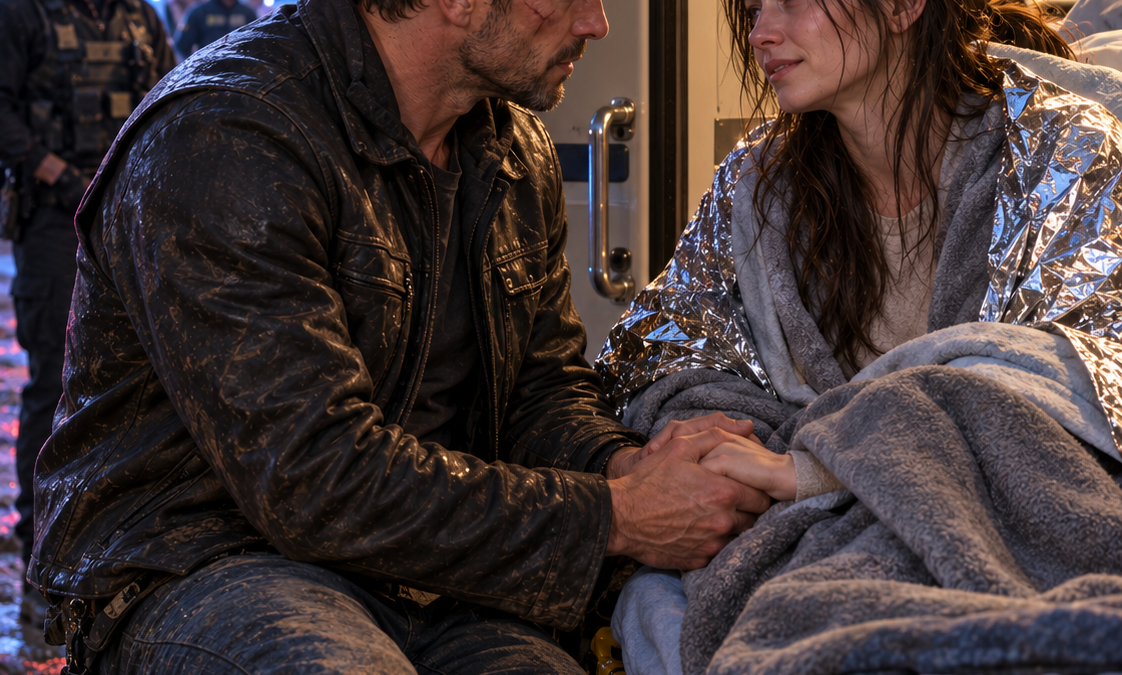
Ryder was not there for that either. He was in the back of a paramedic unit with Carla, who was being assessed by two people who treated her with a careful professionalism that he was grateful for, who asked him at one point to step outside for a moment.
And he did, and he stood in the cold outside the ambulance with his hands at his sides, and his jacket still soaked through with mud, and he breathed. Hatch found him there. They stood side by side without speaking for a moment.
Hatch had been with the state investigators for the last hour providing documentation, the secondary files, Willa’s findings, the phone records, Danielle’s journal, all of it organized with the methodical competence of a former deputy who understood exactly what admissible meant and had structured everything accordingly.
He
had mud on his boots from the access road, and his reading glasses were in his chest pocket with one arm slightly bent from being folded too fast.
He’s in custody, Hatch said.
Carl Cole.
He didn’t say the name.
I know, Ryder said. Roads 2 and three others from inside the building. A pause.
Voss says there are connections running into two additional counties.
She’s already made the calls.
Ryder nodded. The other women.
Hatch said carefully. There were two others inside. Neither of them is.
They’re both going to need time, but they’re both He stopped.
Chose the word present. Ryder understood what the word was carrying and was grateful for it.
Petra Sims, he asked. Hatch was quiet for a moment.
Not here. Voss is working on that.
She thinks she thinks there’s another location.
She’s pulling on the LLC chain.
He stopped again.
She didn’t give me a probability.
And that was the thing about nights like this, like the thing that movies got wrong and that the men who’d been in real versions of them knew from the bone outward.
Nights like this did not end clean. They ended with some things resolved and some things still in the dark. And the people standing outside the ambulance in the mud were left to carry both simultaneously, the relief and the not yet, the found and the still missing, because that was the honest shape of it.
He went back inside when the paramedics indicated he could. Carlo was sitting up. She had a blanket around her shoulders and a cup of something warm between her hands.
Tea, he thought from the smell, and she was looking at the far wall of the ambulance with the particular focused gaze of someone learning to be somewhere again, practicing the fact of a space that they could leave. He sat across from her.
She looked at him.
“You took a long time,” she said.
Her voice was clearer now than it had been on the phone, still damaged around the edges, still carrying the roughness of disuse, but underneath it was something he recognized. The specific cadence of her, the rhythm of how she constructed sentences, unchanged in the way that essential things survive things that are meant to destroy them.
I know, he said. I called the number because I still knew it. She looked down at the cup.
I memorized it when I was 17 because you told me to. You said memorize one number you can always call.
A pause.
I thought I thought maybe you’d moved, changed your number.
People do.
I didn’t, he said.
No, she said you didn’t.
They sat in the ambulance in the cold and the equipment around them made its small technical sounds and outside the operation continued its careful dismantling of the thing that had been built here. And Ryder and his sister sat together in the ambulance and did not say everything because everything was too large for one night and would require many other nights and many other conversations and people more qualified than him to help with the pieces that qualified people needed to help with.
But they sat there, which was its own complete thing.
After a while, Carla said, “I heard a roadking when I called.”
“You used it to tell me something.”
I used it to tell you it was you, she said.
I didn’t want to say your name out loud.
She looked at him.
I didn’t know how much time I had.
You had exactly enough, he said. She almost smiled. It was not a full smile.
It was the preliminary shape of one, the muscular memory of the expression finding its way back to a face that had not used it in some time, but it was there. He stayed with her until the paramedics indicated transport to the hospital.
He gave her his hand when they moved her to the stretcher and she held it until the door closed. He stood in the mud outside and watched the ambulance move down the access road. Santos was beside him when he turned around.
He had no idea when Santos had arrived or how long he’d been standing there, and he understood that this was intentional, that Santos had been there long enough for the presence to be felt and had simply waited.
Dex is with the Quins,” Santos said.
“Good.
Avery is still asleep.”
“Good,” he said again.
Santos put a hand briefly on his shoulder. Not a grip, not a hold, a touch. The duration of a single breath, and then gone.
It was the most Santos said with his hands about any of this, and it was exactly the right amount. The drive back to Harrow took 40 minutes.
Hatch drove and Ryder sat in the passenger seat and Santos was in the back and none of them said much of anything. And the highway was empty in the pre-dawn way that highways in smalltown Pennsylvania are empty.
Occasional trucks running through on their own timelines, headlights floating past in the dark. Everyone going somewhere that had nothing to do with here.
At some point, Hatch said, “Vos called while you were in the ambulance.”
Ryder looked at him. She got a second warrant.
The LLC chain from the farm property ties to a storage facility in Caldwell.
She’s sending a team at first light.
He paused. She thinks Petra Sims may be there.
Ryder turned back to the window. The dark outside was beginning to do the thing it does in the last hour before dawn. Not lightning yet, not changing in any way you could point to, but becoming slightly less absolute.
A quality of darkness just beginning to consider alternatives. Does she know?
Ryder asked. Voss.
Yeah. Is she?
She’s been building this for 14 months.
Hatch said. She knows what to do.
He did.
He trusted Voss in the specific way you trust people who have demonstrated what they’re built of under pressure.
She would get Petra Sims out if Petra Sims was there to get out. And if the news from Caldwell was not good news, Voss would handle that with the same precision, the same careful, professional humanity that she had applied to every piece of this from the corner booth in the diner at 7 in the
morning. He let it go.
He let Voss have it. He understood that letting capable people do the things they were capable of was not passivity.
It was its own form of discipline, and it was harder than going yourself. They got back to the garage at 2:40 in the morning. The light in the upstairs room was on.
Dim, the lamp that sat on the floor because there was no table for it, but visible through the small window that faced the alley.
Dex’s truck was parked at the side of the building.
And Dex himself was sitting on the steps inside the side door with a coffee cup and a watchful stillness that he held badly. Dex was not a man built for stillness. Had never been.
But he held it for the people who needed it held, and that was its own kind of discipline, too. He looked up when they came in.
Read their faces in the way they’d all learned to read each other’s faces over enough years together.
“She’s out?”
he asked.
“She’s out?”
Ryder said.
Dex exhaled long, complete, the exhale of a man releasing something he’d been carrying since the ambulance drove away from the farm.
He pressed his thumb and forefinger against his eyes for a moment and then straightened up and cleared his throat. Okay, he said, not as a response to anything specific, as a statement about the state of things. Okay, Santos agreed from behind Ryder.
Upstairs, the creek of footsteps.
Then Danielle’s voice low, asking Dex something from the top of the stairs.
We’re good, Dex said.
Go back to sleep. A pause from above.
Is she?
She’s out, Dex said.
Go to sleep, Danielle. Another pause. Then the footsteps retreated.
Ryder sat down in this chair he’d been sitting in since last night.
It felt like a different era last night, though it was less than 24 hours ago. And he put his forearms on his knees and stared at the concrete floor between his boots.
The floor was the same floor, oil dark, cracked in the same places, familiar in the way that only things you’ve spent years working over become familiar.
Hatchmade coffee. It was almost 3:00 in the morning and they all drank coffee because it was the right thing to do at almost 3:00 in the morning after a night like this.
And nobody analyzed it or justified it. And the coffee maker made its small domestic noise and the garage smelled of oil and winter cold and weak institutional coffee.
And it was the most comfortable place writer could think of in the entire world.
They didn’t talk about what had happened.
Not in detail. Not yet.
The detail would come in pieces over days and weeks and in the specific careful increments that four men with various forms of damage had learned to use with each other. What they did was sit in the same space and drink coffee and be there together. And that was its own complete language with its own grammar and its own precise meanings.
And Ryder was more grateful for it than he had words to say. At some point he realized Hatch had fallen asleep in his chair with his reading glasses still in his chest pocket.
At some point, Santos turned off the overhead light and left only the smaller work lamp in the corner, which was consideration for Hatch’s sleep rather than any necessity.
At some point, Dex stopped chewing his cheek, and his breathing evened out, and he was asleep on the roll out cot that they kept in the corner. Ryder did not sleep. He sat in the chair and breathed and was awake.
He was awake at 5:00 when Voss called. He stepped outside to take it. The alley behind the garage was cold and absolutely still in the specific stillness of the last dark hour, the hour before anything begins, and his breath made shapes in the air that dispersed slowly, and he watched them while Voss talked.
Petra Sims was alive. She was at the Caldwell facility. She was in poor condition.
Voss used that phrase with the specific evenness of someone being precise rather than soft. but she was alive and she was already in medical transport. Her family, two states away, had been notified.
Ryder pressed his back against the brick wall of the garage and looked up at the rectangle of night sky between the buildings and exhaled.
“How many total?”
he said.
“Seven,” Voss said.
“Including your sister.”
A pause.
“There may be others we haven’t located yet.
The LLC chain goes further than one layer.
We’ll be working it.
Carl Cole formally charged as of two hours ago. Federal involvement now, not county. He will not be in a position to make calls or arrange anything for a very long time.
Another pause. This one with a different quality. The quality of someone saying the next thing carefully because it deserves to be said carefully.
I want you to know that what you gave me, Mercer’s documentation, the journal, the phone records, it’s the reason this held together.
A warrant application without that documentation would have had holes. The documentation closed the holes. Hatch closed them.
Ryder said Hatch organized them.
Voss said, “You kept the witnesses safe long enough for the documentation to matter.
He didn’t say anything.
Get some sleep, Cole.”
She said, “I’ll be in touch later today.”
He went back inside. He sat in his chair, and the darkness outside the high windows slowly, slowly began to change its nature. Still dark, but thinner, the first gray suggestion of something that would eventually become morning.
He watched it happen and didn’t sleep, and found that he didn’t need to yet.
There would be time for sleep. There would be days of it and other things. The particular extended aftermath that nobody talked about much because it was less dramatic than the event, but lasted considerably longer.
At 6:45, small footsteps on the stairs. Avery came down slowly, still wearing the oversized sweatshirt that Danielle had found in the storage room, the one that was approximately three sizes too large and made her look even smaller than she was.
Her hair was in the state of a child who had slept hard and not thought about her hair, and her socks didn’t match, one gray, one with a stripe.
She stopped at the bottom of the stairs and looked at the sleeping man and at Ryder awake in his chair. She patted over, stood in front of him.
“Is it done?”
she asked. He looked at her, the direct plainness of 10 years old, asking the only question that mattered.
“Yes,” he said.
She nodded slowly. processed it the way children process large things with a gravity that adults underestimated and a speed that adults also underestimated. The man in the truck, she said.
He won’t be in a truck for a long time, Ryder said.
She nodded again. She stood there for another moment in her mismatched socks and the oversized sweatshirt.
And then she went to the small workbench in the corner, the one with the clean surface that Santos used for detail work. And she found a scrap of paper and a pencil that lived in the can by the vice.
And she sat on the stool and wrote something. It took her about 2 minutes, and she was careful about it. The careful printing of a child who is taking the task seriously.
She folded it. She brought it to Ryder.
He took it.
He didn’t open it immediately.
He looked at her.
“Thank you,” she said.
Her voice had the specific simplicity of a child who means something so completely that there is nothing extra to add to it. No ornament, no elaboration, just the two words carrying everything. He folded the paper and put it in the inside pocket of his leather vest, the one close to the left side, and he left it there.
At 7:15, Danielle came downstairs. She was composed in the particular way she was always composed.
Not because the composure was easy, but because it was the habit of survival, the practiced architecture of a woman who had held herself together for a very long time under conditions designed to take that architecture apart. She looked at Ryder
and he told her briefly what Voss had told him. The arrests, the charges, the seven women, the federal involvement.
She listened with her hands flat on the bench beside her and her eyes very steady. And when he finished, she looked at the floor for a moment.
“It’s real,” she said.
“Not to him exactly, to herself.
To the fact of it.
” “Yes,” he said.
She breathed in through her nose and out slowly.
“Okay,” she said.
same as Dex had said it in the same register, a reckoning with a changed state of things, the beginning of the long task of building from this point, rather than surviving toward some imagined point beyond it. Hatch woke up at 7:30 and looked at his glasses and then at his watch, and then at everyone else with the expression of a man who has fallen asleep in a chair before, and was not surprised to wake up in one.
He accepted the coffee Santos handed him without speaking and drank it standing up. They stayed in the garage through the morning.
Voss came by at 9:00 with two state investigators and spent 2 hours going through documentation and she was professional and thorough.
And at one point when the investigator stepped outside to make calls, she looked at Ryder across the bench and said simply, “Your sister called me this morning from the hospital.”
She wanted to say that the team who found her was good. A pause.
I told her the team that made it possible was here. She looked at the others briefly. She said she knew.
The investigators wrapped up at 11:00. The county vehicles that had been positioned outside were gone, had been gone since before dawn.
Their drivers now involved in processes that were considerably more significant to their careers than surveillance of a motorcycle garage. The street outside was just a street again. The rain had stopped sometime in the night, and the morning was cold but clear.
The kind of cold that is honest about itself, that doesn’t pretend to be anything other than November.
At noon, Santos made food. He did this without discussion or announcement, simply disappeared into the small back room they used for breaks, and produced sandwiches with the same focus competence he applied to engines, and set them on the workbench, and everyone ate standing or sitting,
wherever they were, and nobody made it into a moment. But it was one.
In the weeks that followed, the arrests spread outward through the counties. The way structural damage spreads through a building when one loadbearing element is removed.
Not all at once, but steadily, each new connection leading to the next. Each name producing other names. The architecture of the thing becoming visible only once it began to collapse.
The federal involvement meant the process moved faster than it would have under county jurisdiction.
And it moved with a weight that Carl Cole’s reach could not redirect because the reach that had kept everything contained for 6 years did not extend to federal jurisdiction and had never needed to because nobody had ever pushed hard enough into county structure to reach the federal level.
Ryder learned the
extent of it in pieces. He was not investigating it. That was not his role and he understood his role.
But it reached him through Voss’s updates, through Hatch’s conversations with Willa Marsh, through occasional news coverage that he read with the specific disconnected feeling of seeing something you lived through described in a language slightly different from the language of the experience.
six years, seven women recovered, multiple properties across three counties, connections that reached into county administration at several points. Though Carl Cole remained the architect of the institutional protection, the man who had understood that systems could be made to overlook things if the right person in the right position applied consistent pressure at the right points. Ryder visited Carla at the hospital on the second day and on every day that followed until she was moved to a recovery facility.
And those visits were sometimes short and sometimes long and were not most of them particularly dramatic. They talked about small things more than large ones, which was exactly right. She asked him once in the second week what had made him keep looking.
Not for her specifically, but in general, what made him the kind of man who didn’t stop when the official systems said to stop?
He thought about it. A kid with wet sneakers, he said. She grabbed my sleeve.
Carlo looked at him with an expression that had more in it than he could read quickly.
And then she said, “Tell me about her.”
He did. Danielle and Avery Quinn did not go back to the apartment on the other side of town.
They stayed above the garage through November and into December, not because there was no alternative, but because the alternative required a sequence of administrative steps that took time, and also because Avery had adopted a position on the subject that was difficult to argue with. She had informed her mother with the matter-of-act certainty of a child who has processed the available information and reached a conclusion that the garage was the safest place she had been in 7 months and that moving from it before she was ready seemed inadvisable. Santos painted the room on the third weekend in December without being asked and without making any comment about doing it.
He chose a color that was approximately the color of winter sky, the pale gray blue of it. And when Avery saw it, she stood in the doorway for a moment and said it looked like the inside of a cloud, which Santos appeared to consider an acceptable response.
Dex taught Avery to play chess on a folding set he found in the storage room and lost to her after 3 weeks, which disturbed him sufficiently that he began practicing between sessions, which Santos and Hatch regarded with an amusement they did not express except in the very small way
that these men expressed amusement. The diner on Portsmith became where they went on Saturday mornings.
Not a planned thing, not a declared thing. It simply became the pattern, the seven of them, or some configuration of the seven of them occupying the corner booth and the two tables pulled adjacent to it. And Avery ordered the same thing every week with the comfortable certainty of someone who has found a preference and is content with it.
And Danielle and Carla sat next to each other with the specific ease of two people who have found in each other a very particular form of understanding that requires no explanation. Ryder sat at the end of the table closest to the window. He could see the street from there, sir.
The parking lot, the morning traffic on Portsmith, the ordinary Saturday movement of a small Pennsylvania town going about its ordinary business. He drank his coffee and watched it. One Saturday in January, clear, very cold, the first real cold snap of the winter.
They were all there, the booth and the pulled tables, the coffee and the food, the particular ambient noise of eight people in a familiar place with the ease of repeated presence. Hatch was reading something on his phone with his reading glasses on, making no comment about the glasses. Dex was explaining something to Avery that she was listening to with polite skepticism.
Santos was eating with the focused attention he brought to anything he considered worth doing properly. Carlo was talking to Danielle in a low voice.
The two of them leaned slightly together, and Danielle was nodding at something. Ryder looked at all of them.
He looked at the street.
He looked at the inside pocket of his leather vest, where the folded piece of paper had been since the morning after everything ended, tucked against the left side of his chest near the scar that had missed his karateed by the distance of someone
else’s bad day.
He had not unfolded it since she handed it to him. He knew what it said. She had told him, standing in mismatched socks in the dim garage in the last hour of a very long night with the plainness that 10-year-old certainty produces.
He kept it folded, not because he needed to read it again, but because the weight of it against his left side had become something he was aware of, not a burden, the opposite, a small, specific proof of something he could feel through the leather when he breathed. Outside, four Harleys sat in the January cold of the parking lot.
His Road King, Santos’s Road King, Hatch’s Electrolide, Dex’s Fat Boy.
They had ridden here this morning through air that was cold enough to turn your ears numb and clear enough to see the mountains on the eastern horizon from the elevated stretch of Route 7. And the ride had been the thing it always was.
The cold and the sound of it and the particular quality of aliveness that engines in motion produced. He heard Avery laugh at something Dex said.
He heard Carla’s voice rise slightly, not alarm, the rise of making a point in a conversation.
and Danielle respond. He heard Santos set down his fork. He drank his coffee.
The morning light came through the diner windows at the low winter angle that made everything slightly amber, slightly warmer than the temperature outside justified, and it fell across the table and the people at it and the coffee cups and the ordinary wreckage of a Saturday breakfast. And Ryder looked at it and breathed. The world was not fixed.
It was not clean or simple or conclusively better in the way that made good endings easy to summarize. Carl Cole would be in a federal proceeding for the next several years.
Petra Sims was in a facility in Pittsburgh working with people whose job it was to help her come back from what had been done to her, and the coming back was slow and nonlinear and would not be complete in any time frame he could name. There were other names in the LLC chain that had not yet produced addresses. The county systems that had failed Danielle Quinn 11 times across three counties had not been remade overnight by the arrests.
Those systems were still what they were, still containing the gaps that men like Carl Cole had learned to use. None of that was nothing.
All of that remained.
And also across this table in this amber light with coffee cooling in cups and the sound of a 10-year-old girl’s laugh at something probably not as clever as Dex thought it was.
also this this too was real and present and required acknowledgement. He put the coffee cup down.
He reached into the inside pocket of his vest and took out the folded piece of paper and held it between his fingers for a moment. Not opening it, just holding it, feeling the fold of it, the slight rough texture of the garage scrap paper, and then he put it back.
Carla caught his eye from across the table. She had seen the motion.
She didn’t ask about it.
She looked at him for a moment with the new version of her face, the one that was still being reconstructed from the inside, still figuring out what it was going to be after everything. And something moved in her eyes that was not quite a question.
He shook his head slightly. Small motion, not a negation, a reassurance.
Later, we have time. She held his eyes for one more moment and then looked back at Danielle, and the conversation resumed. Outside the Harleys sat in the cold parking lot, and the January sun fell across them at the low winter angle, and the chrome threw it back in small points of light, and Route 7 ran east toward the mountains that were pale and clear on the horizon.
And the world continued its imperfect human motion, damaged and functional, failing and holding, the way it always had, the way it always would. Inside the diner, the coffee was hot.
That was enough. That was for now exactly enough.
—END—

