A Freezing Puppy Lay Alone Until a Navy SEAL Found Him in the Snow
A Freezing Puppy Lay Alone Until a Navy SEAL Found Him in the Snow
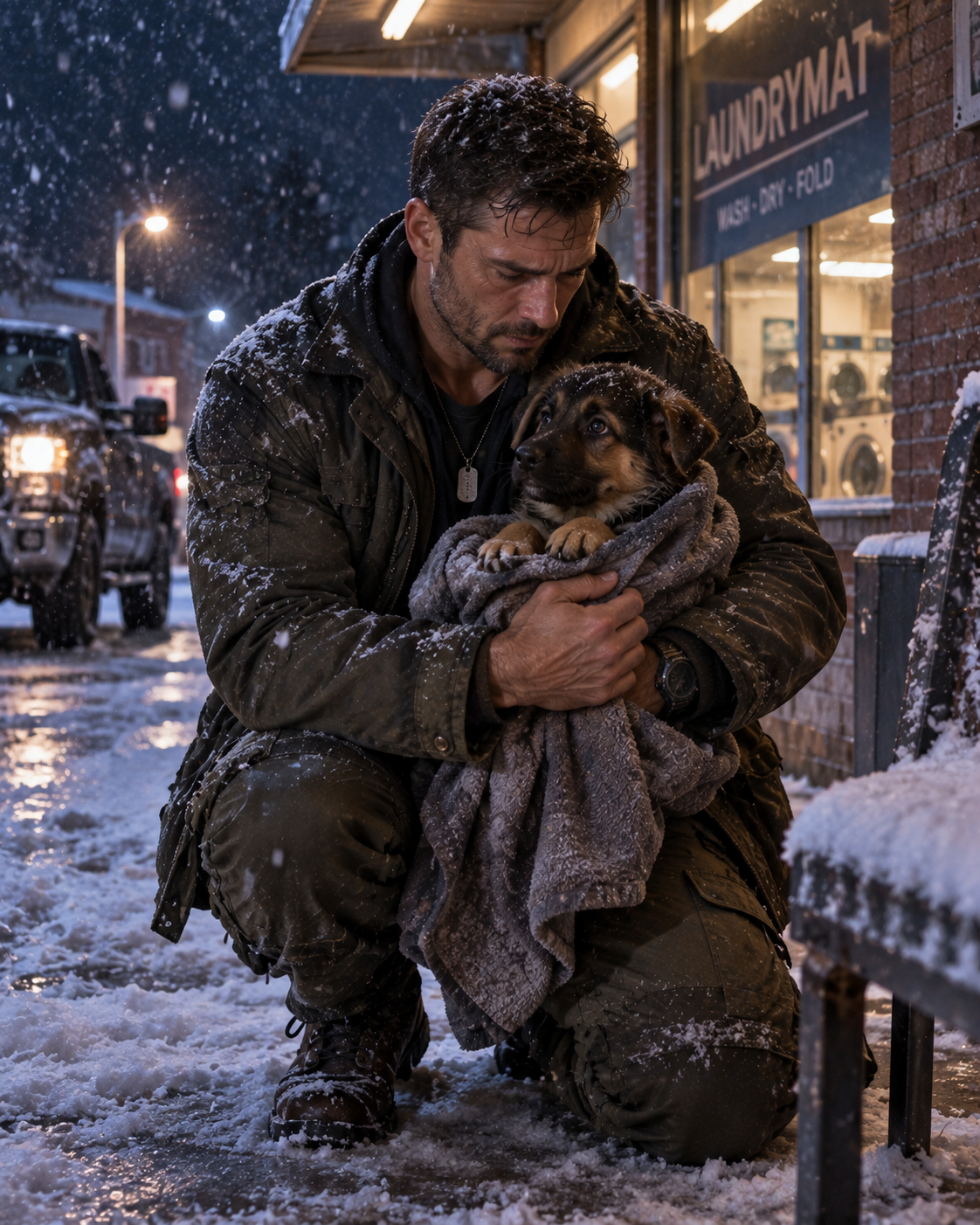
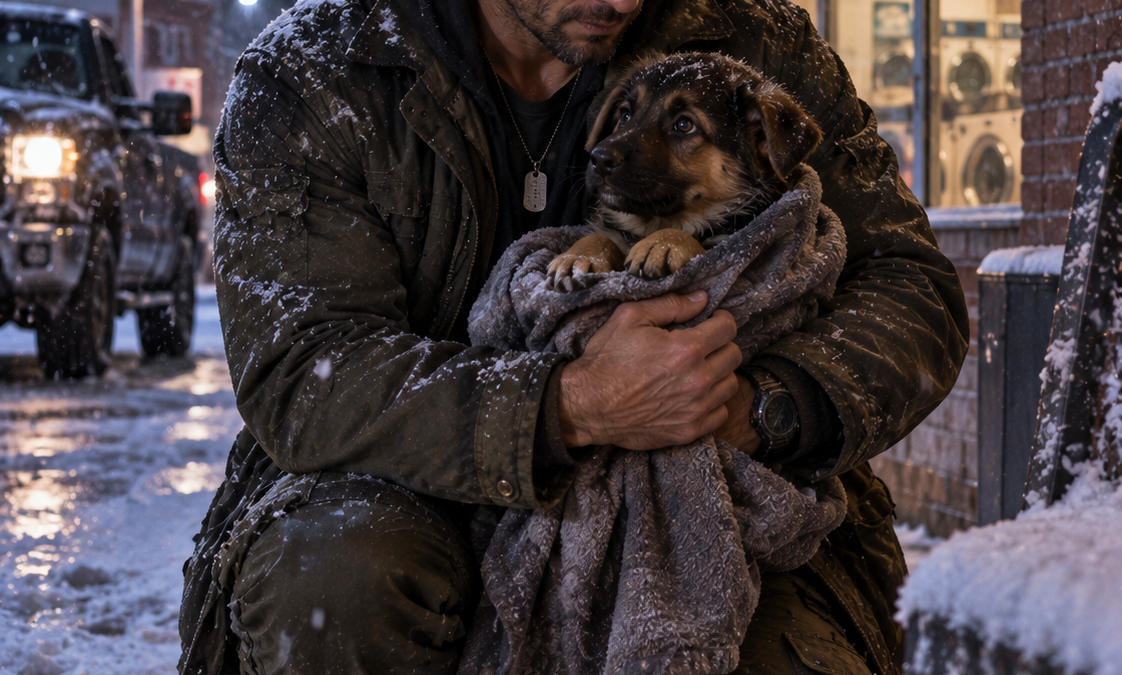
On a silent winter night in North Haven, a tiny German Shepherd lay curled beneath the awning of an old laundromat. He was too cold to cry, too weak to run, with only his tearful eyes left to ask the world for mercy.
Caleb Veric, a former Navy Seal living in silence after loss, carried the freezing puppy home in his arms. But when Caleb placed a bowl of food in front of him, the puppy did not eat.
He quietly dragged it into a dark corner and lay beside it. As if that bowl was not just a meal, but the last piece of hope he had left for tomorrow.
Caleb thought he was saving a puppy from the snow. But he had no idea Brooke was about to pull him out of a darkness of his own.
Caleb Varic had learned over the years that silence came in different shapes. There was the useful silence before a mission when men checked their gear without speaking because everyone already knew what fear sounded like.
There was the dead silence after an explosion when the world went white and the body waited for pain to report where it had landed. And then there was the silence inside his house at the northern edge of North Haven, Minnesota.
A silence so ordinary that no one would have thought to call it dangerous. Caleb knew better.
The house stood beyond the last neat row of town lights, where the road bent toward Harrow Lake, and the pines gathered thickly along the water like old centuries in white cloaks. In summer, people called the place beautiful. In winter, it looked like something carved by a stern northern god who believed beauty should come with frostbite as a warning label.
Caleb liked that, or he told himself he did. He had lived alone there for nearly 2 years, long enough for the town to stop expecting him to attend church suppers, volunteer breakfasts, holiday raffles, or any event involving folding tables, and cheerful questions.
People in North Haven were polite about grief. They knew when to bring casserles, when to stop bringing casserles, and when to let a man become a rumor, if that was what he seemed determined to do.
At 43, Caleb still carried himself like a Navy Seal, though the Navy no longer owned his mornings. He stood a little over six feet, broad through the shoulders, but lean, his strength compact rather than showy. His dark brown hair was cut short in the old military habit, just a little longer than regulation now, with silver beginning at both temples, as if winter had touched him there first.
He kept his face clean shaven which made the hard line of his square jaw and the sharpness of his cheekbones more visible. His skin was fair but weathered by cold wind and years under open skies.
His eyes were the thing people remembered. Gray blue, steady, awake. They made strangers feel sometimes uncomfortably that he had seen whatever they were trying to hide and had decided not to judge them for it.
That night, Caleb wore what he always wore when he went into town, an olive military t-shirt beneath a matte charcoal gunmetal tactical jacket with scuffs at the seams. Old earth brown combat pants with a trace of olive in the fabric. The knees worn from use rather than fashion, and dark brown military work boots that had outlived several easier lives.
A scratched old watch sat on his left wrist. Beneath his shirt, a pair of silver military dog tags rested against his chest, dulled by time, hidden except when the collar shifted. He had gone into town for coffee, canned soup, and a small bundle of firewood he did not strictly need.
The store clerk had asked him whether the lake road was icing over yet. Caleb had answered in six words that counted in North Haven as a conversation. By the time he drove home, snow had begun to fall harder.
It came down in wide, slow flakes, the kind that made the whole world seem softer until the road vanished beneath it. His pickup moved through the white dark with its headlights pushing a tunnel ahead.
The wipers scraped back and forth with a tired rhythm. On the passenger seat sat the paper bag of groceries folded neatly at the top. There was no second bag, no flowers, no pastries, no small item bought because someone at home might like it.
There had been a time when Caleb had brought home ridiculous things because Elena had smiled at ridiculous things. A ceramic fox from a roadside market.
A jar of cherry jam too sweet for anyone with self-respect. A blue mug with a chip in the handle that she insisted had character as if damaged objects became noble when named correctly. The mug was still in his kitchen cabinet.
Caleb had not used it since she died. He had not moved it either. That was the strange law of his house now.
Nothing had to be alive, but everything had to remain. He turned past the closed laundromat at the end of Ash Street, where the neon sign had been dead so long people gave directions by it anyway. The road narrowed there, passing a row of old brick storefronts before opening toward the lake road.
Caleb almost drove past the shape beneath the laundromat awning. Almost.
A dark bundle lay tucked against the wall near a rusted newspaper box. Snow had gathered over it in a thin crust. It looked like a trash bag at first, or a pile of abandoned clothes.
Caleb’s eyes moved over it once, cataloged it, dismissed it.
Then the bundle moved. Not much, only a tremor.
A small shift inside the falling snow.
Caleb’s hands tightened on the wheel.
He drove another 30 yard before slowing.
“There are people whose job this is,” he said aloud.
His voice sounded too large inside the truck. He kept driving. The wipers moved.
The tires whispered over packed snow. The laundromat disappeared in the rearview mirror, swallowed by white.
Then he saw Elena’s mug in his mind.
Not clearly, not like a vision. Just the stupid blue curve of it, the chipped handle, the way she used to hold it with both hands on winter mornings and complained that his coffee tasted like tactical mud.
Caleb exhaled through his nose. Damn it. He turned the truck around.
When he pulled up near the laundromat, the snow had already begun filling his tire tracks. He parked at an angle, hazard lights blinking amber into the storm and stepped out. Cold met him hard.
It needled his face and slipped beneath the edge of his jacket, familiar and unwelcome. The bundle did not move when he approached.
Caleb crouched several feet away. It was a puppy, a German Shepherd, though so thin and soaked that the breed appeared only in fragments, the shape of the head, the oversized paws, the beginning of upright ears that had not yet decided whether hope was worth the effort.
Its coat was cream gray beneath the wet with darker shading along the back and ears, but the colors were dulled by snow and street grime. One ear leaned sideways, the other tried weakly to stand.
The puppy’s eyes were open.
That was what got him. Not the ribs faintly visible under the damp fur.
Not the trembling. Not even the way its small body had curled toward the wall to escape the wind.
It was the eyes, dark, wet, and exhausted, holding a grief too old for anything so young. The puppy did not look surprised to see him.
It looked as if it had been waiting for the world to make up its mind. Caleb removed one glove and held out his hand slowly. The puppy watched.
No growl, no bark, no attempt to flee. Easy, Caleb said. The word came from him without thought, low and quiet.
The way he had once spoken to frightened men under fire and injured strangers pulled from wreckage. He had not used that voice in a long time. It scraped something open in him.
His fingers touched the puppy’s shoulder.
A faint sound slipped from the animal, part whimper, part sigh. Not loud enough to accuse him. Too tired even for that.
Caleb’s throat tightened.
“All right,” he murmured.
“You’re coming out of there.”
He slid one hand beneath the puppy’s chest and the other under its hind quarters, lifting carefully.
The body in his arms felt wrong, too light, too breakable. The puppy stiffened at first, then sagged against him with the terrible trust of something too weak to resist.
As Caleb stood, a small folded paper dropped from a strip of cloth loosely tied around the puppy’s neck.
The cloth might once have been blue, now it was stiff with cold. Caleb looked at the paper lying in the snow.
For a moment, he did not want to pick it up. A man could refuse many kinds of responsibility by not reading the words attached to them.
The puppy shivered against his chest. Caleb bent, took the paper, and unfolded it with his bare fingers. The writing was uneven, blurred slightly where moisture had reached it.
There was only one sentence. I hope some kind person can care for him and raise him in my place.
No name, no explanation, no plea dressed up in pretty language. Just that.
Caleb stared at the sentence until the cold began to sting his hand. He had read orders that sent men into danger.
He had read casualty reports. He had read the clean, official language people used when the truth was too large to fit into paper.
But this one line felt heavier than it had any right to be. in my place.
The words did not excuse anything. They did not answer anything.
They simply stood there small and helpless like the animal in his arms. Caleb folded the note and tucked it inside his jacket pocket.
“Okay,” he said, though he did not know who he was answering.
He carried the puppy to the truck and placed it on the passenger seat, pushing the grocery bag onto the floor. He stripped off his jacket and wrapped it around the small body, leaving himself in the olive t-shirt as the wind shoved snow through the open door. The puppy blinked slowly.
A tremor traveled from its neck to its paws. Caleb climbed in, turned the heat higher, and pulled away from the curb.
For the first few minutes, the puppy remained upright beneath the jacket, nose barely visible, watching him with a solemnness that would have been comical if it had not been so sad. Caleb kept both hands on the wheel.
He did not speak. He was afraid, in some unreasonable corner of himself, that if he spoke too kindly, he would be making a promise. The truck reached the lake road.
Snow moved across the headlights in silver lines. The world narrowed to dark pines, white ditches, and the warm, fragile breathing beside him.
At the edge of town, the puppy made a small sound. Caleb looked over.
Its eyes were still open.
“You can sleep,” he said.
The puppy did not sleep. It watched him all the way home.
Caleb’s house waited at the end of a gravel drive, its windows dark except for the porch light he had left on out of habit.
The place was practical, square built, with a steep roof and a stack of firewood along the side wall. Elena had once called it handsome in a grumpy way, which Caleb had understood to mean she liked it.
He carried the puppy inside. The house smelled of cedar, cold ashes, old coffee, and the faint lavender soap Elena used to buy in bulk because she believed practical things should still have mercy in them.
Caleb had stopped noticing that smell most days. Now with the puppy shivering in his arms, it returned so sharply that he had to pause near the door.
“Not now,” he whispered.
He set the puppy on an old towel near the wood stove, then knelt and opened the stove door. The fire caught slowly, orange licking through the dark. Caleb moved through the kitchen with the efficient quiet of a man used to doing necessary things before feeling anything about them.
bowl. Water. Soft food warmed slightly.
Towel. Another blanket. The puppy watched every movement.
Caleb placed a shallow bowl of water nearby first. The puppy sniffed it, then drank a few cautious laps.
Not enough, but something. Good, Caleb said. The word sounded strange in the house.
He prepared a small portion of food softened with warm water and set it in a metal bowl on the kitchen floor where the light from above fell cleanly around it. The puppy lifted its head.
Caleb stepped back for several seconds. Nothing happened.
Then the puppy rose unsteadily. Its legs trembled. One paw slipped on the wood floor, recovered, tried again.
Hunger drew it forward despite fear. It reached the bowl and lowered its nose.
Caleb felt a thread of relief. Then the puppy did not eat. Instead, it gripped the rim of the bowl gently in its teeth and began to drag it.
The metal scraped across the floor. Caleb frowned. The pup pup pulled the bowl away from the light.
Inch by inch. It moved with painful effort, stopping twice to breathe, then continuing.
Caleb did not interfere. He watched as it dragged the food toward an old cardboard box near the wall, a box he had been meaning to break down for kindling. The puppy nudged the bowl into the shadow beside it, then turned in a clumsy circle and lay down with its body curled around the food.
It did not eat. It guarded. Caleb stood very still.
The fire snapped behind him. Snow tapped softly against the kitchen window.
Somewhere in the cabinet above the counter behind a closed wooden door, Elena’s blue mug sat untouched.
The puppy rested its chin near the bowl, eyes halfopen. Too tired to stay alert and too frightened to surrender.
Every few seconds its gaze shifted toward Caleb, then back to the food, as if the meal were not a meal at all, but a treasure, a last ration, a small proof that tomorrow might not be empty. Caleb understood then, not fully, but enough to feel it in his chest.
This dog had not dragged the bowl into the dark to eat. It had dragged it there to keep.
He crouched a few feet away, elbows resting on his knees. The dog tags beneath his shirt shifted cold against his skin.
You poor little thing,” he said.
The puppy’s ear twitched.
Caleb looked at the cream gray head, the oversized paws, the damp fur beginning to dry in uneven tufts. A name came to him from nowhere, or perhaps from the way the puppy had chosen the corner, the shadow.
The position of a small black and cream piece left on the wrong square after the board had been abandoned.
“Rook,” Caleb said quietly.
The puppy blinked.
“All right, Rook,” his voice lowered rough at the edges.
Just tonight, he told himself that was all it was. One night of warmth, one night away from the snow.
In the morning, there would be phone calls, a vet, some proper place, some proper person, some clean and reasonable answer that would not require his life to change shape. Rook lowered his head beside the untouched bowl. Caleb remained on the kitchen floor longer than necessary.
Outside the storm buried the road, the tire tracks, the corner by the laundromat, and every sign that the night had ever been interrupted. Inside, the old house held its breath around a man who had forgotten how to want company, and a small German shepherd who had forgotten how to trust food. The fire grew warmer.
Neither of them moved toward it. Morning came to North Haven with a pale honesty of winter. It did not arrive warmly.
It did not forgive the night for what it had done.
It simply spread a thin silver light across the frozen lake, the white roofs, the dark pines, and the narrow road where Caleb Veric’s tire tracks had already been softened by new snow.
From the kitchen window, the town looked untouched, as if no small life had been lifted out of a corner beneath the old laundromat, as if no handwritten sentence had followed Caleb home and settled like a stone inside his jacket pocket. The puppy was still near the stove. Caleb had slept badly, though sleep was too generous a word for what he had done.
He had sat in the armchair for most of the night, boots still on, one hand resting near his knee, his eyes opening every time the puppy shifted. The fire had burned low twice. Both times he rose, added wood, and told himself he was only keeping the room warm, just for the dog, just for the night.
By dawn, the house smelled of ashes, damp fur, and coffee Caleb had forgotten to drink. The puppy Rook, though Caleb was not ready to admit the name had settled, lay curled on the towel where Caleb had placed him.
The small German Shepherd’s cream gay coat had dried in uneven patches.
In the better light, Caleb could see how young he was. 12 weeks, maybe. Old enough for his paws to seem borrowed from a larger future.
young enough for one ear to lose its courage halfway up. His body was too thin, his hips too visible, but there was a stubbornness in the angle of his head when he woke that made him seem less fragile than he should have.
Caleb stood at the stove and watched him without moving. Rook opened his eyes.
For several seconds, dog and man regarded each other across the kitchen, both of them silent, both of them measuring what the morning had made undeniable. Night rescues had a way of feeling temporary.
Morning gave everything edges. Still here, Caleb said.
Rook blinked. That makes two of us.
The words came out before Caleb could stop them. He turned away, irritated by his own softness, and poured fresh water into a shallow bowl.
Rook lifted his head. His nose twitched.
The movement was small, but it carried a kind of hunger Caleb could feel from across the room. He prepared another portion of softened food, smaller this time.
Last night’s bowl still sat in the shadow beside the cardboard box, most of the food untouched.
Caleb had not moved it. He had not wanted to disturb whatever strange rule Rook had built around it.
But he could not leave it there forever. He took the old bowl away slowly, expecting resistance.
Rook’s body tensed, but he did not growl.
He only watched the bowl rise from the floor with such quiet dread that Caleb stopped halfway.
I’m not taking it from you, Caleb said.
The puppy did not understand the words. Caleb knew that.
Still, he spoke them because the house had held too many unsaid things already. He rinsed the bowl, filled it with warm food, and placed it in a square of morning light near the table. Then he stepped back and leaned against the counter, arms folded.
Rook rose unsteadily.
The sight made Caleb’s jaw tighten.
Hunger pulled the puppy forward, but caution governed every step. His paws slid once on the wooden floor. He recovered, nose low, eyes lifting repeatedly to Caleb.
When he reached the bowl, he sniffed it for a long time. His tongue touched the food just once. Caleb held still.
“Eat,” he thought.
Rook lowered his mouth, then stopped. He took the rim of the bowl gently between his teeth and began dragging it away from the light.
The sound was soft at first, then rougher as the metal crossed a seam in the floorboards. Caleb watched, the muscles in his arms tightening.
Rook pulled the bowl toward the same dark corner beside the cardboard box. The effort cost him. Twice he paused, breathing through his nose, his thin sides moving too quickly.
Still, he continued until the bowl sat half hidden in shadow. Only then did he lower himself beside it. He ate one small mouthful, then another, then he stopped.
His front legs folded close around the bowl. His chin hovered near the rim. His eyes remained open.
Caleb waited 5 minutes. Rook did not eat again. By midm morning, Caleb had tried three different approaches, all of them sensible, none of them useful.
He moved the bowl closer to the stove. Rook dragged it under the table. He tried a ceramic dish from his cupboard, thinking perhaps the metal scrape frightened him.
Rook pushed the ceramic dish with his nose until it wedged against the wall. He placed a small spoonful of food directly on the floor, away from any bowl at all. Rook sniffed it, licked once, then retreated to the guarded bowl as if the loose food could not be trusted because it did not belong to a container that could be protected.
Caleb had known men who hoarded cigarettes, batteries, dry socks, letters, ammunition, silence. He had seen people hold on to objects that made no sense to anyone who had not been hungry, cold, afraid, or left behind.
Survival made its own religion out of small things. Still, watching it in a puppy hurt in a different way.
Rook was not refusing food because he did not want it. His whole body said otherwise.
The trembling in his legs, the fixed attention on every smell from the bowl, the way his tongue crept out and vanished again. Everything in him was pleading for the meal. But fear sat between hunger and trust like a locked gate.
At noon, Caleb found the note again. He had taken it from his jacket pocket and placed it on the kitchen table beside his untouched coffee.
The paper had dried wrinkled. The sentence looked even smaller in daylight. I hope some kind person can care for him and raise him in my place.
Caleb read it once, then again, he did not want to invent a story around it. People did that too easily. They saw one sentence and built a villain, a tragedy, a noble sacrifice, whatever shape made the world simpler.
Caleb had lived long enough to distrust simple explanations. He knew people abandoned what they loved. He knew people were forced to surrender what they loved.
He knew too that sometimes the difference could not be seen from the outside. The paper gave him no right to decide.
It only gave him a responsibility. By early afternoon, he called the veterinary clinic.
The woman who answered recognized his name after he gave his address. In a town like North Haven, people did not need to know a man well to know he existed.
She told him, “Doctor Norah Whitam could see the puppy if he came before three.”
Caleb almost corrected her. The puppy was not his.
Instead, he said, “We’ll be there.”
The word we remained in the kitchen after he hung up. Rook disliked the truck less in daylight, but distrusted the clinic immediately.
The North Haven Animal Clinic sat near the edge of town, a low building with green trim, a snow-covered ramp, and a wooden sign shaped like a paw print. Someone had hung a wreath on the door.
Caleb noticed with a faint disapproval he did not examine that the wreath wore a red bow large enough to qualify as a hazard in high wind. Inside the air smelled of disinfectant, clean towels, and nervous animals.
Rook pressed low against Caleb’s boot, not trying to flee, not quite willing to stand tall.
Caleb kept the leash loose. He had bought it from a shelf near the counter along with a temporary black harness trimmed in dark blue because carrying Rook everywhere felt wrong and letting him wander felt worse. The harness was too new, too bright, too hopeful.
Rook wore it like a question. Dr.Norah Witcom entered the exam room without ceremony, which Caleb appreciated before he knew he appreciated it. She was in her mid-50s with brown hair threaded generously with silver and pulled back at the nape of her neck.
Her face had the calm alertness of someone who had spent years reading pain in creatures that could not explain themselves. She wore a slate gray sweater beneath a clean veterinary coat, practical dark pants, and shoes built for long hours rather than compliments.
She glanced at Caleb, then at Rook.
Well, she said, “He looks like he’s had a private disagreement with Winter.”
Caleb looked down at the puppy.
“Winter won,” he said.
Norah’s mouth moved slightly, not quite a smile.
Not completely. That was the first thing she gave Rook, not pity, but a verdict that left room for survival.
She knelt without reaching for him. Rook watched her wearily. Norah turned her body at an angle rather than facing him head-on, offering the side of her hand low and still.
Rook leaned forward, sniffed once, and drew back.
“That’s fair,” Norah said.
“The examination took time.”
Norah did not rush it, and Caleb noticed that Rook tolerated her better because of that. She checked his temperature, gums, ribs, abdomen, paws, ears, and teeth. She weighed him, frowned at the number, but not dramatically.
She listened to his heart and lungs while Rook stood stiffly on the table. His oversized paws spread as if he were bracing against the possibility of the entire world tipping.
“He’s underweight,” Norah said, mildly dehydrated, but not dangerously at the moment.
“No obvious injury, no signs of severe illness from what I can see right now.”
The words loosened something in Caleb’s chest.
Norah scanned for a microchip.
The small device passed over Rook’s shoulders, then along his neck and back.
Nothing. She did it again. Still nothing.
No chip, she said. Caleb nodded once.
Norah studied him for a moment. You found him where? Under the awning by the old laundromat.
In that weather? Yes.
Her expression did not change much, but something around her eyes tightened. Caleb handed her the note.
She read it without speaking. When she finished, she placed it carefully on the counter.
I’ll make a found dog report, she said.
We’ll post his photo through the clinic page and the local rescue network.
I’ll notify animal control, too.
If someone is looking for him, they need a chance to come forward. Caleb knew that was correct. The answer landed in him with an unexpected discomfort.
And if no one does, he asked. Then we look at foster placement or adoption. The room became very quiet.
Rook shifted on the table and leaned almost imperceptibly toward Caleb. It was not affection. Not yet.
It was simply a frightened animal choosing the nearest known thing over the unknown ones. Caleb put one hand lightly against his side before thinking. Norah noticed.
Of course, she did.
For now, she said, “Can you keep him a few days?
We’re full and a kennel would be hard on him in this state.
I can give you instructions.”
Caleb almost said, “No.”
The word stood ready. He felt its shape.
No was clean. No prevented confusion. No.
kept the house as it had been, cold but orderly, empty but predictable.
Then Rook’s thin body trembled under his palm.
Caleb looked at the puppy, at the black harness with its dark blue trim, at the cream gray fur that would look soft if the world had been kinder, at the eyes that did not yet believe kindness stayed. A few days, Caleb said. Norah nodded as if she had expected nothing else which annoyed him.
She printed a foster form. Caleb signed it.
temporary care, found animal, veterinary follow-up. The words were precise and harmless, the kind of language people used to keep emotion from spilling across the page. Norah sent him home with recovery food, a feeding schedule that emphasized small portions, and a warning not to force the bowl away if Rook guarded it.
He drags it into corners, Caleb said. Eats a little, then stops, mostly lies beside it.
Norah leaned back against the counter, arms folded.
“Not uncommon in dogs who’ve learned scarcity,” she said.
“The bowl stops being a bowl.
It becomes proof.
If it’s full, tomorrow might be survivable.
If it’s empty,” she paused, choosing the gentler road.
“Empty can feel unsafe.
” Caleb looked at Rook.
The puppy had lowered himself onto the exam table, chin down, watching the door.
“So, what do I do?”
Caleb asked.
“Don’t turn eating into a fight.
Stay nearby, but don’t hover.
Keep things predictable. Small meals, same place, same voice. Let him learn that food returns.
Food returns. The phrase should not have hurt.
It did.
On the drive home, Rook slept for the first time in Caleb’s truck.
Not deeply. His paws twitched. His ears moved at every turn, but his head rested against the folded towel on the seat, and his breathing evened out for several minutes at a time.
Caleb kept the heat high. At home, the afternoon light had already begun to fade. Winter days in North Haven were short and suspicious.
As if the sun had looked around and decided not to get involved, Caleb carried the supplies inside, hung his jacket by the door, and set the clinic papers on the table. Beside them lay the note.
For a moment, the two papers seemed to belong to different worlds.
Norah’s form had boxes, signatures, dates, procedure.
The note had only one sentence and the unbearable space around it. Caleb fed Rook again before dark. Small portion, warm, same bowl.
This time he placed it near the stove, but did not stand over him. He sat at the kitchen table instead, one hand around a mug of coffee that had gone cold long before he drank it. Rook approached the bowl, sniffed, took one mouthful, then gripped the rim, and dragged it away.
Not to the cardboard box this time, under the table.
The bowl stopped near Caleb’s boot.
Rook froze as if surprised by his own choice. Caleb did not move.
The puppy stood there, caught between the old fear and the new geography of the room. The shadow under the table was not as dark as the corner.
Caleb’s boot was inches away.
The bowl was still full enough to guard. Rook lowered himself beside it.
He ate one bite, then another. Then he stopped and rested his chin on the floor, eyes open. Caleb looked down at him.
He felt no victory. Victory was too loud a word for two bites of food.
But something had shifted. Small as a match being struck in a cave.
Rook had not dragged the bowl away from Caleb. He had dragged it closer. The realization sat with Caleb through the evening.
After Rook settled near the stove, Caleb cleaned the kitchen because he did not know what else to do with the feeling.
He wiped the counter twice, rinsed the mug, folded the towel from the truck, set Norah’s instructions beside the recovery food.
Then he opened the cabinet for no reason he could defend.
Elena’s blue mug sat on the second shelf, exactly where it had been for 2 years.
The chip in the handle faced outward. A thin layer of dust softened the rim.
Caleb stood looking at it. He did not touch it. Behind him, Rook made a small sound in his sleep.
Not a wine this time, more like a breath that had almost become one. Caleb closed the cabinet gently.
Not yet. He turned off the kitchen light, but left the stove lamp on low. Rook lay curled beside the guarded bowl, thinner than he should have been, safer than he had been.
Still unsure whether safety could last more than a few hours. Caleb lowered himself onto the floor a few feet away. He did not reach for the dog.
He did not speak. He simply sat there in the dim kitchen listening to snow begin again against the windows. Two survivors in a northern house.
One guarding a bowl, one guarding a mug, neither ready to eat from what they had been keeping. By the third evening, Caleb Varic had learned that hope could become exhausting. It was not the kind of exhaustion that came from carrying weight or crossing distance.
Caleb understood that sort. Muscle fatigue was honest.
Cold was honest. Pain when it belonged to the body usually had a location and a cause. This was different.
This was the fatigue of watching a starving puppy stand in front of food and hesitate as if the bowl itself might punish him for needing it.
Rook had survived the first days in Caleb’s house.
But survival was not the same as recovery. Dr.Norah Wickham had sent them home with careful instructions. small meals, warm water, predictable timing, no hovering, no forcing, no turning food into a contest of wills.
Caleb followed those instructions with the precision of a man who had once trusted checklists with his life. Rook obeyed none of the emotional logic behind them. He drank a little more.
He slept longer near the stove. He no longer flinched every time Caleb crossed the room. But when the bowl came down, the old ritual returned.
He approached. He sniffed.
He tasted one or two bites. Then he dragged the bowl into shadow and folded himself beside it, guarding the food from a threat Caleb could not see.
The third evening had been worse. Outside, North Haven had gone quiet under another fall of snow.
Not a storm this time, only a steady sift of white across the pines and the frozen road. The world looked almost gentle through the kitchen window, which irritated Caleb. Winter had a way of appearing holy while making everything harder.
Inside the house held its familiar arrangement of things that did not ask anything of him. The table, the stove, the cabinet. The chair Elena used to sit in, though he had not called it that out loud in two years.
Rook lay beneath the table with his bowl tucked near one front paw. He had eaten almost nothing.
Caleb stood at the counter, one hand braced on the edge, the other wrapped around a mug of coffee that had gone cold.
Not Elena’s mug.
Never Elena’s mug.
A plain white one from a set of four, though two had broken and one sat unused on the back shelf. He had never replaced them. Placing things suggested a future in which objects continued to matter.
He looked down at Rook.
The puppy’s cream gray fur had begun to look less damp and wild, but his small body still seemed built of caution.
The new black harness with its dark blue trim rested on the back of a chair no longer needed indoors. Without it, Rook looked even younger.
One ear had managed to stand for most of the afternoon before folding again, defeated by sleep or doubt. Come on, Caleb said quietly.
You need more than that, Rook’s eyes lifted.
Caleb regretted the words at once. Not because they were harsh. They were not.
But need was a dangerous thing to name in a quiet house. He lowered himself onto the kitchen floor several feet away from the table. His knees made a faint sound.
Rook watched the movement but did not retreat. That too was progress though Caleb had begun to resent progress for being so small.
You know, he said, voice low.
I’ve followed orders that made less sense than this.
Rook did not blink.
You drag the food closer then act like I’m the strange one for expecting you to eat it.
The puppy’s nose twitched.
Caleb leaned back against the cabinet. The floor was cold, even through his old combat pants.
He should have stood. He should have cleaned the kitchen, checked the doors, done any of the small tasks he normally used to keep memory from catching up with him. Instead, he sat there in the dim light, and felt the house gather itself around him.
His hand reached up toward the counter for a paper towel and found the cabinet handle instead. He did not know why he opened it. Maybe because exhaustion loosens old locks.
Maybe because Rook had spent three days guarding a bowl and Caleb was tired of pretending he did not understand.
Maybe because the puppy’s hunger had become a mirror and there are only so many nights a man can refuse to look.
The cabinet door swung open.
Elena’s mug sat on the second shelf, pale blue ceramic, a small chip near the handle, a hairline crack at the base that had never leaked, but had always made Caleb suspicious.
Elena used to insist the mug was stubborn in a charming way, which was how she described half the things she loved, including an old radio, a leaning porch rail, and once during an argument he lost by laughing Caleb himself. He stared at it.
For a long moment, the kitchen disappeared. Not dramatically, not like a flashback in a film, but softly, the way breath fades from glass.
He saw Elena at the table on a January morning, both hands around that mug, hair still loose from sleep, accusing his coffee of being tactical mud with emotional damage. He remembered telling her she did not have to drink it.
He remembered her taking another sip just to prove she could survive worse. The memory should have warmed him. Instead, it hurt with the clean cruelty of something beloved and unreachable.
Rook shifted under the table. The metal bowl touched the chair leg with a faint click. Caleb looked from the mug to the puppy, and the truth arrived without mercy.
Rook was not the only one guarding something he could not use. The puppy kept food full because an empty bowl felt like proof that tomorrow could not be trusted.
Caleb kept Elena’s mug hidden because an empty chair felt like proof that love had ended, where he could still see it.
He let out a short breath that almost became a laugh. It sounded broken.
“Well,” he whispered.
“Looks like neither of us is very good at letting go.”
Rook lifted his head. Caleb reached into the cabinet, his fingers closed around the mug. For a second, he expected something impossible to happen.
A collapse, a betrayal, some invisible boundary in the house breaking because he had touched what grief had declared untouchable. Nothing happened. The mug was only a mug.
cool ceramic, a chip beneath his thumb, dust along the rim, and also not only a mug.
He set it on the table in front of Elena’s chair, not in the sink, not in a box, not hidden back in the cabinet, on the table.
The gesture was so small that no one else would have understood why his hand trembled. Caleb went to the sink, rinsed the mug gently, and filled it with water.
He did not know why water and not coffee. Perhaps coffee would have felt like pretending. Water was simpler.
Acknowledgement without performance. He placed it back on the table. Then he opened the lower cabinet and took out another bowl.
It was ceramic, off-white, one Elena had bought because she said soup tasted better from bowls that looked as if a grandmother might approve of them. Caleb had never cared what soup came in. He cared now only because he remembered her caring.
He set the empty bowl on the floor beside Rook’s food bowl just outside the shadow under the table.
Rook stiffened. Caleb did not look directly at him.
He had learned that much. Instead, he sat down on the floor again and brought his own plate with him. A heel of bread, a few slices of cold turkey, and half an apple he had cut more from habit than hunger.
He tore off a small piece of bread and placed it in the empty bowl. Then he ate a piece himself.
No speech, no command, no coaxing. The stove ticked quietly. Snow brushed the window.
The old house seemed to lean closer, listening with all its wooden bones. Rook stared at the empty bowl, not at the bread first at the bowl.
His nose stretched forward. He sniffed once, then withdrew.
Caleb took another bite of bread. He kept his movements slow, ordinary, almost boring. That was harder than it sounded.
A mission could be endured through action. Waiting required a different kind of courage.
One that did not look heroic, even to the person doing it. Rook stood.
Caleb did not move. The puppy stepped out from under the table. One paw, then the other.
His body remained low, but he did not retreat. He approached his own bowl first, touched the rim with his nose, then glanced toward the off-white bowl with the piece of bread inside. Caleb ate another bite.
Rook looked at him.
I’m staying, Caleb said softly.
It was the wrong thing, perhaps. Too human, too large, too close to a promise, but once spoken, the words did not feel wrong. Rook lowered his head and ate one bite from his bowl.
Then he stopped and looked up. Caleb remained where he was. Rook ate again.
The second bite was larger. The third came faster.
Caleb’s throat tightened so suddenly that he had to look down at the apple in his hand.
The kitchen blurred around its pale flesh and red skin. He forced himself not to praise Rook too loudly, not to reach, not to ruin the fragile bridge forming between them with his own need to cross it quickly.
Rook ate almost a quarter of the food before pausing. Then he moved toward the off-white bowl, sniffed the bread Caleb had placed there, and did something Caleb did not expect. He did not eat the bread.
He picked it up gently, carried it back to his own bowl, dropped it beside the food, and then took another bite from the meal. Caleb stared.
It was a strange small act, and he did not know what it meant. Maybe nothing.
Maybe the bread smelled like Caleb’s hand and made the bowl safer.
Maybe Rook was simply rearranging the world into a shape he could survive. Still, the sight undid something in him. Caleb pressed the heel of his hand against his eye before the tear could fall, then gave up when another followed it.
The first tear was humiliating. The second was a relief. He sat on the kitchen floor, broad shoulders curved, jaw tight, silent tears moving down a face that had stayed dry through funerals, official condolences, folded flags, and the terrible practicalities of losing a life partner.
He had not cried properly when he packed away Elena’s winter boots.
He had not cried when the insurance papers arrived. He had not cried the first time he woke and forgot for 3 seconds that she was gone.
But a starving puppy eating beside an empty bowl broke him open. Rook kept eating. Every few bites he looked up.
Every time Caleb was still there. By the time Rook stopped, nearly half the food was gone. Not enough for celebration, enough for breath.
Caleb wiped his face with the sleeve of his olive t-shirt and gave a rough, almost embarrassed laugh.
“You’re a hard negotiator,” he said.
Rook blinked, then lowered himself beside the bowl. But this time, his body did not curl around it like a guard at a treasure vault.
He lay with his head near Caleb’s boot, the bowl within sight, but no longer hidden fully in shadow.
Caleb stayed on the floor until his legs began to ache. The next morning, sunlight came thin and cold through the kitchen window. Rook ate a few more bites than usual.
Still cautious, still pausing often, the off-white bowl remained beside his bowl.
Elena’s mug remained on the table.
Caleb did not know what any of it meant yet. He only knew he did not put the mug back in the cabinet. Near noon, the phone rang.
Doctor Norah Whitam’s name appeared on the screen.
Caleb answered while Rook slept beside the stove, his paws twitching at some dream too small and private for human interpretation.
“No one’s contacted us about him,” Norah said after the first greeting.
“Not through the clinic page.”
“Not animal control, not the rescue network,” Caleb looked at Rook.
The puppy’s ear flicked in sleep.
“That’s good,” Caleb asked, though he was not sure whether he wanted it to be.
“It means we continue the process.”
Norah’s voice stayed practical but not cold.
There’s a family I want you to know about.
Daniel and Grace Halden.
They’re on our approved adoption list.
They had a German Shepherd for 11 years. Fenced yard.
Quiet home. Their daughter is gentle with animals.
They’re interested in meeting him once he’s stable enough.
The words arrived neatly one after another like stones placed across a stream. Approved family.
Fenced yard. Gentle.
Caleb should have felt relief. Instead, the kitchen seemed to lose several degrees.
How soon? He asked. A few days, not today.
I want him eating better first. Caleb said nothing. Norah let the silence stretch, then added.
You signed as Foster, Caleb. I remember what I signed. I know you do.
There was nothing accusing in her voice. That made it worse. After the call ended, Caleb stood with the phone in his hand.
Rook slept on, unaware that his future had begun moving in rooms he could not see. The off white bowl sat on the floor beside his food bowl.
Elena’s mug stood on the table where morning light touched its chipped handle.
Temporary, Caleb had liked that word two days ago. It had been a clean word, a safe word, a word that kept the heart from making claims it had no business making.
Now it felt like a door someone had left open in winter. That afternoon, Caleb stepped outside to bring in firewood and found his neighbor standing by the fence. Amos Bell had lived next door since before Caleb bought the house, though next door in that part of North Haven meant a long shout across snow, pines, and mutual privacy.
He was 72, thin in the way old men become when stubbornness replaces some of the muscle. with white hair escaping from beneath a charcoal knit cap and a face carved by weather into permanent lines of suspicion and humor. He wore a faded canvas coat, work pants tucked into old winter boots, and the expression of a man who had come over for no official reason and would deny caring under oath.
He looked past Caleb toward the kitchen window where Rook was visible near the stove.
“So that’s the wolf cub,” Amos said.
Caleb lifted a piece of firewood.
He’s a dog.
Most disaster start with someone saying, “It’s just a dog.”
Caleb shouldered the wood against his hip. You need something?
Peace and quiet.
But since I live beside you, I’ve learned to lower my ambitions.
Caleb stared at him.
Amos’ pale eyes crinkled.
Your porch light was on half the night.
Figured either you’d taken up reading romance novels or something was wrong.
Dog was cold. Ah.
Amos nodded toward the window. And now, Caleb followed his gaze.
Rook had lifted his head and was watching them through the glass.
Now he’s less cold, Caleb said.
Amos studied him for a moment, and the humor in his face softened into something more dangerous. Understanding.
Careful, the old man said.
“That’s how they get in.
Through windows, through all the boarded up places a man thinks are secure.”
Caleb looked back at him. Amos shrugged as if he had said nothing serious.
Anyway, if that animal needs a blanket, I’ve got extras.
My cat refuses anything that doesn’t meet her royal standards.
You have a cat? I serve a cat.
There’s a difference.
Against his will, Caleb felt the corner of his mouth move. Amos saw it immediately.
Well, I’ll be damned, the old man said.
Face still works. Caleb turned toward the wood pile to hide the expression before it became anything more.
Inside, Rook gave one short bark. Not frightened, not loud, more surprised than anything. It was the first clear bark Caleb had heard from him.
Both men looked toward the window.
Rook’s ears stood unevenly, one high, one doubtful, as he stared out at them.
Amos nodded with grave approval. Good.
At least one of you knows how to start a conversation. Caleb almost laughed. Almost.
That evening, he fed Rook again beside the table. The off-white bowl stayed where it had been.
Elena’s mug remained above them, holding water no one drank.
Rook hesitated, dragged his bowl only a few inches, then lay down close enough that Caleb could feel the warmth of his small body near his boot. He ate less than Caleb hoped, more than Caleb feared.
Afterward, Rook rested his chin on Caleb’s boot.
Caleb sat very still. The house was not healed. He was not healed.
Rook was certainly not healed. But something had entered the rooms besides grief.
something with oversized paws, uneven ears, and the inconvenient habit of making absence visible. Caleb looked at the sleeping puppy and thought of the Halden family somewhere across town or beyond it, with their fenced yard and gentle daughter, and all the reasons they might be better.
Then he looked at Elena’s mug.
For the first time, the sight of it did not only hurt. It asked him a question. If love could remain without being locked away, what else could stay?

