A Poor Nurse Helped a Cold Mafia Boss Walk Again—Until His Secret Broke Her Heart
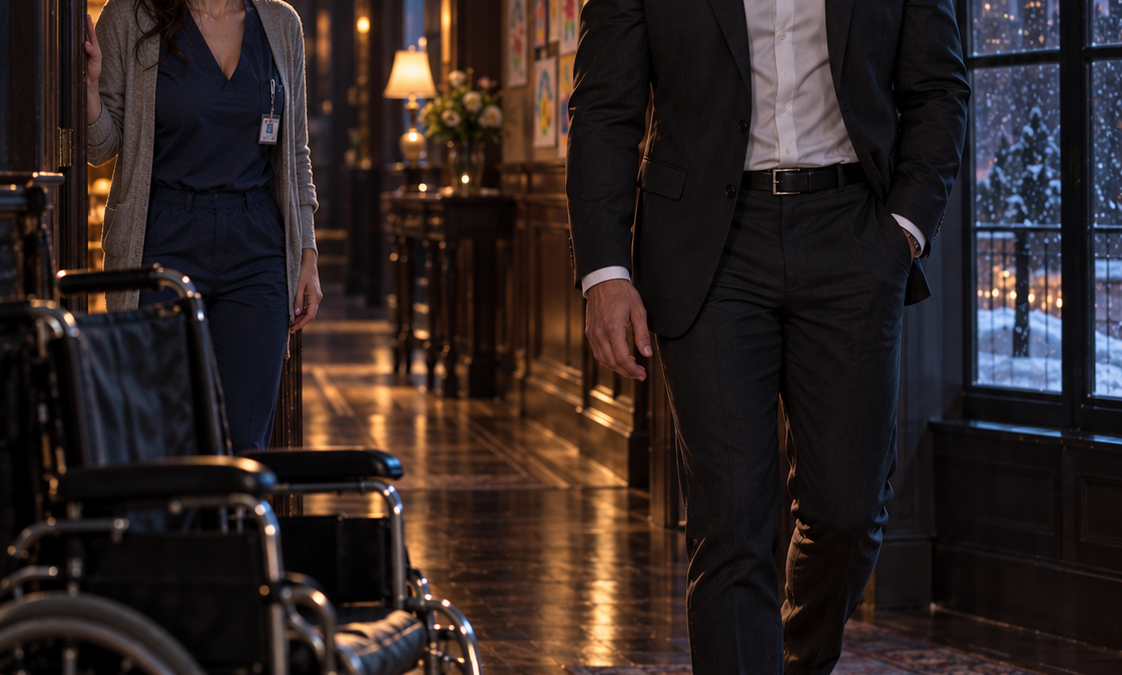
A Poor Nurse Helped a Cold Mafia Boss Walk Again—Until His Secret Broke Her Heart
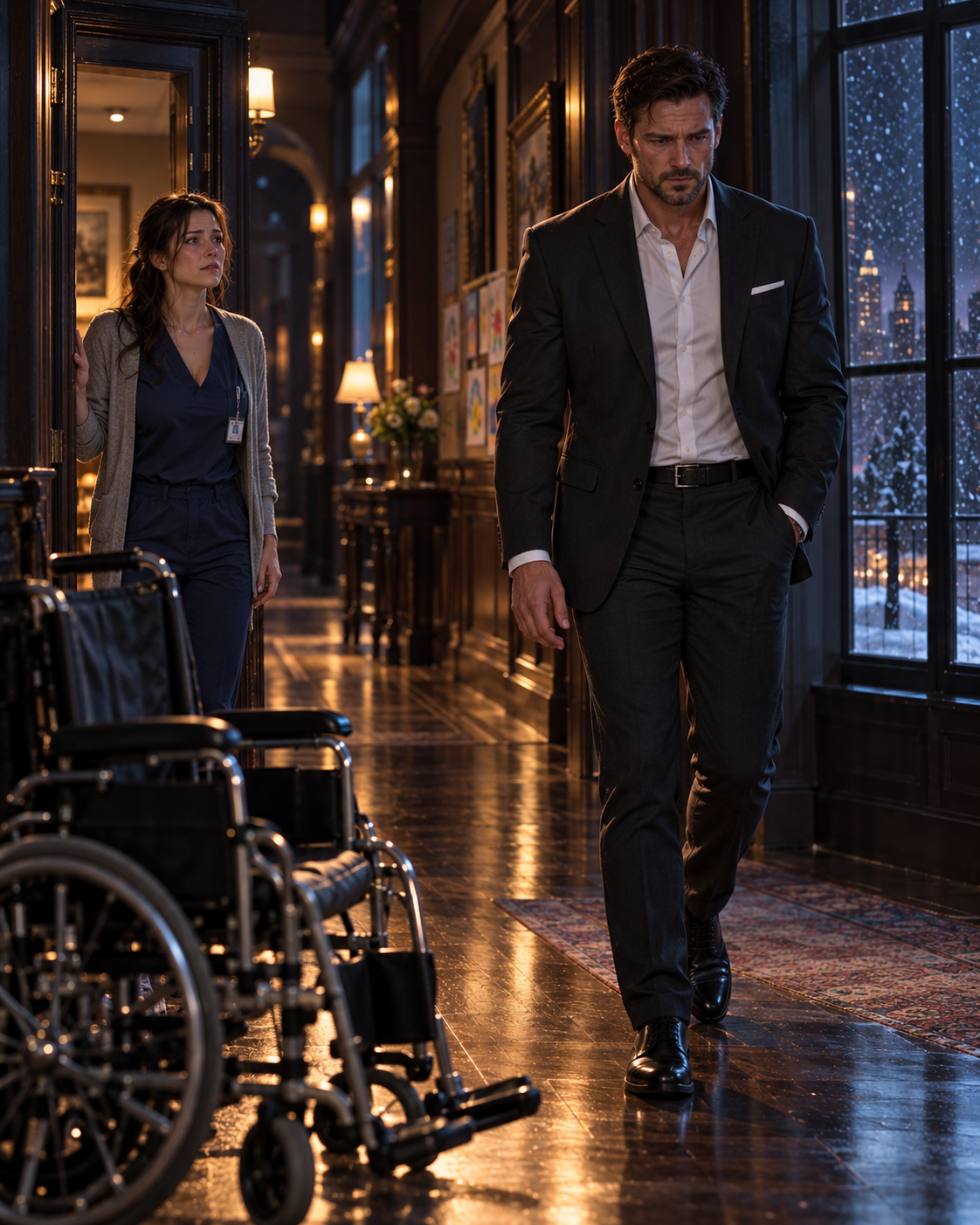
The cash hit the desk in three stacks.
Harland crew didn’t count it.
He didn’t need to.
He just dropped it there like it was nothing.
Like the seven months of a woman’s life sitting in that medical notebook didn’t mean a damn thing.
And he smiled at Everett Langston with the particular smile of a man who believes he has already won. Get rid of her, Harlland said, before she gets rid of you.
Everett didn’t answer.
He sat in his wheelchair near the window with the lake wind dressing gray light through the glass and in an owls and he looked at the money and then he looked at nothing. The room smelled like wood polish and something cold. Outside snow was starting again.
Hadley Fenmore had spent 7 months keeping this man alive.
Not just his body, she’d done that, too.
Yes.
Checking his blood pressure at 2:00 in the morning, adjusting his positioning so the pressure sores didn’t return.
sitting on the floor outside his locked bedroom door talking about her little sister’s drawings when he refused to open it.
But it was more than that.
She had sat in the dark with him when he was delirious with fever and calling his dead brother’s name.
She had screamed with actual joy the first time his toe moved.
She’d gone home that night and made a plan.
7 months written out by hand, every week mapped for his recovery. She believed she was helping him walk again.
She did not know he could already walk.
The day Hadley Fenmore first walked through the gates of the Langston estate, she had $43 in her checking account, a broken zipper on her coat, and a 9-year-old sister at home who thought that their situation was temporary. Tessa believed a lot of
things. Hadley had stopped correcting her.
The job listing had been sparse. Private home care. Discretion required.
Experience with paralysis or neuromuscular conditions preferred. Competitive compensation.
References checked thoroughly.
The agency rep who called her hadn’t mentioned the name Langston until second conversation.
And by then Hadley was already too desperate to process what it meant. She recognized it somewhere in the back of her mind. The name had weight to it.
The way certain names in Chicago always did waterfront warehouses, old money with dirty edges. But names like that were background noise when you owed $11,000 to a hospital that had already destroyed your career.
She’d taken the interview.
She’d gotten the job.
Nobody told her why five caregivers had quit before her. The morning she arrived, a man named Graham Taland met her at the front entrance.
He was older, somewhere in his late 60s, with the careful posture of someone who had spent decades managing other people’s business.
As he looked at her, the way people sometimes look at furniture, assessing whether the piece was appropriate for the room, not whether the piece had feelings about being assessed. He gave her a single sheet of paper, three rules, handwritten, no pity, no unnecessary physical contact, no personal conversation. Hadley read it twice.
“Those are Mr.Langston’s requirements,” Graham said.
She folded the paper and put it in her coat pocket.
“Is there a medical file I can review before I see him?”
Graham handed her a folder without answering her question about whether she could review it first. She reviewed it anyway, standing in the front hallway because she was a nurse, and that was what nurses did, regardless of how the folder had been handed to them. Traumatic spinal impact following a vehicular explosion.
Incomplete injury at the T10 level. Partial motor function retained in both legs, though documented tests showed minimal voluntary movement.
The bombing had killed Wesley Langston, his older brother, 6 months prior to her application. Everett had been in the vehicle moments before detonation and sustained the injury during the secondary shockwave. The medical documentation was meticulous.
too meticulous, actually. The progress notes all had a certain uniformity to them that Hadley noticed without knowing yet why it bothered her.
She tucked it away. Graham led her down a wide hallway with dark wood floors and into the east wing of the mansion.
She heard voices before she reached the study, not an argument, but something with the temperature of one. Sup.
Several men were speaking in the clipped abbreviated shortorthhand of people who had worked together long enough to communicate mostly through implication. Then one voice stopped all the others.
It didn’t raise itself.
It didn’t have to.
Haron one syllable and six men went quiet. Hadley stepped through the study doorway.
Everett Langston sat at the head of a long table in a highbacked manual wheelchair, a glass of water untouched in front of him. He was somewhere in his mid-40s with the kind of face that might have been called handsome in a photograph but in person registered as something harder not cruel exactly but shaped by a long habit of not explaining himself.
His dark suit was pressed. His hands were flat on the table.
His eyes moved to to Hadley the moment she entered and stayed there, not with any particular interest, but with the efficient attention of a man who cataloged information the way other people collected receipts.
Across from him, a heavy set man with a thick neck and a gold ring on his right pinky finger Harland crew, though Hadley didn’t know that yet was mid-sentence.
He stopped when Everett’s attention shifted.
Everyone stopped.
Miss Fenmore, Everett said, not a greeting, more like confirmation that she was the thing he’d expected to appear.
Mr.Langston.
She didn’t apologize for interrupting.
She hadn’t interrupted anything.
Graham had brought her here. She held the folder against her chest.
When you have a moment, I’d like to go through your current medication schedule and discuss a few adjustments to your positioning routine.
Harlon made a sound that wasn’t quite a laugh.
Everett looked at Harlon. Harlon went quiet again.
“We’re done,” Everett said to the room.
“The men filed out.
Haron was last, and as he passed Hadley in the doorway, he gave her the kind of look that was meant to remind her of her place without requiring any actual words.”
She’d seen that look before, from physicians who thought nurses were equipment, from hospital administrators who thought suspended nurses were invisible.
She didn’t move out of his way.
He had to angle his shoulder to get past.
When they were alone, Everett hadn’t moved from the table.
He was watching her with that same cataloging attention.
“The previous caregiver lasted 9 days,” he said.
“I’m not the previous caregiver.”
“No,” he said it like he was filing that observation somewhere.
“What adjustments?”
It took Hadley a half second to realize he was following up on what she’d said about the medication schedule.
He hadn’t asked it as a question.
He’d said it the way someone says continue without bothering to say continue.
She opened the folder. She walked him through it.
Not the gentle version she might have offered someone frightened of medical information, but the direct version, the way she’d always preferred to work before the hospital had spent a year teaching her that she wasn’t supposed to have preferences.
His
current anti-coagulant dosage was slightly high relative to his most recent blood work.
His muscle saxent was being administered on a fixed schedule rather than adjusted for activity level, which didn’t make sense given that his activity level was presumably inconsistent.
There were three medications listed that had no documented purpose in the file. Everett listened without interrupting.
When she finished, he said, “Graham handles the medications.
I’ll need to speak with Graham then.”
Something shifted very slightly in his expression. Not approval, not the opposite either, just adjustment. Like a man recalibrating a small estimate.
Rule three, he said. No personal conversation, she nodded.
That wasn’t personal.
He picked up his water glass for the first time.
He didn’t drink from it immediately, just held it, looking at some middle distance past her left shoulder.
The room adjacent to this one has been set up for your work. Graham will show you. He was dismissing her.
I’ll also need 15 minutes with you every morning for physical assessment, she said.
Before your other meetings? No. The pressure injury indicators in your file suggest.
No. She held his gaze for a moment.
She wasn’t trying to challenge him.
She was just deciding something. Okay, she said.
Then I’ll leave a note outside your door each each morning with what I need to assess.
If you want to ignore it, that’s your decision.
She turned and walked out. She heard nothing behind her.
She counted it as a draw. The first three days were an exercise in being managed from a distance. Everett Langston ran his household like a very clean machine, which was to say that everything happened according to a schedule.
The schedule was enforced by Graham, and any deviation from the schedule was treated as a mechanical failure rather than a human decision. Meals appeared at exact times. Security shifts changed with quiet precision.
The men who came and went through the estate moved through it like they were trying not to disturb its owner, which Hadley suspected was exactly the intent. She disturbed him constantly, though she tried to do it strategically.
She left her morning assessment notes outside his bedroom door. She made sure they were handwritten because type notes would have felt impersonal in a way that might make them easier to discard.
She wrote them the way she’d been trained to write clinical notes, specific, practical, stripped of any softness, and every morning the notes were still there.
When she passed the door at 9:00, she picked them up.
She kept track of what she’d asked.
She started creating her own parallel file. On the fourth morning, his door opened before she reached it.
He didn’t say anything.
He reversed his wheelchair into the room and left the door open behind him. Hadley understood that this was as close to an invitation as she was going to get. She followed him in.
The assessment took 11 minutes.
He tolerated it with the particular stillness of a man who had decided to allow something he didn’t like rather than fight about it.
She checked his skin, his pulse, his positioning. She watched his breathing. She noted the muscle tone in his left leg, which was marginally better than the documentation, suggested it should be at this stage, and filed that observation in the back of her mind without saying anything about it yet.
Pressure sore beginning on the left hip, she said.
“I know the positioning cushion in your wheelchair isn’t adequate for your body weight and frame.
I’ll order a replacement.
Graham, I’ll tell Graham what to order.”
Another of those small recalibrations.
She was almost at the door when he said, “You’re not from a medical agency.”
She stopped.
“No, the agency brokered the placement, but I’m independent.”
“Why did your license get suspended?
It wasn’t a question the way he said it.
More like something he already knew the answer to and was seeing if she’d lie about it.”
She turned around. A patient received an incorrect medication dose. He died.
I was the nurse on record. Were you responsible? I questioned the order before administering it.
I was overruled by the attending physician. The investigation concluded I failed to escalate my concerns adequately. She paused.
I’ve had 2 years to figure out whether that’s true.
What did you decide?
That it doesn’t matter what I decided.
What matters is what the board decided, and I can’t practice until that changes.
He looked at her for a moment.
You could have left that part out and I wouldn’t have known.
You knew before you asked. She held his gaze. So, could we?
He didn’t answer.
She left.
It wasn’t nothing what had just happened.
She knew it wasn’t nothing, but she was careful not to let herself believe it was something larger than it was, because she had learned the hard way.
In a sterile hallway on a Tuesday morning, while a hospital administrator read her the board’s decision out loud that letting yourself believe things were going better than they were was the specific kind of hope that did the most damage when it broke.
It was Beatatric
Hollowell who told her about the previous five caregivers.
Beatatrice ran the mansion’s kitchen with the confident authority of someone who understood that feeding people was its own form of power.
She was somewhere in her late 60s with a wide face and hands that had the permanent slight redness of someone who had worked with them their whole life. She made actual food, not the institutional kind, not the careful, flavorless meals that sometimes appeared in wealthy households as a performance of healthy living, but things with smell and weight and the slight imprecision of something made by a person rather than a process. She fed Hadley lunch on the fourth day, without asking whether Hadley wanted lunch, which Hadley appreciated more than she said.
The first one lasted 2 days, Beatatrice said, setting a bowl of soup down with the matter-of-fact energy of delivering information along with the food.
He locked her out of the medical suite and wouldn’t come out until she left.
The second one he didn’t even meet.
Sent Graham to tell her she wasn’t needed.
She sat down across from Hadley with her own bowl. Third one was a big fellow, former military, thought he could handle the atmosphere.
Everett didn’t say more than 40 words to him in 5 days, and the man still quit.
Said it was the silence. What about the other two?
Beatatric’s expression shifted slightly.
Something that moved across her face and settled into a different configuration. The fourth one made the mistake of feeling sorry for him.
What happened? He told her to leave in the middle of her saying something sympathetic, and that was the end of that.
She picked up her spoon. The fifth one lasted 9 days, which I think was a record.
She was competent, too, but she wouldn’t push back.
Whatever he decided, she accommodated. He fired her for it. Hadley ate her soup.
It was chicken with something in it, she couldn’t quite identify some herb that made it taste like it had a history.
He fired her for being accommodating. He fired her for being afraid. Beatatrice said it simply, like it was just information.
He knows the difference.
He’s always known the difference between someone who agrees because they believe it and someone who agrees because they don’t want to get in trouble.
Hadley thought about the open bedroom door that morning.
He’s not easy, Beatatrice said.
I didn’t expect easy.
No. Beatatrice looked at her for a moment.
You’re something different, I think.
We’ll see.
The fever came on a Wednesday night in the sixth week. Hadley had been asleep for maybe 2 hours.
when she heard the alert from the monitoring equipment she’d convinced Graham to allow in the hallway outside Everett’s room.
She was in his room within 90 seconds. His temperature was 103.
4.
He was halfconscious, talking in a loose, disconnected way that wasn’t quite coherent words without full sentences, names without context.
She worked fast, cool compresses, adjusted medication. She monitored his blood pressure every 15 minutes, keeping her own alarm quiet behind her because there was nothing that would help him less right now than her being scared.
At some point around 2:00 in the morning, the half-conscious words resolved into something clearer.
Wesley, his brother’s name, Wes, I told you.
I told you I’d be right behind you.
Hadley didn’t move.
It was supposed to be me. His voice had something in it she had never heard from him. In six weeks of daily contact, something some stripped of its usual controlled weight, ragged in the way that voices get, when the part of the brain that manages presentation shuts down.
It was my car. It was supposed to be me. She changed the compress and said nothing.
I should have been in that car, Mr.Langston. She kept her voice level, clinical.
Your temperature is coming down. You need to stay still.
He turned his head toward her voice. His eyes were open but not entirely focused.
Hadley.
It was the first time he’d used her first name.
“I’m here,” she said.
He was quiet for a while after that. She stayed until 4:00 in the morning when his temperature dropped back to 101 and his breathing steadied. She moved her chair to the corner of the room and watched him sleep.
She was not supposed to be feeling what she was feeling. She was aware of that.
She was his employee. He had a rule about personal conversation. She had her own rules, too.
The ones she’d made for herself after the board’s decision when she’d reorganized what remained professional lifer around a simpler principle.
Don’t get involved beyond what the work requires.
Because getting involved is how you end up responsible for things that destroy you. But she was a human being sitting in the corner of a dark room watching a man sleep who had just to spent 2 hours talking to his dead brother.
And she was not made of something that could process that without feeling it. She let herself feel it for about 4 minutes. Then she made a note in his file and started thinking about the follow-up care plan.
3 days later, when he was back to himself, which meant sitting at his desk with the controlled composure of a man who had apparently decided that Tuesday’s fever had happened to someone else, she brought up physical therapy.
She’d been thinking about it since the second week.
The documentation suggested minimal voluntary motor function, but the pattern she’d observed during his daily assessments told a more complicated story.
muscle tone that didn’t quite match the injury profile, occasional involuntary responses that were stronger than the clinical picture warranted.
She couldn’t be certain, but she’d been a nurse for long enough that her body had a separate knowledge from her brain, and her body told her something about Everett Langston’s injury wasn’t adding up the way the papers said it should.
“I want to start formal rehabilitation exercises,” she said.
He didn’t look up from the papers he was reviewing.
My previous physician determined that your previous physician’s notes don’t match your current presentation.
That got his eyes up.
I’m not suggesting you’ll walk, she said, because she wanted to be honest with him because she’d promised herself she would be honest with him even when it was harder.
I don’t know what’s possible.
But there’s functional capacity in both your legs that’s not being addressed.
And if we don’t start working with it, you’ll lose it.
That’s not a medical opinion.
That’s just physiology.
He looked at her for a long moment. No false hope, he said.
I’m not in the business of false hope.
The silence lasted long enough that she thought he was going to refuse.
Then he said, “One session every other day.
One session.
Then we’ll see.”
She nodded.
I’ll set up the parallel bars in the east hallway.
The first session was a qualified disaster, which was about what she expected. He was strong, significantly stronger in his upper body than his file suggested he should be, given that the file indicated he rarely left his wheelchair, but he was guarded in a way that went beyond ordinary weariness. He allowed her to position his legs.
He followed her instructions. He performed below the level she suspected he was capable of.
And she knew it. And she let it go for now because there was a kind of trust that had to be built before you could ask someone to be honest with you about what they could do. She pushed him enough that it was real work.
Not enough that he could tell. She already suspected the truth.
In the fourth session, she asked him to try moving his left toes. He looked at her.
Something crossed his face that she couldn’t read.
Just try, she said. Whatever happens happens slowly in a way that made her hold her breath without intending to his left big toe moved.
Hadley screamed. She actually screamed.
The kind of involuntary noise that comes out of a person’s when something happens that they haven’t braced themselves for.
And then before she had fully decided to do it, she had both her arms around his shoulders and her face was somewhere near his collar and she was saying something that probably wasn’t professionally appropriate.
He didn’t move.
He sat very still in his chair and let her have the moment.
When she pulled back, she was crying, which surprised her because she’d thought she’d trained herself out of crying at work.
She pressed the back of her hand to her face and laughed at herself, slightly embarrassed.
And then she looked at him and said, “I’m going to build a seven-month plan.
I want you to walk by Autumn.”
Everett Langston looked at the woman across from him, who had just fallen apart with joy over a toe that he had very carefully chosen to move, and who was already thinking about Autumn, and who had spent the last 6 weeks leaving notes outside his door and sitting in his room at 4 in the morning and refusing to be afraid of him. And for the first time in seven months, he felt ashamed.
Not of the deception itself, he’d made his peace with that.
The paralysis performance was strategic. It was necessary.
It was the only way to keep the traitor in his organization visible and close without alerting him that Everett was already watching. What he felt ashamed of was something more specific. He felt ashamed that he had let her believe, genuinely believe that she was going to give him something back.
He said nothing. He let her keep the joy.
He watched her wipe her face and pull out a fresh notebook and start writing dates. And he said nothing, and the shame sat in his chest like something with weight, a sound like green wood splitting, and he carried it the same way he had learned to carry everything without showing it, because showing it was something he had never quite figured out how to do without the whole structure of himself coming apart.
He had a traitor to find. He told himself that was enough reason. He was not entirely sure, sitting there watching Hadley Fenmore plan a future for him that was built on a lie he had chosen to keep, that it was.
The notebook sat on Hadley’s kitchen table for 3 days before she stopped second-guessing it.
She’d filled 12 pages the first night, color-coded by week, broken into phases with margin notes about which exercises built, on which and what warning signs to watch for if he pushed too hard too fast.
Tessa had come out of her bedroom at midnight to find her sister hunched over the table with three different pens and had asked in the flat observational way that 9-year-olds ask things whether Hadley was okay. Hadley had said yes.
Tessa had looked at the notebook, then at Hadley’s face, then back at the notebook.
You’re doing that thing, Tessa said.
What thing?
Where you care about something too much and you don’t want to say so.
Hadley had kept her pen and sent Tessa back to bed.
She sat alone for another hour after that, staring at the plan she’d built, and she thought about the toe moving, and she thought about what it had done to her, that involuntary scream, the tears she hadn’t anticipated, the way she’d grabbed him without deciding to.
And she made herself sit with the discomfort of having been that open in front of in front of someone who still hadn’t told her a single personal thing about himself in 6 weeks.
She went to bed. In the morning, she took the notebook to work. Everett said nothing about the embrace.
She had expected either acknowledgement or a formal reinstatement of rule two, and she got neither, which was its own kind of answer. When she arrived the next morning and knocked on the study door, he was already at his desk, and he looked up when she entered, and whatever expression crossed his face lasted less than a second before his features settled back into their habitual neutral.
assessment, she said. Good morning, she said. A pause.
Good morning, he said in the tone of a man conceding a point he doesn’t feel strongly about.
She did the assessment. She told him about the plan afterward, the seven months, the phased approach, what she wanted to achieve by spring.
She didn’t perform it.
She just laid it out the same way she would have presented a clinical plan to a physician with the expectation that the other person in the conversation was capable of engaging with information like an adult. He listened.
He asked two questions, both precise, both about specific mechanisms rather than outcomes, which told her that he understood physiology better than he’d led on.
“Where did you learn about spinal rehabilitation?”
she asked.
“I had time to read,” he said after.
She didn’t push it.
She filed it next to the muscle tone discrepancy and the two perfect medical notes and the way he occasionally caught himself the movement and then performed a lesser version of it. I want to add resistance work in week three.
She said that seems fast. Based on your current presentation, your muscle retention is significantly better than based on the documentation.
He said and there was something careful in how he said it.
Based on what I’ve observed, she said another pause.
The particular quality of this one was different from his usual silences. This one had weight in it, like something pressing against the inside of a closed door.
Week four, he said.
She didn’t argue.
Week four was fine. Week four still worked.
The Thursday meeting was the first time Hadley saw the full architecture of Everett Langston’s professional world, and she didn’t like it.
She hadn’t intended to witness it.
She’d come to the east hallway to check the parallel bar setup for that afternoon’s session, and the study door was open 3 in.
Not enough to see, but enough to hear. She knew she should keep walking.
She kept walking for about six steps and then stopped because a voice she recognized as Harlon Cruz was saying something that she couldn’t entirely process at first.
The waterfront projection is off. Harlon was saying 40% off.
Somebody miscounted or somebody’s skimming.
And either way, the answer is the same. You need to put someone in the cal operation who can actually keep track of numbers.
Not that animal Ror put there who can barely.
The calm operation is Ror’s.
Everett’s voice flat and final.
Ror is loyal to whoever’s writing his check.
Everett, and right now the check is coming from a man who can’t get out of his.
The silence that followed was so complete that Hadley stopped breathing.
“Finish that sentence,” Everett said quietly.
He didn’t say it with anger.
“That was the part that made Hadley’s chest tighten.
There was no heat in it at all. Something colder and more specific.
An invitation with consequences attached.”
“Harlund didn’t finish the sentence.”
“The calat numbers are off because the third party routing changed in November,” Everett said in the same unraised voice.
The projection model wasn’t updated.
That’s a Graham oversight.
Ror stays a pause. I want revised numbers by Monday. Hadley heard the scrape of chairs.
She moved quickly to the far end of the hallway and made herself busy checking the bar height adjustment until the meeting sounds faded. When she went back past the study later, the door was fully closed.
She thought about Harland Crew and the gold ring on his pinky and the way he’d angled past her in the doorway on her first day.
She thought about the look on his face when Everett had pointed out that the calat numbers were a Graham oversight, the brief, barely visible tightening around his jaw, the micro expression of a man who had expected the conversation to go differently and was recalibrating. Dy. She had treated enough patients to know the difference between a man who was frustrated and a man who was afraid of getting caught.
She said nothing.
It wasn’t her world.
She went to set up for the afternoon session.
Tessa visited on a Friday 3 weeks later during a school closure that Hadley hadn’t anticipated.
A sound like Greenwood splitting. The babysitting arrangement fell through with 20 minutes notice.
And the only option that didn’t involve leaving a 9-year-old alone in their apartment was bringing her to the estate.
Hadley had asked Graham. Graham had asked Everett. The answer that came back was neither yes nor.
It was reportedly fine. Keep her out of the West Wing.
Tessa arrived with her backpack and her entirely unself-conscious approach to new environments, which involved examining everything within reach and asking questions about things that adults generally left unexamined.
She cataloged the hallway portraits with the critical attention of someone reviewing art she’d been asked to grade.
She decided the mansion was very clean and not as nice as it could be.
She noted that the kitchen smelled good and the rest of the house didn’t smell like anything, which she reported to Beatatrice as a a design flaw.
Beatatrice found this hilarious.
Everett’s introduction to Tessa was accidental.
cease.
Tessa had been permitted to push Hadley’s supply cart through the hallway because it had wheels and she had opinions about the correct speed at which wheeled objects should be moved.
A sound like Greenwood too fast, and she went around a corner too fast and nearly collided with Everett’s wheelchair coming the other direction.
There was a moment. Everett looked down at her. Tessa looked up at him.
“You’re the person my sister works for,” Tessa said.
“Yes, Tessa considered this.
Your house is too clean, is it?
It doesn’t smell like people live here.
She looked at his wheelchair with the direct curiosity of a child who hasn’t yet absorbed the social instruction to pretend that unusual things are ordinary.
Can you feel your legs? Tessa Hadley started from around the corner.
It’s okay, Everett said.
Hadley stopped. Ever looked at Tessa. Sometimes, he said, not always.
Tessa absorbed this with the practical semnity of someone filing information. Sounds confusing. It is.
My friend Marcus has a thing where one of his eyes does something different than the other, and it took him a long time to stop being embarrassed about it. She shrugged.
He’s fine now.
He made it his thing. Everett looked at her for a moment.
Did he? Yeah.
Tessa grabbed the cart handle again. Do you want to play cards later?
I’m really good at cards.
Hadley watched Everett’s face.
Something happened to it.
Not a full expression, more like the shadow of one, the ghost of something that might have been amusement if he hadn’t spent so long organizing his face against such things.
“I’ll think about it,” he said.
He played cards with Tessa at 4:00 in the small sitting room off the kitchen, and Tessa cheated so openly and with such complete transparency that it was impossible to be angry about it.
She simply moved cards when she thought you weren’t looking, which was frequently wrong.
And when caught, she offered alternative scoring interpretations that were factually incorrect, but delivered with tremendous conviction. Everett called her on two of the three cheats.
He let the third one go. Hadley watched from the doorway and felt something she had not expected to feel, which was the specific sadness of of watching someone experience something normal for the first time in what might have been a very long time and not being able to say so.
Tessa, before she left, pulled a piece of paper from her backpack and showed it to Hadley.
It was a drawing two figures she’d apparently done during some downtime in the sprawling con confant style of a child whose drawings are primarily concerned with capturing essential information rather than anatomical accuracy.
I drew the men from outside, Tessa said. Hadley looked at the drawing. Two figures, blocky and generic, with what what Tessa had apparently decided were their distinguishing characteristics.
One was tall and had a hat, and the other was shorter and had drawn with careful deliberate emphasis a circle on his right hand with rays coming off it like a small sun. A ring. What men?
Hadley said. The ones in the car outside our apartment. Tessa said it with the breezy certainty of someone reporting something observed.
The short one has a shiny ring.
I’ve seen them twice.
Hadley’s voice didn’t change.
She was careful about that. When did you see them?
Last Tuesday. And before that, I think a Monday.
I didn’t really pay attention until the second time.
Hadley took the drawing. She folded it and put it in her coat pocket.
She told Tessa she’d done a great drawing and finished bundling her into her coat for the ride home, and she kept her face arranged into its ordinary configuration the whole time.
But because Tessa was nine and did not need to know that the drawing in Hadley’s pocket had made the back of Hadley’s neck feel like ice, she showed the drawing to Everett the following morning.
She set it on his desk without saying anything, and watched his face. He looked at the drawing. She watched the moment it registered, not in any dramatic way, just a stillness that settled into him that was slightly different from his usual stillness.
His eyes moved to the circle on the right hand of the shorter figure. Where did she draw this?
From memory. Two men she saw parked outside our apartment building. Twice in the last 2 weeks.
Everett’s jaw shifted slightly.
She said the short one had a ring. Hadley said a shiny ring on his right hand.
He looked up. Hadley met his gaze and held it.
She said, “Is there something I should know about my situation, Mister Langston?”
He looked at the drawing for another moment. Then he picked up the paper and folded it with exact deliberate creases, and he put it in his own inside jacket pocket, and his expression was entirely controlled when he looked back at her.
“No,” he said.
She had been a nurse long enough to know when a patient was managing their pain instead of describing it. She left the study. She walked to the parallel barroom and stood there for a few minutes with her hands flat against the cold metal rail and her breathing even.
And she told herself that her job was rehabilitation, not investigation, and that whatever lived in the spaces between the things Everett Langston said and didn’t say was not her business to enter.
She believed this for approximately 40 minutes. Everett sent Graham to pull Harlon Cruz financial records that same afternoon.
He did it quietly, the way he did everything with the surface, calm of a man conducting ordinary business, while underneath the ordinary business, something else was being assembled. He had been watching Harland for 3 weeks since the card game.
Since Tessa’s drawing, since the moment he’d registered the gold ring on the girl’s paper, and understood that someone in his organization had made the decision to surveil the woman who took care of him, which meant that someone had decided Hadley mattered enough to be a liability, which meant someone was
paying close enough attention to him to have noticed.
He told Graham he wanted a full account movement summary. Three years, all external transfers, anything routed through the secondary harbor accounts. Graham was quiet for a moment after receiving this instruction.
Any particular reason? Graham said. No, Everett said.
Graham left. Everett sat alone at his desk.
He thought about the night of the bombing.
He thought about the specific hour he’d changed his plans, the phone call that had kept him late, the decision to send Wesley ahead in the car.
He thought about who had known his schedule that evening. He had narrowed the list before.
He narrowed it further now. The list had four names. Two of those people were dead.
One of them was Graham. One was Harland Crew.
3 days after Graham delivered the financial summary, Everett called Harland to the estate. Hadley was in the east hallway when Harlland arrived.
She was returning from the supply room and their paths crossed near the foot of the staircase. And Harlon looked at her the way he always looked at her that measuring subtly derissive assessment that was designed to communicate her relative unimportance without requiring him to actually say anything.
Then his eyes dropped to the pocket where she’d last seen the folded drawing.
It was a very quick look, but Hadley caught it. She kept walking. She went to the kitchen.
She sat across from Beatatrice, who was doing something with dried herbs that filled the room with a sharp, slightly medicinal smell, and she said, “Without any particular preamble, “How long has Harlland crew been with the organization?”
Beatatric’s hands kept moving, 12 years.
Was he close to Wesley? A pause.
The hand slowed, but didn’t stop.
He was close to whoever held power at any given time.
That’s Harlland’s gift.
Did you like Wesley? Beatatrice was quiet for a moment. Wesley was very different from Everett.
He laughed easily. He remembered names, not just the names of the people who mattered, but the names of their children, their spouses.
She set the herbs down. He brought me back a spice tin from a trip to New Mexico once, just because he thought I might want to try it. And Harlon.
Harlon remembered names, too, Beatatrice said, just for different reasons. Hadley heard raised voices from the direction of the study.
Not raised Everett never raised his voice, but there was a particular acoustic quality to the air in the hallway that meant something with volume was happening somewhere, and Hadley sat down her mug and stood.
“Sit,” Beatatrice said without looking at her.
“Hadley sat.”
She sat for 4 minutes, which was about 2 minutes longer than felt comfortable. Then the hallway went quiet again, and 30 seconds after that, she heard a door close with more force than was strictly necessary. A sound like green wood splitting, which she recognized as harvested method of communicating displeasure while maintaining the technical appearance of control.
She heard his footsteps passed the kitchen doorway. She heard him stop. She looked up.
Haron was in the kitchen doorway looking at her with an expression she had not seen him use before. Not the usual dismissive assessment, something more direct, something with an edge to it that was closer to a warning than an insult.
You’re very comfortable here, he said.
Hadley kept her hands around her mug.
It’s my workplace for now, he said.
He left.
Beatatrice stared at the space where he’d been standing for a moment, then looked at Hadley with an expression that had gone carefully still.
“You need to be careful,” she said in a voice that was quiet enough to be only for the two of them.
“He’s not a man who issues warnings more than once.”
“I know,” Hadley said.
“I’m not sure you do.”
Hadley looked at her hands. The mug was warm.
The kitchen smelled like the herbs. outside through the small window above the sink.
Snow was coming down in thin, indifferent lines.
“What did Everett do?”
she said in the meeting just now. Beatatrice pressed her lips together.
I’d guess he showed Harlon something.
Harlland didn’t expect to be shown, and Haron is trying to figure out how much damage it does and whether the fastest solution to that problem is standing in this kitchen right now.
The words landed with a clarity that Hadley hadn’t fully prepared for.
She stood, rinsed her mug, and went to find Graham. Graham was in the small office behind the library, and he looked up when Hadley knocked, and something behind his eyes shifted in a way that she would think about later.
That very slight, very controlled shift of a man who has been momentarily surprised by the wrong person appearing at the wrong moment.
“Miss Fenmore,” he said, “I need you to tell me something honestly,” she said.
“If I can, the men outside my apartment building.”
She watched his face.
“Were they sent by this household?”
Graham was quiet for long enough that the silence became its own answer.
“It was a precautionary measure,” he said finally.
Given the nature of Mr.Langston’s, “Were they watching me to protect me?”
she said, “Or to know what I was doing.”
Another pause. Graham.
Her voice didn’t shake.
She was proud of that because the rest of her was running a fair amount of adrenaline right now. I need a straight answer.
The initial purpose was protective, he said carefully. And the later purpose he looked at her with the measured expression of a man who has spent his life releasing only the exact amount of information required by the moment.
You should ask Mr.Langston that question.
I’m asking you and I’m telling you to ask Mr.Langston.
She held his gaze for a moment. Graham Taland had kind eyes. She had always thought the eyes of someone who had at some point in his life genuinely cared about the people around him.
She looked at those eyes now and tried to read them the way she’d learned to read patients in the first years of nursing.
Before the profession had tried to train the intuition out of her, and what she read was not malice. What she read was guilt.
She left the office without saying anything else. She found Everett in the rehabilitation room.
This was unusual. He never came here except for scheduled sessions.
He was at the parallel bars and when she walked in, he didn’t immediately acknowledge her, which was also unusual because Everett Langston always acknowledged whoever entered a room he was in.
He was sitting in his wheelchair about 3 ft from the bars looking at them. Hadley stood near the doorway.
Harlon is moving money, Everett said. Not to her exactly, more like saying it into the room.
has been for eight months. Routing it through three external accounts and one property holding in Gary. Enough to build an operational base.
Enough to fund. He stopped.
Enough to replace someone.
Hadley said, “You already knew.”
He looked at her then. Not Harland specifically, he said.
I knew it was someone at this table.
I’ve been waiting to find out who.
That’s why the paralysis.
The words came out of her carefully. Part of it anyway. You stay in the wheelchair.
You seem weak and whoever wanted you vulnerable feels safer moving. He said nothing which was confirmation. She crossed her arms.
How much of your condition is real? The silence this time was different from all the previous ones.
It was the silence of a wall coming down. Not dramatically, not all at once, but with the specific quality of a man who has been holding a particular posture for so long that the muscles involved have finally given out. The injury is real.
He said the spinal impact was real.
There’s genuine damage, but but the functional limitation is approximately 40% of what the documentation shows.
Hadley stood very still. I began recovering in the third month, he said.
I’ve been hiding the extent of it since then.
The only person who knew was he stopped. Graham, she said. He looked at her.
Graham picked me for this position, she said.
You told me that in the second week that he’d selected the candidates.
Yes. Why did he pick me?
Everett’s jaw tightened just slightly.
Because you were qualified but compromised. No active license, significant debt, limited family connections.
someone who could be placed in proximity to me without raising questions and who if something needed to change about the arrangement wouldn’t have wouldn’t have anyone powerful enough to make noises about it.
Hadley said he didn’t say yes he didn’t need to.
Hadley uncrossed her arms. She looked at the parallel bars for a moment.
seven months of plans every early morning with the notebook, the screaming and the crying and the seven-month recovery arc she’d built in her kitchen at midnight.
“Did you know?”
she said, “When you let me believe that tow was the beginning of something, did you know exactly what you were doing to me?”
👉 [Tap here for the Next Part ] 👈

