Billionaire Fired the Ex-SEAL Janitor—Then Her Blind Daughter Suddenly Saw Him
Billionaire Fired the Ex-SEAL Janitor—Then Her Blind Daughter Suddenly Saw Him
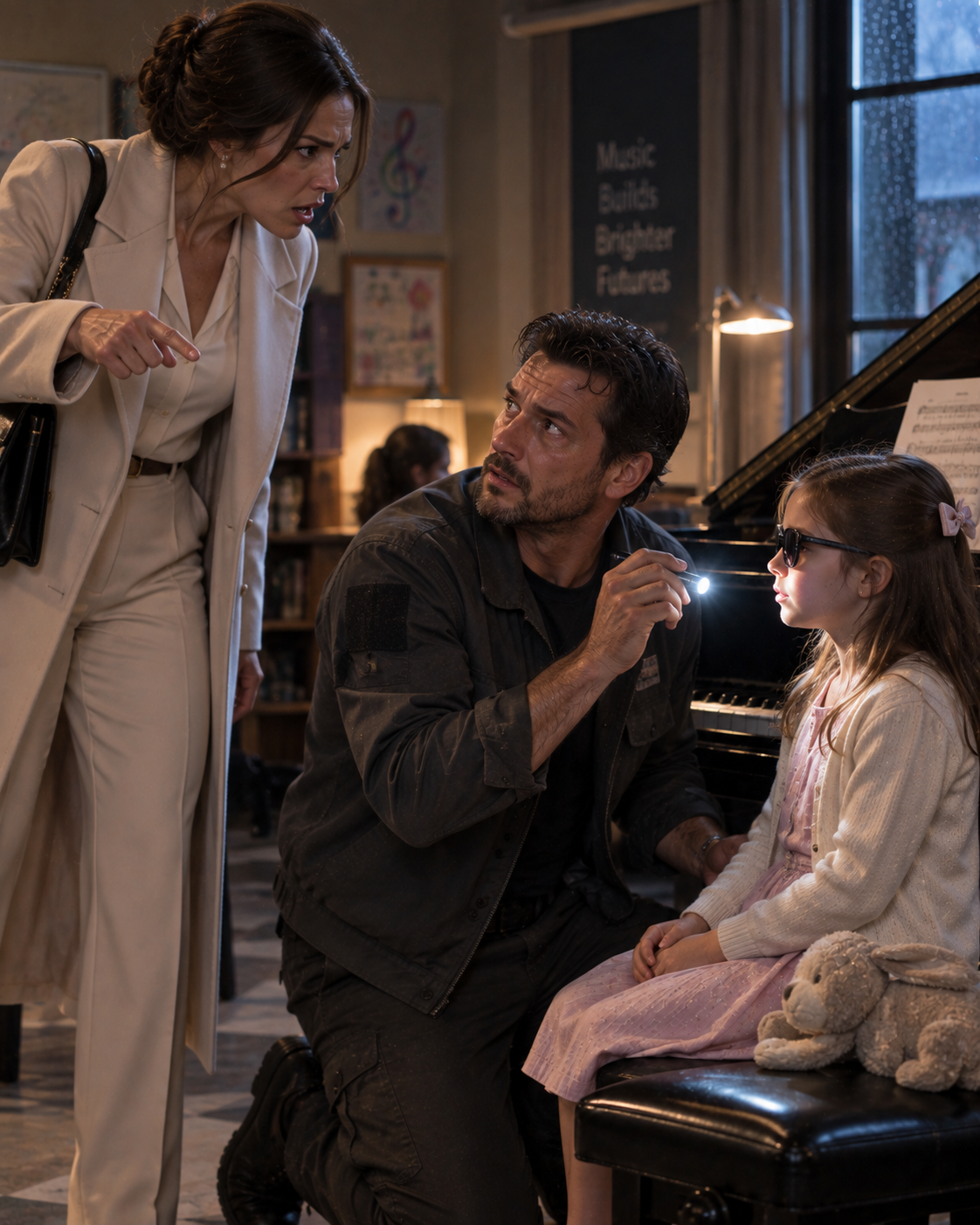
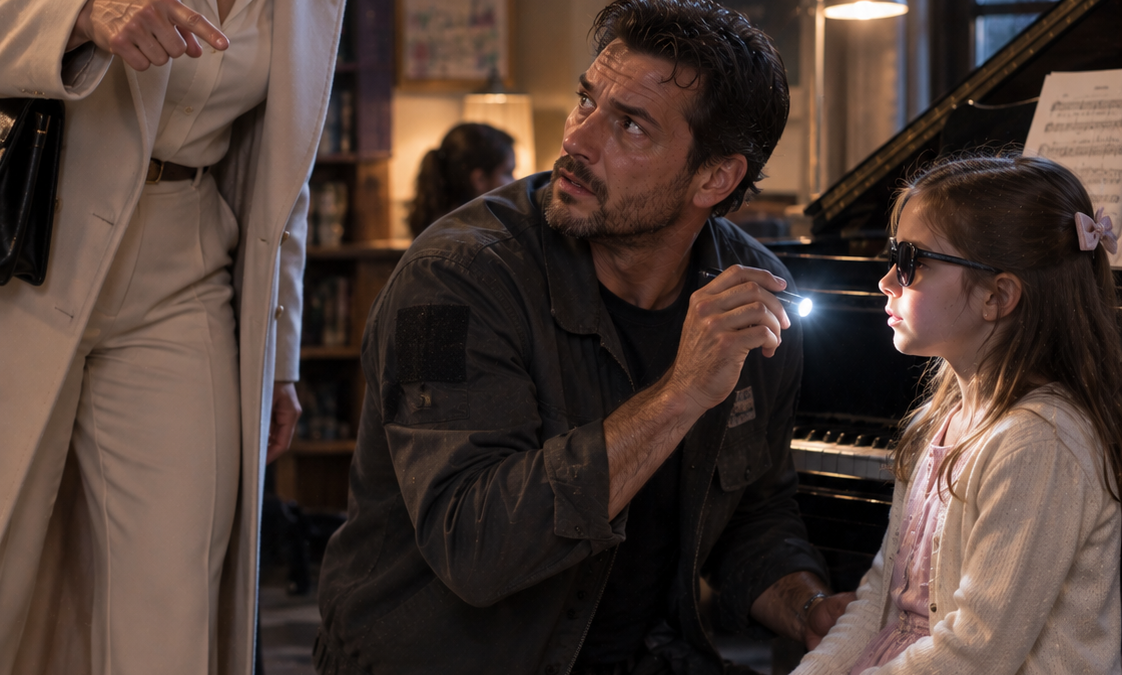
She walked in and saw a man kneeling over her blind daughter with a flashlight aimed directly at the child’s eyes.
Victoria Ashford didn’t ask questions.
She didn’t wait for explanations.
She fired him on the spot in front of students, teachers, and security and had him escorted out of the building like a criminal. He left without a word of protest.
But before he walked through those doors for the last time, he turned back and said something so quiet it barely registered.
she wouldn’t understand what it meant until it was almost too late.
The rain started around 2:00 in the afternoon, the kind that came in sideways off the harbor and made the city look like it had been smudged with a wet cloth. Victoria Ashford noticed it from the backseat of her car, not because she cared about the weather, but because she always noticed things that might complicate her schedule.
She was already running 12 minutes behind.
Her assistant, Dana, was in the front seat going through a list of messages, reading them aloud in that careful, neutral tone she’d developed over two years of working for Victoria.
A supplier issue in the Singapore office, a journalist asking for comment on a pending acquisition, a board member who wanted 15 minutes before Thursday’s call.
Tell Marcus I have 5 minutes before Thursday, not 15, Victoria said. And tell the journalist no comment. And Singapore, tell them to fix it.
Dana made a note without looking up. Victoria turned back to the window. The private academy came into view through the rain red brick, wide lawns, a modest iron gate that looked like it belonged to a smaller school than this one actually was.
Clearwater Academy charged more per year than most people earned in three, and it showed in the quiet, unhurried way the grounds were kept.
There were no flashy banners or signs, the kind of institution that didn’t need to advertise.
Victoria had chosen it for exactly that reason.
She had chosen it because it had the best staffto student ratio in the state, because its special needs program had been rated top tier three years running, and because its principal, a 60-something woman named Doctor Ela Marsh had sat across from Victoria in a meeting 18 months ago and said, “Without any sales pitch at all, we don’t see Lily’s condition as a limitation.
We see it as information
about how she learns.”
Victoria had written the check the same afternoon. The car pulled up to the main entrance. The rain was steady now.
Victoria took her umbrella from the seat beside her, checked her phone one final time, and stepped out. She had come for a routine check-in with Dr.Marsh, the kind of visit she made once a month, always unannounced, always with a prepared list of questions. The academy knew her patterns by now.
The front desk staff always looked slightly braced when she came through the door.
Victoria wasn’t cruel.
She wasn’t unkind, but she was exacting, and she asked the sort of questions that required real answers, not reassurances.
Today, she had six questions prepared. She never got to ask any of them.
The front desk receptionist, a young man named Oliver, who always looked like he’d recently been startled, greeted her with a nod and immediately picked up the phone to notify Dr.Marsha’s office.
Victoria signed the visitor log without being asked. She knew the procedure and handed Oliver her wet umbrella to store behind the desk.
Dr.Marsh is just finishing with a parent.
Oliver said she’ll be I’ll wait in the hall.
Victoria said already moving. She knew the layout of the building the way she knew the layout of her own office towers.
Left past the main stairs, right at the art room, straight through to the administrative wing. She had walked this corridor more times than she could count over the past 3 years.
But she wasn’t walking toward the administrative wing when she stopped.
She stopped because she heard music or something like music it was halting. A little uncertain, the sound of small fingers finding notes on a piano rather than playing them.
Coming from the music room, a large space at the end of the east corridor that she had passed a dozen times without much thought.
Victoria didn’t know why.
She paused. Later, she would think about that moment.
the way her feet simply stopped moving. The way some part of her attention was pulled sideways toward that sound.
She wasn’t the type to follow instincts.
She was the type to follow data. But some something made her turn left instead of right.
The music room door was mostly closed, just a few inches of jar. She pushed it open. The room was dim.
The overhead lights were off. The late afternoon rain had turned the tall windows gray, and the only real illumination came from a small instrument a pocket flashlight held in the hand of a man crouching beside her daughter. Lily was sitting at the piano bench, her small hands resting in her lap, her head tilted at a slight angle.
The man was kneeling to her left, perhaps 2 ft away.
He was turned slightly away from the door and hadn’t heard Victoria enter.
The flashlight was moving slowly, methodically in a shallow arc from left to right, maybe 12 in from Lily’s face.
Victoria’s mind processed the image in pieces.
Her daughter, a stranger, a light eyes. The cold hit her chest before the thought was fully formed. She crossed the room in five steps.
What are you doing to my daughter?
The man’s head came up fast.
He stood and stepped back in the same motion, not panicked, but alert.
was say someone moves when they’ve been trained to respond to sudden changes.
He lowered the flashlight immediately. He was tall, late 30s, maybe 40.
His face was weathered in the particular way of someone who had spent years outdoors, and he was wearing the gray uniform of the building’s custodial staff.
His name tag said Ethan.
I wasn’t trying to hurt her, he said.
His voice was steady, but careful. I want to explain. Who gave you permission to come in here?
I was cleaning the adjoining room, and I heard her playing. I just came to check with a flashlight.
Ethan’s jaw tightened slightly.
I noticed something during the drill this morning. A response.
I thought if I could just You’re fired.
The words landed flat and hard. Victoria said them the way she said most things. She had already decided not with anger, not loudly, but with the kind of finality that made it clear there was no mechanism of appeal.
Ethan went still. Lily, who had been sitting quietly through all of this, turned her face toward her mother. Her expression was uncertain, caught between the two voices in the room.
“Mom, it’s okay, baby,” Victoria said immediately softer.
She moved to Lily and put both hands on her daughter’s shoulders, turning her attention back to Ethan in the same motion.
“I want you out of this building, Miss Ashford.
Now, I’ll be speaking to Dr.Marsh about this today.”
There was a pause. Ethan held the flashlight at his side. He looked at Lily for a moment, not the way Victoria had feared, not with anything calculated or strange, but with an expression that she would struggle to name later.
It looked something like reluctance, like a person walking away from something unfinished. He nodded once.
He walked toward the door and then he stopped just at the threshold without turning around.
“Please,” he said quietly, “don’t stop looking for the answer.”
Victoria said nothing.
She heard his footsteps move away down the corridor, and then there was only the rain against the tall windows, and Lily’s small hands finding the piano keys again, one careful note at a time.
Dr.Marsh was unsurprised in the way experienced administrators are unsurprised by things, which is to say she received the information with a measured expression and a careful sequence of questions. How long had the man been in the room?
Was Lily showing any signs of distress? Had anyone else witnessed the interaction?
Victoria answered everything precisely. Ethan Cole has been with us for 14 months.
Doctor Marsh said he’s been I won’t say he hasn’t done his job well because he has.
But this was a serious breach of I don’t need an assessment.
Victoria said I need confirmation that he won’t have access to students going forward.
That’s already being handled.
Victoria gave a single nod. She picked up her coat from the back of the chair. My questions for today can wait until next month.
She said, “I need to take Lily home.”
She drove home in the rain with Lily in the back seat. The car quiet except for the sound sound of water on the roof and the occasional brief exchange. Lily asking if they could have soup for dinner.
Victoria saying yes. Normal, calibrated, the kind of conversation that was its own form of reassurance.
It was only after Lily was asleep that Victoria sat at her kitchen table and felt the adrenaline finally leave her body. She had done the right thing.
She was certain of that.
She had walked in on an unknown man, a janitor, a person with no medical credentials, no authorization, no explanation she could verify, holding a light source close to her blind child’s face, alone in a dim room with the door nearly closed.
She had done exactly what any reasonable mother would do. She was certain of that.
But Lily’s voice surfaced in her memory from somewhere in the middle of the confrontation, when things were still loud and charged, and Victoria had been focused entirely on the man in front of her.
Lily had said something.
Victoria hadn’t caught it in the moment.
She’d been too focused, but it surfaced now, quiet and insistent.
Lily had said, “It’s okay, Mom.”
He was being nice. Victoria stared at the kitchen table for a long time. Then she got up, poured the rest of her tea down the sink, and went to bed.
She didn’t sleep well.
There is a particular kind of fear that lives specifically in parents, not the ordinary fear of danger, which moves fast and spends itself in action, but the slower kind, the fear that settles in for years, the fear that knows it isn’t going anywhere.
Victoria had lived with that fear since Lily was 11 months old. The diagnosis had come in stages, the way bad news often does, first a concern, then a follow-up, then a specialist, then a name for the thing they were dealing with.
Lever’s congenital amorosis, a genetic condition affecting the retina.
Severe visuals impairment present from birth, typically progressing through early childhood.
Victoria had sat in that specialist office at 22 years old, a year out of business school, Lily on her knee, and listened to a man in a gray suit, explain her daughter’s future in measured, careful language.
She had not cried in the office. She had cried in the parking garage. Then she had gotten in her car, driven to her office, and spent the next 14 hours researching every clinical trial, every specialist, every research program in the country related to LCA.
That was how Victoria Ashford worked.
She didn’t stop.
She didn’t accept.
She found the next angle and she pressed it. She had taken Lily to 12 specialists over 6 years.
She had funded a research grant through a university program. She had flown twice to Europe for consultations that had come to nothing.
She had spent more money than she could easily calculate. Not because money was the answer, but because it was the only lever she had that consistently moved things.
Lily had learned Braille. Lily had learned to navigate with a cane. Lily had a team of specialists who saw her every 6 weeks and who gave Victoria careful, thorough, honest updates.
The updates were never good. They were never devastating either.
They were just unchanged.
Lily’s condition was stable.
Her remaining light perception was minimal and variable. The research was advancing slowly.
There was nothing new to report. Victoria had learned to live in the space between hope and acceptance. She was very good at holding that space.
But she was not very good at allowing for the possibility that something she’d missed might matter.
That night, lying awake in a house that was too quiet, she thought about the janitor’s face when she’d told him he was fired.
He hadn’t argued.
He hadn’t tried to justify himself.
He had simply looked at Lily and then said that one strange specific thing.
Don’t stop looking for the answer.
Not, “I didn’t mean any harm.”
Not, “You’ve made a mistake.”
Not any of the things a person says when they’ve been wrongly accused.
Just don’t stop looking.
Victoria turned onto her side and stared at the window. Outside, the rain had stopped.
The street was shining and empty and completely still. She was in a morning meeting with her senior team when her phone buzzed with an unknown number.
She let it go to voicemail. It buzzed again 6 minutes later. She stepped out.
Miss Ashford, a woman’s voice, composed professional.
This is Ranata Voss from the Clearwater Academy.
I’m calling on behalf of Miss Lily’s primary learning coach is now a suitable time.
Victoria’s stomach tightened.
What’s wrong?
Nothing is wrong, Ranata said. Lily is fine. But she said something this morning that her teacher felt you should hear about.
Victoria moved further away from the conference room door. Tell me. There was a brief pause, the kind that meant the person on the other end was reading from notes.
During quiet time this morning, Lily told her teacher that yesterday when the man was moving the light, she felt something different. She said it was like another pause, a tiny bit of warm and then a shadow. Those were her words.
She said she couldn’t be sure because it went so fast, but she thought it was real.
Victoria said nothing.
Miss Ashford, she also said, “Go ahead,” she said.
She thought she could almost see the door. The hallway was very quiet.
Victoria leaned her back against the wall.
“Thank you,” she said.
Her voice came out level, which surprised her.
“Please tell her teacher I’ll call this afternoon.”
She hung up. She stood in the hallway for a moment, holding her phone.
Then she walked back into the conference room, sat down at the head of the table, and said, “Give me a moment.”
Her team waited. She pressed her fingers to her mouth.
She thought about a man with a flashlight making a careful arc in a dark room, watching her daughter’s face with the specific patience of someone who was looking for something very small.
And she thought about the look on his face when he walked away.
Not resentment, not wounded pride, just that thing she hadn’t been able to name.
She could name it now. It was the look of someone who had seen something that mattered and was being forced to walk away before they could finish.
Victoria straightened in her chair.
“All right,” she said.
Let’s continue.
But her mind was somewhere else entirely, and she already knew what she was going to do before the meeting was over. The meeting ended at 11.
Victoria signed three documents, responded to two messages from the Singapore office, and told Dana she would be unreachable for the rest of the afternoon. Dana wrote it down without asking why, which was one of the things Victoria valued most about her. The drive across the city took 40 minutes in midday traffic.
Victoria sat to Max’s seat with our phone her phone sentent in her lap at spent the time doing what she always did when she needed to think she went back to the data.
She pulled up every record she had on file related to Lily’s condition.
Specialist reports, test results, treatment summaries. She had read most of them so many times she could have quoted passages, but she read them again now, looking for the things she might have missed.
She found nothing new, which was what she expected.
What she was actually looking for wasn’t in the files.
It was in the gap between what the files said and what Lily had described this morning, and that gap was occupied by a man she had fired the previous afternoon.
She had called Dr.Marsha’s office before leaving the building and asked for Ethan Cole’s personnel file.
There had been a pause on the other end of the line, a short one, carefully professional, before Marsha’s assistants had said she would have to check with HR about what could be shared with a parent rather than the board.
Victoria had said that was fine and she would expect a call back by end of day.
She didn’t wait for the call.
She had other resources. Her head of corporate security, a deliberate, undemonstrative man named Frank Garrett, had been with her company for 9 years. He ran background checks on business partners, vendors, anyone with significant access to Asheford Group assets.
He was thorough and he was discreet. And when Victoria called him from the backseat of the car and gave him a name, he asked only two questions.
Spelling and timeline by three, she said.
I’ll do what I can.
She put the phone down and looked out the window at the city sliding past.
She wasn’t entirely sure what she was doing.
That uncertainty was unfamiliar enough to be uncomfortable. Victoria operated from plans, from measurable goals, from a cleareyed assessment of what each action was likely to produce.
She didn’t chase things on instinct.
She didn’t let a child’s account of a sensory impression pull her across the city to look into a man she had every professional reason to be done with.
And yet here she was. She told herself it was due diligence.
She told herself it was the responsible thing that if there was any possibility, however small, that Ethan Cole had noticed something real in Lily’s visual response.
Then she owed it to Lily to understand what that something was before she closed the door entirely. That was what she told herself. It was partly true.
The other part, the part she didn’t examine too closely, was simpler and harder to articulate.
It was the memory of Lily’s voice saying he was being nice, and the memory of the look on Ethan Cole’s face when he’d walked away.
That thing she’d eventually identified as the expression of someone being forced to leave something unfinished.
Victoria had spent 8 years finishing things other people had given up on.
She recognized it in someone else, even when she didn’t want to.
Frank called back at 10 2. Ethan James Cole, he said 37, single, one dependent. A daughter, 8 years old, Mia Cole.
No criminal record, no civil suits. Credit history is thin but clean. Military?
Victoria asked.
She’d had a feeling, though she couldn’t have said why.
Navy, Frank said. 14 years active duty.
Special warfare. He mustered out about 2 and 1/2 years ago.
Medical. A pause.
Nothing on the specifics.
That’s sealed.
Special warfare. Victoria repeated.
SEALs, Frank said.
I can’t confirm the specific team or deployment history.
That’s classified, but his service record is clean.
Commenations, advanced training in reconnaissance and surveillance. Did some work that overlapped with field medicine from what I can piece together from the public record.
Another pause.
He’s been at the academy 14 months.
Before that, about 6 months at a logistics firm. Before that, nothing. I assume transition and recovery.
Victoria sat with that for a moment.
That’s enough, she said.
Thank you, Frank. You want me to look into anything else?
Not right now. She hung up and stared out the window.
The car was moving through a quieter part of the city now, older streets, smaller buildings, a neighborhood that had been workingass for decades, and remained so with a kind of stubborn consistency.
The address she’d obtained through her own administrative contact at the academy, not through Frank, not through anything that felt too much like surveillance, was on one of these streets.
a block of older row houses, well-maintained, but plainly so, with small front yards and parking that required negotiation. The driver pulled up to the address and stopped.
Victoria sat for a moment, looking at the house. It was narrow with a front step that needed repainting and a window box that had dead plants in it from what was probably last fall.
There was a bicycle leaning against the side of the building, a child’s bicycle, pink with the kind of basket on the front that came came already attached when you bought the bike.
the sort of thing a parent picked up quickly rather than planning. There was a light on inside.
She got out of the car.
She rang the bell and waited, aware that she was standing on a stranger’s front step in a coat that cost more than this man’s monthly salary, and that this was objectively a strange thing to be doing.
The thought arrived, registered, and was set aside. She was here now. She would conduct herself appropriately.
Footsteps inside. A pause. She imagined him looking through the peepphole.
Then the sound of the lock. Ethan Cole opened the door in a gray sweatshirt and jeans, a dish towel folded over his shoulder, and a look on his face that was not quite surprise and not quite absence of surprise. Something in between.
The look of a man who had developed the habit of being prepared for things. Miss Ashford, he said.
I know this is unexpected, Victoria said.
I won’t take much of your time.
He looked at her for a moment. Then he stepped back from the door.
She walked in. The inside of the house was exactly what she had expected and also nothing like what she had imagined.
It was small, a narrow front room that served as both living area and dining area. A kitchen visible through an open arch, a staircase along one wall. It was not tidy in any polished sense, but it had the specific order of a space that someone actively managed rather than simply inhabited.
Books stacked deliberately, a pair of sneakers placed beside the door rather than dropped in front of it.
a child’s backpack hanging on a hook beside an adult’s jacket.
On the kitchen table, open notebooks and a pencil case, a bowl of something covered in plastic wrap.
There was music playing from somewhere upstairs, the tiny, cheerful kind that came from a child’s device.
“Meia is doing homework,” Ethan said as if she’d asked.
He moved the dish towel from his shoulder and set it on the back of a chair.
“She’ll be down in a bit for dinner.”
He said it not as a warning, but as orientation. This is how things are here.
I’ll be brief, Victoria said.
He gestured toward the small couch. She sat. He sat across from her in the chair, forearms on his knees, and waited.
I owe you an apology, she said. She had decided on the drive over that she would begin this way.
Not as a concession, not as something she had been talked into, but because it was accurate, and she had no use for beginning an important conversation on false footing. She had fired him publicly without hearing him out. and she had made an accusation in front of her daughter that she had not verified.
Those were errors. She acknowledged errors when she made them.
Ethan’s expression didn’t change much.
“You saw something that looked bad,” he said.
“It looked very bad,” she said.
“But I should have asked what was happening before I acted.”
He nodded once, not accepting the apology exactly more like receiving it and setting it down somewhere.
Lily’s teacher called me this morning.
Victoria said. She told me what Lily described. The sensation during the during what you were doing.
She stopped. I need you to tell me exactly what you saw from the beginning.
Something shifted in his posture.
Not eagerness, more like the particular attention of someone being given permission to say something they’d already worked out.
He said it started during the emergency drill. The academy ran a standard evacuation drill twice a year.
This one had taken place in the morning, the day before Victoria’s visit.
Students had moved from their classrooms to the assembly points on the school grounds, guided by staff, organized by class.
Lily’s class had exited through the east corridor, which ran past the music room, past the gymnasium storage, and out through the side door to the secondary assembly area.
Ethan had been working in the gymnasium storage room when the alarm sounded. He had stepped out into the corridor to make sure the path was clear, the way staff were trained to do. He had stood near the fire door as students moved past, watching for anything that needed attention.
Lily had been moving with the group, Cain in her right hand, her left hand lightly on the shoulder of the student in front of her, the way she had been taught to navigate moving lines. She was near the middle of the column, unhurried, doing everything correctly.
And then a truck had passed on the street outside. It was a delivery truck, the large white kind, and it had passed through a narrow gap between two buildings directly opposite a high window at the end of the corridor.
For approximately 1 and 1/2 seconds, the reflected light from the truck’s white body had swept through that window and across the corridor floor and walls in a moving bar of brighter than usual light.
In in those 1 and 1/2 seconds, Lily had turned her head. Not the small automatic movement of someone reacting to sound. Not a flinch, a deliberate tracking movement, slow following something.
Ethan described it the way he described everything without embellishment with precise detail about timing and angle. He had been approximately 15 ft away.
He had been watching because that was what he did. He watched 14 years of training that had ground certain habits into him so deeply they no longer felt like habits, just the way he perceived the world.
He had noticed Lily turn her head. He had watched her track the light and then the light was gone and she had straightened and moved on with the group and nobody else around her had registered that anything had happened.
I’ve been around low vision kids before.
He said, “My sister.”
He paused for a fraction of a second.
I’ve done some reading on the subject.
A full tracking movement like that following a moving light source.
It’s not nothing.
That’s not a response you see in someone with no remaining light function.
Victoria was very still.
Why didn’t you report it?
He gave her a look that was not unkind, but was entirely honest. To who?
I’m the janitor.
I’m going to walk into the special needs coordinator’s office and tell them I think I noticed something in a blind student’s visual response.
They’d have smiled and nodded and forgotten about it before I reached the door.
He wasn’t wrong.
She knew it. So, you decided to test it yourself.
She said, “I wanted to see if I’d actually seen what I thought I’d seen.”
He said, “There’s a difference.”
I wasn’t treating her.
I wasn’t diagnosing anything.
I was looking, trying to confirm one observation with another one in a dark room alone without telling anyone. I know how it looked.
It looked like exactly what I thought it was. I know that, too. He said it without defensiveness, which somehow made it harder to hold on to.
Victoria looked at her hands for a moment. When you were in the Navy, I did some training that overlaps with field medicine.
trauma response, basic neuro assessment, nothing clinical. He paused.
But I’ve spent a lot of time learning to notice things.
So, I’ve been told.
He looked at her. She could see him recalibrating.
He hadn’t expected that she would have looked into his background.
I had your personnel history reviewed, she said. She said it directly.
The way she said difficult things without apology, but without aggression either. I wanted to understand who you were before I came here.
He was quiet for a moment and he said, “You have a clean record.
You’re trained in ways that would reasonably give you a different kind of observational awareness than most people, and you had no reason I can identify to harm my daughter.”
“No,” he said.
“I didn’t.
” “Then tell me the rest,” she said.
“What you were looking for with the flashlight.”
He leaned back slightly. I wanted to see if she could track a slow, controlled light source, something in front of her face, not ambient, not sudden.
And I wanted to watch her eyes while it happened, not her head movement because head movement can be compensatory. You learn to do it for sound, for air flow, for a dozen reasons. But the eye, what happened?
He paused.
I’m not a doctor, he said.
I want to be clear about that. I understand. Tell me what you saw.
There was a response, he said, in both eyes, but more pronounced in the left. A small movement, a very small one. Something that looked like the beginning of a track.
The way you’d describe a compass needle moving when it comes close to something magnetic.
It didn’t complete, but it started.
Victoria says nothing for a moment. Then, and nobody in 6 years of medical consultations has reported anything like this.
Ethan’s expression shifted.
It wasn’t quite discomfort, more like the look of someone choosing how to say something honest that might land badly.
The tests they run, he said carefully, they’re designed around established protocols.
You look for what the protocols are designed to find.
You’re looking for documented responses in documented ways.
And if you don’t get them, the result is negative.
He stopped.
I wasn’t running a protocol.
I was just watching a kid. There was a long silence in the room. From upstairs, the music had stopped.
Victoria heard the creek of a floorboard.
And a moment later, a girl appeared at the top of the stairs, 8 years old, dark-haired, wearing socks that didn’t match, carrying a book against her chest.
She stopped when she saw the visitor.
“Dad, come on down, Mia.”
Ethan said.
“This is Ms.Ashford.
She just needed to talk for a few minutes.”
Mia came down the stairs slowly, the way children do when there’s a stranger in the room, and they’re working out whether to be shy or not.
She came and stood beside her father’s chair, leaning slightly into his arm.
“Hi,” she said to Victoria.
“Hi, Victoria said.”
Mia looked up at her father.
“Is it time for dinner?”
“Almost,” he said.
“Go set the table.”
“Okay, two plates.”
Mia considered this.
“Are you having dinner with us?”
she asked Victoria.
“No,” Victoria said.
“Thank you, though.”
Mia took that in stride in the way children do when they’ve learned that adults have complicated reasons for things.
She went to the kitchen and they heard the sounds of plates and silverware handled with reasonable care, but not excessive care. The sounds of a child doing a regular thing. Ethan watched Victoria watching the kitchen doorway.
“She does the table every night,” he said.
“I cook.
She does the table. We worked it out when she was five.
He said it’s simply not to impress her.
Just the way things were. Victoria looked at him. You have a daughter her age.
He said it wasn’t a question.
Yes, that’s why you came back.
It wasn’t a question either.
And it was more accurate than she was comfortable with. I came back, she said slowly.
Because what you said before you left yesterday, I couldn’t make sense of it.
And I don’t do well with things I can’t make sense of.
What couldn’t you make sense of if you were angry or embarrassed or trying to protect yourself?
You would have argued. You would have tried to explain yourself on the spot.
You didn’t.
You just said to not stop looking for the answer and you walked out. She paused.
People don’t do that unless they’re very controlled or unless they’re telling the truth.
Could be both, he said. Could be, she said.
I wanted to find out which. He looked at her for a long moment.
Then he said, it’s both.
She almost smiled. Not quite, but almost. Then tell me about your sister, she said.
He went still. Not the trained stillness of someone keeping their reaction.
Managed the real kind.
The kind that comes when someone says a thing you didn’t expect them to say.
Frank found it in your background, Victoria said. Not specifically, just that you had personal experience with a similar condition.
I’m asking because I think it’s relevant and I think you know it’s relevant.
He looked toward the kitchen. The sounds of Mia moving around continued, steady and domestic and entirely unaware.
Her name was Sophie, he said.
She’s fine now.
I want to say that first because it doesn’t have the ending people expect.
He stopped.
She had an early onset vision condition different from Lily’s, less severe.
We grew up in a family where you you didn’t make a big deal of things.
You managed, you dealt with it and moved on. A pause. When Sophie was about 12, she started having headaches, eye strain, we thought, or stress.
Our parents took her to the regular doctor who referred her to an eye doctor who adjusted her prescription, and that was that. He had his hands linked between his knees, looking at a middle point on the floor. She lost another 30% of her usable vision over the next 2 years, he said, cuz there had been some something developing a secondary condition, treatable, but only if you catch it early.
and nobody caught it because everyone assumed the vision issues were just the original condition progressing and there was nothing to do but manage. No one looked further, Victoria said. No one looked further, he said because everyone assumed the answer was already known.
The kitchen was quiet for a moment.
Then Mia’s voice.
Dad, where’s the thing for the pasta?
The big spoon. Second drawer, he called back.
It’s not in the second drawer.
Then it’s in the dish drainer.
A pause. Oh yeah.
Ethan looked back at Victoria.
There were things in his face that he wasn’t saying, and he wasn’t trying to hide that he wasn’t saying them.
There was a layer of something personal and painful that lived underneath the factual account. And he was telling the factual account and leaving the other layer intact, and she respected that without needing it explained.
I should have told someone at the school, he said. I know that.
I told myself I was trying to confirm the observation first before making a report that might go nowhere. But honestly, he stopped. Honestly, I was impatient.
I’d been watching Lily for a few weeks since I noticed her in the corridor.
I knew she was yours.
Everybody knew who Victoria Ashford’s daughter was.
And I kept thinking she has all the resources in the world, every specialist available.
And if none of them have found this, then maybe I’m wrong, and I’m going to look like an idiot.
And maybe I should just verify it first before saying anything. He exhaled through his nose.
That was the wrong call. Yes, Victoria said.
I know, but the observation itself was real.
He said, “I didn’t imagine it.
I’ve spent 14 years training myself to see things correctly, not to see things that aren’t there.
What I saw in that corridor and what I started to confirm in the music room,” he looked at her directly.
It was real. Victoria held that.
In the kitchen, Mia announced that the table was set and asked if there was going to be garlic bread because she wanted there to be garlic bread.
“There’s going to be regular bread,” Ethan said.
“That’s not the same.
” “I know.
I’m sorry.
Victoria stood. She straightened her coat.
She picked up her bag from the floor beside the couch where she’d set it when she came in.
I want to bring Lily back to her specialist, she said with specific observations and a specific request for targeted testing. I need to be able to tell them exactly what to look for and why.
She looked at him. I want you to write it down.
Everything you observed the corridor, the timing, the light source, the angle, the response in in both eyes in the music room. All of it with as much precision as you can.
Ethan looked at her steadily.
And you’ll take it to the specialist.
Yes.
What if they don’t listen?
Then I’ll find one who will.
He was quiet for a moment. Okay, he said.
She moved toward the door. He stood and followed, not to hurry her out, but because it was the natural movement of the space. At the door, she stopped and turned back.
I’m going to ask the academy to reconsider your termination, she said.
I don’t know what Dr.Marsh will decide.
That’s her prerogative, and I’ll respect it whatever she chooses.
But I’ll ask.
Ethan looked at her.
He didn’t see thank you, which she found she preferred.
The document, he said.
I’ll have it to you by tomorrow evening.
She gave him her direct email address.
He didn’t write it down.
He just looked at her for a moment, the way someone does when they’re filing something away with precision, then nodded.
She opened the door.
The evening outside was cool and still, the street damp from last night’s rain, but clear now.
Her driver was parked at the end of the block, discreetly the way she’d asked.
“Miss Ashford,” she turned.
He was standing in the doorway, one hand on the frame. Mia had appeared behind him, leaning around his arm with the look of a child who has registered that the adult conversation is ending and normal life is resuming.
For whatever it’s worth, he said, “What you did yesterday coming in there the way you did, that was the right instinct.
You just didn’t have enough information.”
He paused. Neither did I. Victoria looked at him for a moment.
“We’ll see if the information helps,” she said.
She walked down the front step and along the street toward the car.
Behind her, she heard Mia’s voice.
“Dad, who was that?”
And Ethan’s, someone who needed some answers.
“Did she get them?”
A pause.
“Some of them,” he said.
The rest were still working on. The document arrived the next evening at 6:43.
Victoria was at her desk in the home office working through contracts when the email appeared. She opened it immediately.
There was no introduction, no pleasantries, just the document attached. She opened that too.
It was four pages, single spaced, written in a style that was neither clinical nor casual, precise, and observational. The kind of writing that came from someone who had spent years filing field reports. Every detail had a time stamp.
Every light source was described with reference to its angle, distance, and approximate intensity.
Lily’s responses were recorded with the specific careful language of someone who understood the difference between what they had seen and what they were interpreting.
He had noted twice in different sections that he was not a clinician and his observations should be reviewed by someone with appropriate expertise. Victoria read it twice. Then she forwarded it to the email address of doctor Cara Whitfield, a specialist in pediatric retinal disorders who worked at a research hospital two cities over and who had a three-month waiting list and a reputation for taking on cases that other specialists had given up on.
Victoria had tried to get an appointment with Whitfield twice before and been told there was no availability.
She tried again now, but this time she didn’t call the appointments line.
She called the department directly and asked to speak with Dr.Whitfield’s research coordinator.
She explained that she had a detailed behavioral of observation document authored by an individual with advanced surveillance and perceptual training describing a possible residual light response in a child with a documented LCA diagnosis. The research coordinator asked her to hold.
She held for 11 minutes.
When the coordinator came back on the line, she said, “Doctor Whitfield can see you in 3 weeks.”
Victoria said, “I’d like to discuss the possibility of 2 weeks.”
“A pause.”
“I’ll ask.”
The coordinator said it was 2 weeks. Victoria set the phone down and looked at the window for a moment.
Then she picked up her pen and went back to the contracts. She still had 6 hours of work to do, and Lily needed to be up for school by 7:00.
She did what she had always done. She kept moving, but something had shifted somewhere in the quiet of the evening, in the space between one thing and the next.
She hadn’t been able to name it yet.
She thought she would eventually. 3 weeks was a long time to sit with something and not know what to do with it.
Victoria had spent those weeks working the way she always worked with concentration and discipline and the kind of forward momentum that left very little room for the other thing. The appointment with Dr.Whitfield was on the calendar.
Ethan’s document had been sent.
There was nothing to do now but wait and continue. And continuing was something Victoria knew how to do better than almost anything else.
She didn’t contact Ethan during those weeks.
She wasn’t sure what she would have said.
The situation between them existed in a category she didn’t have a clean name for.
He wasn’t an employee anymore.
Dr.Marsh had been genuinely apologetic but firm, explaining that the circumstances of the dismissal, regardless of their resolution, had created a situation that made reinstatement complicated. She had offered a reference letter and 3 weeks additional pay.
Victoria had accepted the decision without argument because she had promised to respect whatever Marsh decided and she kept her promises, even the inconvenient ones. She had told Ethan by email. He had replied with two sentences.
I understand. Thank you for asking.
That had been 12 days ago. She had thought about calling him. She had thought about it in the particular way.
You think about things you’ve decided not to do with an awareness of the decision sitting there present and slightly uncomfortable.
What stopped her wasn’t propriety.
It wasn’t professional caution or the advice of her legal team or any of the practical considerations that governed most of her decisions.
What stopped her was simpler and harder to justify.
She didn’t know what they were to each other now, and she didn’t have a category for it, and Victoria did not move comfortably in the absence of categories.
So, she worked. She took Lily to her regular appointments. She sat through two more board meetings, one supplier negotiation, and a Friday afternoon call with a lawyer that lasted an hour longer than it should have.
She made garlic bread for Lily on Saturday evening because Lily had asked, and she watched Lily eat it at the kitchen table with the careful, focused pleasure of a child who takes food seriously.
She didn’t sleep particularly well, but she hadn’t slept particularly well in 8 years, so that wasn’t new.
The appointment with Dr.Whitfield was on a Tuesday. Dr.Cara Whitfield was not what Victoria had expected, which was itself unexpected.
Victoria was usually good at knowing what to expect. She had imagined someone formal, institutional, the kind of specialist who delivered assessments with a remove that was probably protective, but always felt cold.
What she found instead was a small woman in her early 50s with reading glasses pushed up into her hair and a habit of asking questions in rapid succession and then going very quiet while she listened to the answers.
Her office was cluttered in the way of someone who was always working journals stacked on the chair that wasn’t being sat in.
A whiteboard with diagrams and measurements that had been partially erased and rewritten.
There was a coffee mug on the desk that had a cartoon on it that Victoria couldn’t quite read from her angle.
Sit, Dr.Whitfield said, already reading something in the folder she’d received.
I’ve read the document twice.
I want you to walk me through it verbally while I ask questions. Victoria had prepared for this. She had not brought Lily to this initial meeting, which Whitfield had specified in her pre-appoint instructions.
The first meeting would be a records review and consultation. No patient present.
She walked Whitfield through Ethan’s observations, the corridor, the truck, the tracking movement, the flashlight test, the specific detail about the response being more pronounced in the left eye.
Whitfield asked questions throughout and they were precise questions, angles and distances and durations, the kind that cut straight to what mattered. At one point she looked up from the folder.
The person who wrote this, she said, “What’s their background?”
“Former Navy Seal, 14 years, specialized training in surveillance and field observation.
” Whitfield looked at the folder again.
“Not medical.”
“No, doesn’t matter,” Whitfield said, which surprised Victoria.
“This isn’t a clinical document.
It’s an observation document.
It doesn’t tell me what’s happening.
It tells me that something is happening. Very different thing. She set the folder down and picked up a different sheet.
Lily’s existing medical records which Victoria had sent ahead.
I’ve read her file.
She’s been assessed six times in 6 years.
Seven, Victoria said. Seven.
The most recent was 14 months ago. Yes. Whitfield looked at the records for a moment.
She had a pen in her hand, but she wasn’t writing anything, just tapping it lightly against the desk.
The protocol that’s been used consistently across these assessments, she said, is the standard ERG battery electroinogram.
You measure electrical response in the retina when light is introduced. In LCA, the response is characteristically flat or near flat. Her results have been consistent across seven assessments.
That’s what I’ve been told.
Victoria said, “Here’s the thing.”
Whitfield said ERG tells you about photo receptor function at the retinal level.
It doesn’t tell you about every downstream pathway.
There are cases uncommon but documented where the retinal response is severely compromised but there’s preserved function in the residual pathways.