Billionaire Left His Pregnant Wife in a Snowstorm — 9 Years Later, Her Secret Shocked Him

Billionaire Left His Pregnant Wife in a Snowstorm — 9 Years Later, Her Secret Shocked Him
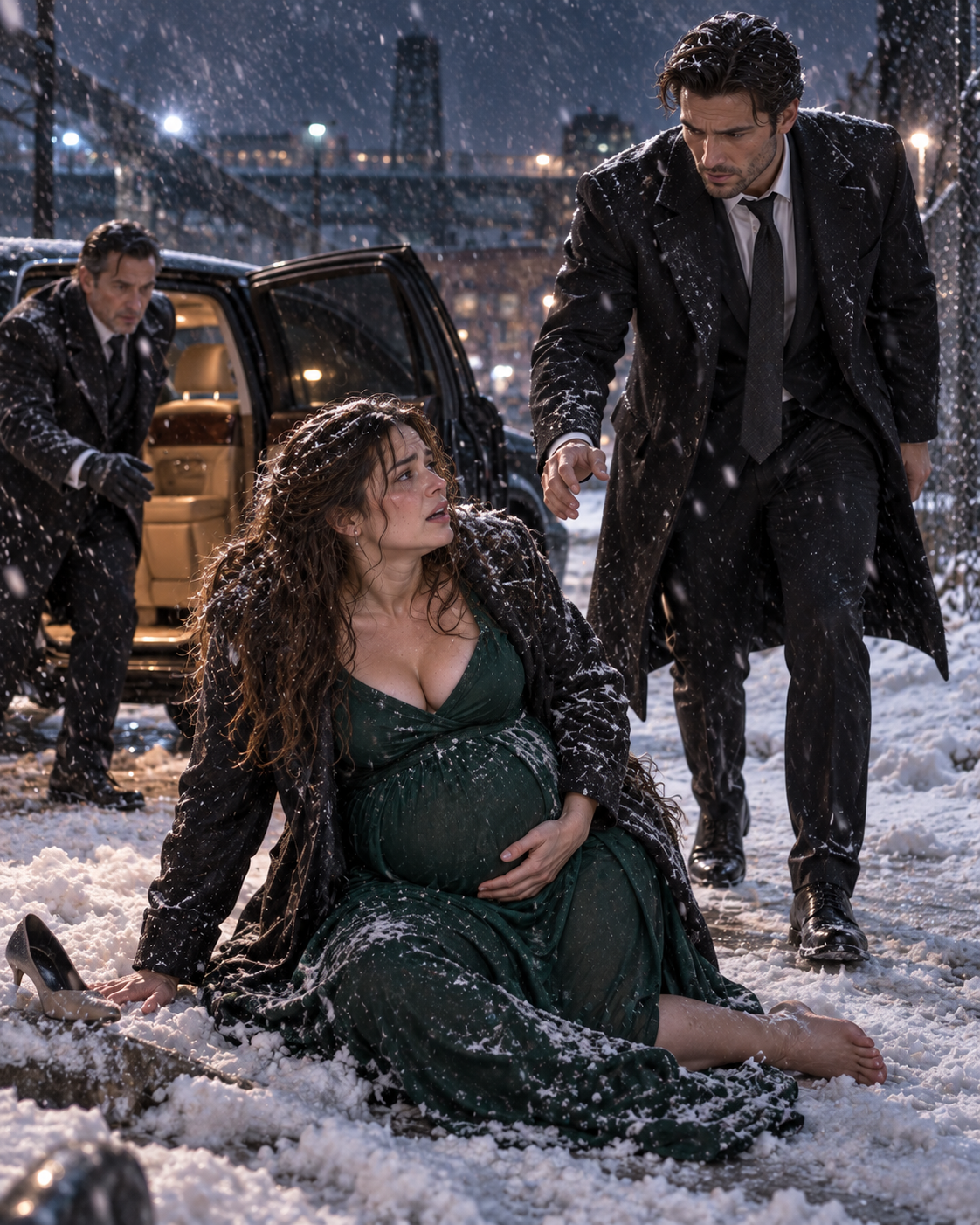
She was 39 weeks pregnant, standing in a Manhattan penthouse, watching her husband kiss another woman.
And when he finally noticed her, he didn’t reach for her.
He reached for the phone to call security.
On the coldest night of the year, Isabella Blackwood’s water broke in the marble foyer of her own home while her husband stood 3 ft away and told her she was nothing.
They took her jewelry. They took her phone.
They took her coat. Then they dragged her outside and locked the gates while the snow swallowed her hole.
Part one. The night she stopped being his wife. The snow started at 6:17 in the evening.
Bella knew the exact time because she’d been watching the window for the past 40 minutes, tracking the way the first flakes caught the light from the penthouse terrace and dissolved before they hit the glass.
She’d been timing the contractions, too, quietly, privately, the way she’d learned to do most things in this marriage.
17 minutes apart at 5:00, 14 minutes at 5:30, 11 minutes at 6:00.
She had her hand pressed flat against her belly beneath the fabric of her dress, a dark green maternity gown that cost more than her first car, and she was doing the math in her head, trying to decide how long she had before this became something she couldn’t manage alone.
She’d been trying to reach Alexander for 2 hours, four calls, three texts.
One voicemail she’d kept to under 30 seconds because she knew he hated long messages.
She’d said, “Alexander, I think I’m going into labor.
Please call me back. I need to talk to you before we go to the hospital.
She’d kept her voice even.
She’d kept the fear out of it.
She was good at that by now. 9 years of practice and appearing calmer than she was, steadier than she felt, less than what was actually happening inside her body in her chest.
The penthouse occupied the entire top floor of the Blackwood Tower on Park Avenue. 4,200 square f feet of imported marble and custom mill work, three terraces, a private elevator that required a biometric scan to operate, and floor to ceiling windows that made Manhattan look like a painting you could buy but never actually touch.
It was the kind of home that appeared in architectural magazines. It was the kind of home that felt most of the time like a museum, beautiful and climate controlled and utterly without warmth.
Bella moved through it carefully, one hand trailing along the wall, the other still pressed to her stomach. She was not small. She had never been small.
At 5’6 and 230 lb, even before the pregnancy, she had spent her adult life navigating a world that kept trying to make her feel like she took up too much space.
Alexander had told her in the early months of their relationship, that she was the most beautiful woman he’d ever seen.
He had said it with a sincerity she’d believed completely.
She’d been 26 years old and she had believed him the way you believe something you’ve been waiting your whole life to hear.
She was 34 now.
She walked down the east hallway toward Alexander’s study where a thin line of light showed beneath the closed door.
She could hear voices low overlapping the specific register of a conversation happening between people who believed they were completely alone. She should have knocked.
She did not knock. She pushed the door open and stepped inside, and what she saw rearranged something fundamental in the architecture of her understanding.
Alexander was sitting on the edge of his desk. Saraphina Caldwell was standing between his knees.
His hands were at her waist, her head was tilted back, and she was laughing at something he’d said.
And he was looking at her the way he used to look at Bella in the first year. that focused private attention that felt like being the only person in the world.
The laugh died the moment Saraphina registered Bella in the doorway.
Alexander’s head turned for three full seconds.
Nobody spoke.
Bella had known Saraphina since they were both 22, sharing a studio apartment in Midtown, while Saraphina waitressed and Bella worked as a junior financial analyst at her family’s firm.
They’d been the kind of close that happens when two people are poor and ambitious and far from home at the same time.
The kind of close where you share food and secrets and the specific particular fear of not becoming who you wanted to be.
When Bella’s family introduced her to Alexander Blackwood at a charity fundraiser 4 years later, it had been Saraphina who helped her pick the dress.
Saraphina was tall, angular, blonde in the specific expensive way that required quarterly maintenance.
and she was wearing a silk blouse that Bella recognized as one she’d recommended herself 6 months ago over lunch at a restaurant in the West Village.
Bella.
Alexander’s voice was flat.
Not guilty.
Not even particularly surprised, just flat, the way you’d say the name of a piece of furniture.
Bella’s hand was still on her stomach.
“I’ve been calling you,” she said.
Her voice came out steadier than it had any right to.
I think I’m in labor.
Saraphina moved away from Alexander’s desk.
She crossed to the window and stood with her back to the room, looking out at the snow. A courtesy, maybe, or just the instinct to absent herself from whatever came next.
Alexander stood up slowly. He adjusted the cuffs of his shirt.
He looked at Bella with an expression she’d never seen on his face before.
Or maybe she had, and she just refused to recognize it.
It was the expression of a man dealing with an inconvenience he’d been aware of for some time and had simply been postponing.
“Sit down,” he said.
“Alexander, I I need to go to the Sit down, Isabella.”
She sat. Not because he told her to, because another contraction was beginning to build in the lower curve of her back, and she needed to not be standing when it hit. She lowered herself into the chair across from his desk and pressed her feet flat against the floor and breathed through it, slow, deliberate, the way the prenatal instructor had taught her in the class Alexander had attended exactly once.
He watched her do this without moving. When it passed, she looked up at him.
“How long?”
she asked.
He didn’t pretend not to understand the question.
“A while,” he said.
“How long is a while?
Does the specific number actually change anything? Something cold moved through her chest.
Not hurt or not only hurt.
Something more like the particular quality of cold that arrives when a temperature has been dropping for hours and you’ve been telling yourself it wasn’t that bad.
And then you step outside and the actual air hits you and you finally understand how wrong you were.
I’m 39 weeks pregnant, Bella said, with your child.
I want to talk about that. You want to? She stopped.
She put her hand back on her stomach. Alexander, I need to go to the hospital.
You can go to the hospital. He said it with the mild reasonleness of a man granting permission to someone who works for him.
But before you do, there are some things that need to be addressed. She stared at him.
He sat back down behind his desk. He opened a drawer and removed a folder.
Not the manila kind, but the kind with a corporate logo embossed on the cover. The kind that came from attorneys who charged by the six-minute increment.
He set it on the desk between them and folded his hands on top of it. This marriage was a business arrangement, he said.
I don’t think that’s a surprise to either of us if we’re being honest.
The contraction was fading. The next one was probably 8 minutes away. She needed to keep him talking long enough to get through at least two more before she had any chance of getting out of this chair without her body betraying her completely.
“Say that again,” she said quietly.
“Your family’s reputation, their connections in the regulatory space, the Whitmore name opened doors for Blackwood International that would have taken me another decade to access otherwise.
” He said it like he was reading from a prepared statement, like he’d rehearsed this.
That was what this marriage provided. I was clear about that early on. You told me you loved me.
I told you what the situation required. The words landed cleanly. No hedging, no softening, no trace of discomfort.
Just the flat delivery of a man who had decided that the relationship between truth and consequence had no bearing on this conversation. Bella looked at the folder on his desk. What is that?
a dissolution agreement prepared by my legal team.
It outlines the terms under which we’ll separate quietly, professionally, without litigation.
You’ll receive a settlement.
He named a number. It was not a small number.
In exchange, you agree to make no public statements about this marriage or its terms, and you agree to relinquish any claim to assets held under the Blackwood International umbrella. She was quiet for a moment.
What about the baby? Something shifted in his face just briefly. A tightening around the eyes that came and went so fast she almost missed it.
I’ve had time to think about this, he said.
And I’ve decided that I’m not prepared to accept paternity of this child.
The room contracted.
I’m sorry, Bella said.
You’ve decided.
There were inconsistencies in our relationship during the relevant period. I have reason to question the Alexander. Her voice was very quiet now.
this is your baby.
That’s a claim that can be verified through appropriate channels at an appropriate time.
He said it with the precision of someone repeating language they’d been given by counsel.
For now, the agreement in front of you addresses the immediate situation.
I’d encourage you to have your attorney review it.
My attorney? She almost laughed.
My phone is in the bedroom. Can I go get my phone?
Of course. She stood slowly, carefully, and walked back down the east hallway to the master bedroom.
She found her phone on the nightstand. She picked it up.
She looked at the four missed calls she’d placed to Alexander, and she thought about the prenatal instructor and the breathing exercises and the bag she’d packed 3 weeks ago and left ready by the closet door.
The bag was still there, gray canvas, monogrammed, everything organized into labeled pockets because that was how she managed anxiety. She organized things.
She picked up the bag. She walked back toward the elevator.
She didn’t make it.
Two men she’d never seen before were standing in the foyer.
Large men in dark clothing, the kind of men who existed in the peripheral spaces of Alexander’s world, who materialized when certain kinds of problems needed resolving without documentation.
The one on the left had her coat draped over his arm. The other was holding what appeared to be the small jewelry box she kept on her dresser.
“What is this?”
she said. Alexander was standing in the hallway behind her. The settlement includes a full accounting of assets acquired during the marriage.
He said the jewelry was purchased with funds from a Blackwood account. So was the coat.
The bag as well, I believe. She turned to look at him.
Alexander, I’m in labor.
You have a phone. You can call a car.
You can’t.
She stopped. Another contraction, harder than the last, and this time her legs were already unsteady, and she had to grab the wall to keep from going down.
She was breathing through it fast and shallow because the longer ones were getting harder to manage with controlled breathing.
“Give her the phone back, at least,” Saraphina said from somewhere behind Alexander.
She hadn’t realized Saraphina had followed them into the hallway.
She looked up through the tail end of the contraction and found Saraphina standing 3 ft away, her arms crossed over her chest, her expression doing something complicated that might have been guilt and might have been the near relative of it. She can keep the phone, Alexander said like he was being generous.
Alexander Saraphina’s voice had something in it now, something strained.
She’s pregnant.
She’s in labor right now.
You cannot do this. Saraphina. His voice dropped into a register Bella had heard before but never had directed at her.
The register that ended arguments. This has been managed.
Step back. A long pause.
Saraphina stepped back. The two men in the foyer moved toward Bella. She would think about this later in a hospital room in the weeks and months and years that followed.
And she would try to identify the precise moment she understood what was actually happening. Not the affair, not the folder, not the dissolution agreement with its careful legal language and its precise financial number.
The moment she understood that Alexander Blackwood was not a man who had made a mistake or lost his way or become someone different than the person she’d married, he had always been this.
The man she’d married had never existed.
What existed was this two large men moving toward her while she was in labor while the snow fell outside while the woman who had been her best friend stood in the hallway and did nothing. They took her bag. They took the phone.
She grabbed for it. She actually grabbed the wrist of the man holding it and tried to pull it back.
And he looked at Alexander and Alexander nodded and the phone went into a jacket pocket.
Alexander,” she said.
Her voice cracked on his name just once.
“There will be no discussion,” he said.
“The terms are what they are.
You’re free to contact a lawyer in the morning.
Tonight, I need you to leave. I need to call an ambulance.
I need You have two legs.
The street is 30 ft from this building’s lobby.”
The elevator arrived. They walked her to it.
Not roughly.
That was the part she’d always remember.
They were not rough about it. They simply moved her forward.
Two large bodies in close proximity to hers, and she was too deep into another contraction to fight them effectively, and the elevator doors closed, and then she was in the lobby, and then she was outside. The cold hit her like a wall. New York in late January at 11:30 at night.
And she was wearing a maternity dress made of fabric that cost a fortune and weighed nothing. And the temperature was somewhere between 8 and 12° F with a wind that made it feel like less.
And the snow was coming down hard now.
Not the picturesque preliminary flakes she’d been watching from the window, but the serious snow, the kind that erased curbs and made the sidewalks treacherous.
She stood on the front steps of Blackwood Tower and the gate clicked shut behind her and she was alone. No coat, no phone, no bag, just her body and the baby inside it and 42 blocks between her and the nearest hospital she could think of. She walked.
She didn’t know what else to do.
There were no cabs. Not in this weather.
Not this late. Not on this block where the snow was already accumulating in thick, slow drifts. She passed three other buildings, pressed her hand against the call buttons of two of them before she understood that nobody was going to buzz her in because she was a stranger in a party dress in a snowstorm.
And that was not a situation that invited trust. She stopped in a doorway and breathed through the next contraction with her forehead pressed against a brass handle gone cold as stone.
And when it passed, she kept moving. Her feet were soaking through the heels she was wearing within the first four blocks.
She lost one heel entirely on the sixth block where the snow had packed over a curb she couldn’t see.
And she went down on one knee and tore the skin and came back up because going down was not an option she was going to allow herself. By the 10th block, she was shaking hard enough that the shaking was affecting her gate.
A full body tremor that she kept trying to suppress and couldn’t.
By the 15th block, she was speaking aloud, not to anyone, just narrating what she was doing, what the next step was. Because if she kept a voice in her head focused on the mechanics, she could keep the other thing, the enormous, shapeless terror of what was actually happening at bay.
Next step, next step. Keep moving.
You’re still moving.
Good. Next step.
She turned east on a block she didn’t recognize.
The street lights were sparse here, an industrial stretch, warehouses and loading docks, and a chainlink fence running along the entire length of the south side of the street. Less foot traffic meant less compacted snow. And less compacted snow meant deeper drifts, and she was moving through them ankle deep, shindep in the worst spots.
And her feet had long since stopped registering cold and were just numb in a way that was either dangerous or merciful.
and she couldn’t decide which.
The contraction that took her down was different from the others.
It came without the usual preliminary warning, or maybe she’d been too far into the cold in the effort to read the signals, and it was a long one, and it was deep, and her knees hit the ground before she made any decision to kneel.
And then her hands were in the snow, and she was breathing in the short staccato bursts that meant it was progressing faster than she’d calculated.
She stayed on her hands and knees. The snow kept coming.
She was 34 years old in the middle of a street in Manhattan in January in labor alone with no phone and no coat and no one who knew where she was. And the thought that moved through her in that moment was not about Alexander, was not about Saraphina, was not about the last 9 years of a life she was only now beginning to fully understand had been built on a lie. The thought was singular and animal and very clear.
My baby is not dying here. Not tonight.
Not in this street. She moved her hands forward in the snow. Then her knees.
Then her hands again. She crawled. She crawled for what might have been 40 ft or might have been 400.
Her sense of distance had dissolved into the rhythm of forward motion and the management of what her body was doing. She crawled until she reached the curb, then pulled herself up against a lampost and got back to her feet.
and she stood there swaying in the wind and the snow and looked up at the sky, heavy and orange gray with the light pollution caught in the clouds, and thought about her son.
She’d already decided on Noah months ago without telling Alexander.
Something she’d held private, a small act of ownership over something that was hers.
Noah, she thought, not tonight.
We’re not done tonight.
She was still standing, but barely, barely. When the headlights found her, they came from the east, moving slow on a street that was almost entirely snow covered, and they were high beams on a vehicle large enough that she felt the vibration of its engine before she fully registered it as a car. It slowed.
It stopped. For a moment, she thought it was going to keep moving, just a driver seeing an obstacle and making a decision to navigate around it. And then it stopped completely, 30 ft away, and the engine kept running.
The rear door opened. A man stepped out.
He was tall, well over 6 feet, with dark clothing and an economy of movement that looked less like stillness and more like the specific controlled calm of someone who didn’t waste anything.
Not a gesture, not a step. He moved toward her without hurrying and stopped at a distance that was not quite arms reach.
And he looked at her, not her face first, but the whole picture. The dress, the bare arms, the missing shoes, the snow in her hair, the hand on her stomach. How far apart?
He said. Not a question.
More like a rapid inventory. She stared at him. The contractions, he said.
How far apart are they?
I don’t.
She had to stop and find her breath. 4 minutes, maybe three now.
He turned his head and said something to the driver she couldn’t fully hear.
Then he looked back at her.
“My name is Lorenzo Moretti,” he said.
“I’m going to get you help.
Do you understand what I’m telling you?”
She knew that name. It was not a name she knew from newspapers exactly, though the newspapers had mentioned it.
It was a name she knew the way people who moved in certain financial circles in New York knew it. Sideways, peripheral, the way you knew the shape of a thing without looking directly at it.
Lorenzo Moretti. She should have been afraid.
Later, she would think about that, about why she wasn’t afraid.
Maybe it was the cold. Maybe it was the pain.
Maybe it was that fear required the presence of something left to lose. And she was standing in a snowstorm without a coat, without a phone, without a plan. And whatever she had left to lose was currently trying to be born on the side of a street in lower Manhattan.
She looked at Lorenzo Moretti and she said, “Okay.”
And that was the moment everything changed, though she didn’t know it yet.
Standing in the snow with her knees shaking and her heart pushing against the inside of her ribs, she didn’t know what came next.
Didn’t know what the man in front of her represented.
Didn’t know that the decision she’d just made in three letters on a deserted street would reorder the entire architecture of the next 9 years of her life.
She only knew that her son’s heartbeat was still there.
she could feel it, had always been able to feel it, and that she was still standing. The driver came around to help her to the car.
She moved toward the door, and above her, the snow kept falling, erasing the print she’d left in the street, smoothing everything over the way it does, covering the evidence, cleaning the slate like the world was trying to pretend that none of this had happened.
But Isabella Whitmore remembered every step. She would remember them for 9 years. and Alexander Blackwood would spend every one of those years believing she was dead.
The clinic had no sign on the door. That was the first thing Bella registered when the black Cadillac pulled into a narrow alley somewhere in the lower garment district.
Not a hospital, not an urgent care, not anything with a lit cross or an illuminated emergency entrance, just a steel door set into a brick wall and a man already waiting on the other side of it when Lorenzo’s driver cut the engine.
The man was in his 60s, compact with the careful, unhurried movements of someone who had performed difficult procedures in difficult conditions for a very long time. He had a medical bag in one hand, and he was pulling on a pair of nitro gloves as he walked toward the car.
And he didn’t say hello to Lorenzo, just opened the rear door and leaned in and looked at Bella with the focused clinical attention of someone taking a rapid inventory.
How many weeks? He said 39 and 4 days.
Bella said through her teeth. Another contraction was building. First pregnancy.
Yes. Water broke. About 2 hours ago, maybe two and a half, he straightened and looked at Lorenzo over the roof of the car.
Something passed between them in that look. A full conversation conducted in a single second.
the specific shorthand of men who had known each other long enough to not need words for most things.
“Get her inside,” the doctor said, and walked back toward the steel door.
What followed was 3 hours that Bella would spend the rest of her life being unable to fully describe to anyone who hadn’t been there.
The clinic was clean. That surprised her.
She’d expected something grim and improvised, but the room they brought her into was properly equipped.
a hospital bed with stirrups, surgical lighting on an adjustable arm, a warming unit ready in the corner. The doctor, Lorenzo called him Romano, and she never got a first name, worked with the kind of competent silence that was more reassuring than anything he could have said. A nurse appeared from somewhere, a woman in her 40s with short gray streaked hair and hands that were efficient without being cold.
Lorenzo stayed outside. Bella registered that somewhere in the part of her brain that was still running assessments, even while her body was doing the most demanding thing it had ever done.
She’d expected him to stay in the room.
She’d expected to be observed, controlled, managed.
He’d walked her to the door and then stopped.
And when she looked back at him, he just said, “Romano is the best I know.”
And stepped back. At 2:47 in the morning, Noah Whitmore was born. 7 lb 11 oz.
A full head of dark hair.
A cry that started thin and then opened up into something decisive, like he’d decided immediately that he had opinions about his situation and intended to make them known.
Romano placed him on Bella’s chest.
And Bella, who had not cried once in the three hours of labor, who had not cried on the street, who had not cried in Alexander’s study when he said the words that took her marriage apart like it was a piece of furniture being disassembled, felt something crack open behind her sternum and press out through her eyes, and she held her son against her body and shook without making any sound.
The nurse pretended to check equipment. Romano wrote something in a notebook and left the room. Bella had exactly 11 minutes alone with Noah before the door opened and Lorenzo came in.
He stopped just inside the threshold. He had taken off his coat, a dark wool overcoat, the expensive kind, the kind that meant nothing to a man who could buy 50 of them, and he was in a dark suit with the jacket open, his tie loosened.
He looked at the baby, just looked at him with an expression that wasn’t quite what Bella expected.
Not calculation, not the weighing of assets, something quieter than that.
He’s healthy, Bella said.
It wasn’t a question.
Romano says, “Yes, both of you.”
She nodded. She was still shaking post labor, post cold, post everything, but the shaking was manageable now, closer to the surface.
She looked down at Noah at the particular perfection of his fingers, which were curled against her chest like he was holding something invisible.
You’re going to want something from me, she said.
Lorenzo moved to the chair beside the bed and sat down.
He had a way of inhabiting space that she’d already noticed in the car, not aggressive, but completely settled, like he decided where he was, and the decision was final.
He put his elbows on his knees and laced his hands and looked at her directly.
That’s a conversation for when you’re not 3 hours out of labor.
I want to have it now. A pause.
He studied her. You know who I am, he said.
Yes.
Then you know I don’t operate on charity.
I know that. She shifted Noah slightly, making sure his head was supported.
I also know what you have and what I have, and I think there’s a conversation worth having if you’re willing to have it straight.
Something moved across his face. Not quite a smile.
More like the recognition of a quality he hadn’t anticipated.
What do you have? He said flat.
not dismissive, genuinely asking information, Bella said about Alexander Blackwood’s financial structure, his offshore accounts, the shell companies he uses to move money through regulatory gaps, the specific relationships he has with three members of the SEC’s oversight division.
She kept her voice
even. And I know where the bodies are buried, figuratively speaking, in terms of the Blackwood International contracts that were secured through means that the board of directors officially does not know about.
Lorenzo was quiet for a long moment.
You’re a financial analyst, he said.
I was before the marriage, and during it, I had access to everything because he trusted me to be decorative and unambitious, and I used that assumption to learn everything there was to know about how his empire actually worked. She looked at him steadily. He made the mistake that powerful men usually make.
He looked at a woman who didn’t fit his idea of threatening and decided she wasn’t.
Lorenzo unclasped his hands. He sat back in the chair.
“What do you want?”
he said.
“Ptection for me and for Noah.
Long enough for me to rebuild legally completely. No exposure on my end.
I’m not interested in anything that puts my son in a position to inherit legal liability.
And in exchange, I help you understand exactly how Blackwood International operates. Every vulnerability, every lever, every relationship he depends on that could be turned against him. She paused, and when the time is right, I take him apart piece by piece all the way down to the foundation.
The room was very quiet. Noah made a small sound, resettled, went still again. Lorenzo looked at the baby for a moment, then back at Bella.
That’s not a short game, he said.
No, Bella agreed.
It’s not.
Another silence longer this time. Get some sleep, Lorenzo said finally. We talk more tomorrow.
He stood up. He moved toward the door. He stopped with his hand on the frame and looked back at her.
At her face, not the baby.
With the expression of a man who had just made a decision he hadn’t fully anticipated making.
Nobody’s going to touch you here, he said.
Tonight or after? He left. Bella looked down at Noah.
His eyes were closed.
His chest rose and fell with the small perfect regularity of a new life that didn’t know yet what the world was capable of.
Okay, she said quietly. To him or to herself or to both of them. Okay, here we go.
She did not sleep. She spent the rest of the night making lists in her head.
The weeks that followed moved in a strange double rhythm.
recovery and planning, exhaustion and calculation, all of it compressed into a life that had no room for anything that wasn’t essential.
Lorenzo’s people moved her to a safe house in Brooklyn within 48 hours of Noah’s birth.
a brownstone in Carol Gardens that had been cleared and quietly furnished with two men stationed outside at all times and a direct line to Lorenzo’s head of security, a compact, watchful man named Marco Russo, who communicated primarily through brief text messages and the occasional appearance at her door.
Marco
made her uncomfortable, not because he was threatening.
He wasn’t, not to her.
He was unfailingly professional and consistently difficult to read, which was its own kind of discomfort. He had the quality of a man who noticed everything and disclosed nothing.
And in those early weeks, she caught him more than once watching her in the way you’d watch someone whose declared intentions you were still in the process of verifying.
She understood it.
She’d have done the same thing.
She was nursing Noah and recovering from delivery and simultaneously rebuilding her financial profile from scratch using resources Lorenzo made available without explaining their source, a laptop, a phone on a number that didn’t connect to her name, access to a secure network.
She set up the first Shell company on day 11. She had a functioning financial model by day 23. She was back in contact with two former colleagues discreetly by the end of the first month.
Lorenzo visited twice in those first weeks. Both times he came alone without announcement in different cars. Both times he sat across from her at the kitchen table and listened while she walked him through what she was building and what she needed and how the two things intersected with what he was trying to do with his legitimate holdings.
He listened the way she had learned to identify as valuable.
not passively, not just waiting for his turn, but actively following the logic, asking specific questions, backing up when something didn’t track, and making her explain it again.
He was smarter than people in his position were usually assumed to be, and she thought that was probably one of the primary reasons he was still alive. On the third visit, something changed. It was a Tuesday in March.
Noah was 6 weeks old, and Bella was sitting at the kitchen table at 7:00 in the morning with a cold cup of coffee and a spreadsheet open on the laptop and the specific thousandy vacancy of someone who had been awake since 3. She heard the key in the front door.
Only Lorenzo and Marco had one and registered the footstep pattern as Lorenzo’s and didn’t look up.
There’s more coffee, she said.
He helped himself and sat down across from her and looked at the spreadsheet and said, “That’s the Blackwood Maritime holding.”
“Yes, he’s moving on Valente.”
She looked up. Lorenzo was watching her with an expression that was difficult to decode.
“Say that again,” she said carefully.
“The Valente Maritime Roots, the Northern Atlantic corridors.
Alexander Blackwood is pursuing acquisition.
He’s been in early conversations with the Valente family for about 6 weeks.
He picked up his coffee. I have it on reliable authority. Bella stared at him.
The Valente maritime routes were on the surface a collection of commercial shipping contracts worth approximately $2 billion and a foothold in Atlantic trade logistics that had been held by the same family for three generations. Underneath the surface, they were something considerably more significant.
a network of transit corridors that the right person with the right financial architecture and the right relationships could use to move things that didn’t appear on manifests.
Alexander wouldn’t know that part.
He’d see the legitimate asset, the business value, the strategic expansion.
He’d see the 2 billion and the prestige and the board would see the acquisition and approve it.
And he’d close it in 12 to 18 months and be very pleased with himself.
He would not see the trap until it closed because the Valente family, the actual Valente family, had an existing relationship with Lorenzo Moretti that had been in place for 11 years. Bella set down her pen.
You’ve been waiting for him to make a move like this, she said.
I’ve been waiting for the right kind of move.
And you knew before I walked into your car. No.
He said it directly without hesitation. I knew after when you told me what you knew and I ran it against what I already had.
That’s when I understood what the timing could look like.
She was quiet for a moment. How long have you been positioned on Valente? Long enough that I can control what Blackwood sees during due diligence.
You can make the asset look clean completely.
And when he’s overextended, when he’s committed, when he’s leveraged his existing holdings to fund the acquisition and his board is locked in and the announcement has been made and there’s no position he can retreat from without destroying the company’s stock value.
Lorenzo paused.
That’s when the floor drops.
Bella let out a slow breath.
The plan she’d been building for 6 weeks.
The careful, methodical patient plan, with its 10-year horizon and its incremental pressures suddenly looked different, not wrong. The bones of it were still right.
But she’d been thinking about dismantling Alexander Blackwood the way you’d take apart a building floor by floor, structural element by structural element, over a long, slow, controlled demolition.
What Lorenzo was describing was more like engineering a sinkhole.
You didn’t take the building apart.
You removed the ground beneath it and let gravity do the work. The timeline changes, she said. Some of it.
I need more time to build Eclipse Capital to the point where the offer is credible.
He won’t take a meeting with a company that doesn’t have a provable track record.
How much time? Four years minimum.
Probably five.
Lorenzo nodded like she’d given him a number he’d already estimated.
And Noah, she said, something shifted in his expression. What about him?
He needs a life that doesn’t look like what it is.
He needs stability, a real address, a school, a a normal childhood, or as close to one as this situation allows.
She met Lorenzo’s eyes.
I’m not going to raise my son in a safe house indefinitely.
I know that. I need to know what that looks like concretely, what the arrangement is long term. Lorenzo sat down his coffee cup.
He looked at the table for a moment, then back at her.
There’s a house in Westchester, he said.
It’s in a name that doesn’t connect to me.
Good school district, quiet neighborhood. You could put down roots there without anyone asking questions that matter. And security.
Marco stays. two additional people rotating embedded.
Noah can’t grow up knowing he he grows up knowing he’s safe, Lorenzo said.
The rest is context he gets when he’s old enough to hold it.
He paused.
That’s your call, not mine.
She looked at him for a long moment. There was something she needed to say, and she was working out the precise way to say it.
I need you to understand something, she said finally.
I’m not doing this because I’m afraid of Alexander.
I’m not doing this from a position of survival anymore.
I’m I’ve survived.
Noah has survived. She put her hand flat on the table.
I’m doing this because what he did, what he did to me, what he did to my family’s name, what he is continuing to do right now in that building on Park Avenue while I’m sitting in a safe house in Brooklyn, that cannot stand.
Not because I want revenge. She stopped.
Because if it stands, the lesson is that it works. and I will not let that be the lesson. Lorenzo was very still.
When he spoke, his voice was quieter than she’d heard it.
I understand that, he said, and she believed him. Not because of anything soft in his expression. There was nothing particularly soft about Lorenzo Moretti at 7 in the morning over bad coffee in a safe house kitchen.
But because she’d read enough people in her professional life to know the difference between a man who was managing her and a man who actually heard her and he heard her, that was the day the arrangement became something more than transactional.
Not personal, not yet, not in the way it would eventually become, but something with weight to it. A shared understanding of stakes that went beyond the financial. a recognition from both sides of the table that what they were building was not going to be clean or quick or without cost and that they both understood this and were choosing it anyway.
The weeks became months. The months moved.
Noah learned to hold his head up, then to sit, then to pull himself upright using the leg of the kitchen table in the Westchester house, where Bella had eventually put down roots exactly as Lorenzo suggested, in a neighborhood where she was known as
Isabella Marsh, a widowed financial consultant who worked from home and kept reasonable hours and was friendly without being open. The kind of neighbor who remembered birthdays but declined most dinner invitations.
It was a performance, but it was also in certain specific ways a life. Marco was there.
He became over time less like a security detail and more like a feature of the household, present without being intrusive. Reliable in the specific way that only people who have no agenda beyond the one-stated agenda can be.
Noah called him Marco and later, when he was four and experimenting with names, tried calling him Uncle Marco once, and Marco’s face had done something startled and unguarded for just a moment before he settled back into his usual expression.
He didn’t correct him.
Lorenzo came when he could, not often enough to establish a pattern that anyone would notice, never in the same vehicle twice.
He came and sat at her kitchen table and drank whatever coffee she’d made and watched Noah drag toys across the floor with the focused attention of a man who did not have much experience with small children, but was applying himself to understanding this one specifically.
One evening when Noah was almost two, she came downstairs to find Lorenzo sitting on the living room floor with his jacket and tie off, stacking wooden blocks with Noah with the absolute serious concentration of someone who had been challenged and was not going to lose.
Noah knocked the stack over with both hands and shrieked with laughter, and Lorenzo looked up at Bella in the doorway with an expression she’d never seen on his face before.
Something open, something that hadn’t been managed or curated.
She didn’t say anything.
She went back to the kitchen and stood at the counter for a moment and thought about what she was building here and whether she’d fully accounted for all the ways it could change shape over time.
She hadn’t.
She knew that. But the plan was moving.
Eclipse Capital was real now, registered, operational, with a track record that was genuine and a reputation in boutique investment circles that was starting to attract the kind of attention she needed.
She’d hired three analysts, two of whom had no idea who they were actually working for or what the long game was.
She’d made four significant acquisitions in 18 months, all of them legitimate, all of them profitable, all of them carefully chosen to build the specific profile she needed to make the eventual approach to Alexander credible.
She was becoming the
architect, not in name, not yet, but in substance.
And then on a Thursday morning when Noah was 2 years and four months old and going through a phase of refusing to wear shoes under any circumstances, Bella got a phone call from a number she didn’t recognize.
She almost didn’t answer it.
She answered it. Isabella Whitmore. The voice was male older.
The precise calibrated diction of old money and older law firms. My name is Harlon Voss.
I’m a senior partner at Voss Greley and Park.
I’m calling because I represent a party who has reason to believe you’re alive and who has made a significant financial offer contingent on your cooperation.
Bella did not speak. Mrs.Whitmore or Miss Marsh if you prefer. A pause.
My client is Alexander Blackwood.
He’s become aware that you may be active in the financial sector under an assumed identity and he’d like to open a dialogue about the terms under which that activity might She ended the call.
She stood in her kitchen with the phone in her hand and Noah in the next room making the specific noise he made when he was building something.
A low focused hum that she’d learned to read as contentment.
and she thought about what had just happened with the cold, precise part of her brain that operated independently of the rest of her.
The part that didn’t panic, the part that ran assessments, Alexander knew she was alive, or he suspected it.
There was a difference, and the difference mattered. She called Marco first, then Lorenzo. Lorenzo arrived in 40 minutes.
A new car, a driver she hadn’t seen before.
He came in through the back and stood in the kitchen with his arms crossed and listened while she played him the voicemail she’d had the presence of mind to let go to on the call back where Harlon Voss had left a more detailed version of the same message.
When it finished, Lorenzo was quiet for a long moment.
“He doesn’t know enough,” he said finally.
“If he knew where you were and who you were and what you were building, this call would not have been made through an attorney.
This would have looked different.
I know that he’s fishing.
He heard something, a name, a transaction that crossed someone’s desk.
Lorenzo uncrossed his arms and put his hands in his pockets.
What he actually knows is much less than what he’s implying.
That doesn’t mean the timeline is safe.
No. He looked at her directly.
It means the timeline may need to accelerate. She turned toward the window.
Outside, Noah’s shoes were on the back porch steps where he’d abandoned them.
She looked at the shoes for a moment.
“How much can you move on Valente in the next 6 months?”
she said.
“Enough, if you’re ready on your end.”
“I’m not at the place I plan to be in.”
“Are you close enough?”
A long silence, she thought about the accounts she had, the relationships she’d built, the board members of Blackwood International she’d been quietly cultivating for 2 years, the ones who had doubts about Alexander they’d never be able to articulate until someone showed them documented evidence that gave their doubt a shape.
She
thought about the federal investigator whose career she’d helped save three years ago with information she’d passed through a careful chain of intermediaries and who owed her something he didn’t know yet he was going to pay.
She thought about the phone call from Harlland Voss.
She thought about Alexander Blackwood in his penthouse on Park Avenue 39 weeks and 4 days ago looking at her in labor and saying, “You have two legs.
The street is 30 ft from this building’s lobby.
Yes, she said, I’m close enough.
Lorenzo nodded once. And then he said the words that made it irreversible.
The words that took everything she’d built and everything she’d endured and committed them to a path that had no exit, no modification, no possibility of walking back.
“Then we move,” he said.
“All of it now.”
Bella turned away from the window.
Her son’s shoes were still on the back steps.
She was going to have to talk to him about the shoes again. But first, she picked up her phone and she began to make the calls that would set the final stage in motion.
The calls that would pull Alexander Blackwood toward a deal he would believe was his salvation. A company he would research and verify and find completely legitimate. A CEO he would request a meeting with.
A name he would speak aloud without recognizing. The architect.
He was coming to her and this time there was no gate she could be locked behind, no storm she could be abandoned in, no version of the next conversation in which Alexander Blackwood walked away from what he had done. The calls took 4 days, not because the mechanics were complicated. Bella had been preparing the infrastructure for this moment for the better part of 3 years, and the individual components were ready.
The shell holdings that would make Eclipse Capital appear to be pursuing the Valente maritime routes independently.
The intermediaries who would surface Alexander’s name in the right conversations in the right rooms at the right frequency to make him feel like he’d discovered an opportunity rather than been steered into one.
The
documentation packages already assembled that would pass every level of due diligence his team could run. The calls took 4 days because Bella made herself slow down. She had learned over 9 years of building something from nothing in secret that the moments that felt most urgent were the moments most likely to produce mistakes.
Speed was the enemy of precision. And what she was setting in motion now required precision of a kind that left no margin.
Not a single document out of place.
Not a single name that didn’t check out.
Not a single thread that Alexander’s attorneys could pull and find something that unraveled.
So she made the calls in a specific order at specific times. And between calls she sat at the kitchen table in the Westchester house and drank water and ate whatever Noah had left on his plate and reviewed her notes and made herself breathe slowly. Marco watched her do this with the expression of a man who understood what was happening and had decided that the most useful thing he could offer was silence.
On the fifth day, Lorenzo called.
Blackwood’s CFO had lunch with the Valente family’s attorney yesterday, he said.
No greeting, no preamble.
They’d long since stopped performing those exploratory, very preliminary, but he came.
Who initiated? Their side, which means our side.
Bella closed her eyes for a moment.
This was the part of the plan she’d built for, the part where the target believed he was acting on his own intelligence, his own network, his own superior instinct for opportunity.
Alexander Blackwood had spent his entire career being the smartest man in whatever room he occupied. And that belief was the most loadbearing element of his psychology.
You didn’t fight it, you fed it.
You built a corridor of mirrors and you let him walk down it and feel brilliant the entire way. How long before he makes a formal approach?
She said 6 weeks, maybe eight. And the federal file.
A brief pause on Lorenzo’s end.
It’s ready.
Packaged and attributed to a source that traces back to a disgruntled former Blackwood International Compliance Officer who genuinely exists and genuinely has grievances.
It’ll hold up.
Another pause. But Bella, the timing on that has to be precise.
We release it too early. He lawyers up and goes to ground.
Too late. And the acquisition closes before the floor drops.
I know the timing. I know you know it.
I’m saying it out loud anyway.
Lorenzo. Yeah, I know the timing. She said again quieter.
And he heard what was underneath that. Not irritation, but the specific kind of exhaustion that comes from carrying something for a very long time.
And he didn’t push it further.
They ended the call. Bella sat in the kitchen for a long time after Noah was at school.
He was 8 years old now, and he went to a school six blocks away where he was known as Noah Marsh and was apparently excellent at mathematics and consistently resistant to sitting still during reading period, which the teacher described as a challenge, and Bella privately understood as hereditary.
She
went to parent teacher conferences and brought snacks on assigned days and attended the school’s spring performance every year where Noah had been in successive years a tree, a cloud, a talking rock, and most recently a minor historical figure whose name Bella had needed to Google.
She sat in those folding auditorium chairs with the other parents and clapped at the right moments and felt the full strange weight of the life she’d constructed.
Its realness, its ordinariness, the way it was both completely genuine and built entirely on a foundation of concealment. She picked him up at 3:15. He climbed into the car with the specific organized chaos of an 8-year-old who had been institutionally contained for 7 hours and was now released.
backpack falling, one shoe half unlaced, already talking before the door closed. Mom. Mom.
Okay, so Marcus said that if you fold a piece of paper enough times, it gets thicker than the distance from here to the moon.
And I said that’s impossible.
And he said, “It’s math.”
And I said, “Math can’t make paper go to the moon.”
“It’s theoretically true,” Bella said, pulling out of the pickup lane.
Noah stopped.
“Wait, what?
Each fold doubles the thickness. Do it enough times and the exponential growth exceeds any distance you can name.
You’d run out of paper long before you got there, but the math works.
Silence from the back seat while he processed this.
That’s insane, he said finally.
Math often is. She watched him in the rearview mirror.
He was looking out the window with the particular expression he got when he was working something out. a focused stillness that appeared in the middle of his general motion like a calm spot in fast water.
He had Alexander’s jaw which she’d made her peace with years ago.
Everything else, the dark eyes, the way he held his hands when he thought, the specific quality of his attention, was hers.
“Mom,” he said, still looking out the window.
“Yeah, Marco’s following us.”
She glanced in the mirror, the gray sedan three cars back. I know, she said. Why does he always follow us?
This was not the first time he’d asked.
It was the first time he’d asked in the flat, careful tone of someone who had already formed a theory and was testing it.
Because it makes me feel better, she said. Which was true.
It just wasn’t all of the truth.
Noah was quiet for the rest of the drive. She noted it.
She noted most things about him.
She noted the question and its tone and stored it beside the other questions he’d been asking more frequently in the past year.
About his father, about why they’d moved from their last house, about why she worked from home and met most of her colleagues through a screen.
He was 8, and 8 was old enough to sense the shape of something without being able to name it. And she was going to have to decide soon how much truth he could hold and in what form.
She hadn’t decided yet.
She was still deciding 3 weeks later when Marco appeared at her kitchen door at 11:00 in the evening and knocked in the specific pattern that meant she needed to open it without turning on any interior lights. She was already awake.
She’d been awake for an hour, sitting at the table with her laptop and a review of the due diligence materials Alexander’s team had officially requested from the Valente attorneys that afternoon, which meant the timeline had compressed, which meant Lorenzo had been right, which meant the formal approach was imminent.
She opened the door.
Marco’s face was wrong.
She’d spent years learning to read Marco’s face, which was not an expressive instrument, and what she saw on it now was not the controlled readiness he wore for procedural emergencies.
It was something else, something effortful, the face of a man delivering news he had rehearsed and was still not prepared to deliver.
“What happened?”
she said.
“Come sit down, Marco.”
Bella. The use of her first name stopped her. He almost never used her first name.
Come sit down, please.”
She sat. He stayed standing.
He had a phone in his hand.
Not his usual phone, but a secondary one, the kind Lorenzo used for conversations that couldn’t be traced.
He set it on the table between them. Lorenzo wants to talk to you directly, he said. But he asked me to be here when he did.
The phone rang. She answered it.
Lorenzo’s voice came through immediately without preamble.
in the clipped tone she’d learned meant he was controlling something he would otherwise not be controlling.
“There’s a problem,” he said.
“Tell me.”
The Federal File, the compliance officer we used as the attributed source. His name is Daniel Greer.
He worked in Blackwood’s risk management division until 14 months ago.
A pause.
He’s dead, Bella.
He died 11 days ago. Cardiac event officially.
He was 53. She was very still.
That’s that’s circumstantial, she said slowly.
53year-olds have cardiac events. Yes, Lorenzo said.
They do, and the timing could be coincidental. He paused. But I received information this evening from a contact inside the New York field office that Greer had recently made contact with federal investigators.
not through our channel, independently.
He’d apparently been building his own case against Blackwood International for the past 2 years.
The kitchen was very quiet. He was running a parallel play, Bella said, without knowing about ours, without knowing about you. He was just a man who knew what he knew and decided to do something about it.
Lorenzo’s voice was flat and careful.
His contact at the federal office received Greer’s preliminary package 6 weeks ago.
2 days after that contact registered receipt, someone accessed the communication log for that division through an internal breach. Someone inside the federal office.
Someone with access? Yes. Bella felt something cold begin to move up the back of her neck.
Alexander has someone inside the federal office, she said. He appears to. How deep?
We don’t know yet, Lorenzo.
She pressed her hand flat on the table. How compromised is our file?
A silence that lasted exactly long enough to be its own answer. The attribution trace, Lorenzo said finally.
If someone with the right access ran a deep search on the sourcing of the materials we packaged, materials that were prepared independently by our people that Greer had no connection to, they would find inconsistencies.
The timeline doesn’t fully align with what Greer actually had access to at Blackwood International.
Meaning, if they look closely enough, the source is fake. Meaning, if they look closely enough, the source is impossible. She stood up from the table.
She walked to the window and stood with her back to Marco and looked out at the backyard, which was dark and damp from rain. The lawn light casting a circle of orange yellow over nothing in particular. The whole federal component falls apart, she said.
If they get to it before we do. Yes.
And without the federal component, without it, Alexander loses the business. He loses the acquisition. He loses the board.
Lorenzo paused.
But he doesn’t go to prison.
And he’s not destroyed.
He’s damaged.
Recoverable eventually with the right attorneys and enough time. She turned around.
Marco was watching her with the careful attention of someone who was prepared to respond to whatever came next. How did he find out I was alive?
She said.
That’s what I’ve been trying.
Not how he suspects. How he knows.
She kept her voice level.
Because what you’re describing, the access to the federal communication logs, the timing on Greer, the sophistication of the internal breach, that’s not the behavior of a man who received a vague tip that his ex-wife might be doing business under a different name.
That’s the behavior of a man who has been running surveillance on a specific target for long enough to map her network.
A long silence from Lorenzo’s end.
Talk to Marco, he said finally.
He’ll tell you the rest.
The call ended. She set the phone down on the table. She looked at Marco.
Marco, who had been with her for 9 years.
Marco, who had been assigned to her by Lorenzo in the first weeks after Noah’s birth.
Marco, who knew the Westchester address and the school Noah attended, and the names of her analysts at Eclipse Capital, and the schedule of her meetings, and the location of every document she’d ever prepared.
Marco, who was standing in her kitchen at 11:30 at night with the phone Lorenzo had sent, and an expression on his face that she was only now, only in this exact moment, reading correctly. Not the face of a man delivering news, the face of a man confessing. How long?
She said.
He didn’t pretend not to understand.
14 months, he said. The number hit her like a physical thing. 14 months.
A year and two months of Marco in her home at her table picking Noah up from school when she couldn’t, knowing everything, and for the last 14 months transmitting pieces of it, pieces of her, pieces of Noah, pieces of the plan to someone.
Who? she said.
A man named Garrett Cross. He runs private intelligence for for Alexander.
Marco nodded. She was very quiet for a long moment.
The particular quality of that silence was one she’d never produced before.
It wasn’t the silence of shock.
She’d been running the math since Lorenzo said talk to Marco, and she’d arrived at this destination two sentences before Marco confirmed it.
It wasn’t the silence of grief, though that was in there somewhere layered underneath.
It was the silence of a woman recalibrating everything.
Not just the plan, not just the 9 years, but the specific texture of what she’d believed was real and what she was now understanding was partly performance.
Noah, she said. Her voice was completely flat. How much does he know about Noah?
Marco’s jaw tightened.
I never gave him Noah’s school schedule.
I never gave him anything about Noah’s.
How much? That he exists, his age, his general. Marco stopped.
I kept Noah out of it as much as I could. I want you to know that you kept Noah out of it.
She looked at Marco with an expression that had nothing in it she’d ever put there intentionally.
It was simply what appeared on her face when every managed layer was removed. You were in my house for 9 years. You sat at my table.
You She stopped. Started again. Why?
Cross found something I needed buried from before. From a situation I handled for Lorenzo before you were in the picture.
He said it directly without the softening of euphemism.
He held it and he used it and I I didn’t have a way out that I could see.
You could have told me. I know that. You could have told Lorenzo.
I know that, too.
Then why didn’t you?
He didn’t answer immediately.
He looked at the table. When he looked back up, his face had the quality of a man who had run out of the ability to not see himself clearly. Because I was afraid, he said, and I convinced myself I was protecting you, that what I was giving cross was manageable, that I could control how much Alexander actually got.
He paused. I was wrong. I know I was wrong.
She looked at him for a long time. She thought about the night Noah was born.
Marco pulling the rear door of the Cadillac open in the alley, his efficient hands, his steadiness.
She thought about the first night in the safe house when she’d heard Noah crying at 2:00 in the morning and come downstairs and found Marco already in the kitchen, awake, having clearly been sitting there for some time, and she’d said, “You don’t have to do that.”
And he’d said, “I know.”
And stayed anyway.
She thought about a hundred small moments over 9 years, the kind that accumulated into something she’d called trust, without examining the word too closely.
She thought about Noah asking about the gray sedan three cars back.
Marco’s following us.
I know, she’d said.
She walked to the kitchen counter. She put her hands on the edge of it and stood there with her back to Marco and looked at the window above the sink and the dark yard beyond it. And she counted to 10, not to calm herself down, but to give her operational brain time to get ahead of everything else.
When she turned around, her face was different. Not composed in the way she usually composed it. deliberate, constructed, professional, different in a way that Marco clearly registered because he straightened slightly.
The way people straighten when something they’ve been waiting for has finally arrived.
Okay, she said, “Here’s what happens now.
You’re going to tell me everything Cross knows, everything you gave him, in what form?
On what timeline?
We’re going to spend the next 3 hours going through it in sequence and I’m going to take notes and you’re going to be completely precise.
She picked up her laptop.
After that, you’re going to contact Cross and you’re going to tell him that you need an emergency meeting tomorrow in person.
Marco stared at her.
You’re going to use me, he said slowly.
I’m going to use the access you’ve already created, she said.
the access to Alexander’s intelligence operation that you’ve been maintaining for 14 months.
The access that Cross has no reason to distrust because you’ve been reliable for 14 months.
She set the laptop on the table and opened it.
You made a choice that damaged what I’ve built.
Now you’re going to make a different choice that fixes it.
Bella. Marco.
Her voice had an edge in it she’d never used with him before.
Not anger. Not quite. Something colder than anger.
something that lived on the other side of it. You told me once that the most useful thing you could offer was the ability to handle problems without being asked. You said it the first week.
Do you remember that? He nodded.
Handle this one, she said. He sat down.
They worked through the night.
What emerged over those 3 hours was both better and worse than she’d initially calculated.
Better because Marco had been more careful than she’d feared.
The core architecture of Eclipse Capital was intact.
The most sensitive components of the federal package had never been transmitted, and Cross’s picture of what she was building was incomplete in ways that could be exploited.
Worse, because what Cross did have was enough to give Alexander a significant tactical advantage if he chose to move on it, and the question of when Alexander would choose to move was now entirely out of her control. At 3:00 in the morning, Lorenzo arrived. He came in through the back as always and he looked at Marco with an expression that said the conversation between the two of them would happen separately and at length.
And then he looked at Bella and she looked at him and he read something in her face that made him set down his coat without speaking and pull out a chair.
“Walk me through it,” he said.
She walked him through it. When she finished, the kitchen was very quiet. Lorenzo looked at his hands for a moment.
“The federal component can be rebuilt,” he said.
It takes time, but it can be rebuilt through a different source. I have two people at Blackwood International who have been preparing their own documentation for unrelated reasons.
We approach them through a separate channel.
It’s slower, but it’s cleaner.
How much slower? 8 months, maybe 10.
We don’t have 8 months.
If Alexander moves on the Valente acquisition before the federal package is in place, then we pivot. Lorenzo said the acquisition still collapses.
He’s still financially destroyed.
The prison component comes later separately through legitimate channels once the company falls and the investigators have wreckage to examine. He looked at her steadily.
It’s not the ending you planned.
It’s not enough.
She said it’s most of what you planned.
He needs to be in a room with me. She said he needs to be standing in front of me when it falls apart. That was always part of it.
She said it without apology, without softening. Not for theater.
What’s cuz the thing that’s driving what he’s doing, the belief that he can erase people, that he can throw a person into the snow and walk back inside and that person simply ceases to exist.
That belief doesn’t break unless someone makes him confront its failure directly in person, face to face.
Lorenzo was quiet. I know what that sounds like, she said. It sounds like the truth, he said.
She looked at him across the kitchen table. There was something between them. Had been for years.
Something neither of them had addressed directly.
Something that lived in the accumulated weight of a thousand evenings at this table and the specific way he’d looked at Noah on the living room floor with the wooden blocks and the thing that had been building since the night she’d stood in the snow and said, “Okay, to a man she should have been afraid of.
” She didn’t address it now.
Now was not the time. The gala, she said. The Metropolitan Museum benefit.
Alexander’s on the host committee.
He’s scheduled to attend in 7 weeks.
Lorenzo looked at her carefully. You want to arrange a meeting at the gala.
I want to arrange a meeting that he thinks he’s arranged.
He hears about the architect. He requests an introduction through the Valente connection.
He shows up believing he’s about to secure his empire’s future.
She put her hands flat on the table and instead he finds out who the architect actually is.
And then and then we see what Alexander Blackwood does when everything he built on someone else’s pain is taken away while she’s standing right in front of him.
The kitchen was completely silent. Marco sat at the far end of the table and looked at the surface of it.
Lorenzo looked at Bella, and Bella looked at nothing in particular because she was already there, already in that room at the Metropolitan Museum, already wearing whatever she was going to wear, already watching the expression move across Alexander’s face when he understood what was happening and who was making it happen.
She’d been building toward this moment for 9 years, and she was close enough now to feel it.
The way you feel a change in air pressure before a storm. That specific heaviness, that particular quality of waiting that is almost indistinguishable from the thing itself.
But there was one more thing.
She’d been turning it over since Marco’s confession, turning it like a coin in a closed fist, feeling its edges.
Marco, she said. He looked up.
Cross thinks he’s meeting you tomorrow.
Yes. When he does, I want you to give him something.
something that looks like a major intelligence find.
Like you’ve finally gotten access to the core of what Eclipse Capital is.
She looked at him steadily. I want you to give him information that leads Alexander to make a move in the next 72 hours.
Something that makes him feel like he’s won, like he’s found the kill shot, and he needs to act on it immediately before the window closes.
Marco frowned slowly.
If he acts immediately, he’ll act without the legal preparation he’d otherwise have, without the full attorney apparatus, without the careful coordination between his team and the federal contact he has.
She picked up her pen.
He’ll act fast and messy and overconfident because that’s what Alexander does when he believes he has a decisive advantage.
He stops being careful. He starts being himself.
She looked up and “And a fast, messy, overconfident Alexander Blackwood is the only version of him I can’t control.”
Marco understood.
“You want him to come at you hard,” Lorenzo said carefully.
“I want him to come at me in a way that exposes the federal contact inside the field office.
I want him to make a move that requires using that asset openly enough that our people can identify who it is.”
She looked at Lorenzo. Because if I walk into that gala without knowing who inside the federal office is compromised, everything I do in that room can be unwound by a phone call made from a parking garage 20 minutes after Alexander leaves.
Lorenzo was very still. And once we know who the contact is, she continued, we make one phone call of our own to someone at the field office who is not compromised.
Someone who will pull that thread and find exactly what’s on the other end of it.
She set the pen down.
Alexander’s asset inside the government becomes the final piece of evidence that makes the federal case not just strong but unassalable.
The silence stretched. Then Lorenzo said very quietly.
You turned this in 30 minutes.
I’ve been doing this for 9 years.
She said I don’t have another way to be.
He looked at her for a long moment. The gala is in 7 weeks. He said yes.
And between now and then, we’re running a deliberate false flag using Marco as the delivery mechanism, trying to draw out a compromised federal agent and simultaneously maintaining the appearance that Eclipse Capital is proceeding normally so Alexander doesn’t spook.
Yes.
While also keeping Noah’s school schedule intact.
She looked at him.
Noah’s school schedule is non-negotiable.
Something moved across Lorenzo’s face that was not quite a smile and not quite something else, but occupied the specific emotional territory between the two.
“Okay,” he said.
He picked up his coat. He stood. He looked at Marco with the flat specific look of a man who had a great deal to say and had chosen a different time to say it.
And then he looked at Bella one more time at the woman who had just had her 9-year plan broken and rebuilt in the span of three hours, who was still sitting at her kitchen table at 3:20 in the morning with her notes and her laptop and the cold coffee nobody had touched. Who was already thinking three moves ahead of the next three moves, who had not let her voice crack once in the entire evening.
And he said nothing because there was nothing to say that the look didn’t already contain.
He left through the back. The door clicked shut.
Bella sat alone in the kitchen. After a moment, she picked up her pen and opened a clean page and wrote a single name at the top.
Harlon Voss.
Below it, she wrote, “What does Voss know that Cross doesn’t?”
Below that, she wrote, “What does Cross know that Alexander doesn’t?”
Below that, after a long pause, she wrote, “What does Alexander know that he doesn’t know he’s told me?”
She looked at that last line for a while. Then she began to write.
The false package Marco delivered to Garrett Cross on a Wednesday afternoon contained exactly what Bella had designed it to contain. Not enough to be obviously planted and more than enough to make a careful man careless. Cross received it in a parking structure in Midtown, third level.
The kind of exchange that had its own choreography by now after 14 months.
Marco’s car pulling into the space beside Cross’s the window coming down.
The drive lasting 4 minutes and 40 seconds before Marco pulled back out and cross sat alone with what he’d been given.
The package suggested that Eclipse Capital’s most protected financial architecture, the hidden holding structure that connected Bella’s operation back through seven layers of intermediaries to the original Whitmore family assets was documented in a single encrypted file currently stored on a physical server at an office in lower
Manhattan.
It gave the address. It gave a window of access.
It gave enough technical detail to be credible and enough urgency to compress Alexander’s decision-making timeline into something that would require him to move before his legal team could fully advise against it.
Bella knew Alexander would move within 48 hours. He moved in 31.
She was in the Westchester house when Marco texted.
Two words, no punctuation, the code they’d agreed on.
Clock running. She was already dressed.
She’d been dressed since 6:00 that morning.
not in anything dramatic, just clothes she could move in, dark and unremarkable, because what was happening today was not a performance. What was happening today was extraction.
The Office Cross’s team was hitting was not actually Eclipse Capital’s server location.
The address was real, a legitimate commercial building in the financial district. And the suite number corresponded to a real tenant, a small financial consulting firm whose principal had agreed with full understanding and appropriate compensation to allow a controlled intrusion to play out in his back office for approximately 40 minutes.
What Alexander’s extraction team would find when they got into the server was real data, just not the data they were looking for.
What they would find was a file encrypted, structured exactly as described, that when opened required a secondary authentication that would ping automatically and immediately an alert to a specific monitored inbox inside the New York field office, not Cross’s contact, a different inbox, the one belonging to special agent Dana Reeves, who had been investigating financial crimes for 11 years, who had no
relationship with Alexander Blackwood’s operation, and who had received 3 weeks ago through the same careful chain of intermediaries Bella had been using for years.
A preliminary brief on what she might eventually be asked to look at. The alert would tell Reeves that someone had attempted unauthorized access to a financial system registered under a specific regulatory filing number. The filing number was clean, legitimate, and attached to a name that would take Reeves approximately 4 minutes to run and approximately eight more minutes to connect to the broader Blackwood International picture.
After that, what happened was Reeves’ professional decision.
Bella had spent a long time thinking about whether it was right to set this in motion, to engineer the conditions under which a federal investigation would accelerate.
And she’d arrived at the same place every time.
The evidence was real. The crimes were real.
the victims of Alexander’s financial practices, the investors who’d been defrauded, the regulatory violations that had been buried through the relationship with Cross’s contact inside the field office, all of it was real and documentable and had been real and documentable for years.
What she was doing was not manufacturing evidence. She was removing the obstacle that had been preventing real evidence from being seen. She believed that.
She got into the car. Marco drove.
Lorenzo was already at a location closer to the city.
Three of his people, but not the rotating security, but the other kind, the kind who appeared for specific situations, were positioned near the financial district office, not to intervene, to observe and to follow whoever left that building with whatever they took, and to confirm the identity
of any additional personnel who showed up in support of Alexander’s extraction team.
What they were looking for was Cross’s federal contact.
the contact who, if things went as Bella had calculated, would receive a panicked call from Cross within minutes of the alert firing in Reeves’s inbox and would make a move to contain it, accessing the system, pulling the alert, trying to bury it before it reached the right desk, and in doing so would expose themselves to the monitoring protocol that Reeves’ team had agreed 3 days ago
to activate.
It was a chain of dominoes. Bella had spent nine years making sure each one was in exactly the right position.
She sat in the back of the car and watched Manhattan assemble itself through the rain streaked window and kept her breathing even and thought about Noah, who was at school, who had kissed her on the cheek this morning and grabbed his backpack and gone out the door with the specific energy of a 9-year-old who had exactly enough time to make the bus and not one second more. She thought about the night he was born. The cold, the lamp post, the headlights coming from the east.
Not tonight, she told him then in the snow.
We’re not done tonight.
9 years ago, they were done tonight. One way or another.
Her phone buzzed at 11:43.
Lorenzo, they’re in six people.
Cross is not present. Stayed back.
Then 40 seconds later, alert fired. Reeves inbox confirmed.
She typed back, “Cross’s contact.”
3 minutes of silence that felt like considerably longer. Then made name is Harlon Puit, deputy field supervisor. He accessed the monitoring system from his personal device at 11:51.
Reeves has it. Bella read that twice.
Deputy field supervisor. Not an analyst, not a mid-level agent.
deputy field supervisor, which meant he’d been running interference for Alexander from a position high enough to suppress investigations before they reached anyone who might actually pursue them, and doing it for long enough that the shape of what had been protected would be visible in the negative space.
In the cases that had been quietly closed, the filings that had been lost, the complaints that had been redirected, she texted Lorenzo, “Send Reeves everything now.
Full package.”
His reply was immediate, already moving. She put the phone in her pocket.
She closed her eyes for exactly 60 seconds.
Then she opened them and she looked at her own reflection in the rain streaked window, and she thought, “Four weeks until the gala.
” The four weeks moved differently than any of the previous nine years.
Every other period of waiting in Bella’s life had required the suppression of urgency.
The daily discipline of not moving before the moment was right, of holding the shape of patience while everything in her wanted to accelerate. These four weeks were different. These four weeks had a different quality because the dominoes were already falling and the falling was outside her control now.
and all she could do was maintain the performance of Eclipse Capital’s normal operations while the world around her reorganized itself according to forces she’d set in motion but could no longer directly manage.
Reeves moved fast, faster than Bella had expected. Within 6 days of receiving the full package, Reeves had convened a closed door review that included two other senior agents and a federal prosecutor. Within 12 days, Puit had been placed on administrative leave pending an internal investigation.
quietly without public announcement in the way these things happened when the people doing them wanted to avoid tipping off the target.
Within 18 days, Reeves’s team had identified nine separate instances in which complaints or preliminary filings related to Blackwood International had been suppressed or misdirected during Puit’s tenure.
Nine instances. Each one was a door that was now open.
Alexander didn’t know any of this.
His operation continued to function because Cross, who had received the manufactured file from Marco’s hand, had reported back to Alexander that Eclipse Capital’s server had been successfully accessed.
The core financial documents had been retrieved, and the architect’s real identity would be in Alexander’s hands within days.
He was still waiting for that information when the gala arrived. The Metropolitan Museum benefit for arts education was a blacktie event with 300 attendees, a silent auction, and a dinner in the temple of Dendur Hall.
The Egyptian wing with the ancient stone structure lit from below in the glass ceiling above showing the night sky and round tables set for 10 draped in white linen.
Alexander Blackwood was on the host committee, which meant he’d arrived early and spent the first hour working the room with the ease of a man who believed the room was his.
He looked well. That was the first thing Bella registered when she saw him from the upper gallery, 60 ft away and one floor above through the architectural glass of the mezzanine rail.
He looked like a man in full possession of his life. The silver at his temples was new.
He was 51 now, and it suited him in the way that certain things only suit men who have never had to worry about their appearances effect on their financial prospects.
He had the posture of someone who had walked into every room he’d ever entered, believing he belonged there more than anyone else.
Saraphina was with him, also looking well, in a deep blue gown, working the room with the practiced warmth of a woman who had been doing this long enough that it felt genuine.
She touched Alexander’s arm twice in the first 10 minutes.
The choreography of a couple who had done events together for years. They looked comfortable together, settled.
They looked, Bella thought, exactly like what they were. People who had gotten away with something.
She moved away from the rail.
The private balcony where the meeting had been arranged was on the museum’s third level, accessible through a service corridor that the event coordinator, a woman named Patricia, who had no idea who she was actually working with, and had been told only that a major potential donor required a discrete meeting space, had cleared and unlocked for the evening.
It was small, overlooking the temple of Dendo from above and to the side, with two chairs and a low table and the sound of the event drifting up from below like something from another world. Bella arrived at 9:14. She was wearing emerald green.
She’d chosen the color deliberately, not for drama, not for symbolism, but because it was the color she’d worn the night she left Alexander’s penthouse.
The maternity gown he’d seen her in before his guards walked her out, and she wanted the color to exist in whatever part of his brain processed threat before his conscious mind caught up.
She stood with her back to the entrance. She heard his footsteps at 9:22. She heard them stop.
She heard the silence of a man who had just entered a room and found it different than he expected. She turned around.
Alexander Blackwood’s face did a thing she had never seen a face do in real life.
A rapid sequential failure of composure. Each layer of it dropping away from the one beneath it. Like watching someone lose their footing on a staircase step by step, catching themselves and losing it again.
He went pale. Genuinely pale. The color leaving his face the way heat leaves a room when a window opens in winter.
He said nothing. She said nothing. Eight seconds of silence that contained nine years.
“You died,” he said finally.
His voice was barely above a whisper.
“No,” she said.
“I survived.”
He was staring at her with an expression she couldn’t fully name.
Not just shock, but something beneath shock, something more animal. The specific look of a man whose understanding of reality has just been revised without his permission.
How, he said. Does that matter?
How long have you? He stopped.
Started again. Eclipse Capital.
Yes, you’re the architect.
I’ve been the architect for 7 years.
He looked at the room around him instinctively, the way people look for exits when the space therein suddenly becomes dangerous. Then he looked back at her, and she watched the shock begin to harden into something else. the particular anger of a man who has been afraid and wants to convert the fear into an offense before anyone can see it.
You set this up, he said. All of it.
Yes. The Valente acquisition was never an acquisition. It was a mechanism for overextension.
You leveraged 73% of your existing holdings to fund the initial capitalization of a deal that was designed to collapse.
She said it plainly, “Without triumph, the way you’d explain a completed transaction.”
The Valente family have had a relationship with my partner for 11 years. The asset was never going to transfer. The due diligence materials you received were real.
The deal itself was not.
Alexander’s jaw was tight.
She could see it from where she stood. the clenching and unclenching, the effort of a man trying to maintain the architecture of his authority in a situation that had removed its foundation.
My legal team will Your legal team is going to have a very difficult few weeks, she said. The federal package covering the financial irregularities in your regulatory filings going back 11 years was delivered to a special agent named Dana Reeves 18 days ago. The individual who has been running interference for you inside the field office is currently on administrative leave pending investigation.
She paused.
There’s no one left to make those calls go away, Alexander.
His breathing had changed. She could see it.
The chest moving differently, the shoulders rising on the inhale in a way that meant he was working to control it.
You can’t prove.
I have 9 years of documentation. every offshore account, every shell company, every transfer that went through the Cayman structure and resurfaced in a domestic account in a form that your compliance team certified as clean.
Every conversation you had with Puit’s predecessor in the field office, transcribed from recordings that were made without your knowledge by a party who has since agreed to full cooperation with federal investigators.
She took one step toward him. I have everything, Alexander.
I have had everything for years.
I was waiting until the moment you couldn’t maneuver around it.
He stared at her. In his eyes, she could see him running it, running the calculations, the legal angles, the possible responses, the way a man who has operated from a position of power for 20 years instinctively reaches for the tools that have always worked.
She could see him reaching and finding nothing.
“What do you want?”
he said. The question came out differently than she expected.
Not negotiating, not positioning, something raw than that, something close to genuine. I want you to understand what you did, she said.
Not legally, not financially. I want you to understand that you put your pregnant wife in the snow and walked back inside and poured yourself a drink and went to bed.
And you went to bed believing that the problem had resolved itself. She kept her voice level. It took effort, but she kept it level.
I want you to be standing here in this room understanding that the woman you threw away spent 9 years becoming something you never anticipated and that everything everything you have built since that night is gone.
Bella, don’t.
The word came out sharp and flat and it stopped him completely.
You don’t get to say my name like that right now.
You don’t get to use that voice.
She breathed in once slowly.
You’re going to walk out of this room and you’re going to go home and at some point in the next 72 hours, you’re going to receive a formal notification from federal investigators.
Your attorneys will advise you to cooperate.
I would suggest you listen to them.”
Alexander’s expression had moved through shock and anger and calculation and was now somewhere Bella hadn’t predicted, somewhere quieter, more dangerous.
“You think this is over?”
he said.
“Yes.”
You think I’m just going to uh Alexander?
Her voice had dropped.
It’s over.
The question is only whether you understand that now or in a courtroom in 6 months. Something snapped in his face.
He moved not toward her sideways to the right toward the balcony rail and he had a phone in his hand and he was dialing before she registered what he was doing.
And she heard him say, “Cross now.
Now move now.”
and she felt a cold certainty settle into her chest because she’d planned for this.
She’d planned for exactly this.
But planning for something and feeling it arrive were not the same thing. She pressed the button on the small device in her left hand. 40 ft below, in the corridor outside the temple of Dendur Hall, three things happened simultaneously.
Lorenzo’s people stopped Cross’s car two blocks from the museum.
Lorenzo himself stepped out of a doorway on the third level of the museum and moved toward the service corridor with the specific unhurried purpose of a man who had been waiting for exactly this and had been very patient about it.
And Noah, who was supposed to be in Westchester, who was supposed to be in Westchester with a detail of two people and absolutely clear instructions, sent her a text message that said, “Mom, I’m here.
I came with Elena.
She said, “You’d want me here.
I’m in the lobby.”
Bella read the text. Her heart stopped.
Not metaphorically. She felt it.
The actual physical lurch of it. The half-second gap where it missed a beat. Lorenzo.
She said it into the earpiece. Noah is in the building.
He’s in the lobby.
A beat of silence. How? Elena brought him.
Elena, her analyst, one of two who didn’t know the full picture, who had no reason to bring a 9-year-old to a blacktie gala who had never met Noah in person.
That’s not Elena.
She was already moving toward the door. Alexander, still on the phone, watched her move with an expression that had shifted again.
Something had come into it, something she hadn’t seen on his face tonight, something that looked almost like anticipation.
Garrett said you’d run, he said.
when you heard about the boy,” she stopped.
She turned back around.
And in the half second that she was looking at Alexander Blackwood, at the satisfaction on his face, at the years of careful plans and 9-year timelines and operational patience, she understood something she should have calculated for and hadn’t.
Something Marco’s confession had told her and she’d heard without fully absorbing.
Alexander had known about Noah for 14 months.
He’d known his name, his age, his general circumstances.
He’d let all of that information sit for 14 months, and Bella had assumed it was because he didn’t know enough to act on it.
She’d been wrong.
He’d been waiting, not for more information for tonight, for the moment when she would be here in this room, committed to the confrontation she’d spent 9 years engineering.
and Noah would be somewhere else accessible, separated from the people responsible for protecting him. And Alexander would have one move left.
And that move would not be about the money or the company or the federal investigation.
It would be about what he’d always understood about her that she’d underestimated.
He understood that she could lose everything else and rebuild, but she could not lose Noah. She looked at Alexander.
“Where is my son?”
she said.
His expression didn’t change.
Make the call, she said.
Whatever you’ve arranged, end it right now.
I’m not the one who needs to make calls.
He said you are. You need to call Reeves. You need to pull the federal package.
You need to have your partner unwind the Valente position, and you need to walk away from all of it tonight in writing and disappear again. He said it with the quiet certainty of a man who had rehearsed it. Do that and the boy rides home with you.
Her hand was on the device.
Lorenzo’s voice in her ear.
Bella, I’m in the lobby.
I don’t see Noah.
He texted from the lobby 30 seconds ago.
I don’t see him.
I see a woman matching Elena’s description moving toward the east exit.
A pause. She has a child with her.
Everything in Bella’s body went to ice.
She looked at Alexander Blackwood across the 8 ft of marble balcony between them, and she thought about the snow and the lamp post and the headlights from the east and 9 years of everything she’d built and chosen and endured.
And she made a decision in the time it takes to draw one breath, the fastest and most irrevocable decision she’d made since she said okay to a man she should have been afraid of on a deserted street in January.
She pressed the device twice.
The second signal, the one she’d prepared and hoped she would never need to use, the one Lorenzo’s people were waiting for, the one that would lock down every exit in a threeb block radius and pull every piece of support she had toward the east side of the building.
Then she looked at Alexander.
“You made one mistake,” she said.
Her voice was completely steady.
“You thought I would trade everything for him.”
She took a step toward Alexander, and something in her movement made him take a step back involuntarily against the rail.
But I didn’t spend 9 years building something I was willing to trade.
I spent 9 years building something that protected him, including the ability to protect him from this. She held his gaze. My people are better than your people, Alexander.
They have always been better than your people. And in about 40 seconds, your last move is going to be over.
Alexander’s phone buzzed.
He looked down at it. Whatever cross had sent him, it was enough to watch the satisfaction leave his face like water leaving a vessel.
Fast and then completely.
He looked up at her, and for the first time since she’d turned around on this balcony, for the first time since he’d walked into this room, Alexander Blackwood looked at Isabella Whitmore and saw her.
Not the problem, not the liability, not the woman he’d walked back inside from, but the actual person who had spent 9 years becoming something he hadn’t anticipated and couldn’t control, and who is standing in front of him now on the far side of all of it, and who was not afraid of him.
He had no idea in that moment what to do with that. The door behind him opened.
Lorenzo stepped through it and he looked at Alexander Blackwood with the expression of a man who had been waiting a very long time for this specific moment and found it entirely as satisfying as he’d expected.
And he said quietly, without drama, the way you’d state a simple fact.
Your car has been stopped. The woman with your boy is being detained. Your son is fine.
Then he looked at Bella. Noah is fine, he said in a different voice entirely. She breathed just one breath, full and deliberate and down to the bottom of her lungs.
Then she looked back at Alexander and she said the last thing she would ever say to him privately, the last words that would pass between them that weren’t mediated by attorneys and federal investigators and the formal language of consequence.
You should call your lawyer now. Alexander Blackwood stood on the balcony of the Metropolitan Museum, with the ruins of his empire already spreading through the circuits of every device his attorneys and board members and investors carried.
And he looked at the woman he had thrown into the snow 9 years ago, like she was something that had already stopped mattering, and he had nothing left to say that the situation hadn’t already said for him.
Below them, through the glass and the stone and the lit water surrounding the ancient temple, 300 people in black tie moved through their evening without knowing that 30 feet above their heads, the longest game in the room had just reached its final move, and the woman who had played it was still standing, and the floor had finally, completely, irrevocably dropped.
Noah was sitting on a bench in the museum’s east corridor when Bella found him.
He was still in his jacket, the navy one she’d bought him two months ago, slightly too big because she’d learned to buy for the size he was becoming rather than the size he was.
And he had his hands between his knees, and he was looking at the floor with the specific expression of a 9-year-old who understood that something serious had happened and was waiting to find out how serious.
One of Lorenzo’s people was standing 12 ft away with his back to the wall facing the corridor, not looking at Noah, but entirely focused on the space around him.
Bella walked past the security man without acknowledging him and sat down on the bench beside her son. Noah looked up. His eyes were dry.
That was the first thing she checked. The specific inventory a mother runs in the first second, cataloging what the damage is and where.
His eyes were dry and his color was normal. and there was a small red mark on his left wrist that looked like it might be from a grip. And she looked at that mark for exactly one second before she made herself look at his face instead.
“Hi,” he said.
“Hi,” she said.
They sat there for a moment. The lady said she was your friend, Noah said.
Elena, she said you wanted me to come.
I know she wasn’t your friend.
No. He looked at the floor again. He was turning something over in his mind.
She could see it in the set of his jaw. That focused stillness that had been in him since he was 8 weeks old. That quality of internal processing that moved slower and deeper than most people expected from a 9-year-old.
“Mom,” he said.
“Yeah, how long has this been happening?”
She looked at her son. She had been preparing for this conversation in the abstract for years.
turning it over, drafting versions of it in her head, trying to find the form that would give him the truth without making him carry weight he wasn’t ready for.
She’d always imagined it happening at home at the kitchen table with time and care and the right sequence of context, not on a bench in the east corridor of the Metropolitan Museum at 9:40 in the evening with a security man 12 ft away and the distant sound of a benefit dinner drifting through the walls.
A long time, she said. Before I was born.
It started the night you were born. He absorbed this. The man, he said carefully.
The man they were talking about in the lobby before Elena before she took me outside. I heard them say a name, he paused.
Blackwood. Bella was very still.
That’s your father’s name, she said.
Noah looked at her with an expression she hadn’t seen on him before.
Not shock, she realized in that moment that he wasn’t shocked.
He’d known or suspected or built a shape around the absence of information that was close enough to knowing that the confirmation didn’t hit him the way it would have hit a child who hadn’t spent years quietly assembling a picture from the pieces available.
He was her son.
Of course, he’d been assembling.
Is he the reason Marco was always there? He said partly yes. And Lorenzo?
She looked at him. Lorenzo was there because he chose to be.
That’s different.
Noah thought about this. Is it over now?
He said, “Whatever was happening.”
Most of it. Yes.
Most of it. There are things that take time, legal processes, but the part that was the part that was a danger to you and to me, that part is over.
He nodded slowly, the way he nodded when he was accepting information he hadn’t finished processing, but understood was going to require more time than he currently had.
She put her arm around him, and he leaned into her.
Not the way small children lean, collapsing, unboned, the full weight of trust, but the way older children lean when they’ve decided to allow it, a deliberate choice.
His shoulder finding the space beneath hers with the careful ease of long practice. They sat like that for a while. Can we go home?
He said finally. Yeah, she said.
We can go home.
She looked up and found Lorenzo standing at the entrance to the corridor 20 ft away, watching them with his hands in his pockets and the expression of a man who had seen something he hadn’t expected to see and hadn’t fully decided what to do with it yet.
He met her eyes.
He nodded once, the operational nod, the one that meant, “It’s contained.
It’s handled.
We’re clear.”
She nodded back. She stood up and Noah stood up beside her and they walked toward the exit and Lorenzo fell into step behind them at a distance that was close enough to matter and far enough to give them the space they needed, which was, she thought, an accurate description of how Lorenzo Moretti had operated in her life for 9 years.
Alexander Blackwood was still in the building. She knew that.
She’d made a decision in the 10 minutes between pressing the device twice and finding Noah on the bench that she was not going to watch him leave.
She’d spent 9 years building toward the moment of confrontation on that balcony.
And that moment had happened and it had been not satisfying exactly, not in the way she’d sometimes imagined it during the long years of preparation.
It had been necessary. It had been true.
It had been the thing that needed to happen and it had happened and now it was done and she didn’t need to watch the rest of it unfold in real time because the rest of it was no longer hers to manage.
The rest of it belonged to Dana Reeves and a federal prosecutor and a grand jury and the slow grinding machinery of institutional consequence. That machinery was already moving. It moved for 11 months.
The federal investigation into Blackwood International and its associated entities was by the account of the prosecutors who eventually tried it one of the more comprehensively documented cases of financial fraud and regulatory manipulation in recent memory.
The documentation was comprehensive because most of it had been assembled over 9 years by a woman who understood Alexander Blackwood’s operation from the inside and had built her case with the patience of someone who could not afford to be wrong.
Harlon Puit, the deputy field supervisor, negotiated a cooperation agreement within the first 6 weeks. His cooperation added seven additional counts to the indictment and provided the prosecution with a complete picture of how Alexander had been operating with federal cover for the better part of a decade.
Cross’s private intelligence operation was dismantled.
Three members of Alexander’s board were charged as co-conspirators.
The Blackwood International stock, which had been in decline since the Valente Maritime Deal collapsed, lost 68% of its value in the two weeks following the formal announcement of the federal investigation. Saraphina filed for
divorce before the indictment was formally unsealed.
Bella found that out from a financial news alert that appeared on her phone on a Tuesday morning while she was making Noah’s lunch.
and she stood at the counter for a moment with a knife in one hand and a jar of peanut butter in the other and felt nothing in particular.
Not satisfaction, not the specific pleasure she might have expected, just a kind of quiet finality like the last page of a book you’d been reading for a very long time and had stopped being surprised by.
She finished making the sandwich. The trial took 4 months.
Alexander’s legal team was experienced and expensive, and they worked with the specific creativity of attorneys who understand that their clients guilt is not in question, and their job is to manage the degree of consequence.
They did everything available to them. It was not enough. The jury deliberated for 3 days.
On the morning the verdict came in, Bella was in the Westchester house.
She was at the kitchen table with her laptop and a cup of coffee that was still hot for once, which meant she’d actually made it on time instead of making it and forgetting it while she answered emails.
Noah had already left for school.
The house was quiet in the specific way that houses are quiet when they’ve been filled with life long enough that the quiet itself feels inhabited.
Her phone was on the table.
She’d been watching the case news intermittently for months with the detached professional attention she might bring to any significant financial litigation, reading the developments, noting the procedural movements, maintaining a cleareyed understanding of where it was going without letting herself get pulled into the emotional current of it.
She’d
testified once in a deposition that took 3 days and covered the full history of the financial documentation she’d accumulated.
She’d been composed and precise and had answered every question directly and had not looked at Alexander’s attorneys any differently than she’d look at anyone doing their job.
She’d not been in the courtroom for the trial itself.
Her attorneys had advised against it, and she’d agreed, not because she was afraid to be there, but because her presence would have made the trial about something other than what it needed to be about.
The case needed to be about the crimes, not about a woman’s 9-year pursuit of the man who committed them.
The moment it became the latter, the defense had a narrative to work with, and narratives were the enemy of evidence. When the notification came through, it was a text from her attorney. Three words: guilty.
All counts. She read it. She set the phone down.
She picked up her coffee.
She sat in the kitchen where she’d spent nine years making decisions and taking calls and running numbers and raising a son and having late night conversations with Lorenzo Moretti that started as operational briefings and became over time something that neither of them had
a clean word for.
And she drank her coffee and let the information settle into the rest of her. Guilty. All counts.
Alexander Blackwood was sentenced 8 weeks later to 19 years in federal prison. The sentencing guidelines had allowed for less. The judge had cited the duration of the fraud, the number of victims, and the specific aggravating factor of the corrupted federal oversight relationship in arriving at the upper range.
His attorneys announced an appeal within 48 hours. The appeal was, by most legal analysis, unlikely to succeed.
Bella was not in the courtroom for the sentencing either. She was in a building on Fifth Avenue that had until recently been the site of a private club that Alexander had held a founding membership in for 20 years. The club had dissolved quietly in the aftermath of the indictment.
The kind of institutional distancing that happened very fast and very efficiently when the liability calculus shifted. The building had gone to auction.
Bella had acquired it through Eclipse Capital 6 weeks before the sentencing in a transaction that was noted in the financial press as an example of the firm’s continued aggressive acquisition strategy.
The building was being renovated. She walked through it on the day of the sentencing with an architect named Clare, who had been contracted to convert it into a financial literacy center, a project Bella had been developing for 2 years, well before the trial, well before the outcome was certain. The center would offer free financial education programs primarily targeting young women and first generation professionals with a particular focus on the regulatory knowledge that most people never encountered unless they were wealthy enough to have attorneys who dealt with
it regularly.
It was not a monument. It was not a symbol.
It was a building being turned into something useful in a city where useful things were constantly needed by a woman who had spent nine years building her own version of useful and understood that the instinct didn’t go away when the original purpose was fulfilled.
Clare was showing her the third floor, which was going to be a resource library and workspace, when her phone buzzed. She glanced at it, her attorney again with the actual sentence number this time, and she nodded and put the phone back in her pocket.
Everything okay?”
Clare asked.
“Yes,” Bella said.
“Let me see the window placement again.”
That evening, she picked up Noah from school. He climbed into the car in his usual manner, organized chaos, backpack, the one shoe, and she waited for the door to close and pulled out of the pickup lane and let him have 45 seconds to decompress before she said anything.
“Good day,” she asked.
We did the exponential thing in math, he said, like the paper folding.
How’d you do?
I already knew it. She smiled at the road. Mom, he said from the back seat.
Yeah. Did it happen today?
The the court thing.
She’d told him two weeks ago that that there would be a day when a judge decided what the consequences would be for a man who had done harmful things.
She hadn’t named Alexander.
She hadn’t needed to.
Noah was nine and he was her son and he had been running calculations since before he could read. Yes, she said.
And he’s going to prison for a long time.
A pause. Good, Noah said.
The word was small and direct and carried no drama, just the flat assessment of a child who had been waiting for a thing to be resolved and was now filing it as resolved. Bella kept her eyes on the road. Yeah, she said quietly.
Good. They had dinner that night, the three of them, her and Noah and Lorenzo, who had taken to appearing for Tuesday evenings over the past year, with the reliable consistency of someone who had stopped needing to announce when he was coming because his presence had become part of the structure of the week.
He brought food, always from a place in Carol Gardens, the neighborhood where they’d started, the safe house she’d spent the first weeks in with a newborn, and a list of shell companies taking shape in her head.
And he and Noah argued about whether any professional basketball team currently in operation was worth watching, an argument that had been running for several months, and that Bella participated in only to the degree of occasionally correcting a statistic. After dinner, Noah did homework at the table while Lorenzo cleaned up.
He’d started doing that at some point without discussion, the way people in shared spaces eventually develop a division of labor that nobody formally assigns.
And Bella stood at the kitchen window and looked at the backyard and thought about almost nothing, which was a condition she’d rarely achieved in 9 years and was slowly getting better at.
Lorenzo came to stand beside her. They looked at the backyard together.
The same yard where Noah’s shoes were always on the steps.
The same light casting the same orange circle over the same lawn. 19 years, he said.
Yes. How do you feel?
She thought about it for a real moment. Not performing consideration, but actually taking stock.
Like I put something down, she said.
Something I’d been carrying long enough that I stopped noticing the weight.
And now I notice the absence of it. She paused.
I don’t know yet what that feels like exactly.
I think it might take a while to find out. Lorenzo was quiet. The Fifth Avenue building, he said.
Claire sent me the revised floor plans.
You’re not on that project.
No, she sent them anyway because she wanted a second opinion on the loadbearing assessment for the third floor renovation. Bella looked at him.
You’re not a structural engineer.
No, he agreed. But I know people. She almost laughed.
She caught it before it fully arrived, but the edge of it showed, and he saw it, and there was something in the moment, small and ordinary, and entirely specific to the particular history of these two people, that had more weight than most moments she could name. Lorenzo, she said.
Yeah. I need to ask you something. Okay.
She turned to look at him directly. He was already looking at her.
had been, she suspected, for most of the last 30 seconds.
He had the quality, when he was paying attention, of giving his attention completely, and after 9 years, she still wasn’t entirely used to it.
The night you found me, she said, you were in that neighborhood, that specific street at that specific time.
I’ve never asked you directly.
He was quiet for a moment.
You’ve never asked, he said.
I’m asking now, he looked at the window, then back at her.
I knew Blackwood, he said, not well, but I knew his name, and I knew his operation, the way you know anyone whose business touches the edges of yours, and I’d heard through someone in his circle that he had a situation he’d resolved that evening.
He paused. The word used was resolved.
I knew what that meant in that context, and I knew his address and the direction his building’s rear exit faced.
And I made a calculation about where someone on foot in that weather would end up if they’d left that building without a car.
The kitchen was very quiet.
Noah’s pencil moved across the homework page.
You went looking, she said. I went to see, he said.
I didn’t know what I’d find.
I didn’t know.
He stopped.
I didn’t know it would be what it was.
she held his gaze.
“And if I hadn’t been there,” she said, “if it had been empty, if the calculation had been wrong, then I’d have driven back and thought about it and probably done something else about Blackwood eventually through other means.
” He said it plainly “But you were there.”
“I was there,” she said.
They stood in the kitchen in the house in Westchester and looked at each other across the distance of a conversation that had been building for 9 years without either of them quite naming what it was building toward.
And Bella thought about the specific geometry of the life she’d constructed.
The shell companies and the federal packages and the 11 months of legal proceedings and the building on Fifth Avenue being turned into something useful and the boy at the kitchen table wrestling with a word problem about exponential growth.
And this man who had sat across from her at a thousand kitchen tables and learned to clean up after dinner without being asked, and whose expression when he watched Noah do ordinary things, had never once been what she’d expected.
She thought about the snow.
She thought about the lamp post and the headlights, and the decision she’d made in three letters, standing in a January street with her son trying to arrive.
She thought about what it cost to build a life from nothing in secret under pressure while also raising a child and becoming something the person who’d abandoned her couldn’t have imagined.
And she thought about what it cost after.
The quiet afterward, the absence of the weight, the slow work of figuring out who you were when you weren’t defined entirely by what you were surviving.
There are things I don’t know how to do, she said.
outside of this, outside of the building and the planning and the the architecture of all of it. She said it carefully without apology.
I’ve been doing one thing for a very long time and I was very good at it and now it’s done and I’m going to have to figure out what comes next.
Yeah, Lorenzo said that’s going to be it.
She paused. Uncomfortable probably. Probably.
I’m not particularly good at uncomfortable.
He looked at her with an expression she’d seen before but never had the space to fully receive.
Something that had nothing managed in it, nothing curated.
Just the way he actually looked at her when he wasn’t performing steadiness for the benefit of a situation that required it.
“You crawled through a snowstorm in labor,” he said.
“You can handle uncomfortable.
” She looked at him and then quietly in the kitchen with Noah’s pencil moving at the table behind them and the orange light on the lawn outside and the 9 years between them settled into the air like something that had finally been allowed to land.
She stepped forward and he didn’t move back and she put her forehead against his shoulder for a moment.
Just a moment.
The way you put something down when you’ve been holding it long enough.
He put his hand on the back of her head. Neither of them said anything. from the table.
Mom, what’s 12 to the 7th power?
She straightened up.
She wiped her face with the back of her hand, not because she’d been crying exactly, but because something had moved through her and left moisture at the corners of her eyes, and she was not going to examine that too closely right now.
Work it out, she said, walking back toward the table. Seven multiplications.
You have a pencil.
That’s so many multiplications.
math often is. Lorenzo sat down across from Noah and pulled the worksheet toward him and looked at it with the expression of a man who was going to help with the math, whether anyone had asked him to or not. Noah looked at him.
Lorenzo looked at Noah. Some kind of negotiation happened in the space of a half second. The specific negotiation of a child deciding whether to accept assistance from an adult who had been quietly present in his life long enough to have earned a certain degree of access.
Noah pushed the pencil toward Lorenzo.
“You do the first two and I’ll check your work,” Noah said.
“That’s not how homework functions,” Lorenzo said.
“It is at this table.”
men. Bella sat down of the corner between them and pulled her own laptop toward her and opened it and did not do any work for the next 45 minutes, while the two of them argued about the most efficient method for repeated multiplication and whether a calculator would be acceptable and what the actual educational purpose of requiring manual computation was in an era of available technology.
She just sat there in the
kitchen, in the house, in the life she’d built from a snowstorm and a lamp post and three letters and nine years of deciding every single day that she was not done.
The next morning, she drove to the building on Fifth Avenue. She parked and walked through the construction entrance, still the raw smell of renovation, exposed plaster, and new wood, and the particular dust of a space being transformed.
And she went up to the third floor and stood in the room that was going to be the resource library. and looked at the windows Clare had redesigned to face east, which let in the morning light at an angle that filled the whole room with something warm and specific.
The Whitmore family name was going on the entrance. Her attorneys had filed the paperwork.
The Financial Literacy Center would be the Isabella and Noah Whitmore Foundation’s first major project, though it would not be the last.
She already had the outline of the second one, a mentorship program in partnership with three universities, which she’d been developing quietly for the past 18 months.
She stood in the empty room with the morning light coming through the east windows, and she thought about her mother, who had died 4 years into the 9 years, a stroke in a hospital room in Connecticut, and who had never known what had become of her daughter after the night of the snowstorm, because Bella had not been able to reach her without risking exposure. And that was the cost that sat differently from all the others. That was the one that had a specific shape and weight and texture that the passage of time had softened but not resolved.
And she didn’t try to resolve it now.
She just held it and stood in the light and thought about what you built after everything you built has served its purpose, which was the question she had the rest of her life to answer. The Witmore name had been used by Alexander as a stepping stone.
He’d leveraged it for access and credibility, and when he no longer needed it, he’d discarded it along with the woman who carried it.
She’d watched that happen from the inside.
She’d felt the specific indignity of having something that belonged to her used as a tool by someone who understood its value, while simultaneously dismissing her own.
She’d gotten it back.
That was the thing she kept returning to, in the quiet of the empty room, with the east light and the smell of new wood.
Not the destruction of Alexander’s empire, which was thorough and documented and would stand as a matter of public record for as long as public records existed.
Not the federal conviction or the 19 years or the collapsed stock price or the board members who’ turned on him or Saraphina’s departure.
Those were consequences.
They were real and they were warranted and she didn’t minimize them.
But what she kept coming back to was the name on the entrance downstairs. Whitmore.
Not Blackwood. Never again. Blackwood.
Whitmore.
Her name, her family’s name, the name she’d been born with, and the name her son carried.
and the name that was going to be on the door of a building that turned into something useful, something that actually helped people, something that would outlast all the legal proceedings and the financial maneuvering and the 9 years of careful architecture and still be standing and still be doing its work long after anyone remembered why it had started. She stayed in the room for a long time.
Then she took out her phone and called Lorenzo. He picked up on the second ring, which was how he always picked up.
Third floor, she said. The east windows.
Come see them when you get a chance. When do you want me there?
She looked at the light.
Whenever you’re ready, she said.
She ended the call and put the phone in her pocket and stood in the room a little longer in the quiet and the dust and the morning light.
A woman who had been thrown away in a snowstorm and had spent 9 years becoming the kind of storm that couldn’t be thrown anywhere.
and who was standing now in the wreckage of that storm, not the wreckage of herself, but the wreckage of everything that had been built on the false belief that she was disposable, and who was already thinking about what came next, not because she couldn’t stop, because stopping had
never been in her.
It was what had kept her moving when her knees were in the snow and her hands were numb and her son was trying to arrive and there was nobody coming. It was what had driven her through 9 years of patience that looked like stillness from the outside and was anything but on the inside. It was the thing Alexander Blackwood had never understood about her.
Not because he lacked intelligence, but because he had never been required to find out what he was made of when everything was taken away and the only options were forward or finished.
He’d chosen someone he thought was soft.
He’d chosen wrong.
She turned and walked toward the stairs and descended through the renovation dust to the ground floor and stepped out into the morning. And the city opened up around her the way it always did, indifferent and vast and full of the specific relentless motion of a place that had no particular interest in what any individual person had survived. And she walked toward her car and got in and drove home to make breakfast before her son woke up.
And the snow that had been forecasted for that morning held off until afternoon. And when it finally came, it was the light kind.

