“Check That Desk, Sir!”—The Maid’s Daughter Warned the Mafia Boss. Seconds Later, He Turned Pale
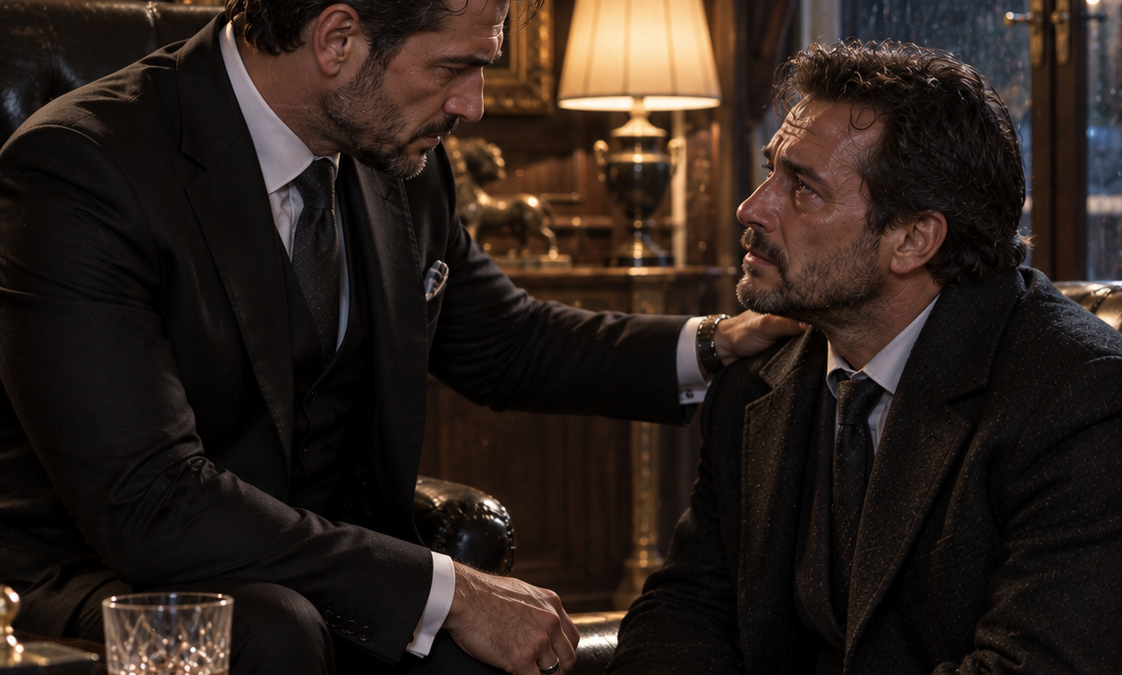
“Check That Desk, Sir!” —The Maid’s Daughter Warned the Mafia Boss. Seconds Later, He Turned Pale
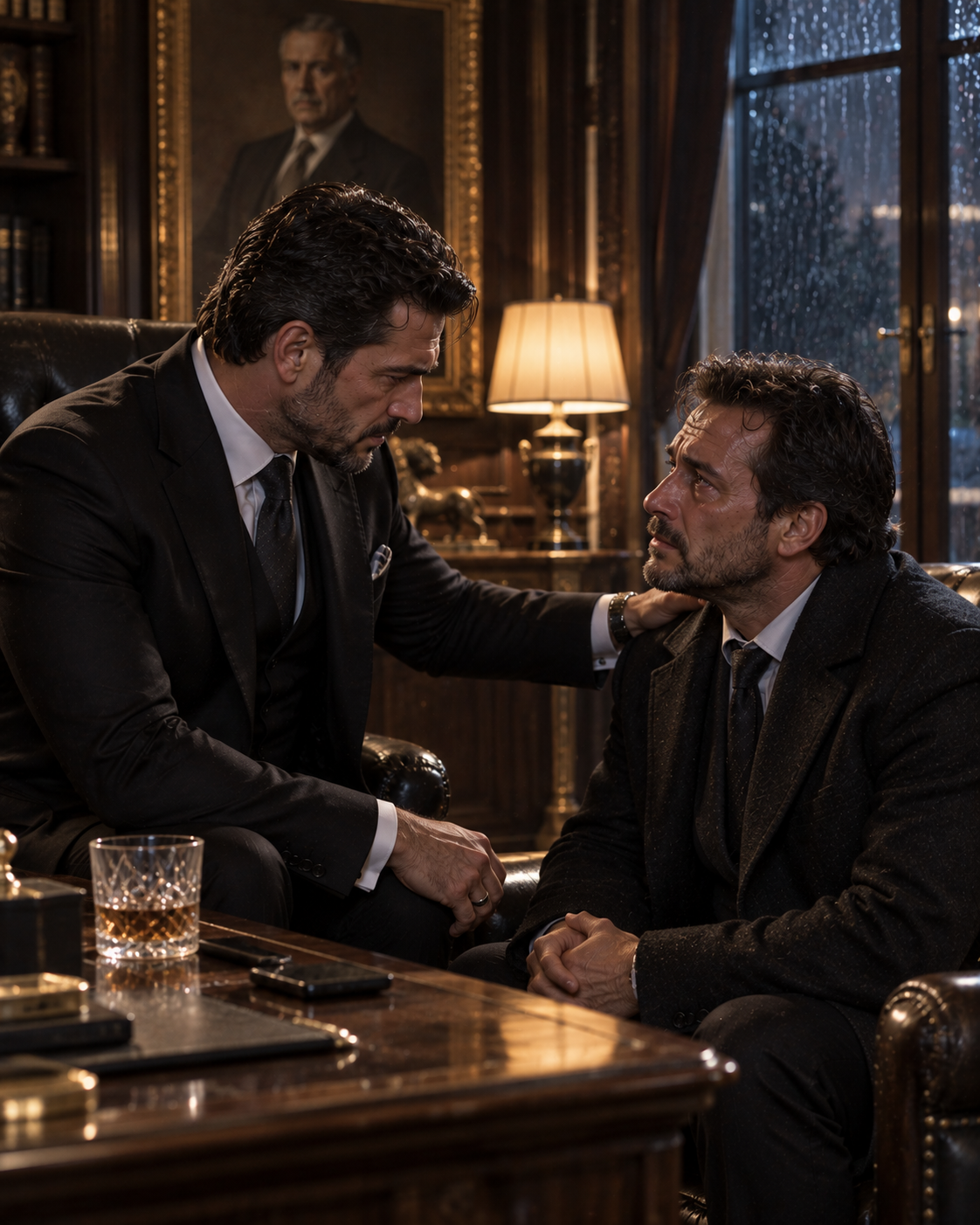
Sir, please check that desk. The trembling voice of Sophie, the six-year-old daughter of the housekeeper, made Aleandro Moretti, the most powerful mafia boss in New York, freeze in place just before stepping into his secret meeting with his closest allies at the Long Island estate. At first, Aleandro only smiled faintly, dismissing it as the baseless worry of a child who had wandered up to the second floor.
But a strange instinct, together with the panic in her blue eyes and the small fingers clenched tightly around the hem of her red shirt, made him change his mind. Seconds later, as he knelt beneath the massive walnut desk and the beam of his flashlight swept into the farthest corner, the face of a man who had not known fear in 20 years of rule suddenly turned pale.
The steady blinking red LED beneath that desk that night marked the beginning of a chilling secret that no one, not even Aleandro himself, could ever have imagined. Alisandre rose from beneath the desk in silence. He did not stand quickly.
He did not brush the dust from his knees. He rose the way a man rises from a grave he was not meant to leave slowly, deliberately, with a body that had already begun rearranging itself around a new fact.
He stepped into the hallway, pulled the door closed behind him with the softness of a man who did not want to wake the house, and only then allowed his hand to lift the phone from the inside pocket of his jacket. Sophie was already gone. Maria had come running the moment a guard whispered to her that her daughter was on the second floor and she had gathered the child into her arms with the frantic apology of a mother who believed she was about to lose her position.
Allesandro had stopped her at the top of the marble staircase, placed a hand lightly on her shoulder and told her quietly to take Sophie down to the west parlor, lock the door, do not open it for anyone but him. Maria had not understood. She had only obeyed.
He dialed a number that was not stored in his contacts. one he had memorized 20 years ago and never used. Study now.
No sirens, no radio outside the internal channel. He ended the call before the voice on the other end could answer. 7 minutes.
Four men arrived through the service entrance, moving through the estate with the quiet efficiency of men who had done this in 17 other houses across the burrows. They carried cases that looked like nothing from the outside.
Richi walked at the front. He was 52 years old, a former army engineer, and had worked for the Moretti family for 18 years. He glanced once through the doorway of the study, and his face changed in a way that no man in that hallway would have noticed, except Aleandro.
For 22 minutes, the team worked in absolute silence. Aleandro stood at the far end of the corridor, one hand resting on the wooden banister, his eyes fixed on the closed door. Beyond the French windows, the thin March rain kept its steady rhythm against the glass.
The sound of something patient, something that had all night to fall. Reachi emerged, carrying the device in a foam lined case.
C4, professional grade, twochannel detonator, tamperresistant, timer set for 20 minutes, starting at 8:00 tonight. His voice was flat, the voice of a man reciting a receipt.
If you had begun your meeting on schedule, sir, no one in that room would have survived the opening greeting. Alessandro closed his eyes for one heartbeat. Three principal allies, two senior bosses of the eastern seabboard, all of them due to arrive within the next 40 minutes.
This was not an assassination aimed at one man. This was a decapitation, an operation designed to erase the entire command structure of the Moretti family in a single evening, in a single room, at a single table.
He opened his eyes. His voice remained level. No one hears about this.
Not the inner circle, not the third ring. The device goes into the basement safe. No log, no report.
Richi bowed his head. And the investigation, sir. Aleandro looked at him.
I will handle it myself. Richi did not ask again.
18 years had taught him the difference between an order he could question and an order he could not. He gave a single nod, gathered his men with a look, and the four of them left through the same service entrance they had entered. 30 minutes later, the estate had returned to the appearance of an ordinary evening.
The staff who had been sent to the lower garage under the pretext of an electrical inspection were now being dismissed home early with apologies and an envelope of cash to soften any curiosity. The guards resumed their positions. The lights burned at the same low warmth.
From the outside, it was a house at rest. Aleandro stepped into the study. He did not sit.
He did not turn on the overhead chandelier. He allowed the hallway light to spill in through the half-cloed door and lay a thin gold line across the floor. The walnut desk stood where it had always stood.
It looked exactly as it had that afternoon, the leatherbound folder for tonight’s meeting placed neatly at its edge.
A heavy fountain pen resting across its cover, the glass of whiskey he had poured before his knees had touched the floor. Still untouched, still half full, the ice long since surrendered to the amber. He walked to it.
He placed his palm flat against the corner of the wood, spread his fingers, and pressed down. He was not testing its solidity.
He was making certain it was still real. Then he raised his eyes to the wall opposite. The oil portrait hung in its heavy gilded frame where it had hung for 48 years.
His father, painted by Sergeant’s grandson in the winter of 1978, the year before Alisandre was born.
In the painting, his father was 34 years old, seated in a leather chair, one hand resting on the arm, the other holding an unlit cigar between two fingers. His eyes looked directly out of the canvas at whoever stood in this room.
Tonight they looked at Aleandro. No one in the estate knew what was behind that painting. Not Tony, not Richi.
Not a single guard who had walked past it 10,000 times. Not even Victor.
In 15 years of standing at Aleandro’s shoulder in this very room, had ever suspected the wall behind that portrait was anything other than plaster and paint.
Aleandro<unk’s father had built it into the wall 25 years ago.
He had never spoken of it, not to his wife, not to his consiguary, not to his son, until the last night of his life, when the morphine had thinned the line between what a dying man remembered and what he needed to pass on.
He had gripped Aleandro<unk’s wrist with a strength that no 70-year-old man in his final hour should have possessed, and he had whispered 11 words into his son’s ear.
Aleandro had smiled at those words then. He had believed them, the wandering of a mind at the edge of sleep. He was not smiling now.
He crossed the room toward the portrait, and the rain kept falling on the glass behind him, patient, unhurried, indifferent to what a man was about to learn about the one direction his heart had never thought to guard. He did not cross to the portrait yet.
Instead, he turned back to the desk, picked up the phone he had set down, and made the calls that had to be made before anything else in the house was allowed to move forward. Don Carlo answered on the second ring. Technical trouble at the estate.
Tonight is postponed. I will be in contact within 24 hours. Don Carlo was 60 years old.
He had known Alessandre<unk’s father before Allesandre was born, and he had learned the difference between a voice that invited questions and a voice that closed them.
Tonight’s voice was the second kind.
Understood. Be careful. The line went dead.
The second call went to Don Vtorio. The same sentence, the same reply. The old man did not ask what had gone wrong.
He heard what he needed to hear in the space between the words, and he let his student handle whatever fire had begun burning on the north shore of Long Island. Three more calls followed. Three more allies who had been dressing for dinner, adjusting cufflinks, checking the wine their drivers would carry.
Three more men who put down the phone and quietly told their staff to unpack the evening. Not one of them asked why. Allesandro placed the phone face down on the walnut.
He turned his eyes toward the window. The rain had thickened. It was the last rain of March in New York.
the rain that always fell hardest in the final week before the city surrendered to spring, and it struck the tall panes of the French window in a steady percussion that sounded to a man standing alone in a room that had almost become his tomb, like the ticking of something counting
backward. He left the study without looking at the portrait a second time.
He took the back stairs down to the lower level. The west parlor lay at the end of a short carpeted corridor.
Its door was closed. The guard stationed outside a broad man named Enzo, who had been in the Moretti household nine years straightened when he saw Alessandro approach and stepped aside without a word. Aleandro pushed the door open.
Maria rose from the couch so quickly that she nearly dropped the small doll she had been holding for her daughter. Her hands went to her apron, smoothing it, then to her hair, then back to her apron.
She bowed her head deeply. She did not meet his eyes. She was 31 years old.
She had worked in this house for 4 years. She had learned in that time to be invisible.
And now that she had been made visible, she believed she was being made visible only in the way a person was made visible before being dismissed. Sit down, Maria. Alisandre raised his hand gently, palm outward, the way a man might slow a horse.
There is nothing to be afraid of. The opposite.
Maria sat. She did not look up. Sophie was on the sofa beside her, small legs swinging above the carpet, arms wrapped around a rag doll that had lost one of its button eyes before either mother or daughter had come to work here.
The child’s blue eyes were on Alessandro now, calm in the way a child’s eyes could be calm only when the worst had already happened, and there was nothing left to fear about the next moment.
Aleandro crouched in front of her. for a man of his height in a jacket cut for the boardroom.
It was not a graceful movement, but he did it, and he did it slowly, so that his eyes came to rest below the level of the little girls, and she did not have to look up.
“You saw the truest thing in this house tonight,” he said softly.
“Do you know that?”
Sophie considered him for a long moment. She did not answer with words.
She nodded slowly, half in understanding, half in trust that if the tall man in the black jacket said a thing was true, then perhaps it was. Alessandro rose to his full height. He turned to Maria.
His voice was even unhurried. Without the softness he had used with the child, but also without the weight he used with grown men. Your daughter saved many lives tonight, Maria.
Mine among them. From this evening forward, you and Sophie will be protected for the rest of your lives as members of this family.
You will remain here in official employment at five times your current wage. Your daughter will attend the finest private school I am able to enroll her in.
This is not a request.
This is a debt.”
Maria opened her mouth. No sound came out.
Her hand rose to her lips, and the tears began to fall before her mind had fully caught the meaning of what he had said before she understood that the man standing in front of her had just in the span of 11 sentences redrawn the border of her daughter’s life and her own.
Allesandro turned to Enzo, who had followed him quietly to the doorway. They stay here tonight, door locked. No one enters but me.
In the morning, take them to the apartment on 68th Street, the one I hold for guests of the family. They remain there until this house is absolutely secure. Enzo bowed his head.
Allesandre looked once more at Sophie. The child had not moved. She was still watching him, still holding the oneeyed doll, still with that impossible stillness that had first drawn his eye an hour before upstairs.
When she had pulled at his sleeve and whispered the words that had cut his life into two halves, he did not smile. He was not tonight a man who could smile. But he inclined his head to her a small formal gesture, the kind a man of another century might have made to a queen.
And then he stepped back into the corridor and let the door close behind him. He climbed the back stairs to the second floor.
Halfway down the marble hallway in the strip of gold light thrown by the wall sconces. He stopped in front of the study door. He did not open it.
He stood there, one hand near the polished brass handle, his eyes fixed on the wood grain of the door, as though the answer he was afraid to find lay in its horrors and lines rather than in the room beyond it. He needed one moment before he stepped inside.
Not because he was afraid, because he understood that whatever he was about to do in the next hour would redefine one of two things. Either his faith in the man he had loved as blood or his faith in his own eyes.
There was no third possibility. There was no answer that would leave both intact.
He stepped inside, closed the door behind him, and turned the brass key in the lock. He had never locked this door before.
Not when Don Carlo had sat across from him, negotiating the surrender of two blocks in Bensonhurst. Not when Don Vtorio had come to talk about the funeral of a shared friend, not on the night his father died, when he had shut himself in this room for 4 hours with only a bottle and a photograph. In 20 years of the study belonging to him, the key had lived in the drawer, decorative and forgotten.
Tonight he turned it and the small mechanical click sounded louder than it should have. He crossed the room toward the eastern wall. The sergeant portrait hung in its heavy gilded frame, taking up nearly a third of the wall, weighted enough that no cleaner had ever tried to move it.
No assistant had ever thought to look behind it. His father sat in that painted chair as he had sat in this real room, spine straight, cigar between two fingers, eyes level with any man who dared to look back. Alessandro placed his hand on the lower right corner of the frame and pressed inward.
At the exact angle his father had shown him in a bedroom heavy with the smell of medicine and yellow lamps. Three years ago, the portrait swung out from the wall on a hinge no eye could have found. Behind it lay a flat metal panel set flush into the plaster.
No visible lock, no exposed hinge, only a small pale square in the lower left corner, no larger than a thumbnail that read the ridges of a fingerprint, and matched them against a memory that had been programmed into it a quarter of a century before Alisandro had become a man. He pressed his thumb against the sensor, the panel slid aside without sound. Inside sat a compact wall safe, and beside it, a hard drive wired to its own uninterrupted power source, a small black box that had drawn silent current from a line that did not appear on any electrical schematic of the estate.
25 years ago, on a summer afternoon that Aleandro could no longer picture, but his father had once described to him in whispered pieces, the old man had installed a camera. It was smaller than a fingernail.
It was hidden inside the bronze lion that stood at the corner of the walnut desk, tucked into the hollow behind the animals left eye, its lens no wider than the pupil of an insect. Only his father had known.
Then his father had died, and only Aleandro had known. Not Tony, not Richi. None of the guards who had walked past that lion 10,000 times and dusted it with cloths passed through their own careful hands.
No one in the family, not a single capo, not a single lieutenant, not the accountants who came each quarter, not the priest who had visited on the anniversary of his mother’s death, not Victor.
In 15 years of standing at Aleandro<unk’s shoulder at that desk, Victor had never once suspected that the lion he had joked with, tapped affectionately, placed his own tumbler of scotch beside on winter nights, had been watching him.
His father’s last words returned to him with the exactness of something that had never truly left.
Alessandro. In the study there is an eye that no one knows.
Do not ever speak of it, not even to the man you trust most, because the hour will come when you need it, and the man you trust most may be the one you must look at through it. Allesandre had smiled.
Then he had been 35 years old, kneeling beside the hospital bed, holding the thinned hand of a father whose mind, he believed, had begun to drift on the tide of morphine.
He had smiled and squeezed the hand and said, “Rest, papa.”
He had believed the words were the wandering of a man whose sentences had begun to leave him. 3 years later, standing in a locked study with rain beating the French windows and a bomb in a basement safe, he was not smiling.
He carried the hard drive to the walnut desk, sat down in the leather chair, and connected it to the personal laptop that lived in the top drawer, the one machine in the estate that was never connected to any network the house maintained. He entered the password.
Four layers, 32 characters drawn from four different keyboards memorized the way a soldier memorized his own name. The drive opened. The files were arranged in a single silent column.
One file per day, automatically deleted after 30 days. 22 years of daily footage had passed through this system since his father had first activated it.
And Aleandro had never watched a single frame. The camera had existed in his mind the way a fire extinguisher existed on a wall, a piece of insurance a man hoped to die of old age before ever needing to reach for. Tonight he had to reach.
He opened today’s file.
He dragged the timeline to the window when the study’s official security camera had been turned off for the daily cleaning rotation 3:00 in the afternoon to 3:30.
A routine so old that no one in the house consciously registered it anymore. The hidden camera in the Bronze Lion, powered by its own line, tied to no system, invisible to every audit, did not stop. It had not stopped in 25 years.
The playback began. For the first 3 minutes, the room was empty.
The angle was exactly what he remembered his father describing a clean, level view straight across the top of the walnut desk, taking in the door, the chairs, the corners, the shadow beneath the desk itself. No blind spot, no dead ground.
At the fourth minute, the door opened. A man stepped into the room.
Aleandro paused the video. He did not lean forward. He did not curse.
He did not move at all. He sat with his eyes fixed on the frozen frame.
And he could not for one long suspended second permit himself to believe what he was seeing. He rewound the file.
He played it again. He watched the door open.
Watch the man cross the threshold. Watch the shoulders enter the frame.
He rewound it a second time. Played it a second time.
reound played a third. But the figure on the screen, the walk he had watched every day for 15 years, the tilt of the shoulders, the way the right hand paused half a beat before the door closed. Small unconscious signatures no man could imitate and no man could disguise did not change through three viewings.
There was no other way to read it. There was no other man in the world who moved that way.
Alessandro sat straight in his father’s chair, both hands flat on the walnut and pressed play a fourth time, not to doubt anymore, but to see the whole of it on the screen.
The man closed the door behind him with the softness of a person entering a chapel. He did not lock it.
He only pushed it until the latch touched and then he let his hand fall from the brass. He did not look around the room.
That was the first detail that told Aleandro everything. A man committing a crime looked around.
A man who had spent 15 years inside these walls, who knew which cameras were switched off at what hour, who had memorized the cleaning rotations because he had personally reviewed the security protocols only 2 months before that man did not look around. He simply walked forward into a room he had walked into a thousand times. On a day like any other, at a moment he had chosen because he had been told to choose it, he crossed to the walnut desk, and then two paces away from it, he stopped.
For two seconds, he stood perfectly still beside the desk. His head lowered.
His shoulders drew tight beneath the fabric of his suit. Aleandro leaned closer to the screen.
He recognized the posture. He had seen it once, exactly once in 15 years.
In the corridor of Mount Si in the autumn of 2015, outside the hospital room where Victor’s mother had just stopped breathing.
Victor had stood in that same shape for two seconds before he pushed open the door and walked in to kiss her forehead one last time. Aleandro had been standing four steps behind him. He remembered thinking at the time that it looked like the posture of a man who had gone inside himself to find something he could hold on to so his body would not fall.
It was the posture of a man breaking open silently and refusing to let the brake reach his knees. On the screen, Victor Romano lowered himself onto one knee and then onto both. He reached beneath the walnut desk.
From inside his jacket, he drew the device a rectangular block of C4, sheathed in dull gray wrapping, the detonator already seated. His hands were shaking.
Aleandro could see the tremor in the fingers as they worked, small and precise, the way Victor’s hands had once shaken in a different room 15 years ago on the night Allesandro<unk’s father had lifted a silver chain from his own neck and placed it around Victor’s.
But
the hands did not stop. He pressed the device into the rear inside corner of the desk, sealed it against the wood with the practice patience of a man doing something he had been told exactly how to do. He set the timer, 20 minutes, keyed to 8:00.
The small red diode began its steady, patient blink. Then Victor lowered his head all the way down to the floor.
For 4 seconds, his forehead nearly touched the boards. His shoulders shook.
There was no sound on the recording. The hidden camera had no microphone. It had never needed one, but Alessandro did not need sound to understand what he was watching.
He had seen shoulders shake in that exact rhythm at his father’s coffin.
He had seen them shake once more. In the second row of the church at the funeral of a young capo, Victor had loved like a brother. He knew the rhythm of a man who was weeping with everything held inside the chest so that the throat gave nothing back.
Victor was crying. He was crying while he set a bomb to kill the man he had been loyal to for 15 years.
Aleandro stopped the video. He did not move for 40 seconds.
He sat with his eyes on the frozen screen and did not blink. The rain kept falling on the tall windows behind him.
The lamp on the desk cast a small yellow circle around his hands. He had faced seven assassination attempts in 20 years.
He had killed four men with his own hands. He had ordered the deaths of 11 others.
He had learned at 12 years old in this very room at his father’s knee how to keep his face still while his heart was burning.
It had been the first lesson. It had also been the deepest.
But tonight, sitting in the room that had almost become his grave, looking at Victor’s face on a black screen, the face of the man he had held as blood, the man who had stepped in front of seven bullets meant for him, the man who had sat with him through the black hours of his father’s death, and
had never once in 15 years offered a word he did not mean.
Alisandro felt something he had not felt in 20 years. It was not rage.
It was not the cold, clean sting of betrayal. It was pain, the kind of pain his father had never taught him how to prepare for. There are betrayals that shock.
And there are betrayals that do not shock because they have already been feared quietly for years. And then there is a third kind, the betrayal that arrives from the one direction the heart never learned to guard.
Aleandro Moretti had built his life to expect the first two. He had never prepared for the third.
He pressed play again. On the screen, Victor rose to his feet. He stood by the desk for a moment, one hand resting lightly on the wood as though steadying himself.
Then he walked to the door. Before he touched the handle, he stopped. He turned his head just slightly, just enough, and looked back at the desk for two seconds.
The look was not the look of a man admiring his work. It was the look of a man apologizing to a thing he had just placed there. Not to the desk, not to the bomb, to something else, something Allesandro understood without being able to name it because he had lived beside Victor long enough to read the small silent movements of that face.
Then Victor opened the door and stepped out. The door closed. Aleandro closed the laptop.
He sat with his hand resting on its cover. He did not shout. He did not stand.
He did not break a single object in the room. There was no glass shattered, no chair overturned, no fist against the wall. He only sat for 3 minutes.
Then he lifted his phone and typed a single line to Tony. Study.
Now alone, he rose. He carried the laptop across the room, laid it back into the small hidden safe, slid the metal panel closed, and swung the sergeant portrait back into its place against the wall.
His father’s painted eyes settled again into their 48-year vigil above the walnut desk.
He returned to his chair. He placed both hands flat on the wood, the same wood beneath which Victor had knelt 9 hours before.
The same wood beneath which the small red diode had blinked patiently through the afternoon, while Aleandro had adjusted his cuff links and waited for a meeting that had almost become his last. Tony came in 4 minutes.
He entered the study, closed the door softly behind him, and stopped a respectful step short of the desk.
His eyes went first to Alessandro<unk’s hands, then to his face.
There was no laptop on the desk between them. There was no folder open.
There was nothing to indicate what had passed in this room in the last 20 minutes, only the quiet and Alessandro’s stillness, which Tony had learned to read in 18 years, the way a sailor learned to read the color of the sea before a storm.
Aleandro did not raise his voice. He said one sentence in a tone so level it was almost frightening.
Bring Victor here now. Tony did not sit down. He did not ask what had happened.
He stood at his usual station, three paces from the desk, hands loose at his sides, and waited.
He did not ask because Alessandro<unkre’s voice had carried a color he had learned to recognize in 18 years of standing in rooms with this man, the color of an order that did not permit discussion.
It was not the color of anger. Anger was easier. Anger left room.
This voice left none. But there was one thing he still needed to know before he moved.
He asked it softly. Cuffs?
No cuffs? Alessandro did not look up. His eyes rested on the walnut, on the space between his own two hands, on the wood beneath which a small red diode had been blinking 9 hours ago.
No cuffs. No hands laid on him. If he asks, tell him I need to talk about the Brooklyn business.
Nothing else. Tony nodded once.
How many men? Four. No more.
Choose men who can stay quiet. Weapons.
Holstered. No one draws unless he moves first. He will not move.
Tony nodded again. He waited.
He could feel that there was something else, some sentence Aleandro had not yet spoken aloud and needed to speak aloud. So that saying the word would confirm to himself that the word was true.
Allesandro raised his eyes, and in that look, Tony saw something he had not seen in 18 years of standing at this man’s shoulder.
Not the anger he had witnessed across countless boardroom tables. Not the cold, patient resolve he had watched shape itself in the seconds before a hard decision.
not the practiced control of the boss, the mask he had learned to wear at 12 years old and had worn every day since, he saw something else, something softer, something more painful, and because of the softness and the pain, something far more dangerous. Aleandro said one word, victor.
Tony did not move a muscle in his face. That was why Alessandro had chosen him tonight and not any other Capo. That was why the message had gone to him and to no one else.
Tony had learned in 18 years that certain sentences could not be received with an expression that some names spoken in some rooms, in some voices were entitled to a face that did not react. But inside his chest, something dropped.
It was as if the ground floor of a building had quietly collapsed and left the upper story still standing, still furnished, still lit, but resting on nothing.
Victor Romano, the man who had been Alessandro<unk’s right hand for 15 years, the man Tony called Fatalino, little brother.
Every Christmas dinner in this house at that same walnut table three floors below, glass raised, mouth full of laughter, the man who had stood as the best man at the wedding of Tony’s younger sister 7 years ago, in a gray suit Allesandro
himself had paid for and had made a toast that had reduced two rows of women to tears.
That victor? Tony drew a slow breath through his nose.
Then he asked in a voice so low Aleandro barely heard it. You are certain? Allessandro did not answer with words.
He only held Tony’s eyes.
That look said. I have seen it with my own eyes.
There is no mistake. Tony nodded. He did not ask again.
He did not ask how or where or through what means Aleandro had come to be certain he knew the boss would not explain. And he knew he did not need to know.
Some certainties were the bosses alone to carry. And the men beneath him carried only the orders that came out of that certainty. 35 minutes to Brooklyn, Tony said.
40 back. You will have him at 12:30.
Bring him up here. This room. Do not take him to the basement.
Not to any of the back rooms. Tony paused for the smallest fraction of a second. This was unusual.
The study was where Allesandre received the men who came to negotiate, not the room where interrogations were held. The house had rooms for that. It had always had them, but he did not question it, understood.
He turned and left the study, closing the door quietly behind him. Allesandre was alone again. He rose from his chair.
He walked around to the front of the walnut desk to the side where visitors sat, the side that faced the leather chair he had just left, and he stopped there. He placed both hands flat on the wood, the same wood beneath which 9 hours earlier, Victor had knelt with trembling fingers and lowered his head to the floor for 4 seconds before pressing a rectangular block of C4 into the far inner corner. He thought about the question he was going to ask.
Only two words, why? But the answer might be history.
Or the answer might be the thing that redrrew every year of the life he had already lived, every dinner he had shared, every gunfight he had walked out of alive, every quiet evening in this room across a bottle of scotch in a silence that had felt for 15 years like the safest silence in New York. He had chosen this room, not the basement, not any of the back rooms.
And he had chosen it for a reason he had not yet spoken aloud, not even inside his own head.
Because if Victor could not explain if the answer when it came was not enough, then Alessandro wanted the last drop of Victor’s blood to fall onto the same walnut beneath which Victor had set the bomb.
That would be a justice his father would have understood. That would be a justice that closed the circle in the exact place it had been opened.
He looked down at his own hands, resting on the wood. The rain outside had not stopped.
It fell in the same patient counting rhythm it had fallen in all evening, indifferent to the room, indifferent to the man, indifferent to the car that was at that moment.
Pulling away from the estate’s north gate with four quiet men inside it, heading south across the East River toward a Brooklyn address where another man was sitting alone in the dark, waiting for the news that would decide whether he ended tonight as a corpse or as something worse.
Aleandro lifted his hands from the desk. He crossed to the sideboard, poured a single measure of scotch into a fresh crystal glass, and set it on the wood at the corner nearest to the visitors chair. Not for himself, for the man who would be sitting there in 58 minutes.
12:27 in the morning, the black SUV rolled to a stop in front of the main gate of the Long Island estate. Aleandro stood at the second floor window of the study, one shoulder against the wooden frame, and looked down.
The rear door of the vehicle opened. Victor stepped out. No cuffs, no barrel pressed against his ribs.
He wore what he had been wearing when the four men had knocked on the front door of his Brooklyn brownstone. A plain black wool overcoat, dark trousers, brown leather shoes worn soft at the toes from years of walking these grounds.
ordinary clothing, the clothing of a man who had been about to sit down alone at his kitchen table when he had heard the knock and had understood before the door had fully opened. That the hour he had been waiting for had come, but the walk was not the walk of the victor that Alessandro had known. The shoulders were drawn tight.
The pace was slow. The head was lowered.
That was not the walk of a man rehearsing a defense. That was not the walk of a man who intended to speak. That was the walk of a man who had made his peace with the ground 3 days ago and was only now arriving at the place he had already, in his own mind, been buried.
Alisandre watched him cross the gravel of the front drive. Tony walked half a step ahead.
The four men chosen for the escort flanked Victor two on each side, close enough to prevent flight, but not close enough to shame him, their hands empty, their eyes fixed forward. There had been no rough hand laid on him.
No word spoken above a murmur. from Brooklyn to Long Island.
He had climbed into the SUV of his own accord. He had sat in the middle seat between two of them and looked at his hands for 40 minutes. When the vehicle had turned through the gate, he had raised his eyes once briefly to the shape of the house he had loved for 15 years, and then he had lowered them again.
Aleandro turned from the window. He walked slowly to the door of the study, unlocked it the second time, and one evening that key had been turned in that lock. After 20 years of being decorative, and left the door a jar, he returned to the leather chair behind the walnut desk.
He did not sit. He stood behind the chair, one hand resting on its high back, and listened. He heard the front door of the estate open on the ground floor.
He heard the soft, disciplined footfall of six pairs of shoes crossing the marble of the foyer. At the base of the great staircase, the group stopped.
Tony’s voice, low, carried up faintly through the height of the atrium.
up. There was a pause. Aleandro could not see what happened in that pause, but he could picture it.
Victor raising his head, looking up the flight of white marble, looking at Tony, and those eyes telling Tony that he understood. Not being taken to the basement did not mean this would be lighter.
It meant the opposite. Being taken up to the study meant that Allesandre wanted to look him in the eye inside the very room he had betrayed. It meant the boss had not chosen distance.
It meant the boss had chosen the closest possible ground, the ground where the betrayal itself had been laid down. Victor began to climb.
His footsteps came up through the marble one at a time. Slow, deliberate, not hesitant.
Victor Romano had not been a hesitant man in 15 years, but waited in the way a man carried his weight when he understood that each step might be a step he would never take again. His hand, Aleandro knew without seeing it, would be resting lightly on the polished wooden banister.
Not because he needed the support, because he wanted to touch this house one last time, because he had walked up this staircase hundreds of times in 15 years. He had walked up it as a boy of 25 when Alessandro<unks father was still alive and had summoned him for a first private conversation.
He had walked up it on the night Allesandro<unk’s father died, carrying a coat that no one had asked him to bring and setting it around Aleandro<unk’s shoulders in the corridor without a word.
He had walked up it on the morning Allesandro had assumed the seat of the family 3 days after the funeral and had stood behind Aleandro<unk’s left shoulder in the study while three men in dark suits had knelt to kiss the ring their new dawn wore.
Tonight was perhaps the last time the footsteps reached the top of the stairs. The four escorts followed. Tony led them along the marble corridor of the second floor.
The wall sconces threw their soft gold light. No one spoke. They stopped in front of the study door.
Tony knocked twice light in the small precise rhythm known only to the inner circle. The rhythm that told the man on the other side of the door who was standing on this one. The door opened from the inside.
Aleandro had crossed the room to open it himself. He stood in the doorway, one hand still on the brass, and he looked at Victor.
For half a second, neither of them moved. Their eyes met. Nothing was said.
Nothing needed to be said. In that half second past the entirety of 15 years, the gunfights survived together.
The funerals endured beside one another. The christenings, the weddings, the quiet nights across a table in this very room, when the whole world had been elsewhere, and only the two of them had remained inside, a silence that had until 9 hours ago been the safest silence Aleandro had ever known. Then Alessandro stepped aside.
Inside, Victor walked in. Aleandro turned to Tony and the four men in the corridor.
His voice was quiet, without ceremony. outside.
Stand in the hall. Door closed. No one enters until I call.
Not even if you hear something. Tony hesitated for the length of half a breath. Then he lowered his head.
Understood. The four men stepped back.
Tony pulled the door shut with the same care he had used the entire evening, and the brass handle settled into place with a small final click. Aleandro and Victor were alone in the very room where 9 hours earlier Victor had knelt on the floor with a block of gray C4 in his shaking hands.
Victor stood in the middle of the room beside the walnut desk. He did not move. He did not look down at the space beneath the desk.
He knew exactly where the device had been placed, and he knew exactly that it was no longer there. His eyes did not need to confirm what his hands had done 9 hours before.
He only looked at Alessandro. Aleandro walked to the leather chair behind the walnut desk. He sat down.
He placed both hands, palms flat, on the surface of the wood, the same wood beneath which Victor had lowered his head to the floor, and wept for 4 seconds before setting a timer for 20 minutes. He looked at Victor.
His voice rose from somewhere deep beneath the boss he had been for 20 years. Not the voice of authority, not the voice of judgment, but the voice of a man who was being cut open by the answer he was about to receive, whether he received it in words or in silence.
Why? Victor did not answer. He looked down at the surface of the walnut desk, his hands resting at his sides, closed slowly into fists against the fabric of his trousers.
His shoulders did not move. His breath did not change. He simply stood there in the middle of the room and let the question settle into the air between them the way a stone settled into deep water.
40 seconds passed. Aleandro did not push. He sat straight in the black leather chair, the chair his father had occupied for 30 years, the chair he himself had occupied for 20, and his hands remained flat on the wood before him.
He had learned patience in this room at the age of 12. He had learned it from a man who had understood that silence correctly held could pull the truth out of a mouth more surely than any blade.
Tonight he held that silence for a different reason. He was not extracting a confession. He already knew what had been done.
He was giving the man he had loved as blood the chance to say it in his own voice, in his own time, in the room where it needed to be said. The rain continued against the tall French windows.
It had thinned in the last hour, no longer the hard percussion of 10:00, but the patient, even rain of the small hours, the rain that fell as if it had nowhere else to be for the rest of the night.
At last, Victor’s voice found its way up out of his throat.
It was horse, the voice of a man who had not swallowed water in 30 hours, who had spoken to no one but himself since the first video had arrived on the burner phone. You found out.
I knew you would. I have been waiting.
Aleandro<unk’s reply came softly.
That is not what I asked. Victor nodded once.
He still did not look up. I know.
His eyes went to the desk to the same walnut beneath which he had knelt 9 hours before. For a single moment, his gaze fixed on one specific spot, the rear inside corner, precisely where his shaking fingers had pressed the block of C4 against the wood grain. There was no mark there now.
The disposal team had scraped and cleaned and swept and left no trace that any human eye could see, but Victor’s eye was not any human eye.
He had put the thing there with his own hand, and he saw the invisible black stain of it as clearly as if it were still bleeding into the wood. He walked forward.
He came around the front of the desk to the visitor’s chair.
the leather upholstered seat where partners sat when they came here to negotiate. He did not sit. He would not permit himself in this moment in this room to occupy a chair equal in height to the one his boss occupied.
Instead, he continued past it. He walked to the side of the walnut desk, to the same side, to the same corner, and there, on the polished wood floor, in the exact place where 9 hours ago he had knelt to lay a bomb, he lowered himself to his knees a second time.
No one had forced him. No one was standing over him. The four guards were on the other side of a closed door.
Tony was in the corridor. The house was silent around them. There was no witness in this room but Aleandro and the painted eyes of Aleandro<unks father watching down from the wall.
Victor knelt because he had chosen to kneel. Aleandro watched him lower himself. He said nothing.
He waited. Victor placed both hands on his thighs, palms flat, and lifted his head.
He looked directly across the desk into Aleandro<unk’s eyes.
His own were full of water, but the water did not fall. He was holding it back with the kind of will that only a man who had lived 15 years in this world could possess. That will had been forged in this house.
It would not break here, not now, he spoke. His voice was low, but it was steady.
Aleandro, I am not asking for forgiveness. I am not asking for mercy.
I know I have to die. Your father taught me from the first day.
My blood is Moretti blood. And if I betray, I am to cut my own throat before the Moretti has to do it. He paused.
He drew a slow breath.
Then he continued, “I did not cut my own throat because I need 24 more hours.
After that, you can kill me by your own hand in this room beside this desk. That is fair. I will not resist.
I will help you if you want. I will show you where to cut.
I will keep my eyes on you so you do not have to look at me when it is done. Alessandro did not move.
He did not answer. Victor looked at him and for the first time since he had entered the study, his voice cracked only a hairline.
Only one small fracture along a single sentence. But before that, I need you to hear one thing.
One, this is not a defense. This is not for me to live. This is so that you know the truth before you decide.
The silver crucifix under Victor’s collar caught the light of the desk lamp as he shifted his shoulders the crucifix Aleandro<unk’s father had lifted from his own neck 15 years ago and placed around Victors.
In this room on a summer evening that both of them remembered in the exact same detail from opposite sides of the walnut.
Aleandro<unk’s eyes went to the silver.
Then back to Victor’s face.
He did not ask Victor why he had needed 24 more hours. He did not need to ask.
He had seen on the hidden footage the moment Victor had lowered his head for four seconds to the floor before pressing the device into place. And in that moment, watching alone in this room 3 hours ago, he had already understood.
Whatever Victor had done, Victor had not done as a traitor. Whatever had driven him to kneel beneath this desk had not come from within him. It had come from outside, and it had come with a weight heavier than 15 years of loyalty.
He only needed Victor to speak the truth aloud.
Both of them needed that, so that the ground beneath what came next could be true ground, and not the assumption of one man’s mercy laid over the silence of another.
Alisandro drew a slow breath through his nose. He did not lean forward. He did not soften his eyes.
He held the same stillness he had held for the last 3 minutes.
Then he said, “Quietly, speak.”
Victor did not begin at once. He held the word Allesandro had just given him in his throat like a coin he was not yet ready to spend. His eyes went down to the floor between his own knees.
His hands remained on his thighs. Aleandro let him keep the silence a moment longer. Then he asked the second question, the one that would collapse the entire wall between them the instant it was answered.
What is it that you need 24 more hours for? Victor looked up. He did not answer immediately.
He knew the moment the answer left his mouth, everything would change. There would be no further ground to retreat to. Every word after it would be built on that first sentence, or on the ruin of it, he spoke softly but clearly.
To save Elena, to save Luchia, Allesandro had known.
From the 4 seconds of Victor’s bowed head on the hidden footage, he had known.
From the tremor in Victor’s hands, as they had pressed the C4 into the wood, from the two-second backward glance Victor had given the desk before leaving the room.
All of it had told him the same thing hours ago in the silence of an empty study, watching a screen with the rain against the window.
But hearing it now from Victor’s own mouth in the same room across a distance of 5 ft was not the same.
It struck a place in his chest that no piece of video could reach. Something there tightened and refused to loosen.
He did not let it show on his face. He rose from the black leather chair.
He walked around the front of the walnut desk, past the corner where Victor had knelt to place the bomb 9 hours ago, past the corner where Victor was kneeling now, and he crossed the last two paces of polished wood floor until he stood directly in front of the kneeling man.
He did not kneel, but he bent a slow, controlled bend at the waist and the knees, deep enough that his eyes came level with Victor’s eyes.
He placed his right hand on Victor’s shoulder.
The weight of it was not the weight of judgment. It was the weight of a brother. Stand up.
Victor shook his head. No, Alessandro, I will tell you.
Kneeling, I am not worthy to stand in this room.
Aleandro<unk’s hand tightened on the shoulder.
Not hard, but with an authority that would not be argued with. He lifted. Victor did not resist.
He had no strength left to resist, no will to.
His knees trembled as he came upright, and for a moment he swayed, and Aleandro<unkre’s other hand came up beneath his elbow to steady him.
Only then did Victor stand fully. Aleandro walked him three steps to the leather visitors chair, the chair he had passed by on his own, refusing to sit in. Aleandro turned him with a light pressure at the shoulder, and eased him down into it.
Victor sat. Then Alessandro did a thing that no one, not Tony, not Richi, not any lieutenant, not any Kappo, not any partner or ally or enemy in 20 years had ever seen him do inside the study.
He did not return to his father’s chair behind the desk.
Instead, he crossed the room to the corner where a single unmatched armchair stood, a chair the housekeeper had left there years ago and never bothered to move. A chair no visitor ever used.
And he lifted it, carried it back across the room, and set it down directly facing Victor on Victor’s side of the desk, not on the boss’s side.
He sat level, not higher. There was no walnut between them anymore.
No polished plane of authority, no desk on which one man’s hand rested and another man’s did not.
He looked at Victor. Victor, look at me.
Victor raised his eyes slowly. You said saving Elena and Luchia is the only thing you ask for.
Good. I agree now before you have told me anything.
Whatever the reason, whatever you have done, I will bring them home. That is a promise. It is not conditional on what you say next.
Victor closed his eyes. The tears he had been holding since the moment he had entered this room finally fell. Not many, only two.
They slid down slowly. one along each side of his face, and they did not seem to belong to a grown man. They seemed to belong to someone much younger, someone who had been holding something for far longer than 3 days.
Alisandro let him keep those two tears. He did not look away from them. Then he spoke again, and his voice was low, but there was steel beneath it now.
But there is something you have to understand. I am not going to kill you afterward. I am not going to agree to that part of your terms.
You will tell me everything from the beginning, and I will decide afterward, not by the law my father taught me, but by what I know of you from 15 years. Victor opened his eyes.
Aleandro, no.
Listen, Aleandro<unk’s tone did not rise.
But it did not permit interruption. My father taught me betrayal is betrayal. There is no reason.
And in his own life, that was true. Because in his own life, he was never made to choose between the family and the person he loved.
He died before he ever had to face that question.
I am facing it right now in this room beside this desk, and I will not decide until I have heard everything.”
Victor nodded slowly. Something in his shoulders went down by an inch and did not come back up.
Aleandro did not take his hand from Victor’s shoulder.
He kept it there, a steady, warm weight, and his voice softened into something Victor had not heard from him in 12 years. Not the voice of the boss. Not the voice of the man who ran the eastern seabboard.
The voice of the older brother he had been once before this house had begun to bury its softer voices under the burden of the seat. Tell me from the beginning.
All of it. Victor drew in a breath.
His chest rose and shook. Then he began. But he did not begin with Tuesday afternoon.
He did not begin with the moment his phone had lit up in a Brooklyn meeting room or with the photograph or with the voice on the other end of the 6:00 call. He began with something Alisandro had not been expecting at all. Alisandro, first I need you to know something.
I have loved Elena since the day she was a waitress at Sals. From the very first day, before she knew my name, if I do not say that to you now, and tonight I die before I see her again. I need you to say it to her.
For me, Alessandro felt something tighten inside his ribs. He nodded slowly.
I will tell her, but you will tell her first. Victor kept going. His voice was still, but it was steadier now, as though the act of releasing the first sentence had loosened the lock on every sentence behind it.

