CORRUPT COPS Targeted an ER NURSE — Unaware She’s a NAVY SEAL MEDIC Building Their Downfall (part 2)
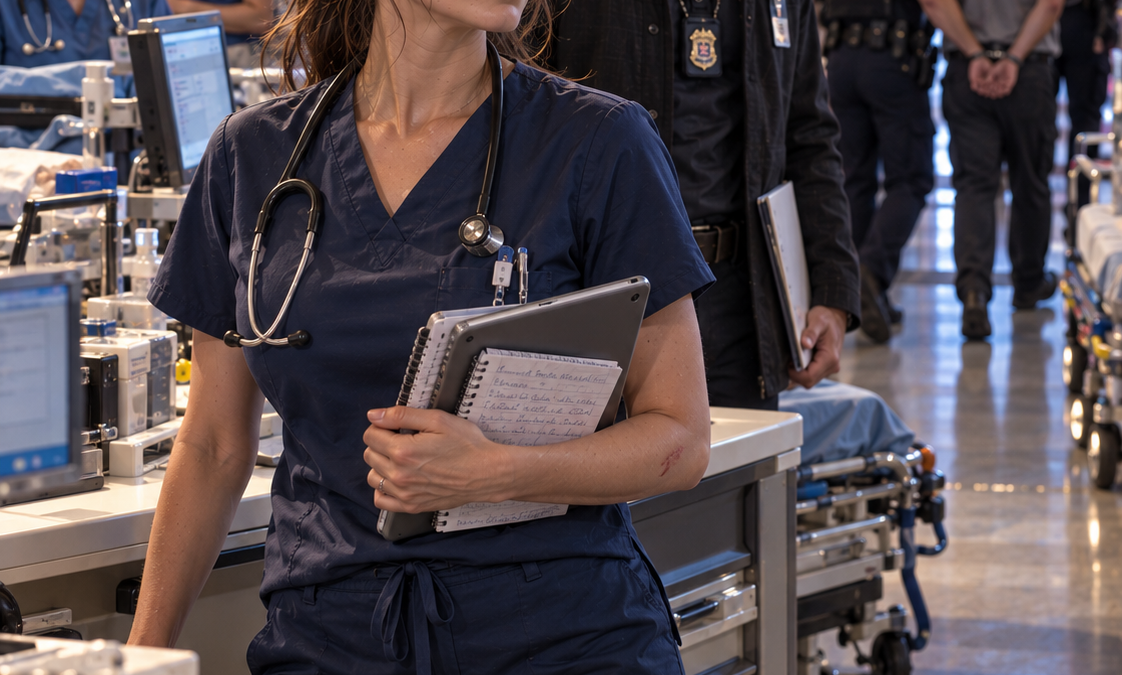
Part 2
Emily said nothing for a moment. She thought about the five patients, the shift windows, the officers who were always present during intake. Petra, she said carefully.
Is there any pattern you’ve noticed with walk-in patients, specifically the ones who come in through the ambulance entrance and have police presence during triage?
Petra’s expression shifted.
not surprise, more like confirmation of something she’d been sitting with.
There have been a few cases where the paperwork felt thin afterward, like the patient came in, got treated, and then the intake notes were just minimal, less than usual. Do you remember any names?
I’d have to look.
Don’t look, Emily said immediately.
Don’t access anything.
If you remember something without searching, that’s different.
But don’t go into the system looking.
Petra stared at her. Emily, what is actually happening here?
Emily thought about how much to say.
Petra wasn’t trained for this.
She was a good nurse and a careful person, and she had the instincts to ask the right questions, but instinct and preparation were different things. Giving her more information right now created risk without giving her any protection.
I think Cain has been using this hospital for something that has nothing to do with his official cases, Emily said.
I think Pitts knows more than he’s saying, and I think the situation is going to change soon.
How soon?
I don’t know exactly.
Petra looked at her over the rim of the cup.
You keep saying things like that, things that sound like you know more than you’re telling me.
I do know more than I’m telling you.
That’s not me being evasive.
It’s me trying to keep you out of the part that has risk in it.
I’m already in it.
I’m the one who told you about Web.
I documented what he said. I know that was the right call. Emily held her gaze.
Keep doing your job exactly the way you always do.
Don’t vary anything.
Don’t ask unusual questions through the hospital system.
If Cain approaches you directly, tell him you don’t have access to the records he’s looking for and refer him to administration.
And what are you going to do? Keep logging, Emily said. Attack.
What she didn’t tell Petra was that logging was the secondary function.
Now the primary function beginning that morning was witness preparation.
Though she wouldn’t have used that phrase out loud, she spent 3 hours in the records office pulling every legitimate document she had access to that touched the five patient cases, photographing each one on her personal phone before returning it to its place.
The photographs went to the encrypted channel in batches. She noted timestamps, file locations, which physical cabinet held the originals.
At noon, she went to the breakroom to eat something and overheard two orderlys talking about the supply room key. Apparently, word had moved faster than Pitts anticipated. Half the floor staff knew by now that Cain had after hours access to clinical areas, and the reactions ranged from confused to quietly alarmed.
Nobody knew how to raise it formally. Nobody wanted their name attached to a complaint against a police lieutenant who had demonstrated repeatedly that he could make those complaints disappear.
Emily ate her sandwich and listened without appearing to listen, which was a skill that looked like passivity and wasn’t.
When she got back to the records office, there was a message waiting. Access log anomaly flagged our end. Someone at your location ran an internal audit query on the five files in the last 2 hours.
Not you. identify if possible. She read it twice.
Then she locked the records office door, which she’d never done before, and sat very still for approximately 30 seconds.
Someone else had accessed those files. Someone inside the hospital today after her morning review.
That meant two possibilities.
Either someone was monitoring the same pattern she’d identified and was ahead of her, or someone knew she’d been looking and was now looking at what she’d seen.
The second possibility was significantly more dangerous. She typed back checking standby.
The access log system showed individual user credentials when queried by admin level login.
Emily didn’t have admin level access from the records office, but she knew who did.
And she knew that Bev, who had come in at 8 and gone to lunch at 11:30, had left her workstation logged in because Bev trusted everyone in the records office and had never developed the security habits that came from spending time in environments where trust was specifically dangerous.
Emily pulled up the log on Bev’s workstation, found the query timestamp, found the credentials.
The query had been run on Haron Pittz’s login.
She photographed the screen, sent it, then she cleared the query history, not to hide it from investigators, but to hide it from Pitts.
Because if he checked and found that she’d seen it, the timeline compressed in a way she couldn’t predict.
The response came back in 6 minutes. Pitts is a secondary target. Do not engage him directly.
You need to be out of the records office tonight. She stared at that last line.
out of the records office meant either off the floor entirely or repositioned.
The channel didn’t specify.
She typed clarify.
The answer that came back was three words, er, night shift, which meant someone had already made arrangements she hadn’t been told about, which meant the 72-hour window wasn’t 72 hours at all.
It had been a ceiling, and whatever
was in motion had been moving faster than she was briefed. She found Pitts at 2 p.m.He was in his office with the door half open typing something.
She knocked on the frame.
“I’d like to return to ER rotation,” she said.
“Tonight’s shift.”
He looked up. His expression went through several quick phases before it settled on something cautious.
“The complaints are still the complaints are administrative, and the ER is short staffed tonight.”
I checked the board.
“Dolores is carrying a double, and you’re one body short on nights.”
She kept her voice straightforward, not aggressive.
I’m offering to solve your staffing problem.
Pitts was the kind of administrator who processed everything through two filters. What was it going to cost him, and what was it going to look like?
Returning her to the ER contradicted the arrangement he’d made with Cain, but an understaffed overnight shift had its own liability calculation, and Pitts was aware of it.
I’ll need to make a call, he said.
Of course, she said. She went back to the records office and waited.
At 4:30 p.m., Pitts appeared in the doorway and told her without quite meeting her eyes that she was cleared to return to ER night starting at 700 p.m.”Thank you,” she said.
Cain’s going to hear about this, he said.
It came out as a warning, but it had the texture of an apology underneath it.
Harlland Pittz wasn’t evil.
He was the more common thing, a man who had made accommodations until the accommodations owned him. He probably will, she said.
That’s all right.
She went home, slept for 2 hours, and was back at the hospital by 6:45. Dolores looked up when she walked into the ER, and the expression on her face was complicated, relieved, and uncertain at the same time.
The way people looked when help arrived from a direction they weren’t sure they trusted.
They said you were coming back.
Dolores said, “I’m back.”
Cain’s not going to like it.
Probably not. Dolores looked at her for a moment.
She was a decade older than Emily, had spent 22 years in this ER, and had developed the kind of judgment that came from watching people under pressure for that long.
“You all right?”
she asked.
“Yes.”
“You sure?”
“I’m sure.”
Dolores nodded once, the kind of nod that meant, “Okay, I’ll trust that for now, but I’m watching.”
Then she handed Emily a tablet and pointed her toward bed 4, where a 40-year-old man was presenting with chest tightness that hadn’t resolved.
Emily went to work. Yep.
The first 3 hours were routine. Chest case turned out to be anxiety with a cardiac overlay, a laceration from a kitchen accident, two separate pediatric fevers.
The ER had its own momentum, and Emily slid back into it without friction. Her hands remembered the work. Her body remembered the pace.
She hadn’t realized until she was back in it how much the records office had been costing her.
The low-grade wrong of sitting in the wrong room for 9 days doing the wrong job. At 10:40 p.m., Cain walked in. He came alone this time, which was unusual enough that Emily clocked it immediately.
No officers flanking him, no folder of paperwork, just Kane in his uniform, moving through the ER with his particular brand of ownership, scanning until he found her.
She was at the nurse’s station.
She didn’t move.
He stopped 6 ft away. His jaw was working.
Pitts shouldn’t have put you back here.
Pitts made a staffing decision.
I’m covering a short shift.
You think I don’t know what you’re doing?
She met his eyes.
I’m triaging patients.
He stepped closer. Not quite threatening.
The distance between professional and personal. I pulled that folder you had.
Looked through it. She said nothing.
A lot of notes, he said. Very thorough.
His voice had a quality she hadn’t heard from him before.
Not anger, but something underneath anger. Something that recognized it had miscalculated.
You’re a records clerk who takes very thorough notes.
I was a records clerk for 9 days, she said.
I’m a nurse.
You’re a problem, Lieutenant.
She said it quietly, not as a courtesy, but as a marker, establishing that this was a formal interaction now audible to the three other staff members within earshot.
If you have a medical need, I’ll direct you to intake.
If you have official business requiring patient records, you’ll need to submit proper legal documentation to administration.
Is there anything else I can help you with? The muscles in his face went tight.
He stood there for a beat longer than was comfortable. Long enough that Dolores at the far end of the station had stopped pretending to look at her monitor.
“You’re making a mistake,” Cain said.
“I’ll document this interaction,” Emily said.
“Standard procedure.”
He left. Dolores waited until the ER doors swung shut behind him, then walked over.
“What was that?”
“He came to remind me that I’m a problem.”
Emily said she was already writing the time and content of the interaction into her notepad. Are you? Emily thought about the five patient files, the access log, pits running queries, the signal from the parking lot two nights ago that had compressed the timeline from 72 hours to something shorter.
Not the kind he thinks, she said. She finished writing, folded the notepad, and went back to her patients.
40 minutes later, her phone vibrated in her pocket. She checked it in the medication room where she had 30 seconds of privacy.
Tonight, be in the ER. Do not leave the building after midnight. She put the phone away and went out to respond to a call light in bed 7.
Midnight was 2 hours away.
She had no way to know that what was coming wouldn’t wait that long.
That at 11:38 p.m.was a black SUV would pull into the ambulance bay. And right behind it, a second one.
and behind that a third. And that the two officers Cain had sent in advance to collect Marcus Webb from the waiting room, Webb, who had come back a second time and made the mistake of asking for Emily by name at the front desk, would find themselves outnumbered before they had time to understand by whom. Emily was changing a dressing on a
burn patient in bed three when the ambulance bay doors opened and the ER went quiet in the specific way it went quiet when something was wrong.
and she looked up and she saw who was walking through the door first. She recognized him.
She hadn’t seen him in almost three years.
His name was Special Agent Darius Wal.
And the last time Emily had seen him, they’d both been covered in someone else’s blood in a forward operating position that didn’t exist on any official map.
He looked roughly the same, broader maybe, hair cut to the same regulation length it had been in the military, though he’d been out 4 years.
He was wearing a dark jacket with a federal ID clipped to the front.
And he was moving through the ambulance bay with three people behind him who moved the way people moved when they’d done this kind of entry before.
Fast, low profile, eyes already working the room. He found her in approximately 2 seconds.
She hadn’t moved from bed three.
The burn patient, a man named Garrett, 51, construction work accident, secondderee burns on his left forearm, looked between Emily and the newcomers with the confused alarm of someone who had come to the hospital for a medical problem and was now part of something else. You need to step out for a minute, Emily told Garrett quietly.
Take your IV stand, walk to the family waiting area. Someone will come get you.
What’s please?
She met his eyes now. He went.
She stood up. Vault crossed the ER floor in eight steps.
Behind him, his team had already separated. Two moving toward the intake desk, one positioning near the ambulance bay doors.
Emily registered all of it in the peripheral way she’d trained herself to register things.
The full room at once rather than the single point of focus. Carter, Wal said. Wal.
He almost smiled. Not quite. You look exactly the same.
You’re early, she said.
Things moved. He glanced around the ER.
The frozen staff, the monitors, the two officers who had been standing near the waiting room entrance and were now very still.
Where’s Web?
Waiting room. Those two were about to move him.
Vulk turned, made eye contact with one of his team members, and tilted his head. The team member went.
The two officers tracked the movement and one of them reached not for a weapon, just a reach instinct.
The beginning of an objection and Vulk’s second agent was between them before the motion completed.
Redwood Falls PD Vulk said to them. His voice was pleasant.
You’re going to want to stand down.
Federal jurisdiction as of he checked his watch 14 minutes ago.
You don’t have authority to I have a federal warrant, a RICO designation, and 4 hours of patience left in me tonight.
He pulled out a document and held it at arms length toward the closer officer.
Read it or don’t.
Either way, step back. They stepped back. Emily exhaled once slow through her nose.
She was aware that Dolores was 3 m away with both hands flat on the nurse’s station and the expression of someone watching something happen that she’d half expected but hadn’t fully believed would.
I need the ER locked down.
Vulk said to Emily, “Not asking, but asking her specifically, which meant something.
Patients stay. Non-essential staff can go to the breakroom or family waiting and nobody goes in or out of the ambulance bay without my team clearing it. I can do that.
She turned to Dolores. You heard him.
Dolores didn’t move for a half second.
Then she picked up the overhead intercom handset and her voice went out through the department steady and practiced. Attention Blackstone Memorial ER staff. We are entering a temporary lockdown protocol per administrative directive.
All non-critical staff, please relocate to the staff break room. Patients remain in their beds. No one enters or exits the ambulance bay until further notice.
It wasn’t a protocol that officially existed, but Dolores had been in this ER for 22 years, and she knew how to move people without causing a stampede.
But the next 8 minutes were controlled noise. Staff relocated.
Two patients who were ambulatory and anxious needed brief explanations that there was a security situation being handled and they were not in danger, which was true in the immediate sense.
Wulk’s team moved through the department with the efficiency of people who had done room clearances in environments where the stakes were considerably higher than a Colorado hospital.
Emily stayed at the nurses station because that was where the information was.
The intake board, the patient census, the department layout she knew and they didn’t.
Wol came back to her twice to ask questions. Where was the secondary exit? Was there a stairwell access from the ER?
What was the layout of the supply room corridor? She answered everything.
On his second return, he paused. Your documentation sent everything through the channel. 79 entries supporting photos, access log, screenshots.
The access log pits. Yes.
Vulk’s expression shifted in a way that wasn’t quite surprise.
He’s further in than we initially assessed.
I know.
She’d understood that when she saw his credentials on the query.
A hospital administrator running unauthorized record checks on files connected to a corrupt police lieutenant wasn’t a man who’d been coerced once.
That was someone who had been participating.
“How many staff do you trust in here tonight?”
Wol asked. She thought about it honestly.
“Dolores Petra’s not on shift.
Two of the techs I’d vouch for.
The overnight resident I’ve worked with twice, so I don’t know him well enough.”
That’s fine.
We don’t need everyone.
We just need them not in the way. He looked at her for a moment.
You did good work, Carter.
The documentation package was, “Your handler said you always ran clean logs.”
“Who’s my handler these days?”
she asked.
“Because I sent to an old channel and it picked up.”
“It picked up because we were already watching Kain.
” “You walked into an active federal investigation.”
He said it without accusation, just information. Your logs corroborated three months of our work.
The access pattern you found, the five patients, that’s the piece we were missing.
She absorbed that.
3 months, which meant this had been building long before the first night Cain walked through the ER doors, which meant Cain’s behavior here had been the visible edge of something considerably larger.
“What are the five patients?”
she asked. Wulk hesitated. then witnesses in an ongoing federal case against a trafficking operation running through three counties.
Cain was running interference using the hospital to identify which patients were cooperating with federal prosecutors and feeding their information to the network.
She’d suspected something along those lines.
Hearing it stated directly still had weight. The supply room key, she said he was accessing pre-digitized intake forms, the analog gap.
Smart.








