Does It Hurt—A Female Billionaire Froze When Her Silent Daughter Whispered to a Single Dad Ex SEAL (part 4)
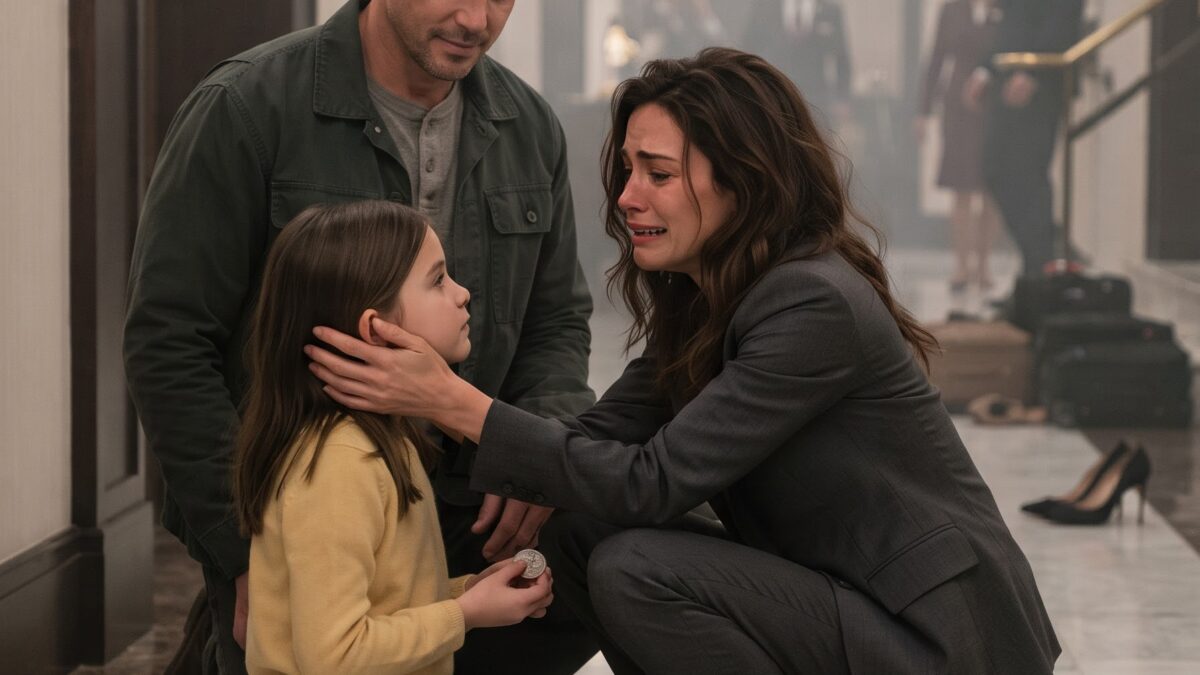
Part 4
Lily has the coin on her desk every morning when she wakes up. Aurora said she showed me through the phone.
I figured she’d either keep it or lose it.
She’s not going to lose it.
No, he agreed.
She’s not.
She stopped walking. He stopped a half step later, turning to face her, and they stood there on the riverwalk with the wind doing what it wanted and the lights of the city making the sky lighter than it had any right to be at 10:30 at night. She had meant to say something about the coin, about what it meant to Lily, the practical miracle of an object that had given her daughter something to fight toward.
But what came out instead was, “I don’t do this well.”
He waited.
“This,” she said, gesturing vaguely at the space between them, and feeling the inadequacy of the gesture, even as she made it.
“Talking, actually talking.
I I’m I’m very good at conversations that have an objective.
this doesn’t have one and I’m aware that I’ve been She pressed her lips together.
I’ve been telling you things I don’t tell people.
I know, he said, not smuggly, just acknowledging that he’d noticed and hadn’t been confused about it.
That concerns me slightly. Yeah, he said. Me, too.
The honesty of that, the fact that he didn’t reassure her, didn’t smooth it over, admitted his own version of the same uncertainty, hit her somewhere behind the carefully maintained composure she’d been wearing all evening.
“We should probably go,” she said.
“Probably.”
Neither of them moved for another 5 seconds. Then she turned and he fell in to step beside her. And they walked back toward the hotel district with the river at their backs and the wind in their faces, not talking, and the silence was the most honest thing that had passed between them all night.
He hailed a cab for her at the corner, not with any ceremony, just practical, because she was farther from the hotel, and the wind was getting worse.
She got in and he stood on the sidewalk with his hands in his jacket pockets and she looked at him through the window as the cab pulled away and thought about what he’d said.
You stopped trying to put it down.
She thought about Lily’s desk and the silver coin catching the morning light and her daughter practicing the same motion every day, not because anyone had told her to, but because she’d decided that getting it right mattered, and that was reason enough.
She thought about Cole Ahmad’s name, said quietly at a railing over a river.
the way you say a name when you still mean it. She thought about what it might cost and what it might be worth to be the kind of person who sat down on the floor.
The cab crossed the river and the lights of the city rearranged themselves in the window and Aurora sat in the back seat and let the discomfort of the evening stay with her rather than trying to organize it into something manageable, which was not something she was good at yet, but which she was slowly beginning to understand
was the actual work. Back in the hotel room, she texted Lily. You awake?
3 minutes later, a photo arrived.
The silver coin in focus on Lily’s palm.
One word beneath it. Practice. Aurora sat on the edge of the bed and looked at the photo for a long time.
She did not try to put down what she felt. She let it be heavy and real and completely hers. Then she got up, washed her face, and went to bed.
In Evston, 20 minutes north, Cole Mercer sat at the kitchen table with a glass of water he wasn’t drinking, and thought about a name he still carried and a woman who was learning to carry hers.
And he thought that grief was a strange kind of kinship, that it could make strangers recognizable to each other, in ways that success and compatibility never quite managed.
He thought about Emma, asleep at her mother’s house in Phoenix, who would call at 8:00 in the morning and argue with him about something and be entirely herself.
He thought about a little girl who practiced coin tricks alone in her room because she’d decided to get it right.
He thought about sitting down on a floor when everyone around you was rushing toward the exit, and whether the things you chose to stop for said more about you than the things you chose to pursue. He finished the water, rinsed the glass, and went to bed. The river outside, indifferent to all of it, kept moving in the dark.
November became December the way seasons do in the Pacific Northwest. Not dramatically, not with a clear line, just a gradual deepening of gray.
Until one morning, you look out the window and realize the light has changed in a way you can’t put back.
Aurora noticed it on a Tuesday, standing at the kitchen window with her coffee going cold, watching Lily in the backyard. Lily was crouched near the cedar hedge with her binoculars, the good ones, Zeiss, which had been an extravagant birthday gift that Lily had received with the somnity of someone accepting a serious responsibility, tracking something in the upper branches.
She’d been out there for 20 minutes.
She was wearing one boot and one slipper because she’d left the house in a hurry and hadn’t noticed.
And the sleeve of her jacket was too long, and she’d pushed it up on one arm, but not the other.
And she looked, Aurora thought, like a small scientist who had larger concerns than personal presentation. She looked, Aurora thought, almost like herself. Not the self before the accident.
That was a child who was gone, and Aurora had made her peace with that, or was in the process of it, but herself in a forward moving sense, like someone finding out what she was now rather than waiting to go back to what she’d been.
Aurora’s phone buzzed on this counter.
She picked it up without looking away from the window. The text was from Cole. Emma wants to know if the Zeiss binoculars work better for Paserine birds or raptors.
She says she’s asking for academic reasons.
Aurora had given Emma her number two weeks ago after their third Chicago dinner when Emma had called Cole’s phone to ask about homework and had somehow ended up in a 15-minute conversation with Aurora about whether birds recognized individual humans.
Emma had opinions. Emma always had opinions and she expressed them with the specific confidence of a 9-year-old who had been raised to believe her questions were worth asking.
She typed back, “Tell Emma that Lily says raptors because of the magnification, but pasarines are harder regardless of the equipment because they won’t hold still.
Also, tell Emma that Lily would like to know what kind of pasarines Emma is looking at in Chicago in December because most of them should have left already.”
She watched the message deliver. Then she went to the back door and opened it. Lily, come look at this.
Lily appeared at the back door 40 seconds later, binoculars still around her neck, the mismatched footwear making her gate slightly uneven on the deck boards.
She looked at Aurora’s phone with the focused attention she brought to anything bird adjacent, and then looked up.
“She’s in Chicago,” Lily said.
“She is in December.”
Lily’s expression carried the particular weight of someone reviewing an error.
She should be looking for white-throatated sparrows and darkeyed junkos. They overwinter there.
She said it without superiority, just as information that wanted to be correct. You could tell her that.
Lily looked at the phone. She had texted Emma twice before.
Brief factual exchanges initiated by Emma’s questions.
And each time, Aurora had noticed the way Lily’s thumbs moved on the screen.
Careful, deliberate, like someone making sure each word was exactly right before committing it.
“Can I use yours?”
Lily asked. Aurora handed the phone over and went to refill her coffee, giving Lily the privacy of not being watched.
She heard the small percussion of typing. Then the phone was on the counter beside her mug, and Lily was pulling her boots on properly at the back door, both of them this time, and going back out to the hedge. Aurora picked up the phone.
Lily had typed, “White throatated sparrows overwinter in Chicago.
Also, darkeyed junkos look near brush piles or low shrubs, not in trees.”
Emma, you’re looking in the wrong place.
The last sentence had no comma, which made it more emphatic rather than less. Aurora smiled at it and put the phone down.
Cole’s response arrived while she was standing there.
Emma is now looking at brush piles. She says to tell Lily she found one.
She also says, and I quote, “Lily is extremely correct.”
Aurora read it and felt the particular warmth of watching two children who had never met become in their specific and limited way friends.
It had happened in increments through the phones, through relayed information, through the shared currency of Emma’s directness and Lily’s precision.
and it had happened without anyone orchestrating it, which was maybe why it had worked. She put her coffee in the microwave to reheat and thought about December.
The visit had been tentative since the riverfront in November. Neither of them had proposed it directly. It had emerged the way plans sometimes did between two careful people through accumulation rather than declaration.
Emma had asked during one of her phone hijackings whether Seattle had good birding spots. Aurora had described the wildlife sanctuary 20 minutes from the house.
Emma had said with the simplicity of someone for whom logistics were someone else’s problem.
We should go there.
And Cole, who had been listening, had said to Aurora, “She’s not wrong.
” They’d settled on the third weekend of January.
It had seemed far enough away in November to be theoretical. January was no longer theoretical.
Aurora had not told her executive team about Cole. There was nothing to tell, she reasoned. or rather there was something, but it was not yet in the category of things that needed to be told.
What it was exactly, she hadn’t finished determining.
They talked three or four times a week, sometimes briefly, sometimes for an hour and a half, while she sat at the kitchen table after Lily was in bed. He told her about the Pilson retrofit, which had entered a complicated phase involving a disagreement with the building owner about whether to replace or repair a section of the panel.
She told him about a series B she’d been tracking that had shifted in a direction she didn’t like.
Neither of of them was performing expertise for the others benefit.
They were just talking, which was different from most conversations Aurora had in a professional context and from most of the conversations she’d had in her personal life in the last several years, though she would have struggled to explain precisely how.
She was aware that she’d let something through a door she normally kept closed.
She was also aware that she couldn’t fully determine yet whether that was right or reckless, which was a strange position for a woman who was professionally paid to evaluate risk.
Dr.Callaway noticed the way Dr.Callaway noticed things.
“You seem different,” she said in their session in early December.
They sat across from each other in the familiar office while Lily was in the inner room. Callaway had said it neutrally as an observation rather than a prompt.
Different how? Aurora asked.
Less managed. Callaway tilted her head slightly.
You’ve always presented as someone running a lot of processes in parallel.
Today you seem like you’re running fewer.
I’m not sure if that’s good.
It’s not necessarily either.
It’s just observable.
She paused. Has something changed?
Aurora thought about Cole on the riverwalk saying, “You stop trying to put it down?”
She thought about the text chain between Lily and Emma about brush piles and junkos. She thought about sitting in her kitchen at 11 at night, not working, just talking.
I’ve been letting myself be less certain about some things, she said, which was the most accurate way she could put it.
Callaway nodded slowly.
And Lily, she’s practicing.
Aurora didn’t mean the coin trick.
Or not only that, she’s practicing being in things, trying them.
The school called me, Callaway said. Her teacher, Miss Ferrer, reported that Lily participated in a group activity last Thursday.
She didn’t speak, but she engaged, moved to the group, contributed with gesture, stayed for the full session.
Aurora had known this. Miss Ferrer had emailed her, too.
She’d read the email three times and then closed her laptop and gone to make tea she didn’t drink.
She’s moving toward things, Aurora said, instead of away.
Yes, Callaway said it simply without clinical ornamentation.
That’s what it looks like.
They sat with that for a moment.
Outside the office window, Seattle’s December rain did what Seattle December rain did steadily without drama as if rain were simply the default state of things and sunshine was the aberration.
The man from Chicago, Callaway said, “Have you seen him again?”
Twice. A pause.
We talk regularly. Callaway did not react in any way that Aurora found readable, which was either professional neutrality or a very good performance of it.
“How is that for you?”
she asked.
“Uncomfortable,” Aurora said.
“In a way I don’t entirely dislike.
” Callaway almost smiled.
“That’s honest.
I’m working on it.”
January arrived the way January always did, with the bleakness of a month that knows it has nothing to recommend it except following December. But the third weekend brought a cold front that cleared the clouds for two days running, which in Seattle in January was borderline miraculous.
And on the Saturday morning, when Cole’s rental car pulled into Aurora’s driveway, the light was sharp and real, and the Olympic Mountains were visible across the sound in a way they weren’t more than a handful of days a year.
Aurora heard the car and made herself finish setting the mugs on the counter before going to the door. She was not going to be the person who watched from the window.
She was not quite successful at this. She caught herself at the kitchen window for approximately 4 seconds before the front door opened because Lily had been watching since 6:45 in the morning and had stationed herself where she could see the driveway without being seen, which was a strategy Aurora recognized.
The first sound was Emma’s voice.
Oh my. A pause of what Aurora recognized even through the door as genuine uncomplicated awe.
You can actually see mountains. I told you. Cole said you said there were mountains.
You didn’t say they were like right there.
Where did you think mountains were?
I don’t know.
Bar like in the background. These are in the foreground.
Their voices moved toward the door and Aurora composed herself and opened it before the knock.
Emma Mercer was 9 years old and looked like she’d been assembled from the components of someone who was always about to say something.
She had her father’s dark eyes and her own particular animation, which was something else entirely, constant, specific, turned fully onto wherever her attention happened to land.
She was wearing a bright orange vest over her jacket, which Aurora suspected was a birding vest, which meant Cole had bought it for the trip, which was a detail she filed away without examining. She looked at Aurora for a half second and then passed her.
“Is Lily here?”
she asked. Not rude, just prioritized.
Emma, Cole said behind her. What?
She’s the one I’m here for.
She looked at Aurora. No offense.
None taken, Aurora said. Come in. Cole came through the door after his daughter, a travel bag over one shoulder, and Aurora and he did the thing they had been doing since November, which was exchange a look that held more information than was technically necessary for two people who were simply acquaintances.
and then both look at something else.
“Nice house,” he said.
“Thank you.
Coffee’s on.”
“That’s the best thing you’ve said.”
They went inside.
Lily was standing in the hallway, which was as close to the door as she’d been willing to get, her binoculars around her neck by old habit, her hands at her sides.
She was looking at Emma with an expression that was carefully neutral and also not neutral at all.
That careful measuring look she gave situations she hadn’t calibrated yet.
Emma stopped in front of her. She was 3 in taller than Lily and about 40° louder in every way, but she stopped without crowding, without the performative enthusiasm that adults often deployed around quiet children, and that Lily had always found the most alienating thing about adult interactions.
“You’re Lily,” Emma said.
Lily looked at her.
“I found the Junko,” Emma said.
“On Thursday, right where you said, near the brush pile by the fence.”
She reached into her vest pocket. It was definitely a birding vest. It had many pockets.
And pulled out a small notebook.
She’d drawn the bird in pencil, a careful sketch with notes around it in handwriting that tilted hard to the right.
I looked it up after darkeyed junko Oregon subspecies, which apparently shows up in Illinois more than people realize. Lily looked at the notebook. Then she looked at Emma.
Oregon subspecies has more rufus on the flanks. Lily said.
Did you notice the flanks?
I noticed the white outer tail feathers, but I didn’t.
Emma turned the notebook over like she might find more information on the back. No, I missed the flanks, but I can check tomorrow. There are junkos in the sanctuary, Lily said.
We’re going tomorrow.
That’s the plan, Aurora said from the kitchen doorway.
Lily looked at Emma’s notebook again.
Can I? She stopped.
Can I see? Emma handed it over without ceremony, and Lily moved to the kitchen table and sat down with it and began going through it page by page with the focused silence of someone reading a document that mattered.
And Emma sat across from her
and watched, and the particular quality of the room changed in the way rooms sometimes do when something that’s been slightly offaxis finally settles into place.
Aurora looked at Cole, who was standing near the door with his bag still on his shoulder, watching his daughter watch Lily.
He had an expression on his face she hadn’t seen before.
Not complicated, very simple, actually.
Just quiet satisfaction, the kind that doesn’t need to make itself known.
She handed him a mug of coffee and said nothing. And he took it and said nothing, and they stood in the kitchen doorway and watched their daughters at the kitchen table. It was not a smooth weekend.
Nothing about four people with significant edges to them ever was. Emma argued about the seating arrangement in the car, which she felt was inefficient.
She was not wrong, but the argument lasted through the first half of the drive and required Cole to use a voice that he used rarely, and it stopped, but not without Emma having made her points clearly for the record.
Lily knocked over Emma’s water bottle on the sanctuary trail and then stood rigid with the specific distress of someone who has caused accidental disruption and cannot decide how to respond.
and Emma picked it up without comment and kept walking, which was the exact right thing and also something a lot of adults wouldn’t have managed.
Cole slipped on a wet boardwalk section near the heron pond and caught himself, but not gracefully, and said something under his breath that was technically inaudible but recognizable by category.
And Emma said, “I heard that, Dad.”
Without turning around, and Aurora laughed, which surprised her.
“It’s icy,” he said with dignity.
The sign said slippery surface, Aurora told him. The sign said that after the slippery surface. Did it?
I’m choosing to believe that.
She laughed again, and he looked at her sideways in the winter light, and she made herself look at the heron pond, which was magnificent and also a useful place to direct one’s attention.
The girls found seven species before noon. Emma logged them all in the notebook. Lily corrected the field marks on three of them, not critically, just precisely, the way she corrected everything.
And Emma updated the notes with the equinimity of someone who preferred accuracy over being right, which was Aurora thought, an unusual quality in a 9-year-old and probably directly traceable to being raised by Cole.
On the way back to the car, Emma fell into step beside Aurora, which hadn’t happened yet during the visit.
Your company invests in stuff, Emma said. Like businesses? Yes.
How do you know which ones are good? Aurora considered this.
You look for a few things.
whether the people running it actually understand the problem they’re trying to solve.
Whether they’re honest about what they don’t know, whether the core idea holds up when you push on it.

