Does It Hurt—A Female Billionaire Froze When Her Silent Daughter Whispered to a Single Dad Ex SEAL (Part 6)
Part 6
Miss Ferrer paused again.
She’s been working towards something, Miss Sinclair.
You both have.
Whatever you’ve been doing, it’s working.
Aurora thanked her. She sat with the phone on her knee for a long time after the call ended. When Lily came through the door at 3:15, she put her backpack on the bench and took her shoes off and went to the kitchen for a glass of water with the careful normaly of someone who is going to decide on their own schedule whether to discuss something.
Aurora was at the counter not pretending to do anything in particular. Lily drank her water, set the glass in the sink. Then she looked at Aurora with that measuring expression that had grown over months from something defensive into something that was more like assessment, like she was reading the room before deciding how much of herself to bring into it.
Miss Ferrer called you. She said she did. I figured she would.
Lily looked at the glass in the sink.
I didn’t plan it.
We were up there and Theo started and I just She stopped. I knew the material.
I knew it better than anyone in the room. It seemed like the wrong reason not to.
Aurora looked at her daughter, 7 years old, slight, a bent primary sparrow named Clive in her yard and a silver coin on her desk and four months of quietly, stubbornly on her own terms, deciding to come back to the world.
Lily, she said, and then couldn’t find anything adequate to follow it with, so she didn’t try.
Lily crossed the kitchen and leaned against her mother’s side in the particular way she’d been doing since she was small.
Not a full hug, just contact, the specific warmth of a child who has decided that proximity is enough to say the things she doesn’t have words for.
Aurora put her arm around her daughter’s shoulders and looked out the kitchen window at the brush pile and the empty space where Clive had been that morning.
She didn’t say anything.
She didn’t need to.
She texted Cole that evening. Lily presented her science project to the class today verbally.
Four minutes. She answered questions.
His response came faster than usual, which told her he’d been near his phone.
4 minutes is a long time, she wrote back.
It’s a very long time.
Then she said she knew the material better than anyone. She said it seemed like the wrong reason not to.
A pause. Then his response.
That’s not a child who’s broken.
That’s a child who was waiting until she trusted the room enough to fill it.
Aurora read that twice. She put the phone down and picked it up and read it once more.
She wrote, “You’re going to make me cry in my own kitchen.”
He wrote, “You won’t.”
She wrote, “You’re right, but it was close.
The Whitmore project launched in March as scheduled.”
Cole had hired two additional electricians.
A woman named Priya who turned out to be the best roughin technician Daario had ever worked alongside and a younger guy named Marcus who was still learning speed but had good instincts and asked the right questions before touching something he wasn’t certain about.
He’d implemented one of the contractor management platforms Aurora had sent him in January.
Not because she’d recommended it, he’d told her, but because when he’d looked at the comparison and run the numbers for the Whitmore scale of work, it was the obvious choice.
She’d accepted that distinction without comment, because it was a real one.
He’d called her in late February with a question about the Whitmore contract structure, specifically about a clause in the payment schedule that didn’t sit right with him.
and she’d pulled up the document and gone through it with him and found the thing he’d sensed but hadn’t been able to name a net 60 terms arrangement buried in the milestones that would create a cash flow gap in May if the project ran to its projected timeline.
She had explained what she saw.
He’d gone back to the property developer and renegotiated the terms to net30 on the first three milestones.
The developer had pushed back and then agreed because he wanted Cole’s team and Cole knew it and knowing it had taken Aurora thought more confidence than he’d had 6 months ago.
She didn’t tell him that.
She filed it away in the category of things she observed and kept. Daario apparently had opinions about Aurora.
Cole reported this in March with the particular tone of someone who found it mildly embarrassing but not untrue.
Daario had said, according to Cole, “You’ve been easier to work with since October.
less in your head.
I don’t know what you did, but you should keep doing it.
Cole had told him it was none of his business, which Daario had accepted as confirmation.
He’s not wrong, though, Aurora said.
I know he’s not wrong.
A pause.
I just don’t need Daario running editorial on my life.
I think Daario sounds like a useful person. Daario is an excellent electrician.
That’s the extent of what I need from him.
Tell him I said he’s observant.
I’m absolutely not telling him that.
He’ll be insufferable.
She laughed and he said nothing.
And she knew he was smiling because she’d learned the particular shape of his silences by now.
The ones that were thoughtful and the ones that were withholding and the ones that were simply him being warm without making a production of it. In April, Cole drove up to Seattle for a long weekend, not a group visit.
Emma was in Phoenix for her mother’s birthday, and Lily was at a sleepover at Mrs.Navaro’s niece’s house, which was itself a milestone of such magnitude that Aurora had needed to sit quietly for 10 minutes after dropping Lily off before she trusted herself to drive.
Lily had gone willingly.
She’d packed her binoculars and the notebook and the silver coin, and she’d stood at the front door of the unfamiliar house and looked back once at Aurora with an expression that was not quite fearless, but was something better.
An expression that said, “I know it’s hard, and I’m going to do it anyway.”
and then she’d walked in.
So when Cole arrived on Friday evening, it was the first time they had been in the same space without children at the center of it. That turned out to matter more than either of them had entirely anticipated.
He arrived with takeout from a Thai place she’d mentioned once 4 months ago in passing.
She hadn’t thought he’d remembered.
She should have known better by now. They ate at the kitchen table, and it was different than Chicago.
No restaurant around them, no riverfront to walk along, just the kitchen and the early April light coming through the window and the absence of the specific kind of attention children required.
She didn’t know what to do with that space at first.
She kept listening for footsteps that weren’t coming and then catching herself doing it.
She went willingly, Cole asked.
He’d gotten the summary on the drive up.
She looked back once, then she went in. Aurora set down her fork.
I sat in the car for 10 minutes. Of course you did.
Is that It’s exactly right.
She was brave. You were terrified.
And you stayed in the car instead of going back to the door.
That’s you doing the thing correctly.
She looked at him.
You’re oddly good at validating the precise thing rather than just being generally supportive.
General support is lazy. Most people settle for it.
Most people aren’t paying close enough attention.
She held his gaze for a moment and then looked at her food because some things needed a beat before you walked further into them. After dinner, they sat on the back porch despite the temperature, which was April cool but not impossible, and she showed him the brush pile and the empty perch where Clive had been documented multiple times that week. And he looked at it with the same genuine interest he brought to everything she showed him, which was not performed interest, but actual attention, and she thought about what Emma had said on the sanctuary trail.
He’s actually home when he’s home.
She understood now what Emma meant. Being the recipient of it was significant.
She had spent years surrounded by people who were partly somewhere else.
She hadn’t fully realized it until she stood beside someone who was entirely present.
“I need to tell you something,” she said.
He waited. He was good at waiting.
“I’ve been certain for a while,” she said.
About this about you. She kept her eyes on the brush pile because it was easier.
I didn’t say it because I’m careful and because the stakes are not small and because I have Lily and you have Emma and there are approximately 11 ways this could be complicated.
Leaven seems conservative, he said, but I’ve been certain.
She looked at him. I wanted you to know that. He looked at her for a long moment, not calculating, not performing the reception of information, just taking it in, letting it be real.
I’ve been certain since the diner, he said.
She blinked. November, October. The first time he said it without drama, the way he said everything true.
You came into that corridor with no shoes on and went straight to your kid and you didn’t cry until you thought no one was watching.
I was watching. A pause. I was certain about the kind of person you were before I knew your name.
She sat with that. The October corridor, 31st floor. Aurora Sinclair barreling through a door with her suit jacket and her bare feet and all her careful composure stripped off because her daughter was missing and nothing else had mattered.
She hadn’t known anyone had seen her cry.
She’d done it turned toward the wall very briefly once Lily was next to her.
“You didn’t say anything,” she said.
“It wasn’t mine to say anything about.
You’ve been She stopped since October.
You’ve been Yes.
and you waited. You needed time. He said it without resentment, without the undertone of someone who had waited and wanted credit for waiting.
Just a fact. You were still working things out.
Pushing would have been the wrong move. Most people push.
Most people are impatient. He looked at the brush pile.
I found patience useful. She laughed.
A short real laugh. And he turned to look at her.
And the expression on his face was the one she’d seen that first morning in the diner when she’d said something that caught him off guard.
And it was the same expression now because she did it to him sometimes. Got through the containment without trying. And she was glad.
She was glad he wasn’t entirely contained.
Cole, she said, “Yeah, I think you should stay.”
She said it clearly the way she said things she’d thought through.
Not just this weekend.
I think we should stop managing this from separate cities and figure out what it actually is when it’s not managed from a distance.
He was quiet for a moment. She held her ground. Whitmore runs through September.
He said, “I know.
Emma’s school year ends in June.
I know that, too.
You’ve thought about the logistics.
I’ve been thinking about the logistics since January.”
She looked at him.
I’m not asking you to make a decision tonight.
I’m telling you where I am so you can take it seriously because I am.
He looked at the brush pile. He looked at the April sky which had gone the deep blue of early evening clear in a way Seattle rarely was.
He looked at her. Emma would not object to relocating to the city with the wildlife sanctuary.
He said, “No,” Aurora agreed.
“She would not.
Daario would object to me leaving. I imagine he would.
He’d get over it.
I imagine that, too. Cole leaned back in the porch chair.
He looked tired in the way that wasn’t bad tired, but the kind that came from a long and honest day, and she thought about what Daario had said.
You’ve been easier to work with since October, less in your head.
And she thought about a man who had been carrying things a long time and had found somewhere in the process of this year that some of them had gotten lighter. Okay, he said. She looked at him.
Okay, meaning okay meaning I’ll stay.
He said it quietly, looking at her. Not just this weekend. She nodded once.
Her throat was doing something she ignored. She was not, as he had predicted in February, going to cry.
The silver coin was on Lily’s desk when Lily came home from the sleepover on Saturday afternoon, sunburned slightly on one cheek and carrying the specific disheveled energy of a child who had been up until 11 and was running entirely on the fumes of that triumph.
She dropped her bag and kicked her shoes toward the bench, not at the bench, toward it, with the optimism of someone who has never once succeeded at this and continues trying, and went to the kitchen and stopped when she saw Cole at the table with a coffee, the same way she’d stopped in the hotel corridor 7 months ago, except completely differently.
“You’re here,” she said.
“Your mom made good coffee,” he said.
Hard to leave. Lily looked between them with the careful measurement of a child who understood more than adults typically gave her credit for and had the patience to wait for things to reveal themselves on their own time.
Then she apparently decided she’d collected enough data for now.
Emma texted.
She said she found a curve build thrasher in her mom’s backyard in Phoenix.
She sent pictures. Lily pulled out her phone with the efficiency of someone who has important business.
The range is right. They breed in Arizona, but she wants confirmation on the ID.
What’s your read?
Cole asked. Lily sat down across from him and pulled up the photos and went through them with the notebook. She talked through the field marks, the eye color, the bill curvature, the tail length relative to body size.
And Cole listened without interrupting, asking one question when she paused that showed he’d actually followed the reasoning.
And Lily answered it with the contained pleasure of someone whose expertise is being taken seriously. Aurora made sandwiches and listened to her daughter discuss bird identification with a former Navy Seal in her kitchen on a Saturday in April and thought about what it meant that this was ordinary.
Now, not easy exactly.
The word ordinary didn’t mean easy.
It meant real. It meant woven into the fabric of things. Easy was a surface quality.
Ordinary was structural.
She thought about the therapist’s office in October, trying to find language for something that had shifted in Lily, lighter, like something had been released.
She thought about Callaway’s careful neutrality and the note she’d probably written about a patient who demonstrated increased willingness to engage.
She thought about how insufficient all that language was for what had actually happened, which was a seven-year-old sitting on a corridor floor with a man who understood that presence was different from intervention and deciding, for reasons that lived somewhere too deep to excavate, that she was safe enough to say something. The things that changed your life were not usually the things you planned for.
They were the fire alarms you didn’t schedule, the corridor floors you sat on, the coin tricks that took three weeks of daily practice to get right.
They were the people who showed up without fanfare, who didn’t need you to be fixed or explained, who just sat down beside you and waited without needing the weight to look like anything in particular.
Aurora knew this now, not in the way she’d known business principles or investment thesis with the confidence of accumulated evidence.
In the way you knew things that had happened to you, which was messier and less transferable and stuck harder and meant more. She thought about her mother. She let herself think about her mother.
Not the accident, not the guilt that lived adjacent to that memory and probably always would, but her mother as she’d actually been.
The woman who had taken Lily to the botanical garden because she loved Lily and because she loved Aurora, and because she understood, perhaps better than Aurora had at 27, that love was mostly just showing up when you were needed without making a production of it. She let herself have that without it pulling immediately toward the darker rooms it usually led to. That was still hard.
It would probably be hard for the rest of her life. But the weight had changed quality the way Cole had said it would.
She was stronger now, or the carrying was more familiar, and she could hold it without disappearing into it. She thought about what she wanted Lily to know, not to be told, because Lily had the precise instincts of someone who could hear the difference between a lesson being taught and a life being lived.
and she would not respond to the former, but she absorbed the latter constantly, the way she absorbed everything thoroughly, silently, with those eyes that noticed the bent primary on the sparrow’s third feather.
What she wanted Lily to know then, by watching her mother live it, that strength was not armor, that asking for help was not a confession of failure, that the most important decisions you made were usually not the ones you deliberated over in conference rooms.
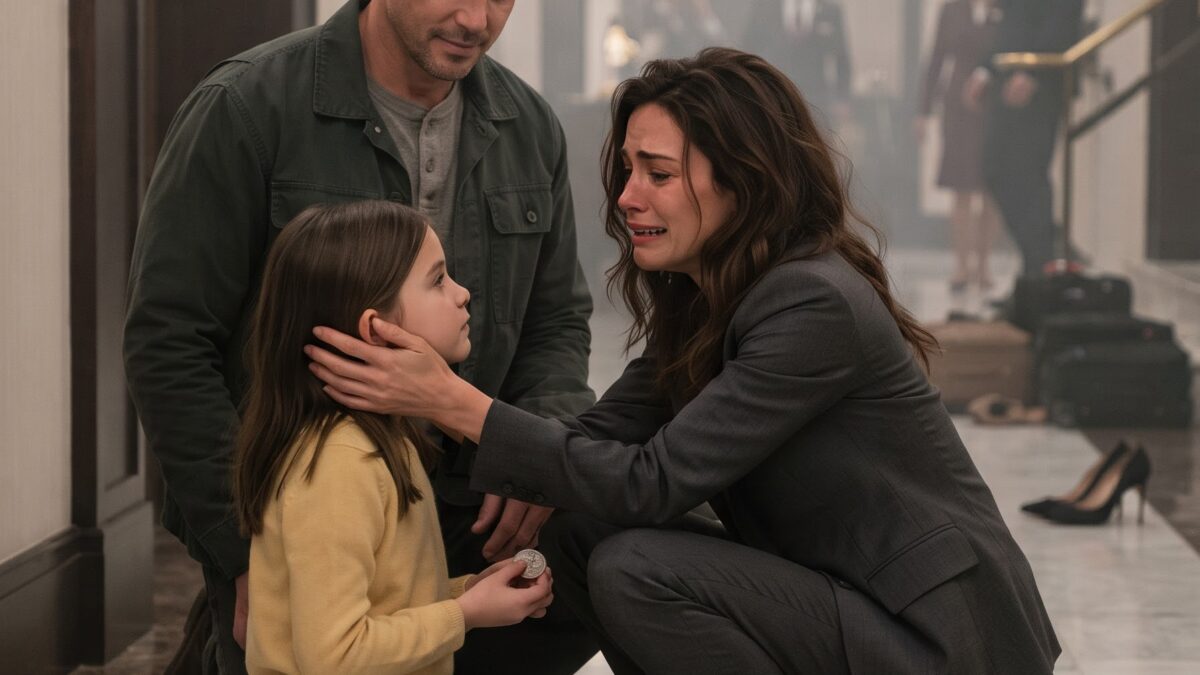
They were the ones you made at 10:30 at night in a hotel corridor when you were scared and barefoot and someone you didn’t know sat down on the floor because they understood that sitting down was sometimes the bravest available action.
She wanted Lily to know that money was useful and she’d worked hard for it and she’d use it carefully, but that the things it couldn’t buy were not consolation prizes.
They were the actual prizes and the money was just infrastructure. The actual prizes were a daughter who stood up in class because she knew the material and that was reason enough.
A man who remembered the Thai restaurant and renegotiated his own contract and carried his grief without making it anyone else’s problem.
A 9-year-old in an orange vest who talked to a silent child the same way she talked to anyone. A sparrow named Clive working through a brush pile that someone had built specifically for that purpose. She wanted Lily to know that patience was not the same as passivity, that waiting was not the same as giving up, that the people who sat down when everyone else was rushing toward the door were not the people who had stopped caring about the emergency.
They were the ones who had understood through some hard one clarity what the emergency actually was. Lily finished her sandwich and announced she was going to send Emma a confirmation text about the Thrasher ID.
And Cole said, “What’s the verdict?”
And Lily said curve build definitely the distal bill curve is diagnostic with the finality of someone who does not entertain alternate theories once the evidence is clear.
And Cole said Emma’s going to be very pleased.
And Lily said she should be.
It’s a good sighting without a trace of condescension.
Just accuracy. Just Lily telling the truth about what things were worth.
Aurora watched her daughter go upstairs, backpack over one shoulder, phone in hand, coin in her pocket where she’d moved it after picking it up from the desk the moment she got home, and thought about October.
She thought about the fire alarm and the 31st floor and the barefoot sprint through a stairwell. She thought about a corridor and a coin and a man on a floor and a little girl who decided that stillness was the right response when everything around her was moving too fast.
She thought that Lily had known something then that Aurora was still learning. That the instinct to go quiet, to wait, to find the floor when the crowd was too much.
That wasn’t damage.
That had never been damage.
That was wisdom in a form that didn’t look like wisdom because we’d been trained to see movement as progress and stillness as failure.
Lily had sat on that floor and waited for something real. And something real had sat down beside her.
The rest had been time. The rest had been the slow, unmiraculous work of people choosing over and over to show up for each other without making it conditional on everything going right first. That was not dramatic.
It didn’t have a clear beginning or a clean resolution.
It just accumulated like light in March, like warm days arguing with cold ones.
Until one morning, you stood at the window and the quality of everything had changed in a way you couldn’t undo and didn’t want to.
Cole came to stand beside her at the counter while the coffee finished.
He didn’t say anything.
She didn’t say anything.
They stood in the kitchen in the late afternoon light with the particular ease of two people who had both separately and together done the hard work of becoming slightly more honest about what they needed and slightly less afraid of what it would cost to ask for it. Outside in the brush pile at the edge of the yard, something moved. Aurora looked a small shape, brown and purposeful, working through the lower branches with the efficient confidence of a creature that had found its place and intended to use it.
Clive, third primary, bent, right where Lily had said he’d be.
“There he is,” she said.
Cole looked.
“The famous Clive, the one and only.”
They watched the sparrow for a while.
It didn’t know it was being watched, or it didn’t care, or both.
It just worked through the brush with complete absorption, finding what it needed, doing what sparrows did entirely itself in the late April light.
The silver coin stayed on Lily’s desk that night, which was unusual.
Aurora noticed when she went in to say good night.
She looked at it, heavy silver, worn smooth at the edges from 3 years of Navy pockets, and then seven months of a little girl’s hands, and understood that Lily had left it there on purpose.
Not because she’d forgotten it, because she no longer needed to carry it to feel like it was hers.
She turned off Lily’s light and went back downstairs, where Cole was washing the dinner dishes, because that was the kind of man he was.
and she picked up a dish towel and dried them and they worked through the stack without talking.
And it was the most ordinary thing she’d done in years.
That was the thing no one told you about the life you actually wanted.
It didn’t arrive with music or revelation.
It arrived on a Tuesday or a Saturday or a late April evening when someone was washing dishes and you picked up a towel and the window showed you the darkening yard and the brush pile where a sparrow slept. and the child upstairs had left her coin on the desk because she trusted the room she was in. It arrived quietly and you had to be paying attention.
Aurora Sinclair had spent a long time not paying attention to the right things.
She’d paid attention to balance sheets and return rates and the careful management of outcomes she could control.
And she’d been good at all of it.
And none of it had taught her what she’d learned in a hotel corridor from a man on a floor and a little girl who decided that the stranger beside her was safe enough to speak to.
You couldn’t buy that.
You couldn’t analyze your way into it.
You couldn’t build a system for it or hire the right consultant or implement the right protocol and arrive at it on schedule.
You could only be still enough and honest enough and patient enough in the real way rather than the performed way and wait for something genuine to sit down beside you. Then you had to be brave enough not to stand up and walk away.
She’d almost walked away.
Not dramatically.
She hadn’t fled or refused or made a choice she could point to.
She’d just been cautious and managing and carefully non-committal for long enough that it had started to look like a decision.
It hadn’t been.
It had been fear wearing the face of wisdom. The difference, she now understood, was that wisdom knew what it was protecting. Fear just protected everything indiscriminately and called that safety.
She was done calling that safety. Cole handed her the last dish.
She dried it and put it away and folded the towel. And the kitchen was clean and quiet, and the light over the counter was the only one on, exactly like January, except that January had been tentative and this was not. Stay, she said.
You asked me that last night, he said.
I’m asking again.
He looked at her.
You’re going to keep asking until you’re sure I mean it.
Yes, I mean it, he said. She looked at him for a long moment at the lines around his eyes and the work jacket hanging by the door and the way he stood like someone who had learned through long practice how to take up exactly the right amount of room.
Not too much and not too little. Just exactly what was needed.
Okay, she said. And that was enough. That was more than enough.
That was the whole thing right there. Two imperfect people in a kitchen. Clean dishes.
A sparrow sleeping in a brush pile. A coin on a desk. A little girl who had stood up in class because she knew the material and that was reason enough.
The rest was just life.
—END—

