“Don’t Go In! It’s a Trap!” Night Clerk Saved 16 Hells Angels From Disaster
“Don’t Go In! It’s a Trap!” Night Clerk Saved 16 Hells Angels From Disaster
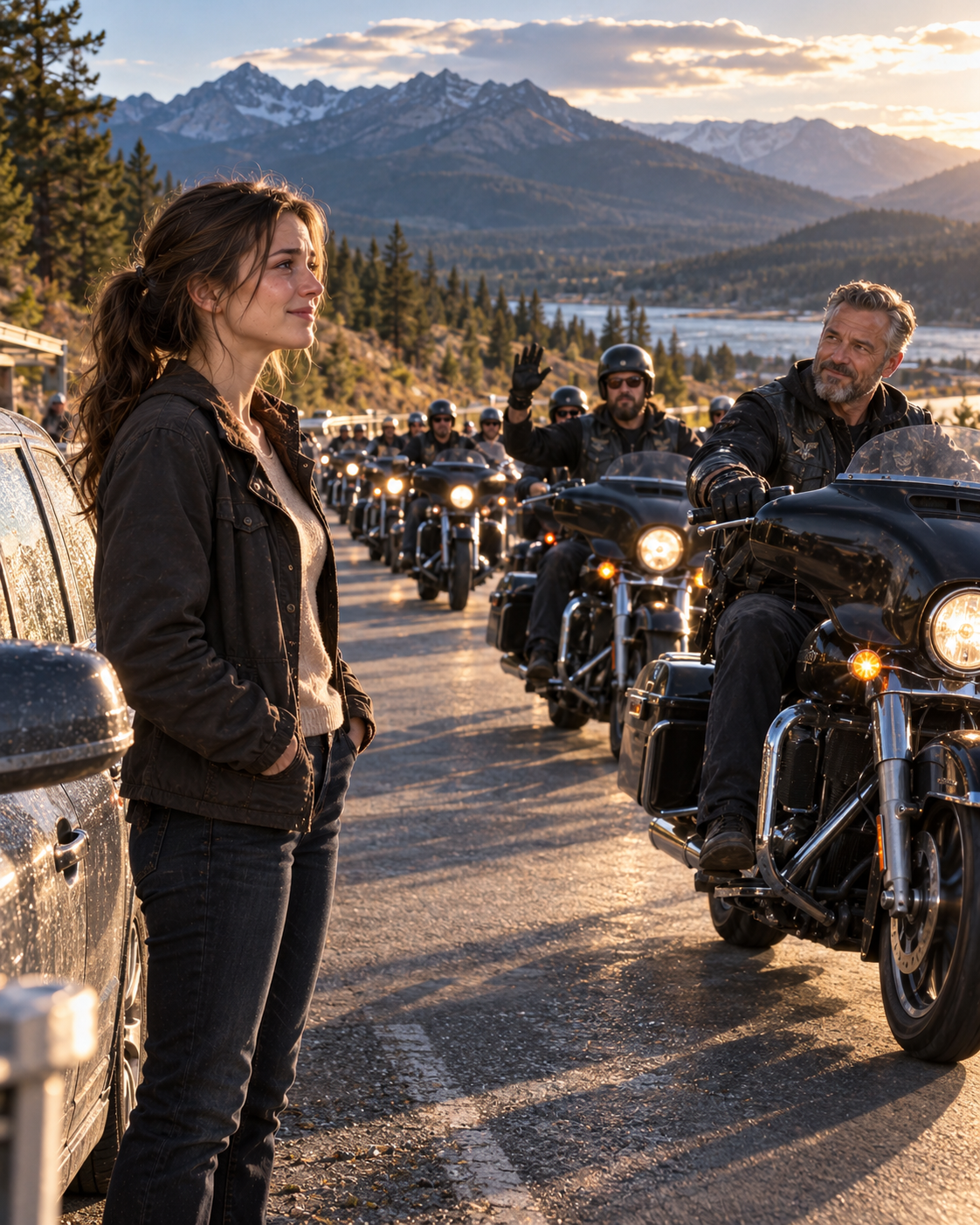
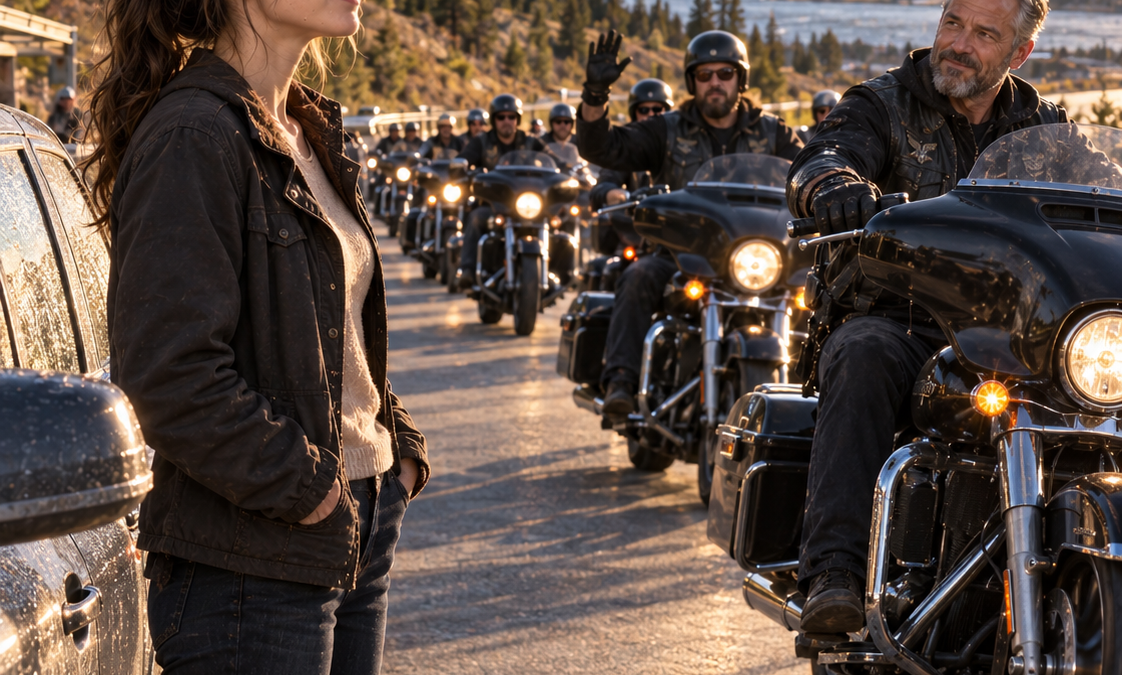
Don’t go in, she screamed, her voice cracking against the wind and the roar of 16 engines.
It’s a trap.
They’re going to kill you.
Nobody warned her. Nobody asked her to do it. A 28-year-old motel clerk standing alone in the dark on a Montana mountain highway, throwing herself in front of the only road that led to the place where 16 men were supposed to die.
It was nothing fancy, nothing that anyone else would have bothered naming or writing down. It was just the way her brain worked the way it had always worked.
Since she was a little girl in Billings, watching her mother count change at the grocery store and whispering to herself, “Ease always know what’s in front of you, Maddie.
Always.
” Her mother was a practical woman who believed in paying attention to the world exactly as it was, not how you wished it might be.
That lesson stuck the way. Only lessons from mothers can stick deep down in the bone, unreachable, permanent. So, by the time Madison found herself working the graveyard shift at the Silver Pine Lodge, a faded two-story motel, sitting off a Montana mountain highway, like something the decade had left behind, she had already built her system into muscle memory.
Every night, starting at midnight, she walked every hallway once. She checked the ice machine on the first floor. She made a full pot of coffee, not because guests asked for it at that hour, but because the act of making it steadied her gave the silence something to fill.
She read the guest registry. She noted which rooms had the lights still on past 1:00 in the morning. She listened.
She always listened. Most nights there was nothing unusual to hear.
Most nights, the Silver Pine Lodge did not attract the kind of guests who made headlines. It attracted truck drivers stopping through on long hauls.
Traveling salespeople who had pushed past reasonable driving hours, retired couples doing budget road trips and pretending to enjoy the thin mattresses. Occasionally hunters during season, occasionally a family midargument, putting a motel wall between themselves and a car they could no longer stand to be inside together.
Madison had seen all of it. None of it surprised her anymore. But Tuesday nights in September were the quietest of all, which was why the light under the door of room 206 caught her attention the moment she stepped into the second floor hallway at 114A.
M room 206 had checked in under the name Garrett Wells, a cash payment, no credit card on file. Ease. The Silver Pine Lodge still allowed cash if the desk manager approved it.
And the desk desk manager that evening had been Phil, who approved pretty much anything if it meant he could go back to watching sports on his phone.
Madison had made a note of it when she came on shift because it was the kind of detail that didn’t quite fit the pattern of everything else.
She didn’t know why it bothered her.
It just did. She stopped outside the door.
She wasn’t going to knock.
There was no reason to knock. She was simply doing her hallway check and a light under the door at 1. 14 in the morning was not ease on its own.
A cause for anything except a small notation in the back of her mind. She took one step past the door and then stopped again. Voices low, deliberate.
The specific kind of low that people use when they don’t want to be overheard, which is itself a kind of sound, a tightened sound is compact and careful that stands out against silence exactly the way a loud sound would in a busy room.
She had learned years ago during the time she spent in an open plan accounting office that hushed conversations always carried further than people thought. She stood absolutely still.
Can’t risk any of them getting past the curve.
A man’s voice.
He’s flat.
Unhurried.
They won’t.
Another voice. Younger maybe.
He’s harder.
Not with what we’ve got set up.
The timing’s exactly right.
16 bikes. The first voice again. One wrote.
Nobody leaves.
Madison’s hand went to the wall beside her before she realized she had moved at all.
She pressed her palm flat against the painted cinder block and made herself breathe. 16 bikes, one road.
Nobody leaves. She stood there for three full seconds.
She counted them and then she made herself move quietly. Back to the stairwell ease down the steps across the lobby behind the front desk.
She sat in the chair and placed both hands flat on the counter in front of her and stared at them. Her hands were not shaking.
She found that strange actually. She had expected them to shake.
She picked up the phone and called the Mineral County Sheriff’s Office.
It rang nine times. She counted those two.
No answer. She looked up the direct line for the night dispatch and called that instead. It rang four times and went to a recorded message telling her that for emergencies she should call 911.
She called 911.
The operator was polite and calm, which in Mattis UN’s experience meant they were not going to do anything quickly.
She explained what she had heard. The operator asked her to confirm the address, asked her if she had personally witnessed any weapons, asked her to hold. She held for 6 minutes.
When the operator came back, she was told that a deputy had been notified and would be in the area within the hour. The hour.
Madison hung up and looked at the clock on the wall.
He’s 1:22 a.m.She called her manager, Derek, whose number was pinned to the corkboard above the desk.
Derek answered on the second ring, which meant he had not been asleep. Madison, what? Derek, I need you to listen to me.
I heard something in room 206. Three men.
They were talking about 16 motorcycle riders coming through before sunrise.
And they said, “Please, Madison,” his voice flattened.
Are you calling me because guests are talking in a room? They said nobody leaves.
People say all kinds of things. She could hear him shifting, reselling himself somewhere.
You watch too much crime TV.
I’ve told you that.
Derek, I’m mind the desk.
Don’t go near that room.
Please don’t bother the guests.
A pause and do not call me again tonight unless the building is on fire. He hung up. Madison sat with the phone in her hand for a moment and then put it down.
She looked at the front door. She looked at the road through the window.
She looked at the clock 1:24 a.m.She had worked in this motel for 2 years. Before that, she had spent 4 years as a junior accountant at a commercial real estate firm in Billings called Harrove and Price. She had been good at the work, genuinely good, the kind of good that gets noticed and rewarded and moved upward.
She had a precise ease, methodical mind that caught things other people missed. And she had made the mistake at age 25. if of catching something she was not supposed to see.
The managing partner at Harrove Price was a man named Douglas Mercer.
He had a firm handshake and a habit of remembering everyone’s children’s names and a side operation in which he had been redirecting client funds through a series of shell holding entities for at least 3 years.
The amounts were large. The paper trail was careful, but not careful enough.
not careful enough for Madison, who had been handed a set of reconciliation files as part of a routine audit and found a pattern in 40 minutes that apparently no one else had found in 36 months. She reported it.
She thought she was doing the right thing. She was doing the right thing, but doing the right thing and coming out of it intact are two different experiences, and no one had prepared her for the distance between them. The firm closed ranks.
The managing partner’s lawyer was faster than the regulatory review.
Witnesses changed their recollections.
Madison’s employment was terminated for reasons that were described in the paperwork as restructuring and in the hallways she would later learn as attitude problems.
By the time any formal investigation got meaningfully underway, she had already spent 6 months unable to get another accounting job in Montana because Douglas Mercer knew everyone who mattered in the industry and his words still traveled further than hers. She ended up at the Silver Pine Lodge. She told herself it was temporary.
Two years later, she was still here. E still walking the halls, still making coffee at midnight. still noticing things, but she had stopped reporting them until tonight.
She stood up from the desk and walked to the window and looked out at the road. The highway stretched away into the mountain dark in both directions. No headlights yet, nothing moving, just the parking lot lamps and the stillness of a high altitude September night.
16 bikes. She went back to the desk and opened the guest registry and looked at the entry for room 206 again. Garrett Wells.
Three room keys issued, which meant three people. The other two names on the check-in were listed as additional guests.
No IDs provided, which Phil had also allowed without comment. She looked at the time the room was checked in, 6:00 in the evening.
Nearly 8 hours ago. They had been in that room for 8 hours. She started thinking, three men, cash payment, two unidentified additional guests, an 8-hour wait, a target arriving before sunrise.
16 motorcycles, one road.
The specific phrasing, “Nobody leaves.”
That was not the language of a prank or a misheard conversation or paranoid imagination. That was the language of a plan.
She went back upstairs.
She knew she shouldn’t.
She went anyway. She did not knock on the door.
She stood in the hallway, closer this time, close enough that she could hear more clearly, but far enough that her shadow wouldn’t cross the light under the door.
She made herself breathe shallow, and she listened. Holloway confirmed the route this morning.
Same road they’ve been using for the memorial ride for 6 years.
A pause. The sound of something being moved.
Something hard and mechanical.
This time they won’t get to finish it.
What about the clerk downstairs? The younger voice. Forget her.
The first voice. Certain.
Dismissive.
She’s a nobody.
Nobody listens to nobodies. Madison felt something move through her. It was not fear.
She had expected fear. And what she got instead was something colder and more focused, something that felt almost like clarity.
She recognized it from the night she had found Douglas Mercer’s files.
The same sensation of standing at the edge of a thing that was real and large and required a decision. The last time she had made the decision and paid for it.
This time the stakes were different. She went back downstairs.
She sat behind the desk and looked at the phone and the clock and the window and the registry and the parking lot. She counted what she knew. Room 206, three men, cash, 8 hours.
A man named Holloway who had confirmed a route. A memorial ride, 16 bikes, sunrise, specific curve on a specific road.
She had heard them say the curve at least twice. A mountain road meant a single deadly curve was entirely plausible. The kind of curve where the guardrail was the only thing between asphalt and a several hundred ft drop.
The kind of curve that didn’t forgive errors.
the kind that with the right setup could become something else entirely. She looked at the clock 1:41 a.m.The deputy who had been notified would arrive in the area within the hour. That was what the 911 operator had told her.
Within the hour, it was now 17 minutes since that call. 43 minutes remaining, possibly less if the deputy was efficient, which was not something she could assume.
But the men in room 206 had said before sunrise. September sunrise in Montana came around 7 a.m.M. She had hours.
She could wait. She could sit here and keep watching and trust the system she had already set in motion.
She looked at the window and then she saw it. A single headlight far down the highway moving fast.
She looked at the clock. 1:44 a.m.No, that was too early.
He’s way too early for 16 bikes.
That could be anything.
He’s a truck.
A solo rider. One of the men in 206 expecting somebody.
No. They had cash.
They didn’t want records.
They wouldn’t want extra contact.
She watched the single headlight. It was moving fast and it was getting closer and then it split.
Or she thought it did. And then it split again. And then she realized what she was seeing was not one headlight.
It was the first headlight of many. Spread out along a long stretch of highway.
the way riders travel spaced for safety close enough to move as a unit. She counted as they came into the glow of the outermost edge of the parking lot lights.
He’s 1 3 7 12 15 16 bikes before sunrise just like the men upstairs had said.
Madison’s breath went out of her body all at once.
She sat for two full seconds. Ease. Then she grabbed the phone and called 911 again and told the operator they were here.
The motorcycles were here. They were on the highway right now. She needed somebody immediately and she did not wait for the answer.
She hung up and grabbed her car keys from the hook below the desk and walked out through the front door and got in her car. She drove.
She went through the parking lot exit, turned left and put her headlights on high beam and accelerated until she was ahead of the formation. And then she pulled sideways across both lanes of the highway and put the park and turned on her hazard lights and got out of the car. The engines were loud.
They were close. She could see the headlights clearly now. And she could feel the vibration of them through the soles of her shoes.
And she stood between her car and the center line.
And she held both arms out and she screamed, “Don’t go in.
It’s a trap.
Stop.
Don’t go in.”
For a moment and it was the longest moment she had ever lived through. She was not sure they were going to stop. The lead bike decelerated hard.
She could hear it. The others followed, breaking in a sequence that rippled backward through the group like something choreographed.
Engines dropping, tires biting into asphalt. Ease. And then the lead rider was 15 ft from her and stopping.
And the ones behind him were stopping too. A controlled ease. Careful stop that spoke to years of experience on the road.
The lead rider pulled off his helmet. He was in his early 50s, gray at the temples and in his beard, which was neat and trim.
His eyes found her immediately and stayed on her with a directness that most people never achieved the kind of attention that came from a lifetime of reading roads and reading people and knowing that both of those skills in the end were the same skill.
He did not say, “What is wrong with you?”
He did not say, “Get out of the road.”
He looked at her, her hands still raised, her hazard lights still blinking. her breath ragged from screaming and running.
And he said quietly over the settling noise of 16 engines being killed one by one, “Talk to me.
” And Madison Harper, who had not believed for 3 years that anyone would listen, talked.
She told him about room 206. She told him about the three men and the cash in the 8 hours.
She told him about the rifle case she had seen in the gap under the door. She described it exactly.
black hard shell, heavy duty latches, the kind that was not sold at regular sporting goods stores. She told him about the map with markings.
She told him about Holloway, the name she had heard, the one who had confirmed the route out. She told him the exact words she had heard, 16 bikes, one road, nobody leaves.
She told him everything.
She told it fast and precise and without filler, the same way she had once laid out financial irregularities for a superior who hadn’t wanted to hear them.
The lead rider listened without interrupting. Behind him, the other riders had dismounted. Some stood close enough to hear, others fanned out slightly, instinctively positioning themselves the way people do when the air changes, and they understand that something is different now.
When she finished, there was a moment of silence. Then one of the writers behind the leader, a younger man. Ease.
Broad through the shoulders with a look of open skepticism on his face said. Cole ease.
Come on. She works at a motel.
The lead writer. Cole did not look at the man who had spoken.
He kept his eyes on Madison. What name did you say?
He asked her. Is the name you heard in the room.
Holloway? She said.
They said Holloway confirmed the route.
Something shifted in Cole’s face.
Ease. It was not a dramatic shift.
It was subtle. the kind that only showed itself in the set of his jaw and the slight pressure that appeared between his eyebrows, but it was visible, and the three riders standing closest to him saw it, too.
She could tell by the way they moved, small adjustments, almost unconscious, like men who had ridden long enough together to read each other’s body language the way other people read faces.
He’s Cole, another writer closer in age, voice quieter.
You know what that name means? Yeah, Cole said.
He looked back at Madison. How many men in the room?
He’s three.
The room was rented under Garrett Wells. Two additional guests, no IDs. Cash payment.
They checked in at 6:00 in the evening. The room is still above the parking lot. 206 east side of the building.
Faces the highway. Cole pulled out his phone.
He made a call. Whoever answered picked up immediately. He spoke in short sentences.
E gave the room number. E gave the name Holloway. Ease gave the highway location ease and said ease.
Don’t call anyone else until I know what we’re walking into.
Then he hung up and looked at the riders around him.
We’re not going forward.
He said it was not a question. It was not even a statement exactly.
It was the kind of sentence that ended discussion before discussion started. Not because it was loud, but because it carried a weight that everyone present recognized.
No one argued. One of the riders took a step toward the road ahead, looking in the direction they had been heading, then looked back at Cole. If Holloway planned what I think he planned, Cole said.
Then somewhere up this road.
He’s probably around the ridge curve.
There’s a setup waiting for us.
He’s another silence.
6 years, the younger, skeptical rider said. His voice was different now. Queter.
We’ve run this road for 6 years.
He’s he would know that.
Another voice said from behind.
That’s exactly why he’d pick it.
Madison stood between them and her car. Her hazard lights still blinking orange across all of them.
And she watched 16 men process the information the way experienced people process sudden danger, not with panic. Not with immediate action, but with a focused and quiet reorientation. Like a compass needle finding north, like a gear shifting.
Cole looked at her again. You worked the night shift alone? Yes.
You called the police. A deputy is supposed to be coming within the hour.
I called again when I saw you on the highway, but I didn’t wait for the answer.
The corners of his mouth moved slightly. It was not quite a smile. It was something more tired and more real than a smile.
You blocked the road, he said.
I didn’t have another option.
You had the option to stay inside. She looked at him steadily.
No, she said I didn’t.
He held her gaze for a moment. Then he turned to his riders and said, Get the bikes off the road. Two groups.
Jace Rabbit, you’re with me.
Everyone else holds here and watches the building. There was no hesitation. The riders moved.
Disciplined and coordinated and quiet. Ease. 16 motorcycles repositioning off the highway surface in under 2 minutes.
East.
Tucked behind the treeine and the topography of the road’s edge.
Invisible to anyone looking from above. The speed of it surprised her.
the way they all simply knew what to do without instruction, like something they had practiced, or like the kind of competence that comes from years of operating in situations where mistakes had lasting consequences. Cole stood in front of her as the movement happened around them.
What’s your name?
He asked. Madison Harper.
I’m Cole Bennett.
He extended his hand and she shook it. His grip was firm and brief, the kind that did not linger.
Madison, I’m going to ask you to do something.
Go back to your desk. Act normal.
Don’t go near 206.
Don’t let on that anything has changed.
If anyone from that room comes downstairs, you’re just a night clerk.
Can you do that?
She thought of Douglas Mercer’s files.
She thought of 3 years of walking halls and making coffee and noticing things that had no consequence. She said Cole nodded once. Go.
And Madison, he waited until she looked at him directly. You did the right thing.
I don’t know what it cost you to do it, but you did the right thing.
She walked back to her car. She turned off the hazard lights.
She drove back to the parking lot and parked in her usual spot and walked through the front door of the Silver Pine Lodge and sat behind the front desk. She folded her hands on the counter. She looked at the clock.
2 3:00 a.m.The highway outside was empty and dark and perfectly silent. Ease.
And above her in room 206, three men who believed that nobody listened to nobodies had no idea that the most important thing they had said that night had already traveled further than they could have imagined. Madison made a pot of coffee. She kept her eyes on the parking lot.
She waited. Madison sat behind the front desk and did not move for the first four minutes after she returned. She did not look at the stairwell.
She did not look at the ceiling as if she could see through it to room 206. She kept her eyes forward the parking lot.
The highway ease. The reflection of the lobby lights against the glass and she breathed slowly and let the coffee maker do its job beside her. Ease filling the silence with something ordinary.
The clock on the wall read 2:7 a.m.She had done what Cole asked. She was back at her desk.
She was acting normal. She was a night clerk who had made coffee and checked the hallways and heard nothing unusual and had absolutely no reason to be afraid.
She was very, very afraid. Not the kind of fear that made her want to run. The kind that sharpened everything that made the ordinary details of the lobby stand out with an almost painful clarity.
The grain of the countertop, the low hum of the vending machine near the stairwell door. The way the second hand on the wall clock moved in tiny stuttered jerks rather than a smooth sweep.
She had never noticed that before. She noticed it now. Her phone vibrated.
She looked at it. Unknown number.
She answered.
It’s Cole.
His voice was low. Background noise behind him.
Wind. Or maybe the sound of men moving carefully through underbrush.
You still at the desk? Yes.
Good. Anyone come down from upstairs since you went back in? No.
Anyone call the front desk? Any activity at all?
Nothing.
It’s quiet.
A pause. The background noise shifted.
I need you to do something and I need you to be honest with me about whether you can do it without making it obvious. Her hand tightened around the phone.
Tell me what it is. The room directly below 206.
Is it occupied? She pulled up the registry without looking like she was pulling up the registry, a skill she had developed over years of multitasking behind the desk without appearing distracted to guests.
Out yesterday it’s empty.
Is there a master key situation? Can you open it?
I have a master card for all rooms. Can you go down there and tell me without going inside?
Just standing at the door whether there’s any sound coming through, anything at all?
Madison looked at the stairwell door. She looked at the clock.
She thought about Derek telling her to mine the desk. She thought about the 911 operator telling her a deputy would arrive within the hour.
She thought about the man in room 206 saying she’s a nobody.
Nobody listens to nobodies. Yes, she said. Take your time.
Don’t rush.
You’re just doing a hallway check.
I do a hallway check every night at this time anyway. Even better. Another pause.
Madison, if you hear anything that sounds like they’re moving, packing, footsteps heading for the door.
Anything, you call me immediately and you get yourself away from that hallway. You understand? I understand.
She clipped the phone to her belt where the screen would be hidden against her hip and kept the line open. She stood up, took her clipboard, the hallway check clipboard that she carried every single night and which would look like exactly what it was, and walked to the stairwell door. Ease.
The second floor was quiet. The hallway light was on its overnight setting, dimmer than daytime, giving everything the slightly flattened quality of a place that was neither fully awake nor fully asleep.
She walked the length of the hall at her normal pace, checking each door as she passed. The light under room 206 was still on.
No sound came from it that she could make out from the hallway, which told her either they had gone quiet or she wasn’t close enough.
She went back downstairs and moved through the ground floor corridor toward room 106. She stood at the door. She did not touch it.
She tilted her head and she listened. These footsteps directly above her. One set deliberate and heavy crossing from one side of the room to the other.
A pause then the same footstep returning. Someone pacing and then a voice.
She couldn’t make out words just tone low and controlled.
The particular register of someone speaking into a phone. rather than to another person in the room.
She raised her own phone and said quietly, “Someone’s on a call in 206.
I can hear one voice pacing.
I can’t make out words.”
Cole’s response came back immediately.
Get back to the desk. She walked back to the lobby. The clock read 219a.
M. She sat down.
3 minutes passed. Then Cole called again.
The road’s clear so far, he said.
We’ve got men on the ridge approach.
Whatever they’ve set up, it’s further along than we can reach on foot without risking someone spotting us.
We need the police on that road before we do anything else. A beat.
Has anyone called back?
Sheriff’s office.
You’re nothing.
The silence that followed that single word said more than either of them put into it. All right. His voice was steady.
Not reassuring. Steady, which was different. Reassuring implied trying to make something sound better than it was.
Daddy meant accepting what it was and moving anyway. Please keep the line. Tell me the second anything changes.
He’s Cole.
She said it before she had decided to say it. Yeah, the man they mentioned, Holloway, you recognize that name. It was not a question.
She had watched his face change when she said it the first time, and she was not the kind of person who left that kind of observation unspoken when it mattered. A pause. Yeah, he said again.
Do you know what he’s trying to do specifically?
Another pause longer. She could hear him thinking in it.
The quality of the silence was different from the silence of someone who didn’t want to answer.
It was the silence of someone deciding how much truth to give and understanding that the person on the other end deserved more of it than less.
If it’s the hollow way, I know, Cole said, then what he’s trying to do is make sure no one from our group makes it to sunrise.
And he’s been planning it long enough to know our route, our timing, and our numbers.
a breath. He used to be one of us.
Madison absorbed that. How long ago?
Seven years. What happened? He stole from people who trusted him.
People who needed what he took.
He was given the chance to make it right and he didn’t take it.
So, we removed him.
Cole’s voice had not changed in pitch or pace.
He delivered it the way a person delivers a fact they’ve had years to make peace with.
He never made peace with being removed. He blamed you, Madison said.
He blamed all of us, but me specifically. Yeah, I was the one who made the call. She thought about that about seven years of anger with nowhere honest to go turning in on itself becoming something else.
Something that made a man sit in a motel room for 8 hours with a rifle case and a marked map and two hired strangers while 16 people who had once been his family rode toward a mountain curve in the dark.
I’m sorry, she said.
Don’t be.
His voice didn’t change.
You’re the reason it hasn’t happened yet.
She kept her eyes on the parking lot. kept her hands flat on the counter.
The coffee was done and she poured a cup she had no interest in drinking because the act of pouring it was something to do with her hands and because it looked exactly like a night clerk on a slow shift, which was what she needed to look like. At 2:31 a.m., the door of room 206 opened.
She heard it before she saw anything the specific sound of a door opening on the second floor traveling down through the ceiling above the stairwell. the footsteps on the landing, the stairwell door, and then a man appeared in the lobby.
He was somewhere in his late 30s, lean with the look of someone who had spent significant time outdoors in a way that had not been entirely recreational. He was wearing a gray jacket, zip up over a dark shirt.
He walked to the vending machine near the stairwell door with the relaxed ease, casual movement of a person who had nothing to be nervous about, ease, fed it some coins, and made a selection. He turned while the machine was running and looked at Madison.
She was already looking at him, not staring. Looking the way she always looked at guests brief, professionally attentive.
He’s ready to help if needed.
She had perfected this expression over 2 years. It meant nothing and implied nothing and gave absolutely and nothing away.
He said, “Evening.
Everything okay with your room?”
Fine. He watched the machine deliver his selection.
Quiet night always is out here. He picked up whatever came out of the machine. She registered it as chips without making it obvious that she registered anything.
And he looked at her again. Slightly longer this time, assessing though trying not to appear so. How long you been working here?
He asked casual. Too casual.
The question landed a halfbeat wrong in the rhythm of a normal conversation. Couple years, Madison said.
Road ever get busy at this hour? Her hand was on her hip against her phone against the open line.
She kept her voice even and her expression unchanged. Sometimes truckers mostly the occasional early morning hunter.
He’s quiet tonight.
He nodded. Something in the nod was satisfied. Ease, which told her the question had been exactly what it appeared to be.
He was checking what she knew.
What she’d seen.
Ease. Whether she was worth worrying about ease. She gave him nothing.
He said, “Have a good night.”
and went back upstairs.
The moment the stairwell door closed, she raised her phone and said quietly, “One of them just came down, checked me out, got a read on whether the road was busy.”
Cole’s voice came back in under 3 seconds.
What did you give him?
He’s nothing.
Quiet night. Good.
A pause. Madison, listen to me.
They’re getting close to moving.
When men start doing perimeter checks, even casual ones, it means they’re coming up on their window.
Whatever they’ve set up on that road has a timing to it.
They need to be in position before the riders get there, which means they thought we were already on the road, which means they don’t know you’ve stopped, right?
Which also means the window is going to close soon.
And when they realize we’re not coming, one of two things is going to happen.
They either pull back and clear out or they come down here to find out why. The lobby felt smaller than it had 60 seconds ago.
What do I do if they come down? She asked.
You tell them there’s a road closure advisory.
Construction crew early start happens on mountain highways. You saw a county truck go past an hour ago.
They’ll want to verify that.
Yes.
And they’ll find out in about 2 minutes that they can’t easily verify it at 2 in the morning, which buys time.
That’s all we need.
How much time? 10 minutes. Maybe less.
She was quiet for a moment processing outside through the front window. The highway was dark and empty and perfectly still.
There was not a single indication that 16 men were positioned in the trees along its edge or that the slow grinding machinery of consequence was moving toward room 206 in ways its occupants had not planned for.
Cole, she said, “Yeah.
” “Is the deputy coming?”
A silence that lasted exactly long enough to answer the question without saying any.
“We’ve got people making calls,” he said finally.
She understood what that meant. It meant the formal system was still running at its own pace, indifferent to the urgency of the particular situation feeding into it. It meant the kind of institutional friction she had encountered before in a different context with different consequences and which she had learned did not respond to desperation or volume, but only to the accumulation of enough pressure from enough directions simultaneously.
Okay, she said. You with me?
I’m with you.
At 244A, a second man came downstairs, not to the vending machine. He came to the desk. He was bigger than the first, wider through the chest, older, with a face that had the particular settled quality of a man who had spent a long time being the one people did not challenge.
He put both hands flat on the counter across from Madison and leaned slightly forward and looked at her with a directness that was designed to be uncomfortable. There any reason the road past the highway junction would be backed up this time of night?
Madison did not blink. Probably the construction advisory, she said. County sent a crew up the mountain for early prep.
They do it before traffic starts. I saw a truck go past about an hour ago.
He held her gaze for a moment that stretched. You see which direction it went?
He’s east toward the ridge.
Any idea how long they’d be up there?
These couldn’t say.
Could be an hour, could be longer.
Sometimes they’re done by 4:00, sometimes they go all morning.
Depends on what they’re fixing.
She tilted her head slightly, professionally curious. Is there somewhere you need to be?
I can look up alternate routes if you need to get somewhere by a certain time. Something flickered across his face.
The offer was too ordinary, too helpful. It made her look exactly like what she was supposed to be. A slightly bored night clerk being genuinely useful who had absolutely nothing to hide and even less to gain.
No, he said, “Just checking, of course.
If you need anything, I’m here all night.”
He straightened up and went back upstairs. The moment she heard the second floor hallway door close, her entire body exhaled.
She had not realized she had been holding herself that rigidly until the release of it moved through her like something physical. She pressed her palm flat against the counter to steady herself and breathe.
Her phone, she raised it. Second one came to the desk.
He’s checked on the road.
I used your story. He buy it. I think so.
Long enough. Long enough is all we need.
Something changed in Cole’s background sound.
Is movement closer. Madison, I need you to listen to me very carefully right now.
I’m listening.
In the next few minutes, things may move fat. I need you to not be behind that desk when it happens.
I need you to find a reason, a normal, ordinary reason to be in the back office behind a closed door. Can you manufacture that?
Her brain moved through the logistics quickly. The back office was behind the desk through a door that locked from the inside. She had a legitimate reason to be there at almost any hour inventory night paperwork.
The monthly occupancy report that the morning manager always needed early. Yes, she said. Do it now.
Get settled.
Get the door between you and the lobby and stay there until I tell you it’s clear.
Please don’t come out for any noise.
Not shouting, not running, nothing. Please. Do you understand?
Yes, I mean it, Madison.
Whatever happens out there is going to happen fast and it’s not going to look pretty.
Stay behind the door. She stood up.
She picked up her coffee cup and her clipboard and she walked with complete and total normaly through the door into the back office and she closed it behind her. She did not lock it immediately because the locking sound might carry if the lobby was quiet enough.
She sat at the desk inside. She looked at the occupancy report.
She picked up a pen and held it above the paper like someone about to work. She listened.
For 2 minutes, there was nothing.
Just the hum of the building’s climate system and the distant sound of the highway and her own breathing.
Then from outside, from somewhere close, but not directly visible, she heard a car engine. Then another, not the motorcycles, different engines. Ease.
Multiple vehicles arriving at the same time. from the sound of it pulling into the parking lot with a particular controlled speed quality that was not civilian driving.
She heard voices outside, not in the building. Short, sharp instructions. Movement.
Then above her, she heard the sound of room 206’s door opening.
One set of footsteps fast heading for the stairwell. The stairwell door, the lobby.
She pressed the lock on the office quietly, smooth. The latch caught without a sound. A bang from the lobby, something hard against the front desk surface.
Then a voice she recognized as the bigger man’s.
He’s tighter now.
Stripped of the casual facade it had been wearing 20 minutes ago. Where is she?
Where did the clerk go? Nobody answered him because there was nobody in the lobby to answer. These then more voices outside getting closer.
And then the front door of the Silver Pine Lodge opened and Madison heard Cole Bennett’s voice for the first time at full volume.
Unhushed. The way a man sounds when he is done being careful and has moved to something else entirely.
Nobody’s going anywhere, Cole said.
Not tonight. What followed lasted 4 minutes and 12 seconds, though it felt both shorter and longer than that simultaneously.
Madison sat in the locked office with her pen in her hand and the occupancy report in front of her and she listened to the controlled ease directed chaos of 16 men and a growing number of law enforcement personnel doing the work of making a plan fail. There was no gunfire. There was shouting and running and the sounds of struggle and the sharp authoritative voices of deputies, multiple deputies, not one, which meant the calls had finally moved through giving instructions.
Then it got quieter. Then it got quiet. Her phone buzzed.
Cole, it’s clear.
He said, “You can come out.”
She put the pen down. She looked at the occupancy report, which she had not written a single thing on. She unlocked the door and opened it.
The lobby was not empty anymore. Two uniform deputies were near the front door.
A third was on his radio near the stairwell.
One of Cole’s riders, the younger, skeptical one, who had said she works at the motel, was standing near the vending machine with his arms crossed and an expression that was nothing like the one he’d had on the highway.
He looked at Madison when she
came through the office door and then looked away. Jaw tight ease. and she understood that whatever else was happening in that expression, there was something in it that acknowledged what he had not believed 2 hours earlier.

