“From Janitor to Hero: How a Single Dad Saved the Most Feared Female CEO!”

“From Janitor to Hero: How a Single Dad Saved the Most Feared Female CEO!”
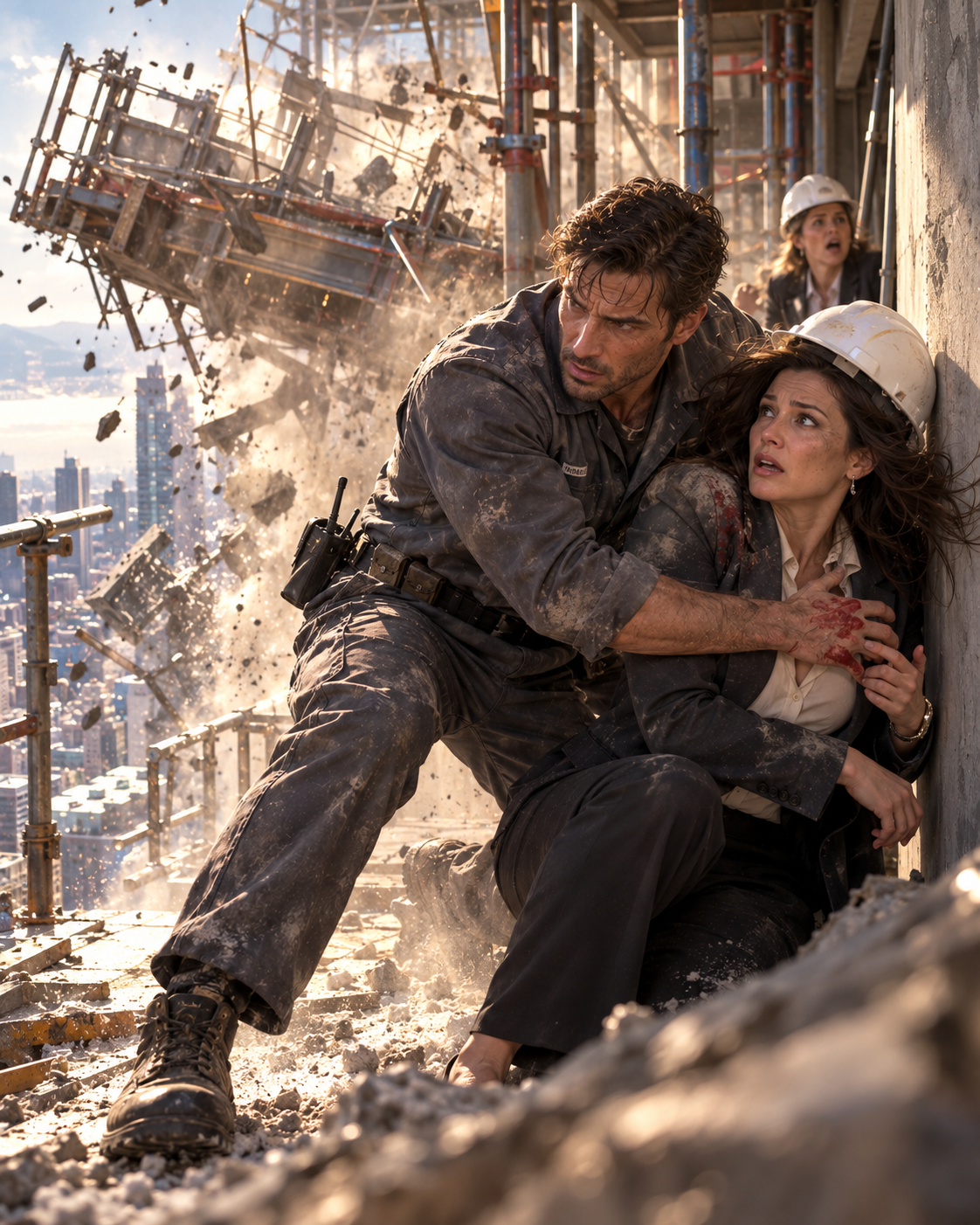
Ethan Callaway grabbed the steel cable with both bare hands and pulled.
Not because he was told to, not because it was his job, but because a woman was about to die, and he was the only one close enough to stop it. The scaffolding screamed as it came down.
Dust swallowed the air. And when the silence finally settled, the most feared CEO in New York City was alive, staring up at a janitor covered in blood and concrete dust. She had destroyed careers, crushed competitors, never once asked for help.
But this this she couldn’t explain away.
The elevator at Meridian Tower didn’t go to the basement.
That was the first thing Ethan Callaway noticed on his first day, 6 months ago now, and it still bothered him. Not because he needed the elevator.
He never used it, but because the basement was where the real work happened, where the pipes groaned and the foundation breathed, and the men who built empires apparently couldn’t be bothered to send a machine down to the people who kept those empires clean.
So, every morning, Ethan took the stairs down 14 floors to the suble utility corridor, mop, bucket, supply cart, back up to whatever floor needed him that day.
He didn’t complain.
complaining was a luxury and Ethan Callaway hadn’t been able to afford luxuries in a long time.
He was 41 years old, 5’11, lean in the way that working men get lean, not from a gym, but from carrying things.
His hands were rough. His boots were waterproofed with a can of spray he bought at the dollar store because the good stuff was $12.
And $12 was Sophie’s lunch money for 2 and 1/2 days.
And that math wasn’t hard.
Sophie was seven. Sophie was everything. Daddy, do you like your job?
She had asked him that 3 weeks ago, sitting at the kitchen table in their apartment in the Bronx, a two- room place on the fourth floor of a building where the heating worked maybe 60% of the time, and the super’s name was a mystery because nobody had seen him since 2019.
Ethan had been filling out a form, some school thing. He looked up. Yeah, baby.
I like it fine. Sophie tilted her head. She was missing one of her front teeth.
The tooth fairy had visited recently, which had cost Ethan $3 he borrowed from the jar he kept under the bathroom sink labeled emergency. You always come home tired, she said. Everybody comes home tired, Sof.
Mrs.Patterson doesn’t.
She comes home happy. She dances in the hallway. Mrs.Patterson, Ethan said carefully, is retired.
Sophie considered this. Maybe you should retire.
Maybe I should. He smiled and ruffled her hair. In about 30 years, she giggled.
And that sound, that specific unre repeatable sound, was the only reason Ethan Callaway got up at 4:47 every morning and put on his gray uniform and took the stairs down to the basement and started all over again. Meridian Tower was going to be something. Everybody said so.
60 floors of glass and steel and ambition rising out of the lower west side of Manhattan like a declaration. Luxury condominiums on the upper 40 floors.
Mixeduse commercial space below. Rooftop garden. Private concierge.
The kind of building that got written up in Architectural Digest before it was even finished. Ashford Development had been building it for 2 years.
The company’s name was on every billboard within three blocks, printed in clean silver letters next to a logo that looked like a compass.
precise, intentional, expensive.
The CEO’s name was Victoria Ashford.
Ethan had never met her.
He’d seen her picture, of course.
It was on a framed poster in the main lobby, the kind of corporate portrait where the lighting is perfect, and the expression says, “I have already thought of everything you’re about to say.
” She was mid-40s, dark-haired, sharp featured in a way that made you think of architecture itself.
Every angle deliberate, nothing soft. The workers called her the ice queen, not to her face.
Nobody said anything to her face except, “Yes, Miss Ashford,” and right away, “Mashford.”
And the occasional, “Of course, Miss Ashford.
I’ll have that corrected immediately.”
She visited the site maybe once a month. And when she did, everyone stood up straighter and talked quieter and checked their work twice.
Ethan had his own feelings about powerful people who made working people nervous just by walking in a room. He kept those feelings to himself. That was another thing he was good at, keeping things to himself.
The morning it all changed started the same way every morning started. 4:47 alarm.
Hit snooze.
Don’t actually snooze.
Get up.
He made Sophie’s breakfast before she woke up.
Oatmeal with brown sugar, cut up banana, a glass of orange juice he poured carefully because the container was almost empty and he needed it to last through Thursday.
He made his own coffee in a travel mug that had a crack in the lid he’d fixed with electrical tape.
He wrote Sophie a note. Be good. Eat your lunch.
I love you to the moon and back and back again.
And taped it to the fridge where she’d see it.
When Mrs.Delgato from 4B came to walk her to school. He kissed his sleeping daughter on the forehead.
He took the stairs down. He caught the 520 train. Hey, Callaway.
Ray Dominguez met him at the site entrance. Ray was one of the senior construction foremen.
a thick-necked man from Queens who’d been building things in the city for 23 years and had the hearing loss to prove it.
He was holding a clipboard in a cup of coffee and looking at Ethan the way people sometimes did like they were about to say something they hadn’t quite decided to say yet.
Morning, Ray. You see the southeast stairwell yesterday?
Suble two. I mopped it. I know you mopped it.
I mean, did you see it? Ethan stopped walking.
The crack in the corner column. Ray looked at him.
You saw it? Yeah. Three days ago.
I put it in the log. The log. Ray made a sound that was somewhere between a laugh and a cough.
Ethan, nobody reads the log. Then who am I writing it for?
Ry had no answer for that. He rubbed the back of his neck, looked at his clipboard, looked at the building.
It’s probably nothing, he said.
Finally. Settlement.
These big pores always crack a little. That crack is 2 in wide, Rey.
I said I’d look into it.
You said that last week.
Ray’s jaw tightened.
I said I’d look into it, Callaway.
You’re the janitor.
Let me do my job.
It wasn’t cruel.
Rey wasn’t a cruel man.
But the words landed where they were aimed, right in the center of Ethan’s chest.
And Ethan stood there for a moment, breathing, reminding himself of what he always reminded himself of in these moments. Sophie, oatmeal, orange juice, the note on the fridge.
Sure, Ray, he said. Whatever you say.
He walked past him and went to get his mop. The thing nobody understood about being invisible was that you saw everything. That was the trade-off nobody told you about.
When people didn’t see you, they didn’t edit themselves around you.
They didn’t lower their voices or change their subject or pretend to be something other than what they were.
To the men and women of Meridian Tower, Ethan Callaway was a ghost, a gray uniform that materialized when there was a spill and disappeared when there wasn’t.
He wasn’t worth lying to.
He wasn’t worth impressing.
He was furniture. So they talked. They talked in the hallways while he mopped beside them.
They argued in the breakroom while he wiped down the counter behind them. They made phone calls 3 ft away from him, not bothering to lower their voices because what was he going to do?
And Ethan listened, not because he was nosy, because he was a man who had spent his entire adult life solving problems. Real concrete physical problems. And his brain was wired to collect information the way a drain collects water.
You couldn’t turn it off.
He listened and he remembered. And he wrote things in the small green notebook he kept in the front pocket of his uniform. The one Sophie had given him on his birthday last year.
The one with a drawing of a rocket ship she’d done on the inside cover in red crayon.
The crack in suble two.
The delivery he’d seen two weeks ago.
Bags of concrete mix stacked near the loading dock.
A brand he didn’t recognize.
a brand that wasn’t on any of the spec sheets he’d seen posted in the project manager’s office.
The argument he’d overheard between two engineers.
The rebar spacing doesn’t match the drawings.
I’ve told Marcus three times.
That stopped abruptly when they noticed him emptying the trash near their table. The name Marcus came up a lot.
Marcus Hail was the CFO of Ashford Development. Ethan had never spoken to him directly, but he knew the type immediately and completely. The way working men always know the type.
The way you can read a man’s character in the way he treats the people he’s decided don’t matter.
Marcus was 48, silver-haired, the kind of handsome that came from money and gym memberships, and he moved through the site like he owned it, which technically he co-owned it. And that seemed to be the most important fact in his universe. He talked on his phone constantly.
He never wore a hard hat correctly. Always pushed back, a fashion accessory, a statement.
He called Ry Buddy in a tone that made buddy sound like servant. And three weeks ago, Ethan had watched Marcus Hail stand in front of a delivery of substandard concrete mix and wave it through without a second look.
Then get on the phone and say quietly, but not quietly enough.
Yes, I told you it’s fine.
Nobody checks. Just make sure the invoice is the right brand. Ethan had written it down.
He didn’t know what he was going to do with it yet.
He just knew that you didn’t build a 60story building with wrong grade concrete and lie about it and not eventually answer for it.
The laws of physics were the one thing that didn’t care about money.
It was a Tuesday when Victoria Ashford arrived.
Ethan knew it was Tuesday because he always called Sophie on his lunch break on Tuesdays and she always said, “Daddy, today we did art.”
and then described the art in exhaustive and wonderful detail. And he was standing near the site entrance at 12:15, phone to his ear, listening to Sophie explain the difference between ceruan and regular blue when the black car pulled up. Two security guys got out first, then an assistant, young woman with a tablet talking before her feet hit the ground.
And then Victoria Ashford. She was smaller than her photos.
That was the first thing he noticed. Not small in a fragile way. Small in the way of things that are densely packed, things that carry more weight per square in than they appear to.
She wore a white hard hat that she’d clearly just put on because it was still sitting slightly crooked and a charcoal blazer over dark slacks.
And she walked with the specific velocity of a person who had decided before leaving the car exactly how much time they had to spend here and intended to spend not one second more. Daddy, are you still there?
Yeah, baby.
I’m here.
Ceruan, the blue with more green in it. Right. And Mrs.Baker said mine was really good.
Of course it was because you’re really good.
Victoria Ashford walked past him without looking at him. Her assistant glanced at him briefly, the way people glance at furniture and then followed.
The security guys brought up the rear. Ethan watched them go. Daddy, are you listening?
Every word, Sofh, tell me what you painted. He should have gone back to work.
He should have finished his lunch, washed out his travel mug, and gone back to suble 3, where the water lines near the northeast utility closet had been sweating, and he was supposed to lay down absorbent mats before the afternoon shift started. Instead, at 12:47, something made him walk toward the east scaffolding tower.
He couldn’t explain it exactly.
It was the same instinct that had made him pick up a dropped wrench during his army days and say, “Something’s wrong with this.”
before the sergeant could use it.
The instinct that had no name, but had saved lives before, including his own, and that he’d learned a long time ago, not to argue with.
He’d been watching the east scaffolding for two weeks, not because he was assigned to watch it, because something about the way it was anchored to the building’s exterior, specifically the clamp assembly on the 14th floor section, looked wrong to him.
Not dramatically wrong, subtly wrong.
The kind of wrong that a trained eye catches and an untrained eye doesn’t.
And the only reason Ethan had a trained eye was because he’d spent four years in Army Corps of Engineers before his daughter was born and his marriage fell apart, and his life had rearranged itself around an entirely different set of priorities.
He walked to the base of the East Tower and looked up. The clamp assembly on 14 was intact. That was good.
The clamp assembly on 12 was, he squinted, fine. probably fine. The loadbearing junction on 13, where the main horizontal walkway met the vertical support frame was.
Ethan felt his stomach drop.
The anchor bolt, the one that should have been torqued to spec, the one that was holding the junction bracket against the building’s exterior.
It was loose. Not a little loose. Wrong loose.
the kind of loose that meant the vibration from the construction work had been working on it for days, maybe weeks, and whoever was responsible for inspection had either not looked or had looked and not understood what they were seeing. He looked left.
Victoria Ashford was standing on the 12th floor exterior walkway, 40 ft above him, her assistant three steps behind her, looking out across the site. She was pointing at something, talking.
She had no idea. He looked at the junction bracket.
He looked at her. He calculated the way his brain did this automatically, the way it always had. Load, angle, stress, failure point.
If that bracket let go, the entire 13th floor platform would swing outward and down, and the 12th floor walkway was directly in the fall path, and Victoria Ashford was standing directly in the fall path. Later, people would ask Ethan what he was thinking in that moment. News reporters, a lawyer, Rey, over beer, 3 weeks after everything happened.
The honest answer was nothing.
He wasn’t thinking.
He was moving. He hit the exterior stairs running. Not the main stairwell.
Too slow. Wrong angle.
The maintenance stairs.
The narrow metal ones bolted to the building’s east face.
The ones he used to get to the upper floors when the elevator was in use. He took them three at a time, one hand on the rail, one hand free, his boots clanging on the steel grading. Sixth floor, seventh.
His lungs were burning already. He could hear the bracket.
That was the thing that people didn’t understand later when he tried to explain it.
He could hear it.
The sound metal makes when it’s failing.
that specific frequency somewhere between a groan and a tick.
A sound that’s not loud but that carries in a particular way if you know how to listen for it.
Eighth floor 9th 10 Hey, someone stop that man. One of the security guards had spotted him from below.
Ethan didn’t look back.
He didn’t slow down.
11 12 He burst through the access door onto the 12th floor exterior walkway and the first thing he saw was Victoria Ashford’s face.
Surprised, annoyed, the expression of a person who does not expect to be interrupted. And the second thing he saw over her left shoulder was the 13th floor junction bracket beginning to fail. Not all at once.
That was how these things worked. First the bolt, then the bracket arm, then the whole assembly in one catastrophic second. Move.
He didn’t ask.
He didn’t explain.
He crossed the 10 ft between them in three strides and hit her hard, shoulder into her side, arms wrapping around her, spinning her away from the walkway edge toward the building’s exterior wall.
And then the world came apart above them. The sound was enormous.
Steel on steel, then steel on concrete. A cascading thunder as the 13th floor platform swung down and hit the 12th floor railing where Victoria Ashford had been standing 2 seconds before.
The walkway shuddered under Ethan’s boots.
Dust exploded outward. A section of the railing tore away and plummeted. Ethan tracked its sound.
Heard it hit the ground far below.
Then silence or not silence, the ringing in his ears and Victoria Ashford’s breathing and his own heartbeat very loud.
They were against the building’s wall.
His arms were still around her. His right hand, he realized, was bleeding.
He’d caught the edge of something on his way up the stairs.
A bolt or a bracket corner. And there was blood on his palm and on his sleeve.
And now on the shoulder of Victoria Ashford’s blazer, he let go and stepped back.
She stared at him. Her hard hat was knocked sideways. There was dust in her dark hair.
A long smear of gray concrete powder across one cheek.
Her assistant was somewhere behind them, pressed against the wall, making sounds that weren’t quite words.
Down below, voices were shouting. the specific organized chaos of a work site emergency beginning to mobilize.
Victoria Ashford stared at him. Her eyes were green.
He hadn’t been close enough to notice that from the lobby photo.
She said, “Who are you?”
He looked down at himself. Gray uniform, bloodied hand, dust on his boots.
“I’m nobody,” he said.
“I’m the janitor.”
She stared at him for another long moment and something happened behind her eyes.
Something that he couldn’t quite name.
The way a locked door sounds different from a locked door when someone finally puts in the right key. The janitor, she repeated.
Yes, ma’am.
She looked at her shoulder, at the blood, at the destroyed railing 10 ft away where she had been standing. She looked at her hands which were trembling barely controlled but trembling.
You’re bleeding.
She said, “Yeah, your hand.
I know.”
She looked at him again.
“You could have been killed.”
Ethan didn’t have an answer for that.
He’d thought of Sophie on the stairs.
That was the truth of it. Not bravery, just math. Sophie needed him.
Sophie needed him to be alive.
And he’d done the calculation and decided that the best way to stay alive long enough to be useful to his daughter was to not let the woman standing on that walkway get crushed.
Because if he’d stood at the bottom and watched it happen, he would have had to live with that.
And Ethan Callaway was not the kind of man who could live with things like that. It was the right call, he said.
The right call,” she said softly.
“Yes, ma’am.”
The security guards arrived then, breathless, weapons not drawn, but hands hovering. Victoria held up one hand, and they froze.
“This man,” she said, and her voice had shifted, still controlled, but with something underneath it that hadn’t been there before.
Something real.
“Just saved my life.
Nobody touches him.”
Understood? Miss Ashford, we should get you.
I said nobody touches him. Get me the site manager and call a medic. She paused.
Get him a medic first. She looked at Ethan one more time.
What’s your name?
She said. Your real name. Ethan, he said.
Ethan Callaway. She nodded once.
Precise and deliberate. the way people nod when they are filing something away in a place where they keep things they intend to return to.
Then she straightened her hard hat, brushed the concrete powder from her jacket sleeve, and walked toward the access door like a woman who had somewhere to be. Ry found him in the first aid station 20 minutes later while a sight medic named Gina was stitching the cut on his palm. 14 stitches, Gina said.
I’ve had worse, Ethan said.
I don’t doubt it, Gina said.
Ry stood in the doorway.
He looked like a man who wanted to say several different things and couldn’t figure out which one to say first.
Finally, he settled on, “You crazy.”
Probably. You could have gone down with that scaffolding. I calculated the angle.
I had enough time. Ray stared at him. You calculated the angle.
Old habit.
You’re a janitor, Ethan.
I know what I am, Ray. Ray rubbed his face.
He came in and sat down on the stool across from him and looked at the floor for a while. The anchor bowled on 13, he finally said.
The inspection report said it was fine. The inspection report was wrong.
I know that now. It was wrong three weeks ago, too. Ethan kept his voice flat, not accusing, just stating.
I logged it. I told you.
Someone looked at that bolt and signed off on it anyway. Ry was quiet. Who signed the inspection?
Ethan asked. Ethan, who signed it, Ry? Ry looked at him with the expression of a man watching something unavoidable approaching from a distance.
It was routed through Marcus Hail’s office,” he said quietly.
“Same as everything else lately.”
Ethan looked down at his stitched hand. The cut ran across his palm in a neat diagonal line, closed now, held together by thin black thread. A small wound, a record of one decision.
He thought of the green notebook in his breast pocket. He thought of the crack in suble two.
He thought of the delivery manifest he’d photographed on his phone.
Wrong concrete, wrong grade, invoiced as something else. He thought about a 60story building full of substandard materials and falsified inspections, rising into the Manhattan skyline, being sold to people who would live in it, sleep in it, raise families in it. He thought about Sophie.
If this building falls, he thought, it won’t just be Victoria Ashford who gets hurt.
Rey, he said, I need you to listen to me. Ry looked at him.
Something is very wrong with this building, Ethan said. Not just the scaffolding, the foundation, the concrete, the rebar spacing on the lower floors.
I’ve been watching it for 3 months and I’ve been writing everything down and I think I think someone is deliberately cutting corners in a way that is going to get people killed.
The silence between them was the specific silence of a man hearing something he was hoping he wouldn’t have to hear.
Ethan Ray said, you understand what you’re saying.
I understand exactly what I’m saying.
If you go to the city inspector, if you go anywhere with this, I know you’ll lose this job.
Marcus Hail will make sure of it.
And if he’s doing what you’re saying he’s doing, he’s not going to just fire you.
He’s going to I know, Rey.
Rey looked at the floor again. I have a daughter, Ethan said.
She’s seven.
She needs me to be here and she needs me to be the kind of man that she thinks I am. He paused.
That’s really the whole thing right there.
Rey was quiet for a long time.
Then he said, “What do you need?”
outside in the black car that had been pulled around to the east side of the building at Victoria Ashford’s direction, away from the cameras, away from the reporters who had already appeared at the main entrance like iron filings drawn to a magnet.
Victoria sat in the back seat with her phone in her hand and didn’t make any calls.
Her assistant, Lisa, sat across from her and very wisely said nothing. Victoria looked at the blood on her jacket shoulder. Ethan Callaway.
She pulled up the employee roster on her phone, searched the name, found it in under 30 seconds. Janitorial staff site level $910 per hour. Hired 6 months ago.
Previous employer listed as various. Prior to that, US Army Corps of Engineers, 4 years, honorable discharge.
She stared at that for a while. Then she looked at her shoulder again. The blood had dried to a dark rust color against the gray fabric.
She had a meeting in 2 hours with the Meridian Tower investors. She would need to change.
She would need to give a statement to the site safety officer. She would need to call the PR team and get ahead of whatever story was about to break about the scaffolding collapse.
She knew how to do all of those things.
She’d been doing them her whole career.
What she didn’t know how to do was sit with a particular feeling currently occupying her chest.
The feeling of realizing that a man who made $9 an hour had looked at a falling scaffold and looked at her and decided in a fraction of a second that her life was worth his.
She’d never had that before, not once.
He called himself nobody. Victoria Ashford was 44 years old.
She had built a company from a twoperson operation in a Midtown sublet to a publicly traded development firm with 11 active projects in four states. She had fired people and hired people and made decisions that had ended partnerships and started them.
She was not sentimental. She did not believe in luck, but she believed in people in that cold, precise way of someone who has learned to read them like blueprints. Looking for loadbearing structures, looking for the cracks.
And Ethan Callaway, she thought, was loadbearing.
She didn’t know yet what that meant.
She didn’t know what she was going to do with the feeling in her chest, or what she was going to do about the janitor who had filed three safety reports in the log that no one had read, or what she was going to do about the fact that her CFO’s name had appeared three times
in the last 6 months on inspection paperwork that had been rubber stamped over serious structural concerns.
But she knew one thing with the clarity that had made her the woman she was. she was going to find out.
That evening, Ethan sat on the edge of Sophie’s bed and read her two chapters of Charlotte’s Web, the same two chapters she always asked for, even though they were long past that point in the book.
And Sophie fell asleep with her hand tucked under her cheek and her mouth slightly open, the way she slept when she was deeply, completely at peace. He turned off the light.
He sat in the kitchen with his green notebook and his cold coffee and his 14 stitches and thought about the day, about the bracket, about the fall line, about Victoria Ashford’s green eyes and the specific sound of a woman realizing she was alive when she shouldn’t have been.
About Rey saying it was routed through Marcus Hail’s office.
He opened the notebook.
He drew a line under everything he’d written before and below it he wrote today’s date and below that he wrote 13 floor bracket failure no inspection sticker anchorbolt deliberate removal check maintenance log and below that she’s going to find out something is wrong with this building she doesn’t know it yet but she is he tapped the pen against the page question when She does.
Whose side is she on?
He didn’t have an answer.
Not yet. He looked at the rocket ship Sophie had drawn in red crayon on the inside cover of the notebook. Nose pointing up, exhaust flames bright as fire, disappearing into a sky full of crooked stars.
He closed the notebook. He got up and checked the lock on the front door and went to bed. The call came at 6:14 in the morning.
Ethan was already up. He was always already up, standing at the kitchen counter with his cracked travel mug, watching the coffee brew, listening to the specific silence of an apartment where a child is still asleep, and the whole world is holding its breath out of respect for that.
His stitched hand achd in the cold.
He’d slept maybe 3 hours.
The number on his phone screen was one he didn’t recognize.
Manhattan area code. He almost let it go to voicemail.
Then something that same instinct, the one he’d learned not to argue with, made him pick up.
Mr.Callaway, not a question, a statement. The voice was low, controlled, with a particular precision of someone who chose every word the way a surgeon chooses instruments. He knew immediately who it was.
“Miss Ashford,” he said.
A pause, brief, but real, like she hadn’t expected him to recognize her voice and was recalibrating.
“I’d like to meet with you today,” she said.
“Off site, not at the tower.”
Ethan looked at the coffee maker.
“What time?”
“9:00.
There’s a coffee shop on West 22nd, Clemens.
Do you know it? I can find it.
Good. Another pause.
I appreciate what you did yesterday, Mr.Callaway. I want you to know that.
You already said that. I know.
I’m saying it again.
He didn’t say anything to that.
9:00, she repeated and hung up. Ethan set the phone down on the counter and looked at it for a moment. Then he poured his coffee and went to write Sophie a note for the fridge.
Be good. Eat your lunch. I love you to the moon and back and back again.
He added at the bottom. P. S.
Ceruan is the best blue.
He thought she’d like that.
He taped it to the fridge. He took the stairs down.
Clemens was the kind of place that had been in the same location since 1987 and showed it. Dark wood, good coffee, no Wi-Fi password posted anywhere because the owner believed that if you needed the internet, you should go somewhere else. Ethan arrived at 8:52 and got a table in the back corner out of old habit, positioning himself where he could see both the entrance and the side door.
Army thing. You never entirely stopped doing army things. Victoria Ashford arrived at 9 exactly.
No assistant today.
No security, just her in a black coat and dark slacks, moving through the coffee shop with the same compressed velocity he’d noticed yesterday.
Like she was always slightly ahead of where her feet were. She sat down across from him and looked at his hand.
“How is it?”
she said.
“Fine.”
“14 stitches.”
“You checked?”
I asked Gina, the medic. He studied her face in the daylight, away from the sight, away from the hard hat and the dust and the adrenaline.
She looked not softer exactly, more specific, like a photograph coming into proper focus. You want to ask me something?
He said, “I want to ask you several things.
” “Okay.”
She set her phone face down on the table. That surprised him.
He got the impression it was not a thing she did often.
“Tell me about the scaffolding,” she said.
So he told her, “Not the version from yesterday’s official incident report.”
He’d seen that already.
The sanitized version that said bracket failure due to standard construction vibration.
But the real version, the anchor bolt, how long it had been loose, why he’d noticed it, what he’d noticed before it, the pattern of small wrong things that had been accumulating around the east tower for weeks.
She listened without interrupting. That surprised him, too. When he finished, she was quiet for a moment.
“You said you logged it,” she said three times.
and nobody responded. Correct.
She turned her coffee cup slightly on the table, not drinking it, just adjusting its angle by a few degrees. He recognized the gesture.
Something to do with her hands while her mind was working.
I want you to tell me everything else you’ve logged, she said.
Everything?
everything you’ve noticed, everything you’ve written down, everything that didn’t look right.
She met his eyes. I know you have a notebook. How do you know that?
Because people who pay attention always have somewhere they put what they see, she said.
And everything about you says you’re someone who pays attention.
Ethan looked at her across the table. He was trying to figure out how much trust he could afford to extend in this direction.
Trust was a resource, and like all resources, he’d learned to be careful about where he spent it.
“Before I tell you anything,” he said carefully, “I need to understand something.”
“Ask the materials on this project, the concrete mix, the rebar spacing on the lower floors, the inspection reports.
” He kept his voice even.
“Did you know?”
The question landed. He watched it land.
Watched something move behind her eyes.
Something she didn’t bother to hide.
And it wasn’t guilt exactly, but it was in the neighborhood of guilt.
Closer to the particular pain of a person confronting what they should have looked at sooner.
“No,” she said.
“I didn’t know, but you should have.”
She held his gaze. Yes, I should have.
Most powerful people in his experience would have bristled at that, would have shifted the conversation, redirected, found a way to spread the responsibility outward like warm water filling a flat space. Victoria Ashford did not do that. She absorbed it, all of it, and sat with it.
And the fact that she could do that made Ethan Callaway decide something. He reached into his breast pocket and put the green notebook on the table between them.
The rocket ship was my daughter’s idea, he said.
Victoria looked at the notebook, then carefully, like she understood that this was something that mattered, she opened it. She read for 7 minutes without speaking.
Ethan drank his coffee and watched the door and let her read. When she looked up, her jaw was tight. This goes back 3 months, she said.
The first entry is from my fourth day on the job. The wrong concrete mix. You have delivery dates, lot numbers.
I photographed the manifests when they were left unattended near the loading dock. Photos are on my phone. The lot numbers trace back to a supplier in New Jersey called Cresten Materials.
They’re not on our approved vendor list.
She looked at him. You traced the lot numbers. I had evenings free.
Ethan, she stopped. Seemed to recalibrate something.
Mr.Callaway, how do you know how to do any of this? Army Corps of Engineers, 4 years. I was a structural specialist.
He paused. I know what buildings are supposed to be made of.
She closed the notebook slowly with both hands like it was evidence, which it was.
“Tell me about Marcus,” she said quietly.
“And there it was.
The thing they’d both been building towards since she sat down.
I can tell you what I’ve observed,” Ethan said.
“I can tell you what I’ve heard.
Whether that connects to him the way I think it connects, that’s above my pay grade.”
“Tell me what you’ve observed.”
So he did.
The phone call at the loading dock, the inspection signatures routed through the CFO’s office, the conversation between the two engineers.
He could give her the date, the approximate time, the names of the engineers if she could cross reference her staff list.
He’d written all of it down in the notebook in his careful, specific, unmbellished way.
Not accusations, not interpretations, just what he saw when he saw it.
where Victoria listened to all of it the way she’d listened to the scaffolding account.
Completely still, completely focused. The kind of focused that had probably made a lot of people in boardrooms very uncomfortable over the years because it meant she was absorbing everything and forgetting nothing.
When he finished, she didn’t say anything for a long moment.
Then she said, “He’s been with me for 9 years.”
I know. His photo is on the wall with yours. I brought him from my last company.
I built this firm partly on the basis that I could trust his numbers. I understand he has access to everything.
Every contract, every vendor relationship, every She stopped. Something moved through her expression.
Something that was almost, not quite, but almost fear. The kind of fear that comes not from danger, but from the specific vertigo of realizing the floor under your feet might not be what you thought it was.
If he’s been doing this, then it’s been done carefully and deliberately and for a reason, Ethan said.
Yes, ma’am.
She looked at him sharply at the ma’am like it bothered her.
Stop calling me that, she said. Sorry, Victoria. He nodded.
Victoria. She picked up her coffee finally and drank it. It had to be cold by now.
She didn’t appear to notice or care.
I need to move carefully, she said.
If Marcus finds out that I’m looking, he’ll move the evidence.
Or worse. Ethan leaned forward slightly.
That’s why I haven’t gone to the city inspector yet.
She stilled. You were going to go to the inspector?
I was thinking about it.
If you’d done that without She stopped again, breathed.
The city inspection process is 6 weeks minimum, and everything goes into the public record within 48 hours of filing. Marcus has contacts in that office.
He would have known before the inspector finished typing the complaint. And the building keeps going up in the meantime.
Yes. And the people who already purchased units in it.
Yes. The word was quiet and it cost her something to say it.
So we need to do this without triggering the official process until we have something so complete that it can’t be buried.
Ethan said. Victoria looked at him again. That thing behind her eyes.
That quality of a door receiving the right key.
You’ve been thinking about this for a while.
She said since the night I wrote the first entry in that notebook.
You’re a janitor, she said.
Not cruy, more like she was testing the phrase, pressing on it to see if it held.
I’m a janitor, he agreed.
But this isn’t a janitorial problem.
This is a structural problem and I know structural problems. She was quiet. I also, he said, have nothing to lose.
That landed differently than he intended. He saw it.
saw her hear what was underneath the statement, the honesty of it, the particular freedom of a man who lives $9 an hour at a time and has already accepted that the floor can fall out from under him at any moment. You have a daughter, she said.
That’s why I have nothing to lose, he said.
If this building comes down, it won’t be because I didn’t try.
The coffee shop made its usual sounds around them. The espresso machine.
The muted clatter of cups. A conversation at a table near the window about something that had nothing to do with any of this. Ordinary life going on.
Victoria sat down her cup. She looked at the notebook.
She made a decision. He could see her make it the way you can see a door close on a room someone was standing in.
I need access to the project files, she said. The real ones, not the versions in the system.
You’re the CEO.
You have access to everything. The digital versions are what Marcus controls. I need the originals, the physical copies from the first two years of the project before the system migration.
They’re in the archive storage in the basement of the tower.
Suble four, Ethan said. She looked at him. Nobody goes down there except maintenance, he said.
I’ve been down there twice.
Then you know where the archive room is. Third door on the left, past the utility risers.
She held his gaze. I need someone to get me in there without creating a digital access record.
That’s not a janitorial request.
No, it’s not.
She paused.
I’m asking you anyway.
Ethan looked at her for a long moment.
He thought about Ry saying, “You’re the janitor, Callaway.”
He thought about the inspection log, but nobody read. He thought about 60 floors of substandard concrete and families who had signed purchase agreements and given deposits and trusted that the building they were buying was what it claimed to be.
“I can get you in Thursday night,” he said.
After the evening shift clears, 11:00, I’ll be there.
Come in through the service entrance on the south side.
I’ll be at the door.
She nodded. She reached for the notebook.
I need to keep that, he said. She pulled her hand back. Of course.
He tucked it back into his breast pocket next to his heart next to Sophie’s rocket ship.
The walk back to the subway took 12 minutes, and Ethan spent all 12 of them trying to figure out if he’d just done something very smart or something very stupid.
The honest answer was probably both simultaneously in proportions yet to be determined. He trusted her.
That was the part that surprised him because trusting powerful people was not a habit he’d developed.
powerful people had given him very little reason to develop it. But Victoria Ashford had looked at the notebook.
She had said, “I should have.”
She had been honest about Marcus in the specific way that only hurt people are honest. And she had been afraid, briefly, really afraid, and had not tried to hive it.
He trusted her the way he trusted loadbearing structures that had been properly built. Not blindly, not absolutely, but with the grounded confidence that came from checking the materials and the joints and deciding the engineering was sound.
He was wrong about people sometimes.
He hoped he wasn’t wrong about this one.
Rey was waiting for him at the site entrance. Management wants a statement from you. Ry said the official incident report.
I already gave one yesterday. They want an amended one.
Apparently, there are questions about how exactly you identified the bracket failure and whether Ray’s face was doing something complicated.
Whether you’d been accessing areas outside your assigned zones.
Ethan looked at him. Who asked for the amended statement? Ray looked at his shoes.
“Ray, it came through Marcus Hail’s office,” Ry said quietly.
“Same as everything else.”
Ethan took a breath. Let it out. What does the amended statement ask me to say that you were passing by on a regular maintenance route when you heard the sound of the failing bracket?
that it was the phrasing they used was a chance observation by a diligent employee.
Meaning I wasn’t watching the scaffolding specifically, right?
Meaning nobody needs to ask why I was watching the scaffolding specifically, Ethan. Meaning nobody needs to explain why the bracket had been flagged in the maintenance log three times without response.
Ray rubbed the back of his neck. You sign the amended statement. You keep your job.
Nobody asks questions.
That’s the offer.
That’s not an offer, Rey.
That’s a warning.
Maybe. Ry looked at him with an expression that Ethan had seen before on men who knew something was wrong and were scared of the cost of saying so.
The man has reach, Ethan. You understand?
This isn’t just this job.
He makes calls.
People don’t work again.
I know.
You’ve got Sophie to think about.
I’m always thinking about Sophie.
Ethan picked up his supply cart from beside the entrance.
That’s the whole problem.
What does that mean?
It means if I sign that statement, I’m signing away the one thing I have that might stop something very bad from happening in this building.
He looked at Ry level.
I’m not signing it.
Ray stared at him.
Ethan, man, I’m not signing it.
Tell them I need more time to review the language. That buys me two, maybe 3 days.
And then, and then I won’t need more time, Ethan said, and wheeled his cart through the door.
Suble 2 was where Ethan spent most of Tuesday afternoon. Not because it needed mopping.
It didn’t.
But because it put him near the structural column in the northeast corner, the one with the crack he’d logged three weeks ago.
He measured it again, 2 and 1/2 in wide now. It had been 2 in 6 days ago. He took out his phone and photographed it with a dollar bill set against it for scale.
Sent the photos to the email address he’d made specifically for this.
a new account, no name attached, accessed only from the library computer on 183rd Street.
He’d started backing everything up two weeks ago.
The same week, the amended statement request had appeared in his supervisor’s inbox.
He was careful.
He’d learned careful the hard way in the army, in the years after the army, in the slow, patient education of being a man who had very little room for error and had reorganized his entire life around that fact.
He straightened up from the column and stood there in the concrete quiet of the suble alone with the sound of the building settling around him. the creeks and ticks and structural size of 60 stories of steel and stone and ambition rising above his head and thought about the weight of it. Not metaphorically, literally, the actual load forces pressing down through every column and beam and joint, distributing, transferring, landing finally in the foundation that was supposed to hold everything.
the foundation that was made of the wrong concrete. The thought settled in his chest like a stone. He went back upstairs.
That evening, Sophie asked him why he had stitches on his hand.
He’d been braced for the question all day.
He told her he’d cut himself at work.
She accepted this with the matter-of-act pragmatism of children who understand injuries the way they understand weather. These things happen. They heal.
The important thing is whether or not ice cream is involved. Does it hurt?
She asked. Not much.
Mrs.Delgato said she saw it on the news. That something fell at your building.
Ethan paused.
He hadn’t thought about the news.
He should have thought about the news. It was an accident, he said.
Everything’s okay.
Sophie looked at him with her direct 7-year-old gaze. the gaze that had a tendency to cut straight through his more polished evasions.
“Were you scared?”
she asked.
“A little,” he said.
“For a second.”
“What did you do when you were scared?”
“I stopped thinking and just moved.”
She considered this.
“That’s what you told me to do when I was scared to jump off the diving board.
Stop thinking and just move.”
And did it work? Yeah, she grinned, the tooth gap grin that was going to end him eventually.
It worked. He hugged her tight enough that she complained about it.
Dad, you’re squishing me.
Sorry, he said, and didn’t let go.
Marcus Hail called him directly on Wednesday morning.
Ethan didn’t know how Marcus had gotten his cell member.
That alone told him something. Callaway.
The voice was smooth, effortless, the voice of a man who had spent decades being charming in situations that required it. I wanted to reach out personally.
Congratulate you on your quick thinking the other day. Thank you, Ethan said.
Heck of a thing. Real hero moment. The company wants to recognize you for it.
There’s a bonus being processed through HR.
Not much, but a token of appreciation.
That’s not necessary.
Of course it is.
You saved the CEO’s life.
We don’t take that lightly.
A pause. And something shifted in the smoothness. Barely, the way a perfectly calm lake surface shifts when something moves underneath it.
I also wanted to personally assure you that the amended statement is just a formality. Standard legal language for incident reports.
Nothing to worry about.
I haven’t signed it yet.
Right. I heard you needed some more time.
Completely understandable. The smoothness again, calibrated and warm.
Take all the time you need, though obviously we’d like to get it processed before the end of the week just for the recordeping.
You understand? Sure, Ethan said. Good man.
Another pause.
How’s your daughter Sophie?
Isn’t it 7 years old?
The hair on Ethan’s arms stood up.
“She’s fine,” he said.
His voice came out perfectly flat. He worked to keep it that way.
“Good, great age.
Kids that age, everything is an adventure, right?”
Anyway, the voice pulled back, wrapping itself back up in its professional packaging.
I’ll let you get back to work.
Don’t forget about that statement.
And Callaway, you’re a valued member of this team.
I want you to know that he hung up.
Ethan stood on the sidewalk outside the sight entrance and breathed the cold morning air and let the feeling passed through him the way he’d learned to let things pass through him.
Not pushing it down, just holding it, examining it, deciding what to do with it. What he felt was not fear.
What he felt was clarity. Marcus Hail had just told him in the language of professional men who never say directly what they mean that he knew Ethan was a problem.
That he knew Ethan had not been on a regular maintenance route. That he had looked up Sophie.
That the bonus was not appreciation. It was a down payment on silence.
And Ethan Callaway, who had nothing to lose, and a daughter to answer to and a notebook full of everything he’d seen over the past 3 months, had just decided with complete and irreversible certainty that he was not going to be bought.
He put his phone in his pocket. He pushed through the site entrance. He had 2 days until Thursday night.
He had work to do. Victoria spent Wednesday in her office on the 43rd floor of the Asheford Development Headquarters on Park Avenue, doing the things she always did, meetings, calls, emails, the normal infrastructure of running a company. While underneath all of it, invisible to the people around her, she did the other thing.
She pulled every contract associated with Meridian Tower from the digital archive, cross-referenced the vendor lists against the approved supplier registry, flagged the discrepancies. There were 14 of them in the concrete and steel categories alone going back 22 months.
22 months.
a year and 10 months of wrong materials, falsified approvals, and a man she had trusted to run the numbers sitting three offices down the hall from her, smiling, doing the job she’d given him, and somewhere else entirely underneath.
She had built things her whole life, companies, relationships, a reputation.
She knew better than most what happened to structures when the foundation wasn’t what you thought it was.
She looked at the 14 discrepancies on her screen.
Then she opened a new document and began to write down what she needed from Thursday night’s archive.
Every physical document that might predate the system migration.
Every original contract that might carry Marcus’ direct signature rather than the digital routing that could be explained away.
She worked until 7:00. She was still working at 10:00.
At 11:00, she looked up from her desk and realized the office was empty except for her, and the city was laid out below the window in its late night arrangement of lights. And somewhere in the Bronx, she knew a man with 14 stitches in his hand and a rocket ship notebook had his daughter in bed and was probably sitting at his kitchen table doing the same thing she was doing. going over everything they had and everything they still needed.
Building the case one piece at a time, the only way any real thing was ever built. She picked up her phone. She put it down.
She thought about calling him, not about the building, just to.
She wasn’t sure.
She was not accustomed to just to.
She was not accustomed to the specific feeling of wanting to tell someone that you were in this together because she had spent a great deal of her adult life ensuring she was never in anything with anyone that she couldn’t exit cleanly.
She thought about what he’d said.
I have nothing to lose.
That’s why I have nothing to lose.
She looked at the city. After a while, she turned off her desk lamp, put on her coat, and went home.
She didn’t call him, but she would.
Thursday came the way bad days always come. Quietly like nothing special, like any other morning.
Ethan made Sophie’s oatmeal, poured the orange juice carefully, wrote the note, kissed her forehead, took the stairs down, caught the 520 train, did everything exactly the way he always did it.
Because the best way to not look like a man who is planning something is to be a man who is doing nothing different.
He’d been in the army long enough to know that the site felt different that morning, though.
Not in any way he could point to. The noise was the same.
The traffic of workers and equipment and shouted instructions was the same. But there was a quality to the air, a particular tension, like the moment before weather changes, when the pressure shifts and your body knows it before your brain does. Ray caught up with him near the east stairwell at 8.
Marcus asked about you again. Ry said he was keeping his voice low, positioned so his back was to the main corridor.
Specifically asked if you’d been going anywhere you weren’t assigned.
What did you tell him? I told him you were the most reliable man on the cleaning crew and you stayed exactly where you were supposed to stay. Ray paused.
Which was true until about 2 weeks ago. You covering for me, Ry?
I’m trying to figure out if I’m covering for someone who knows what he’s doing.
Rey looked at him directly. Do you? Yes.
You sure?
I’m sure enough.
Ray stared at him for a long 3 seconds. Then he looked away down the corridor at nothing in particular.
“My brother-in-law lost everything in 2009,” he said.
“Built his whole life around a construction company that turned out to be built on about six different kinds of fraud.
Lost his pension, his house, took him four years to get back to anything like normal.”
He was quiet for a moment. I know what that kind of thing does to people.
I know you do, Ethan said.
I’m not saying anything else.
I’m just saying if there’s anything you need from me, practically speaking, access to something, a record you can’t get to on your own.
Ry looked back at him.
I’ve been a foreman on this site for 14 months.
I have keys to things. Ethan looked at his friend for a moment. Suble 4, he said quietly.
The archive room, third door past the utility risers. Tonight, 11:00.
If your pass key gets me in without logging to the central system, the maintenance key cards bypass the digital log. They always have.
Ry reached into his jacket pocket.
He’d already pulled the card.
He held it out between two fingers, his expression carefully neutral. the expression of a man handing over something while maintaining plausible deniability.
Ethan took it. Thanks, Ray.
Don’t thank me.
I don’t know anything about anything.
Understood. Ray walked away without looking back. Ethan watched him go, then closed his hand around the key card and went to get his mop.
The day was 12 hours of ordinary. Ethan cleaned things. He fixed a running toilet on the eighth floor.
He replaced the broken fluorescent tube in the sublevel one corridor. A job that technically belonged to the electrical crew, but that everyone defaulted to him because Ethan would do it without being asked and without filing a separate work order.
He ate his lunch in the utility room on 6. Sandwich from home, apple, water, and did not call Sophie because Sophie was in school and he did not want to hear her voice right now.
did not want anything soft in his chest for what was coming. At 4:30, Marcus Hail walked through the building.
Not the usual walkthrough. This was different.
He had two men with him that Ethan didn’t recognize.
Not construction workers, not engineers.
They wore the kind of business casual that meant they were comfortable on job sites but didn’t work on them.
Security maybe, or something adjacent to security. They moved with Marcus through the sub levels and Ethan watched from a corridor junction as they stood outside the archive room door for two full minutes.
Marcus talking in a low voice, one of the men nodding.
Ethan didn’t move.
He stood with his mop cart and was furniture and let them be visible to him.
Marcus didn’t look in his direction once, which told Ethan one of two things.
Either Marcus didn’t consider him worth watching or Marcus was very good at not appearing to watch him.
He couldn’t yet tell which.
At 10:45 that night, Ethan was back. The site ran a skeleton crew after 9ine, a night watchman on the main entrance, a security camera system that he already knew had a 15-second lag on its recording loop, and the motion sensor in the lobby that was triggered by the lobby doors, not by the service entrance. He came in through the south side.
The door opened on Ray’s key card with a muted click and no logging tone.
He stood in the service corridor for 30 seconds listening. nothing. At 10:58, he heard footsteps.
Victoria came in the same door 2 minutes early, dressed in dark clothes.
He noticed she’d thought about this, dressed practically, no heels.
She moved quickly, no hesitation at the threshold, which told him she’d done this kind of thing before, or was good enough at projecting confidence that the difference was irrelevant.
Clean entry, she said quiet. Clean. Cameras have a lag.
We have maybe 90 minutes before the night watchman does his suble round. Understood. She looked at him.
You look like you’ve done this before.
Different context, same principles.
She didn’t push it.
He respected that. They moved.
Sublevel 4 was the lowest point of the building, below the mechanical systems, below the water lines, concrete walls, and a low ceiling, and the kind of quiet that felt pressurized, like the weight of everything above was making the silence denser. Ethan had been down here twice.
He knew where the light switches were, knew that the third fluorescent panel on the left was the only one that worked reliably. He hit the switch. The panel came on with a flicker and in its thin light they moved to the archive room.
Maintenance key card. The door swung open.
The room was floor to ceiling shelving, banker’s boxes labeled by date and project code.
Hundreds of them organized in the specific way of things that were organized by someone who expected to be the only one who ever accessed them. Victoria exhaled.
there,” she said, almost to herself, and moved to the far shelving unit.
“You know what you’re looking for,” Ethan said.
The original structural specifications from the project’s first 8 months before Marcus restructured the vendor contracts.
She was already reading labels, quick and efficient, and the original approved materials list, the one signed by the city engineer before the migration. If we can prove the materials list was changed after approval, then everything built to the changed specs is in violation, Ethan finished.
Every floor, every pore, all of it. She found the first box, pulled it from the shelf, set it on the floor, opened it.
Ethan crouched beside her. Inside were document folders tabbed by date.
the physical originals, not scans, not digital copies, real paper, real signatures, the kind that can be examined by a forensic accountant and held up in court. Victoria pulled the first folder and went still.
What? Ethan said. She turned the folder toward him.
The approved material specification sheet from month four of the project. The concrete grade was listed, the supplier, the lot verification protocol, and at the bottom in the signature block, a handwritten initials above the printed title CFO, Ashford Development, MH.
He signed the original, Victoria said. Her voice was quiet and absolutely steady in the way of people who have learned to keep their voice that way when things are bad. And then changed it.
And then changed it. She set the folder carefully aside, the way you set down something fragile and important, and reached for the next one. They worked for 40 minutes side by side on the concrete floor of that underground room, pulling folders, cross- refferencing dates, building the timeline.
Victoria read fast, faster than anyone Ethan had seen read technical documents, processing the engineering specs with a fluency that reminded him she had not built a company like Ashford by accident. She asked him questions as she went. Does this concrete gray designation mean what I think it means?
This rebar spacing tolerance. Is that outside code?
And he answered each one directly and correctly. And he could feel her trust recalibrating, widening, the way a door slowly opens when someone keeps producing the right keys.
The switch happened at month 10.
She said it wasn’t a question.
She had the documents spread in front of her like a map chronological here. Month nine, everything matches the approved spec. Month 10, the supplier invoices shift.
New vendor, lower grade, different lot numbers, but the inspection sheets. She held up two documents side by side. Same signature, same approval stamp.
As if nothing changed because whoever signed those knew they matched the original spec. Ethan said the city engineers were signing off based on what Marcus told them they were signing off on. He forged the material designations on the inspection documents.
Altered, not forged. Technically, the originals exist.
They’re right here.
And the digital versions are different. Victoria looked at him.
How long have you known this is what we’d find down here?
I suspected it for about 6 weeks. I was waiting for a way to verify it. You were waiting for me.
He didn’t answer that directly.
I was waiting for someone who could do something about it. She held his gaze for a moment.
Something passed between them in that pressurized quiet. Not something romantic, not yet, but something real. The specific intimacy of two people who are in a dangerous situation together and have just acknowledged wordlessly that they have decided to trust each other with it.
We need copies, she said. Phones, we photograph everything relevant. Every original that contradicts the digital version, every Marcus signature.
She was already pulling out her phone. You take that shelf.
I’ll take this one.
They worked. It was at the 61 minute mark that Ethan heard it. He stopped photographing, held absolutely still.
Footsteps. Sublevel corridor.
Not the measured unhurried rhythm of the night watchman’s round.
The night watchman was a man named Ed who was 63 years old and walked with a left side limp and whose round sounded entirely different from this. This was two sets of steps.
Quick, directed. Victoria, he said very quietly.
She looked up from the folder in her hands. She heard it a second later.
He watched her face change. How many?
She said. Two, maybe three.
They’re coming here.
We don’t know that yet, but they both knew it.
He looked at the shelving unit behind them, the space between the back wall and the last row of boxes, maybe 18 in. He looked at the open door. No time to reach it without being in the corridor line of sight.
Behind the shelves, he said, “Now.”
She didn’t argue.
She put down the folder, put the documents carefully back, slid into the gap between the shelving and the wall. Ethan followed, pulling the door, too.
Not latching it, just pulling it close. He killed the flashlight on his phone. They stood in the dark, pressed against the wall, not touching, but close enough that he could hear her breathing slow itself down deliberately.
The breathing of a person with discipline. The footsteps stopped outside. A pause.
The door opened. A flashlight beam crossed the room in a slow arc. Ethan could see it through the gap in the shelving, sweeping the floor, the boxes, the open aisle.
He counted his own heartbeat. Six. Seven.
Eight.
A voice said, “Clear, check the boxes on the left wall.”
Different voice familiar in a way that made Ethan’s jaw tighten.
Marcus Hail. He was here in person after 11 at night in the archive room, which meant either Marcus had been tipped off or Marcus had been watching the sub-level access himself personally, which meant the level of his concern was significantly higher than
Ethan had calculated.
The first man moved through the room. Ethan heard him checking the boxes on the left, pulling them, sliving them back, checking These are the month 8 through 14 original docks, the man said.
I know what they are.
Marcus’s voice was controlled, but there was something underneath the control, a thinness, a quality of pressure.
Pull the month 10 folder. Material specifications.
A pause. Rustling.
Then got it. Is the original in there?
Silence. The sound of pages turning. Yeah, the man said slowly.
It’s here.
Give it to me. More silence. Then Marcus said very quietly.
This goes with us. The digital version is the only version now.
Understood. Understood.
And the month 11. Pull that too.
Ethan stood in the dark and did not move and thought very precisely and carefully about the fact that he and Victoria had already photographed both those documents and that the photos were currently on both their phones in this room and that Marcus Hail was in the process of destroying the physical evidence that matched those photographs. He was also thinking about the fact that Marcus was here at 11:15 at night to do this personally, which meant Marcus was scared.
Scared people were dangerous in ways that confident people weren’t.
Scared people did things that weren’t fully calculated.
Victoria’s hand found his arm in the dark.
She didn’t grip it, just touched it.
a single point of contact. Steadying, he held still.
The second folder came out. More shuffling.
Then Marcus said, “Nothing else from this section needs to come out.
Lock this room when we leave and get me the maintenance key card access log.
I want to know who’s been in this corridor in the last 72 hours.
” Ethan heard him moving toward the door.
The light swept the room one more time. passed over the gap in the shelving, moved on.
The door closed. The footsteps receded.
Ethan didn’t move for a full 60 seconds after the sound was gone.
Neither did Victoria. They stood in the dark in the 18-in gap between the shelving and the wall and let the silence confirm itself.
Then Victoria exhaled.
“He took them,” she said barely audible.
I know the originals, the only physical evidence that the month 10 spec was legitimate before he altered it. Victoria, he kept his voice even. We photographed both those documents 40 minutes ago.
A pause. We have the photos, she said. High resolution timestamps with the box labels visible in frame for provenence.
She was quiet for a long moment.
He couldn’t see her face, but he could feel something shift in the air between them.
A specific quality of relief that arrives not as softness, but as renewed resolve. The way a fighter who took a hit steadies and decides to keep going.
He doesn’t know, she said.
He doesn’t know.
He came here to eliminate the evidence and he has no idea he was 20 minutes too late. Correct.
Another silence, then quietly with a precision that reminded him of nothing so much as a structural engineer recalculating load after a column fails.
We need to get those photos somewhere safe, somewhere he can’t reach.
Already set up, Ethan said.
I have an off-site email archive that’s not connected to anything with my name on it.
Has been running for 2 weeks. For how many documents?
Everything in my notebook. Every photo of every delivery manifest. The crack measurements in sublevel two with the timeline.
The engineering conversation I overheard dated and sourced. He paused.
And now these. She was quiet.
Mr.Callaway, she said. Ethan.
Ethan. The way she said it was different from the first time at Clemens.
Less formal, less careful.
What exactly were you prepared to do with all of this if I hadn’t called you?
He thought about it honestly. I was going to give it to the city inspector and lose my job and find another one, he said.
and the building would have been halted and the investigation would have leaked to Marcus before it got anywhere near him and he would have walked. So you waited.
I waited for a chance that might not have come. It came. She made a sound.
Not quite a laugh, but something in that territory.
You’re either very patient or very stubborn.
My ex-wife would say both. that landed lightly, and he felt her relax fractionally beside him.
The particular easing that happens when someone real enters a conversation, when the armor comes down by one small degree.
“We need to move,” he said.
“I know.”
They slid out from behind the shelving.
Ethan cracked the archive door, corridor empty, and they moved back the way they’d come, quick and quiet, through suble four and up to the service corridor.
and out the southside door and into the cold. They stood on the sidewalk. The city was doing what it always did at midnight, living its parallel life, indifferent and continuous.
Victoria looked at her phone, opened the photos, scrolled through them with the focus of someone cataloging evidence.
“These are clear,” she said.
“We should both send them to the off-site archive now from here before we separate.
She looked up.
“You trust me with the address?”
“You’re already in this with me?”
he said.
“We’re past the trust question.”
She held his gaze. Then she nodded and he gave her the email address and they both uploaded from where they stood.
He watched the confirmation come back on his phone. Received, stored, timestamped.
Backup, she said.
There’s a second archive, different service, different address.
I’ll upload there when I get home.
He pocketed his phone. And the photos are on the library backup drive I set up last week.
Victoria stared at him for a moment. You built a redundant evidence system.
Yes. While working as a janitor for $9 an hour.
The pay doesn’t affect the thinking, he said.
She looked at him with an expression. He was becoming familiar with that quality of recalibration of a person in the process of revising a prior estimate significantly upward.
He didn’t know what to do with it exactly.
He wasn’t used to being looked at that way and it produced a feeling he couldn’t immediately name.
Something uncomfortable and warm at the same time, like a joint that’s been stiff for a long time starting to loosen.
“Marcus is going to check the access log,” he said.
He asked for the last 72 hours.
The maintenance key card doesn’t log, she said.
Right.
But he’ll find the gap.
A corridor that should show no access with a door that was recently opened.
He’ll know someone was there.
How long does that take? If he checks tonight, maybe 12 hours. If he waits until morning, 24.
She nodded, working the timeline. I have a board meeting at 9:00 tomorrow.
I need to be in that room without Marcus knowing anything has changed. Can you do that?
I’ve been managing what I know around Marcus for 9 years without knowing I was doing it, she said.
I think I can manage one more morning. Something crossed her face as she said it.
A flash of genuine pain quickly contained. 9 years.
Ethan thought about what that meant. what it felt like to look back at 9 years of trust and find out it had a false floor.
I’m sorry, he said.
He didn’t usually say things like that without a specific reason, but it seemed like the true thing and so he said it.
She looked at him and the flash came back briefer this time, more controlled, and she said, “It’s not your fault.”
I know.
I’m still sorry.
She looked away toward the building toward the 60 stories of glass and ambition and compromised concrete rising into the dark above them. How bad is it?
She said the structure. If the building opened tomorrow, how bad is it actually?
He thought about the crack in suble 2, now 2 1/2 in wide.
the rebar spacing on floors 3 through 9, the load calculations he’d run on the back of a grocery receipt two weeks ago alone in his kitchen.
You don’t want me to sugarcoat it.
I never want anyone to sugarcoat anything. The foundation is marginal, not immediately catastrophic. It would hold the building through normal occupancy, probably for several years, maybe longer.
But in a significant load event, major storm, seismic activity, construction stress from the neighboring project they’ve already announced.
He paused. It fails.
And when a 60story building fails, Victoria, it doesn’t fail.
Quietly. She stood very still. The units are 60% pre-sold.
She said, “I know there are families, people who have put down deposits.
There are. She stopped. He could see her doing it.
Running the human numbers, not the financial ones. People, bodies, Sophie people in apartments on floors 3 through 9.
That’s why I waited, Ethan said.
And that’s why we can’t wait much longer.
She turned back to him. Her face had done something in the last 60 seconds.
The last calculation had completed. And what came out the other side was not fear. It was something harder than fear.
Something that looked a lot like what Ethan recognized in himself when he had decided beyond all revision what he was going to do. I need 48 hours, she said.
I need to get to someone on the city engineers team who I trust personally, not through Marcus’ contacts, not through the standard process, someone who can receive our evidence and act on it before it hits the public record.
Who? Tom Gared.
He was on the original building permit review.
He’s one of the few people in that office Marcus doesn’t have a relationship with.
She thought for a moment. I can reach him by end of day Friday. Friday?
That’s tomorrow.
Yes. Marcus checks the access log in the morning. By noon, he knows someone was in that room.
By tomorrow afternoon, he starts moving. I know.
Her voice was firm.
That’s why it has to be Friday.
I reach Gity. We deliver the full evidence package, photos, your notebook records, the timeline, and we do it before Marcus can pull whatever emergency break he has in place.
And if Marcus moves first, then we’re in a different kind of fight.
She met his eyes.
But we don’t lose because he has no idea what we have.
Ethan looked at her for a long moment. 48 hours.
48 hours was a long time when a man like Marcus Hail was scared and moving.
But he’d waited 3 months for this.
He could hold 48 more hours. Okay, he said.
Okay. She pocketed her phone.
Go home, Ethan. Get some sleep.
You, too. She made that sound again. Not quite a laugh.
Sure. She walked to the waiting car at the corner.
He noticed she’d had it parked a block and a half away, not directly outside.
She was being careful, had been careful all night. He respected it. Just before she got in, she stopped and looked back at him.
“The notebook,” she said.
“The rocket ship your daughter drew.”
“Yeah, keep it safe always,” he said.
The car pulled away. Ethan stood on the sidewalk alone, cold air on his face, the building at his back.
He could feel it behind him. All 60 floors of it. All the weight, all the wrong concrete and the altered documents and the human lives waiting inside the math of it, pressing against his spine like something that needed to be resolved.
He started walking to the subway. His stitched hand achd. His feet hurt.
He hadn’t eaten since the sandwich at lunch, and he was hungry in that bone tired way you get when adrenaline finally drains out.
He thought about Sophie, asleep, her mouth slightly open, her hand under her cheek. He thought about Marcus Hail at midnight, standing in that archive room, taking the folders, thinking he had closed the door. He thought about Victoria in the back of that car calling Gity or already planning how to call Gity.
Moving through all of it with that compressed heat in a small space quality of hers already 12 steps ahead. He went down the stairs to the subway. He sat in the mostly empty car and closed his eyes and did not sleep, just rested and let the motion of the train carry him north through the dark.
At the Bronx stop, he climbed back up to the street. He went home.
He checked the front door lock. He looked in on Sophie.
One second, just the shape of her, the sound of her breathing. He went to the kitchen table, opened the green notebook, and on a clean page in his careful hand wrote the date and the time and a single line. He took the originals.
We have the photos. 48 hours.
He closed the notebook. He laid his stitched hand flat on the table and looked at the black thread across his palm.
The small record of one decision, already 3 days old, already changed everything. The apartment was quiet around him.
He stayed at the table for a long time, just breathing, just waiting for morning. Morning came without mercy.
Ethan was at the site by 6:15, 20 minutes earlier than usual because he needed to see the building before Marcus did. He needed to walk the sub levels, check the south service corridor, make sure nothing looked disturbed, make sure there was nothing that announced what had happened the night before. He moved through the basement with his cart, unhurried, covering the ground the way he always covered it.
And by 6:45 he was satisfied that the archive room looked exactly as Marcus had left it, which meant it looked exactly as it should. He was mopping the suble one corridor at 7:10 when his phone buzzed.
Victoria, a text, four words. Gity is in today. He read it twice.
Put the phone back in his pocket. Kept mopping. Today meant the 48 hours had compressed to something closer to 12.
Today meant Victoria had called Gity last night after the car pulled away or first thing this morning before 6 and G had said yes and whatever was going to happen was going to happen faster than either of them had planned.
He didn’t know if that was good or bad yet.
He decided to wait until he had more information before deciding. At 7:53, Marcus Hail walked into the building. Ethan was at the end of the suble one corridor, invisible furniture, and he watched Marcus crossed the lobby with his usual stride, but something was different.
The stride was the same.
The silver hair was the same, but the two men from yesterday were back flanking him at a distance that looked casual and wasn’t.
And Marcus’s phone was already at his ear before he cleared the entrance.
And the conversation he was having was the kind of conversation that happens in a low voice because the content is not for general distribution. Ethan watched him go.
Then he took his mop cart to the supply closet, locked it, and sent Victoria a single text.
He’s here.
Moving fast. How soon is Gity?
The reply came back in under a minute. 2 p.m.his office. I need the full evidence package.
Everything. Ethan looked at his phone.
Everything meant the notebook, the photos already in the archive, the crack measurements, the delivery manifests, the engineering conversation, the dated log entries going back 3 months. Everything meant the complete record that Ethan Callaway had been building in green ink in a rocket ship notebook while pushing a mop cart through a building that was trying to kill people quietly and slowly. He typed back.
I’ll have it ready.
Where do we meet? Clemens 100 p.m.He pocketed the phone.
He had 5 hours. Ray found him at 9, not at his cart this time.
Ry came to the utility room on 6, knocked once, and came in without waiting.
His face said that whatever he was carrying, he’d been carrying it since early morning, and it was getting heavy.
They pulled the access log.
Ray said, “I know.
Marcus came to me directly 30 minutes ago, asked me about the maintenance key card, the one I gave you.”
Ethan went still. What did you tell him?
I told him I’d given it to you for the sublevel 4 waterline inspection we’ve been scheduling.
Told him I authorized it 3 days ago.
Ray’s jaw was tight, which gives you a plausible reason for your card to have been near the archive room.
Doesn’t explain the door, but it’s something.
Rey, don’t thank me.
I’m not done.
Ry pulled a folded piece of paper from his pocket and held it out. He also gave me this said to have you sign it by end of day.
Ethan unfolded it. It was the amended statement, the same one from before.
Chance observation, regular maintenance route, diligent employee, but there was an addition at the bottom now, a new paragraph, three sentences. The new sentences said in careful legal language that Ethan Callaway confirmed he had not accessed any restricted areas of the Meridian Tower site outside of his assigned duties, that he had no knowledge of any ongoing safety or compliance investigations, and that he had not shared any proprietary information about the
Asheford development project with any third parties.
It wasn’t just a cover story anymore.
It was a trap. If he signed this today and the evidence reached Tom Gity by 2:00, Marcus could use this document to discredit everything. Could argue that Ethan had signed a sworn statement contradicting his own evidence.
Could argue coercion, fabrication, and a grieved employee with an axe to grind.
“He’s smart,” Ethan said quietly.
“He’s been doing this a long time,” Ry said.
He knows how to build a wall in front of someone who’s coming for him.
Ethan looked at the paper for another moment. Then he folded it and put it in his breast pocket next to the notebook.
“I’m not signing it,” he said.
“Ethan, I know what I’m doing, Rey.
I need you to trust me for about six more hours.”
Ry looked at him with that expression. The one that was somewhere between belief and fear. the one that belongs to people who are standing at the edge of a decision they know is going to cost them something.
6 hours, Ry said.
6 hours and then it won’t matter anymore.
Ry nodded once short and final and left. At 11:30, Marcus Hail appeared in the sixth floor corridor alone.
No assistance, no security men, just Marcus in his pushedback hard hat and his expensive shoes, walking toward the utility room with the relaxed, proprietary ease of a man who owns the floor he’s walking on.
Ethan was coming the other way with his cart. They met in the middle of the corridor, the way two men can meet in the middle of a corridor. Not quite by accident, not quite by design.
Marcus stopped. Ethan stopped. Callaway, Marcus said.
His voice was everything it had been on the phone. Warm, smooth, perfectly calibrated.
Glad I ran into you. Mr.Hail, any word on that statement?
Ry said you were still reviewing the language. Still reviewing? Ethan said.
Marcus studied him. It was a different kind of looking than the way most people looked at Ethan. Not dismissive, not overlooking, evaluating.
The specific look of a man who is deciding how much of a problem you are. I want to be straight with you, Marcus said.
He put a hand on the edge of Ethan’s cart.
A casual gesture, a claiming gesture. I know this building has had some issues. the scaffolding, some of the sub-level concerns you flagged.
I respect that you noticed those things. I genuinely do.
Thank you, Ethan said. But there are processes, official channels.
When a company like Ashford is in the middle of a project of this scale, with investors, with pre-sale commitments, with a construction timeline that affects hundreds of jobs. Marcus paused.
Let the word hundreds sit there. Let the weight of it be felt. Unofficial channels create chaos, unnecessary panic.
You understand what I’m saying?
I think so, Ethan said. The statement I need you to sign is just about keeping things orderly. It protects you, too.
By the way, put you on record as the man who sounded the alarm on the scaffolder.
That’s a good story for you, Callaway.
That’s the story where you’re the hero.
Ethan looked at him for a moment.
“And if I don’t sign it,” he said.
Something moved under Marcus’s expression.
“Not much, barely.
Like a very small thing shifting under very thin ice.”
“Then things get complicated,” Marcus said pleasantly.
“For everyone.”
“Complicated?
How?”
“Well,” Marcus lifted his hand from the cart, adjusted his hard hat.
A man who accesses restricted areas without authorization, who potentially tampers with archived project documents, who may have been sharing proprietary construction data with outside parties. He shrugged a what can you do gesture. That man has some legal exposure, especially if he has a custody arrangement he needs to maintain.
The air in the corridor went very still. Ethan looked at Marcus Hail and thought about Sophie and the oatmeal and the orange juice and the note on the fridge. He thought about what fear felt like and whether this was it, this specific cold, specific thing in his chest.
He decided it probably was. And he decided he was going to stand here anyway and not show it.
And he thought that was the bravest thing he’d ever done, braver than the scaffolding.
because the scaffolding had been physics, but this was a man with resources and reach and no bottom. I appreciate the clarity, Ethan said. His voice came out level.
He was proud of that. I thought you would, Marcus smiled. Bring me the signed statement by 3:00.
I’ll make sure HR processes that bonus this afternoon.
He walked away down the corridor. Ethan stood with his cart and breathed and let the cold thing in his chest be what it was and not collapse under it.
Then he pulled out his phone and texted Victoria. He just threatened custody.
We need to move now. Can Gity do earlier? 30 seconds.
Then I’m calling him.
Stand by. 40 seconds after that. 12:30.
Same location. Can you leave the site?
He looked up at the corridor, at the building around him, at the 60 stories above his head.
He typed, “Already gone.”
He made it to Clemens by 12:15.
Victoria was already there in the same back corner where he’d sat the first time, but today she was not composed in the way she’d been composed at their first meeting.
She was focused in a different way, tighter, more compressed, like pressure building inside a contained space. She looked up when he sat down. He threatened Sophie, she said.
It wasn’t a question.
Custody?
He implied he’d make a case that I’m unstable, create legal exposure.
Her jaw tightened. He did the same thing to the last person who tried to flag concerns internally, a project manager named Dennis Pharaoh 2 years ago. Dennis had a DUI from 2015 that Marcus somehow surfaced and used to get him fired and discredited before he could file anything.
You know about Dennis Pharaoh? I found him this morning.
It took me 4 hours and a lot of digging through records Marcus thought he’d buried.
She leaned forward.
Ethan, this isn’t the first time.
Meridian Tower isn’t the first project.
There was a warehouse complex in Newark in 2020. The same pattern, different scale, but the same vendor substitutions, the same altered inspection records.
The building was sold and flipped before anyone caught it. Ethan stared at her. How long has he been doing this?
At least 5 years, possibly longer.
I don’t know yet how far back it goes because I only had 4 hours and I need more time than that.
But what I know is that Tom Gared has been quietly looking at the newer complex for 8 months. And when I called him this morning and told him what we had from Meridian Tower.
She stopped, took a breath.
He said he’d been waiting for someone inside Ashford to come to him.
He said he had pieces but not enough.
He said, “What we have might be the piece that closes the whole thing.”
The whole thing. Not just the building, not just the falsified documents, the whole architecture of it, years of it, project after project.
Marcus Hail building a parallel enterprise inside the company Victoria had built. Skimming from the materials budget, taking kickbacks from substandard vendors, constructing buildings that were slow motion disasters, waiting for the right conditions. Ethan sat with that for a moment.
The whole thing, he said. Yes, that changes the timeline.
Gity won’t just halt Meridian Tower.
He’ll freeze everything.
Every Ashford project. I know.
That’s your company, Victoria.
I know that, too. Her voice was quiet and absolutely certain.
I know what it costs.
I’ve been sitting with what it costs since about 4 this morning.
But if there are other buildings, she stopped. I can rebuild a company.
I can’t rebuild people.
He looked at her at the cost that was visible in a face, not hidden, not managed away, just there, real. The price of doing the right thing when the right thing is also the expensive thing. Okay, he said.
What does Gity need? Everything, digital and physical.
The photos from last night, the notebook records, the timeline, the delivery manifests. He wants a formal statement from you.
Your background, your observations, your specific technical assessment of the structural concerns. I can give him all of that.
There’s one more thing.
She hesitated for the first time since he’d sat down.
He wants me on record, too. A CEO statement acknowledging the internal failures and providing voluntary cooperation.
It goes into the public record. That means the story breaks within 24 hours of filing. Yes, Marcus will know.
The investors will know. The press will know.
She looked at her hands on the table. Steady hands.
He noticed. He respected that.
My board will convene an emergency session. There will be an investigation.
The company’s stock will drop significantly.
And you’re doing it anyway.
I decided last night, she said simply on the way home from the building. I decided in the car.
He thought about her in that car after midnight looking at her phone with the photos of the documents they’ pulled from the archive.
He thought about the specific moment a person decides who they are when it costs something. He reached into his breast pocket and put the green notebook on the table.
Everything’s in there, he said.
Every entry dated, sourced. The photos are already in the archive.
I’ll send you the access credentials right now.
She looked at the notebook at the rocket ship on the cover, visible through the front.
You’re sure?
Sophie drew that rocket ship on my birthday, he said.
She told me rockets go up because they don’t let anything hold them down.
He pushed the notebook across the table. Take it.
Victoria picked it up, held it for a moment with both hands, the way she’d held it the first time, carefully understanding what it was.
Let’s go, she said.
Tom Gered’s office was on the 14th floor of a city building on Broadway.
A functional, undecorated space that smelled like coffee and old paper, and the specific density of a place where consequential things got decided quietly.
He was a compact, gay-haired man in his late 50s with a civil engineer’s hands and a civil servant’s eyes, the kind of eyes that had seen people try to move him before and had not been moved.
He looked at the notebook first, then the photos. He asked Ethan three technical questions about the concrete grade discrepancies, specific and precise, the questions of someone who already knew the answers and was verifying sources. Ethan answered each one without hesitation.
Gity looked at Victoria.
And you’re prepared to give a voluntary cooperation statement today.
Today, Victoria said.
That statement triggers a mandatory freeze on all active Asheford projects within the city’s jurisdiction.
You understand that? I understand.
It also triggers a review of all projects completed in the last 6 years under the CFO’s vendor oversight.
I understand that too. Gity studied her for a moment.
He had the quality of a man who is deciding something, not about the evidence. The evidence was clear, but about the people in front of him.
Ms.Ashford, he said carefully, “In 22 years, I have had exactly one other CEO of a publicly traded company sit in that chair and voluntarily hand me evidence against their own CFO.
” “What happened to that company?”
she asked.
“It survived,” Gity said.
The CEO didn’t go to prison.
The CFO did. He paused. It took about 3 years to fully rebuild trust.
It wasn’t easy.
It never is, Victoria said. He nodded once. Then he opened a drawer and took out a recording device.
Let’s start with Mr.Callaway’s statement, he said.
And then we’ll do yours.
They were in Gered’s office for 2 hours and 17 minutes.
When they came out, it was 4:12 in the afternoon, and the sky over Broadway was the specific flat gray of a New York afternoon in late fall, and Ethan Callaway stood on the sidewalk with his hands in his jacket pockets and felt something he hadn’t felt in a long time.
Not relief exactly, not victory. Something quieter than both.
The feeling of a weight that’s been distributed correctly.
The feeling of a structure that’s been properly built.
Victoria stood beside him looking at her phone. It was already starting. Three missed calls from her board chairman, two from her PR director, one from a number she identified with a look as a financial press contact.
It’s moving, she said.
Fast. Faster than I thought. Gity must have started the freeze process before we left the building.
She lowered the phone. My board chairman is going to be furious. What will you tell him?
The truth, she said. I seem to be doing that more lately. He almost smiled at that.
She turned to face him fully in the gray afternoon light.
She looked tired in the way that people look tired after they’ve done something they decided to do.
Not depleted, but expended.
The way a battery looks after it’s done the work it was built for.
You should go get your daughter, she said.
School’s out at 3:30.
Mrs.Delgato has her until I get back. Go get her, Victoria said again. And there was something in her voice, not an order, not exactly, but something that carried the weight of a woman who understood maybe for the first time what it meant to have someone you went home to.
She should see her father tonight. What about you?
He said, “What happens now?”
Now I go back to my office and I answer my phone and I talk to my board and I start the work of dismantling what Marcus built inside my company before it dismantles everything else. She said it evenly the way she said hard things directly without flinching. And Marcus her phone buzzed.
She looked at the screen. Something moved through her face.
Gity already contacted the DA’s office.
she said quietly.
They’re moving for an emergency arrest warrant.
Ethan looked at her. Tonight?
Tonight. He thought about Marcus in the sixth floor corridor, the hand on the cart, Sophie.
The particular precision of a threat from a man who had no bottom. And in a few hours, the specific permanent resolution of that threat.
Good, he said. Yes. She pocketed the phone.
Good. They stood on the sidewalk for a moment in the gray light.
Two people who had gone into something together and come out the other side of it, not unscathed, but intact.
There was something between them that hadn’t been there a week ago.
Not something simple, not something he had a clean name for, but real. The kind of real that gets built in the specific conditions of genuine stakes and genuine honesty.
The kind that doesn’t come from anywhere else.
Ethan, she said. Yeah, the notebook.
She reached into her coat. She held it out to him. The green notebook, the rocket ship on the cover.
All three months of careful, patient, righteous recordkeeping. You might need that, he said. Gity made copies of everything.
This belongs with you. She held it out steady. Your daughter drew that.
It should go home. He took it from her.
It sat in his hand the way it always had. Small, worn at the corners, heavier than its weight. Thank you, he said.
He didn’t specify for what.
He thought she understood it was for all of it. She nodded once, precise, the way she nodded when she was putting something in the place where she kept things she intended to return to. Then she walked to her car.
Ethan watched it pull away. He stood there alone on the sidewalk with a notebook in his hand and the city doing its thing around him. And then he turned north and started walking to the subway.
He had a daughter to go home to. The rest could wait until morning. Marcus Hail was arrested at 6:47 in the evening.
Ethan found out the way most people found out, through his phone, a news alert that came through while he was sitting at the kitchen table watching Sophie eat the grilled cheese sandwich he’d made her.
The one she always wanted when she could feel something was different about a day. The same way dogs know weather before it arrives. The alert was three sentences.
Ashford Development CFO taken into custody on multiple counts of fraud, falsification of public records, and criminal endangerment.
Manhattan DA’s office confirms ongoing investigation.
Full statement expected tomorrow morning. Sophie looked up from her sandwich. What is it?
Work stuff, he said. Good work stuff or bad work stuff?
He looked at his phone at the three sentences. He thought about the anchor bolt on the 13th floor and the crack in suble 2 and the families with their deposits and their floor plans and their plans. He thought about Dennis Pharaoh, the project manager from 2 years ago who had been dismantled and discredited for trying to do the right thing and who Ethan intended to contact when all of this settled to make sure he knew what had happened.
Good, Ethan said. Really good. Sophie went back to her sandwich, satisfied.
And Ethan set his phone face down on the table and just sat there for a moment, listening to his daughter eat, listening to the apartment around him. The heat that worked maybe 60% of the time, the thin walls, the city noise from four floors down and felt something in his chest that was so unfamiliar it took him a full minute to identify it. Peace.
He felt peace.
It didn’t last because nothing did and he didn’t expect it to.
But it was there and it was real. And he held it the way you hold things you know are temporary carefully with both hands without trying to make it something other than what it is.
The story broke fully the next morning. By 7:00 a.m.it was the lead item on every local news outlet and several national ones.
By nine, it was on the front page of the Times website above the fold. Ashford CFO arrested in multi-year construction fraud scheme.
CEO cooperating with investigation. By 10, there were three news vans outside Meridian Tower and a crowd of people on the sidewalk.
Some of them were the pre-sale buyers, the people who had put down deposits, who had stood in the sales office looking at the floor plans and imagining their lives in 60 stories of glass and ambition. They were angry, and they had every right to be, and Ethan hoped someone was talking to them.
He wasn’t at the site.
He’d been told gently but clearly by a lawyer Victoria had arranged that he should stay home until the investigation team was ready to take his formal statement, probably by end of week.
The lawyer’s name was Patricia Cells, and she had the specific, comfortable authority of a woman who had spent 30 years being the smartest person in rooms full of people who’d assumed she wasn’t.
Ethan liked her immediately.
You’re a witness, a cooperating source, and potentially a material party to a civil action, Patricia told him on the phone at 7:15 while he was making Sophie’s breakfast.
That means you stay away from the site.
You don’t talk to the press.
You don’t talk to anyone from Asheford Development except Victoria Ashford and through me.
Understood. I mean it about the press, Mr.Callaway.
They’re going to find you probably today.
How will they find me? A pause.
There’s a construction worker named Ray Dominguez who gave a brief statement to a Post reporter at 6 this morning.
He was enthusiastic in his description of your role. Ethan closed his eyes briefly.
Of course he was.
He called you, and I’m quoting directly, the kind of man this city used to make more of.
Ethan was quiet for a moment.
“I’ll stay inside,” he said.
He did not entirely stay inside. He took Sophie to school because Sophie needed to go to school and the world did not stop for investigations. And on the walk back, two reporters were waiting near his building entrance, which meant someone had talked to someone, which meant the city was doing what the city did, connecting dots at the speed of ambition.
He walked past them without stopping. One of them called his name.
He kept walking. He went upstairs, made coffee, and sat at the kitchen table with the green notebook and his phone and the particular stillness of a man waiting for the next thing. Victoria called at noon.
“How are you holding up?”
she said. It was the first thing she said before anything about the investigation or the press or the company. And the fact that it was the first thing she said told him something ignite a laugh.
The board convened at 8.
They’re angry, most of them.
But the ones who matter are behind the cooperation decision.
The ones who aren’t will come around when they understand the legal exposure of the alternative and the company.
The freeze is in place on all active projects. City inspection teams are on site at Meridian Tower as of this morning and two other projects.
The structural assessments will take 2 weeks minimum. She paused.
The preliminary reading from the Meridian Tower team is consistent with everything you documented. The foundation concerns the rebar spacing on the lower floors.
All of it. I know. He said you were right.
she said about all of it from the first entry in that notebook to the last.
I wasn’t right.
I just wrote down what I saw.
That’s the same thing.
He didn’t argue with that.
The pre-sale buyers are going to be made whole. She said full refunds with interest.
I’m announcing it this afternoon.
Whatever it costs, it’s not a discussion.
Her voice had the quality it got when she had decided something all the way down. Not just the surface of it, but the structure.
And the building will be rebuilt correctly or not at all. Those are the only two options. Rebuilt correctly costs more.
Yes, significantly more. A pause. Do you know what it costs to live with the alternative?
Yeah, he said I do. a quiet moment between them. There are going to be civil suits, she said, against the company, against Marcus personally.
It’ll be years before everything is settled.
I know your statement is going to be central to all of it. You understand what that means?
Depositions, testimony, public record. Patricia explained it.
Ethan, she stopped.
I want you to know that whatever comes from this, whatever legal process, whatever media attention, whatever complications, the company’s legal team is fully at your disposal, Patricia, or anyone else you need.
That’s not a favor.
That’s the least we can do.
He thought about saying, “You don’t owe me anything.”
He thought about it and decided it was the wrong thing. Not because it was untrue, but because it missed the point of what she was actually saying, which was not about debt.
It was about something else. Something harder to name. Something that had been building since a Tuesday afternoon on a 12th floor walkway when a man covered in blood and concrete dust had called himself nobody and changed both their lives.
“Thank you,” he said instead.
“Don’t thank me.
Just take care of Sophie always,” he said.
The formal investigation took 11 days to reach its first public milestone. On day 11, the Manhattan DA held a press conference and announced an expanded indictment against Marcus Hail. 14 counts total, including three counts of criminal endangerment, two of bribery of a city official, and one count that the DA described carefully, as conspiracy to commit fraud, causing substantial risk of mass casualty.
The Newark warehouse project had been pulled into the investigation and two other CFOs at related companies were under subpoena. The whole thing, as it turned out, was significantly larger than a single building. It was a network, vendors, inspectors, a contract attorney who had been facilitating the document alterations for a fee.
And Marcus Hail was at the center of it.
Ethan watched the press conference on his phone, sitting in the pickup line outside Sophie’s school.
When it was over, he sat there for a moment, watching parents move and children pour out through the school doors in that particular afternoon tumult and thought about Dennis Pharaoh, who he had reached by phone 4 days ago, and who had cried briefly, not making a production of it, when Ethan told him what had happened. I thought I was crazy, Dennis had said.
I spent two years thinking I’d made it all up, that I’d seen problems that weren’t there and lost my career over nothing.
You weren’t crazy, Ethan had told him.
You were right. You were just right alone. And he made sure you stayed that way.
How did you Dennis stopped?
Why didn’t he do the same thing to you?
Ethan had thought about that. He tried, he said.
He mentioned my daughter. He had the amended statement.
He was building the same wall he built around you. He paused. I just happened to be standing in a room with someone who could do something about it before the wall got high enough.
Dennis was quiet for a moment. Who?
Victoria Ashford. A longer quiet. Then Dennis said carefully.
She knew.
She didn’t know.
Ethan said that’s the difference.
When she found out, she chose. Sophie came through the school doors and spotted the car and broke into a run the way she always did, full commitment, backpack bouncing, the tooth gap grin going at full power.
And Ethan put the phone down and got out to meet her. 3 weeks after the arrest, Victoria called him with a question. Not about the investigation, not about the legal process, which was grinding forward on its own momentum now larger than both of them in the hands of people who were paid to handle large things.
Something different.
I want to ask you something, she said, and I want you to know that there is absolutely no pressure attached to this question, and your answer won’t change anything between us professionally or legally.
I need you to understand that before I ask. Okay.
He said, I’m rebuilding the company’s project oversight structure from the foundation up.
New protocols, new verification systems, independent structural review on every project from first pour to final inspection. She paused.
I need someone to design and run the structural integrity review process. Someone who understands what the problems look like from the inside. Someone who can read a building the way you read a building.
Ethan was quiet.
I’m not talking about a janitorial supervisor promotion, she said.
And there was a careful precision in how she said it.
Not dismissive of where he’d been, but clear about what she was describing.
I’m talking about a senior role, director of structural integrity, full authority over all project materials verification and inspection protocols, reporting directly to me.
The silence between them was long enough that she said, “You don’t have to answer now.”
“What does the job pay?”
he asked. A pause.
Then she named a number. He sat down.
He was in the kitchen.
He sat down at the table where he’d sat every night for the last 3 years, doing Sophie’s homework with her, writing green ink entries in a rocket ship notebook, eating sandwiches and drinking cold coffee, and being a man who carried a lot of weight in a small space.
He sat down and looked at the coffee ringed surface of the table and thought about $9. 10 an hour and the orange juice container you poured carefully because it had to last until Thursday.
That’s more than I’ve ever made in my life.
He said, “I know.”
She said, “It should still be more.
We can negotiate.”
Victoria. Yes. Why me?
He said it came out without planning. Not why professionally. I understand the professional case.
Why? You could hire anyone. You could hire someone with a resume and a degree.
And I could, she said. I did that for 9 years with Marcus. A pause and when she spoke again, her voice was quieter, more direct.
The voice she used when she was not managing anything, just speaking. I want someone whose north star is the building. Not the budget, not the timeline, not what the investors want to hear.
The building, what the building actually is underneath all the language we put on top of it. Another pause.
You sat in a basement and wrote everything down for 3 months because you couldn’t stand the idea of a building that wasn’t what it claimed to be.
That’s the person I meet.
He looked at the table.
He thought about the army, about the years after the drift, the reconstruction of a life out of parts that didn’t quite fit the original design.
He thought about Sophie and the oatmeal and the note on the fridge.
He thought about a crack in sub-LE 2, 2 and 1/2 in wide, that he’d measured four times because it mattered and nobody else was measuring it.
I’d need to finish the week, he said.
Give Ry proper notice. Of course, and I want to bring Ry in as a senior site supervisor on whatever projects you restart after the freeze.
He’s the best foreman I’ve worked with, and he stuck his neck out.
Done. And I want the oversight process to include a direct line for any site worker, any level, to report concerns to my office without going through project management, anonymous if they needed to be.
Ethan, that’s not negotiable, he said.
That’s the thing that would have stopped all of this 8 months ago if it had existed.
A pause. A long one.
He could hear her processing it, not resisting, just taking it in fully.
That’s already in the redesign, she said quietly.
I put it in 3 days ago. He breathed out.
Okay, he said, “Okay, okay, I’ll take the job.
” He told Sophie that night after dinner in the specific way he told her important things.
sitting at the kitchen table. No phone, no TV, just the two of them in the ordinary light of the apartment.
“I’m getting a new job,” he said.
She looked up from the drawing she was working on a horse. She was in a horse phase. Every drawing for the past 2 weeks had been some variation of a horse at the building.
A different job at the same company, but a different role. Are you still going to clean things?
Not exactly. She considered this.
What will you do?
I’ll make sure the buildings are built right, he said.
Make sure nobody uses bad materials or skips important steps. Make sure the people who live in them are safe.
Sophie thought about this with a focused seriousness she brought to things that seemed important, like a building doctor, something like that. Do building doctors make more money than building cleaners?
Yes. She nodded as if this confirmed an existing theory.
Good, because I think we need a new couch. Mrs.Delgato says our couch is a conversation piece.
I don’t think that’s a compliment.
He laughed. A real one, the kind that comes from somewhere unguarded.
Sophie looked pleased with herself, the way she always looked when she made him laugh.
The way she’d looked since she was 3 years old and discovered she had this specific power over her father.
“Can I keep drawing?”
she said.
“Yeah, baby, keep drawing.”
She bent back over the horse. He watched her for a moment.
Her small, serious face, her tongue slightly between her teeth, the way it got when she was concentrating.
the crooked way she held her pencil because she’d learned to draw before anyone corrected her grip.
And now it was just how she did it. Part of her particular shape.
He thought about all the mornings, the oatmeal, the notes on the fridge, the stairs down, the train, the gray uniform, and the mop cart, and the 14 hours of being invisible, of being furniture, of being nobody important. He thought about the green notebook and the rocket ship and the three months of careful, patient attention to things that mattered when nobody was watching. He thought about the anchor bolt on the 13th floor and the fraction of a second in which a decision got made.
He got up and went to the kitchen counter. He picked up the green notebook.
It was sitting where he always kept it now, next to the coffee maker in its permanent place, and opened it to the inside cover. The rocket ship in red crayon, nose pointing up, exhaust flames bright, disappearing into a sky full of crooked stars.
He looked at it for a long time. 6 months later, Ethan Callaway stood on the suble 2 floor of the newly redesigned Meridian Tower Foundation.
The real one, the rebuilt one, the one made with the right concrete and the right rebar and the right everything.
verified at every stage by a process he had designed from scratch and that would never again be routed through one man’s office without independent check.
He was in a hard hat and a jacket with the Asheford Development logo on the chest. And he had a clipboard and a structural engineer named Jaime beside him, who was 26 years old and meticulous and had already flagged two minor specification discrepancies in the first week that would have been missed under the old system. He was going to be excellent at this job.
Ethan had already decided.
He’d told Victoria.
She’d said, “Good.
Hire him permanently.”
He had. The crack in the northeast column was gone.
The whole column was gone. Removed, repoured, done right.
He stood where it had been and put his hand flat against the new concrete and felt nothing but solidity.
“Everything looks good on this level,” Jaime said, checking his board.
One more thing. Ethan moved to the far corner, crouched down, examined the base of the loadbearing column in the southeast quadrant, the one that had worried him first months ago before any of the rest of it.
The new pore was clean. The aggregate was right. The rebar spacing was to exact specification, documented and photographed at every stage.
He stood up. Good, he said.
We’re good.
His phone buzzed. Victoria board approved the Newark remediation plan starting next month. A pause then.
Also, Sophie’s drawings arrived.
They’re on my desk.
Please tell her the horses are very good. He had brought Sophie to the office 2 weeks ago on a Saturday when the building was empty and he wanted to show her where her father was going to work.
She had been enormously unimpressed by the office and enormously impressed by the view. And at the end of the visit, she had given Victoria three drawings from her current series, Horses, all of them, as a gift with the gravity of a seven-year-old, conferring something of genuine value.
Victoria had accepted them with the gravity they deserved.
He typed back, “She’ll be glad to hear it.”
Then after a moment, “Good work on Newark.”
A pause.
“Good work on all of it.”
The reply came back.
“We’re not done yet.”
“No,” he typed.
“But we’re building it, right?”
He pocketed the phone.
He stood in the suble of the rebuilt foundation in the quiet below 60 stories of properly constructed ambition and felt the building above him the way he always felt buildings as weight as load as a question of what holds and what doesn’t of what you put in the ground when you
think nobody is watching and what that choice eventually becomes.
He thought about what the building would be when it was finished. The people who would live in it.
The families who would stand at those windows and watch the city and feel safe because the floor under them was what it claimed to be all the way down.
He thought about Sophie and the couch they’d bought last month.
Not expensive, just new, just theirs.
And Mrs.Delgado saying, “Much better, Miho, and meaning it.”
He thought about Rey, three floors above him right now, running the morning crew walkthrough with the specific unflapable authority of a man who had been waiting his whole career to be given the room he needed.
He thought about Dennis Pharaoh, who had called last week to say he’d been brought in as a consultant on the Newark remediation, and whose voice had carried the particular quality of a man who has been told that what he saw was real, that he hadn’t been crazy, that it had mattered all along.
He thought about a woman in a black coat who would put a green notebook down on a coffee shop table and read it like it was exactly what it was. A record of someone paying attention when attention cost something.
Written in careful ink in a rocket ship notebook by a man who cleaned floors for $910 an hour and couldn’t stop seeing what was wrong because that was just how he was built.
Nobody overlooked Ethan Callaway anymore.
Not because he’d changed.
He hadn’t.
Not in the ways that counted. He still took stairs when elevators were available.
He still wrote things down. He still got up at 4:47 and made the oatmeal and poured the orange juice carefully. Not because he had to now, but because it was the shape of his mornings, and some shapes were worth keeping.
He still called Sophie at lunch on Tuesdays and listened to her describe colors with the full attention of a man who understood in his bones that the most important structures are the ones you build quietly over time, one true thing at a time. He had just stopped being invisible. And the difference, he had come to understand, was not in him.
It was in the moment he’d grabbed a steel cable with both bare hands and pulled.
Not because he was told to, not because it was his job, but because it was the right thing and he was the only one close enough to do it. That was the whole story really. Everything else was just what got built after.
He picked up his clipboard. He walked to the base of the stairs. He started up.

